Tungnaarjökull Retreat, Iceland

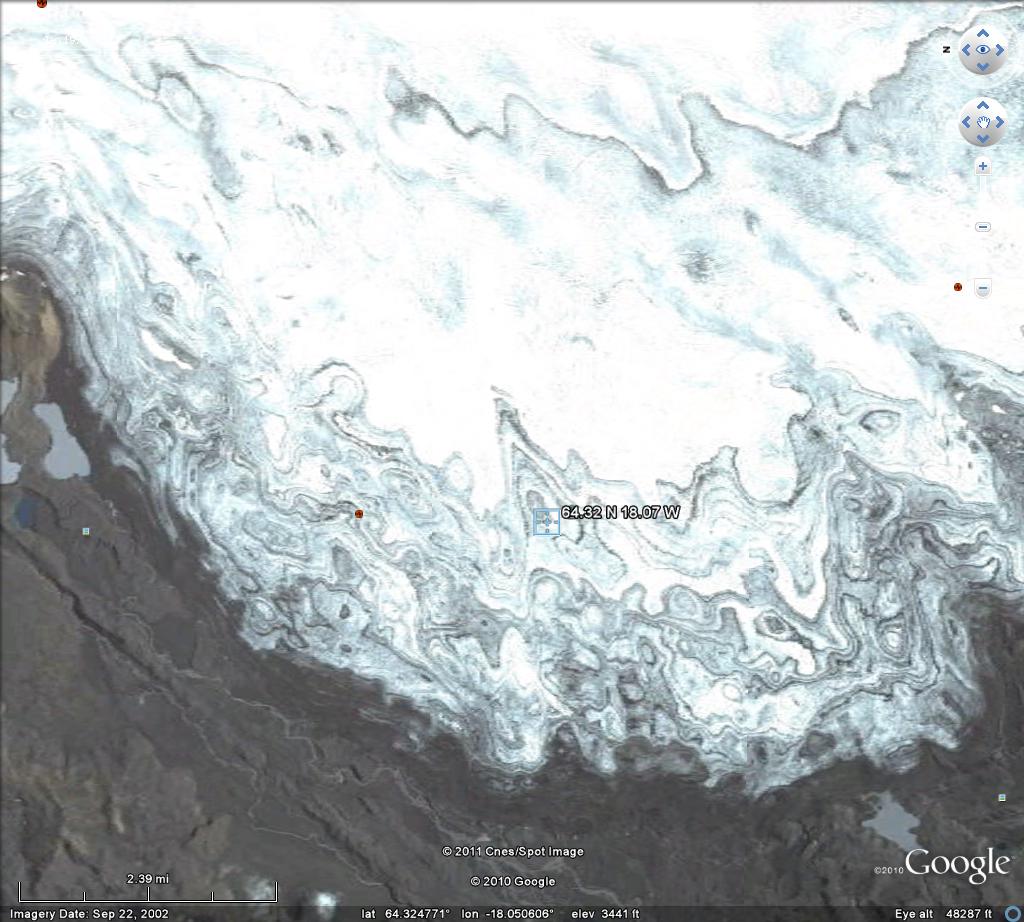
Tungnaarjökull drains the west side of the Vatnojökull Icecap. The glacier begins just west of the Grimsvotn Volcano at 1500 m. Just to the north of this large outlet glacier, 350 square kilometers, is the Loki Volcano. The first image below denotes these volcanoes and the epicenter of recent earthquakes. The volcanic activity is recorded in the dark ash layers that fall on the glacier in the accumulation area and are subsequently buried to emerge in the ablation zone. The snowline is visible in the imagery just above the highest ash horizon. The glacier drains into the Skaftá River which experiences jökulhlaups such as in June 2015.A June 6, 2015 Landsat image indicates little ablation being generated in the area.

tungnaar 2015

June 6, 2015 Landsat Image

 
Google Earth Images
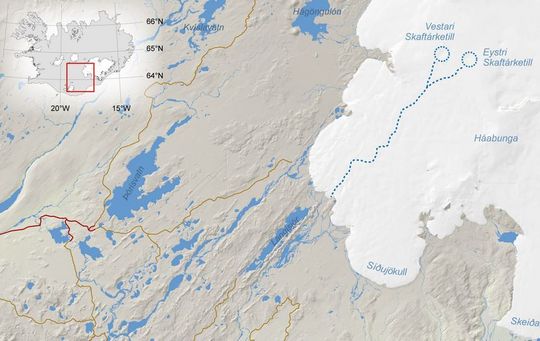
skaftarkatlar_kort_en
Iceland Met Service map of Skaftá River and jökulhlaup source.

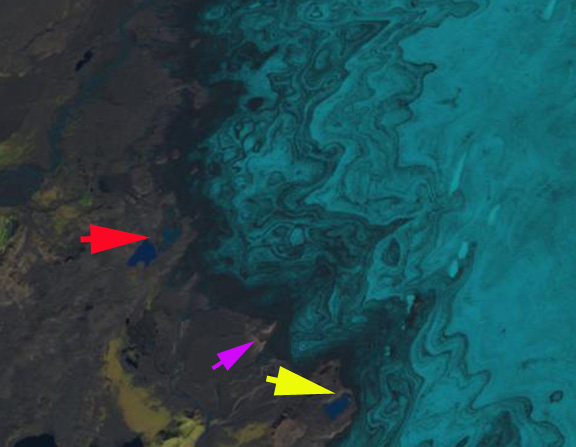
The glacier terminates at 800 m, and has a snowline since 2000 averaging 1300 m. Like many of the glaciers draining the Vatnajökull the glacier experiences periodic surges. Surging is a short term, several months to several years, acceleration and the associated advance of a glacier that is not primarily dictated by changes in mass balance or climate. A surge is related to a change in the basal water pressure that in this region is related to volcanic activity. The glacier surged in 1920, 1945 and 1995, that latter surge led to an advance of 1175 m in 1995. From 1955-1970 the glacier retreated at a rate of 75 m/year. From 1973-1992 the glacier retreated 1400 m. The surge led to an advance of 1175 m in 1995 bringing the glacier back close to its 1973 position. Since then the glacier has continued to retreat. Tungnaarjökull terminus is surveyed each year and the data reported to the WGMS. From 1996-2000 the glacier retreated 80 m. From 2001-2010 the glacier retreated 640 m. Below is the margin of the glacier indicating the moraine from which the glacier receded after the 1945 surge, the 1995 surge did not emplace a moraine. A comparison of Landsat images from 1999 and 2014 illustrates the retreat. Note the expansion of the lakes and the formation of a new one at the red and yellow arrow.  The exposure of new moraine ridges at the purple arrow also indicates retreat.

tungnarr 1999
1999 Landsat image

tungnarr 2015
2015 Landsat image

The mass balance of this glacier has also been measured since 2000. During that period the glacier has had a negative balance every year, 12 of the 13 years the mass balance loss has been larger than 0.8 meter of water equivalent. The total loss for the period of 15 m, will lead to continued retreat. This is a substantial thinning of the glacier, but a small part of the total volume given a glacier that averages more than 500 m in thickness. The equilibrium line has been high since 2000, leading to only 40% of the glacier being snow covered at the end of the summer. on a glacier like this that lacks avalanche accumulation due to its low and consistent slope at least 60% of the glacier must be snow covered to have an equilibrium balance this would be 1150 m. This height is close to the elevation midpoint of the glacier.

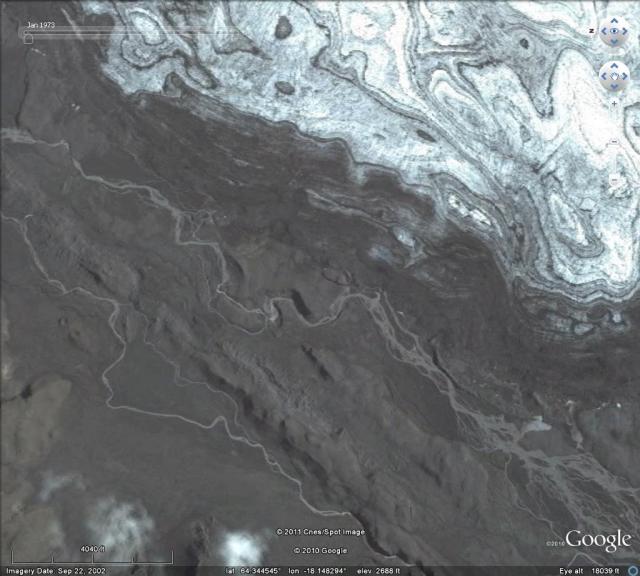
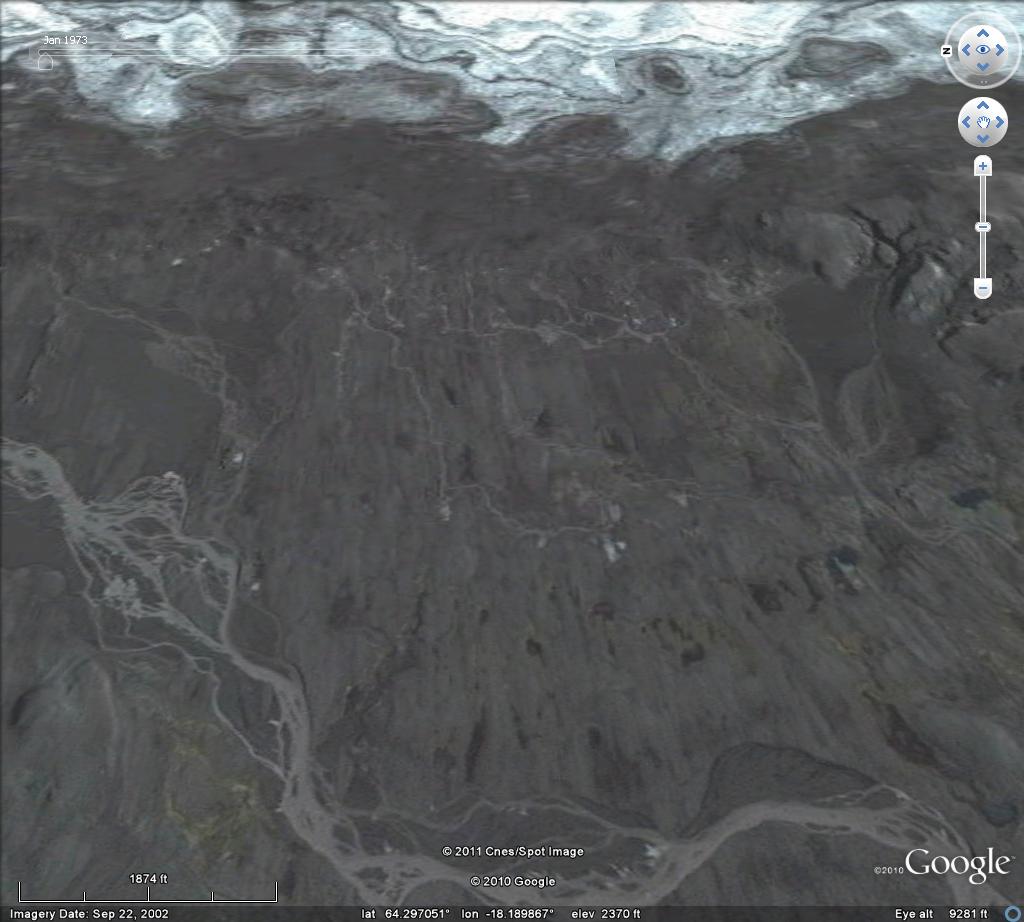
Beyond the terminus the retreat is exposing a large relatively flat plain that is rich with glacial geologic deposits, many linear examples are evident. These features are streamline features from glacier flow. The retreat here is similar to the Bruarjokull on the north side and Skeidararjokulli on the west side of the Vatnojokull.
Tungnaarjökull Retreat, Icleand

Tungnaarjökull drains the west side of the Vatnojökull Icecap. The glacier begins just west of the Grimsvotn Volcano at 1500 m. Just to the north of this large outlet glacier, 350 square kilometers, is the Loki Volcano. The first image below denotes these volcanoes and the epicenter of recent earthquakes. The volcanic activity is recorded in the dark ash layers that fall on the glacier in the accumulation area and are subsequently buried to emerge in the ablation zone. The snowline is visible in the imagery just above the highest ash horizon.The glacier terminates at 800 m, and has a snowline since 2000 averaging 1300 m. Like many of the glaciers draining the Vatnajökull the glacier experiences periodic surges. Surging is a short term, several months to several years, acceleration and the associated advance of a glacier that is not primarily dictated by changes in mass balance or climate. A surge is related to a change in the basal water pressure that in this region is related to volcanic activity. The glacier surged in 1920, 1945 and 1995, that latter surge led to an advance of 1175 m in 1995. From 1955-1970 the glacier retreated at a rate of 75 m/year. From 1973-1992 the glacier retreated 1400 m. The surge led to an advance of 1175 m in 1995 bringing the glacier back close to its 1973 position. Since then the glacier has continued to retreat. Tungnaarjökull terminus is surveyed each year and the data reported to the WGMS. From 1996-2000 the glacier retreated 80 m. From 2001-2005 the glacier retreated 240 m. Below is the margin of the glacier indicating the moraine from which the glacier receded after the 1945 surge, the 1995 surge did not emplace a moraine. The distance appears small, but averages 1.5 kilometers. This gives a sense of the scale of the glacier. The mass balance of this glacier has also been measured since 2000. During that period the glacier has had a negative balance every year, 8 of the nine years the mass balance exceeding 1 meter of water equivalent loss. The total loss for the period of 12 m, will lead to continued retreat. This is a substantial thinning of the glacier, but a small part of the total volume given a glacier that averages more than 500 m in thickness. The equilibrium line has been high since 2000, leading to only 40% of the glacier being snow covered at the end of the summer. on a glacier like this that lacks avalanche accumulation due to its low and consistent slope at least 60% of the glacier must be snow covered to have an equilibrium balance this would be 1150 m. This height is close to the elevation midpoint of the glacier. Beyond the terminus the retreat is exposing a large relatively flat plain that is rich with glacial geologic deposits, many linear examples are evident. These features are streamline features from glacier flow. The retreat here is similar to the Bruarjokull on the north side and Skeidararjokulli on the west side of the Vatnojokull.
Retreat of Glacier d’Argentiere, France

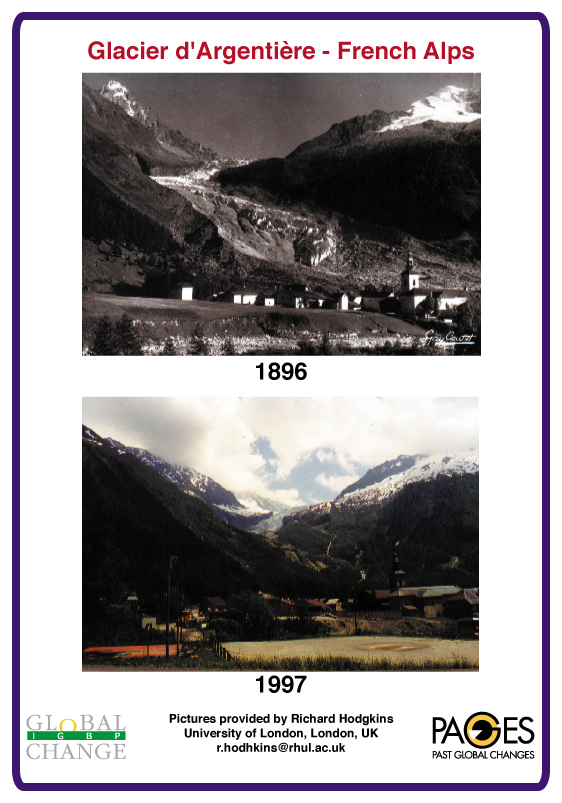
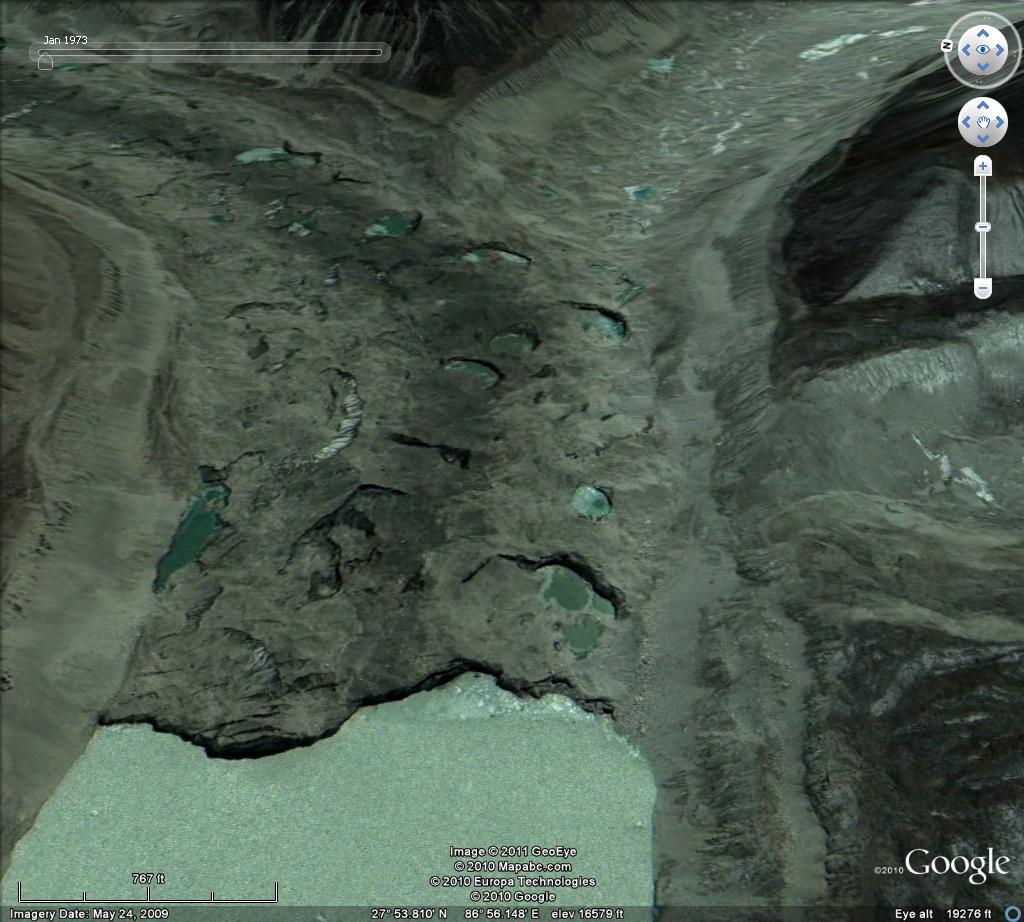
Glacier d’Argentiere flows 9 km northwest towards the valley of Chamonix, France just north of Mont Blanc and one valley north of the Mer de Glace. The glacier retreated 1000 meters from 1870-1967. The first picture below provided by Richard Hodgkins to the PAGES project shows a century of change. Below that is the 2009 terminus view in Google Earth. The terminus is quite crevassed indicating considerable velocity. It is currently at the top of a steep slope that it has retreated up in the last five years. From 1968-1985 the glacier advanced 300 m. Since 1985 the glacier has been retreating at an increasing rate: 80 meters from 1991-1995, 187 meters from 1996-2000, 199 meters from 2001-2005, data is not in for the 2006-2010 period but the retreat is in excess of 200 meters. The retreat has been triggered by sustained negative mass balance. A mass balance program on d’Argentiere was begun in 2004, the glacier lost 1.3 m in 2004, 1.9 m in 2005, 1.4 m in 2006, 0.7 m in 2007, 1.3 m in 2008 and 2.6 in 2009. That is a cumulative mass balance loss of 9.2 meters of water equivalent lost from the glacier in six years, and that is a 10-11 m loss in average ice thickness from the glacier. The recent rapid retreat and mass balances losses parallel those of the other glaciers in the Alps from which data is reported to the WGMS. The reason for the mass balance loss is evident from the Google Earth imagery of August, 2009. The snowline, shown in lime green, is at 3300 meters on south facing slopes and at 2900 meters on north facing slopes and the main valley of the glacier, this is one month left in the melt season. At this point the glacier is 35-40% snowcovered and will be less by the end of the melt season. To be in equilibrium a glacier must have 60% snowcover at the end of the summer. From 2004-2009 the average snowcovered area at the end of the melt season was 30%. The tributary glaciers draining the south facing slopes of the valley have lost all their snowcover in 2005, 2006 and 2009. This is leading to a diminished contribution to the mainstem of the Argentiere. This will foster continued retreat. A view across the glacier in August 2008 from Jürg Alean indicates the meager snowcover on the south facing glaciers and the main glacier tongue.

Imja Glacier Retreat and Imja Tsho Lake expansion, Nepal

The Imja Glacier is in the Khumbu Range of Eastern Nepal’s Himalaya, just
southeast of Mount Everest. The glacier drains the east slopes of Lhotse, south slope of Penghatse and west slopes of Baruntse before flowing past the southern slope of Island Peak to terminate at Imja Tsho glacial lake. Imja Tsho formed after 1960 due to glacier retreat and is continuing to expand today. According to Fujita and others (2009), the lake in 2008 is 1.1 kilometers long and has an area of 0.9 km2 and a volume of 37 million cubic meters. Bajracharya and Mool (2009) observed that Imja Glacier itself retreated at a rate of 41 meters/year from 1961-2000 and 74 meters/year from 2001-2006. The terminus ends in the expanding lake and is heavily debris covered. A study by ICIMOD (The International Centre for Integrated Mountain Development, 2008) documented that all 22 glaciers observed in the Dudh Khosi Basin have retreated since 1976 with the minimum retreat being 10 meters/year and the maximum 59 meters/year
The Imja Glaciers is two valleys east of the more famous Khumbu Glacier which has been retreating at a slower rate of 15-20 meters/year. Imja Glacier like its neighbors can be divided into four key sections that each have a different mass balance impact and climate sensitivity.
1)Debris Covered Zone-The portion of the Imja Glacier comprises 35-40% of the glaciers area. The debris cover if thin can enhance melting, but in most area the debris cover is thick enough to insulate the glacier and reduce melting. The debris is brought down onto the glacier by avalanches and accumulates at the surface as the snow and ice the debris mingles with is melted away. This area has plenty of debris and is not impacted by black carbon deposition.
2)Transition Zone-this is the zone between the debris cover and the dry snow accumulation zone. This zone encompasses the snowline which is 5400-5600 meters on Imja Glacier. This is zone of bare ice and snow that experiences melting and can be impacted by black carbon deposition. On Imja Glacier this zone comprises 15 to 20% of the glacier’s area.
3) Avalanche slope zone. There are many unglaciated slopes that are a mixture of rock and snow. They are too steep to hold sufficient snow to form a glacier and most snow cover avalanches onto the glacier below. Though not part of the accumulation zone of the glacier, these slopes are a key feeder to the glacier. Since the avalanches relocate snow from high elevation to low elevation they are a key feature that makes Imja Glacier susceptible to precipitation at elevations above 5500 meters.
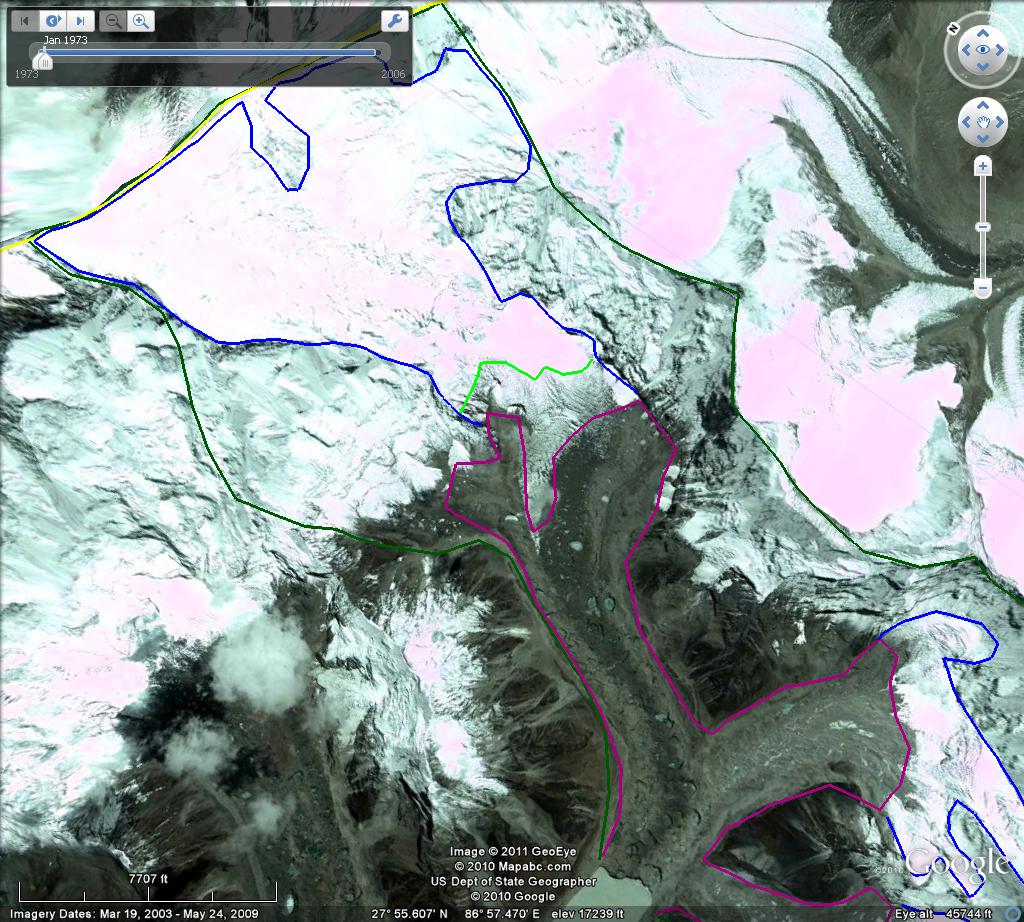
4) Accumulation zone-This is a dry snow zone above 5800 meters of perennial snow cover. The snow is dry indicating the lack of melting. A unique aspect of the Himalayan glaciers on the southern flank of the range is that the melt season coincides with a principal accumulation season of the summer monsoon. The summer monsoon causes nearly daily snowfall from June-August that is retained above 5800 meters. The new snow prevents the glacier from being susceptible in this area to black carbon deposition. In the image below the debris covered zone is outlined in purple, the snowline in the transition zone is shown in lime green, accumulation areas are outline in blue and the entire area that feeds the glacier is outlined in dark green. The areas that feed the glacier, that are not part of the glacier do so by avalanching.
The lake is of concern since the moraine that dams it is not stable. It can melt down and erode slowly or it can lose height more quickly resulting in a glacier dammed lake outburst. The level of the lake has been relatively constant in recent years, but is monitored to forecast this potential hazard. ICIMOD has collected satellite images of the lake expansion from 1962-2008.

White Glacier Retreat, Olympic Mts. Washington

White Glacier descends the Northwest flank of Mount Olympus in Olympic National Park in Washington. The glacier had a very large retreat from its Little Ice age maximum to 1952 of 3200 meters (Heusser, 1957). At that time it was joined with its more famous neighbor Blue Glacier, which is also retreating today. From 1958-1980 the glacier advanced a small distance, the 1950 based map of the area shows the terminus location of the glacier at that point. The burnt orange line indicates the map terminus, the forest green line the 1990 terminus. The Blue Glacier advanced nearly 200 meters in this intervalBy 1990 the glacier had retreated 100 meters from its recent advance position. From 1990-2006 retreat accelerated averaging 12 meters per year, 315 meters total. The Blue Glacier has retreated nearly the same distance, 300-325 meters since its maximum position in the 1980’s. In the image below from 2006 the retreat since 1990 is evident, what is also striking is the sections of the bedrock ridge between the two termini outlined that is emerging from the glacier. The White Glacier will become two distinct glaciers separated by this rock ridge as retreat continues. The retreat is ongoing as the lack of crevassing near the current terminus indicates. This is despite a fairly steep slope. The rock rib that is beginning to separate the White Glacier is also visible below. The terminus today is at 1400 m, the head of the glacier at 2000 m. The high elevation of the upper glacier has allowed it to retain snowpack even in recent warm summers when other glaciers in the area, Anderson and Fairchild, lost all their snowcover. This will allow this glacier to endure current climate.

Heusser, C.J., 1957. Variations of Blue, Hoh and White Glaciers during recent centuries. Arctic, 10(3), 139-150.
Spicer, R.C., 1989. Recent variations of Blue Glacier, Olympic Mountains, Washington, USA. Arctic and Alpine Res., 21(1), 1-21.

Thiel Glacier Alaska ongoing retreat

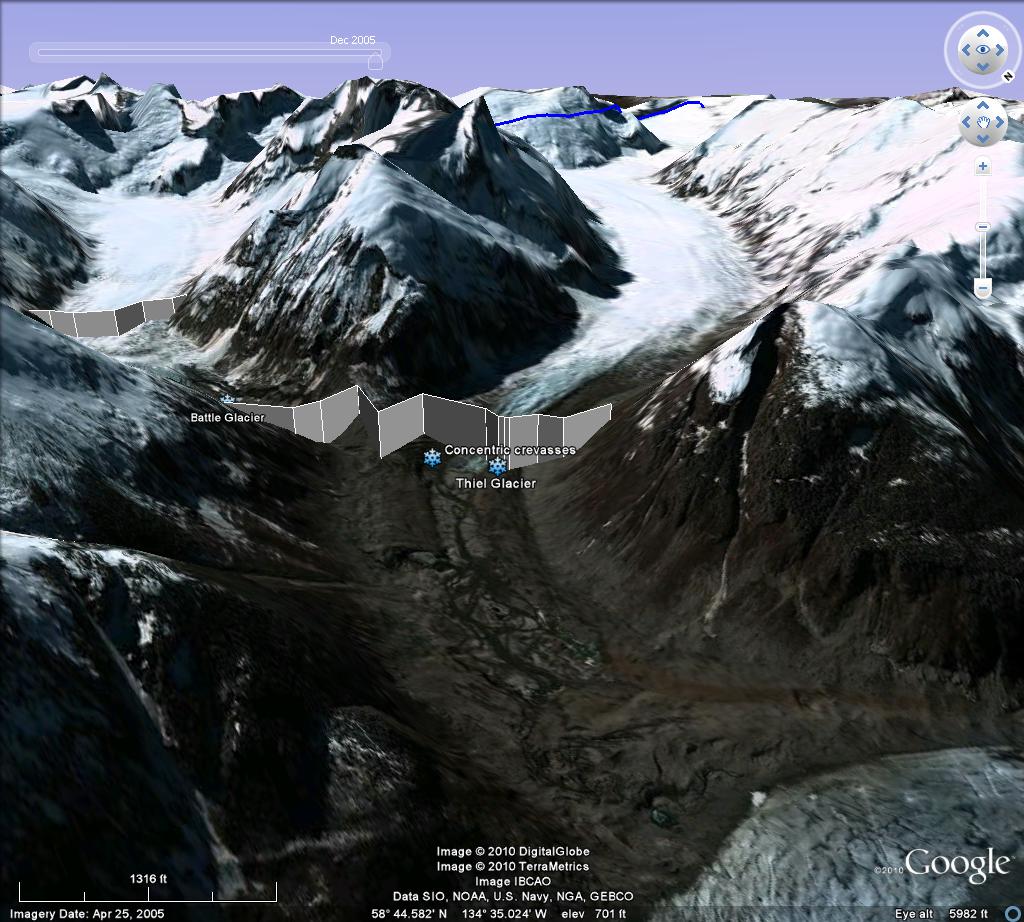
Thiel Glacier is a valley glacier in the Juneau icefield of Alaska. The glacier was a tributary of the Gilkey Glacier and is shown as such in USGS maps. From 1948-2005 the glacier has retreated 2100 meters from its former junction with the Gilkey Glacier. Below is the USGS map of the area showing the junction of the Battle, Gilkey and Thiel Glacier. The same view from the 2005 Google Earth imagery indicates the separation of the three glaciers and the emergence of a new deglaciated valley section. In 1984 looking down at the glacier from its highest elevation, it was clear that the glacier had too small of an accumulation area to support the long, low elevation valley tongue of the glacier. From that vantage I could not see the terminus. The snowline at the end of the summer typically is at 4000-4500 feet at the end of the melt season, leaving only 45% of the glacier in the accumulation zone. For a glacier to be in equilibrium at least 60% of the glacier needs to be in the accumulation zone. The upper margin of the glacier is outlined in blue and the snowline indicated with blue arrows in the image below. The current glacier terminus is stagnant and the retreat is ongoing. At the terminus a close examination of the 2005 imagery forth indicates a series of concentric crevasses at the terminus. Such crevasses typically are the indicative of a collapse feature. Usually it is a subglacial lake that drains that had supported the terminus to some extent. Above this point the ice is stagnant lacking tranverse crevasses that would indicate movement. The surface of the glacier has a rough cross profile as a result without active movement to even out the profile. Areas of debris generally are prominent as the debris is insulating the ice underneath. The 2005 terminus is at 650 feet, compared to the same location in the USGS maps of 1500 feet. This nearly 900 feet of thinning is depicted by the surface wall overlay added to Google Earth, the top of this wall is at 1500 feet. In the foreground is the Gilkey Glacier which the Thiel formerly joined and the new deglaciated valley. This glacier will continue to retreat rapidly with the current climate much like the nearby Hoboe Glacier and Tulsequah Glacier and Lemon Glacier