Professor of Environmental Science at Nichols College in Massachusetts since 1989. Glaciologist directing the North Cascade Glacier Climate Project since 1984. This project monitors the mass balance and behavior of more glaciers than any other in North America
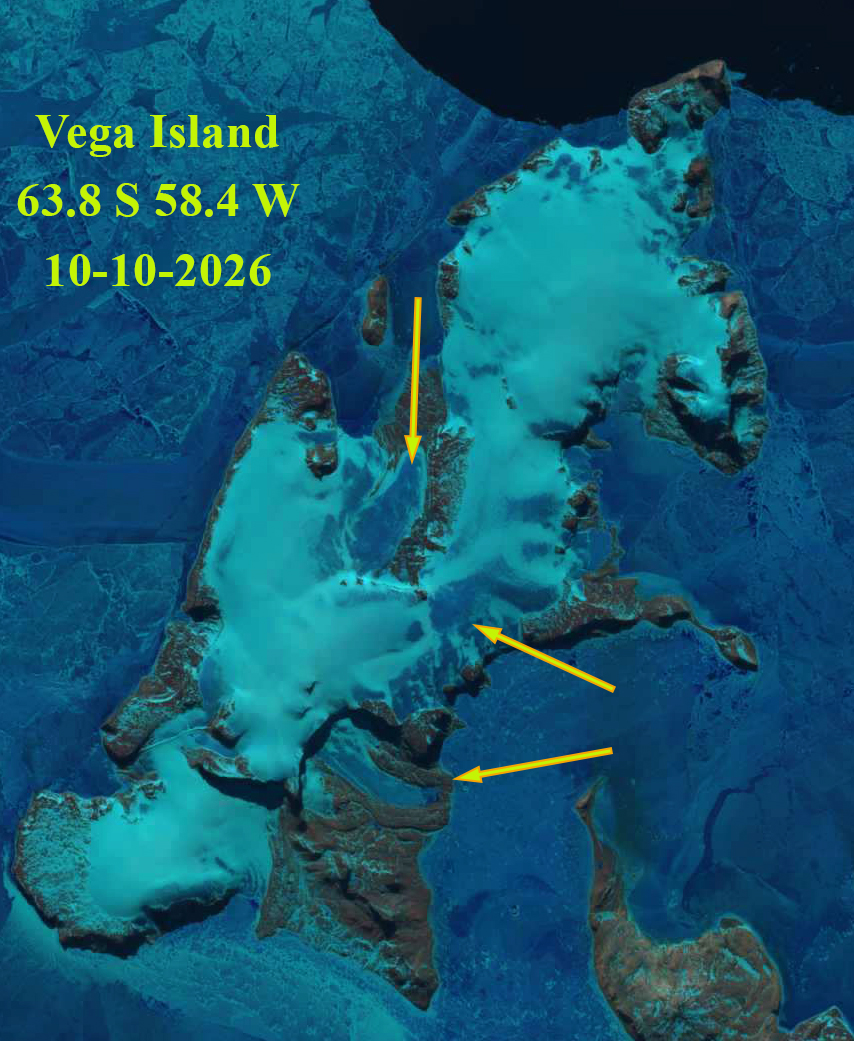
Vega Island indicating several glaciers that have snowcover on ~50% or less of the glacier surface on Oct. 10, 2026 in this Landsat image.
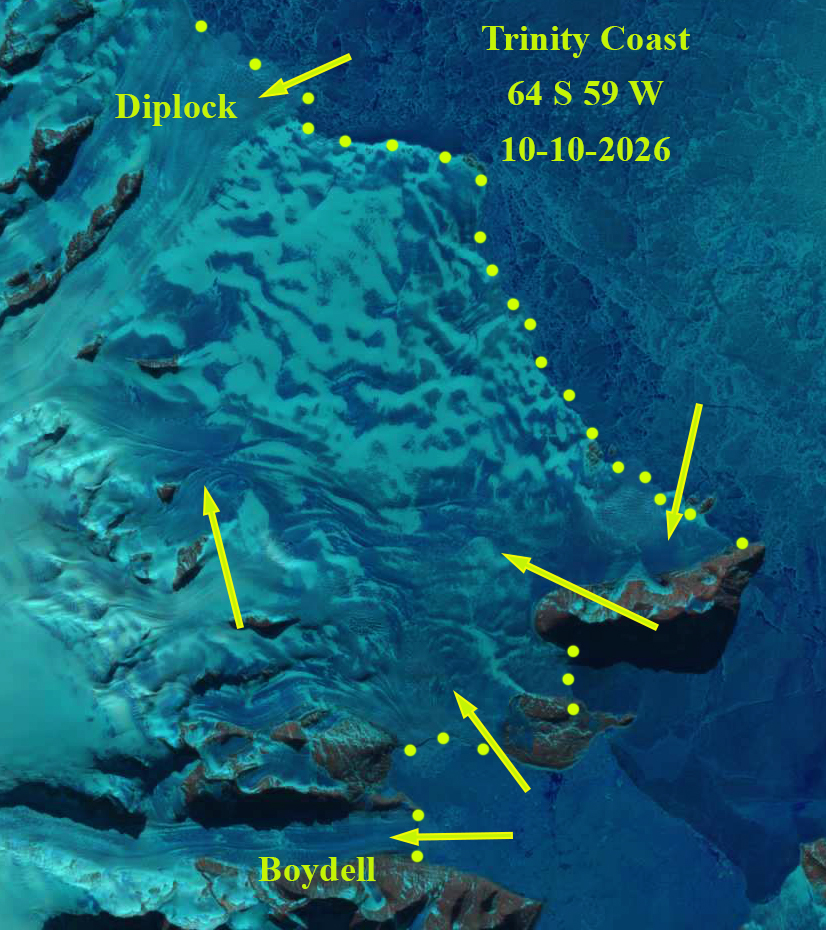
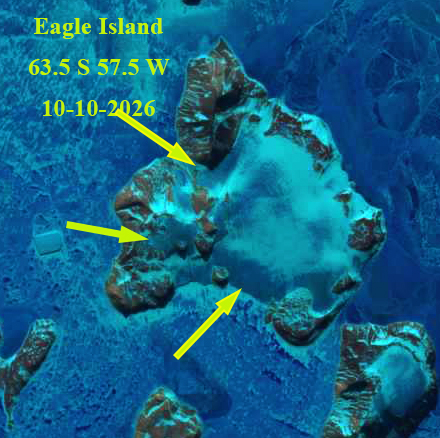
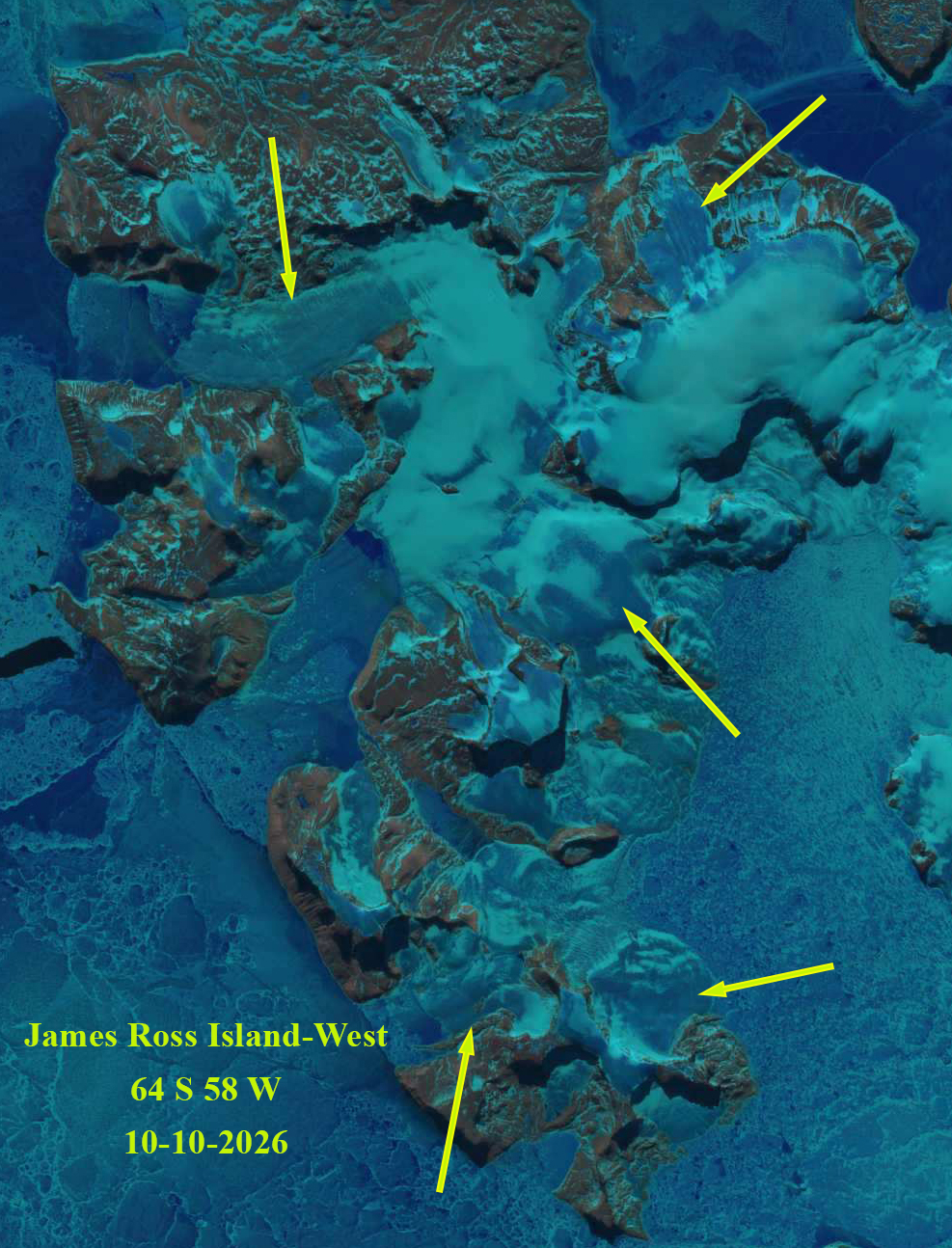
The melt season has is not yet underway, yet significant bare ice areas are evident on glaciers on the east side of the Antarctic Peninsula and adjacent islands. The winter season from May-August featured above average temperatures each month, particularly in June, while September was near normal. The bare ice surfaces seen on this Oct. 10, 2026 Landsat image are not an indicator of melt during winter, but of limited new snow accumulation further reduced by sublimation and wind scouring. The winter season was no treat for these glaciers.
Boydell and Diplock Glacier are outlet glaciers from the Antarctic Peninsula along the Trinity Coast. There are large bare ice areas along the coast between these glaciers also, on Oct. 10, 2026 in this Landsat image.Yellow dots mark the edge of the glaciers meeting sea ice.
As the melt season begins if the bare ice surfaces persist melt will be enhanced due to greater solar radiation being absorbed and reduced long wave radiation being emitted. Even a thin cover of new snow from a spring storm would be helpful in the short run.
Eagle Island ice Cap indicating significant bare ice areas on the glacier surface, yellow arrows, on Oct. 10, 2026 in this Landsat image.James Ross Island’s western half indicating many glaciers that have snowcover on ~50% or less of the glacier surface, on Oct. 10, 2026 in this Landsat image..
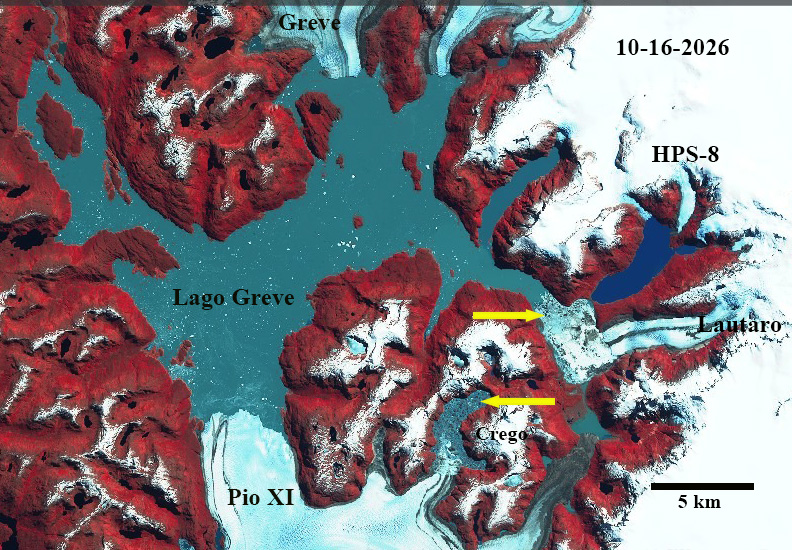
Lago Greve in Sentinel image from 10-16-2026 indicating recent calving activity at Lautaro Glacier and Lago Crego
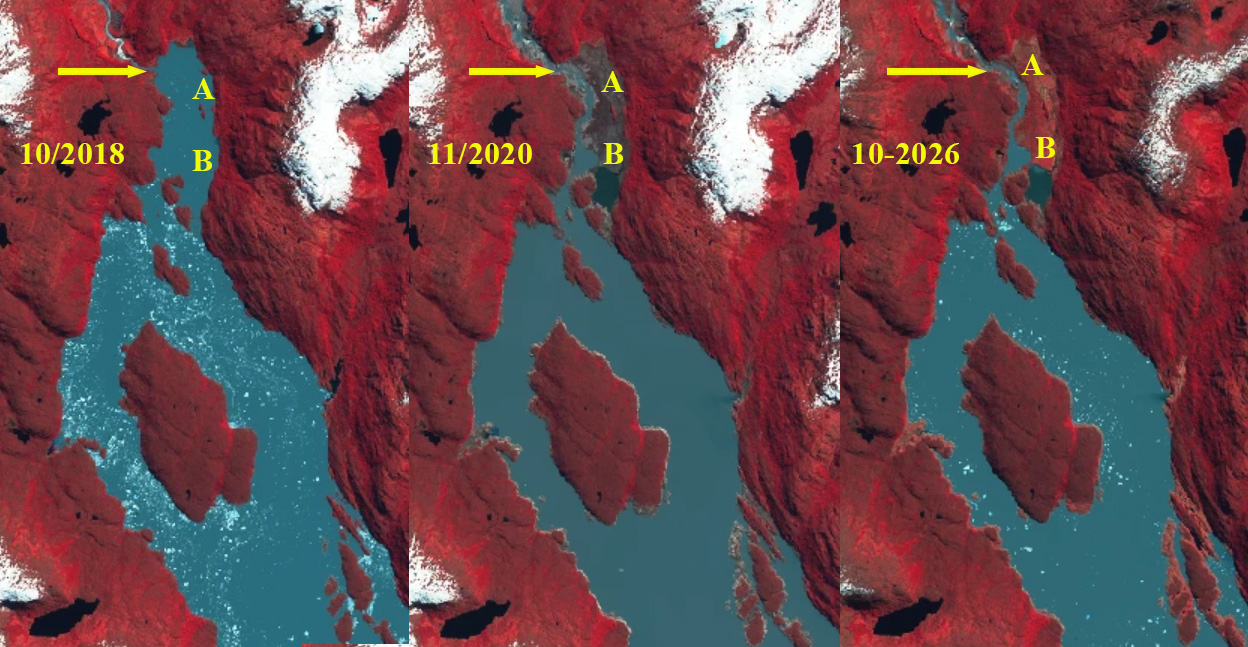
Lago Geve is a proglacial lake on the western margin of the Southern Patagonia Ice Cap that several glacier terminate in; Greve Glacier, Lautaro Glacier, HPS-8 Glacier and Pio XI Glacier. This is one of the largest proglacial lakes in the world with an area of ~190 km2. The lake drains through an outlet river on the northwest shore of the lake. Erosion of the oulet channel did lead to a signfnificant decline in lake level and lake area (~14 km2) in 2020 (Hata et al 2022). Any GLOF from this lake does not pose a hazard do the remoteness of the lake and the fjord it feeds. The lake level has been static since this event. The outlet river enters the fjord near the retreating Occidental Glacier.
Lago Greve outlet before and after the outlet erosion event in 2020 that led to lake level decline. Arrow indicates former outlet, while Point A and B indicate new land that resulted.
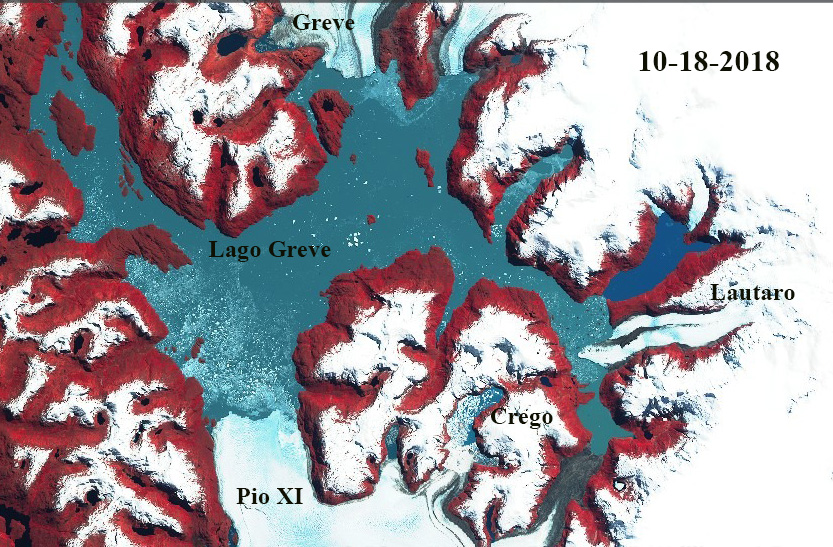
In 2026 the terminus tongue of Lautaro Glacier calved, and area of 1.5 km2, littering the ice front area with icebergs (upper yellow arrow). Lake Crego is an ice-dammed lake impounded by Pio XI Glacier, that has also calved significantly in 2026, helping fille the lake with ice bergs (lower yellow arrow)
Lago Greve in Sentinel image from 10-18-2018 indicating Lautaro Glacier before terminus tongue calved and lake outlet changed.
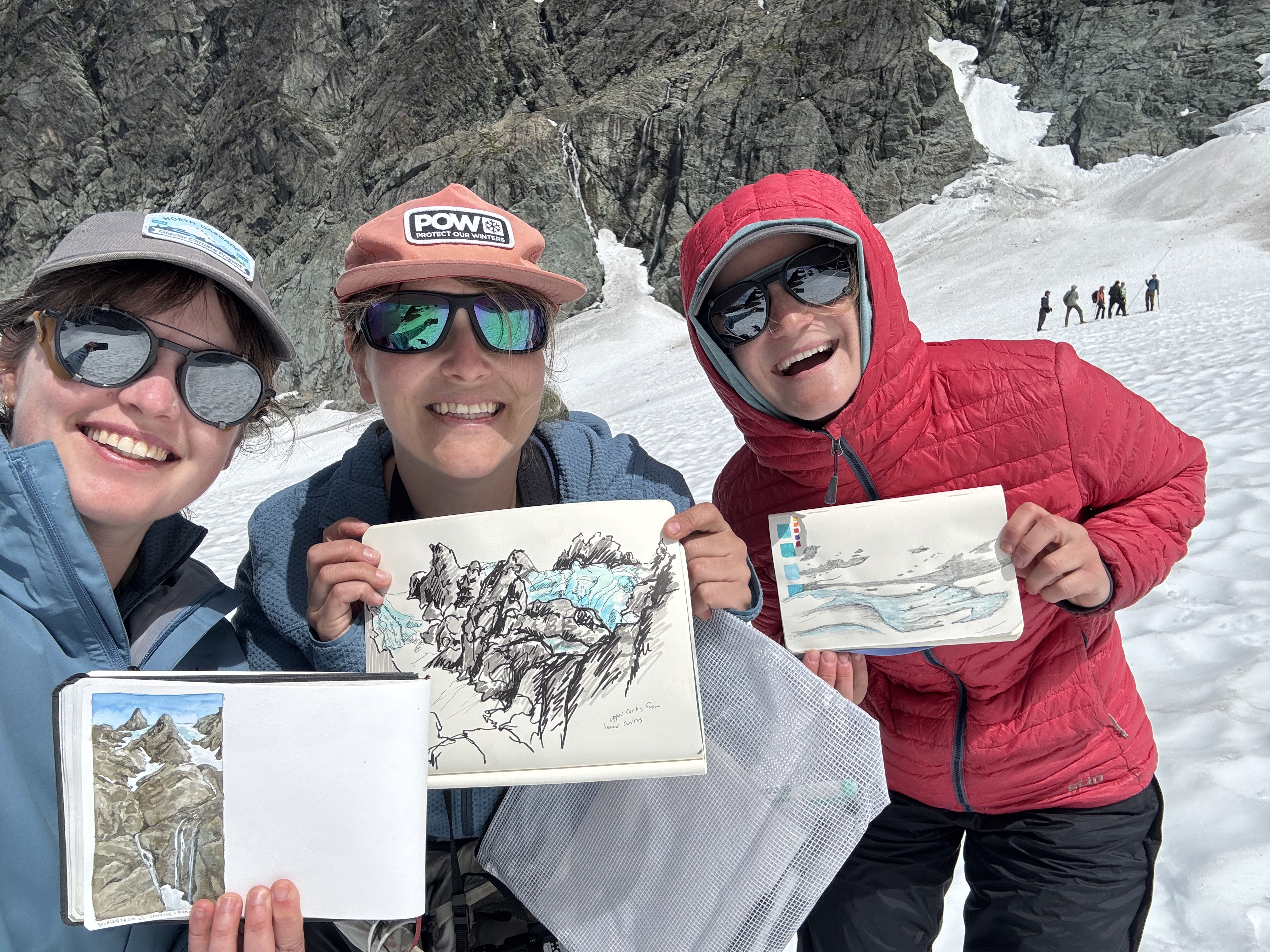
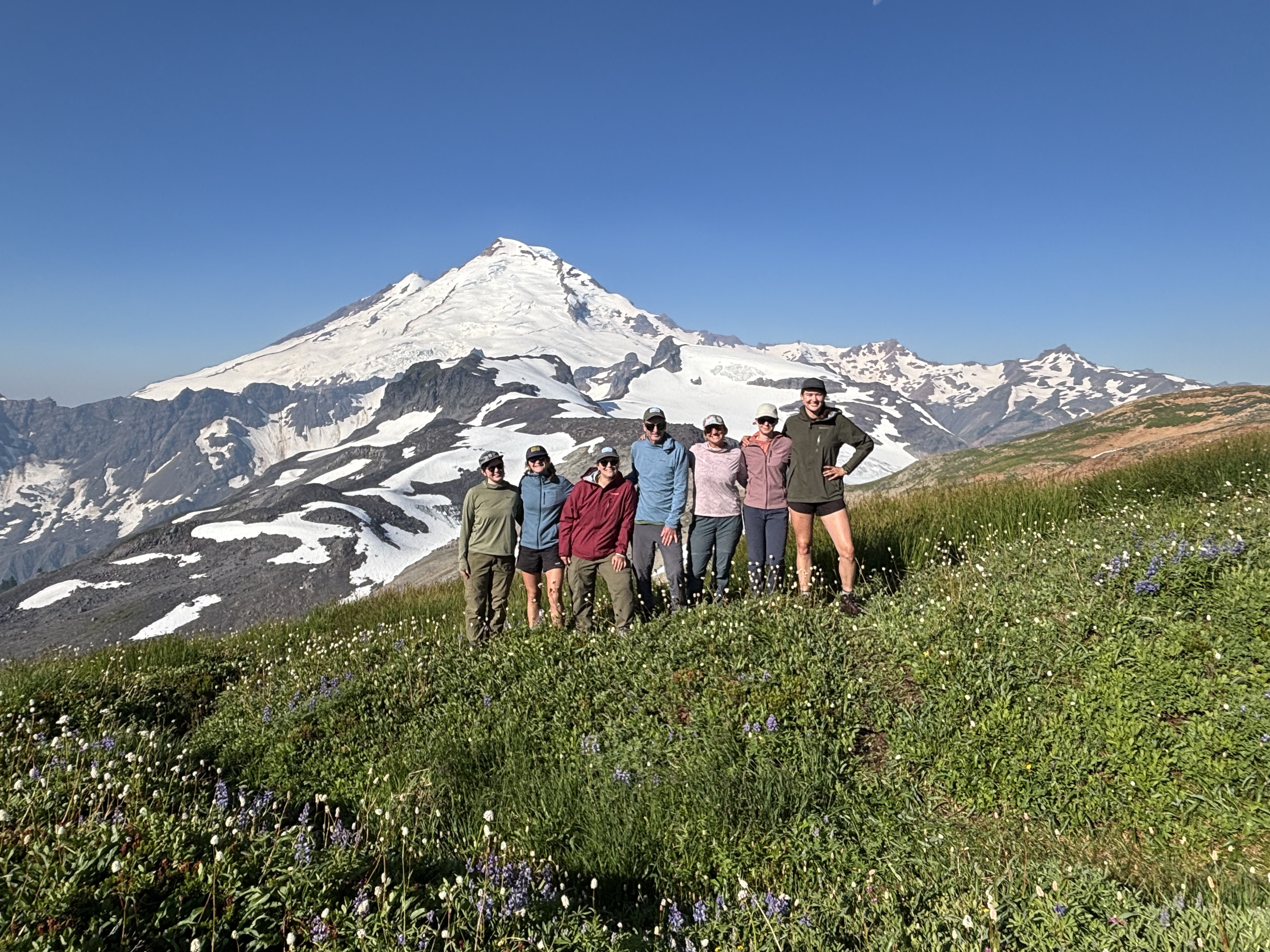
We completed our 43rd annual observation of North Cascade glaciers in the field. Three of the glaciers we monitor are global reference glaciers for the World Glacier Monitoring Service (WGMS); Columbia Easton and Rainbow Glacier. The field team was Abby Connor, Shaina Dotson, Rikki Held, Jill Pelto, Mauri Pelto and Ava Reynolds. Ben Pelto, Hannah Conteras, Nina Adjanin and Danielle Schlunegger-Warner
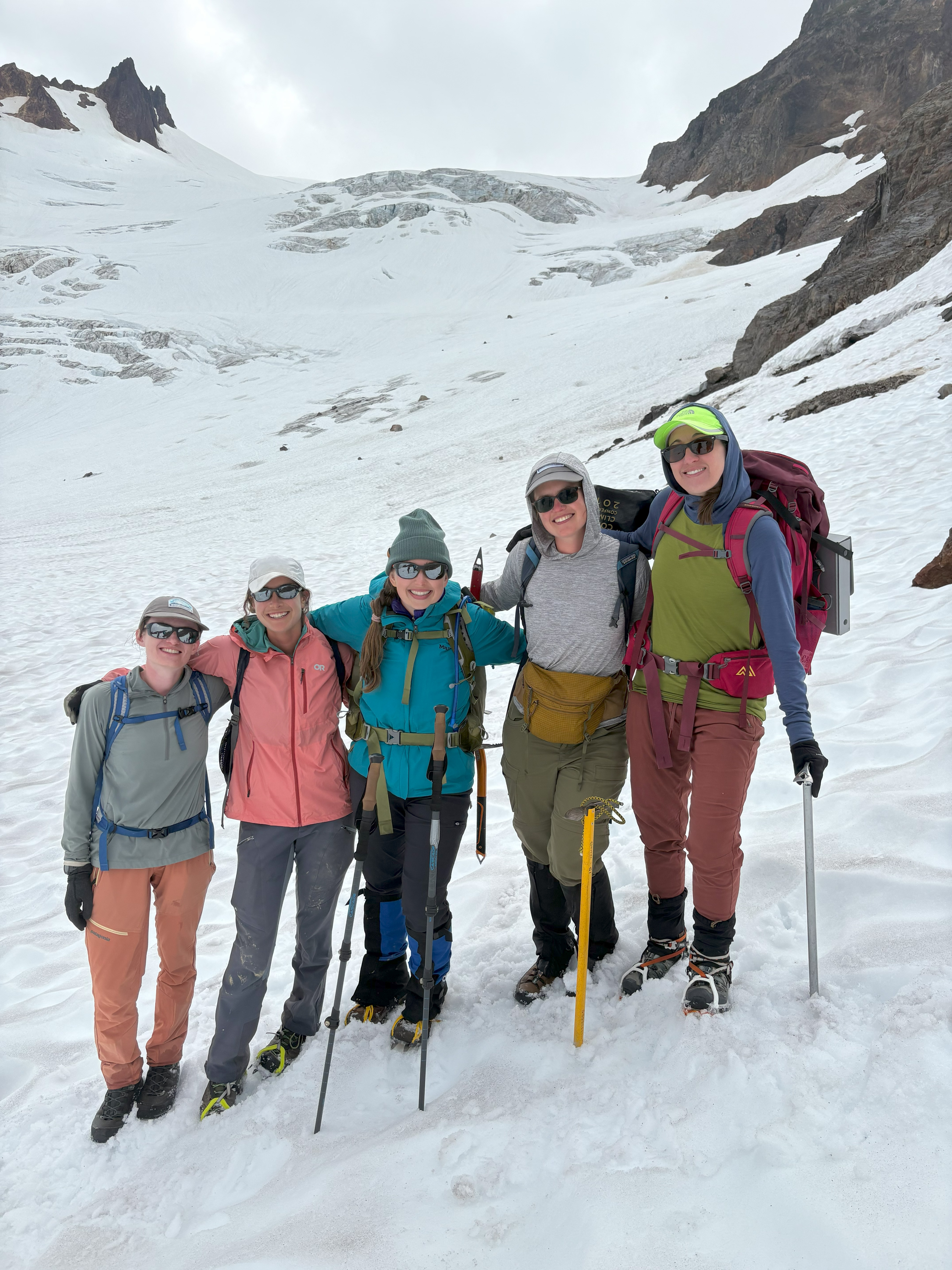
Team at Ptarmigan Camp in our Marmot gear.
The 2026 field season follows similar patterns to the 2021-2025 seasons. All of these featured either historic heat waves and/or periods of extended warm weather. Sustained high temperatures led to a greater exposure of bare ice on glaciers with a higher albedo and greater density. The observed melt rates during warm weather events on the surface of the glacier are 7-9 cm/day (water equivalent) for ice surfaces , vs. 4-6 cm/day for snow surfaces. This led to substantial mass losses on North Cascade glaciers across the five years of a combined ~8m. The contribution of new snow this winter was poor, with April 1 snowpack at the six long-term North Cascade stations at 68% of the 1984-2026 mean. April 15th represented the maximum snowpack for elevations at 1500 m and above. The snowpack was less than 50% of normal below 1800 m.
Above 2000 m, warm wet winter events did deliver snowfall that was rain below. This helped many locations at higher elevation sustain more snowpack later into the summer. Working with Snowgoat Skimo as they prepared for the annual Kulshan Randonée, we noted snowpack of over 6 m above the 2000 m level. This was due in part to a historic atmospheric river event occurred in late December, leading to record stream levels, flooding and road washouts in many Cascade locations. This led to reduced snow depths below 2000 m across the region, and potentially higher snow depths above this elevation.
Each month from May to August, temperatures were above normal across the Cascades and precipitation below normal (WSCO, 2026). By the end of May, snowpack was 20% of normal across the region. The temperature anomaly was highest in June and July leading to rapid snow melt off, particularly in non-glacier areas. By early August glacier snow lines were rising rapidly to typical end of summer levels. Alternatively, September was cooler and wetter than average, limiting glacier ablation at the end of the melt season.
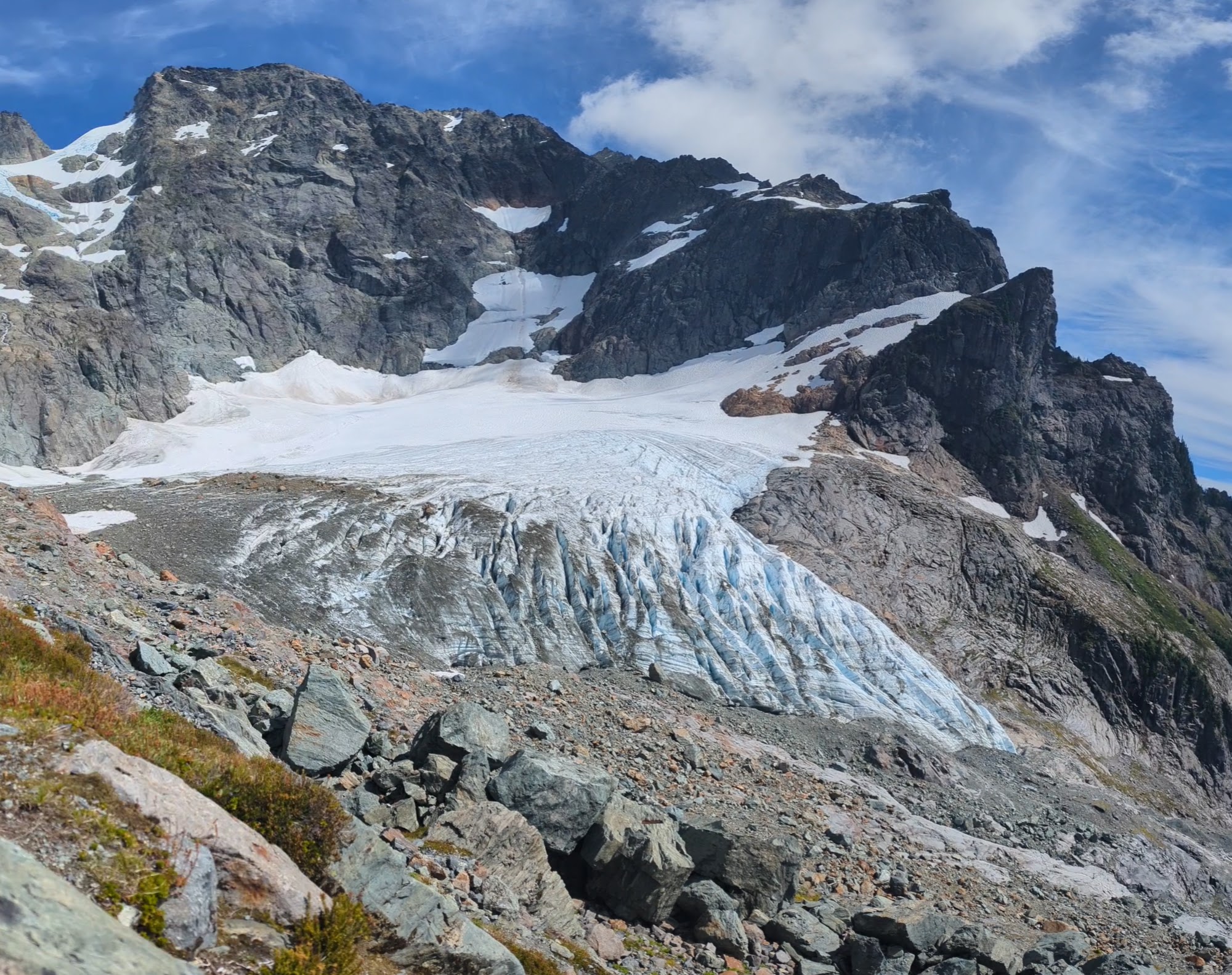
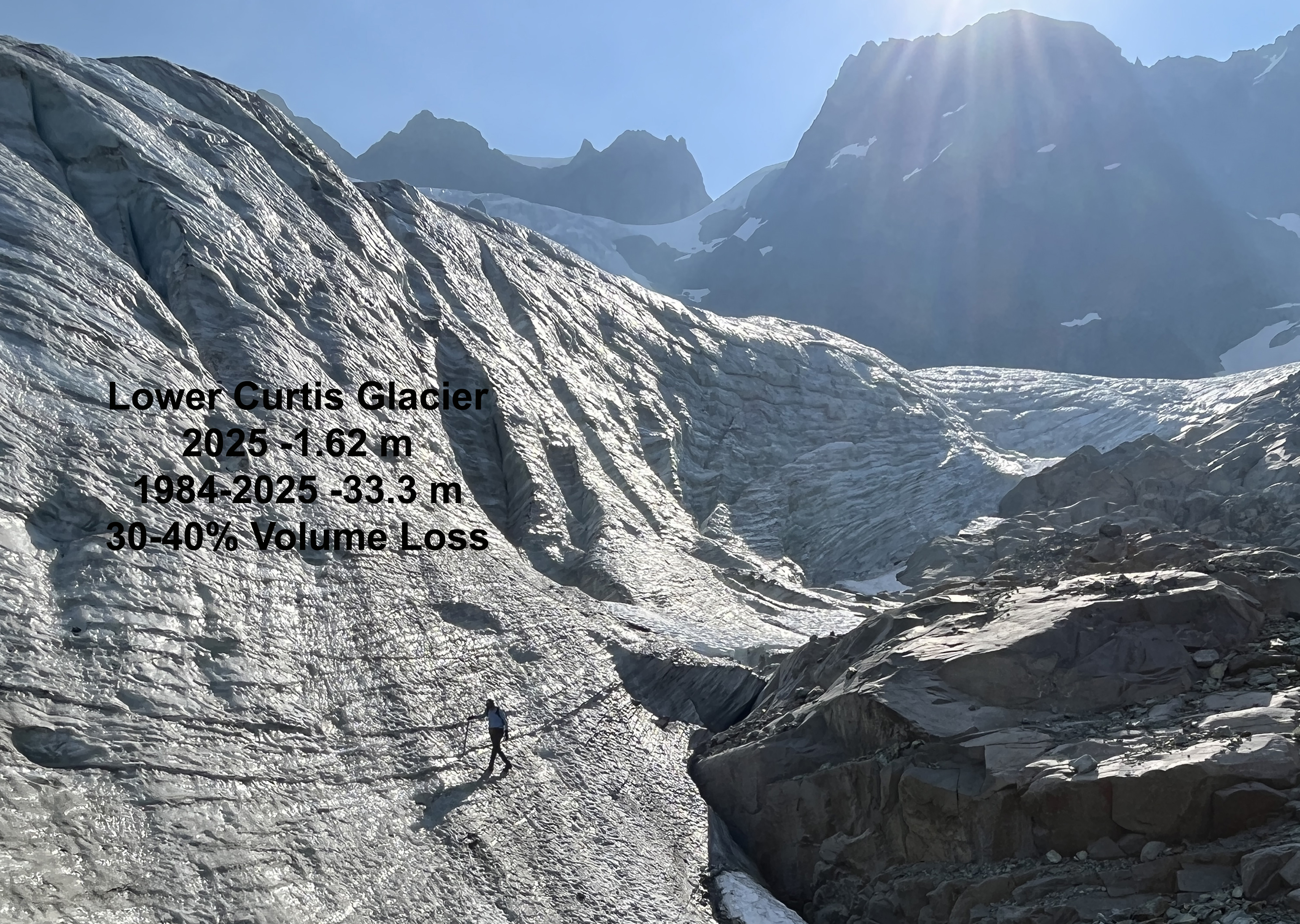
Lower Curtis Glacier on July 30th, 2026 with snowcover limited to the northeast side of the glacier below the couloir.
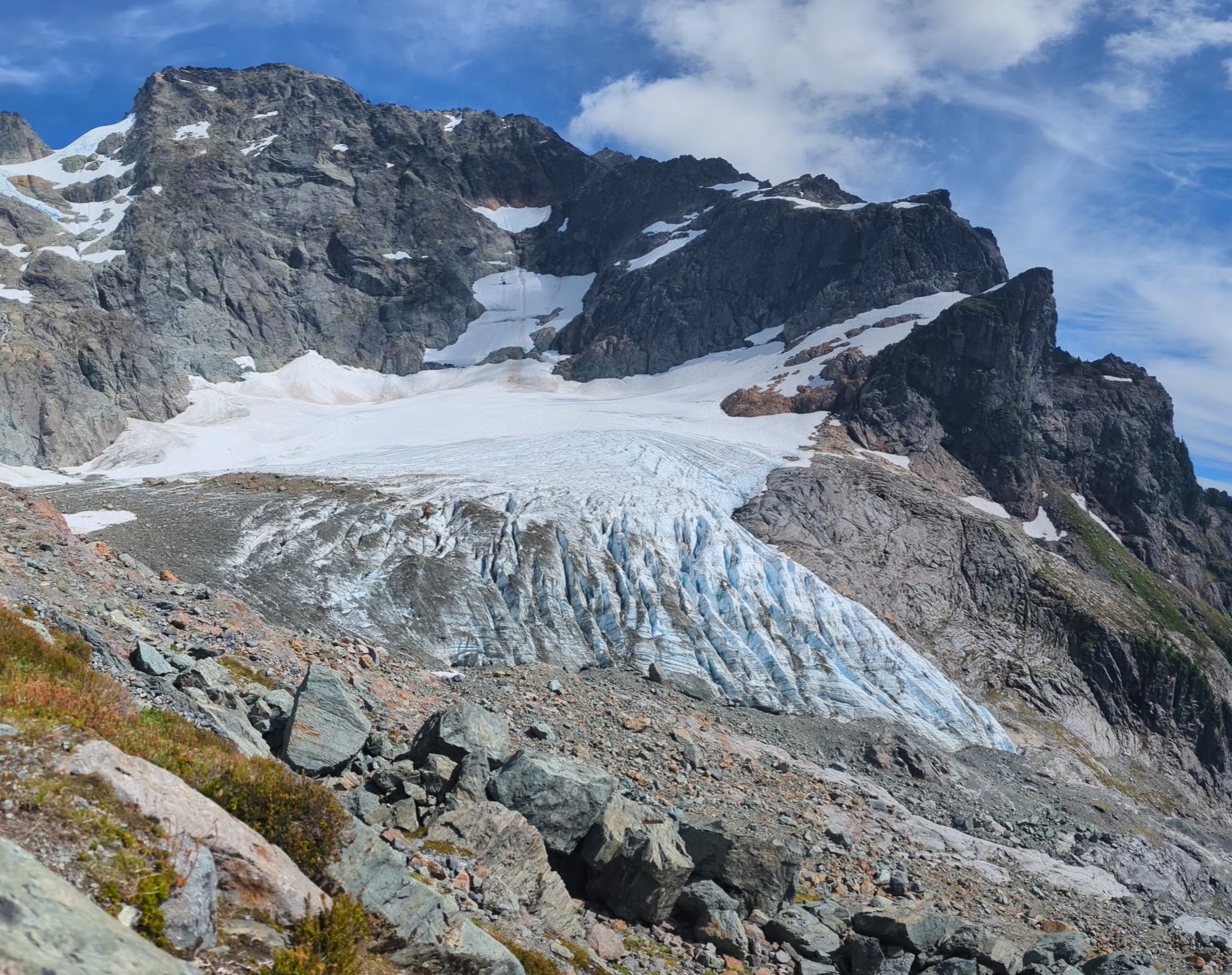
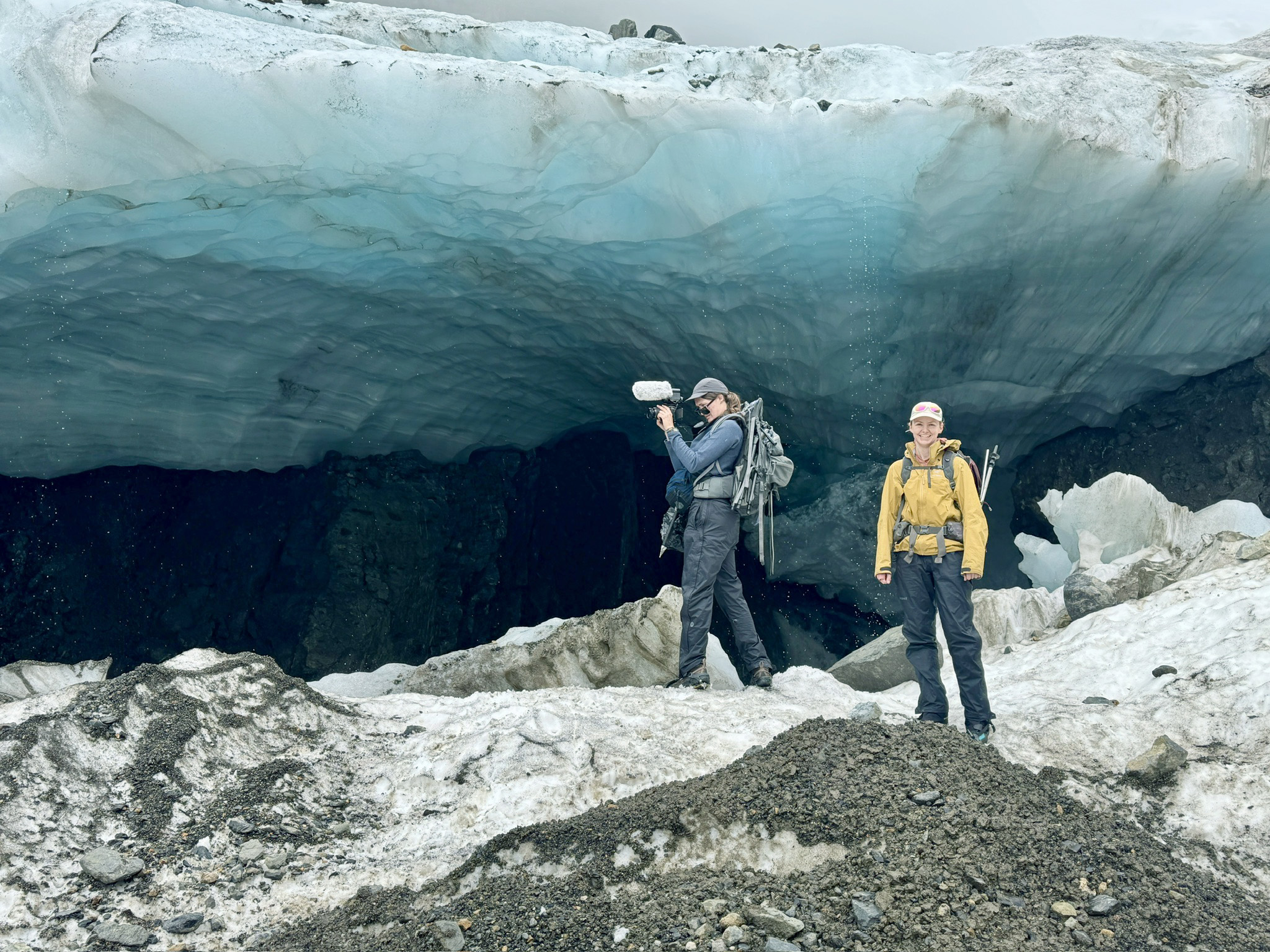
Lower Curtis Glacier on Mount Shuksan is a cirque glacier at 1700-2000 m and is fed by avalanching mainly in the 1900-2200 m elevation range. Snowpack across most of the glacier was lost by the end of July, including all avalanche fans except for the northeast couloir fan, where snow depths averaged over 3 m. The terminus front has thinned by 20 m in the last five years, while retreat continues at 5-10 m per year. The annual mass balance was -2.12 m, with an accumulation area ratio of 24%.
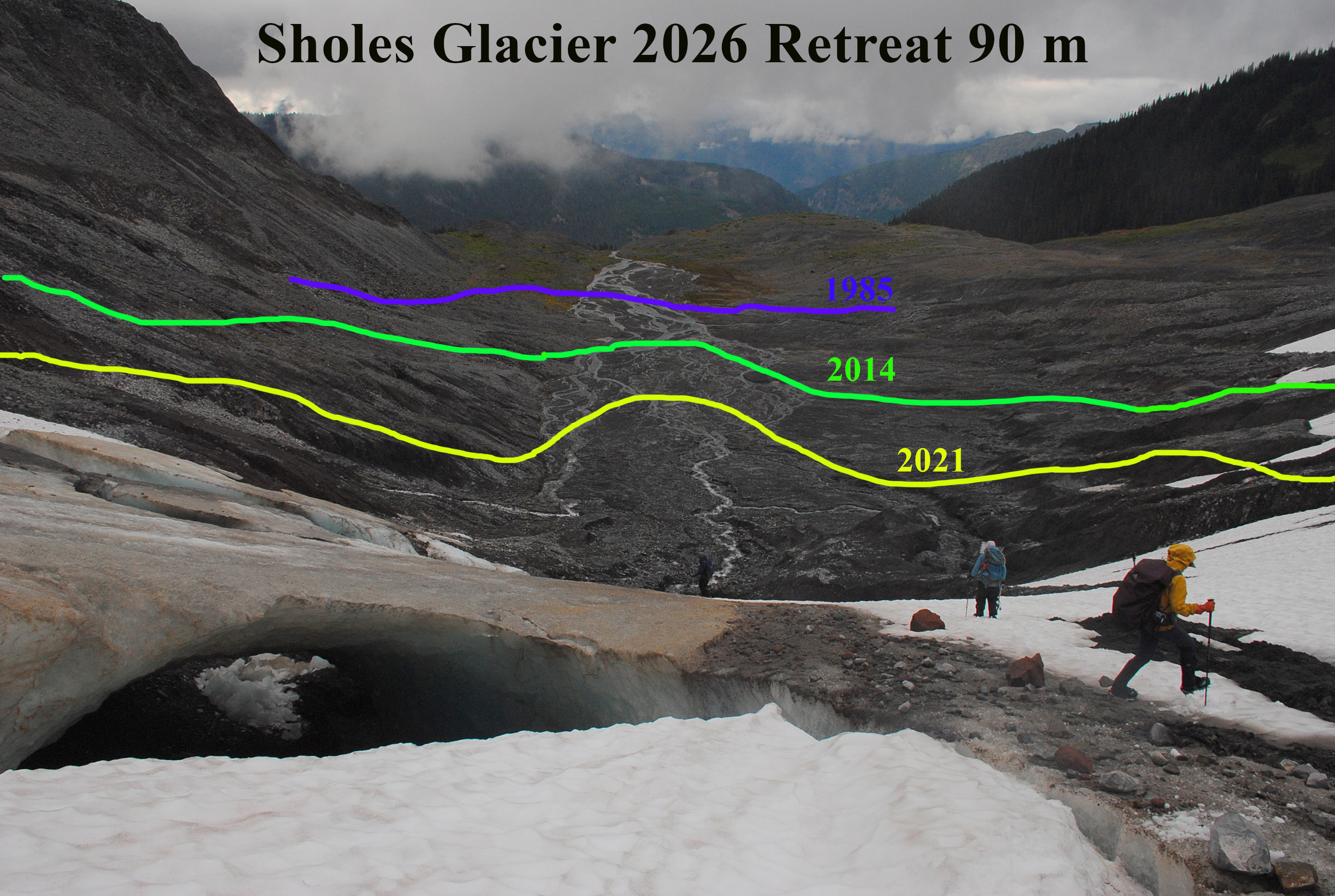
Sholes Glacier terminus and ice cave with former terminus margins noted.
Sholes Glacier on Mount Baker had another spectacular terminus ice cave, that collapsed during the summer leading to further rapid terminus retreat of 90 m. The lower glacier margin continues to rapidly move upslope indicating how thin the lower portion of the glacier is. We observed daily melt through August on this glacier, which averaged 0.065 m/day w.e. The annual balance was -2.24 m on Sholes Glacier.
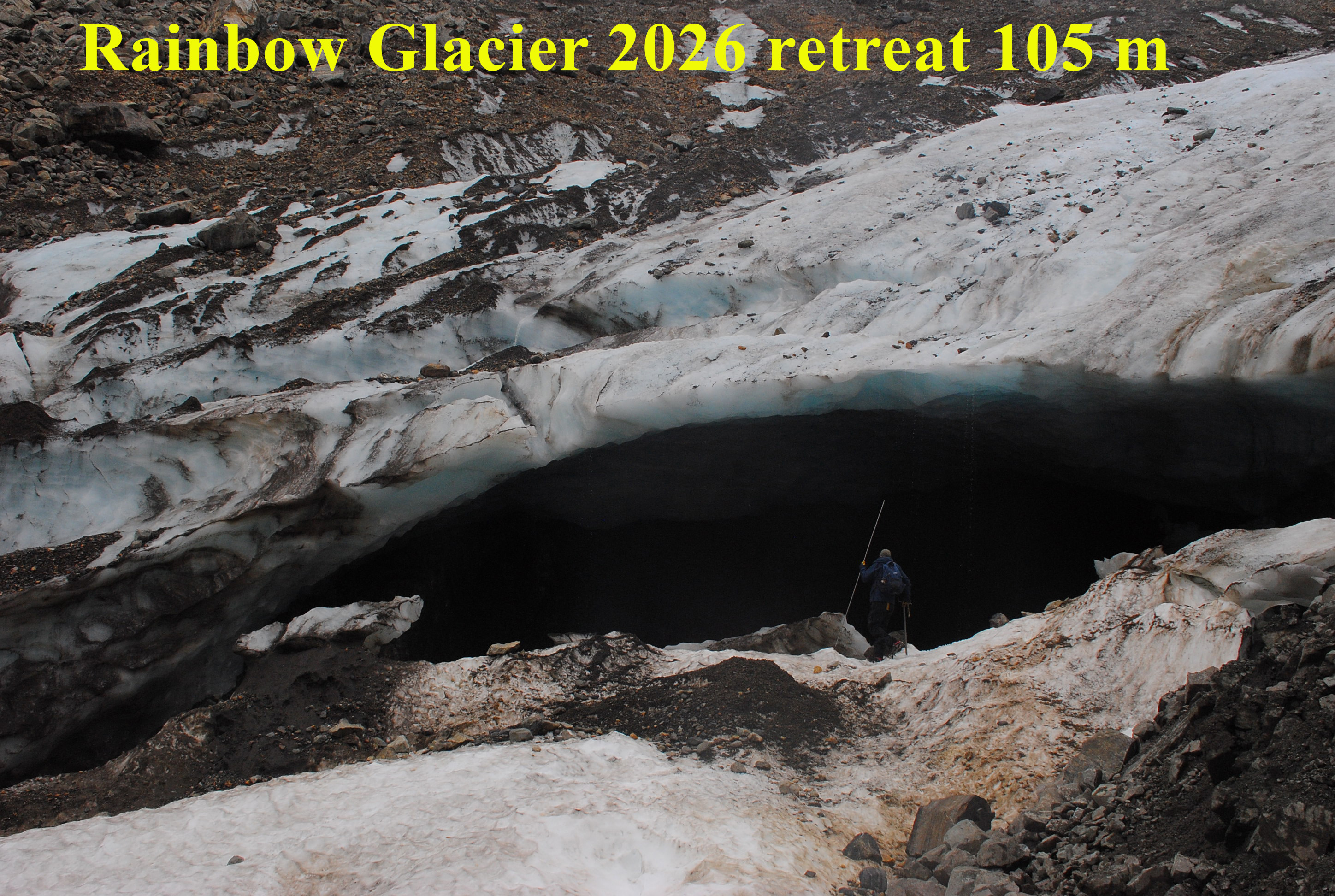
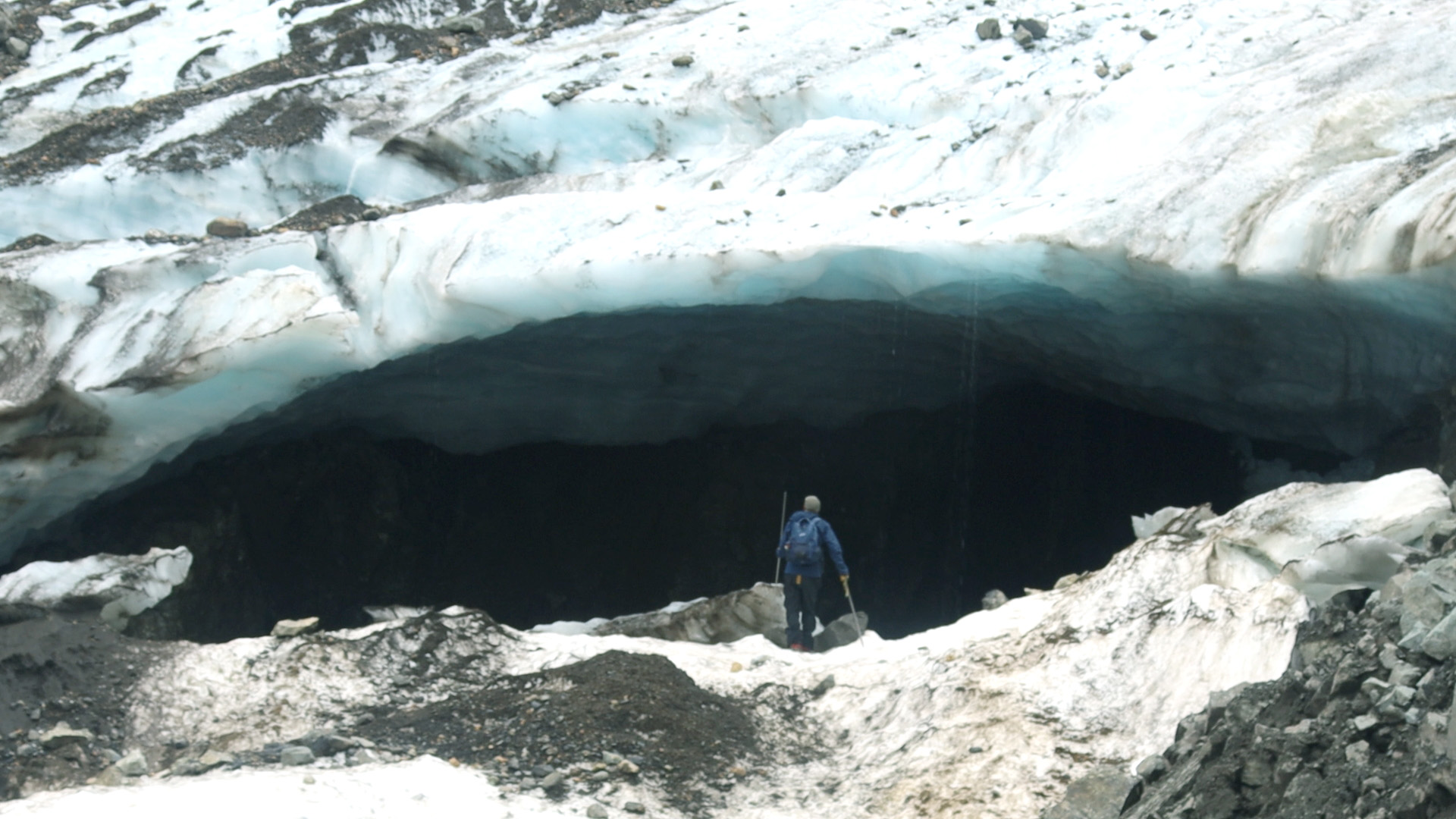
Rainbow Glacier Cave in early August. This cave represents an extension of a collapsed portion.
Rainbow Glacier on Mount Baker had a more exposed terminus and lower glacier than we had seen since 2015. This was an indication of the poor winter snowpack. The snowline on this glacier was at 1850 m at the start of August, rose to 1950 m by early September, then rose no further. The snowpack on the saddle between 2050-2150 m was above average indicative of the freezing level during the December atmospheric river event. The terminus retreated 105 m, and the annual balance was -1.46 m.
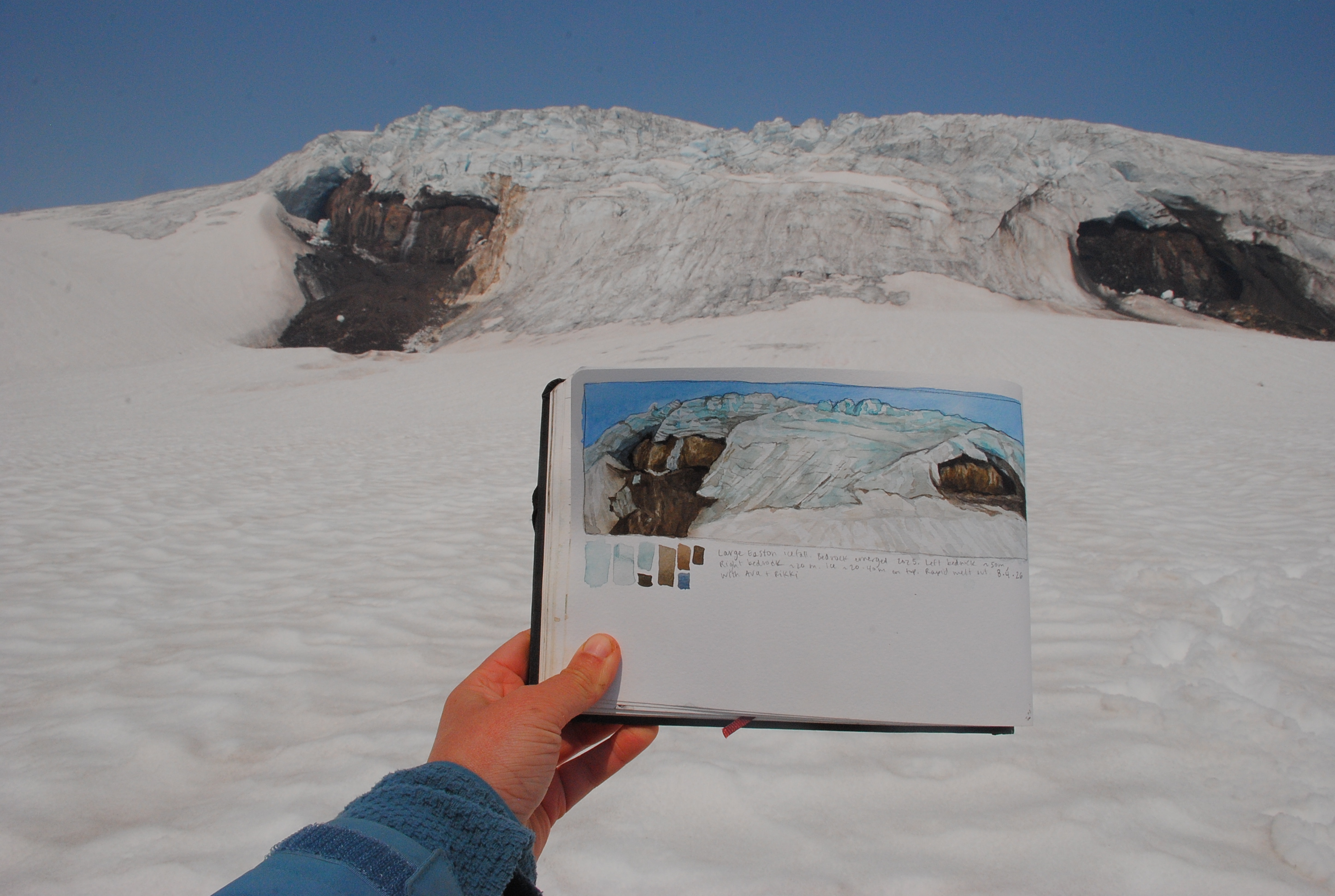
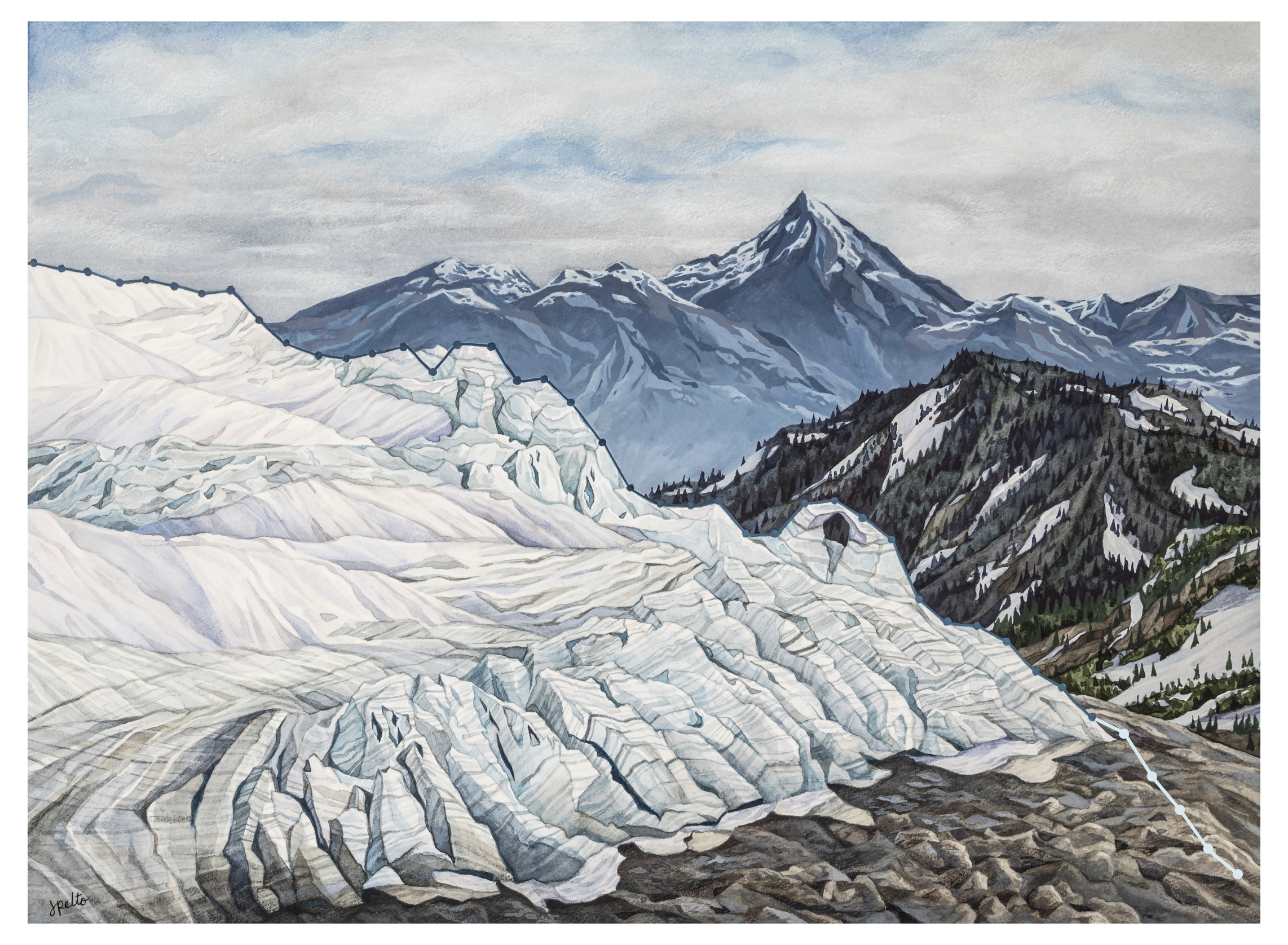
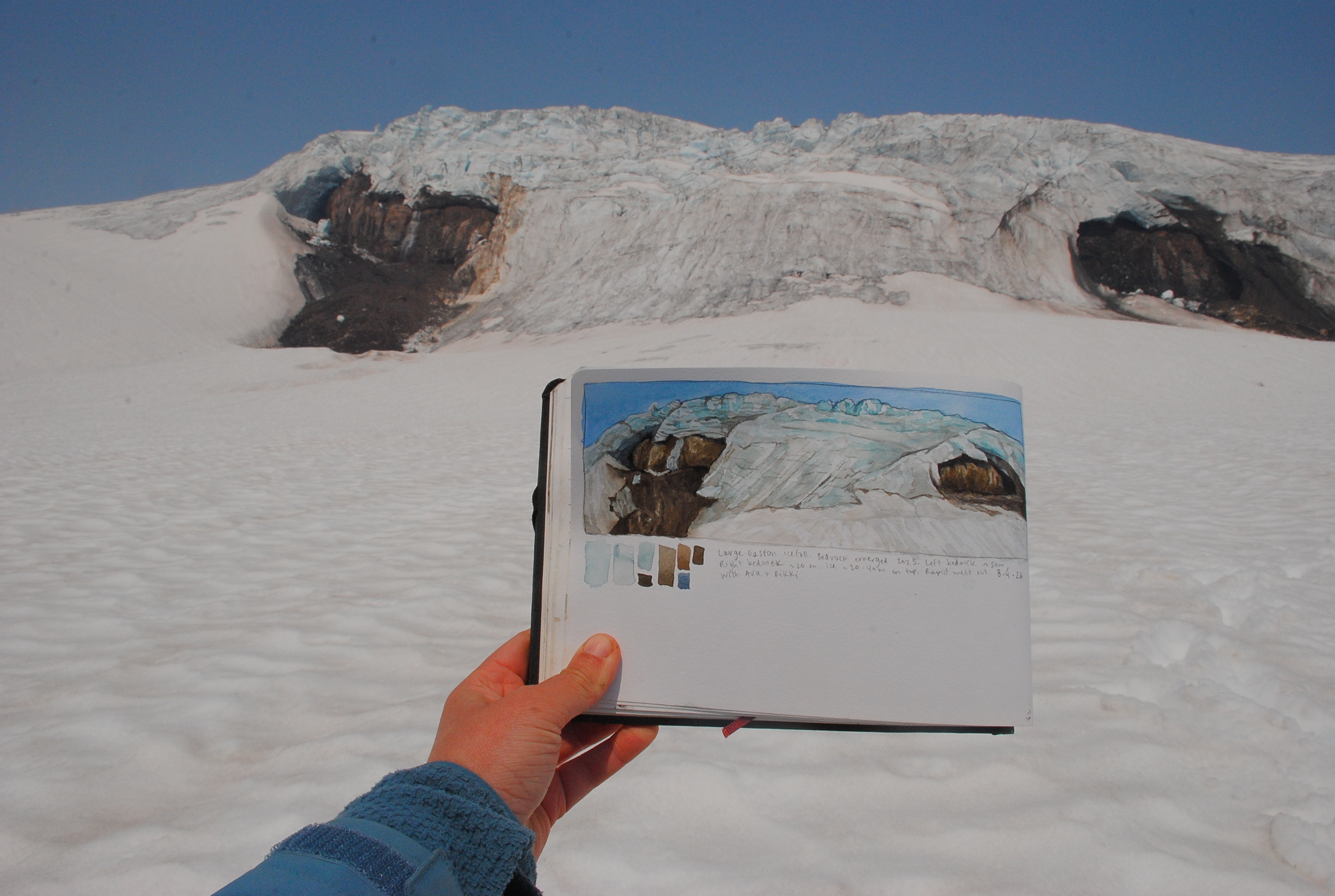
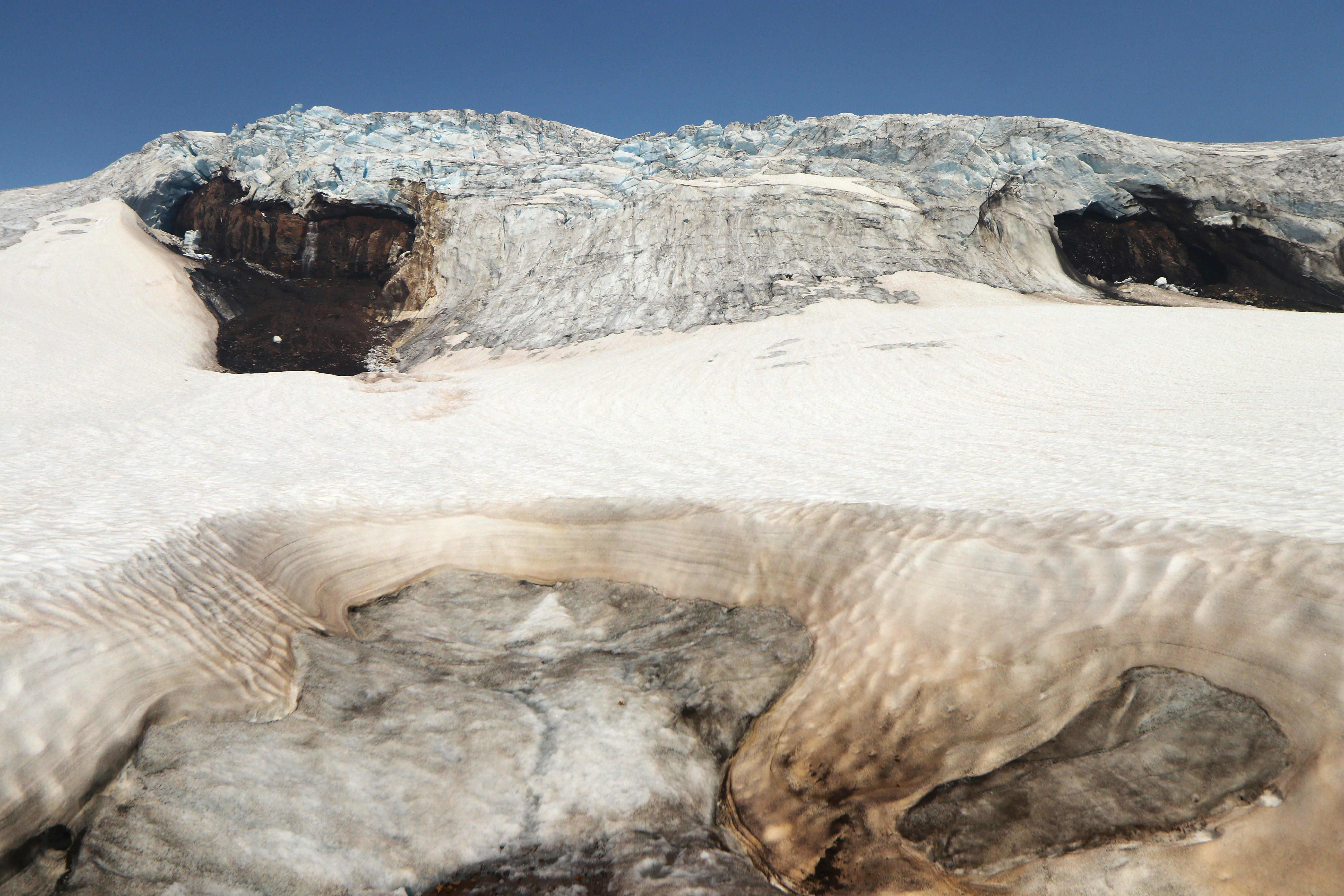
Easton Glacier’s main icefall developed two large bedrock areas, that had not been present in 2024, and were emerging but stil in caves in 2025. This illustrates significant annual thinning at 2100 m, well above the terminus area at ~1700 m. Field Painting by Jill Pelto.
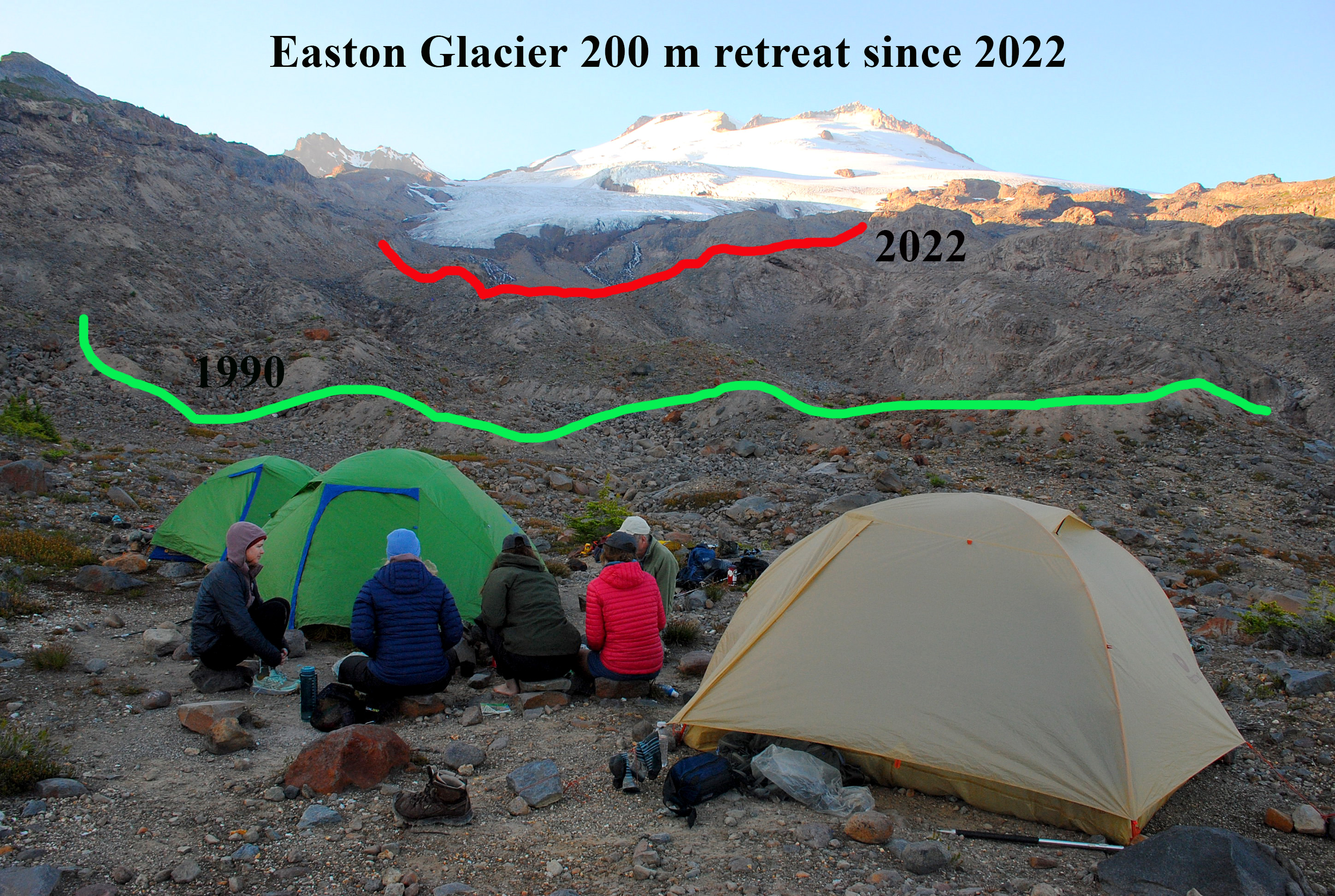
Easton Glacier below 2200 m lost all snow cover by mid-August and thinned rapidly, leading to continued rapid retreat of 45 m. The thinning exposed new bedrock areas as high as 2800 m on the glacier. The snow depth rose rapidly above 2400 m, indicating the freezing level during the December AR event. Annual balance of -1.17 was less negative due to better high elevation snowpack.
Easton Glacier in 2026 from our base camp.
We observed terminus retreat and accumulation area ratio and 2300 m snow depths on Deming, Squak and Talum Glacier. Deming Glacier retreated rapidly, losing 110 m in 2026 due to a cave collapse and formation of a small lake. Squak’s steep terminus lacks crevassing indicating limited motion despite the 30 degree slope. This illustrates how thin the ice is, which will lead to continued rapid retreat, which was 40 m in 2026.
Columbia Glacier and its expanding proglacial lake in mid-August 2026. notice only snowcover in avalanche fans on west side.
In 2026 the approach to Columbia Glacier via the Blanca Lake trailhead was lengthened by bridge and road washouts from the December atmospheric river event. The lack of avalanche snowpack in the basin and on the glacier indicates the warm winter conditions that prevented buildup of snowpack in the 1600-2000 m range that feeds this glacier. By early August the only snow cover on the glacier was in two avalanche fans on the west side. By the end of summer only 10% of the glacier had snowcover, and the annual balance was -2.56 m. The lake at the terminus expanded due to continued rapid retreat, 50 m in 2026.
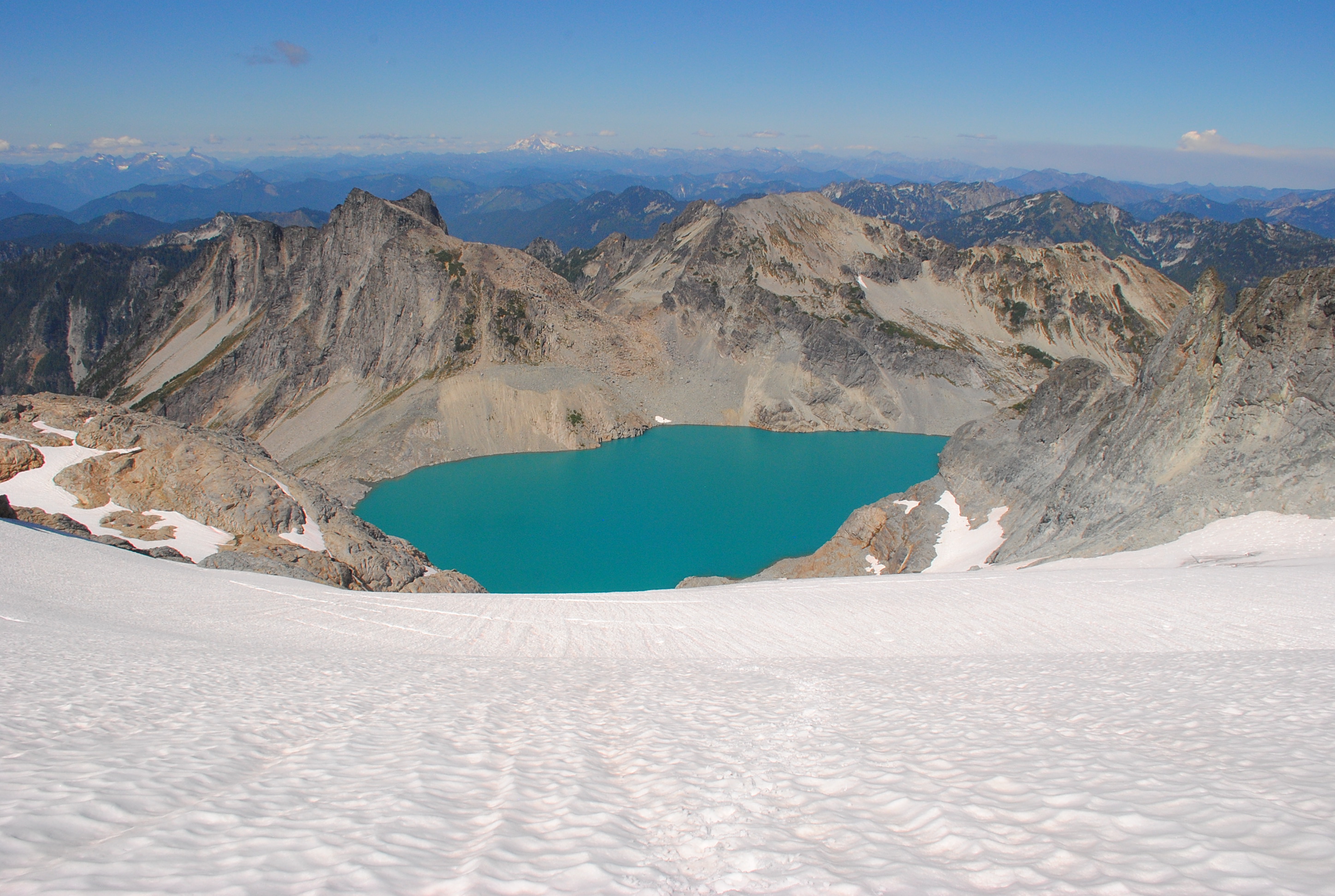
Lynch Glacier’s upper accumulation basin. Notice lack of snowpack around Pea Soup Lake in the 2000 m range, while good snowpack existed at 2300 m.
Lynch Glacier had substantial snowpack remaining in its upper basin above 2300 m. This indicated that the December atmospheric river event deposited snow not rain on the upper Lynch. This was partly due to the embedded cold air east of the divide that Lynch Glacier sits on. Our approach and exit from Mount Daniel and Lynch Glacier was impacted by smoke from the Three Queens fire, the area was evacuated as we completed work on these glaciers. The glacier had its highest accumulation area ratio, 30% since 2020 leading to an annual balance of -1.28 m.
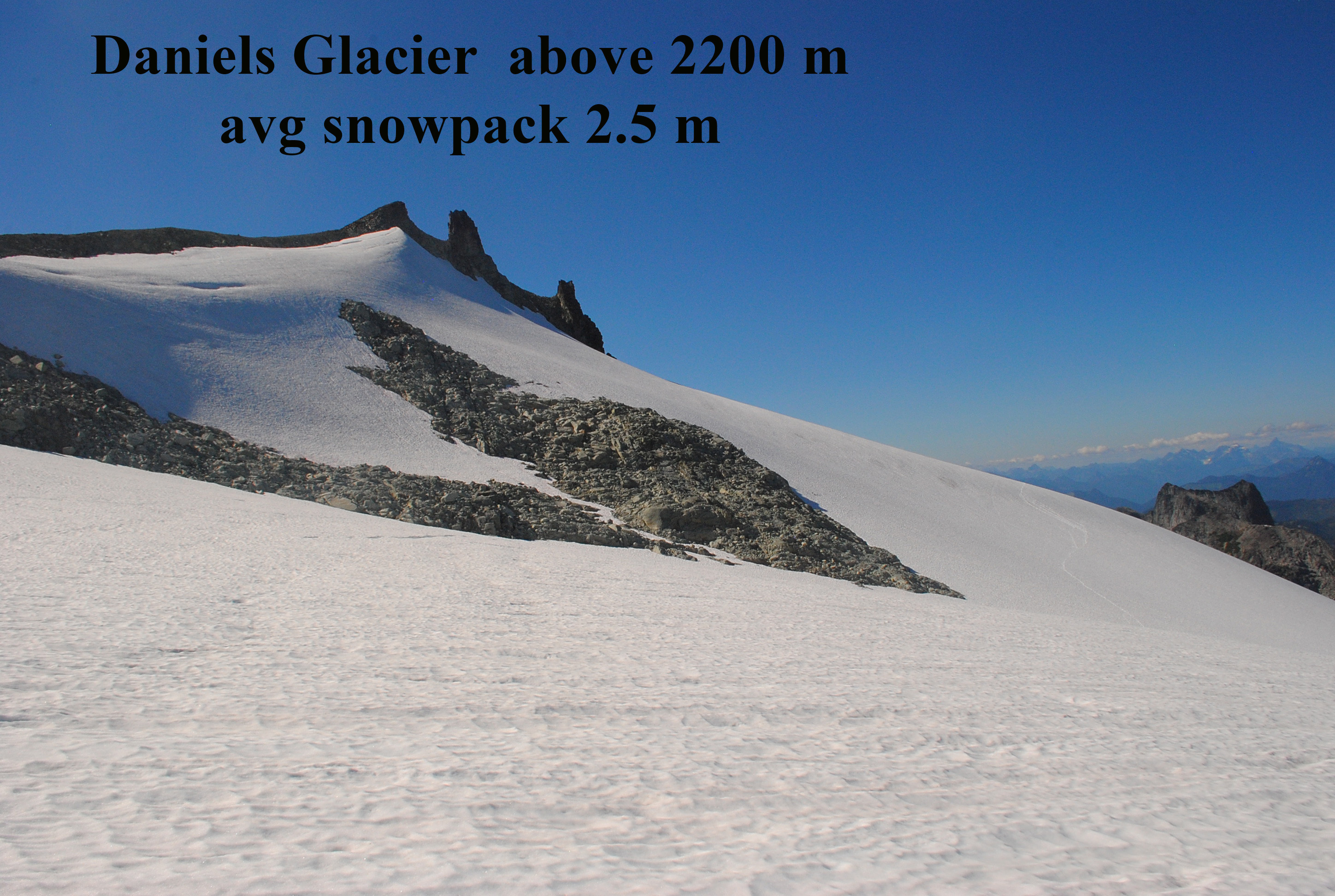
Daniels Glacier in mid-August with good snow cover.
Daniels Glacier was the clear winner in 2026! Rapid recession has eliminated the lower section below 2150 m, which was 40% of its area. In early August the glacier was still fully snow covered. By early September the glacier was still 80% snow covered. This remaining snowpack was thin, but did keep glacier ice from being exposed. By October 3, the glacier was down to 32% snowcover The results was a positive mass balance of -0.96 m. This is in sharp contrast to the 2021-2025 mean balance of -2.4 m/year.
On September 25th, the melt season ended with a two day snow storm blanketing the glaciers. Jill had been on Mount Shuksan the previous day. The lack of melt in September resulted in reduced mass losses from the previous three years at -1.5 m, vs over 2 m the in 2023-2025.
Snowpack depth of 3.75 m at 2600 m on Easton Glacier.
40 Years in the North Cascades by Jill Pelto. This piece captures the Mass Balance data of the North Cascade glaciers as whole as collected by our project from 1984-2022. Jill digitally updated the graph line in her painting to include 2023-2026, as seen by the pale line that extends beyond the ice.
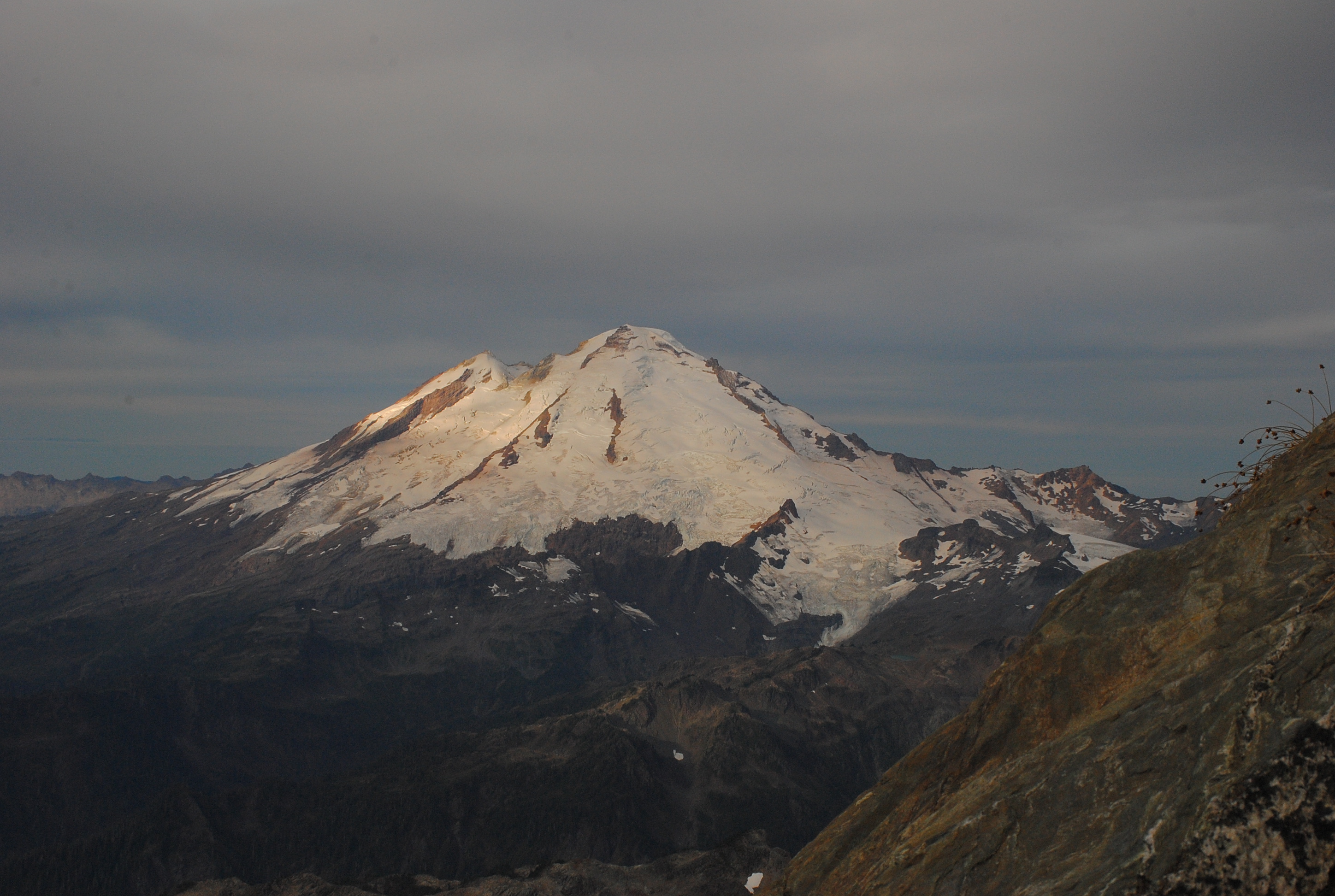
Mt. Baker at the end of the melt season, on September 24, 2026. Photo taken by Jill Pelto from the summit pyramid of Mt. Shuksan
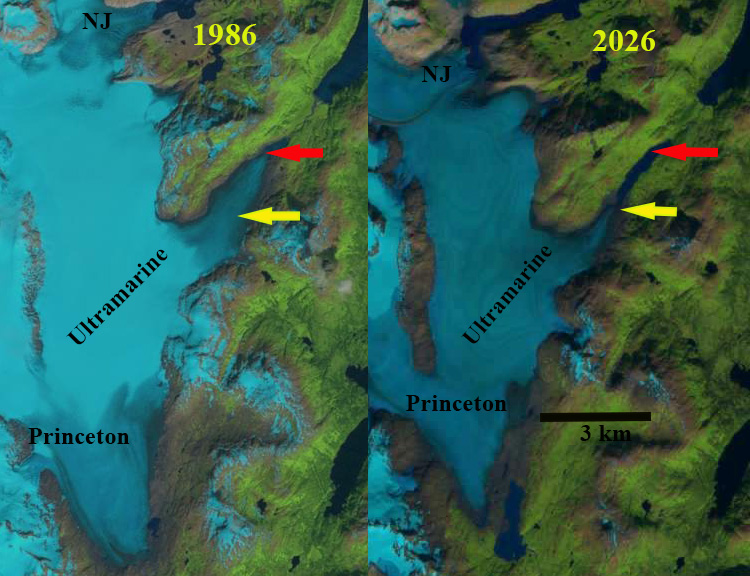
Ultramarine Glacier in 1986 and 2026 Landsat image, red arrow 1986 terminus and yellow arrow 2026 terminus. The glacier has retreated 2.2 km and in 2026 has no retaied snow cover. (NJ=Nellie Juan Glacier)
Ultramarine Glacier is an outlet glacier of the Sargent Icefield. The terminus extends northwest from the glacier and icefield. To the south is Princeton Glacier and the north is Nellie Juan Glacier. The glacier terminus has been in an expanding proglacial lake, but appers to be retreating from this lake. The glacier has a low elevation accumulaiton between 300 and 525 m, with a terminus tongue extending down to 100 m.
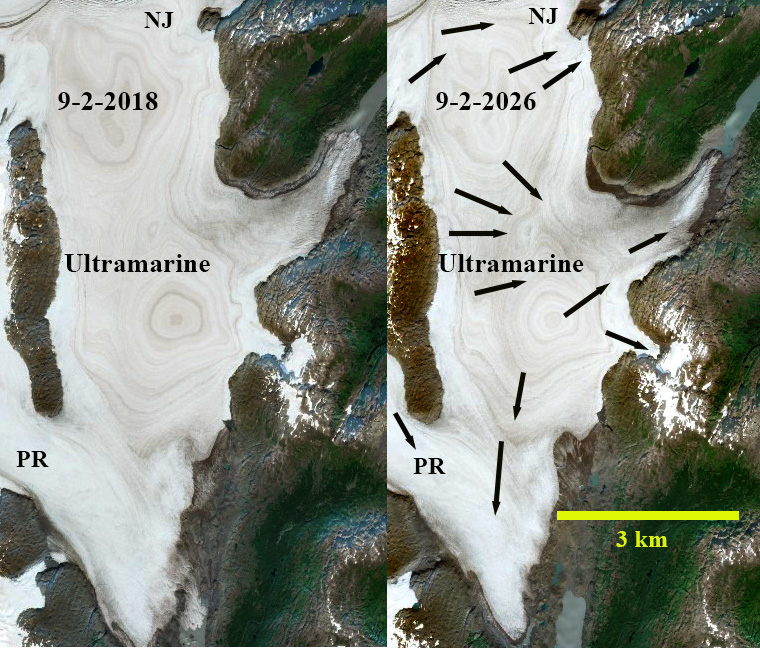
The glacier has retreated 2.2 km since 1986, similar to the 2.8 km retreat of Nellie Juan Glacier. In 2018, 2019, 2020, 2021, 2022, 2024 and 2026 the glacier lost all of its snow cover. The firn layers are evident in the Landsat image above and the Sentinel images below, these layers are not visible when snow cover exists. The ring pattern marks the ice divides where ice flows either to the Nellie Juan, Ultramarine or Princeton Glacier. A glacier without a persistent accumulation zone cannot survive. This is the situation for Ultramarine Glacier, with an area of 17 km2 it will endure for several decades. The Contact Glacier to the north that was connected to the Nellie Juan Glacier as well, is in the same situation, but with an area of 2.5 km2 will disappear sooner. The glacier fits well the regional pattern including in Kenai Fjords National Park (Black and Kurtz, 2021) and Excelsior Glacier on the south side of the icefield.
Ultramarine Glacier with no snow cover in 2018 and 2026. The firn layers are evident which also highlight the flow divides of the glacier. (NJ=Nellie Juan Glacier, PR+=Princeton Glacier)
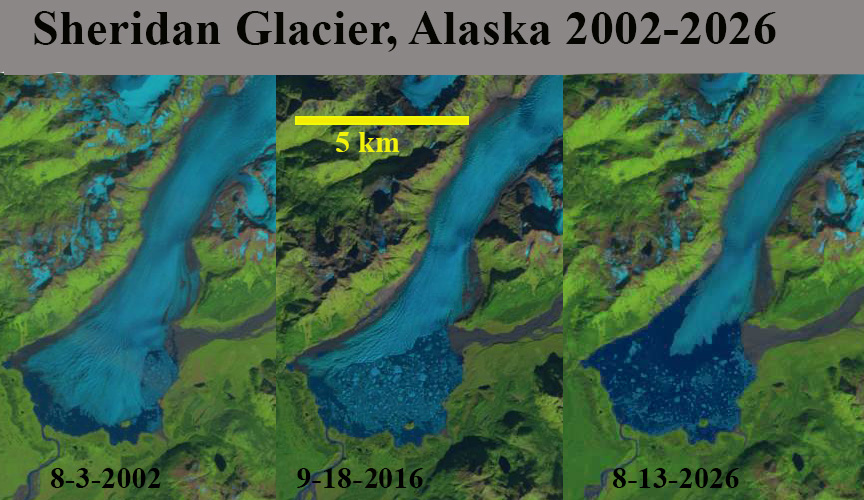
Retreat of Sheridan Glacier and expansion of Sheridan Lake from 2002-2026 in Landsat images. Lake has expanded from 3.8 to 13.5 km2, due to 2.25 km retreat.
.Sheridan Glacier in the Chugach Mountains of Alaska flows southwest out of the mountains onto a terminus plain where it has gouged out a lake basin that expands as the glacier retreats. Sheridan Lake is a proglacial lake at the terminus that drains into the Sheridan River that 12 km later reaches tidewater. From 1950 to 2000 Sheridan Glacier experienced modest retreat, with a fringing proglacial Sheridan Lake persisting. Then a rapid retreat accompanied a terminus disintegration from 2000-2016. (Shugar et al 2018). This led to lake expansion that is ongoing in 2026.
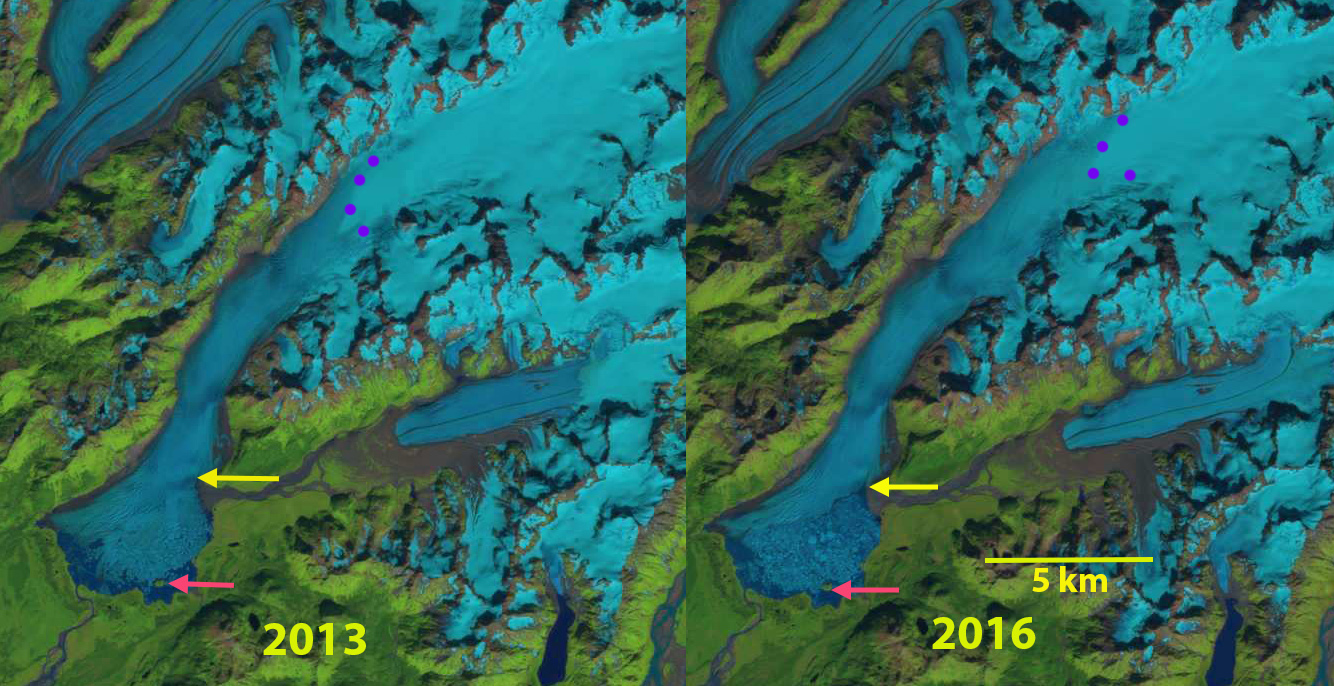
In 2002 the proglacial lake had an area of 3.8 km2, with the terminus crossing one small island in the lake. The snowline was at 750 m. In 2013 there is a 4 km2 terminus area that has disintegrated, the terminus has retreated off of the island. By 2016 the terminus has retreated north of the glacier stream from Sherman Glacier entering from the east, though much of the lake is still filled with an iceberg melange. The snowline is at 925 m. In 2020 the Sheridan Lake area has expanded to 11.2 km2, with the snowline at 970 m. In 2026 the lake has expanded to an area of 13.5 km2,.epresenting a retreat of 9.7 km2 since 2002. In 2026 the terminus tongue is not stable, unbuttressed on its lateral margins for 2 km, and retreat will continue.
Sheridan Glacier retreat and lake expansion 2002-2020. Snowline indicated by blue dots on these Landsat images.Sheridan Glacier retreat and lake expansion 2013-2016. Snowline indicated by blue dots on these Landsat images.
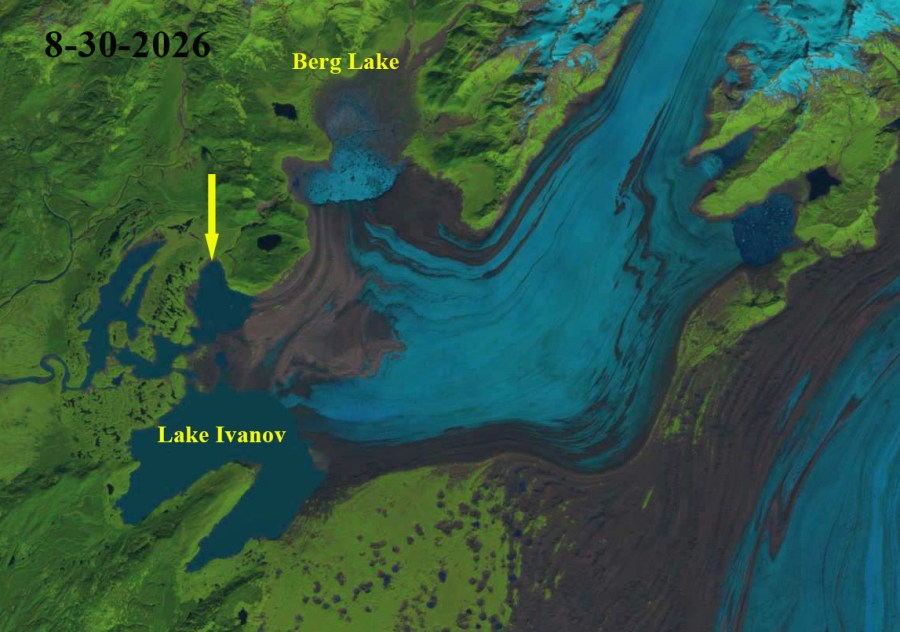
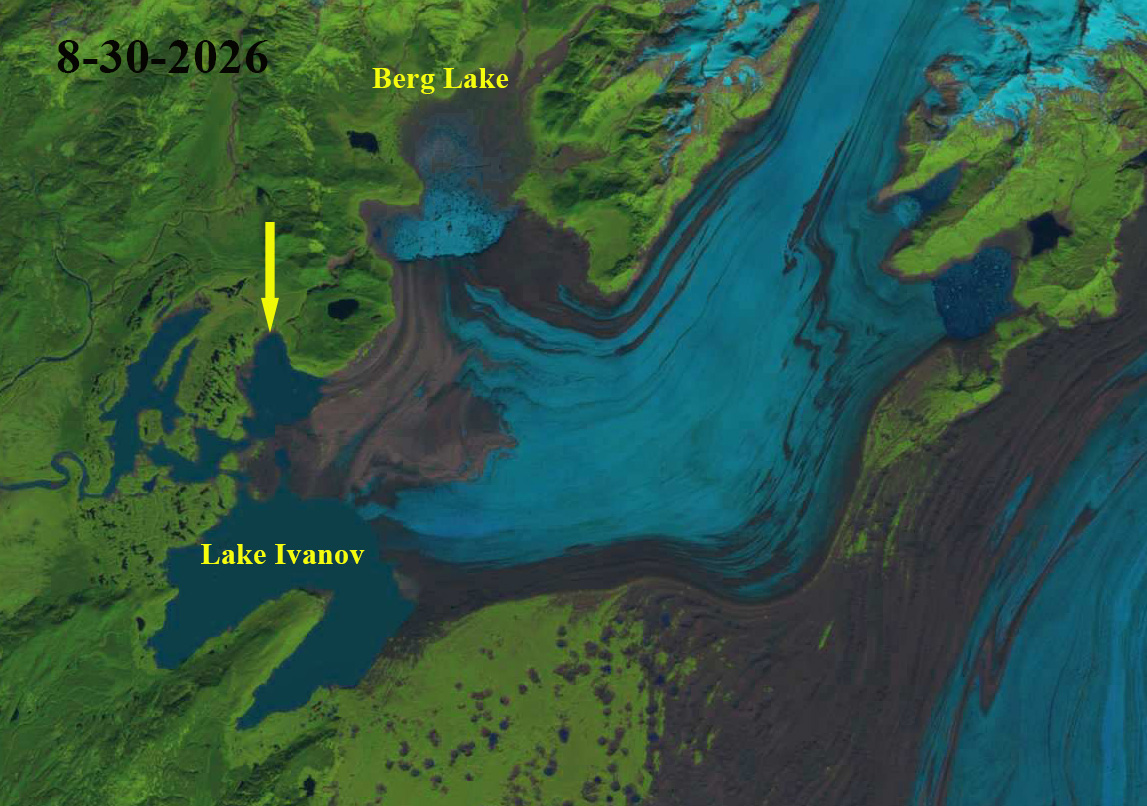
Berg Lake on Aug. 30th after drainage in this Landsat image. Yellow arrow indicates lake that has changed from dark blue seen in late July indicative of limited glacier input, to a lighter blue indicating glacier input.
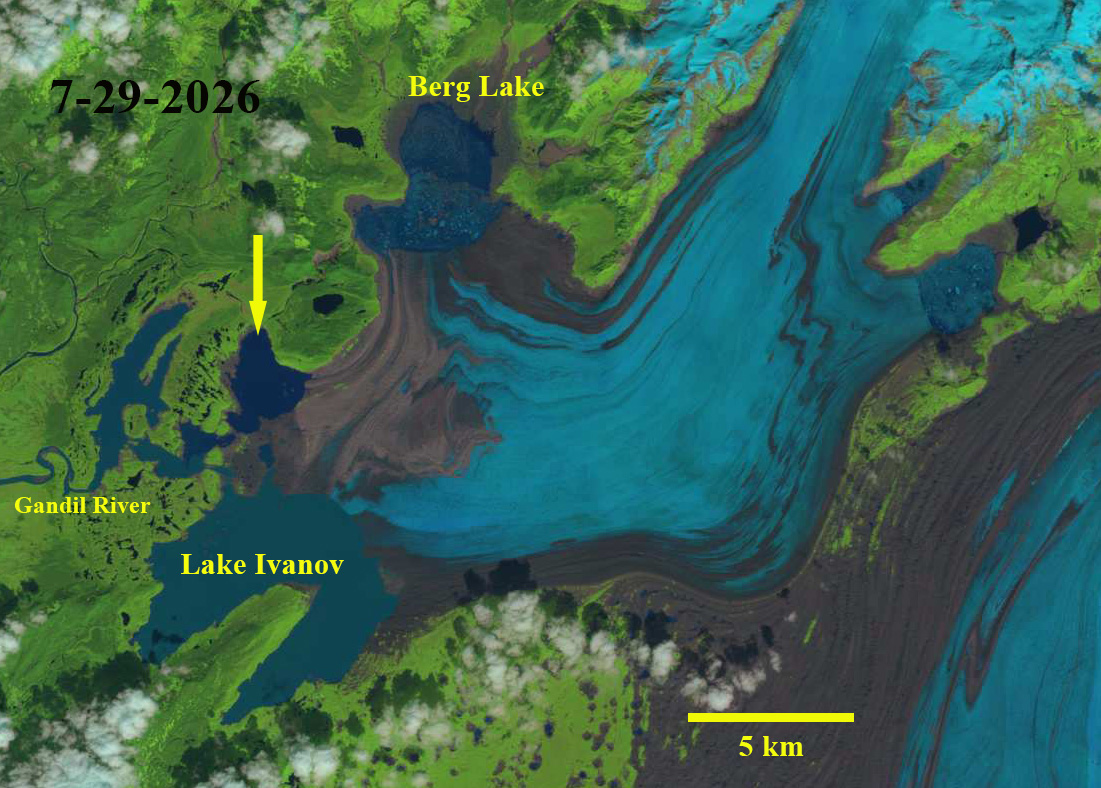
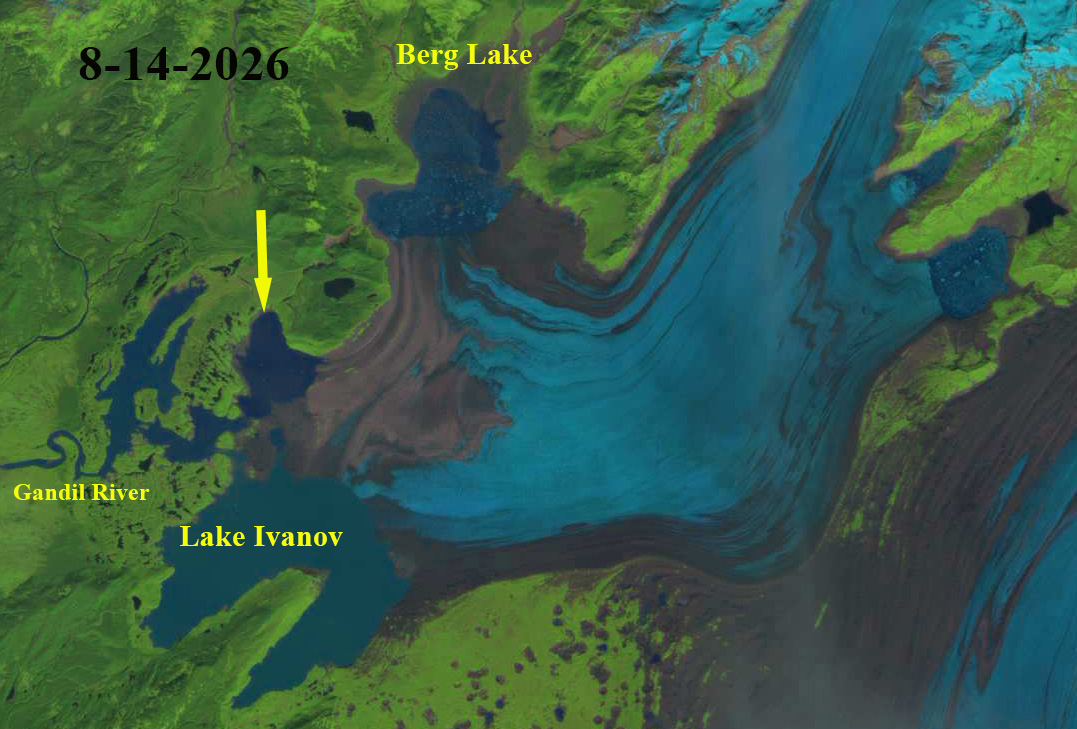
Berg Lake, Alaksa is impounded by the Steller Glacier terminus. During the latter half of the 20th century and early 21st century this lake periodically drained west through a gorge to the Bering River. The lake drainage currently goes directly from Pacman Lake into the Gandil River and then into the Bering River watershed. The lake continues to fill each summer and drain in late summer, with drainage being in August of 2021 and 2022, and late July of 2023 and 2024 and August in 2025 and 2026. The evolution was discussed in a NASA project I worked on in 2025 (NASA, 2025). Here we examine a series of Landsat images that illustrate the filled and drained lake in the summer of 2026.
Berg Lake on July 29th before drainage in this Landsat image. Yellow arrow indicates lake that is dark blue indicative of limited glacier input.
In 2026 the lake filled to an area of 13 km2 by late July and maintained that level through at least Aug. 14th. Imagery from Aug. 27th and 30th indicates the lake had drained. The lake bottom is now littered with icebergs. There are two other ice dammed lakes due east across the glacier that have not drained.
Berg Lake on Aug. 14th still full in this Landsat image. Yellow arrow indicates lake that is dark blue indicative of limited glacier input.
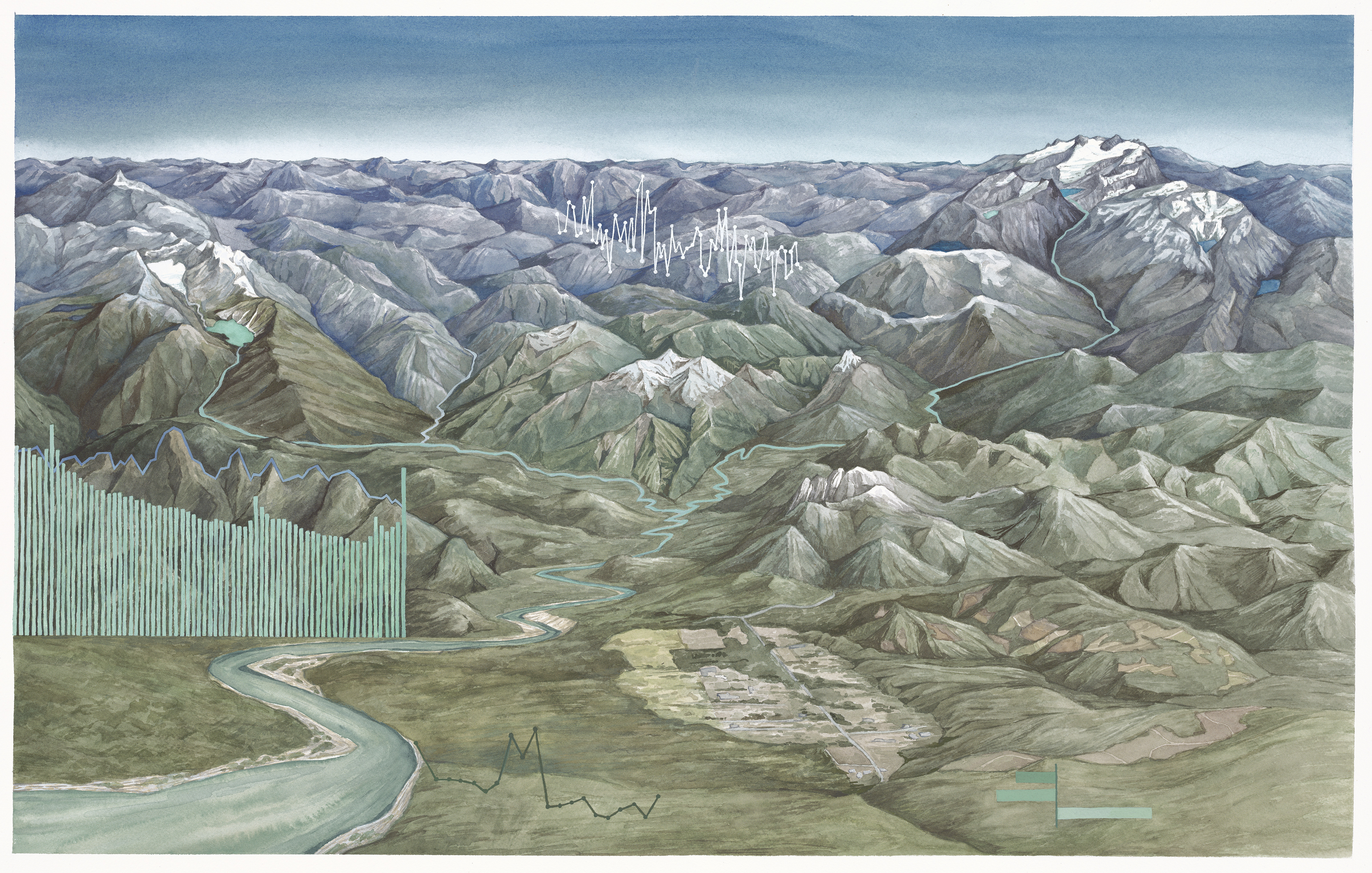
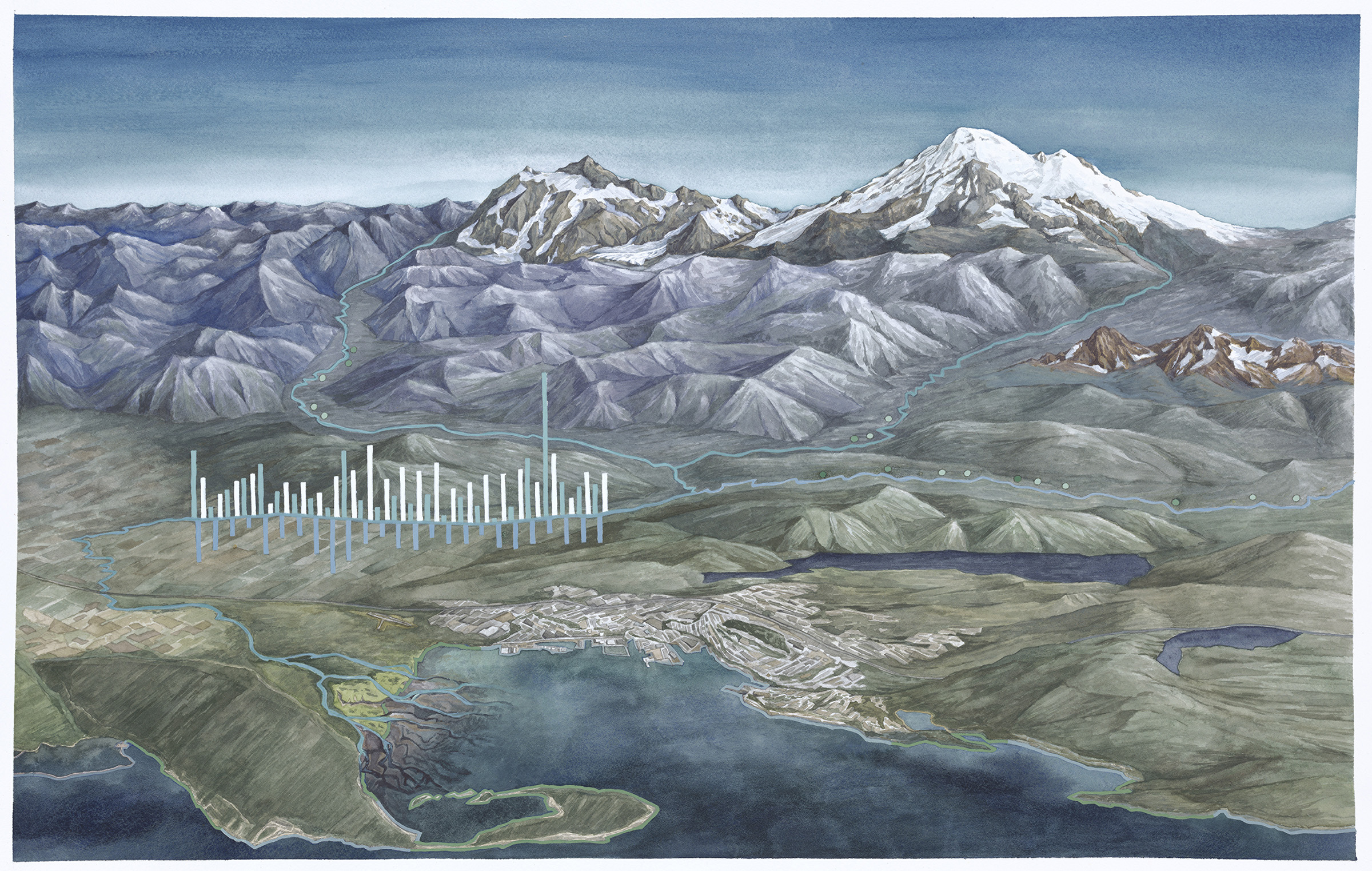
The Skykomish River in the North Cascades is partially glacier fed. It joins with the Snoqualmie River to form the Snohomish River, flowing into the Puget Sound near Everett. Columbia Glacier is seen on the left of the painting, with the beautiful Blanca Lake beneath. This is one of three glaciers remaining in this region, the other six have recently disappeared. On the right side is the Alpine Lakes Wilderness, two glaciers in this complex remain. The large bar graph in this piece shows Skykomish River discharge (the volume of water) from mid July to late September in 2023. The decrease in water over the dry, hot summer period is evident. The line graph that makes up the mountain above the bars shows the temperature of the river at this same time, highlighting heat wave events. When the temperature spikes, and when the river levels drop, a critical threshold is reached for salmon and other species. This highlights the importance of glaciers in acting as a buffer during drought and heat events.
In 1958 the Skykomish River Basin was home to nineteen glaciers or perennial snow and ice bodies exceeding 0.1 km2 in area, with a combined area of 5.7 km2 (Post and others, 1971). It was the third most glaciated west side basin in the North Cascades behind the Nooksack and Skagit River. These glaciers provided significant runoff to the basin in late summer (Fountain and Tangborn, 1980). We have monitored the mass balance of two glaciers in this basin from 1984-2026, and the changing area and dynamic characteristics of six other glaciers during this period. The Skykomish River Basin has experienced rapid glacier loss leading to the loss of six of its nine glaciers, and over a 40% area reduction of the remaining three.
The North Cascade Glacier Climate Project has maintained an annual mass balance monitoring on the two largest glaciers in the basin from 1984-2026; Columbia and Lynch Glacier. The mean annual mass balance on these two glaciers was –0.4 m/year from 1984-2013, decreasing to –1.5 m/year from 2014 to 2025. This represents the average water equivalent thickness of ice lost from the glacier.
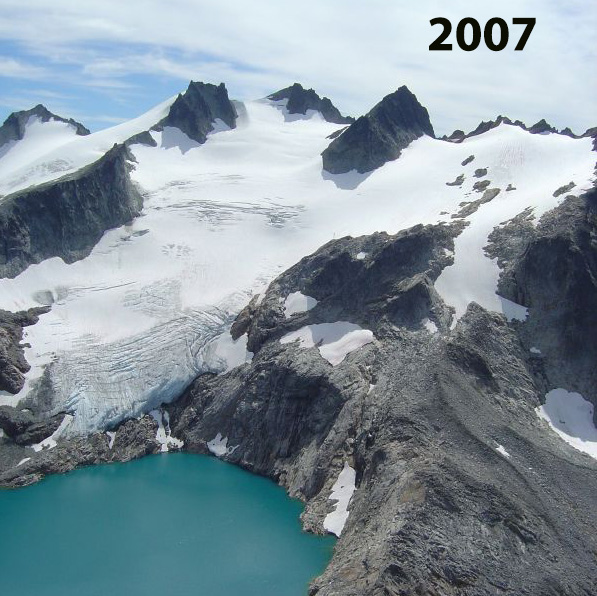
Columbia Glacier in 2003 and 2026 illustrating both the thinning, formation of a new lake and significant area decline.
In the field between 1984 and 1986 we identified nine glaciers in the basin that had active crevassing and sufficient area to be classified as a glacier. During the 2005-2023 period we observed six of these glaciers to have disappeared. Lynch and Columbia Glacier now comprise 88% of the total glaciated area in the basin in 2023, up from 37% of total glaciated area in 1958. Foss Glacier, the third remaining glacier in the basin, has lost 85% of its area since 1958 and has almost disappeared. We will check on this glacier later this summer to see if it still is a glacier. The basin is on a trajectory to lose all its remaining glaciers in the next 2-3 decades; this transition to a non-glacier fed watershed will lead to further reductions in summer discharge and increased summer water temperatures.
In 2026 the approach to Columbia Glacier via the Blanca Lake trailhead was lenghtened by bridge and road washouts from the December atmospheric river event. In 2026 the Columbia Glacier will thin by at least 2 m. The lack of avalanche snowpack indicates the warm winter conditions that prevented buildup of snowpack in the 5000-6500 foot range that feeds this glacier. Lynch Glacier had substantial snowpack remaining in its upper basin above 7200 feet. This indicated that the December atmospheric river event deposited snow not rain on the upper Lynch. This was partly due to the embedded cold air east of the divide that Lynch Glacier sits on. Our approach and exit from Mount Daniel and Lynch Glacier was impacted by smoke from the Three Queens fire.
Foss Glacier continues to fragement and disappear.
In glaciated watersheds glacier runoff is of particular importance to aquatic life in late summer and early fall when other water sources are at a minimum, increasing minimum flow and reducing maximum temperatures, thus providing crucial drought buffering capacity (Ultee and others, 2022). In the Skykomish River Chinook salmon are a threatened species with the fall runs being sensitive to lower flows and higher temperatures.
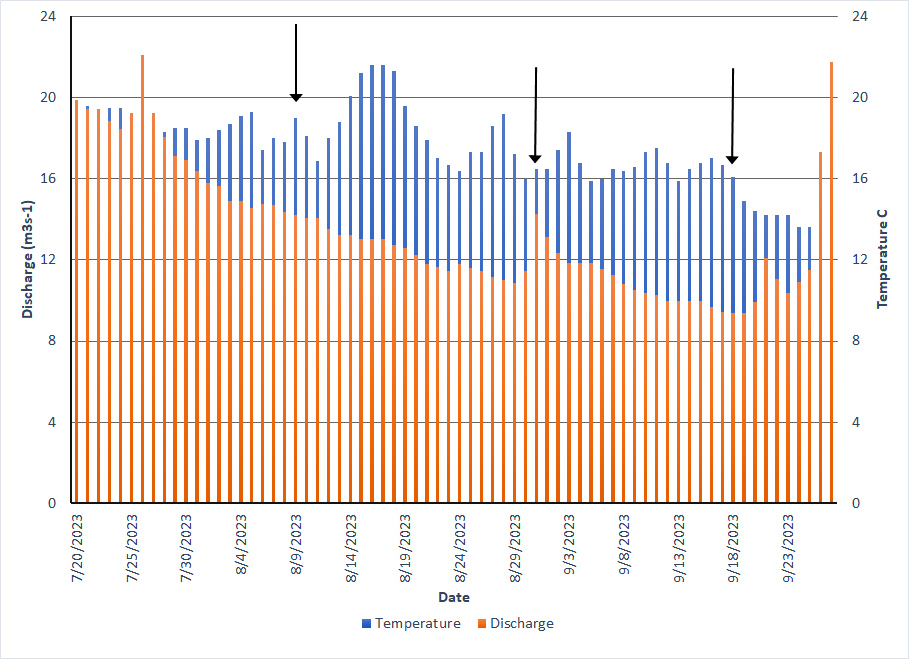
Stream discharge and temperature are observed at the USGS Skykomish River gaging station at Gold Bar. This gaging station is downstream of the confluence of the North and South Fork of the Skykomish River. The basin above Gold Bar has an area of 1386 km2, the average elevation of the basin is 1050 m. A key threshold of in-stream flow levels considered insufficient to maintain short term survival of fish stocks is below 10% of the mean annual flow, for Skykomish River that threshold is 14 m3s-1 (~490 cfs). In the Skykomish River from 1958 to 2023 there were 390 melt season days with discharge below 14 m3s-1. Of these only three occurred before 1985, and 74% have occurred since 2000. The loss of significant glacier runoff is a key reason for the increase of low flow days. Of more concern for aquatic life is the occurrence of extended periods (7+ days) of low flow-below 14 m3s-1 during the melt season, 1986, 1987, 1992, 1998, 2003, 2005, 2006, 2007, 2015, 2017, 2019, 2021, 2022, 2023, 2024, 2025 and 2026.
These low flows are associated with higher stream temperatures.The Skykomish River was listed as having a water quality standard impairment for water temperature in a 2008 303(d) listing and proposed 2010 303(d) listing, under the Clean Water Act[11]. Several segments of the Skykomish River as well as its tributaries consistently exceed water quality temperature standards today. The TMDL(total maximum daily load) for the Skykomish River indicates the maximum temperature should not exceed 16oC for seven consecutive days.
A water temperature sensor became operational in early July 2022 at the USGS Gold Bar site. The temperature exceeded 18oC for the first time on July 27. It surpassed 18oC diurnally on 37 of 42 days from July 27-September 7. In 2022 the 16oC threshold was exceeded continuously from July 26th to August 4th, August 14th-August 28th, and August 29th to September 4th. In 2023 the 16oC threshold was exceeded continuously from July 27th to August 21st, coinciding with the period of low streamflow from August 11to August 21. In 2025 stream temperature remained above 16C from August 22nd to Sept. 14th.
In 2026 stream temperature rose above 16C on Aug. 5th and as of Aug. 22nd has remained above this threshold. During this same interval discharge has reamined below the adequate flow threshold declining to 360 CFS. The low flow and high stream temperatures will continue to stress salmon and limit recreational uses of the river.
Lynch Glacier from across Pea Soup Lake. The lake has lost its pea soup color and is now trending toward azure. The west side of the glacier is now crisscrossed by rock bands and no longer contributes to flow.Skykomish River discharge and temperature at the USGS Gold Bar station in summer 2023 indicates temperature rising above the 16 C threshold and discharge falling below the 14 m3/second threshold.
Jill Pelto: Field painting of new large bedrock exposures in the big icefall on Easton Glacier, Mt. Baker. The 2026 field season of the NCGCP brought dramatic changes. While we expected most of these, it doesn’t make them any easier to physically navigate or emotionally experience. Even at 9,000 ft, the glaciers of Mt. Baker are thinning, with new bedrock emerging. Above about 7,000 ft, the snowpack was decent, which will slightly help to mitigate the losses from lack of snowpack at lower elevations. The atmospheric river carved a story across our field sites. From this big shift in snowpack up high, to washed out roads, and altered riverbeds. It was a year of fascinating, sad, and occasionally hopeful shifts.
Abby Connor: Looking down at the terminus of the Lower Curtis Glacier on Mt. Shuksan, noticeably thinner than when I last visited. I grew up in Bothell, in a family that spends its weekends outdoors, assuming that massive and seemingly unchanging glaciers are a fact of life. But as we approached our first field site on the Lower Curtis Glacier on Mt. Shuksan, I struggled to reconcile the view of the noticeably less massive terminus of the glacier with my memory from my last visit eight years ago. When we reached our break spot and looked far down at the glacier, Mauri described the wall that would have towered 100 feet over where we sat, before the glacier had lost its impressive thickness. Throughout the 2026 field season, I was continually awed with the scale of the glaciers we still have in the North Cascades while surrounded by reminders of how quickly they’re disappearing, fast enough that we are on track to lose almost all of our glaciers in the state within my lifetime. In Western Washington, a place defined by the mountains and Sound, glaciers are the link between the two. They are no longer an unchanging fact of life.
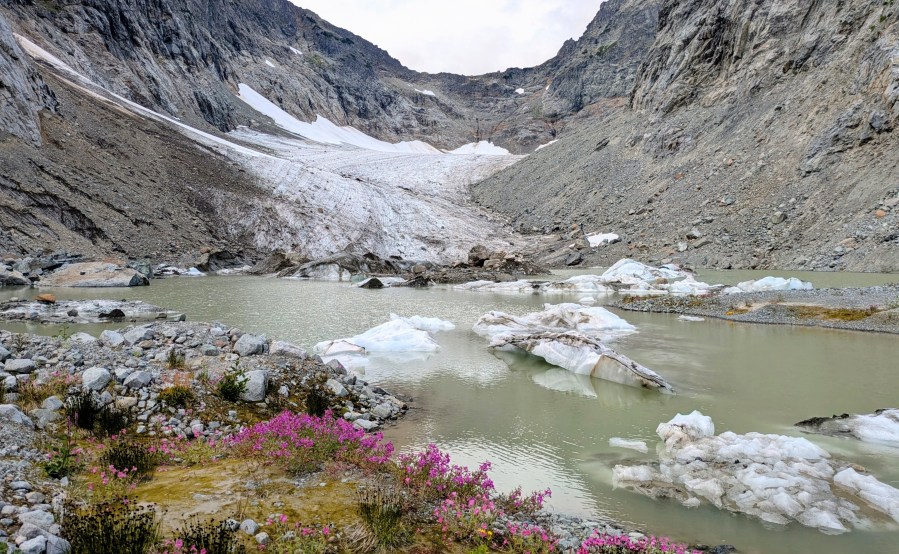
Ava Reynolds:Pink monkey flower and fireweed bloom in the rocky moraine of the Columbia Glacier – one of the glaciers in the 2026 field season that looked the most impacted by warm temperatures and a reduced snowpack, with avalanche bands that feed the glacier now shutoff, rockfall evident across the entire glacier, and a growing lake of floating ice at the terminus.This field season was visually striking, highlighting the impact of our warming climate on the glaciers and surrounding ecosystem. Flowers were blooming weeks ahead of schedule, sections of new bedrock were exposed, wildfires dotted the horizon at every field site, and residual evidence from the December 2025 storm system was prevalent in downed trees and washed out riverbeds.
Shaina Dotson:Amidst the icefall of Easton Glacier. Joining the NCGCP this field season was equal parts breathtaking and sobering. Each glacier was stunning and wholly its own — ancient and irreplaceable — yet we were immersed in the evidence of a warming planet. Wildfire plumes lined the horizon, ice thinned and retreated where it once held firm, and every day I found myself torn between the beauty of this world and its unraveling.
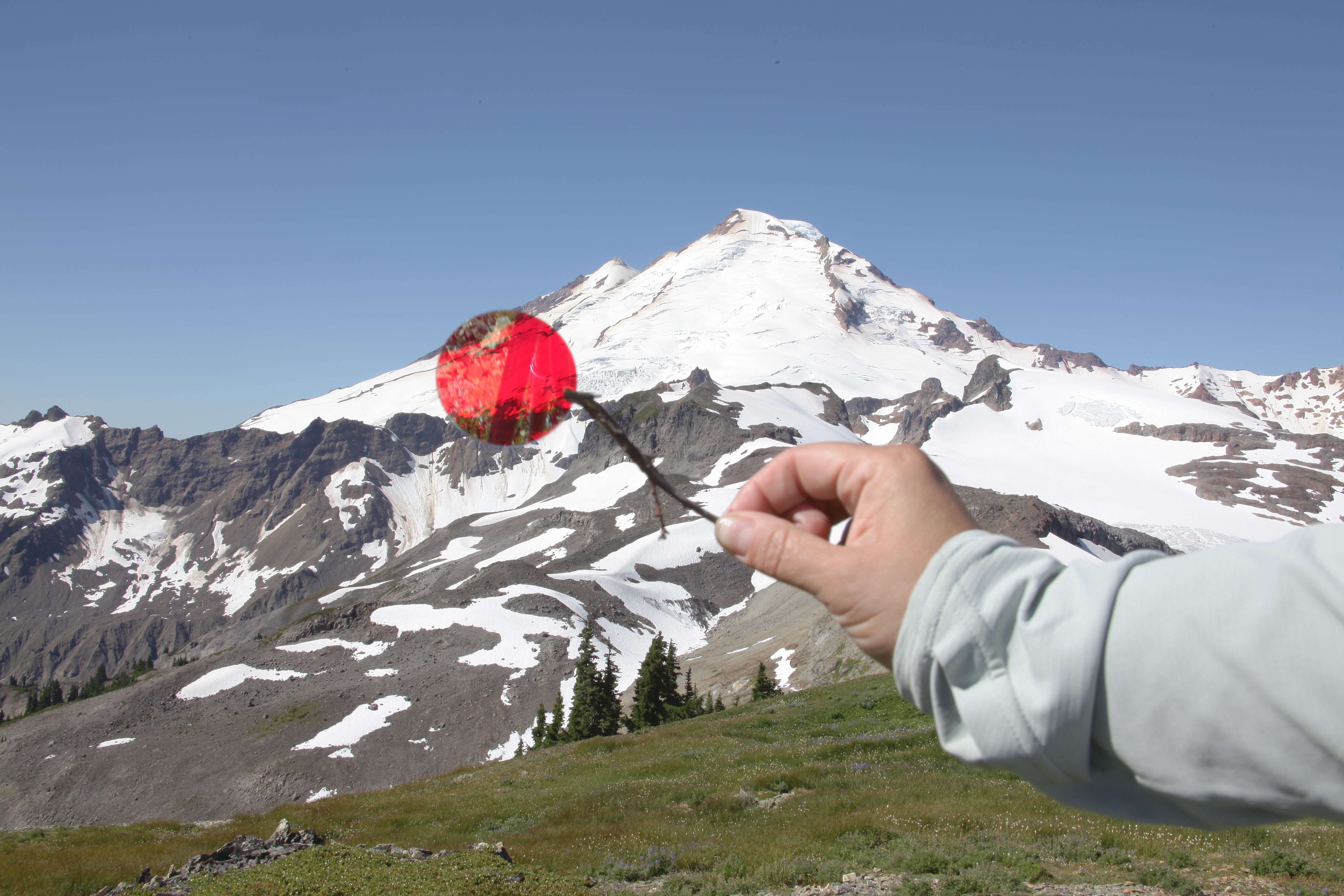
Danielle Schlunegger-Warner: Red Lens over Rainbow Glacier with Ice Alge sampled from Rainbow Glacier in the microscope. As an artist invited out to attend the 43rd field season with NCCGP, I spent my time in immersed with looking and observing. My attention drew not just to the fantastical forms of the ice on the glaciers, but the way they change the landscape around them. I saw ice algae and tiny black worms dotting the ice and snow, listened to the life bubbling up in the streams at their edges.The focus shifted between the expansive ancient glaciers, microorganisms, and the yearly changes diligently measured by the NCCGP with somber results. This experience illuminated for me not just that these glaciers the heartbeat of the North Cascades, but that their impact ripples out into our own lives in ways that are worth paying more attention to.
Rikki Held: Rainbow Glacier cave with Mauri for scale. The 43rd field season of the NCGCP was filled with both devastating and beautiful moments. We traversed landscapes with fresh glacier-fed streams, rugged mountains, wildflowers, mountain goats, and glaciers with unique formations and characteristics, while also witnessing heartbreaking sites including the large cave hollowing out Rainbow Glacier’s terminus on Mt. Baker and wildfire smoke plumes throughout the field season. Mauri and Jill shared their multi-year observations noting vegetation changes, newly exposed bedrock, and how far the glaciers have receded since they first visited them – e.g., Easton Glacier has retreated around 750m since 1990. This project highlights the importance of long-term data collection, science communication, and personal narratives as we all work to reduce the impacts of anthropogenic climate change and protect the environmental systems we depend on.
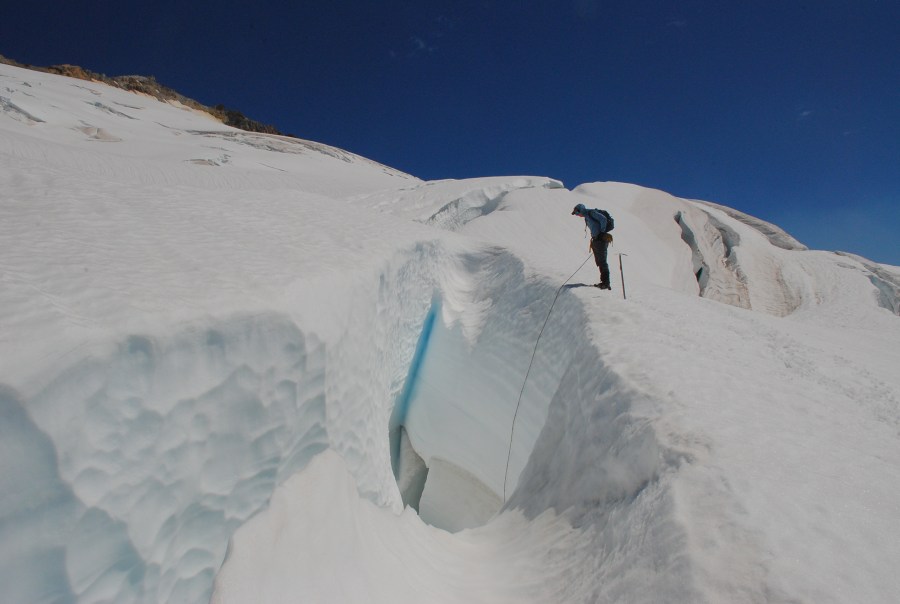
Mauri Pelto: Rainbow Glacier cave at the terminus with Abby and Rikki in foreground, viewed from an area where a previous cave had collapsed. Large ice caves are features of retreating glaciers where warm air circulates expanding the cave until it collapses. We observed several of these at the terminus of glaciers on Mount Baker this summer. The largest was at the terminus of Rainbow Glacier. The cave is large enough to hold a cape style house. It will collapse by the end of summer driving further retreat. The size of this cave and the roar of the water was quite intimidating.
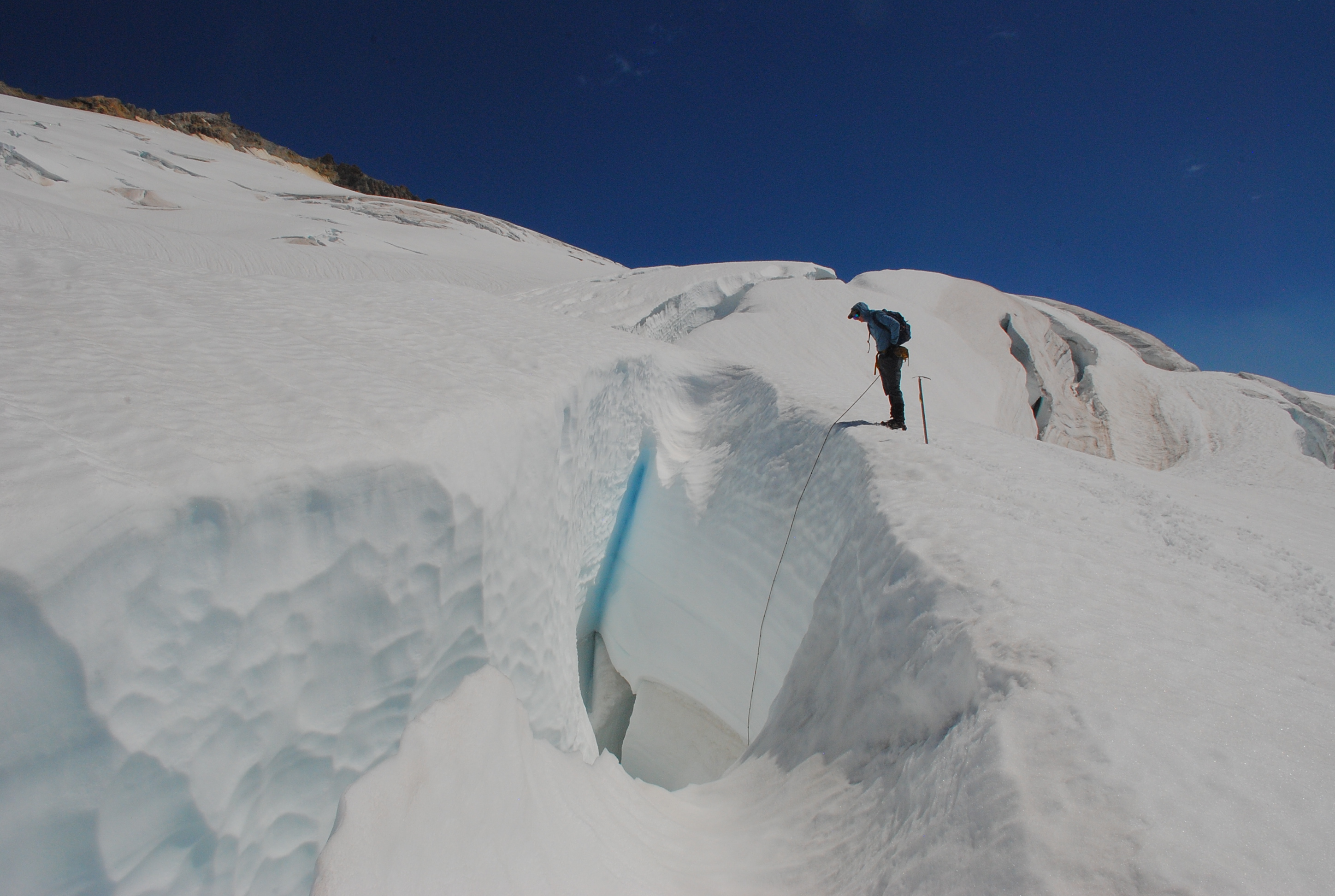
Hannah Contreras: In a melted feature looking up at two newly exposed, widening bedrock areas in the Easton Glacier icefall. As bedrock becomes visible, it’s darker shade absorbs heat and melts the ice around it even faster, creating a vicious cycle. In between measuring crevasse and snow depth, this field season we observed newly exposed bedrock in the icefall, again at ~9000 ft just off the popular Easton climber’s route, and finally at the top of the famed Roman Wall (~10,000 ft). Seeing growing bands of melted out bedrock at these elevations and features highlights how threatened the Easton truly is. As a mountaineer, I have spent quite a bit of time both traveling on and marveling at glaciers, but never like this. Experiencing these landscapes always evokes a strong sense of awe, appreciation, and inspiration, but when faced with the magnitude, speed, and decisiveness of their retreat, these feelings were countered by an equally powerful sense of dread and loss.
Petermann Glacier in Landsat images from July 21st and Aug. 13 2026. Indicating the rift that leads to iceberg calving of berg A-yellow arrows. Additional significant rifting inidicated by red arrows. Berg B is not a stable configuration.
The Petermann Glacier in northwest Greenland is significantly different than the fast flowing large outlet glaciers, such as the Jakobshavn and Helheim Glacier we here so much about. Petermann Glacier is much thinner at the calving front and moves much slower. The volume flux from this glacier is much less than Jakobshavn which loses 40 km3 per year, versus 1 km3 at the calving front of Peteramann and 12 km3 at the grounding line. A detailed review of some of the differences is explored in an article I wrote for Realclimate in 2008. In 2008 Petermann Glacier lost a substantial area, 29 km2 due to calving. Additional large calving events in 2010, when a 250 km2 berg broke off and in 2012 a 32 km2 berg broke off (NASA, 2023).
This summer the rifts that have been evident for some time cutting across the glacier led to a calving event on Aug. 4th, reported by Univesity of Ottawa researcher Adam Garbo. Because of the flat nature of this feature it can be referred to as an ice island as well. Imagery from July 21 indicates no calving. By August 6th berg A, with an area of 75km2 . The glacier thickness at the calving front is less than 150 m, which allows this berg to cross the sill that is 350-450 m deep (Tinto et al 2015), and move out of the fjord. The berg has moved 28 km from Aug. 4 to Aug. 13, a velocity of ~3 km per day. Becuase the ratio of berg length and width to thickness, this is not an iceberg that will turnover. Exiting the fjord the iceberg has turned southwest.
Existing rifting indicates that additional iceberg B will break off in the near future, behind this additional rifting indicates a weakness cutting across almost the entire glacier for additional calving that will occur in the next several years, though likely not as a single large ice berg. This is the largest observed calved ice berg in the Northern Hemisphere in 2026.
Petermann Glacier in Landsat images from Aug. 6th and Aug. 13 2026. The iceberg has separated by just a 5 kilometers by Aug. 6th, and 28 km by Aug. 13th. Additional significant rifting inidicated by red arrows. Berg B is not a stable configuration.
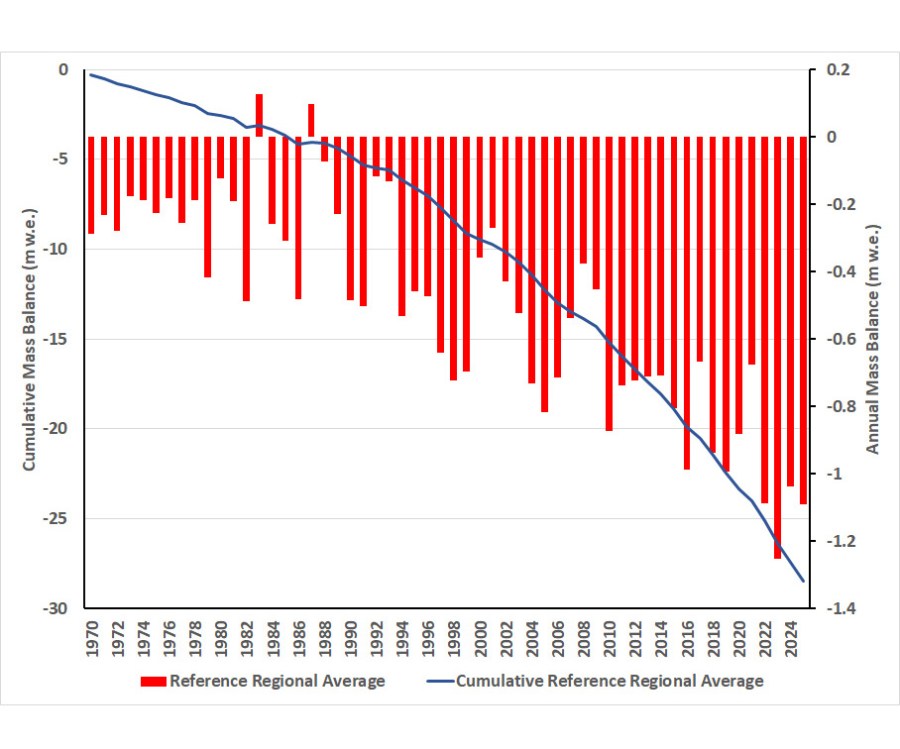
Figure 1. Global mean annual balance (bars) and cumulative balance (line) from the WGMS data set.
Each year since 2008 I have been responsible for summarizing the global alpine glacier status for each specific year in the Bulletin of the American Meteorological Society State of the Climate report. The 2025 report came out in early August. Below is the report with several added figures.
The 2025 World Glacier Monitoring Service (WGMS) dataset of annual glaciological mass balance observations includes 162 glaciers from six continents and 26 nations, 158 with a negative balance and four with a positive balance. In 2025, the mean annual mass balance of the 59 reporting global reference glaciers was –1.34 m w.e., and -1.34 m w.e. for all 162 reporting glaciers. The 2025 regionalized global average annual balance of –1.09 m w.e., is the fourth consecutive year with mass balance loss exceeding 1.0 m w.e., 2023 had the most negative -1.23 m w.e and 2024 was at 1.04 m w.e. Since 1976, mountain glaciers and ice caps have lost 9179+621 Gt of water, contributing 25.3+1.7 mm to the global mean sea level rise, with 41% of this loss occurring in the last decade (Dussaillant et al. 2025).
The mean annual balance of global reference glaciers was -1.34 m w.e., a similar result to 2023 and 2024 with a mean annual balance for global reference glaciers of -1.60 m w.e. and -1.37 m w.e., respectively. This makes 2025 the 38th consecutive year with a global alpine mass balance loss, the 16th consecutive year with a regionalized global mass balance below –0.5 m w.e. The significant acceleration of mass balance loss is evident in glaciological observations, geodetic observations, altimetry observations and gravimetric observations (The GlaMBIE Team, 2025). The acceleration of mass balance loss indicates glaciers are not approaching equilibrium and increasingly are disappearing. The Global Land Ice Measurement from Space inventory of global glaciers has now added an extinct glacier layer to record glaciers that have disappeared, that is populated by 181 glaciers that had existed in a previous inventory (Raup et al. 2025). In conjunction with 2025 being the UN International Year for Glaciers’ Preservation the Global Glacier Casualty List has been created to chronicle the story of specific glaciers being lost from each glaciated region (Boyer and Howe, 2025).
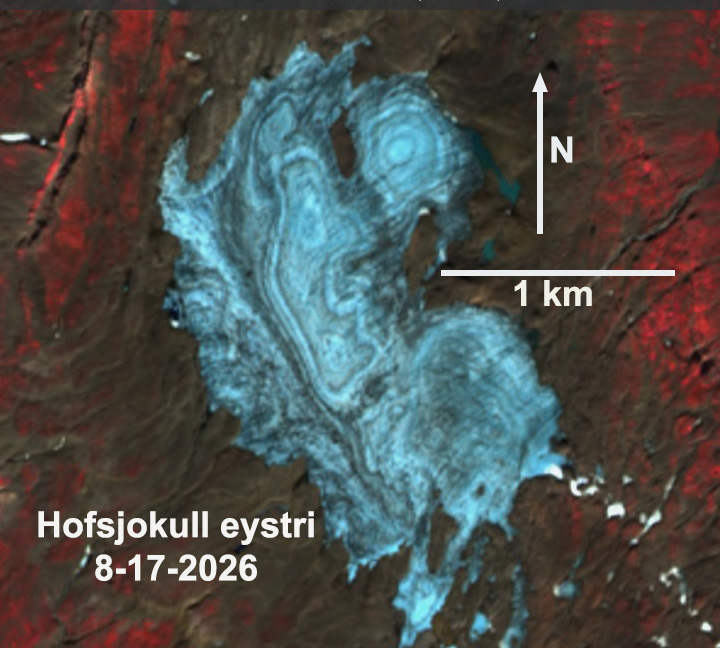
Hofsjokull eystri, Iceland was snow free by mid-August, leading to extensive ice cap thinning.
In the European Alps all 54 glaciers observed had negative balances, with 45 of the glaciers losing over 1 .0 m w.e. In Iceland (6) and Svalbard (9) all 15 glaciers observed lost over 1.0 m w.e. In Norway 8 of 10 glaciers had a negative balance, with two glaciers having a positive balance. In Sweden 3 of 4 glaciers had a negative balance.
High snow line on Durung Drung Glacier, India near end of summer monsoon season.
In Asia all 23 glaciers across 7 nations had negative balances averaging 0.97 m w.e. In New Zealand the glaciers observed had a negative mass balance.
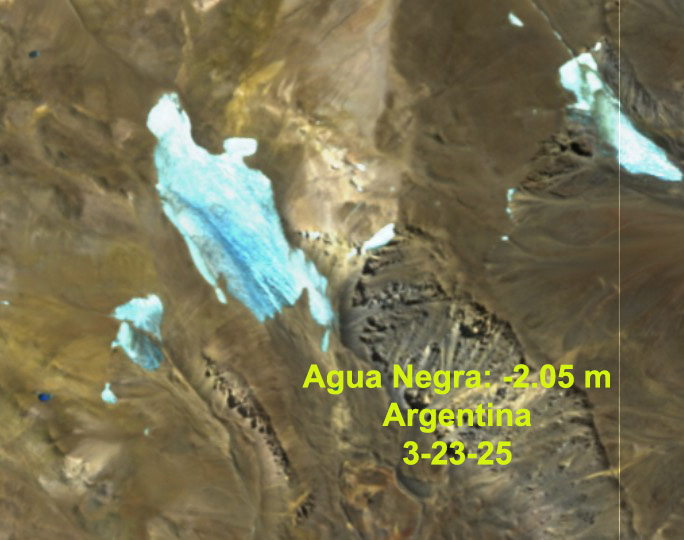
Agua Negra Glacier, Argentina with minimal snow cover at end of summer melt season.
In the Andes Mountains of South America nine of ten, reporting from four nations, had negative balances, with an average balance of -0.92 m w.e.
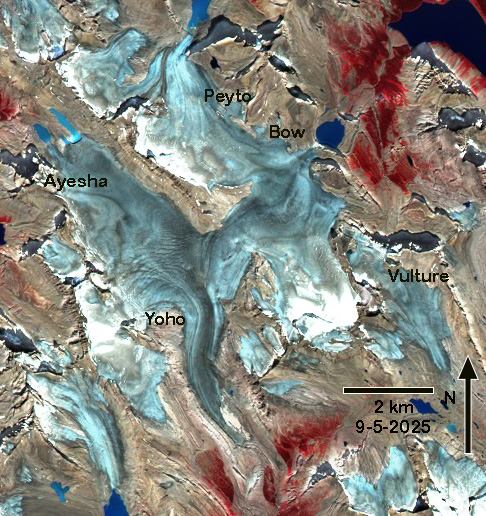
All 14 glaciers in Western North America, outside of Alaska, had mass balance below -1.0 m w.e. with an average of -2.24 m w.e. Peyto Glacier, Canada exemplifies the limited retained snow cover on alpine glaciers in Western North America in 2025, a glacier should be 50-60% snow covered at the end of summer to be in equilibrium (Fig X2). It is evident Peyto Glacier is representative of adjacent glaciers that also have limited retained snow cover. In Alaska 3 of 4 glaciers had negative balances. The five glaciers in Arctic Canada all had small negative balances averaging -0.16 m w.e.
Snow cover was minimal in the Yoho-Peyto Glacier regions, Canada at the end of the melt season.
Alpine annual mass balance glaciological observations are reported to the WGMS by National representatives with a December 1 annual submission deadline. WGMS reference glaciers (60) have at least thirty continuous years of mass balance observation. Benchmark glaciers (23) have at least a ten-year mass balance record and are in regions that lack sufficient reference glaciers. The combination of benchmark and reference glaciers are used to generate regional averages (WGMS, 2023). Global values are calculated using a single averaged value for each of 19 mountain regions, limiting bias from observed regions (WGMS, 2023). Expansion of this data set leads to reanalysis and updated values.
References
Boyer, D. and Howe, C. 2025. Communication efforts to educate the public about vanishing glaciers, 1958–2025. Annals of Glaciology, 67: e2. doi:10.1017/aog.2025.10033
Dussaillant, I., Hugonnet, R., Huss, M., Berthier, E., Bannwart, J., Paul, F., and Zemp, M. 2025: Annual mass change of the world’s glaciers from 1976 to 2024 by temporal downscaling of satellite data with in-situ observations. Earth System Science Data 17(5): 1977-2006, https://essd.copernicus.org/articles/17/1977/2025/.
Raup, B., Andreassen, L., Boyer, D., Howe, C., Pelto, M., and Rabatel, A. 2025: Tracking extinct glaciers in GLIMS. Annals of Glaciology, 66, e35, 1–6. https://doi.org/10.1017/aog.2025.10027
Lower Curtis Glacier terminus in 2025 with overall results of our work 1984-2025.
2026 Field Season: For the 43rd consecutive summer we are heading into the field to measure and communicate the impact of climate change on North Cascade glaciers. This field season follows the 2021-2025 seasons that featured either historic heat waves and/or periods of extended warm weather. The heat led to a greater exposure of bare ice on glaciers with a higher albedo and greater density. The observed melt rates are 7-9 cm/day water equivalent during warm weather events vs 4-6 cm/day for snow surfaces. This led to substantial mass losses on North Cascade glacier for the five years of ~8m. This winter was poor and the summer will be hard on glaciers. This year we have provided support from Alpine Start, Marmot, Protect our Winters and Smartwool.
Science objectives: We will complete detailed measurements on 10 glaciers, three of which are part of the World Glacier Monitoring Service reference glacier network (48 glaciers globally), which have 30+ consecutive years of mass balance observations. This summer we will have an opportunity to assess the long-term ramifications of the 2021-2025 period of unprecedented mass balance losses and associated glacier changes, with detailed mass balance, crevasse depths and glacier surface elevation profiling. We also focus on the impact of diminishing glacier size on downstream runoff.
Art Objectives: We will collaborate with several artists who will join us for a portion of the field season. They will be able to create their own work about the landscape and the science or may join us for fieldwork and make plans for future artwork. We hope to use this art to share our research with a broader audience and highlight the beauty and importance of these places.
Communication Objectives: We will leverage the brands of our expedition sponsors and local organizations that we are building collaborations to focus on continued rapid glacier loss and the downstream effects. We will utilize a combination of artists and scientists to tell the story.
Painting by Jill Pelto of the Nooksack watershed illustrating connections from glacier to the sea.
Bios
Jill Pelto (she/her) is an artist and scientist from New England who grew up loving winter sports and trips to the mountains. She incorporates scientific research and data into paintings and prints to communicate environmental changes. 2025 was Jill’s 17th field season. She has coordinated an art gallery exhibit “Shaped by Ice” in Seattle in 2025 and in Winthrop, WA in 2026. She is excited about continuing to document the change in North Cascade glaciers that she has witnessed each of the last ten years —through science and art.
Mauri Pelto (he/him)has directed the project since its founding in 1984, spending more than 800 nights camped out adjacent to these glaciers. He is the United States representative to the World Glacier Monitoring Service. For 16years he has been author of the blog “From a Glacier’s Perspective”, and associate editor for three science journals. He is on the Science Advisory Board for NASA’s Earth Observatory. His primary position is Associate Provost at Nichols College, where he has been a professor since 1989. He either runs on trails or skis on alpine and cross country trails every day.
Ava Reynolds is a printmaker examining the relationship between environmental beauty and climate change in her work. Ava holds a B.A. in Global Sustainability and a B.A. in Studio Art from the University of Virginia (2020), and is in her first year at the Rhode Island School of Design, pursuing an MFA in Printmaking. She finds inspiration for her prints from organic forms, natural landscapes, and climate change data and seeks to use art as a medium to engage with a large audience about the impacts of climate change.
Shaina Dotson is a Seattle-based creative with a BFA in Metalsmithing whose hobbies include metal arts, fiber arts, and printmaking. She serves on the board of the Washington Alpine Club and instructs for their Basic Climbing Class, sharing her love of the mountains with new climbers. Shaina is an avid mountaineer who finds joy in exploring the forests, peaks, and wild places of Washington State. Her deep connection to the landscape, combined with a love of learning and giving back to her community, naturally drew her to this project. She looks forward to creating new work inspired by the glaciers of Washington and the research this project brings to light.
Rikki Held is an early-career scientist passionate about understanding Earth and climate systems and communicating science through film. Growing up on her family’s ranch in southeastern Montana and studying the adjacent river with USGS scientists sparked her interest in investigating the complex Earth systems in which we live. She earned her B.A. in Environmental Science at Colorado College and has conducted interdisciplinary research, taught high school biology and chemistry through the Peace Corps in Kenya, and communicated climate impacts through her climate advocacy work in Montana. In graduate school, Rikki aims to study glaciology and climate variability to better predict future change. She looks forward to learning from the scientists and artists involved in NCGCP and creating a short documentary on their inspiring work.
Abby Conner (she/her) is a water resources professional with a passion for connecting people to their local watersheds. She earned her M.S. in Civil Engineering from the University of Colorado and returned to the PNW, where she serves on the board of the Carkeek Watershed Community Action Project and volunteers with the Mountaineers. She looks forward to bringing her background in water resources to the NCGP and exploring the connections between North Cascade glaciers and the communities downstream.
Nina Adjanin (she/her) is an associate professor at Northwest Missouri State University. Her work integrates technology and immersive experiences to explore the intersection of education, extreme environments, and the impact of climate change on high mountains and polar regions. Beyond her academic work, Nina is an experienced high-altitude mountain guide and adventurer, with expeditions that have taken her to extreme environments around the world and shaped her interdisciplinary approach to research. Nina is thrilled to be joining this project documenting the changes in the North Cascade glaciers, bringing her background in extreme environments and climate change research.
Danielle Schlunegger-Warner is a multi-disciplinary artist working in sculpture, installation, and experimental digital photography, to celebrate the wonder of the natural world. After graduating from California College of Art with a BFA in Sculpture, she has fabricated and designed museum exhibits for over ten years and maintained an independent art practice including science communication projects. For NCGCP, Danielle plans to continue combining her art, science, and museum exhibit background. She will investigate how the rapidly changing glacial landscape of the Cascades can be seen through the lens of a microscope, intertwining field microscopy, image projection, and artistic observations illustrating impact of smallest forms of life the greater environment.
Team on Rainbow Glacier in 2025 from left Katie Hovind, Caitlin Quirk, Claire Sianna Seaman, Jill Pelto and Margaret Kingston.
2026 Schedule
July 28: Hike In Lower Curtis Glacier
July 29: Lower Curtis Glacier survey
July 30: Hike Out Lower Curtis/Hike in Ptarmigan Ridge
July 31: Sholes Glacier
Aug. 1: Rainbow Glacier
Aug. 2: Rainbow Glacier
Aug. 3: Hike out. Hike in Easton Glacier (Resupply in Bellingham WA)
Aug. 4: Easton Glacier
Aug. 5: Easton Glacier
Aug. 6: Squak Glacier
Aug. 7: Talum Glacier
Aug. 8: Hike out Hike in Columbia Glacier (resupply in Monroe WA)
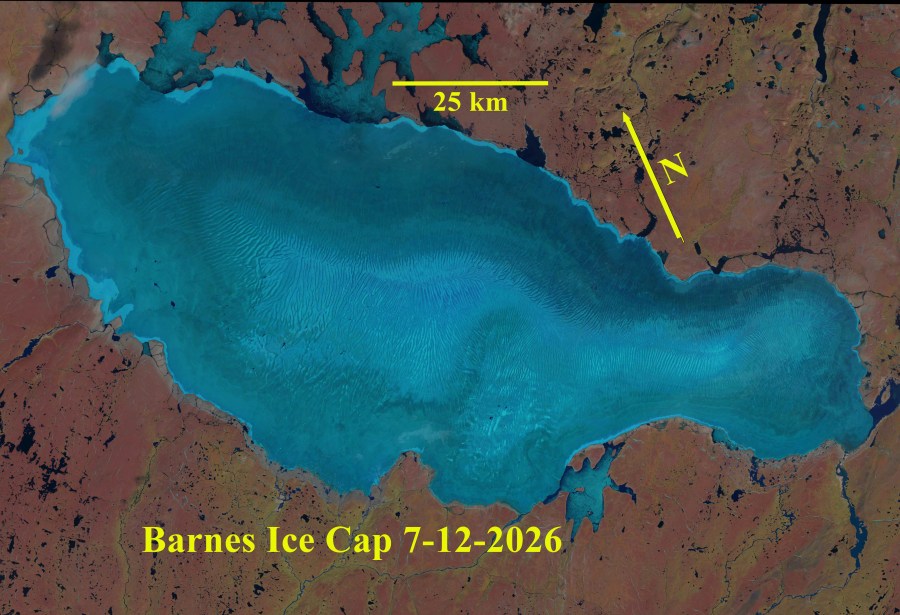
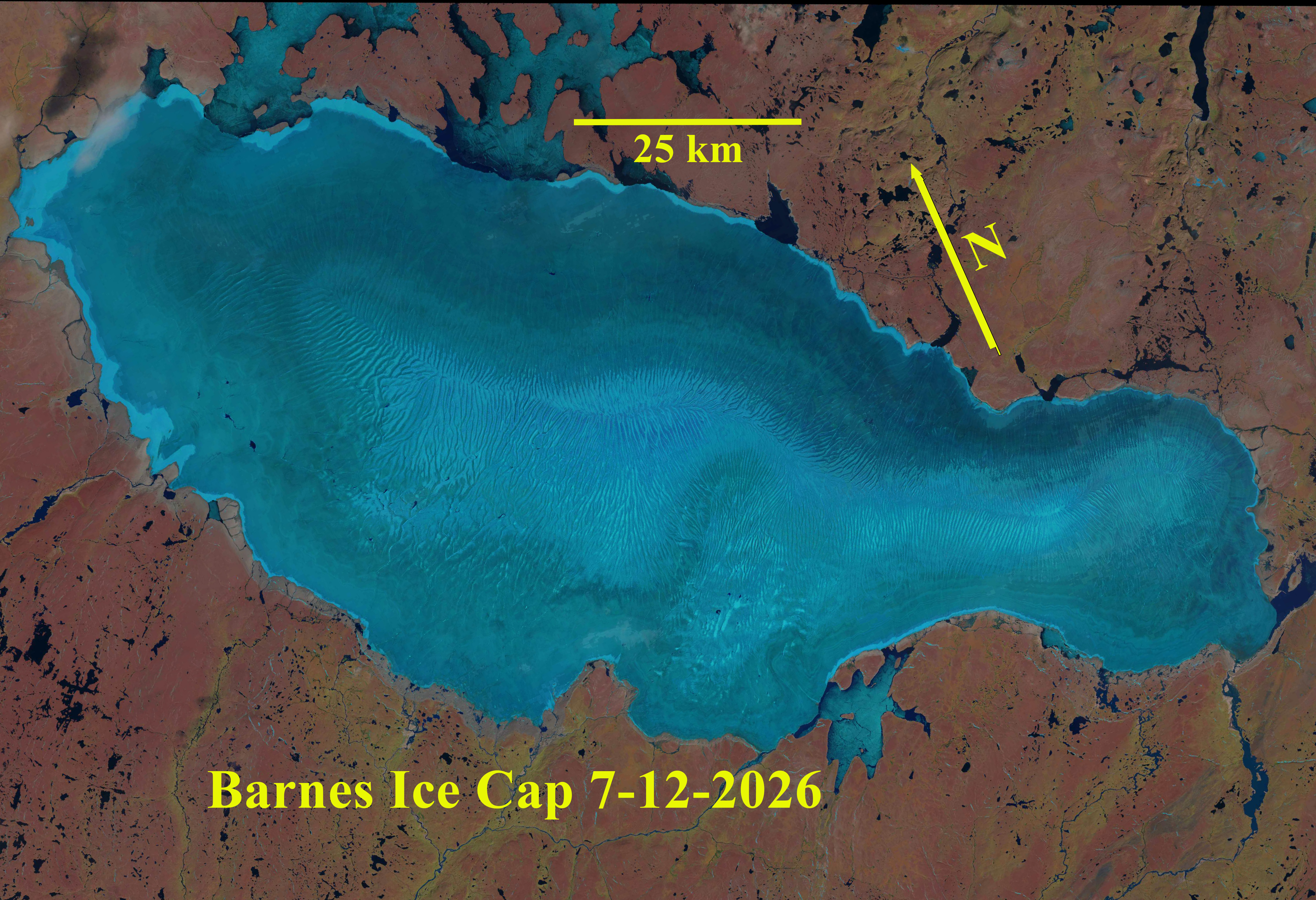
Barnes Ice Cap having in Landsat image with well developed melt channels from crest to margin of ice cap. Snow cover has been lost with over a month left in melt season.
Barnes Ice Cap located in the center of Baffin Island, Canada covers an area of ~5731 km2 in 2021 (Rippin et al 2026). The ice cap is approximately 150 km long, 60 km wide and has maximum ice thickness of ~730 m and a maximum ice elevation of 1124 m above sea level (asl) at the summit of the north dome. ICESat altimeter data indicated the thinning of the BIC at a mean rate of 0.75 m/year for the 2003–2009 period Gilbert et al (2016). They also noted that the ELA was at 950 in the 1960-80 period and is at 1100 m from 2002-2010 this leaves a limited accumulation zone area. observe that Barnes Ice Cap lost its accumulation area beginning in 2010, in part due to the longer melt season. The glacier does tend to not retain snowcover the accumulation zone consists of superimposed ice at the crest. Papasodoro et al (2016) noted that glacier wide balances were −0.52 m w.e./year from 1960 to 2013 and doubled to −1.06m w.e./year from 2005 to 2013 and remained at ~-1 m/a year through 2021 (Rippin et al 2026).
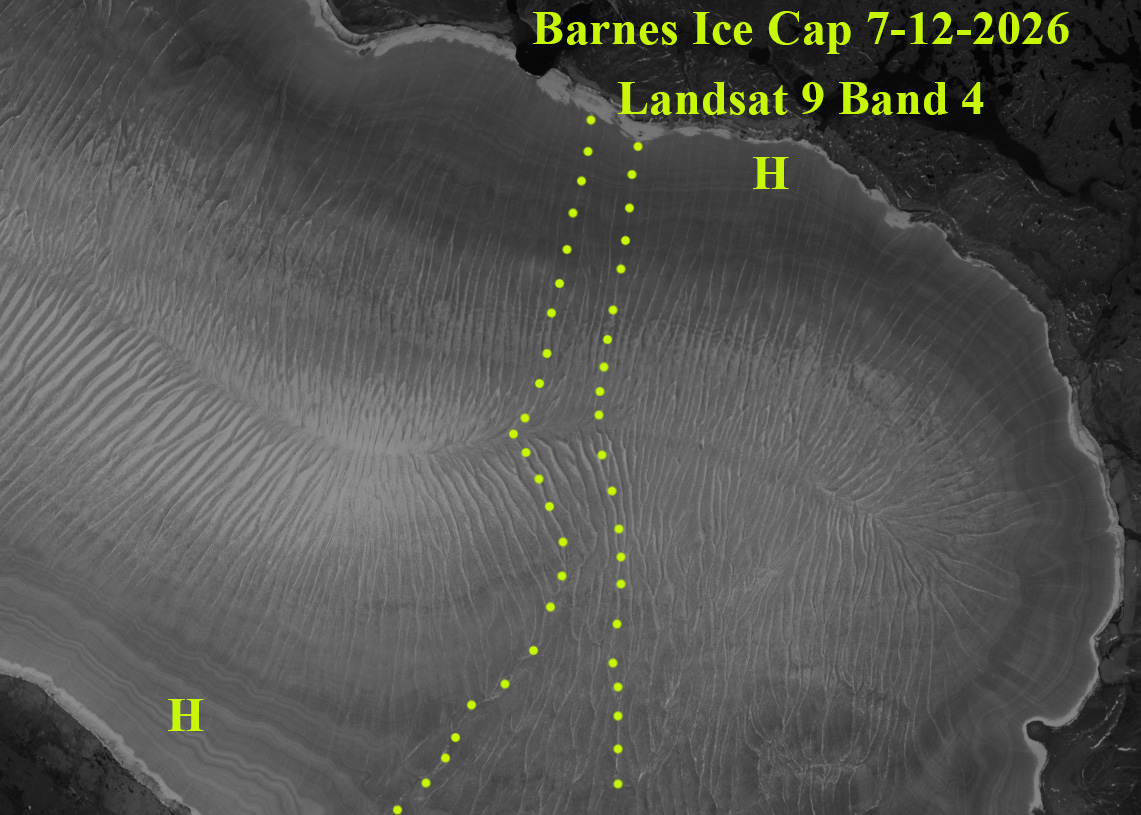
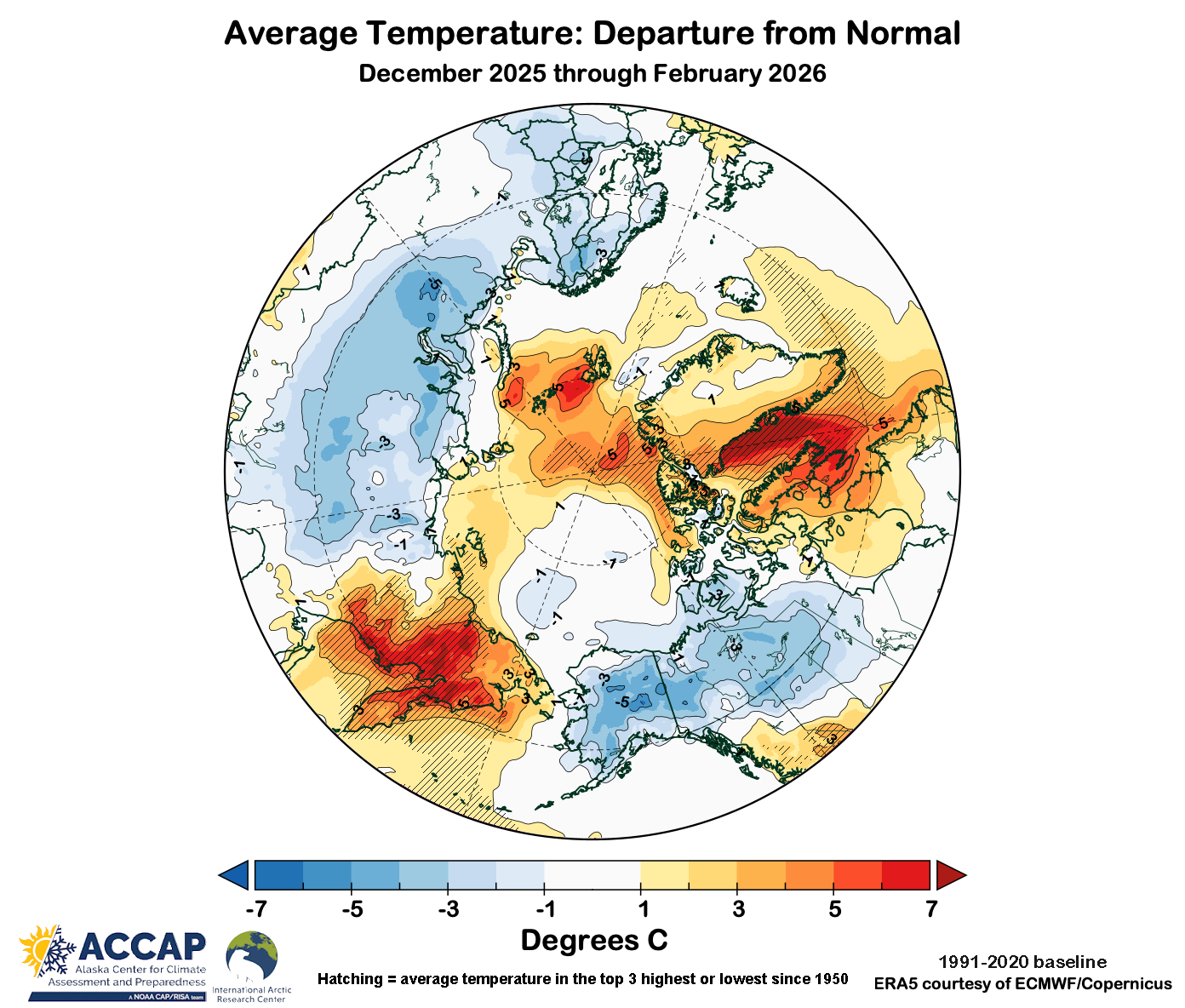
This has enabled supraglacial channels/valleys to develop and expand from year to year, extending from the ice cap crest to the margin, providing an effective pathway for meltwater to leave the ice sheet (Rippin et al 2026). This greatly diminishes refreezing, which had been the key mechanism for accumulation. The channels persist through and between melt seasons. There is insufficient ice motion or annual accumulation to offset the melt season runoff impact. Note the Band 4 image below indicates the extent of specific channels and how they cross cut specific stratigraphic ice horizons (H). Winter conditions were 3-5 C above average in the area, with spring and early summer conditions being normal or slightly below normal. This combined with the rapid snow loss on the ice cap between June 24 and July 12 indicates that snowpack was thin.
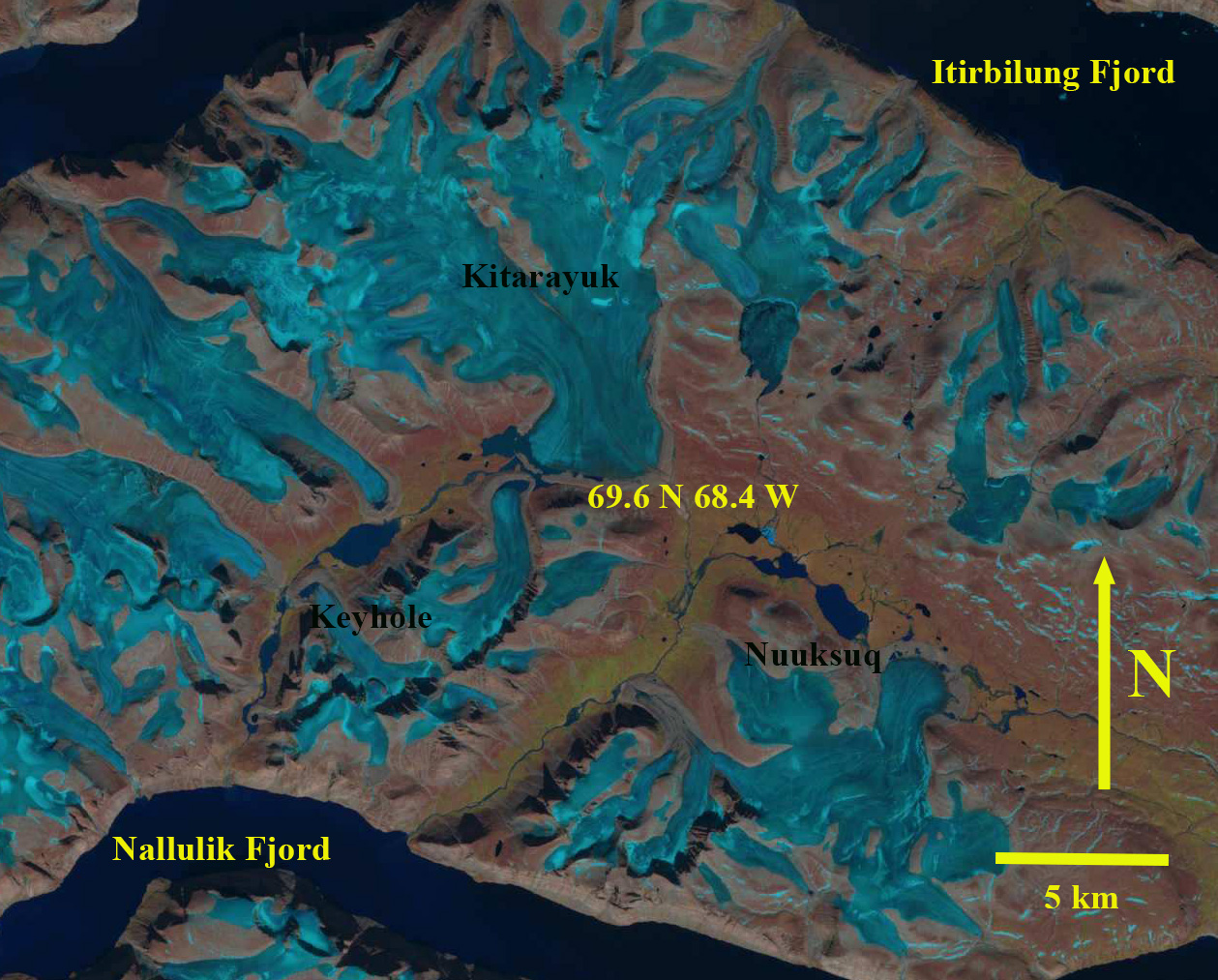
Barnes Ice Cap southern lobe with specific supraglacial stream channels noted. These have incised into the surface and persist. They cross stratigraphic ice horizons (H) near the margin of this Landsat Band 4 image from July 12, 2026.Winter temperature anomaly across the Arctic.Glaciers on Peninsula on northern side of Home Bay having lost nearly all snowcover by July 15, 2026 in this Landsat image.
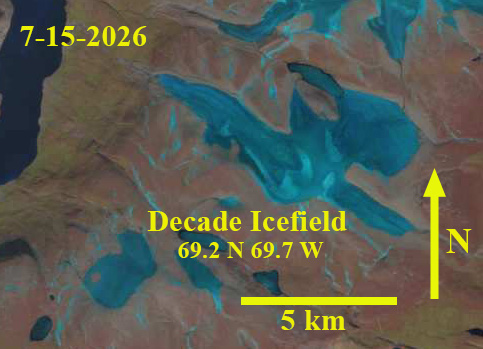
In mid-July 2026 Landsat imagery indicates the loss of all snow cover on Barnes Ice cap and that the supraglacial streams are fully activated. A series of glaciers to the east of the ice cap also have lost all snowcover including Keyhole, Kitarchick and Nuusuq Glacier. With over a month left in the melt season this will lead to substantial mass balance loss of these glaciers, driving further thinning and recession. Decade Icefield just to the north of this trio of glaciers also has lost all snow cover by mid-July.
Decade Icefield in Landsat image from mid-July has lost its snow cover.Barnes Ice Cap southeast region illustrating suprglacial stream extent and lack of snowcver from margin to summit of ice cap in Landsat image.