Khatling Glacier Retreat, Uttarakhand, India

Khatling Bamak (Glacier) is the headwaters of the Bhilangana River in Uttarakhand, India. The Bhilangana River flows into the Tehri Reservoir(2400 MW), that along with the Bhilangana River’s three small hydropower projects (50 MW), make these glaciers key contributors to regional hydropower. The glacier was formerly joined with the Ratangrian Glacier as indicated by the map, but the two have separated with the Ratangrian Glacier now terminating 1.7 km upvalley of this former connection. The 10 km long glacier is fed by several mountain peaks including Jaonli over 6000 m. The lower section of the glacier is debris covered. khatling map
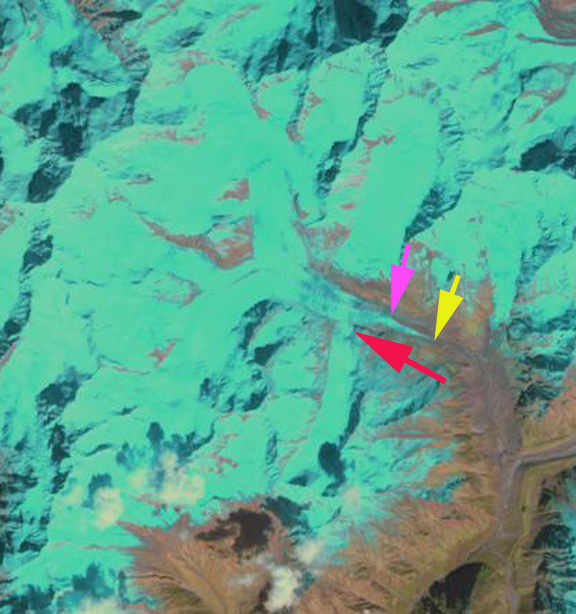
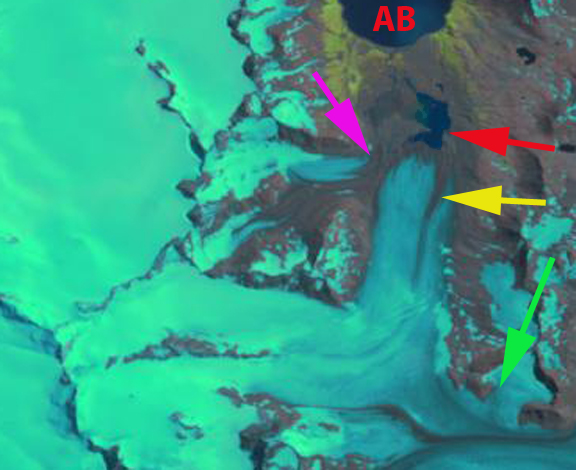
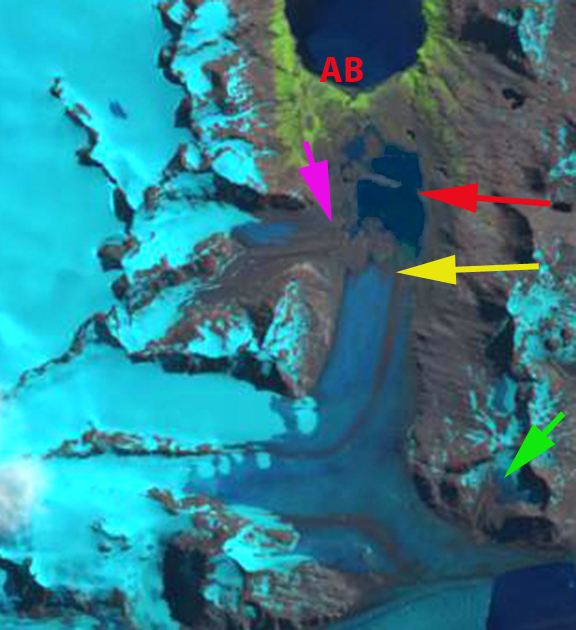
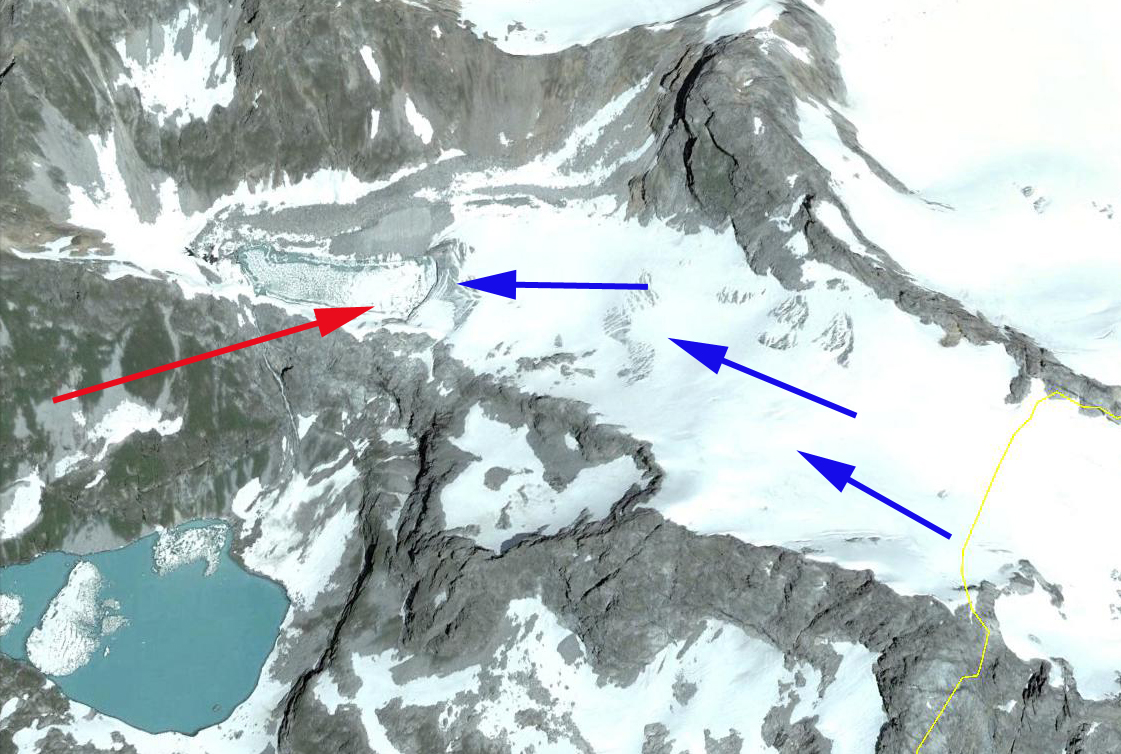
Here we examine satellite imagery from 1998, 1999, 2011 and 2013 to identify recent changes. The yellow arrow in the images indicates the lower limit of the clean ice in 1998, the pink arrow the lower limit of the clean ice in 2013. The red arrow indicates a significant tributary to Khatling Glacier joining from the south. The terminus is not evident in the Landsat images, but can be observed in the Google Earth imagery.

In 1998 the southern tributary joins the Khatling Glacier at 4500 m, 2.5 km upglacier of the terminus. The clean ice extends to within 1 km of the terminus. In the 1999 image the same connection with the southern tributary and location of the clean ice is evident. By 2011 the southern tributary is no longer connected to the glacier, red arrow. The clean ice does not reach the yellow arrow. The spread of the debris cover is not from additional avalanche input or flow from upglacier. The spread occurs as a glaciers ablation melts the clean ice faster and the debris cover where thick slows ice melt. This leads to topographic highs covered by debris cover that than slide-tumble down onto the clean ice. Without much input from upglacier the debris within the ice is melted out and can continue to concentrate at the surface. This is common among retreating glaciers with debris cover to have the debris begins to spread across the glacier. By 2013 the clean ice extent has retreated 1000 m from 1998 to the pink arrow of 2103. The southern tributary has retreated 200 m from its former junction. The terminus of the glacier has retreated 400 m from 1998-2013. A close up of the terminus from 2011 Google Earth imagery indicates the outlet river (pink arrow) issuing from beneath the stagnant debris covered ice (DC) and the distance from the terminus to the clean ice (CI). The lateral moraines of the Khatling and Ratangrian Glacier are also shown. The hummocky thin nature of the lower 700 m of the glacier is evident, light blue arrows, indicating an area that will be lost from the glacier soon. Khatling Glacier retreat is similar to that of nearby Gangotri Glacier and Jaonli Glacier that also feed Tehri Dam.
khatling 1998
1998 Landsat image

khatling 1999
1999 Landsat image

khatling 2011
2011 Landsat image

khatling 2013
2013 Landsat image

khatling terminus upglacier
2011 Google Earth image

Ratangrian Glacier Retreat, Uttarakhand, India

Ratangrian Glacier is adjacent to Khatling Glacier and with that glacier is at the headwaters of the Bhilangana River. The Bhilangana River flows into the Tehri Reservoir(2400 MW), that along with the Bhilangana River’s three small hydropower projects (50 MW), make these glaciers key contributors to regional hydropower.
ratangrian glacier

Ratangrian ge

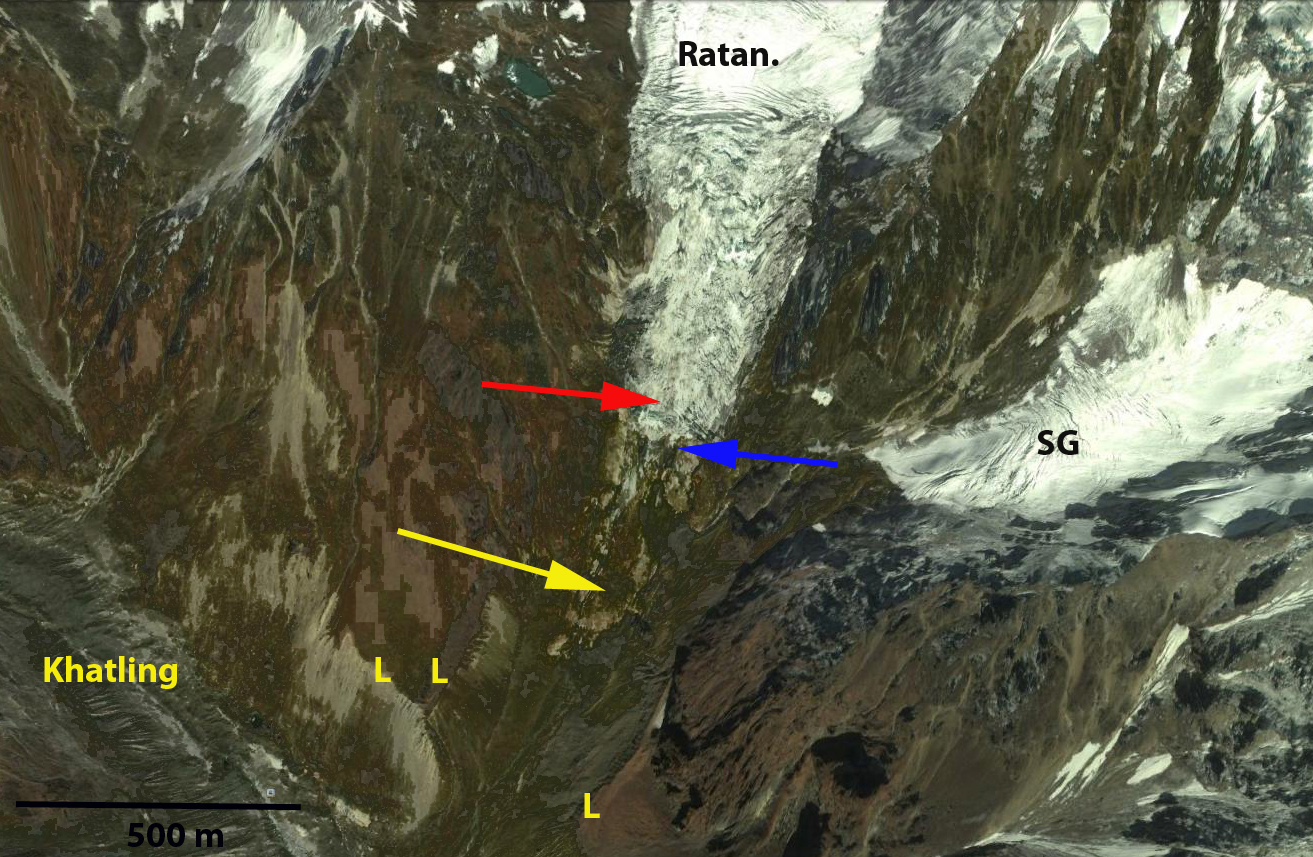
In the 1998 Landsat image the glacier terminus is at the red arrow, which is at 4150 m and downhill of the stream from the glacier labelled SG. The map above indicates the glacier was joined with Khatling Bamak at 3950 m, the lateral moraines (L-on second image below) indicate this too. The glacier is quite steep in its last mile descending from 5000 m to 4150 m in 1.5 km. The glacier is also not debris covered unlike many of its neighbors Khatling, Gangotri or Jaonli Glacier. A 2011 Google Earth image indicates the glacier has retreated to the blue arrow, where the outtlet stream from the glacier SG reaches the Ratangrian valley. By 2013 the glacier has retreated above the location where the outlet stream reaches the valley and is at the yellow arrow. The total retreat in 15 years is 400-450 m. The terminus of the glacier has risen from 4150 m to 4500 . The glacier is following the path of retreat of the nearby Gangotri Glacier and Jaonli Glacier that also feed Tehri Dam. The retreat is more rapid proportionally for the size of the glacier, probably due to the lack of debris cover. The slopes in the basin feeding the glacier are mostly covered by the glacier itself. If they were steeper and were not as ice covered, than avalanches could sweep debris onto the glacier.
ratangrian 1998b
1998 Landsat image

Ratangrian 2011
2011 Google Earth Image

Ratangrian 2013b
2013 Landsat image

Ratangrian 2013a
2013 Landsat image-closeup

Verde Glacier Retreat, Chile

Verde Glacier is adjacent to Reichert Glacier and drains the north side of the Northern Patagonia Icefield. It is a small glacier compare to many outlet glaciers of the icefield that have been examined in previous posts, Reichert Glacier, Steffen Glacier, Nef Glacier, and Colonia Glacier. Here we examine Landsat imagery during the 1998-2014 period to identify the response of the glacier. The glacier flows from a pair of peaks at 1800 m to terminate at the edge of a proglacial lake. There is a significant icefall at 800-1250 m and a significant avalanche fan at the base of this icefall that is spills from a disconnected portion of the glacier west of the terminus and just northwest of the icefall. Davies and Glasser (2012) Figure 2d indicates the glacier nearly filling the entire lake in 1975. In Figure 8a they indicate the fastest retreat for the glacier being from 1998-2014. Rivera et al (2007) indicate the ELA for the glacier at the top of the icefall 1250 m. npi north ge
The yellow arrow in each image is the 2014 terminus and the red arrow the 1998 terminus. In 1998 the glacier terminates at the red arrow just beyond the northeast bend in the lake. The lake is 1.6 km long. By 2001 the glacier has retreated 300 m and is at this bend. Notice that the lowest lone kilometer of the glacier is quite debris covered. By 2014 the glacier has retreated to the yellow arrow, this is a further 600 m retreat since 2011. The lake is 2.5 km long measured along its center line. The 900 meter retreat in 16 years is substantial for a glacier that is only 5 km long. A cloe up view of the terminus in a Goggle Earth image indicates that the lowest 300 m is debris coverered ice, notice the wetness of some of the debris, pink arrow. This looks more like ice cored moraine than active glacier ice covered by debris. If this is the case the active terminus is 300 m from the shore of the lake, at the yellow terminus where calving begins. It is certain the lake will expand further as the buried ice melts, but it is nearing its southwestern limit. The steep slope of the icefall and the rock slope to the right of the icefall is evident. This will lead to continued avalanching onto the terminus area, that will make that lowest region above the yellow arrow more difficult to melt out. One observation that is striking is the number of narrow alpine lakes that have formed and expanded as the Northern Patagonia Icefield outlet glaciers have receded. npi n 1998
1998 Landsat image

npi n2001
2001 Landsat image

npi n 2014
2014 Landsat image

verde icefall
Google Earth image

Reichert Glacier Rapid Retreat, Northern Patagonia Icefield, Chile

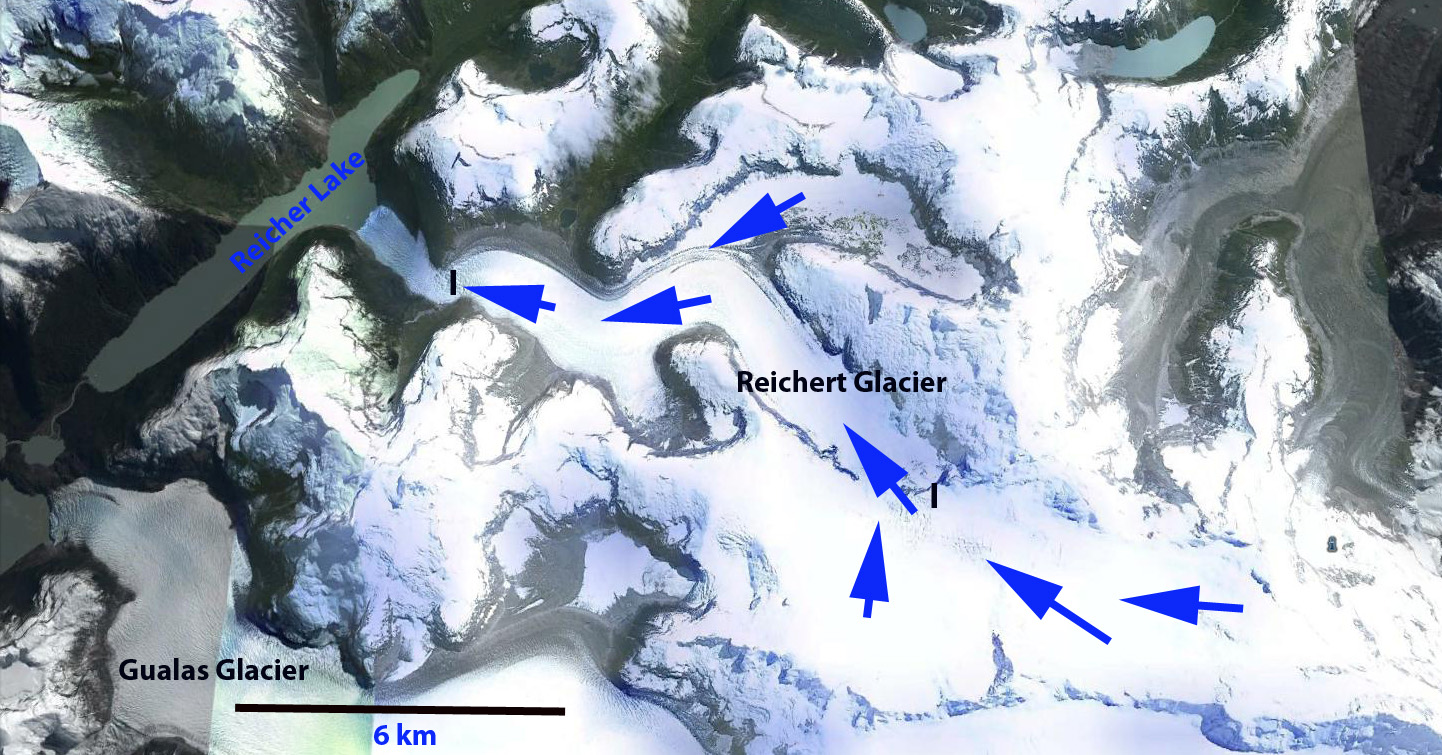
Reichert Glacier (Reicher) is at the northwest corner of the North Patagonia Icefield (NPI) and flows west from the Mont Saint Valentin region and ends in the expanding Reicher Lake. Rivera et al (2007) notes that the glacier was named for French geologist Federico Reichert, but that Reicher has ended up as the established spelling. They further note that the glacier lost 4.2 square kilometers of area from 1979 to 2001 and had an ELA of 1330 m. The glacier has two main icefalls, one at the first bend in the glacier above the terminus at 400 m, the second at the ELA from 1100-1600 m. Davies and Glasser (2012) identify the most rapid area loss of -0.77% per year to the 1986-2001 period. The glacier retreated rapidly from 1987-1997, but the terminus was stabilized from 1997-2001, before retreating again to near the 2014 terminus by 2002.
reicher glacier ge 2013
2013 Google Earth image
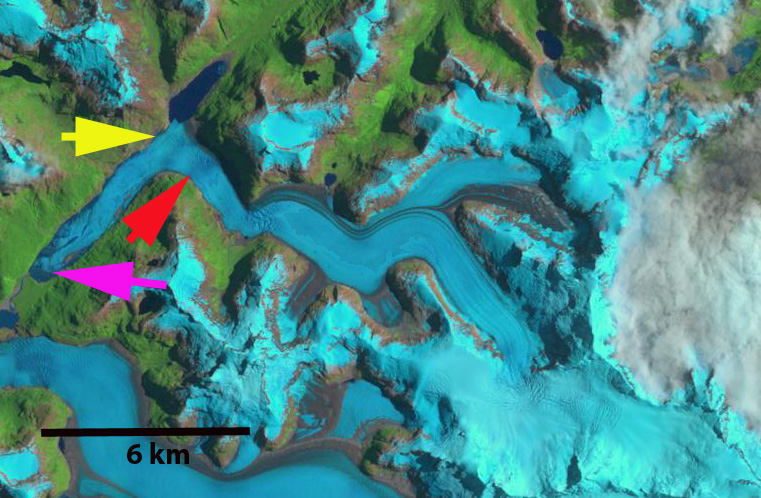
Here we examine Landsat imagery from 1986, 1997 and 2014 to document the changes. The pink arrow indicates the 1987, terminus, the yellow arrow the 1998 terminus and the red arrow the 2014 terminus. In 1987 the glacier terminates close to the southern end of Reicher Lake, pink arrow. By 1998 the glacier has retreated to the yellow arrow and is terminating on the west side of Reicher Lake across the lake from the main glacier valley. By 2014 the glacier has retreated into the main glacier valley and Reicher Lake extends 8.8 km from the northeast to southwest. A new lake has developed in 2014 above the first icefall, orange arrow. This lake indicates a potential second lake basin beginning to develop in the glacier reach above the first icefall. If this is the case another rapid retreat will ensue, though not in the immediate future. The glacier retreated 6.7 km from 1987 to 2014, with 90% of the retreat occuring by 2002. Area extent loss is 8-9 square kilometers. The lower icefall is 1.5 km from the current terminus, and indicates the maximum extent of Reicher lake and the retreat that can be enhanced by calving into that lake. This glacier has followed the pattern of the neighboring Gualas Glacier just to its south. WHOI-Oceanus recently published an interesting article on this glacier. The retreat is emblematic of the entire NPI as noted by both Rivera et al (2007) and Davies and Glasser (2012) work, the latter had an excellent Figure 8 indicating two periods of fastest recession since 1870, are 1975-1986 and 2001-2011 for NPI glaciers. This retreat includes that of Steffen Glacier, Nef Glacier, and Colonia Glacier.

reicher  glacier 1897
1987 Landsat image

reicher glacier 1998
1998 Landsat image

reicher glacier 2014
2014 Landsat image

Heaney Glacier and Cook Glacier Retreat, South Georgia Island

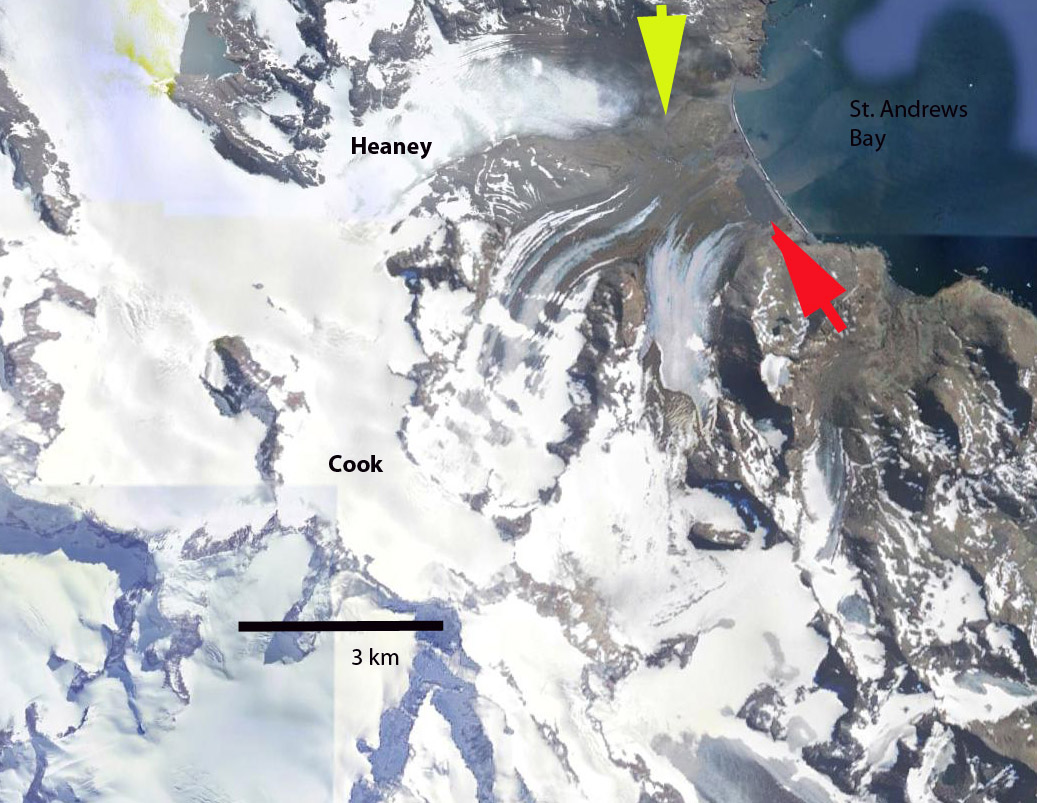
Heaney Glacier and Cook Glacier were merged near the terminus and reached the coast of St. Andrews Bay on the east coast of South Georgia Island in 1975. This is illustrated in a Geomorphology map of the area compiled by Chalmers Clapperton, and David Sugden produced with the support of the British Antarctic Survey, the glaciers terminates along the coastline.heaney glacier geology
Photograph of 1980 BAS map

Heany Glacier ge
2007 Google Earth Image

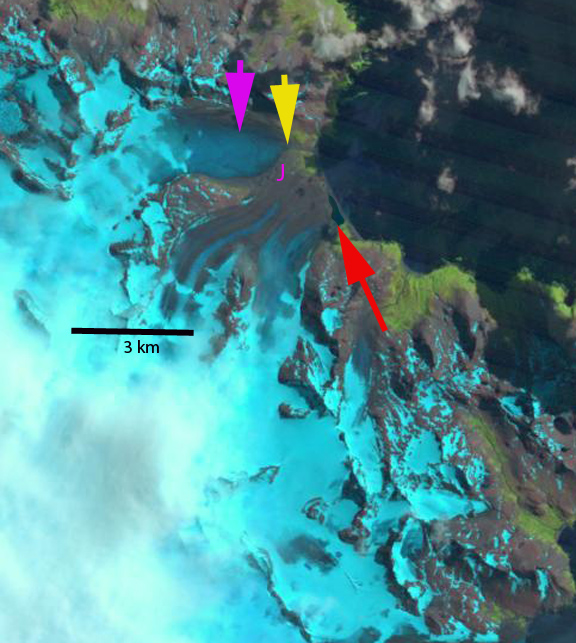
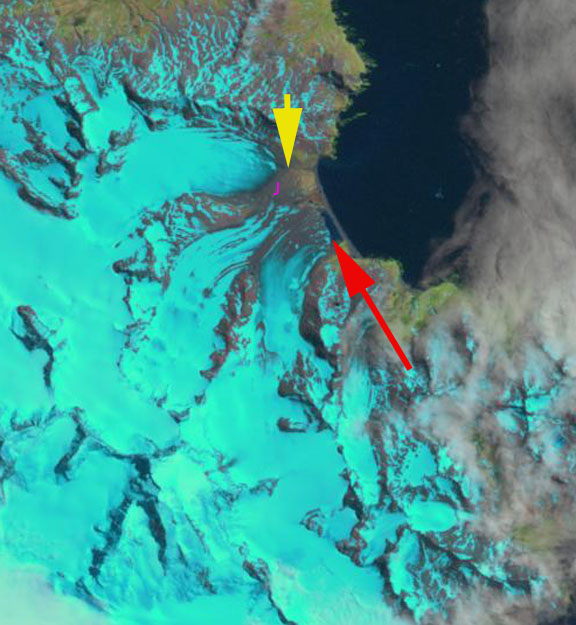
Here we use Landsat images to examine glacier change from 1989 to 2014. In 1989 Cook Glacier had retreated from the coast, and a small 200-300 m wide proglacial lake has formed at the end of the glacier, red arrow. The yellow arrow marks the 1989 terminus of Heaney Glacier in 1989 which is 800 m from the coast, pink arrow indicates 2014 terminus position. Point J marks the junction of the two glacier which is debris covered ice in 1989. The next image in 1999 indicates modest retreat of both glaciers. In 2003 Cook Glacier has retreated 500 m from the coastline, and Heaney Glacier is now 1100 m from the coast. In 2012 a small lake is developing at the front of the Heaney Glacier and the Cook Glacier proglacial lake has expanded to 700 m. In 2014 the narrow lake forming as Heaney Glacier retreat’s is now 600 m long and the glacier terminus is 1800 m from the coast, pink arrow. This is an 1000 m retreat from 1989 to 2014, 40 m/year. Point J is now fully deglaciated with Cook and Heaney Glacier being fully separated. Cook Glacier has retreated 900 m from the coast and 600-700 m since 1989. The proglacial lake, red arrow is 750 across and is still expanding as the glacier retreats. The story at this point is familiar with that of other land terminating glaciers on South Georgia Island, Konig Glacier and Purvis Glacier, with substantial accelerating retreat and lake formation at the terminus. Cook et al (2010) and Gordon et al (2008) have emphasized that this pattern is island wide with many calving glaciers having faster retreat.
heaney glacier 1989
1989 Landsat image

heaneyglacier 1999
1999 Landsat image

heaney glacier 2002
2002 Landsat image

heaney glacier 2012
2012 Landsat image

heaney glacier 2014
2014 Landsat image

Purvis Glacier Retreat, South Georgia Island

Purvis Glacier is on the norteastern coast of the island, terminating on land near Possession Bay. The British Antarctic Survey (BAS) has mapped many aspects of the island including glacier front changes. Their mapping indicated below shows that the Purvis Glacier terminus was on the coastline in 1974. Here we examine Landsat imagery from 1999 to 2014 to identify more recent changes. Cook et al (2010) quantified the change in these maps noting that 97% of the 102 coastal glacier retreated between the 1950’s and today.
purvis glacier map
BAS map of Glacier change.

purvis ge
Google Earth image

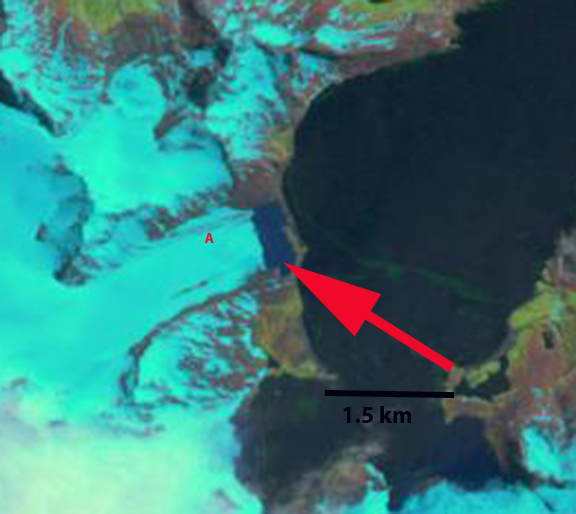
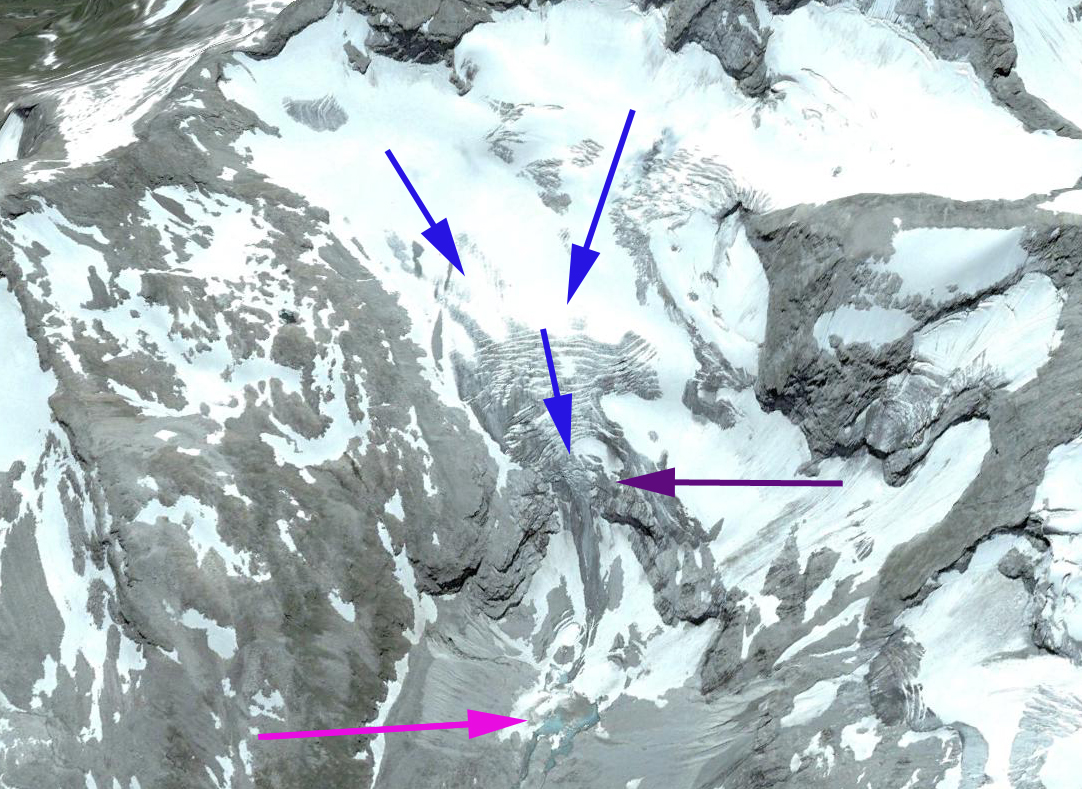
In 1999 the proglacial lake, red arrow, that the glacier terminated in was 300 m wide, indicating a retreat of 300-400 m since 1974. By 2002 the proglacial lake had expanded to a width of 600 m, exposing a peninsula at Point A. By 2013 the proglacial lake had expanded to 1050 m, further exposing the peninsula at Point A. By March 1, 2014 Landsat imagery indicates a retreat of 1100 m since 1974, with most of that retreat occurring since 1979. A closer look at the glacier from Google Earth highlights the issue. The glacier is fed by relatively low lying snowfields with quite limited areas above 500 m. Sugden, Clapperton and I in a 1989 paper identified the snowline a short distance from here at 400 to 450 m. As the 2011 Google Earth image indicates the remaining snowcover at the end of the melt season is minimal, too little to sustain this glacier (Pelto, 2010). Further a look at the terminus indicates the stagnant nature of the terminus region that will lead to continued retreat, blue arrows note ablation holes in the glacier that do not develop when a glacier is actively moving. The low slope and stagnant nature should preserve an excellent glacial geologic landscape.
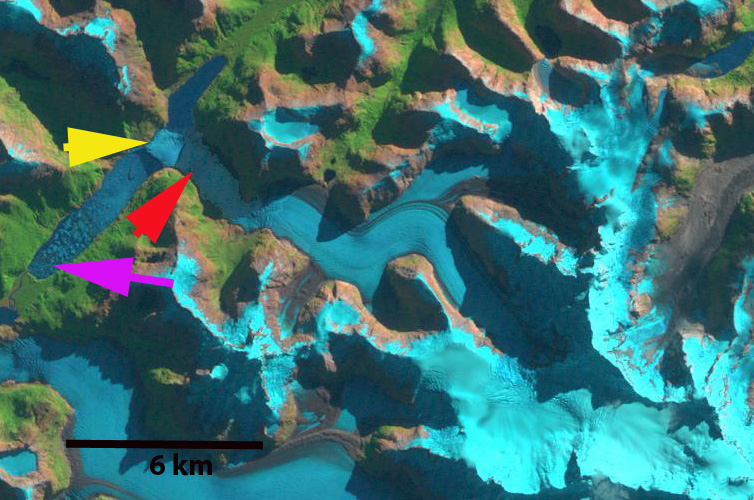
The glacier is behaving in the same fashion as other land terminating glaciers Heaney Glacier and Konig Glacier. The retreat is less than that of calving glaciers on the island Neumayer Glacier and Ross-Hindle Glacier.
purvis glacier 1999
1999 Landsat image

purvis glacier 2002
2002 Landsat image

purvis glacier 2013
2013 Landsat image

purvis glacier 2014
2014 Landsat image

purvis glacier terminus
Google Earth image

Konig Glacier Retreat, South Georgia Island

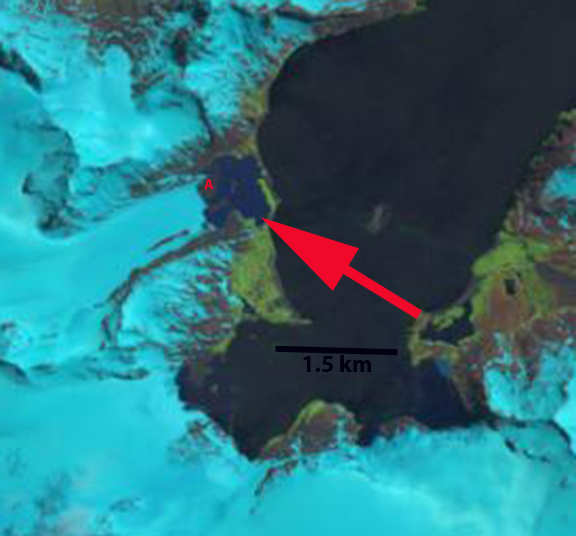
Konig Glacier is a land terminating glacier just north of the Neumayer Glacier, ending on an outwash plain in the Antarctic Bay (AB) on the northwest coast of South Georgia. In 1977 the glacier extended to within 300 m of Antarcic Bay and no proglacial lake existed (BAS map). Neumayer Glacier is a calving glacier that has retreated 4800 m from 1999 to 2014 and is dynamically connected to the Konig Glacier along its southern margin just where the glacier turns northeast. Gordon et al., (2008) observed that larger tidewater and sea-calving valley and outlet glaciers generally remained in relatively advanced positions until the 1980s. After 1980 most glaciers receded; some of these retreats have been dramatic and a number of small mountain glaciers will soon disappear. konig glacier ge Here we examine changes in Konig Glacier from 1999 to 2014 using Landsat imagery. In 1999 the glacier ended in a proglacial lake at the red arrow, where a terminal moraine developed across the lake. A tributary glacier from the west joins the Konig Glacier near the terminus in 1999, pink arrow. At the green arrow is a small cirque-valley glacier that joins the Neumayer Glacier near the boundary with Konig Glacier. In 2003 there has been limited retreat of the main terminus since 1999 and of the west tributary at the pink arrow, the British Antarctic Survey mapping shows that the two glacier had separated by 2003. The side cirque glacier at the green arrow is still connected. By 2005 a closeup of the terminus in Google earth indicates the low slope, lack of crevasses and developing outwash plain at the terminus. The terminal moraine in the middle of the lake marking the 1993 terminus position is also evident (BAS). The retreat from this moraine by 2005 is 500m. In 2014 the glacier has retreated from to the yellow arrow, this is an 800 m retreat in 15 years from the 1999 red arrow terminus. The proglacial lake is now 1500 m across and the terminus is 2300 m from Antarctic Bay. The west gtributary at the pink arrow is fully separated. The side cirque glacier at the green arrow no longer is connected to the Konig-Neumayer Glacier. This indicates considerable thinning of the junction of these two glaciers which will result in further retreat of Konig Glacier.
konig glacier 1999
1999 Landsat image
konig glacier 2003
2003 Landsat image

konig terminus
Google earth image 2005

konig glacier 2014
2014 Landsat image

Kluhor Glacier Retreat, Caucasus Mountains, Russia

Kluhor (Klukhor) Glacier is in the Caucasus Mountains west of Mount Elbrus. It drains into the Teberda River and then the Kuban River and eventually Krasnodar Reservoir and the Black Sea. The Krasnodar Reservoir is primarily a flood control and irrigation management reservoir. Here we examine three glaciers each experiencing the familiar pattern in the Caucasus Mountains of retreat with expansion of proglacial lakes. As the area and number of glacier is reduced, the number and area of alpine lakes is increasing, note Khimsa Glacier, Georgia, Psysh Glaciers, Russia, and Gora Bashkara, Russia. Stokes et al (2006) note that 94% of Caucasus Mountain glaciers retreated from 1985 to 2000 and it is clear from the aforementioned that the trends continues.
klukhori glacier ge lg

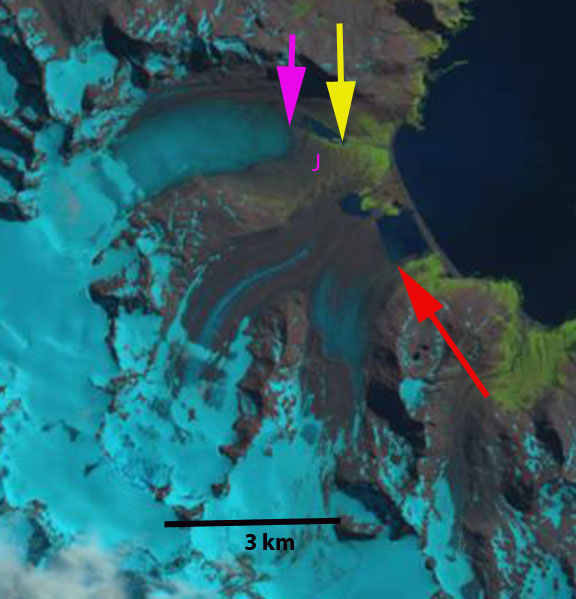
We examine Landsat imagery from 1998 and 2013 to identify the change. In each image the Kluhor Glacier terminus lake is indicated by the red arrow. The unnamed Glacier here named east Kluhor Glacier terminus lake is noted with a yellow arrow. Another unnamed glacier on Lednik Daut is identified here as north Daut Glacier is noted by pink and purple arrows. In 1998 there is small lake at the end of Upper Kluhor Glacier, 150 m long, and on east Kluhor Glacier, 50-100 m wide. At north Kluhor Glacier the glacier ends at the base of a steep icefall near a third lake, pink arrow. The purple arrow indicates the terminus of north Daut Glacier in each image. By 2013 Kluhor Glacier has retreated 300 m and the lake is 450-500 m long. The east Klhor Glacier has retreated 150 m and the lake is 250 m across. The north Daut Glacier has retreated to the top of the steep icefall slope, a 400 m retreat and is now quite distant from the lake below.

The 2007 Google Earth image of Kluhor Glacier there are a number of crevasses paralell to the ice front, indicating that some calving losses will continue to occur. The glacier overall extends from 2950 m to 3250 m, is narrow and has limited snowcover in both satellite images. The snowcover extent in the August satellite images, well before the end of the melt season is 30%, whereas typically 55-65% is necessary to sustain a glacier. In the 2007 Google Earth imagery the thin nature of the icefall at north Daut Glacier is evident, that has since melted away.
kluhor Glacier 1998
1998 Landsat image

kluhor glacier 2013
2013 Landsat image

klukhori glacier lake
2007 Google Earth image of Kluhor Glacier

klukhori glacier n
2007 Google earth image north Kluhor Glacier