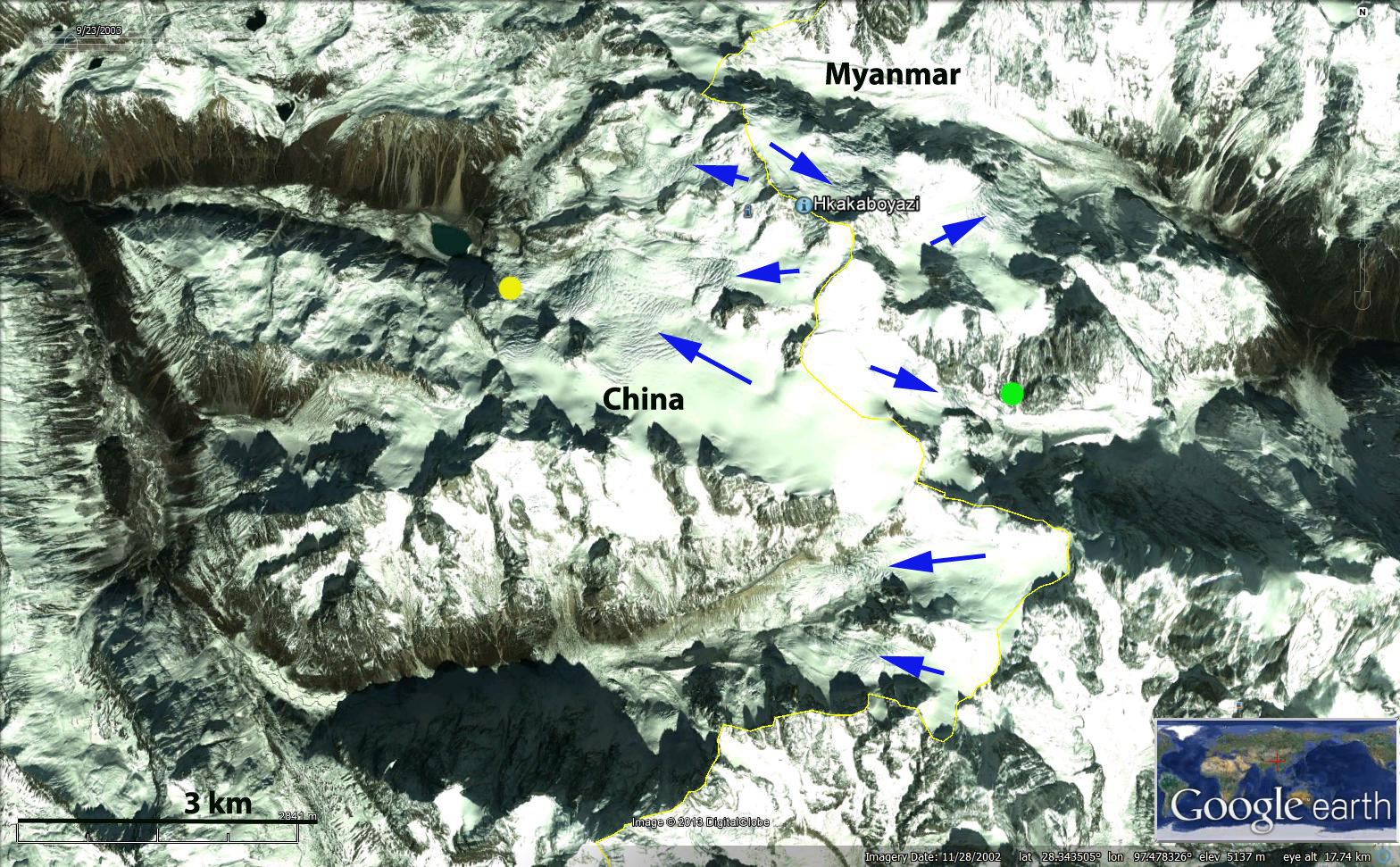
Hkakabo Razi is the highest peak in Myanmar and straddles the border with China. The Myanmar side (east) of the mountain drains into the Irrawaddy River and on the China side (west) to the Brahmaputra River. First of all how many people thought Myanmar had glaciers? Secondly this is a remote peak that only one party has managed to climb. In the Google Earth image the blue arrows indicate icefall regions and the direction of flow into these areas.
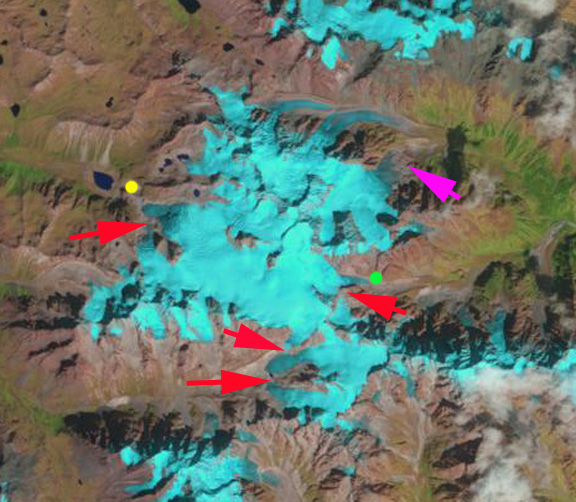
Here we examine the changes in several glaciers using Landsat imagery from 1987, 1996 and 2009. The red arrows indicate several locations in each image where in 1987 and 1996 sections of a each glacier coalesce. By 2009 in each of the red arrow locations the sections of the glacier have separated. The change in terminus position of three glaciers is also noted, the yellow dot indicates the terminus of the main west flowing glacier. The retreat from 1996 to 2009 is 250 m. The green dot indicates a location at the terminus of an east side glacier. In 1996 the terminus is at the down slope side of the dot and in 2009 the terminus barely reaches the up slope side of the green dot a retreat of 200 m. The pink arrow indicates the terminus of a steep east side glacier. In 1996 the glacier ended at a prominent cleft in the rock, pink arrow and by 2009 had retreated 200 m from this feature. These glaciers have behaved in a similar fashion to Hailuogou Glacier and the glaciers at the headwater of the Bode Zangbo. 
1987 Landsat image
Author: mspelto
Bode Zangbo Headwaters Glacier Retreat, Tibet, China
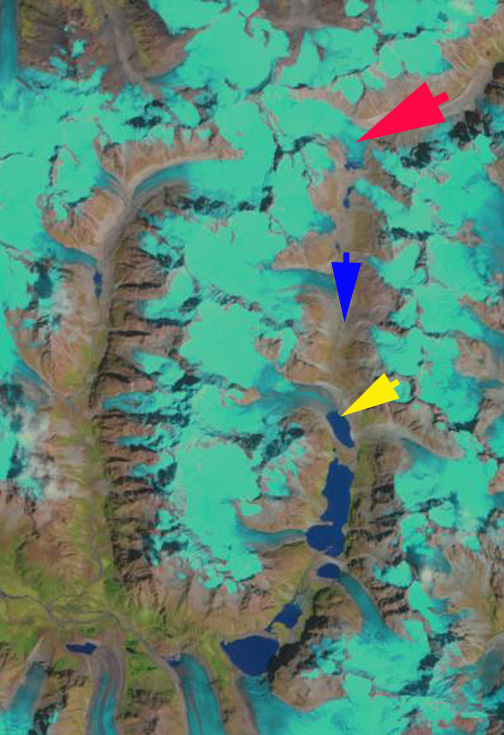
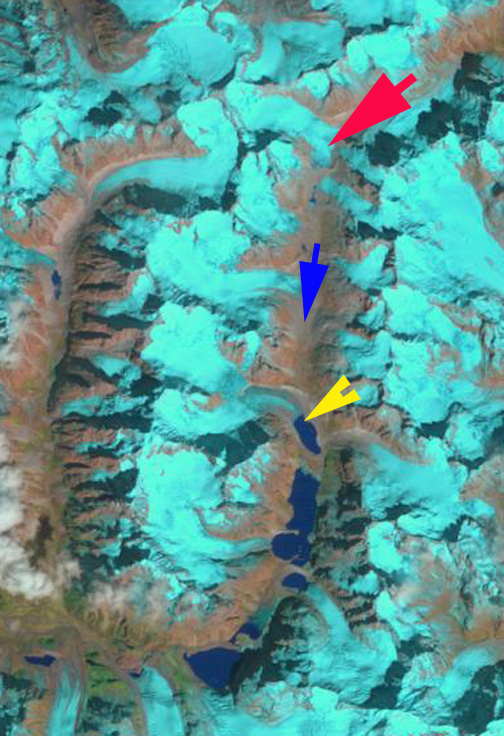
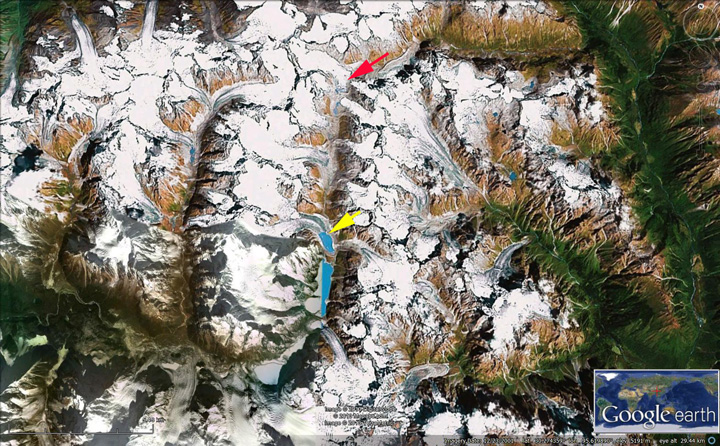
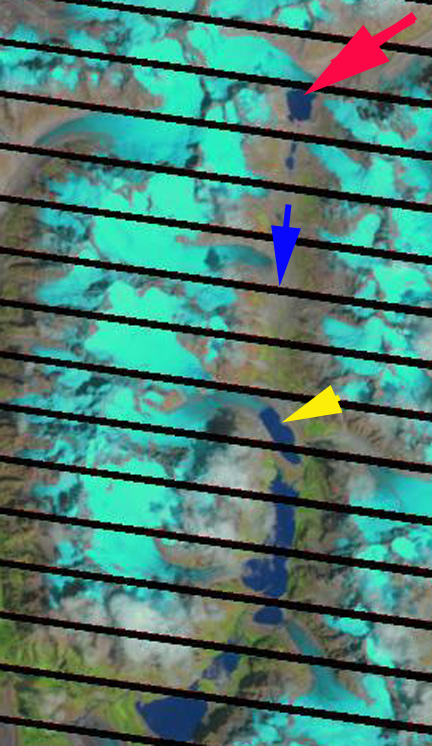
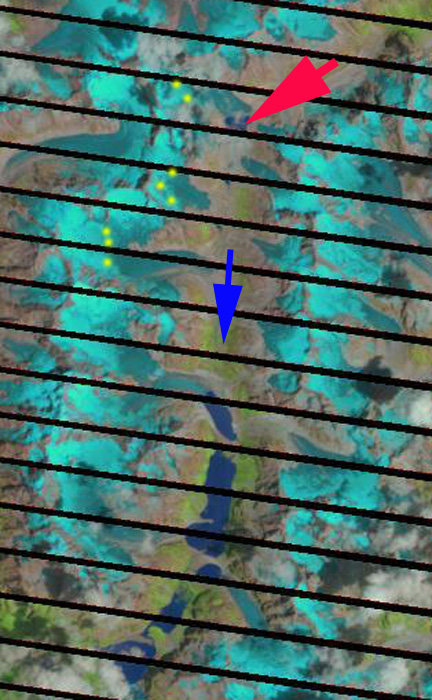
In the eastern portion of the Nyainqêntanglha Shan, there is a raindrop shaped group of mountains encircled by the Bode Zangbo to the west and Yu Chu Zangbo (maps indicate several names here) to the the east. At the headwater of the Bode Zangbo are a series of glaciers ending in valley occupied by several new lakes formed by glacier retreat. The Bode Zangbo is the site of a proposed new 9600 kW hydropower project financed by Datang Power International. The Bode Tsangbo than joins the Parlung Zangbo and then Yarlung Tsangpo that becomes the Brahmaputra River in India. Both of the latter rivers are the focus of ongoing intensive hydropower development as indicated by the map from Tashi Tsering, with most existing dams being upstream on the Yarlung, red arrow indicates glacier site. Here we focus on two glaciers in particular indicated by a red and yellow arrow in each Landsat or Google Earth image. Both glaciers are unnamed. In fact the first image is the area in general from Google Earth with all the layers activate to show names, and there are none in this mountain region. In the lower left of the image China National Road 318 is visible that in this region connects Bomê County and Nyingchi.

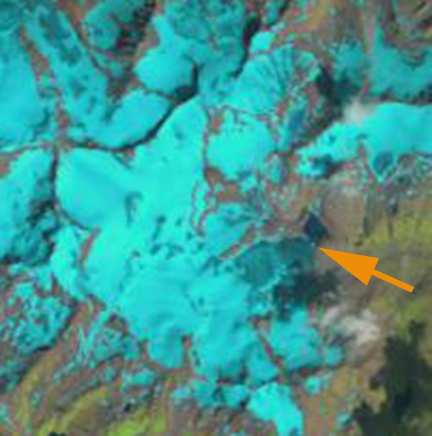
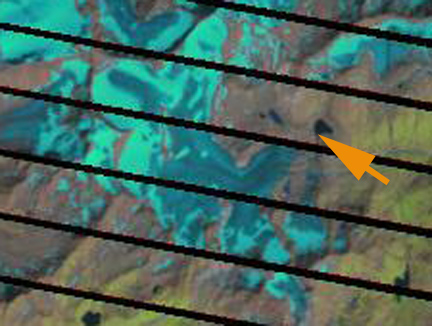
The red arrow indicates a glacier that was 3 km long in 1986 beginning at 5500 m and ending at a moraine at 4900 m. The red arrow points to the low lying terminus piedmont lobe. The second glacier ends in a lake, with the yellow arrow indicating a peninsula on the northeast side of the lake where the glacier ends in 1986. The blue arrow simply indicates the drainage direction of the stream. In 1986 the Bode Zangbo Headwaters Glaciers at the red arrow has no lake at its terminus, the terminus has a toe that turns south down the main valley to end at a series of moraines. By 1999 a tiny lake is evident. In 2000 and the 2001 Google Earth image the lake is still barely detectable. By 2011 a full fledged deep blue lake has developed, where the terminus of the glacier had been. The lake is 600 m long and 400 m long, indicating a 550-600 m retreat in the last decade of the glacier. At the yellow arrow there is limited change from 1986 to 2000, with the glacier still ending in proximity to the peninsula. By 2011 the glacier has retreated 350 m from the 1986 position. The other glaciers in the valley have also been in retreat, but given the location of the scan line errors and clouds it is harder to point out the specific retreat. The yellow dots in the late summer 2011 image indicates the snowline at 5150 m. This is the same snowline and terminus behavior as noted for Jiongla Glacier 110 km west northwest. The glacier follows the pattern of many other glaciers retreating in the region leading to lake expansion, Longbasba Glacier.

1986 Landsat Image
Jiongla Glacier Retreat, Tibet, China
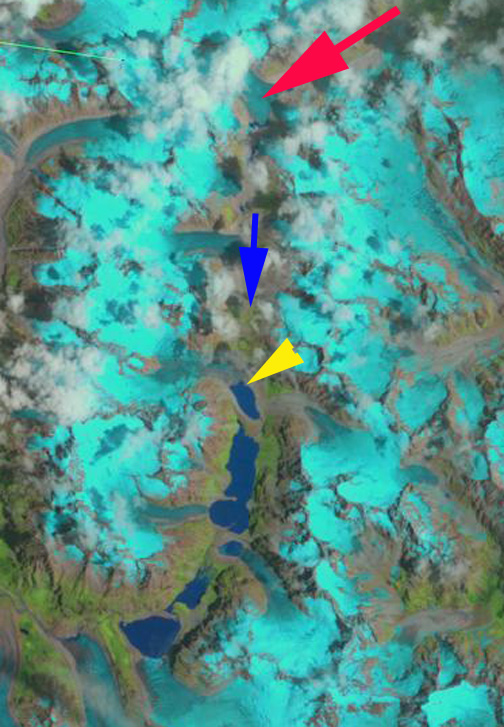
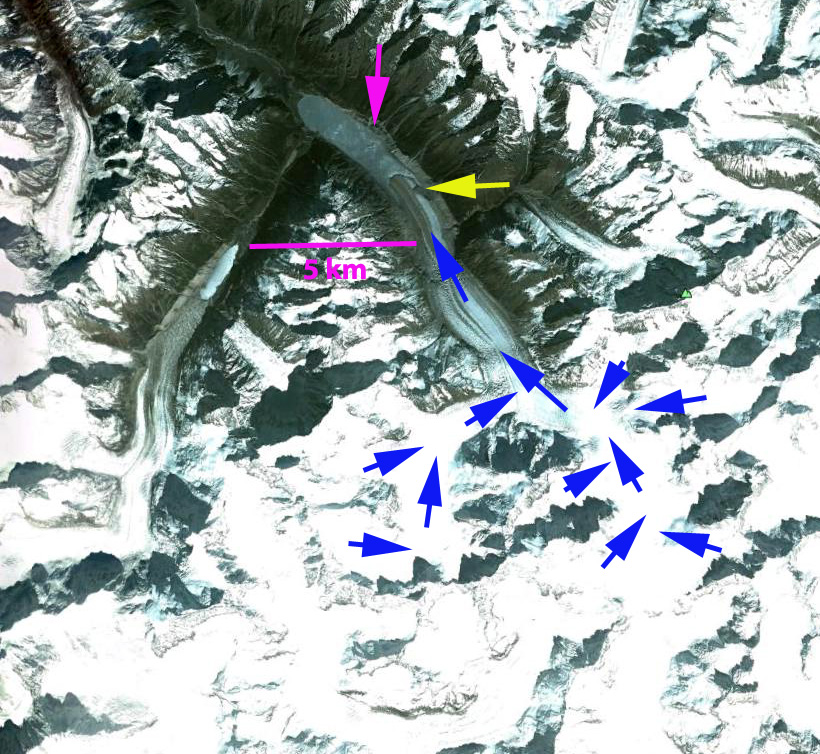
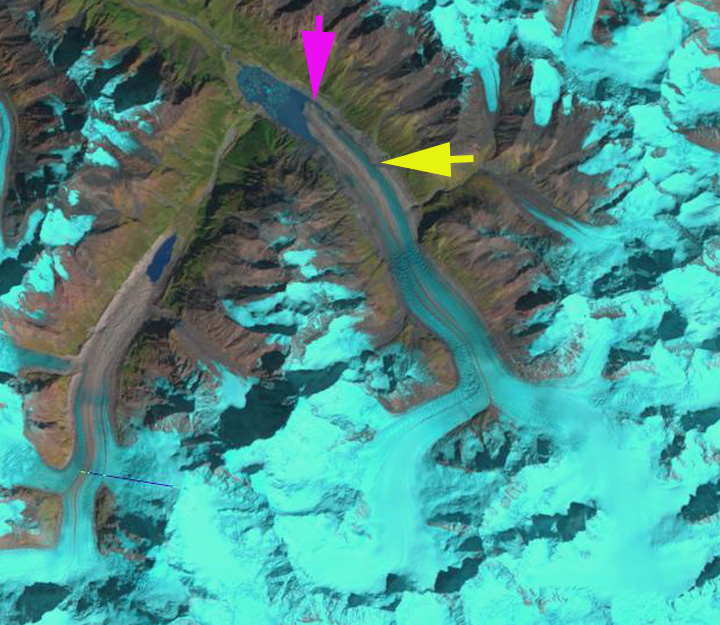
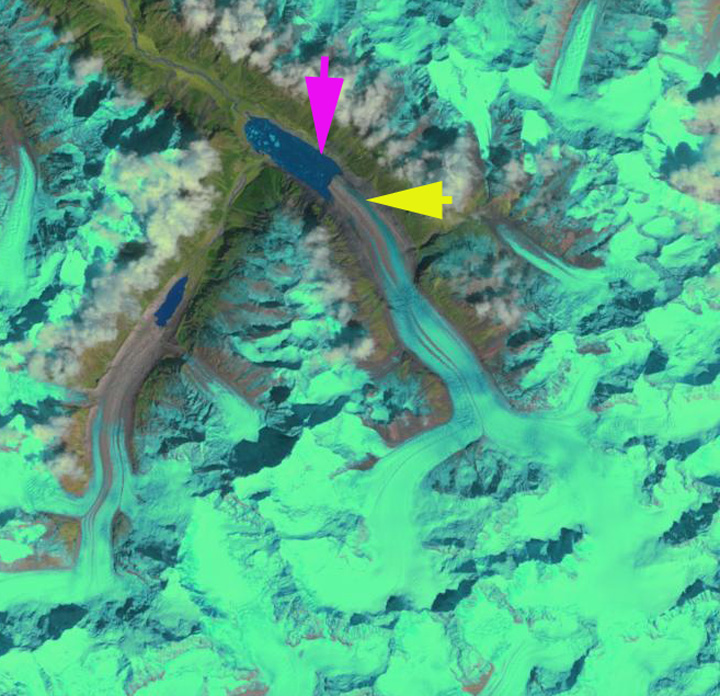
Jiongla Glacier is at the northern boundary of the .Brahmaputra River Basin.) at the east end of the Nyainqentanglha Shan. The glacier drains the western slopes of Koma Kangri Peak and ends in a lake before feeding into the Parlung Zangbo and then Yarlung Tsanpo. Ninglian and Shichang (2010) in the China National Report on Cryospheric Sciences noted a loss in glacier area of 15 to 17 % in the region. ICIMOD (2011) notes that the basin has 11, 500 glaciers covering an area of 14,000 square kilometers. Here we examine satellite imagery from 19988, 2000, 2009, 2010 and 2011. The pink arrow denotes the 1988 terminus and the yellow arrow the 2011 terminus. 
2003 Google Earth image
In 1988 the lake where Jiongla Glacier ends is at 4000 meters and is 2 km long. By 2000 the glacier has retreated 1300 meters. By 2009 the lake is 4 km long, a 2 km retreat in 20 years. The retreat from 2009 to 2011 is not evident in the satellite imagery used here. There are icebergs visible in the lake particularly in the 2003, 2009 and 2011 images indicating that this one a key reason for rapid recent retreat. In reviewing the satellite images for the region cloud cover made it difficult to find imagery near the end of the melt season. The 2011 image is from near the end of the melt season and indicates a snowline at 5150 m, green arrows, this is too high for equilibrium, with limited glacier area above 5500 m and the terminus at 4000 meters. This suggests that retreat will continue. The last image is a 2003 terminus closeup that indicates vigorous flow through an icefall, red arrow, 2 km behind the terminus. This indicates the lake will end before this point and the glacier does not have a substantial stagnant terminus tongue. This also suggests the rate of retreat will soon slow. The retreat here is similar to that of Sepu Kangri Glacier and Requiang Glacier. This glacier feeds the Parlung Zangbo which is the site of numerous planned hydropower projects, last image, . before joining the Yarlung Tsanpo which becomes the Brahmaputra River
Landsat image 1988
Galaxy Glacier Rapid Retreat, Pukulkul Basin Glacier disappears, British Columbia
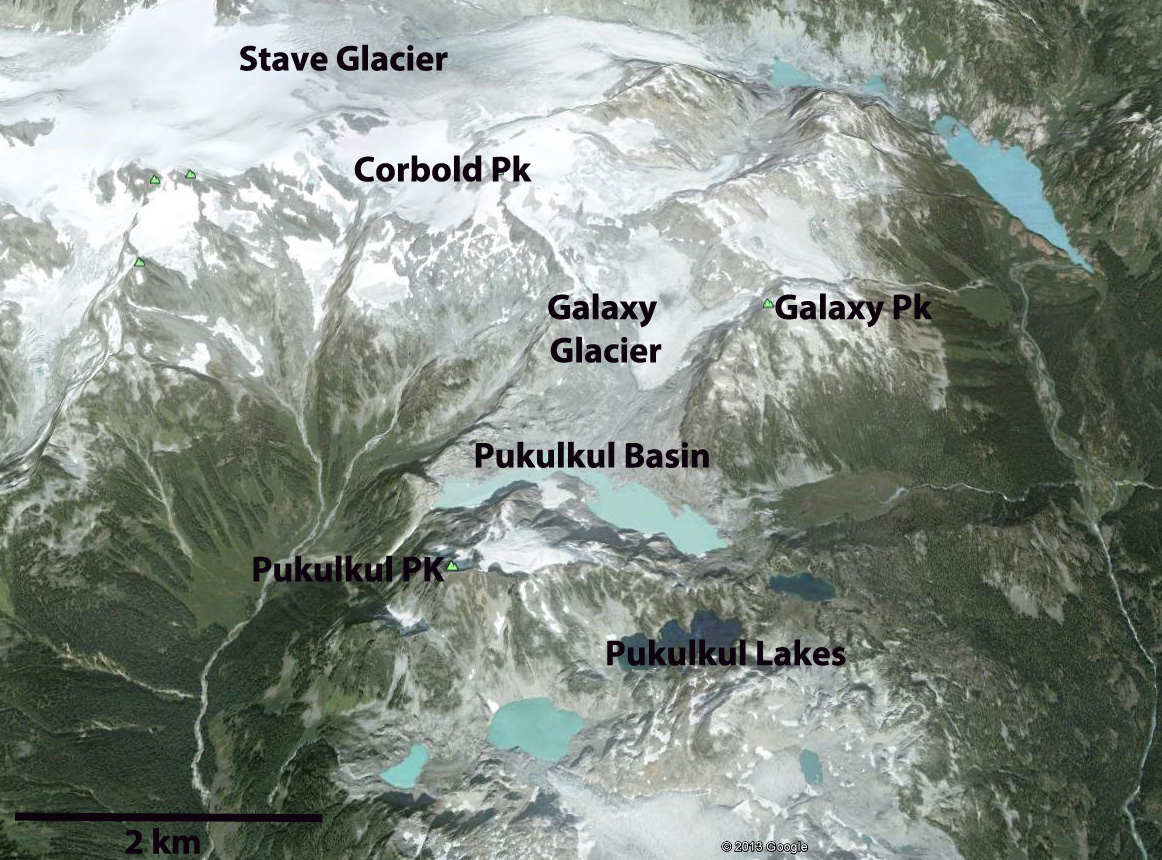
Over the ridge south from Stave Glacier is a 1.5 km long unnamed glacier, that is on the west flank of Galaxy Peak, hence referred to here as Galaxy Glacier. The glacier is in Garibaldi Provinical Park, British Columbia.
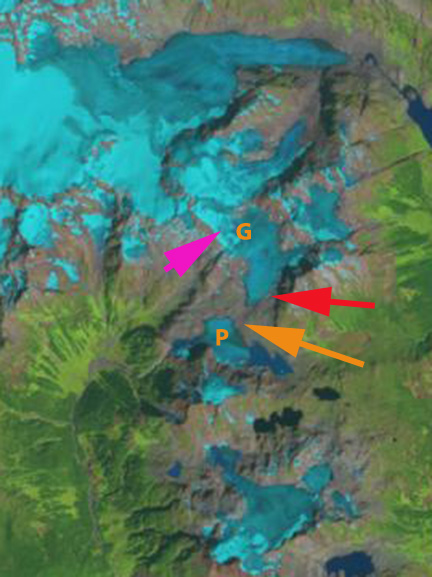
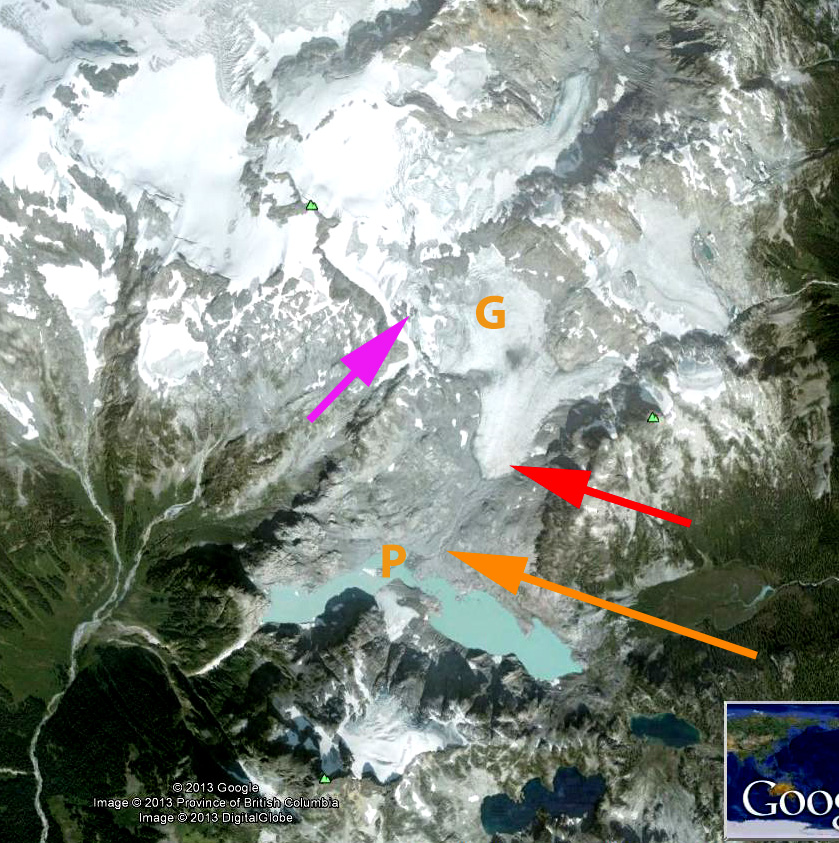
Koch et al (2009) in their detailed survey of glaciers in the park chronicled the Park’s glacier retreat from 1952 to 2002. Koch et al (2009) Found that all 45 glaciers are retreating, and Stave Glacier was experiencing its fastest retreat from 1976-1996, with a 750 m retreat. Satellite imagery from 2012 indicates the Stave Glacier retreat rate from 1996 to 2012 is 1600 m or 100 m per year, even faster. Here we utilize Landsat imagery from 1985, 1987, 1992 and 2009, plus Google Earth imagery form 2006 to examine the retreat and separation of Galaxy Glacier. The orange arrow indicates the terminus of the Galaxy Glacier (G) in 1985 where it joined the glacier (P) in the Pukulkul Basin where several lakes have been forming. This basin is just north of Pukulkul Peak. In 1985 Galaxy Glacier and the Pukulkul Basin Glacier are joined at the orange arrow, the red arrow marks the 2009 terminus and the purple arrow indicates the connection to the highest accumulation area on the east slope of Corbold Peak. By 1987 Galaxy Glacier has separated from the Pukulkul Basin Glacier, the latter has an area of 0.45 square kilometers and is larger than the lake it ends in. By 1992 the Galaxy Glacier is separated by 500 meters from Pukulkul Basin Glacier. The area of bare rock at the purple arrow at the top of Galaxy Glacier has expanded. By 2006 the Pukulkul Basin Glacier is gone and a 2.5 km long series of lakes is in its place. Galaxy Glacier has retreated 800 m from the new lake, and 650 meters from its 1985 position. The purple arrow indicates two large rock outcrops effectively ending significant glacier inflow from the upper east slopes of Corbold Peak. By 2009 the Pukulkul Basin Lake has a deeper blue as the glacier input has declined. The glacier is 90% bare of snowcover and the bedrock at the purple arrow has continued to expand. A closeup of the glacier from the 2006 Google Earth imagery indicates exposed firn layers at the blue arrows. This indicates that all the snowcover not just from the most recent winter has been lost but a number of previous winters as well. This is indicative of a glacier that has no consistent accumulation zone and cannot survive (Pelto, 2010). This glacier similar to the nearby Helm Glacier cannot survive current climate. The purple arrows indicate the limited connection to the upper slopes of Corbold Peak. The red arrow indicates the current terminus position. Galaxy Glacier has lost half of its area in the last 25 years, and the 800 m retreat is one-third of its total length. 
1985 Landsat
Malavalle Glacier Retreat, Italy
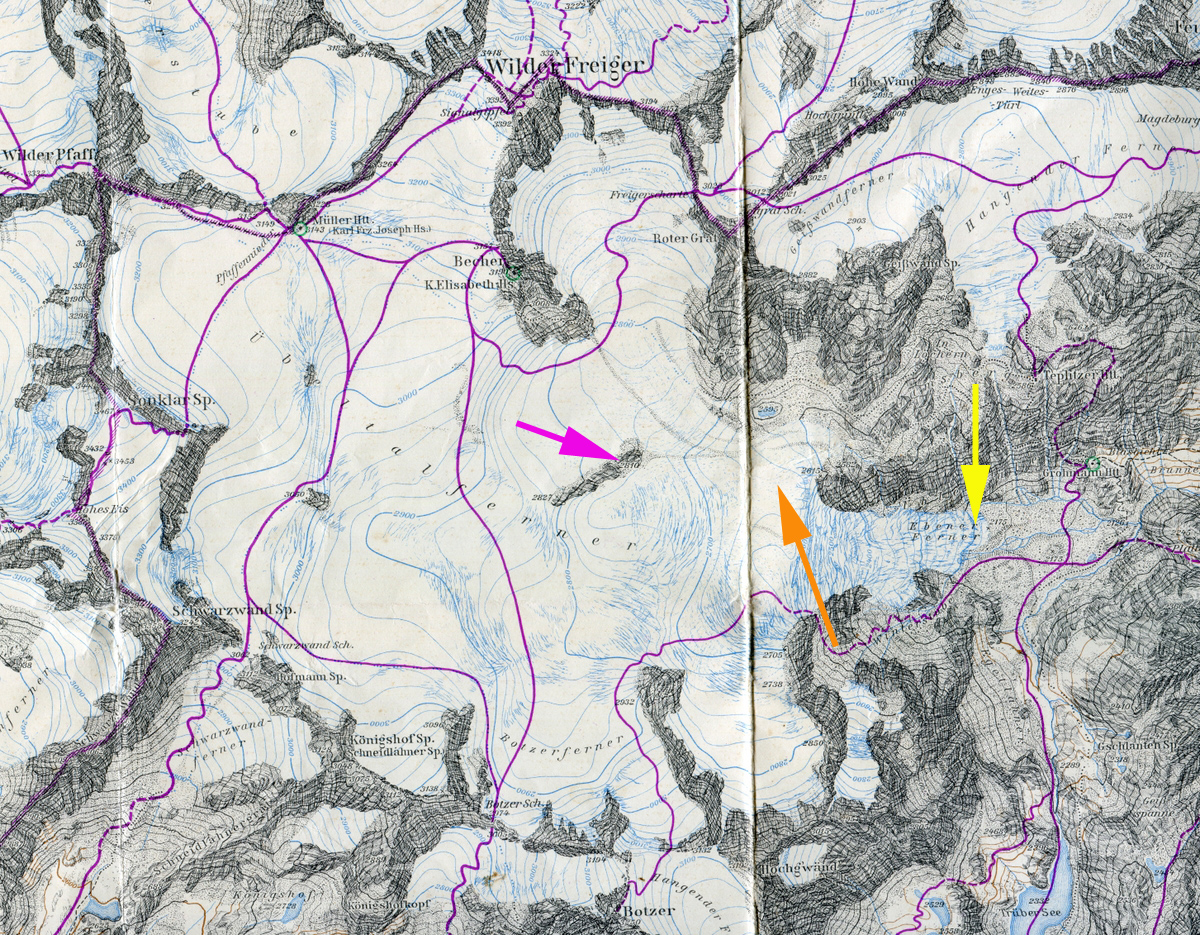
Malavalle Glacier is an Italian glacier draining south from the Austrian border. The glacier has an interesting cartographic history with maps spanning several centuries indicating its evolution. The Italian Glaciological Committee indicates the retreat of this glacier from 1938 to 2004, from 1938 to 1958 the glacier retreated 500 m. A map from 1937 provided by Nicholas Fisher indicates the terminus of the glacier, with the orange arrow indicating the location of a lake that the glacier ended in 1985, the yellow arrow the 1937 terminus and a purple arrow the location of a prominent ridge. Below the indicated lake in 1937 the glacier descended a steep icefall and then had a gentle terminus. The rapid retreat to 1958 removed the entire section of the glacier on and below this icefall. The second image is a 2002 view of the glacier from Google Earth, the red arrow indicate two small proglacial lakes that formed. From 1958 to 1978 the retreat essentially ended, with just 30 m of retreat. From 1978 to 2004 recession accelerated with 180 m of retreat.
Here we examine Landsat imagery from 1985, 1990, 2000, 2010 and 2011 to identify a retreat of 540 meters from 1985 to 2011. In each image the orange arrow indicates the location of the lake where the glacier terminated in 1985, and in 2011 the purple arrow indicates the 2011 terminus. In 1990 there is a narrow strip of rock between the glacier and the lake. By 2000 the glacier has further retreated from the lake, and the majority of the glacier is bare ice. In 2010 snowpack on the glacier is again limited. In 2011 the terminus has not only retreated 540 m from the lake, but the current terminus is also quite narrow. The last image is from the Italian Glaciological Committee of the glacier showing the terminus position from 1885 to 1997. The retreat is similar to that of Lobbia Glacier and Sabbione Glacier. However, Malavalle has a higher elevation accumulation zone above 3100 meters below the summit of Wilder Freiger that continues to retain snowpack. 
1985 Landsat
Lake Cachet 2 Jökulhlaup Colonia Glacier, Chile
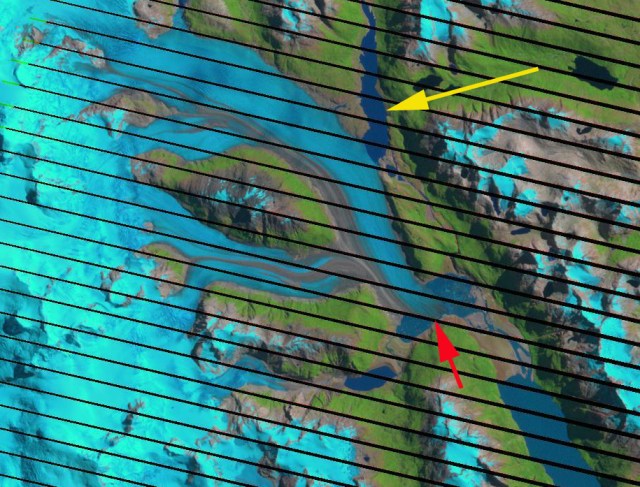
Colonia Glacier drains east from the Northern Patagonia Icefield feeding the Rio Colonia and then Baker River, Chile. A Feb 8th 2013 Landsat image caught the impacts of a jökulhlaup in progress, glacier lake outburst flood. This post examines the filling and emptying of Cachet Lake 2 and its impacts and the continued retreat of Colonia Glacier. The glacier is unusual in the number of lakes that are adjacent to or feed into the adjacent glacier dammed or proglacial lakes. In the image below Lake A=Arco Lake, Lake B=East Terminal Lake, Lake C=Cachet, Lake D= West terminal Lake, Lake E=Colonia Lake and Lake F=Cachet 2.
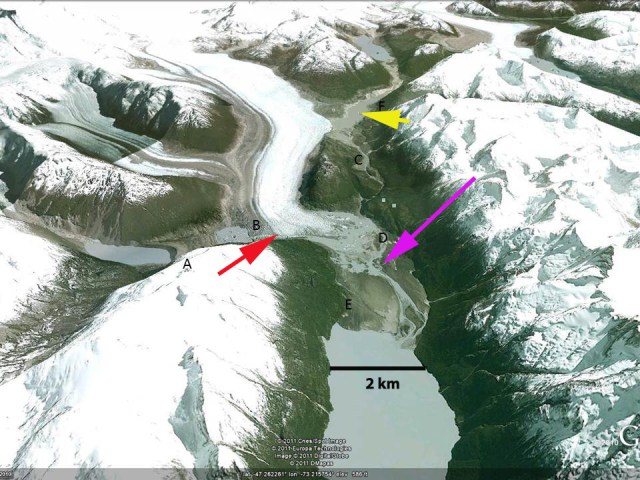
The glaciers recent retreat has been closely monitored by the Laboratorio de Glaciología in Valdivia, Chile. Aniya and others (1999)observed that Colonia Glacier began a rapid retreat after 1985, with a comparison of a RADARSAT image from 1997 and a Landsat 1987 image indicating a retreat of 400 m. From 1997-2005 the retreat has further accelerated, with a general frontal retreat of 2.5 km. The retreat has continued to 2013 as examined below.
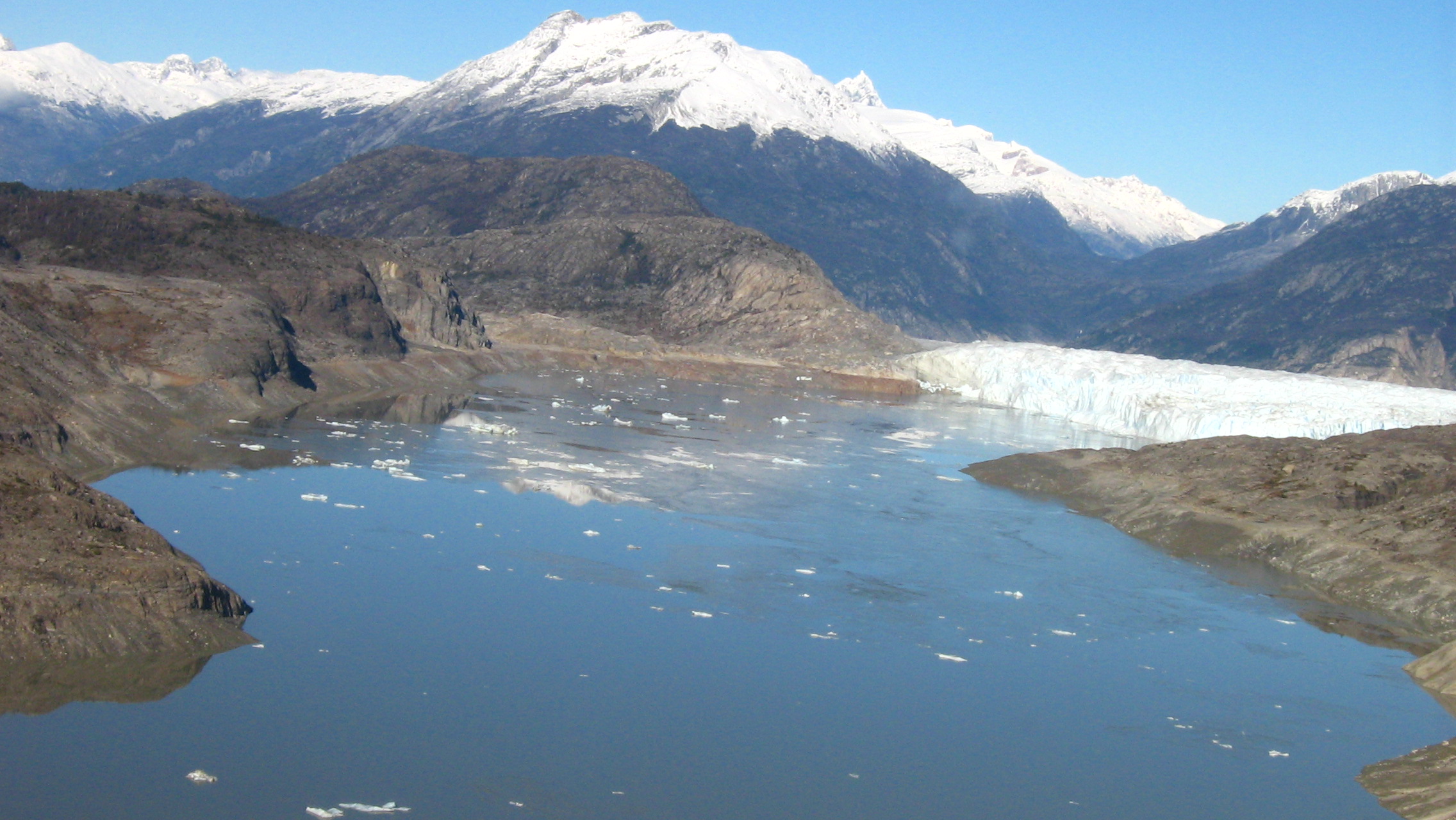
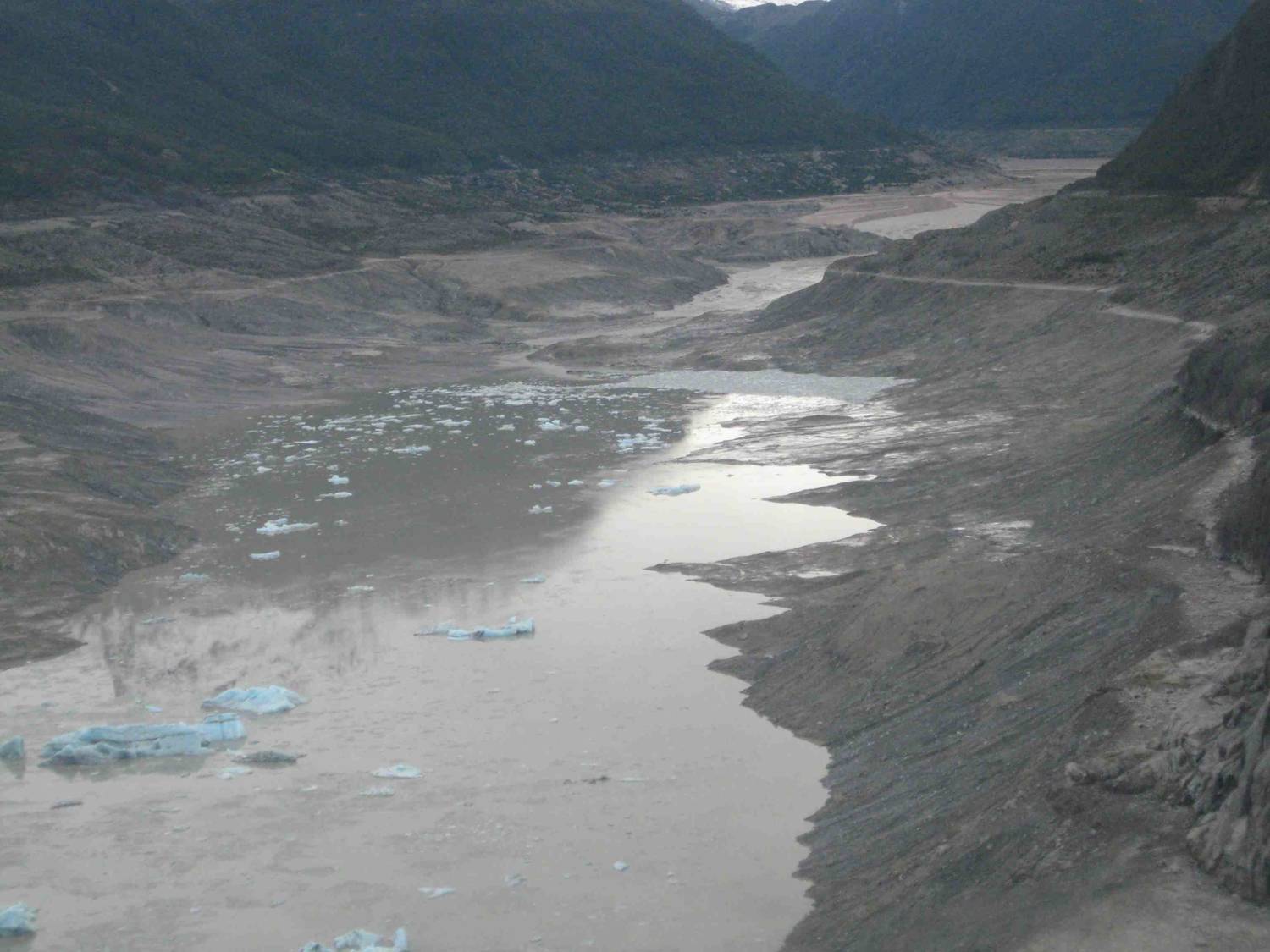
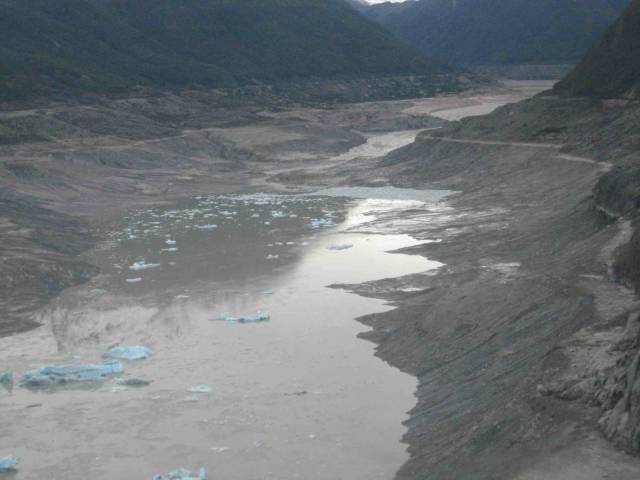
In the spring of 2008 Baker River suddenly tripled in size, in less than 48 hours, roads, bridges, and farms were severely damaged. Lake Cachet 2 had vanished the 5 square kilometer glacial lake had emptied 200 million cubic meters of water in just a matter of hours. This lake drained beneath the glacier after sufficient water had filled the lake to buoy part of the glacier and subglacial conduits had begun to develop. Since Cachet 2 emptied in April 2008, the lake has emptied thirteen times, with the Feb 7-8 release in 2013 the most recent. In 2008 the General Directorate of Water (DGA) setup a station to monitor the water level and telemeters this information, so that any outburst can be quickly identified. The two pictures below are of the Lago Cachet 2 basin filled and empty 
In this case notification came from Fabian Espinoza at the DGA.
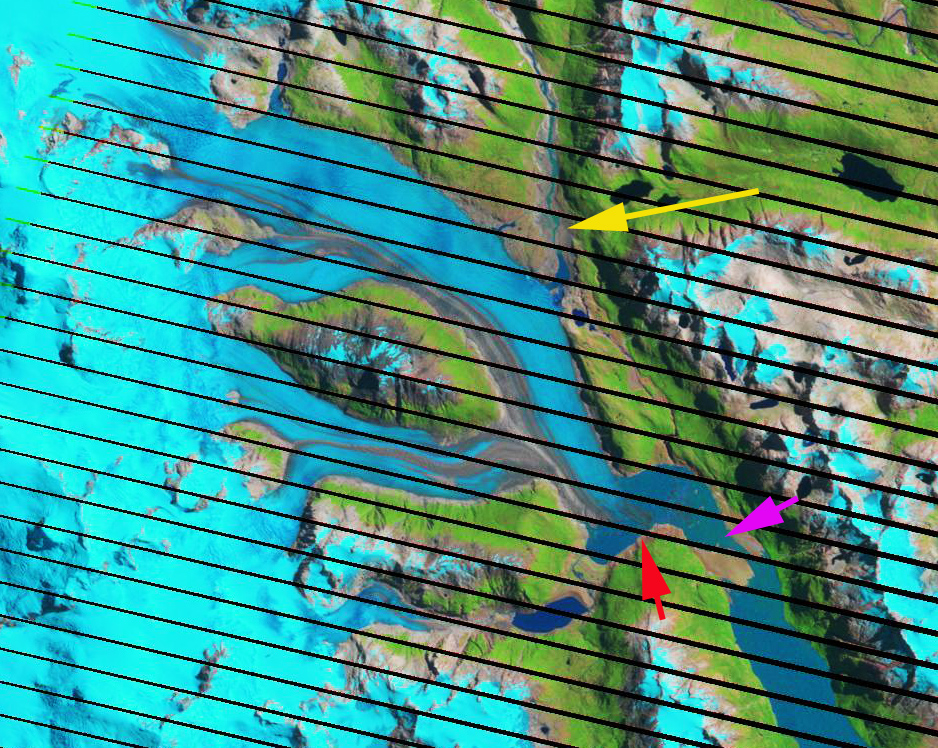
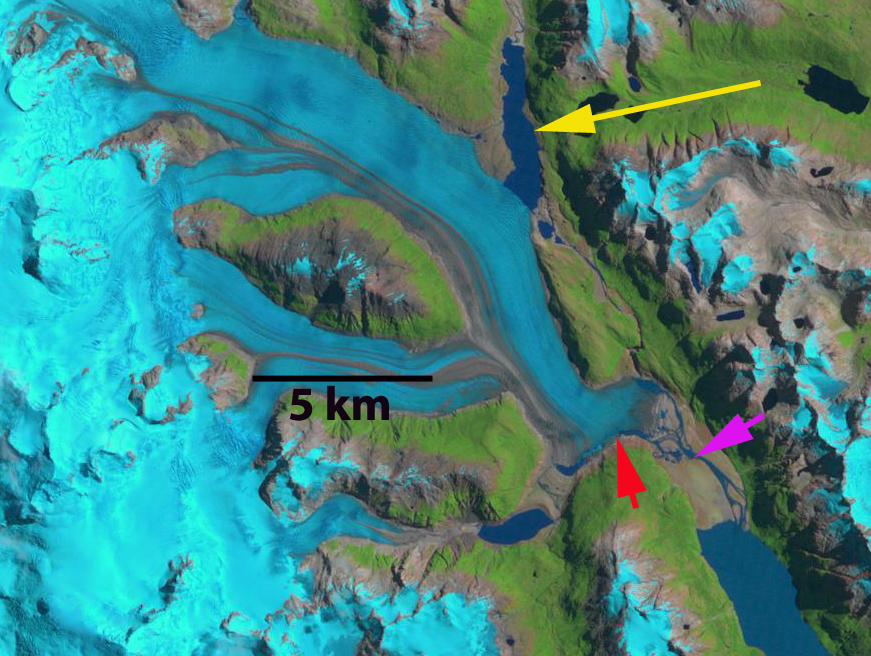
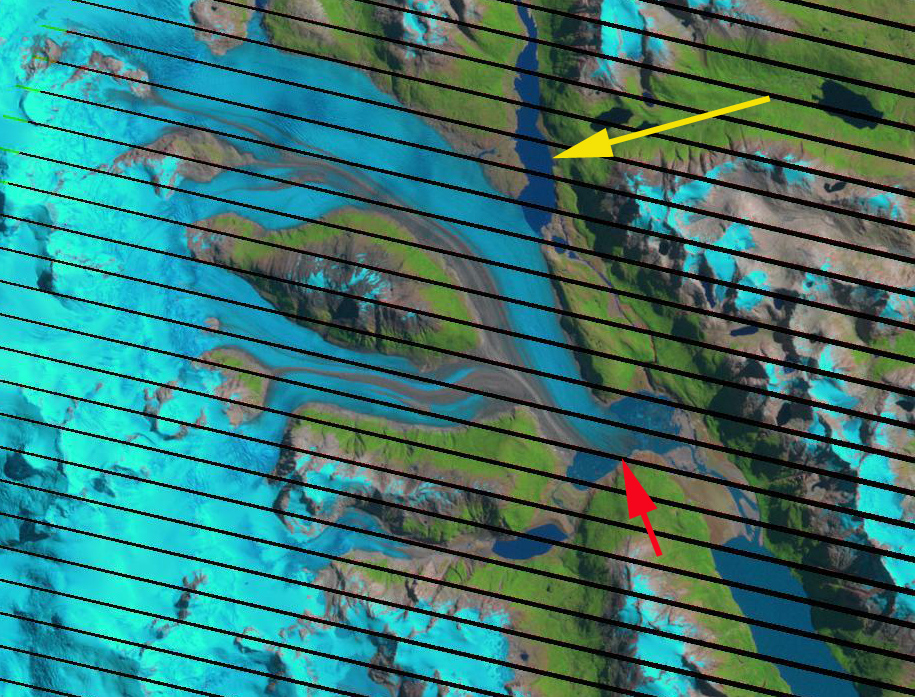
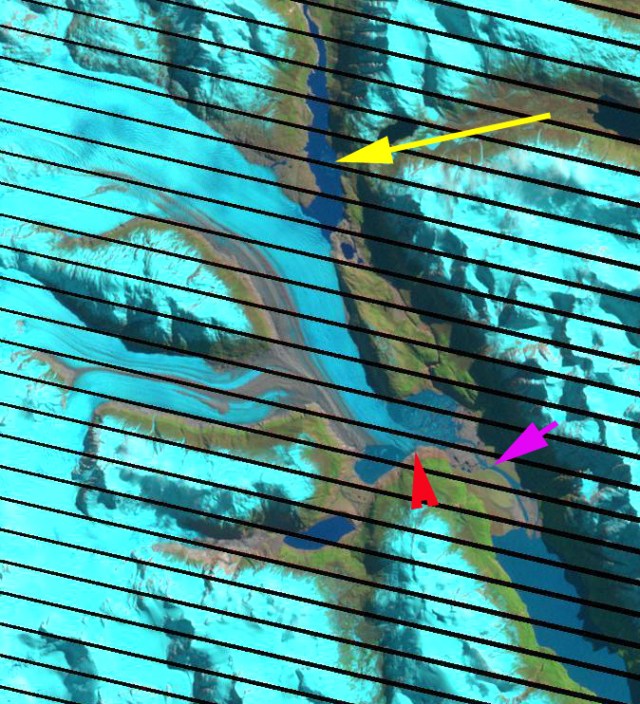
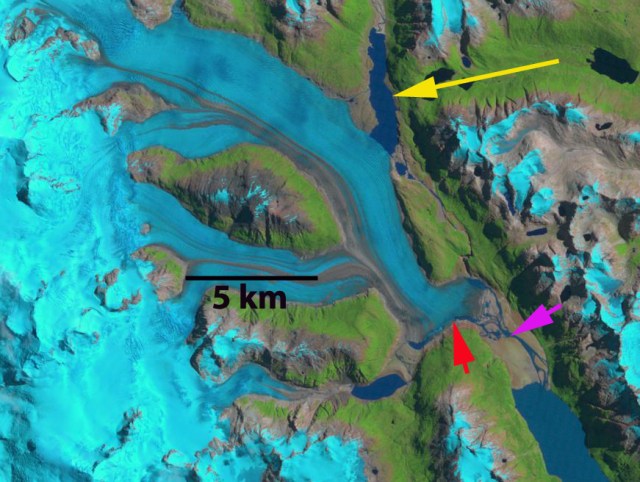
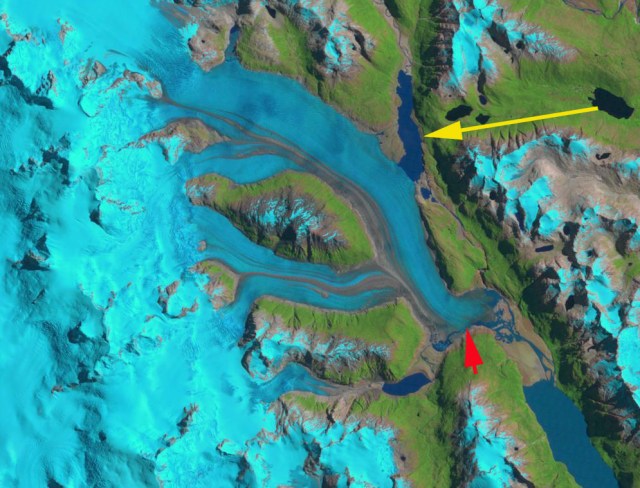
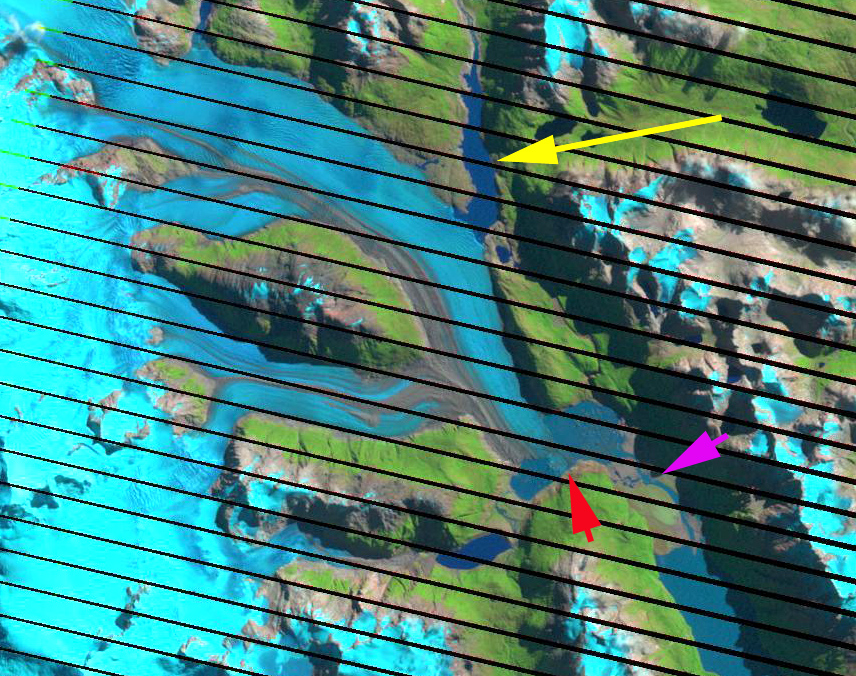
Below is a sequence of images from Sept. 17, 2012 when the lake is full, then on Feb. 8, 2013 just as the lake is finishing draining and then on March 28, 2013 after the lake has mostly refilled. The yellow arrow indicate Lago Cachet 2, the red arrow where the terminus has its last connection to a peninsula between the two proglacial terminus lakes and the purple arrow to the outwash plain between the proglacial terminus lake and Lake Colonia. In the Sept. 2012 image the east terminus lake has its normal water level and the outwash plain is 3 km long between the lakes. On Feb. 8th the water level in both Colonia Lake and the east and west terminus lake have been raised and most of the outwash plain is flooded. Even Colonia Lake has risen considerably, notice the southeastern edge of the outwash plain flooded by the outburst. By March 28, 2013 Lago Cachet is mostly filled again and the outwash plain is normal. The terminus connection to the red arrow peninsula has declined in width from 1 km in 2012 to less than 500 m by March 2013. The Feb. 2013 image indicates that the high water level in the terminus lakes partially submerged the terminus. 
Sept. 17 Landsat
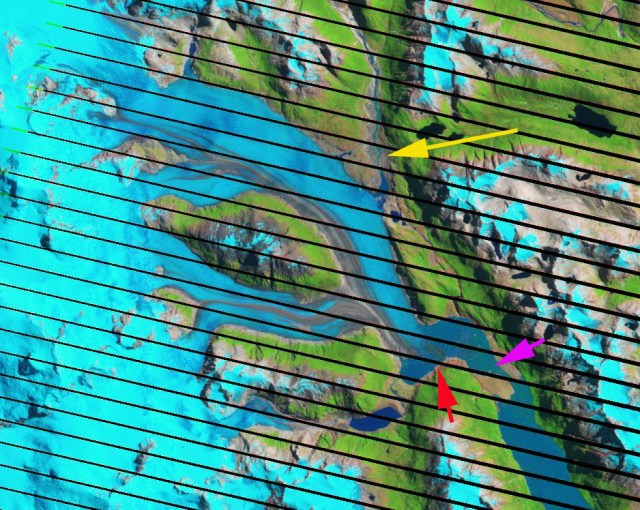
The terminus of the glacier continues to retreat and its area in the proglacial terminus lake basin contract. Below is a sequence of images from 1999, 2003, 2005, 2011 and 2013. In 1999 the terminus lakes barely exists. By 2004 the lakes have a combined area of 1.4 square kilometers. In the Google Earth image from 2005 this has expanded to 2.3 square kilometers. By 2012 the terminus lakes have expanded to an area of 4.0 square kilometers, and the glacier terminus has lost the same area. The connection to the red arrow peninsula will be lost very soon, which should lead to further terminus tongue breakup. This is much like the breakup observed at Glaciar Steffen and Glaciar Gualas 
North Cascade Glacier Accumulation Season Ends
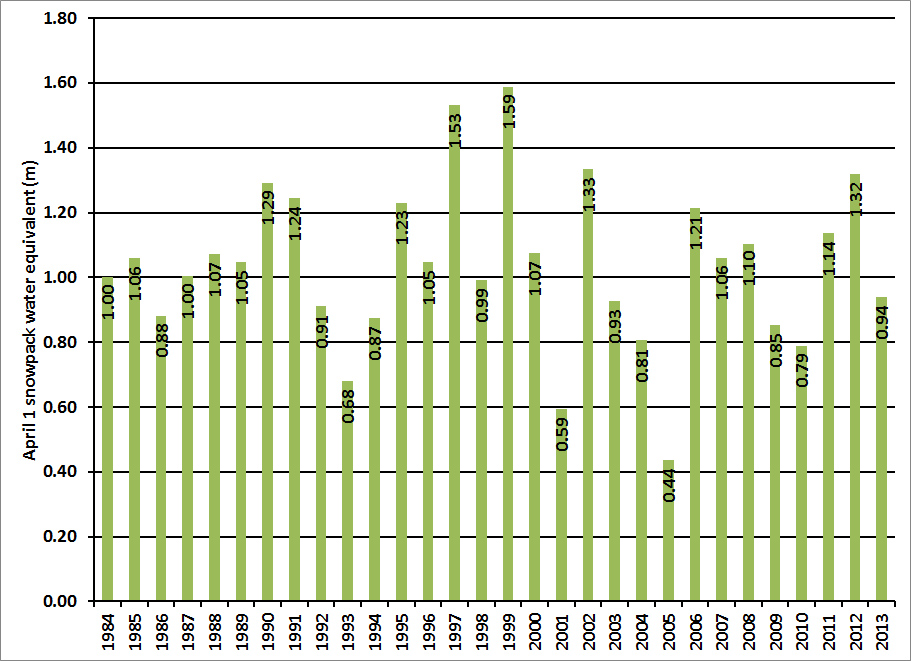
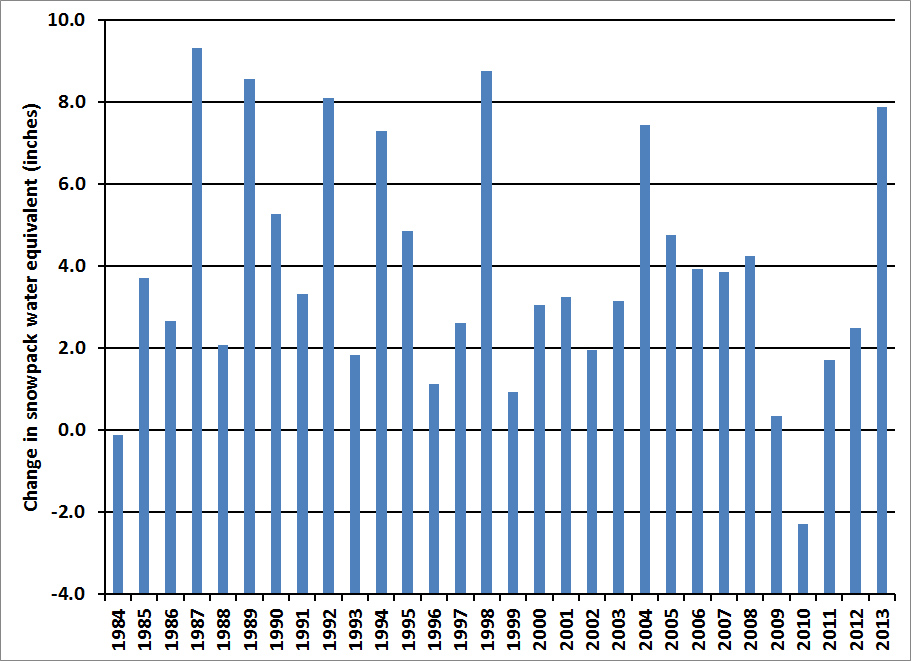
The typical maximum snowpack accumulation on North Cascade glaciers occurs on May 10. Because the network of USDA Snotel stations are at lower elevations, the best measure of winter accumulation from these valuable long term stations is on April 1. The first image below is the mean April 1 SWE from seven long term stations in the North Cascades. In 2013 April 1 SWE is 10% below the 1984-2012 mean. For the glaciers additional snowpack occurred in April 2013, but about average for April. The accumulation season ended on April 29 and 30th with a final snowfall. From May 3-10 temperatures reached at least 11 C everyday at Lyman Lake which is the station closest to a glacier, just 2 km away. This led to the most rapid start of the melt season since 1998, with 20% of the snowpack at the Snotel stations lost.
April 1 Snowpack Water Equivalent at seven North Cascade USDA Snotel stations (Fish Lake, Harts Pass, Lyman Lake, Park Creek Ridge, Rainy Pass, Stampede Pass, Stevens Pass)

May 1-10 Snowpack Water Equivalent at seven North Cascade USDA Snotel stations from May 1 to May 10.
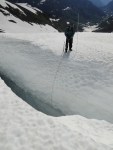
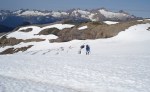
As the melt season begins the snow lays deeply on Easton Glacier, 15-20 feet deep. When we are making measurements late in the summer how deep will the snow be? We will back in the field for the 30th consecutive summer this year measuring the mass balance of North Cascade glacier, the early indications are that the mass balance will be negative.
From 1984 to 2010 glaciers in western North America mass balance losses have been extensive. The video below indicates the similarity in the cumulative mass balance and trends on a series of glaciers from Alaska, Washington and British Columbia. In each graph the red line is the mean for all glaciers and the blue line the cumulative annual mass balance of the individual glaciers.
Puisortoq North Glacier Retreat Southeast Greenland
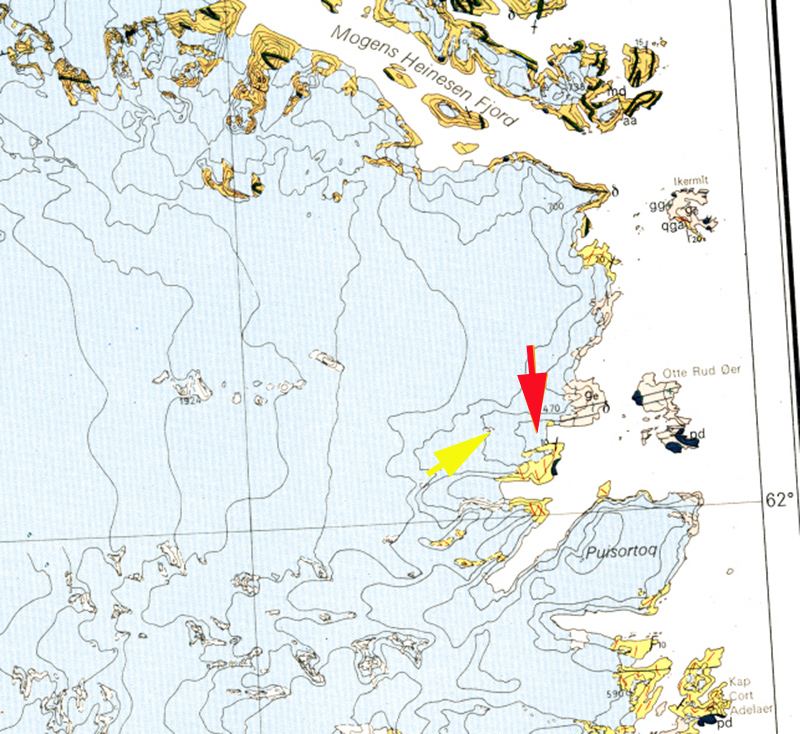
Puisortoq North Glacier southeast Greenland has experienced an increased rate of retreat since 2000. The retreat is expanding a fjord that begins just north of the Puisortoq Peninsula and west of the Otte Rud Island.
In the assessment of Greenland glacier terminus change by the Glacier Dynamics Group, at Ohio State University Howat and Eddy (2011) observed the glacier retreat as 20 m in the 1990’s and 2 kilometers from 2000-2010. Of the 90 glaciers in southeast Greenland examined, 90% retreated, with an average rate of 107 meters per year from 2000 to 2010.
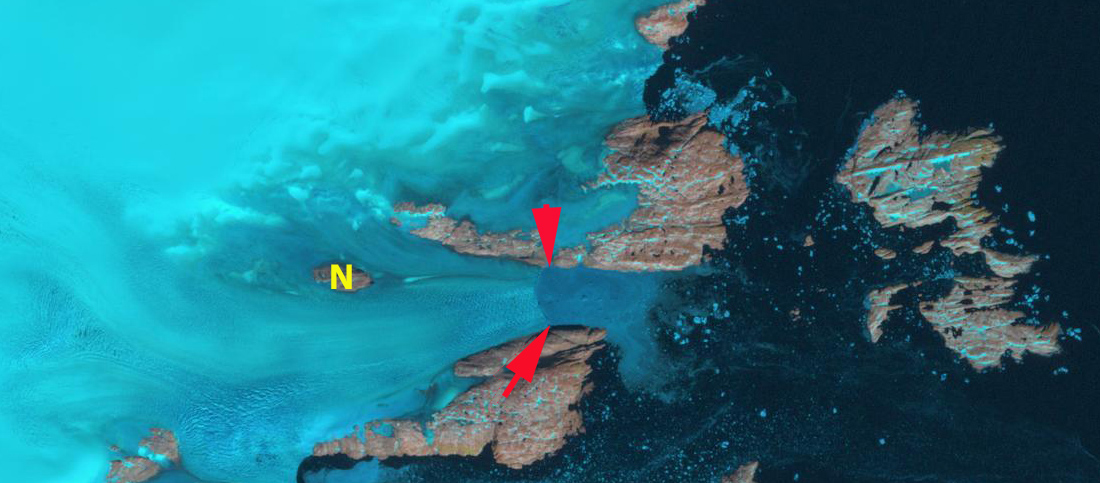
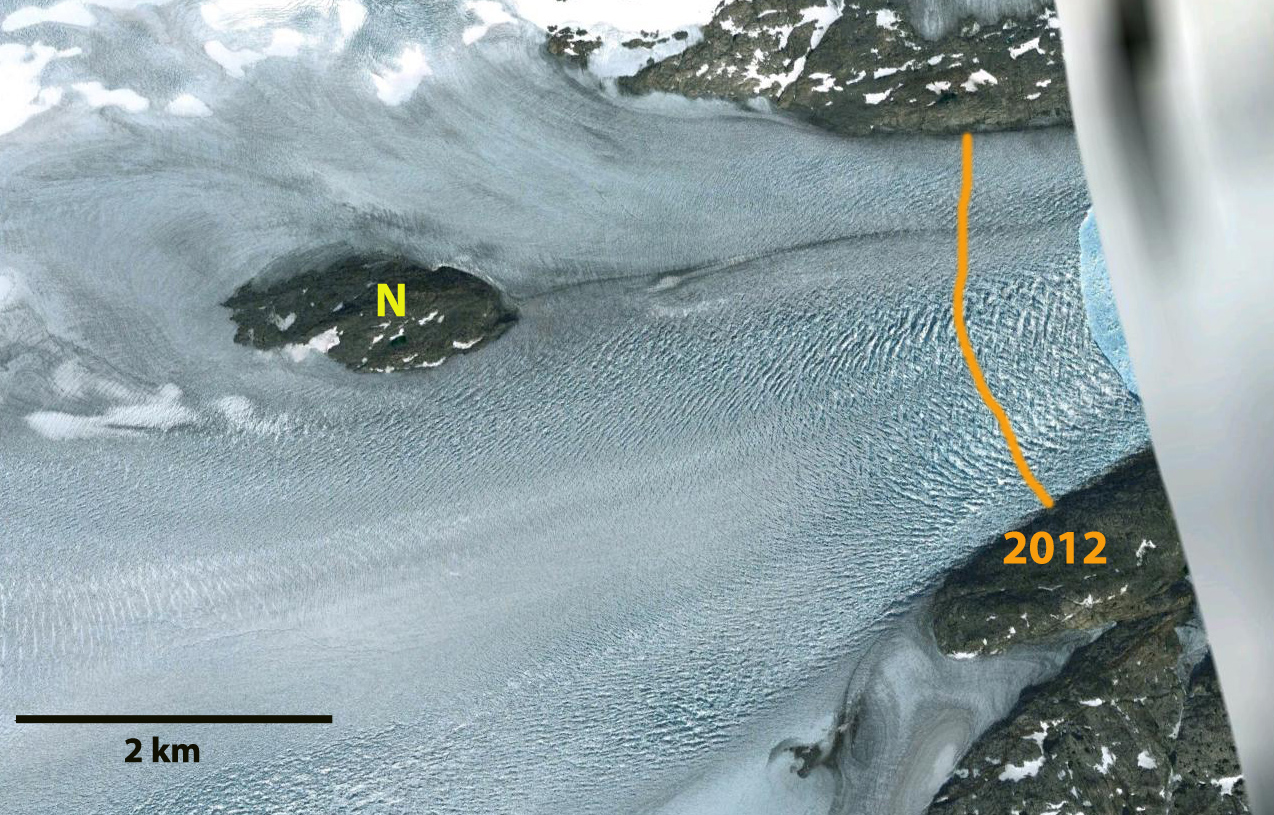
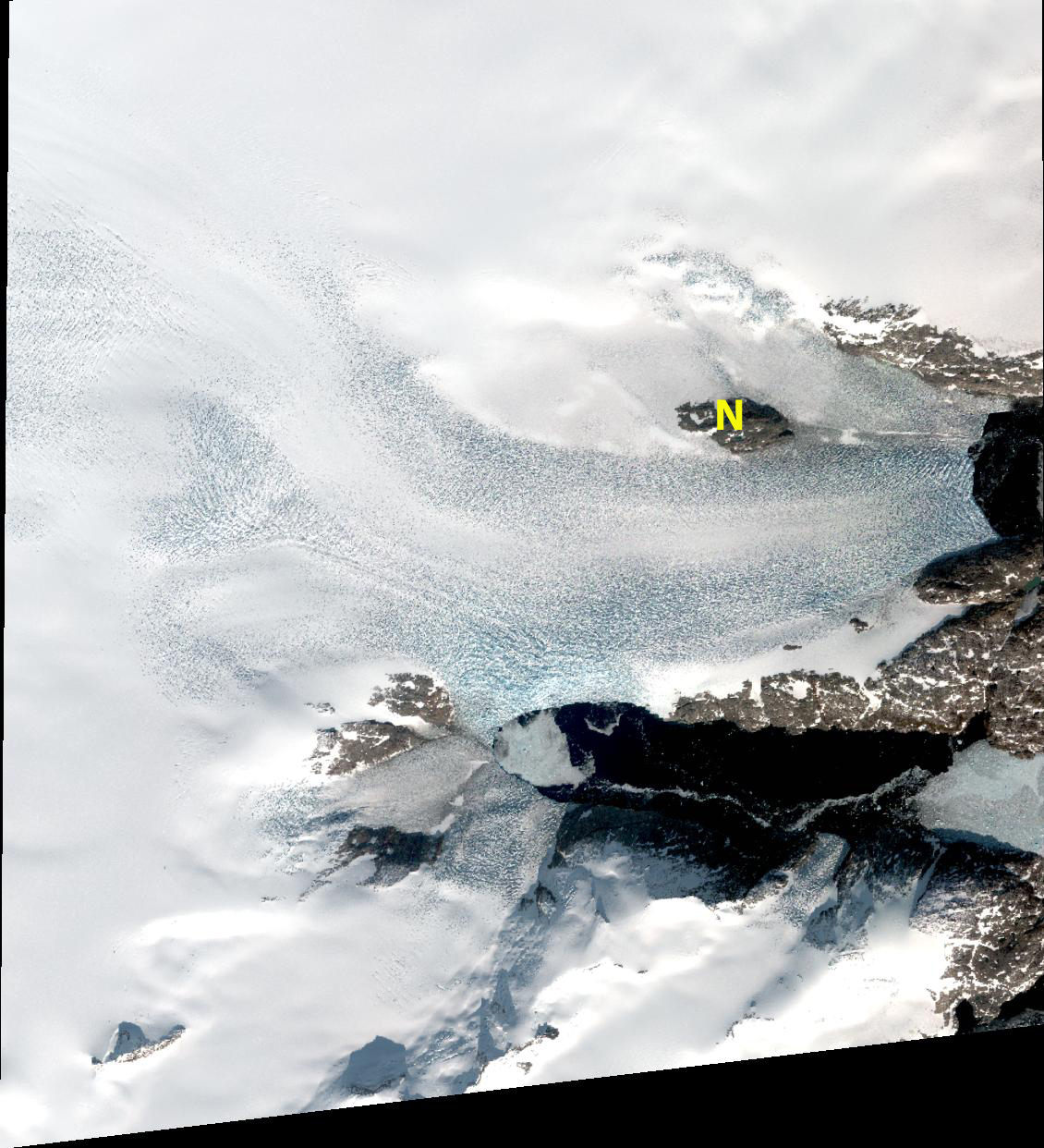
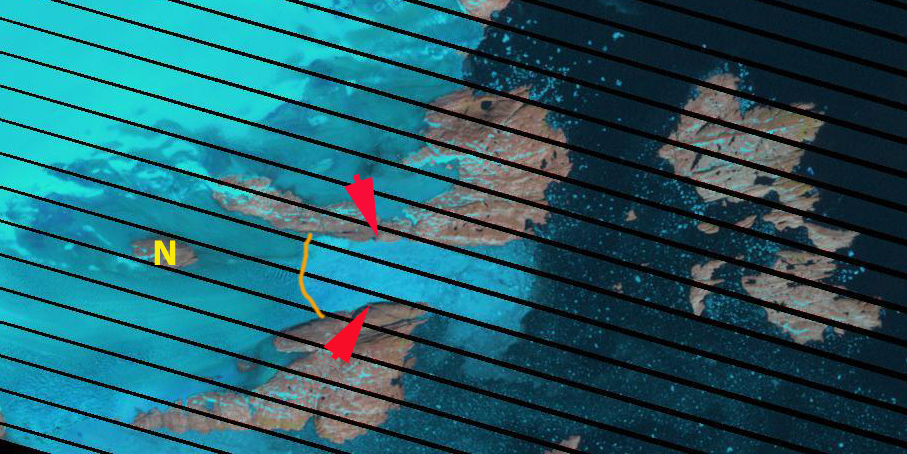
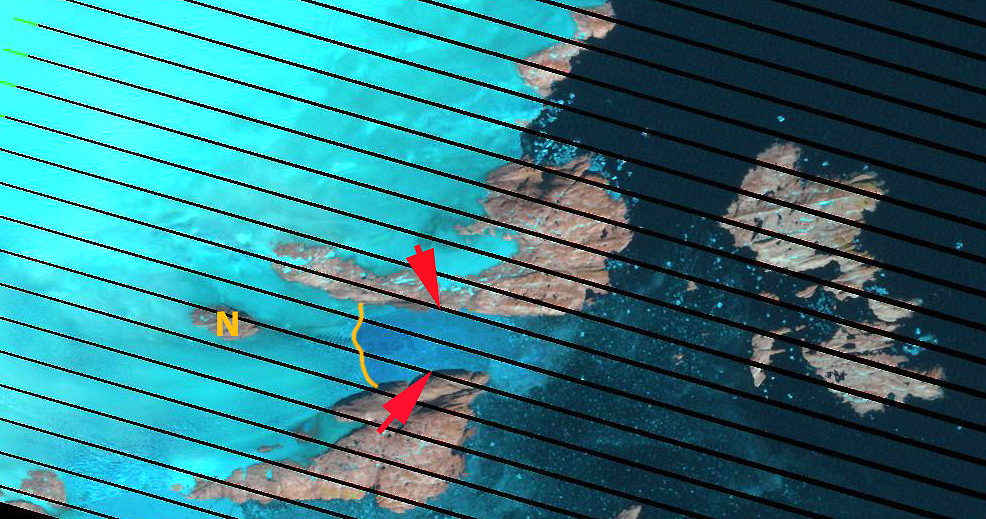
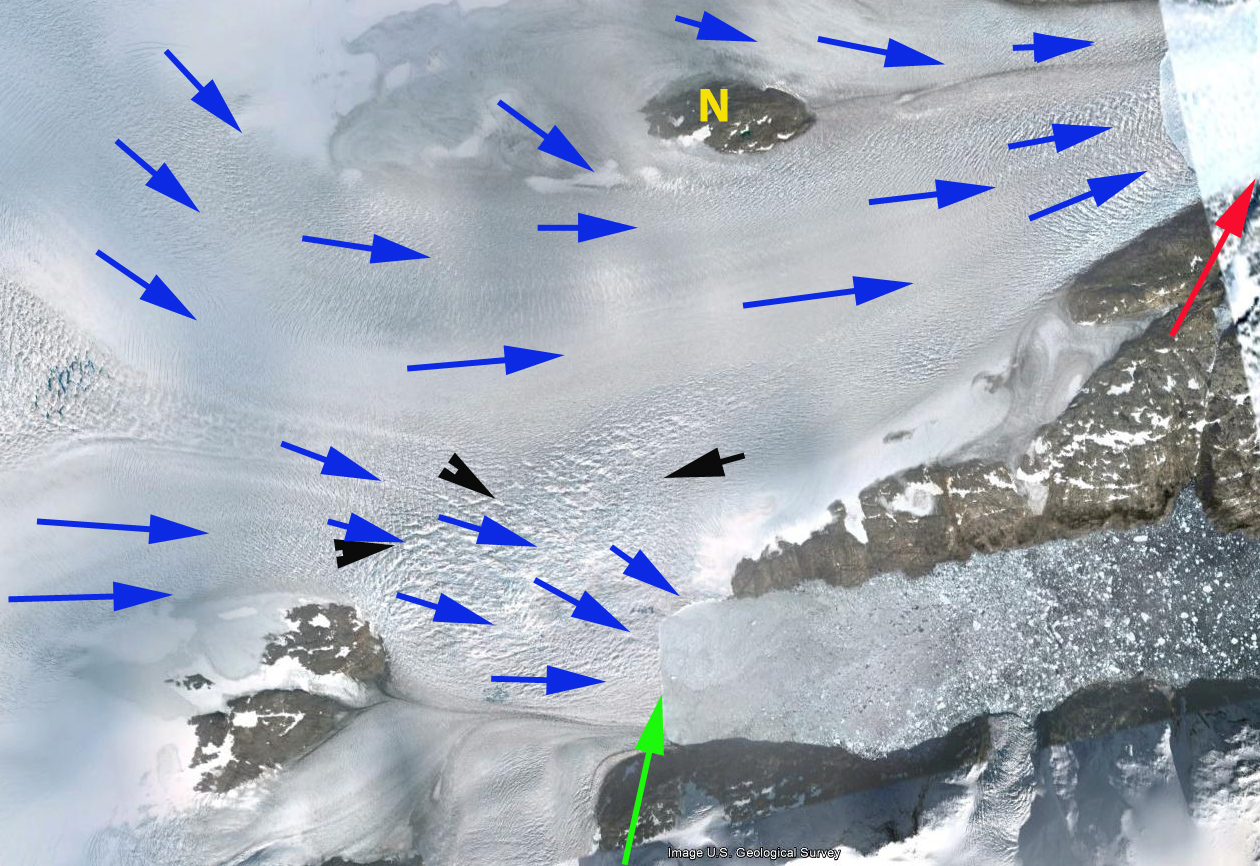
In this post we examine imagery from 1999, 2000, 2004, 2009, 2010 and 2012 to portray the terminus change. The red arrow in each image indicates the 1999 and 2000 terminus position, which coincides with a prominent feature on both the north and south side of the fjord. The Yellow N denotes a nunatak. In the 1999 and 2000 Landsat imagery the nunatak is 5.2 kilometers from the ice front, at the calving front the fjord is 2.1 kilometers wide. By 2004 in a Google Earth image the glacier nunatak is 4.0 kilometers from the ice front and the fjord at the calving front is 2.4 kilometers wide. This is a 1.2 kilometer retreat in four years. By 2009 in a Geoeye image, the nunatak is 3.5 kilometers from the ice front. By 2012 the ice front is 3.2 kilometers from the ice front. The retreat from 2000 to 2012 is 2 kilometers, just as Howat and Eddy (2011) noted. The fjord at the calving front is now 2.7 kilometer wide and will expand to 3.1 kilometers wide as the glacier retreats another 700 meters. The increasing width of the calving front, will increase the calving rate encouraging continued rapid retreat at least until the nunatak is reached after a further 3 kilometers of retreat. The complicating feature in this case is a separate terminus on the south side of the glacier, green arrow, that seems to be capturing part of the flow of the Puisortoq North Glacier and could well merge with the northern terminus, red arrow, after a 4 to 5 km retreat. In the last image the blue arrows indicate flow paths, and the black arrows a chaotic region of crevassing, where the stresses are pulling the ice in different directions. This glaciers behavior is similar to that of Thyrm Glacier and Apuserajik Glacier
Sulztalferner Retreat, Stubaier Alps, Austria
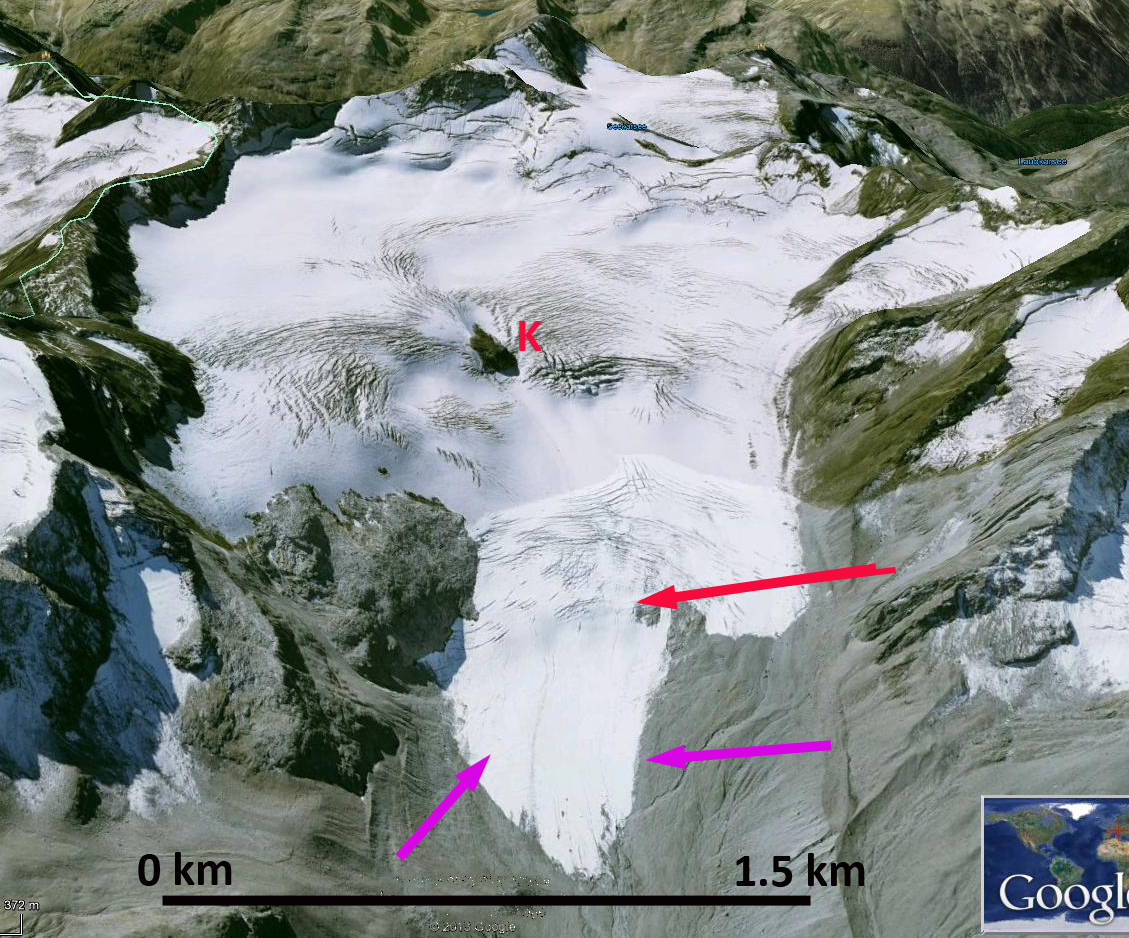
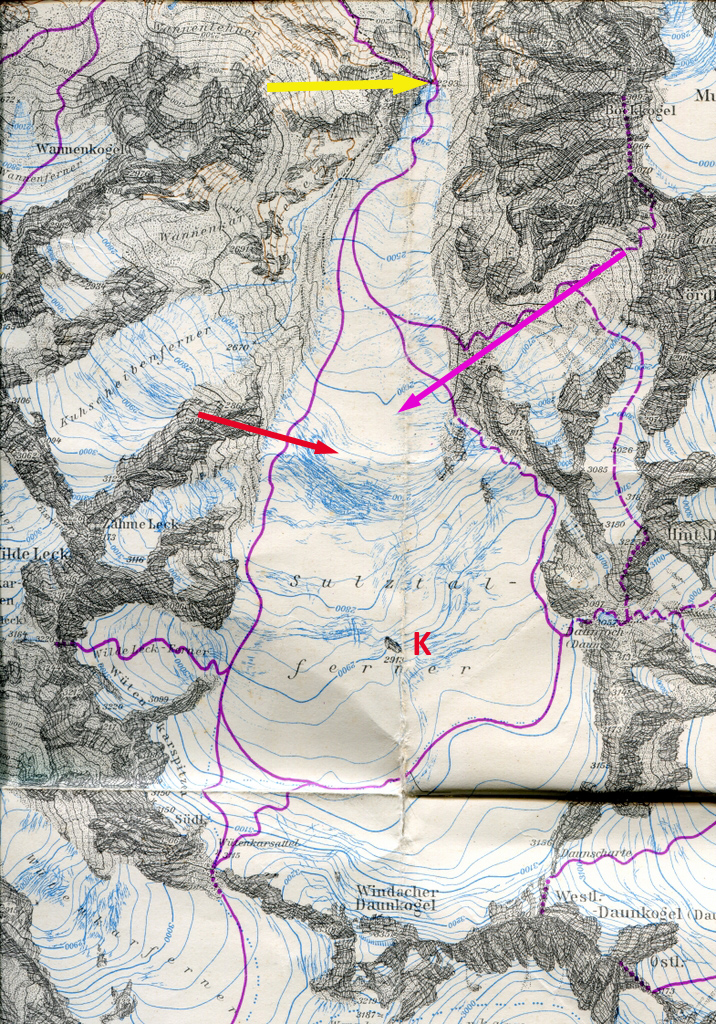
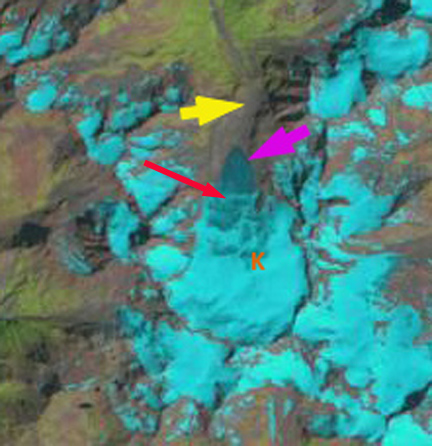
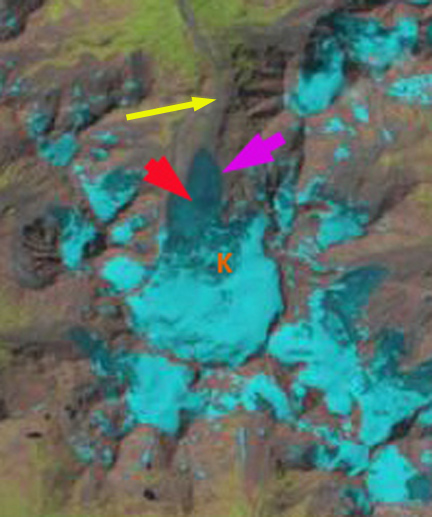
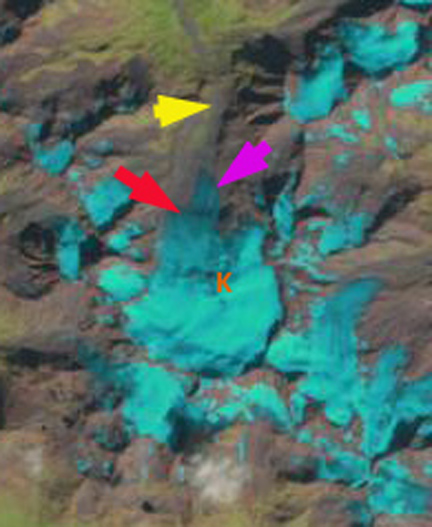
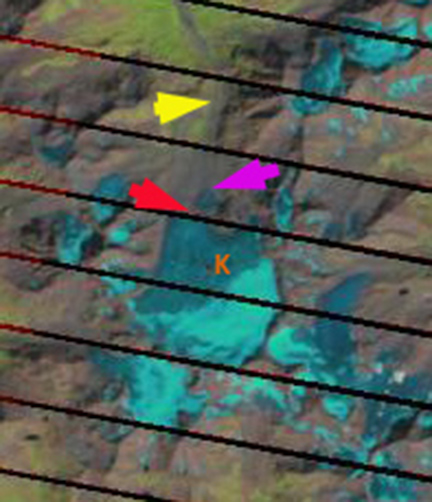
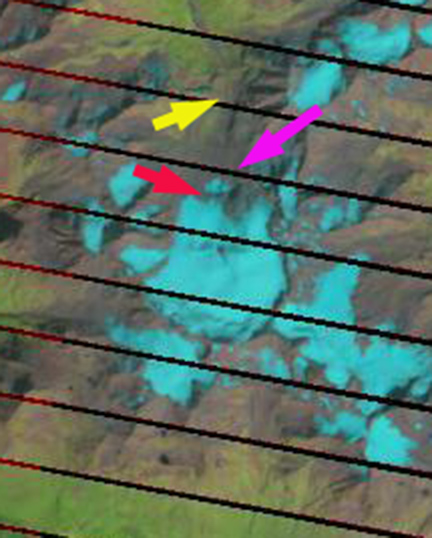
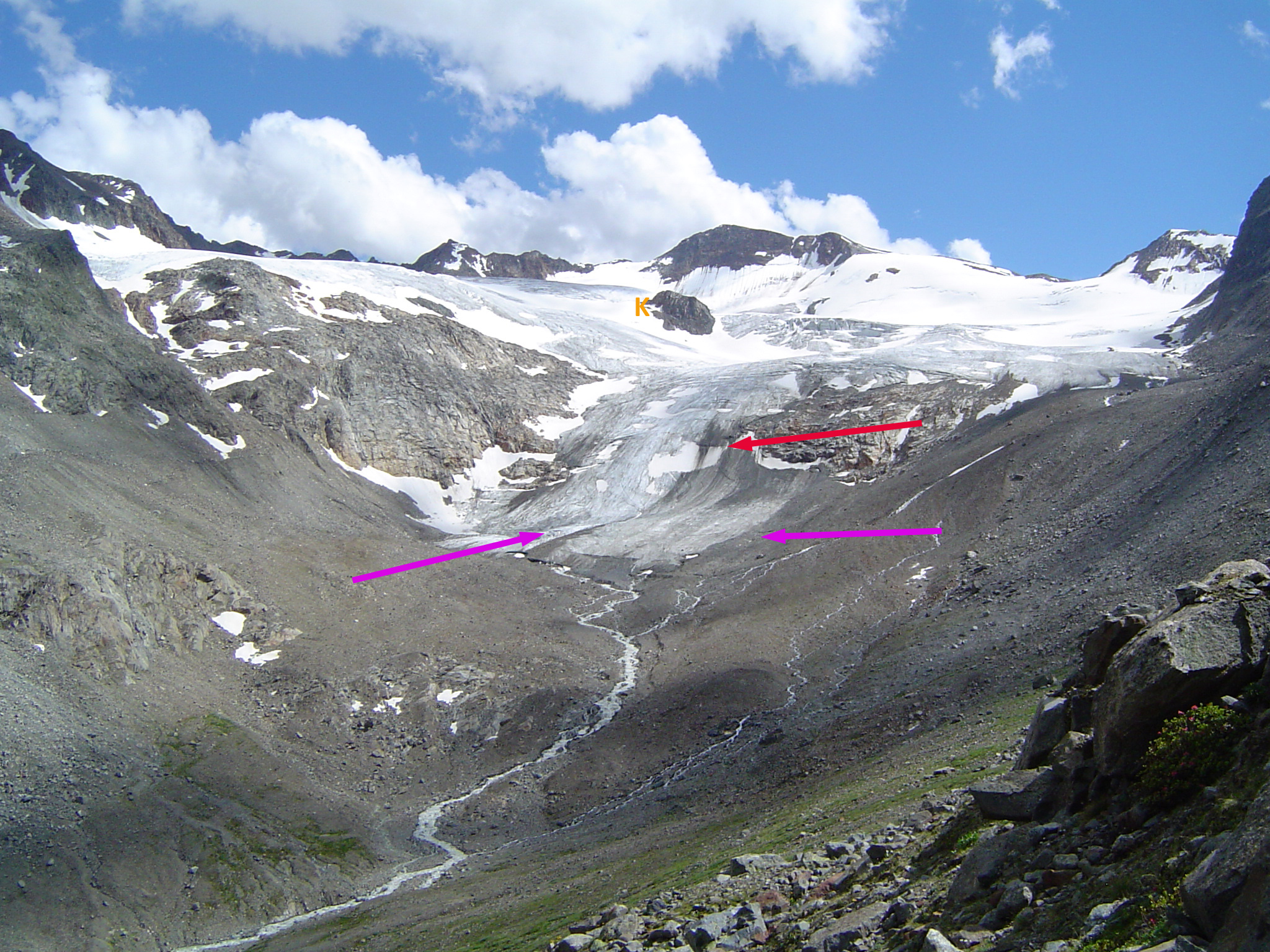
Sulztalferner is a glacier in the Subaier Alps of Austsria. The glacier begins at 3200 m below peak and descends north from the peak of Daunkogel. Below is the glacier in a 2000 Google Earth image. In each of the images the purple arrow indicates a comparatively level area of the glacier below an icefall at 2700 meters. The red arrow indicates this icefall, the yellow arrow indicates the 1937 terminus, and K indicates a bedrock knob.
Schlicker (2006) identified that between 1969 and 2003, 14 of the 88 glaciers in this range disappeared. The area of the glaciers waas to 54.1 km2 in 1969, increased slightly to 54.4 km2 in 1985, decreased to 47.2 km2 in 1997 and the a rpaid decline to 36.9 km2 in 2003. The retreat between 1969 and 2003 was 32% of the 1969 area. Schlicker (2006) observed that the area of Sulztal Ferner, one of the largest glaciers in the region, decreased from 4.16 km2 in 1969 to 3.51 km2 in 2003. This fits the pattern of all Austrian glaciers ( Lambrecht and Kuhn (2007) and Abbermann et al (2009) and the nearby Stubai Glacier. Here we examine the changes in Sulztalferner from 1937 to 2011. Nicholas Fisher, provided a 1937 map of the glacier indicating the extent of the glacier, that was 3.5 km long and ended at 2350 m. By 1985 the glacier had retreated 700 m.
The glacier retreat was slow but steady from 1985-2000 totaling 100 m. From 2000 to 2010 the World Glacier Monitoring Service reports the retreat at 326 m, or 33 m per year. The annual fluctuations are measured by the Austrian Alpine Club’s glacier terminus survey, which fourn a retreat of 27 m in 2012. The most notable change from 2000 to 2011 is the near total loss of the glacier tongue beneath the 2700 m icefall. Further there is a separation between the glacier above the icefall and this shrinking detached terminus tongue in 2010. The terminus tongue in 2000 below the icefall had a length of 540 m. This is now separate from the main glacier and will quickly melt completely away.


The thin nature of the ice flowing down the lower icefall at 2700 m is evident in a picture of the glacier from Steffen. The red arrow indicates the point at which the glacier separates in 2010.

Hidden Creek Glacier Thinning, North Cascades, Washington
Hidden Creek Glacier is northeast of Baker Lake on the west slope of Mount Hagan in the North Cascades of Washington. We began measuring the retreat of this glacier in 1985, with periodic visits since.
Pelto and Hedlund (2001) examined the terminus response time of 38 North Cascade glaciers, where we could determine the terminus history for the 1890-1998 period. The glaciers exhibit three distinct patterns (Table 3): 1) Retreat from 1890 to 1950 then a period of advance from 1950-1976, followed by retreat since 1976. 2) Rapid retreat from 1890 to approximately 1950, slow retreat or equilibrium from 1950-1976 and moderate to rapid retreat since 1976. 3) Continuous retreat from the 1890 to the present. Hidden Creek is a type 2 glacier.
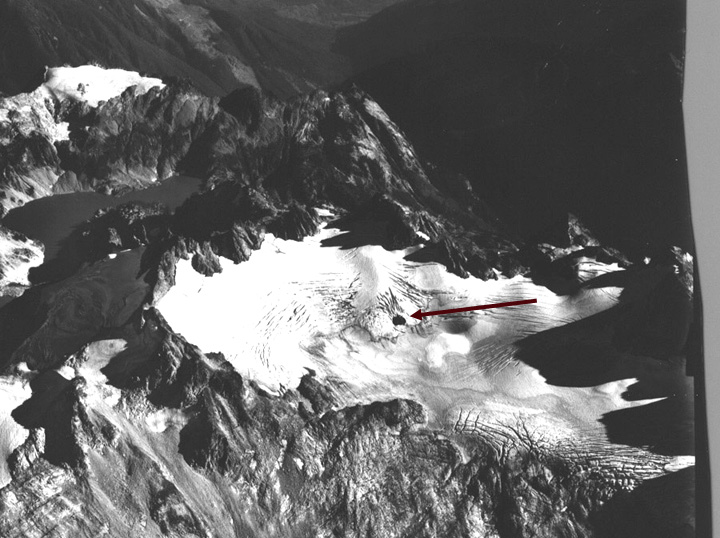
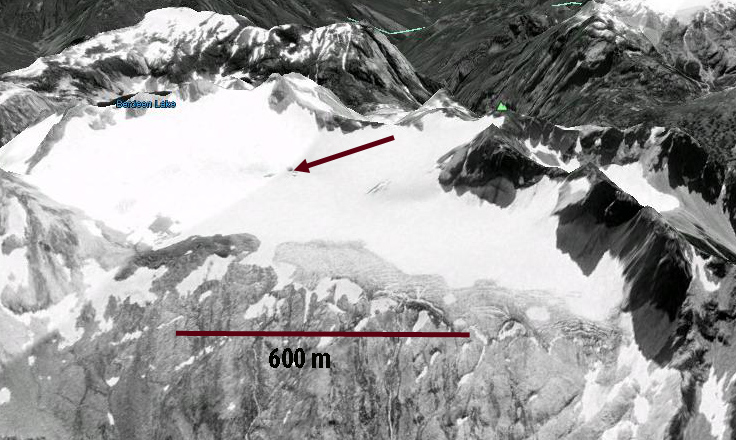
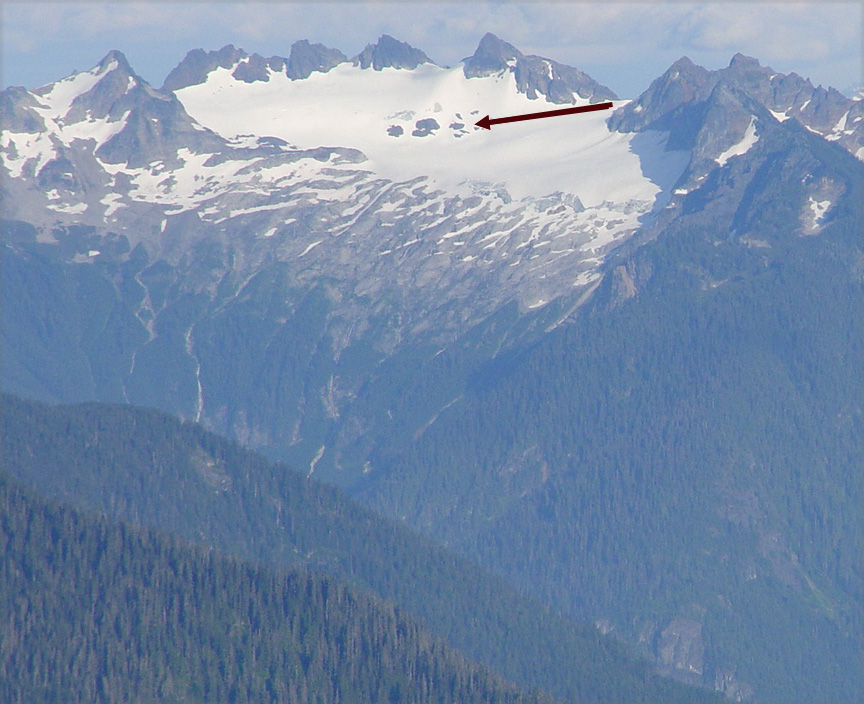
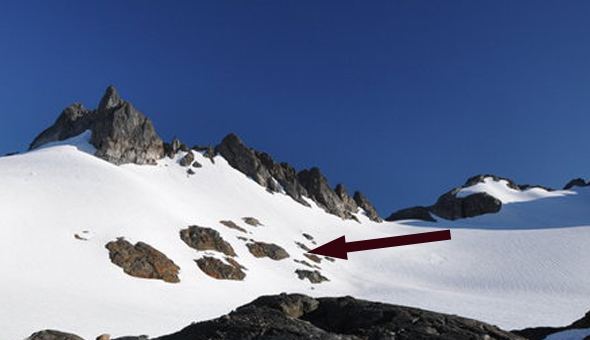
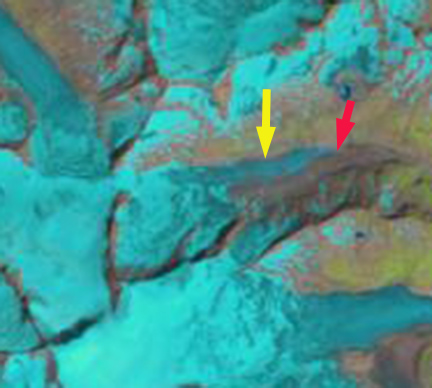
Here we examine photographs of the glacier to identify changes from 1979 to 2010. The burgundy arrow indicates the rock outcrop between the upper northern part of the glacier and the lower southern part of the glacier. In 1979 there is one small outcrop of rock between the upper and lower part of the glacier, the glacier has numerous extensively crevassed regions. From 1985-1990’s this one outcrop remained visible but did not notably change, as seen in the 1998 and 1999 image below. By 2006 and 2007 a network of outcrops had emerged, as the upper glacier became increasingly separated from the lower and southern section of the glacier. By 2009 the outcrops had merged into two large outcrops 270 m across, the main terminus had retreated only 50 m from 1979 to 2011, but the thinning of the glacier indicates much more significant changes to come. The thinning of the upper glacier indicates a glacier that cannot survive current climate, though it is not disappearing rapidly (Pelto, 2010). In 2010 the early August image indicates the extent of the rock outcrops that have still not melted out from the previous winter snows. We will be interested to see the glacier again this summer when we head to the field. This glaciers response is similar to Quien Sabe Glacier and Daniels Glacier.

1979 Photograph from Austin Post (USGS)

1999 image taken from Ptarmigan Ridge
Viltragenkees Glacier Retreat, Austria
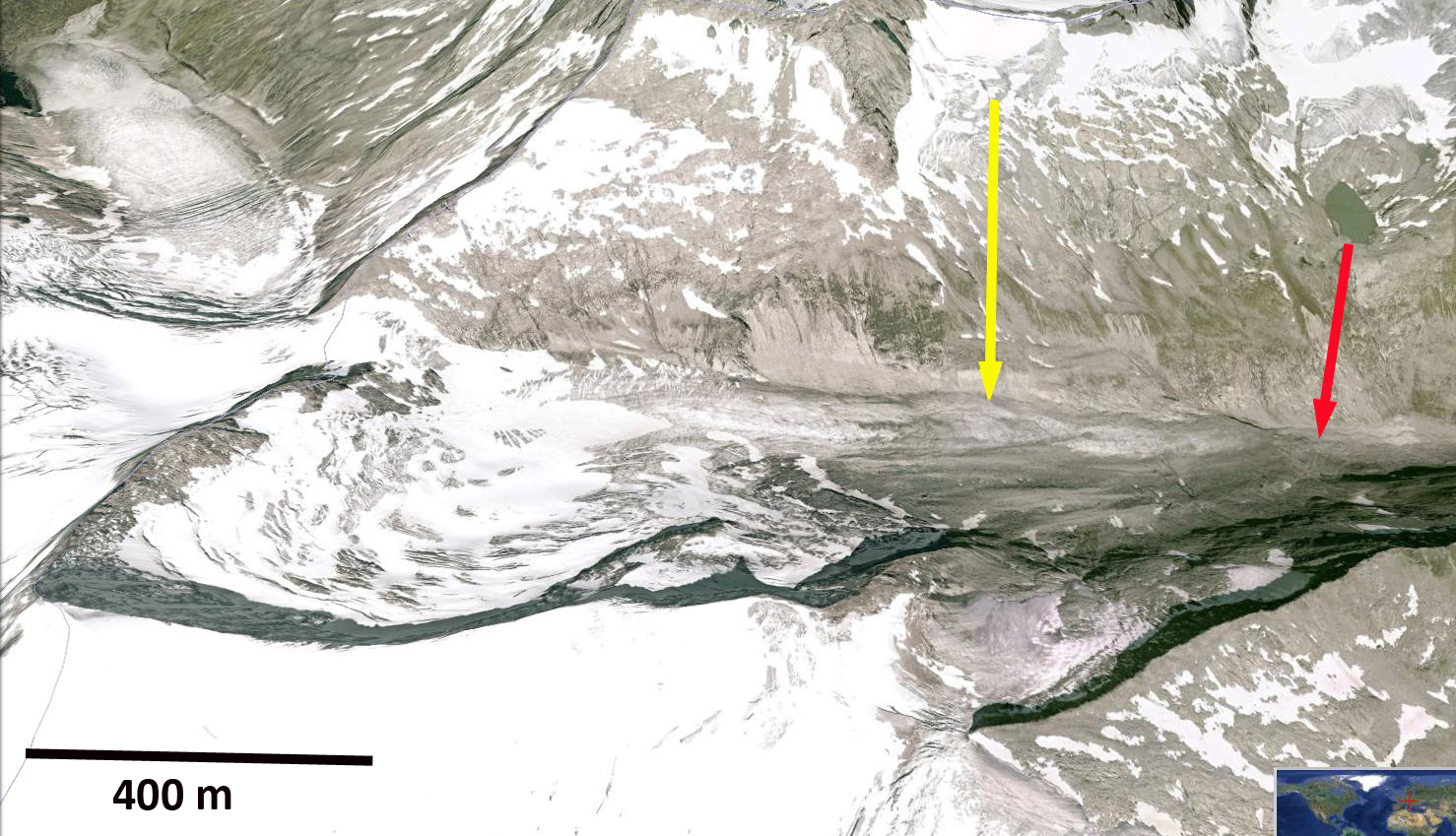
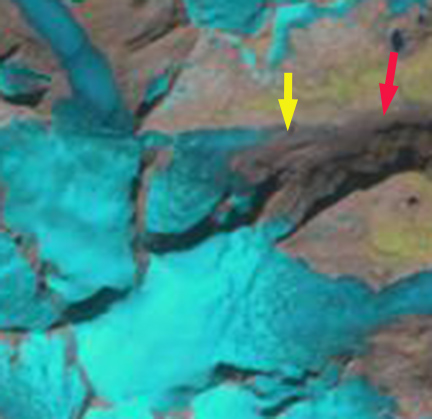
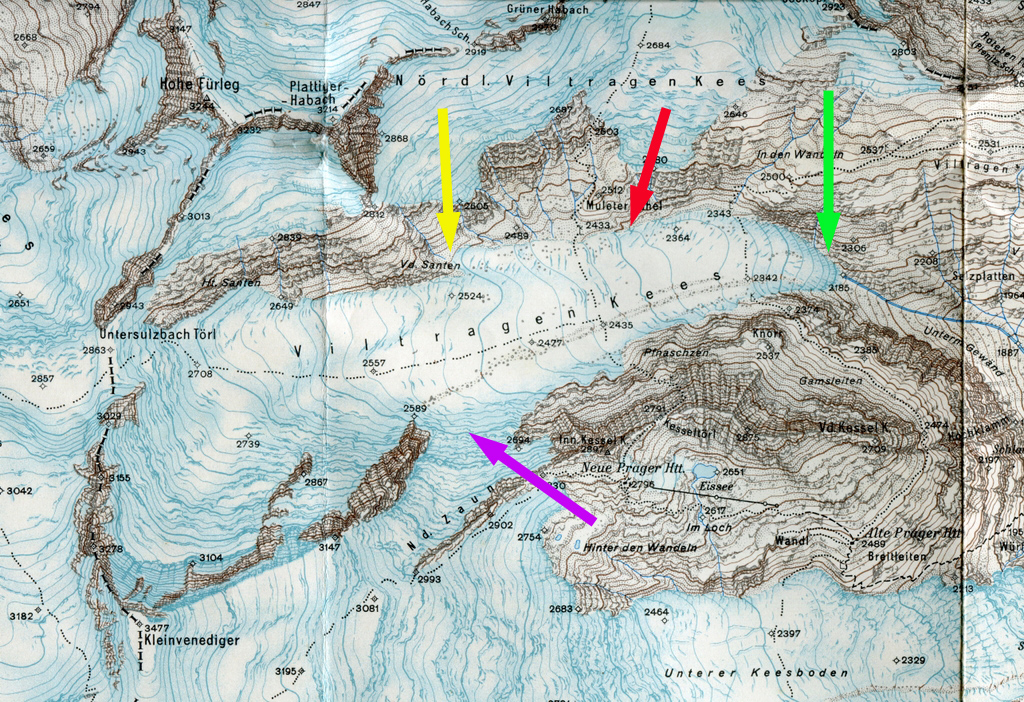
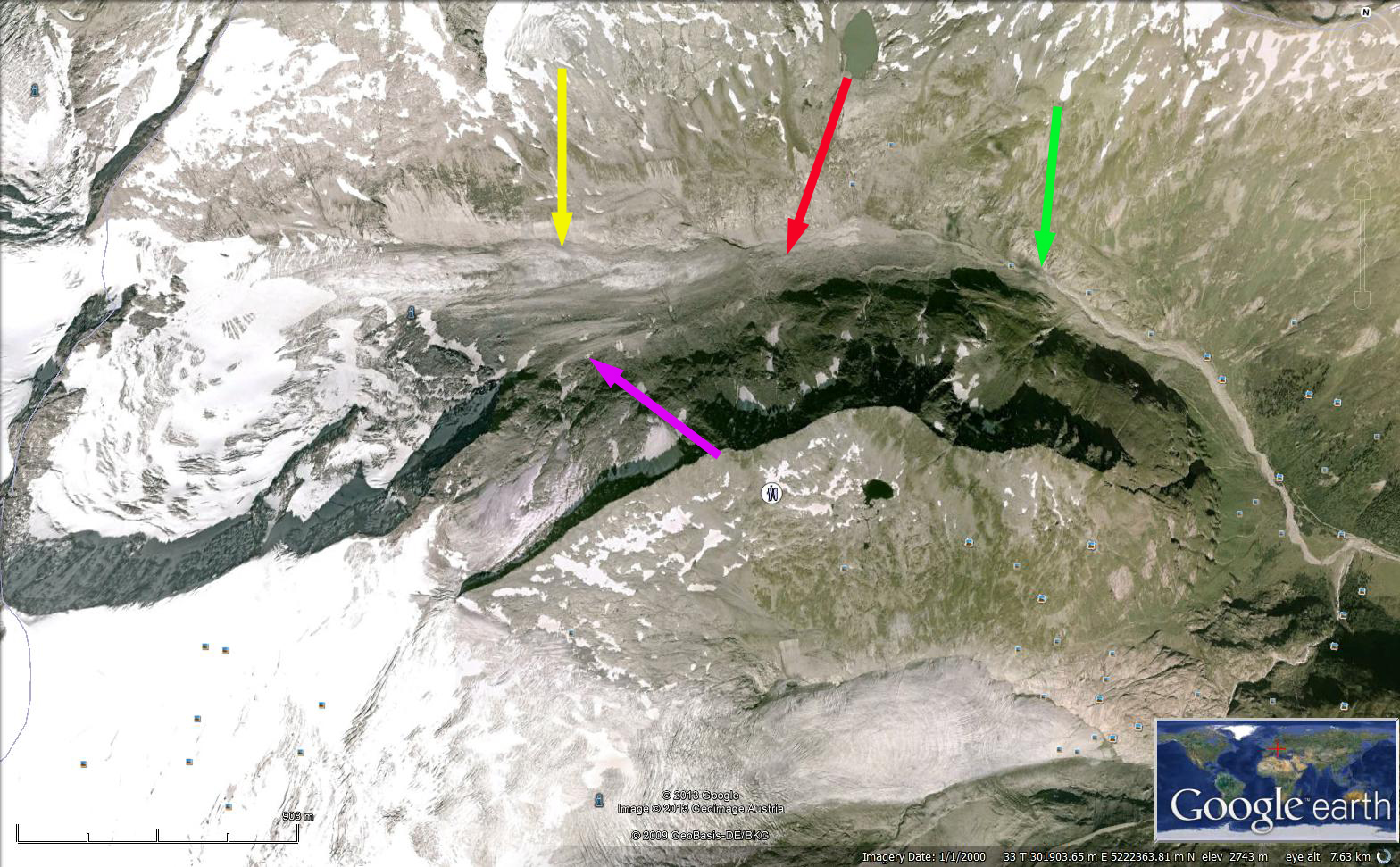
The Austrian Alpine Club published the results of its annual terminus survey program on April 13, 2013. Out of the 95 glaciers measured, 93 retreated an average 17 meters in 2012, two were unchanged. Here we examine one of the those glaciers Viltragenkees. This glacier flows east from the Grosvenediger Massif into the Drau River. In 1988 the glacier was 3 km long beginning at 3200 m and ended at 2340 m. Lambrecht and Kuhn (2007) noted that Austiran glaciers lost 17% of their area from 1969-1998. Abbermann et al (2009) noted that this rate of retreat continued up to 2006 with a further 8% loss. Viltragenkees has been noted by the World Glacier Monitoring Service as having retreated 92 m from 2001-2005 and 157 m from 2006-2010. Here we examine Landsat and Google earth imagery from 1988, 1998, 2000, 2011 and 2012 to illustrate the retreat and then compare a 1929 map to the 2000 terminus position. The red arrow indicates the 1988 terminus the yellow arrow the 2012 terminus on each image. The retreat from 1988-1998 is minor. By 2000 in the Google Earth image the retreat is still minor from 1988, but the terminus section has thinned and is stagnant (see last image in post). In 2011 there is a small segment of residual ice between the 1988 and 2012 terminus position, the glacier has retreated most of the way to the 2012 position otherwise. In 2012 the relict ice is gone and the glacier has completed a 400 m retreat since 1988. However, 90% of the retreat occurred since 2000, indicating a rate of 35-40 m per year. In fact from 2006-2012 the glacier retreated 35-50 m in five of the seven years.

The Austrian Alpine Club noted a retreat of 47 m for Viltargenkees in 2012. Viltragen Glacier is 10 km east of Obersulzbach Glacier that has had a similar retreat. The terminus area in 2000 is quite stagnant, a deeply incised suprglacial stream indicates this fact, blue arrow. The orange arrow indicates a region with a couple of melt ponds, again indicating stagnation. The debris covered terminus has no crevassing in 2000 in the lowest 400 meters again indicating the thin and hence stagnant nature of the lower section of the glacier that was at that point preconditioned for rapid retreat. Below the 2000 terminus image is the full glacier in 2000 compared to the 1929 map of the region provided by Nicholas Fisher. The green arrow indicates the 1929 terminus and the purple arrows where the Schlaten Kees formerly joined Viltragenkees. The retreat over the 70 year period was 700 meters.
Nevado Cololo Glacier Retreat, Bolivia
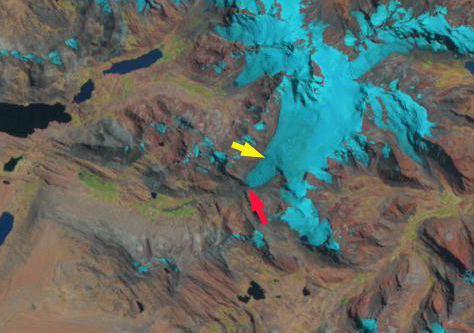
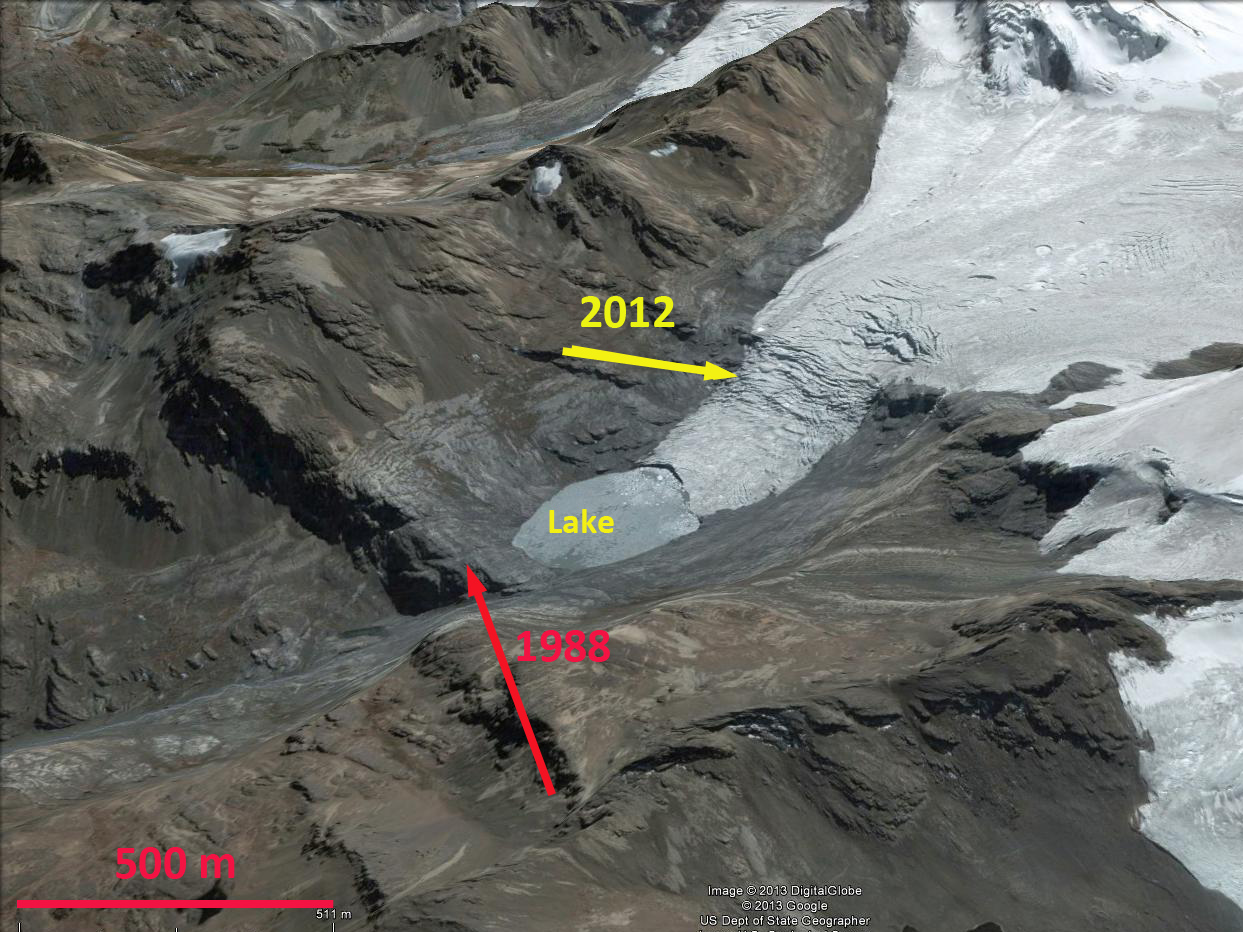
Nevado Cololo is a glaciated mountain area in the Cordillera Apolobamba of northwest Bolivia. Here the focus is on a glacier draining west from the Nevado Cololo into the Rio Suches and then Lake Titicaca. The glaciers of the Apolobamba have lost 48% of their area from 1975-2006 (Hoffmann, 2012). Hoffmann and Weggenmann (2012) have observed both the extensive retreat, new lake formation, and the problem of glacier lake outbursts in this region, which is part of the Apolobamba Integrated Natural Management Area. The glacier that is our focus has developed a new lake at its terminus since 1988, the glacier begins at 5700 m and ends at 4930 m.
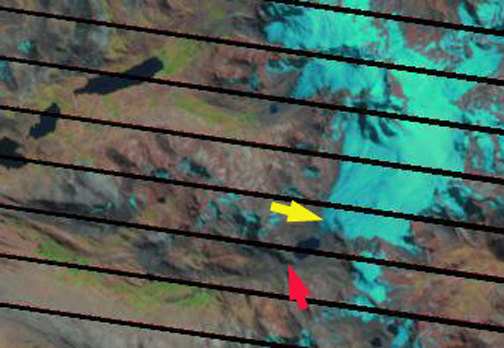
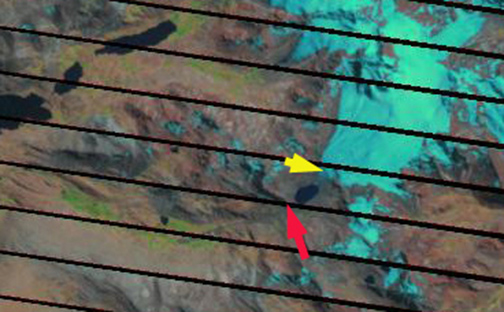
. The red arrow in each image indicates the 1988 terminus position which was at the top of a bedrock cliff evident in all images. The yellow arrow is the 2012 terminus position at the base of a second cliff. By 2005 the glacier had pulled back from the cliff exposing a new lake that is 400 meters across. The glacier still ends in the lake. By 2012 last two images, the glacier has retreated several hundred meters from the shore of the lake and ends at the base of a cliff at 5000 m. The glacier should rapidly retreat to the top of this cliff. The retreat from 1988-2005 was 540 m, the retreat from 2005-2012 has been 280 m. The total retreat over 25 years is 820 m or 33 meters per year.
The retreat of this glacier fits the pattern of other Bolivian Glaciers, such as the Zongo Glacieror Laramcota Glacier and tropical Andean glaciers in general (Rabatel et al, 2013).