Emend River Headwaters Glacier Retreat, Hindu Kush, Takhar Province, Afghanistan

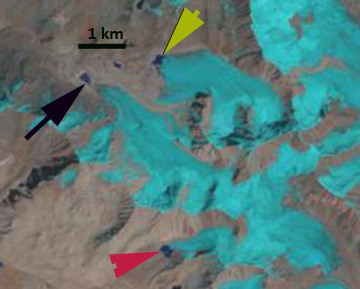
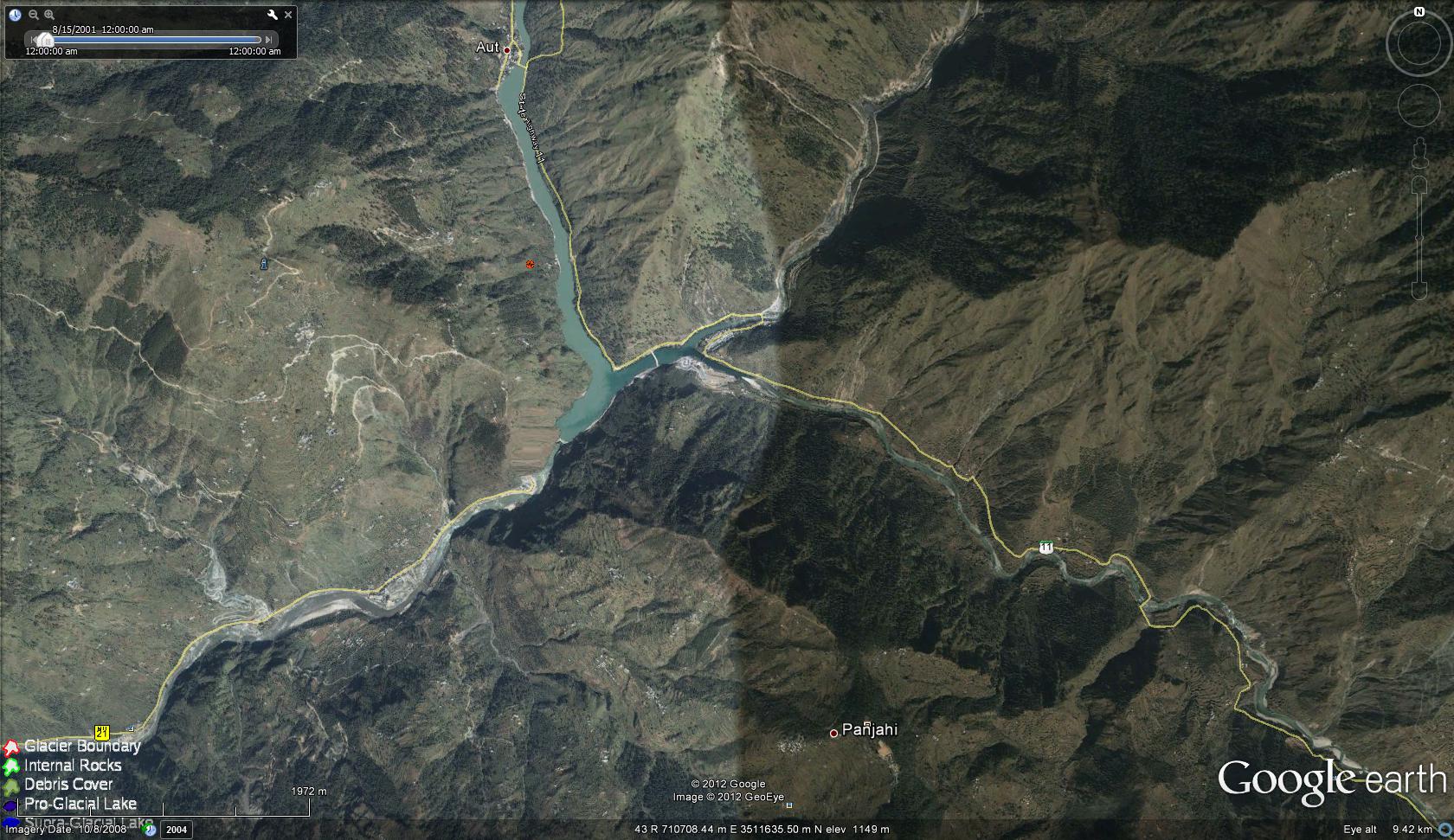
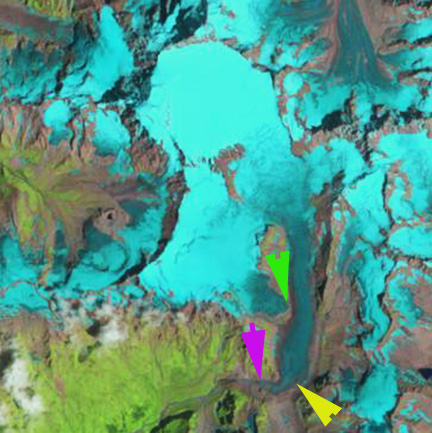
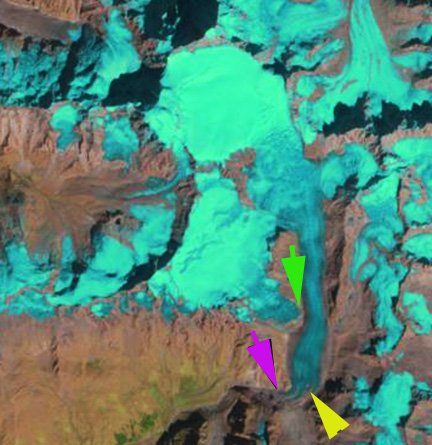
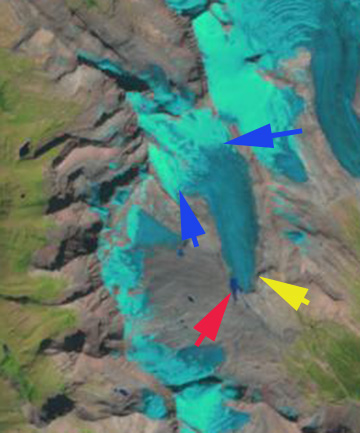
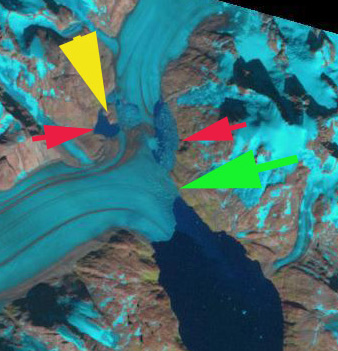
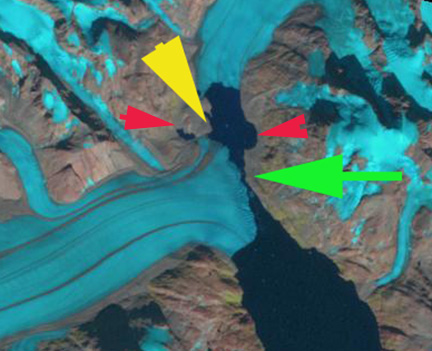
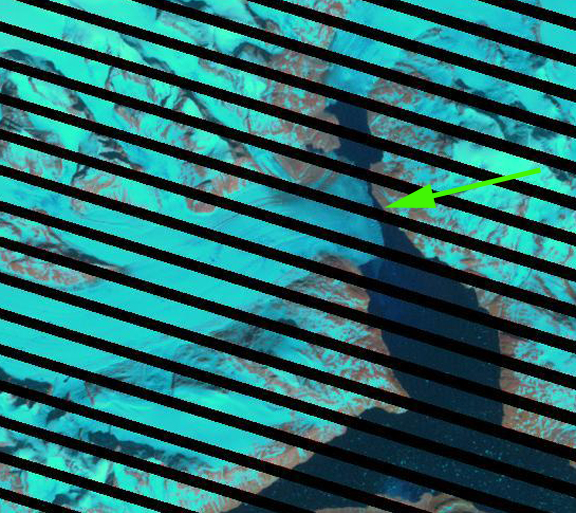
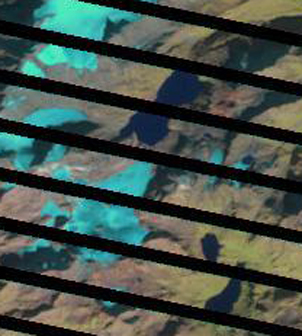
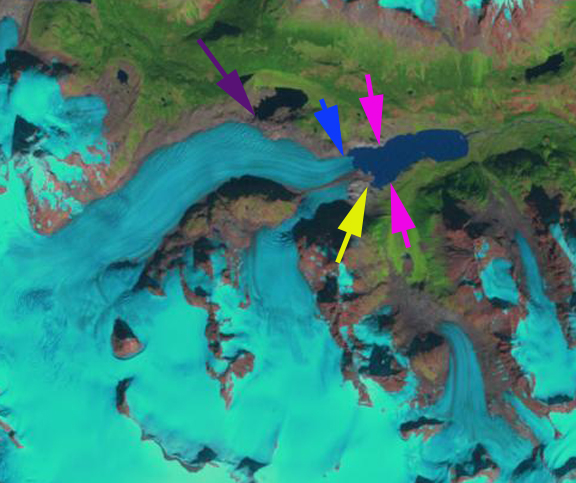
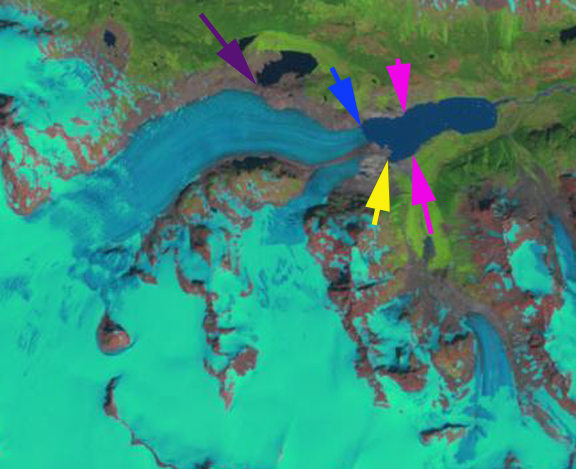
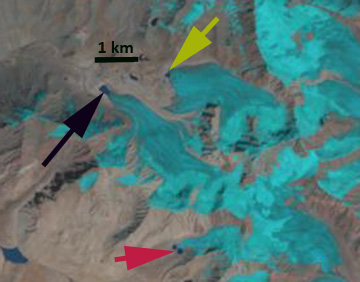
The Emend River drains from the Hindu Kush Mountains and joins the Worsaj River and eventually drains into the Amu Darya River. This area is not impacted much by the summer monsoon and glacier runoff is key to summer streamflow. The runoff from the glacier is tapped for extensive irrigation in the valley bottom both along the Emend, and eventually downstream near Taliquan (bottom image). At the headwaters of the Emend River, Takhar Province, Afghanistan are a pair of 3 kilometer long glaciers that are the focus of this post. We examine Landsat images from 2000 and 2011 and a Google Earth image from 2004. In 2000 the western glacier ends in a proglacial lake indicated by the purple arrow in each image. By 2007 the glacier has receded 50 meters from the edge of this lake, and by 2011 the glacier has receded 100+ m from the lake. On the eastern glacier in 2000 a small proglacial lake less than 0.1 square kilometer is at the end of the lake, yellow arrow. In the 2007 Google Earth image the lake has expanded as the glacier has retreated and has an area of 0.25 square kilometers. A small additional expansion has occurred by 2011, with the lake area reaching 0.3 square kilometers. Another glacier to the south also in the Emend River watershed has also experienced lake expansion at its terminus, red arrow. This latter lake has expanded from less than 0.1 square kilometers to 0.3 square kilometers in the last decade. These are all small lakes and do not pose a glacier lake outburst flood hazard.
<

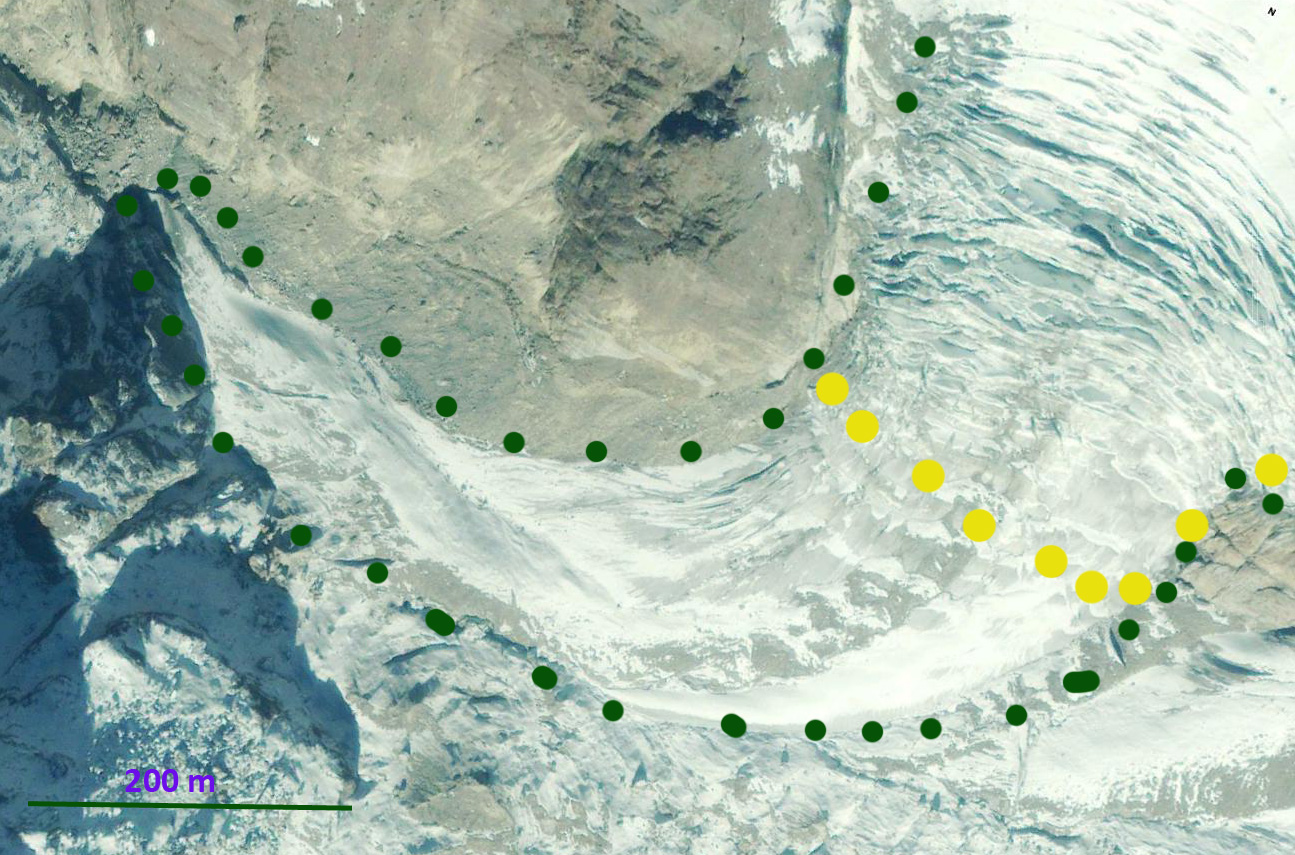
A closeup view of the terminus area indicates numerous depressions, green arrows. The depressions are ablation hollows, where more dust has accumulated, and then accentuated ablation, the hollows typically form from wind scouring. The hollows are not water filled, Petrov Glacier also featured similar features. This region of the Hindu Kush has not been the focus of detailed glacier studies. Northeast of Takhar Province in the Wakhan Corridor a group of glaciers was examined by Umesh Haritashya and others (2009) and found 28 of thirty had retreated. Zemestan Glacier is one example. The Hindu Kush follows the pattern of the high mountains of central Asia including the Himalaya.

Emend River Headwaters Glacier Retreat, Hindu Kush, Takhar Province, Afghanistan

The Emend River drains from the Hindu Kush Mountains and joins the Worsaj River and eventually drains into the Amu Darya River. This area is not impacted much by the summer monsoon and glacier runoff is key to summer streamflow. The runoff from the glacier is tapped for extensive irrigation in the valley bottom both along the Emend, and eventually downstream near Taliquan (bottom image). At the headwaters of the Emend River, Takhar Province, Afghanistan are a pair of 3 kilometer long glaciers that are the focus of this post. We examine Landsat images from 2000 and 2011 and a Google Earth image from 2004. In 2000 the western glacier ends in a proglacial lake indicated by the purple arrow in each image. By 2007 the glacier has receded 50 meters from the edge of this lake, and by 2011 the glacier has receded 100+ m from the lake. On the eastern glacier in 2000 a small proglacial lake less than 0.1 square kilometer is at the end of the lake, yellow arrow. In the 2007 Google Earth image the lake has expanded as the glacier has retreated and has an area of 0.25 square kilometers. A small additional expansion has occurred by 2011, with the lake area reaching 0.3 square kilometers. Another glacier to the south also in the Emend River watershed has also experienced lake expansion at its terminus, red arrow. This latter lake has expanded from less than 0.1 square kilometers to 0.3 square kilometers in the last decade. These are all small lakes and do not pose a glacier lake outburst flood hazard.
<

A closeup view of the terminus area indicates numerous depressions, green arrows. The depressions are ablation hollows, where more dust has accumulated, and then accentuated ablation, the hollows typically form from wind scouring. The hollows are not water filled, Petrov Glacier also featured similar features. This region of the Hindu Kush has not been the focus of detailed glacier studies. Northeast of Takhar Province in the Wakhan Corridor a group of glaciers was examined by Umesh Haritashya and others (2009) and found 28 of thirty had retreated. Zemestan Glacier is one example. The Hindu Kush follows the pattern of the high mountains of central Asia including the Himalaya.

Mittie Glacier retreat, Ellesmere Island, Canada

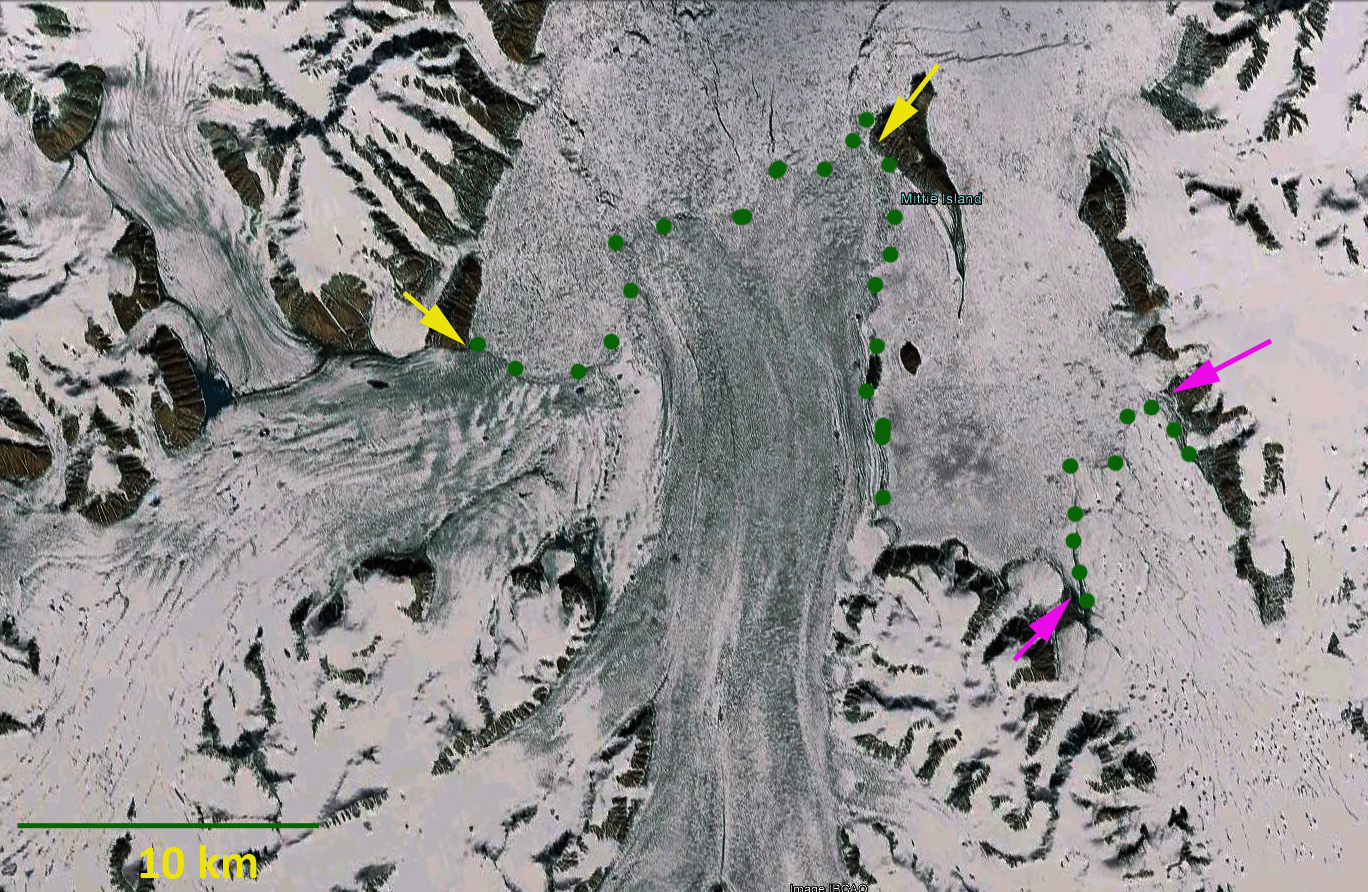
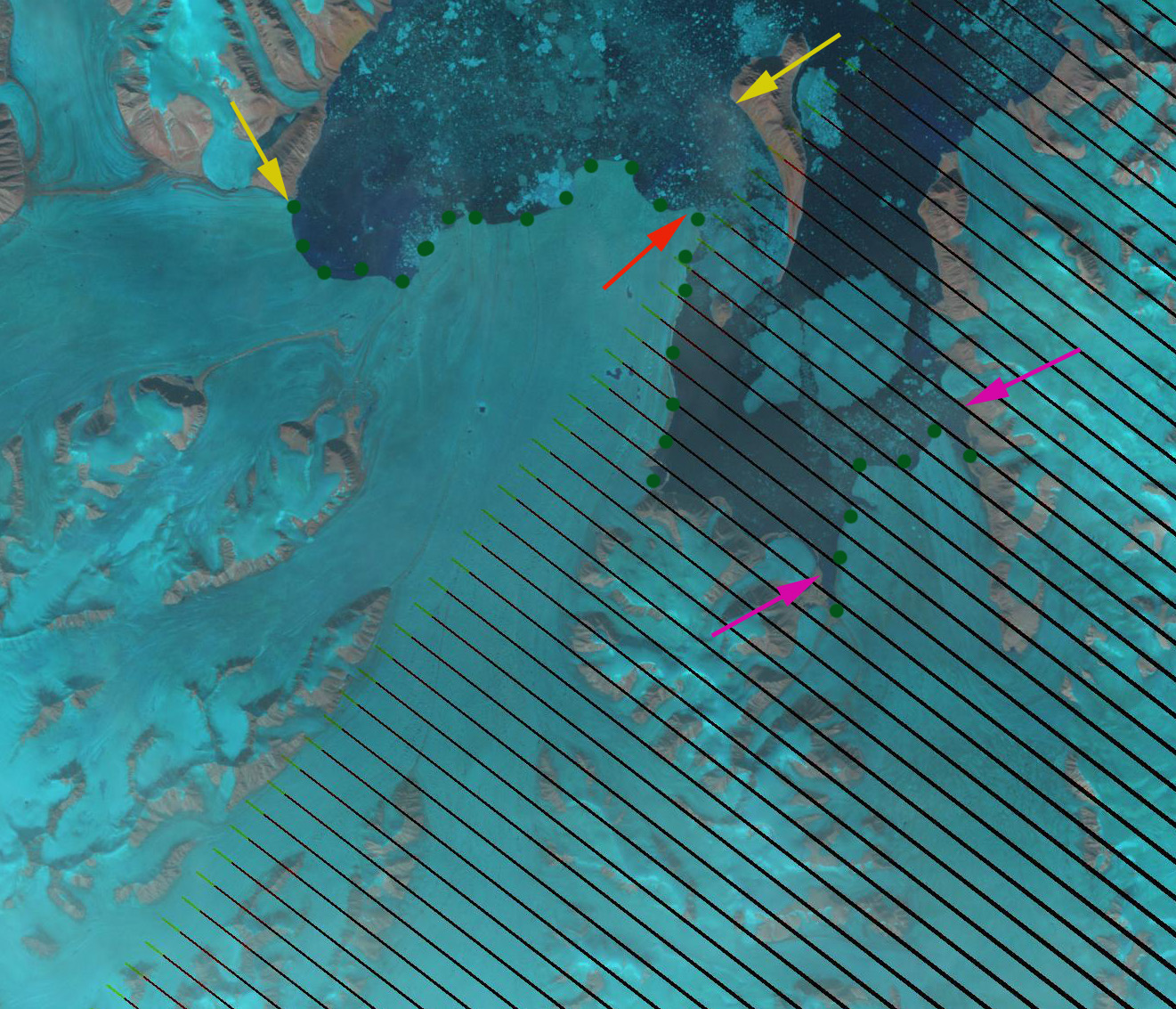
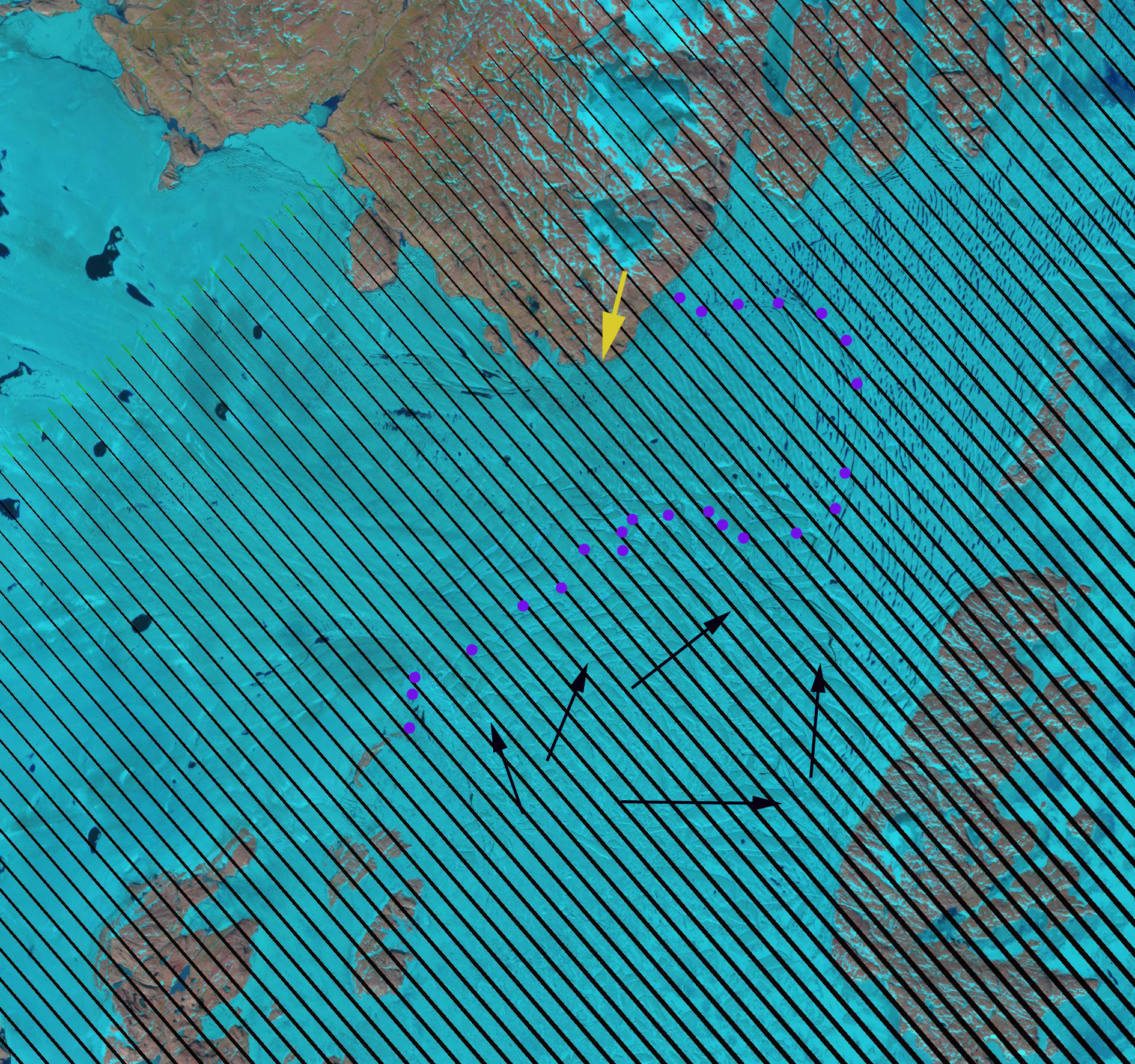
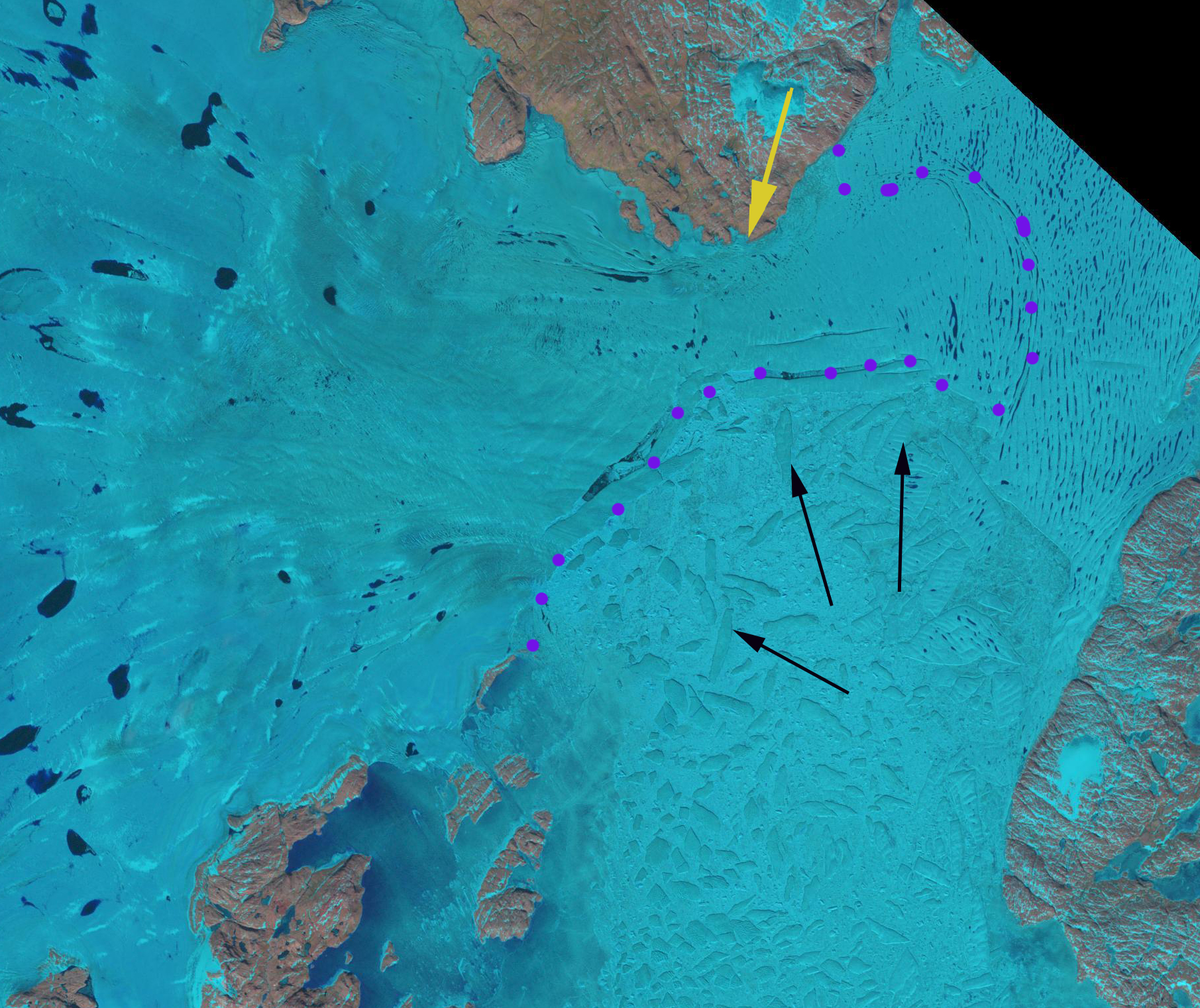
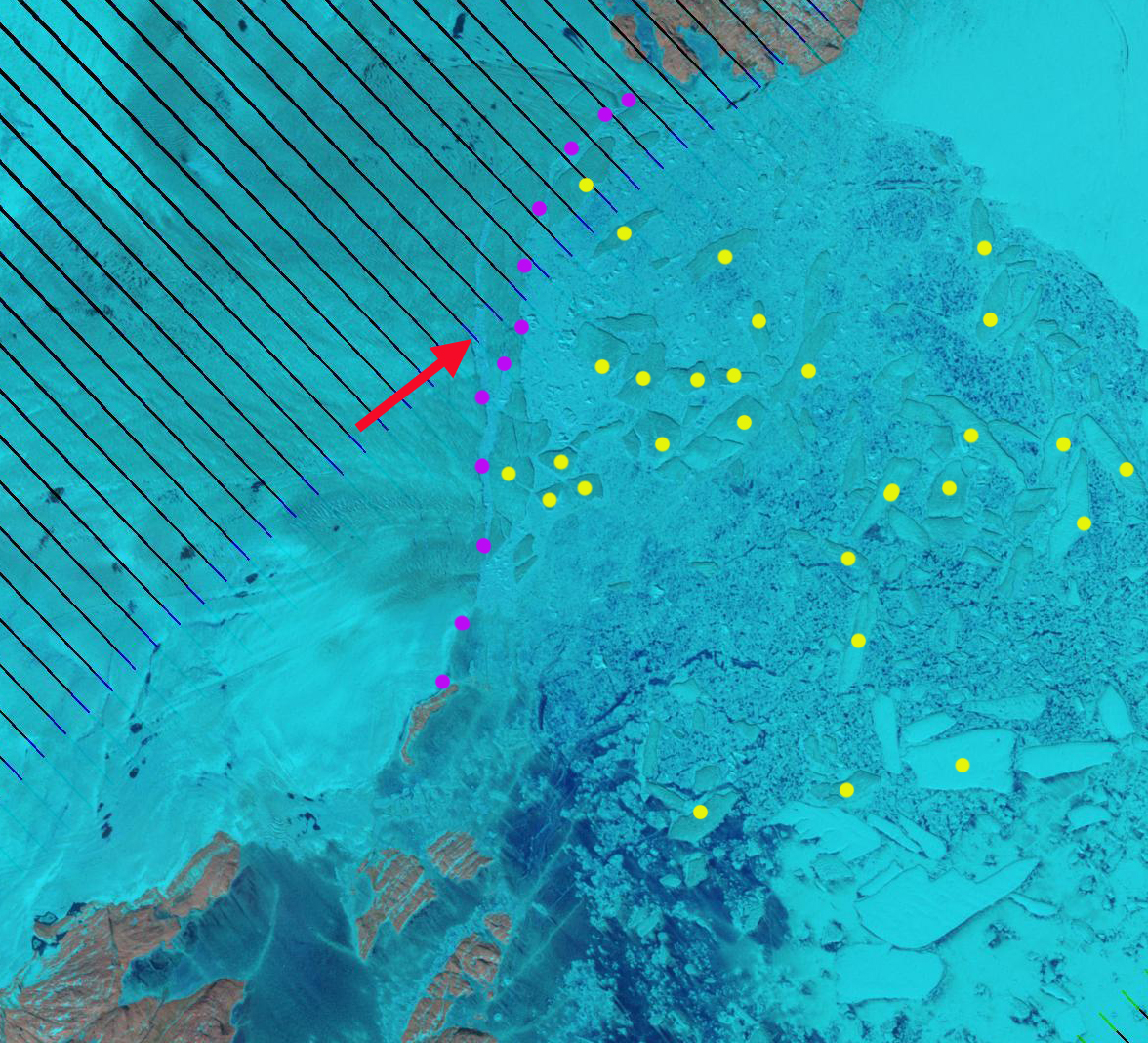
The Manson Icefield is in southeast Ellesmere Island, Canada. This icefield has the highest concentration of surging glaciers in the Canadian Arctic Islands (Copland et al, 2003). The Mittie Glacier is the largest such glacier and drains north from the icefield into Smith Bay. Mittie Glacier was noted to be advanacing and surging in 1999-2000 by Copland et al (2003). This surge led to an advance of about 4 km from the 1959 terminus position and peak velocities reached 1 km/year. During this surge extensive crevassing was noted from the terminus to 30 km inland. The surge was noted to continue up until 2008 (Sharp et al, 2011). mittie mapA surge is an episodic speed up of a glacier that also tends to lead to glacier advance, this post does not examined velocity data and can address if the surge has ended, here we examine a change in the terminus position of the primary Mittie Glacier and a secondary glacier just east of Mittie Glacier. Here we focus on 2002, 2010 and 2012 imagery to illustrate terminus change of Mitte Glacier. The terminus in each image is indicated by green dots. The 2002 terminus position of the Mittie Glacier is indicated by yellow arrows and the adjacent glacier that did not surge pink arrows in each image for comparison, the 2012 image at the point nearest Mittie Island in 2012 is indicated by a red arrow. In 2000 and 2002 Landsat imagery indicates the Mittie Glacier reaching to Mittie Island. By 2010 and 2012 the glacier has retreated from the island. The glacier has retreated on the northeast corner 4.5 km from Mittie Island. The smaller tributary to the east of the main Mittie Glacier has retreated approximately 1 km. The main change is that Mittie Island was a pinning point for the terminus of the glacier. Without this pinning point the glacier will experience enhanced terminus calving. The warm climate conditions of the last three summers and reduced sea ice duration in the area will increase the capacity for retreat of this glacier. The last images is a MODIS image from Aug. 30, 2012 indicating Mittie Island, yellow arrow, and the lack of sea ice in the vicinity of the glacier terminus. The retreat of the terminus from the pinning point is similar to that seen this summer on Thrym Glacier, Greenland.
Malana Glacier Retreat, Himachal Pradesh, India

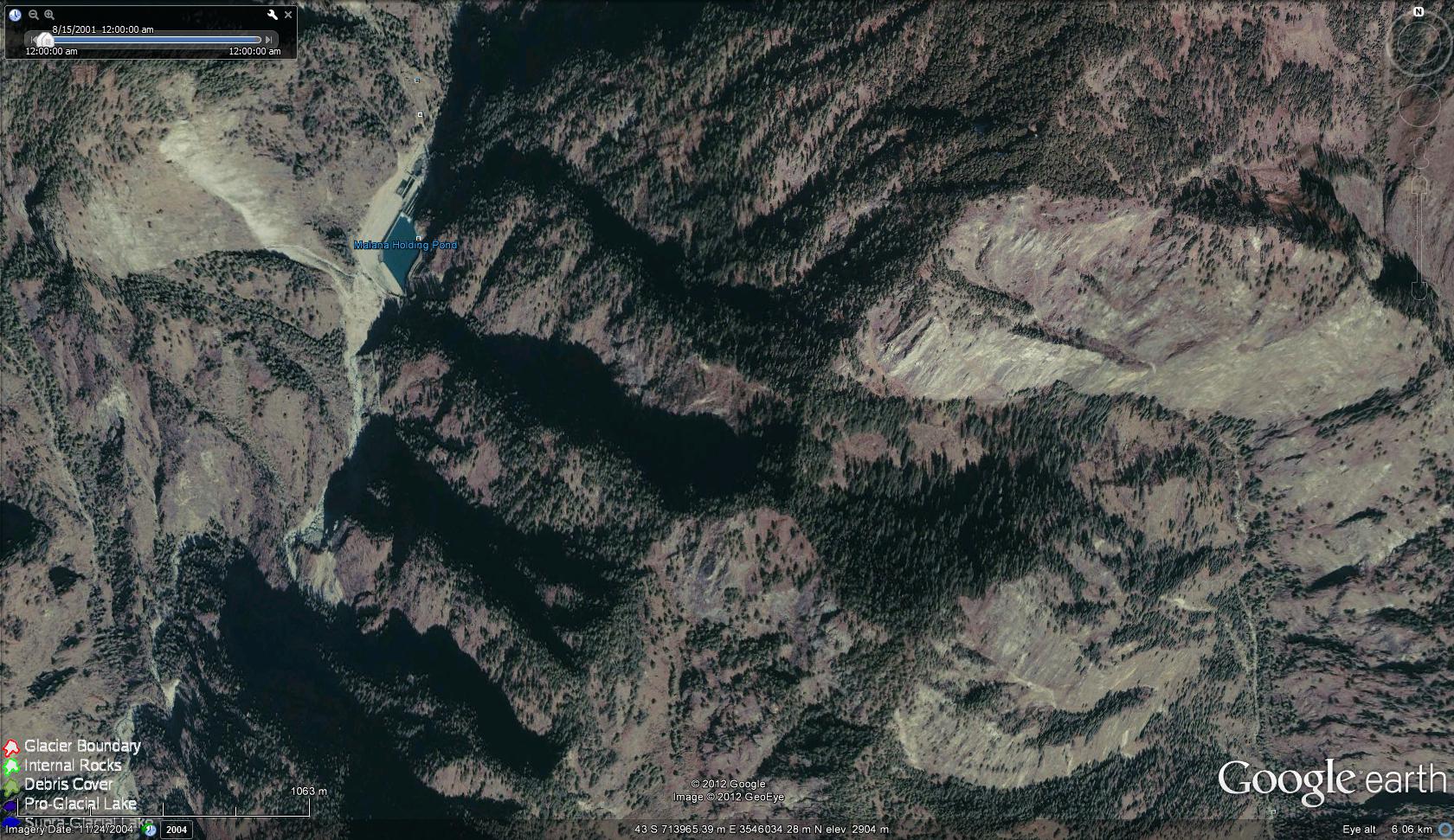
The Malana Glacier (top image) is at the headwaters of the Malana River in the Himachal Pradesh of India. The glacier feeds the Malana Hydropower Plant (second image) a 108 MW run of river hydropower plant, that lacks a significant reservoir. The Malana River than flows into the Parbati and Beas River. Malana Glacier runoff once in the Beas River feeds hydropower facilities at Larji (120MW: third image), which alters streamflow below it leaving the river bed quite exposed at times (fourth image), Pandoh (990MW) and Pong (360 MW). The Pandoh Dam diverts water out of the basin into the Sutlej System to generate the power, see Sara Umaga Glacier retreat for details. The Malana Valley is very secluded and is sometimes referred to as the Shangri-la. This glacier differs from many of the glaciers in the region that have a heavily debris covered terminus such as the Gangotri or Satopanth. The retreat is similar to that of all glaciers in the region (Kulkarni et al, 2007). and in the high mountains of Asia except the Karokoramlarji outlet beas streamflow
Google Earth image below Larji dam indicating low streamflow near Markanda Temple.
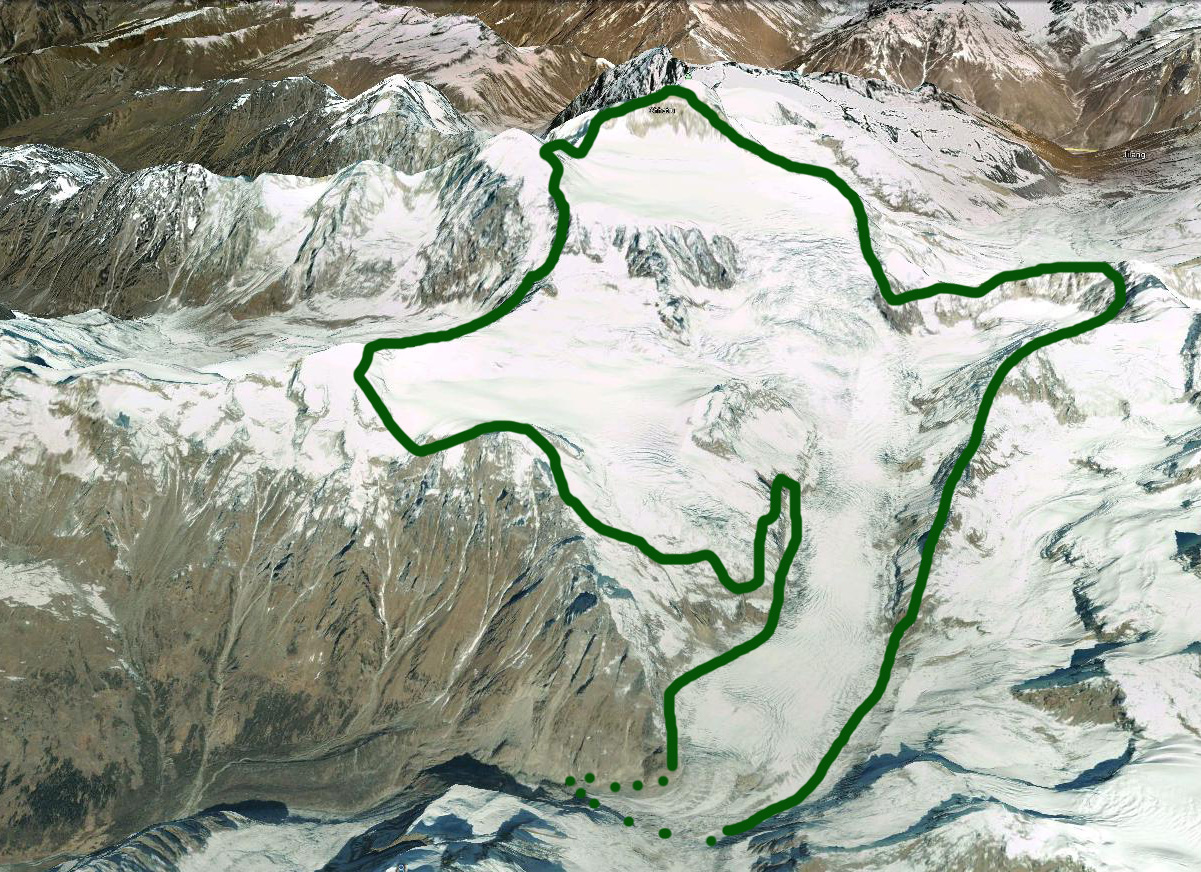
The Malana Glacier flows south from Mt. Indrasan and Mt. Deotibba and has until the last few years turned west where the Manala valleys turns and the Malana Glacier used to join the South Manala Glacier flowing north to this junction point. Here we look at Landsat imagery from 1998, 2000 and 2011. In 1998 and 2000 the glacier turns the corner and begins the western descent to its terminus purple arrow, the narrow tongue of blue in both cases is evident heading west, though further in 1998. There is a prominent bedrock knob, yellow arrow at the western turn on the east side of the glacier. By 2011 the lower 600 meters of the glacier below the western turn has melted away and the glacier now ends at the prominent knob, yellow arrow, there is no tongue of glacier ice turning west. Just above the terminus one significant tributary, green arrow, that had been joined to the glacier during the first ascents in the region in the 1960’s had separated by a short distance in 1998 and 2000. In 2012 this distance has increased as the former tributary also retreats. The Google Earth imagery from 2004 also indicates the glacier turning the corner and descending 400-500 meters ending at an elevation of 3900 meters. A closeup of the terminus indicates the thin uncrevassed nature in 2004 suggesting that this section was largely stagnant and melting away. The 2004 terminus is indicated with green dots and the 2012 terminus with yellow dots.

Des Poilus Glacier Retreat, British Columbia

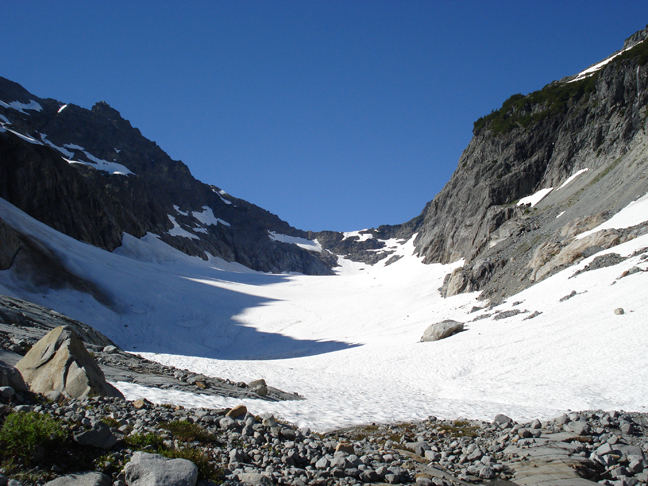
Des Poilus Glacier, British Columbia is at the southwest corner of the Wapta Icefield in Yoho National Park. The glacier flow south at a relatively low slope from the slopes of Mt. Des Poilus. The glacier retreated 500 m, a rate of 15-18 m/year, from 1950-1980. In this post we examine the continued retreat and development of a new lake at the terminus of the glacier using Landsat imagery from 1988, 2001 and 2012. In 1988 no lake exist at the terminus, red arrrow. The glacier extends well past the prominent ridge on the east side of the glacier shortly above the terminus, yellow arrow. The blue arrow indicates that the snowline is very high 2650 m, which is 200 m higher than that necessary for the glacier to be in equilibrium. By 2001 a small lake had developed along the west side of the glacier and the glacier had retreated 300 meters from 1988. By 2012 a substantial lake has developed that is 600 m long and 500 m wide. The glacier has retreated beyond the prominent ridge east of the glacier, yellow arrow. Total retreat from 1988 is 800 meters and 450-500 meters since 2001. The retreat rate since 1988 has increased to 25-30 m/year since 1988. The snowline despite this being an Aug. 12th image is already at 2600 meters. The issue for this glacier is that the consistent snowline is too high to support the main valley tongue of the Des Poilus Glacier, which will dissappear (Pelto, 2010). The only section of the glacier that maintains snowcover is on the east flank of slopes of Mt. Des Poilus.
This retreat has followed the pattern for glaciers in the area overall (Bolch et al, 2009) from Freshfield Glacier, Columbia Glacierand Washmawapta Glacier.

Glacier Post Index 2009-August 2012

Glacier Index List
Below is a list of the individual glacier posts examining our warming climates impact on each glacier. This represents the first 3.2 years of posts, 228 total posts, 208 different glaciers. I have worked directly on 45. The others are prompted by fine research that I had come across, cited in each post or inquiries from readers and other scientists. I then look at additional often more recent imagery to expand on that research. The imagery comes either from MODIS, Landsat, Geoeye or Google Earth.

United States
Columbia Glacier, Washington
Lyman Glacier, Washington
Boulder Glacier, Washington
Deming Glacier Icefall, Washington
Deming Glacier, Washington
Easton Glacier Assessment, Washington
Mount Baker Mass balance, Washington
Ptarmigan Ridge Glacier, Washington
Anderson Glacier, Washington
Eel Glacier, Washington
Milk Lake Glacier, Washington
Suiattle Glacier, Washington
Paradise Glacier, Washington
Easton Glacier, Washington
Redoubt Glacier, Washington
Honeycomb Glacier, Washington
Vista Glacier, Washington
Rainbow Glacier, Washington
Daniels Glacier, Washington
Colonial Glacier, Washington
Quien Sabe Glacier, Washington
Mazama Glacier
Fairchild Glacier, Washington
White Glacier, Washington
Banded Glacier, Washington
Borealis Glacier, Washington
Hinman Glacier, Washington
Lower Curtis Glacier, Washington
McAllister Glacier, Washington
Lewis Glacier, Washington
Kennedy Glacier, Washington
Fremont Glacier, Wyoming
Minor Glacier, Wyoming
Sourdough Glacier, Wyoming
Grasshopper Glacier, Wyoming
Grasshopper Glacier, Montana
Harrison Glacier, Montana
McDonald Glacier, Montana
Sperry Glacier, Montana
Hopper Glacier, Montana
Old Sun Glacier, Montana
Yakutat Glacier, Alaska
Grand Plateau Glacier, Alaska
Eagle Glacier, Alaska
Gilkey Glacier , Alaska
Gilkey Glacier ogives, Alaska
Lemon Creek Glacier, Alaska
Taku Glacier, Alaska
Bear Lake Glacier, Alaska
Chickamin Glacier, Alaska
Okpilak Glacier, Alaska
Sawyer Glacier, Alaska
Valdez Glacier, Alaska
Antler Glacier, Alaska
Field Glacier
East Taklanika Glacier, Alaska
Brady Glacier, Alaska
Brady Glacier Retreat lake expansion 2004-2010, Alaska
Thiel Glacier, Alaska
Speel Glacier, Alaska
Romanzof Glacier, Alaska
Pedersen Glacier, Alaska

Canada
Icemantle Glacier, BC
Bridge Glacier, British Columbia
Washmawapta Glacier, British Columbia
Bubagoo Glacier, British Columbia
Hector Glacier, Alberta
Helm Glacier, British Columbia
Jacobsen Glacier, British Columbia
Melbern Glacier
Warren Glacier, British Columbia
Castle Creek Glacier, British Columbia
Hoboe Glacier, British Columbia
Coleman Glacier, British Columbia
Tulsequah Glacier, British Columbia
Decker and Spearhead Glacier, British Columbia
Columbia Glacier, British Columbia
Freshfield Glacier, British Columbia
Apex Glacier, British Columbia
Great Glacier, British Columbia
Devon Ice Cap, Nunavut
Penny ice Cap, Nunavut
Northern Outlet Devon Ice Cap, Nunavut
Penny Ice Cap SW, Nunavut
Snowshoe Peak, Yukon
Petain Glacier, Alberta

New Zealand
Tasman Glacier
Murchison Glacier
Donne Glacier
Mueller Glacier, NZ
Gunn Glacier, NZ

Africa
Rwenzori Glaciers
Tyndall Glacier, Kenya

Himalaya
Ngozumpa Glacier, Nepal
West Barun Glacier, Nepal
Samudra Tupa, India
Longbasba Glacier, Tibet
Zemu Glacier, Sikkim
North Lhonak Glacier, Sikkim
Theri Kang Glacier, Bhutan
Zemestan Glacier, Afghanistan
Khumbu Glacier, Nepal
Imja Glacier, Nepal
Gangotri Glacier, India
Milam Glacier, India
Satopanth Glacier, India
Kali Gandaki Headwaters, Nepal
Menlung Glacier, Tibet
Boshula Glaciers, Tibet
Urumquihe Glacier, Tibet
Sara Umaga Glacier, India
Dzhungharia Alatau, Kazakhstan
Petrov Glacier,Kyrgyzstan
Hailuogou Glacier, China
Reqiang Glacier Retreat, Nepal
Lumding Glacier, Tibet
Himalaya Glacier Index

Europe
Taconnaz GLacier, France
Mer de Glace, France
Dargentiere Glacier, France
Grand Motte and Pramort Glacier Tignes Ski area, France
Saint Sorlin, France
Sommelier Glacier
Obeeraar Glacier, Austria
Ochsentaler Glacier, Austria
Pitzal Glacier, Austria
Dosde Glacier, Italy
Maladeta Glacier, Spain
Presena Glacier, Italy
Sabbione Glacier Retreat
Triftgletscher, Switzerland
Gietro Glacier, Switzerland
Rotmoosferner, Austria
Stubai Glacier, Austria
Hallstatter Glacier, Austria
Ried Glacier, Switzerland
Cavagnoli Glacier, Switzerland
Chuebodengletscher and Ghiacciaio-del-Pizzo-Rotondo
Forni Glacier, Italy
Careser Glacier, Italy
Peridido Glacier, Spain
Engabreen, Norway
Midtdalsbreen, Norway
Tunsbergdalsbreen, Norway
TungnaarJokull, Iceland
Langjökull, Iceland
Gigjokull, Iceland
Skeidararjokull, Iceland
Kotlujokull, Iceland
Lednik Fytnargin, Russia
Rembesdalsskaka, Norway
Irik Glacier, Mount Elbrus, Russia

Greenland and European Arctic
Mittivakkat Glacier
Ryder Glacier
Humboldt Glacier
Petermann Glacier
Kuussuup Sermia
Thrym Glacier Retreat
Tiningnilik Glacier Lake
Jakobshavn Isbrae
Zachariae Isstrom
Umiamako Glacier
Alison Gletscher
Kong Oscar, Glacier
De Reste Bugt
Upernavik Glacier
Epiq Sermia
Sarqardliup Seremia
Steensby Glacier
Sortebrae Glacier, Greenland
Severnaya Zemlya, Russian Arctic
Hansbreen, Svalbard
Nannbreen, Svalbard
Hornbreen and Hambergbreen, Svalbard
Olsokbreen, Svalbard
Albrechtbreen, Svalbard
Roze and Sredniy Glacier, Novaya Zemyla
Nizkiy and Glazova Glacier, Novaya Zemyla

South America
Colonia Glacier, Chile
Artesonraju Glacier, Peru
Nef Glacier, Chile
Tyndall Glacier, Chile
Alemania Glacier, Chile
Zongo Glacier, Bolivia
Sierra Nevade del Cocuy Glaciers, Colombia
Ritacuba Blanco Glacier, Colombia
Llaca Glacier, Peru
Joerg Montt Glacier, Chile
Arhuey Glacier, Peru
Seco Glacier, Argentina
Onelli Glacier, Argentina
Quelccaya Ice Cap, Peru
Glacier Gualas, Chile

Antarctica and Circum Antarctic Islands
Pine Island Glacier
Fleming Glacier
Hariot Glacier
Smith Glacier, Antarctica
Amsler Island
Stephenson Glacier, Heard Island
Neumayer, South Georgia
Ampere, Kerguelen
Cook Ice Cap, Kerguelen Island
Nordenskjold Coast, Antarctic Peninsula
Prospect Glacier, Antarctic Peninsula
Ross Hindle Glacier, South Georgia
Vega Island Ice Cap
Rohss Bay, James Ross Island, Antarctica

North Cascade Glacier Climate Project Reports

Forecasting Glacier Survival
North Cascade Glacier Mass Balance 2010
Columbia Glacier Annual Time Lapse
North Cascade Glacier Climate Project 2009 field season
28th Field Season Schedule of the North Cascade Glacier Climate Project
North Cascade Glacier Climate Project 2011 Field Season
BAMS 2010 alpine glaciers
BAMS 2011 Alpine Glaciers
2011 Glacier mass balance North Cascades and Juneau Icefield
Taku Glacier TSL Paper
Glacier Ground Truth 2012 North Cascade Field Season
North Cascade Glacier Climate Project 2012 Field Season

Thrym Glacier Retreat, Greenland

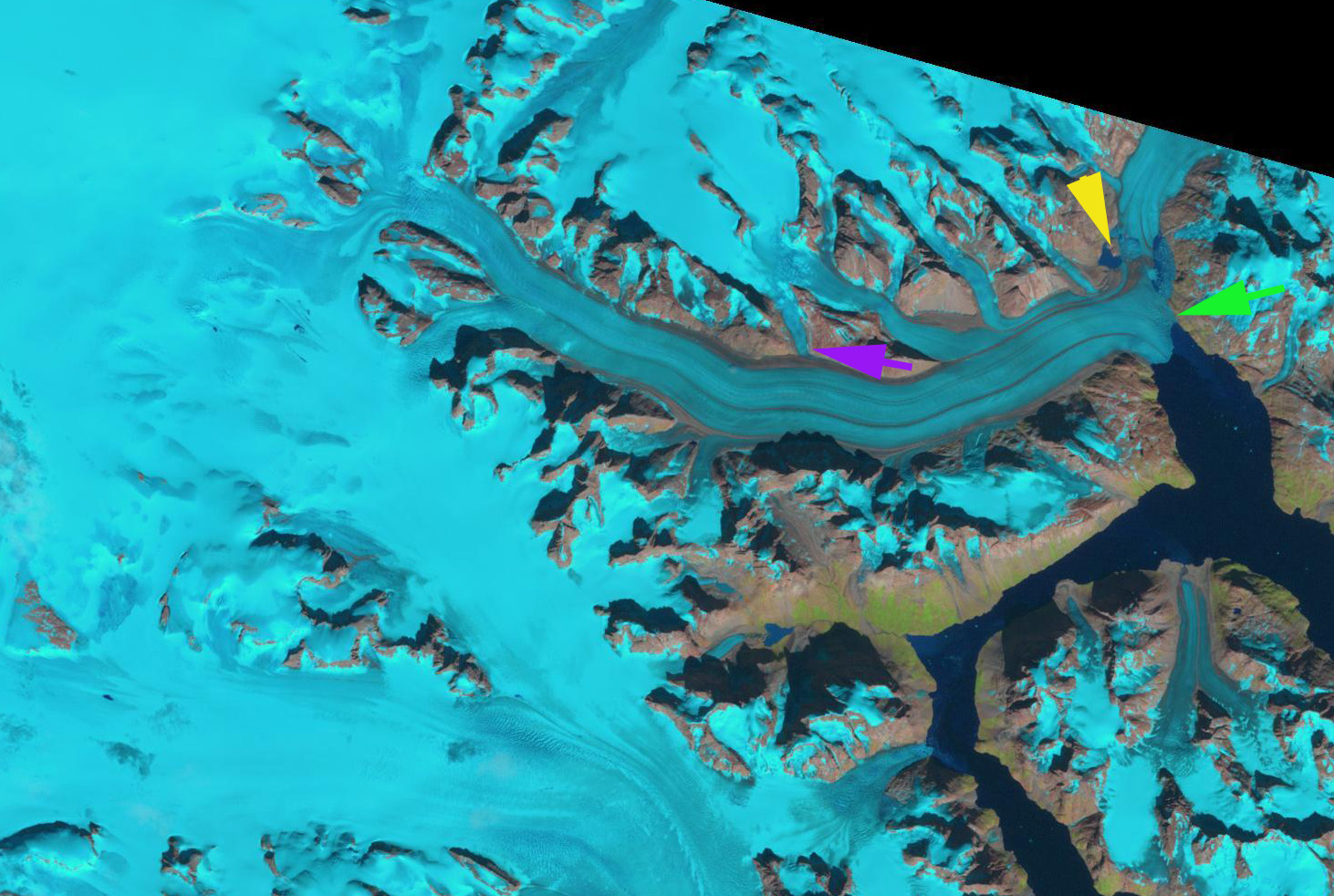
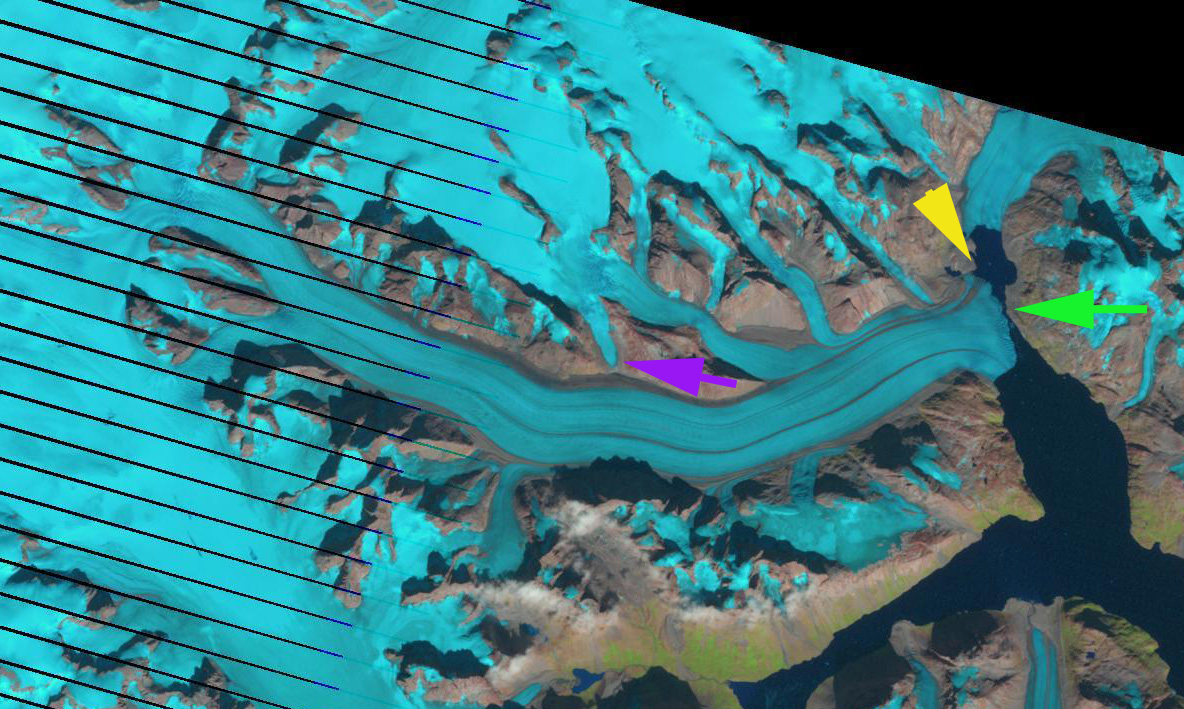
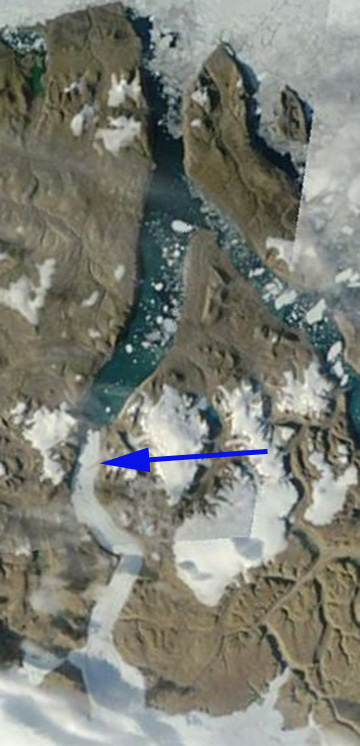
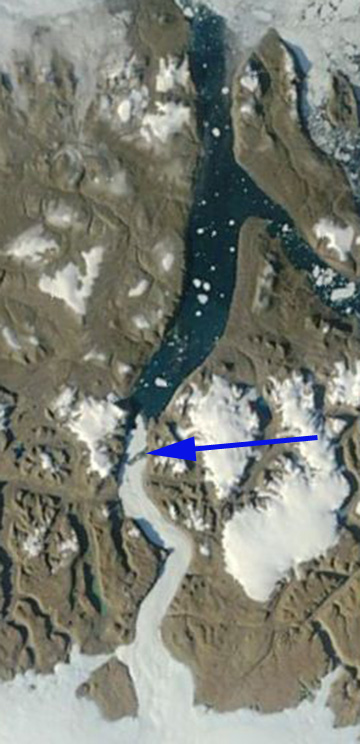
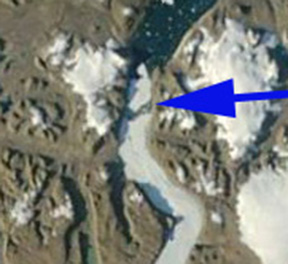
Thrym Glacier in southeast Greenland is a marine terminating outlet glacier at the head of Skjoljungen Fjord. This post focuses on Landsat images from 2000, 2004 and 2012. During the last decade several changes of significant are evident at the terminus of the glacier. This glacier was one of the glaciers that was a focus of a recent examination of Greenland glacier marginal change over the last 80 years by Bjork et al (2012) (detailed supplement).Thrym Glacier’s terminus in 2000 was connected with a second glacier flowing from the north, a branch of the Maelkevejen. The first change since 2000 is the opening of a channel between the terminus of the glacier and the fjord wall (green arrow) on the east side of the valley. This removes a pinning point for the glacier that should enable an increase of calving in the greater water depths. At the junction of the two glacier a lake has developed that now is part of the fjord. This water body has expanded to 2.5 km in length and 1.5 in width (yellow arrow). Upglacier of the terminus the glacier is fed by many tributaries, one of these has separated from the glacier in the last decade and is no longer feeding ice into the system, purple arrow.
Landsat image 2000

Landsat image 2004
Landsat image 2012
A close up view of the glacier terminus and new outlet also indicates the drop in water level of the developing lake in 2000 that has now become part of the fjord in 2012, images below. The red arrows indicate the recession of shoreline as the fjord opened and water levels dropped. The actual retreat of the glacier margin ranges from 200-400 meters during the last decade, fairly minor, but the changes will lead to a more dramatic retreat in the near future. John Mercer of Ohio State(1961) was the first to write about the importance of pinning points to stability of a terminus. Brown et al (1982) of the USGS, quantified the strong direct relationship between water depth and calving rate on Alaskan glaciers, Pelto and Warren (1991) noted that this relationship extended with to Greenland glaciers. The current terminus position of Thrym Glacier having just moved into deeper water and fronted now by tidal front along its entire front, is not in a stable position. The glacier will now have to retreat into the narrower valley, to reduce its calving rate. In June of 2013 the opening remains unchanged, indicating no terminus advance during the winter season. Historic photographs of this glacier dating back to World War II indicate the outlet had been closed throughout the latter half of the 20th century. The retreat of this glacier follows the regional pattern observed on Sortebrae Glacier and De Reste Bugt Glacier
Landsat image 2000

Landsat image 2012
thyrm glacier 2013Landsat image 2013

Sabbione Glacier Retreat, Italy

Italy’s mountains have been experiencing a warm summer, rivaling their warmest summer in the last couple of centuries, 2003. The impact on the glaciers will be considerable melting. Here we look at the retreat of the Sabbione Glacier. The glacier drains into Lago Sabbione an artificial lake that in turn drains into Lago Morasco, which is a 29MW hydropower facility. The lake also has good fishing. This glacier in 1988 reached the shore of Lago Sabbione.
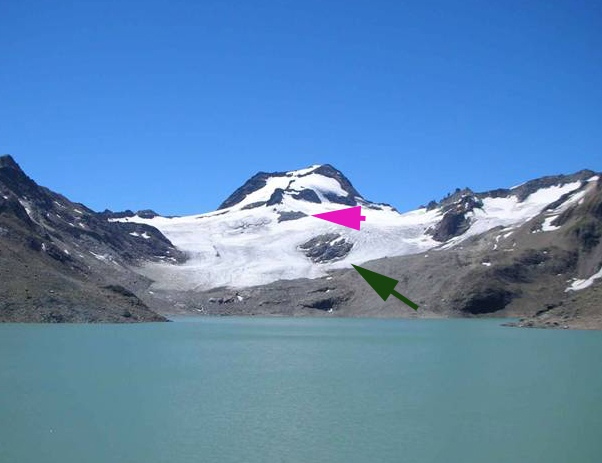
In a series of Landsat images from 1988, 2006 and 2010 and a picture from Lago Sabbione in 2007, the retreat from the lake is evident. Tthe 1988 terminus is indicated by a red arrow, the 2010 terminus by a yellow arrow, the new outcrop in the midst of the glacier by a magenta arrow and the outcrop that has reached the margin of the glacier in 2010 a green arrow. The retreat during this period has been 450 meters. of greater concern for the future of the glacier is the emergence of rock outcrops in the midst of the middle portion of the glacier, and smaller ones on the upper glacier. This indicates a glacier that is not in equilibrium lacks a persistent accumulation zone, indicating it will not survive current climate.

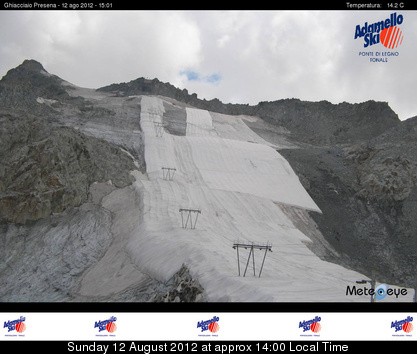
The retreat is similar to the losses experienced across Italy from the smaller Dosde Glacier, the larger Forni Glacier and the Presena Glacier, ski area. On the latter on Aug. 12, 2012 from the ski area webcam you can see the attempts to use blankets, grooming and snowmaking to supplement the glacier, which off the ski run is bare ice.

North Cascade Glacier Climate Project 2012 Field Season Initial Observations

The 2011/12 winter was a La Nina winter that led to the typical La Nina excellent snowpack. By May 1 the 2012 snowpack was one of the top five snowpacks of the last 30 years. After an average May and a cool June, the snowpack was still high on July 1. July and August tied 1998 and 2009 as the warmest over the last 30 years in the North Cascades, leading to rapid glacier melt. The result with four to six weeks left in the melt season is that glaciers are going to finish the year with a mix of glaciers that gained and lost mass despite the good winter. The duration and intensity of melt if sustained above average will leave most glaciers with a loss.

We started on Columbia Glacier, a low elevation cirque glacier fed by tremendous avalanching, that had received considerable snow accumulation from avalanching off the slopes of Columbia Peak. Our measurements found an average snowpack of 4.2 meters at the start of August. The glacier lost 9 feet of snow pack during the month of August. The glacier will likely finish the season with a small positive balance, unless September is significantly above average in temperature.

We were joined by Oliver Grah, Nooksack Indian Tribe Water Resource Manager in assessing Rainbow and Sholes Glacier. Average melt and runoff was 11 cm/day from Sholes Glacier. On Rainbow Glacier snowpack was well above average on the lower half of the glacier below 1600 meters, but had very little increase with elevation and only average accumulation at the top of icefall at 1800-2000 m. The Rainbow Glacier will likely have a positive mass balance. Sholes Glacier had an an average snowpack of 3.5 m in early August, and 1.5 meters by the end of August. This will likely lead to a close to equilibrium balance.

On Lower Curtis Glacier the south facing terminus does not retain snowpack well, and is more sensitive to summer conditions. As a result the high ablation of July and August had led to rapid melt of the terminus seracs and icefall. We were able to get beneath the glacier, where the rapid melting has led to the glacier being off its base in many areas. The glacier will finish the year with negative mass balance, regardless of September weather.

The next stop was Easton Glacier where Oliver Grah, his assistant Jezra Beaulieu, Western Washington U., Peter Sinclair videographer joined us. The lower kilometer of the glacier was mostly blue ice already by August 12. By the end of August little snowpack remained below the 2000 meter bench. This glacier does not receive avalanching and again is more susceptible to summer conditions. Like Lower Curtis Glacier this glacier will finish the season with a negative mass balance. Snowpack remaining rose from 3.2 m at 2000 m to 5.7 meters at 2500 meters in mid-August. A detailed survey of crevasse with, length and depth that will be repeated will hopefully be able to identify glacier velocity changes going forward.

On Mount Daniels we examined Ice Worm Glacier, Daniels and Lynch Glacier. The snowpack on these glacier the furthest south and east that we observe was the best of anywhere. Ice Worm Glacier is an avalanche fed small cirque glacier that had excellent snowpack. Daniels Glacier for the first time since 1999 was fully snowcovered even on August 16th. Lynch Glacier had good snowpack as well with the blue ice area limited to less than 10% of the glacier. All three of these glaciers will finish the year with a positive mass balance.

Mauri Pelto, Tom Hammond, Ben Pelto and Jill Pelto

Zachariæ Isstrøm Further Retreat, NE Greenland

zis 2013sm
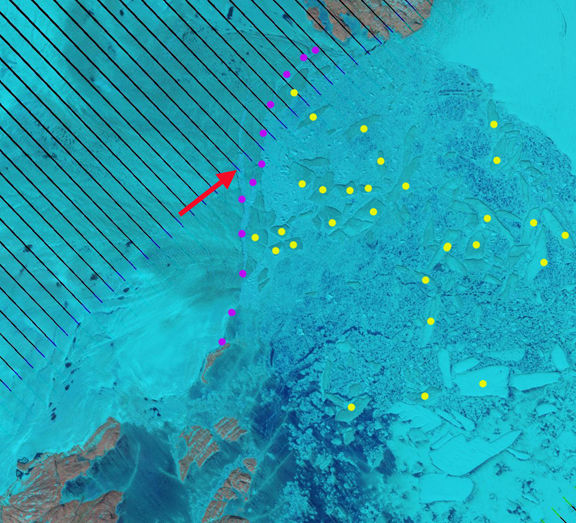
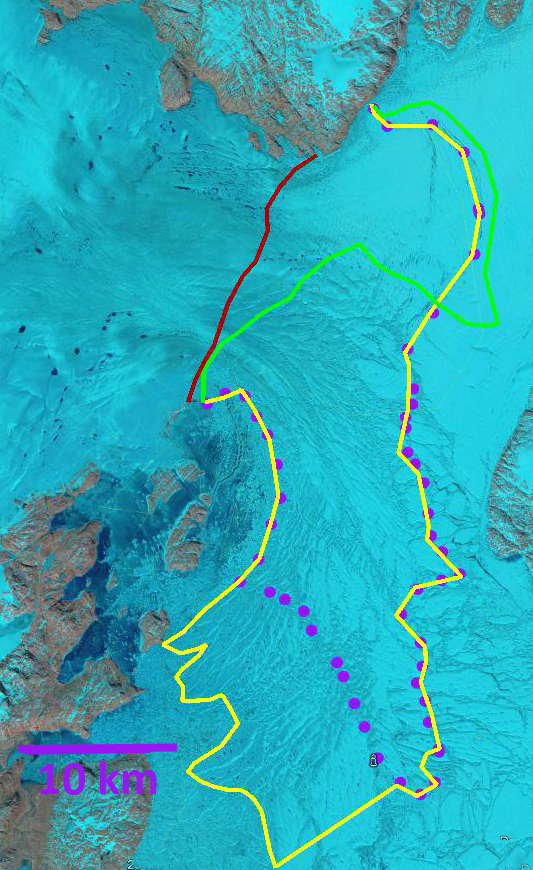
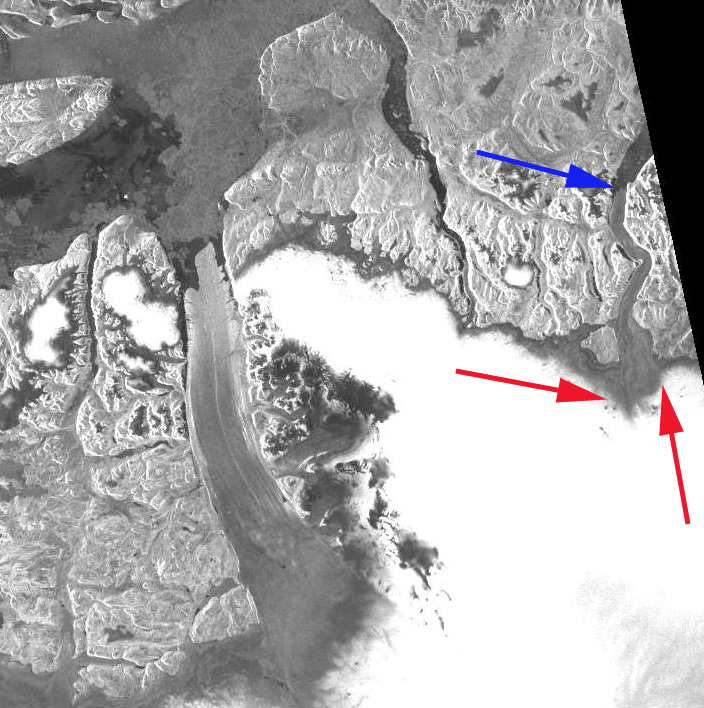
2013 from June 17 Landsat image, yellow dots are icebergs generated in 2012, purple dots terminus, red arrow a rift that will lead to another significant calving event this summer, below this is compared to other images, including from late last summer, when more rifts existed that yielded the icebergs now dotted.

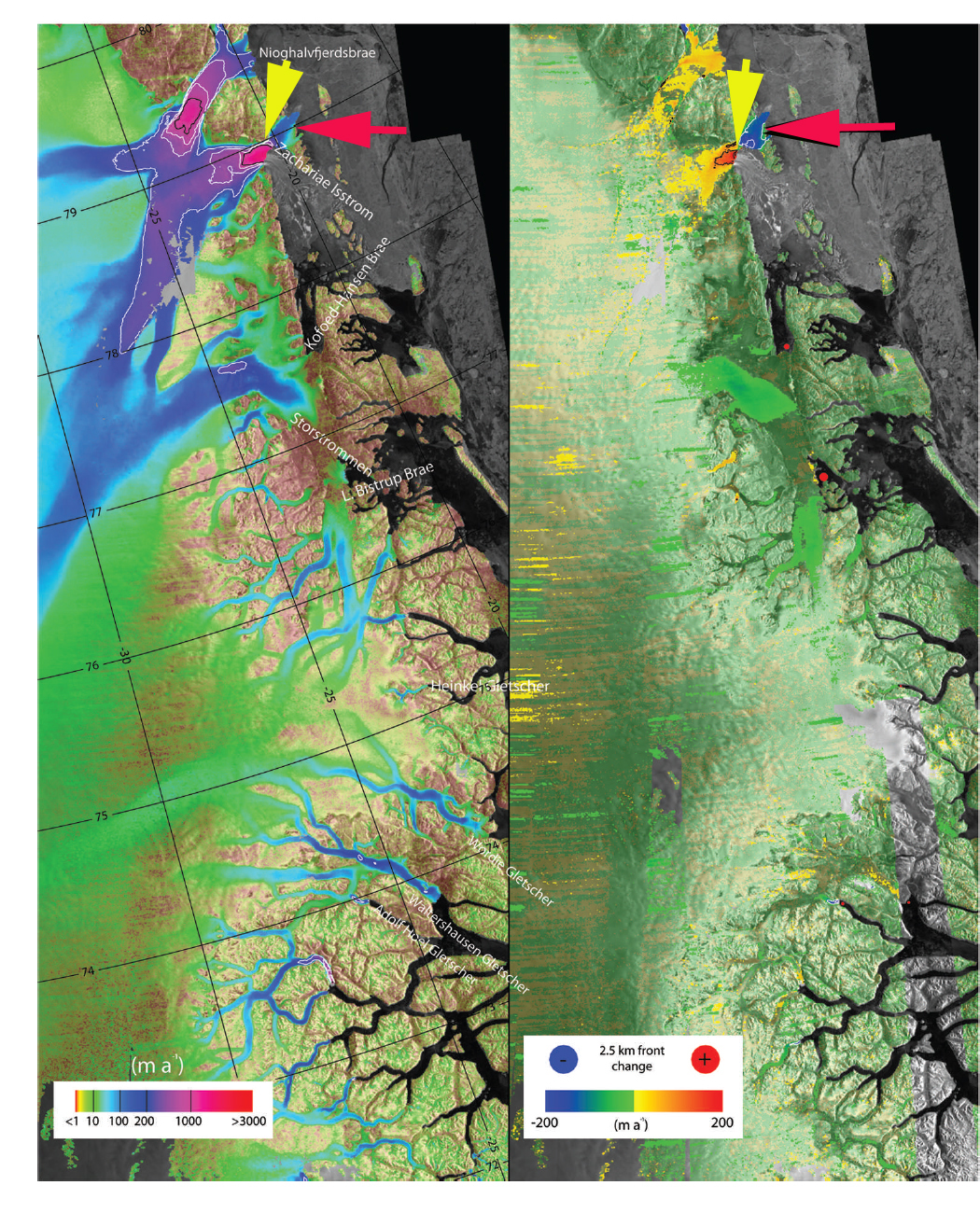
In an article Dan Bailey and I published at Skeptical Science, we observed that in northern Greenland high velocities extend far inland only on Zachariae and Petermann Glacier tapping into the midst of the ice sheet in northern Greenland. Further, it is the Zachariae Isstrøm (ZIS) that is likely the only of this group that would be comparable to a bank that is too big to fail as its increased velocity band extends well into the ice sheet. ZIS is one of the three main outlets of the northeast Greenland Ice Stream, Storstrommen and Nioghalvfjerdsfjorden (79N) are the other two. The extent of the high velocity zone is evident in the first image below from the exceptionally detailed work of Joughin et al (2010), and Joughin et al (2001). The area of high velocity versus the surrounding ice at over 100 m/year extends 350 km upglacier from the ZIS terminus. The velocity then increased from 100 to 400+ m/year from 200-100 km from the ice front. At the grounding line the velocity is 1100 m/year (Rignot et al, 2001). The velocity remains high to the ZIS icefront. The width of the ice stream identified by the zone of higher flow is 40 km wide 350 km above the terminus and remains at least 30 km wide all the way to the terminus region. The velocity is lower than on Jakobshavns, but the ice stream is also much wider.

A view of the basal topography from Joughin et al (2001) indicates that the acceleration occurs in the same area as the bed depth drops significantly below sea level 200 km from the ice front. The base of the glacier is 300-700 meters below sea level all the way to the ice front. The thickness at the grounding line is noted as 550-600 meters by Rignot et al (2001). The result is an ice flux at the grounding line of ZIS of some 11 cubic kilometers per year, this is much less than the 40+ cubic kilometers from Jakobshavn Isbrae and similar to the 12 cubic kilometers from Petermann Glacier. The red arrows in both images indicates the area of fast ice, discussed below and the yellow arrow the location of the new 2012 ice front.

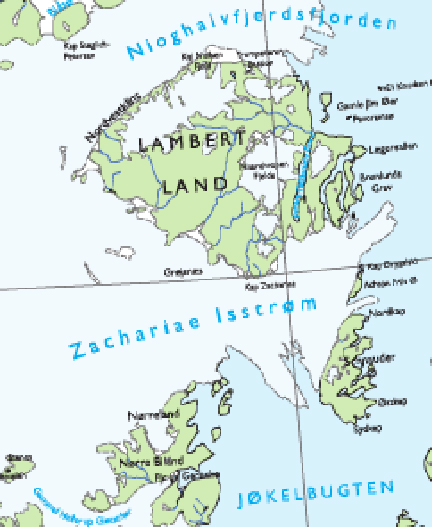
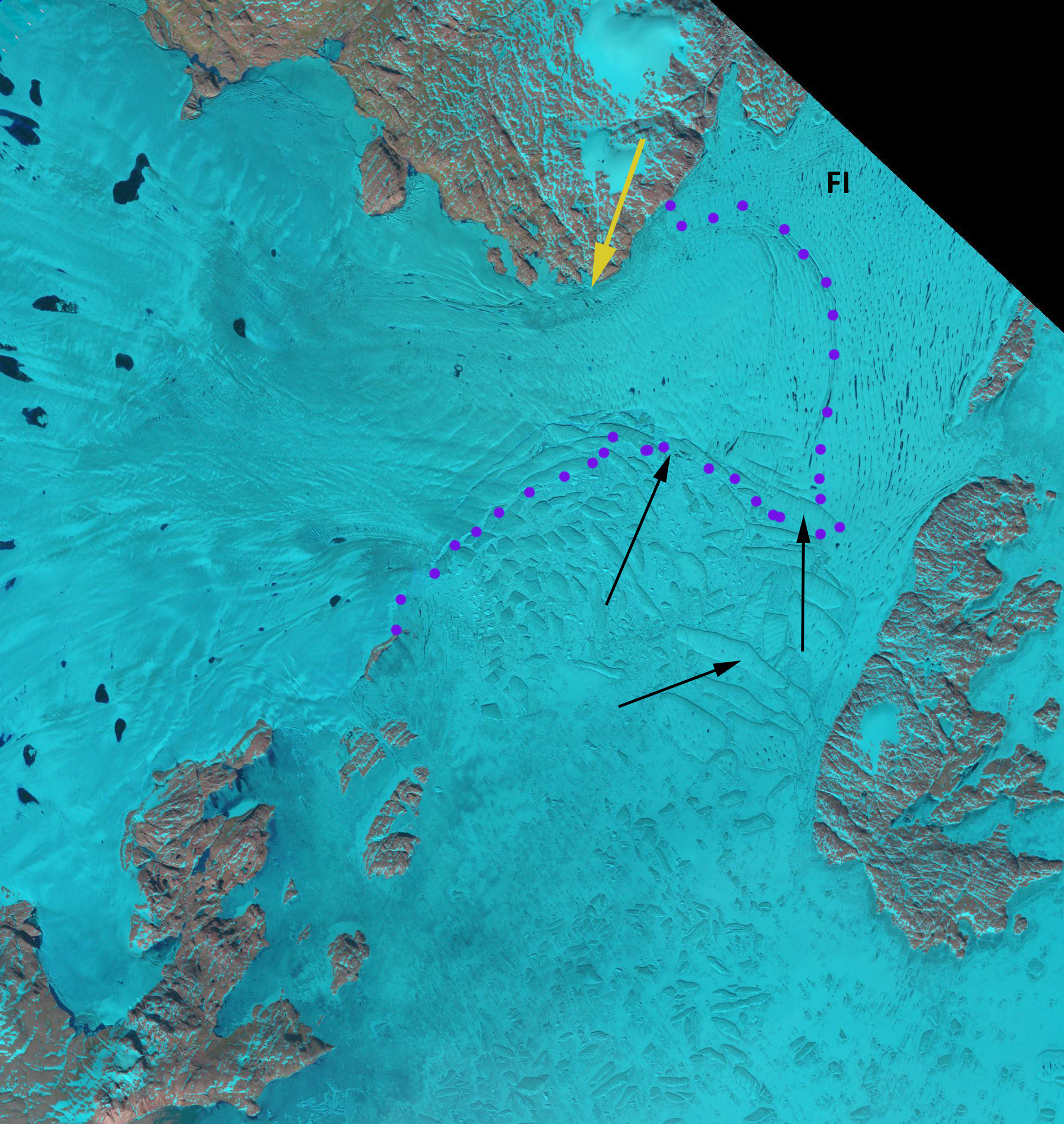
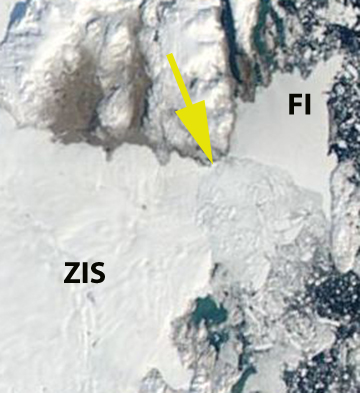
This post examines recent changes in ZIS updating the work of Box and Decker (2011). They noted an average decadal rate of loss of 14 square kilometers/year and the evolving terminus position in the first image below from Jason Box at Meltfactor.org. Box and Decker (2011) also noted a potential advance in 2006-2007, that we will further explore here. The reduced sea ice in the region has exposed the ZIS terminus to increased open water in what was typically a region that was dominated by persistent sea ice. The enhanced surface melting is also a concern. In 2012 ZIS has experienced an additional retreat that has separated the main glacier from a melange of glacier ice and fast sea ice on the northeast side of the terminus, that had survived the last major tongue disintegration of the southern floating arm of ZIS in 2000-2001. The changes have been an going watch by several of the participants at the Arctic Sea Ice blog, which has developed into a wonderful community for daily detailed sea ice observations. Espen Olesen and I have discussed the split that occurred this August which warrants pointing out and. Here we examine Landsat imagery from 2006, 2008, 2009 and 2010 and MODIS imagery from 2011 and Aug. 19 2012 to depict the changes. The last image is a July 30 2012 Landsat with the purple terminus line indicated. The images are shown below with the fast ice zone (FI) noted in 2006 and the MODIS images from 2011 and 2012. The new 2012 terminus that has retreated to the corner of Lambert land, or Kap Zacharaiae is indicated by a yellow arrow, this is Kap Zachariae, and is separate from the ice to the northeast. The actual terminus in the Landsat images is indicated by purple dots, but based on the melange that exists on the east side and fast ice on the north side this is not a clear cut distinction. The fast ice is distorted in a convex pattern by the impinging ice front in the Landsat images. The new terminus is at the southeast corner of Lambert land and extends directly southwest to Heretugen Land and then Norreland
2006 Landsat image

2008 Landsat image
2009 Landsat image

2010 Landsat image

2011 MODIS image

2012 MODIS image
2012 Landsat image
zis 2013
2013 from June 17 Landsat image, yellow dots are icebergs, purple dots terminus, red arrow a rift that will lead to another significant calving event this summer.

The retreat follows the calving events on Petermann and Steesnby Glacier. Here there is no single large iceberg to observe. The retreat from 2010 to 2012 is approximately 10 km, the loss of area is particularly hard to accurately determine. Overlaying the 2006 and 2012 images I estimate the loss at 170 km2. The ice margin in 2000-2001 is even harder to accurately depict. Most maps and analysis to date have included much of the fast sea ice as part of the glacier. The fast ice has a velocity unconformity with the main ice and a profile that is not consistent with it being connected to ZIS. Whether it is fast sea ice or a combination of relict ice from ZIS and fast ice is unclear. Here based on the same assessment as used for the other years the retreat from 2001-2012 amount to the loss of 600 km2, most of which occurred abruptly in 2000-2001. The changes are seen in the composite below of two 2001 images, with the yellow being the tentative 2001 margin, green the 2006 margin and red the 2012 margin. A closeup of the area just south of Kap Zachariae indicates the change from 2006 on right to 2012 on left from an unrifted main outlet of ZIS, to an area of scattered ice bergs with rifts developing further west as well. This image from July 30, had turned to open water two weeks later. As of Sept. 2, 2012 there is still considerable open water in the embayment around ZIS, bottom image.

Steensby Glacier Calving Event and Retreat, Northern Greenland

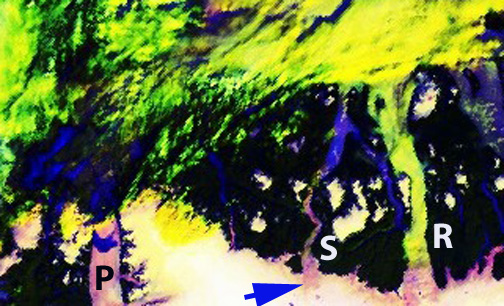
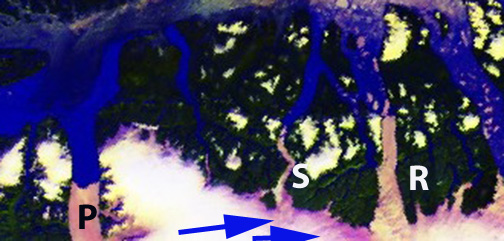
Steensby Glacier flows north from the Greenland Ice Sheet into the Arctic Ocean between Petermann Glacier to the west and Ryder Glacier to the east. The glacier terminates 100 km up the twisting Sankt George Fjord from the ocean after flowing 60 km down the twisting valley from the ice sheet. This distance and the fact that the fjord empties into the Arctic Ocean would suggest it is less easily reached by warming ocean water to melt the floating glacier tongue. The glacier has a thin floating ice tongue like Petermann Glacier at the terminus with a thickness of 75-105 m. The terminus as a result has a low velocity and would not accelerate and retreat via the same mechanism of backforce reduction that has led to retreat of almost all marine terminating outlet glaciers that do not have large floating ice tongues. The snowline was noted as 800 m in the 1970-1980’s, has in recent years been 1000 meters (Pelto, 2010). With the warm weather the past two summers it has seemed inevitable that Ryder and Steensby Glacier would have a terminus response. Steensby had last been observed in retreat back in 1947 (Ahnert, 1962). From 1947 to 1976 and since 1976 has changed little. On my return from glacier field work I checked the MODIS daily imagery from 8/15 and saw nothing. This glacier seemed a particularly likely culprit for retreat this summer because the terminus area is such a melange of ice as seen in the 2006 Landsat image (M),and as Ahnert had observed, the crack that created the icebergs is likely the same one visible in 2006, blue arrows. In the invaluable blog Arctic Sea Ice run by Neven, the calving event was noted by commenters on Aug. 24th Sphaerica, Twemoran and Espen Olsen. This is what makes the blog so valuable many of the participants are actively examining daily satellite imagery making interesting observations, and as a glaciologist this proves to be remarkably valuable and interesting resource time and again.

Here we first look at MODIS images of Steensby Glacier from 8/2010, 8/2011, and 2012. The 2012 images are from 8/12, 8/15 , 8/23 and 8/24, with the crack first appearing in the 8/15 and open water appearing on 8/23 and widening by 8/24. The icebergs approximate maximum dimensions are 4 km by 6 km. The last image is a terminus closeup.
Melting has been significant in northern Greenland for three straight summers. In 2010 the first image the melt area is below 1000 meters at the head of the Steensby Glacier outlet denoted by red arrows, this is a typical pattern of the last few years (P=Petermann, R=Ryder, S=Steensby). In 2012 the area of extensive melt has expanded from a zone around the head of the valley of Steensby and Ryder Glacier near 1000 m in July (blue arrows) to a wide zone extending all the way from Steensby to Ryder Glacier in August. Unlike Petermann Glacier, Steensby Glacier does not have a deep connection to the ice sheet as indicated by bedrock maps of the glacier from Bamber et al. (2011). The glacier is much narrower, thinner at the grounding line and its velocity is much less, volume wise the Steensby Glacier just lacks the importance in terms of influence on the larger ice sheet that Petermann Glacier has.

Jacobsen Glacier, BC Retreat

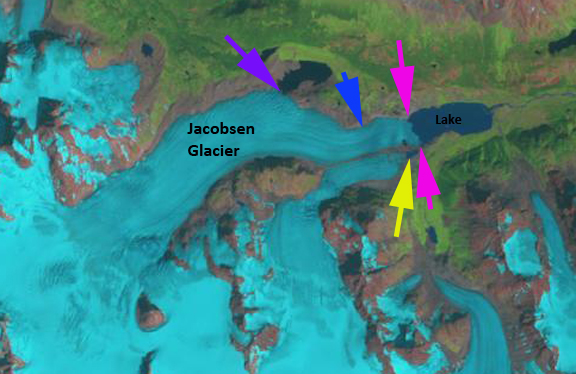
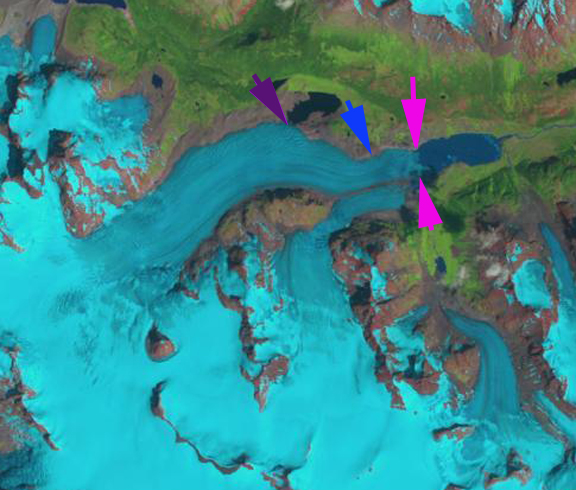
Jacobsen Glacier is part of the Monarch Icefield of the Coastal Range of British Columbia. VanLooy and Forster (2008) noted that the glacier retreated at a rate of 30 meters/year from 1974 to 1992 and 47 meters/year from 1992-2000. In this post we examine Landsat satellite imagery from 1992, 1994, 2010 and 2012 to illustrate the changes over the last two decades. There are three readily observable changes. The first, indicated by purple arrows, is the lateral recession 2.5 km upglacier of the current terminus. At this point the glacier was in contract with a proglacial lake. The lake shoreline has not changed from the 1992-1994 images, but the glacier margin is now 300 meters distant from the lake margin. The second change, indicated by yellow arrows, is of what was previously a secondary terminus that terminated in a small proglacial lake in 1992-1994. This small lake has turned into an embayment of the larger unnamed lake that the Jacobsen Glacier ends in. The secondary terminus has retreated 900 meters since 1992. The last change is the actual terminus retreat of Jacobsen glacier with the 1992 terminus indicated by the pink arrows and the 2012 terminus by the blue arrow on the northern margin. The retreat and lake expansion has been 1100 mters from 1992-2012, a rate of 55 meters/year, only a slight change from the 1990-2000 reported rate. The changes indicate a consistent mass balance loss that is typical of glaciers in the Coast Range from Lemon Creek Glacier to Bridge Glacier and Helm Glacier. The ongoing mass balance losses are resulting in substantial glacier area and volume losses ( Pelto, 2007; Scheifer et al, 2008).