Schlegies Glacier, Austria Response to Climate Change: Segmentation

Schlegies (S), Furtschagl (F), Hornkees (H) and Waxeggkees (W) in 1990 and 2017 Landsat images.  Red arrows indicate the 1990 terminus location and pink arrows indicate locations where the Schlegies (S) and Furtschagl (F) separated. Schlegies Reservoir (SC) near top. 

In August, 1990 you could have skied 5.5 km across the width of the Schlegies (S) and Furtschagl (F) Glaciers in the Zillertal Alps, Austria without taking your skis off. By August 2017 this traverse would have necessitated removing your skis three times as marginal retreat has led to glacier segmentation. These glaciers feed the Schlegeis Reservoir and hydropower system, and along with the adjacent Waxeggkees (W) and Hornkees (H) provide a good example of Austrian Glacier retreat and area loss that has led to glaciers separating into smaller segments. The Austrian Alpine Club conducts an annual survey of terminus change, supervised by Andrea Fischer, on nearly 100 glaciers. In 2016, 87 of the 90 glaciers surveyed retreated with the greatest retreat being 65 m at Hornkees (Fischer, 2017). In 2017, the survey examined 83 glacier, with 82 retreating (Fischer 2018).  The average retreat of 25.2 m was the largest since 1960 and was attributed to the snow poor winter of 2016/17 and warm summer of 2017 (Fischer 2018).  The second largest retreat was of Waxeggkees at 120 m.  The high rate of retreat of these two Zillertal glaciers indicates the significance of climate change on glaciers in this region.  Verbund the largest electricity generating company in Austria operates the Schlegies-Rosshag Hydropower pumped storage facility that can generate 231 MW.  Because it is pumped storage it is not as vulnerable as the run of river hydropower plants that Verbund operates.

In 1990 Hornkees and Waxeggkees have significant valley tongues extending from the upper accumulation zone.  Schlegies and Furtschagl is a 5.5 km wide continuous accumulation zone. By 1998 Schlegies, Furtschagl, Hornkees and Waxeggkees  have all retreated significantly.  By 2013 Waxeggkees has lost its terminus tongue and is now has a broad slope terminus. In 2017 Schlegies has separated into three parts and has not retained any snowpack from 2017.  Schlegeis has 500-650 m across its broad front from 1990 to 2017. Furtschagl has separated from Schlegeis as well.  Furtschagl has retreated 350 m from 1990-2017, m in 2017.  Hornkees main terminus has retreated 850 m from 1990-2017, 86 m from 2015-2017.  Waxeggkees main terminus has retreated 700 m from 1990 to 2017, including 152 m from 2015-2017. The mean thickness of Waxeggkees and Hornkees was 30 m and 28 m in 1999, (Fischer and Kuhn, 2013).  The thickness will have decline with area loss since, Fischer et al (2015) note that Austrian glacier have been losing area at a rate of 1.2% annually after 1998.
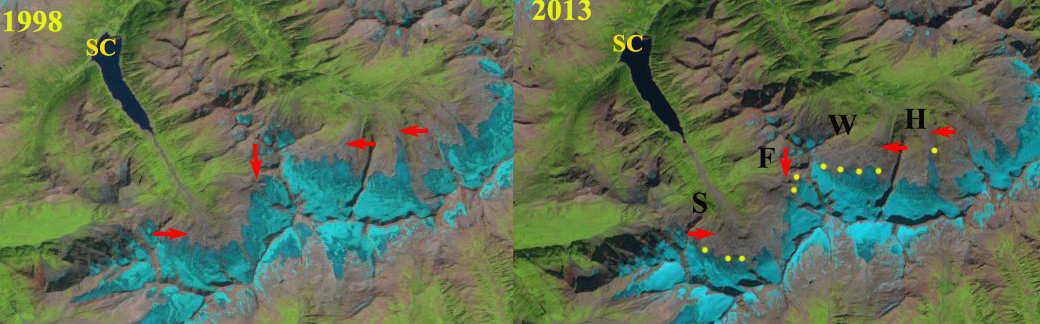
Schlegies (S), Furtschagl (F), Hornkees (H) and Waxeggkees (W) in 1998 and 2013 Landsat images.  Red arrows indicate the 1990 terminus location and yellow dots indicate the 2013 terminus.


Schlegies (S), Furtschagl (F), Hornkees (H) and Waxeggkees (W) In Google Earth image.

Sulztalferner Retreat, Austria Bedrock Expansion Mid-Glacier

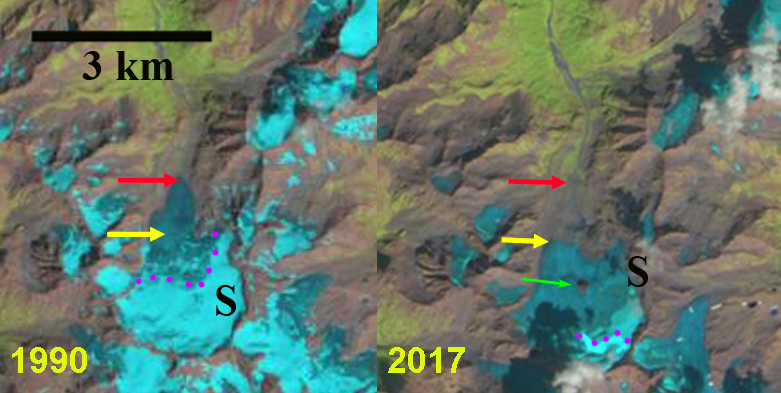
Sulztalferner in Landsat images from 1990 and 2017.  Red arrow is the 1990 terminus, yellow arrow the 2017 terminus, purple dots the snowline and the green arrow an area of emergent bedrock amidst the glacier. 

Sulztalferner is a glacier in the Subaier Alps of Austria. The glacier begins at 3200 m below Daunkogel Peak and descends north from the peak.  Schlicker (2006) identified that between 1969 and 2003, 14 of the 88 glaciers in this range disappeared. The area of the glaciers was to 54.1 km2 in 1969, increased slightly to 54.4 km2 in 1985, decreased to 47.2 km2 in 1997 and the a rpaid decline to 36.9 km2 in 2003. Schlicker (2006) observed that the area of Sulztalferner, one of the largest glaciers in the region, decreased from 4.16 km2 in 1969 to 3.51 km2 in 2003. This fits the pattern of all Austrian glaciers  Fischer et al (2015).    Fischer and Kuhn (2012) measured the thickness of the glacier finding the average was 42 m and the maximum was 131 m.  The glacier terminus fluctuations are examined annually and reported by the Austrian Alpine Club  Fischer (2016) and Fischer (2017), with all 11 glacier in the Stubaier area retreating in 2015 and 2016 and Sulztalferner retreating 14 m each year.

In 1990 the glacier descended a steep icefall at the yellow arrow and terminated at 2430 m at the red arrow, the glacier was 3050 m long.  By 1999 the glacier retreat and thinning made the icefall more pronounced.  By 2015 the glacier terminated near the top of the a steep bedrock step that had caused the icefall to exist. An area of bedrock had also emerged just below the snowline. In 2017 the glacier is 2100 m long extending from an elevation of 3200 m to 2730 m.  Retreat from 1990-2017 has been 950 m, a mean of 35 m/a.  That is more than 1% of the glacier length lost per year. In 2017 in late August only 10% of the glacier has retained any snowcover indicating substantial volume losses will occur in 2017, which will drive further retreat.  This glacier is following the pattern of Bachenfallenferner just to the north. This glacier is just to the west of the Stubai Glacier and the Stubai ski area that has utilized a protective by blanket on the glacier The Stubai Glacier Ski Area opens for the 2017/18 season this Saturday 9/16 after a couple of snowstorms that have blanketed Sulztalferner and Stubai Glacier with some fresh snow.


Sulztalferner in Landsat images from 1990 and 2017.  Red arrow is the 1990 terminus, yellow arrow the 2017 terminus, and purple dots the snowline.

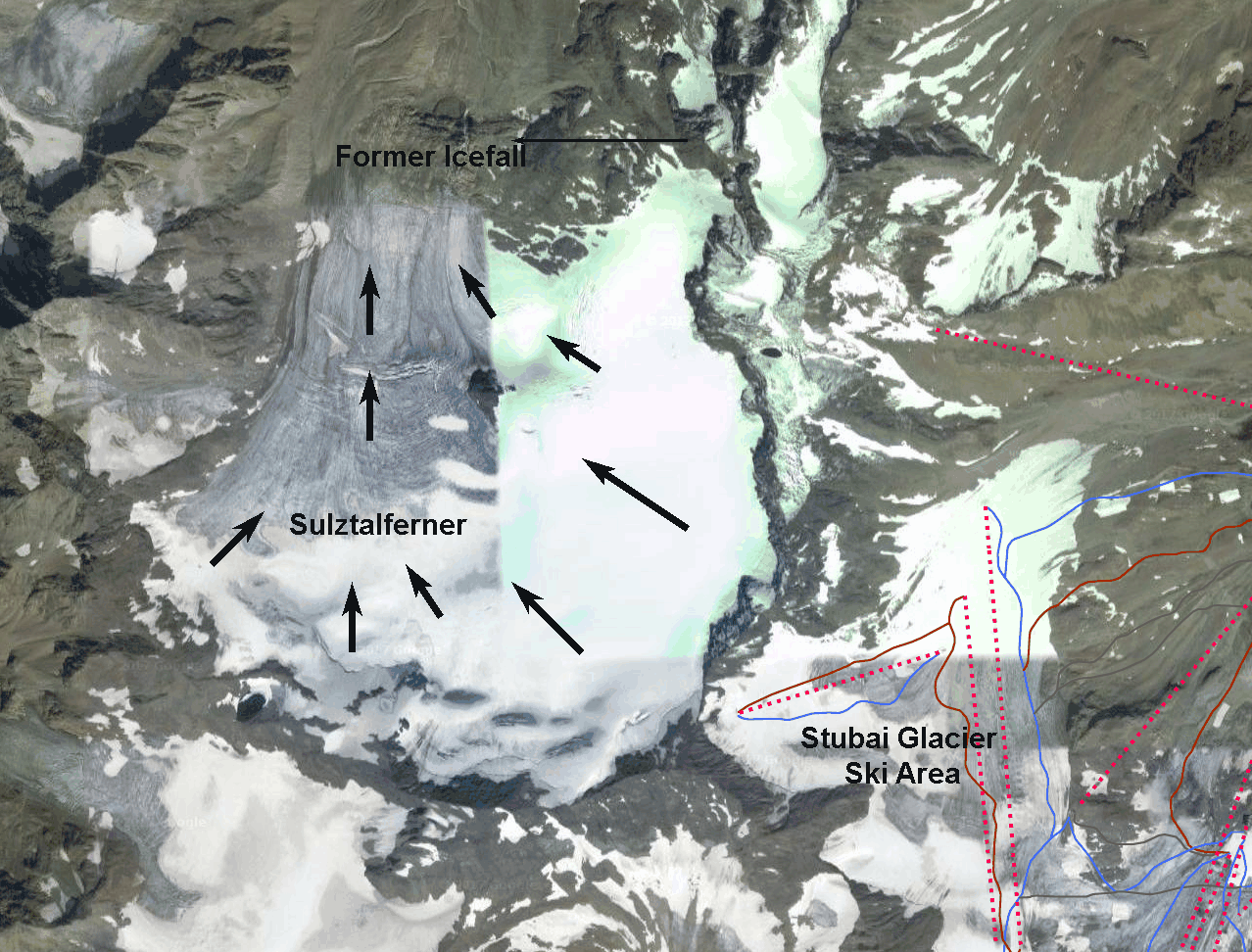
Digital Globe image from 2015 indicating the bedrock exposed in the midst of Sulztalferner.  It measures 250 m long and 150 m wide.  Note  the thin nature of the retreating terminus.


Sulztalferner Digital Globe image from 2015.  Note adjacent ski area and deglaciated icefall reach.


Bachfallenferner, Austria: 2017 Illustrates Why Glacier is Forecast to Not Survive

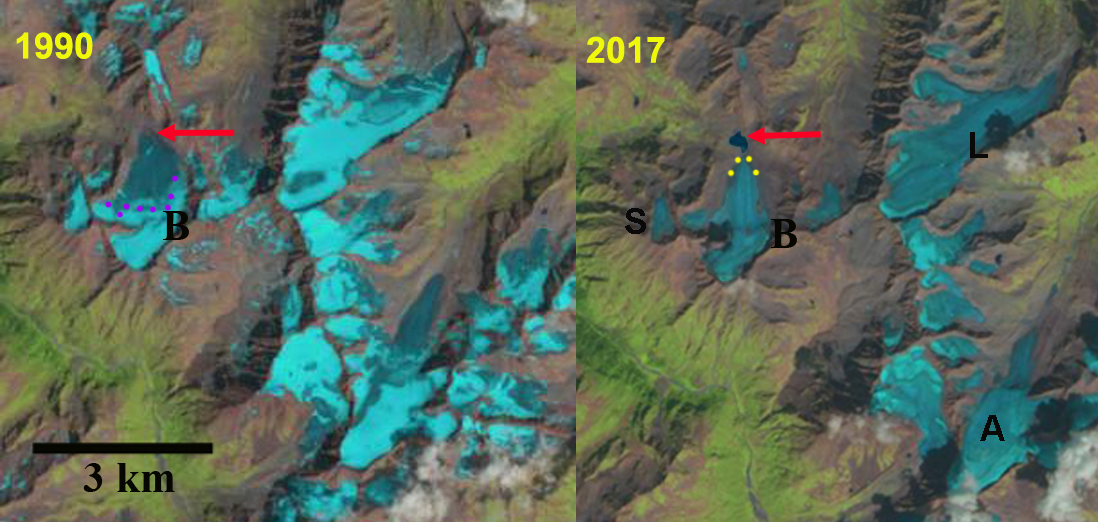
Comparison of Bachfallenferner (B) in Landsat images from 1990 and 2017.  The red arrow indicates the 1990 terminus position and yellow dots the 2017 terminus.  Note there is no retained snowcover in 2017 and a new lake has formed due to retreat. Other glaciers that lost all snowcover in 2017  L=Lisenser, A=Alpeiner and S=Sauischbachferner

Bachfallenferner is in the Stubaier Alpen, Austria.  The glacier terminus fluctuations are examined annually and reported by the Austrian Alpine Club  Fischer (2016) and Fischer (2017), with all 11 glacier in the Stubaier area retreating in 2015 and 2016.  Fischer and Kuhn (2012) surveyed the thickness of 64 alpine glaciers in Austria including Bachfallenferner, with a goal of determining volume.  They found in 2000 the glacier had an area of 2.08 square kilometers, with an average thickness of 41 m yielding a volume of .085 cubic kilometers.  

In 1990 Bachfallenferner ended on an outwash Plain at 2700 m.  The glacier was 2350 m long in 1990 with a width of 1100 m at its mid-point.  By 1999 a small sublacial lake has formed at the terminus, the lower 0.8 kilometer of the glacier is uncrevassed and relatively stagnant. In 1999 the snowcover the retained snowcover in late August covers 30% of the glacier.  In 2015 the glacier retreat has led to the formation of a proglacial lake that is 275 m across.  The glacier in late August is only 10-15% snowcovered.  By 2017 the glacier has retreated 400 m from its 1990 location including 60 m in 2015 and 2016.  More importantly the glacier by late August has lost all of its snowcover, as essentially have some of its neighbors: L=Lisenser, A=Alpeiner and S=Sauischbachferner.  A glacier that does not consistently retain snowcover cannot survive (Pelto, 2010). The glacier is now less than 2 km long and at the 1990 mid-point is 800 m wide.  Lateral recession in the lower 1 km of the glacier is similar to the rate of terminus recession.  The maximum ice thickness in 2000 was 97 m Fischer and Kuhn (2012), which is likely to have lost no more than a meter per year, hence there is still some comparatively thick ice.   The Stubaier Alpen has experienced substantial retreat in the last 30 years as have all Austrian Glaciers (Fischer et al.,2015).  Bachfallenferner is larger than most of the Austrian glaciers that are currently disappearing such as Mittlerer Guslarferner.

Comparison of Bachfallenferner in Landsat images from 1999 and 2015.  The red arrow indicates the 1990 terminus position and yellow dots the 2017 terminus.  Purple dots indicate snowline, not lake formed at red arrow due to glacier retreat after 1999.

Digital Globe image of Bachfallenferner in 2015. Note the lack of retained snowcover and the new lake that formed.


Schlatenkees Accelerating Retreat, Austria 1988-2016

Schlatenkees comparison in 1999 and 2016 Landsat images.  Red arrow is the 1988 terminus position, yellow arrow is the 2016 terminus location, purple dots indicate the snowline. 

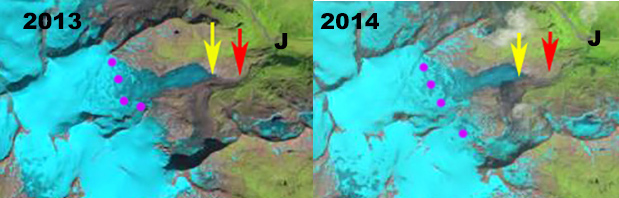
Schlatenkess (Glacier) is in the Venediger Alps draining into the Innergschlöss a tributary of the Isel River. The glacier is part of the network of glaciers examined by the Austrian Alpine Club annual glacier terminus survey supervised by Andrea Fisher.  Schlaten Glacier was one of the fastest of the 97 glaciers examined in 2015 and 2016 retreating 115 m in those two years. Fishcer, (2017) report that 84 of 88 glaciers observed were in retreat during 2015, and that 87 of 90 glaciers observed in 2016 were in retreat. . Bender et al (2012) provide a photo comparison of the glacier from 1890 and 2010 illustrating the loss of glacier ice.  Here we examine Landsat and Google Earth images from 1988 to 2016. In each image the red arrow is the 1988 terminus position, yellow arrow is the 2016 terminus location, purple dots indicate the snowline and J is the Innergschlöss River junction. 

Schlaten Glacier drains east from Grossvenediger and was approximately 5.4 km long terminating at 2220 m in 1988.  The snowline in 1988 is at 3050 m.  In the 1999 Google Earth image the lower 400 m of the glacier lacks significant crevassing indicating stagnation.  In 2000 the snowline is at 3000 m. In 2013 the snowline is at 3000 m, at 3050 m in 2014, at 3150 m in 2015 and 2016.  The terminus has retreated 600-650 m from 1988 to 2016 in the Landsat images, this is 12% of the glacier length gone.  The retreat rate for this periods is ~20 m/year rising to over ~55 m/year in the last two years, which also featured highs snowlines. The glacier now terminates at 2350 m , the lower 600 m has a low slope, few crevasses and one area of concentric crevasses, indicating a basin.  The basin indicates thin ice, suggesting this section of the glacier will soon be lost.  The regional retreat has been particularly fast since 1998 as Fischer et al (2015) noted with a 20% area loss in the Venediger area.  The retreat is similar to Gepatsch Glacier and Obersulzbach Kees

Schlatenkees comparison in 2000 and 2015 Landsat images.  Red arrow is the 1988 terminus position, yellow arrow is the 2016 terminus location, purple dots indicate the snowline.

Google Earth Image from 1999, above and 2015 below.  Point A and B respectively indicate the 1999 and 2015 terminus locations. 

Terminus of Schalten Glacier in 2015 note concentric crevasses indicating a basin. 

Schlatenkees comparison in 2013 and 2014 Landsat images.  Red arrow is the 1988 terminus position, yellow arrow is the 2016 terminus location, purple dots indicate the snowline.