Darwin Glacier, Sierra Nevada, California No Longer a Surviving Glacier

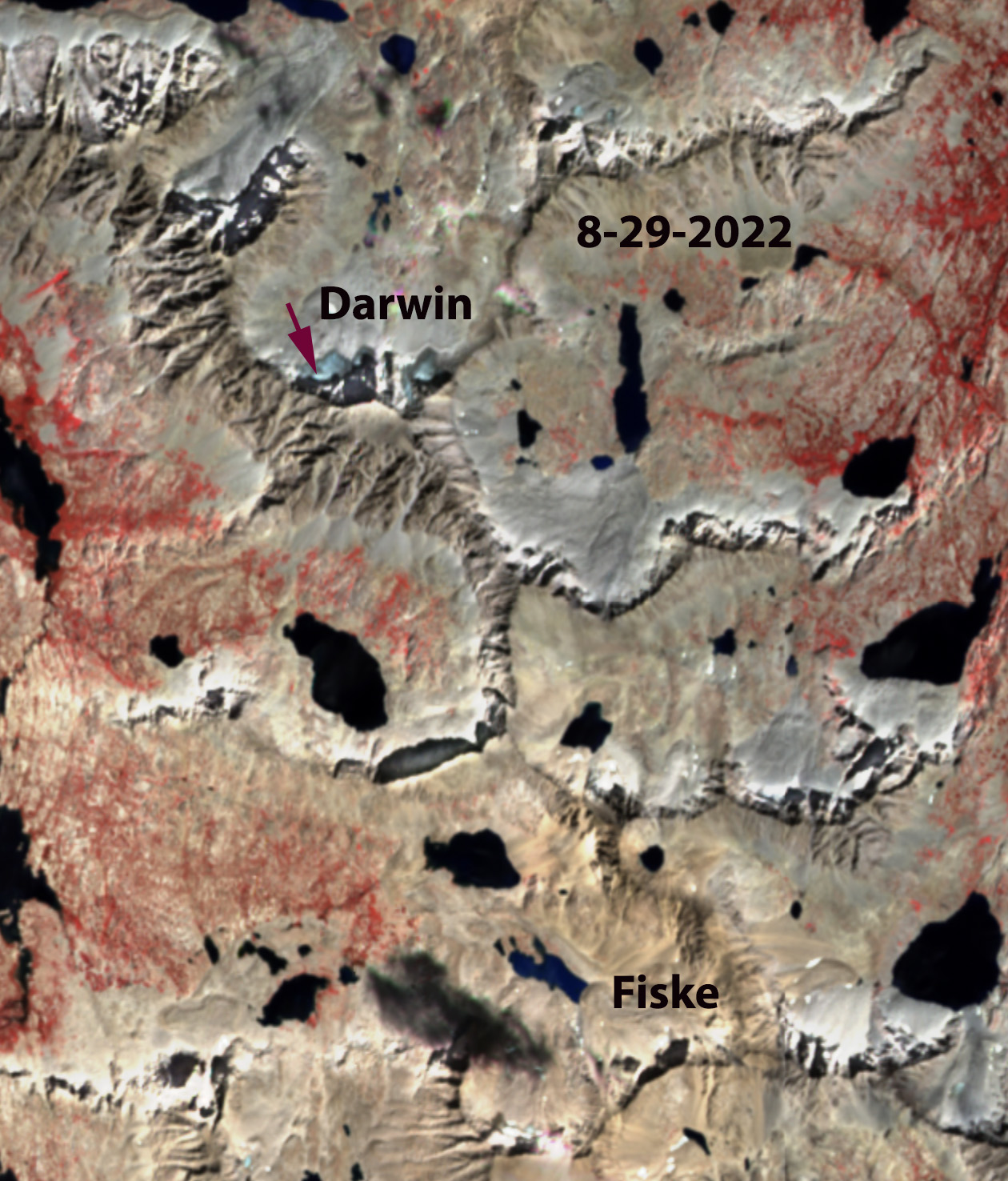
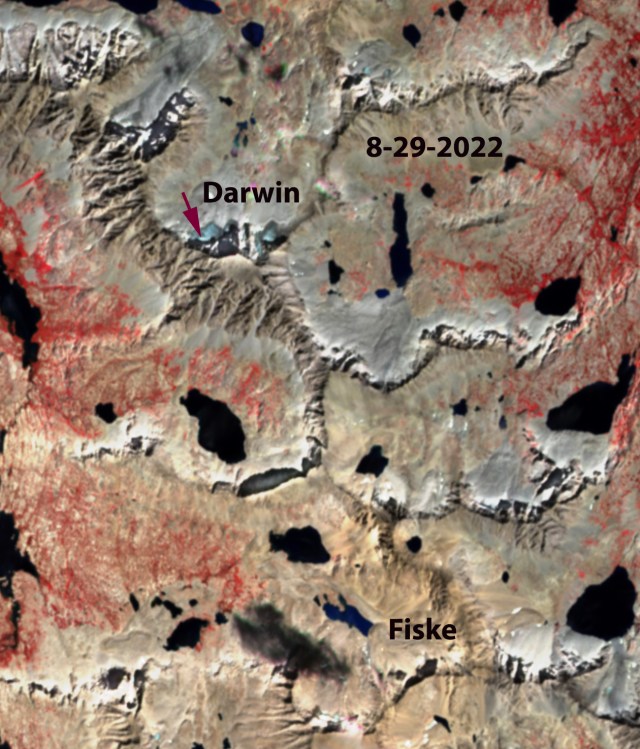
Darwin Glacier on 8-29-2022 in Sentinel False Color image with area reduced to 0.026 km2. No longer a glacier there is still relict ice clinging to the slope, in the next six weeks further melt reduced volume significantly.
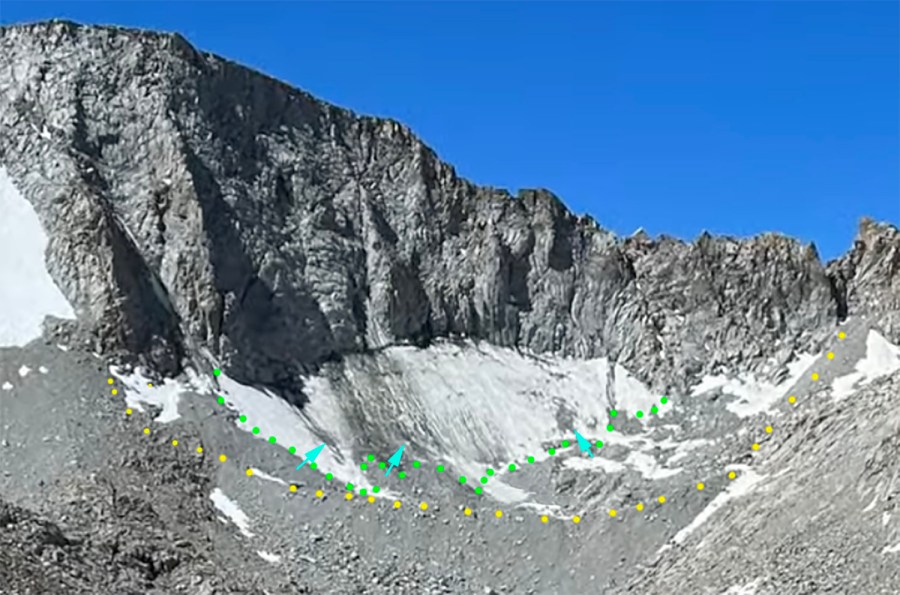
Darwin Glacier on July 19, 2022 with the moraine that the glacier was in contact with in the 1990s-yellow dots, and curent margin green dots. The blue arrows indicate rock area emerging as glacier thins. Slope has steepened and bergshrund is melting out (sierralara.com, image)

The Sierra Nevada, California has a number of small glaciers that have clung to the north facing slopes of the High Sierra. Darwin Glacier is one of those glaciers on the north side of Mount Darwin. named for Charles Darwin. The glacier is in Kings Canyon National Park and drains into the San Joaquin River.

In 1903 the glacier had an area of 0.25 km², declining 40% by 1948, 0.14 km2 Basagic and Fountain (2011). The glacier expanded beginning in the 1970s and ending in the 1990s, with an area of 0.157 km² in 1976 (GLIMS), and then had declined slightly in 2001 had an area of 0.135 km², 5-10% greater than in 1948. In 2004 area loss was increasing with the area measured in the field by Basagic and Fountain (2011), at 0.114 km2 .

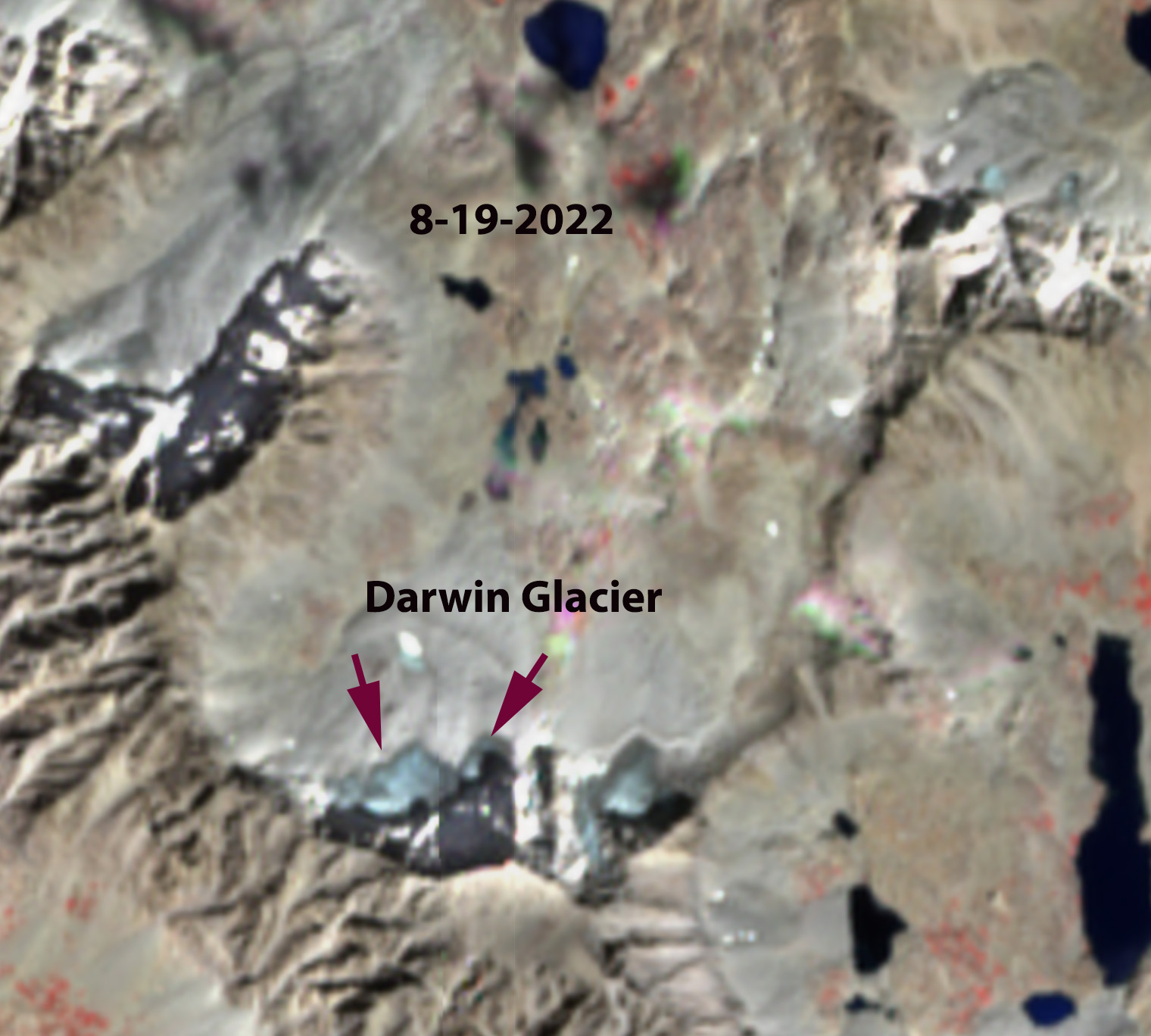
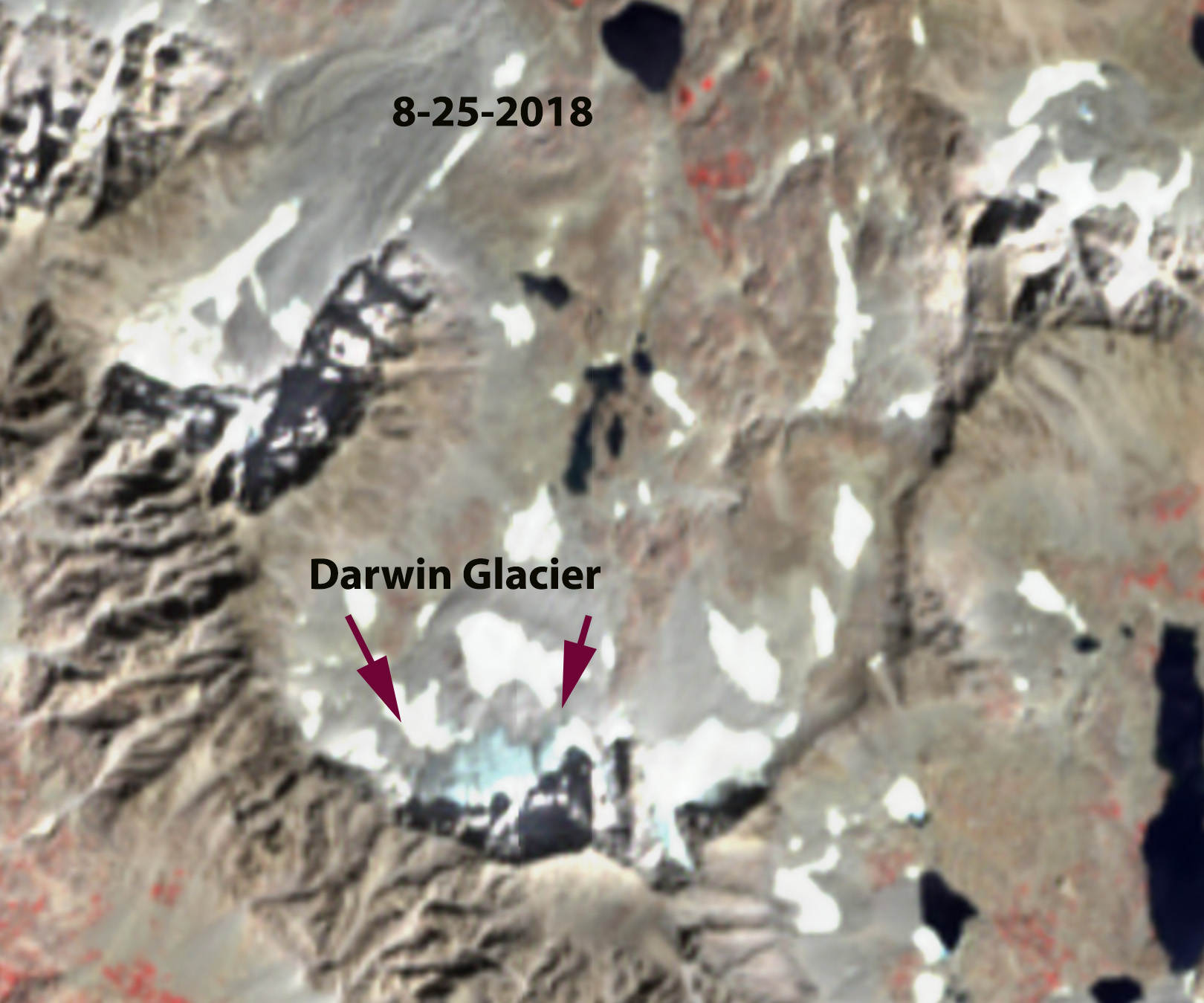
With a steep slope of ~30 degrees, the glacier depends on snow sloughing/avalanching off the north face of Mount Darwin and piling up against a moraine. Retreat from this moraine after 2004 has led to steepening of the glacier with less snowcover retained on its surface. From 2004 to 2022 the glacier rapidly lost volume and area. In 2014 the glacier area had declined 50% to 0.057 km² (GLIMS), in 2018 the glacier area was 0.048 km². The particularly warm summers of 2021 and 2022 led to further rapid decline to 0.038 km² in 2021 and 0.026 km² in 2022. At this time Darwin Glacier and was no longer a glacier with less than 20% of relict ice left from 2004, and with movement having ceased. The glacier bergshrund is also melting out. Bare rock was was also being exposed at several areas amidst the glacier area in 2022.

Just to the south Mount Fiske Glacier has disappeared as well, along with the glacier that was in the cirque on the north side of Mt. Mendel. The high snowfall winters of 2023 and 2024 have been offset by continued warm summers, preventing any significant volume increase.
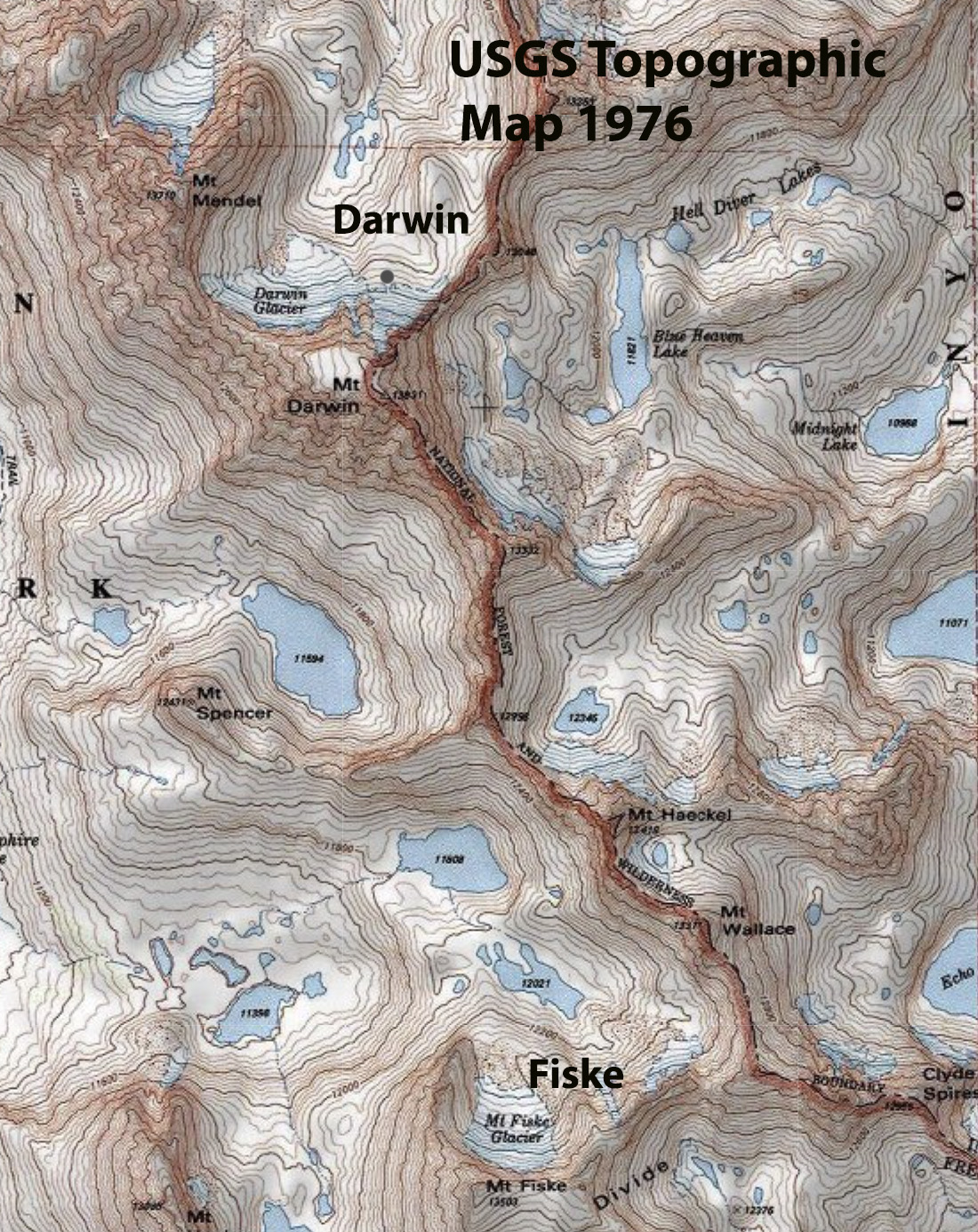
Darwin and Mt. Fiske Glacier on 1976 USGS Topographic map with areas of 0.16 km2 and 0.08 km2 respectively.
Darwin Glacier in 2018 Sentinel false color image with an area of 0.048 km2.
Darwin Glacier and Fiske Glacier no longer have sufficient area to qualify as glaciers at 0.026 km² for Darwin Glacier and 0.008 km² for Fiske Glacier. No retained snowcover in 2021 or 2022.
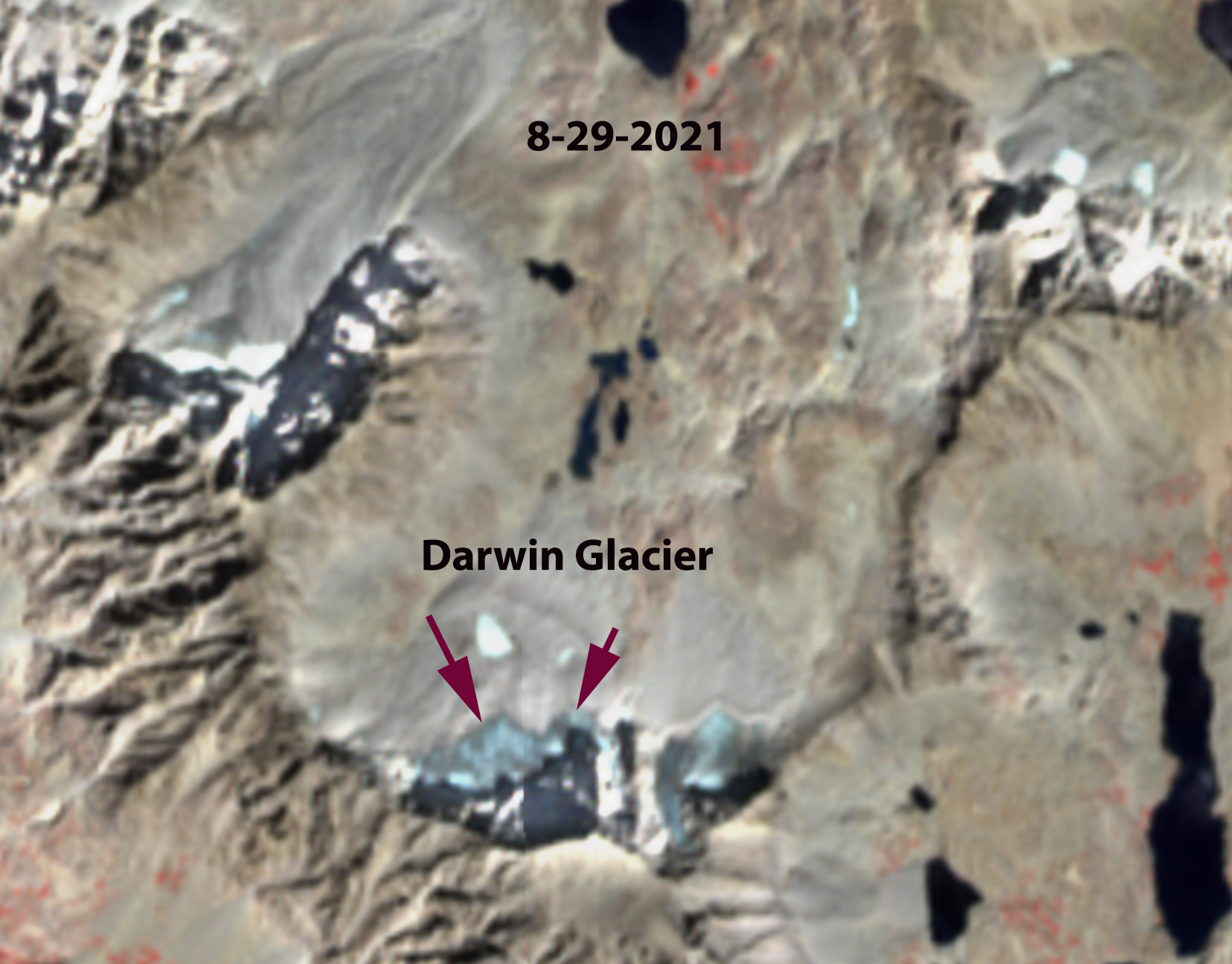
Darwin Glacier on August 29, 2021 in Sentinel false color image. There is no retained snowcover and area has declined to 0.036 km2.
Darwin Glacier on August 28, 2024 in Sentinel false color image. There are two areas where area loss from 2022 is evident, despite 60% of the glacier still having snow cover.

These losses are similar to those observed on Whitney Glacier, Mount Shasta. The NCEI NOAA Division 5 climate data for this area indicates that meltseason temperatures have been the primary cause of the recent decline, though declining accumulation season precipitation has been as well, see bottom.

California Division 5 Average Temperature May-September 1950-2022.
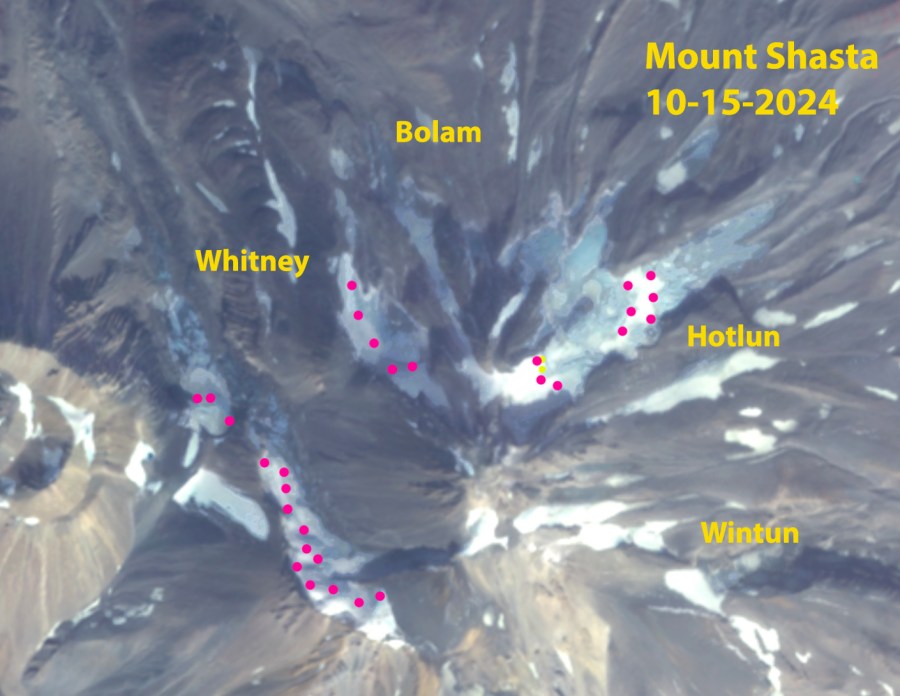
Depsite High Winter Snowfall Mount Shasta 2024 Glacier Snowcover Extent Low

Snow cover extent on Mount Shasta glacier as the melt season ends in 2024. Oct. 15, 2024 Sentinel image, red dots indicate outline of snowcover areas ~25% of glacier area.

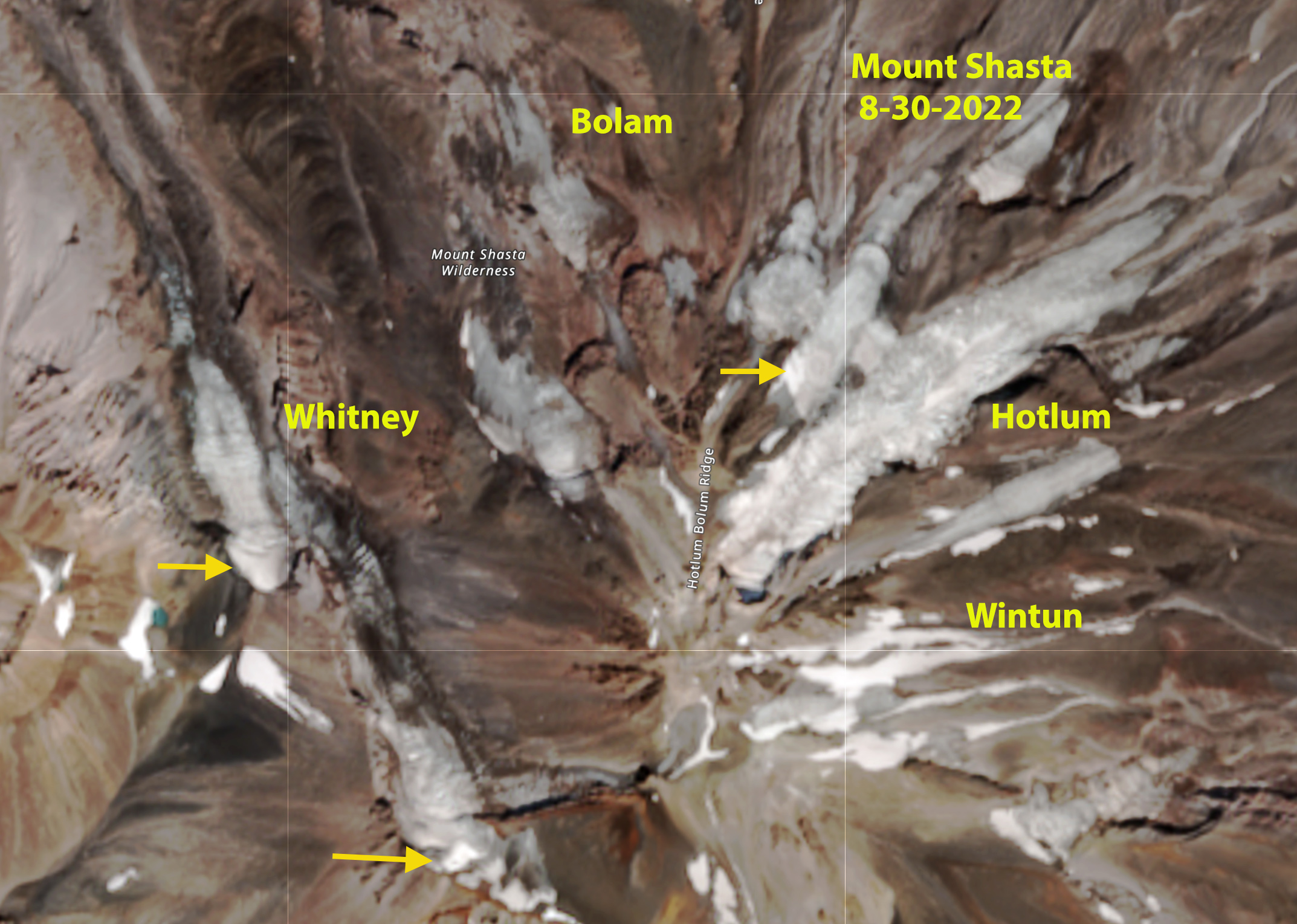
In 2021 and 2022 winters of below average snowfall , 4.50 m and 3.61 m at Snow Bowl, were followed by summers of persistent heat and several notable heat waves that left the glaciers of Mount Shasta nearly bare of snowcover, the resulting rapid volume loss and fragmentation of the glaciers was noted in detailed reports (Patel, 2021; Pelto, 2022). In 2021 less than 5% of the glaciers retained snowcover, and in 2022 less than 10% was retained.

In 2023 and 2024 a pair of winters with much above normal snowfall, 8.51 m and 8.43 m inches at Snow Bowl blanketed the mountain. How much of this snow has been retained by the glaciers as the 2024 melt season concludes.

Snow cover extent in September 2021 is less than 5% on Mount Shasta glaciers in this Sentinel image.

The summer of 2023 featured persisten warmth that led to ….In 2024 the melt season was again warm with the mean departure being 1.5-2.0 C in the Mount Shasta area. Regional Climate Center ACIS maps of the temperature anomaly for June-August provide a comparison of summer temperature for 2021-2024. Examining the remaining snowcover extent on Oct. 15, 2024 illustrates that

Summer temperature anomaly (in oF), for 2021-2024 for California. Each summer the departure has exceeded 1 C in the Mount Shasta region. ACIS maps

For Cascade range glaciers to maintain equilibrium they need 60% snowcover at the end of the melt season. Examining the remaining snowcover extent on Oct. 15, 2024 illustrates that the three primary glaciers Bolam, Hotlum and Whitney have 25% snowcover remaining. This indicates signficant loss of volume in 2024, though less than 2021 or 2022. This will drive continued thinning, retreat and loss of glaciers.

Snowcover extent on Aug. 30, 2022 on Munt Shasta Glaciers. Yellow arrows indicate that less than 10% of the glaciers are snowcovered.

Sierra Nevada, California Glaciers Rapid Decline 2018-2022

MacClure and Lyell Glacier in 2018 and 2022 Sentinel images illustrating a decline from 0.09 to 0.06 km²

The Sierra Nevada, California has a number of small glaciers that have clung to the north facing slopes of the High Sierra. An inventory of these glaciers completed by Basagic and Fountain (2011) identified glacier area in 2004, which had declined by 55% since 1903. At that time the MacClure Glacier had an area of 0.15 km², the West Lyell Glacier an area of 0.42 km², Conness Glacier an area of 0.16 km² and Darwin Glacier an area of 0.12 km². The Palisade Glacier is the largest glacier, with an area of 0,84 km² in 1984. Yosemite NPS has been assessing area change of Lyell and MacClure Glacier, they found a rapid acceleration of area loss beginning in 2012, noting a thickness loss of 3-4 m per year during the 2012-2015 drought.  These losses are similar to those observed on Whitney Glacier, Mount Shasta. The NCEI NOAA Division 5 climate data for this area indicates that meltseason temperatures have been the primary cause of the recent decline, though declining accumulation season precipitation has been as well, see bottom.

The thickness loss of 2012-2015 has been matched during the 2020-2022 drought. Area decline from 2018-2022 on West Lyell Glacier has been from 0.18 to 0.13 km², on MacClure Glacier from 0.09 to 0.06 km², on Conness Glacier from 0.08 to 0.05 km² and on Palisades Glacier from 0.62 to 0.48 km². In September of 2021 and 2022 all of these glaciers were completely bare of snowcover, even in areas of avalanching. A glacier requires 50-60% snowcover at the end of summer to be in equilibrium and cannot persist without a consistent accumulation zone. This illustrates the glaciers cannot survive the climate of the last decade. The area has declined ~30% in just five years from 2018-2022 on West Lyell, MacClure, and Conness Glacier, they each lost all of their snowcover both years by late August. Fiske (0.01 km²),  Dana (0.04 km²), Darwin (0.026 km²), Matthes (0.01 km²) and Powell Glacier 0.04 km² no longer qualify as glaciers. The next glaciers to join this class will be MacClure and Conness Glacier. The only glacier with even a small persistent accumulation zone has been Palisades Glacier.

The lost of glacier thickness in just 2021 and 2022 is 5-6 m w.e. ice thickness. To replenish this loss requires 5 m w.e of snowpack to be retained at the end of the melt season in early October. This equates to 8-9 m of snowpack remaining. This will not happen in a single season even a record snowfall year such as 2023.

Palisades Glacier in 2018 and 2022 Sentinel images, retreat indicated by lake expansion. Purple dots indicate area of firn indicating region where some snow from recent years has remained, but less than 10% of glacier area in 2021 and 2022. Note marginal recession along east and west edge of glacier.

Conness Glaciuer diminishing and darkening from 2018 to 2022 in Sentinel images. Area declined from 0.08 to 0.05 km². If it is hard to pick out the glacier on high resolution imagery like this, that is telling.


Darwin and Fiske Glacier no longer have sufficient area to qualify as glaciers at 0.026 km²  for Darwin Glacier and 0.008 km² for Fiske Glacier. No retained snowcover in 2021 or 2022. That they are hard to discern is visual evidence of their current insignficance as ice masses.

Dana Glacier has an of perennial ice of 0.04 km².  No retained snowcover in 2021 or 2022. 

Matthes Glacier in 2021 with no retained snowpack and an area of perennial ice of 0.015 km².

Palisade Glacier with narrow fringe of snow and firn in 2021.

Lyell ad MacClure Glacier in 2021 with no retained snowpack.

NCEI NOAA Division 5 climate data for melt season temperatures  (May-Sept.) and accumulation season precipitation (November-April)