Middle Lhonak Glacier Retreat, Sikkim, India

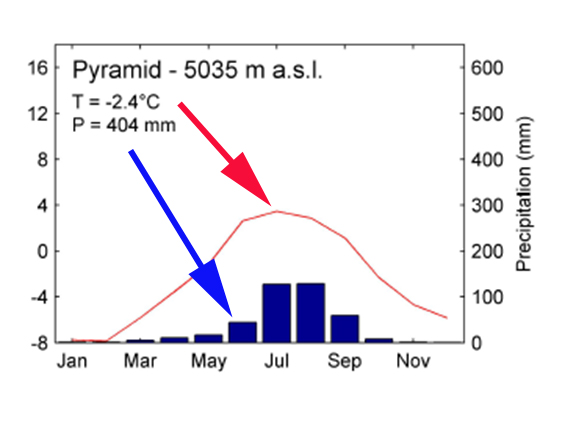
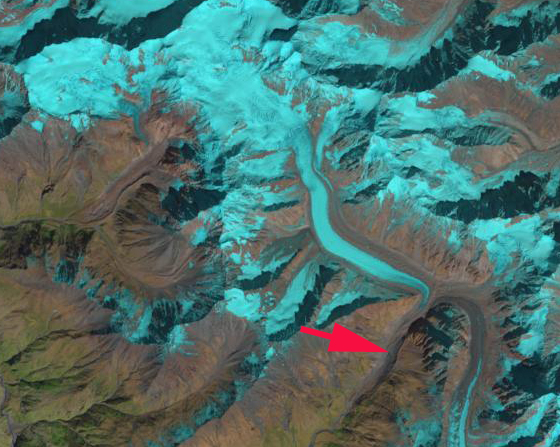
“Middle” Lhonak Glacier is an unnamed glacier between North Lhonak and South Lhonak Glacier near the border of the state of Sikkim in India and Nepal, red arrow on first map. I have previously reported on the retreat of South Lhonak Glacier whose retreat has led to a significant proglacial lake expansion and nearby Changsang Glacier. Here we examine landsat and Google Earth imagery from 2000-2013. Like all glaciers in this region Middle Lhonak Glacier is a summer accumulation type glacier. This means that the glacier receives most ~80% of its snowfall during the summer monsoon. This is also the period when ablation low on the glacier is highest. Following the summer monsoon which ends in early September there is a transition period with some colder storm events where the snowline drops. Than from November-February is the dry winter monsoon with limited precipitation. Thus, strange compared to most glaciers as winter proceeds often the lower glacier remains snow free. The pre-monsoon season from March-May features increasing precipitation, temperature and rising snowlines. The glacier drains into the Teesta River, which has several existing and many proposed hydropower projects, mostly run-of-river with minor dams. kanchenjunga map close
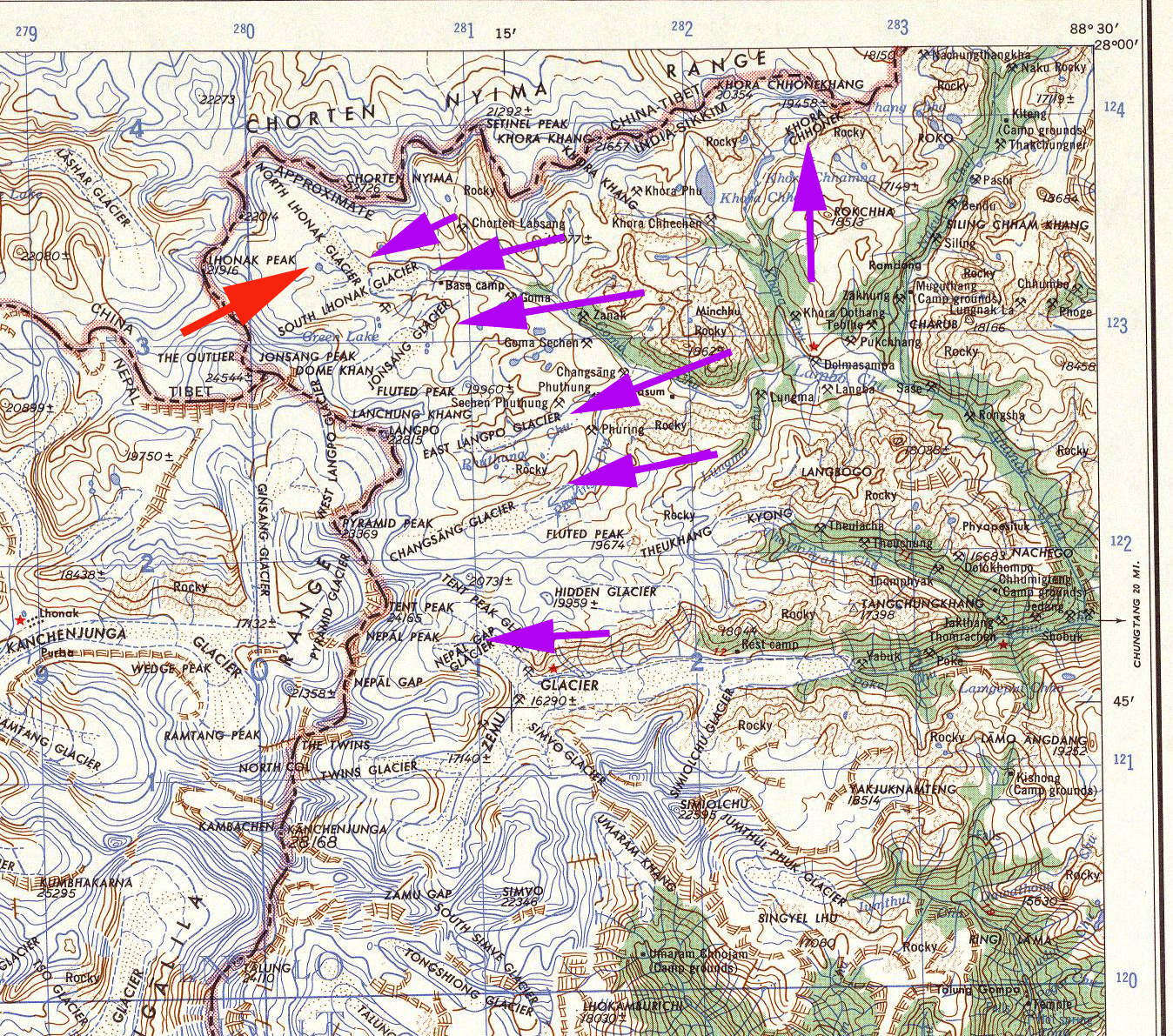
Map of Region
pyramid tp
Weather records from Pyramid station at 5000 m in Nepal indicating the peak temperature and precipitation occurring in summer monsoon.Deluge_of_Dams_Nature-Dec2012
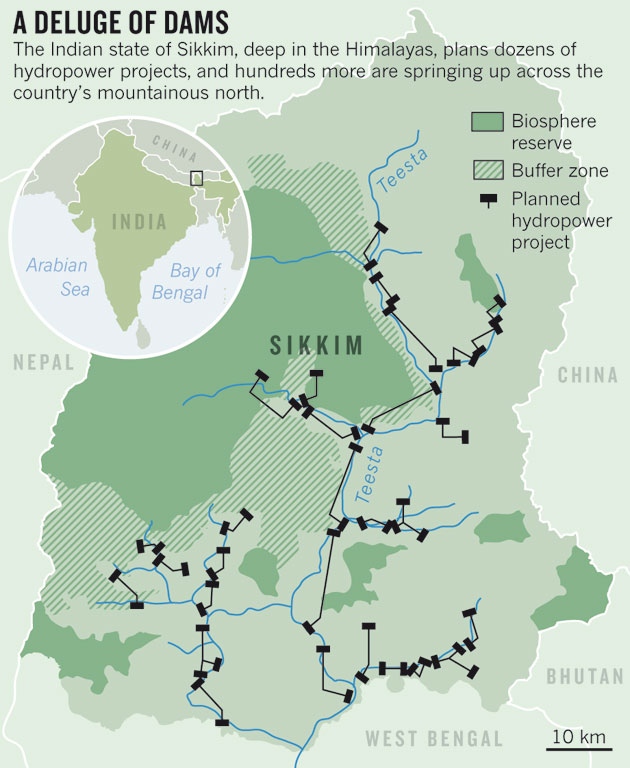
Proposed hydropower

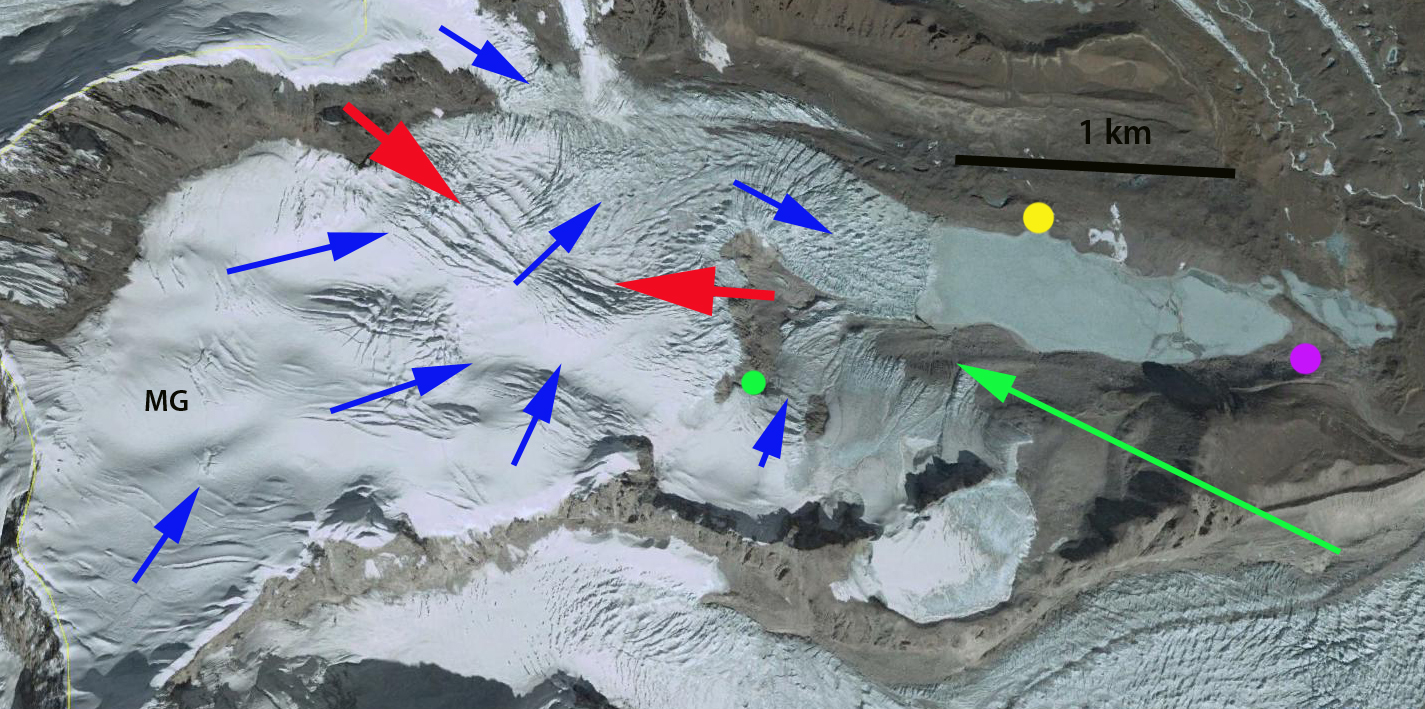
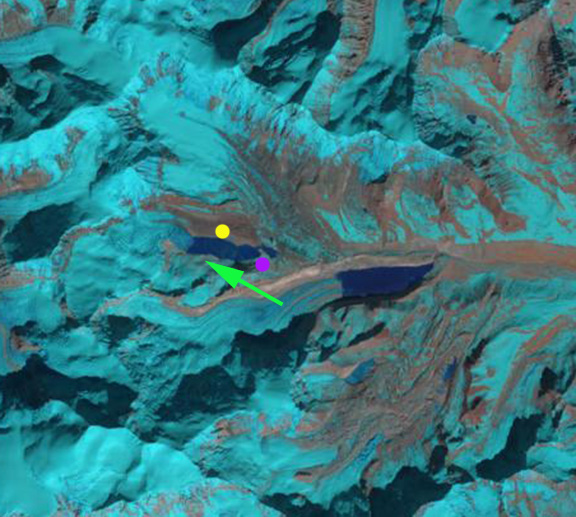
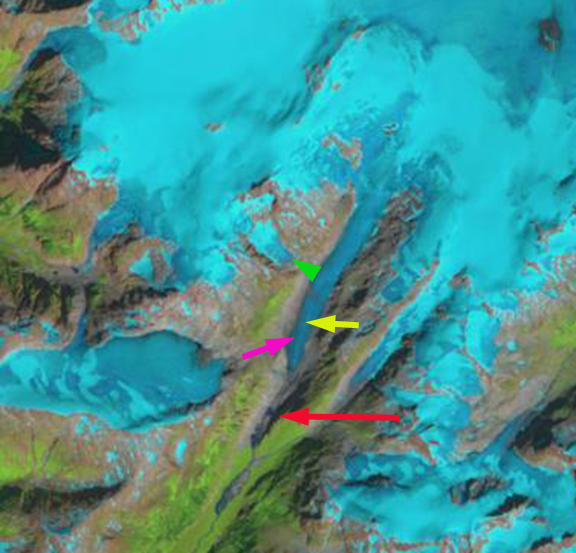
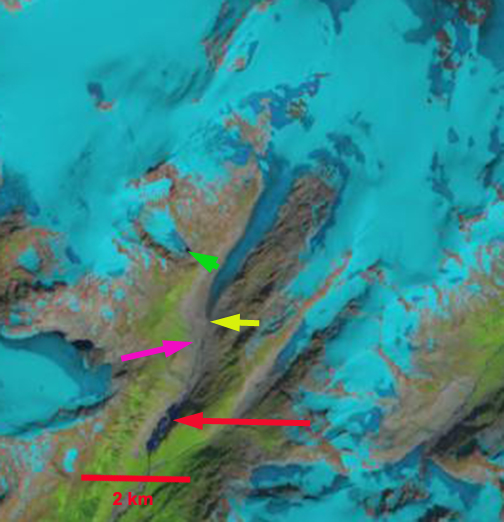
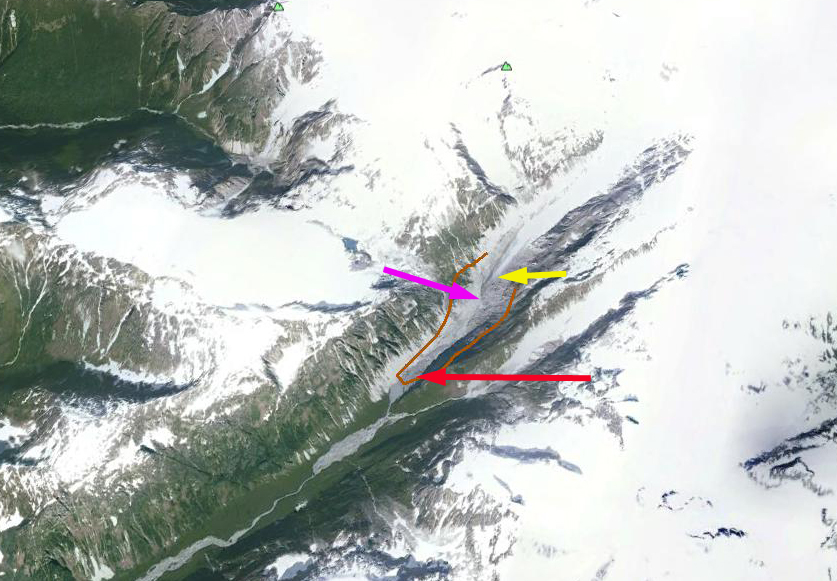
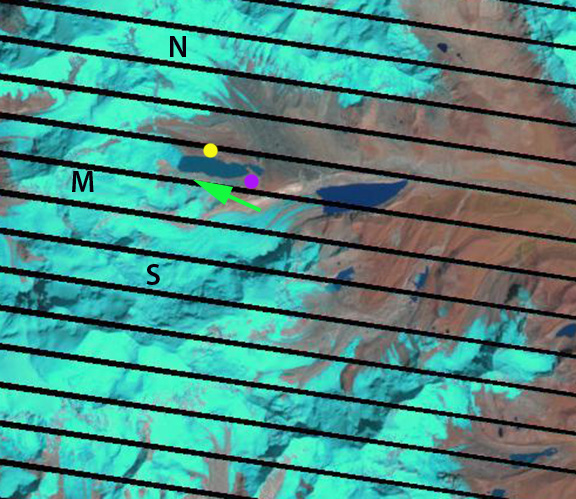
In 2000 and 2001 Middle Lhonak Glacier ends in a proglacial lake at the yellow dot. The pink dot indicates a small peninsula in the lake. The green dot indicates a bare rock area that separates two arms of the glaciers. The green arrow indicates where the two arms of the glacier join. By 2005 the glacier had retreated from the yellow dot, but the two arms of the glacier still connected, green arrow. In 2006 a higher resolution image from Google Earth indicates the 300-400 m retreat since 2000 of the glacier. The two glacier arms still join, green arrow, though barely. There is a substantial icefall that begins at 5800-5900 m, as noted by red arrows. Above the icefall the glacier is almost always snowcovered, but the icefall the glacier often remains snow free for much of the year at around 5700 meters. This will be explored further in a sequence of 2013 images below the terminus change sequence. In 2013 the two arms of the glacier have separated, the green dot bare rock area has greatly expanded and the glacier terminus has retreated 500-600 m since 2000. Lhonak glacier 2000
Landsat image 2000

Lhonak 2001
Landsat image 2001

lhonak 2005
Landsat image 2005

Middle Lhonak 2006
Google Earth image 2006

lhonak12212013
Landsat Image 2013

A series of images below indicate the snowline in a period from October 12, 2013-December, 21 2013. On October 21 the snowline is at the last bend above the terminus at 5650 m. By November 21 the snowline has shifted little. By December 1 the snowline has begun to rise to 5700 m. The rise has continued to 5750 by December 21. The lake at the terminus remains unfrozen.
lhonak10122013
October 12 2013 Landsat

Lhonak11212013
November 21, 2013 Landsat

lhonak 1212013
December 1, 2013 Landsat

lhonak12212013
December 21, 2013 Landsat

Burroughs Glacier, Alaska Demise Continues

Burroughs Glacier in Glacier Bay National Park, Alaska has been retreating without pause for the last century. The glacier is unusual in that it no longer has any areas that are in an accumulation zone, where snow persists through the year. Without an accumulation zone a glacier cannot survive (Pelto, 2010). Mickelson (1971) summarizes the retreat of the glacier from 1890-1970 and the amazing glacial geology it was leaving behind. Molnia (2007) provides a map of the regions glaciers from 1750 to 1985. Here we examine the glacier in Landsat imagery from 1986 to 2013 to illustrate both the retreat at the lack of snowcover. In the 1948 map of Burroughs Glacier, the glacier is 12.1 km long, and much of the glacier is already stagnant, the glacier has both a north and south terminus, purple arrows. To the west of Burroughs Glacier is Plateau Glacier. burroughs map By 1986 Plateau Glacier has only three small remnants marked by P, surrounding these vegetation is still limited, with considerable expanse of bare glacial sediments. In 1986 Burroughs Glacier has now snowcover. The glacier terminates in proglacial lakes at both the north and south terminus red and yellow arrow respectively, and is 9 km long, purple arrows indicate 1948 terminus. By 2003 Plateau Glacier is gone and vegetation is filling in most of the area that was still bare sediment in 1986. In 2003 Burroughs Glacier again lacks any snowcover. The southern terminus has retreated 2.2 km from the lake, and the northern terminus has retreated into a second lake basin. The glacier is 6.3 km long, half of its length in 1948. In 2004 snowcover is again lacking anywhere on the glacier. In 2010 snowcover is lacking and retreat has continued shrinking the glacier to 5.4 km in length. In 2013 the glacier lacks snowcover in this September Landsat image even though snow has returned to the surrounding mountains. This indicates how far below the snowline the glacier lies. Portions of a glacier are supposed to be the first locations that receive snowcover. The terminus has continued to retreat and is now 4.6 km long. The northern terminus is retreating into a third basin of the proglacial lake. Vegetation has reclaimed almost all of the Plateau Glacier area and has reclaimed the region deglaciated by Burroughs Glacier before 2003.

Burroughs Glacier has not been in equilibrium with climate since the end of the Little Ice Age. Its retreat has been hastened by the rising snowline of the last decade note by Pelto et al (2013) on Brady Glacier. This glacier is half of its length from 1986, the volume loss is likely less than 50%. Retreat usually increases as elevation declines and as the size of the remnant ice declines. There is no debris cover or persistent snowcover to slow the loss. Thus, it seems likely this glacier will be gone within 25 years. The 2011 Google Earth image at bottom indicates no snow, the reduced albedo from the dirty surface and a few crevasses near the margin that are collapse features. This is unlike nearby glaciers that are retreating significantly but not disappearing, like Brady Glacier, Grand Plateau Glacier, Yakutat Glacier and Riggs Glacier. burroughs 1986
1986 Landsat image

burroughs 2003
2003 Landsat image

burroughs 2004
2004 Landsat Image

Burroughs Glacier 2010
2010 Landsat image

burroughs 2013a
2013 Landsat image
burroughs ge 2011
Google Earth image

Burphu Glacier Retreat, Uttar Pradesh, India

Burphu Glacier is in Uttar Pradesh, India draining into the Goriganga River. The Burphu Gad stream enters the Goriganga a short distance upstream of the proposed hydropower project at Bogudiyar. This project is slated at 370 MW, and will have only a minor dam to divert the water from the river for a short distance before running through turbines and returning to the river. The map of the area is a 1940’s era map with the terminus of the Burphu Glacier indicated by the yellow arrow.burphu map

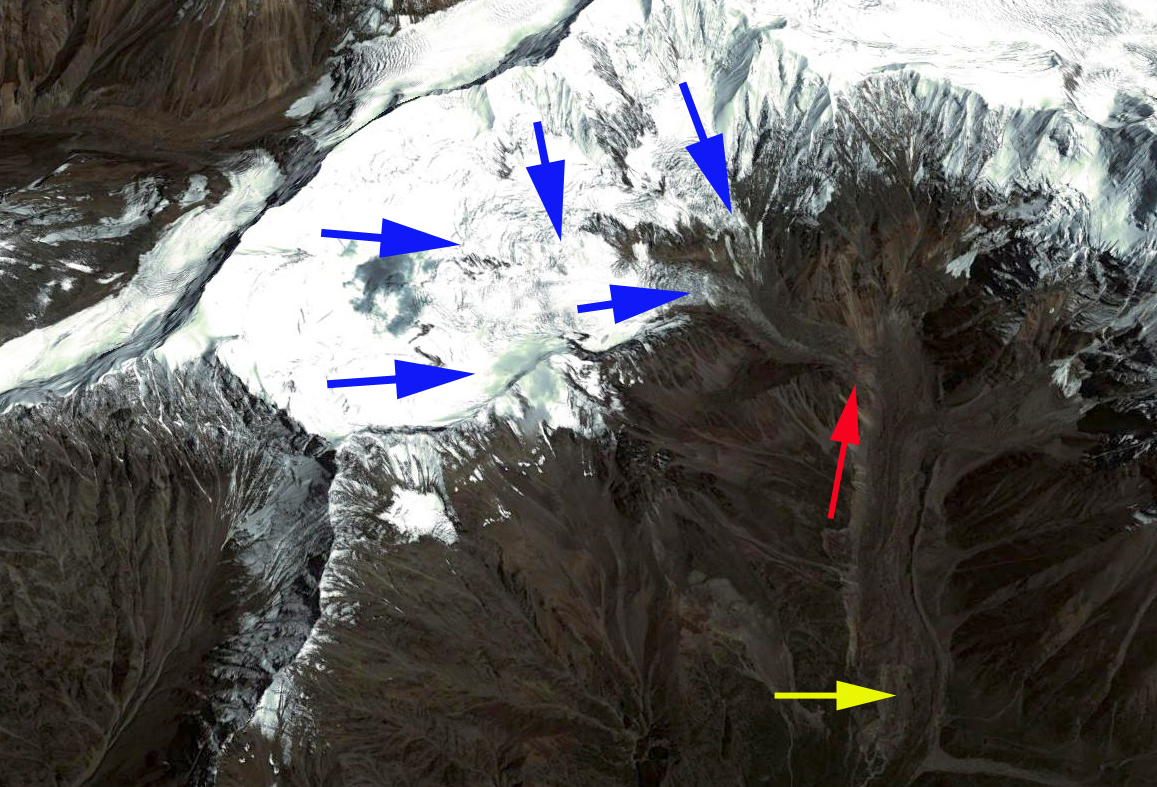
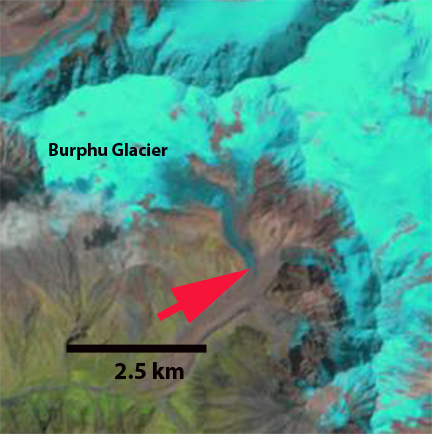
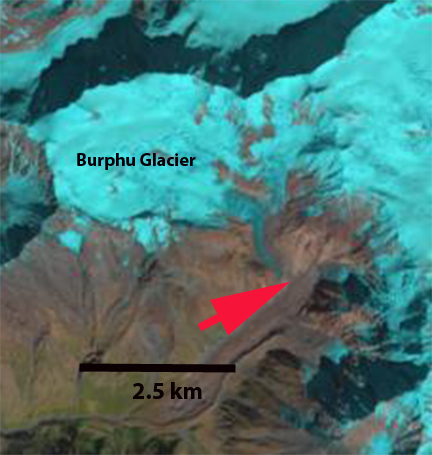
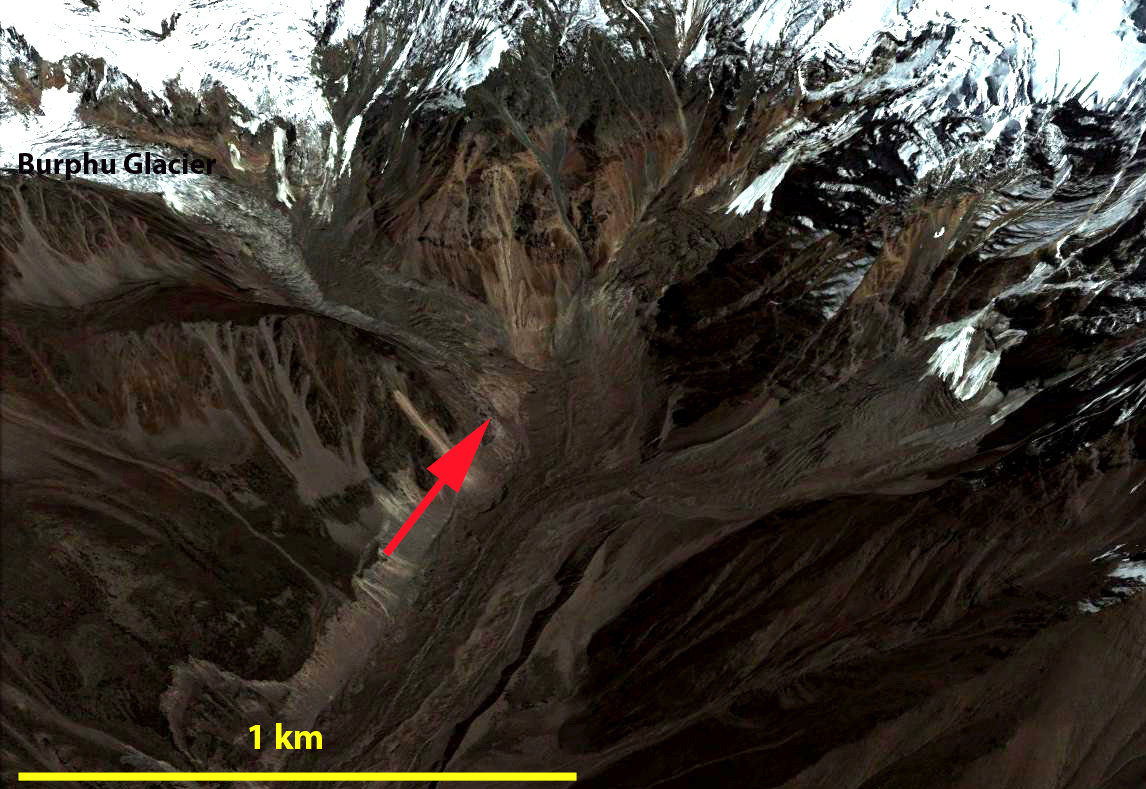
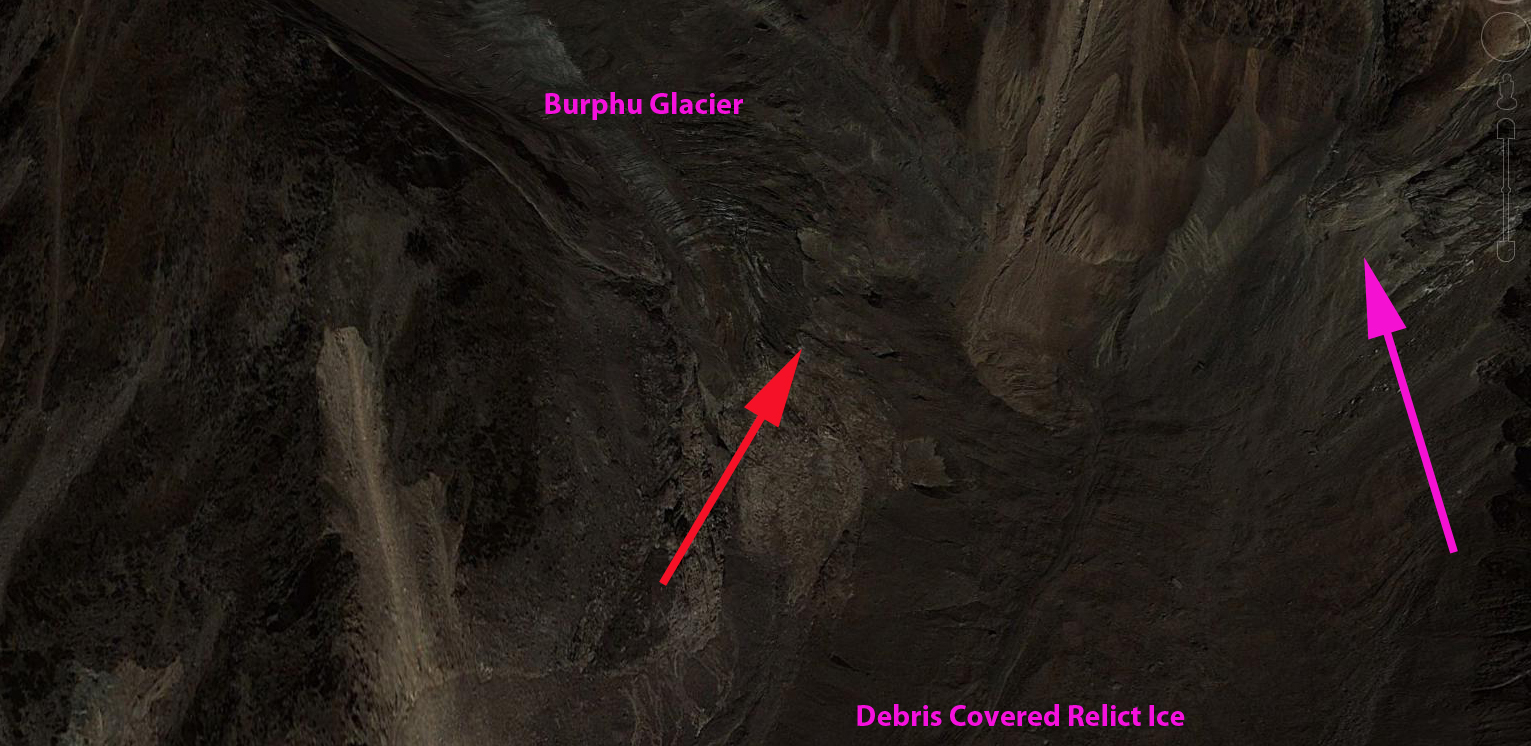
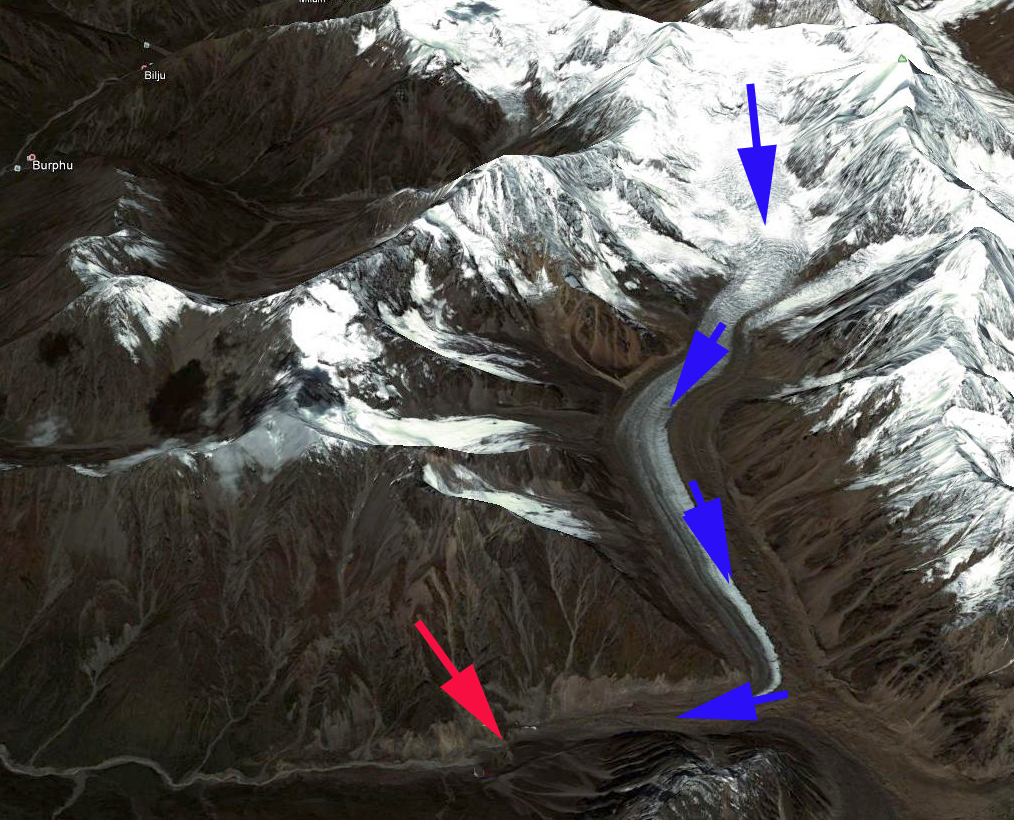
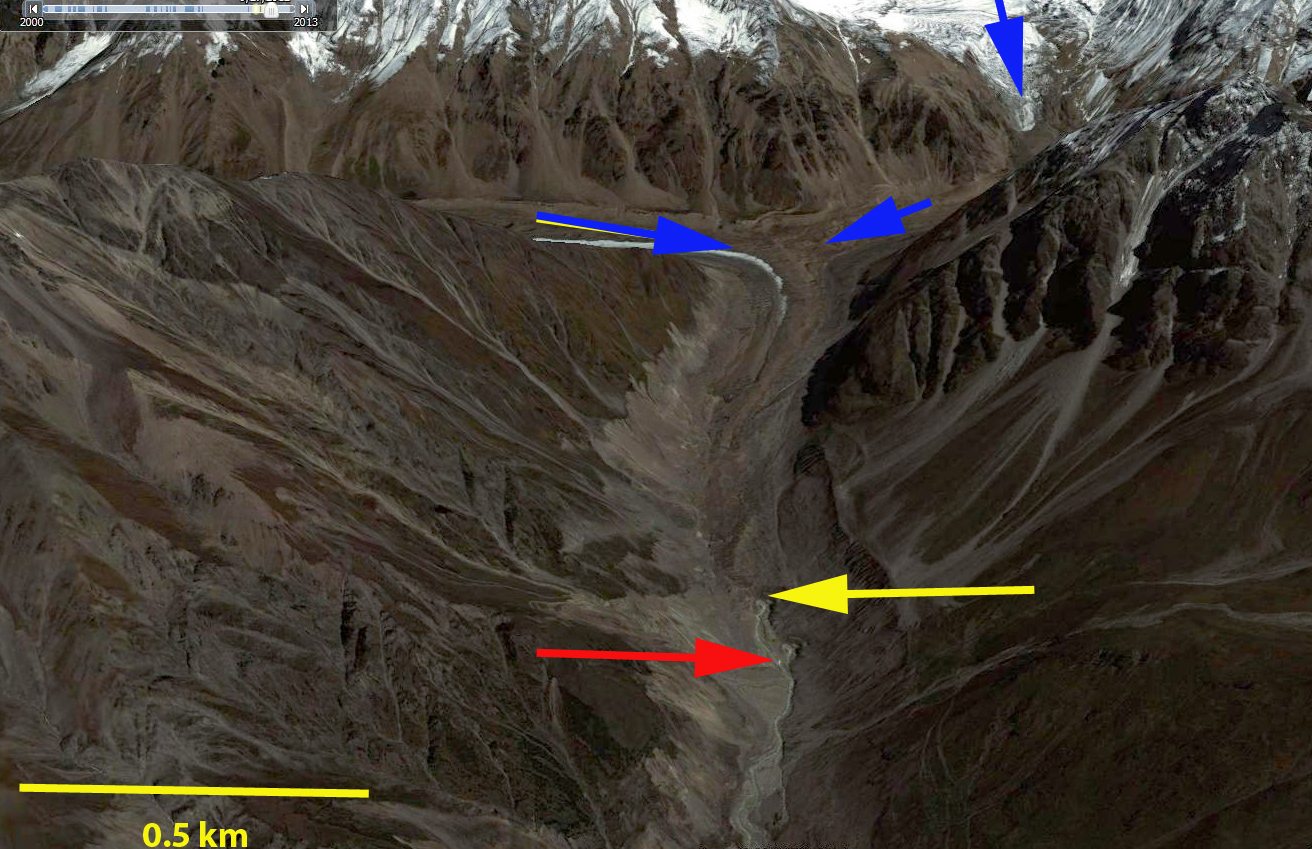
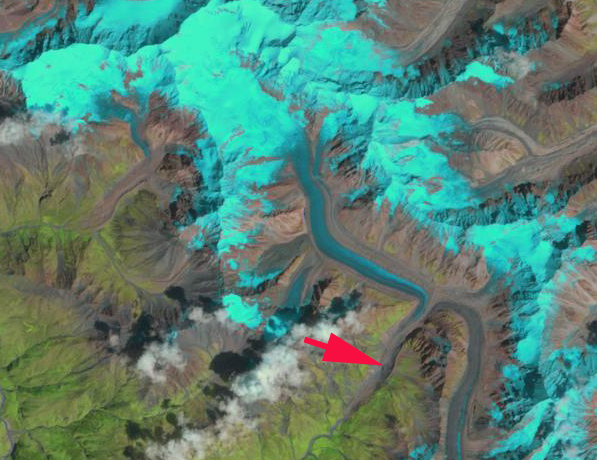
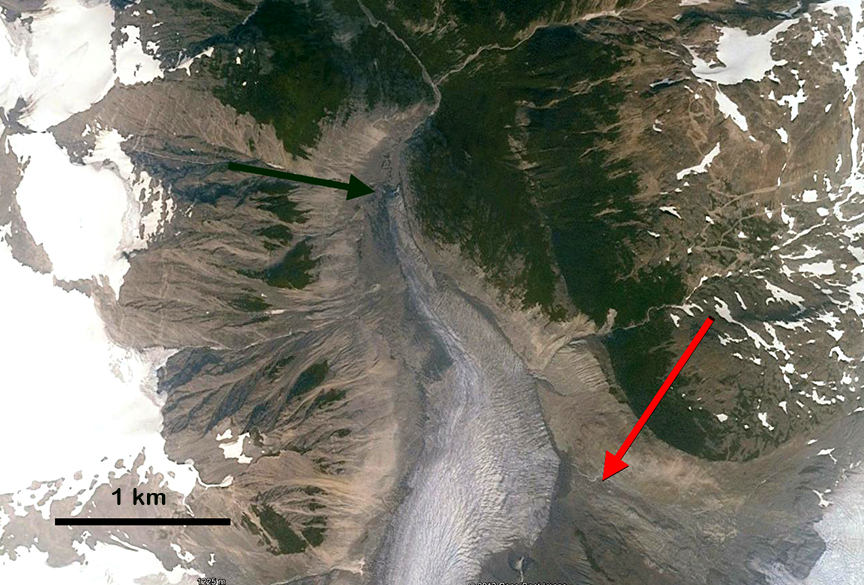
Here we examine Google Earth imagery and Landsat imagery from 2000-2013 to identify more recent changes. The Burphu Glacier has a substantial accumulation zone above 5000 m, before the glacier narrows and flows through an icefall descending to 4300 m where the glacier reaches the main valley and turns southwest, yellow arrow indicates map terminus, red arrow 2012 terminus. In the 2000 Landsat image the blue ice tongue of the Burphu Glacier reaches the main valley at the westward turn where debris cover than dominates, red arrow. By 2013 the Landsat image indicates the blue ice tongue no longer reaches the main valley, red arrow. In 2012 the Google Earth image illustrates an area of bare rock at 4400 m at the red arrow indicating that the Burphu Glacier terminates above the main valley as suggested by the Landsat 2013 image, though some relict ice remains in the main valley below. An even closer view indicates that the other tributary to the main valley tongue of the Burphu Glacier no longer reaches it either, pink arrow. Thus, this area with some pockets of relict glacier ice buried under debris cover is now fully detached. The total glacier retreat from the 1940’s mapped terminus to 2012 is 2800 meters. The retreat from 2000-2012 is at least meters 250 m as this the distance from the relict main valley ice to the current terminus. The retreat of this glacier is very similar to that of the nearby Kalabaland Glacier and is following the pattern of Malana Glacier, Milam Glacier and Satopanth Glacier in this region. burphu overview
Google Earth overview 2012

burphu 2000
2000 Landsat Image

burphu 2013
2013 Landsat Image

burphu 2012
2012 Google Earth view

burphu closeup

Kalabaland Glacier, Retreat, Uttar Pradesh, India

Kalabland Gal (Glacier) in Uttar Pradesh, India drains into the Goriganga River, via Ralam Gad. The glaciers flows southeast from the Peak of Chhiring We, joins the Yankchar Glacier and turns sharply southwest. The combined terminus is referred to as Shunkalpa Gal, but here since Kalabaland is the largest contributing glacier, that name is applied to the terminus as well. Here we examine changes in the glacier from 2000 to 2013 using Google Earth and Landsat imagery. purphu map
Map of Region

ralma ge
Google Earth Image, blue arrows glacier flow, red arrow terminus.

The Goriganga River is fed by many glaciers and is a target for a number of run of river hydropower projects, some existing such as at Talla Dummar and others projected, such as at Bogudiyar. These projects have only minor dams to divert the water from the river for a short distance before running through turbines and returning to the river. In 2000 both Landsat and Google Earth imagery indicate the terminus location, red arrow. The terminus is heavily debris covered and is evident because of the glacial stream that emerges from beneath the debris covered ice. By 2012 the glacier had retreated 250 m to the yellow arrow. The lowest one kilometer of the glacier has thinned both in width and thickness, is stagnant and will melt away soon. The side by side view from 2000 and 2012 better indicates the change and the thinning of the terminus tongue. The two pink markers are at the 2000 and 2012 terminus respectively, dark pink 2000 and light pink 2012.

ralma 2004
2000 Google Earth

Ralma 2012
2012 Google Earth

ralman terminus change
Terminus closeup in Google Earth

Landsat images from 2000 to 2013 indicate that the terminus retreat is small compared to the full length of the glacier, red arrows. The width and length of blue ice extending southwest at the bend has been reduced from 2000 to 2013 indicating a continued reduction in net flow of ice to the terminus. This glaciers retreat is following the pattern of Malana Glacier, Milam Glacier and Satopanth Glacier in this region.

ralman ls 2000
2000 Landsat image

ralman 2013
2013 Landsat image
Glacier Ice Worm Investigations-A Long Slow Processs

Yes, worms really do live in glaciers and in fact, they can’t live off of them. Their scientific name is Mesenchytraeus solifugus. I first saw an ice worm in 1981 in Alaska, the number was small and they seemed insignificant overall. In 1984 I began working in the North Cascades of Washington, and Bill Prater (inventor of the snowshoe with crampon attached) told me I would see millions, and he was correct. In the evening and night hours ice worms feed primarily on the surface of snow on glaciers, and to a much less degree, on bare ice. During the day, ice worms hide out beneath the surface of the glacier, avoiding any sunlight. We have undertaken annual ice worm counts on Sholes Glacier for twenty years. They move slowly and are out only in low lights, which does not make for exciting video, as seen below, but that is reality. On Suiattle Glacier in 2002 we found a density of ~2600 ice worms per square meter. With an area of 2.7 square kilometers, this represents somewhat over 7 billion ice worms on this glacier.

In 2003, we sat at the edge of the Sholes Glacier looking at the glacier covered Mt. Baker volcano waiting for the sun to set. After sunset we counted the ice worms on the glacier. There were close to 1000 ice worms per square meter right up to the glacier margin. By the time we had traveled 10 meters from the edge of the glacier onto seasonal snowpack almost no ice worms existed on the snowpack, within 30 m we could not find a single ice worm. This is true even in cases where the snowpack adjacent to the glacier survived the summer. Thus, the ice worms need the permanent snowpack of glaciers to survive.

In a joint project with Oregon State in 1994 we collected Ice Worms for DNA analysis, they did not find differences between ice worms from various glaciers. In 2002 In a joint study with Clark University the Ice Worm genome was sequenced. In 2011 we joined Queens University in a study of ice worm anti-freeze proteins (AFP) which help keep them from freezing solid. These AFP’s inhibit the growth of ice by lowering the freezing point and coating ice molecules. This facet is seen in other organisms that inhabit cold environments, more details on ice worm AFP from Napolitano et al (2003). Queens University was examining the ability of the AFP’s to suppress the melt temperature of water for transplant surgical procedures. Ice worms are a critical part of the glacier ecosystem in the coastal ranges of the Pacific Northwest. Glacier ice worms only inhabit glaciers from southern Alaska’s coastal ranges through the Coast Ranges of British Columbia, the Cascades of Washington to the Three Sisters of Oregon and the Olympic Mountains. The Three Sisters and Mount Hood areas is south of the Cordilleran Ice Sheet limit, indicating that this ice sheet cannot be the only dispersal method for ice worms. It is also noteworthy that ice worms are not found in the interior ranges of British Columbia or in the Rocky Mountains, which is the interior side of the Cordilleran Ice Sheet. The ice worms are associated only with temperate climates. Ice worms are tough too, surviving the Mount Saint Helens eruption in the firnpack of the newly redeveloping glacier on the mountain. The most likely means of populations spread dispersion is birds, the Rosy Finch is the bird most commonly seen feeding along the surface of the glaciers. For further details note our Ice Worm Research Project page.

Clara Smith Glacier, Alaska-British Columbia Retreat

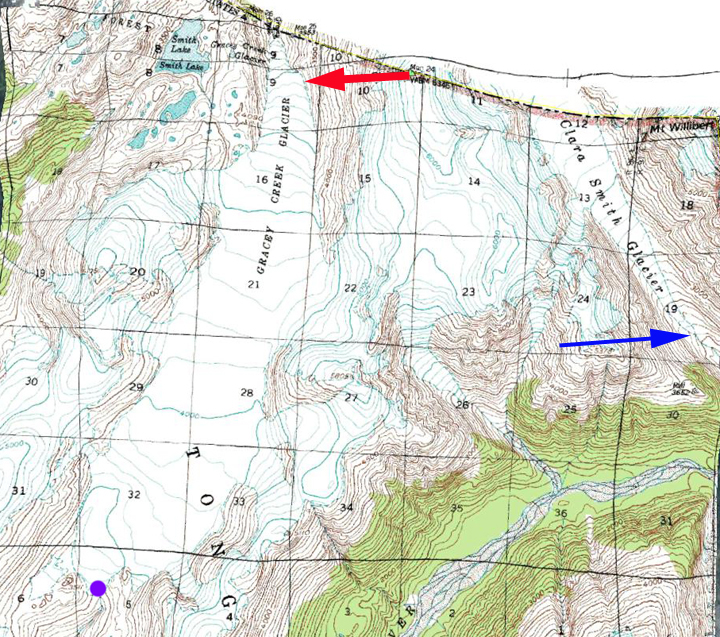
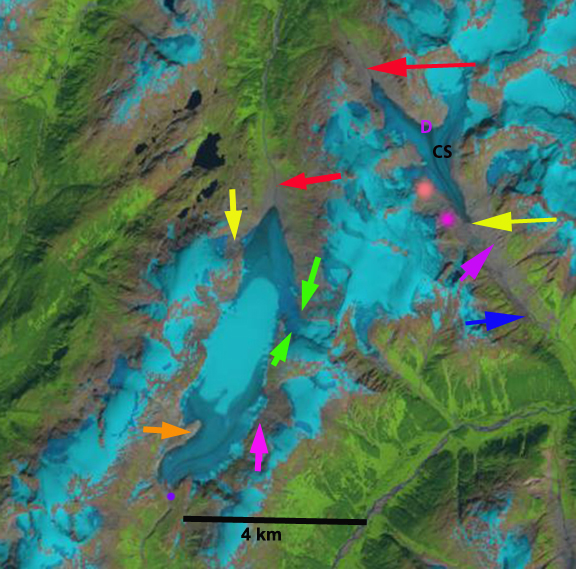
Clara Smith Glacier begins in the Coast Mountains of the British Columbia-Alaska boundary region and descends into Alaska. The USGS map shows the 1948 terminus of the glacier at 2100 feet, blue arrow, 4 km south of the border.
gracy creek map
1948 aerial photograph based USGS map.
gracey creek
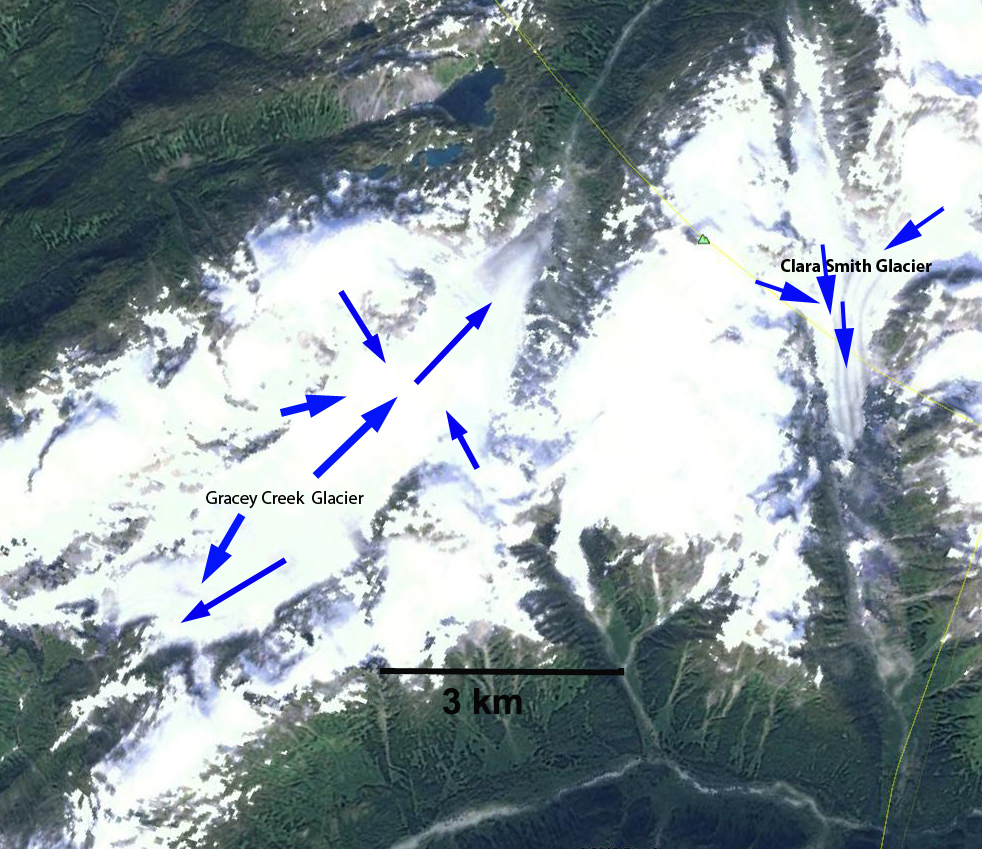
Google Earth images with flow directions.
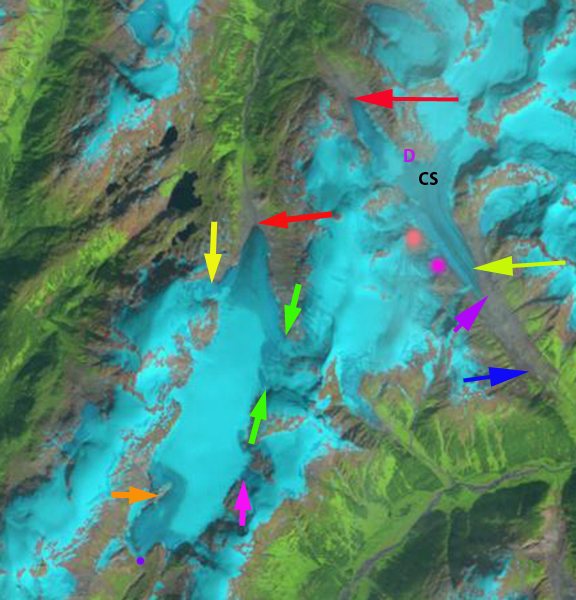
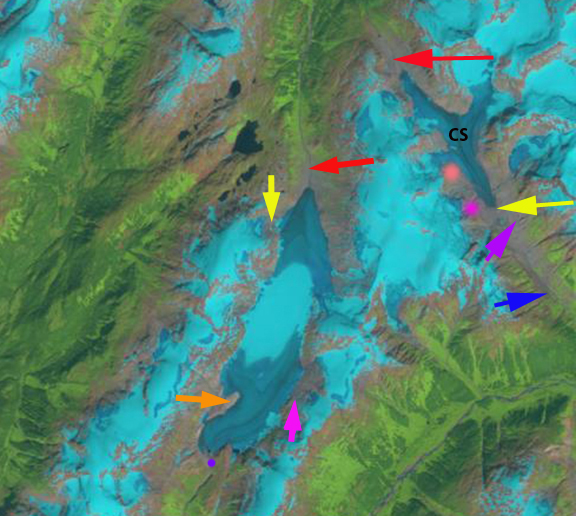
Here we focus on changes from 1987 to 2013 in Landsat images. The glacier is just east of Gracey Creek Glacier, which in the landsat images below also is marked with arrows, By 1987 the glacier had retreated 1.9 km to the magenta arrow. The glacier was fed by two significant tributaries from the west at the light and dark pink dots. The glacier also has a north flowing terminus marked by a red arrow, the divide between the two is marked by a magenta D. By 1997 the main southern terminus has retreated 400 m since 1987 and the dark pink dot tributary is just separating from the main trunk glacier. In 2010 the dark pink dot tributary is well separated from the main glacier and the terminus is at the yellow arrow. In 2013 the tributary at the light pink dot is only half its width from 1987 and is following the course of the other tributary and will separate. The main terminus is at the yellow having retreated 1000 m since 1987. The terminus is about 1 km south of the border today. The northern terminus has retreated 500 m since 1987 and a small lake has appeared at the terminus, though this could be a temporary feature. In the 1987 and 2013 images the divide between the north and south flowing terminus is marked by a magenta D, the width of the glacier at this point has declined 35-40%, a sign that both termini will continue to retreat with less ice being delivered down valley from the divide region. Notice that in 1997, 2010 and 2013 the snowline is well above the divide even though the images are not at the end of the ablation season. The divide is at 1270 m, a snowline higher than this will not maintain any portion of the main trunk of Clara Smith Glacier. This glacier is experiencing not just substantial retreat of the terminus, but tributary separation, lateral retreat on upper sections of the glacier and thinning in the accumulation zone. This trait is shared by Bromley Glacier, and Gracey Creek Glacier.
clara smith 1987
1987 Landsat image

clara smith 1997
1997 Landsat image

clara smith 2010
2010 Landsat image

clara smith 2013
2013 Landsat image
Gracey Creek Glacier Retreat and Tributary Loss, Alaska

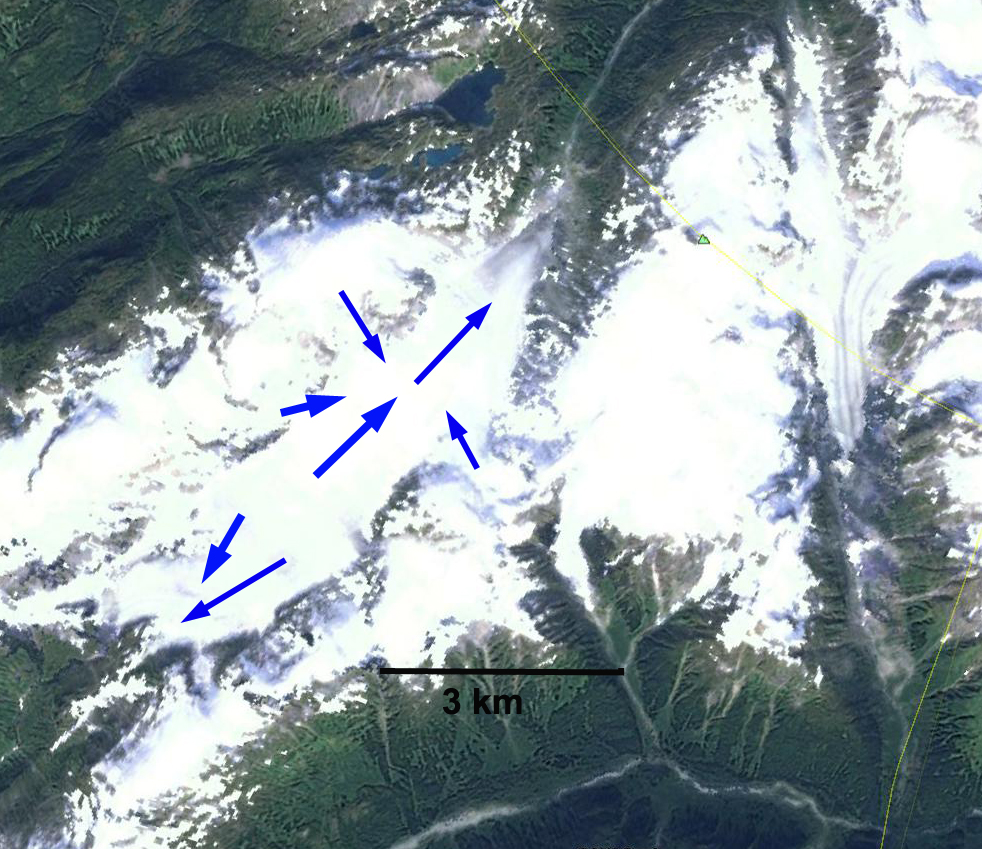
Gracey Creek Glacier is a small glacier in southeast Alaska that terminates near the Canadian border. The glacier’s main terminus is the northern terminus (red arrow), though it has southern terminus as well (purple dot), both drain into Behm Canal via different rivers. Here we examine Landsat images from 1987 to 2013 to identify retreat and tributary separation in the last quarter century.
gracy creek map
USGS map of Gracey Creek Glacier

gracey creek
Google Earth image indicating direction of flow.

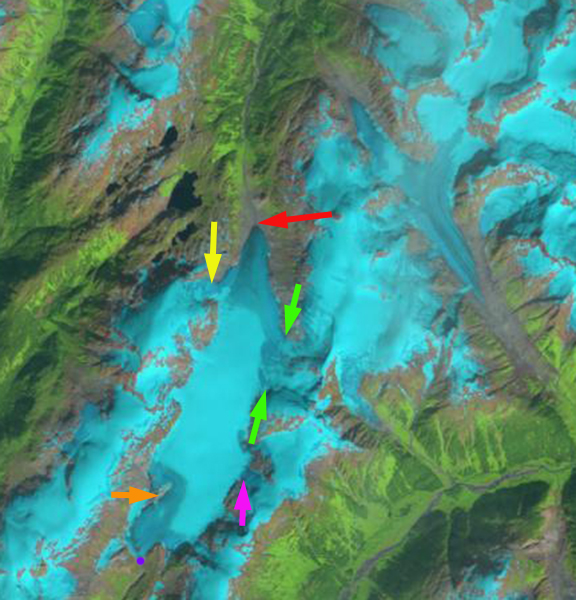
In 1987 Gracey Creek Glacier is fed by several main tributaries yellow, pink and light green arrows. The glacier’s northern terminus is at the red arrow and the southern terminus at the purple dot. By 1997 the pink tributary no longer connects to the main glacier, and the other tributary connections are much narrower. The glacier has retreated 200 m at the northern terminus and 50 m at the southern terminus. Snowcover is quite limited on the glacier. In 2010 the yellow tributary is no longer connected to the main glacier. The area of bedrock at the orange arrow near the southern terminus is greatly expanded. The northern terminus has retreated 400 m and the southern terminus 100 m. Of more importance in 2010 is the limited snowpack that is left, even though this is in mid-August with five weeks left in the melt season. By 2013 the only tributary connection is at the green arrows though this is only 40% of its 1987 width. The northern terminus has retreated 600 m since 1987 and the southern terminus 200 m.

There is limited snowpack in this late August image as was the case in the 1997 and 2009 image, this has become typical not unusual. The bad news is that in 2013 the melt season extended into mid-August and it is likely little snow remained on the glacier. The limited snowcover, loss of connection with higher elevation tributaries and thinning of the glacier even at its higher elevations indicates this glacier cannot survive current climate (Pelto, 2010). This thinning in the accumulation zone is evident from the reduction in width of the glacier at the divide between the southern and northern terminus, this is indicative of retreat of the lateral margins of the upper portion of the glacier, another sign of a glacier that cannot survive. The glacier is still 6.8 km long and it will not disappear quickly. The retreat here is less than on nearby Chickamin Glacier, Bromley Glacier and Nass Peak Glacier, however the changes on the upper glacier are the story. This glacier is similar in size and retreat to Lemon Creek Glacier of the Juneau Icefield.
gracey creek 1987
1987 Landsat image
gracey creek 1997
1997 Landsat image

Gracey Creek 2010
2010 Landsat image

gracey creek 2013
2013 Landsat image

Building a 30-year Glacier Mass Balance Time Series


The above video looks at the effort behind a long term field study, looking at images from 11 of the 30 years of our research, digital cameras became good then. Long term monitoring programs have until recently been unattractive for federal grantmakers, since they are not directly advancing the frontiers of science. However, many long duration time series from monitoring programs do advance science eventually as the response to changes in environmental or climate conditions are documented. In 1984, I responded to a request from the US National Academy of Sciences, “to monitor glaciers across an ice clad mountain range”, something that was not being done anywhere in Norther America. Thirty years later we are still pursuing this project. We have developed a 30 years time series of glacier mass balance on glaciers across the North Cascades of Washington. To ensure that the program could be sustained, we did not pursue any federal funding for the project. The data we, collect is submitted to the World Glacier Monitoring Service (WGMS) each year, the regional time series built in the North Cascade is just part of the contribution to the global glacier mass balance time series at WGMS. The cumulative North Cascades glacier mass balance record is in fact quite similar to the cumulative global mass balance time series. For the globe there have been 22 consecutive years of negative mass balance, that is the reality of the impact of global warming on mountain glaciers around the globe. The impact on the glaciers of Mount Baker was recently published Pelto and Brown (2012)
Slide1

Bromley Glacier Retreat, NW British Columbia

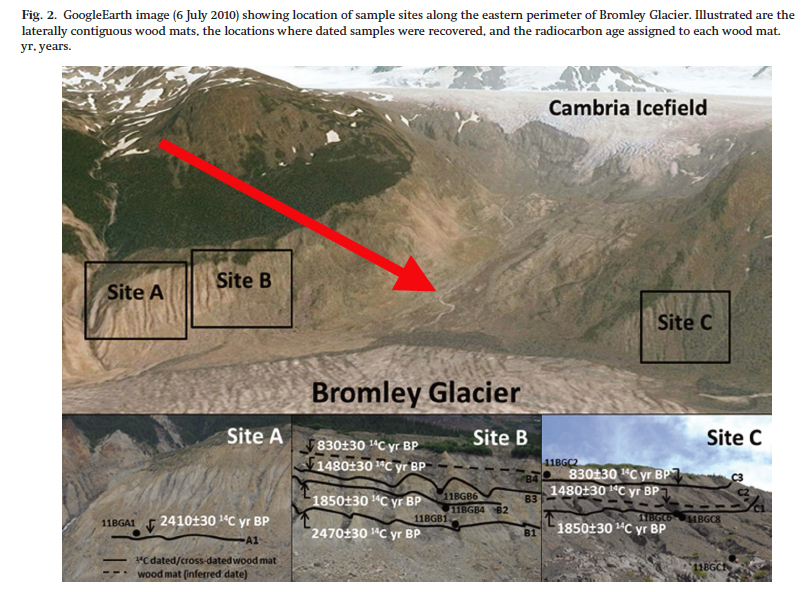
Bromley Glacier is the largest outlet glacier of the Cambria Icefield near Stewart, BC. The glacier drains north into the Bear River. bromley mapDan Smith and his graduate students of the University of Victoria have been busy searching for fossil wood as it emerges from beneath the rapidly retreating glaciers of British Columbia. They have found numerous pieces from former forest that have emerged in the last decade after being buried for at least 2000 years. Smith, points out this is due to the rapid retreat that began in the area in the 1980’s. Bolch et al (2010) noted a reduction of 0.3% per year in glacier area in the Northern Coast Mountains of British Columbia from 1985 to 2005. Scheifer et al (2007) noted an annual thinning rate of 0.8 meters/year from 1985-1999. One of the glacier they visited was Bromley Glacier in 2011. This led to a publication from Smith and Kira Hoffman (Hoffman and Smith, 2013) that found periods of glacier expansion at ca. 2470–2410, 1850, 1450, and 830 years BP.

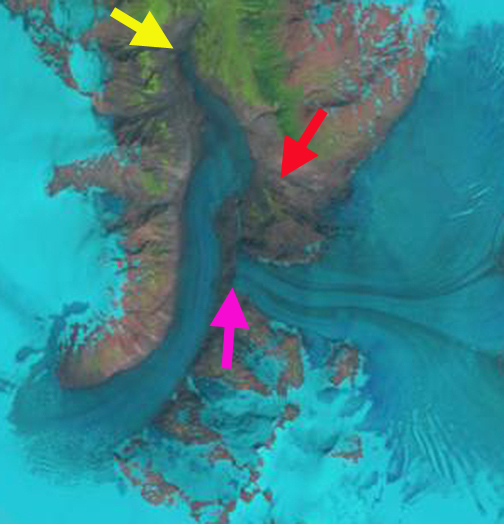
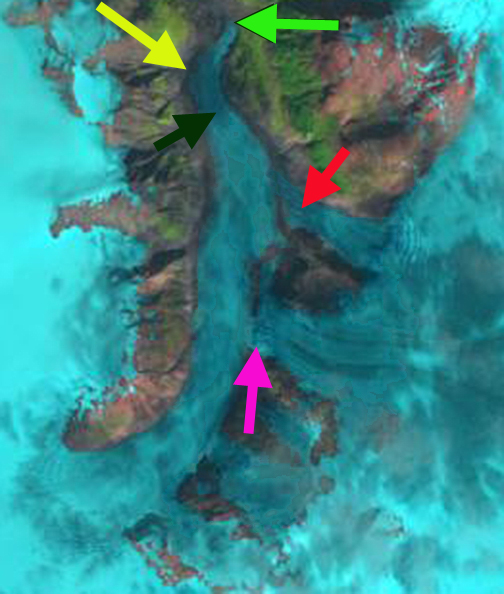
Here we examine satellite imagery from 1986, 1997, 2010 and 2013. The yellow, red, and green arrows indicate the same location in each image. In 1986 as in the map the Bromley Glacier was comprised of three large glacier tributaries, two flowing from the east red and pink arrow and from due south. In 1986 the eastern tributaries still contributed directly to Bromley Glacier. The terminus was at the lime green arrow, 500 meters beyond a side valley on the west marked by the yellow arrow. In 1997 the tributary at the red arrow is no longer feeding the Bromley Glacier while the tributary at the pink arrow connection has narrowed. The terminus has retreated 200 m since 1986, but still rounds the bend heading northeast. In 2010 the separation at the red arrow is greater than 1 kilometer. The pink arrow tributary is also no longer in contact with Bromley Glacier. The terminus has retreated to the yellow arrow, a 700 m retreat since 1986. The lower 500 meters of the glacier are narrow and thin. By 2013 the glacier has retreated to the dark green arrow, an additional 500 m since 2010 and 1200 m since 1986. The red tributary has retreated 1400 meters from Bromley Glacier and the pink arrow tributary 250 m from Bromley Glacier.

The loss of contributions from two of the three main tributaries will spur continued extensive retreat of the glacier. The snowline of the main glacier has been at close to 1600 m in the imagery here, too high for anything but a very negative mass balance. This retreat is similar to that of nearby Chickamin Glacier, Porcupine Glacier and Nass Peak Glacier. There is an exceptional photo gallery provided by the Tree Ring Lab at University of Victoria, the album does not get to the Cambria Icefield and Bromley Glacier until image 123, though images 65-68 have excellent examples of fossil trees. Figure 2 from Hoffman and Smith (2013) is below. This is in the area rendered ice free by the retreat of the red arrow tributary since 1986. bromley glacier 1986
1986 Landsat image
bromley glacier 1997
1997 Landsat image
bromley glacier 2010
2010 Landsat Image

bromley glacier 2013
2013 Landsat image

Hoffman and Smith Fgiure 2
Figure 2 from Hoffman and Smith (2013) of red arrow tributary that was connected to Bromley Glacier in 1986, this is a 2011 image.

bromley terminus
Google Earth image 2010

Nass Peak Glacier Retreat, Coast Mountains, British Columbia

“Nass Peak” Glacier is a 5 km long unnamed valley glacier that feeds Coast Mountain Creek and then Nass River. The closest community is Kitsault, BC on the north side of the small icefield from which the glacier originates. Nass peak map Here we examine changes in the is glacier in Landsat imagery from 1986 to 2013. In 1986 the glacier terminated at the red arrow, this is also approximately the mapped terminus position. The terminus is near the nose of a long ridge at 650 m in 1986. By 1997 the glacier had retreated 800 m to a location adjacent to the southern outlet stream from another glacier in a side valley. By 2010 the glacier has retreated behond the northern outlet stream of the side glacier, pink arrow and almost too the yellow arrow. In 2013 the glacier has retreated just beyond the yellow arrow a distance of 2000 meters since 1986 and is at an elevation of 850 m. For a glacier that was 7.5 km long and is now 5.5 km long that is a 27% loss of length in 27 years. The green arrow point to the separation between a side glacier and the Nass Peak Glacier, this expanded 250 m both from retreat of the side glacier and the lateral thinning at this elevation of Nass Peak Glacier. The last image is a 2009 Google Earth Image indicating the mapped terminus outline to the 2009 terminus.

The Nass Peak Glacier retreat is larger as a percentage of the glacier, but similar in distance than the nearby Porcupine Glacier, BC, Bromley Glacier, BC, Jacobsen Glacier, BC, Chickamin Glacier, AK and Patterson Glacier, AK. Nass Peak Glacier also has lacked a proglacial lake which typically enhances retreat via calving, making the retreat quite significant in terms of surface mass balance loss.
nass peak 1986
1986 Landsat Image

nass peak 1997
1997 Landsat Image

nass peak 2010
2010 Landsat Image
nass peak 2013
2013 Landsat Image

nass peak ge
2009 Google Earth Image

Rink Gletscher, Retreat NW Greenland

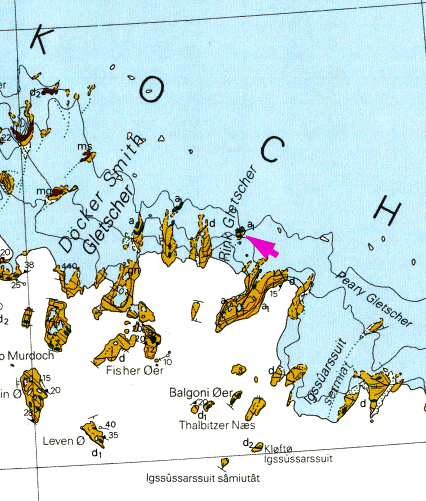
Rink Gletscher is just east of Docker Smith Glacier in Melville Bay Northwest Greenland. It should not be confused with the large and more famous Rinks Isbrae 5 degrees latitude south. This is a minor outlet glacier with a 4 km wide calving front.docker smith area  map
GEUS Map
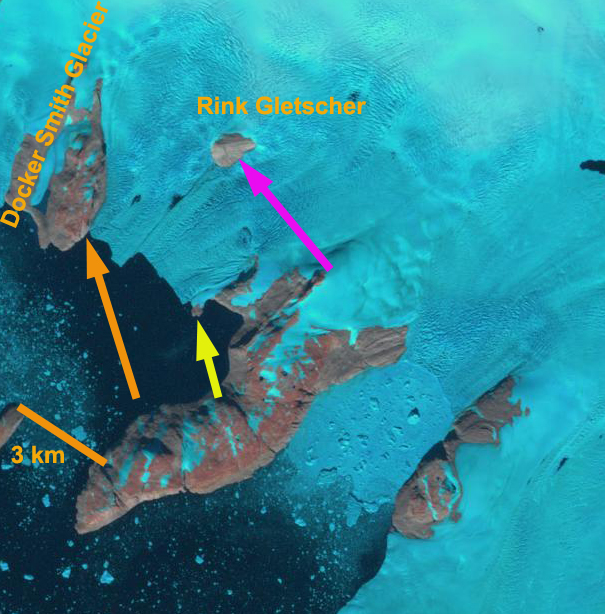
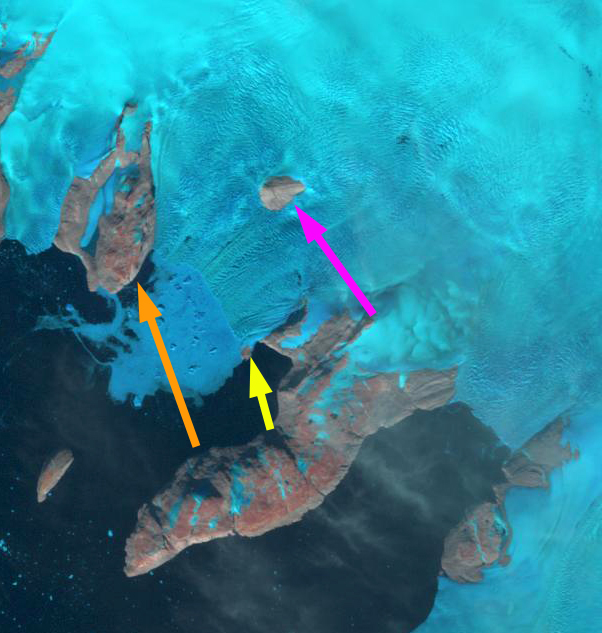
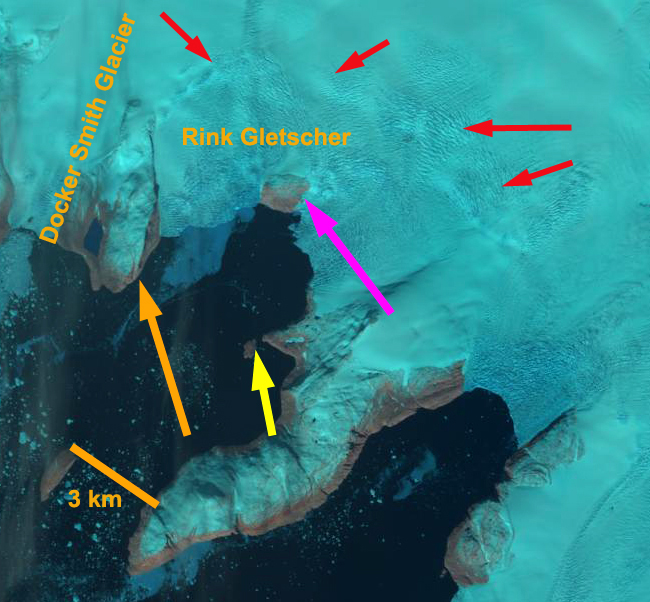
McFadden et al (2011) noted that several larger neighboring glaciers in Northwest Greenland Sverdrups, Steenstrup, Upernavik, and Umiamako underwent signficant retreat, acceleration and thinning between 2002 and 2007. Steenstrup was the focus of a recent post where retreat of up to 5 kilometers since 1999 had led to new island formation. Howat and Eddy (2011) observed that 98% of glaciers in northwest Greenland retreated from 2000-2010 with a mean rate of 127 m per year. Van As (2011) has noted that net annual ablation after 2000 has been consistently higher in the region. Enderlin and Howat (2013) note that basal melting is 0.3-0.5 m day in this region, much higher than surface ablation. Here we again utilize the exceptional Landsat record of the changing earth surface with imagery from 1999, 2001. 2012 and 2013. In 1999 the glacier extends to the orange arrow on the west margin and a small peninsula, yellow arrow, on the east margin. A nunatak is located 3.5 to 4 km behind the calving front, pink arrow. By 2001 retreat of the western margin is evident, but only minor retreat in the east. By 2012 the glacier has retreated back to the nunatak with the greatest retreat in the center of the glacier and less at both margins. By 2013 it is evident that the island by the yellow arrow, has been freed from the ice sheet. The center of the glacier has retreated 3.5 to 4 km to the nunatak, pink arrow. Retreat is 3 km along the eastern margin and approximately 1.8 km on the western margin. A series of red arrows indicates a point where the surface slope of the glacier increases, resulting in greater crevassing. This reflects a bedrock step in elevation as well. The recent retreat has largely been via calving. This retreat can rapidly continue back to the red arrows, at that point water depths will be greatly reduced as will calving. The retreat here is coincident with the pattern of retreat and new island generation seen at Kong Oscar Glacier, Alison Glacier and Upernavik Glacier.
rink glacier 1999
1999 Landsat Image

rink glacier 2001
2001 Landsat Image

Rink glacier 2012
2012 Landsat image

Rink glacier 2013
2013 Landsat image

Steenstrup Glacier Retreat, New Island Generation NW Greenland

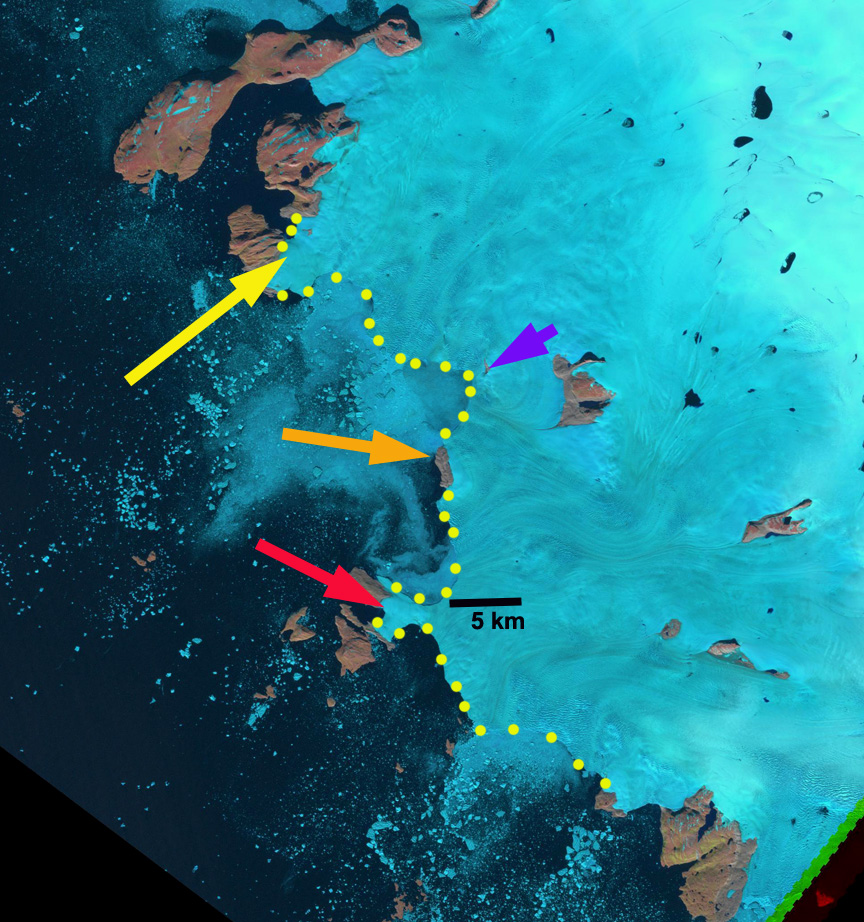
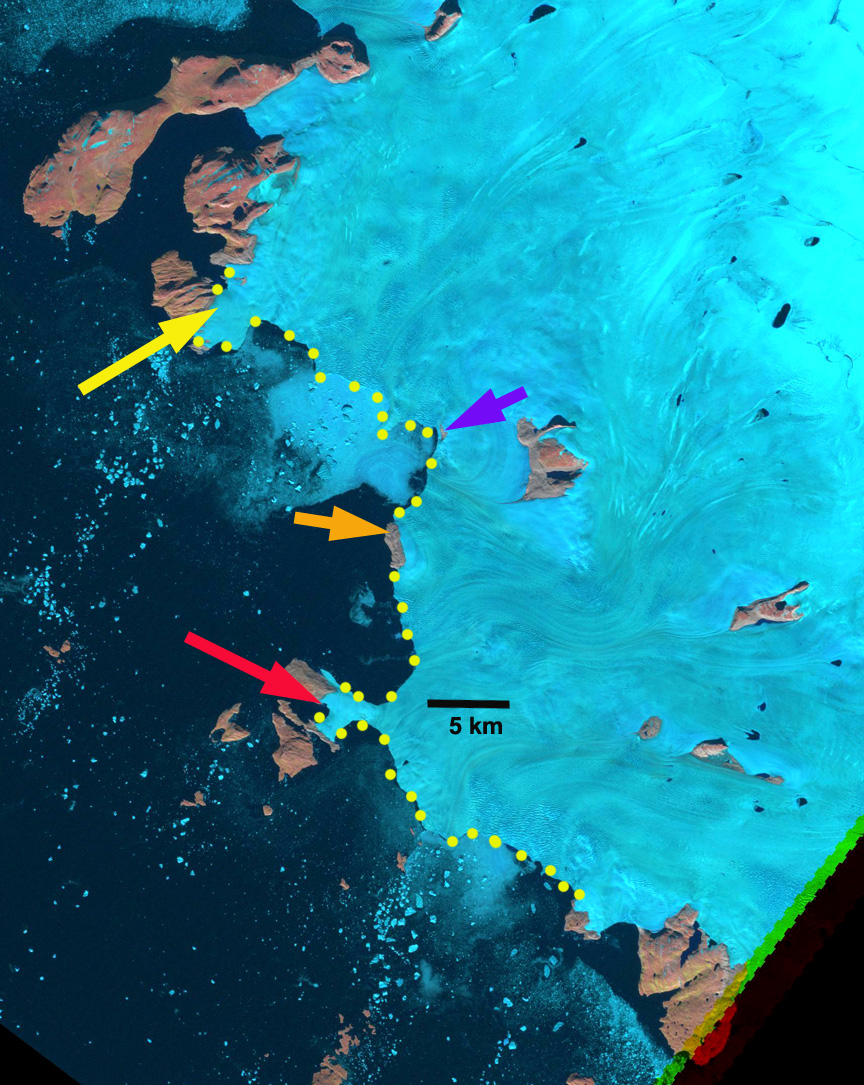
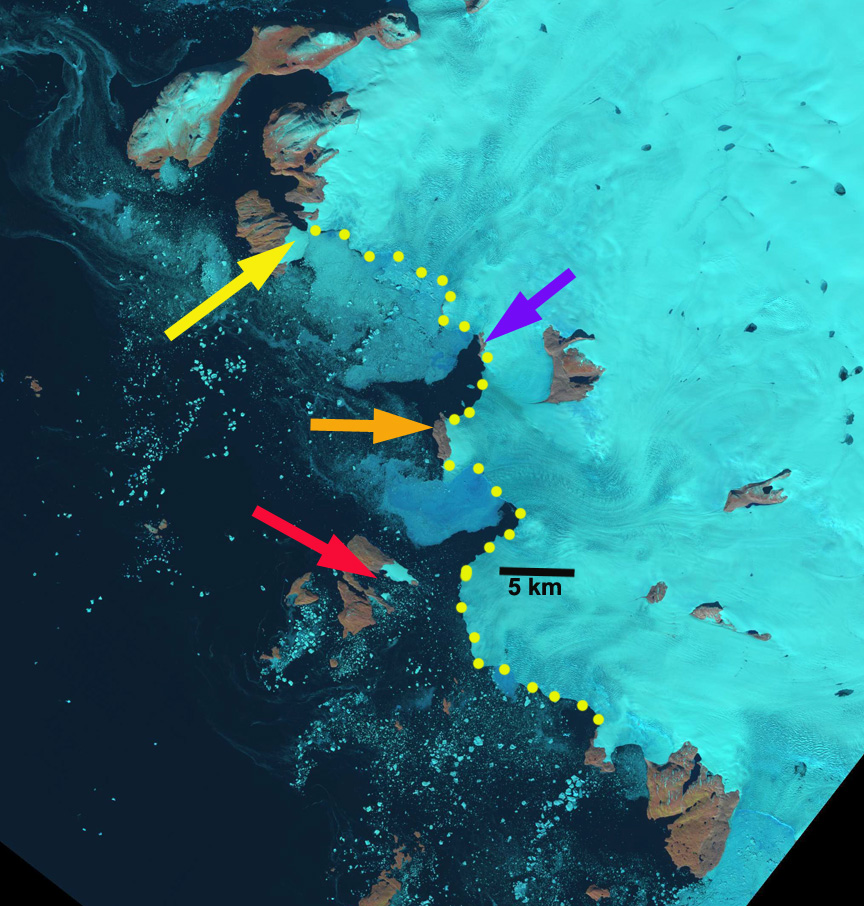
Steenstrup Glacier is located at 75.2 N in Northwest Greeland. The glacier terminates on a series of headlands and islands, the glacier immediatley to the south is Kjer Glacier. The boundary between Steenstrup Gletscher and Kjer Glacier is Red Head, Steenstrup Glacier’s northern margin is at Cape Seddon. Here we examine changes in the terminus position of Steenstrup and Kjer Glacier from 1999 to 2013. The retreat of the glacier during this interval has led to generation of new islands. Steenstrup Glacier has retreated 10 km over the past 60 years (Van As, 2010). Kjer Glacier was noted as relatively stable until loss of connection with Red Head Peninsula in 2005 (Van As, 2010).
steenstrup map
Image from Van As (2010).

McFadden et al (2011) noted several glaciers in Northwest Greenland Sverdrups, Steenstrup (75°16’15.37”N), Upernavik, and Umiamako that had similar thinning patterns. Each experienced rapid thinning of up to ~100 m a-1 since 2000. They further noted that thinning was not synchronous with Steenstrup and Sverdrups thinning fast from 2002 to 2005, Upernavik from 2005 to 2006, and Umiamako from 2007 to 2008. This is not exactly synchronous, but occurring within a few years is essentially synchronous in terms of glacier dynamics. Each glacier also had a coincident speed-up with a 20% acceleration for Steenstrup Glacier (McFadden et al, 2011). This is a familiar pattern with thinning there is less friction at the calving front from the fjord walls and the fjord base, leading to greater flow. The enhanced flow leads to retreat and further thinning, resulting in the thinning and the acceleration spreading inland. The initial thinning comes from a combination of basal and surface melt.

Here we examine Landsat images from 1999, 2001 and 2013 to identify changes. The red arrow indicates Red Head, which the glacier still reaches in 1999, though the connection is less than 2 km wide. The purple arrow indicates a small nunatak where the Automatic Weather Station utilized by Van As (2010) is located. The nunatak is 1.5 km from the ice edge in 1999. The orange arrow is an island at the ice front, South of the island the ice front is even with the island in 1999. The yellow arrow notes the connection of Steenstrup Glacier to Cape Seddon that is about 4 km wide. In 2001 there is little change in the ice front except at the purple arrow, where retreat has almost brought the nunatak to the terminus. By 2013 the connection to Red Head has been lost, it is now an island, this occurred as noted by Van As (2010) in 2005. Retreat from Red Head is 6 km. There is a substantial embayment south of the island at the orange arrow, indicating 4 km of retreat. North of this island that will soon lose it connection to the ice sheet, the embayment has expanded as well. At the purple arrow the ice front has reached the former nunatak now becoming an island. At the yellow arrow the loss in ice area at Cape Sneddon is greater than at Red head, though a connection may still exist, it is too narrow to measure. The last image below is a 2012 Google Earth image indicating the narrow connection to Cape Sneddon at that time and the strange relict crevasse pattern. It is clear that the end of Cape Sneddon will be in island next summer if not already, the MODIS imagery is not clear enough to distinguish this. The connection to the island at the south end of Kjer Glacier, last yellow dot near bottom has become much narrower since 1999 and will follow the route of Red Head and Cape Sneddon. The retreat here is coincident with the thinning and acceleration and follows the pattern of retreat and new island generation seen at Kong Oscar Glacier, Alison Glacier and Upernavik Glacier.

steenstrup 1999
1999 Landsat Image

steenstrup 2001
2001 Landsat image

Steenstrup 2013
2013 Landsat image
cape sneddon crevasses
Google Earth 2012 image Cape Sneddon.