North Cascade Glacier Accumulation Season Ends

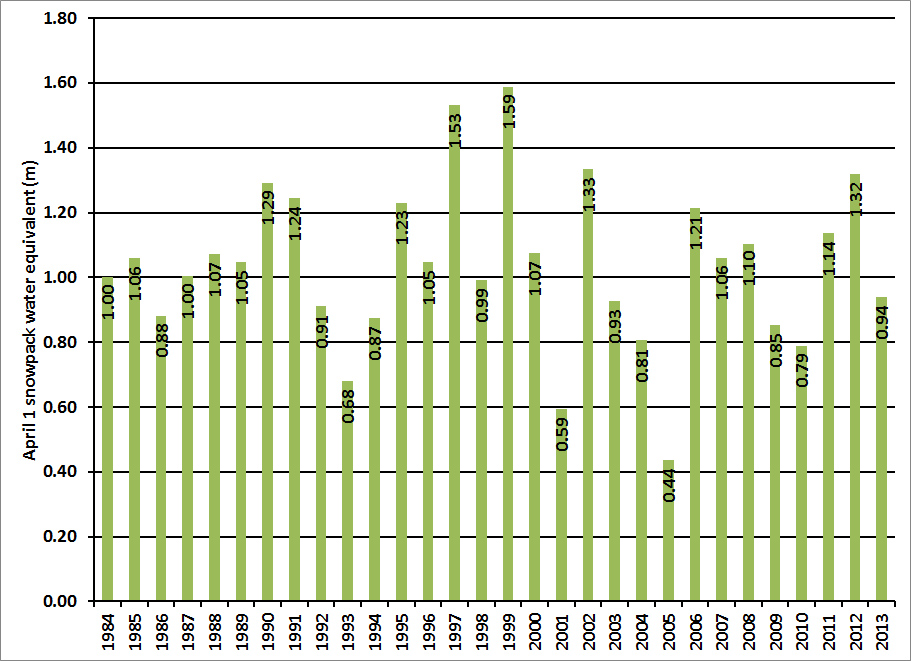
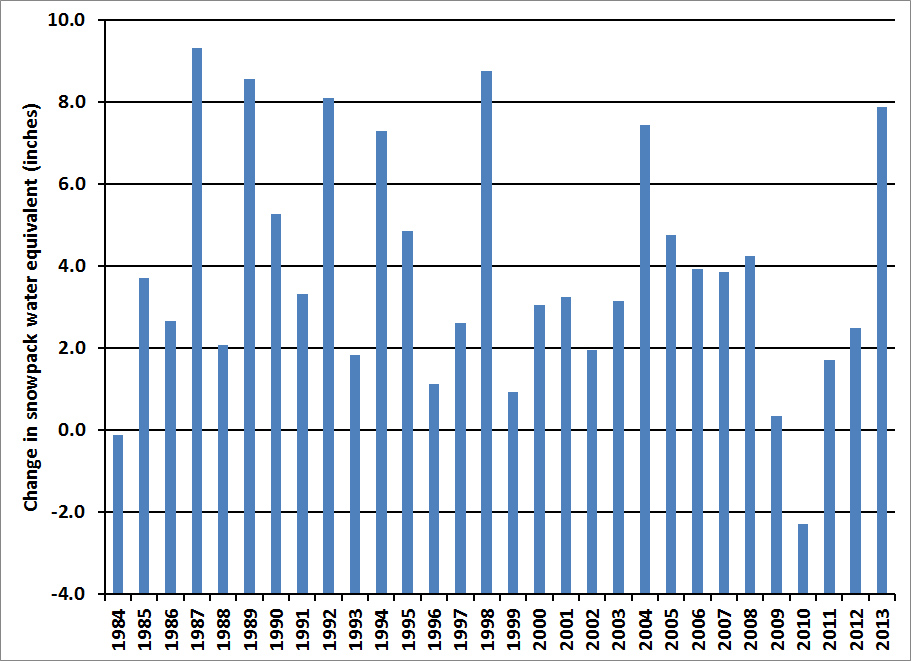
The typical maximum snowpack accumulation on North Cascade glaciers occurs on May 10. Because the network of USDA Snotel stations are at lower elevations, the best measure of winter accumulation from these valuable long term stations is on April 1. The first image below is the mean April 1 SWE from seven long term stations in the North Cascades. In 2013 April 1 SWE is 10% below the 1984-2012 mean. For the glaciers additional snowpack occurred in April 2013, but about average for April. The accumulation season ended on April 29 and 30th with a final snowfall. From May 3-10 temperatures reached at least 11 C everyday at Lyman Lake which is the station closest to a glacier, just 2 km away. This led to the most rapid start of the melt season since 1998, with 20% of the snowpack at the Snotel stations lost.april 1 swe
April 1 Snowpack Water Equivalent at seven North Cascade USDA Snotel stations (Fish Lake, Harts Pass, Lyman Lake, Park Creek Ridge, Rainy Pass, Stampede Pass, Stevens Pass)
early may ablation
May 1-10 Snowpack Water Equivalent at seven North Cascade USDA Snotel stations from May 1 to May 10.

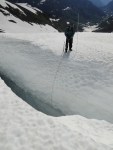
As the melt season begins the snow lays deeply on Easton Glacier, 15-20 feet deep. When we are making measurements late in the summer how deep will the snow be? We will back in the field for the 30th consecutive summer this year measuring the mass balance of North Cascade glacier, the early indications are that the mass balance will be negative.

From 1984 to 2010 glaciers in western North America mass balance losses have been extensive. The video below indicates the similarity in the cumulative mass balance and trends on a series of glaciers from Alaska, Washington and British Columbia. In each graph the red line is the mean for all glaciers and the blue line the cumulative annual mass balance of the individual glaciers.

Puisortoq North Glacier Retreat Southeast Greenland

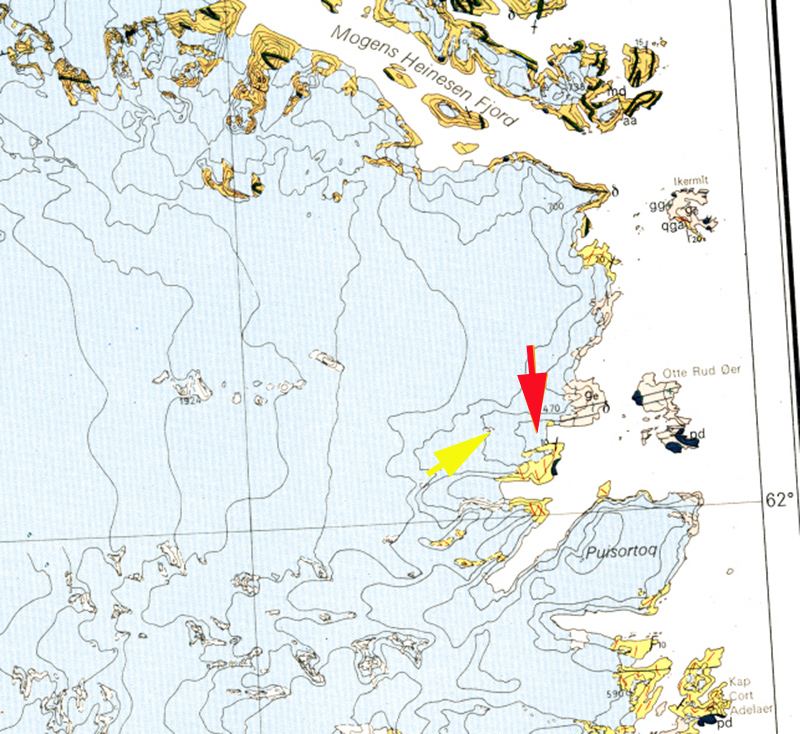
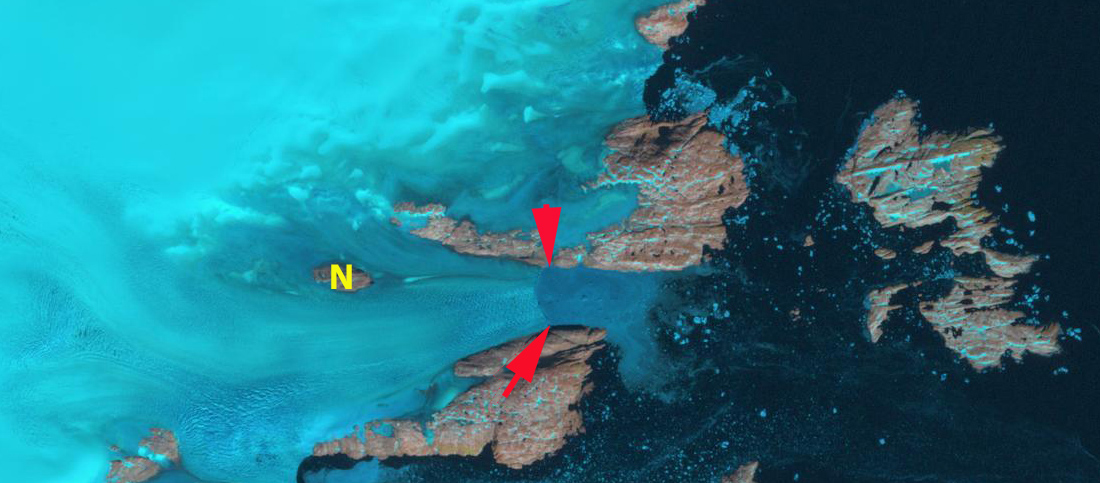
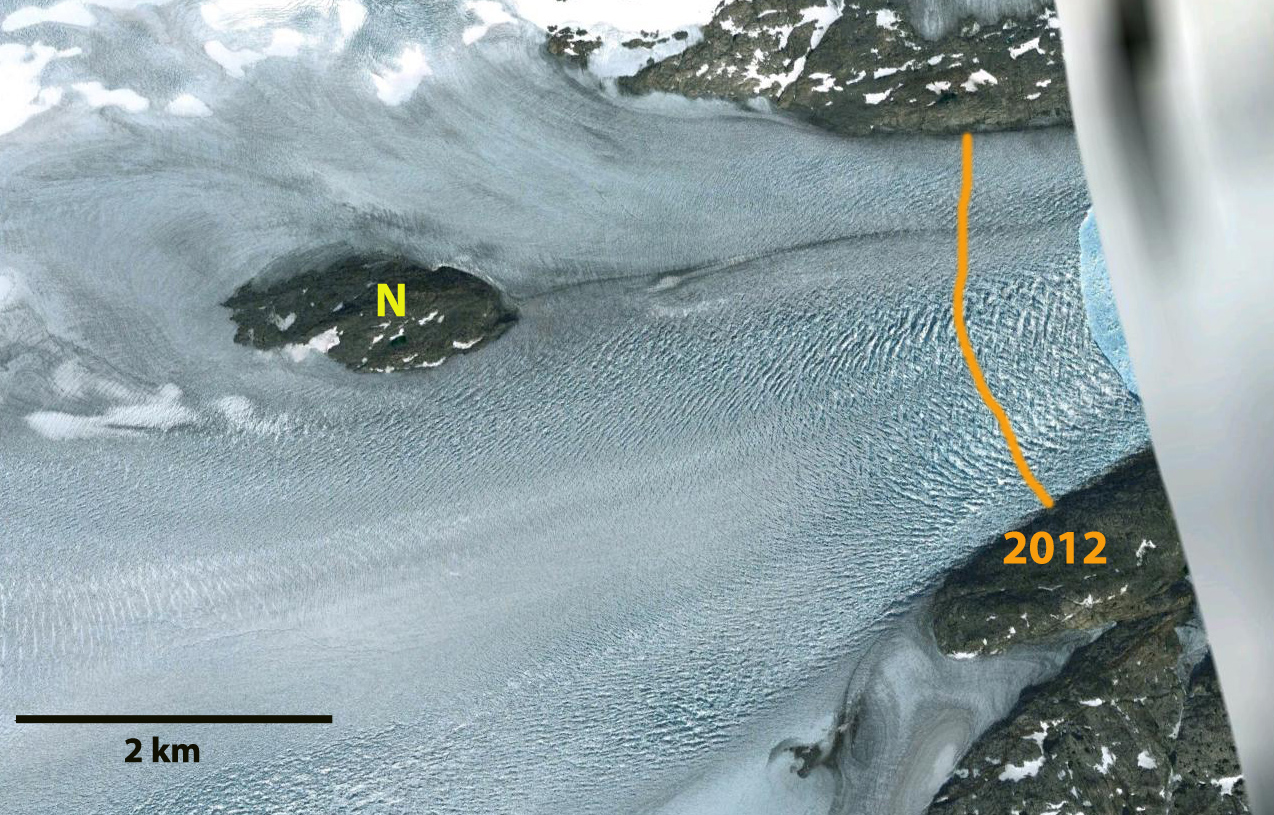
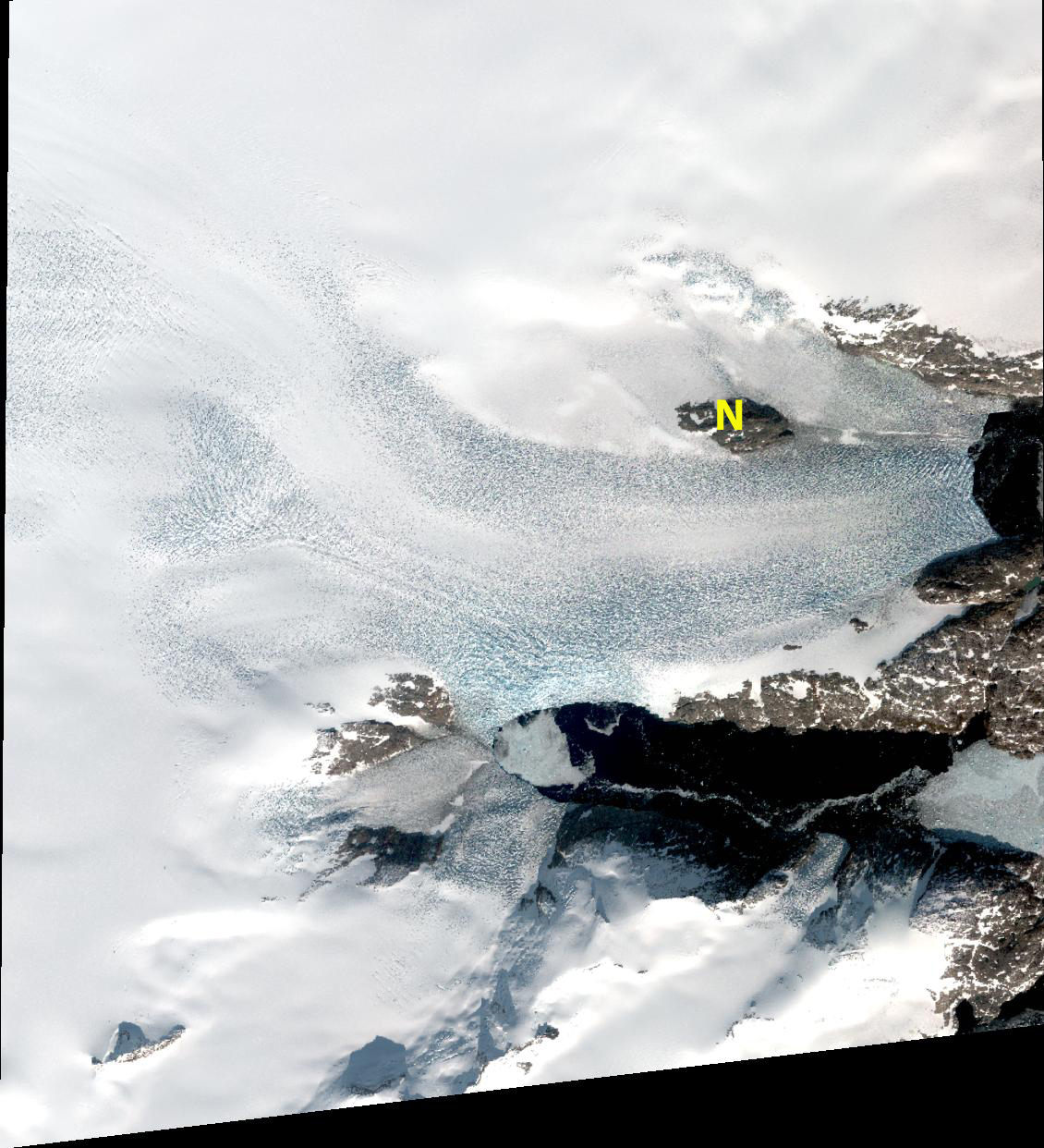
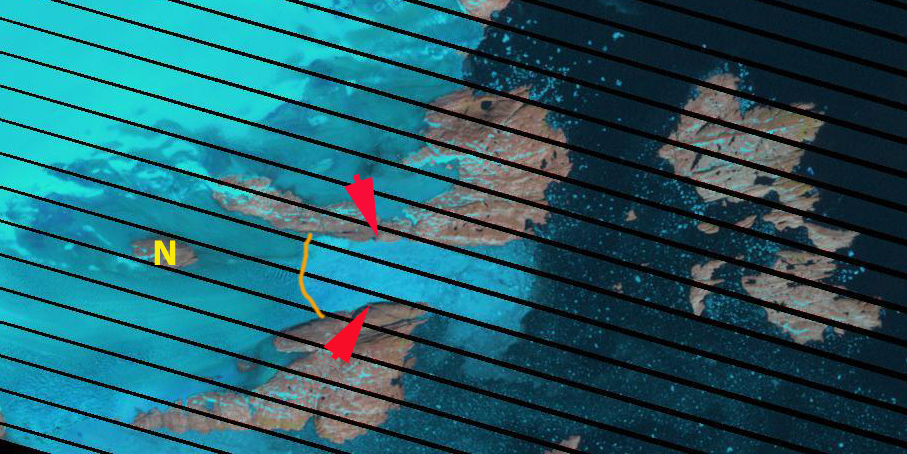
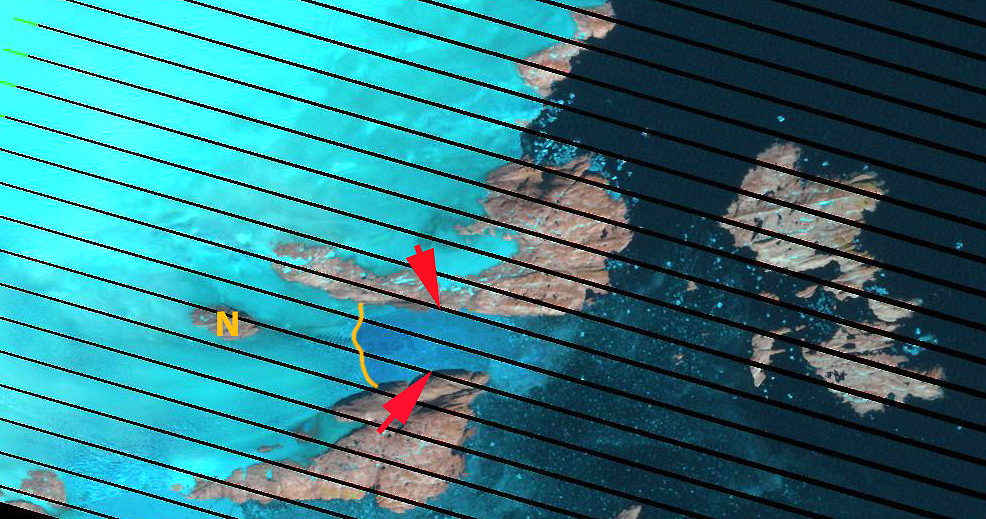
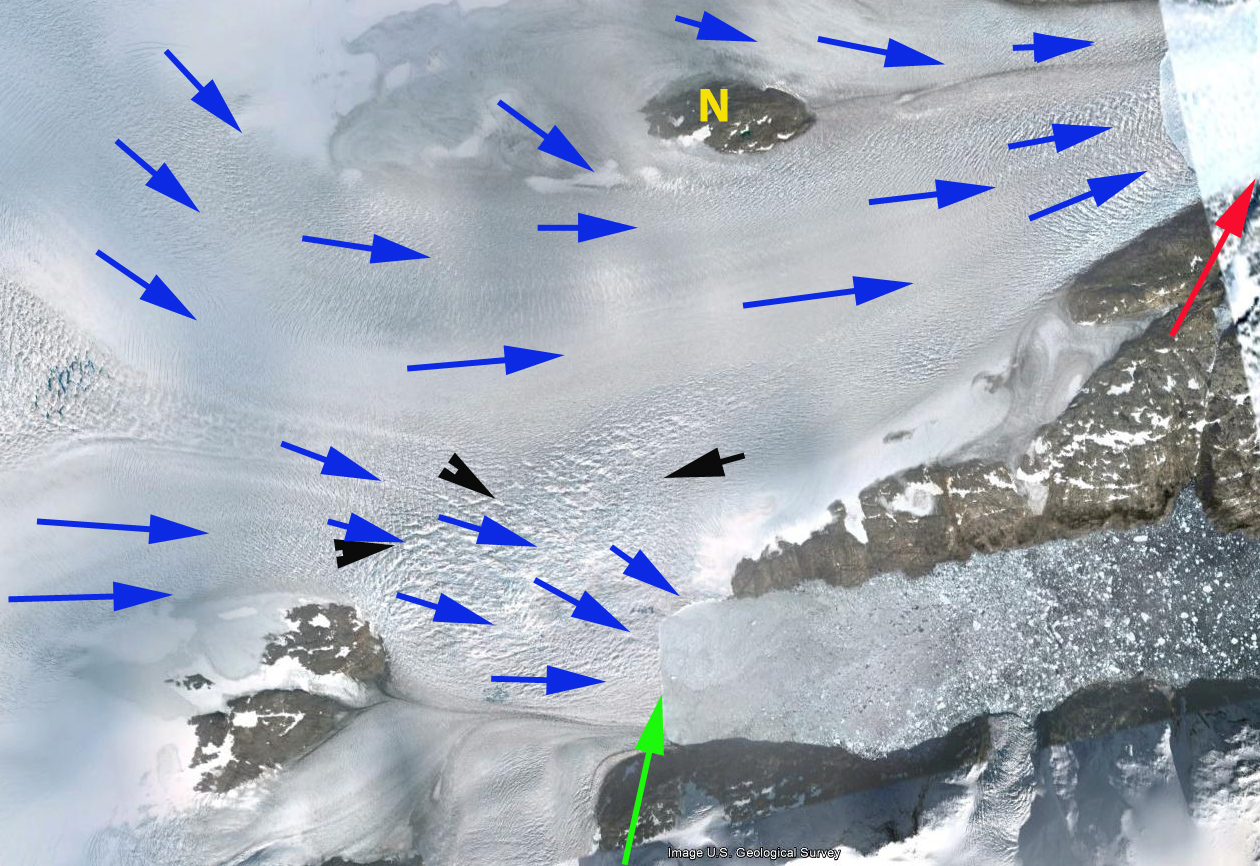
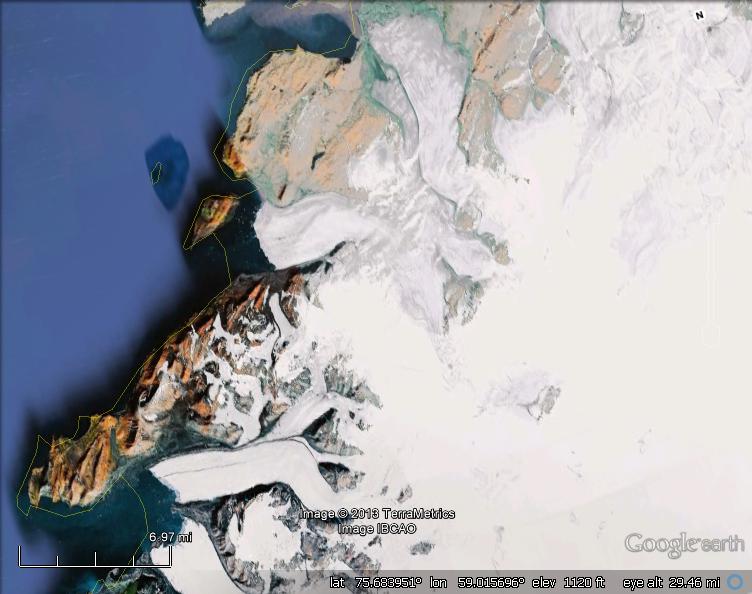
Puisortoq North Glacier southeast Greenland has experienced an increased rate of retreat since 2000. The retreat is expanding a fjord that begins just north of the Puisortoq Peninsula and west of the Otte Rud Island. egreenland62n In the assessment of Greenland glacier terminus change by the Glacier Dynamics Group, at Ohio State University Howat and Eddy (2011) observed the glacier retreat as 20 m in the 1990’s and 2 kilometers from 2000-2010. Of the 90 glaciers in southeast Greenland examined, 90% retreated, with an average rate of 107 meters per year from 2000 to 2010.

In this post we examine imagery from 1999, 2000, 2004, 2009, 2010 and 2012 to portray the terminus change. The red arrow in each image indicates the 1999 and 2000 terminus position, which coincides with a prominent feature on both the north and south side of the fjord. The Yellow N denotes a nunatak. In the 1999 and 2000 Landsat imagery the nunatak is 5.2 kilometers from the ice front, at the calving front the fjord is 2.1 kilometers wide. By 2004 in a Google Earth image the glacier nunatak is 4.0 kilometers from the ice front and the fjord at the calving front is 2.4 kilometers wide. This is a 1.2 kilometer retreat in four years. By 2009 in a Geoeye image, the nunatak is 3.5 kilometers from the ice front. By 2012 the ice front is 3.2 kilometers from the ice front. The retreat from 2000 to 2012 is 2 kilometers, just as Howat and Eddy (2011) noted. The fjord at the calving front is now 2.7 kilometer wide and will expand to 3.1 kilometers wide as the glacier retreats another 700 meters. The increasing width of the calving front, will increase the calving rate encouraging continued rapid retreat at least until the nunatak is reached after a further 3 kilometers of retreat. The complicating feature in this case is a separate terminus on the south side of the glacier, green arrow, that seems to be capturing part of the flow of the Puisortoq North Glacier and could well merge with the northern terminus, red arrow, after a 4 to 5 km retreat. In the last image the blue arrows indicate flow paths, and the black arrows a chaotic region of crevassing, where the stresses are pulling the ice in different directions. This glaciers behavior is similar to that of Thyrm Glacier and Apuserajik Glacierotterud1999

otterud 2000

otterud 2004

otte rud 2009

otterud2010

otterud2012 puisotorq

Sulztalferner Retreat, Stubaier Alps, Austria

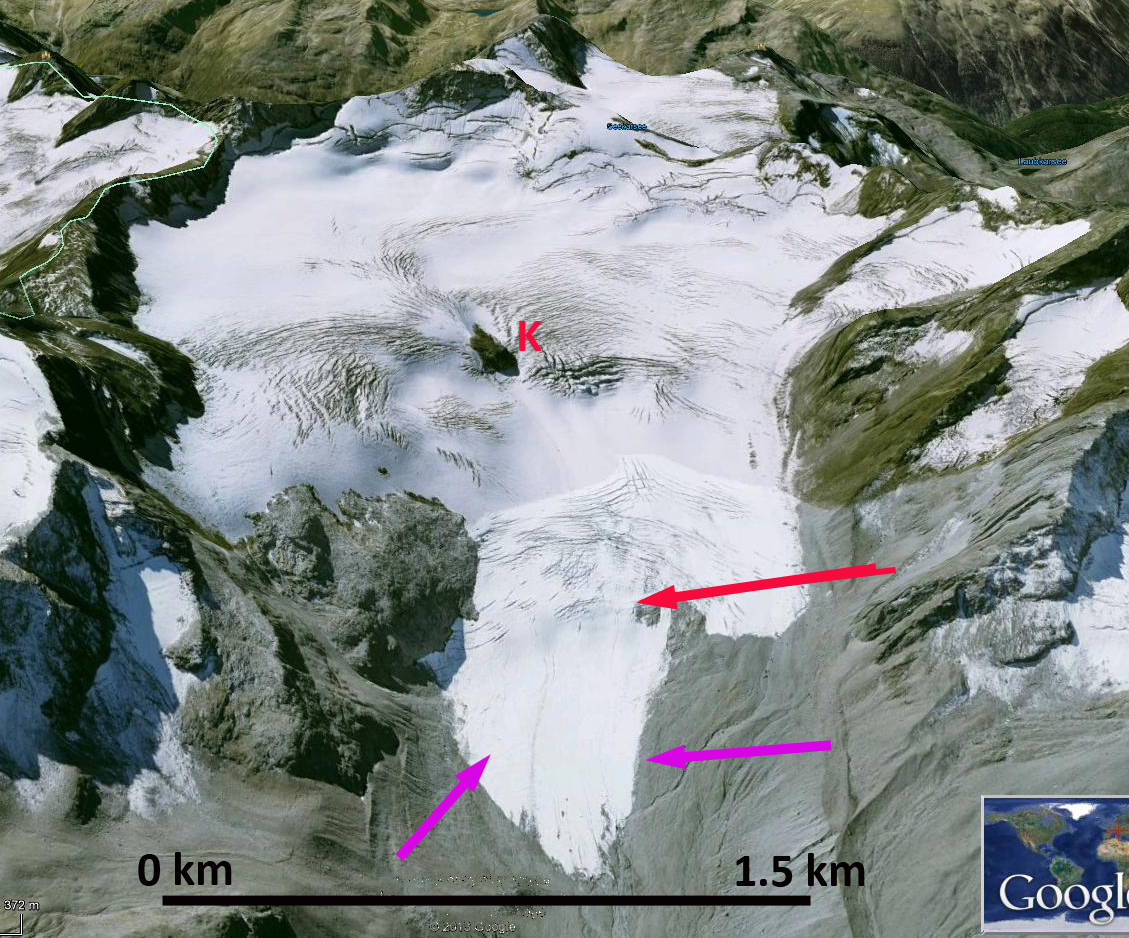
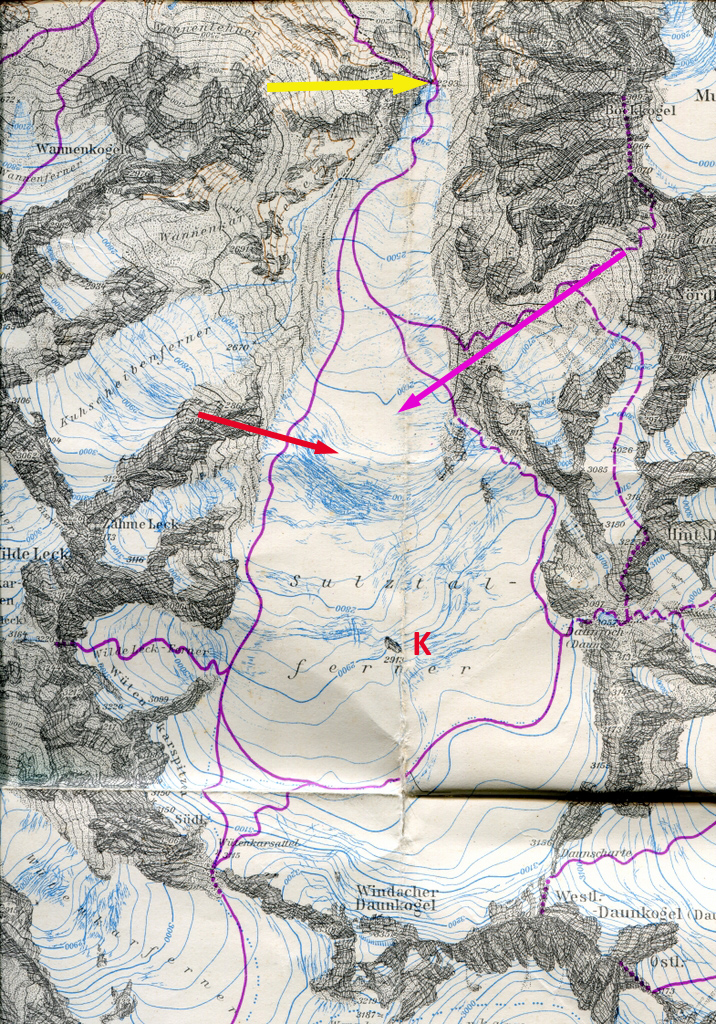
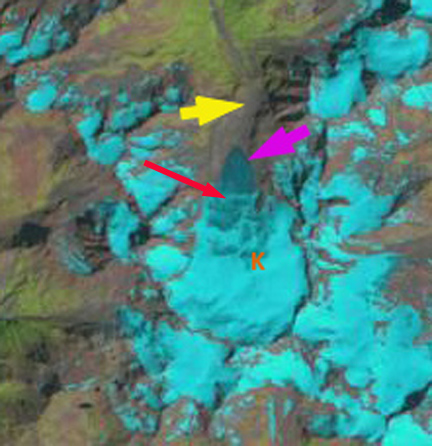
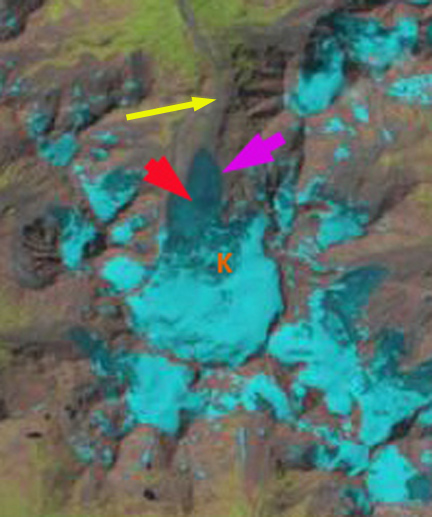
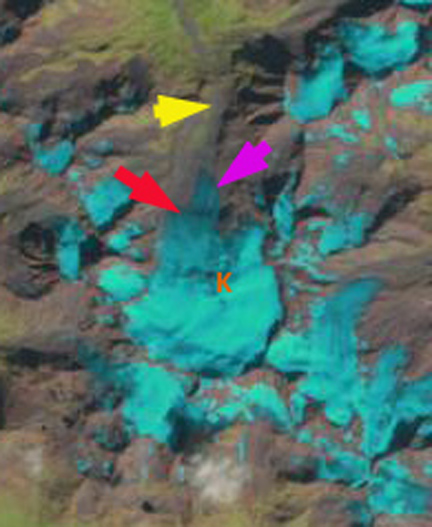
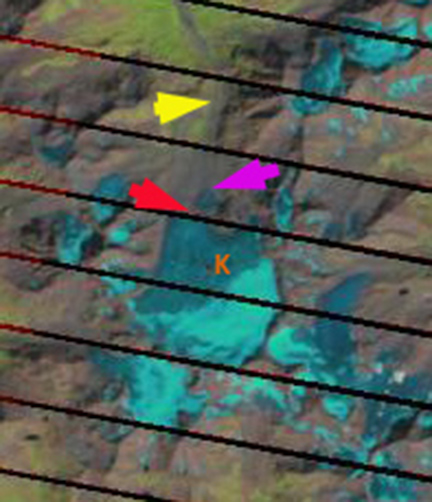
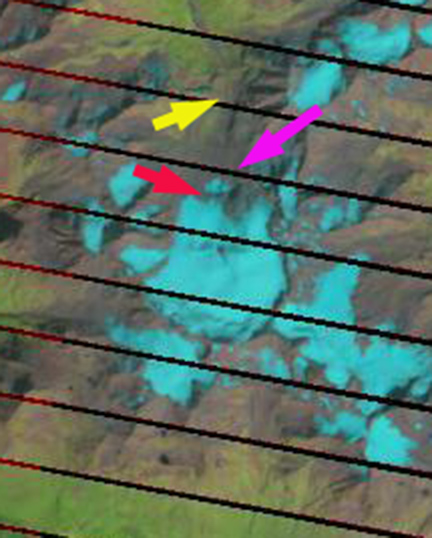
Sulztalferner is a glacier in the Subaier Alps of Austsria. The glacier begins at 3200 m below peak and descends north from the peak of Daunkogel. Below is the glacier in a 2000 Google Earth image. In each of the images the purple arrow indicates a comparatively level area of the glacier below an icefall at 2700 meters. The red arrow indicates this icefall, the yellow arrow indicates the 1937 terminus, and K indicates a bedrock knob.sulztalferner Schlicker (2006) identified that between 1969 and 2003, 14 of the 88 glaciers in this range disappeared. The area of the glaciers waas to 54.1 km2 in 1969, increased slightly to 54.4 km2 in 1985, decreased to 47.2 km2 in 1997 and the a rpaid decline to 36.9 km2 in 2003. The retreat between 1969 and 2003 was 32% of the 1969 area. Schlicker (2006) observed that the area of Sulztal Ferner, one of the largest glaciers in the region, decreased from 4.16 km2 in 1969 to 3.51 km2 in 2003. This fits the pattern of all Austrian glaciers ( Lambrecht and Kuhn (2007) and Abbermann et al (2009) and the nearby Stubai Glacier. Here we examine the changes in Sulztalferner from 1937 to 2011. Nicholas Fisher, provided a 1937 map of the glacier indicating the extent of the glacier, that was 3.5 km long and ended at 2350 m. By 1985 the glacier had retreated 700 m.
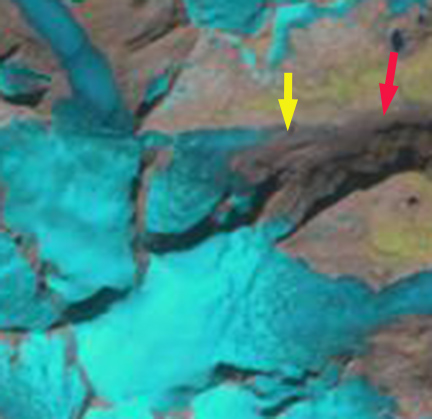
sulztal 1937 The glacier retreat was slow but steady from 1985-2000 totaling 100 m. From 2000 to 2010 the World Glacier Monitoring Service reports the retreat at 326 m, or 33 m per year. The annual fluctuations are measured by the Austrian Alpine Club’s glacier terminus survey, which fourn a retreat of 27 m in 2012. The most notable change from 2000 to 2011 is the near total loss of the glacier tongue beneath the 2700 m icefall. Further there is a separation between the glacier above the icefall and this shrinking detached terminus tongue in 2010. The terminus tongue in 2000 below the icefall had a length of 540 m. This is now separate from the main glacier and will quickly melt completely away.
sulztal 1985

sulztal 1990

sulztal 2000

sulztal 2010

sulztal 2011
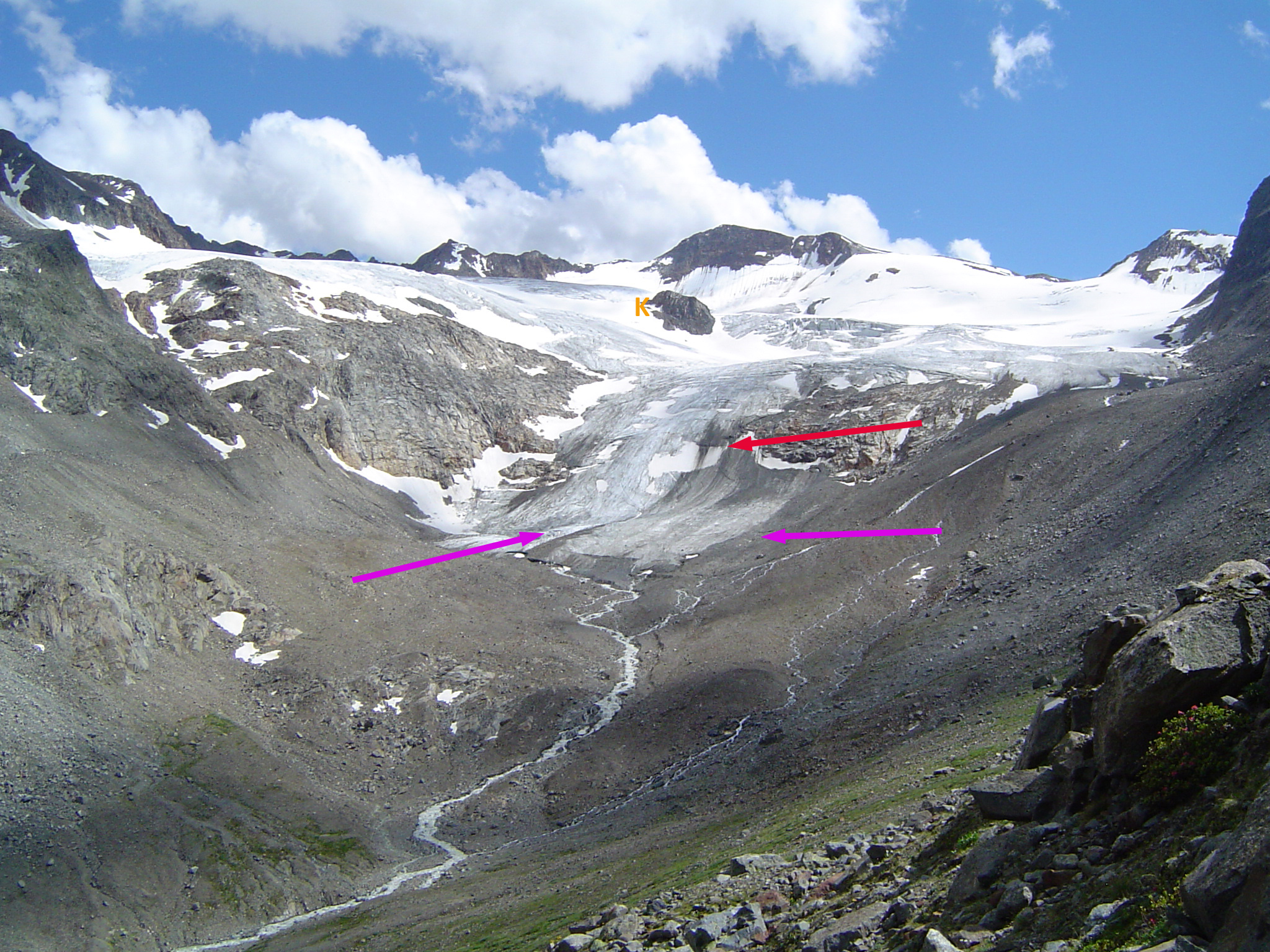
The thin nature of the ice flowing down the lower icefall at 2700 m is evident in a picture of the glacier from Steffen. The red arrow indicates the point at which the glacier separates in 2010.
sulztal 2008

Hidden Creek Glacier Thinning, North Cascades, Washington

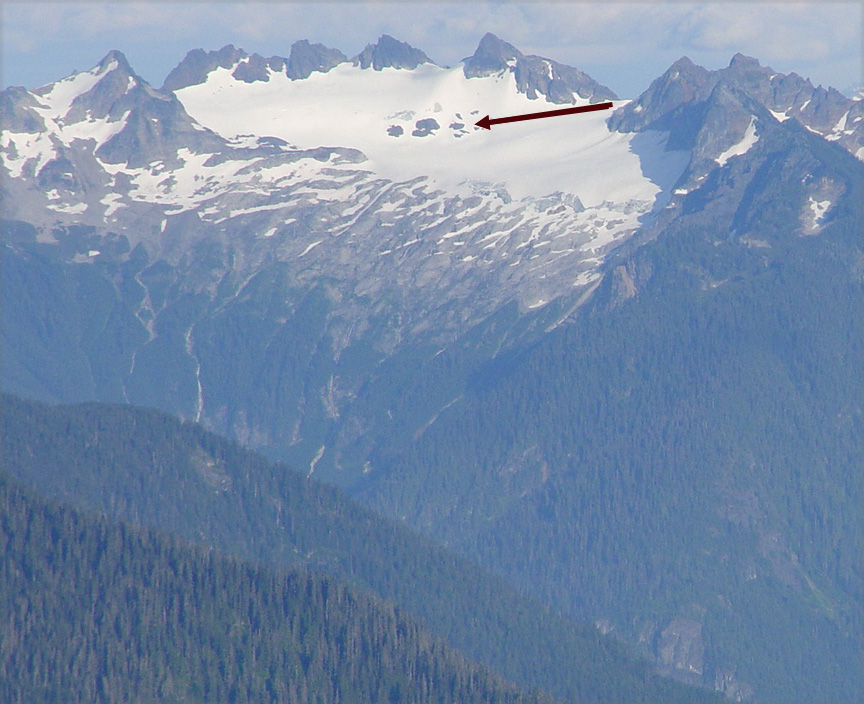
Hidden Creek Glacier is northeast of Baker Lake on the west slope of Mount Hagan in the North Cascades of Washington. We began measuring the retreat of this glacier in 1985, with periodic visits since. hidden creek bakerlake Pelto and Hedlund (2001) examined the terminus response time of 38 North Cascade glaciers, where we could determine the terminus history for the 1890-1998 period. The glaciers exhibit three distinct patterns (Table 3): 1) Retreat from 1890 to 1950 then a period of advance from 1950-1976, followed by retreat since 1976. 2) Rapid retreat from 1890 to approximately 1950, slow retreat or equilibrium from 1950-1976 and moderate to rapid retreat since 1976. 3) Continuous retreat from the 1890 to the present. Hidden Creek is a type 2 glacier.

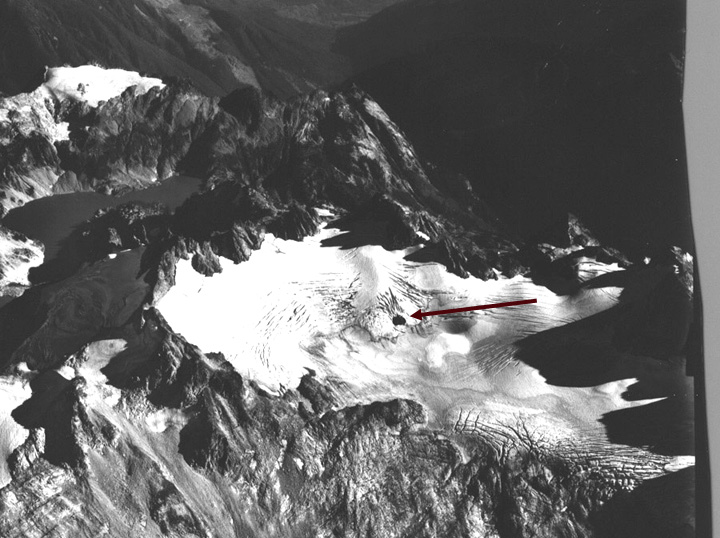
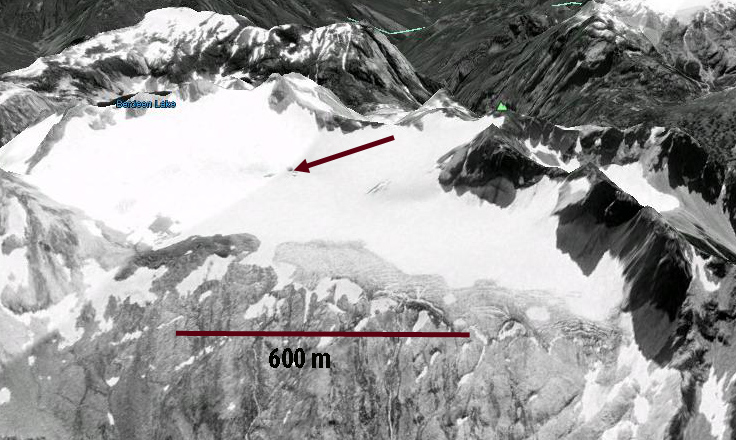
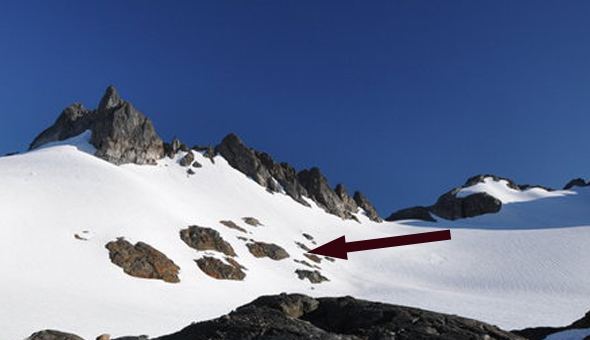
Here we examine photographs of the glacier to identify changes from 1979 to 2010. The burgundy arrow indicates the rock outcrop between the upper northern part of the glacier and the lower southern part of the glacier. In 1979 there is one small outcrop of rock between the upper and lower part of the glacier, the glacier has numerous extensively crevassed regions. From 1985-1990’s this one outcrop remained visible but did not notably change, as seen in the 1998 and 1999 image below. By 2006 and 2007 a network of outcrops had emerged, as the upper glacier became increasingly separated from the lower and southern section of the glacier. By 2009 the outcrops had merged into two large outcrops 270 m across, the main terminus had retreated only 50 m from 1979 to 2011, but the thinning of the glacier indicates much more significant changes to come. The thinning of the upper glacier indicates a glacier that cannot survive current climate, though it is not disappearing rapidly (Pelto, 2010). In 2010 the early August image indicates the extent of the rock outcrops that have still not melted out from the previous winter snows. We will be interested to see the glacier again this summer when we head to the field. This glaciers response is similar to Quien Sabe Glacier and Daniels Glacier.

hidden creek79
1979 Photograph from Austin Post (USGS)

hidden creek 1998
1998 Google Earth image

hidden creek glacier 1999
1999 image taken from Ptarmigan Ridge

hidden creek 2006
2006 Google Earth image

hidden creek 2007
2007 image taken from Ptarmigan Ridge

hidden creek 2009
2009 Google Earth image

hidden creek 2010
2010 Hidden Creek Glacier from right below the glacier

Viltragenkees Glacier Retreat, Austria

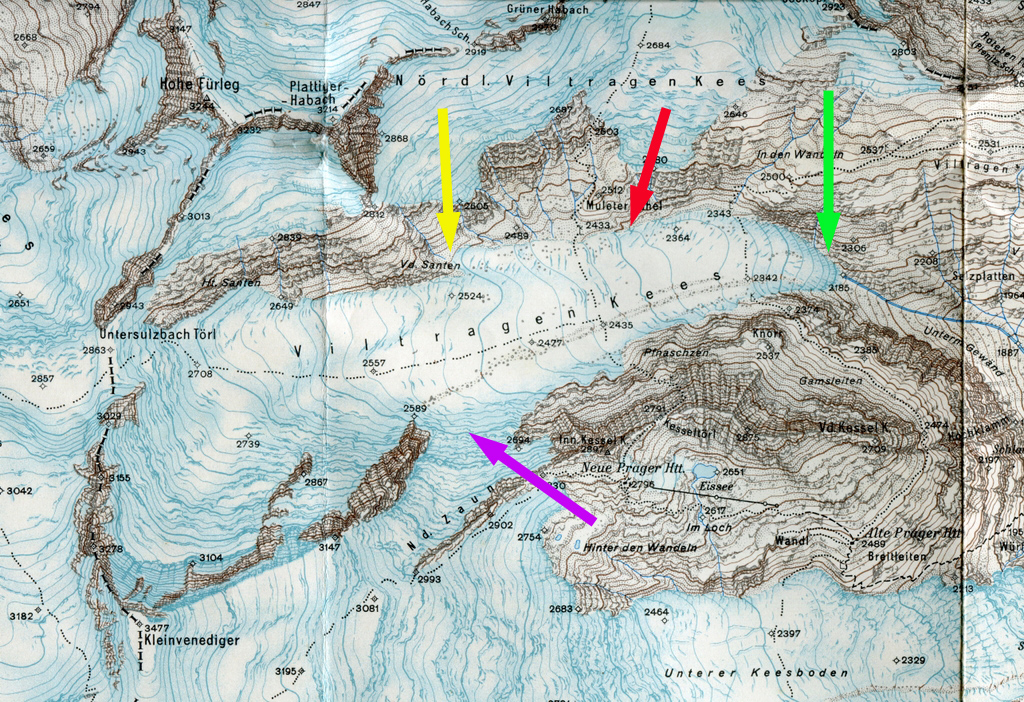
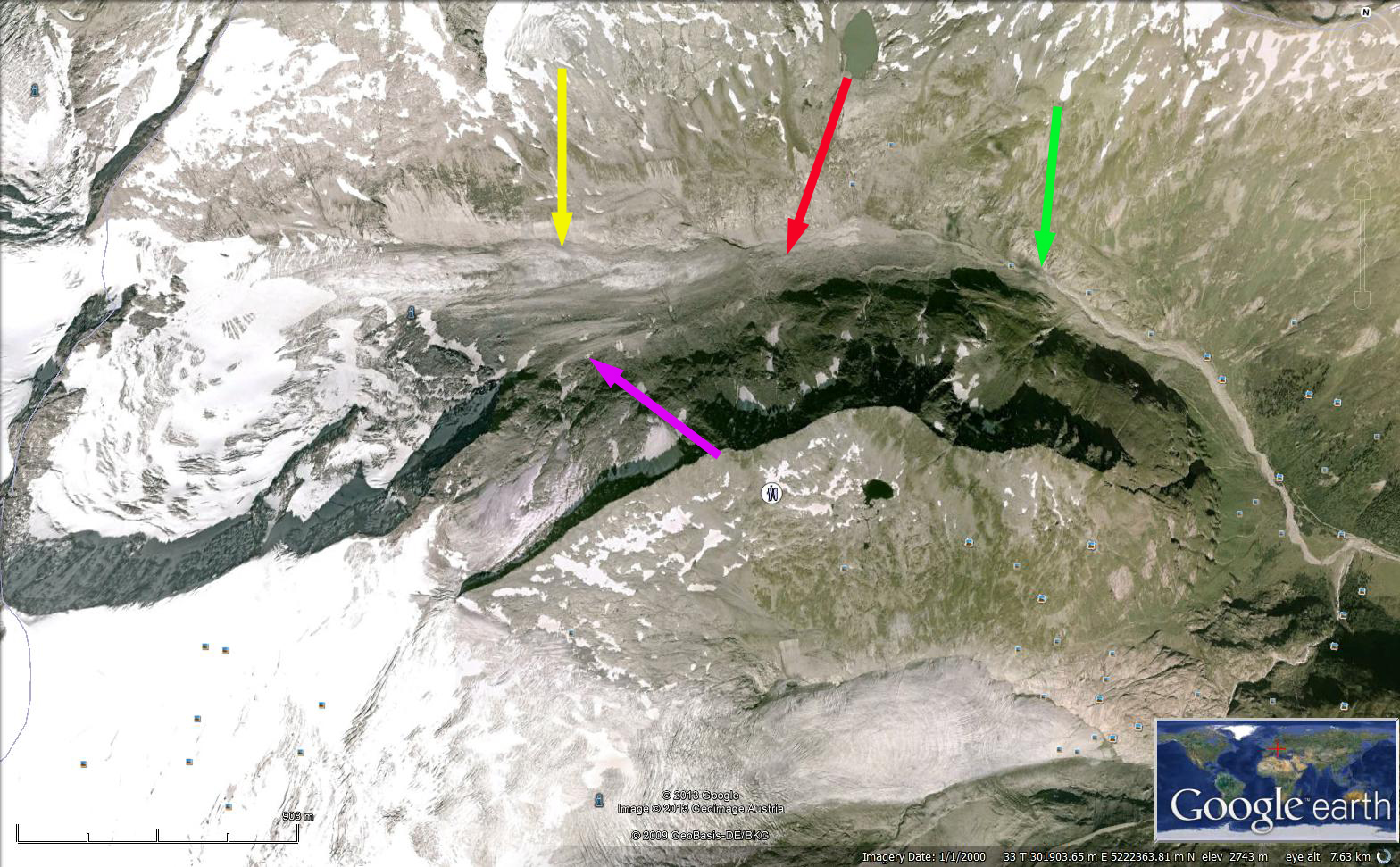
The Austrian Alpine Club published the results of its annual terminus survey program on April 13, 2013. Out of the 95 glaciers measured, 93 retreated an average 17 meters in 2012, two were unchanged. Here we examine one of the those glaciers Viltragenkees. This glacier flows east from the Grosvenediger Massif into the Drau River. In 1988 the glacier was 3 km long beginning at 3200 m and ended at 2340 m. Lambrecht and Kuhn (2007) noted that Austiran glaciers lost 17% of their area from 1969-1998. Abbermann et al (2009) noted that this rate of retreat continued up to 2006 with a further 8% loss. Viltragenkees has been noted by the World Glacier Monitoring Service as having retreated 92 m from 2001-2005 and 157 m from 2006-2010. Here we examine Landsat and Google earth imagery from 1988, 1998, 2000, 2011 and 2012 to illustrate the retreat and then compare a 1929 map to the 2000 terminus position. The red arrow indicates the 1988 terminus the yellow arrow the 2012 terminus on each image. The retreat from 1988-1998 is minor. By 2000 in the Google Earth image the retreat is still minor from 1988, but the terminus section has thinned and is stagnant (see last image in post). In 2011 there is a small segment of residual ice between the 1988 and 2012 terminus position, the glacier has retreated most of the way to the 2012 position otherwise. In 2012 the relict ice is gone and the glacier has completed a 400 m retreat since 1988. However, 90% of the retreat occurred since 2000, indicating a rate of 35-40 m per year. In fact from 2006-2012 the glacier retreated 35-50 m in five of the seven years.
viltragen 1988

viltragen 1998

viltragen ge

viltragen 2011

viltragen 2012

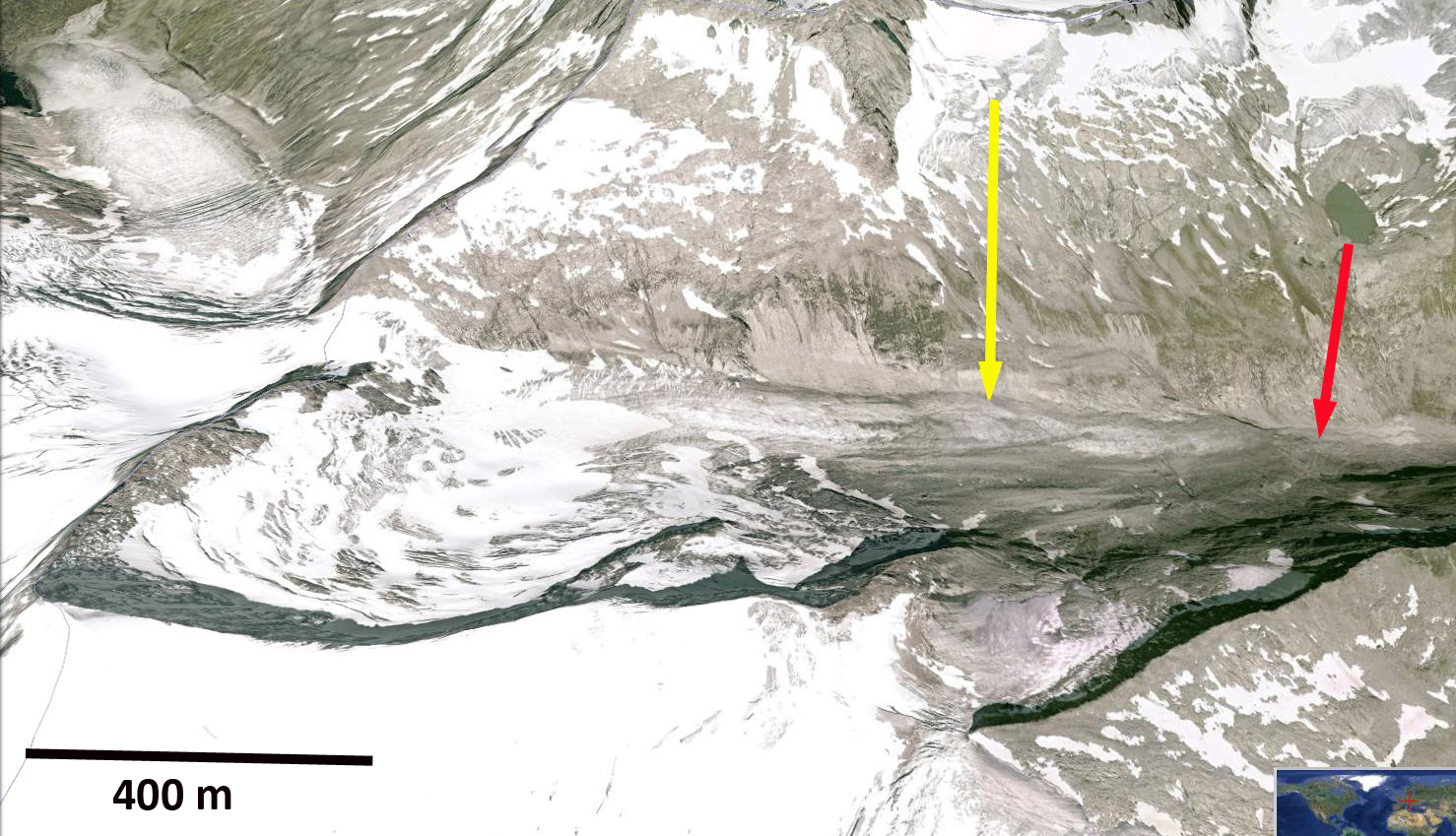
The Austrian Alpine Club noted a retreat of 47 m for Viltargenkees in 2012. Viltragen Glacier is 10 km east of Obersulzbach Glacier that has had a similar retreat. The terminus area in 2000 is quite stagnant, a deeply incised suprglacial stream indicates this fact, blue arrow. The orange arrow indicates a region with a couple of melt ponds, again indicating stagnation. The debris covered terminus has no crevassing in 2000 in the lowest 400 meters again indicating the thin and hence stagnant nature of the lower section of the glacier that was at that point preconditioned for rapid retreat. Below the 2000 terminus image is the full glacier in 2000 compared to the 1929 map of the region provided by Nicholas Fisher. The green arrow indicates the 1929 terminus and the purple arrows where the Schlaten Kees formerly joined Viltragenkees. The retreat over the 70 year period was 700 meters.

viltragen terminusvitragen 1929

vitragen 2000

Nevado Cololo Glacier Retreat, Bolivia

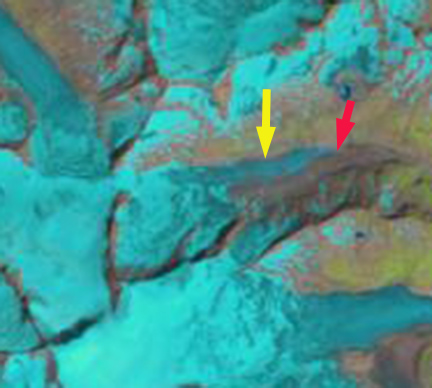
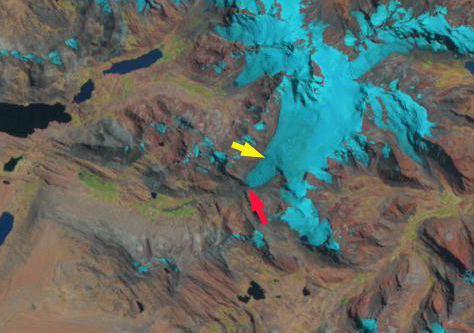
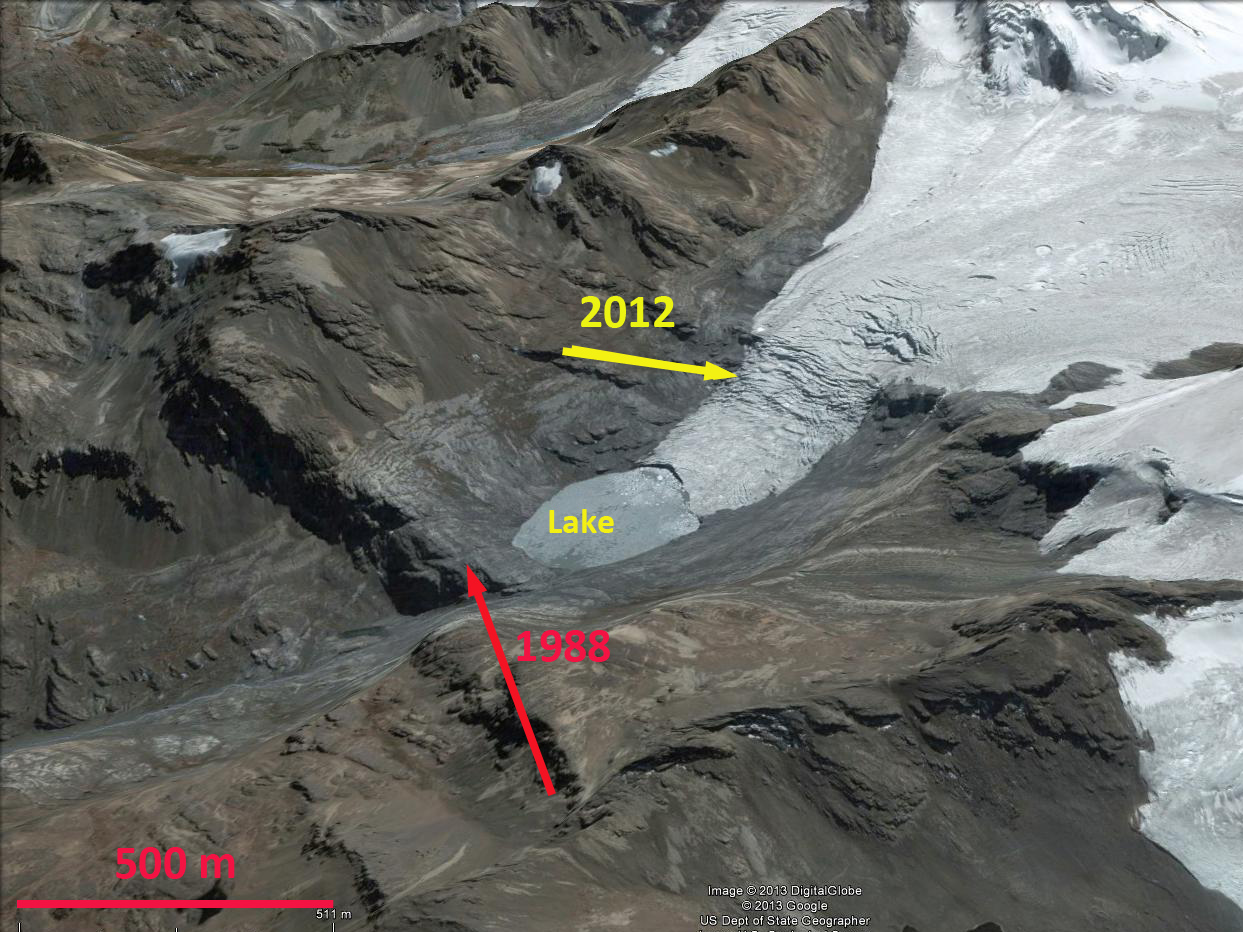
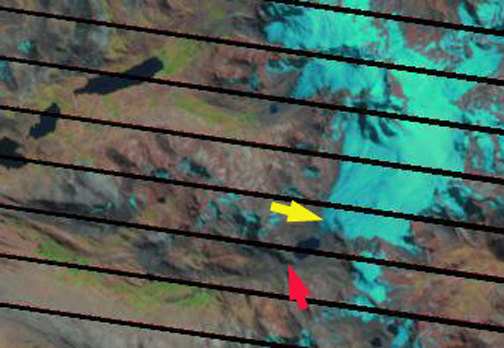
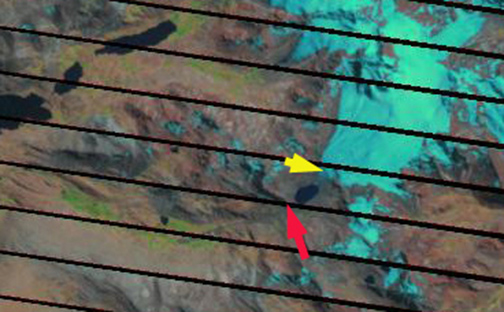
Nevado Cololo is a glaciated mountain area in the Cordillera Apolobamba of northwest Bolivia. Here the focus is on a glacier draining west from the Nevado Cololo into the Rio Suches and then Lake Titicaca. The glaciers of the Apolobamba have lost 48% of their area from 1975-2006 (Hoffmann, 2012). Hoffmann and Weggenmann (2012) have observed both the extensive retreat, new lake formation, and the problem of glacier lake outbursts in this region, which is part of the Apolobamba Integrated Natural Management Area. The glacier that is our focus has developed a new lake at its terminus since 1988, the glacier begins at 5700 m and ends at 4930 m. cololo 2005. The red arrow in each image indicates the 1988 terminus position which was at the top of a bedrock cliff evident in all images. The yellow arrow is the 2012 terminus position at the base of a second cliff. By 2005 the glacier had pulled back from the cliff exposing a new lake that is 400 meters across. The glacier still ends in the lake. By 2012 last two images, the glacier has retreated several hundred meters from the shore of the lake and ends at the base of a cliff at 5000 m. The glacier should rapidly retreat to the top of this cliff. The retreat from 1988-2005 was 540 m, the retreat from 2005-2012 has been 280 m. The total retreat over 25 years is 820 m or 33 meters per year.

cololo 1988

cololo terminus

cololo 2011

cololo 2012The retreat of this glacier fits the pattern of other Bolivian Glaciers, such as the Zongo Glacieror Laramcota Glacier and tropical Andean glaciers in general (Rabatel et al, 2013).

Laramcota Glacier Retreat, Bolivia

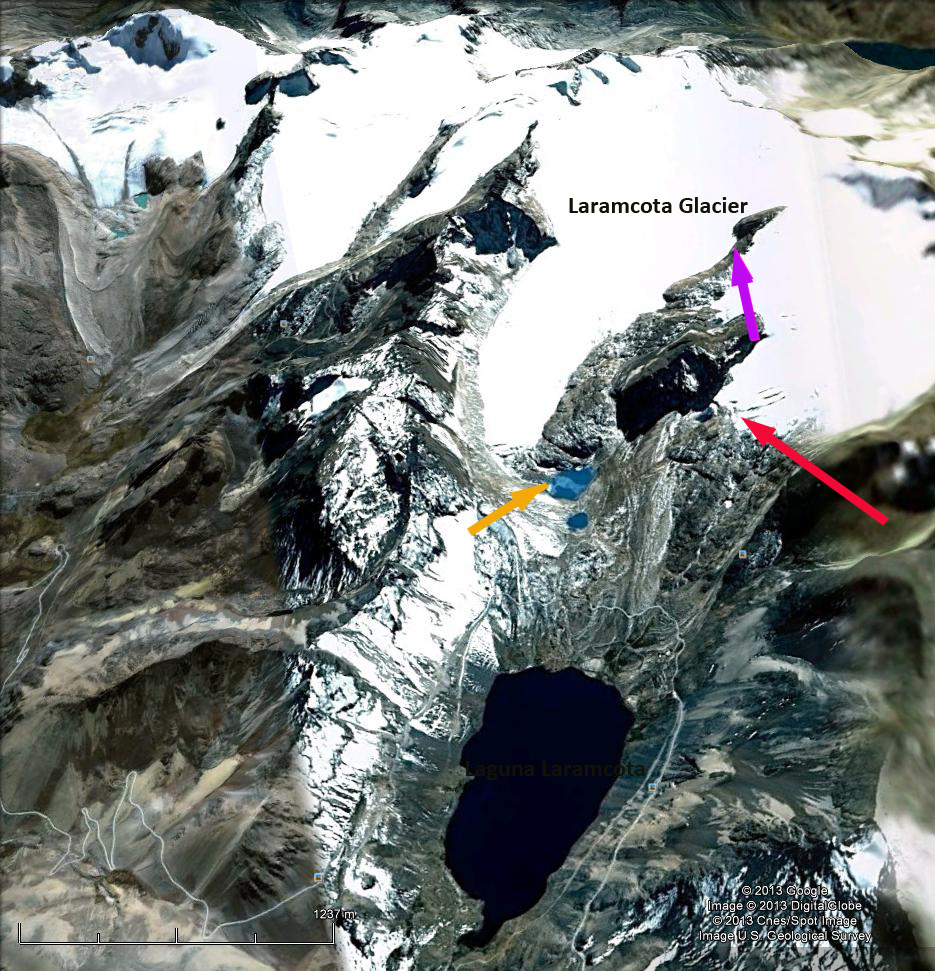
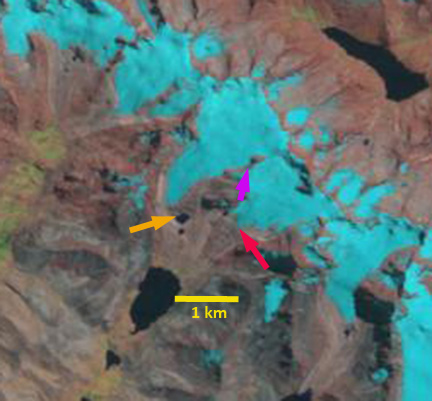
Laramcota Glacier is in the Cordillera Tres Cruces of Bolivia. The glacier feeds into Laguna Laramcota and eventually the Rio Boopi, Rio Beni and finally the Amazon River. The glaciers of Bolivia have received much less scrutiny than those in Peru or Chile, but are quite numerous. Riberio et al (2005) noted a 32% loss of glacier area inn the Tres Cruces from 1972-1999 using satellite imagery. Melocik (2010) in a preliminary report using remote sensing noted a 40% loss in Tres Cruces glacier area from 1985 to 2005. This is a quite a substantial loss, and is likely a maximum loss as some of the area lost at higher elevation could have been non-glaciated snow covered area. Here we examine the changes in Laramcota Glacier using Landsat imagery from 1988 and 2011. The 2.6 km long glacier flows west from 5600 meters to a terminus at 5000 meters.laramcota ge In 1988 the glacier ends at a small lake one kilometer upstream of Laguna Laramcota, orange arrow. The glacier just to the east ends just 600 meters from the Laramcota, red arrow. The ridge separating the two glaciers at the purple arrow is quite narrow. By 2011 the glacier has retreated 300 meters from the lake, orange arrow. The glacier just to the east has retreated 200-300 m as well. The ridge separating the glaciers has expanded considerably in width, purple arrow. The overall loss in glacier from 1988-2011 is 10-15%. The retreat of this glacier fits the pattern of other Bolivian Glaciers, such as the Zongo Glacier or Nevada Cololo and tropical Andean glaciers in general (Rabatel et al, 2013). lamarcota 1988 laramcota 2011

Twitcher Glacier Accelerated Retreat, South Georgia island

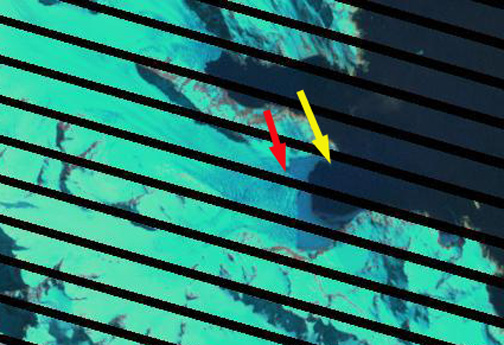
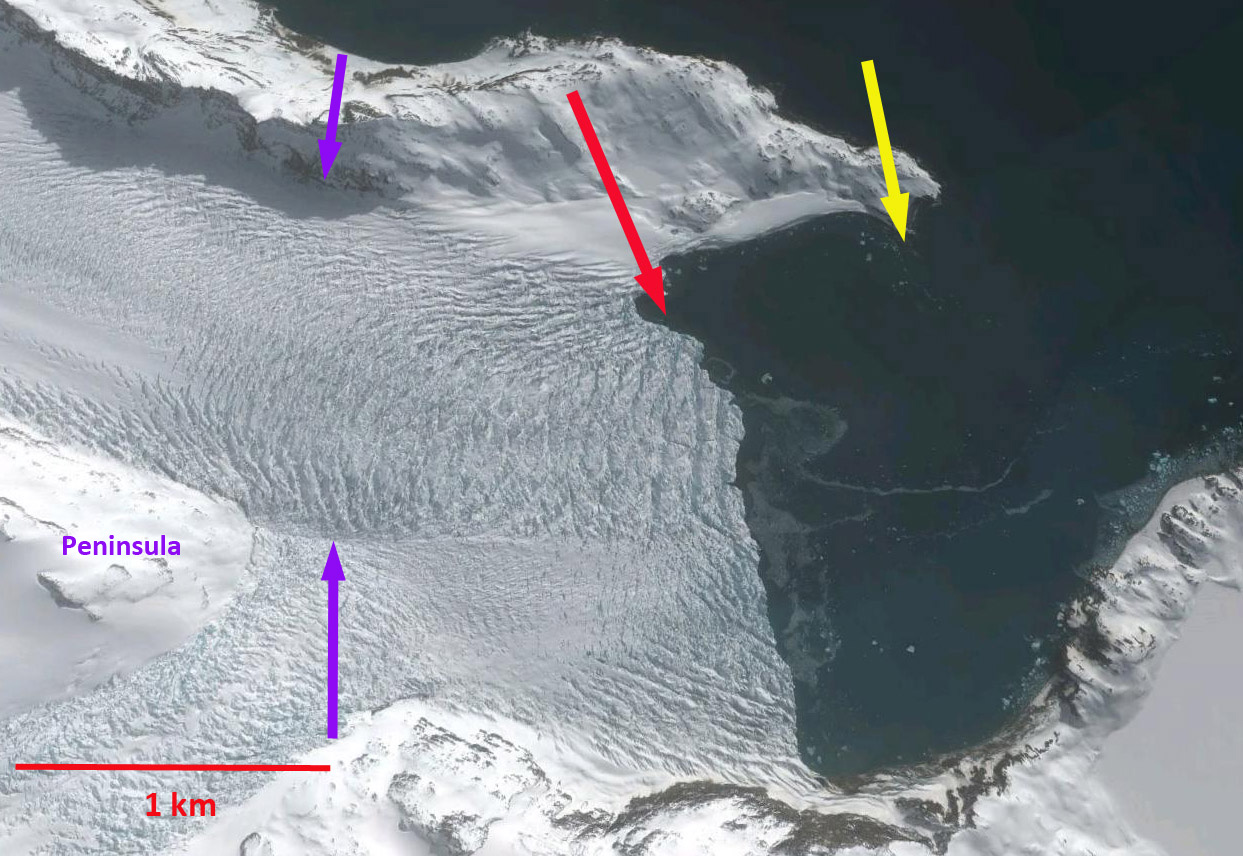
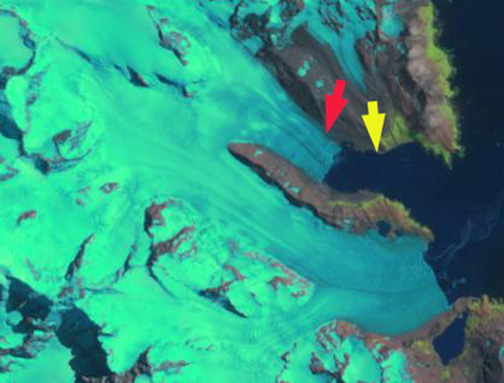
Twitcher Glacier is the next glacier south of Herz Glacier on the east coast of South Georgia. Until 1989 the glacier ended at the tip of a peninsula, the ensuing retreat has led to the opening of a new fjord. Twitcher Glacier was 10 km long and had a 2 km wide calving front in 2009. The terminus change of this tidewater glacier was completed by the British Antarctic Survey for the 1960-2007 period. The glacier retreated 1.5 km between 1960 and 2007, with have of the retreat occurring after 1992. (Gordon et al, 2008). The map below indicates the slow retreat from 1960-1988 and a more rapid retreat since. twitcher glacier getwitcher glacier mapIn 1989 this glacier terminated approximately at the end of a peninsula separating the two glaciers. Here we examine Landsat imagery from 1989, 2000, 2009 and 2013 to identify the rate retreat. The 1989 terminus position is indicated with a yellow arrow and the 2009 terminus position with a red arrow. The retreat is 1.2 km during this period. From 2009 to 2013 retreat accelerated with a further 1.2 km retreat to the purple arrow in the 2013 imagery, the retreat may be even greater but the resolution is poor for the January 1, 2013 image. Notice the lake just south of the glacier terminus in 1989, this lake is evident in the 2000 and 2013 imagery, but is snowcovered in 2013. A 2012 MODIS image has poorer resolution but no cloud cover and indicates the extent of the retreat from the Peninsula the glacier had reached in 1989. The last image is a closeup in Google Earth from 2010 note the significant crevassing which is indicative of rapid flow. The terminus is currently quickly retreating to the next peninsula where the terminus will separate into two parts. The southern tributary already is partly exposed to calving into the fjord. The rapid retreat here is similar to that of Neumayer Glacier or Ross Hindle Glacier.
twitcher 1989

twitcher 2000

twitcher 2009

twitcher 2013twitcher 2012twitcher glacier terminus 2010

Herz Glacier Retreat, South Georgia

Herz Glacier is on the southeast coast of South Georgia Island. The terminus change of this tidewater glacier ending in Iris Bay was completed by the British Antarctic Survey for the 1960-2007 period (Gordon et al, 2008). The map below indicates the slow retreat from 1960-1988 and a more rapid retreat since.harz glacier map Here we examine imagery from Google Earth and Landsat to examine terminus change from 1989-2010. In each image the red arrow indicates the location of the terminus in 2009-2010 the yellow arrow the 1989 terminus position. The first image is the Google Earth image from 2010, followed by the 1989, 2000 and 2009 Landsat images. The terminus on the north side of the fjord has retreated 1.8 km in the 20 year period and the terminus on the south side has retreat 2.2 km. The overall 2 km retreat is a rate of 100 meters/year and is 20 % of the total glacier length. This is an exceedingly cloudy region and imagery from 2011 and 2012 does not provide a clear observation of the terminus. The retreat of this glacier is less dramatic than that of Neumayer Glacier or Ross Hindle Glacier further north on the coast.herz glacier ge

harz glacier 1989

harz glacier 2000

harz glacier 2009

Porcupine Glacier Retreat and Lake Expansion, British Columbia

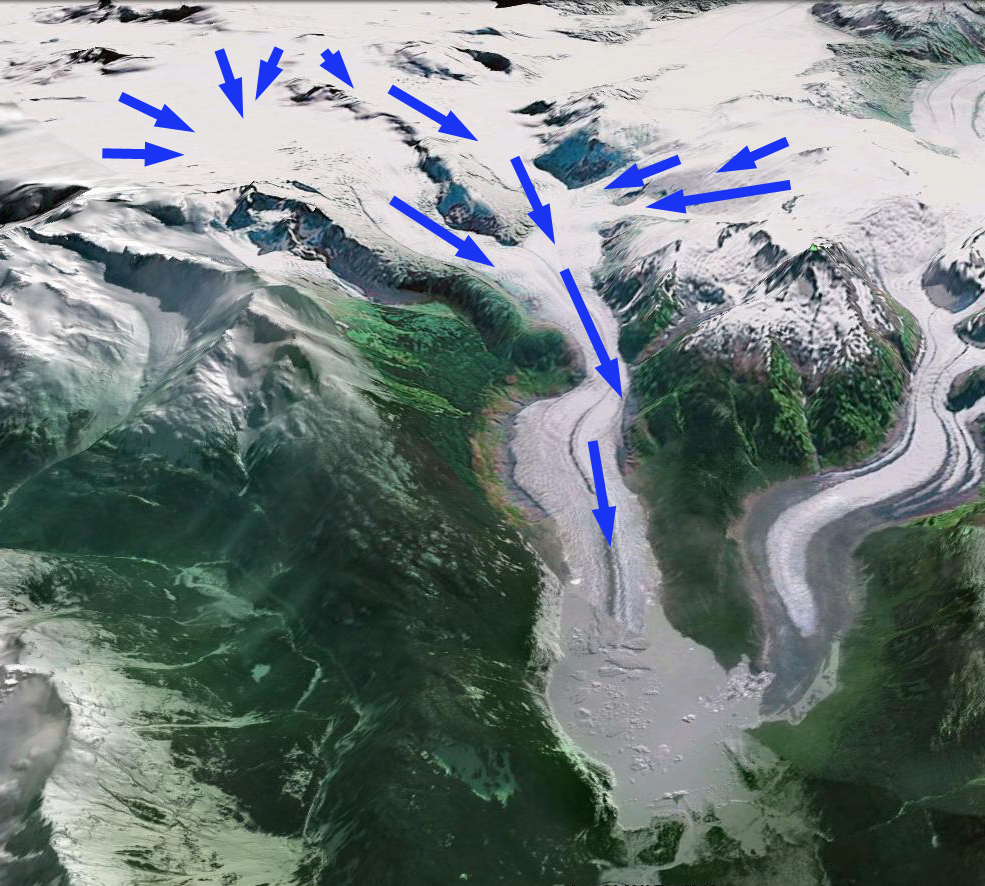
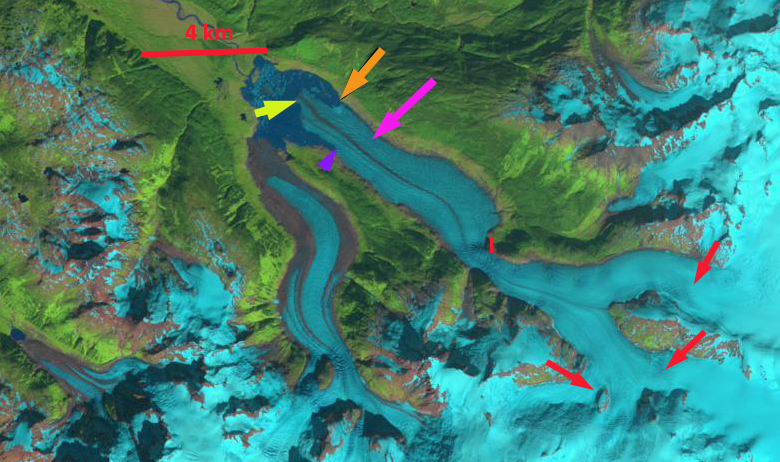
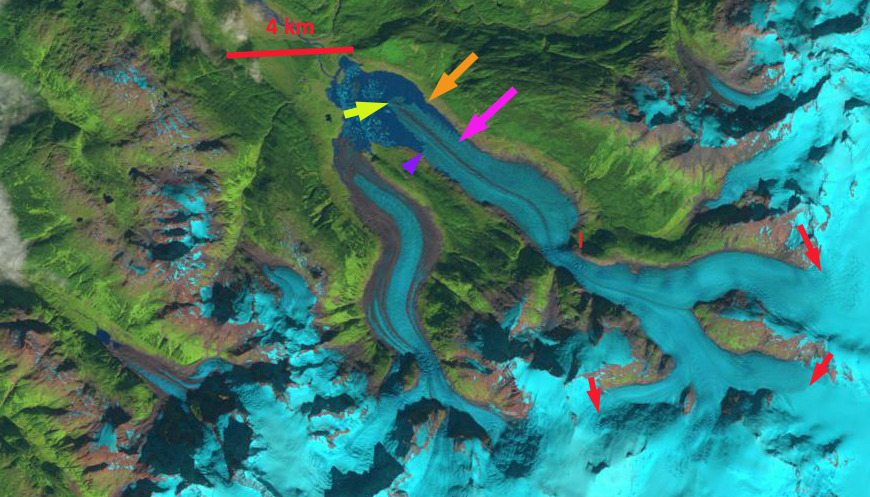
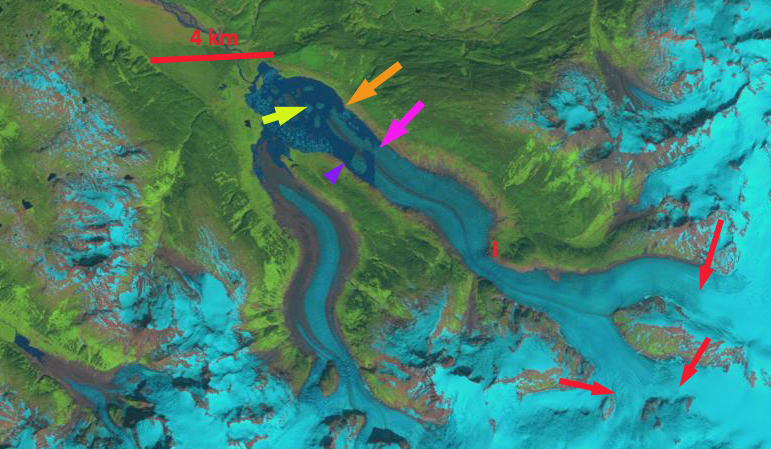
Porcupine Glacier is a 20 km long outlet glacier of an icefield in the Hoodoo Mountains of Northern British Columbia. Bolch et al (2010) noted a reduction of 0.3% per year in glacier area in the Northern Coast Mountains of British Columbia from 1985 to 2005. Scheifer et al (2007) noted an annual thinning rate of 0.8 meters/year from 1985-1999. Here we examine the retreat of Porcupine Glacier and the expansion of the lake it ends in from 1988-2011 using four Landsat images from 1988, 1999, 2010 and 2011. Below is a Google Earth view of the glacier with arrows indicating the flow paths of the Porcupine Glacier. The second images is a map of the region from 1980 indicates a small marginal lake at the terminus.
porucpine ge porcupine map
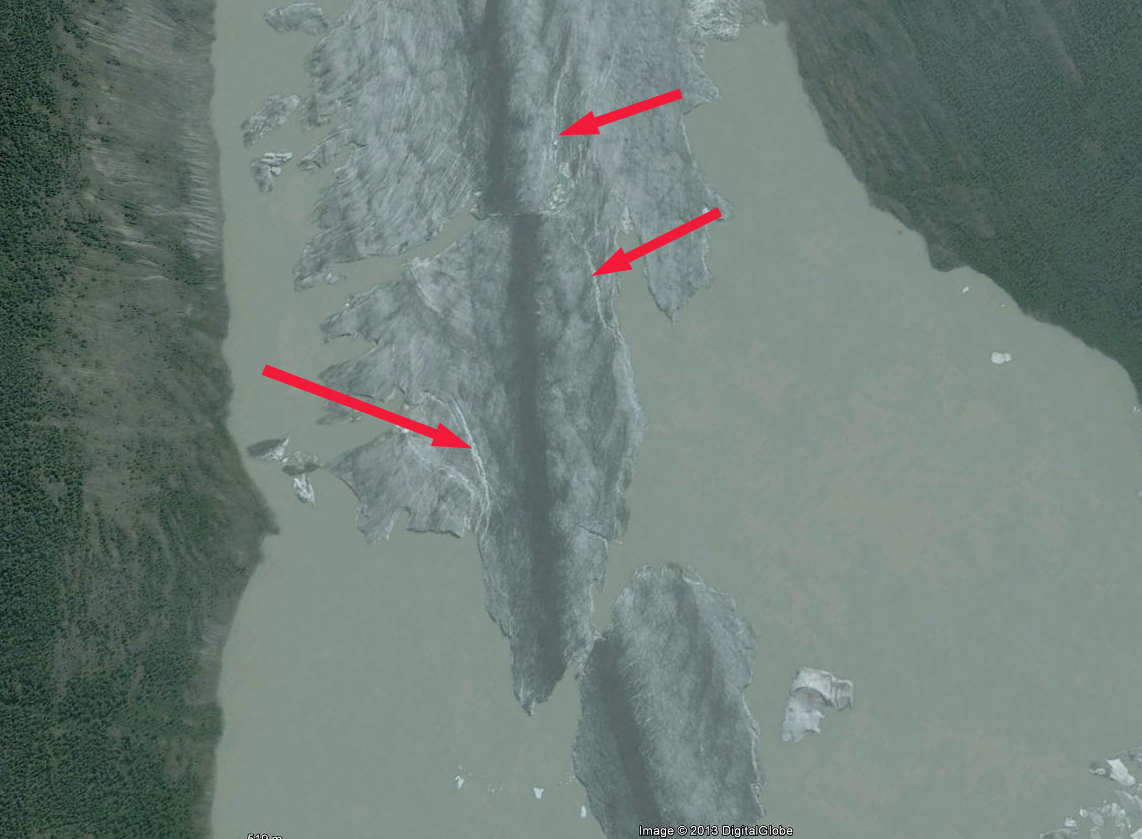
In 1988 a tongue of the glacier in the center of the lake reached to within 1.5 km of the far shore of the lake, yellow arrow. All but the red arrows are in the same location in each of the images below. The orange image is at the 1988 terminus position on the northern edge of the glacier, the purple arrow indicates the 1988 terminus position on the south side of the glacier. The yellow arrow indicates the 1988 center tongue position. The pink arrow is the 2011 terminus position at the north edge of the glacier. The glacier has retreated 2 km in the 22 year period. The number of icebergs in the lake at the terminus indicates the retreat is mainly due to calving icebergs. Glacier thinning of the glacier tongue leads to enhanced calving. The glacier tongue has a low slope up to an icefall, noted by red I, at this icefall the glacier rises from 450 m to 750 m. This is a likely point at which the lake basin ends and the glacier retreat can slow. The retreat of this glacier is similar to a number of other glaciers in the area Great Glacier, Chickamin Glacier, Patterson Glacier and Bromley Glacier. The terminus viewed up close in 2005 has numerous weaknesses indicating the calving that was going to happen in the next several years.
porcupine glacier 1985
porcupine glacier 1999

porcupine glacier bc 2010

porcupine glacier bc 2011procupine terminus closeup

Krivosheina Glacier Retreat, Novaya Zemlya

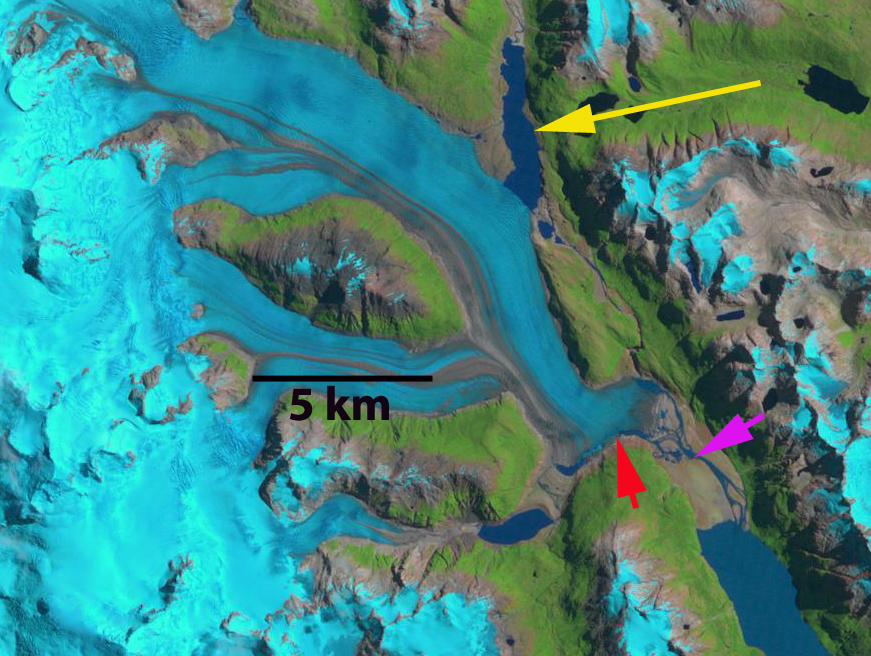
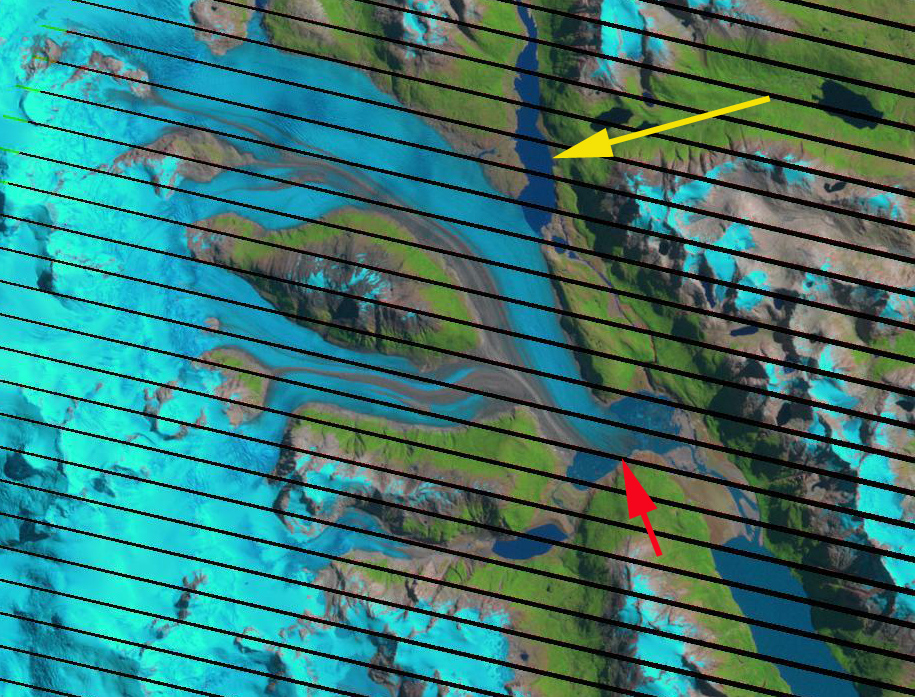
Krivosheina Glacier is a tidewater glacier on the northwest coast of Novaya Zemlya ending in the Barents Sea. A recent study by LEGOS (Laboratoire D’Eetudes en Geophysicque et Oceanographie Spatiales) in France highlights the changes of these glaciers from 1990-2000. They note that Krivosheina Glacier lost 3.3 square kilometers of area due to retreat in that decade. Given the recent reduction in Arctic Sea Ice in the region, these glaciers are facing dramatic climate changes. nziHere we examine satellite imagery from 1988, 2009 and 2011 to identify glacier change. In 1988 the glacier ended on an island, labelled Point A on each image. The north edge of the terminus turned the corner into northwest into a bay just west of Point B. The southern side of the terminus ended at the nose of a ridge just west of Point C. By 2009 a deep water channel was present between the island and the terminus. The north side of the terminus ended just south of Point B and the southern side of the terminus had retreated across the side valley to the east of Point C. By 2011 the terminus had retreated 2 km from its 1988 terminus position on the island and 1400 meters at the south side near Point C. Given that the glacier is 4.6 km wide, this retreat that averaged 1.6 km equals an area loss of 7 square kilometers since 1988. This retreat is similar to that of Nizkiy and Glazova Glacier just to the south and Roze and Sredniy Glacier on the east side of the island.
Krivosheina 1988

Krivosheina 2009

Krivosheina 2011

Rongbuk Glacier Supraglacial Lake Expansion, China

The Rongbuk Glacier is famous as the climbing gateway to the north side of Mount Everest (Qomolangma). In recent years the great climber and mountain photographer David Breashears has highlighted the change of this glacier over a the 1921-2007 period using repeat images of the glacier. The collection is part of Breashears Glacier Works Project, that is chronicling with repeat images the changes in a number of major Himalayan glaciers, the results of which have been in several well traveled exhibits. Here we examine a change on the surface of the main Rongbuk glacier over the last 15 years, the development of a substantial supraglacial lake. Ren et al (2006) noted the retreat of glaciers on the north side of Qomolangma as 5-10 meters/year. Ye et al (2009) noted a loss in glacier of 15 square kilometers for the glacier draining the north side of Qomolangma, and further noted the rapid expansion of the supraglacial lake from 0.05 in 1974 to 0.71 square kilometers in 2008. rongbuk ge. The red arrows in the Landsat images from 1992, 2001 and 2012 indicate the extent of the supraglacial lake in 2012 , first three images below. In the two Google Earth images from 2003 and 2011, last two images in sequence, the lake extent is marked with point A and B. In 1992 the lower section of the Rongbuk Glacier was heavily debris covered with a isolated melt ponds amidst the rugged debris covered surface. By 2001 some of the melt ponds have coalesced, but a well defined lake is not present. The key to lake expansion is the downwasting of the higher mounds of debris covered ice on the ice tongue. A second key is that the stream exiting the East Rongbuk Glacier now in part feeds this lake system, this could not happen until the glacier surface was low enough for this stream to be able to access the surface. By 2012 the lake has expanded to a length of 1.9 kilometers, and is still expanding in area. A higher resolution view using Google Earth images indicates that most of the lake formation occurred between 2003 and 2011. The terminus is so covered by debris that examining retreat of the front of this glacier is not as important as the thinning of the ice in the lower 8 km of the glacier, which is downwasting rapidly and will melt away. Notice the meltwater stream entering the lake system from the lower right in the 2011 image. rongbuk 1992

rongbuk 2001

rongbuk 2012

rongbuk close 2003

rongbuk close 2011

Upglacier of the this lake at the main junction of the Rongbuk Glacier is another area of lakes that could coalesce into the same type of feature. This indicates that this glacier will have to retreat a long ways to reestablish equilibrium. The glaciers behavior reflects the same trends though the specific symptom, surface lake formation is different, as Lumding Glacier, Ngozumpa Glacier and Imja Glacier
rongbuk jct lakes