
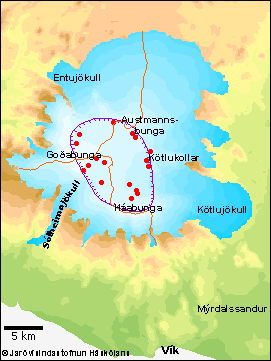
Kötlujökull drains the southeast corner of the Mýrdalsjökull Ice Cap. This ice cap is centered around the Katla volcano, a subglacical volcano. The glacier descends from 1200 meters to 200 meters.  This glacier advanced during the 1980’s creating a push moraine at the front (Kruger et al, 2002). In the 1990’s the glacier began to retreat. Kruger et al (2002) noted that during the 1990’s at the glacier front a 300-500 meters of dead ice formed. From 2000-2005 the glacier retreated 130 m (WGMS). There has been increased earthquake activity at Katla during 2011 as indicated in the diagram from the Icelandic Met Office, top image. The locations of the activity within the Katla Caldera is illustrated by the map from the Iceland Institute of Earth Sciences, bottom image.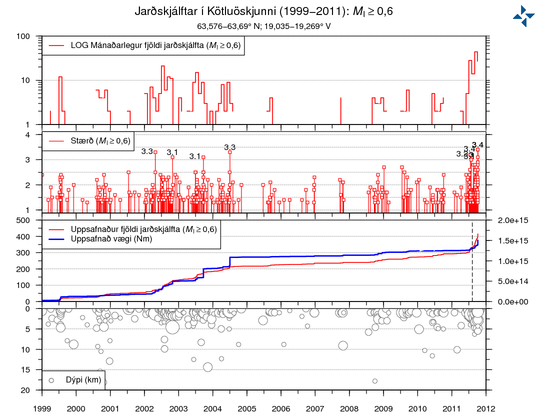
 This has been associated with a couple of significant glacier outburst floods. In July a flood from Kötlujökull washed out the Highway 1 Ring Road bridge over the Múlakvísl. In 1973 the glacier had an active front during the early phase of its advance in this picture form Richard Williams (USGS).
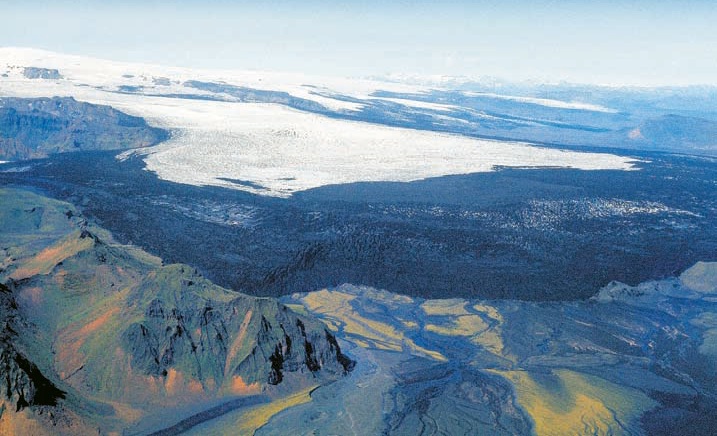 . Today the terminus features too indicators of retreat a zone of dead ice and now deglaciated terrain between the advance moraine and the present active ice. Beyond the 1980’s advance moraine is a flat outwash plain. The distance to the active ice from the former margin is 600 to 800 meters.
 During retreat the glacier has emplaced a number of recessional moraines. Recession is limited during the winter and a bit of a ridge is formed as sediment is pushed up and sediment is dumped at the terminus.
 The increased activity of Katla is being closed watched for an eruption as it often erupts after the which erupted in 2010. We often imagine the heat of a volcano will completely melt a glacier, however, this is not case with the ice caps in Iceland, which is an indication of just how much ice there is and the amount of heat needed to melt it. Recent eruptions did not remove either Gígjökull of Eyjafjallajökull Ice cap orSkeiðarárjökull Glacier
Category: Glacier Observations
Post detailing changes in a glacier
Onelli Glacier retreat separation, Argentina
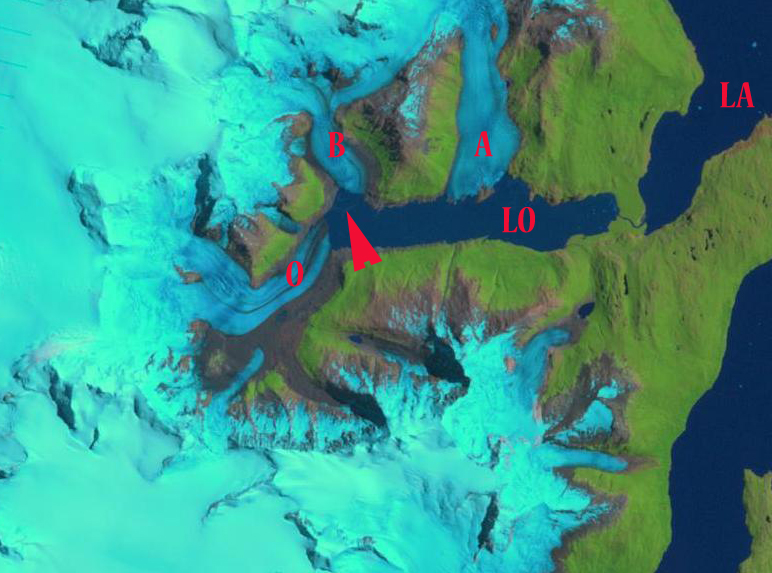
The Onelli Glacier drains eastward from the South Patagonia Icefield into Lago Onelli (LO), which then connects to Lago Argentino (LA). Lago Onelli has three main glaciers termininating in the lake Aggassiz (A), Onelli(O)and Bolados Glacier (B). The glacier is noted as 13 km long with an area of 84 square kilometers by the Labratorio de Glaciologia in Chile . Warren and Sugden (1993) note an 1800 meter retreat from 1945-1992 for Onelli Glacier and 850 meters for Agassiz Glacier. Eric Shipton was the first to visit this glacier and did so in the company of Ohio State glaciologist John Mercer in 1958. They found Lago Onelli so filled with icebergs that little water could be seen (Shipton, Land of Tempest, 1963). Agassiz and Onelli Glacier were observed to have a shared terminus much like Onelli Glacier and Belados Glacier in 2003, ion contact but one flowing into the fjord from the north with a steep calving face, and one from the northwest (Onelli) with a gentler slope. The focus for Mercer was the age of the moraines beyond the glacier terminus, for Shipton hiking up onto the icefield to explore potential avenues to the crest of the icefield. The glacier is located on the icefield base map image from the Glaciares of Argenina website.  . A comparsion of Landsat satellite images indicate the separation and retreat of Bolados (B) and Onelli Glacier(O) from 2000-2010. In 2000 the joint terminus cuts directly across Lago Onelli as one reasonably straight 1.6 km long. By 2003 the glaciers are barely touching and the combined termini are now long 1.8 km long. BY 2008 the glaciers are separated by 1300 meters. The retreat from the 2000 terminus of Onelli Glacier has been 1500-1800 meters depending where on the ice front the retreat is assessed. Theretreat of the last decade of 160 meter/year is a considerable acceleration over the period from 1945-1990. Belados Glacier has retreated 800 meters. The ELA in the satellite images from recent years has been 1300 meters.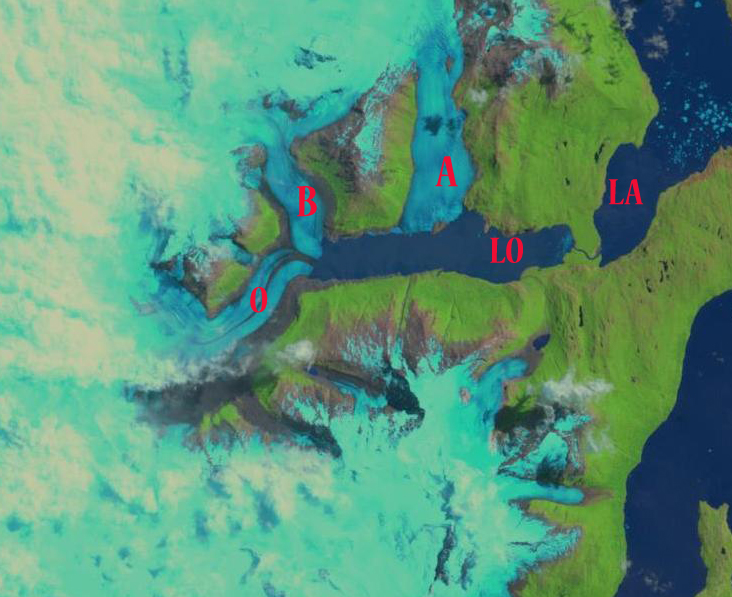

New Islands Forming Kong Oscar Glacier, NW Greenland
Ongoing glacier retreat changes local maps. For alpine tt can be the formation of new lakes due to glacier retreat, the draining of a lake that had been dammed and the expansion of lakes or fjords. In the case of Greenland’s glacier that are not confined by a fjord it can be the formation of new islands. This is no longer a rare occurrence. A close look at many areas along the west coast north of Disko Island reveals a number of new islands such as for Upernavik Glacier. Another location further north where new islands are being created is Kong Oscar Island. Box and Decker (2011) note that the retreat rate of the last decade has been 0.6 square kilometer per year. Howat and Eddy(2011) Examine 75 glacier termini in NW Greenland from 2000-2010 and find an average retreat of 127 meters per year and all but two are retreating. They further note that this contrasts to the retreat rate for the same area of 17-20 meters per year. Landsat images for the Kong Oscar Glacier region from 2002, 2010 and 2011 are below. The terminus of the southern most terminus shown, Sverdrup Glacier, is outlined and is near the tip of an island in 2002 and by 2011 Sverdrup Glacier has retreated 4 kilometers in this eight year period, note yellow arrow. Three islands are examined all noted by red arrows and lettered A-C, these islands are all part of Nansen’s or Nordesnkiolds Glacier. Island A was connected to the ice sheet in 2002 and now is separated by a deep water passage. Island B is just hanging on in 2011, compared to 2002 and even 2010. This connection will likely not survive next summer. The same can be said for Island C. 
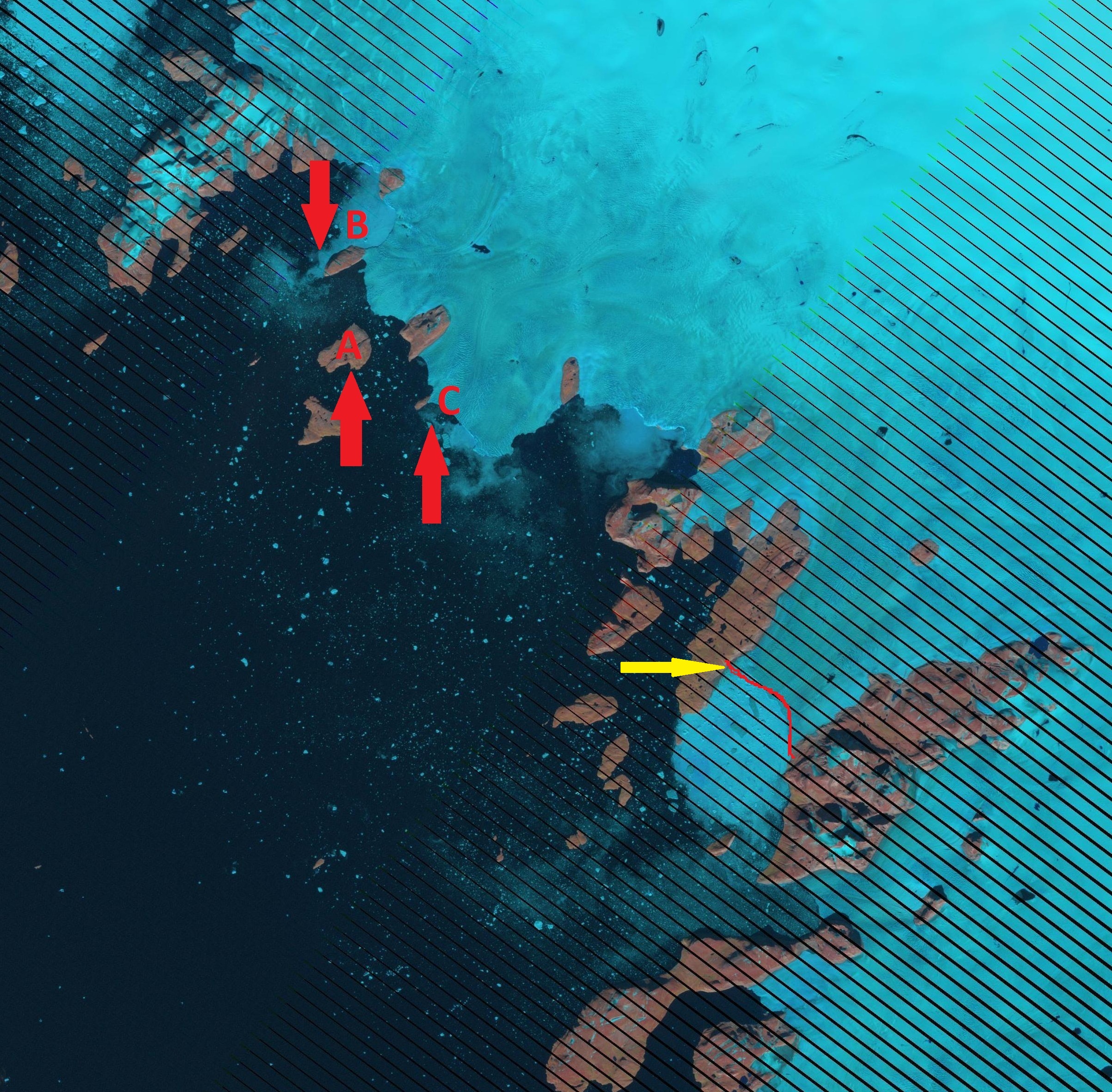
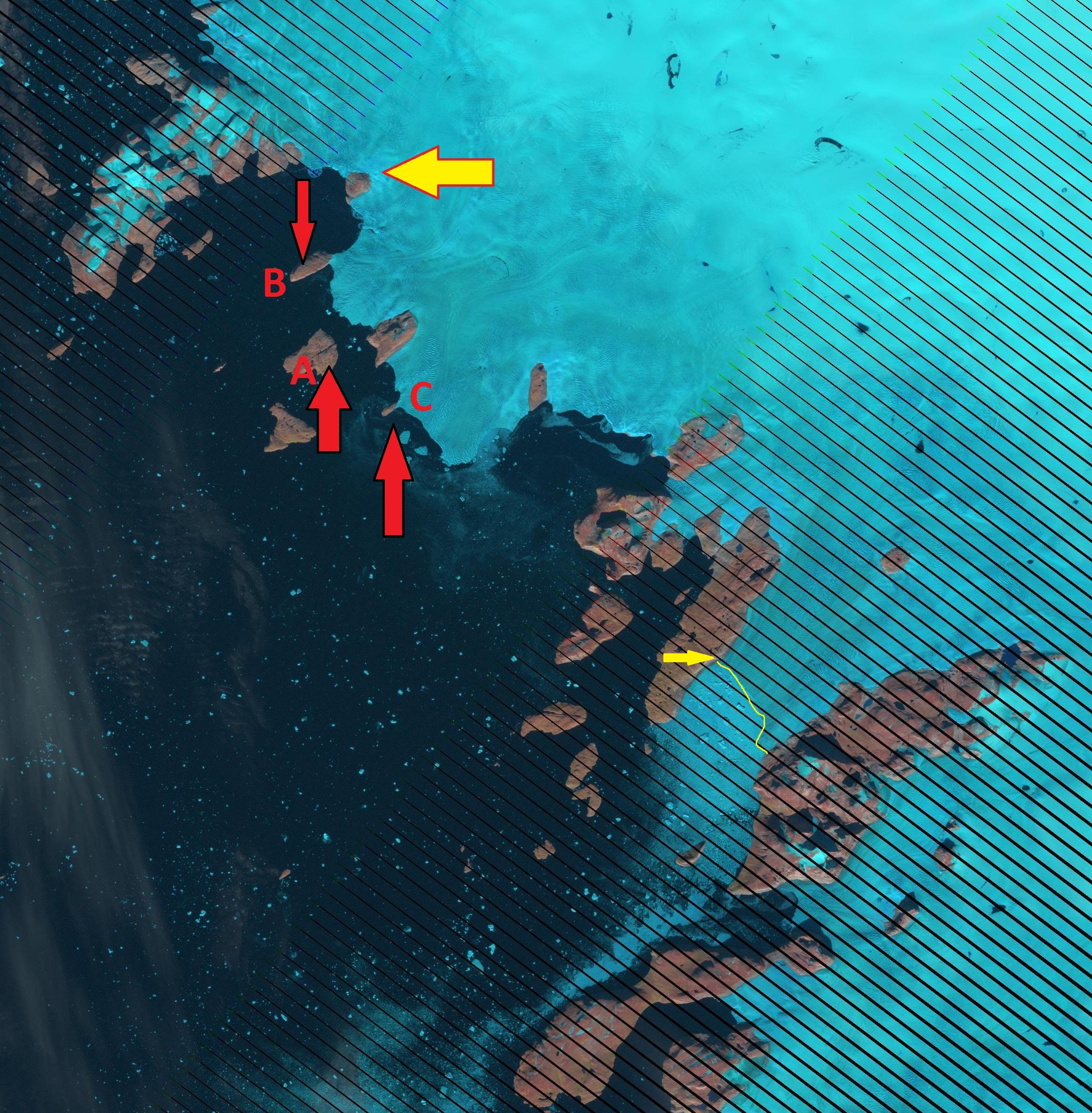 . This glacier is not confined to a narrow front or a single terminus in a fjord. The rate of retreat may be less, but the overall area lost is not. We must note that there are many new islands being formed it is not just a single island somewhere, such as Warming Island.
Cavagnoli Glacier Retreat, Swiss Alps
Ghiacciaio dei Cavagnoli (Ghiacciaio dei Cavagnöö) drains south into Lago dei Cavagnoli (Lago dei Cavagnöö), which is impounded by a dam that was 111 meters high. This hydropower plant provides 174 MW of power. The glacier itself has separated into five separate ice masses that are each melting quickly away. The Swiss Glacier Monitoring Network has observed the annual retreat of this glacier since 1980. A chart of this retreat from the data of the Swiss Glacier Monitoring Network is below. 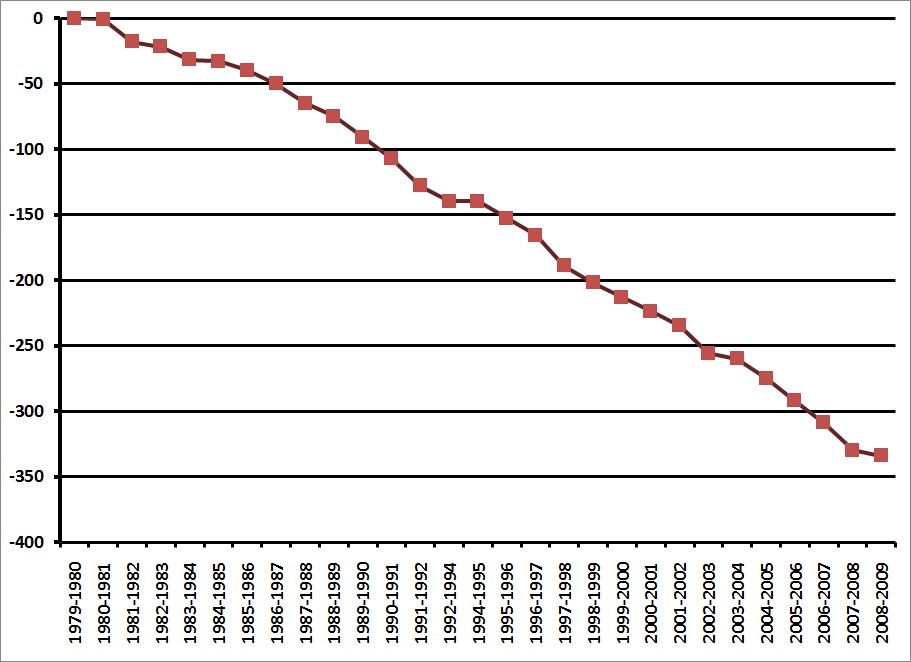 The total retreat of the main ice mass has been 343 meters. The top of the glacier has also been retreating this is a symptom of a glacier that will not survive (Pelto, 2010). The glacier as viewed from below and from directly above in Google Earth Imagery indicates a thin glacier with few crevasses. The five separate ice masses are all indicated by stars. This glacier has no accumulation zone in 2009. This has become a reoccurring pattern for this glacier, and also is a sign of a glacier that cannot survive.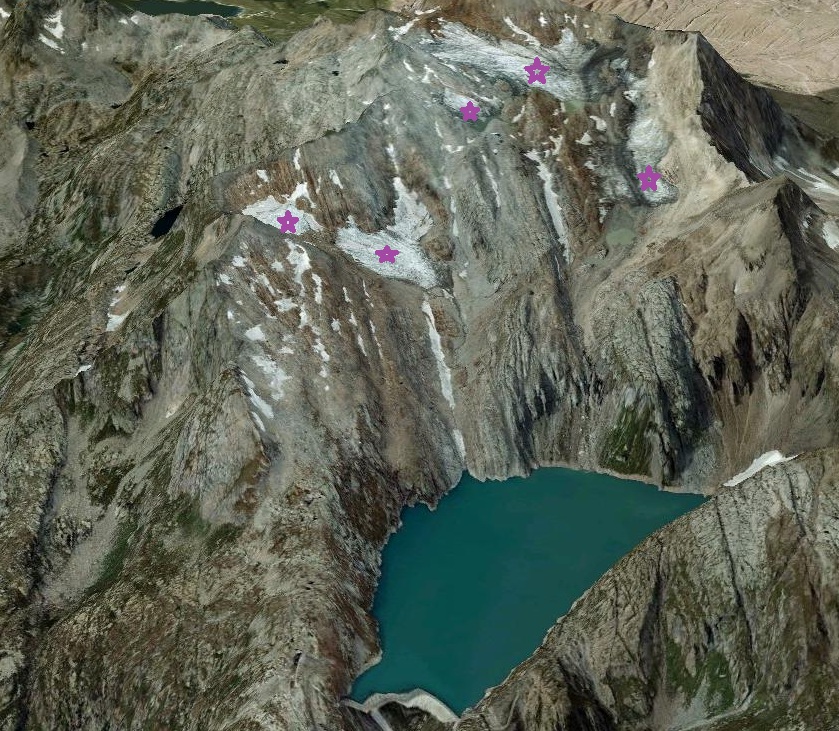
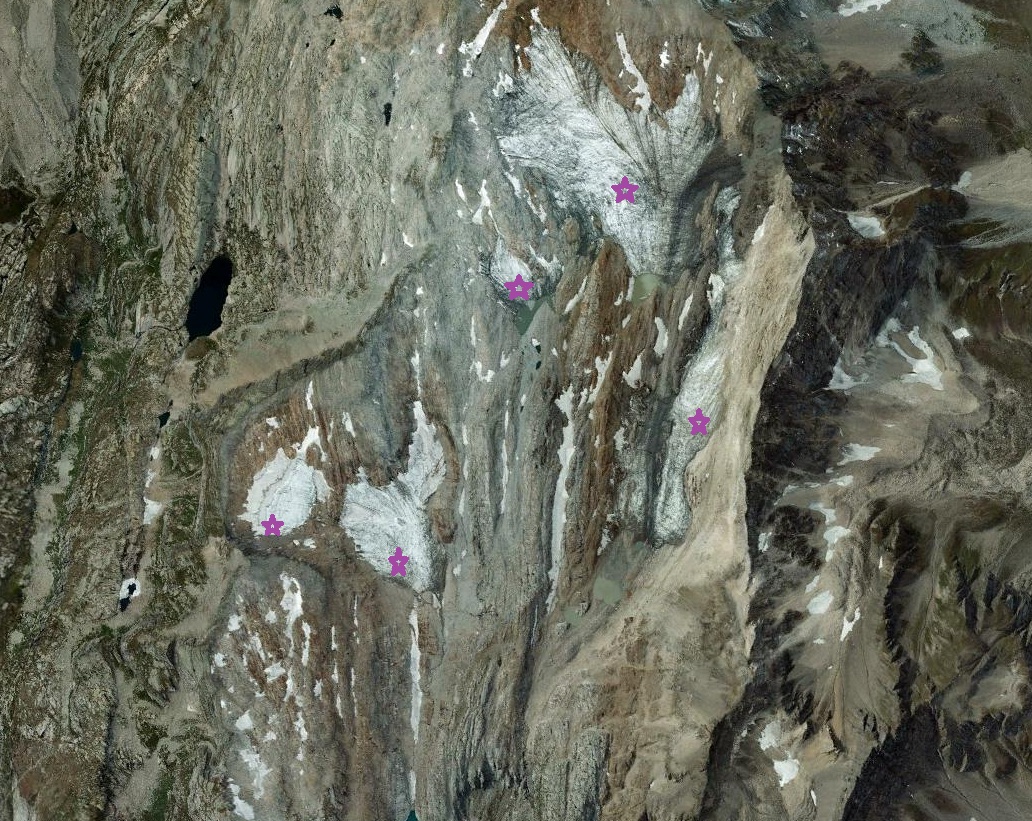 This glacier is a small relic of its former mapped extent.
  when the glacier was a single ice mass. Today the largest ice mass is 0.4 square kilometers and none of the ice masses appear destined for surviving. On the main ice mass there is a meltwater stream from the top to the bottom of the glacier indicating that even the top of the glacier is usually snow free by summer’s end.
 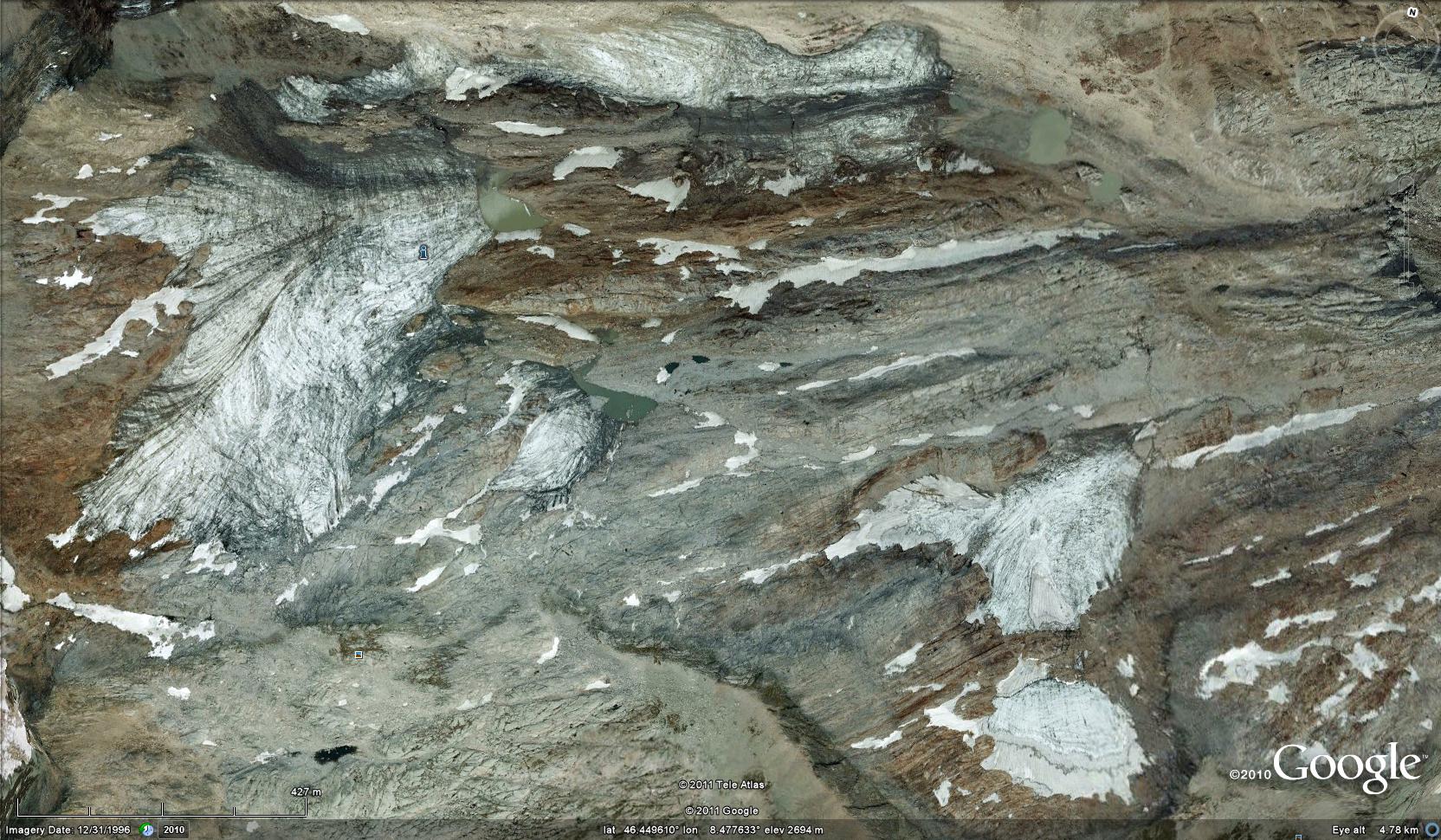 This glacier is in similar shape to the glaciers in the Rotondo area just to the north
Eagle Glacier Retreat, Juneau Icefield Alaska
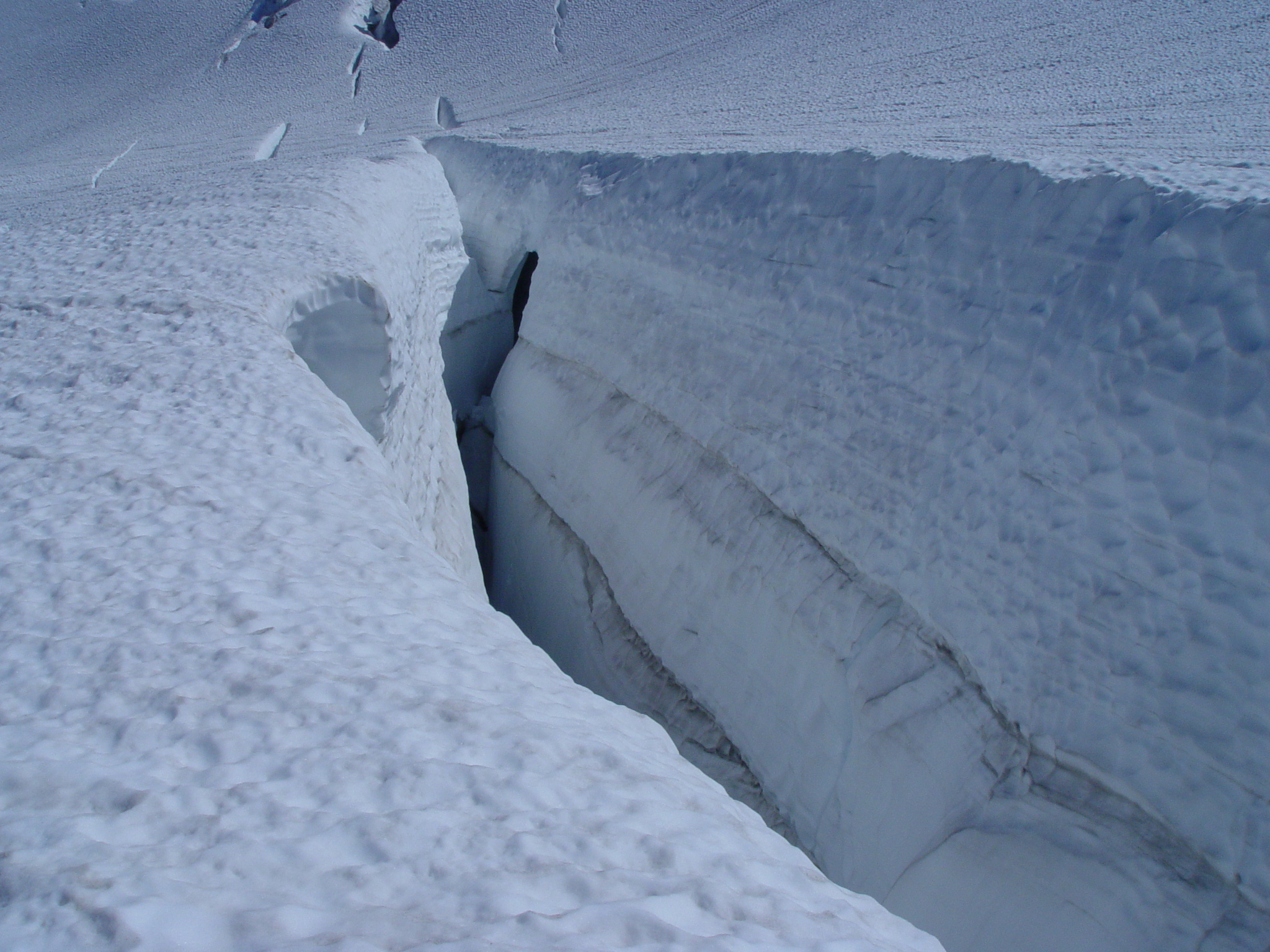
 Above is a paired Landsat image from 1984 left and 2013 right indicating the 1100 m retreat during this period of Eagle Glacier.My first visit to the Eagle Glacier was in 1982 with the, ongoing and important, Juneau Icefield Research Program, that summer I just skied on the glacier. In 1984 we put a test pit at 5000 feet near the crest of the Eagle Glacier to assess the snowpack depth. This was in late July and the snowpack depth both years was 4.3 meters, checking this depth in nearby crevasses yielded a range from 4-4.5 meters.
 In 1984 the snowline at the end of the summer melt season in early September was at 1050 meters. In the image below the glacier is outlined in green, the snowpit location is indicated by a star and the snowline that is needed for the glacier to be in equilibrium at 1025 meters is indicated.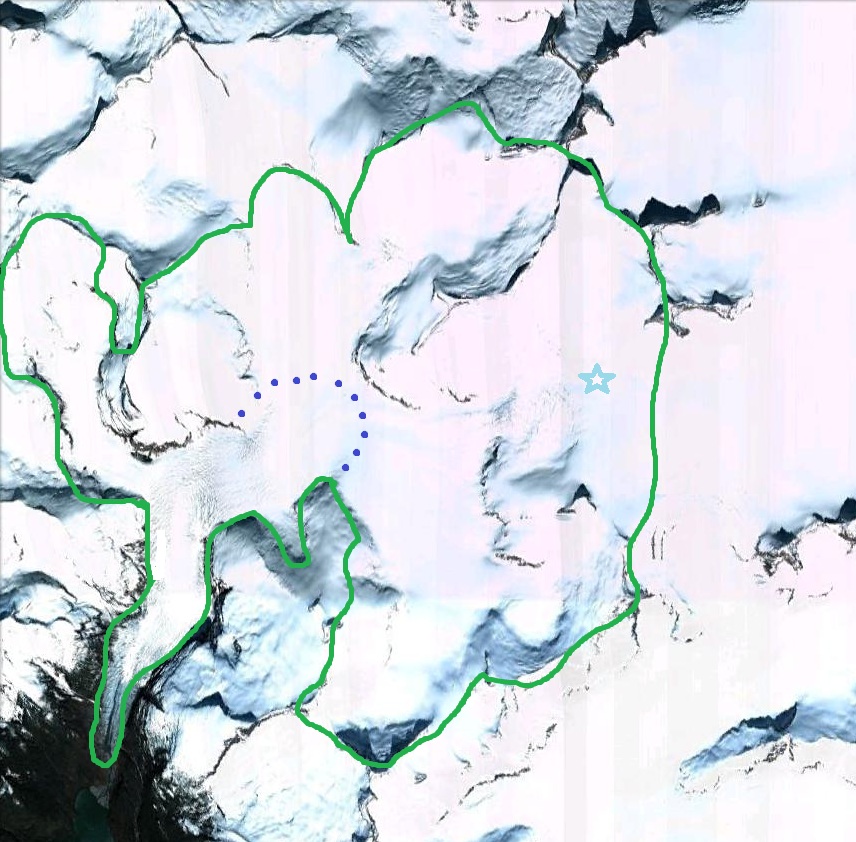
Eagle Glacier has experienced a significant and sustained retreat since 1948. The first map image below is of the glacier in 1948, at this time the glacier ended at the south end of a yet to be formed glacier lake. By 1982 when I first saw the glacier and when it was mapped again by the USGS (second image) the glacier had retreated to the north end of this 1 kilometer long lake. In the sequence of images the red line is the 1948 terminus, the magenta line the 1982 terminus, the green line 2005 terminus and the orange line the 2011 terminus. 
 From 1982 to the 2005 image used in Google Earth the glacier retreated 500 meters, 21 meters/year (next image). The bottom image is from a 2011 Landsat image in May and indicates the terminus position once again with an additional retreat in six years of 400 meters, 65 meters/year. Going back to the 1948 map the terminus in 2011 is located where the ice was 500-600 feet thick in 1948
 The more rapid retreat follows the pattern of more negative balances experienced by the glaciers of the Juneau Icefield (Pelto et al, 2008). The Equilibrium line altitude which marks the boundary between the accumulation and the ablation zone each year is a good marker of this. On Eagle Glacier to have an equilibrium the glacier needs to have an ELA of 1050 meters. At this elevation more than 60% of the glacier is in the accumulation zone. Satellite imagery allows identification of the ELA each year, seen below is the elevation in 1984, 1998, 1999 and each year since 2003.
  The number of years where the ELA is well above 1050 meters dominate leading to mass loss, thinning and glacier retreat. This follows the pattern of Lemon Creek Glacier that is monitored directly for mass balance, which has lost 26 meters of thickness on average since 1953.
Apex Glacier Retreat British Columbia
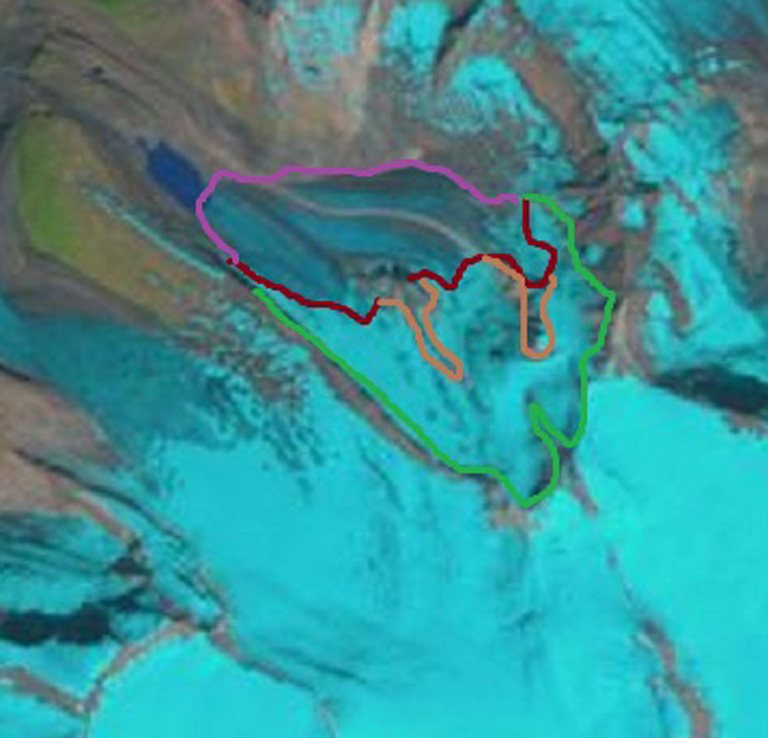
The Apex Glacier is part of the Clemenceau Icefield Group in the Rocky Mountains of British Columbia. The Apex Glacier drains into 430 square kilometer Kinbasket Lake impounded by the 1.75 MW Mica Dam.  In a recent paper Jiskoot et al (2009) examined the behavior of glacier in this and the neigboring Chaba Icefield. They found that from the mid 1980’s to 2001 the Clemenceau Icefield glaciers had lost 42 square kilometers, or 14% of their area. During this same period terminus retreat averaged 21 meters per year on the glaciers. In this post we are looking just at Apex Glacier contrasting the mapped extent, 2001 extent and 2010 extent in a Landsat image. A new glacier lake began to form after the 1980’s mapped extent. In the images below the 1980’s terminus is marked with a green line, the 2001 extent in magenta. By 2001 in the Google Earth image the lake is 0.5 km long, in 2010 the lake is 0.8 km long.

Glacier Map
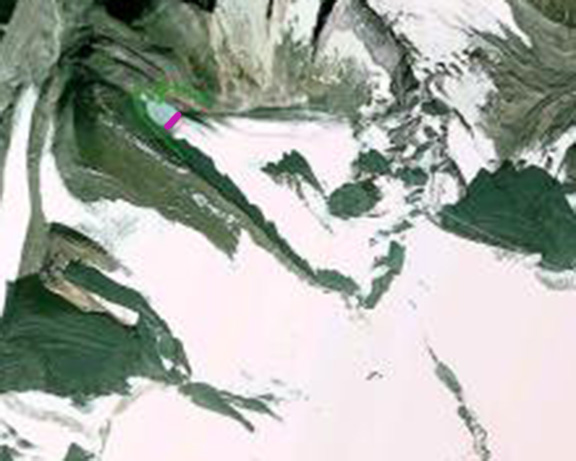
2001 Google Earth Image
2010 Landsat image Apex Glacier’s retreat of 300 m in nine years exceeds 30 meters per year, red arrow 2010 terminus. Hester Jiskoot’s (University of Lethbridge, Alberta) found a retreat rate of 52 meters per year from 1986-2001. The reduced rate of retreat may result from the lake depth being reduced, that the lake is getting a bit narrower hints at this as well. One other interesting aspect is that this glacier is fed by a northern and a southern accumulation zone. The snowline is 2400 to 2500 meters in the 2010 August Landsat image. The remaining accumulation zone is quite small for the northern accumulation zone with another month of melting to go. The ablation zone is between the purple margin and burgundy snowline. The accumulation zone is between the snowline and the green upper limit of the glacier, with the bare rock areas noted with the tan line. In 2013 the glacier has continued to retreat, though the change of approximately 100 m since 2010. In 2013 the glacier lost all but 10% of its snowcover with the snowline at 2700 m, yellow dots. This represents a large negative mass balance that will reinforce retreat.
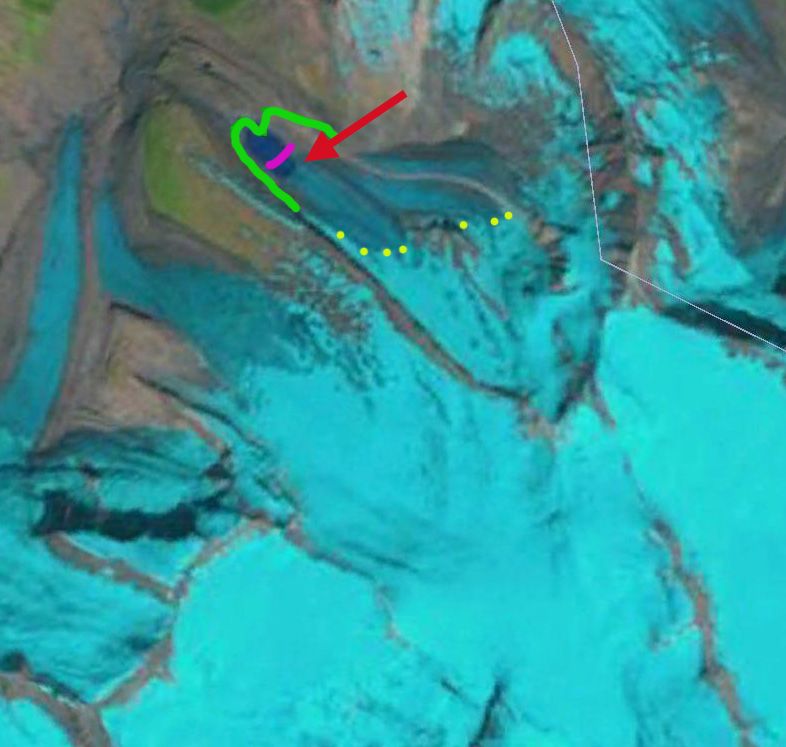
2010 Landsat image
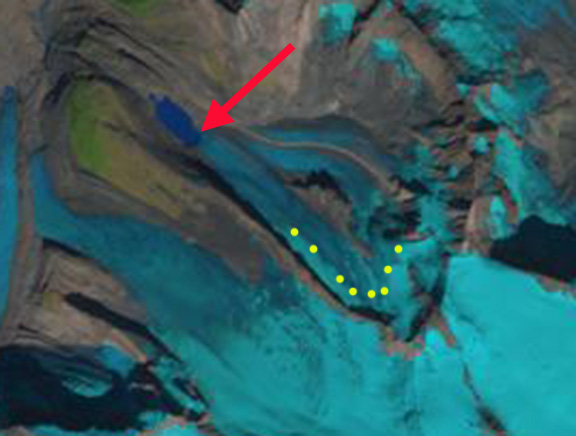
2013 Landsat image
2010 Landsat image
The result for Kinbasket Lake of the loss of the collective large area is a reduction in summer glacier melt and summer glacier runoff. The annual runoff which will be dominated by annual precipitation would not change just because of the glacier loss as noted in cases like the Skykomish Basin (Pelto, 2011) and Bridge River (Stahl et al 2008).
Glacier Retreat Kali Gandaki Headwaters, Nepal
The headwaters of the Kali Gandaki River is in northern Nepal. The basin is identified as having 1025 glaciers covering 2030 square kilometers by ICIMOD. The largest hydropower project is the 144 MW Kali Gandaki A project. The dam is located in Mirmi and the water is then sent through a 6 km long tunnel to Beltari.  The Kali Gandaki River is fed by the summer monsoon rains and glacier melt. The glaciers in the range are summer accumulation type. The monsoon precipitation in summer (June- September) provides 80 % of annual precipitation.
Ageta and Higuchi (1984) noted that on summer accumulation type glaciers, accumulation and ablation occur simultaneously in summer. The result is that glacier retreat does not impact streamflow as much, as in other glaciated alpine regions. This post will look at several glaciers north of the highest section of the Himalaya. The Kali Gandaki River passes between the 8000 meter peaks of Annapurna and Dhalaguri. North of these peaks the climate is drier and colder as the peaks act as a barrier to the incursion of warmer monsoonal air masses. The glaciers examined range in altitude from 6000 m to 5500 m. These are cold glaciers where the bulk of the glacier ice is below freezing. The cold based summer accumulation type glacier at the headwaters of the Kali Gandaki are quite susceptible to warming, because of the low elevation and their dependence on frequent summer snowfall events to keep the albedo of the glacier surface high. In the glaciers examined here a point of concern is the extent of the surface drainage systems. Cold-based glaciers move slower and have fewer crevasses as a result. In addition meltwater does not penetrate into the cold glacier ice. Therefore, meltwater tends to drain along the surface and the persistence of meltwater drainage is evident in the formation of channels. If the majority of a cold type glacier has these streams, this indicates a limited accumulation area, which will then lead to glacier retreat. An examination of each of the three glaciers below indicates that the extent of the meltwater channels is unusually large. The meltwater channels are indicated with red arrows. The images are from late October 2009 and in some cases new snow has already covered some of the stream channels which in two cases nearly reach the top of the glacier. This is not an equilibrium situation where meltwater channels cover more than 70% of an alpine glacier. this is an indication of an expanding melt area on these glaciers. 

 A comparison of the middle glacier with a 2000 Landsat image indicates 200 meters of retreat in the last decade. Notice the lake that is at the terminus in 2000 below is now 250 meters from the terminus in the image.
 above. These glaciers are small compared to the large Himalayan glaciers like Khumbu, Imja or Gangotri, but have the same response to climate, significant retreat.
Quelccaya Ice Cap Retreat, Peru
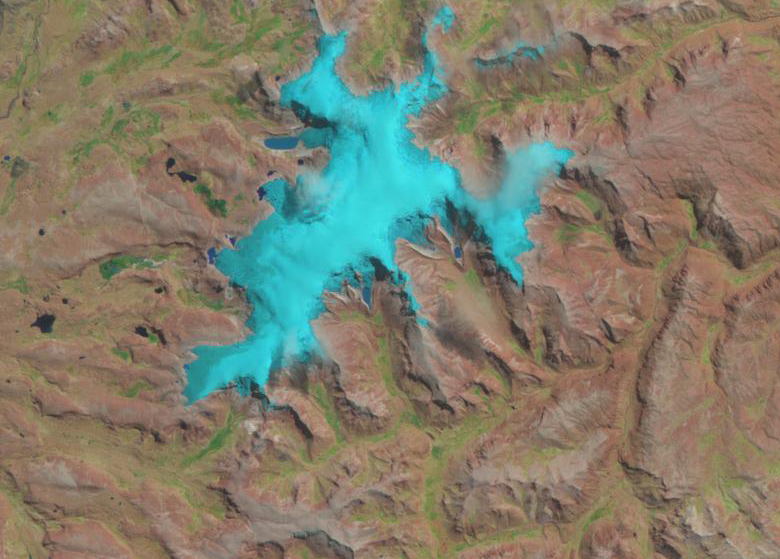 Quelccaya Ice Cap is in the of Peru. The first detailed investigations were by Lonnie Thompson at Ohio State examining the ice cap for its potential for ice coring (Thompson, 1980). Three decades later he is still involved in research on this ice cap and others, which combined have yielded one of the finest glacier climate records we have. This is nicely chronicled in Thin Ice by Mark Bowen. This research generated an excellent ice core record, that has annual resolution back some 1000 years, that illustrated the global nature of the Little Ice Age (Thompson et al, 1986). This core also indicated the reduced accumulation during El Nino events Thompson et al (1984) In conducting this research Thompson et al (2011) Figure 8, has also chronicled the retreat of one outlet glacier the Qori Kalis and put this in context with other tropical glaciers.
 The retreat of this glacier had been 1300 meters from 1963-2005. Today the University of Massachusetts, Climate System Research Center has installed weather stations on the glacier. Recent fieldwork has also focussed on ablation, accumulation and energy balance measurements, this is nicely chronicled in photographs by Carsten Braun, slideshow bottom of linked page Westfield State University. This post will focus on the development of new proglacial lakes at the terminus of the Quelccaya Ice Cap southwest of Qori Kalis and on the retreat of the ice cap from several lakes that had been in contact with the terminus. Landsat imagery from 1991 and 2010 is used. Point A is Qori Kalis, Point B, C and D are separate termini.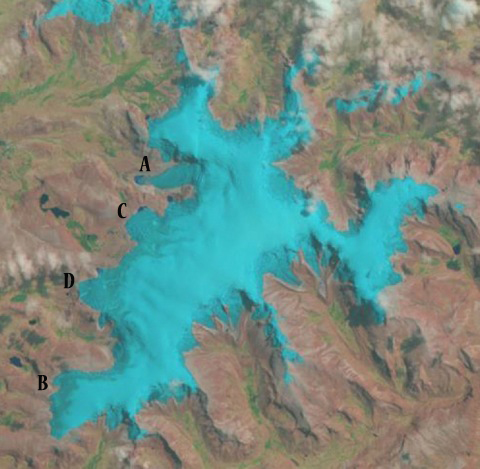
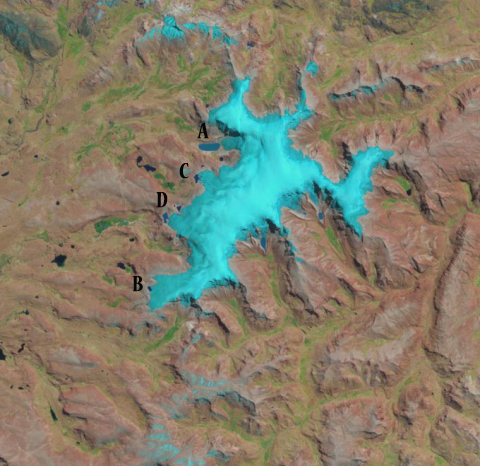
We see several new proglacial lakes indicated by blue arrows and two lakes that were in contact with the ice cap in 1991, but now are not, red arrows.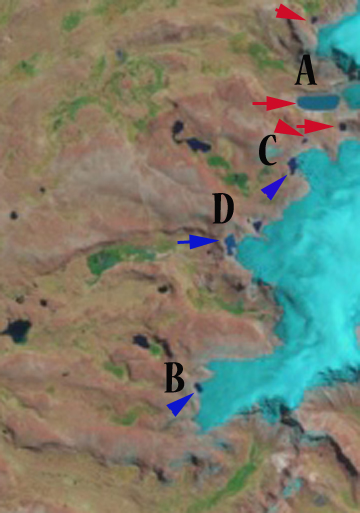 Qori Kalis (point A) has retreated out of its proglacial lake. The glacier filled this lake in 1963, the lake is now 1300 meters long and the glacier is 1450 meters from the northwest end of the lake, this represents its retreat over the last half century. The next lake indicated by a red arrow south of Point A. was in contact with the ice cap in 1991 it is now 200-250 meters from the ice cap edge. The next lake to the south indicated by a red arrow is was also in contact with the ice cap in 1991 and is now 250 meters from the ice cap margin. Points B,C, and D point two newly formed lakes filling basins exposed by glacier retreat since 1991. The distance from the far edge of each lake to the current ice cap margin indicate retreat of 300 m at C, 400 m at D and 250 meters at B.
Index of 130 Glacier Posts June 2009-August 2011
Glacier Index List
Below is a list of the individual glacier posts examining our warming climates impact on each glacier. This represents the first 2.3 years of posts, 130 total posts, 121 different glaciers. I have worked directly on 36 of the glaciers described below. Other glaciers were selected based on fine research that I had come across, cited in each post, I then look at additional often more recent imagery to expand on that research. The imagery comes either from MODIS, Landsat, Geoeye or Google Earth.
North America
Columbia Glacier, Washington
Lyman Glacier, Washington
Boulder Glacier, Washington
Ptarmigan Ridge Glacier, Washington
Anderson Glacier, Washington
Milk Lake Glacier, Washington
Paradise Glacier, Washington
Easton Glacier, Washington
Redoubt Glacier, Washington
Honeycomb Glacier, Washington
Vista Glacier, Washington
Rainbow Glacier, Washington
Daniels Glacier, Washington
Colonial Glaer, Washington
Quien Sabe Glacier, Washington
Mazama Glacier
Fairchild Glacier, Washington
White Glacier, Washington
Banded Glacier, Washington
Hinman Glacier, Washington
Bridge Glacier, British Columbia
Bubagoo Glacier, British Columbia
Hector Glacier, Alberta
Helm Glacier, British Columbia
Melbern Glacier
Warren Glacier, British Columbia
Castle Creek Glacier, British Columbia
Hoboe Glacier, British Columbia
Tulsequah Glacier, British Columbia
Decker and Spearhead Glacier, British Columbia
Columbia Glacier, British Columbia
Freshfield Glacier, British Columbia
Devon Ice Cap, Nunavut
Penny ice Cap, Nunavut
Minor Glacier, Wyoming
Grasshopper Glacier, Wyoming
Grasshopper Glacier, Montana
Harrison Glacier, Montana
Sperry Glacier, Montana
Hopper Glacier, Montana
Old Sun Glacier, Montana
Yakutat Glacier, Alaska
Grand Plateau Glacier, Alaska
Gilkey Glacier , Alaska
Gilkey Glacier ogives, Alaska
Lemon Creek Glacier, Alaska
Taku Glacier, Alaska
Bear Lake Glacier, Alaska
Chickamin Glacier, Alaska
Okpilak Glacier, Alaska
Sawyer Glacier, Alaska
Antler Glacier, Alaska
East Taklanika Glacier, Alaska
Brady Glacier, Alaska
Brady Glacier Retreat lake expansion 2004-2010
Thiel Glacier, Alaska
New Zealand
Tasman Glacier
Murchison Glacier
Donne Glacier
Africa
Rwenzori Glaciers
Himalaya
Zemu Glacier, Sikkim
Theri Kang Glacier, Bhutan
Zemestan Glacier, Afghanistan
Khumbu Glacier, Nepal
Imja Glacier, Nepal
Gangotri Glacier, India
Satopanth Glacier, India
Menlung Glacier, Tibet
Boshula Glaciers, Tibet
Urumquihe Glacier, Tibet
Sara Umaga Glacier, India
Europe
Mer de Glace, France
Dargentiere Glacier, France
Grand Motte and Pramort Glacier Tignes Ski area, France
Sommelier Glacier
Obeeraar Glacier, Austria
Ochsentaler Glacier, Austria
Pitzal Glacier, Austria
Dosde Glacier, Italy
Maladeta Glacier, Spain
Presena Glacier, Italy
Triftgletscher, Switzerland
Rotmoosferner, Austria
Stubai Glacier, Austria
Ried Glacier, Switzerland
Chuebodengletscher and Ghiacciaio-del-Pizzo-Rotondo
Forni Glacier, Italy
Peridido Glacier, Spain
Engabreen, Norway
Midtdalsbreen, Norway
TungnaarJokull, Iceland
Gigjokull, Iceland
Skeidararjokull, Iceland
Lednik Fytnargin, Russia
Rembesdalsskaka, Norway
Hansbreen
Nannbreen
Greenland
Mittivakkat Glacier
Ryder Glacier
Humboldt Glacier
Petermann Glacier
Kuussuup Sermia
Jakobshavn Isbrae
Umiamako Glacier
South America
Colonia Glacier, Chile
Artesonraju Glacier, Peru
Nef Glacier, Chile
Tyndall Glacier, Chile
Zongo Glacier, Bolivia
Llaca Glacier, Peru
Seco Glacier, Argentina
Antarctica and Circum Antarctic Islands
Pine Island Glacier
Fleming Glacier
Hariot Glacier
Amsler Island
Stephenson Glacier, Heard Island
Neumayer, South Georgia
Ampere, Kerguelen
Nordenskjold Coast, Antarctic Peninsula
North Cascade Glacier Climate Project Reports
Forecasting Glacier Survival
North Cascade Glacier Mass Balance 2010
Columbia Glacier Annual Time Lapse
North Cascade Glacier Climate Project 2009 field season
28th Field Season Schedule of the North Cascade Glacier Climate Project
North Cascade Glacier Climate Project 2011 Field Season
BAMS 2010
North Cascade Glacier Climate Project 2011 Field Season Report
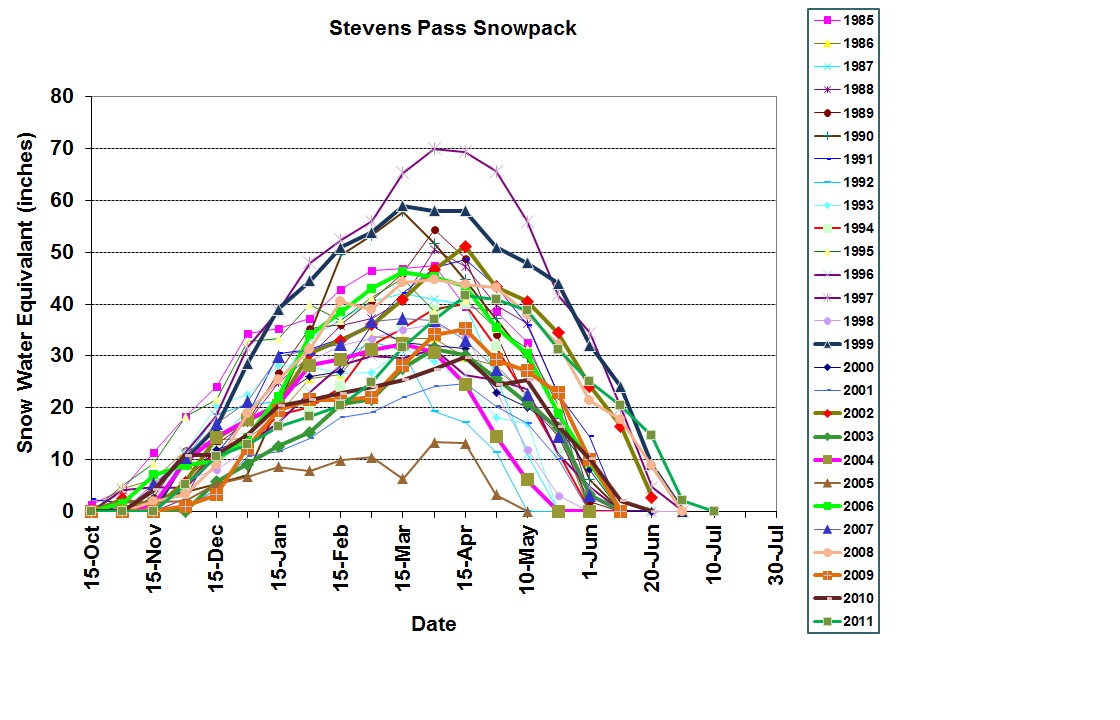
For the 28th consecutive summer the first three weeks of August were spent observing North Cascade glaciers. The 2011 season exhibited unusual snowpack levels second only to 1999 in the last 28 years. In 1999 the world record annual snowfall record was set at Mount Baker, one of our key field research areas. The difference this year was that it was not the winter snowfall that was extraordinary it was the lack of melt through the spring and early summer. A comparison of snowpack at two USDA Snotel long term sites in the North Cascades illustrates that the bright green 2011 on April 1 was ordinary, and that the dark blue 1999 snowpack level was not approached until early June.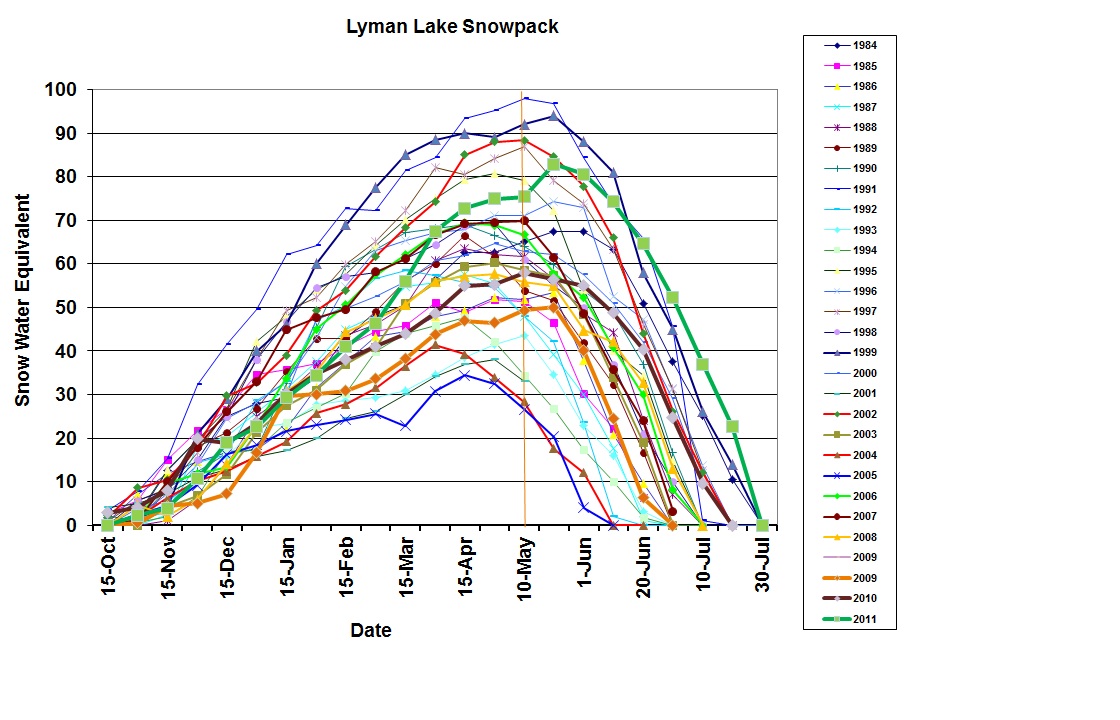
 Below is a visual look at the field season in a video followed by detailed description of field results, obtained by Ian Delaney, Mariève Desjardins, Tom Hammond, Ben Pelto, Jill Pelto and Mauri Pelto.
The field season began at Columbia Glacier. This is the lowest elevation large glacier in the North Cascades. Enroute to the glacier we probed our way across the still largely frozen Blanca Lake. In the afternoon slush we forded the outlet stream instead. The glacier was 100% snowcovered average snowdepth was just over 5 meters from extensive probing on the glacier. Snow depth in 2009 and 2010 had been nearly identical in early August, this year the depths were consistently 3.8 meters deeper. 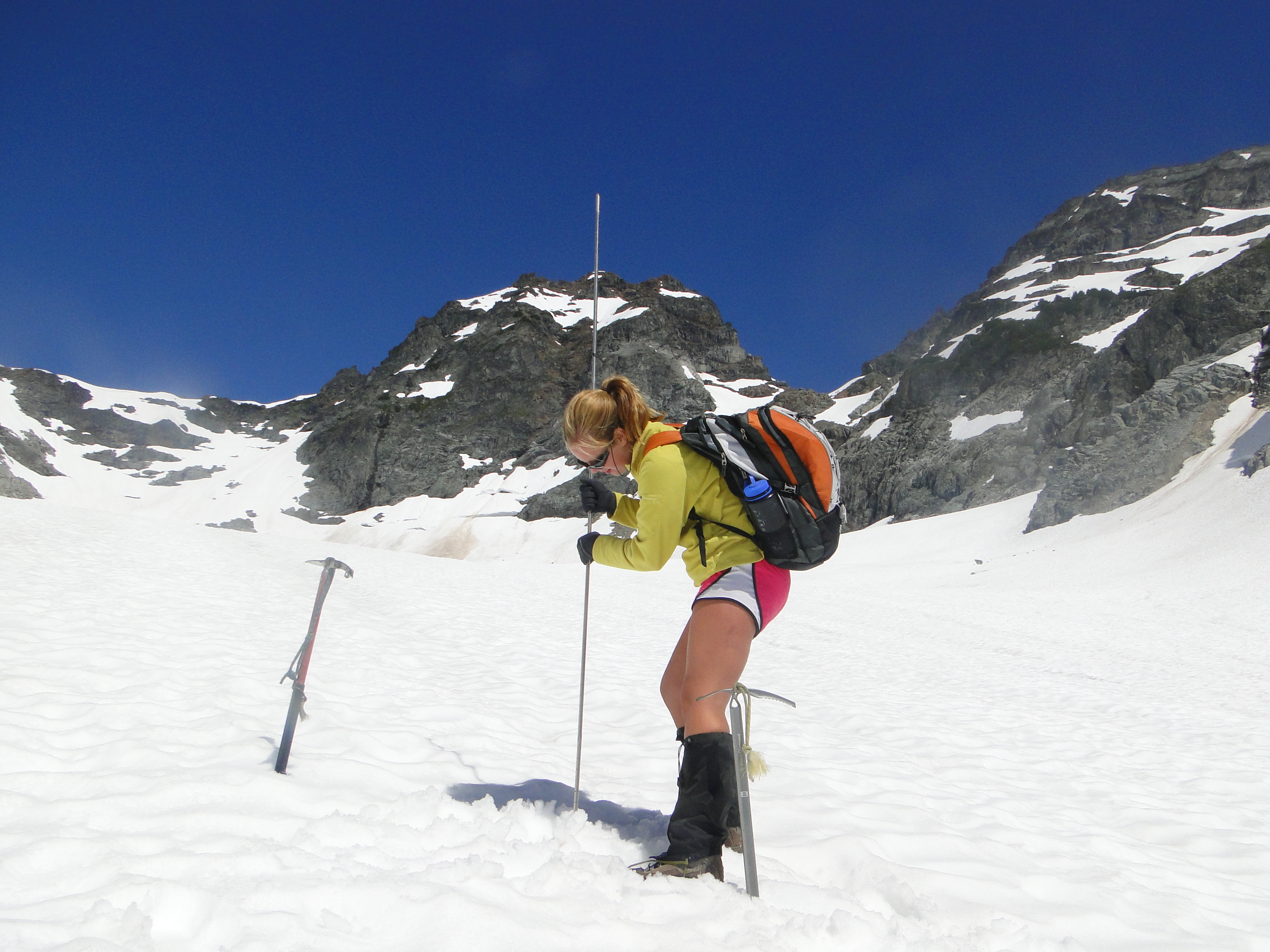
The hike in to Lower Curtis Glacier was on snow as was our camp. A climax avalanche descended from the north side of the valley in two locations enroute to the glacier. The steep terminus of this glacier was exposed. The terminus was easier to explore with snowpack below it, a retreat of 8 meters had occurred since the previous August, all of it late last summer. 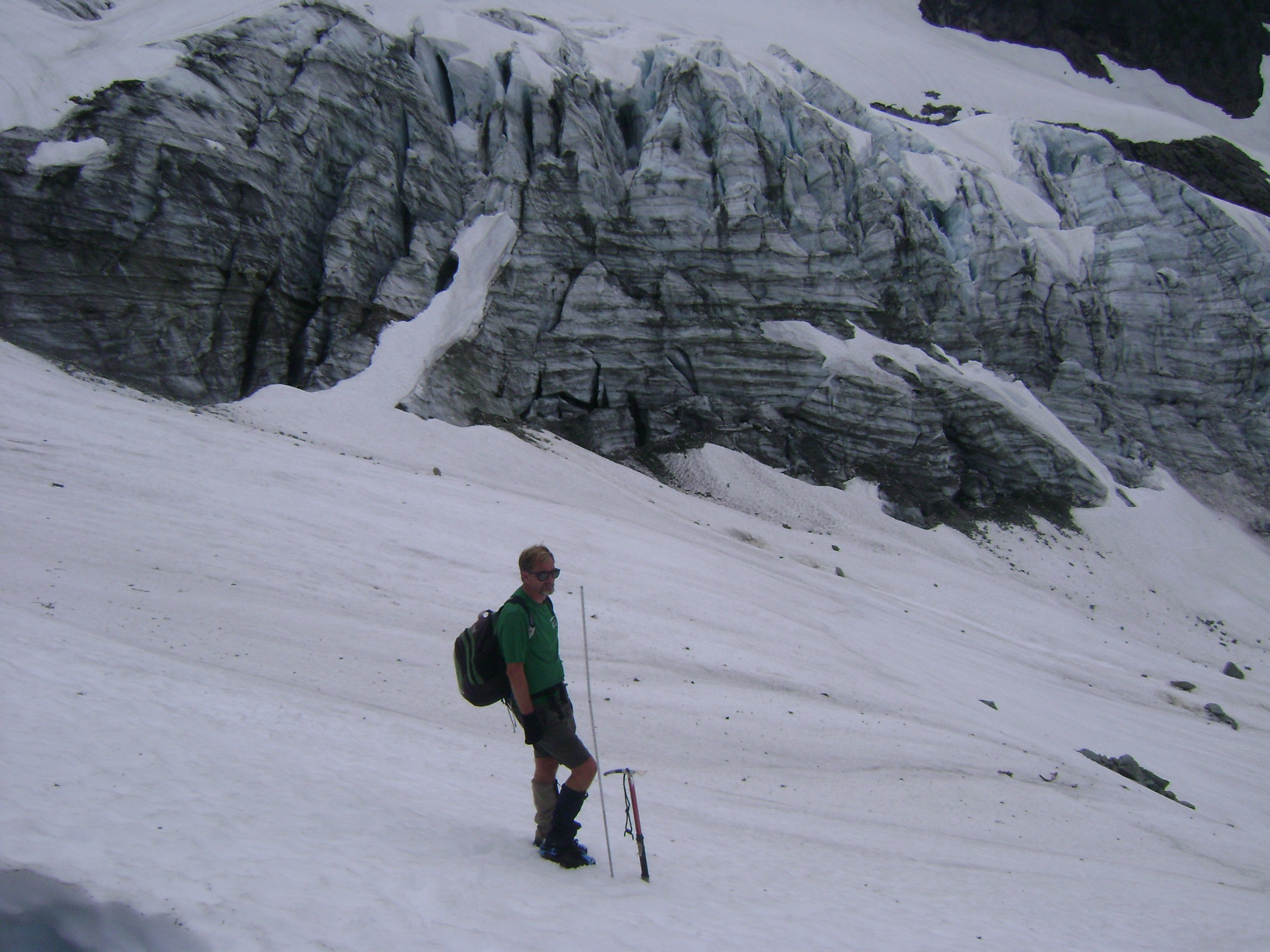 The glacier had an average snowpack of just over 5 m, 3.6 meters more than last summer. The next field area was Easton Glacier and Squak Glacier. We measured the snowpack on both. We found 3.5 meters of snowpack at 6000 feet, where normally it is blue ice and at 6600 feet the average snow depth was 4.75 meters. The measurements were almost all made using crevasse stratigraphy as probing more than 4 meters is difficult. Both termini were buried. On
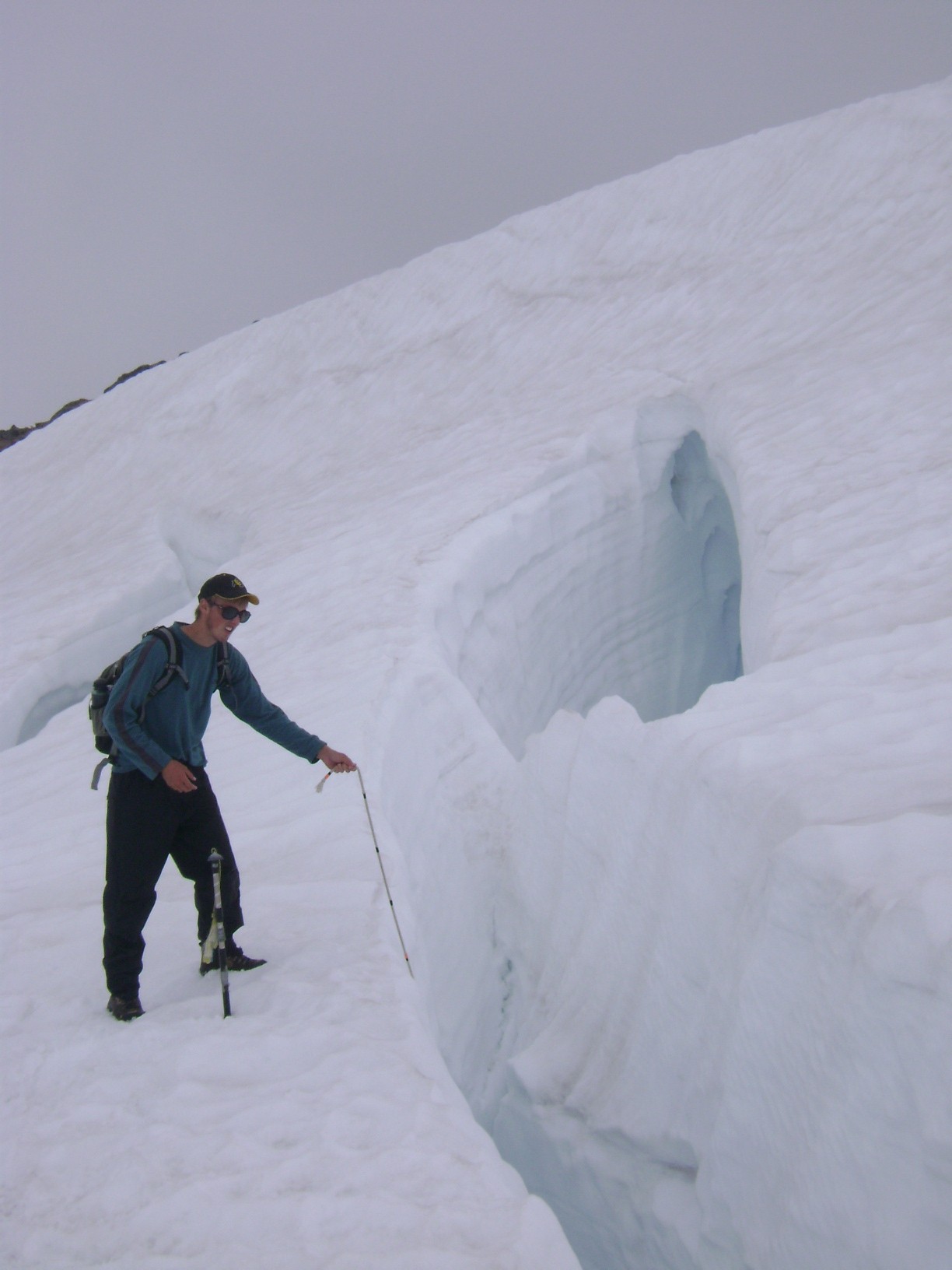 Deming Glacier a new hole had emerged at the base of the icefall on the east side, matching the hole that developed and expanded on the right side (note arrow in top image). We also collected ice worms for an anti-freeze protein project at Queens University, Kingston Ontario (Peter Davies and Mariève Desjardins).
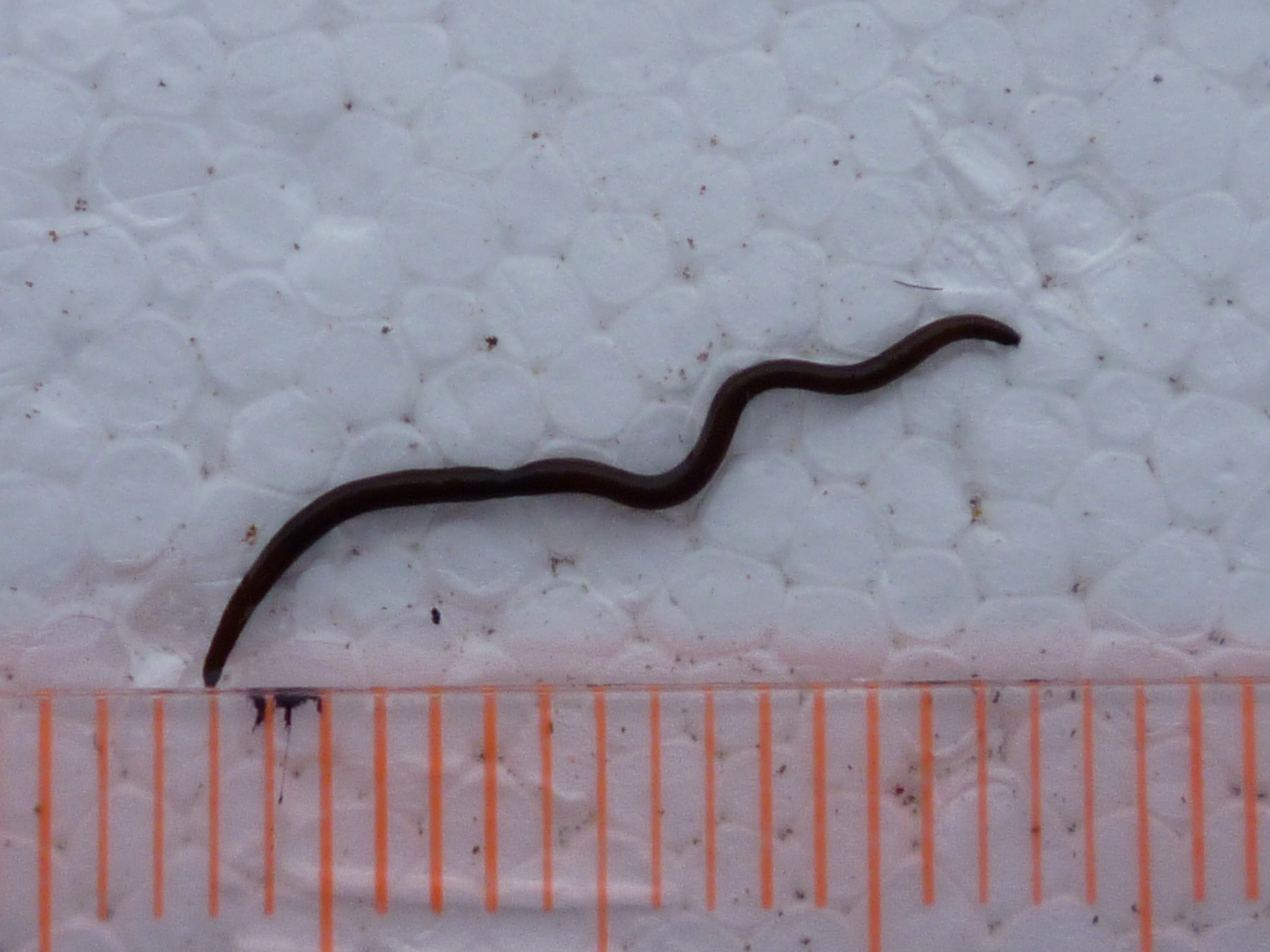 These anti-freeze proteins help keep organisms from freezing solid, by coalescing around ice crystals and limiting their expansion in part due to lowering the freezing point without altering the melting point. For us they could be a critical resource in surgical transplant procedures where keeping organs cold is important. We could have used some kind of protein to keep us warm on the four chilly-cloudy but dry days on the Easton Glacier. We visited Lyman Glacier ascending the former Spider Glacier valley, which was this summer of course still snow filled. Lyman Glacier has lost some of its splendor in the last three years. It had a high ice cliff in 2008 and 2009, measured at 18 meters that has now diminished to 8 meters The glacier has gone from an average surface slope of 12 degrees in 1986 to 18 degrees in 2008 to 21 degrees in 2011, as it continues a rapid ice loss. The steepening results from more rapid thinning at the terminus and overall glacier shortening as the 10 meter per year retreat continues. On Mount Daniels snowpack was not as extraordinary as at other locations. Snowpack on Ice Worm Glacier averaged 4.6 meters, and on Lynch and Daniels Glacier 4.3 and 4.6 meters respectively, this was 2.5 meters more than average. This area had significantly less above average snowfall than the other field areas. Pea Soup Lake at the base of Lynch was still ice covered. We ascended the Lynch over the bergshrund pictured in last image below with a snow depth from the winter of 6.7 meters.
 .
.
The mass balance of North Cascade glaciers will be strongly positive in 2011. We normally take 1100-1300 snow depth measurements. This year the deeper snowpack limited out measurements to 1/3 this total. Each glacier will be checked again in one month, to assess the final mass balance.
Nordenskjöld Coast Glacier Retreat, Antarctic Peninsula
A recent paper by Shuman et al (2011) in the Journal of Glaciology examined the thinning and retreat of glaciers feeding the area that used to contain Larsen Ice Shelf B and the southern end of Larsen Ice Shelf A. They found that the thinning of over 80 meters occurred over large areas of Hektoria, Jorum, Evans, Crane and Green Glaciers. Terminus retreat of five kilometers of the primary glaciers from late 2002-2009 occurred for Larsen B. The rapid loss of thickness and retreat has accompanied the expected and observed acceleration of the glaciers after ice shelf loss. The removal of an ice shelf is a substantial reduction in the backforce on a feeder glacier, or like taking off the brakes. Pine Island Glacier is another example where this is of concern. The Shuman et al (2011) paper particularly the figures are compelling and prompted me to take a look at one embayment in the Larsen A region that is experiencing ongoing glacier retreat. The area has been mapped by USGS and is referred to as the Nordenskjöld Coast.  We will look at the unnamed embayment marked B, between Drygalski and Dinsmoor Glacier. This embayment which has formed in the last decade is 25 square kilometers in area.The above map indicates the extensive retreat due to the Larsen A ice Shelf loss that took place in the mid-1990’s and the development of the embayment by 2009. The five glaciers that feed it flow from the center of the Antarctic Peninsula, upper left in the image below.
 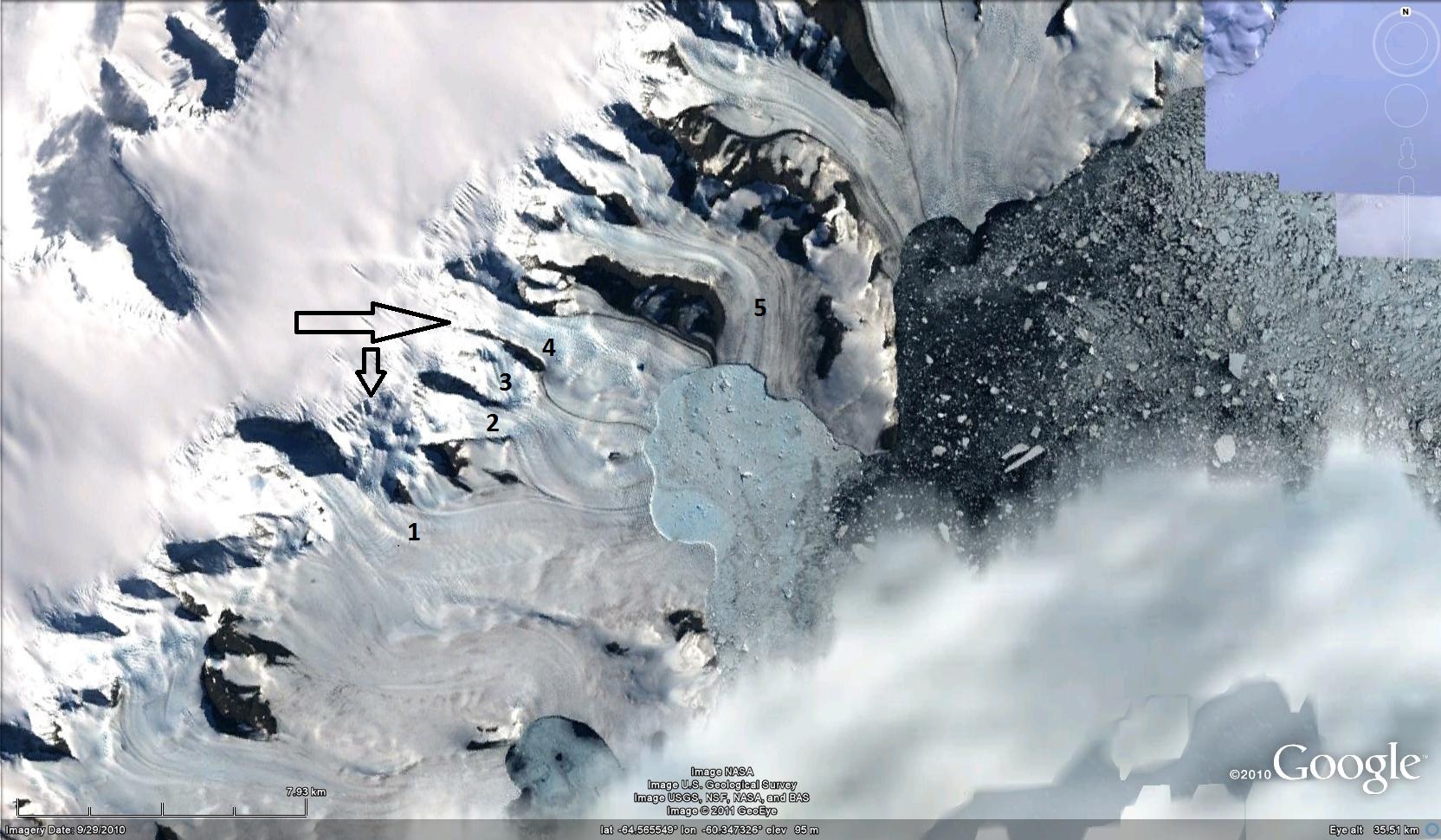 . The embayment itself has numerous icebergs suggesting the rapid ice discharge from the glaciers feeding this bay.
 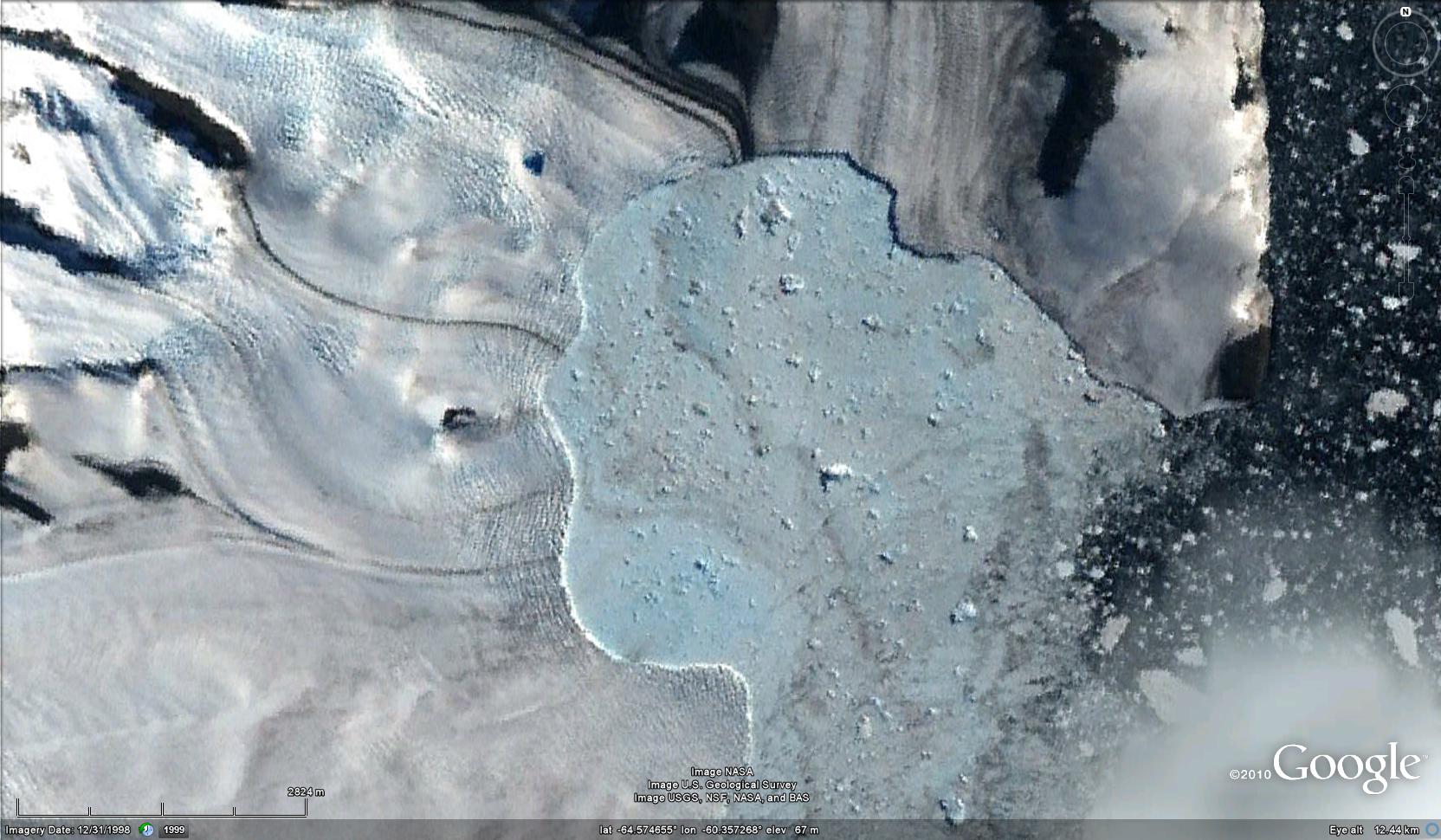 This bay has been ice covered for a long time, transitioning from a grounded ice sheet to an ice shelf environment 10,700 years ago, and which has persisted since (Brachfield et al, 2003). The embayment did not expanded notably from the Landsat imagery from 2001 to 2009, as seen in the 2001 Landsat
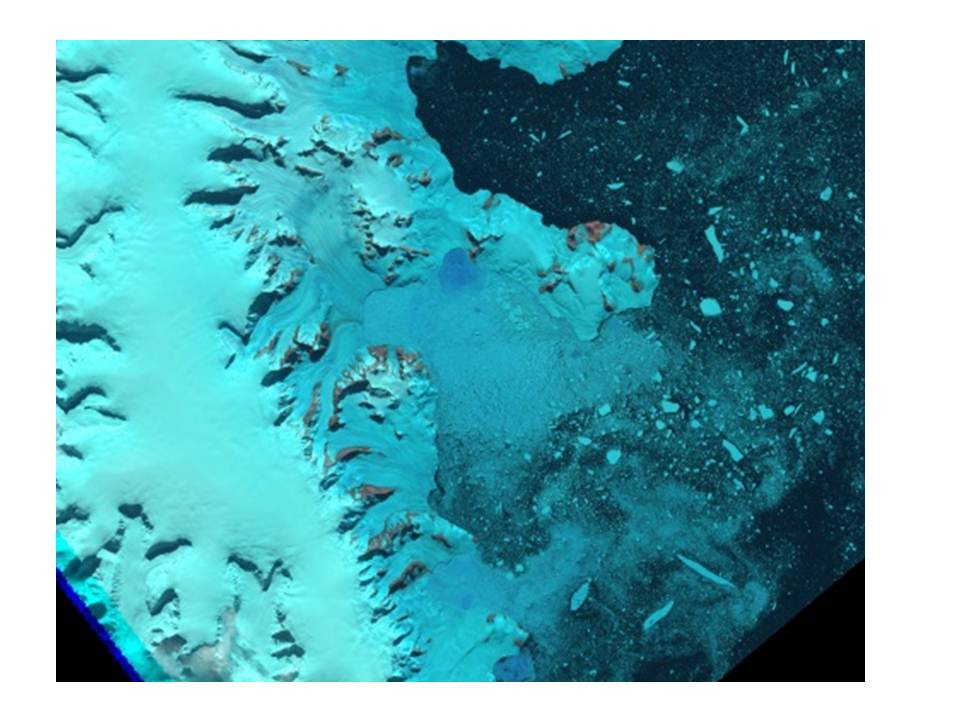 . In 2011 the retreat was significant as seen in MODIS imagery from Jan.27 the embayment has developed two lobes (note black arrows in image below.. The southern lobe has expanded by 1.5 km. The northern lobe by a smaller amount, but the area between glacier 4 and 5 is now a headland, indicating at least 500 meters of retreat.
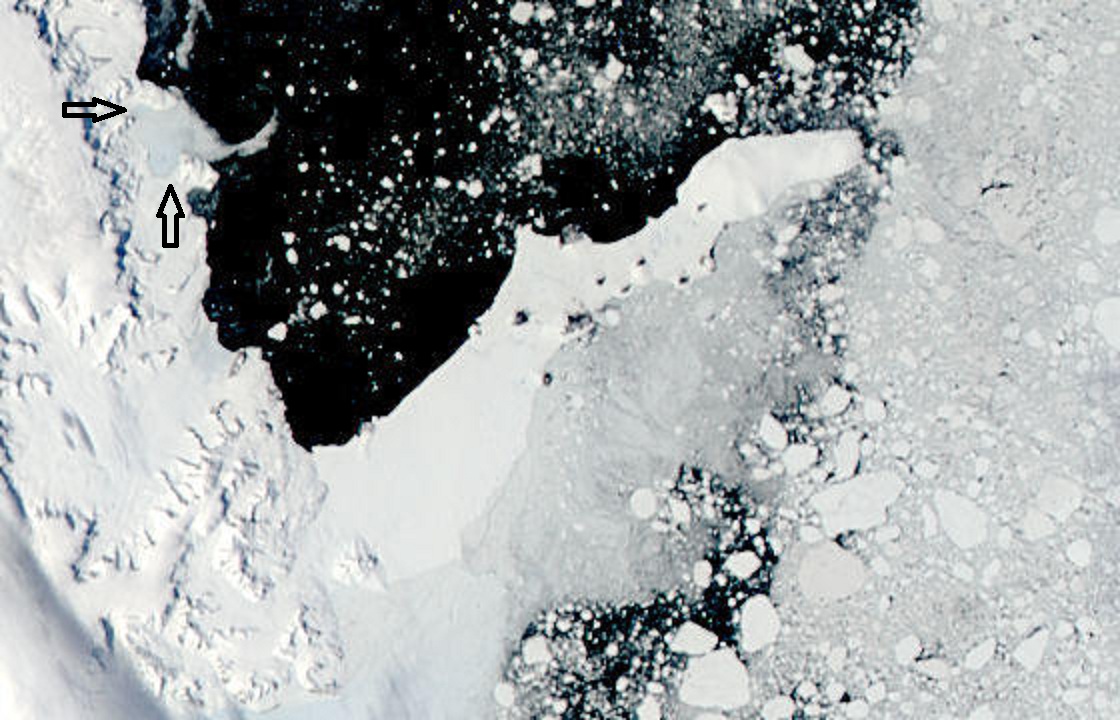 . The glaciers in this bay do not appear to have large floating sections generating tabular icebergs at this point, such as are evident on Fleming Glacier.
Grande Motte, Pramort Glacier Retreat and the Tignes Ski area, France
The Tignes ski area in France is famous for its great summer glacier skiing. The portion of the area that is generally open from early June to early September is on the Grand Motte Glacier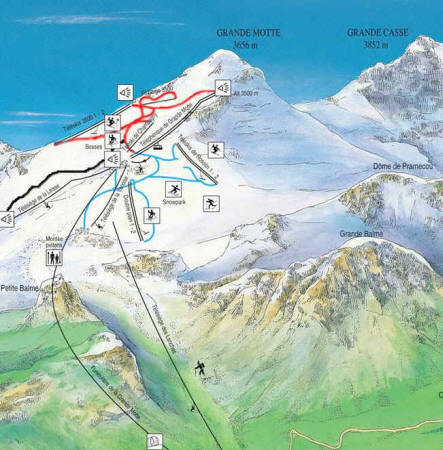
 . A webcam view for the glacier indicates that on Aug. 20th there is limited snowcover on the glacier, note the 3100 meter camera view, and the ski season will likely be cut short a bit. The bottom of the lift is at 3000 meters and the top of the lift is at 3450 meters. This webcam even has the ability to look back at archive coverage. To protect the ski season on the Grand Motte Glacier the resort has adopted the use of snow guns at the bottom of the Grande Motte Glacier lift. This is similar to the strategy on Pitzal Glacier. A look at the Grande Motte Glacier (Point A) and two neighboring glaciers indicates the issue.
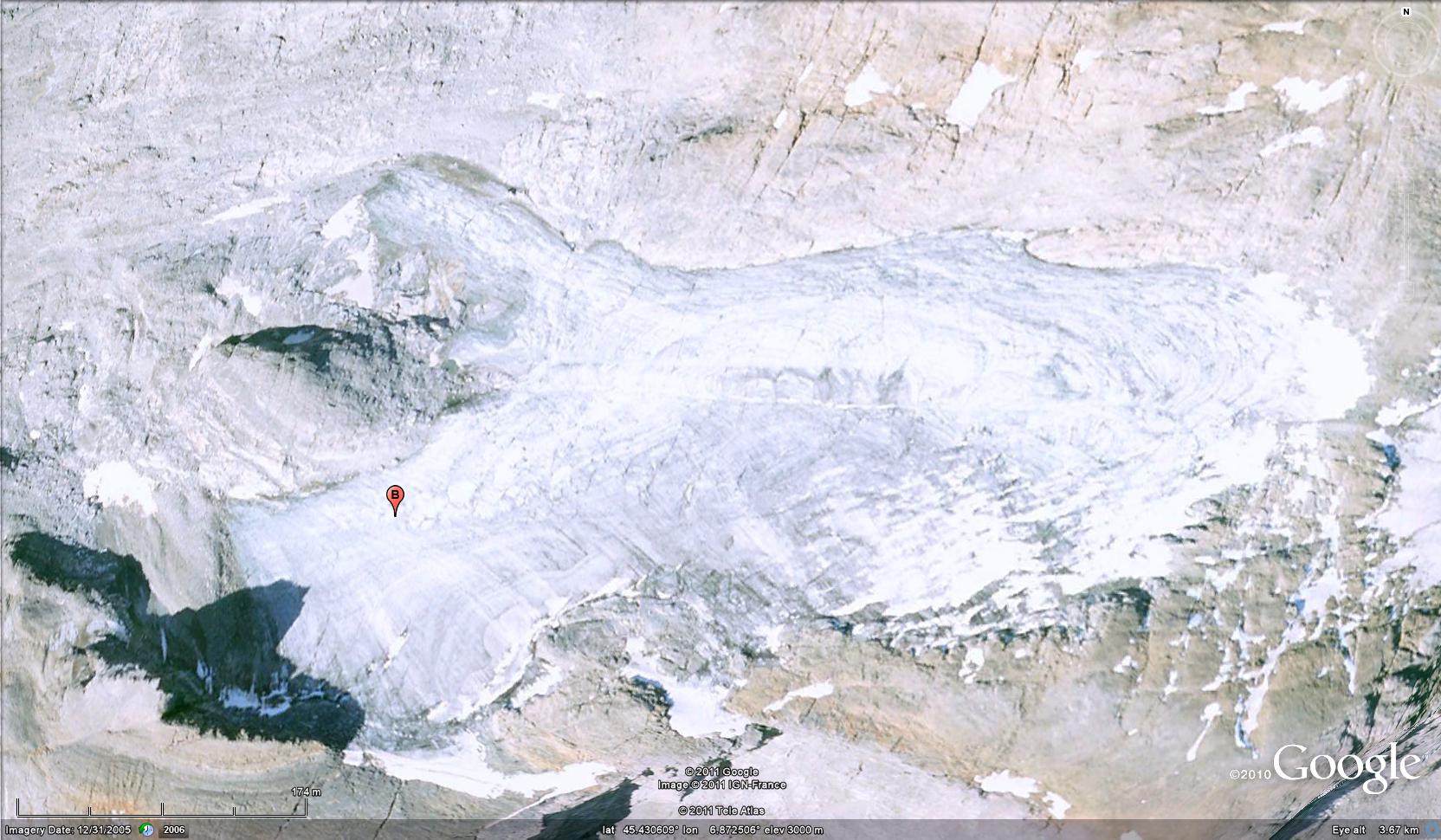
 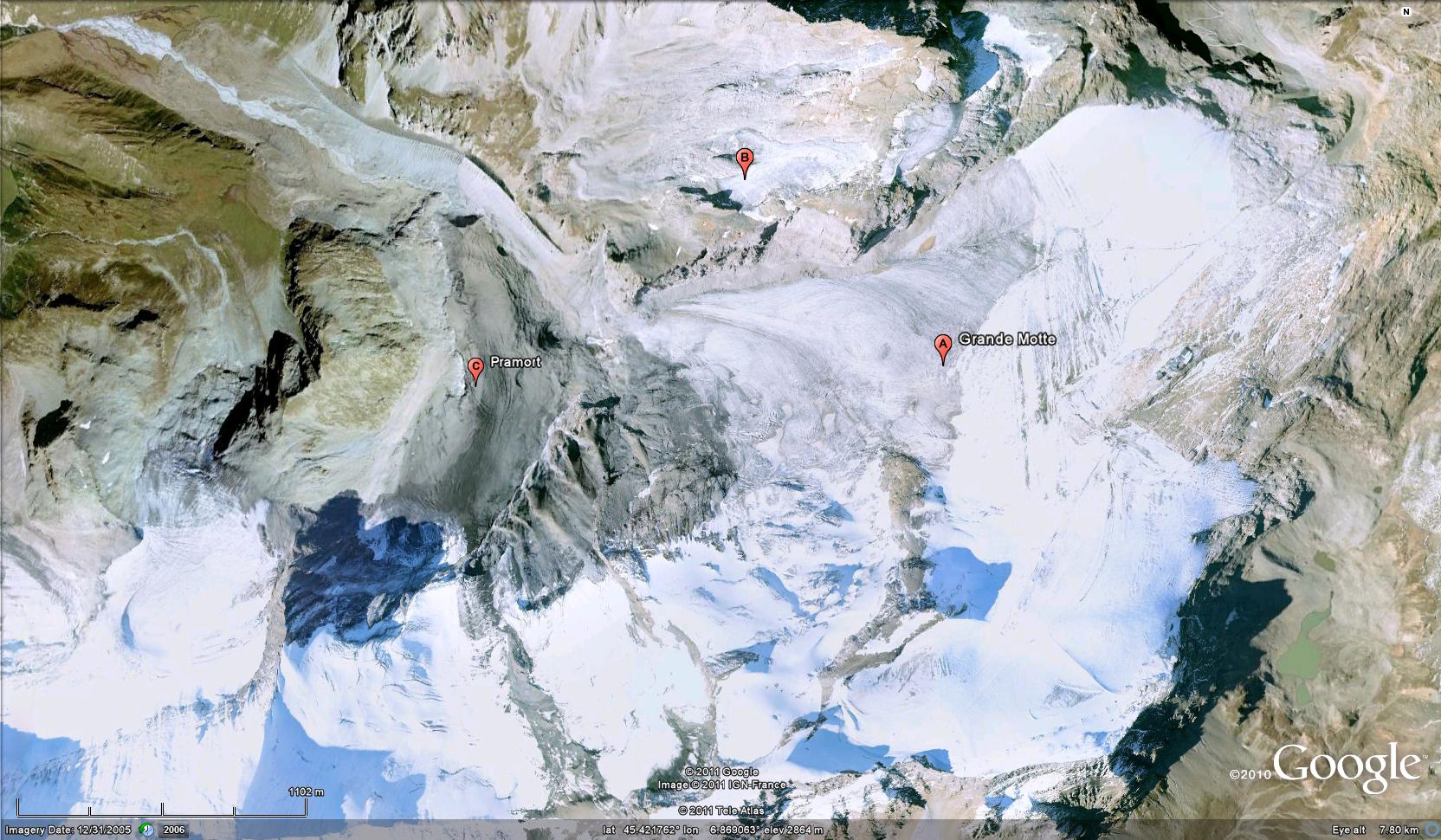 The terminus of Grande Motte Glacier at 2700 meters, top image, is thin and uncrevassed, indicating retreat will continue. In 2011 as in most years the majority of the glacier has lost its snowcover. This indicates a negative mass balance and continued glacier loss. The neighboring unnamed glacier, labelled B, is completely bare of snow in the Google Earth imagery, is quite thin and uncrevassed. This glacier has separated into three parts, the largest is labelled and is still 500 meters wide and 400 meters long, it will still melt away in the coming decade. The Parmort Glacier, Point C, used to be connected to the Grande Motte Glacier and the Premou Glacier. It is now a 1 km long debris covered stagnant terminus tongue ranging from 2700 meters to 2400 meters. This glacier has no snowcover at the end of most summer and is melting away. There are several areas of concentric crevasses that indicate basins beneath the glacier that periodicially fill with water lifting the glacier a bit, then drain, leading to the crevasses.
 The glaciated landscape in this area is changing dramatically(Gardent and Deline, 2011) noted a 30% loss in glacier area since the 1960’s. This trend is following the behavior of Glacier D’Argentiere and Mer De Glace. Those larger glaciers are not currently threatened, as these are with melting away.
 From a Glaciers Perspective