Turnback Glacier, South Georgia, Retreats from Tidewater

Turnback glacier 1999-2023

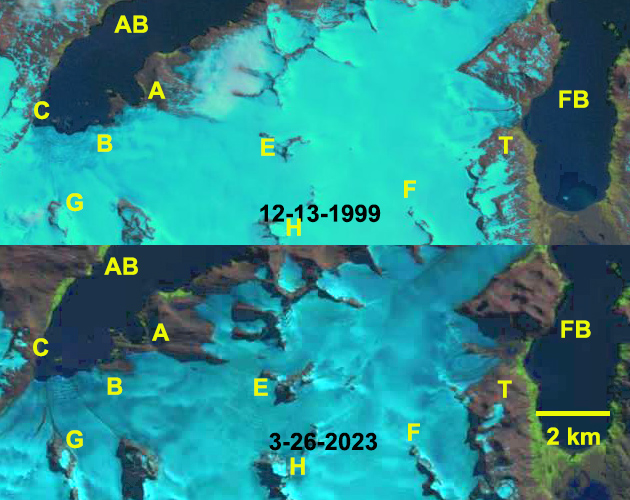
Retreat of Turnback Glacier (T) from the shore of Fortuna Bay (FB) and retreat of Compass and Crean Glacier (A,B,C) exposing new terrain along the shore of Antarctic Bay (AB) in Landsat images. Also note the expansion of bedrock nunatks at Point E-H.

Turnback Glacier terminated on the west shore of Fortuna Bay on the northwest coast of South Georgia Island.  In 1989 the glacier extended the shore of Fortuna Bay (BAS map).  Crean and Compass Glacier have a joint terminus at the southern end of Antarctic Bay terminating on new small islands and a small peninsula.  Gordon et al., (2008) observed that larger tidewater and sea-calving valley and outlet glaciers generally remained in relatively advanced positions until the 1980’s.  After 1980 most glaciers receded; many of these retreats have been dramatic including Twitcher, Herz, Ross, Hindle, Konig and Neumayer Glacier (Pelto, 2017).  Here we examine 1999-2023 Landsat imagery and 2017-2023 Sentinel images to identify glacier change.

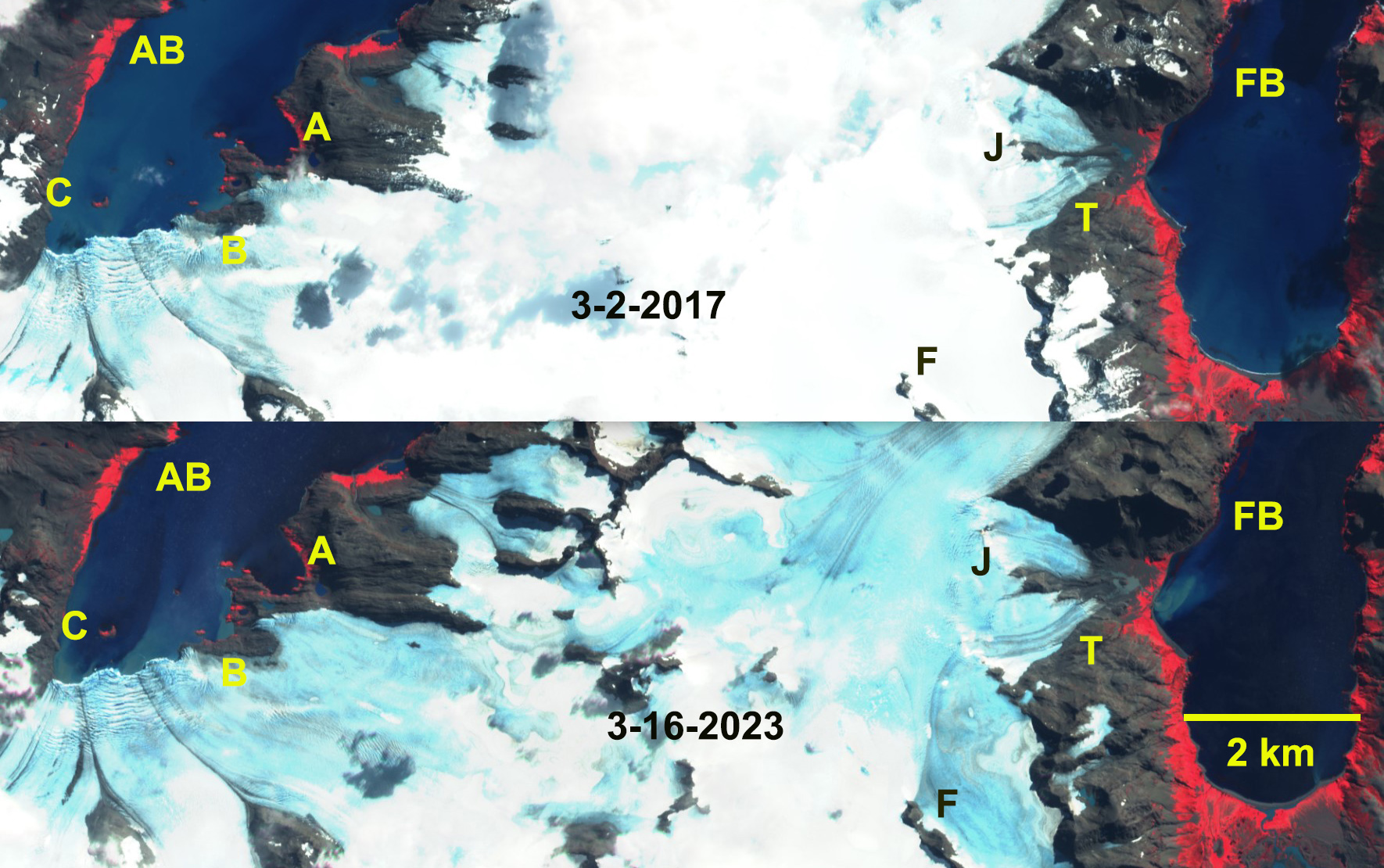
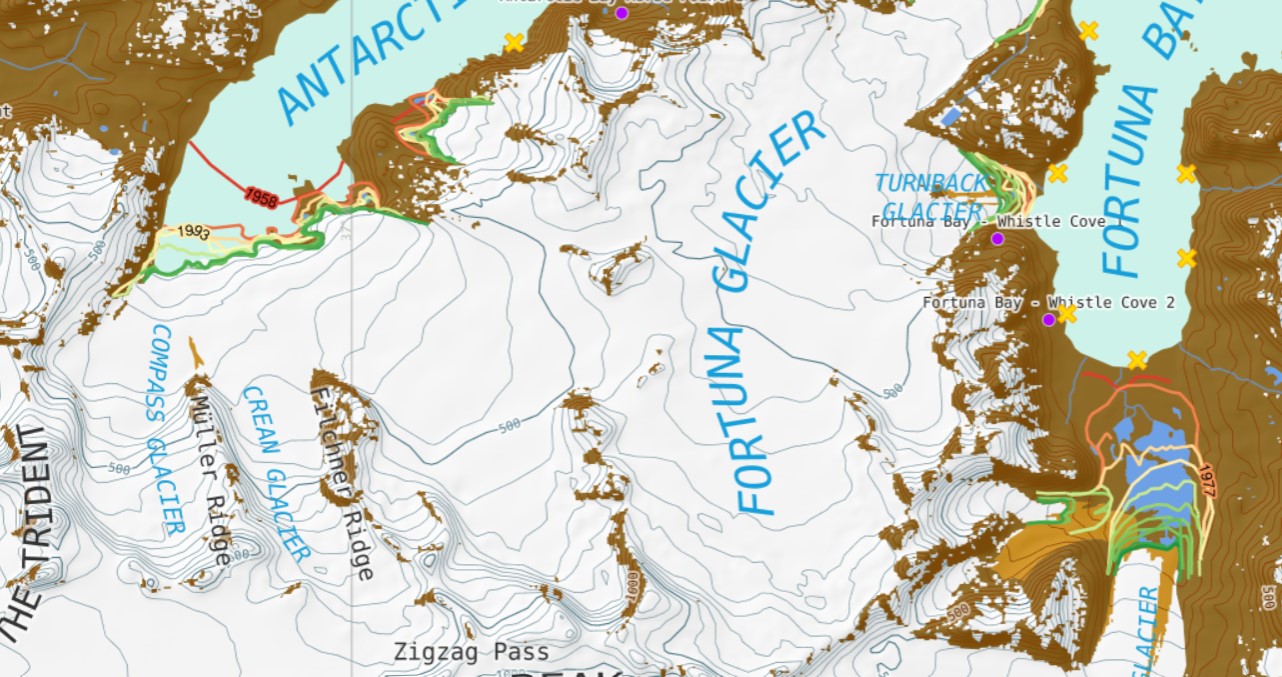
In 1999 Turnback Glacier (T) is within a 100 meters of the Fortuna Bay shore and has a single terminus with a medial moraine extending to the terminus near the glacier center. Crean and Compass Glacier have just retreated from two islands adjacent to Point B and C, and reaches the shore in a cove at Point A. By 2017 Turnback Glacier has retreated 500 m from the shoreline of Fortuna Bay and has begun to separate into two separate termini, with the medial moraine extending from Point J to the terminus still largely a medial moraine. An increasing area of deglaciated terrain extends from Point A-B along the shore where Crean Glacier is retreating. Compass Glacier has retreated 375 m from the island at Point C.  By 2023 Turnback Glacier has retreated 650 m, and has separated into two termini separated by a deglaciated ridge extending from Point J to the terminus. Compass Glacier has retreated 450 m from the island at Point C. At Crean Glacier there is a 1 km² contiguous area of deglaciated terrrain along the shore that previously had been smaller separated segments. The glaciers begin on shared accumulation plateau with Fortuna Glacier at 500-600 m. This region is thinning as indicated by the increasing exposure of nunataks at Point E-H, which will drive ongoing retreat.  The British Antarctic Survey map below illustrates glacier retreat and the elephant seal beaches (yellow X) and penguin colonies (purple dots) in the two bays.

The retreat here is signficicantly less than the larger glaciers Ross/Hindle, Neumayer, Konig and Twitcher Glacier, but is still exposing new coastal regions that are being occupied by flora and fauna.

Turnback glacier 2017-2023

Retreat of Turnback Glacier (T) from the shore of Fortuna Bay (FB) and retreat of Compass and Crean Glacier (A,B,C) exposing new terrain along the shore of Antarctic Bay (AB) in false color Sentinel images. Also note the expansion of bedrock nunataks at Point E-H. Also the medial moraine transitioning to deglaciated ridge at Point J.

turnback glacier map

British Antarctic Survey map of the Fortuna Bay to Antarctic Bay shoreline and glaciers. Colored lines indicate glacier retreat, yellow X=elephant seal beaches, purple dots=penguin colonies.

Novosilski Glacier, South Georgia Retreat Causes Separation

Novosilski Glacier in Landsat images from 2020 and 2022. Note the retreat near Point A in particular. The terminus that extended from Point B-C developed an embayment reaching Point A.

Novosilski Glacier is a large tidewater outlet glacier on the west (cloudier) coast of South Georgia terminating in Novosilski Bay It shares a divide with the rapidly retreating Ross and Hindle Glacier on the east coast.  Gordon et al. (2008) observed that larger tidewater and calving outlet glaciers generally remained in relatively advanced positions from the 1950’s until the 1980s. After 1980 most glaciers receded; some of these retreats have been dramatic, such as at Neumayer Glacier. The west coast has featured much less retreat than the east coast.  The change in glacier termini position have been documented by Cook et al (2010) at British Antarctic Survey in a BAS retreat map,  identified that 212 of the Peninsula’s 244 marine glaciers have retreated over the past 50 years and rates of retreat are increasing. Pelto (2017) documented the retreat of 11 of these glaciers during the 1989-2015 period.  NASA Earth  piggy backed on the retreat of some east coast glaciers seen in Landsat images.

Novosilski Glacier in Landsat images from 20o3 and 2022. Note the retreat from Point D  in 2003 to Point A in 2022  ed from Point B-C developed an embayment reaching Point A.

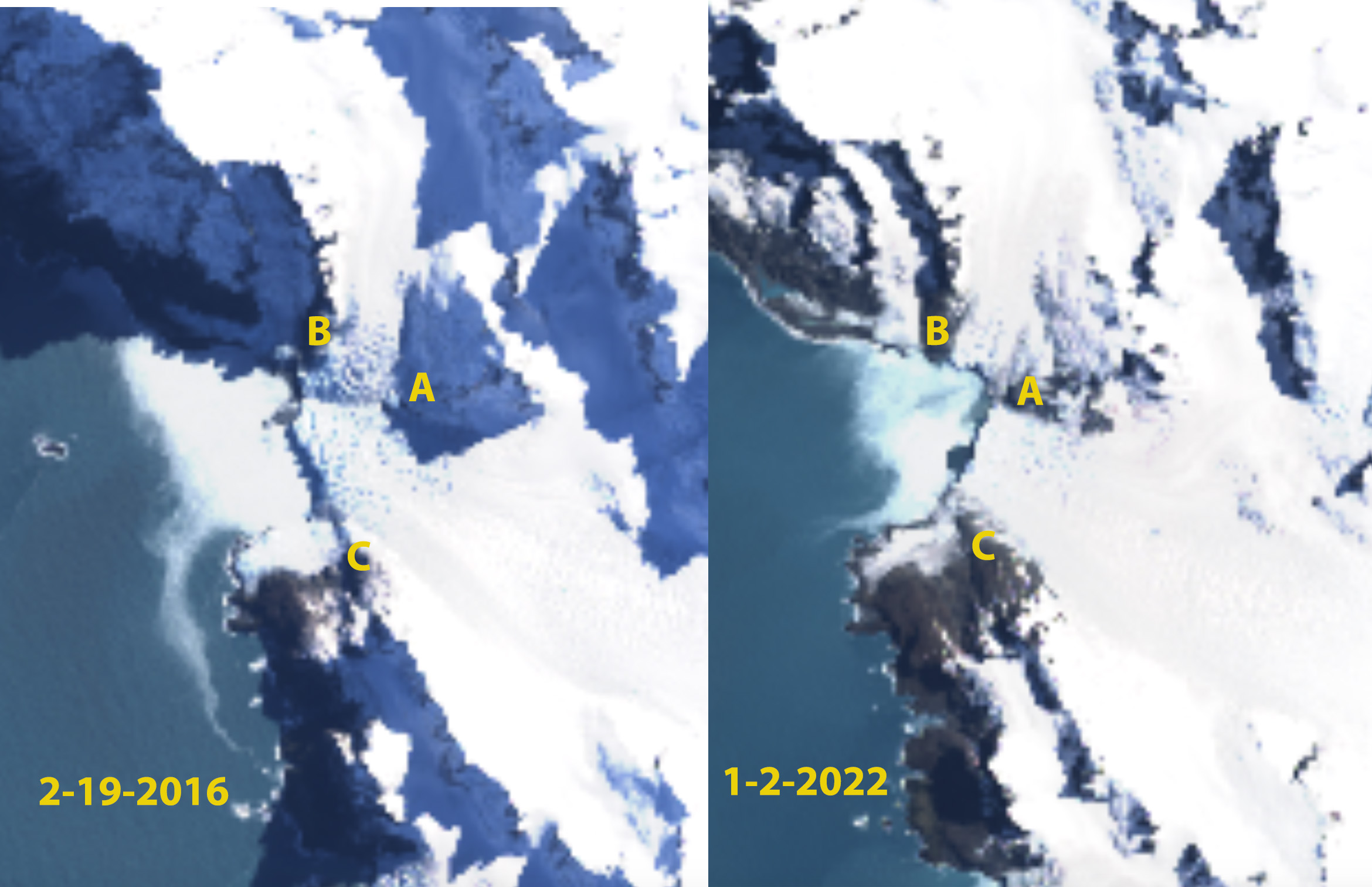
In 2003 Novosilski Glacier terminated in shallow water just east of a small island that acted as a pinning point, Point D.  By 2009 the glacier had retreated only a minor amount from this island into deeper water.  A rapid retreat ensued and by 2016 the glacier had retreated into a narrower fjord reach. The north and south margins featured remnant ice that was based above tidewater, Point B and C.  By 2016 the 2 km wide calving front had retreated 2.5 km from the 2003 position.  There was no significant retreat from 2016 to 2020.  By March of 2022 the glacier has retreated 1 km in the glacier center further leading to separation of the glacier into a northern and southern arm separated by the the Point A rock rib. The retreat also has led to a 6 km2 expansion of Novosilski Bay. The glacier slope at the terminus is steep and active, suggesting retreat may slow again.

Novosilski Glacier in Landsat images from 2016 and 2022. Note the retreat near Point A in particular. The terminus that extended from Point B-C developed an embayment reaching Point A.


Hindle Glacier Retreat Causes Rapid Opening of Fjord, South Georgia

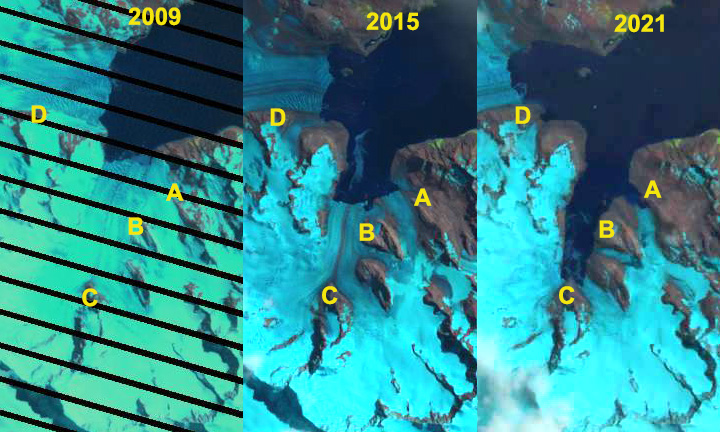
Hindle Fjord opening comparison in 2009, 2015 and 2021 Landsat images.  Point A is the northern tributary, Point B the middle tributary, Point C separates the eastern and western tributary and Point D is Ross Glacier.

Hindle Glacier enters Royal Bay on the east coast of South Georgia Island.  The British Antarctic Survey (BAS) has been the  examining glacier change on South Georgia Island, Cook et al (2010) noted a pattern island wide with many calving glaciers having the fastest retreat.  Alison Cook (BAS) identified that 212 of the Peninsula’s 244 marine glaciers have retreated over the past 50 years and rates of retreat are increasing.  In 2017 we examined Landsat imagery from 1989 to 2017 to identify the rapid retreat rate of Hindle Glacier. NASA Earth  piggy backed on this assessment, with excellent imagery, since the retreat rate has increased. Here we focus on the formation of the fjord from 2009-2021.

For Ross-Hindle Glaicer in 1989 the glaciers joined 2.5  km from the terminus spanning Royal Bay with a 3.2 km wide calving front.  By 2001 the glacier front had retreated 800 m, but was still a single joined calving front. By 2009 the glaciers had separated due to an additional retreat of  1.4 km. The Hindle Glacier front was now retreating south up opening a new separate fjord from Ross Glacier.  The calving front in 2009 was 1.6 km wide.  By 2015 a 1.6 km retreat led to the separation of Hindle from the northern tributary, Point A.  From 2015 to 2019 the main terminus retreated another 2.1 km, passed the middle tributary at Point B, to a prominent rock knob, Point C, separating the two main tributaries of the glacier with total retreat of  6.1 km in 30 years, an exceptional rate of over 200 m/year. The western tributary is at the head of the fjord and no longer calves significantly, while the eastern tributary has another 1 km to an increase in slopes that likely is close to head of the fjord. The new fjord is 4.5 km long and averages 1.1 km in width and has an area of 5.5 km2.  The northern tributary near Point A is also still calving and retreating.

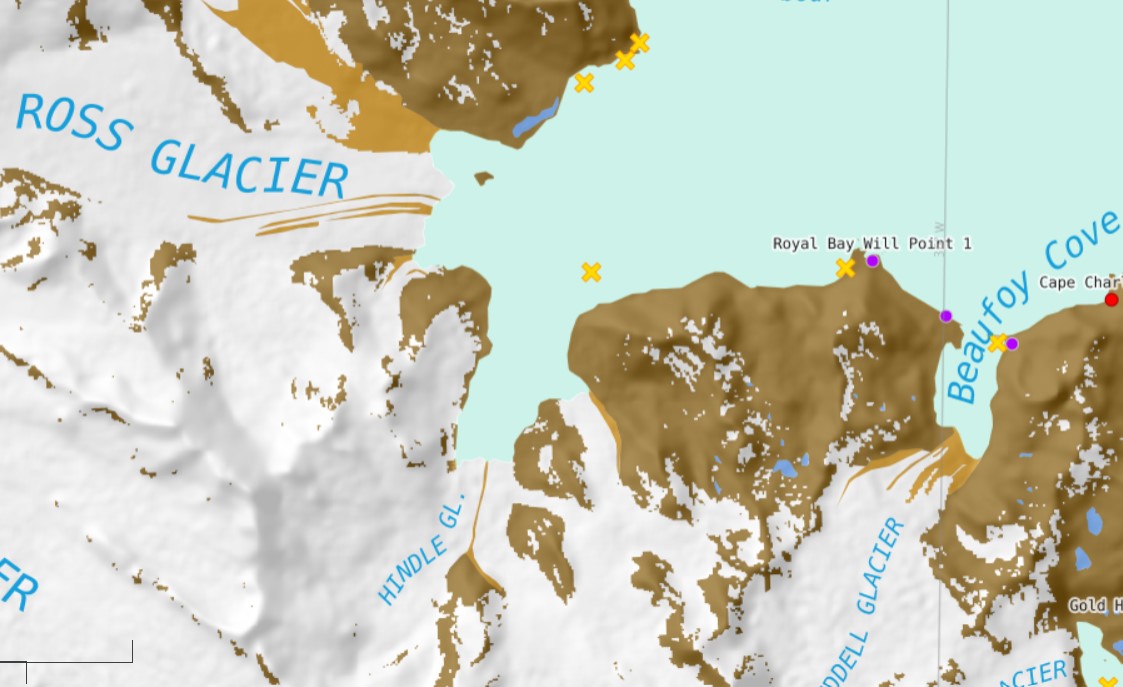
This embayment opens up new areas for Gentoo Penguins and Elephant Seals to occupy. There are current colonies in Royal Bay and like at Moraine fjord, these two species are early colonizers of deglaciated terrain (see map below from BAS). In particular the beaches adjacent to the northern tributary, just north of Point B and northwest of Point A are wave protected and low slope.  Levy et al (2016) discuss that the southern Gentoo Penguins tend to remain within the same archipelago year around. They examined DNA from 39 Gentoo at Bird Island, adjacent to South Georgia, and found none were migrants.

Hindle Fjord in 2020 and 2021 Sentinel images indicating ongoing retreat at Point A and C, with a significant sediment plume from Point B in December 2020. Point A is the northern tributary, Point B the middle tributary, Point C separates the eastern and western tributary and Point D is Ross Glacier.

Hindle Glacier comparison in 2001, 2017 and 2019 Landsat images.  The red arrow is the 2001 glacier terminus. Point A is the northern tributary, Point B the middle tributary, Point C separates the eastern and western tributary and Point D is Ross Glacier.

British Anatarctic Survey map of Royal Bay area showing Elephant Seal beaches (yellow X) and Gentoo Penguin colonies (purple dots).

Herz Glacier, South Georgia Loses 25% of its Length 1989-2021

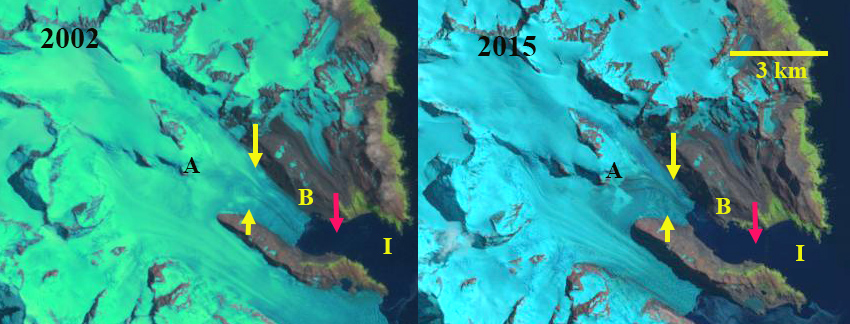
Landsat images from 1989-2021 of Herz Glacier.  Red arrow is 1989 terminus location, yellow arrows the 2021 terminus location. I=Iris Bay.

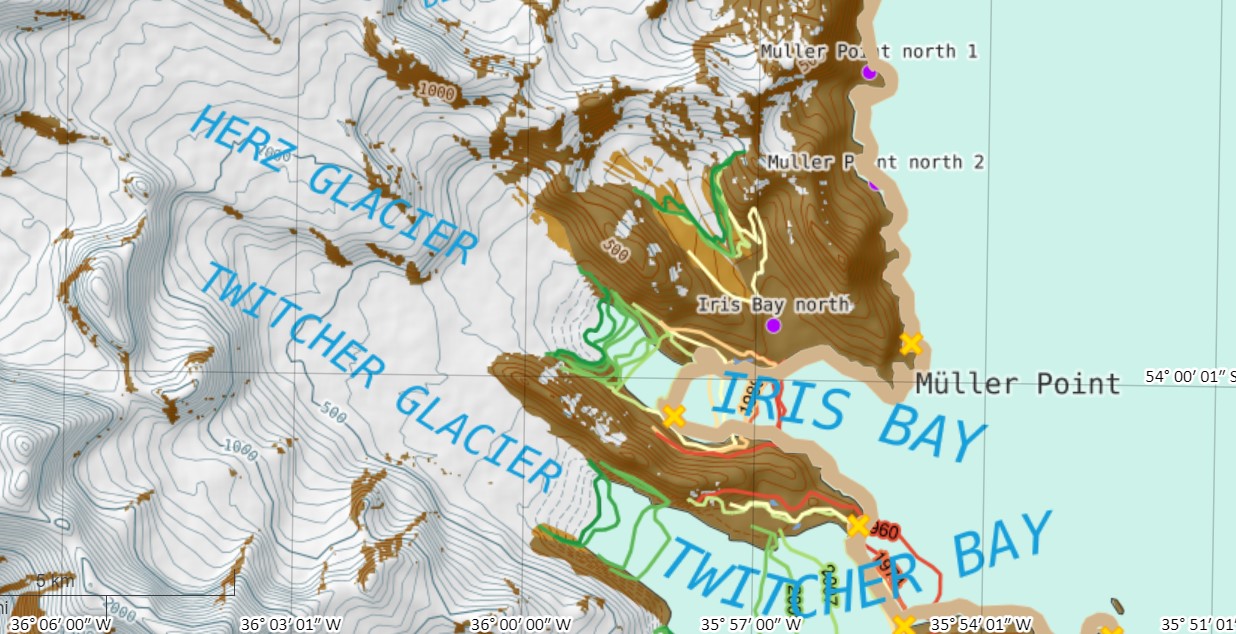
Herz Glacier is on the southeast coast of South Georgia Island, and is adjacent to the Twitcher Glacier. The terminus change of this tidewater glacier ending in Iris Bay was completed by the British Antarctic Survey for the 1960-2011 period, see map below (Gordon et al, 2008). This map indicates the slow retreat from 1960-1988 and a more rapid retreat since. Here we utilize Landsat imagery from 1989-2021 to examine terminus change.

In 1989 the glacier is 10 km long with the terminus located in the east trending arm of Iris Bay at a point where it widens substantially. Point A is the midway point of the glacier.  By 2002 the terminus has retreated ~1.1 km to Point B in a narrower portion of the fjord.  The calving front is 0.9 km wide in 2002.  By 2009 the glacier had retreated 1.8 km on the north side of the fjord and  2.2 km on the south side. The overall 2 km retreat is a rate of 100 meters/year and is 20 % of the total glacier length (Pelto, 2017). By 2015 the terminus has retreated into an even narrower portion of the fjord, which would reduce calving.  The snowline in both 2002 and 2015 is ~1000 m. In 2021 the terminus has continued to recede and could be nearing the head of the fjord. The snowline in 2021 is somewhat above 1000 m in the early March landst image.

The retreat has been 2.5 km in the 32 year period from 1989-2021, a rate of  78 m/year.  The glacier is nearing the inland end of the ridge separating Herz from Twitcher.  As both Twitcher Bay and Iris Bay have expanded there are certainly new locations for both elephant seal and penguin colonies (BAS, 2018). The retreat of this glacier is comparable to that of other South Georgia glaciers noted by NASA Earth Observatory; Neumayer Glacier, Twitcher Glacier and Hindle Glacier.

Landsat images from 2002 and 2015 of Herz Glacier.  Red arrow is 1989 terminus location, yellow arrows the 2021 terminus location. I=Iris Bay.

Map of Herz Glacier area from the British Antarctic Survey, illustraing glacier front changes 1988-2011. Yellow crosses mark elephant seal beaches and purple dots penguin colonies, which can expand to new locations in this opening fjord.

Weddel Glacier Retreats from Tidewater, South Georgia Island

Weddel Glacier in 1989 and 2020 Landsat images.Red arrow marks the 1989 NW terminus, orange dots the terminus location, purple arrows locations of ice spilling over a ridge, pink arrow a tributary glacier and yellow arrow the base of an icefall.

Weddel Glacier is on the southeast coast of South Georgia Island terminating in Beaufoy Cove  just north of Gold Harbor. The change in glacier terminus position was documented by Alison Cook at British Antarctic Survey in a BAS retreat map.  In 1958 it reached within 400 m of the outlet of Beaufoy Cove.  For Weddel Glacier the retreat was rapid from 1960 to 1974 and was slow from 1992-2003.  Here we examine Landsat imagery from 1989 to 2020 to visualize and update this change.

In 1989 the glacier terminates near the tip of a peninsula, red arrow in each image. The calving front extends southeast, orange dots. At the yellow arrow the glacier fills a small side valley adjacent to the main glacier. At the purple arrows are two locations where ice spillovers a bedrock ridge.  The pink arrow indicates a low elevation tributary glacier joining the main glacier, its highest elevation is 500 m.  In 2002 there is only minor retreat between the red and yellow arrow, but thinning has led to the small extension of the main icefall being almost cutoff by bedrock. By 2015 the glacier has retreated 200-300 meters from the 1989 position and the main terminus is narrower and calving has essentially ceased. At the purple arrow this is just bedrock now, there is no glacier extension flowing down the bedrock step. At the pink arrow the tributary glacier connection has narrowed, but is still connected. The glacier connection to Beaufoy Cove is almost gone in 2015.  By 2020 the glacier has receded from the tidewater of Beaufoy Cove.  The greening of the area around the cove is also evident. The tributary on the east side at pink arrow is no longer connected to the main glacier. The ridge at the upper purple arrow is just bedrock, while the lower purple arrow marking a pass to Bertrab Glacier has narrowed and bedrock has emerged at this 500 m glacier divide.

Weddel Glacier retreat is a 400 m since 1989, which is quite limited compared to Neumayer Glacier which retreated 8.8 km from 1999-2020 or Hindle Glacier which retreated 4.4 km from 1989-2017. This retreat of glaciers on South Georgia is portrayed in NASA Earth Observatory feature.

Weddel Glacier in 2002 and 2015 Landsat images. Red arrow marks the 1989 NW terminus, orange dots the terminus location, purple arrow indicates ice spilling over a ridge, pink arrow a tributary glacier and yellow arrow the base of an icefall.

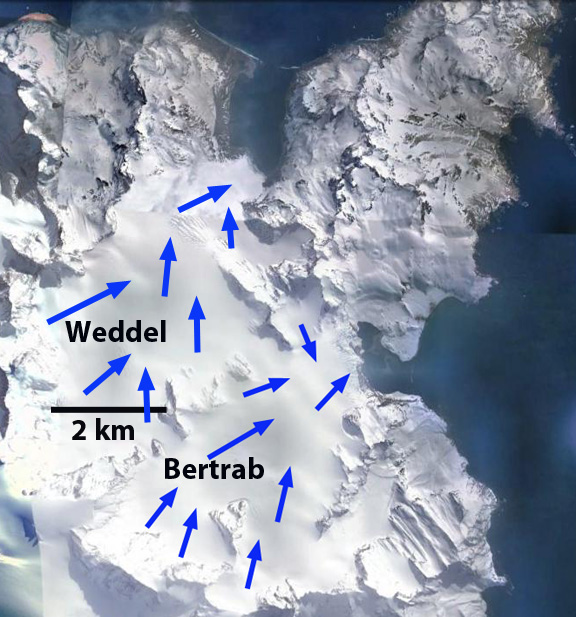
Weddel Glacier flow.


Neumayer Glacier 8.8 km retreat 1999-2020 Fjord Expansion

Neumayer Glacier (N) in 1999 and 2020 Landsat images. Red arrow is 1999 terminus position, pink arrow 2016 terminus location and yellow arrow March 2020 terminus location. K=Konig and T=Three Brothers Tributary, L=glacial lake.

Neumayer Glacier, South Georgia  is a calving glacier that has been retreating rapidly since 1993 that was dynamically connected to the Konig Glacier along its southern margin just where the glacier turns northeast  The glacier ends in a fjord that until recently was too short to be given a name, that empties into Cumberland Bay.  Gordon et al., (2008) observed that larger tidewater and sea-calving valley and outlet glaciers generally remained in relatively advanced positions until the 1980’s.  After 1980 most glaciers receded; some of these retreats have been dramatic (NASA, 2017).  The BAS has a mapping function that provides glacier front positions since early in the 20th century (Cook et al 2010). For Neumayer Glacier the 1938 position is 3.5 km down fjord from the 2006 position. There was essentially no retreat up to 1974 and limited retreat up to 1993. Here we examine 1999-2020 Landsat imagery to identify glacier change.

In 1999 and 2002 the glacier extends passed the junction with Konig Glacier terminating in 2 km wide calving front. By 2002 the glacier had retreated 0.5 km, by 2006 1.8 km, by 2011 3.0 km and by 2016 5.3 km.  A glacier dammed lake (L) along the north shore of the fjord no longer exists in 2016 and one tributary from the south is no longer connected. The glacier appears to have retreated into a deeper section of the fjord then where it ended from 1970-2002. The glacier is on the verge of separation into two main tributaries, Konig and Neumayer. In 2016 the calving front is 1.6 km long for Neumayer.  Konig Glacier has a 1.3 km long tidewater front, but has limited calving. In 2018 I reported that the glaciers had separated (Pelto, 2018), with Neumayer Glacier still being in rapid retreat and Konig Glacier changing little. A tributary (T) from the south that parallels the Three Brothers Range, is still connected to Neumayer Glacier. In January 2020 the glacier remains connected to tributary (T). By early March 2020 the glacier has further retreated separating from tributary (T).  The total retreat from 1999-2020 is 8.8 km, a retreat rate of over ~420 m/year. In the BAS map it is evident that there is a smaller slope change 2 km from the current terminus and a large slope change 5 km from the current terminus.  The former may represent the end of the fjord or at least a significant shallower.  The latter slope change is certainly the end of the low slope valley reach of the glacier, whether that be a shallow fjord or not. This is one of the most dramatic South Georgia glacier retreats along with Ross and Hindle Glacier (Pelto, 2017). Cook et al (2010) noted the average retreat of glaciers in this area of South Georgia of 60 m/year for the

Neumayer Glacier (N) in 2002 and 1-2020Landsat images.Red arrow is 2002 terminus position, pink arrow 2016 terminus location and yellow arrow March 2020 terminus location. K=Konig and T=Three Brothers Tributary.

Neumayer Glacier (N) in 2016 and 2018 Landsat images. Red arrow is 2002 terminus position, pink arrow 2016 terminus location and yellow arrow March 2020 terminus location. K=Konig and T=Three Brothers Tributary.

Neumayer Glacier (N)  in South Georgia GIS Map from the BAS showing terminus change. 

Nordenskjold Glacier, South Georgia Retreat Accelerates

Nordenskjold Glacier in 1993 and 2019 Landsat images.  Red arrow is the 1989 terminus location, yellow arrows the 2019 terminus location. Purple arrow is a tributary that has separated. Point #1 and #3 is expanding bedrock ribs.  Point #2 is an impounded glacial lake.

Nordenskjold Glacier is a tidewater glacier flowing into Cumberland East Bay on the east coast of South Georgia, Island.  Cook et al (2010) and Gordon et al (2008) noted a pattern island wide with many calving glaciers having the fastest retreat.  Gordon et al., (2008) observed that larger tidewater glaciers remained in relatively advanced positions from the 1950’s until the 1980’s, followed by significant recession,  this retreat was delayed on Nordenskjold Glacier until 2000. The map below from the British Antarctic Survey indicates the slow retreat from 1957-1998 and a more rapid retreat since. Here we use Landsat imagery from 1989-2019 to identify changes.

In 1989 the glacier terminated at approximately the same location as in 1957. Vegetation extended quite close to the terminus with a minimal trimline or recently deglacated zone evident. At Point #1 and #3 are bedrock ridges that generate medial moraines. At Point #2 is a glacial lake impounded by a secondary terminus. At the purple arrow is a tributary glacier joining the main glacier. By 1993 there has been a limited retreat exposing some newly deglaciated unvegetated terrain adjacent to the shoreline and glacier terminus. There was limited additional retreat up to 2000. This is unusual as the neighboring glaciers had all retreated substantially by 2000. By 2016 the glacier had retreated substantially, ~900 m. The tributary at the purple arrow no longer reaches the main glacier. At Point #2 the impounded lake has expanded slightly and is open water. The snowline is also at 500 m above Point #1 and #3.  In 2019 the snowline is again above 500 m. The area of bedrock at Point #1 and #3 has expanded significantly indicating glacier thinning, and greater ablation at this elevation. The terminus has retreated an average of 1250 m from 1989-2019. There is a significant trimline and recently deglacited terrain on the western shore of the bay.

The retreat is much less than on Neumayer, Twitcher or Hindle Glacier. The upglacier thinning suggests this process will continue, with a 3.2 km wide calving front in water of unknown depth calving will continue to be a key driver of retreat.

Nordenskjold Glacier in 1989 and 2016 Landsat images.  Red arrow is the 1989 terminus location, yellow arrows the 2019 terminus location. Purple arrow is a tributary that has separated. Point #1 and #3 is expanding bedrock ribs.  Point #2 is an impounded glacial lake.

Map of terminus change from the British Antarctic Survey map platform

Twitcher Glacier, South Georgia, 40% of Length Lost 1989-2019

Twitcher Glacier in Landsat images from 1989 and 2019.  The red arrow is the 1989 terminus and yellow arrow is the 2019 terminus.  1, 2 and 3 are tributaries.

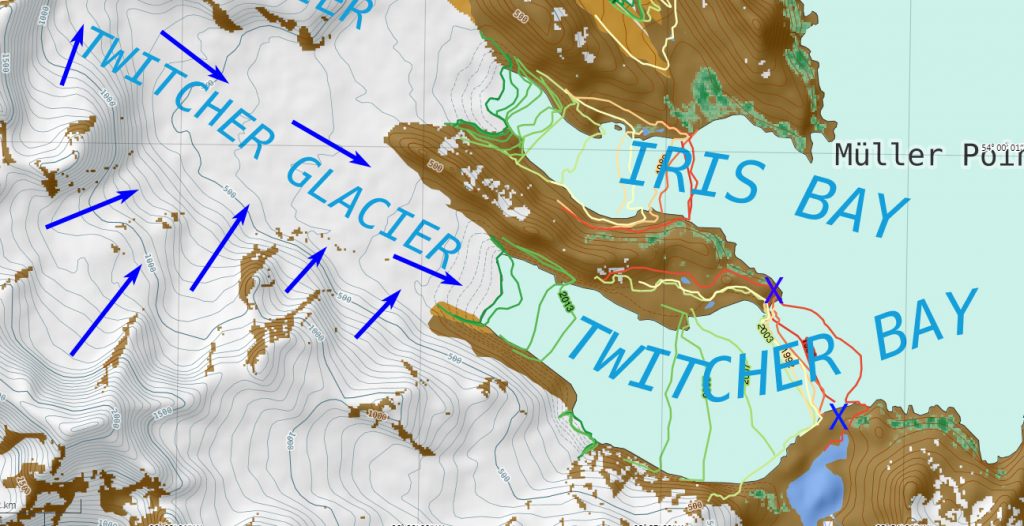
Twitcher Glacier is the next glacier south of Herz Glacier on the east coast of South Georgia. Until 1989 the glacier ended at the tip of a peninsula, the ensuing retreat has led to the opening of a new fjord.  Twitcher Glacier was 12 km long and had a 2.3 km wide calving front in 1989. The terminus change of this tidewater glacier was completed by the British Antarctic Survey for the 1960-2007 period. The glacier retreated 1.5 km between 1960 and 2007, with half of the retreat occurring after 1992 (Gordon et al, 2008). The map below indicates the slow retreat from 1960-1988 and a more rapid retreat since.

In 1989 this glacier terminated approximately at the end of a peninsula separating the two glaciers. Here we examine Landsat imagery from 1989, 2002, 2015 and 2019 to identify the rate retreat. The 1989 terminus position is indicated with the down pointing red arrow and the 2019 terminus position with a yellow arrow. The retreat is less than 0.5 km  from 1989-2002. Three tributaries from the south side are feeding the main glacier in 1989 and in 2002.  By  2015 the glacier has retreated  a further 1.7 km retreat and tributary #1 now flows directly into the expanding Twitcher Bay. By 2019 tributary #2 has detached from the glacier as well.  The glacier retreat from 1989-2019 has been 5.2 km, which is 40% of its 12 km length in 1989.  last image is a closeup in Google Earth from 2010 note the significant crevassing which is indicative of rapid flow. The terminus is currently quickly retreating to the next peninsula where the terminus will separate into two parts.  The retreat of this glacier rivals that of both Neumayer Glacier and Hindle Glacier that have also separated and opened up large new fjord reaches NASA Earth focused on this assessment. Hindle and Twitcher have both had the fastest retreat since 2015. The glacier currently has a 1 km wide calving front, but this should widen some as tributary #3 is reached.  This will lead to greater retreat in terms of area if not length.

Twitcher Glacier in Landsat images from 2002 and 2015.  The red arrow is the 1989 terminus and yellow arrow is the 2019 terminus.  1, 2 and 3 are tributaries.

Retreat of Twitcher Glacier in the BAS map from 1988-orange lines to 2017 green line at glacier front.

Hindle Glacier Retreat, South Georgia 2 km 2015-2019

Hindle Glacier comparison in 2017 and 2019 Landsat images.  Red arrow is 1989 terminus, pink arrow the 2015 terminus, yellow arrow the 2017 terminus location and green arrow the 2019 terminus location. 

South Georgia is south of the Polar Front preventing any truly warm season, with the cool maritime climate leading to numerous glaciers covering a majority of the island.  Hindle Glacier enters Royal Bay on the east coast of South Georgia Island.  The British Antarctic Survey (BAS) has been the principal research group examining glacier change on South Georgia Island.  Cook et al (2010) and Gordon et al (2008) noted a pattern island wide with many calving glaciers having the fastest retreat.  Gordon et al., (2008) observed that larger tidewater glaciers remained in relatively advanced positions from the 1950’s until the 1980’s, followed by significant recession.   Alison Cook at British Antarctic Survey identified that 212 of the Peninsula’s 244 marine glaciers have retreated over the past 50 years and rates of retreat are increasing.   In 2017 we examined Landsat imagery from 1989 to 2017 to identify the rapid retreat rate.  NASA Earth  piggy backed on this assessment, with excellent imagery, since the retreat rate has increased. Here we update the retreat with 2019 Landsat images.

For Ross-Hindle the retreat was minimal from 1960 to 1989 with the glaciers joined   In 1989 the glaciers joined 2.5  km from the terminus. The glacier spanned Royal Bay with a 3.2 km wide calving front.  By 2002 the glacier front had retreated 800 m, but they were still joined. By 2008 the glaciers had separated due to an additional retreat of  1.4 km. The front was now retreating south up a separate embayment from Ross Glacier.  The calving front in 2008 was 1.6 km wide.  By 2015 further retreat led to the separation of Hindle from an eastern tributary at the first prominent headland in the fjord, a 1.6 km retreat in seven years.  By 2017 an additional 600 m of retreat had occurred.  From 2017 to 2019 the terminus retreated another 1.5 km back to a prominent rock knob separating the two main tributaries of the glacier with total retreat of  6.1 km in 30 years. This is a rate of over 200 m/year, which is an exceptional rate.  Over the 2015-2019 period the glacier retreaeted over 2 km, more than 500 m/year. The western tributary appears to be at the head of the fjord, while the eastern tributary has another 1 km to an increase in slopes that likely is close to head of the fjord. The new fjord is 4.5 km long and averages 1.1 km in width.  This embayment will open up new areas for Gentoo Penguins and elephant seals to immigrate into.  Levy et al (2016) discuss the shift and dispersal of colonies in the region, that climate change is an important driver of.

Map of terminus retreat of Ross and Hindle Glacier from the BAS.  Green Pin Locations are Gentoo Penguin colonies. 

Hindle Glacier comparison in 1989 and 2015 Landsat images.  Red arrow is 1989 terminus, pink arrow the 2015 terminus, yellow arrow the 2017 terminus location and green arrow the 2019 terminus location. 


Novosilski Glacier, South Georgia 2.5 km Retreat 2001-2018

Novosilski Glacier in Landsat images from 2001 and 2018. Red arrow indicates 2001 terminus location, yellow arrow the 2018 terminus location, pink arrows the fringing grounded sections of marginal ice.

Novosilski Glacier is a large tidewater outlet glacier on the west (cloudier) coast of South Georgia terminating in Novosilski Bay It shares a divide with the rapidly retreating Ross and Hindle Glacier on the east coast.  Gordon et al. (2008) observed that larger tidewater and calving outlet glaciers generally remained in relatively advanced positions from the 1950’s until the 1980s. After 1980 most glaciers receded; some of these retreats have been dramatic.   The change in glacier termini position have been documented by Cook et al (2010) at British Antarctic Survey in a BAS retreat map,  identified that 212 of the Peninsula’s 244 marine glaciers have retreated over the past 50 years and rates of retreat are increasing. Pelto (2017) documented the retreat of 11 of these glaciers during the 1989-2015 period. Here we examine Landsat images from 2001-2018  and the British Antarctic Survey GIS of the island to identify the magnitude of glacier change.

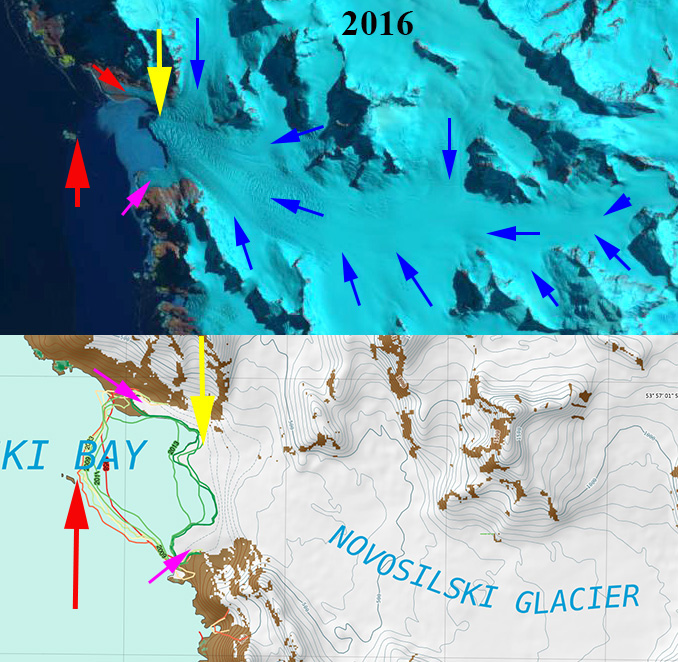
In 2001 Novosilski Glacier terminated in shallow water just east of a small island that acted as a pinning point, red arrow.  By 2009 the glacier had retreated only a minor amount from this island into deeper water.  A rapid retreat ensued and by 2016 the glacier had retreated into a narrower fjord reach. The north and south margins featured remanant ice that was based above tidewater, pink arrows.  The blue arrows in the 2016 Landsat image indicating the large accumulation area feeding Novosilski.  By 2018 the 2 km wide calving front had retreated 2.5 km from the 2001 position. There is little evident thinning upglacier of the terminus and, there is a significant increase in surface slope suggesting that unless calving rate increases, the terminus can remain near its current position.  The snowline is low below 500 m in each of the satellite images of the glacier.  This is not a particularly hospitable section of coastline and the BAS has only identified Gentoo Penguins having colonies in the area.

Novosilski Glacier in Landsat image from 2016. Red arrow indicates 2001 terminus location, yellow arrow the 2018 terminus location, pink arrows the fringing grounded sections of marginal ice, and blue arrows the glacier flow directions. Below is the South Georgia BAS map of the area indicating glacier margin position and elevation contours.

Novosilski Glacier in Landsat image from 2009. Red arrow indicates 2001 terminus location and, yellow arrow the 2018 terminus location.


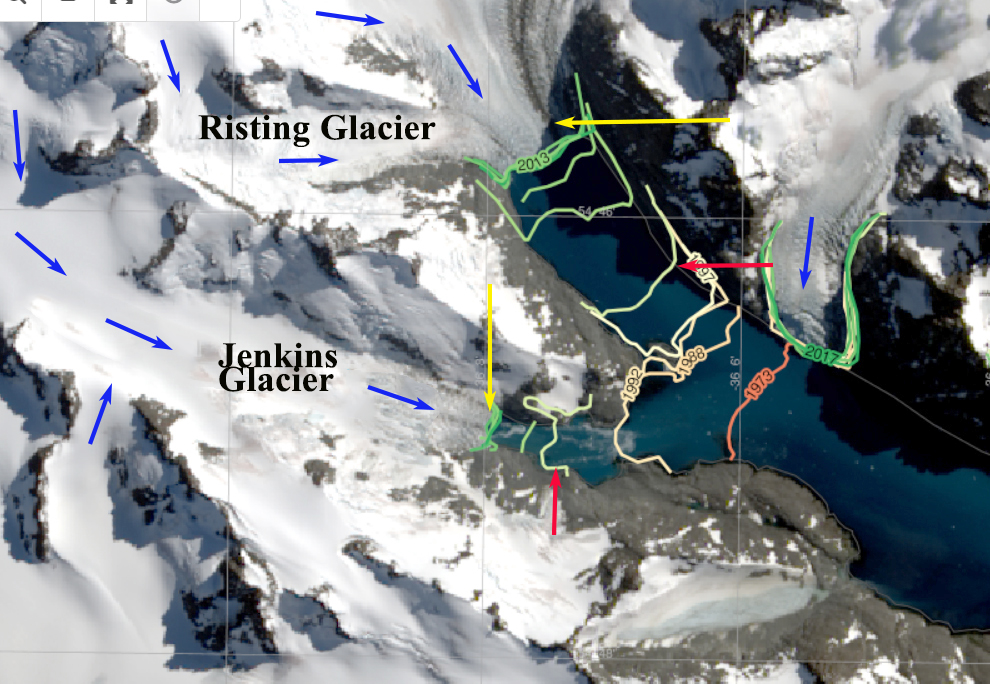
Risting Glacier, South Georgia Retreat Expands Drygalski Fjord

Risting Glacier right and Jenkins Glacier left in Landsat images from 2002, 2015 and 2016.  Red arrow is the 2002 terminus lcoation and yellow arrow at 2016 terminus location.  Dryglaski fjord extends southeast from the glaciers. 

Risting Glacier terminates in Drygalski Fjord on the southeast coast of South Georgia.  Risting and Jenkins Glacier were joined until the 1980’s.  Cook et al (2010) note the glacier had a relatively uniform retreat rate from 1955-1999 of 40 to 50 meters/year, with retreat increasing after 2000. (BAS map).   Gordon et al., (2008) observed that South Georgia’s larger tidewater and sea-calving valley and outlet glaciers generally remained in relatively advanced positions until the 1980’s, Risting Glacier was ahead of this timing in its retreat.

From 2002-2016 Risting Glacier retreated 1100 m, a rate of ~80 m/year twice the 1955-1999 rate. Jenkins Glacier retreated 500 m from 2002-2016 a rate of ~40 m/year.  In the Google Earth image below the slope of Jenkins Glacier suggests the glacier is near the head of the fjord. On Risting Glacier the steepest slope is 2 km behind the calving front, suggestive that the head of fjord is at that point. This location is exceedingly cloudy, making identification of the snowline difficult. The retreat hear is much less than Ross and Hindle Glacier just to the north.  The separation of Jenkins and Risting Glacier is like the separation of Konig and Neumayer Glacier  or Ross and Hindle Glacier.

From the British Antarctic Survey South Geogia GIS online viewer indicating terminus front positions.  Red arrows indicate 2002 positions and 2017 terminus is at yellow arrows.

Front of Jenkins glacier left and Risting Glacier above left, note extensive crevassing of Risting Glacier in particular. 

Konig Glacier, South Georgia Separates from Neumayer Glacier in 2017

Konig Glacier (K) terminus retreat compared in 1999 and 2017 Landsat images.  The red arrow indicate the 1999 terminus location, yellow arrows 2017 terminus location and blue arrows the surface movement. The southern terminus formerly connected with Neumayer Glacier (N) is now separate.

Konig Glacier is a land terminating glacier just north of the Neumayer Glacier, on the northwest coast of South Georgia.  The glacier has a split terminus, a northern terminus ending on an outwash plain near Fortuna Bay and a southern terminus that has merged with Neumayer Glacier. In 1977 the glacier extended to within 300 m of Fortuna Bay and no proglacial lake existed (BAS map).  Neumayer Glacier is a calving glacier that has retreated 5600 m from 1999 to 2016 and is dynamically connected to the Konig Glacier along its southern margin just where the glacier turns northeast. Gordon et al., (2008) observed that larger tidewater and sea-calving valley and outlet glaciers generally remained in relatively advanced positions until the 1980’s.  After 1980 most glaciers receded; some of these retreats have been dramatic and a number of small mountain glaciers will soon disappear.  Here we examine 1999-2017 Landsat imagery to identify glacier change.

In 1999 the southern terminus merged with Neumayer Glacier and extended several kilometers down the fjord.  The northern terminus ended in a proglacial lake adjacent to a tributary joining from the west.  By 2002 glacier retreat had expanded the lake at the northern terminus while limited retreat had changed little at the southern terminus.  In 2006 the northern terminus is at the southern margin of the proglacial lake.  By 2015 the northern terminus had separated from the western tributary and the terminus had retreated from the proglacial lake.  The proglacial lake had expanded in width possibly due to ice cored moraine metling.  The snowline, purple dots, in 2015 is at 550 m.  By 2017 the southern terminus of Konig Glacier has separated from the rapidly retreating main trunk of Neumayer Glacier.  The northern terminus has retreated 1100 m since 1999 and a new upper proglacial lake is forming at the terminus. The western tributary no longer approaches Konig Glacier. The medial moraine running down both the southern and northern arm have expanded in prominence suggesting enhanced ablation.  The snowline in December 2017 is at 450 m with several months of the melt season to go.  The retreat of Konig Glacier is like that of land terminating Purvis Glacier. While glacier separation has also been since at Ross and Hindle Glacier.

Map of terminus positions of Konig and Neumayer Glacier, South Georgia from the British Antarctic Survey online map site.

Konig Glacier (K) terminus retreat compared in 2002 and 2015 Landsat images.  The red arrow indicate the 1999 terminus location, yellow arrows 2017 terminus location and blue arrows the surface movement. The southern terminus is still connected with Neumayer Glacier (N).

Konig Glacier in 2006 Google Earth image indicating northern terminus (2) and southern terminus (1).