Quebrada Carhuascancha Glacier Retreat, Peru

Quebrada Carhuascancha Glacier is in the Cordillera Blanca of Peru, draining the northeastern slopes of Huantsan. A glacier lake outburst flood was reported in the valley in 1965 from a landslide into one of the lakes. The region has experienced ongoing glacier loss with Racoviteanu et al (2008) noting a 22% loss in area from 1970-2003 in the Cordillera Blanca. They further observed an average rise of terminus elevation by 113m and an average rise in the median glacier elevation of glaciers of 66 m, with the greatest changes on the eastern side of the Cordillera. Vuille et al (2008) observed that the glacier in the Cordillera Blanca are not in balance with regional climate, and that tropical glaciers shrink in response to increased air temperature, which was the observed case in the Cordillera Blanca region. On three glaciers on nearby Nevado Queshque Marks and Seltzer (2005) observed volume loss and retreat due to warming. Examining temperature records from 29 stations in the Cordillera Blanca they found an average rising temperature trend ofof 0.26 1C per decade over the 1962-1999 period.

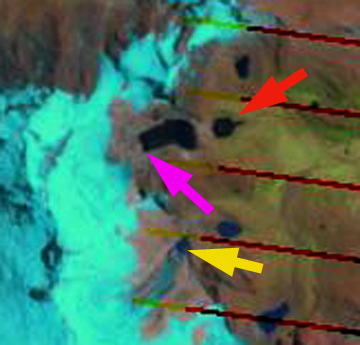
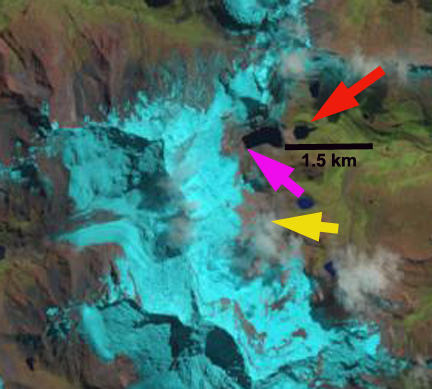
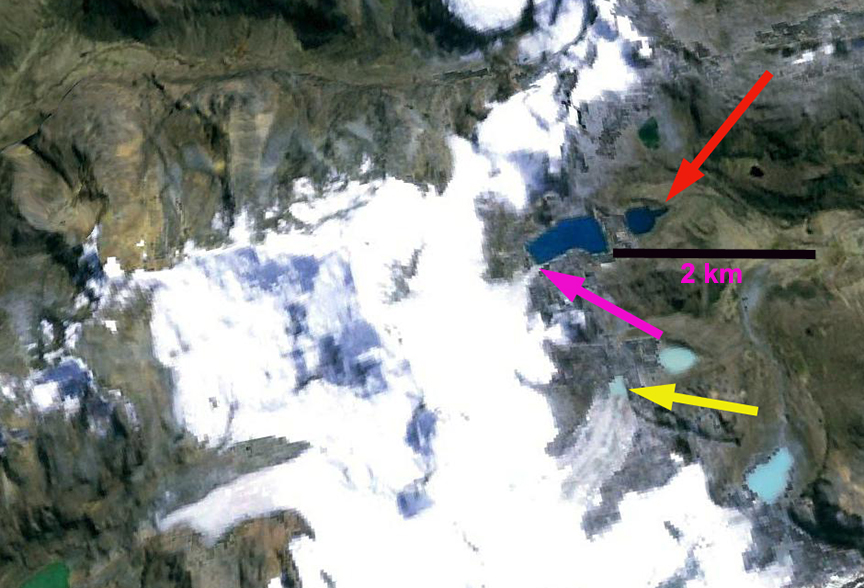
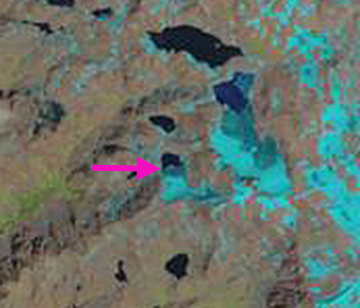
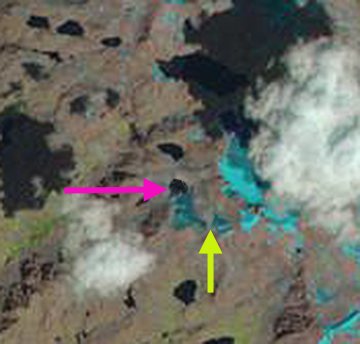
In this post the pink arrow notes the western margin of the lake that Carhuascancha reached in 1999 and 2000. The yellow arrow notes the terminus of the next glacier to the south of Carhuascancha, and the orange arrow a terminal-lateral moraine from the Little Ice Age. In 1999 and 2000 the glacier reaches just to the margin of the Laguna, and the southern glacier ends against a bedrock ridge. In both 2013 images Carhuascancha no longer reaches the lake terminating 250 m short of the lake and 200 m above the lake in elevation. The southern glacier terminates in a small lake that has formed. This small lake is also evident in the Google Earth imagery, which is an unknown date. Corihuasi Glacier and Chuecon Glacier in Cordillera Centrale, Yanashallasa Glacier and Artespnraju Glacier have all had a similar recent retreat. quebrada 1999
1999 Landsat image

quebrada 2000
2000 Landsat image

quebrada 2013a
2013 Landsat image

quebrada 2013
2013 Landsat image

quebrada ge
Google Earth image
Glacier du Mont Miné Retreat, Swizterland

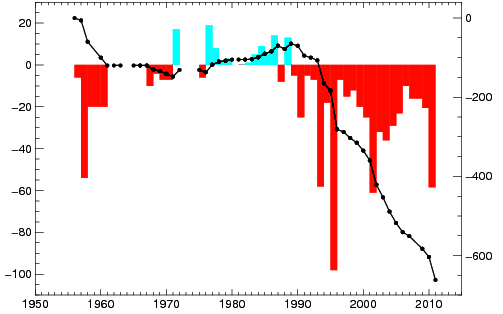
Glacier du Mont Miné is an 8 km long alpine glacier that drains into the Rhone River. The runoff from this glacier is heavily tapped for hydropower, for example Compagnie Nationale du Rhône has 19 hydropower plants on the river. The Swiss Glacier Monitoring Network measures the terminus position of this glacier each year, graph below. The glacier experienced a period of minor advance from 1971-1989, followed by a retreat of 600 m from 1989-2011. montmine graph
Annual terminus change Glcier du Mont Mine, from Swiss Glacier Monitoring Network

mont mine 2010
Glacier du Mont Miné, Google Earth image 2009

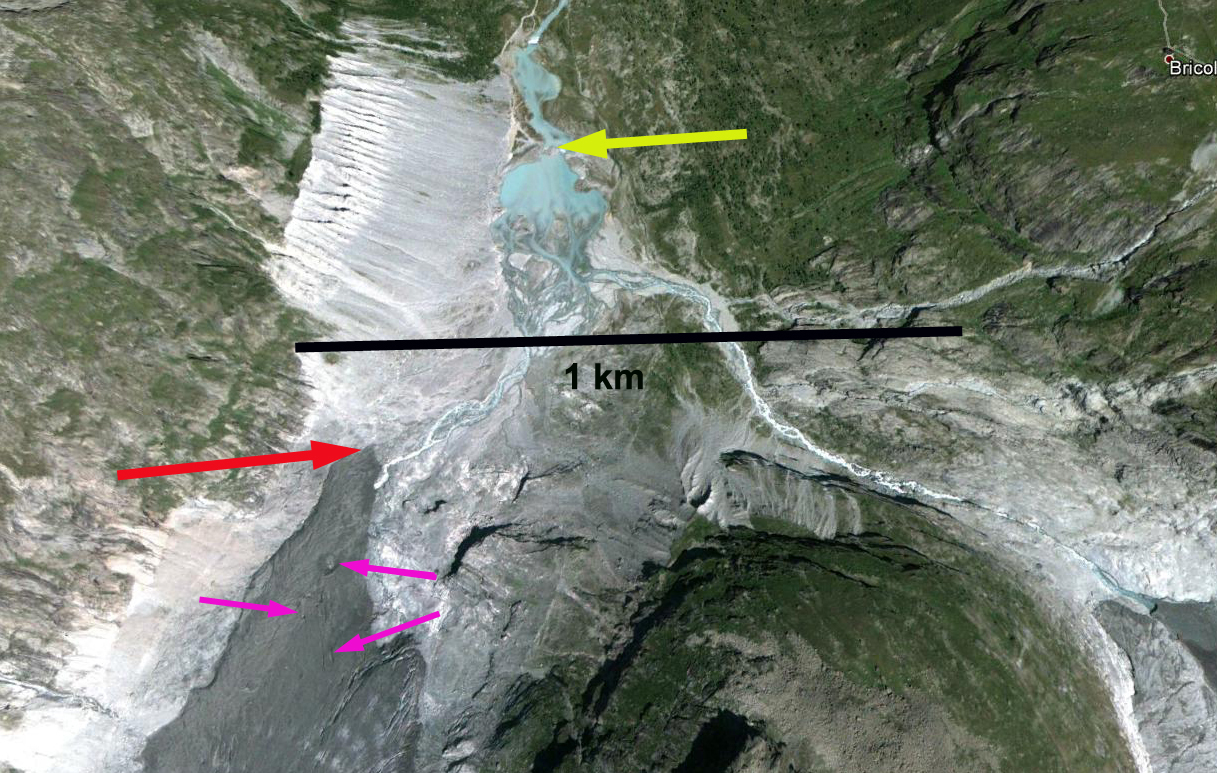
The advance moraine emplaced by the 1971-1989 advance is indicated by a yellow arrow in each image, a pink dot indicates the actual terminus at the time of the image. In the 1988 Landsat image Glacier du Mont Miné is in an advance position in contact with the moraine at the end of a small lake that is quickly being infilled with sediment. By 1999, Landsat image, the glacier has retreated out of the low lying basin below 2000 m. In 2011 and 2012 the glacier has pulled into its own valley having retreated 600 meters from 1988. The terminus is quite thin in the 2009 Google Earth image, yellow arrow indicates 1989 advance moraine, red arrow current debris covered terminus. The lower 300 m of the glacier is thin and stagnant, note depressions indicated by pink arrows. There is an icefall 2 km above the terminus, green arrow that is now detached from the glacier below. It still contributes mass via avalanching, but the lower terminus tongue will not survive long term without direct icefall connection. The retreat is similar to that of Gietro Glacier, Ried Glacier and Triftgletscher. mont mine glacier 1988
1988 Landsat image

mont mine glacier 1999
1999 Landsat image

mont mine glacier 2011
2011 Landsat image

mont mine glacier 2012
2012 Landsat image

glacier du mont mine terminus
2009 Google Earth image

mont mine icefall
2009 Google Earth image

Theodulgletscher Retreat, Zermatt Ski area Swizerland

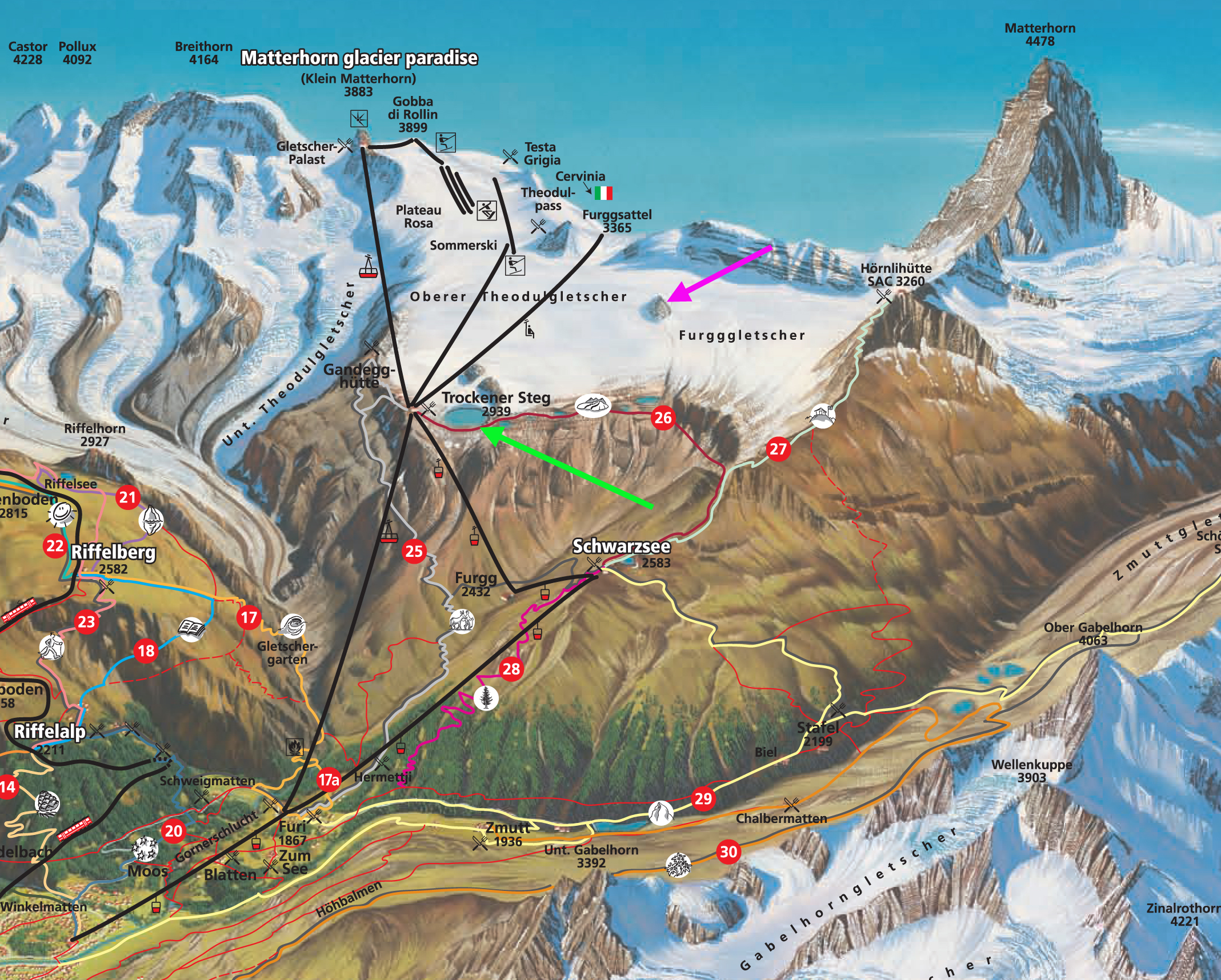
Theodulgletscher is one of the most visited glaciers in the world. It is part of the Zermatt ski resort in Switzerland. With three lifts crossing the glaciers western half. theodul trail map.
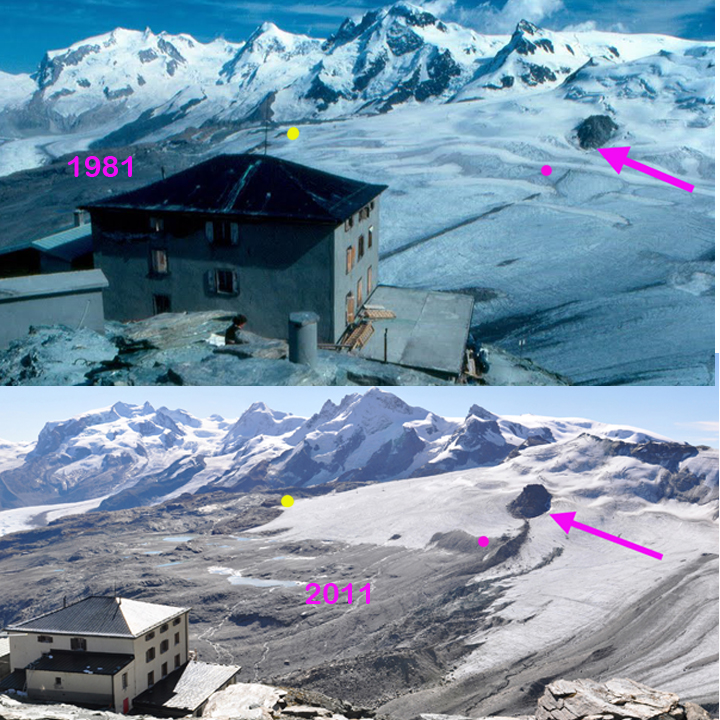
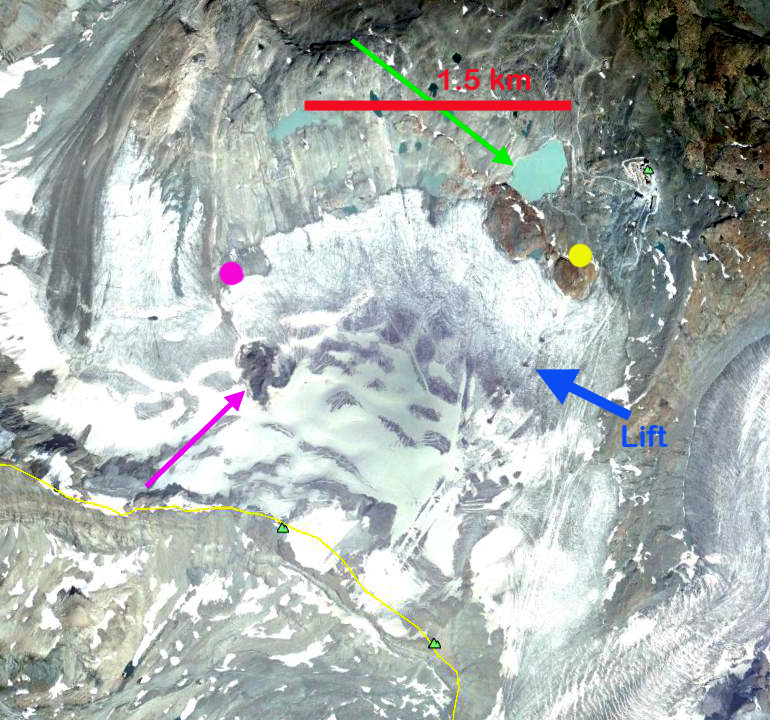
As ski season approaches I am reminded of ski area taking extraordinary steps to maintain the glaciers Stubai, Les 2 Alpes, Tignes and now Zermatt. Since 2003 summer skiing has been enhanced with Europe’s longest glacier chairlift, the 2.5 km long lift can transport 2,400 people every hour, ascending from Trockener Steg, at 2940 m, to Furggsattel station at 3365 m, above the Theodulgletscher in 8 1/2 minutes. Engineering wise the interesting part is that 12 of its 18 supporting masts stand on glacier ice, and have been engineered so that masts can shift and revolve to accommodate the glacier’s movement. This post examines changes in this glacier from 1999-2013. What makes Theodulgletscher a good ski run is its modest slope and limited movement that leads to few crevasses. The skiis runs themselves are well-groomed and marked to keeps skiers from venturing into areas where there are crevasses. With glacier retreat the distance from the glacier runs to the lift base at Trockener Steg has increased. Today an IDE snowmaker is being used to connect the Theodulgletscher to Trockener Steg with a 700 m long strip of snow. The IDE snowmaker is the world’s first snow machine that operates independently of ambient temperature. This is not enough to slow the retreat of this large glacier as seen from 1981-2011 below. The 1981 image is from Dave Brown Photrography.
theodulgletscher change

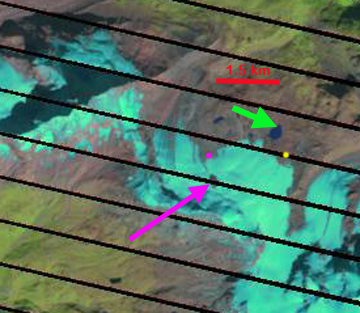
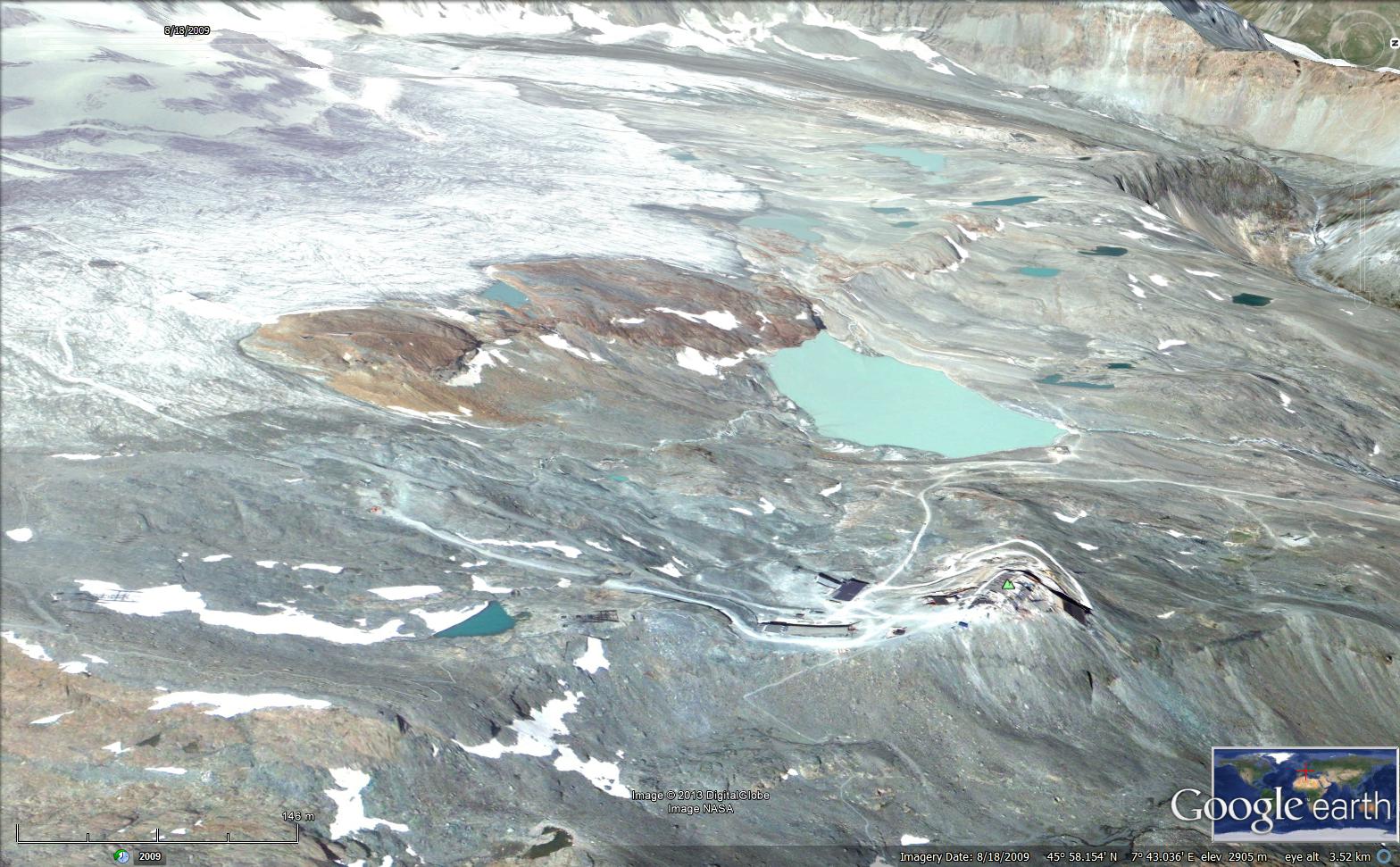
In each of the images in the sequence below and the images above the pink arrow indicates a prominent rock knob in the midst of the glacier, the pink dot below this knob is the glacier terminus, the green arrow indicates a small reservoir, and the yellow dot a location adjacent to the 1999 terminus below a rock knob. It is quite evident that the distance from the rock knob to the terminus, pink dot has changed dramatically in the 13 years 1999-2012, from 850 m to 450 m. A 400 m retreat of the west side of the Theodulgletscher in 13 years. The eastern side near Trockener Steg has experienced less retreat, with 140 m of retreat near the yellow dot. This is partly due to the grooming of the ski runs, where the compacted snow does not melt off as fast, last image. The glacier is quite thin across the entire front indicating retreat will continue.The daily web cam pictures from the top of the Matterhorn Glacier Paradise show the Theodulgletscher, though not that clearly. This identifies the day when the lower glacier loses its snowcover. This was July 19th in 2012 and August 2nd in 2013.
theodul 1999
1999 Landsat Image

theodul 2012
2012 Landsat Image

steg 2009
2009 Google Earth image

steg 2010

theodul 2011
2009 Google Earth image after a snowfall.

theodul terminus
2009 Google earth side view.

theodul surface
2012 surface of Theodulgletscher, note the last snowcovered areas are groomed regions.

J Glacier Retreat-Impending Loss, Wyoming

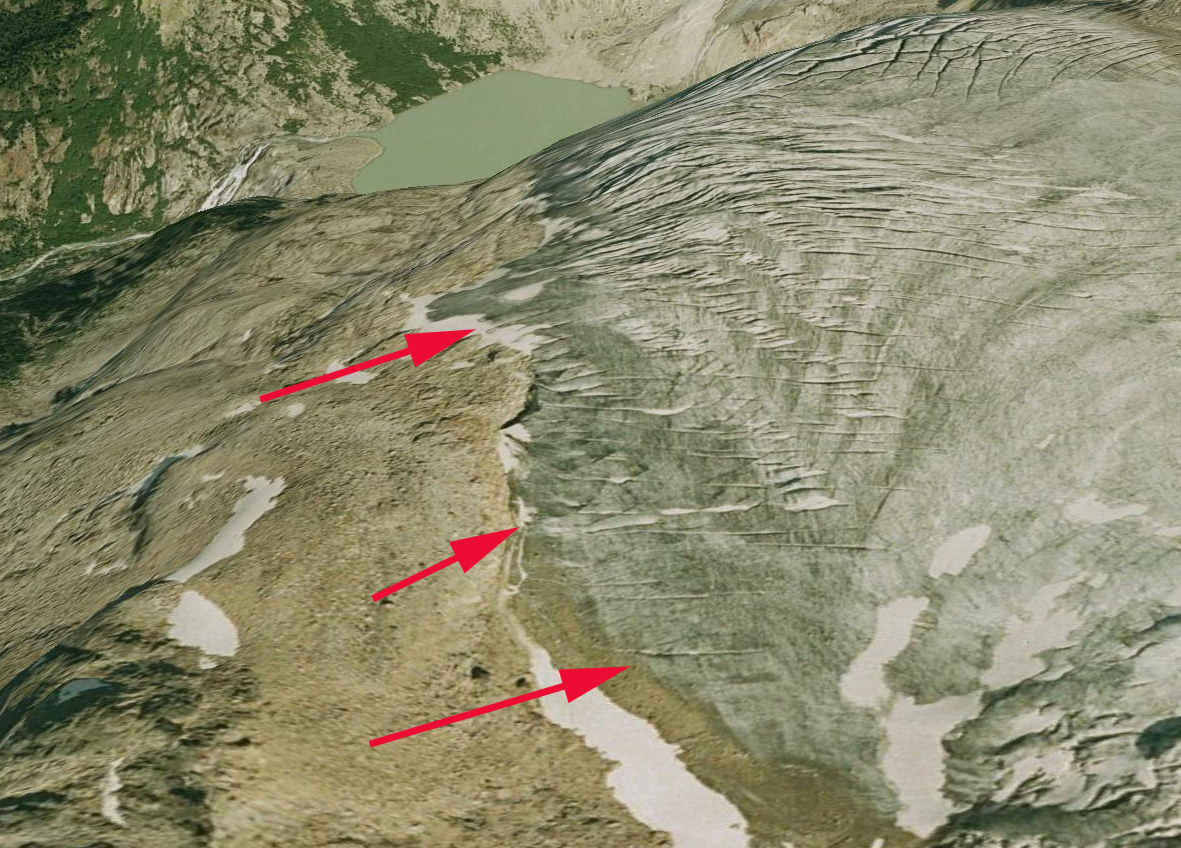
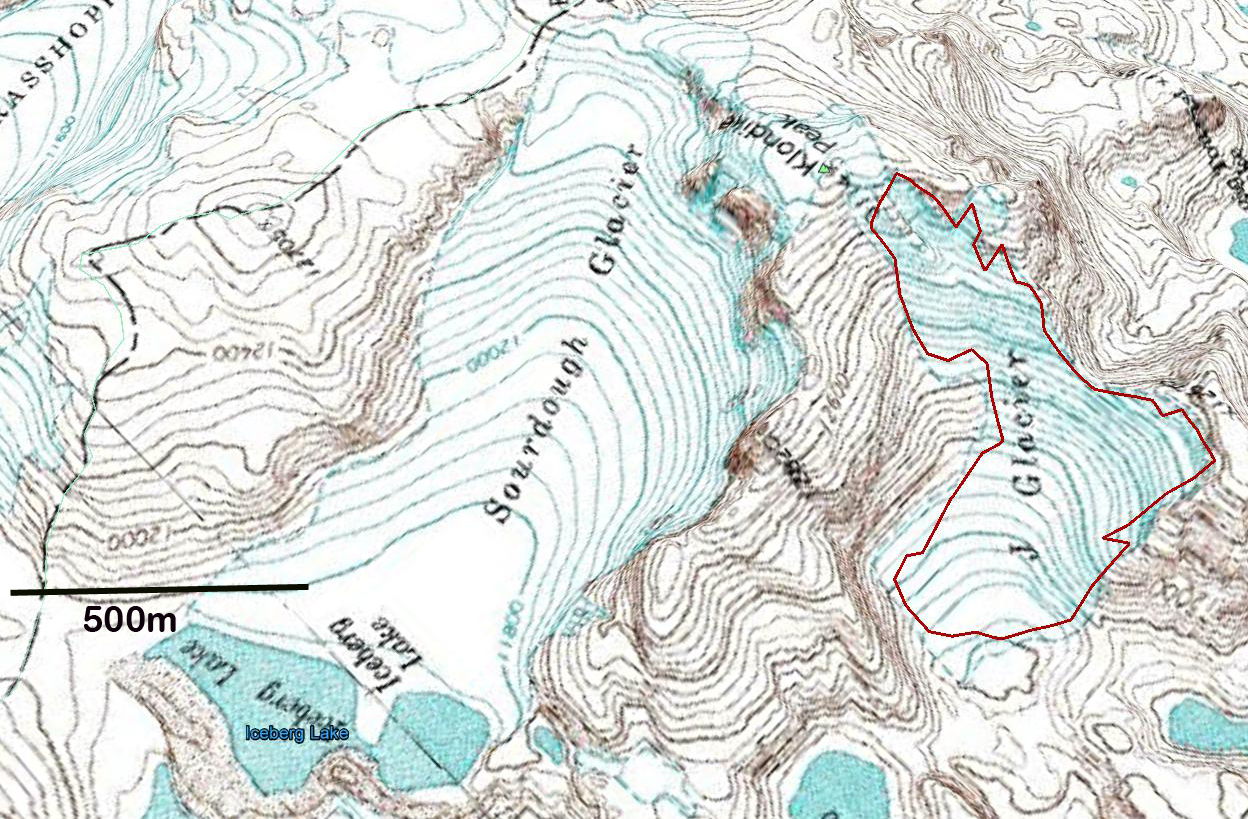
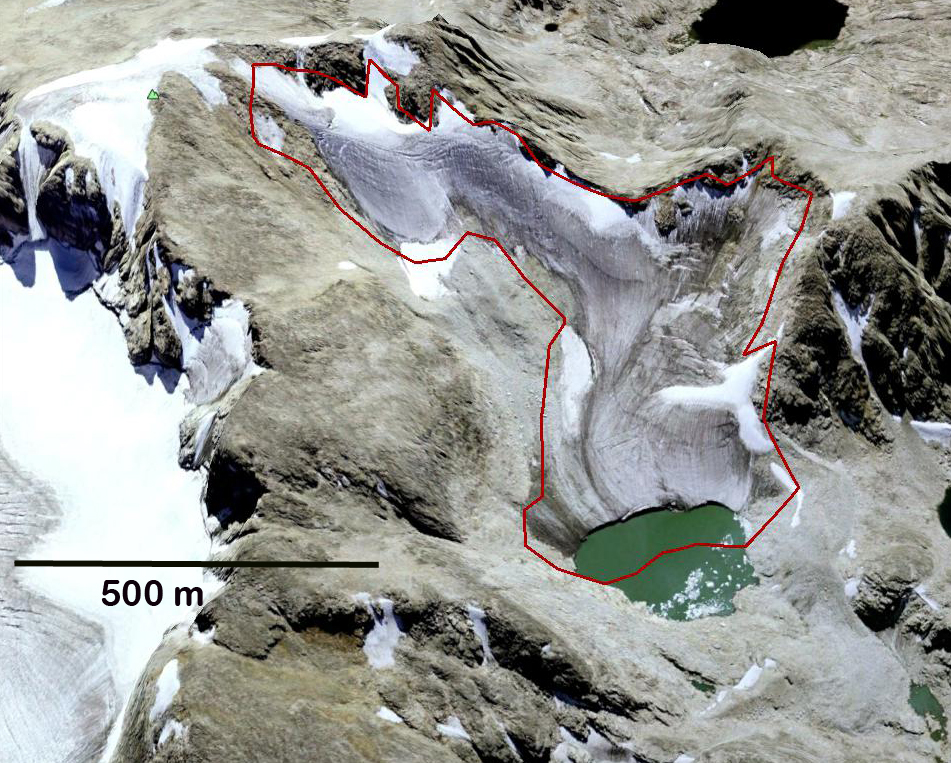
J Glacier is a small Glacier on the northwest side of Klondike Peak in the Wind River Range of Wyoming. In this post we examine changes in this glacier from 1994-2013 using Landsat Imagery and from 2013 and Google Earth imagery from 1994, 2006 and 2009. In 1966 the glacier ended on the far side of the lake basin and no lake was present. The retreat from 1966-1995 was 60 m a rate of 2 m per year. By 1994 a lake had formed at the terminus, the 1994 margin of the glacier is indicated with a burgundy line on each Google Earth image. The main terminus of the glacier retreated 100 m from 1994 to 2009, a rate of 6.6 m/year. More importantly the image from 2006 indicates a significant retreat and rock exposure on the upper portion of the glacier on the west side, pink arrow. In 2009 the glacier terminus is beginning to recede out of the lake as seen by emerging shoreline rock near the glacier center. In 2013 a July and August Landsat images indicate the extent of snowpack loss that occurred in just one month, leaving the glacier without any snowcover by late August. The terminus is indicated with a pink arrow, any change since 2009 cannot be discerned on this image. The complete snowpack loss has led to glacier ice melt and separation of the upper eastern corner of the glacier from the rest of the glacier, yellow arrow. The loss of area and exposure of rock on both the upper west and upper east side of the glacier indicate the lack of an accumulation zone. This indicates a glacier that cannot survive as noted by Pelto (2010). This is the same forecast as for nearby Minor Glacier and Grasshopper Glacier, whereas the neighboring Sourdough Glacier has fared a bit better. j glacier map
USGS Map of J glacier and Sourdough Glacier, from 1966 aerial photography.

J glacier 1994
1994 Google Earth image

j glacier 2006
2006 Google Earth Image

J glacier 2009
2009 Google Earth image

j glacier 7-2013
July 2013 Landsat Image

j glacier 8-2013
August 2013 Landsat image

Eyjabakkajökull Retreat, Iceland

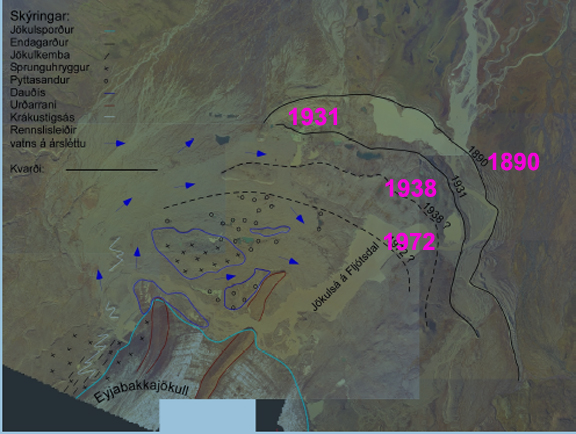
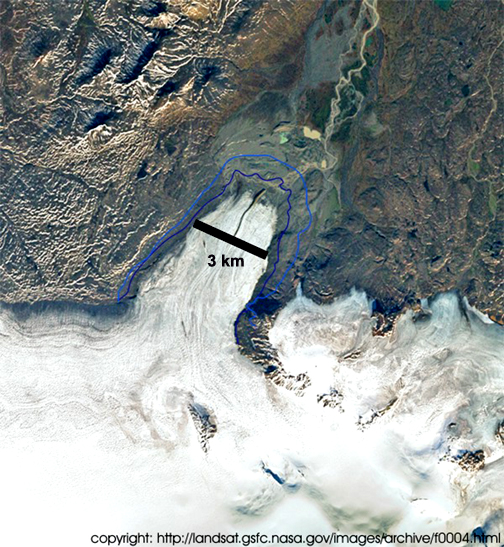
Eyjabakkajökull is a surging glacier that emanates from the north side of Vatnajokkull Ice Cap. The glacier surged in 1890, 1931, 1938 and 1972. During the latter advance the glacier advanced approxmately 2 km (Ívar Örn Benediktsson, 2009). A recent project focused on this glacial geology in front of this glacier led by Ólafur Ingólfsson and Ívar Örn Benediktsson (University of Iceland) and Dr. Frank Lisker (University of Bremen). The information was put together by Antje Herbrich. The first image is a map from this project indicating the glacier moraines emplaced by the four most recent surges. It is apparent that each surge has not extended as far as the previous surge. In the second image also from the Eyjabakkajökull project, the blue line is the 1973 terminus and the purple line the 1991 terminus position drawn on a 2000 Landsat image. eyej map

Eyjabakkajökull 2000

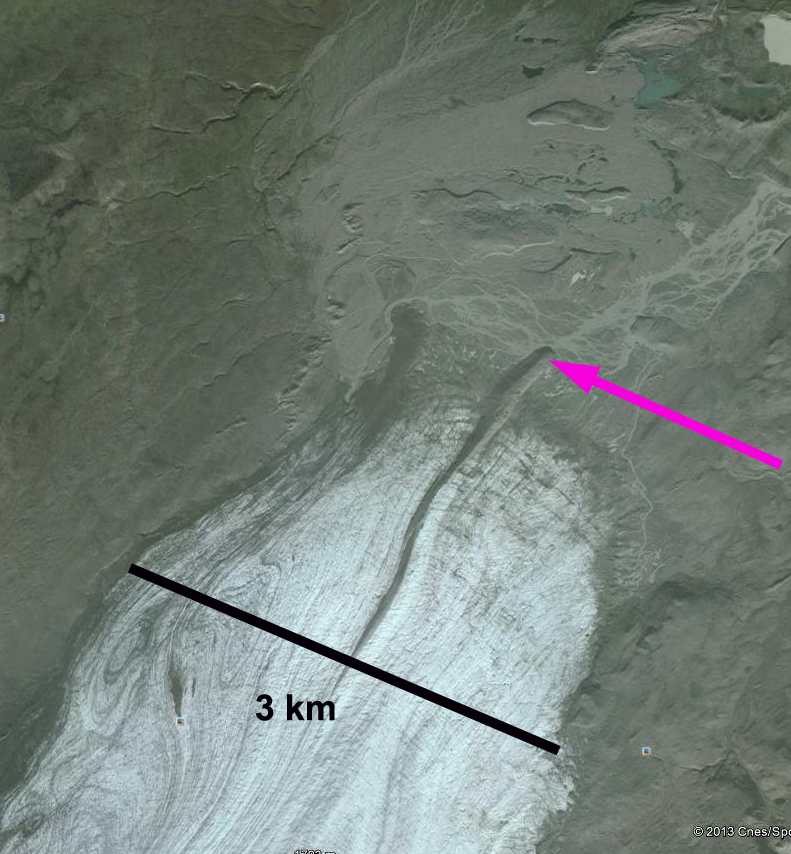
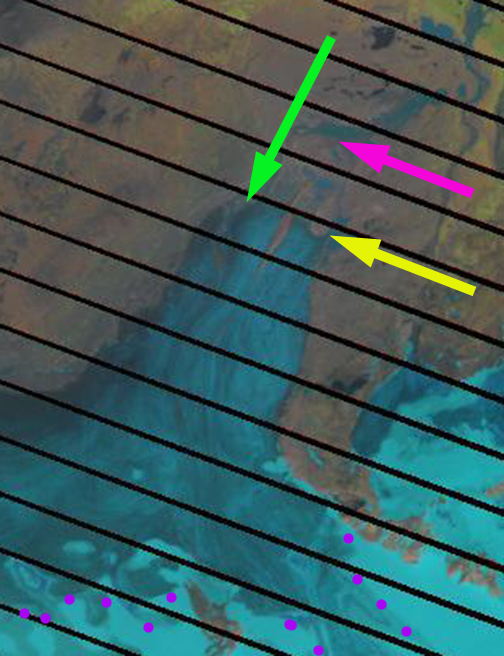
Here we examine Landsat Imagery from 1999, 2012 and 2013 and Google Earth imagery in 2000. The glacier tongue has a prominent medial moraine ridge that in 1999 ended just short of the outlet river in a stretch where it ran west to east, pink arrow. This is a ridge because it is an ice cored moraine, as the ice core melts the ridge disappears. By 2012 the glacier had retreated 2 km from the 1999 terminus, and ending at the yellow arrow. This distance is emphasized by the length of the green line to the terminus. The green line starts from a specific lake and terminates at the glacier. In 2013 the 2 km retreat since 1999, and the 1.1 km retreat from 1972-1999 places the terminus about a kilometer behind the terminus location prior to the 1972 advance. The 1972 terminus is marked with a red arrow. The current terminus has a very low slope and limited crevassing indicating that a rapid retreat will continue. Hence, when the next surge comes, it will begin from quite a recessed position and will fell well short of the 1972 advance moraines. The snowline in 2012 and 2013 is above 1100 m, purple dots, which is high enough to indicate significant negative mass balance.
Eyjabakkajökull 1999
1999 Landsat image

Eyjabakkajökull ge
2000 Google Earth

Eyjabakkajökull 2012
2012 Landsat image

Eyjabakkajökull 2013
2013 Landsat image

This retreat is similar to that of draining the Tungnaarjökull west side of Vatnajokulland Skeiðarárjökull Glacier on the south side and Brúarjökull . The low slope is seen in the image below looking across the glacier from Ívar Örn Benediktssoneyej 2007

Inter Glacier Retreat-Demise, Mount Rainier Washington

Inter Glacier is one of the smaller glaciers on Mount Rainier, Washington, lying between the larger Emmons and Winthrop Glacier. The glacier now extends from 2800 to 2200 m, with recent retreat shortening the glacier to 1 km in length. This post examines the retreat from 1992 to 2013 using Landsat imagery, Google Earth imagery and pictures from 2013 from Tyler Christensen.
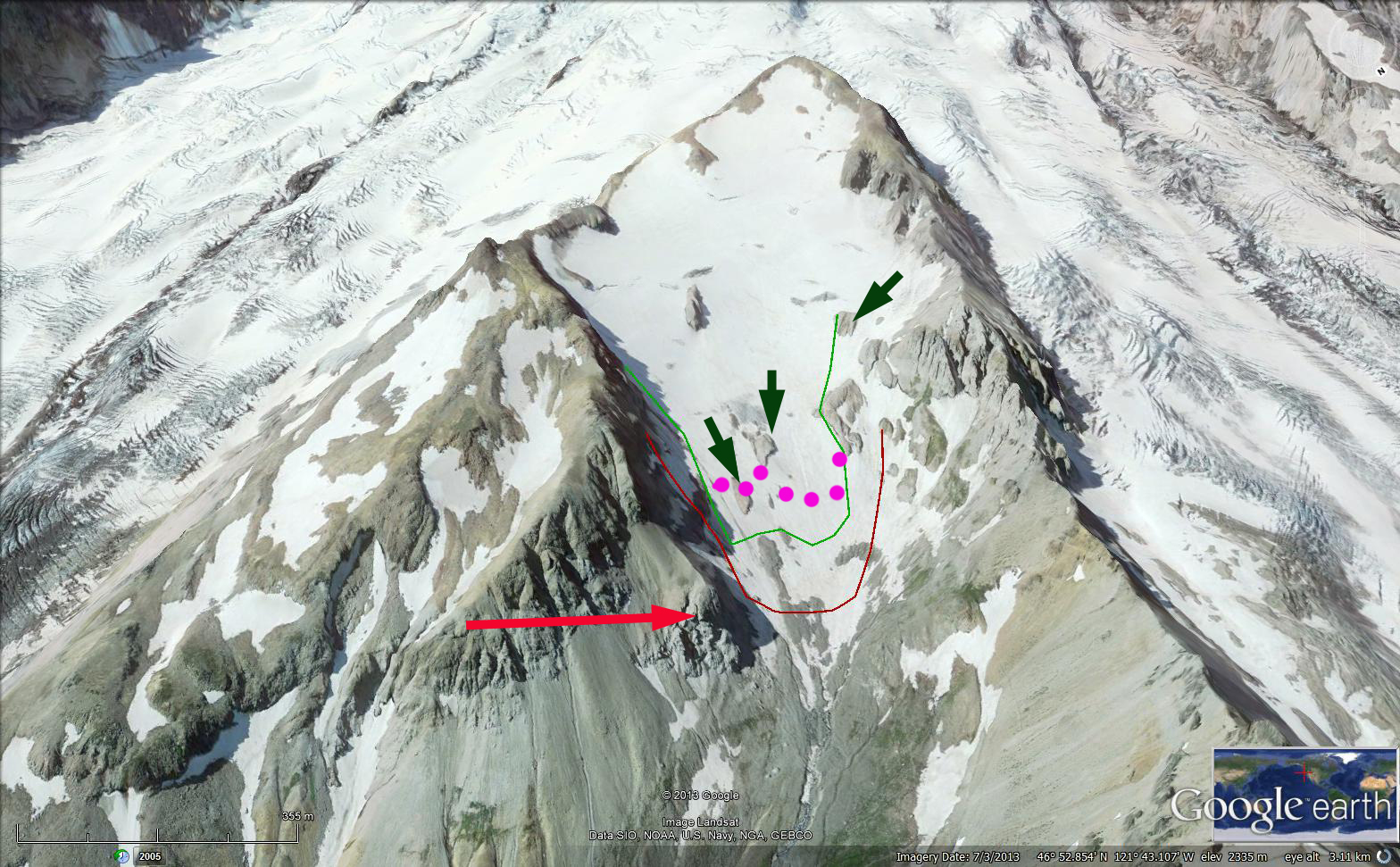
In 1992-1994 the glacier extends below a prominent knob on the east side of the glacier, red arrow. There are also only two bedrock knobs protruding through the glacier surface. The 1994 margin in the Google Earth image is a red line. inter glacier 1992
Landsat Image 1992

inter glacier 1993
Landsat image 1993

inter glacier 1994
Google earth image 1994

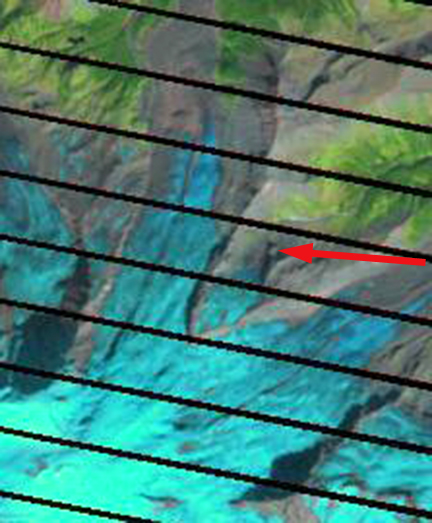
By 2009 the glacier has thinned considerably and retreated 200 m, terminus indicated by green line. There are five outcrops of rock that now protrude through the thinning glacier, see dark green arrows. The thin stagnant nature of the lower glacier indicates the retreat will continue. The 2013 Landsat image indicates the glacier has retreated beyond the bedrock knob east of the glacier, red arrow and to the bedrock knobs that had been amidst the glacier on its east side. The glacier 2013 terminus is indicated with pink dots on the 2012 and 2013 image below. The last two images are from Tyler Christensen who was climbing on Mount Rainier in August, 2013. The first picture is from below the terminus, indicating the stagnant nature of the lower glacier and emerging bedrock. The second image is a view east across the glacier at 2400 m, indicating the lack of crevassing, the number of emerging bedrock higher on the glacier, and the lack of snowcover with six weeks left in the melt season. All three of these observations indicate a glacier that cannot survive (Pelto, 2010).

inter glacier 2009
Google Earth image 2009
inter glacier 2012
Google Earth Image 2012

inter glacier 2013
Landsat Image 2013

IMG_20130811_124527
Tyler Christensen image

IMG_20130811_115737
Tylear Christensen image

This glacier is responding like all Mount Rainier glaciers, retreating. Inter Glacier is a smaller glacier like Paradise Glacier, and like Paradise Glacier it will not survive current climate. There is limited detailed study of Mount Rainier glaciers compared to Mount Baker (Pelto and Brown, 2012). With limited mass balance work on two glaciers Nisqually and Emmons. A detailed report on change in the termini is only up to 1994.

North Dawes Glacier Retreat, Alaska

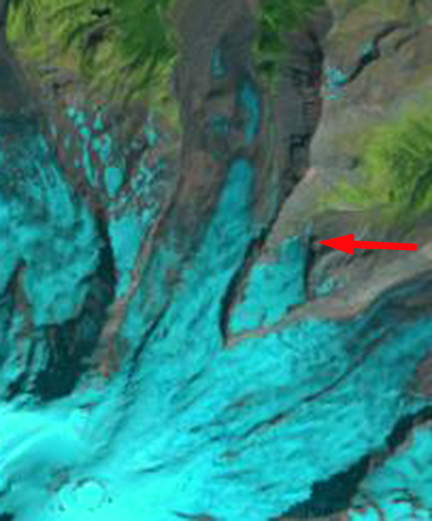
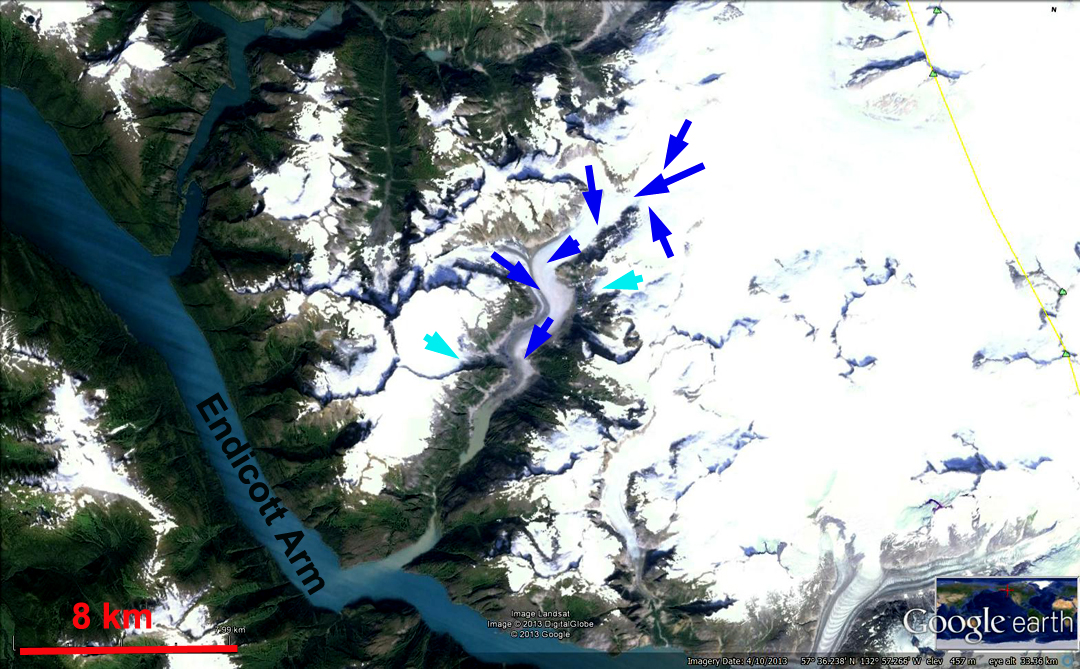
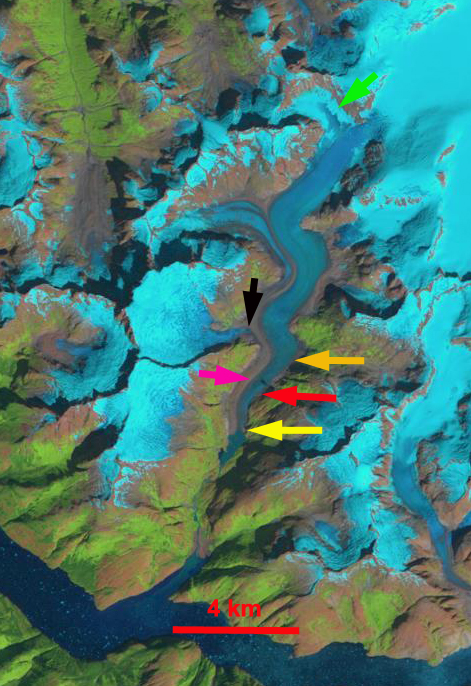
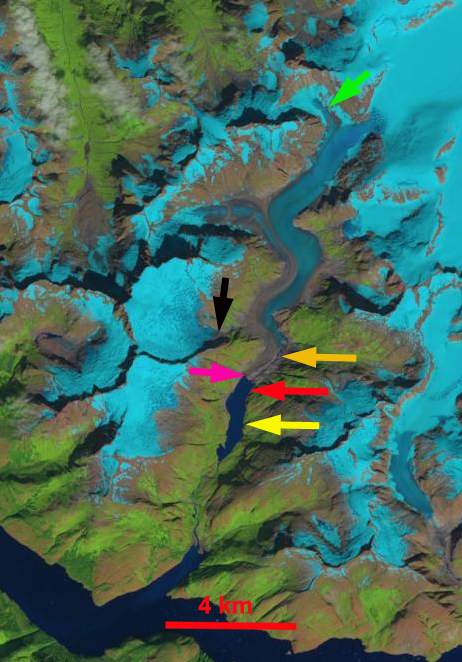
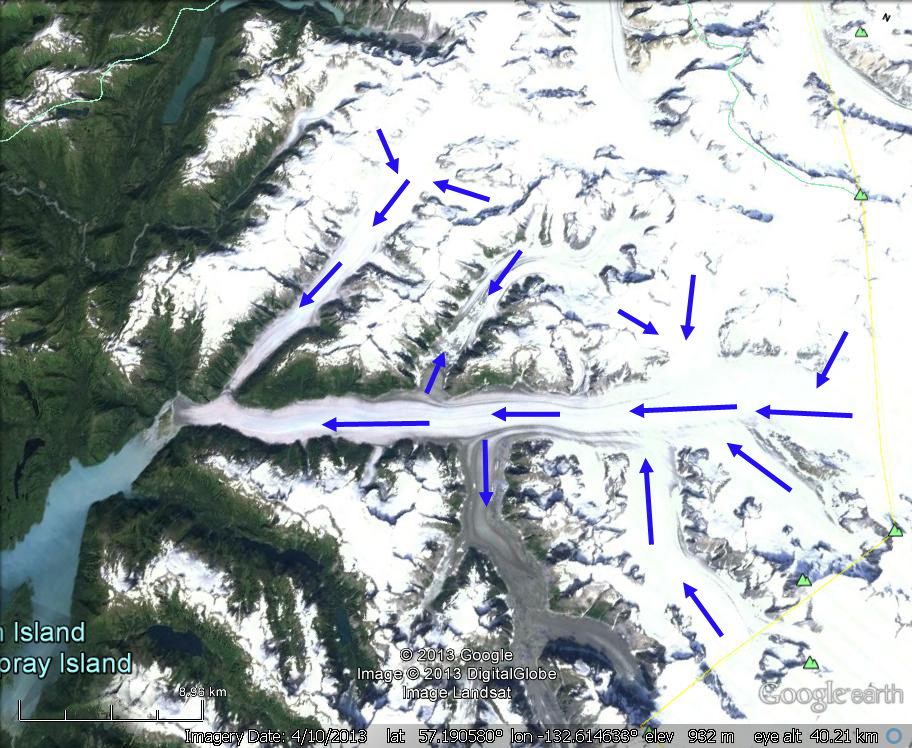
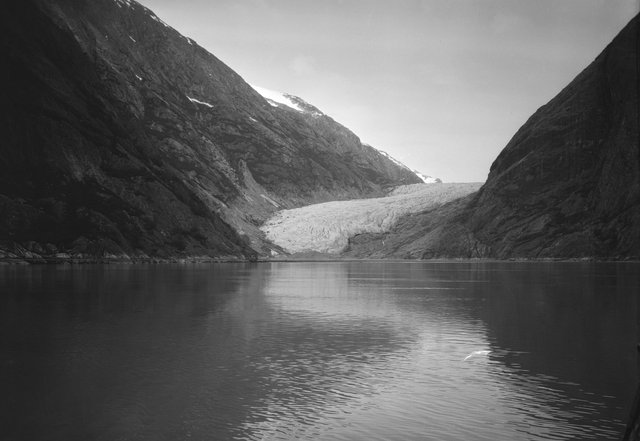
North Dawes Glacier reached the Endicott Arm as a calving glacier when visited by John Muir in the 1880’s. By 1923 the glacier had retreated a half kilometer and was no longer tidewater. The American Geographical Society under the leadership of William O. Field observed the glacier several times from 1941 to 1961 observing a retreat of 1.8 km from 1923-1961. Here we examine the retreat of the North Dawes Glacier from 1990-2013 and observe some disquieting signs on upper portions of the glacier. The first image is a 1929 image from William Cooper an ecologist from the Univ. of Minnesota of the glacier in 1929 when it was still near Endicott Arm. The second is from Google Earth with the blue arrows indicate the flow direction for the glacier, the lighter blue arrows tributaries that no longer reach the main glacier. northdawes1929North Dawes glacier ge. When I first saw the North Dawes Glacier in 1982 from a plane a small lake had formed at the terminus. In the 1990 Landsat image the glacier ended in a lake that is 1.2 km long, yellow arrow. By 2005 the glacier had retreated another 1.3 km and the lake was long 2.5 km, red arrow. In 2013 the glacier has retreated out of the lake, pink arrow and terminates at a small new developing lake orange arrow. The lake is 2.8 km long, but will likely become shorter as glacier sediments infill the upstream end. There are some stagnant ice cored moraine areas between the 2013 terminus and the lake. The terminus retreated 3.1 km between 1990 and 2013. north dawes Glacier 1990
1990 Landsat image
north dawes glacier 2005
2005 Landsat image
north dawes glacier 2013
2008 Landsat image

The retreat of the terminus of North Dawes Glacier is the result of diminished accumulation higher on the glacier and increased melt. Two indicators of the impact on the upper glacier is the separation of one of the former tributaries, black arrow, from 1990 to 2013. A second is the tributary higher up on the glacier that was formerly a snowcovered basin feeding the main glacier, green arrow. In 2005 and 2013 it is evident that this basin is no longer a location where snowpack is retained. The result is thinning and exposure of new areas of bedrock, indicating the demise of this tributary even though it is 7 km above the terminus. The basin is mainly at 950-1100 m which is now below the end of the summer snowline (ELA) most years. This glacier is retreating at approximately the same rate as nearby Sawyer Glacier, but is losing a greater percentage of its total area and length. North Dawes is also retreating much more than nearby Baird Glacier.

Baird Glacier Retreat Initiation, Alaska

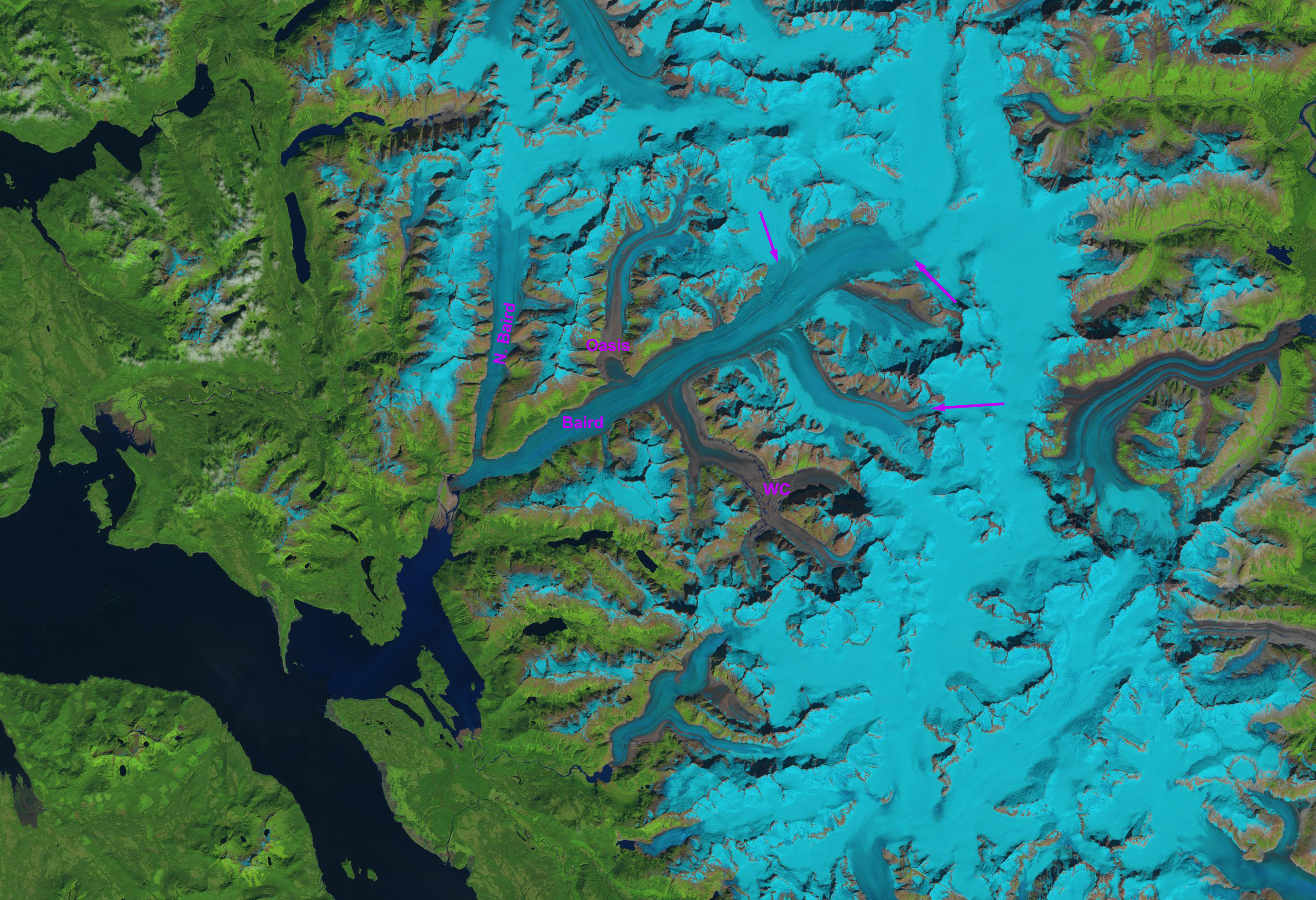
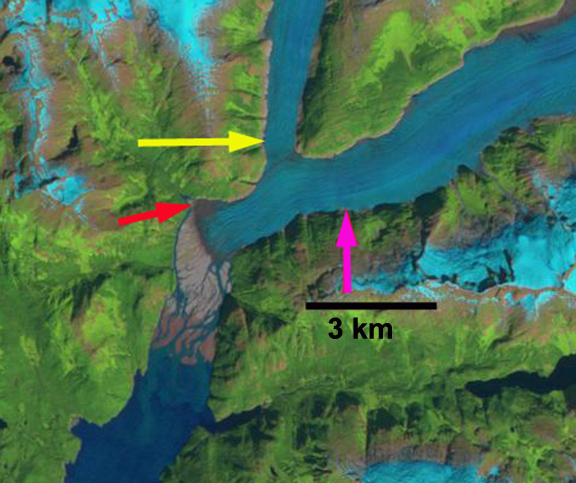
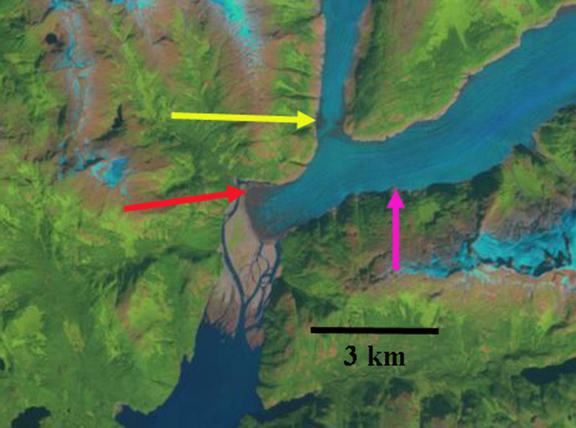
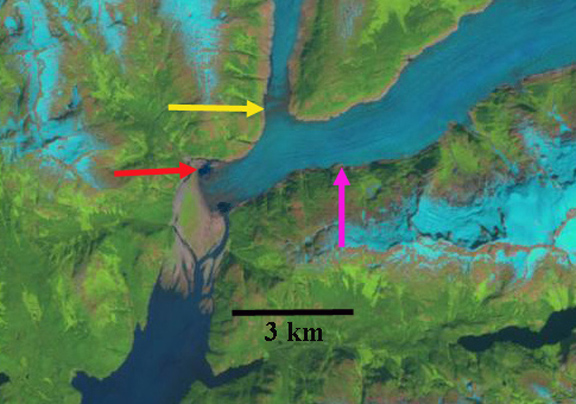
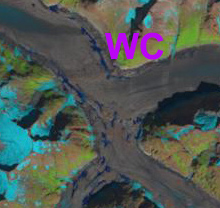
Baird Glacier drains the west side of the Stikine Icefield in southeast Alaska. It is the only glacier of the Stikine Iceifield that has not retreated significantly since 1960. This is similar to the Juneau Icefield where only the Taku Glacier has not retreated. From 1887 to 1941, the advance totaled about 1 km and from 1941-1980 it advance another kilometer. The terminus had not changed from 1980-2010. In 1984 I had a closeup look at the terminus, it was heavily debris covered and lacked crevassing. This indicated a limited velocity, yet the ice was clearly quite thick, and it would take considerable melting to initiate retreat. In this post we examine Landsat images from 1990, 2005 and 2013 to see how the terminus is responding to climate change. The blue arrows indicate the glacier flow in the Barid Glacier System. Just above the terminus the main Barid Glacier is joined by the North Baird Glacier. About 15 km upglacier of the terminus are two glaciers Witches Cauldron (WC) to the south and Oasis to the north that the Baird Glacier is flowing into instead of being fed by them. This has been the case for sometime. The purple arrows indicate the 2013 snowline near the end of the melt season is at 1300 m. This is high and will lead to a negative mass balance and volume loss for the glacier in 2013.baird glacier ge copybaird glacier landsat8 In 1990 the Baird Glacier is sitting on an outwash plain, with no lake at the terminus. The North Baird Glacier was 1100 meters wide at the yellow arrow, just before joining the Baird Glacier . The main Baird Glacier is 1350 m wide at the pink arrow. By 2005 the North Baird Glacier is 900 m wide at the yellow arrow, and the Baird Glacier 1200 m wide at the pink arrow. The terminus appears unchanged in 2005. By 2013 the North Baird Glacier is just 700 m wide at its junction at the yellow arrow and the Baird Glacier just 1100 m wide at the pink arrow. The narrowing of both indicates less ice flow to the terminus, which will lead to retreat. In 2013 two lakes have appeared at the terminus, red arrow. The terminus has begun a measurable retreat, the lakes are 400-600 m across indicating. There will be a continued expansion of these two lakes and a significiant retreat of the main terminus will ensue. This will lead to the separation of the North Baird and Baird Glacier. Upglacier in the Witches Cauldron a series of supraglacial lakes have begun to form as well. Larsen et al (2007) using repeat laser altimetry note that North Baird Glacier in its lowest 10 km from the junction with Baird Glacier was losing 2 m per year in ice thickness. From 2000-2009 the thinning rate is even higher, with Baird Glacier main trunk losing 10-20 m in thckness in the lowest 20 km Larsen et al (2009). Baird Glacier is joining the rest of the Stikine Icefield is already in retreat, Sawyer Glacier, Patterson Glacier and Great Glacier.
barid glacier 1990

baird glacier 2005

baird 2013

witches cauldron

Toby Glacier Retreat, Purcell Range, British Columbia

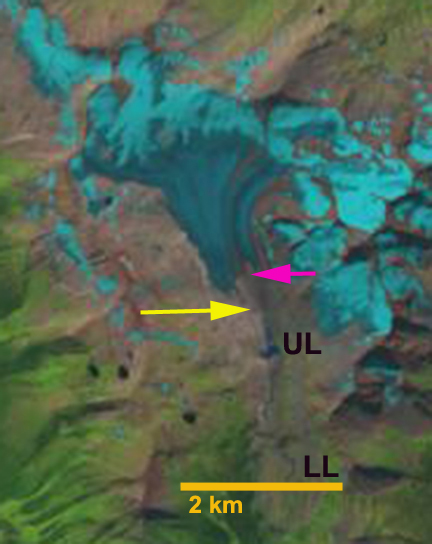
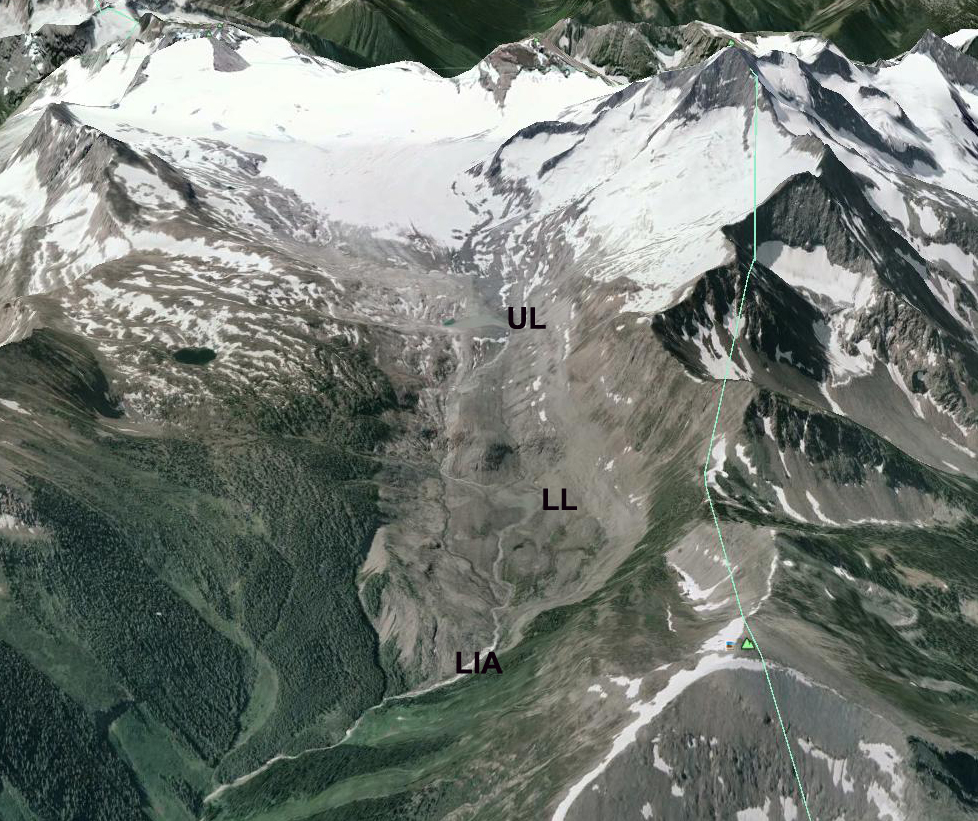
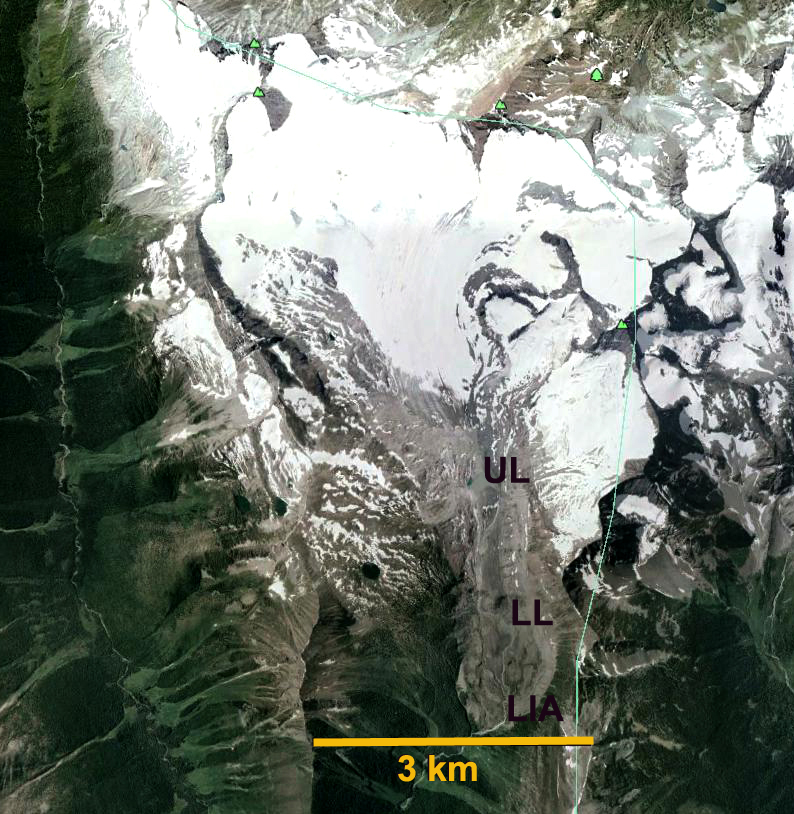
Toby Glacier is in the Purcell Mountains of southern British Columbia, part of the Purcell Wilderness Conservancy Park. Here we examine retreat of this glacier from 1998 to 2014 using Landsat imagery and Google Earth images. The map image indicates the Little Ice Age advance moraine (LIA_on other imagers) at 1960 m, a lower lake (LL)at 2060 m, an upper lake (UL) at 2280 m, the former ELA at a slope change at 2500 m and the recent ELA at 2600-2650 m, all images are oriented with north at the bottom. toby map In the 1998 Landsat image the glacier terminates at the yellow arrow 250 m from the Upper Lake. The snowline in 1998 is at 2650 m and only 25% of the glacier is snowcovered. By 2005 in the Google Earth view from 2005 the glacier terminates 450 m from the Upper Lake. In 2013 the glacier terminates 800 m from the Upper Lake, pink arrow. Yellow arrow marks 1988 terminus for comparison. The snowline is again at 2650 m in 2013 with a month left in the melt season, no more than 20% of the glacier will be snowcovered by the end of the summer. In 2014 on Aug. 18th the snowline is between 2600 and 2650 m with six weeks left in the melt season, purple dots. By the end of the summer little will remain snowcovered. The terminus has retreated additionally from 2013 but not an amount that can be assessed accurately. Typically 60% snowcover is necessary for glacier equilibrium. The result of the substantial negative mass balance that result from the high snowlines and small accumulation zone will be continued retreat. There are significant bedrock areas emerging in the upper portion of the glacier indicating a lack of a persistent accumulation zone indicative of a glacier that cannot survive (Pelto, 2010). A glacier lacking a consistent accumulation zone is experiencing a disequilibrium response to climate and cannot retreat to a point of equilibrium. This is exemplified best in an image from Wildair Photography-image 36. The glacier retreat is like that of Vowell Glacier and Conrad Icefield in the nearby Bugaboos. TOBY GLACIER 1998
1998 Landsat image
TOBY GLACIER 2013
2013 Landsat image
toby glacier 2014
2014 Landsat image
toby glacier tiltview
2005 Google Earth view

toby glacier ge
2005 Google Earth view

Brúarjökull Retreat, Iceland

Brúarjökull is a major, 1600 square kilometers outlet glacier on the northeast side of the Vatnjokull Ice Cap in Iceland. Brúarjökull is a surging glacier that has surged n 1810, 1984 and 1964. During a surge a glaciers basal water pressure increases leading to reduced basal friction, a sharp velocity increase and terminus advance. Surges do not typically reflect climate change. In recent years Brúarjökull has been retreating at about 100 m/year. The glacier advanced 8-10 km during the 1964 surge. In this case an additional factor has been added, with the completion of a dam and the filling of the Hálslón Reservoir in 2007 that is now in contact with the terminus of Brúarjökull. Kárahnjúkar hydro power plant is Europe’s largest dam and a $2 billion project that produces 690 MW of power. Unfortunately with the dam now in operation it has not proved profitable for the Landsvirkjun, Iceland’s national energy company. In 2013 the surface level of the Hálslón Reservoir reached 625 meters above sea level at the end of August which is the spillway elevation.
The Brúarjökull Project has examined the glacier terminus and newly exposed landscape by retreat in recent years. The terminus they observe is quite stagnant. The elevation range of Brúarjökull is 600–1750 m a.s.l. with an equilibrium line altitude of 1200 m and accumulation area ratio AAR of 60%. The mass balance of Brúarjökull measured since 1994 and has been consistently negative, losing 10 m of ice thickness overall, with greater much greater thinning near the terminus. Here we examine Landsat images from 1999, 2008, 2012 and 2013 and Google Earth imagery from 2005 and 2009. The contorted medial moraines, red arrows are indicative of a surging glacier. The purple arrows indicate the snowline which leaves much too large an area of glacier in the ablation zone for equilibrium balances. In 2013 the ELA in late August is 1300 m, it will rise a bit more which will mean a negative mass balance of at least 1 m. bruar 2013
Landsat 2013 image
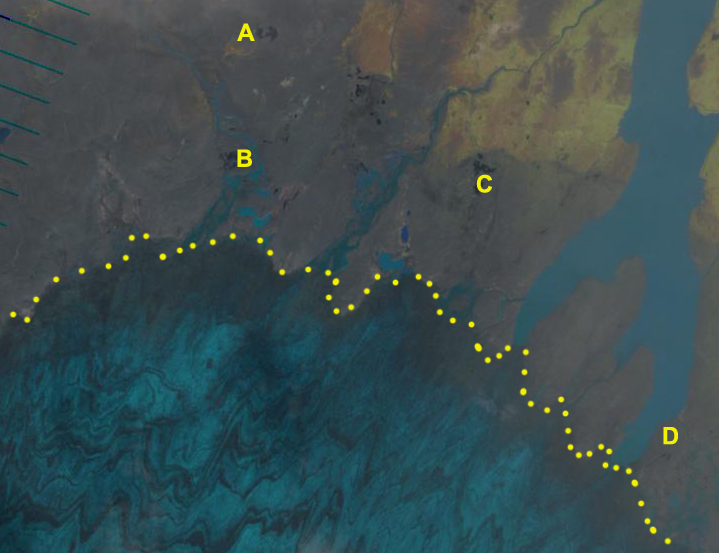
The terminus in each image is indicated by yellow dots with Points A-E being consistently located for comparison. The first image is a Landsat image from 1999, the Hálslón Reservoir does not exist. The distance from Point B to the ice front is 1 km, from Point C 1.75 km and Point D is 0.75 km upglacier of the ice front to the immediate west. By 2005 Google Earth image the Hálslón Reservoir is still not present. By 2008 the terminus has retreated with Point B now 1.5 km from the ice front, Point C 3.5 km and Point D at the ice front to the immediate west. The reservoir exists and frontage in the reservoir 1.75 km. This is better illustrated in the 2009 Google Earth image of the immediate ice front in Hálslón Reservoir. Numerous small icebergs are seen, read arrows. By 2013 the Landsat image indicates the glacier front is 2.5 km from Point B, 5.25 km from Point C and 0.75 km from Point D. The retreat from 1999-2013 is then 1.5 km at Point B, 3.5 km at Point C and 1.5 km at Point D. In 2013 the glacier frontage in the lake has decreased to 1.5 km, and will quickly diminish to where calving is not longer occurring. This retreat is similar to that of draining the Tungnaarjökull west side of Vatnajokulland Skeiðarárjökull Glacier on the south side bruar2012 terminus
Landsat 1999 image
bruar ge 2005
Google Earth 2005 image
bruar 2008b
Landsat 20008 image
bruar 2009
Google Earth 2009 image
bruar 2013 terminus
Landsat 2013 image

Kintla Glacier Retreat, Glacier National Park, Montana

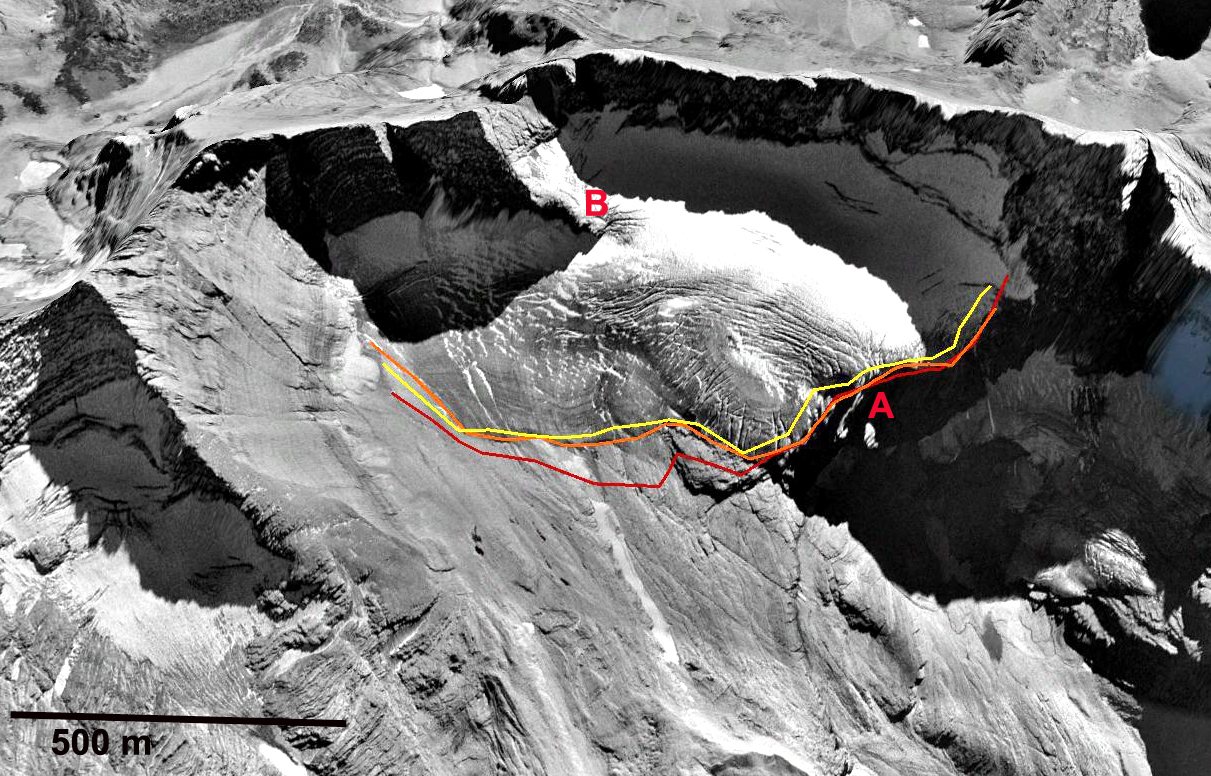
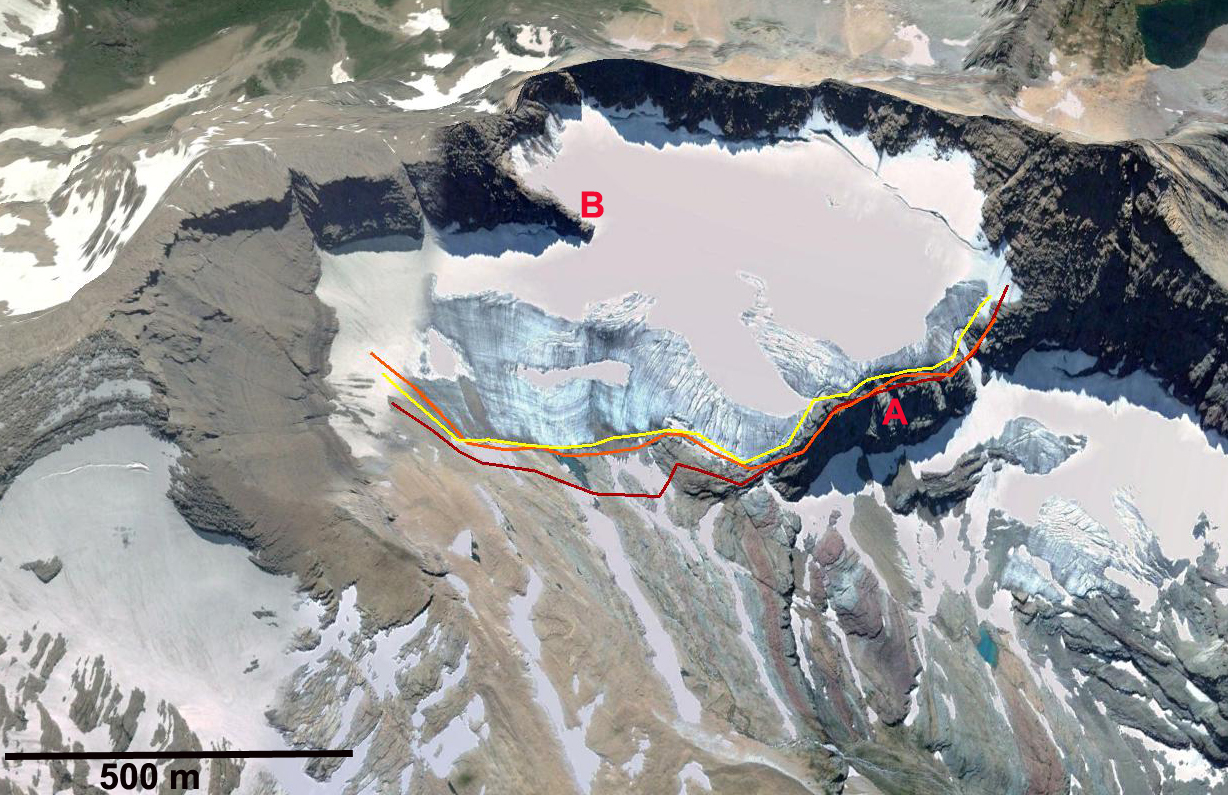
There continues to be a persistent misperciption that all glaciers in Glacier National Park, Montana will be gone by 2030, I get asked that by journalists frequently, and when I point out that is not the case, they are surprised. The number of glaciers has declined from 150 to less than 30 today, and most of those are doing poorly, however, there are a few that are retreating relatively slowly and not on the verge of disappearing. This week brings another examples from National Geographic. This post focusses on why this is not going to occur using Kintla Glacier as an example. Kintla Glacier is 8 km south of the border with Canada on the north slope of Kintla Peak and drains into Medicine Bow Creek and then Kintla Lake. All of the images from Google Earth and Landsat are oriented with south at the top. kintla areaKintla Glacier is noted by Key et al (2002) and by continuing USGS reseearch to have had an area of 1.7 km in 1966 and 1.15 km2 in 2005. This is the loss of nearly a third in 40 years. Here we examine changes from 1990 to 2013 using three Google Earth images and a Landsat image from 2013 to indicate the changes in the glacier during the last two decades. The margin of the glacier in the sequential Google Earth images from 1990 (red), 2003 (orange) and 2007 (yellow) indicate the limited retreat in this period. Retreat averages 30-40 m with a glacier length averaging 500 m. The width of the glacier changed even less. Hence, this glacier has lost 5-10% of its area from 1990 to 2007. n 1990 Jon Scurlock has some exceptional images of the glacier taken in 2009 and posted Glaciers of the American West. These images indicate a glacier that has less than ideal snowcover, but significant crevassing near the main terminus and insignificant retreat from 2007. In 2013 Landsat imagery from August indicates no major retreat. Thus, this glacier is thinning and retreating, but is not poised despite its small size to disappear by 2030. kintla 1990

kintla 2003

kintla 2007

Kintla 2013

A key indicator of a glacier that will not survive current climate for long, is retreat of the upper margin and appearance of bedrock outcrops on the upper glacier (Pelto, 2010), neither is apparent here. A indicates a cliff below the main terminus, and is a good measure of the lack of retreat from this point. Point B is the end of a buttress that has not changed significantly during the 1990-2007 period indicating a lack of change in the upper portion of the glacier. The last image is a picture of the glacier from 2007 indicating a glacier that is not about to disappear in the next twenty years. This glacier will survive beyond 2030 just as Harrison Glacier will. Other glaciers in this park that continues to lose glaciers are not going to survive as long, such as Grinnell Glacier or Sperry Glacier. All of the glaciers in the region are responding to recent climate change, but not at the same rate. Further warming will certainly eliminate all of them.

Kintla Glacier 2007a

Conrad Icefield Retreat, Selkirk Mountains, British Columbia

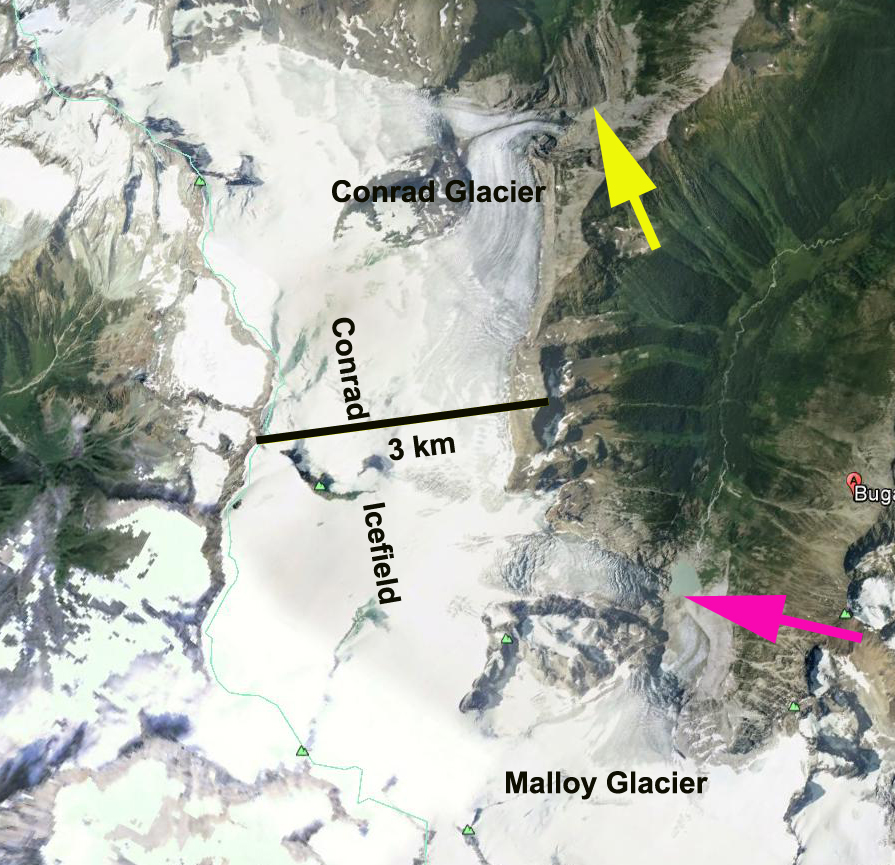
Conrad Icefield is at the northern edge of the Bugaboos in the Purcell Range of the Selkirk Mountains in southwest British Columbia. The icefield feeds several terminus tongues primarily the Conrad Glacier and Malloy Glacier, both of these have two arms. In the case of Conrad Glacier the two arms still join above the terminus, while for Malloy Glacier there are now separate termini. conrad icefield map
British Columbia Topographic Map of the Conrad Icefield area

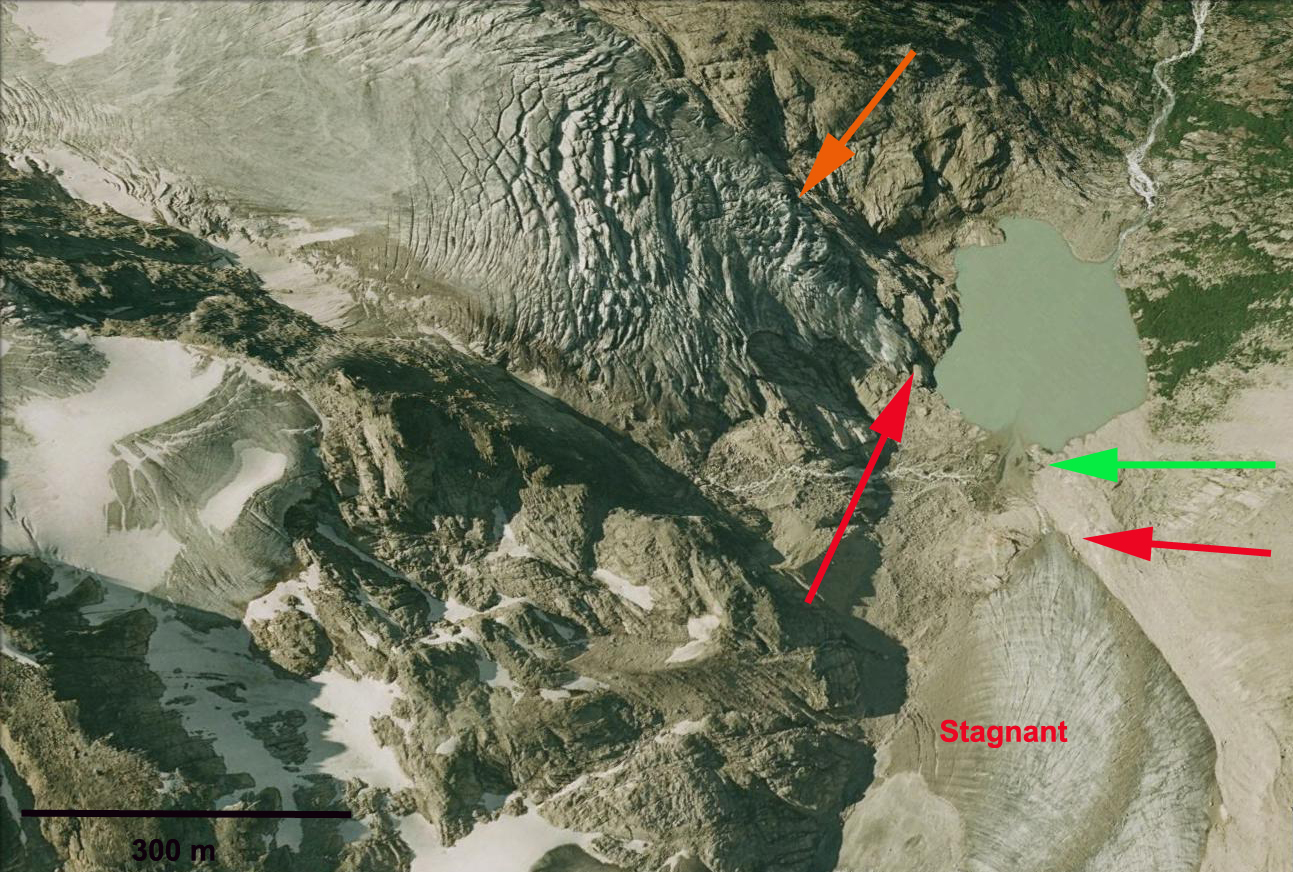
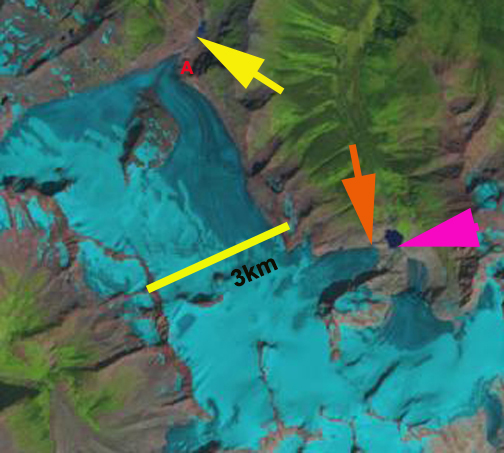
Here we examine the terminus changes of these from 1998 to 2013 using Landsat images from 1998 and 2013 and Google Earth images from 2005. The pink arrow for Malloy Glacier and yellow arrow for Conrad Glacier are in fixed locations on each image. In the 1998 image and map above the west terminus of the Malloy Glacier, pink arrow, reaches to the shores of an unnamed lake at the head of Malloy Creek, the south terminus ends just short of the lake. Conrad Glacier extends past the yellow arrow to end at what is the beginning of a proglacial lake in 1998 that is not in evidence on the map. By 2005 in the Google Earth image the west terminus of Malloy Glacier has retreated a short distance from the lake shore and the southern terminus has retreated 150 m from the lake. Conrad Glacier has retreated upvalley of the yellow arrow. A closeup view of the Malloy Glacier terminus, red arrows, from 2005 indicates that the southern terminus is quite stagnant below the icefall and retreat is continuing. The west terminus is quite narrow and ending on a steep slope, with a buttress paralleling the north side of the terminus ending at the orange arrow. The Conrad Glacier terminus is stagnant beyond the knob at Point A, and is only 200 meters wide from Point A to Point B. The proglacial lake beyond the Conrad Glacier terminus is now 400 m long and the terminus has just retreated upvalley of the lake. In 2013 Malloy Glacier western terminus is at the top of the buttress, orange arrow ending 250 m from the lake, pink arrow. The southern terminus has pulled back 250-300 m from the lake. Malloy Glacier has undergone a 250 m retreat from 1998-2013. Conrad Glacier has retreated a significant distance from the proglacial lake, and now ends on a line between the knob at Point A and B. The proglacial lake has filled in at its upstream end a small amount, hence the distance from the downstream end of the proglacial lake to Point A is a better measure of the retreat from 1998 to 2013. This distance is 700 m, however the retreat is between 600 and 700 m as the lake had begun to form in 1998. Another measure is the distance from where the two arms of Conrad Glacier join to the terminus. The upglacier joining has experienced little change. This distance is in 1.7 km 1998 and just under 1 km in 2013, also indicative of close to 700 m of retreat in 15 years.conrad icefield 1998
1998 Landsat image of Conrad Icefield
conrad icefield ge
2005 Google Earth image of Conrad Icefield
conrad icefield east terminus 2005
2005 Google Earth image of Malloy Glacier terminus
conrad icefield main terminus 2005
2005 Google Earth image of Conrad Glacier terminus
conrad icefield 2013
2013 Landsat image of the Conrad Icefield

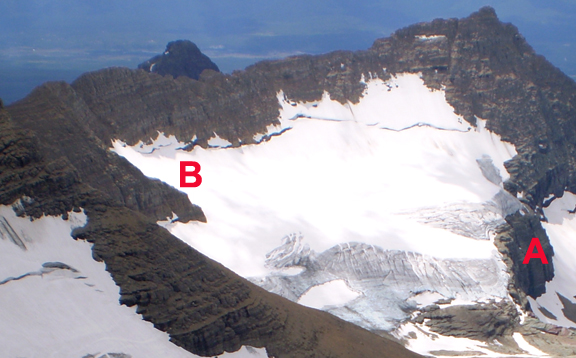
Examination of the margins of both glaciers above the icefalls 1 km above the terminus in 2005 indicates thinning and downwasting, red arrows, suggesting reduced flow that will drive continued retreat. The distance to the lake of the Malloy Glacier west terminus is seen in an image from Gery Unterasinger, Vertical Unlimited mountain guide. He also has a nice image showing the stagnant nature of the southern terminus below the icefall, both images are from 2010. These glaciers are retreating faster than Bugaboo Glacier, but not as fast as Vowell Glacier also in the Bugaboos. The retreat observed in the southern interior ranges of British Columbia, has been 15% from 1985 to 2005 (Bolch, 2010). malloy glacier margin
conrad glacier marginmalloy terminus

malloy west