Vowell Glacier Rapid Retreat, Bugaboos British Columbia

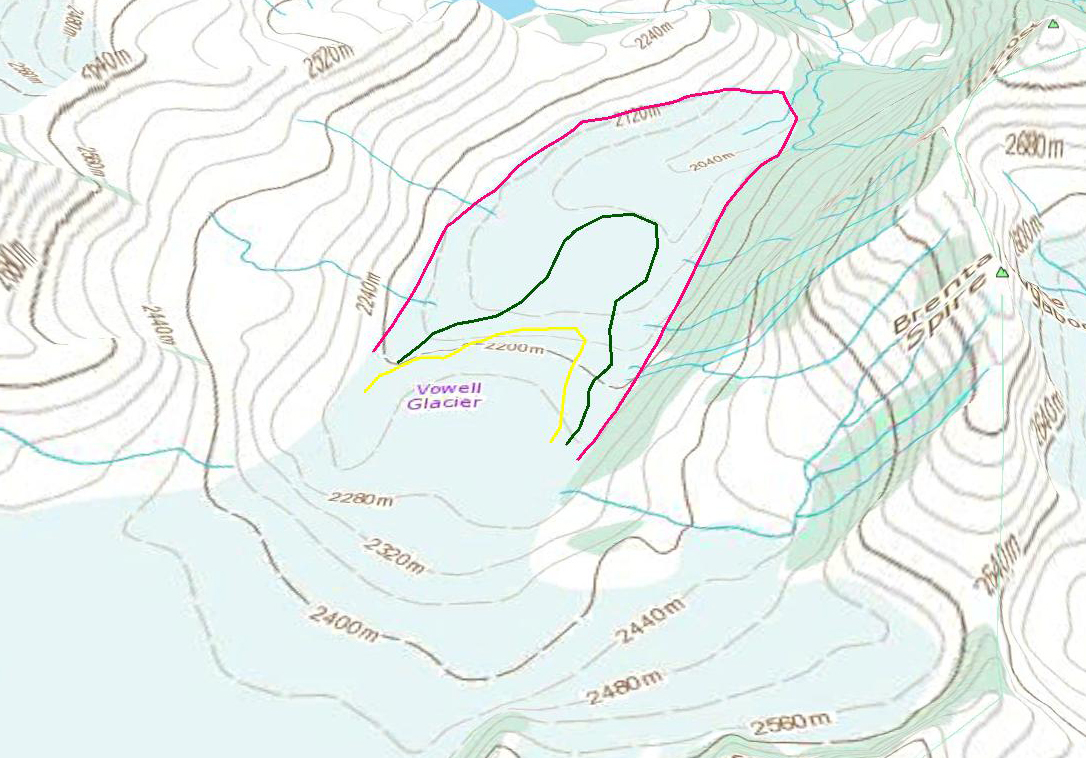
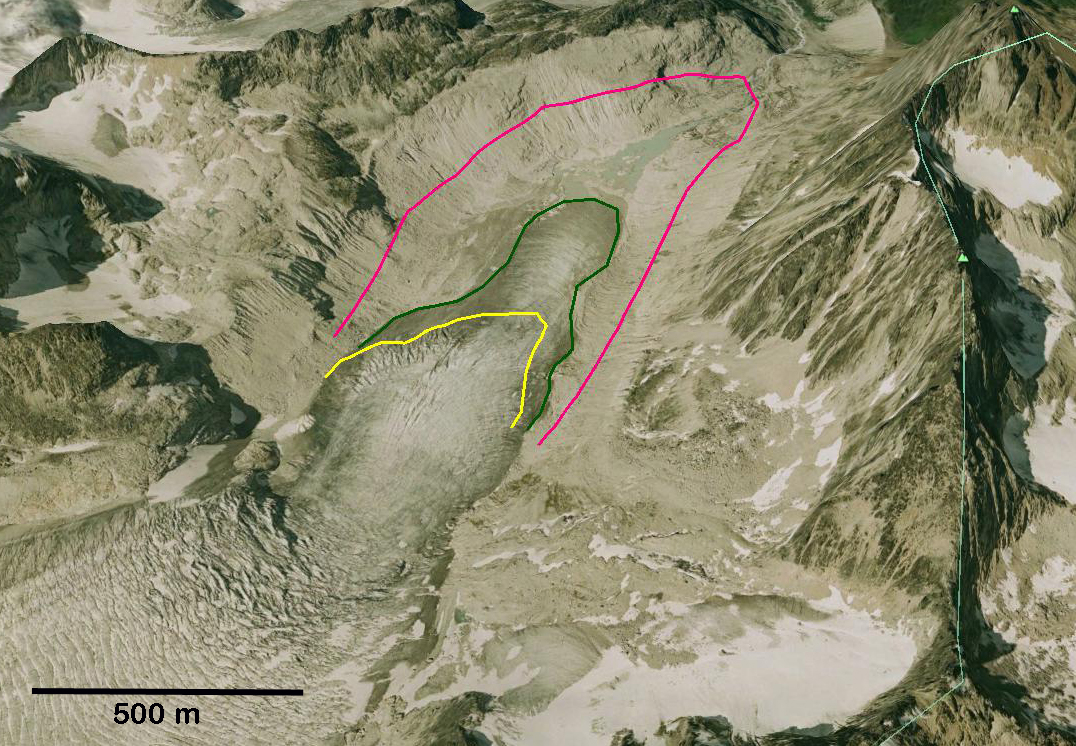
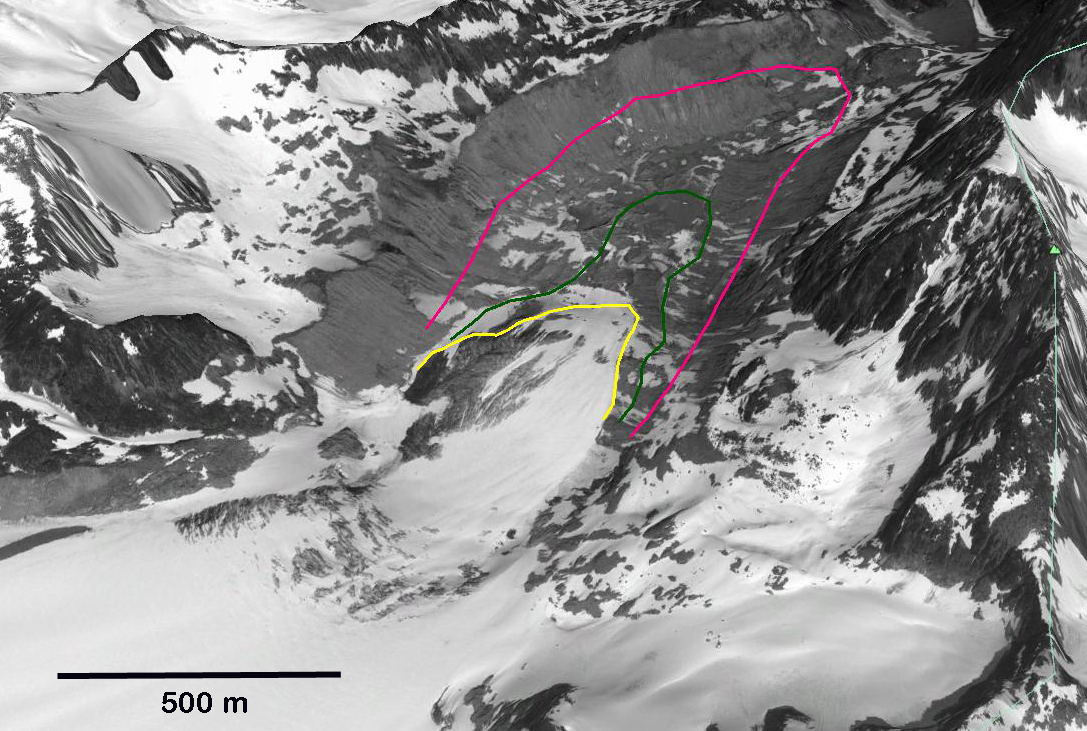
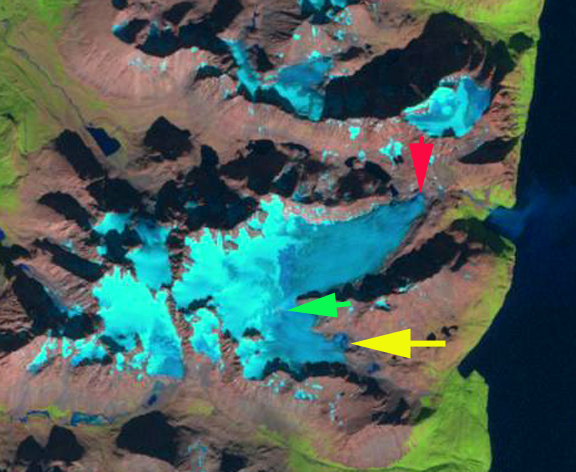
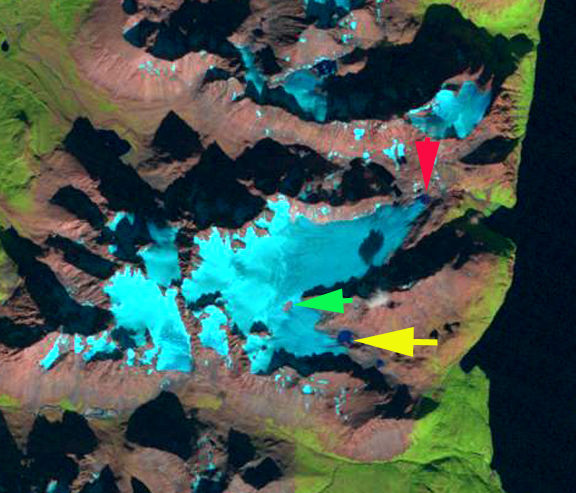
Vowell Glacier is the largest glacier of the Bugaboo’s or maybe was. The glacier drains to the north into Vowell Creek has retreated quite rapidly from 1998 to 2013 creating a new lake and then retreating from that lake. Here we use a sequence of Landsat and Google Earth images to identify the changes from 1998 to 2013. In 1998 Landsat imagery shows the glacier to be 5.5 km long ending at 2060 m with no sign of a lake, this is also the size of the glacier in the BC 20,000 scale topographic map. vowell glacier overview
Vowell Glacier Google earth image from 2005 Pink line map-1998 terminus, green line 2005 terminus, yellow line 2012 terminus.
bugaboo map
Topographic map of Vowell Glacier

vowell glacier 1998 ls
Landsat image from 1998

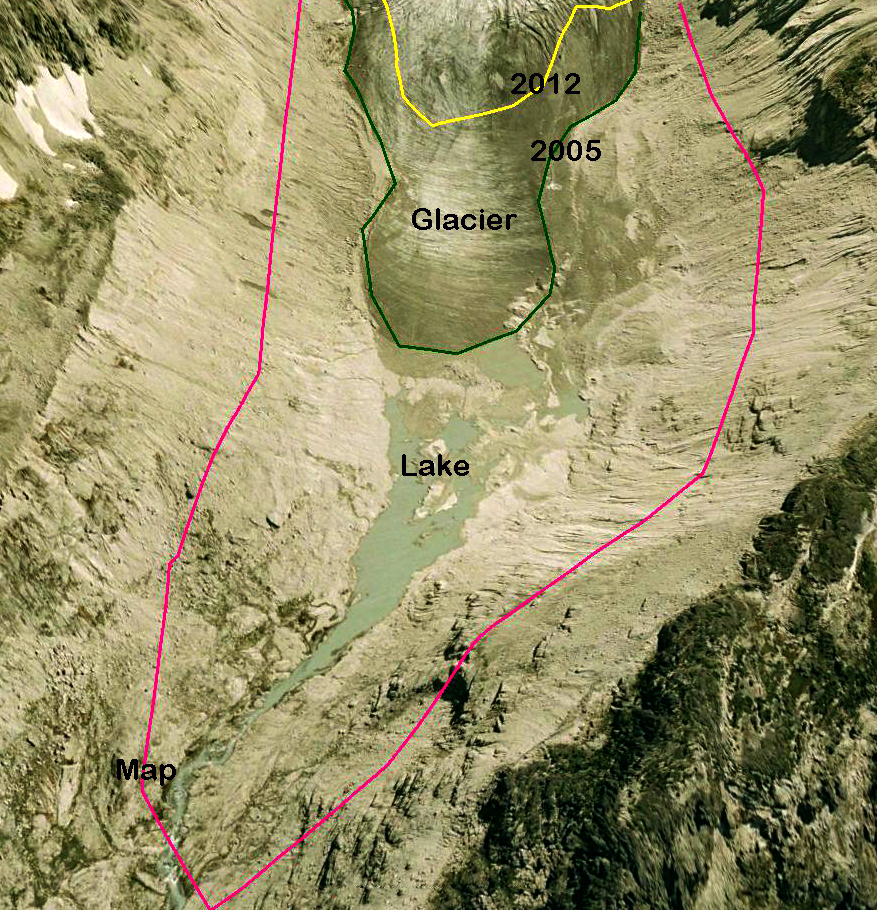
The pink arrow in each image indicates the 1998 terminus and the yellow arrow the 2013 terminus. By 2005 Google earth imagery indicates a 800 m retreat from the map position and the formation of a proglacial lake with numerous icebergs and residual glacier pieces. The lower 500 m of the glacier is stagnant, uncrevassed and thin at this point. By 2012 Google Earth imagery indicates the glacier has retreated from the lake and is now 1500 m from the mapped position. The 2013 Landsat indicates a terminus retreat in 15 years of 1550 m. vowell glacier map overlay
Mapped extent of glacier overlain in Google Earth

vowell glacier 2005
2005 extent in Google Earth image

vowell map overlay
2012 extent in Google Earth image

vowell glacier terminus 2005
Close up of terminus in 2005

A wonderful image from Canadian Mountain Holidays Heli Ski Guide Lyle Grisedale shows the glacier in 2013. The yellow arrows indicate the current terminus, the burgundy arrows lateral moraines, red arrows glacier peices in the lake and the magenta arrow a detached portion of ice cored moraine.The glacier is flowing with some vigor through the icefall that extends from 2400 m to 2200 m. The lower 400 m of the glacier still appears stagnant and poised for retreat. Worse is the fact that the August 22nd image from 2013, with a month of melting to go, shows the snowline at 2600 m. The snowline will likely rise 200 m by the end of summer leaving only 25% of the glacier snowcovered. A glacier such as the Vowell would need about 60% snowcover to have an equilibrium mass balance for the year. This glacier is retreating more rapidly than the more famously named adjacent Bugaboo Glacier. CMH Bugaboos: Aug 25, 2013

North Cascade Glacier Climate Project 2013 Field Report

The 2013 winter season provided close to average snowpack in the North Cascades as indicated by the average SWE at SNOtel stations in the range. The summer melt season has proved to be long, warm and dry. The May-August mean temperature at the station closest to a glacier, Lyman Lake, has been tied for the 2nd warmest in the last 25 years with 2009 and only 2004 warmer. The summer has lacked record periods of warmth and has featured sustained warm temperatures and higher than average humidity, reducing the number of nights when the glacier surface has frozen. The average minimum temperatures at Lyman Lake are the highest in the last 25 years for July and August. The humidity was the strikingly high during our field season, note diagram from a Cliff Mass article on the topic. The net result will be significant negative glacier mass balances in the North Cascades. There is one month left in the melt season most glaciers are close to an equilibrium balance already.

The field team included Stewart Willis and Matt Holland, Western Washington University, Jill Pelto, U of Maine, Ben Pelto, UMass,-Amherst, Jezra Beaulieu and Oliver Grah, Nooksack Indian Tribe research scientists And Tom Hammond, North Cascade Conservation Council. Alan Kearney, Photographer worked with us for the first week capturing time lapse imagery of our work.

After a month of perfect summer weather we arrived to a foggy and wet conditions on the Columbia Glacier. The Columbia Glacier terminus was exposed and has retreated 85 m since 1990. The glacier had a substantial area of blue beginning 200 m above the terminus and extending along the western side of the basin for 400 m. The area of blue ice on August 1 was 50,000 square meters, by Aug. 21 the area had expanded to 200,000 square meters, the shift of the 2013 winter snowline during this period indicates a melt of m during the three weeks.


The Lower Curtis Glacier terminus was exposed early in the summer resulting in a continued retreat of 20 m since 2011, the area of thick seraced terminus lost since 1990 has been 60,000 square meters. The lateral retreat and terminus retreat since 1990 are both in the 125-150 meter range depending on location.
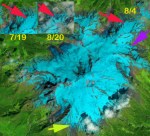
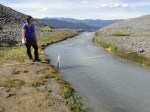
We spent a week observing ablation and resulting glacier runoff on Sholes Glacier. With Oliver Grah and Jezra Beaulieu who work for the water resources section of the Nooksack Indian Tribe we emplaced a stream gage right below Sholes Glacier and one on Bagley Creek which is snowmelt dominated. With the water level gages in we all began work on a rating curve for the Sholes Glacier site directly measuring discharge on 14 occasions, kayak socks helped reduce the impact of cold water. Average ablation during the week was 8.25 cm/day of snowpack or 5 cm of water, discharge measurements identified a mean of 5.2 cm/day of from the glacier during this period. The agreement between ablation and discharge was a nice result. Discharge became notably more turbid after 1 pm, peaking in turbidity around 5 pm. Of equal interest was the change in snowcovered area. On July 19th a Landsat image indicated 100% snowcover for Sholes Glacier. On Aug. 4th our surface measurements indicates a blue ice area of 12,500 square meters, which is also evident in a Landsat image from that day. By Aug. 20th a satellite image indicates that the blue ice area had expanded to an area of square meters. This coincided with the area where snowdepth was observed to be less than 1.2 m on Aug.4. This represents a volume loss of 592,000 cubic meters of water in 16 days.
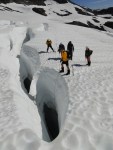
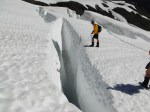
We measured the mass balance on Rainbow and Sholes Glacier during this period. The snowpack was poor on both, especially above 1900 meters on Rainbow Glacier. Typical depths are over 5-6 m, this year 3.75-4.5 m. The poor snow depths were also noted on the Easton Glacier above 2000 m in crevasse stratigraphy measurements. Each crevasse is approached probing to ensure it is safe and then assessed to make sure the crevasse is vertically walled, this enables a safe but also accurate measure. In some cases layers from mulitple years can be assessed. IN the Lynch Glacier crevasse the 2013 layer will be lost to melt before end of the summer. Easton Glacier had a terminus that was fully exposed by the start of August. The terminus slope has thinned markedly in the last three years as retreat has continued. The retreat of Easton Glacier has averaged 10 m/year from 2009-2013. This year the retreat will exceed that with two months of exposure. The Deming Glacier retreat has been exceptional over the last 12 months with at least 30 m of retreat. The snowline on Easton Glacier was at 1850 m on Aug. 10th. By the end of August the snowline had risen to 1980 m, where snow depths had been 1.5 m three weeks previous. The mass balance of Sholes, Rainbow and Easton Glacier will all be close to – 1 meters water equivalent, that is losing a slice of glacier 1.1-1.2 m thick. Mount Daniels had the best snowpack of any location in the North Cascades. On the small and dying Ice Worm Glacier ablation and runoff were assessed simultaneously. The expansion of the area where 2013 has all melted expanded rapidly from 8/13 to 8/21. The glaciers lower section had is often avalanche buried, this year the snowpack was gone on much of the lower section. However, snowpack averaged 1.7 m across the entire glacier on August 14th. With daily ablation of 7-8 cm/day this will be gone by early September. This will lead to a substantial negative mass balance this year. Lynch and Daniels Glacier both had limited exposed blue ice and firn, and snowpack values that were slightly above average. Both glaciers will have small negative mass balances this year. On Lynch Glacier a large crevasse at exposed the retained snowpack of the last three years, from 2010-2012 5 m of firn remains. ice worm 2013

ice worm 821upelto team
Ben in his 9th year, Jill her 5th year and Mauri 30th year of glacier work in the North Cascades

Storstrømmen Susceptible to Rapid Retreat

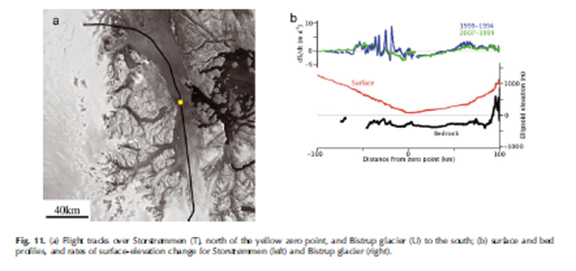
Storstrømmen and L. Bistrup Brae are large outlet glaciers in northeast Greenland that join at their terminus. This joined terminus area is referred to as Bredabrae, though here I refer to the glaciers individually. The calving front is long and has numerous island pinning points. There is a large relatively flat low lying terminus region. The glacier differs from the Zacharaie Isstrom and 79 Glacier in that it currently has quite a low velocity. Storstrømmen surged between 1978 and 1984 (Reeh et al, 1994). The glacier advanced and both terminus regions thickened. Thomas et al. (2009) provide a figure based on a flight over this 60 km long 15-25 km wide low lying, low slope, slow flowing ice plain. The bed of the glacier is 300-400 m below sea level. Joughin et al. (2010) observed the stagnation of the lower portion of this glacier. They further note that the lower 40 km of the Storstrømmen is still slowing and thinning, while further from the ice front the glacier is thickening. Joughin et al. (2010) identify the same drop in speed to near zero near the stagnant front of L. Bistrup Bræ. This thinning and slow down near the terminus and thickening upglacier is typical of a surge glacier.
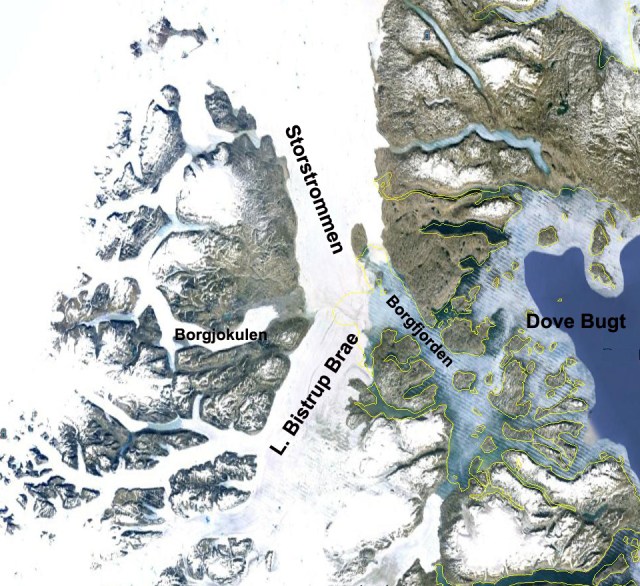
storstrommen ge

storstrommen-Thomas etal2009
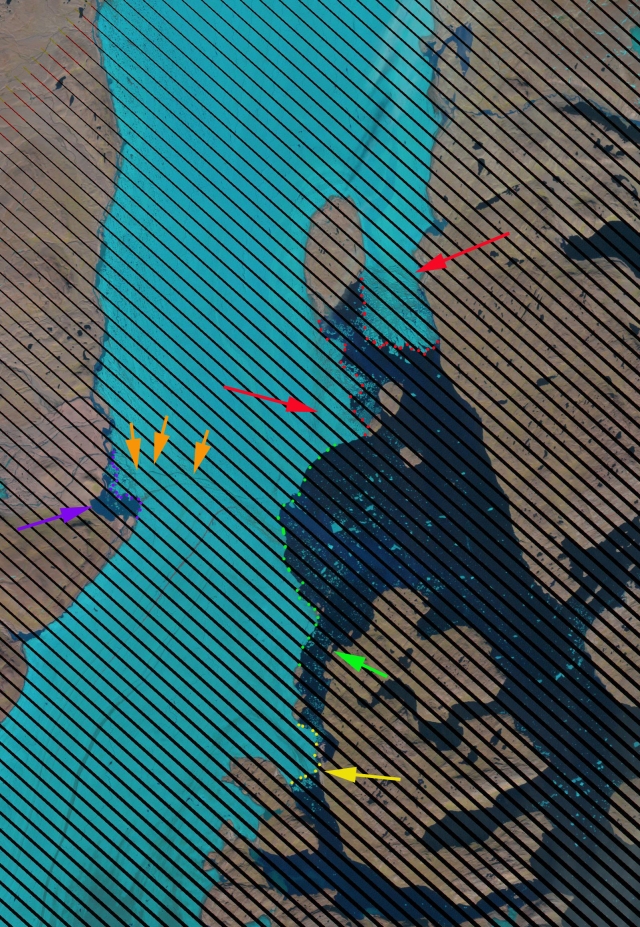
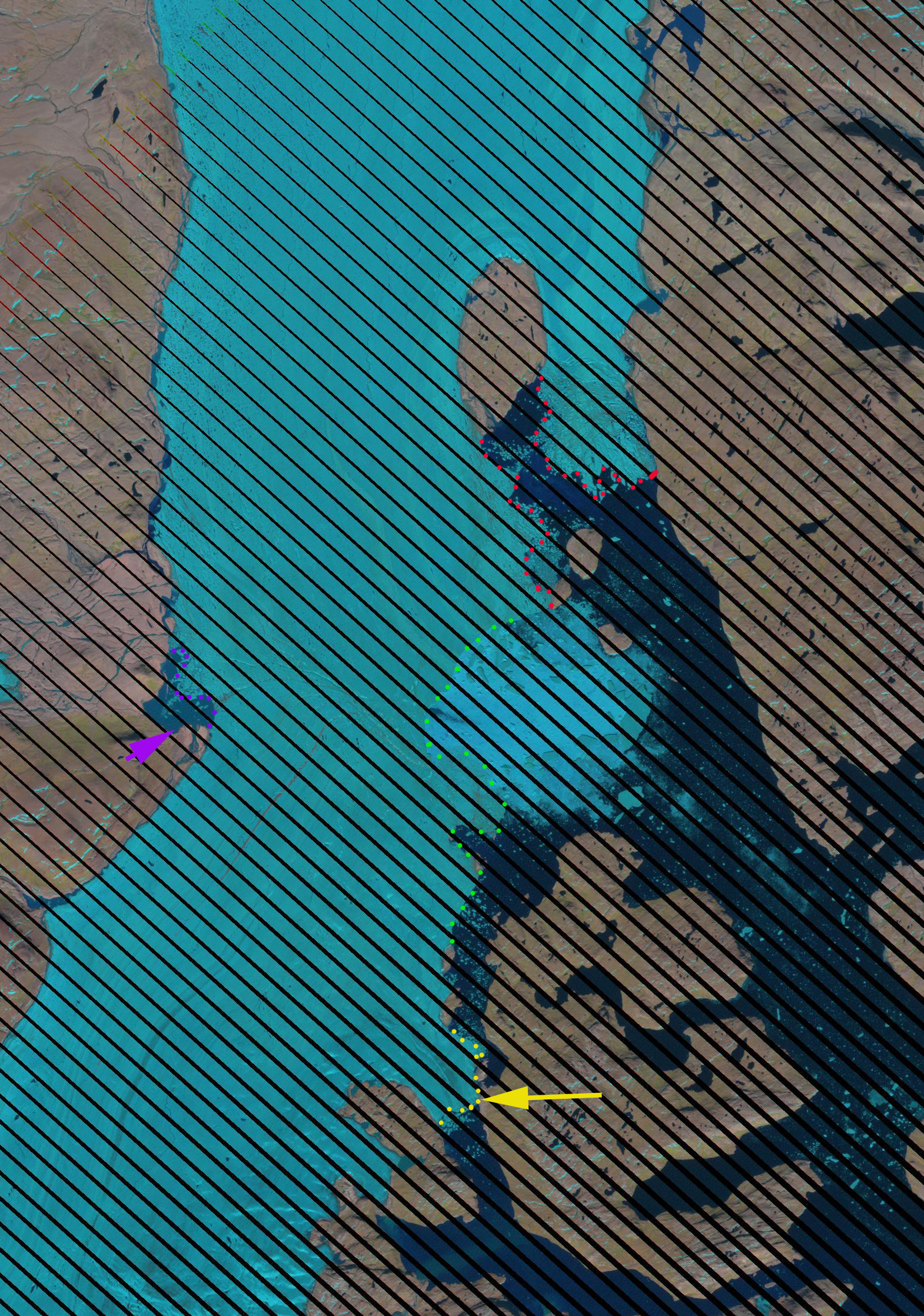
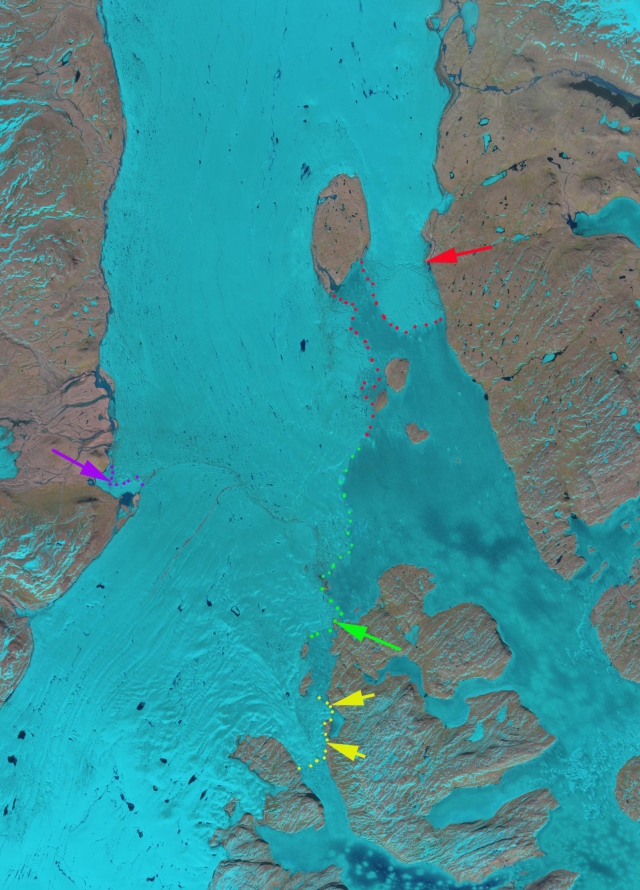
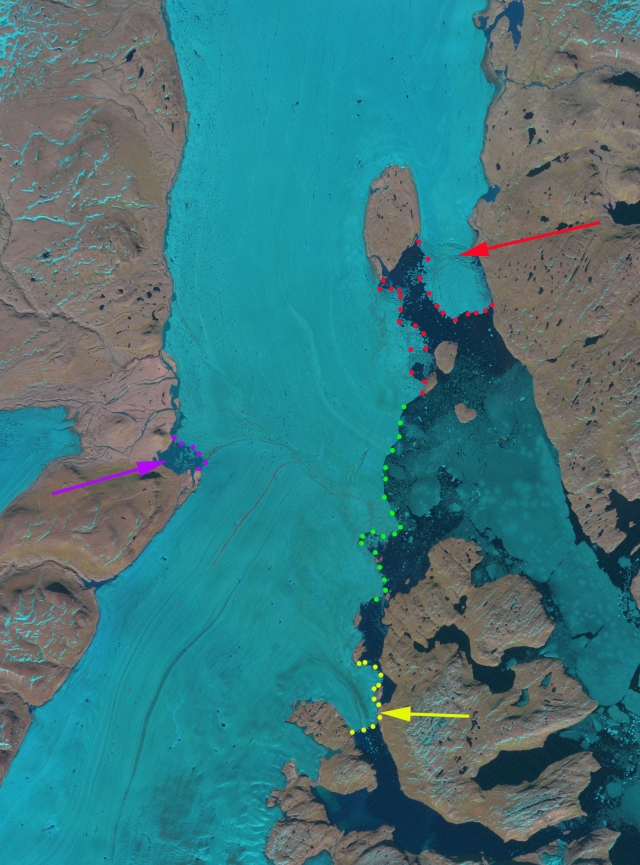
The question posed here is how vulnerable is this ice plain, given the recent years of high melting? Espen Olsen has been examining some potential cracks that could be indicators of weakening ice. Here we examine Landsat images from 2002, 2006, 2009, 2012 and 2013 to identify changes. In addition recent Google Earth images are used. In each image the yellow dots and arrow indicate the terminus of L. Bistrup Brae and its main pinning point. The red dots indicate the terminus of Storstrømmen. The green dots the main calving front that extends across both glaciers. The purple arrows and dots indicate a proglacial lake, Randsøen, on the inland side (western) of the ice plain near where the two glacier meet.

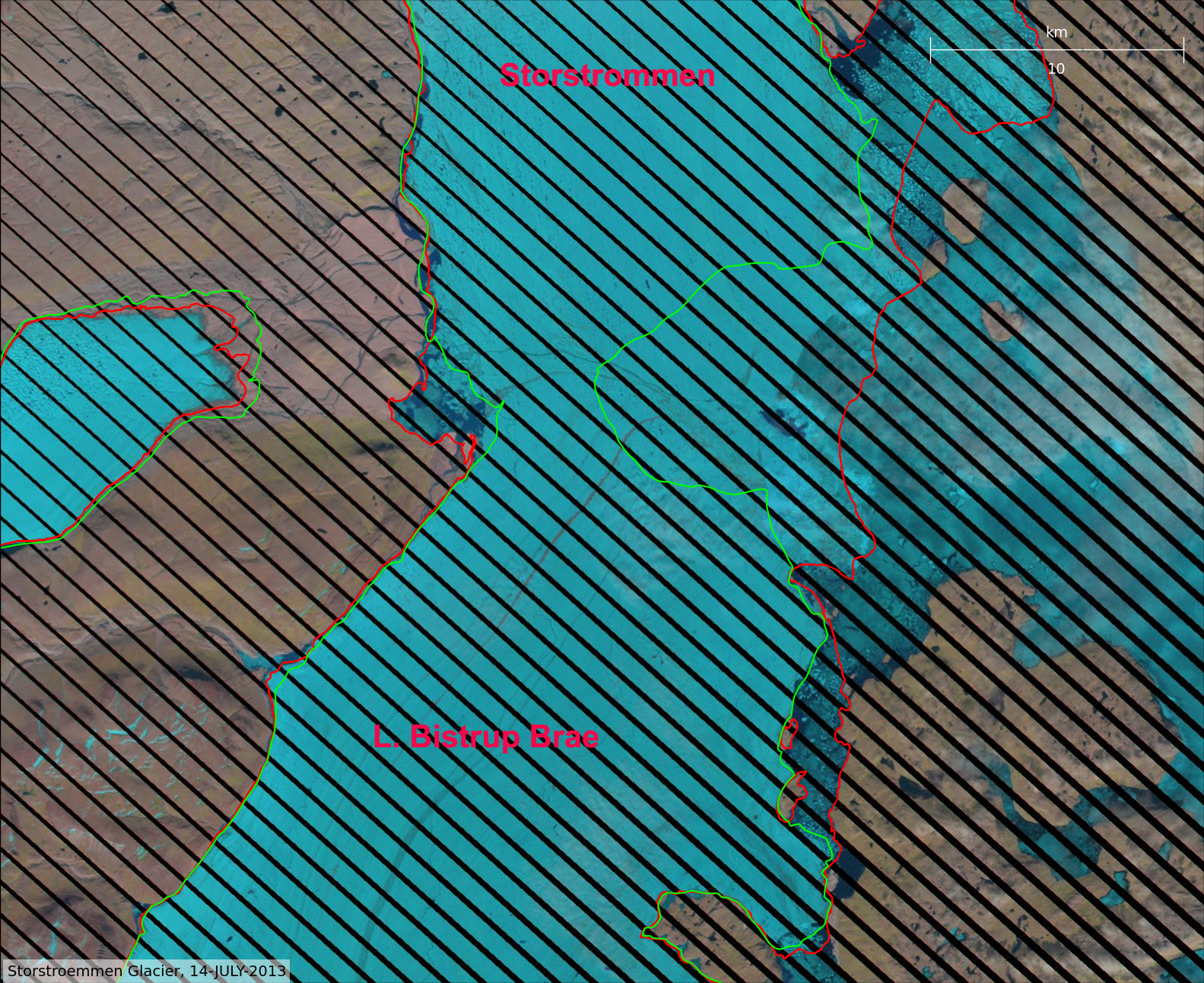
The first image below is from the Polar Portal indicating the terminus of the glacier in the mid-1980’s green and 2000 red on a 2013 Landsat image. The advance from the surge, post 1980’s image, is evident particularly in the main calving front between pinning point islands. The next two images are from 2002 and 2013. Terminus change is limited in the red dot region of Storstrommen. The red arrow indicates a rift on the eastern arm of Storstrommen that has remained in the same place for the last decade. The melange of ice in front of the rift has lost some area, but is largely intact, the stability indicates the lack of glacier velocity, but also suggests a limited water flux in the fjord here and limited melting. The L. Bistrup Brae margin, yellow dots, has retreated from one of the two key pinning points, yellow arrows. The main retreat is in the green dot section where the main advance had occurred, here the front has gone from convex in 2002, to concave in 2013 with 4 km of retreat. At the southern edge of the green dot section the glacier has pulled back from a island pinning point leaving an open water passage 1.6 km wide, green arrow. Another change is the expansion of the lake Randsøen at the western margin of the glacier downstream of the outlet streams from Borgjokulen, purple dots and arrow.
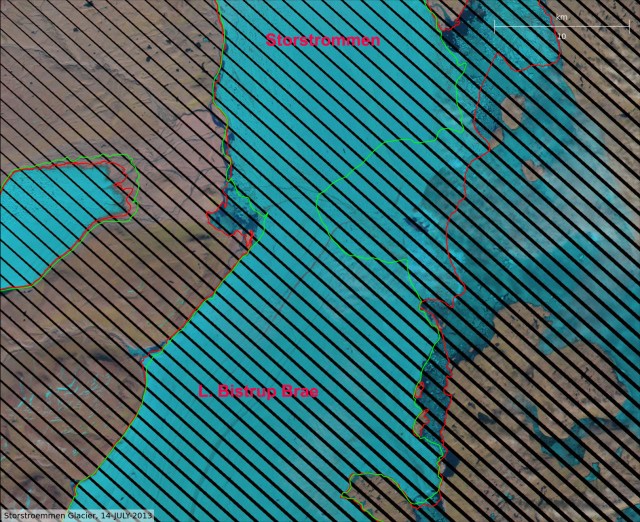
storstrommen portal

storstrommen 2002a

storstrommen 2013a

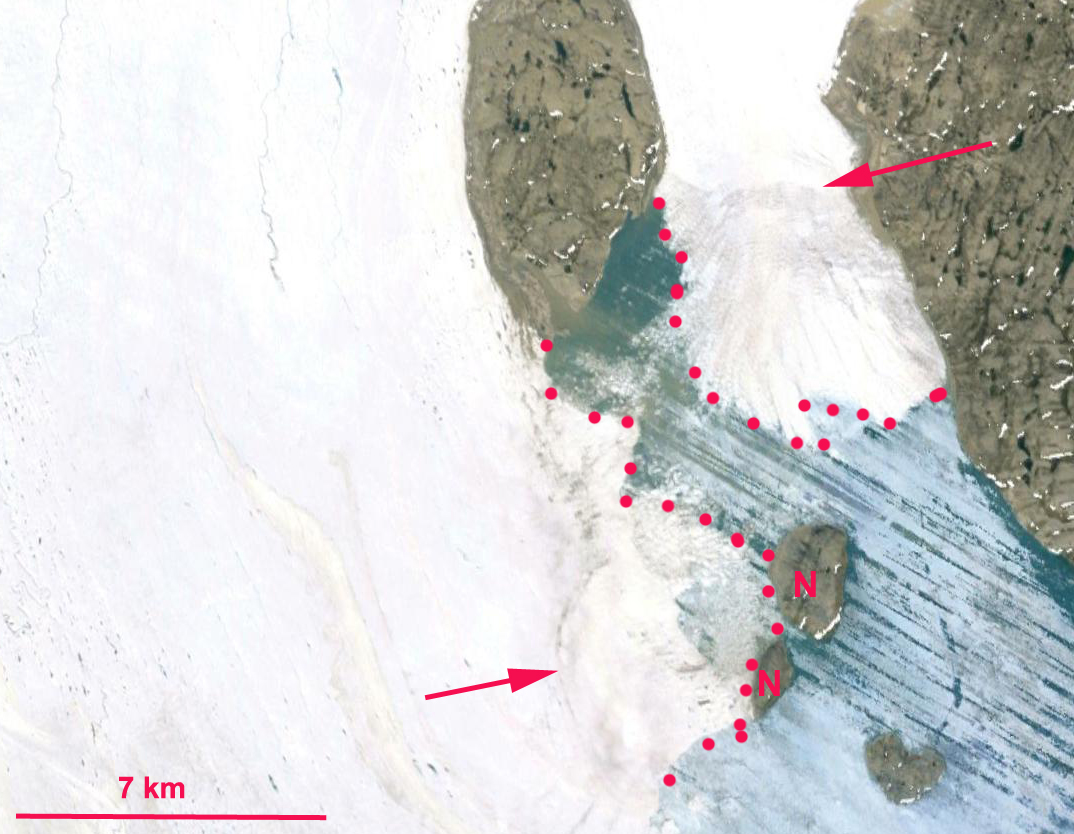
A closer look at various locations from Google Earth provides more detail, the image indicates it is from 4/10/2013 which is incorrect, however, it is quite recent. The first is the calving margin of Storstrommen, the two red arrows indicate substantial persistent rifts, with ice melanges beyond the rifts. Both the rifts and melanges have been pretty stable over the last decade. The area of coastline exposed in the midst of the margin along the south coast of the island has expanded slightly.

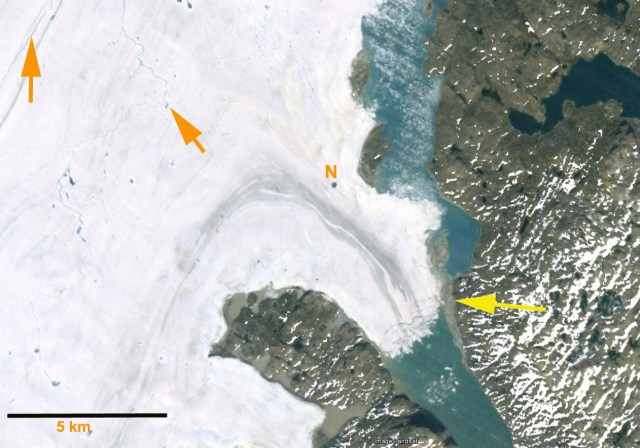
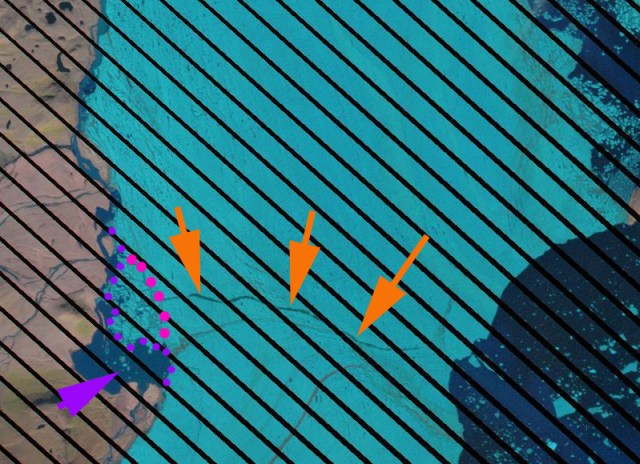
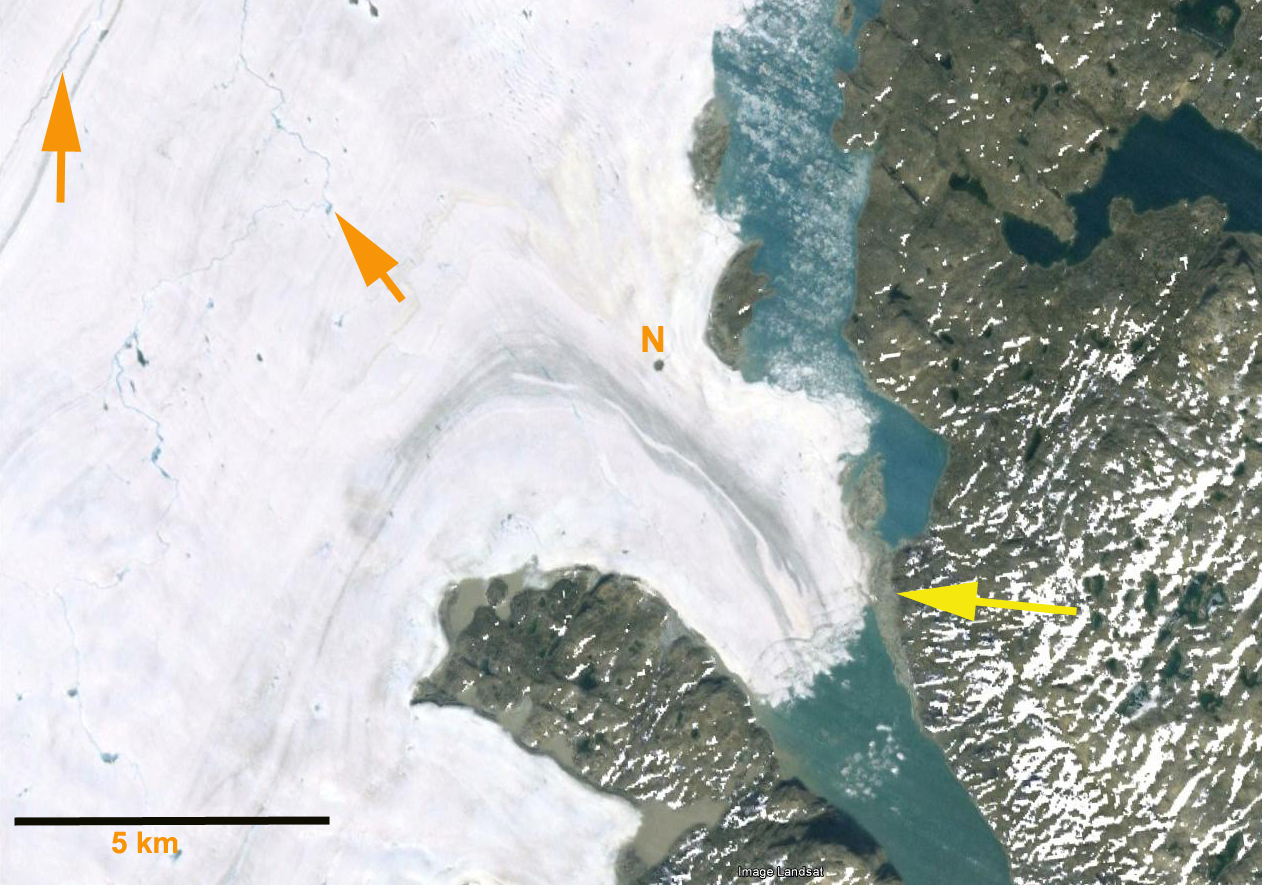
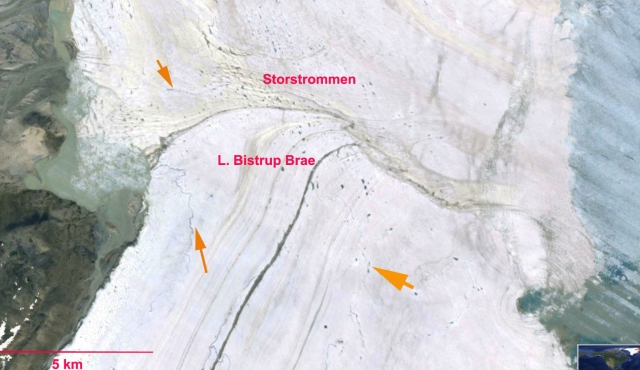
A closer look at the junction of the glaciers, the Bredbrae area, indicates a few substantial supraglacial streams, orange arrows. The front is also exhibiting a bit of a melange, that has been lost in recent Landsat imagery. The last closeup is of the L. Bistrup Brae terminus. The yellow arrow indicates the trimline of the recent advance that the glacier has retreated from. The N denotes a new island emerging from beneath the ice, indicating good pinning points, shallow water and limited calving in this area. The last image is a closeup of the proglacial Randsøen downstream of Borgjokulen. This lake indicates expansion, and considerable potential for more, note the heavily rifted, stream bisected area encompassed by purple and pink dots. A key change is the development of a substantial supraglacial stream that is first evident in the imagery in 2012, and expanded in 2013, orange arrows. This feature may well have existed prior to this but not at scale visible in Landsat. The stream has clearly expanded greatly in the last few years, likely due to enhanced melt. As we have seen on Petermann Glacier outlet streams are not key points of weakness for sections of floating or near floating ice, it is actual rifts. There are no rifts here. However, given the lack of velocity, and the presence of so much surface melt and some bottom melt at least near Randsøen, the large supraglacial stream indicates a section of the glacier that is thinning and quite vulnerable. In particular if the juncture area of Storstrommen and L.Bistrup Brae continues to thin and rift, this is the likely place for a collapse to occur. The thin nature of this section in the Polar Portal terminus of the 1980’s, less than 10 km, indicates this is the weakness. A key question of mine is how extensive is bottom melting for this glacier? The lack of a large floating tongue and low flux in and out of the fjord suggested by the melanges, suggests basal melt is lower than for many glaciers. Andreas Muenchow’s, a physical oceanographer at U. Delaware, notes that Reeh et al (2004) does not indicate significant bottom melting for Storstrømmen and that the a close look at the Lidar and Radar data from Operation IceBridge is essential to address this issue.
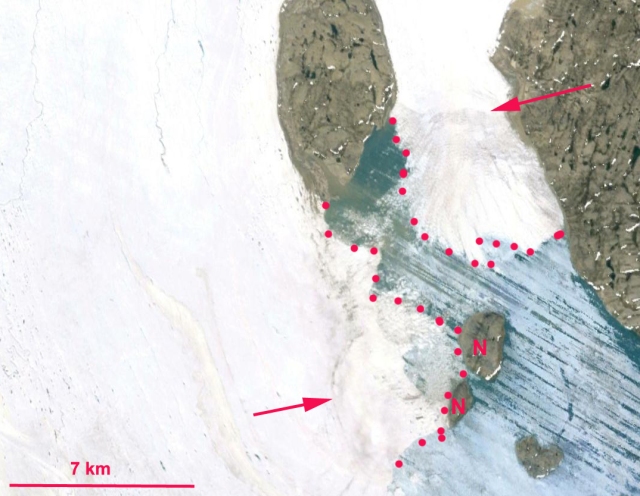
storstrommen ge terminus

storstrommen bredbrae

storstrommen bistrup

storstrommen streams

The last few images are Landsat images from 2006, 2009 and 2012 reinforcing the above that the main terminus change is in the central green dot section, that there are considerable pinning points for both L. Bistrup Brae and Storstrommen on their eastern margins, suggesting the central margin is the weak point. The central margin is also where the large proglacial lake has developed on the west margin of the glacier. The last image is MODIS from 8/23/2013. This indicates little change from the July 2013 Landsat images. However, what is illustrated is the fantastic range of imagery thanks to NASA, with high resolution of Landsat and high frequency of MODIS, and both readily available.
storstrommen 2006

storstrommen 2009

storstrommen 2012
storstrommen20130823TERR

BAMS State of the Climate 2012-Glacier section

The BAMS State of the Climate 2012 has been published. It is the best synopsis of 2012 climate there is. What follows is the section on Alpine glaciers, that I authored, from BAMS.

3) Alpine glaciers—M. S. Pelto

Alpine glaciers have been studied as sensitive indicators of climate for more than a century, most commonly focusing on changes in terminus position and mass balance. The worldwide retreat of mountain glaciers is one of the clearest signals of ongoing climate change (Haeberli et al. 2000). The retreat is a reflection of strongly negative mass balances over the last 30 years (WGMS 2012). Glacier mass balance is the difference between accumulation and ablation. The recent rapid retreat and prolonged negative balances have led to some glaciers disappearing and others fragmenting (Pelto 2010).
The World Glacier Monitoring Service (WGMS) record of mass balance and terminus behavior (WGMS 2012) provides a global index for alpine glacier behavior. Annual mass balance was -766 mm
water equivalent (w.e.) in 2011, negative for the 21st consecutive year. Preliminary data for 2012 from Austria, Norway, New Zealand, Nepal, and the United States indicate it is highly likely that 2012 will be the 22nd consecutive year of negative annual balances. The loss of glacier area is leading to declining runoff; the importance of this is indicated by Schaner et al.(2012) who determined that, globally, 370 million people live in river basins where glaciers contribute at least 10% of river discharge on a seasonal basis.

The cumulative mass balance loss since 1980 is 15.7 m w.e. the equivalent of cutting a 17-m thick slice off the top of the average glacier (Fig. 2.9). The trend is remarkably consistent from region to region
(WGMS 2011). WGMS mass balance results based on 30 reference glaciers with 30 years of record is not appreciably different, -15.5 m w.e. The decadal mean annual mass balance was -198 mm w.e. in the 1980s,
-382 mm w.e. in the 1990s, and -740 mm w.e. for 2000–10. The declining mass balance trend during a period of retreat indicates alpine glaciers are not approaching equilibrium and retreat will continue to be the dominant terminus response.

global glacier mass balance 2012

In 2012, slightly-above-average winter accumulation in the Alps was offset by extreme summer ablation, yielding mass balances that were negative. In Austria, Mullwitzkees had a mass balance of -1461
mm w.e. and Hallstätter Gletscher a mass balance of -1944 mm w.e. (Fischer 2012). The Austrian Glacier inventory in 2011 examined 90 glaciers: 87 were in retreat and 3 were stationary. Average terminus change was -17 m, reflecting the continued negative mass balances of the region. In Italy, a large deposit of World War I ammunition melted out of the glacier on Ago Di Nardis Peak during August 2012. The Swiss Glacier Monitoring Network noted in 2011 92 glaciers retreating, 1 advancing, and 3 stationary. The one advancing glacier had retreated the previous five years. The 2012 data are not complete, but retreat was again dominant.

In Norway, terminus fluctuation data from 25 glaciers for 2012 with ongoing assessment indicate 21 retreating, 2 stable, and 2 advancing. The average terminus change was -12.5 m (Elvehøy 2012). The retreat rate is less than 2011. Mass balance surveys found deficits on all Norwegian glaciers.

In the North Cascades, Washington La Niña conditions during the winter led to a wet winter and a cool and wet spring. Summer was drier and warmer than normal. This led to nearly equilibrium conditions on North Cascade glaciers, with mass balance positive on five glaciers and negative on four glaciers (Pelto 2013). In southeast Alaska, the same La Niña conditions prevailed and led to the highest snow totals in several decades. Glacier snowlines were more than 100 m below average on Lemon Creek and Taku Glaciers of the Juneau Icefield indicative of moderate positive mass balance (Pelto 2013).

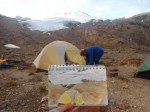
Camp below Easton Glacier

In New Zealand, the annual end of summer snowline survey on 50 glaciers found snowlines that were approximately 120 m above the elevation for glacier equilibrium. This indicates strong mass balance losses (NIWA 2012). In Nepal, the International Centre for Integrated Mountain Development measured the mass balance of Yala and Rikha Samba Glaciers in 2012 and found both to be significantly negative (Mishra 2012). Pelto (2012) reported that the extensive inventories are better validated than GRACE (Jacob et al. 2012) for
Himalayan glacier volume change. This conclusion has been confirmed by Bolch et al. (2012).

Mangin Glacier Retreat and Separation, Alberta

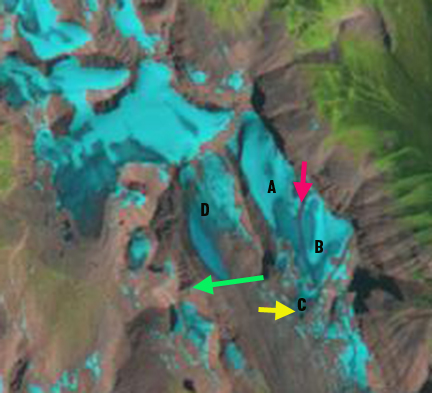
Mangin Glacier and its unnamed neighbor flow down the north slope of Mount Joffre, Alberta and drain into Kananaskis Lake. The glacier like the vast majority in Alberta has been losing area and volume during its retreat. Bolch et al (2010) noted that the glaciers in western Canada had on average lost 11% of their area from 1985 to 2005, 16% on the east slope of the continental divide in the Rocky Mountains of Alberta. A comparison of Landsat imagery from 1994 and 2013, Google Earth imagery from 2005 and the Canadian Topographic map published in 1994, based on early 1990’s aerial photographs. In the map Mangin Glacier was a single ice body that extended for 3.2 km ending in a small lake at 2575 m, sections A-C were all joined, green line is glacier boundary for the map and brown line the 2005 glacier margin. By 1994 section C, yellow arrow, has only a tenuous connection and is clearly going to separate from parts A and B. Further a ridge between A and B is beginning to develop, red arrow. By 2005 in the Google Earth image sections A and B are nearly separated by the expanding ridge and C is fully separated from A and B. By 2013 A and B are fully separated, this image is from mid-August with a month of melting to go. The light blue is snowcover and the darker blue is bare glacier ice. In another month the amount of snowcover will be very small. For example earlier this month on Sholes Glacier in the North Cascades we observed rapid expansion of the blue ice zone from 12, 500 square meters on Aug. 3 to 35,000 square meters on Aug. 9. The retreat of the unnamed glacier labeled D is apparent in the comparison of the 1994 and 2013 images, note the green arrow. This retreat is 300-400 m, with much of the retreat coming after 2005. Mangin Glacier’s retreat from the map based on early 1990’s imagery is 500 m, combined with retreat of the top of the glacier 20% of the glacier length has been lost in the last 20 years. Mangin Glacier has been retreating even on its upper margin, this is indicative of a glacier without a consistent accumulation zone, and a glacier that will not survive(Pelto, 2010). Just southeast is Petain Glacier also retreating. As the glaciers retreat their meltwater that is primarily yielded in late summer when other sources are at a minimum will decline. It is anticipated that during this century glacier contributions to streamflow in Alberta will decline from 1.1 km3 a−1 in the early 2000s to 0.1 km3 a−1 by the end of this century Marshall et al (2011).mangin map

mangin early

mangin 2005 ge

mangin 2013

Index to 300 Glacier Posts & North Cascade Glacier Climate Project 2013 Field Season

Below is a list of the 300 individual glacier posts examining our warming climates impact on each glacier, this represents the first 4 years of posts. I have worked directly on 52 of the glaciers noted. The others are prompted by fine research that I had come across, cited in each post or inquiries from readers, or just glaciers that nobody has focused upon. I then look for satellite imagery spanning a period of time to identify change. Most of the imagery comes from Landsat, thanks to its long term archive of free images. Some imagery is from MODIS, Geoeye or Google Earth. There is a consistent signal from the glaciers, mass balance loss, thinning and retreat. In many cases this leads to new lake formation or lake expansion for alpine glaciers. For the next three weeks there will be no new posts as I will be in the field.

North Cascade Glacier Climate Project 2013 Field Season, 30th Annual

This will be the 30th consecutive year heading into the field to assess North Cascade glaciers. Over the next three weeks we will be measuring snow depth and melt at over 2000 locations on 10 different North Cascade glaciers. We will be mapping changes in the terminus position on 12 glaciers and surface elevation on specific profiles on 6 glaciers. The decent winter left the region with average snowpack as of May 1. Spring melting began on May 3, and the melt season has preceded with drier and warmer conditions than typical. The main crew will consist of Stewart Willis from WWU, Jill Pelto UMaine (5 years), Ben Pelto UMASS-Amherst (9 years) and myself (30 years). We will begin as usual at Columbia Glacier, where we will be joined by Tom Hammond (11 years) of the North Cascades Conservation Council and Alan Kearney, photographer. We will then head to the north side of Mount Baker for a week on Sholes Glacier, Lower Curtis Glacier, Rainbow Glacier and Ptarmigan Ridge Glacier. We will be joined here by Matt Holland, WWU, Jezra Beaulieu and Oliver Grah, Nooksack Indian Tribe. We will focus on installing ablation stakes here and measurement of streamflow including emplacement of two streamflow sensors below the glaciers to help the Nooksack Tribe identify how declining glacier area is going to impact summer streamflow and salmon in the Nooksack River. We then head to the Easton Glacier and Deming Glacier. On Easton Glacier we will again be joined by Tom Hammond. Last is Mount Daniels with the Ice Worm, Daniels and Lynch Glacier.


United States
Columbia Glacier, Washington
Lyman Glacier, Washington
Whitechuck Glacier
Boulder Glacier, Washington
Roosevelt Glacier
Deming Glacier Icefall, Washington
Deming Glacier, Washington
Hidden Creek, Washington
Lower Curtis Glacier Annual Survey, Washington
Easton Glacier Assessment, Washington
Mount Baker Mass balance, Washington
Ptarmigan Ridge Glacier, Washington
Dusty Glacier, Washington
Neve Glacier, Washington
Anderson Glacier, Washington
Eel Glacier, Washington
Milk Lake Glacier, Washington
Suiattle Glacier, Washington
Paradise Glacier, Washington
Easton Glacier, Washington
Redoubt Glacier, Washington
Honeycomb Glacier, Washington
Vista Glacier, Washington
Rainbow Glacier, Washington
Daniels Glacier, Washington
Colonial Glacier, Washington
Quien Sabe Glacier, Washington
Mazama Glacier
Fairchild Glacier, Washington
White Glacier, Washington
Banded Glacier, Washington
Borealis Glacier, Washington
Hinman Glacier, Washington
Lower Curtis Glacier, Washington
Mount Baker Glaciers, Washington
McAllister Glacier, Washington
Lewis Glacier, Washington
Kennedy Glacier, Washington
Fremont Glacier, Wyoming
Minor Glacier, Wyoming
Knife Point Glacier, Wyoming
Bastion Glacier, Wyoming
Sourdough Glacier, Wyoming
Grasshopper Glacier, Wyoming
Grasshopper Glacier, Montana
Harrison Glacier, Montana
McDonald Glacier, Montana
Sperry Glacier, Montana
Hopper Glacier, Montana
Old Sun Glacier, Montana
Yakutat Glacier, Alaska
Grand Plateau Glacier, Alaska
Eagle Glacier, Alaska
Gilkey Glacier, Alaska
Fork Glacier, Alaska
Gilkey Glacier ogives, Alaska
Norris Glacier
Lemon Creek Glacier, Alaska
Taku Glacier, Alaska
Bear Lake Glacier, Alaska
Riggs Glacier
Chickamin Glacier, Alaska
Okpilak Glacier, Alaska
Sawyer Glacier, Alaska
Valdez Glacier, Alaska
Antler Glacier, Alaska
Field Glacier
East Taklanika Glacier, Alaska
Gold Rush Glacier
Brady Glacier, Alaska
Brady Glacier Retreat lake expansion 2004-2010, Alaska
Thiel Glacier, Alaska
Excelsior Glacier, Alaska
Speel Glacier, Alaska
Patterson Glacier, Alaska
Romanzof Glacier, Alaska
Pedersen Glacier, Alaska

Juneau Icefield, Alaska 1984-2013

Canada
Icemantle Glacier, BC
Bridge Glacier, British Columbia
Porcupine Glacier, British Columbia
Snowcap Creek
Stave Glacier, British Columbia
Washmawapta Glacier, British Columbia
Bubagoo Glacier, British Columbia
Hector Glacier, Alberta
Helm Glacier, British Columbia
Jacobsen Glacier, British Columbia
Melbern Glacier
Warren Glacier, British Columbia
Castle Creek Glacier, British Columbia
Hoboe Glacier, British Columbia
Coleman Glacier, British Columbia
Tulsequah Glacier, British Columbia
Des Poilus Glacier, British Columbia
Decker and Spearhead Glacier, British Columbia
Columbia Glacier, British Columbia
Freshfield Glacier, British Columbia
Apex Glacier, British Columbia
Galaxy Glacier, British Columbia
Great Glacier, British Columbia
Devon Ice Cap, Nunavut
Dexterity Ice Cap Baffin Island
Penny ice Cap, Nunavut
Northern Outlet Devon Ice Cap, Nunavut
Penny Ice Cap SW, Nunavut
Mittie Glacier, Ellesmere Island, Nunavut
Snowshoe Peak, Yukon
Petain Glacier, Alberta
Saskatchewan Glacier, Alberta

Himalaya
Ngozumpa Glacier, Nepal
West Barun Glacier, Nepal
Khumbu Glacier, Nepal
Imja Glacier, Nepal
Reqiang Glacier Retreat, Nepal
Kali Gandaki Headwaters, Nepal
Samudra Tupa, India
Malana Glacier, India
Warwan Basin, India
Sara Umaga Glacier, India
Kedarnath Floods, India
Jaonli Glacier, India
Jaundhar Barnak Glacier, India
Zemu Glacier, Sikkim
North Lhonak Glacier, Sikkim
Changsang Glacier, Sikkim
Gangotri Glacier, India
Milam Glacier, India
Satopanth Glacier, India
Hakakabo Razi Glacier, Myanmar
Theri Kang Glacier, Bhutan
Zemestan Glacier, Afghanistan
Emend River Headwaters, Afghanistan
Yajun Peak Glacier, Afghanistan
Godur Glaicer, Pakistan
Tirich Mir, Pakistan
Longbasba Glacier, Tibet
Menlung Glacier, Tibet
Boshula Glaciers, Tibet
Urumquihe Glacier, Tibet
Lumding Glacier, Tibet
Matsang Tsanpo Glacier, Tibet
Jiongla Glacier, Tibet
Rongbuk Glacier, Tibet
Zayul Chu Headwaters, Tibet
Bode Zangbo Headwaters, Tibet
Dzhungharia Alatau, Kazakhstan
Petrov Glacier,Kyrgyzstan
Hailuogou Glacier, China
Sepu Kangri, China
Himalaya Glacier Index

Europe
Taconnaz GLacier, France
Mer de Glace, France
Dargentiere Glacier, France
Glacier du Tour, France
Glacier de la Girose
Glacier Blanc
Grand Motte and Pramort Glacier Tignes Ski area, France
Saint Sorlin, France
Sommelier Glacier, France
Obeeraar Glacier, Austria
Obersulzbach Glacier, Austria
Rotmoosferner, Austria
Viltragenkees, Austria
Stubai Glacier, Austria
Sulztalferner, Austria
Hallstatter Glacier, Austria
Ochsentaler Glacier, Austria
Pitzal Glacier, Austria
Dosde Glacier, Italy
Presena Glacier, Italy
Forni Glacier, Italy
Careser Glacier, Italy
Lobbia Glacier, Italy
Sabbione Glacier Retreat, Italy
Malavalle Glacier, Italy
Triftgletscher, Switzerland
Gietro Glacier, Switzerland
Ried Glacier, Switzerland
Cavagnoli Glacier, Switzerland
Chuebodengletscher and Ghiacciaio-del-Pizzo-Rotondo, Switzerland
Peridido Glacier, Spain
Maladeta Glacier, Spain
Engabreen, Norway
Midtdalsbreen, Norway
Tunsbergdalsbreen, Norway
Lodalsbreen, Norway
Strupbreen and Koppangsbreen, Norway
Blamannsisen
Rembesdalsskaka, Norway
TungnaarJokull, Iceland
Langjökull, Iceland
Gigjokull, Iceland
Porisjokull, Iceland
Skeidararjokull, Iceland
Kotlujokull, Iceland
Lednik Fytnargin, Russia
Kirtisho Glacier, Georgia
Lednik Kauraugom, Russia
Irik Glacier, Mount Elbrus, Russia

Greenland and European Arctic
Mittivakkat Glacier
Ryder Glacier
Humboldt Glacier
Petermann Glacier
Kuussuup Sermia
Thrym Glacier Retreat
Tiningnilik Glacier Lake
Jakobshavn Isbrae
Tracy Gletscher
79 Glacier
Zachariae Isstrom
Umiamako Glacier
Alison Gletscher
Kong Oscar Glacier
De Reste Bugt
Qaleraliq Glacier
Upernavik Glacier
Quinngua Avannarleq
Apuserajik Glacier
Epiq Sermia
Puisortoq North
Dodge and Storm Glacier
Sarqardliup Seremia
Steensby Glacier
Sortebrae Glacier, Greenland
Bussemand Glacier
Narssap Sermia
Severnaya Zemlya, Russian Arctic
Hansbreen, Svalbard
Nannbreen, Svalbard
Hornbreen and Hambergbreen, Svalbard
Olsokbreen, Svalbard
Albrechtbreen, Svalbard
Svitjodbreen, Svalbard
Roze and Sredniy Glacier, Novaya Zemyla
Nizkiy and Glazova Glacier, Novaya Zemyla
Krivosheina, Novaya Zemlya
Chernysheva Glacier, Novaya Zemlya
Taisija Glacier, Novaya Zemlya

South America
Colonia Glacier, Chile
Glaciar Steffen, Chile
Artesonraju Glacier, Peru
Nef Glacier, Chile
Tyndall Glacier, Chile
Alemania Glacier, Chile
Zongo Glacier, Bolivia
Nevado Cololo, Bolivia
Laramcota Glacier, Bolivia
Sierra Nevade del Cocuy Glaciers, Colombia
Ritacuba Blanco Glacier, Colombia
Llaca Glacier, Peru
Joerg Montt Glacier, Chile
Nororeste Glacier, Chile
Arhuey Glacier, Peru
Seco Glacier, Argentina
Onelli Glacier, Argentina
Quelccaya Ice Cap, Peru
Manon Glacier, Peru
Corihuasi Glacier, Peru
Chuecon Glacier
Glacier Gualas, Chile

Antarctica and Circum Antarctic Islands
Pine Island Glacier
Fleming Glacier
Hariot Glacier
Smith Glacier, Antarctica
Thwaites Glacier, Antarctica
Amsler Island
Stephenson Glacier, Heard Island
Neumayer, South Georgia
Ampere, Kerguelen
Lapparent Outlet, Kerguelen Island
Cook Ice Cap, Kerguelen Island
Nordenskjold Coast, Antarctic Peninsula
Prospect Glacier, Antarctic Peninsula
Ross Hindle Glacier, South Georgia
Twitcher Glacier, South Georgia
Herz Glacier, South Georgia
Vega Island Ice Cap
Rohss Bay, James Ross Island, Antarctica
Jones Ice Shelf, Antarctica
Sheldon Glacier, Antarctica

New Zealand
Tasman Glacier
Tasman Glacier 2013 update
Murchison Glacier
Donne Glacier
Mueller Glacier, NZ
Gunn Glacier, NZ
Douglas Glacier Neve, NZ

Africa
Rwenzori Glaciers
Tyndall Glacier, Kenya

North Cascade Glacier Climate Project Reports

Forecasting Glacier Survival
North Cascade Glacier Mass Balance 2010
Columbia Glacier Annual Time Lapse
North Cascade Glacier Climate Project 2009 field season
28th Field Season Schedule of the North Cascade Glacier Climate Project
North Cascade Glacier Climate Project 2011 Field Season
BAMS 2010 alpine glaciers
BAMS 2011 Alpine Glaciers
2011 Glacier mass balance North Cascades and Juneau Icefield
Taku Glacier TSL Paper
Glacier Ground Truth 2012 North Cascade Field Season
North Cascade Glacier Climate Project 2012 Field Season

Tracy Gletscher Retreat 1987-2013, Northwest Greenland

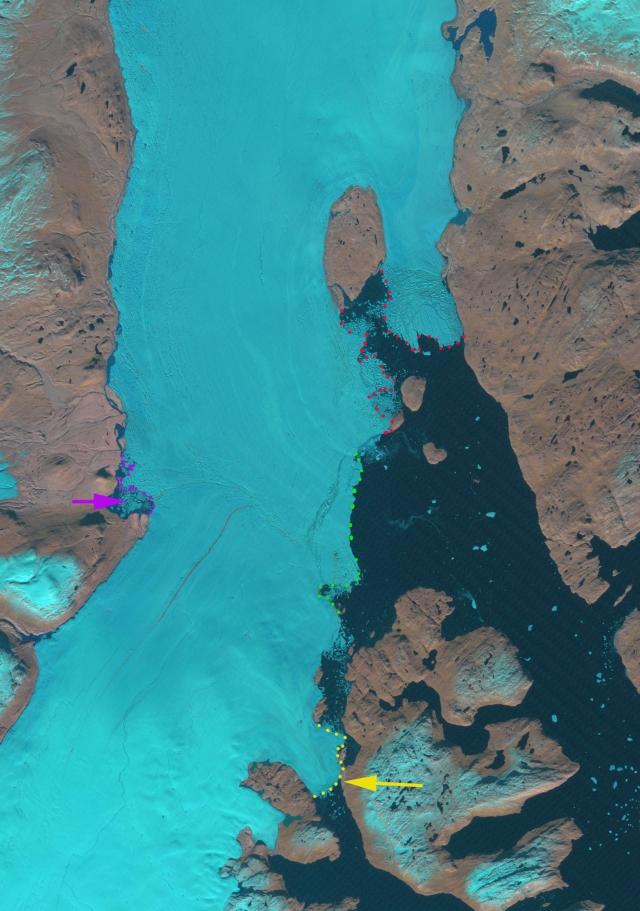
Tracy Gletscher in Northwest Greenland has experienced an accelerated retreat since 2000. Here we utilize Landsat imagery from 1987-2013 to examine this retreat. Rignot et al (2001) identified the centerline velocity as it entered the final fjord reach, 25-30km from the terminus, of 500 m/year, with a thickness of 1200 meters.
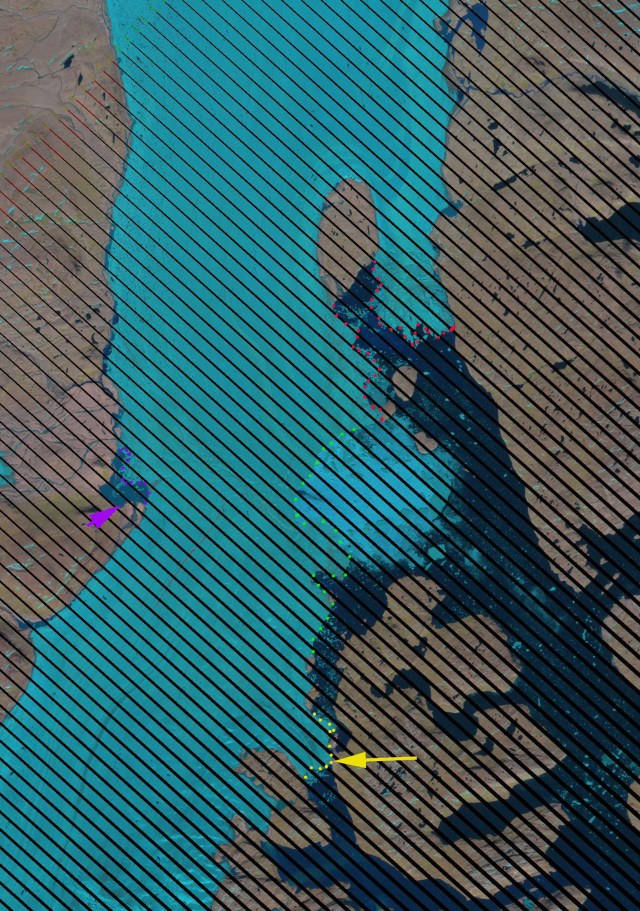
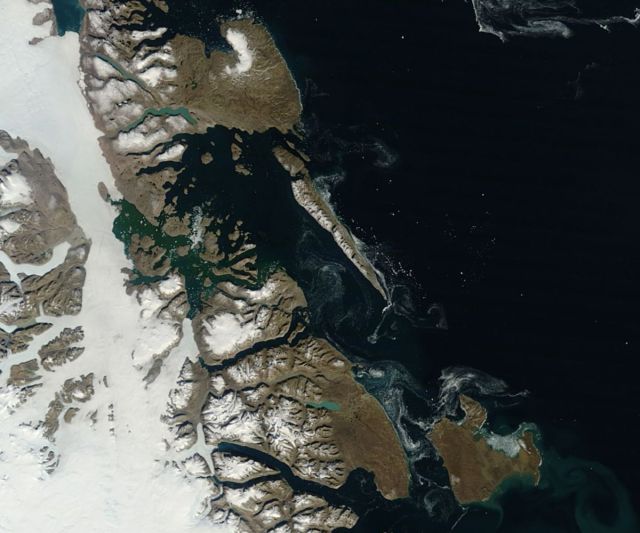
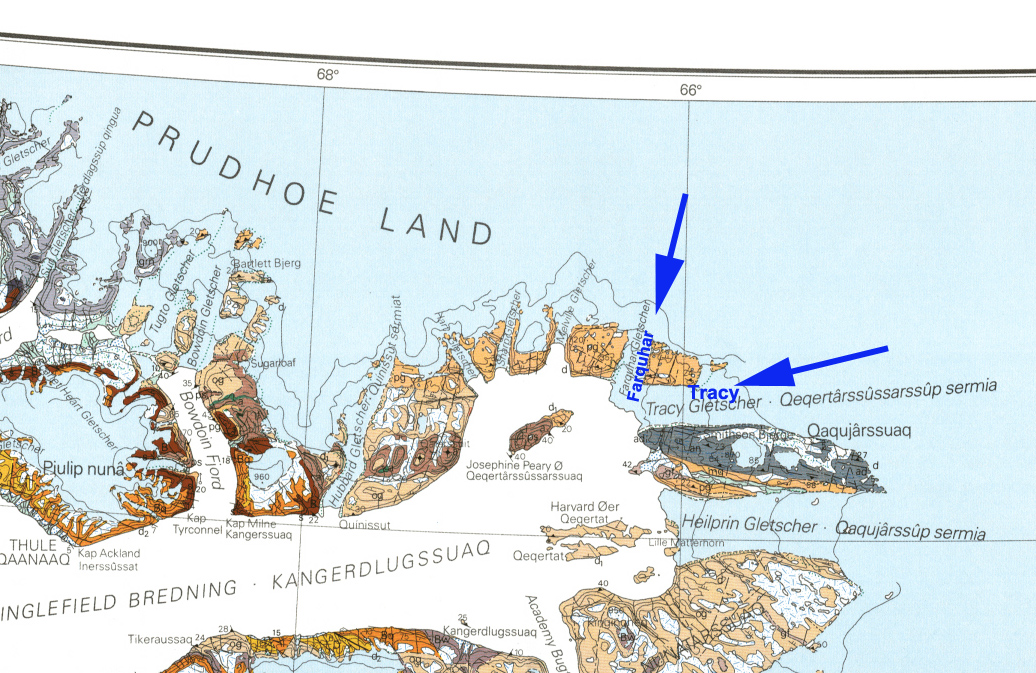
Sakakibara (2011) noted an increased retreat of 3.1 km from 2000-2011. The noted an acceleration of the glacier from 1988 to 2011 with velocities of 2 km per year 10 km behind the calving front. The 1991 geologic map of the area from GEUS indicates the tributary from the north, Farquhar Glacier, joined with the Tracy Gletscher at the terminus. tracy map In the Landsat images the ice front of both of these glacier is indicated by red dots. The 2013 terminus location of Tracy Gletscher is indicated by a pink arrow and the yellow arrow indicates the tip of a peninsula where the southern margin of Tracy Gletscher was in 1988. There is a quite a number of large icebergs beyond the terminus in 1987, 1991 and 2000. The termini are still joined in 2000. By 2009 the glaciers are separated and have retreated into their respective fjords. By 2013 the main Tracy terminus is aligned with a kink in the lateral moraine, pink arrow. The retreat since 1987 of the main terminus has been 3 km on the southern margin, 5.5 km on the northern margin and 9 km for the center tongue. With most all of the retreat occurring since 2000. This higher retreat rate for the 1992-2000 period as the tongue collapsed is noted by Moon and Joughin (2008). The retreat is similar to that of nearby Dodge and Storm Glacier, and Kong Oscar Glacier. This glacier falls into a long list of retreating glaciers of all types in all regions of Greenland. tracy glacier 1987

tracy glacier 1991

tracy glacier 2000

tracy glacier 2009

tracy glacier 2012

tracy glacier 2013

Glacier Contribution Kedarnath Flood in June 2013

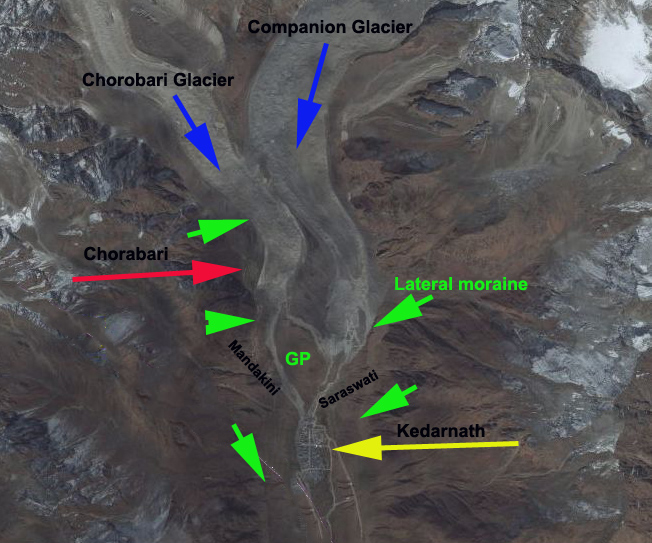
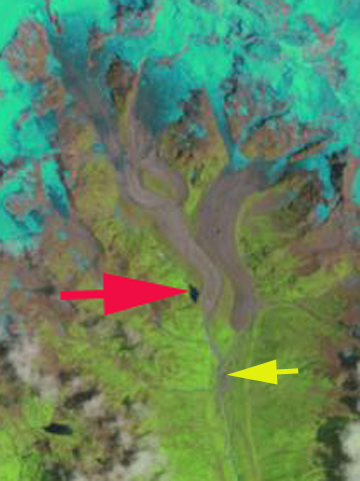
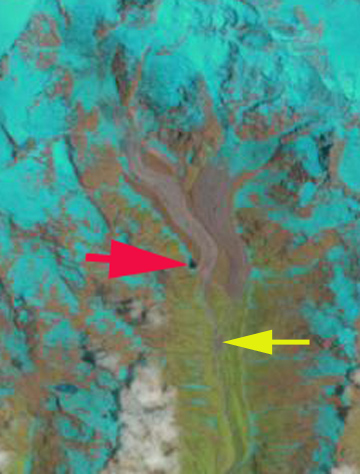
On June 16 and 17th 2013 catastrophic flooding occurred in Kedarnath, Uttarakhand, India due to excessive monsoon rains and the failure of a glacier moraine dammed lake. A detailed description of what led to the combined flows of the Mandakini and Saraswati River overwhelming Kedernath is provided by Dobhal et al (2013) in the most recent Current Science. issue. Here that analysis is supplemented with Landsat imagery from before and after the event. In each image Kedarnath is indicated with a yellow arrow and Chorabari Lake a red arrow. Chorabari Lake is impounded by the lateral moraine of the Chorabari Glacier and is a largely snow and rain fed lake that is not always present. The lake is adjacent to the terminus of debris covered Chorabari Glacier. In the Landsat images from 2000 and 2002 the lake is quite evident, and Kedarnath is on the outwash plain between the Saraswati and Mandakini River just 2 km from the lake and end of the glacier. The 2012 Landsat image is not as clear but the lake is still evident. In all three of these images there is a bright green vegetated area (GP) just north of Kedarnath that is between the Companion and Chorabari Glacier, protected by the lateral moraines of each.

kedarnath map

The vegetation resumes immediately after Kedarnath. In the 2013 Landsat imagery from June 23 and June 30th the lake is no longer present. The extent of the vegetative free area around Kedarnath has expanded after the flooding. Dobhal et al (2013) report that, “…WIHG meteorological observatory at Chorabari Glacier camp recorded 210 mm rainfall in 12 hours between 15 June (5:00 p.m.) and 16 June (5:00 a.m.). On 16 June 2013 alone (from 5:00 a.m. to 5:00 p.m.), 115 mm rainfall was recorded, causing 325 mm rain in 24 hours. The Chorabari Lake is a snow melt and rain fed lake, located about 2 km upstream of Kedarnath town which is approximately 400 m long, 200 m wide having a depth of 15–20 m. The bursting of this lake led to its complete draining within 5–10 min as reported by the watch and ward staff of the Wadia Institute of Himalayan Geology (WIHG) who were present in WIHG camp at Chorabari Glacier on 16 June and early morning of 17 June 2013. The heavy rainfall together with melting of snow in the surrounding Chorabari Lake washed off both the banks of the Mandakini River causing massive devastation to the Kedarnath town.” The glaciers in this area have been retreating, which has led to formation of many new lakes, and has led to further vertical exposure of the lateral moraines from the Little Ice Age. The decreased buttressing of the moraines, the enhanced melting, and glacier retreat is leading to enhanced glacier involved outburst floods. Jaundhar Barak, Jaonli and Gangotri Glacier are other local glaciers impacted by recent retreat.
kedarnath 2000
2000 Landsat image

kedarnath 2002
2002 Landsat image

kedarnath 2012
2012 Landsat image

kedarnath 2013b
June 30, 2013 Landsat image

kedarnath 2013
June 23, 2013 Landsat image

Strupbreen and Koppangsbreen Glacier Retreat, Northern Norway

Strupbreen and Koppangsbreen are in Lyngen region of northern Norway, draining into Lyngen Fjord. the glaciers share an accumulation area and have a joint area of 14 square kilometers, which is the 24th largest glacier in Norway in the NVE inventory (The Norwegian Water Resources and Energy Directorate). The nearby Langfjordjokulen, measured by NVE , had negative mass balances for 14 consecutive years from 1997-2010, leading to a 370 m retreat from 2000-2010. Koppangsbreen retreat as assessed by NVE is 168 m from 2000-2010. Here we examine the retreat and formation of two new lakes at the terminus of these glaciers using Landsat imagery from 1990, 2002 and 2011. The yellow arrow indicates the terminus of Koppangsbreen, the red arrow Strupbreen, and the green arrow a location on the ice divide between the glaciers. Both glaciers end at about 500 m, and the distance to sea level is a mere 1.5 km for Strupbreen and 2 km for Koppangsbreen which leads to some spectacular waterfalls. strupbreen ge
Google Earth image

In 1990 there is a tiny sliver of a lake apparent at the end of Koppangsbreen and not lake at the end of Strupbreen. At the ice divide there is no exposed bedrock knob in 1990. By 2002 there is no lake at the end of Strupbreen and a small oval lake partly snow filled is at the end of Koppangsbreen. The ice divide is still all snow and ice. In 2011 the ice divide is interrupted by a bedrock knob that is 150 m long. This indicates thinning of the glacier even at 900 m. A lake has formed at the end of Strupbreen, and the glacier has retreated 300 m since 1990. Koppangsbreen has retreated 250 m since 1990 and the new lake at the terminus is now 300 m across. The two glaciers are a destination for glacier walking treks from the Lyngen Lodge, providing some excellent images of the terminus lakes. The retreat of these two glaciers follows the pattern of others in northern Norway, including Engabreen and Blamannsisen. strupbreen 1990
1990 Landsat image

strupbreen 2002
2002 Landsat image

strupbreen 2011
2011 Landsat image

Taisija Glacier Retreat, Novaya Zemlya

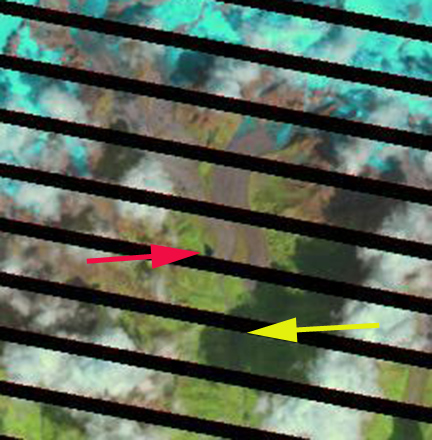
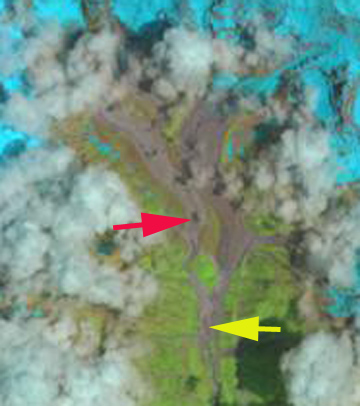
Taisija is an outlet glacier that drains the northern side of the Novaya Zemlya Ice Cap into the Barents Sea. This outlet glacier is just southwest of Chernysheva Glacier, and like that glacier has retreated from an island since 1988. The glacier has been retreating like all tidewater glaciers in northern Novaya Zemlya (LEGOS, 2006) taisij ge Google Earth Image

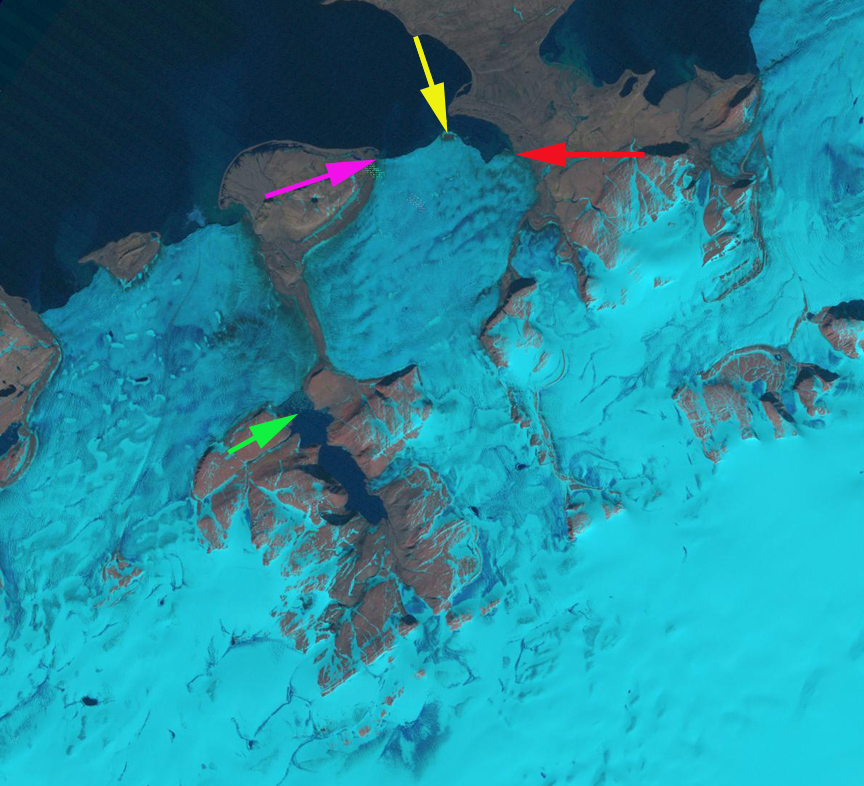
Here we examine the glacier using Landsat imagery from 1988-2013. In 1988 the glacier terminus was grounded on an island near the center of the glacier, yellow arrow. The western margin purple arrow is near the tip of a peninsula. On the east side an embayment exists in 1988 and the terminus is on a small island, red arrow. The green arrow indicates a glacier dammed lake that is full in 1988 on the neigboring glacier Kraynij Glacier. By 2006 the glacier center is still grounded on the island. An embayment has formed on the west side of the glacier and it has retreated from the peninsula. On the east side the glacier has retereated from the island, though this embayment has some sea ice in it that makes the retreat less evident. The glacier dammed lake is partially filled. By 2011 the glacier in the center has retreated from the island. The embayments on the east and the west have both expanded. The glacier dammed lake is empty. In June 2013 a Landsat 8 image provides a clearer perspective, the eastern embayment still has sea ice, but has pulled well back from the thin island at the red arrow. The retreat of this glacier is 1 kilometer on the west, 1.2 km in the center and 1.5 km on the west since 1988. This retreat is similar to that of Chernysheva, Krivosheina, Roze and Sredniy
taisij 19881988 Landsat image

taisij 20062006 Landsat image

taisij 2011
2011 Landsat image
taisij 2013
2013 Landsat 8 image

Chernysheva Glacier Retreat, Novaya Zemlya

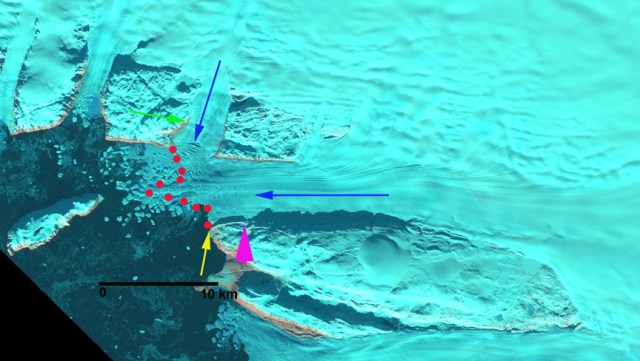
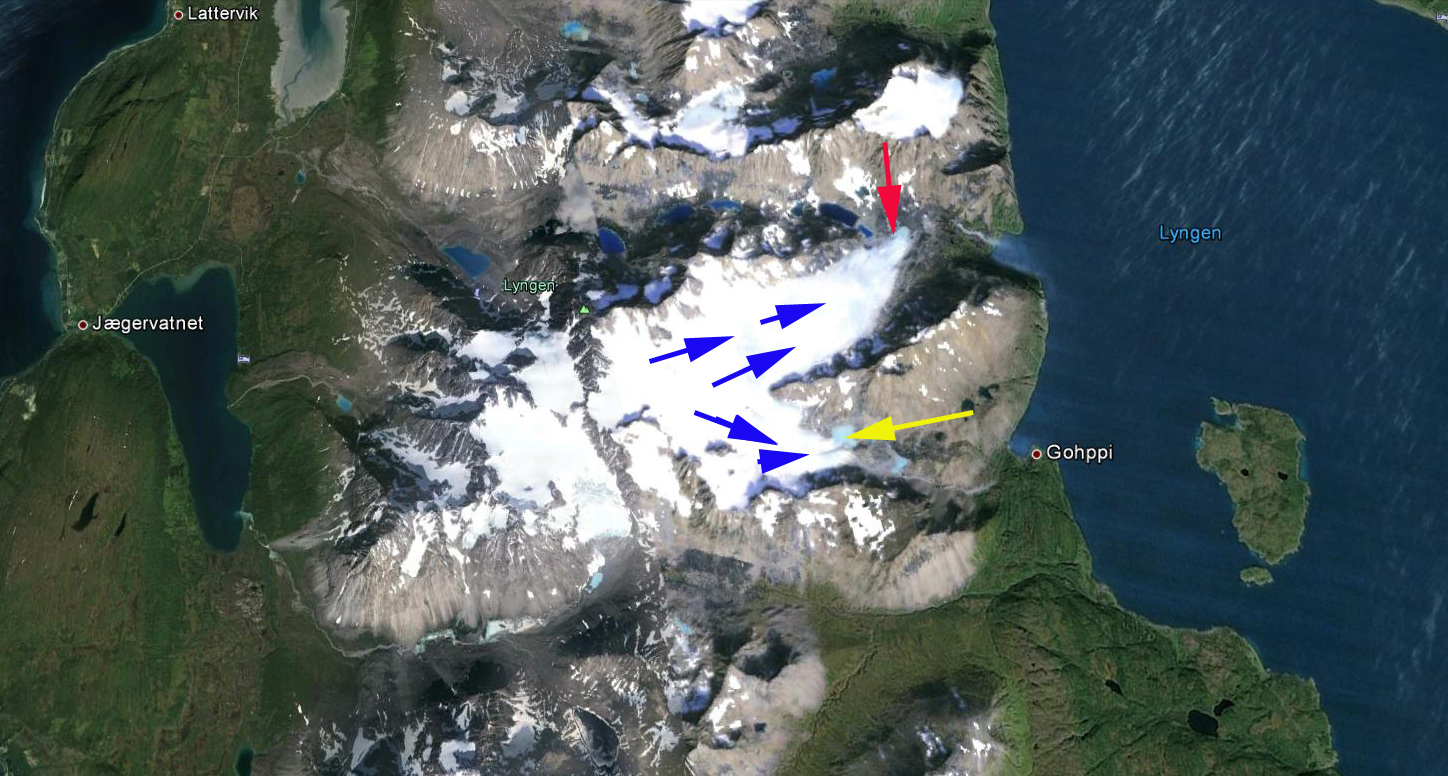
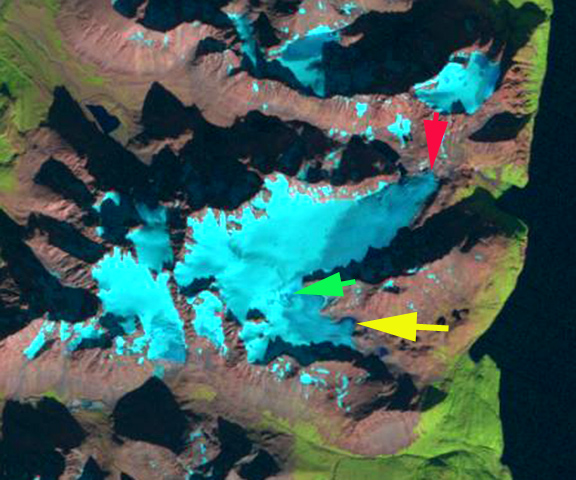
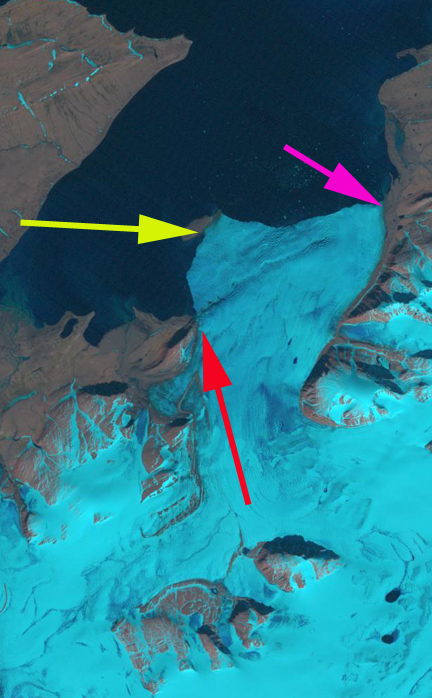
Chernysheva Glacier is on the northwest coast of Novaya Zemlya. The glacier terminates in the Barents Sea and has been retreating like all tidewater glaciers in northern Novaya Zemlya (LEGOS, 2006) This glaciers retreat follows the pattern of Krivosheina, Roze and Sredniy and Taisija Glacier. In this post we examine the changes using Landsat imagery from 1988, 2006 and 2011. The flow of the glacier from the main ice cap is indicated by blue arrows. The yellow arrow in each image indicates an island, the red arrow a bedrock ridge that extends under the ice, and the pink arrow the east margin of the terminus in 1988.

chernysheva ge
Google Earth image

In 1988 the glacier ended on the island which is a pinning point that would limit calving at the time. The 1988 image is very clear and the ridge with the bulge in the ice over it seems to extend 70% of the way across the glacier. In 2006 the glacier has pulled back from the island, there is however sea ice between the glacier front and the island, which has several icebergs embedded in it. By 2011 the glacier retreat from this island is 3100 m. The retreat from the east margin is 2600 m. The bedrock ridge at the red arrow should provide some stability and slow the retreat rate on the west side, it does not appear to extend to the eastern margin and this may continue to retreat apace. Interestingly the embayment here is very similar to that of Nizkiy and Glasova Glacier, which must be due to the similar geology. The reduction in duration of Barents Sea ice cover ice in front of the glacier has certainly helped to increase recent retreat.
chernysheva 1988 1988 Landsat image

chernysheva 2006
2006 Landsat image

chernysheva 2011
2011 Landsat image