Glacier Post Index through October, 2012

Below is a list of the individual glacier posts examining our warming climates impact on each glacier. This represents the first 3.4 years of posts, 244 total posts, 223 different glaciers. I have worked directly on 45. The others are prompted by fine research that I had come across, cited in each post or inquiries from readers and other scientists. I then look at additional often more recent imagery to expand on that research. The imagery comes either from MODIS, Landsat, Geoeye or Google Earth. There is a consistent signal from the glaciers, mass balance loss, thinning and retreat. In many cases this leads to new lake formation or lake expansion for alpine glaciers. I will continue to record these changes here with a new post twice a week and in the field.

United States
Columbia Glacier, Washington
Lyman Glacier, Washington
Boulder Glacier, Washington
Deming Glacier Icefall, Washington
Deming Glacier, Washington
Easton Glacier Assessment, Washington
Mount Baker Mass balance, Washington
Ptarmigan Ridge Glacier, Washington
Anderson Glacier, Washington
Eel Glacier, Washington
Milk Lake Glacier, Washington
Suiattle Glacier, Washington
Paradise Glacier, Washington
Easton Glacier, Washington
Redoubt Glacier, Washington
Honeycomb Glacier, Washington
Vista Glacier, Washington
Rainbow Glacier, Washington
Daniels Glacier, Washington
Colonial Glacier, Washington
Quien Sabe Glacier, Washington
Mazama Glacier
Fairchild Glacier, Washington
White Glacier, Washington
Banded Glacier, Washington
Borealis Glacier, Washington
Hinman Glacier, Washington
Lower Curtis Glacier, Washington
Mount Baker Glaciers, Washington
McAllister Glacier, Washington
Lewis Glacier, Washington
Kennedy Glacier, Washington
Fremont Glacier, Wyoming
Minor Glacier, Wyoming
Knife Point Glacier, Wyoming
Bastion Glacier, Wyoming
Sourdough Glacier, Wyoming
Grasshopper Glacier, Wyoming
Grasshopper Glacier, Montana
Harrison Glacier, Montana
McDonald Glacier, Montana
Sperry Glacier, Montana
Hopper Glacier, Montana
Old Sun Glacier, Montana
Yakutat Glacier, Alaska
Grand Plateau Glacier, Alaska
Eagle Glacier, Alaska
Gilkey Glacier , Alaska
Gilkey Glacier ogives, Alaska
Lemon Creek Glacier, Alaska
Taku Glacier, Alaska
Bear Lake Glacier, Alaska
Chickamin Glacier, Alaska
Okpilak Glacier, Alaska
Sawyer Glacier, Alaska
Valdez Glacier, Alaska
Antler Glacier, Alaska
Field Glacier
East Taklanika Glacier, Alaska
Brady Glacier, Alaska
Brady Glacier Retreat lake expansion 2004-2010, Alaska
Thiel Glacier, Alaska
Speel Glacier, Alaska
Romanzof Glacier, Alaska
Pedersen Glacier, Alaska

Canada
Icemantle Glacier, BC
Bridge Glacier, British Columbia
Washmawapta Glacier, British Columbia
Bubagoo Glacier, British Columbia
Hector Glacier, Alberta
Helm Glacier, British Columbia
Jacobsen Glacier, British Columbia
Melbern Glacier
Warren Glacier, British Columbia
Castle Creek Glacier, British Columbia
Hoboe Glacier, British Columbia
Coleman Glacier, British Columbia
Tulsequah Glacier, British Columbia
Des Poilus Glacier, British Columbia
Decker and Spearhead Glacier, British Columbia
Columbia Glacier, British Columbia
Freshfield Glacier, British Columbia
Apex Glacier, British Columbia
Great Glacier, British Columbia
Devon Ice Cap, Nunavut
Penny ice Cap, Nunavut
Northern Outlet Devon Ice Cap, Nunavut
Penny Ice Cap SW, Nunavut
Mittie Glacier, Ellesmere Island, Nunavut
Snowshoe Peak, Yukon
Petain Glacier, Alberta

New Zealand
Tasman Glacier
Murchison Glacier
Donne Glacier
Mueller Glacier, NZ
Gunn Glacier, NZ

Africa
Rwenzori Glaciers
Tyndall Glacier, Kenya

Himalaya
Ngozumpa Glacier, Nepal
West Barun Glacier, Nepal
Samudra Tupa, India
Malana Glacier, India
Longbasba Glacier, Tibet
Zemu Glacier, Sikkim
North Lhonak Glacier, Sikkim
Theri Kang Glacier, Bhutan
Zemestan Glacier, Afghanistan
Emend River Headwaters, Afghanistan
Godur Glaicer, Pakistan
Tirich Mir, Pakistan
Khumbu Glacier, Nepal
Imja Glacier, Nepal
Gangotri Glacier, India
Milam Glacier, India
Satopanth Glacier, India
Kali Gandaki Headwaters, Nepal
Menlung Glacier, Tibet
Boshula Glaciers, Tibet
Urumquihe Glacier, Tibet
Sara Umaga Glacier, India
Dzhungharia Alatau, Kazakhstan
Petrov Glacier,Kyrgyzstan
Hailuogou Glacier, China
Reqiang Glacier Retreat, Nepal
Lumding Glacier, Tibet
Himalaya Glacier Index

Europe
Taconnaz GLacier, France
Mer de Glace, France
Dargentiere Glacier, France
Grand Motte and Pramort Glacier Tignes Ski area, France
Saint Sorlin, France
Sommelier Glacier
Obeeraar Glacier, Austria
Ochsentaler Glacier, Austria
Pitzal Glacier, Austria
Dosde Glacier, Italy
Maladeta Glacier, Spain
Presena Glacier, Italy
Lobbia Glacier, Italy
Sabbione Glacier Retreat
Triftgletscher, Switzerland
Gietro Glacier, Switzerland
Rotmoosferner, Austria
Stubai Glacier, Austria
Hallstatter Glacier, Austria
Ried Glacier, Switzerland
Cavagnoli Glacier, Switzerland
Chuebodengletscher and Ghiacciaio-del-Pizzo-Rotondo
Forni Glacier, Italy
Careser Glacier, Italy
Peridido Glacier, Spain
Engabreen, Norway
Midtdalsbreen, Norway
Tunsbergdalsbreen, Norway
TungnaarJokull, Iceland
Langjökull, Iceland
Gigjokull, Iceland
Skeidararjokull, Iceland
Kotlujokull, Iceland
Lednik Fytnargin, Russia
Rembesdalsskaka, Norway
Irik Glacier, Mount Elbrus, Russia

Greenland and European Arctic
Mittivakkat Glacier
Ryder Glacier
Humboldt Glacier
Petermann Glacier
Kuussuup Sermia
Thrym Glacier Retreat
Tiningnilik Glacier Lake
Jakobshavn Isbrae
Zachariae Isstrom
Umiamako Glacier
Alison Gletscher
Kong Oscar, Glacier
De Reste Bugt
Upernavik Glacier
Apuserajik Glacier
Epiq Sermia
Sarqardliup Seremia
Steensby Glacier
Sortebrae Glacier, Greenland
Severnaya Zemlya, Russian Arctic
Hansbreen, Svalbard
Nannbreen, Svalbard
Hornbreen and Hambergbreen, Svalbard
Olsokbreen, Svalbard
Albrechtbreen, Svalbard
Roze and Sredniy Glacier, Novaya Zemyla
Nizkiy and Glazova Glacier, Novaya Zemyla

South America
Colonia Glacier, Chile
Artesonraju Glacier, Peru
Nef Glacier, Chile
Tyndall Glacier, Chile
Alemania Glacier, Chile
Zongo Glacier, Bolivia
Sierra Nevade del Cocuy Glaciers, Colombia
Ritacuba Blanco Glacier, Colombia
Llaca Glacier, Peru
Joerg Montt Glacier, Chile
Nororeste Glacier, Chile
Arhuey Glacier, Peru
Seco Glacier, Argentina
Onelli Glacier, Argentina
Quelccaya Ice Cap, Peru
Manon Glacier, Peru
Glacier Gualas, Chile

Antarctica and Circum Antarctic Islands
Pine Island Glacier
Fleming Glacier
Hariot Glacier
Smith Glacier, Antarctica
Thwaites Glacier, Antarctica
Amsler Island
Stephenson Glacier, Heard Island
Neumayer, South Georgia
Ampere, Kerguelen
Cook Ice Cap, Kerguelen Island
Nordenskjold Coast, Antarctic Peninsula
Prospect Glacier, Antarctic Peninsula
Ross Hindle Glacier, South Georgia
Vega Island Ice Cap
Rohss Bay, James Ross Island, Antarctica

North Cascade Glacier Climate Project Reports

Forecasting Glacier Survival
North Cascade Glacier Mass Balance 2010
Columbia Glacier Annual Time Lapse
North Cascade Glacier Climate Project 2009 field season
28th Field Season Schedule of the North Cascade Glacier Climate Project
North Cascade Glacier Climate Project 2011 Field Season
BAMS 2010 alpine glaciers
BAMS 2011 Alpine Glaciers
2011 Glacier mass balance North Cascades and Juneau Icefield
Taku Glacier TSL Paper
Glacier Ground Truth 2012 North Cascade Field Season
North Cascade Glacier Climate Project 2012 Field Season
Guyot Glacier Retreat, Icy Bay Alaska

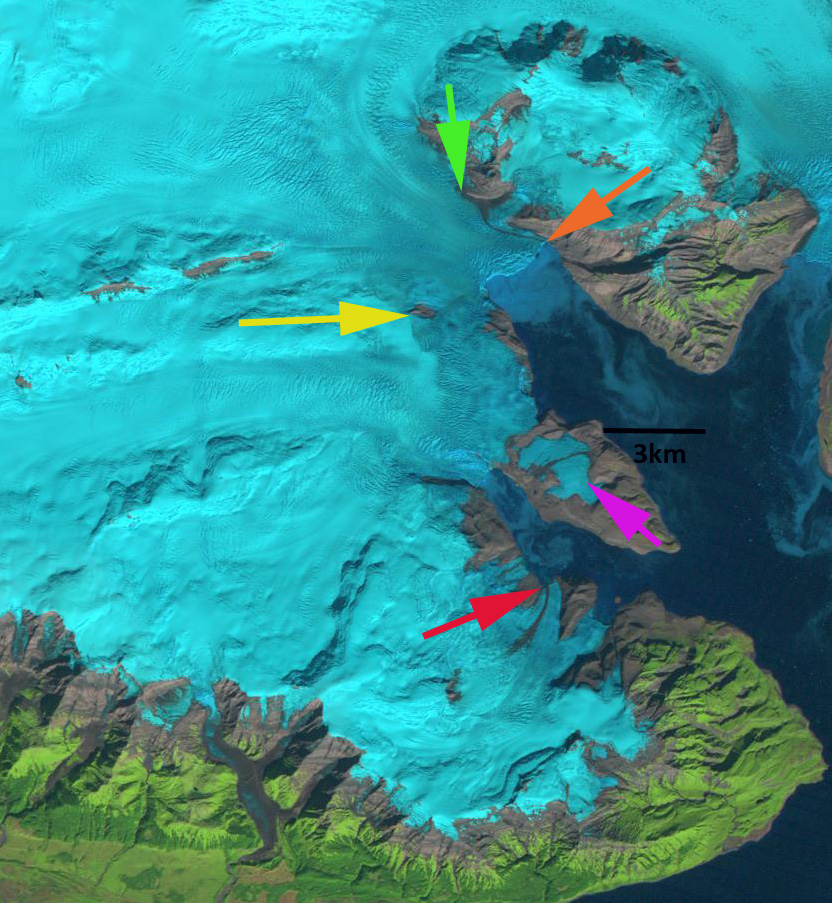
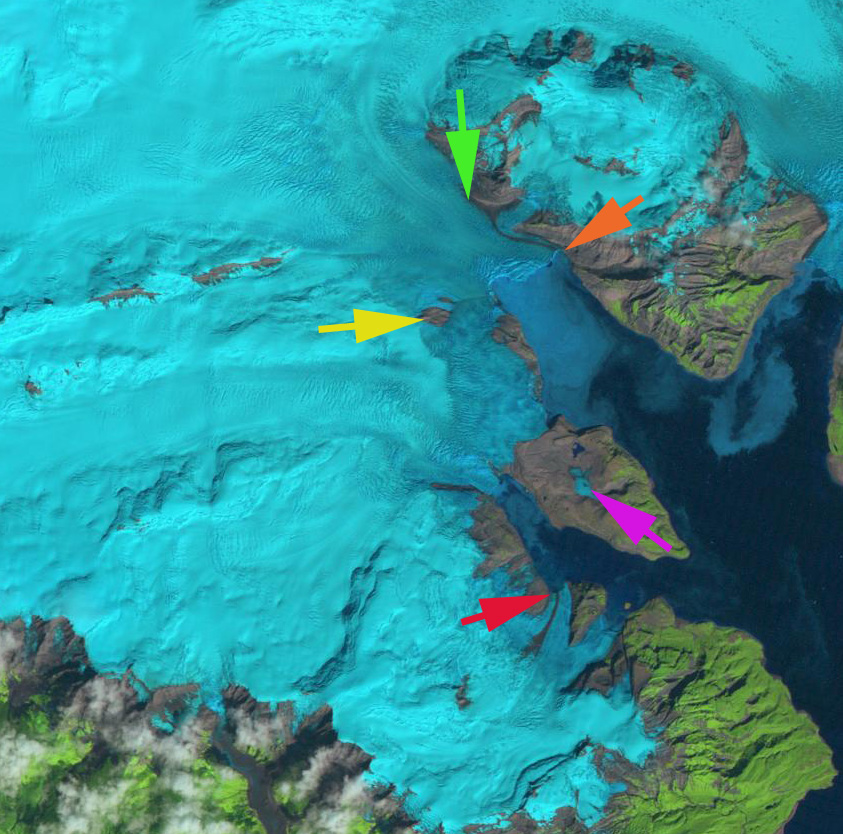
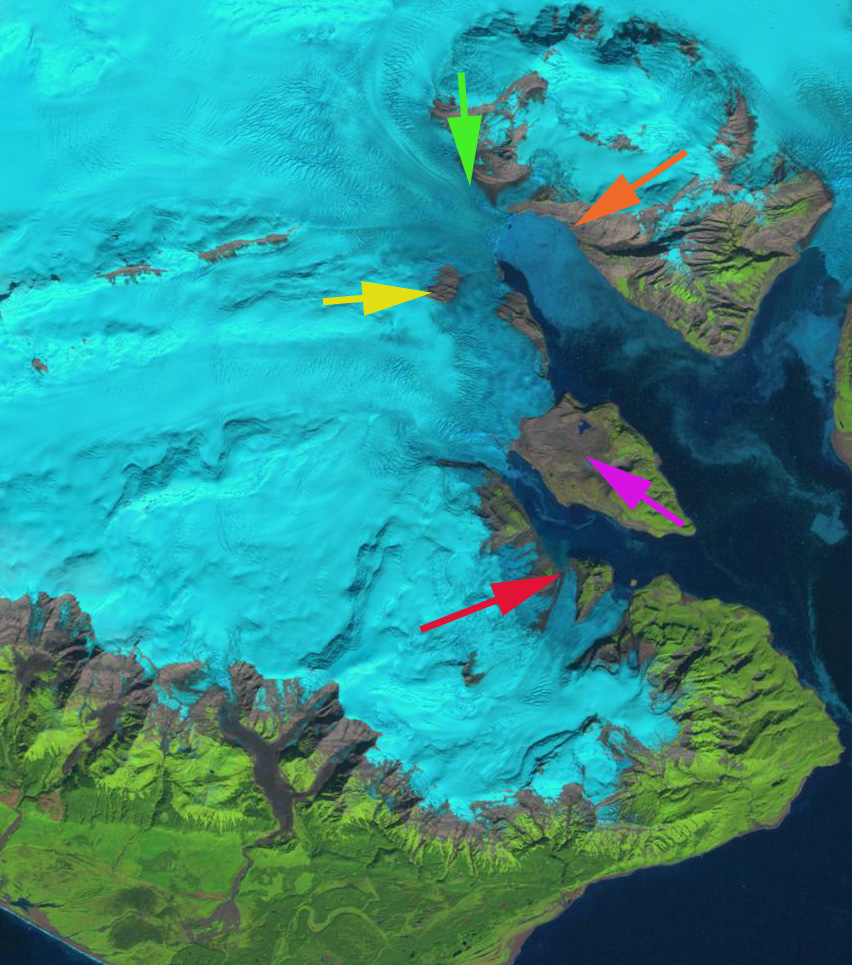
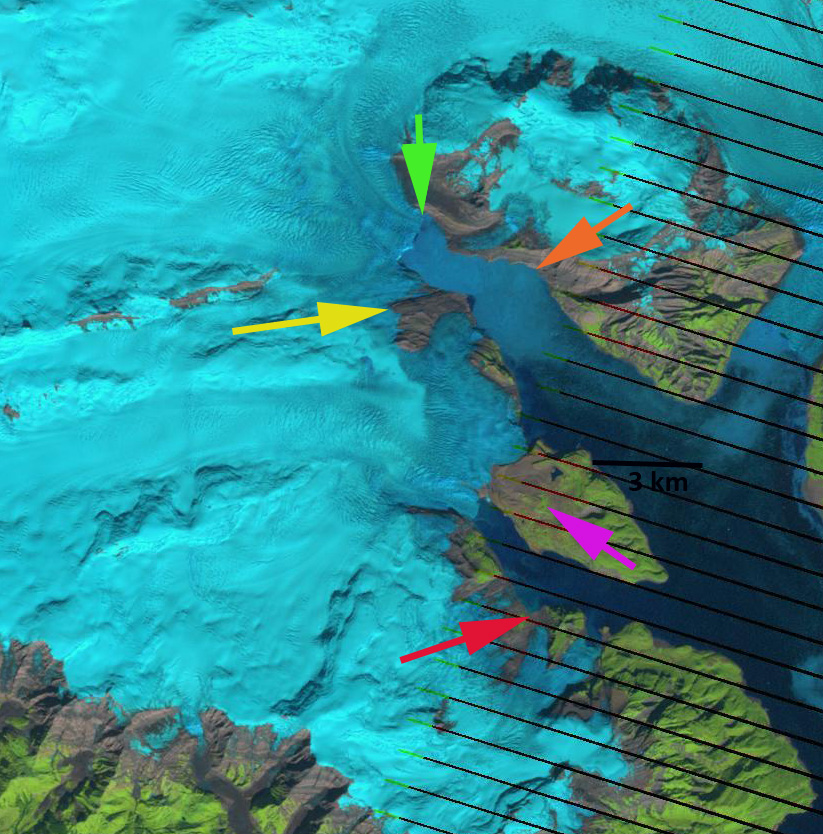
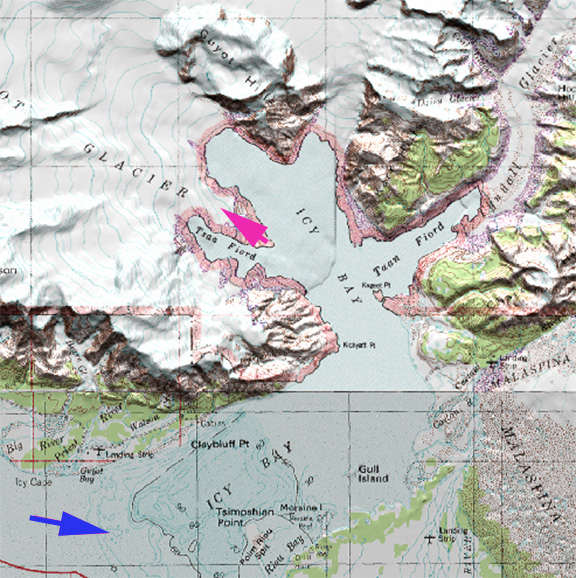
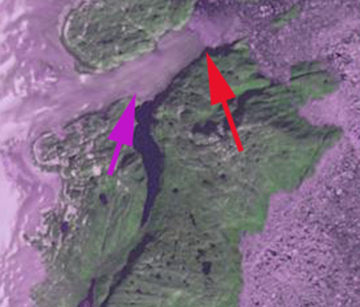
Guyot Glacier a century ago was joined with the Tyndall and Yahtse Glacier with an ice front that reached just beyond the entrance of Icy Bay. Today Guyot Glacier has retreated more than 50 km. This post examine satellite imagery from 1984-2010 to illustrate ongoing thinning and retreat of the Guyot Glacier. Guyot Glacier has retreated more than 50 km since 1904 (Molnia, 2007). As retreat began the glacier had a calving front that was over 10 km long. The glacier was also calving into deep water. This led to a rapid retreat up to 1938 (USGS). In the sequence of images below from the USGS, this is evident. By 1969 the glacier had separated into three sections, middle image in sequence and by 1986 the Guyot Glacier had retreated a considerable distance up the newly exposed fjord. The pink arrow points to the Kashteen Peninsula that will emerge, and the orange arrow to the 1984 terminus position of Guyot Glacier. Barclay et al (2009) have illustrated the dynamic nature of this glacier that has had three large (40 Km+) advances and retreats in the last 4000 years. The Landsat image sequence is from 1984, 1995, 2000 and 2010. In each image the pink arrow indicates an area on the Kashteen Peninsula that was still covered by the glacier until 1980. In 1984 on Kashteen there are two ice masses with an area of 1.3 square kilometers, by 1995 one small ice mass of 0.3 square kilometers, by 2000 the stranded ice masses are gone. By 2010 the area is showing considerable vegetation development. This indicates a relatively short ecesis rate, rate of vegetation returning after deglaciation. The orange arrow indicates the 1984 terminus of Guyot Glacier. The green arrow is the 2010 terminus position of Guyot Glacier, the main terminus retreated 3.8 km during the 26 year period. The yellow arrow indicates the expansion of a bare bedrock region on the south side of the main Guyot Glacier terminus that now extends 2 kilometers from the margin. The red arrow is a separate terminus of an unnamed glacier that ended in Tsaa Fjord up to 2000, and is no longer tidewater, having retreated 400 meters from tidewater and 600 meters since 1984. Tidewater glaciers have two means to lose mass calving and melting. The former can be insensitive to climate and is more dependent on water depth and calving width (Brown et al, 1982). Pelto (1987) and Viens (1995) produced models showing that climate acts as a first-order control on the advance/retreat cycle of calving glaciers during most of the advance retreat cycle, but there are climate insensitive periods of the tidewater glacier cycle too (Meier and Post, 1987). In the case of Guyot Glacier today the peripheral areas at the yellow and red arrows indicate considerable thinning in areas that are no longer calving and indicate that mass balance losses are still occurring without calving, hence, climate driven. For the main Guyot Glacier the current ratio of the accumulation area to the melt area is quite high. This is the accumulation area ratio, and it is high enough to be in equilibrium if calving is reduced. The Brady Glacier is at the other end of the cycle, just beginning a large retreat due to extensive thinning from recent reduced mass balance. Yakutat and Valdez Glacier are two nearby glaciers that have also experienced large calving retreats, though both still have large ablation (melt) areas.

Manon Glacier Retreat Lake Formation, Peru

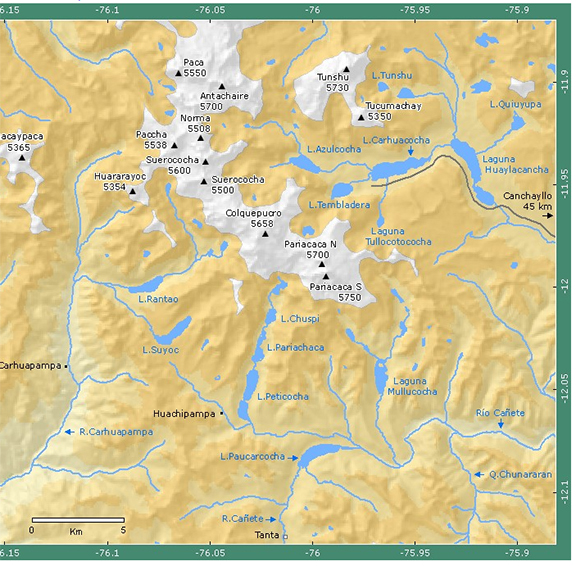
In the Cordillera Centrale of Peru a series of glaciers extends north from Pariacaca. Pariacaca is the pre-Incan god of water, appropriate name in this dry region, that is draped with glaciers and has numerous alpine lakes. In fact with glacier retreat the number of lakes is increasing. Here we examine the Manon Glacier which descends from Nevado Suerococha and drains into the Rio Carhuapampa. This area has received little attention when it comes to glacier study. A glacier lake outburst flood from the Suerococha Basin in 1941 is the only noted event. The retreat of the Manon Glacier over the last decade is documented with a comparison of Landsat and Google Earth imagery from 1997, 1998, 2005,2010 and 2012. The retreat of these glaciers matches the more closely observed Cordillera Blanca and Quelcaya Ice Cap region (Mark., 2008 and Vuille et al, 2008). The Manon Glacier terminus is indicated with a green arrow in the Landsat images. The pink arrow is the Chuecon Glacier which will be the focus of a later post. In 1997 the lake at the terminus has not yet begun to form, by 2005 the lake has nearly reached its full size, and the glacier is still terminating in it. By 2010 and 2012 the glacier no longer reaches even the edge of the new lake. The retreat from 1997 to 2010 is 550 meters, the lake is 500 meters long. The 2010 Google Earth image indicates no snow snow on the southern half of the glacier, even at its highest altitude of 5200 m, the larger section coming off the main peak has a snowline at 5100 meters. A closeup of the terminus indicates that the southern portion of the glacier also has a number of features indicative of stagnation, pink arrows. Thesse are depressions that have higher debris concentration and are wind scoured, both enhancing melting. If the debris cover was a thick blanket it could retard melting. This type of ablation hollow is also seen at the top of the southern section of the glacier, indicating this part no longer has an accumulation zone and will melt away.

Tirich Mir Region Glacier Retreat, Pakistan

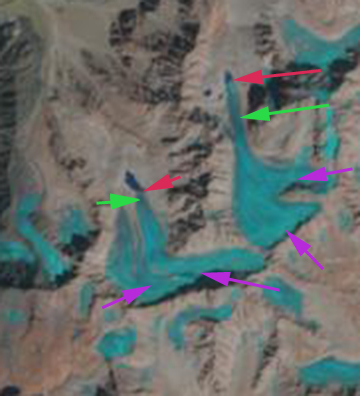
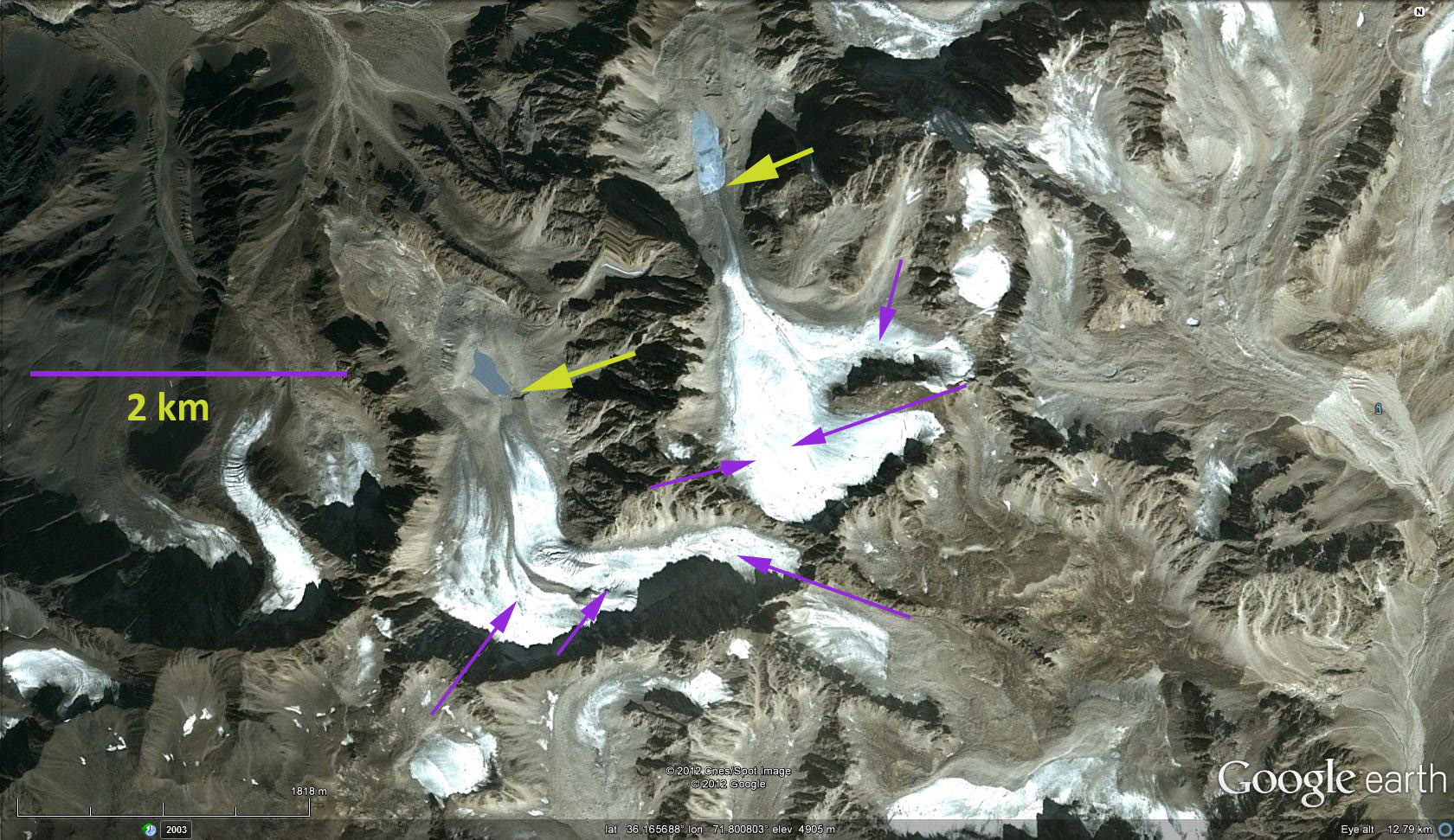
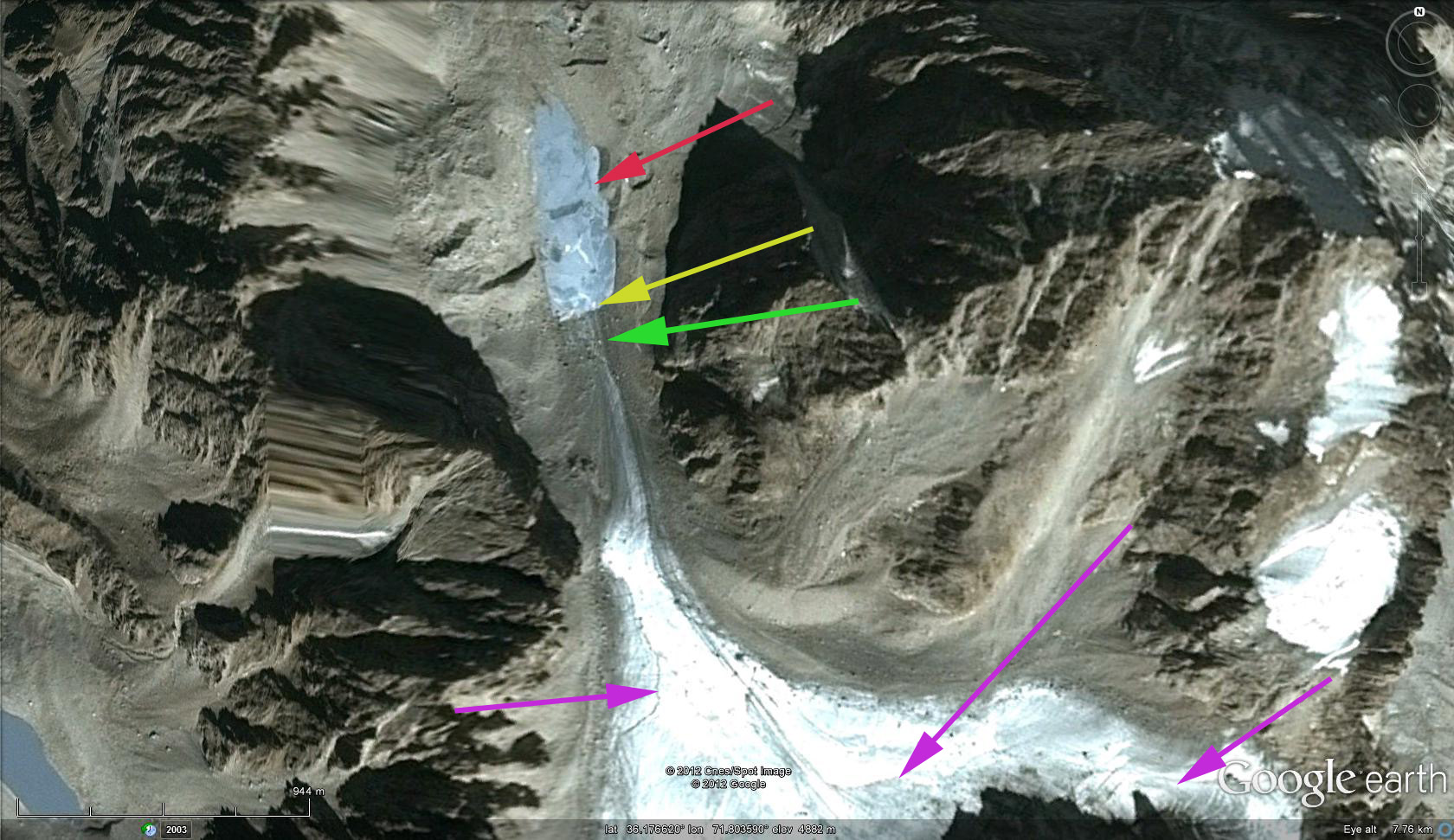
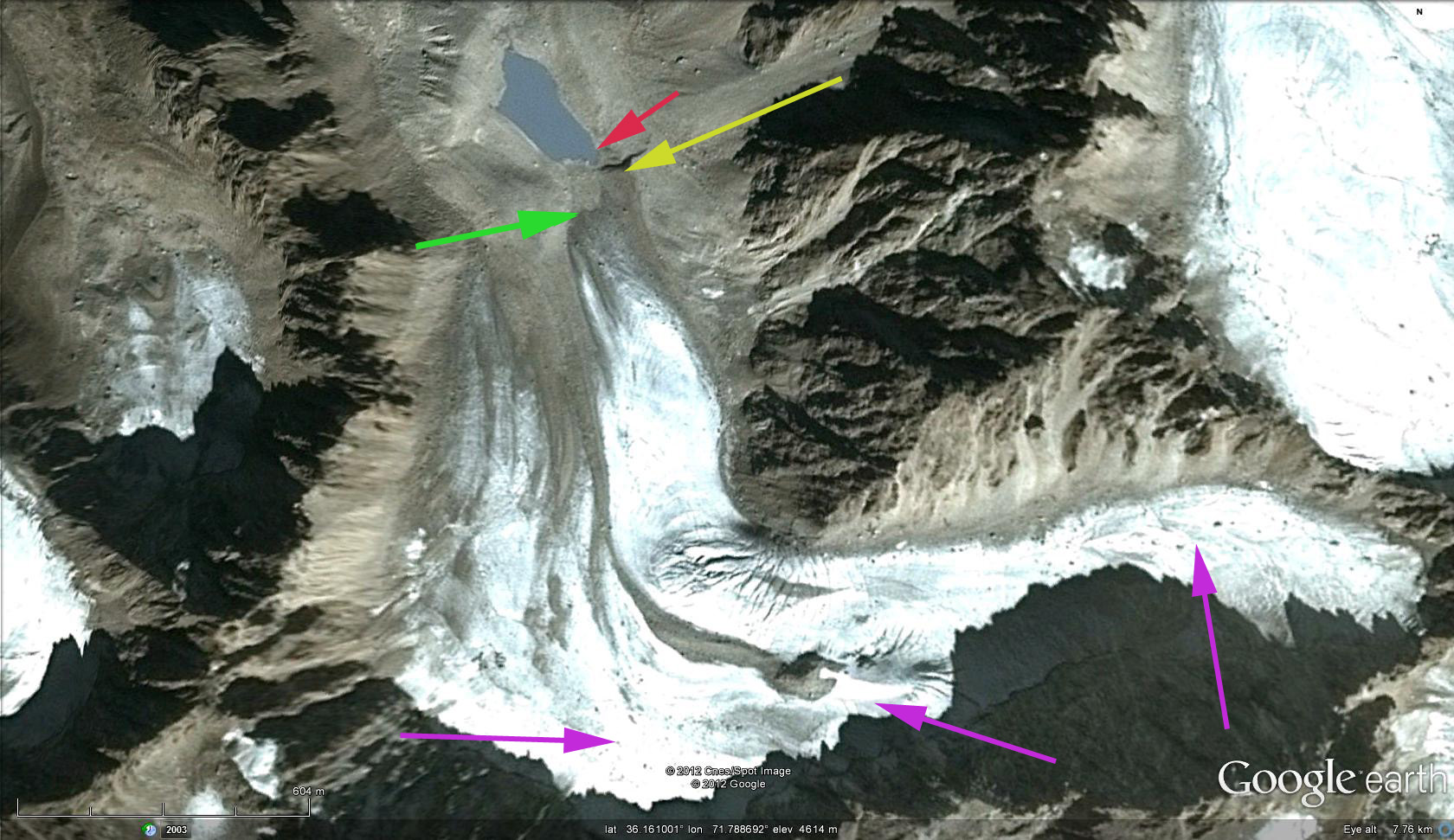
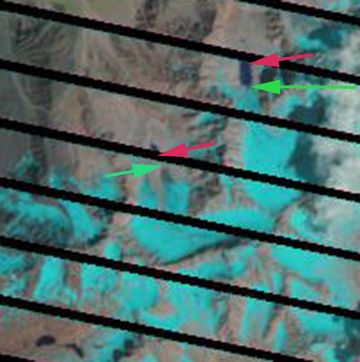
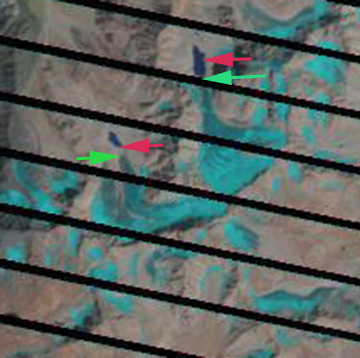
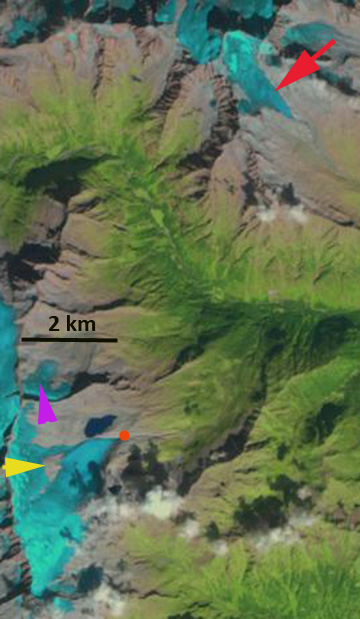
Tirich Mir is the highest mountain in the Hindu Kush and is in the northwestern corner of Pakistan. Here we examine Google Earth and Landsat imagery from two glaciers off the southwest ridge of Tirich Mir. The two glaciers are unnamed and are in the Dir Gol Valley, that starts in Akari, Pakistan and drains the southwest side of Tirich Mir, red arrows. A 2000 Landsat image (top image) indicates both glaciers ending in small lakes. The arrows in all images are purple for the lack of snowcover even in the glacier accumulation zone, red for the 2000 terminus, yellow for the Google Earth terminus and green for the 2011 terminus. By 2008 the Google Earth imagery indicates that the eastern of the two has retreated 400 meters leading to a more than doubling of the lake size. For the western glacier, the glacier still maintains has just retreated from the lake margin. The lake is slightly larger than in 2000. There is no snowpack on either glacier in the Google Earth imagery or in the 2000 image even at 5000 meters. This indicates glaciers without persistent accumulation zones, which means they cannot survive (Pelto, 2010). By 2010 and 2011, last two images. The eastern glacier has retreated an additional 100 meters and the lake is still expanding. The western glacier is no longer in contact with the lake, the terminus is now 150 m from the lake. The retreat from 2000-2011 of the eastern glacier has been 500 meters and 200 meters for the western glacier. The rretreat is similar to that of Godur Glacier in the Swat Valley. After 2000 76% of the glaciers in the region have been retretaing (Sarikaya et al, 2011). Around Tirich Mir glacier retreat had been relatively low up to this point. Most of the glacier in this region of the Hindu Kush

Glacier Noroeste Retreat, Gran Campo Nevado, Chile

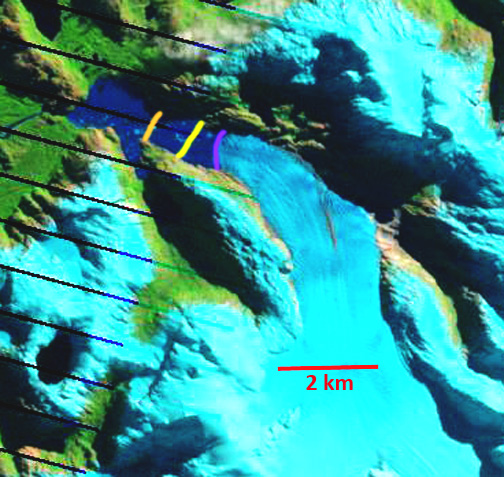
The Gran Campo Nevado (GCN) is the smallest of the four primary Patagonian Icefields. It is on the Península Muñoz Gamero 200 km to the south of the Southern Patagonia Icefield. The major outlet of this icefield is the Noroeste Glacier. In a recent paper examining the changes in Patagonia glacier from 1870-2010 (Davies and Glasser, 2012), observed that the Gran Campo Nevado icefield lost of its area from 1870-2010, and 14% of its area from 1986-2011. Davies and Glasser (2012), Aberystwyth University, also documented that 21 of the 31 glaciers of the icefield experienced their most rapid retreat of the last 140 years during the 1986-2010 period. Nororeste Glacier has been a focus in two papers Scheider et al,(2007) and Moller and Schenider (2010). These papers document a retreat of 1100 m from 1986-2002 first image below, they further identify that the glacier area has declined by 4 square kilometer from 1986-2007, and in 2007 was just under 50 square kilometers. Moller and Schenider (2010) develop an areal extent model for the glacier that indicates the glacier will lose a further 15 square kilometers by 2100. The second image is showing the areal extent change from Davies and Glasser (2012), with the red arrow indicating Nororeste Glacier and the yellow the deglaciated area since 1870. Here we examine Landsat imagery from 1999, 2007 and 2012. The 1986 terminus is noted by the orange line, the 2002 margin is a yellow line, the 2007 terminus a purple line and the the 2012 terminus indicated by pink arrows. The retreat from 1986-1999 was 600 meters, from 1999-2007 1050 meters and 2007-2012 250 meters. The overall retreat of 1900 meters from 1986-2012, is 73 meters/year and from 1999-2012 the 1300 meter retreat is 100 meters/year. One other noteworthy change is the thinning and retreat at the northern margin that has led to the drainage of an. ice dammed lake that is present in 1999, red arrow and gone in 2012. The lake had drained by 2007 but that is not evident in the deep shadows of the Landsat image. This glaciers retreat fits the regional patter of glaciers to the north, Joerg Montt Glacier, Colonia Glacier, Glacier Gualas and Alemania Glacier to the south. This also fits the overall pattern of area loss that increased after 1986 and has remained high (Davies and Glasser, 2012) and the ongoing detailed studies of the Chilean Laboratorio de Glaciologia

The retreat is partly due to calving of icebergs into the lake the glacier terminates in, as evident by the icebergs visible in each satellite image above and in the Google Earth image below of icebergs in the lake in 2004.

Bastion Glacier Retreat, Wind River Range, Wyoming

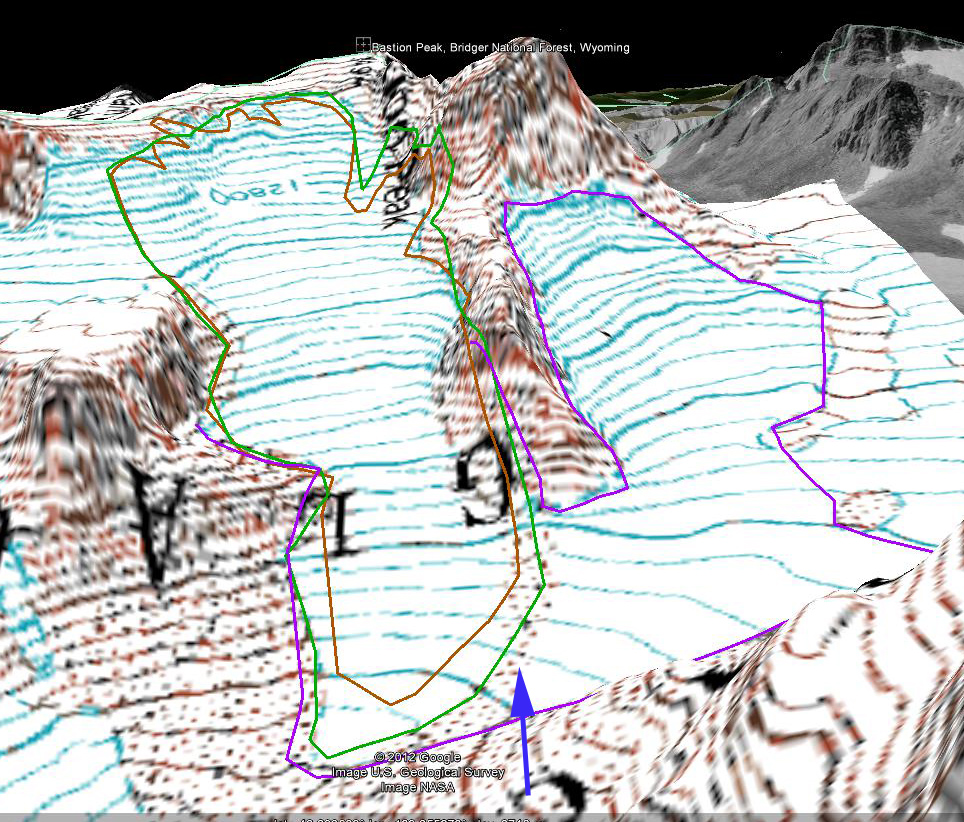
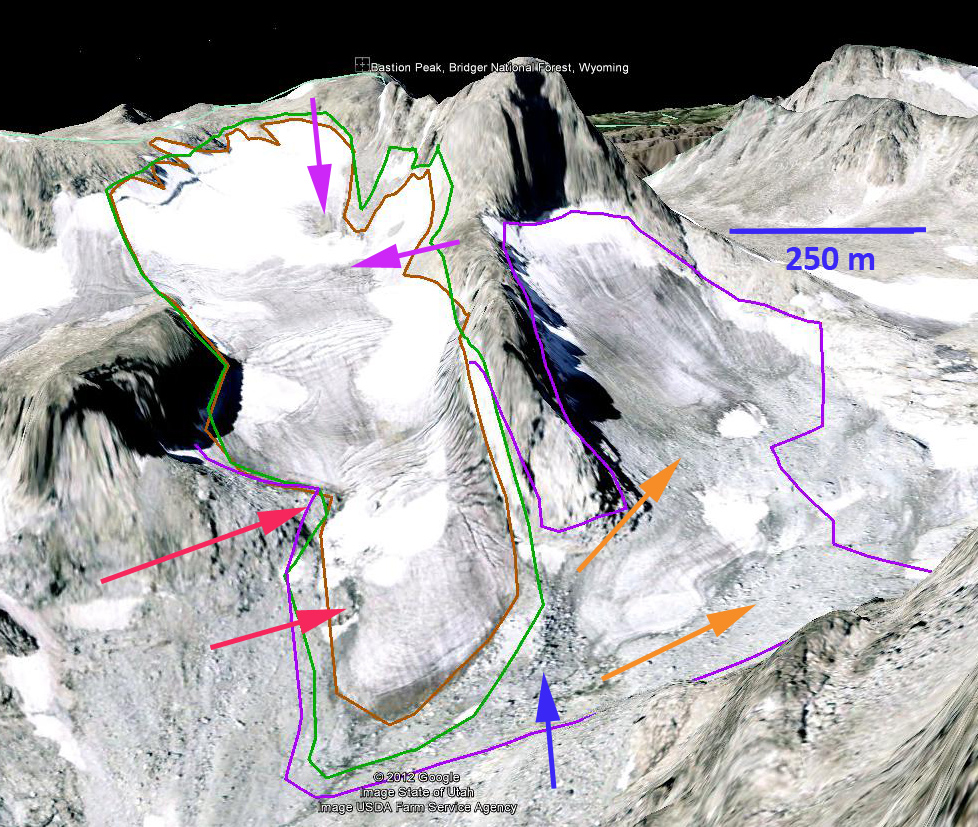
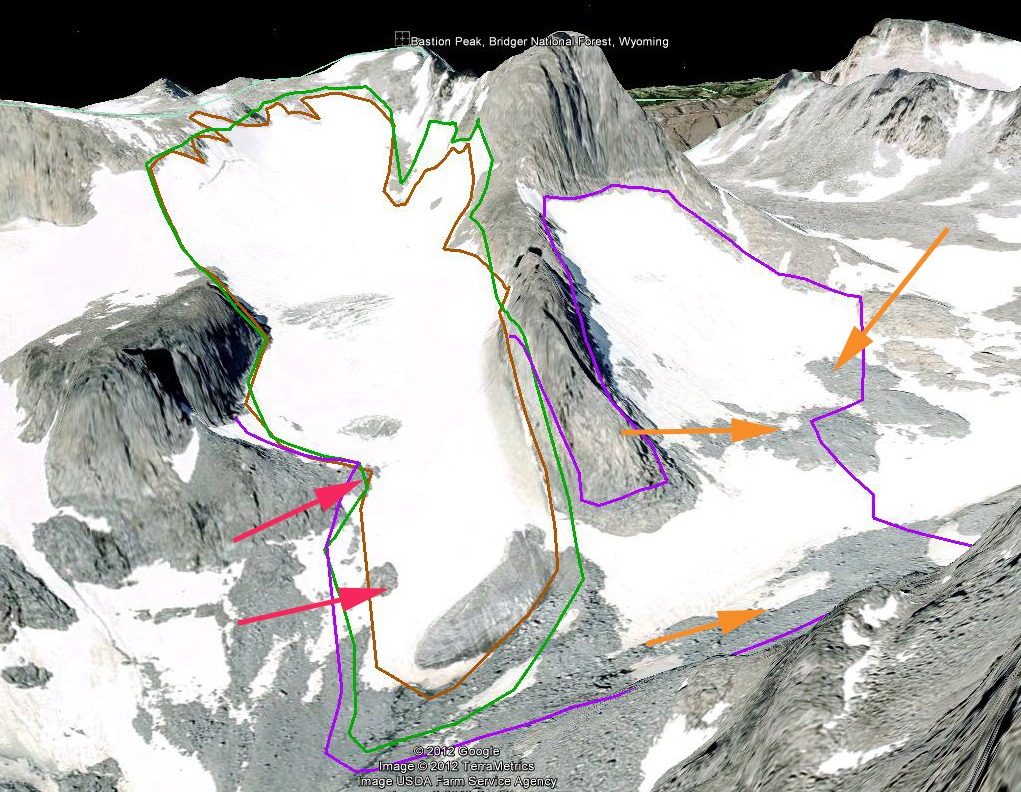
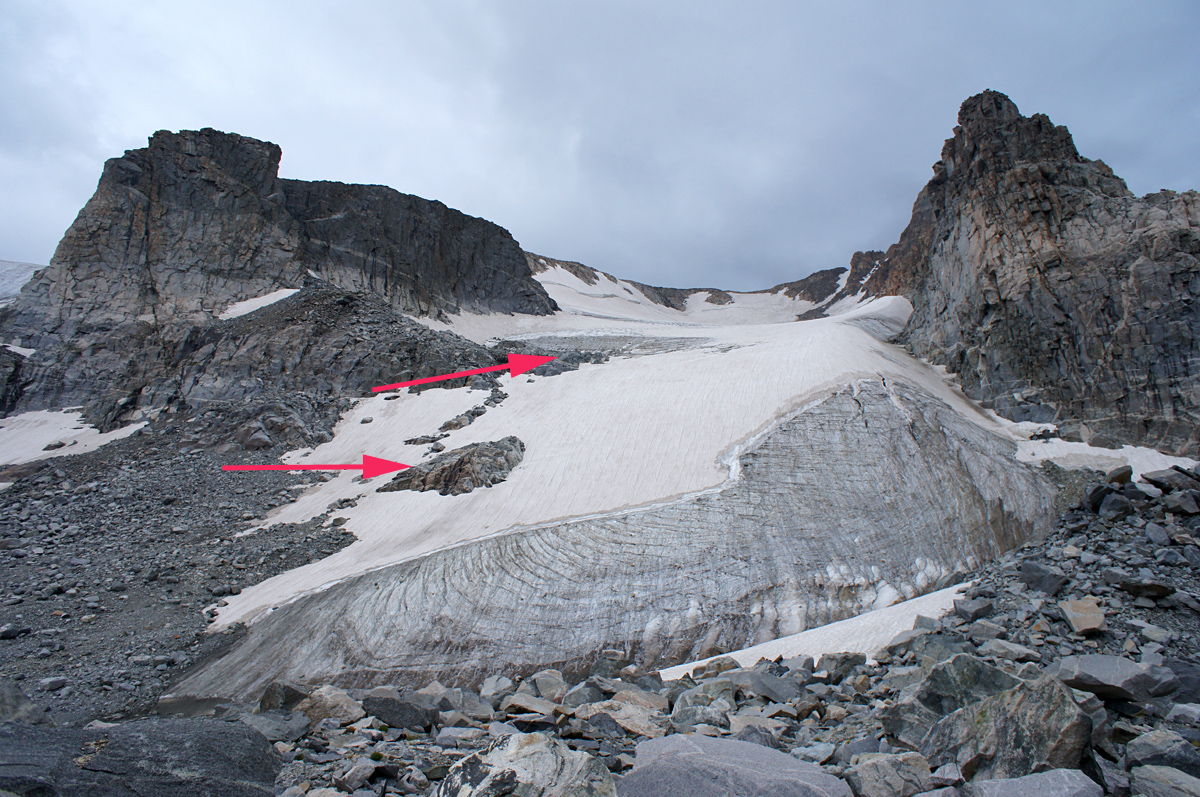
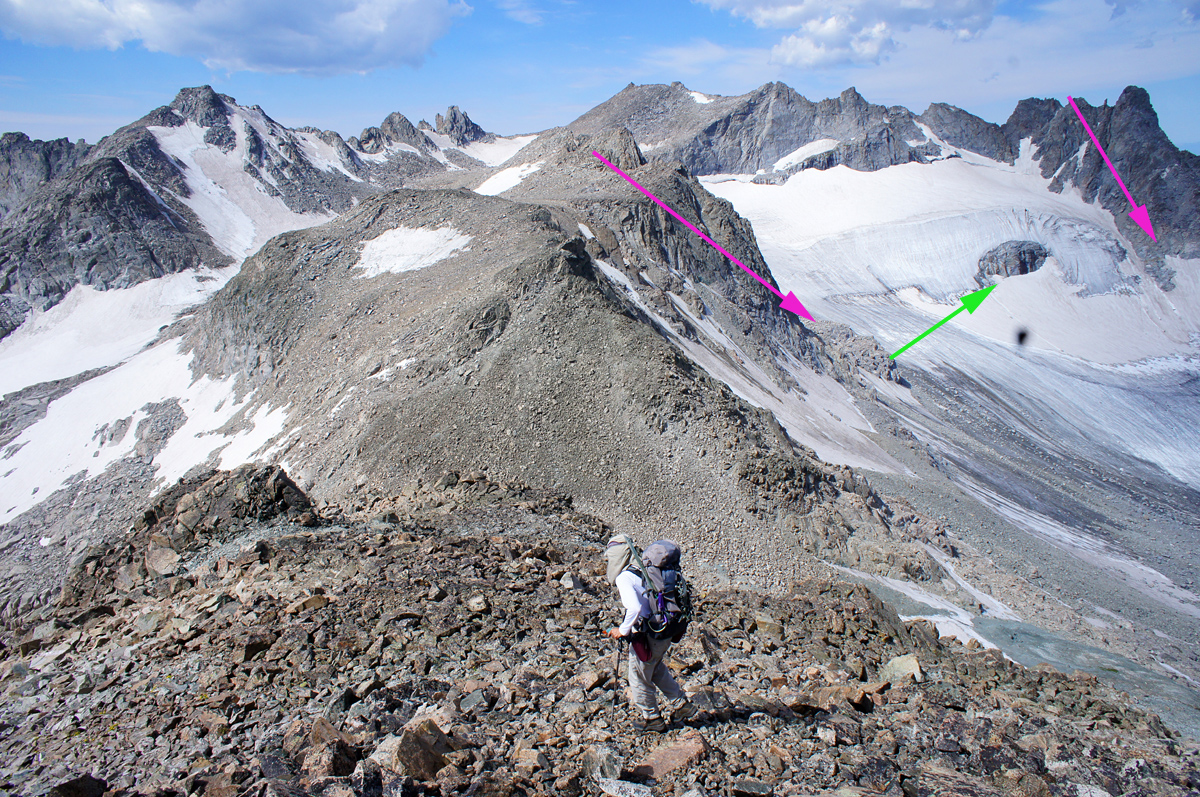
Between Bastion and Rampart Peak just north of Gannett Peak in the Wind River Range of Wyoming is a smaller unnamed glacier. It is distinct from the Gannett Glacier and here we refer to it as the Bastion GlacierExamination of this glacier from the 1966 based USGS map, 1994 USGS photography and 2006 and 2009 Google Earth Imagery and a 2012 climbing photograph. The glacier area is from the 1966 map is outlined in purple, in 1994 is green and 2006 in brown. In 1966 the Bastion Glacier was joined at its terminus with a glacier to its north below the east ridge leading to the summit, blue arrow. By 1994 the glaciers are separated and by 2006 the division has expanded. At the red arrows two areas of bedrock are expanding into the midst of the glacier, and by 2012 the lower outcrop is particularly important. The 2012 photograph is from Sarah T. The retreat during this period is 120 meters from 1966-2009, with most of the retreat, 80 meters occurring since 1994. More importantly for this glacier is the expansion of bedrock outcrops in the midst of the glacier, red arrows low on the glacier and purple arrows high on the glacier. Orange arrows indicate the expansion of bare area as the glacier north of the ridge has lost dramatic area. Below are the images in order from 1966, 1994, 2006, 2009 and 2012. The ongoing and thinning of this glacier of this glacier is following the same path as Minor Glacier, Knife Point and Sourdough Glacier, but slower. The image from 2012 is from late July. The melt season in 2012 continued up to October, 3rd, as identified from the temperature records at SNOTEL sites in the area. By the end of the melt season a further 3 meters of snow and ice was lost from Bastion Glacier. The expansion of bedrock outcrops in the upper portion of the glacier indicates lack of a persistent and consistent accumulation zone, a symptom of a glacier that cannot survive (Pelto, 2012).
Apuserajik Glacier Retreat, southeast Greenland

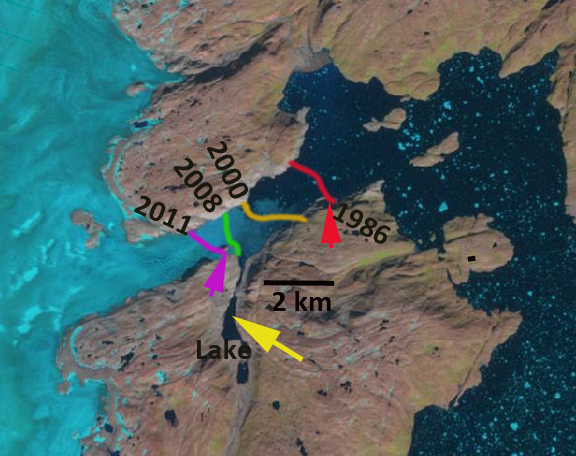
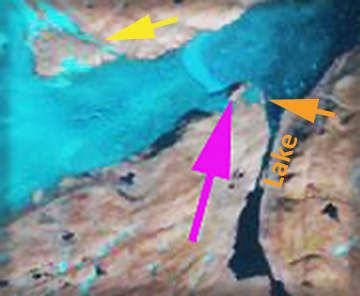
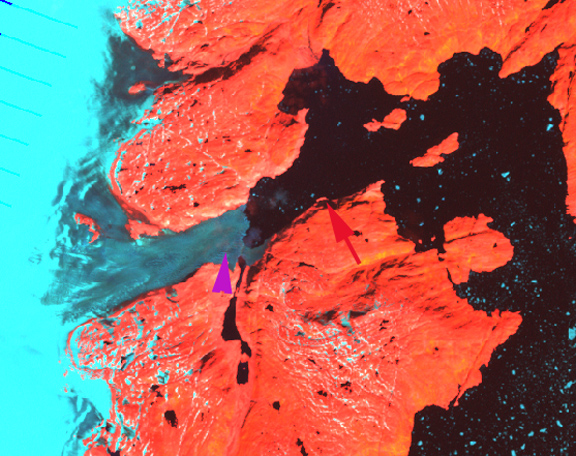
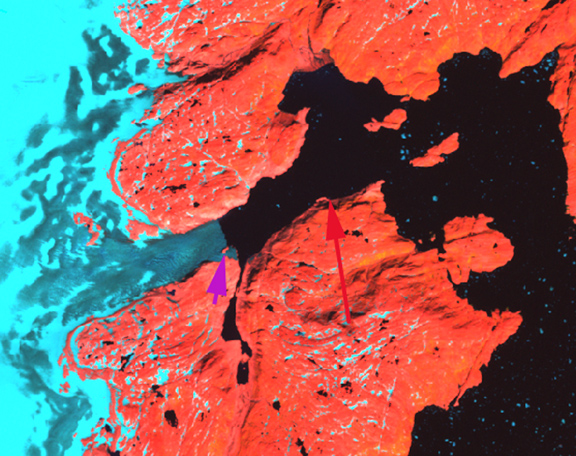
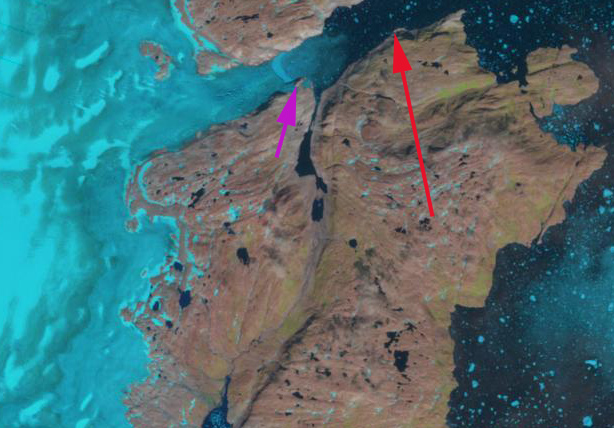
Anders Anker Bjørk at the Centre for GeoGenetics, Natural History Museum of Denmark, University of Copenhagen alerted me to the retreat of the Apuserajik Glacier (just south of Helheim Glacier), which is not a unique name for a Greenland glacier. Here we examined satellite imagery from 1986, 2000, 2003, 2008 and 2011 to document the retreat, development of a new island and the drainage of a former ice dammed lake. Bjørk et al.(2012)identify the terminus change of 132 glaciers in southeast Greenland over the last 80 years. They observe that the observational period can be divided into three periods. Two recessional events 1933-1943 at the onset of their observations and 2000-2010. There was also a period of widespread advance from 1943 to 1972. In their supplement Table 7 identify the retreat of SEGL017-Apuserajik Glacier from 1933 to 2010. There was a 1.5 km retreat from 1933-1972, a 0.9 km retreat from 1972 to 1985 and a 3.7 km retreat from 1985-2010. The rate from 1933-1985 was 50 m/year, and from 1985-2010 was 140 m/year. The first image is from 2011 and the red terminus line is from 1986, the orange line from 2000, the green line from 2008 and the magenta line from 2011. Below the first image is the sequence in order of 1986, 2000, 2003, 2008 and 2011, the red arrow in each indicates the 1986 terminus and the magenta arrow the new island at the 2011 terminus. The lake that is at the 2008 terminus is quite substantial in 1986 and 2000, by 2003 it has drained considerably and is near its current size, having separated into several pieces. The terminus has retreated 4.2 km from 1986 to 2011, a rate of about 160 m/year. The Apuserajik Glacier was not observed to readvance by Bjørk et al (2012). The retreat here and the change in the characteristics of the lake in a former side valley, is similar to the retreat and opening of a new fjord at Thyrm Glacier. The Helheim Glacier just to the north is a much larger and faster moving glacier that has garnered considerable attention and has retreated 4.8 km from 1985-2010 (Joughin et al 2008; Howat et al, 2005; Andresen et al, 2011))The last image is a closeup of the new islands and the narrower lake entrance. With the new islands being noted by orange and magenta arrows. The yellow arrow indicates a valley that was in 1986 filled by glacier ice and is increasingly bare rock, indicating the upglacier thinning.

Thwaites Glacier Tongue Major Calving Event, Antarctica

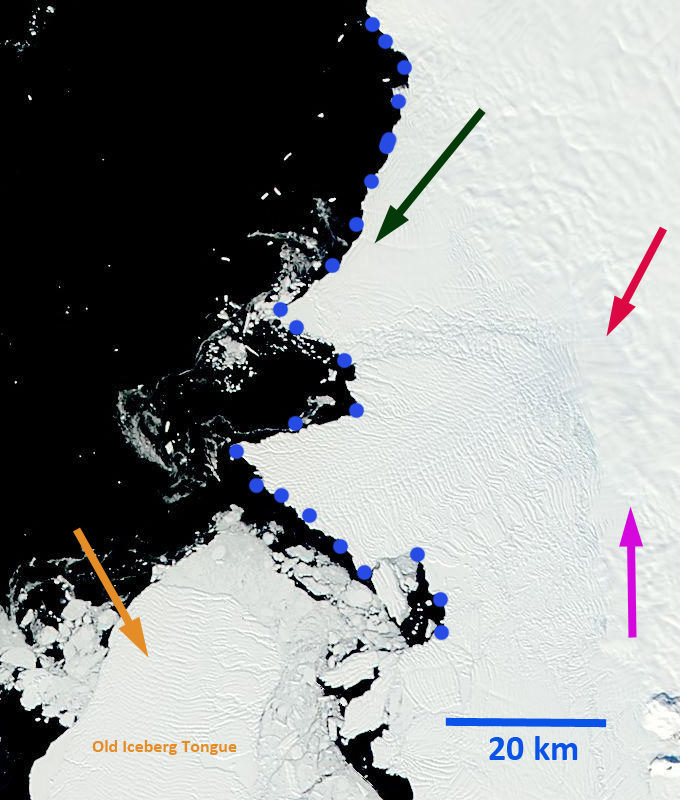
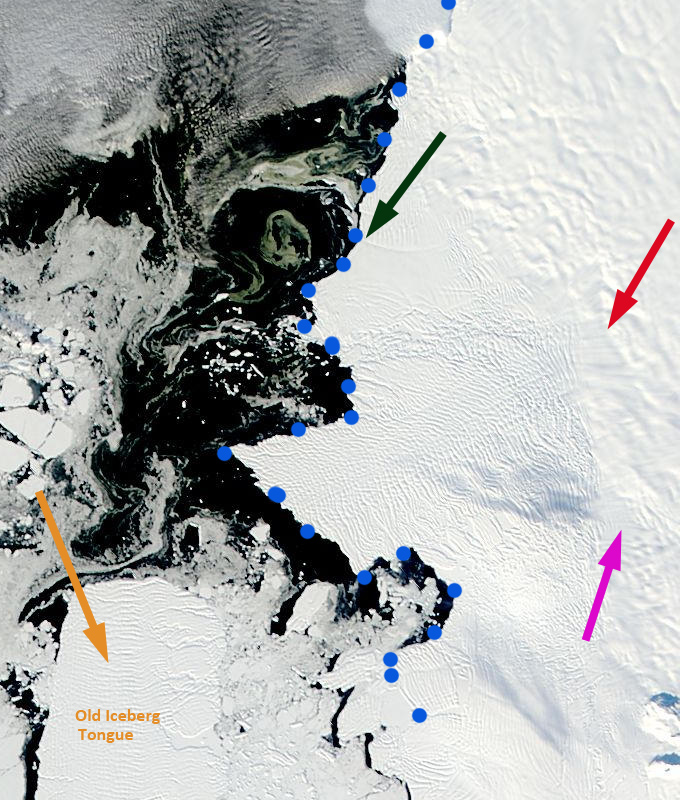
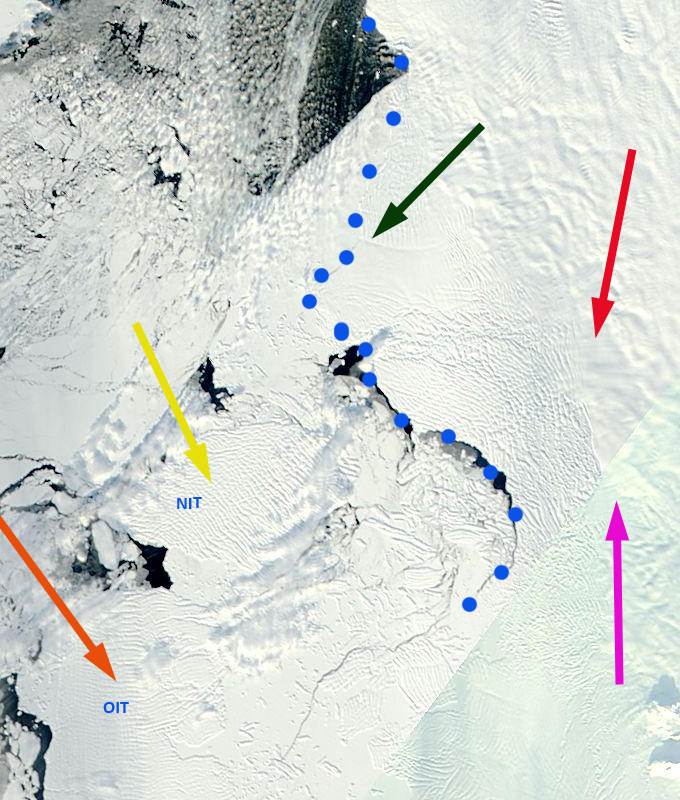
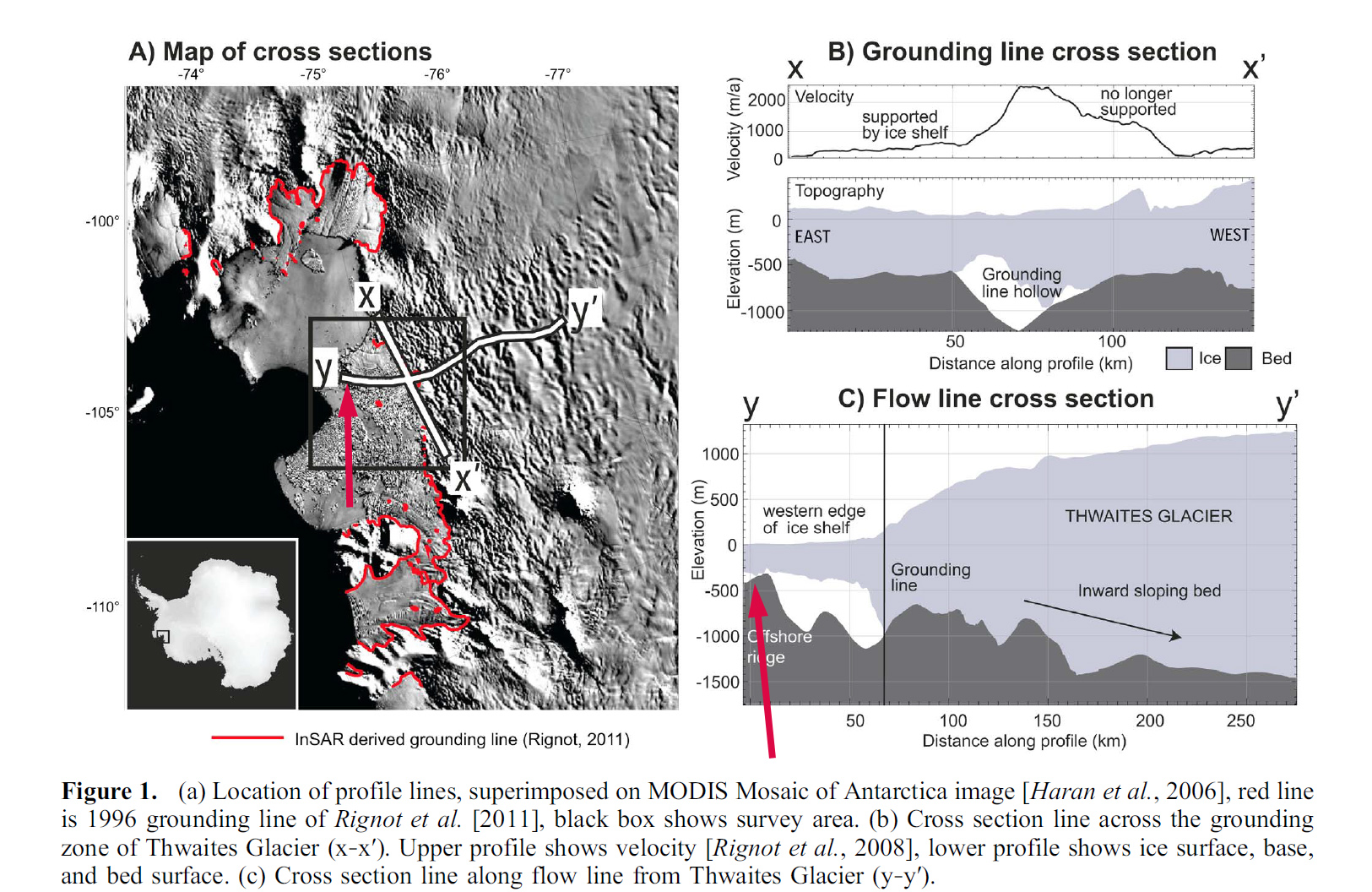
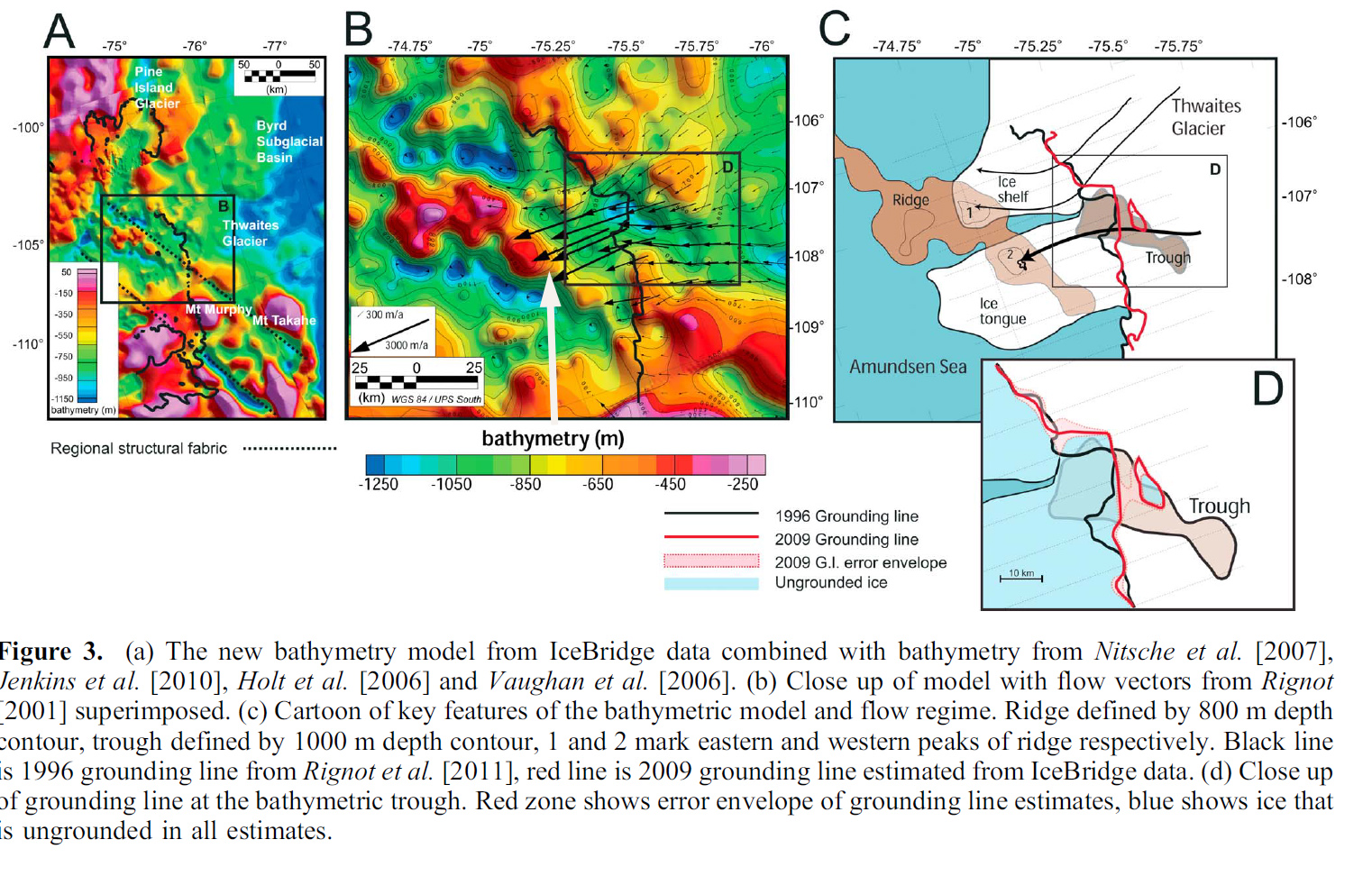
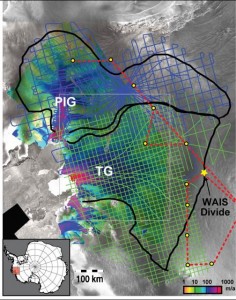
During the Austral winter between April and September, 2012 the Thwaites Glacier a large outlet glacier of the West Antarctic ice Sheet experienced a major calving event, as was pointed out by a reader on this blog. This is along with Pine Island Glacier often considered the weak underbelly of the ice sheet. MODIS imagery from February, March, September and October is used here to illustrate the event. The red, magenta and green arrows point to the same location in each image. The blue dots mark the ice front. The orange arrow points to a portion of the Thwaites Glacier Ice Tongue that had previously calved in 2002/03. In the latter two images the yellow arrow indicates the new ice tongue piece that has broken off. This is an important glacier along with the A video using MODIS and Landsat imagery notes the 2012 changes and the number and size of new icebergs from the glacier. Pine Island Glacier as they both tap into the heart of the WAIS but lack big buttressing ice shelves. This is why in 1985 I was busy preparing a bedrock map in front of the glacier from two shipboard seismic transects for Tom Kellogg and Terry Hughes at U Maine. Of course that map did not look nearly as good as the recent ones in Tinto and Bell (2011), from the extensive NASA Operation Icebridge. What they indicate in the two following images from their paper is that the new ice tongue before it broke off was ending on top of a bedrock high (red arrow first image below), that would act as pinning for the ice tongue. The thicker the ice at that point the better the pinning point. This bedrock high is noted in the 3-d with a white arrow. Kirsty Tinto and Robin Bell (2011) of Colubmia University, also did predict a faster retreat for Thwaites Glacier. Rignot et al (2002) noted that the Thwaites Glacier grounding line was in retreat, the mass loss was increasing and the glacier was thinning, though not nearly as fast as Pine Island Glacier. In the last image below from Rignot (2008) the velocity of Pine Island Glacier and Thwaites Glacier is shown, the high velocity region of Thwaites is wider, and this has been expanding ((Rignot et al, 2002). The Thwaites Glacier behavior ice frontal changes and thinning is like the Smith Glacier to its west also. Unlike Petermann Glacier where there is no past history to suggest the terminus will readvance significantly towards its former position, Thwaites Glacier has experienced large calving events in the past, such as 2002/03. The difference on this occasion is that the ice tongue was quite small and hence more stable than in previous calving event occasions. The continued thinning makes the readvance and subsequent pinning on the bedrock ridge less likely. The rifting is also quite extensive as MacGregor et al (2012) had noted, I look forward to the observations that will emerge from NASA’s Operation Ice Bridge in Antarctica that begins in a week.

Godur Glacier, Pakistan Retreat and Separation

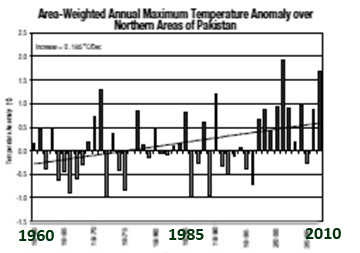
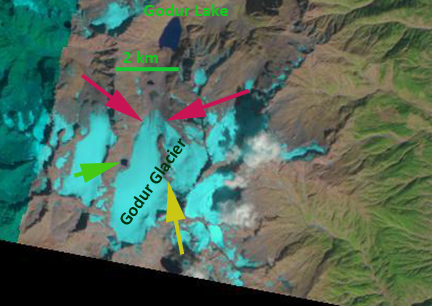
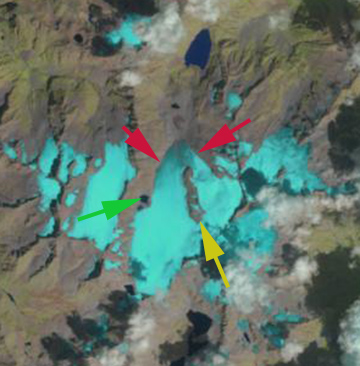
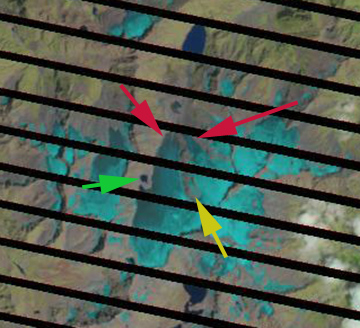
Godur Glacier drains into Godur Lake (Godar) in the Hindu Kush Mountains of Northwest Frontier Province, Pakistan and then into the Swat Valley and then Indus River. ICIMOD (2010) noted there were 233 glaciers with an area of 223 square kilometers in the Swat Valley region, this indicates numerous but generally small glaciers. ICIMOD (2010) also examines the changing climate conditions in the region, noting that the change in precipitation has been minor, while temperatures have risen markedly and the frequency of heat waves has increased (first image, from ICIMOD, 1960-2010). The main accumulation season for the glaciers in this area is in the winter season, with the summer monsoon playing a small role. In 1998 and 2000 the Godur Glacier terminus was a location where two tributaries joined, red arrows. By 2011 the retreat had led to separation of the two glaciers. The separation has increased in the divide between the glaciers, yellow arrow. the west margin of the glacier has also retreated, note the distance from the lake to the edge of the glacier in 1998 versus 2011, green arrow. The retreat of this glacier and the enhanced melting through the Hindu Kush will lead to changes in timing of runoff in the Indus River. The net annual runoff depends largely on precipitation, which has not shown a clear trend. However, during heat waves extensive melting can lead to high water levels in the Indus River, well long term retreat leads to decreased summer melt and runoff. The retreat here parallels that seen to the west in Afghanistan (Emend Valley glaciers) and to the west in the Himichal Pradesh (Malana Glacier).
Knife Point Glacier Retreat (Dissappearing), Wind River Range, Wyoming

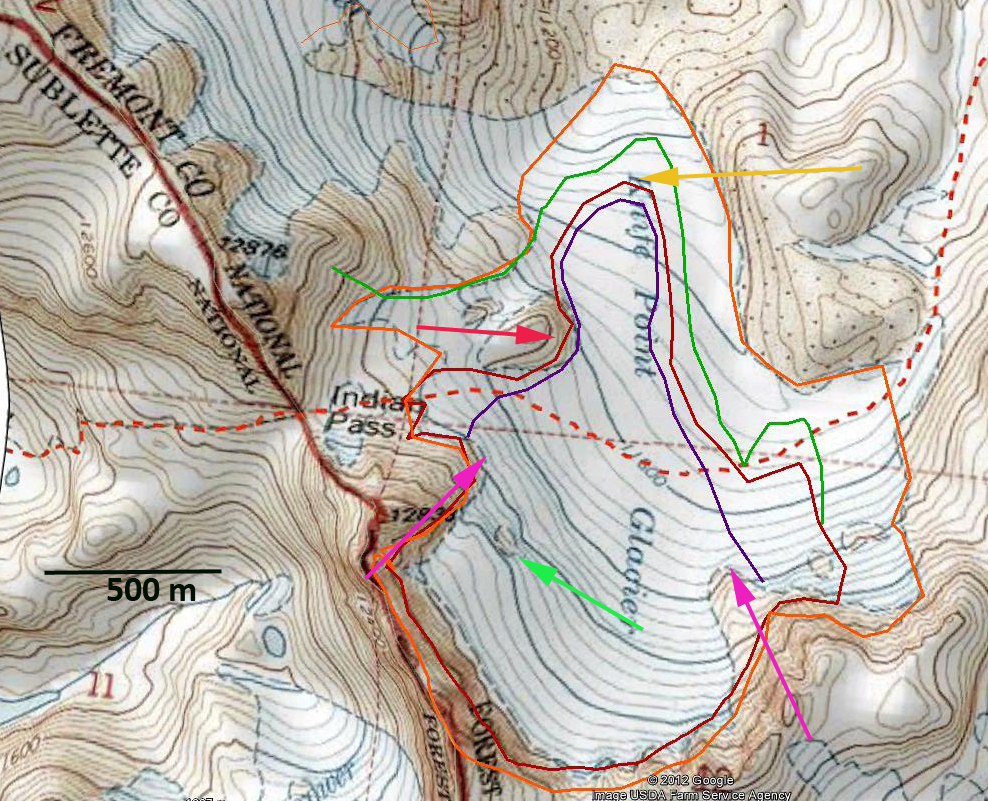
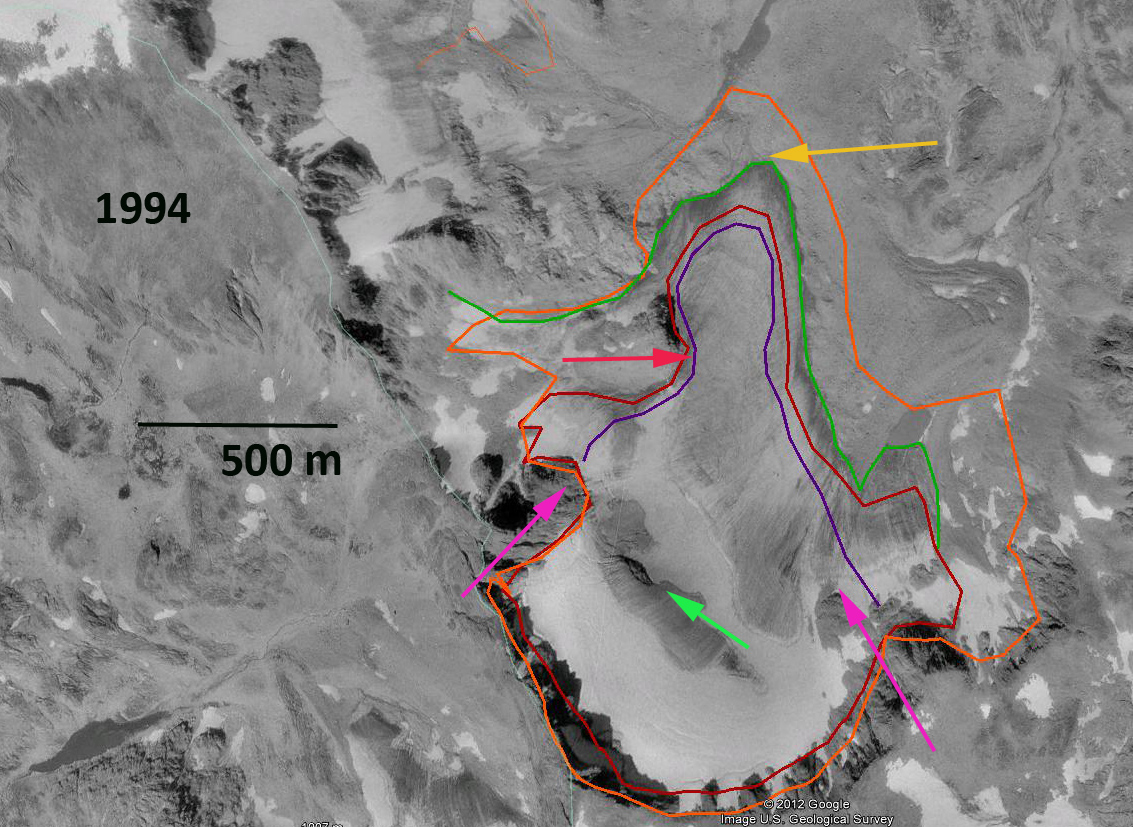
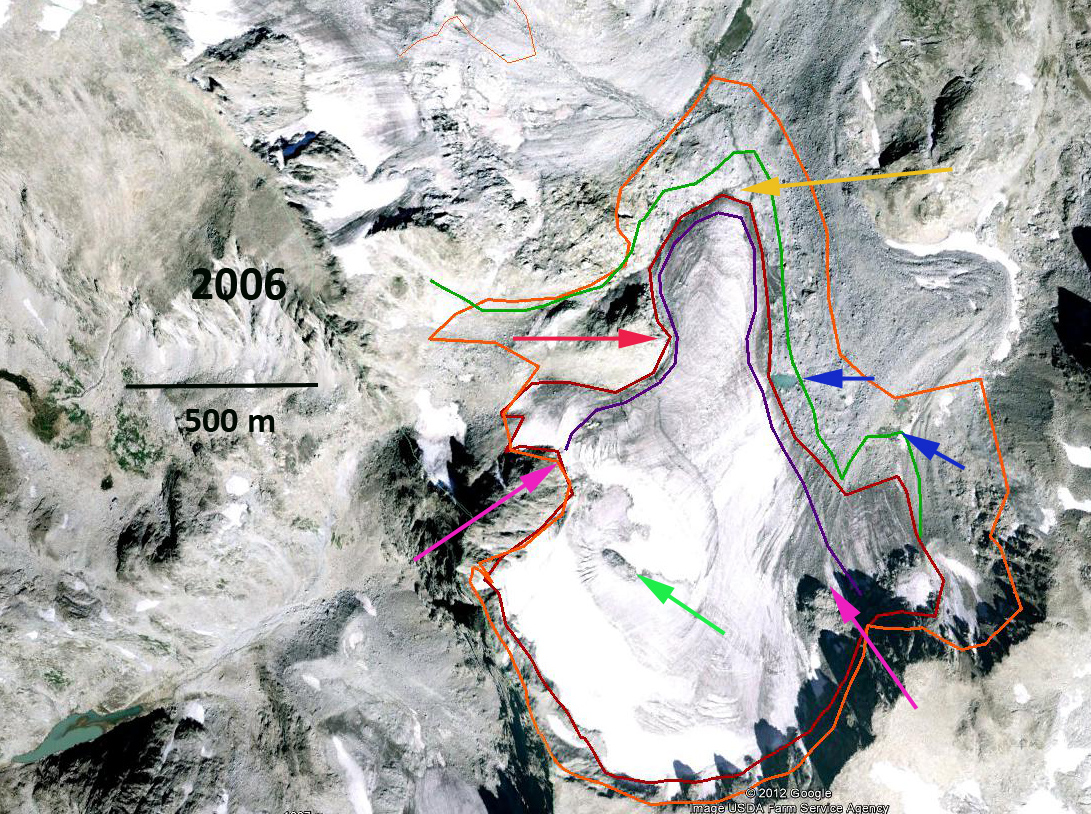
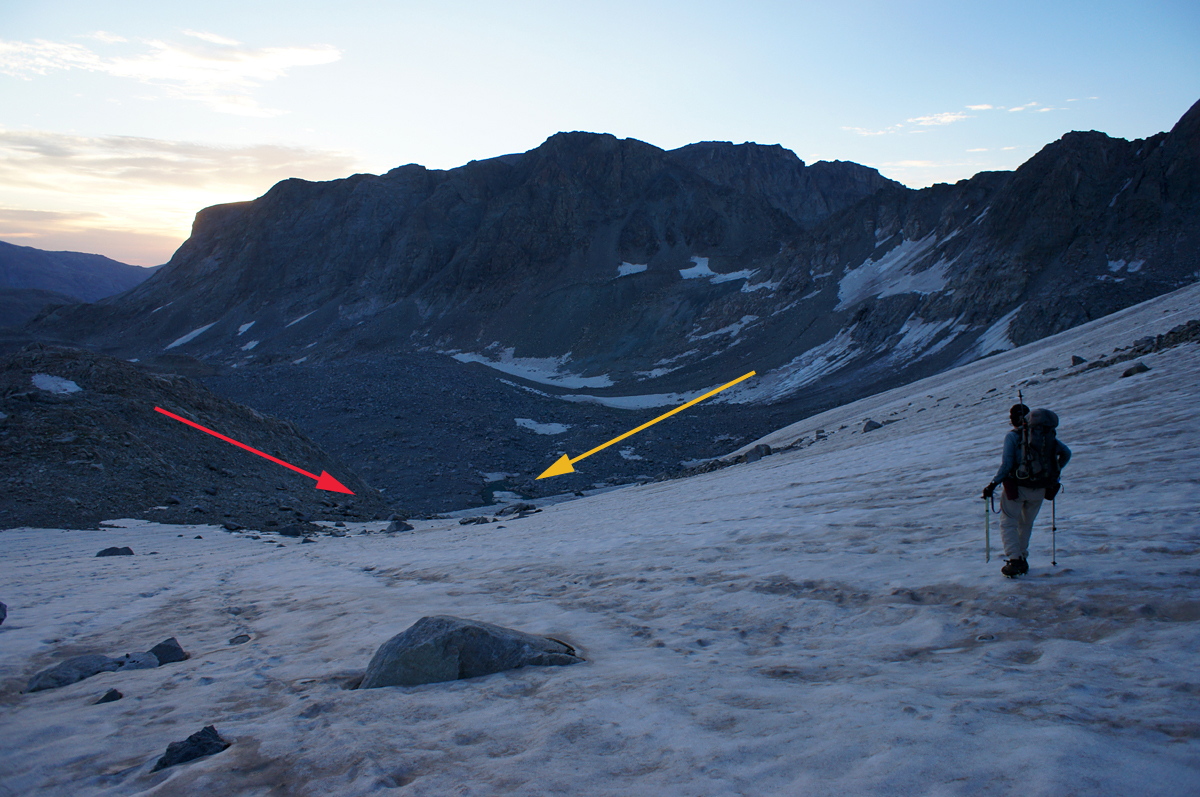
The Wind River Range is host to 40 glaciers that all have retreated significantly over the last 25 years and 45 years. Of the 15 glaciers observed in detail, nine will not survive current climate (Pelto, 2008). This is based on the lack of a persistent and consistent accumulation zone essential for glacier survival (Pelto, 2010). Thompson et al (2011) quantified the loss in area, of the 44 glaciers was estimated to be 45.9 km2 in 1966 and 28.6 km2 in 2006, a decrease of 38%. Here we examine Knife Point Glacier using Google Earth images from 1994, 2006, 2012 Landsat imagery and some 2012 photographs. The magnificent photographs are from Sarah T, who during the course of an impressive 2012 climbing season, climbed Knife Point. A comparison of its extent from 1966 USGS map, 1994 USGS aerial photography and 2006 satellite image in Google Earth indicate the retreat. The 1966 glacier boundary is outlined in orange, 1994 boundary in green, 2006 boundary in red and 2012 boundary in purple. The arrows in each image point to the same location. The yellow arrow to the 2006 terminus, green arrow to the upper glacier rock outcrop, magenta arrow to the prominent ridges now marking either side of the glacier, and the red arrow the bedrock knob that is now just above the terminus. In 1966 the glacier was connected to the Bull Lake Glacier to its northwest. By 1994 the glaciers were separated and a small lake had formed at the eastern terminus. By 2006 the eastern lake had largely filled in with sediment and another small lake had formed and the eastern side of the glacier had retreated more than the terminus. By 2012 the glacier shape had become confined to the central basin at the top with a narrowing glacier terminus tongue. The glacier area has declined from 1.5 km2 in 1966 to 0.8 km2 in 2012, a 46% loss in area. The main terminus has retreated 360 meters from 1966-2012. The width of the glacier on the east side has declined by 300 m. At the green arrow a small bedrock knob has expanded from 1966-2012. This is in the middle of the accumulation zone and indicates the lack of persistent and consistent snowcover. There is almost no snowcover left in the 9/27/2012 image of Knife Point Glacier.

The images from Sarah T, are from late July and despite there being two months left in the summer season the glacier has lost most of its snowcover. The lack of crevassing despite the slope indicates the thin inactive nature of the glacier.
The response of this glacier to climate parallels that of Lower Fremont Glacier, Minor Glacier and Sourdough Glacier.

Mount Baker Glacier Hydrologic Year End Update

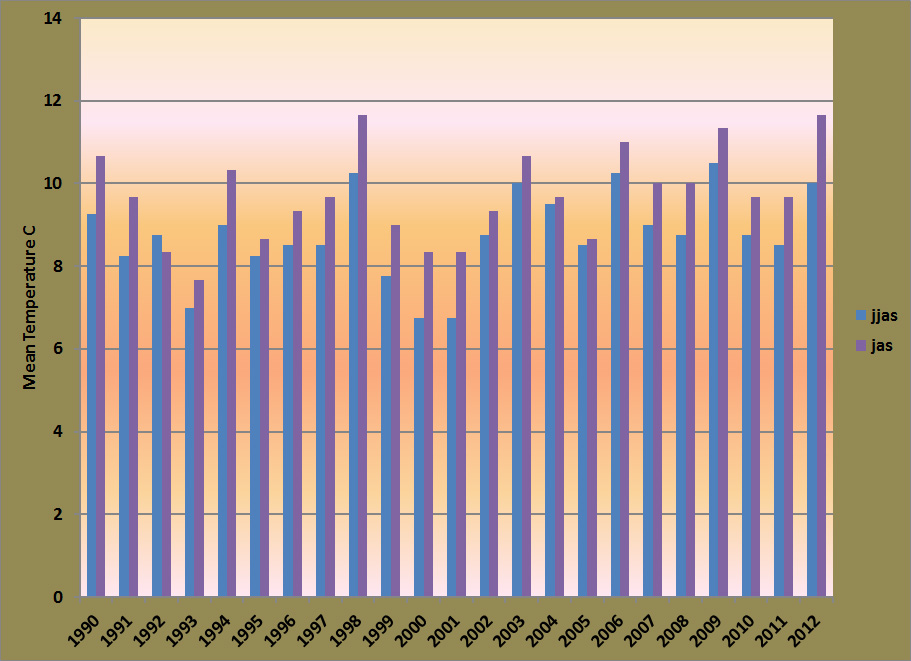
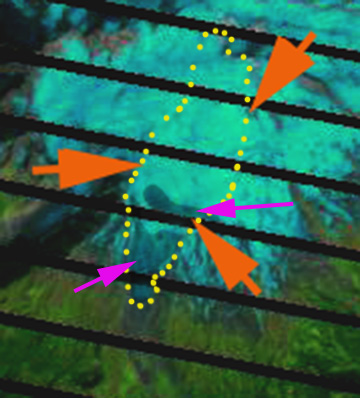
October 1 marks the end of the hydrologic year. For glaciers this should be the end of the melt season, though this year in the North Cascades it is not. The year began with excellent snowpack in the North Cascades 4th highest since 1984. The ablation is primarily June-September, after a cool June, the melt season has been sustained and warm. The June-Sept. period is the fourth warmest of the 1990-2012 period and the warmest for the July-Sept. There was not exceptional periods of heat, just sustained warmth due to the lack of cool wet systems in the region. This was evident from a period of 47 consecutive days with less than .01 inches of ppt at SeaTac Airport. The warm weather is projected to extend at least through Columbus Day. . Here we will examine Easton Glacier on Mount Baker. On July 20 the snowpack was still extensive covering 100% of the glacier. By August 10 the glacier had substantial blue ice. Note images from new video on research taken then. A series of Landsat images below are from July 20, August 25th and Sept. 26th. The orange areas point to the same locations. For the August and September image there is a second image, the last two in sequence, of each with the glacier outlined by yellow dots and the blue ice zones where the snowpack had melted away a darkened blue. The imagery does not distinguish the exposed 2011 firn from the 2012 snowpack. . Comparing images from 8/10/2012 and one month later 9/8/2012 the expansion of bare ice is evident. A marks the western terminus that was surveyed this summer as having experience 310 m of retreat from 1990-2012. B marks an area with average snow depth of 0.7 m on 8/10 and had lost snowpack and 1.4 m of ice by 9/8. The top of the C had snowpack of 1.8 m on 8/10 and by 9/8 was at the snowline. D marks an icefall that has expanded considerably. E marks an area with 5.5 m of snowpack on 8/10 and 3.8 m of snowpack on 9/8. By Sept 30 considerable additional melting had occurred. Final mass balance results will emerge over sometime in November. We measured snowpack depth at over 400 locations on Mount Baker using probing and crevasse stratigraphy, last two images.

Lobbia Glacier Retreat, Italy and World War I relic exposure

The summer of 2012 was a warm one in the Italian Alps. This has led to large losses in glacier volume and exceptional surface melting. One example of this has been the exposure via melting of a considerable amount of World War I relics. One location noted has been the Ago Di Nardis Glacier in the Trentino Mountains, where artillery ammunition is observed Image from Maffei Glauco / Trentino Italian / EPA. In this post we use Landsat imagery from 1999, 2011 and 2012 to examine the retreat of Lobbia Glacier with a small note on the retraction of Ago Di Nardis Glacier. The Lobbia Glacier is adjacent to the Mandrone Glacier that has been examined in detail by the Università di Brescia, Italy (Ranzi et al, 2010), which lost over a meter of ice thickness on average from 1999-2006. The Lobbia Glacier retreat from 1999-2010 has been observed by the Italian Glaciological Survey and found to have retreated 140 meters from 1999-2005, and 45 m from 2006-2009. In the Landsat images the red arrow indicates the retraction in glacier width of Ago Di Nardis Glacier at the 3000 meter level. The Orange dot indicates the 1999 terminus location of Lobbia Glacier. The yellow arrow indicates the expansion of a bare rock area that had been surrounded by ice in 1999 on Lobbia Glacier. The purple arrow indicates the separation of horseshoe shape glacier adjacent to Lobbia Glacier.. The glacier has a low slope and few crevasses. The combination indicates low velocity and even stagnant conditions. The slopes on the west side of the glacier, yellow arrow are not retaining snowcover and no longer feed the glacier tongue. The lack of a consistent and persistent snowcover indicates a glacier that cannot survive (Pelto, 2010), image from TecTask. The current glacier health parallels that of Dosde Glacierand Presena Glacier