

Above is a paired Landsat image from 1984 left and 2013 right, indicating a 2300 m retreat in this period, below is further detailed examination.
The Field Glacier flows from the northwest side of the Juneau Icefield, and is named for Alaskan glaciologist and American Geographical Society leader William O. Field. Bill also helped initiate the Juneau Icefield Research Program, which Maynard Miller then ably managed for more than 50 years. The JIRP program is still thriving today. In 1981, as a part of JIRP, I had my first experience on this glacier. It was early August and there was new snowfall everyday that week. Jabe Blumenthal, Dan Byrne and myself undertook a ski journey to examine the geology on several of the exposed ridges and peaks, note the burgundy line and X’s on image above. This was truly a remote area. The glacier begins from the high ice region above 1800 meters, there are several icefalls near the snowline at 1350 meters, and then it descends the valley ending at 100 meters. The runoff descends the Lace River into Berners Bay.  This post focuses on the significant changes occurring at the front of the Field Glacier. The development of a proglacial lake at the terminus is accelerating and spreading into the main southern tributary of the glacier. This lake is going to quickly expand and develop a second arm in that valley. The USGS map from 1948 imagery and the 1984 imagery indicate little change in the terminus position, with only a small lake at the terminus.
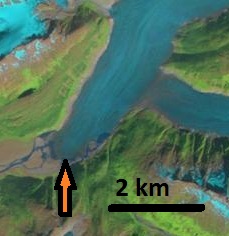 . After 1984 the mass balance of the Juneau Icefield became more negative, this was apparent from the rise in the snowline elevation on all the glaciers and by the increasing losses and resultant thinning typified by the Lemon Creek Glacier (Miller and Pelto, 1999)
 . The Field Glacier by 2006 had developed a proglacial lake at the terminus that averaged 1.6 km in length, with the east side being longer. There are several small incipient lakes forming at the margin of the glacier above the main lake, each lake indicated by black and orange arrow. In 2009 the lake had expanded to 2.0 km long and was beginning to incorporate the incipient lake on the west side of the main glacier tongue. By 2011 the main lake has nearly reached the southern tributary lakes. The lake has expanded to 2.6 km long, with the west side having caught up with the east side, and an area of 4.0 square kilometers. In addition the main lake has joined with the fringing lake on the south side of the south tributary. There is also a lake on the north side of this tributary. This lake should soon fill the valley of the south tributary and fully merge with the main, as yet unnamed lake at the terminus, maybe this should be Field Lake. Below in order is the 2006, 2009 and 2011 Landsat images.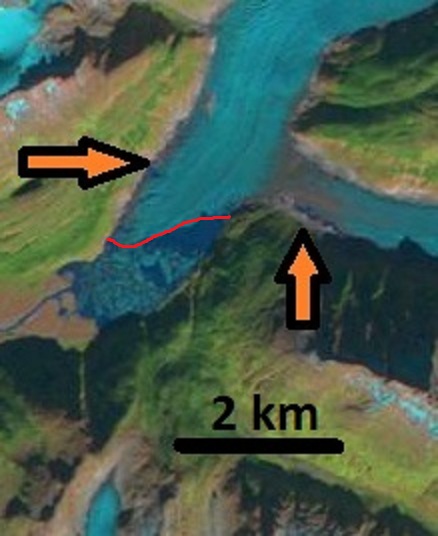

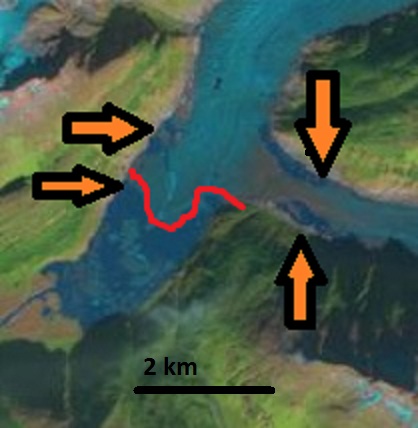 This glacier is experiencing retreat and lake expansion like several other glaciers in the icefield, Gilkey Glacier, Eagle Glacier, and Antler Glacier.
Tag: alaska glacier melt
Eagle Glacier Retreat, Juneau Icefield Alaska
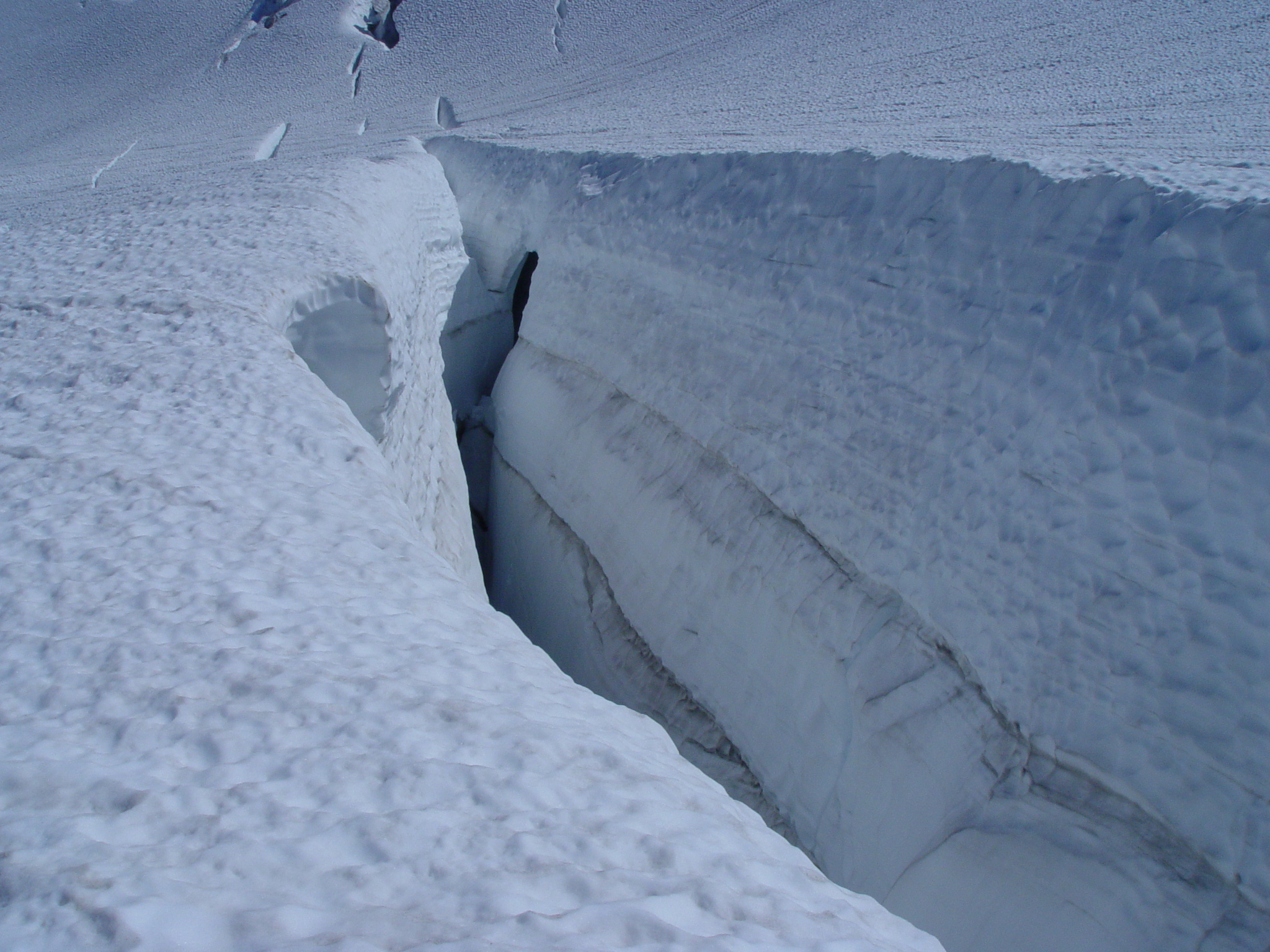
 Above is a paired Landsat image from 1984 left and 2013 right indicating the 1100 m retreat during this period of Eagle Glacier.My first visit to the Eagle Glacier was in 1982 with the, ongoing and important, Juneau Icefield Research Program, that summer I just skied on the glacier. In 1984 we put a test pit at 5000 feet near the crest of the Eagle Glacier to assess the snowpack depth. This was in late July and the snowpack depth both years was 4.3 meters, checking this depth in nearby crevasses yielded a range from 4-4.5 meters.
 In 1984 the snowline at the end of the summer melt season in early September was at 1050 meters. In the image below the glacier is outlined in green, the snowpit location is indicated by a star and the snowline that is needed for the glacier to be in equilibrium at 1025 meters is indicated.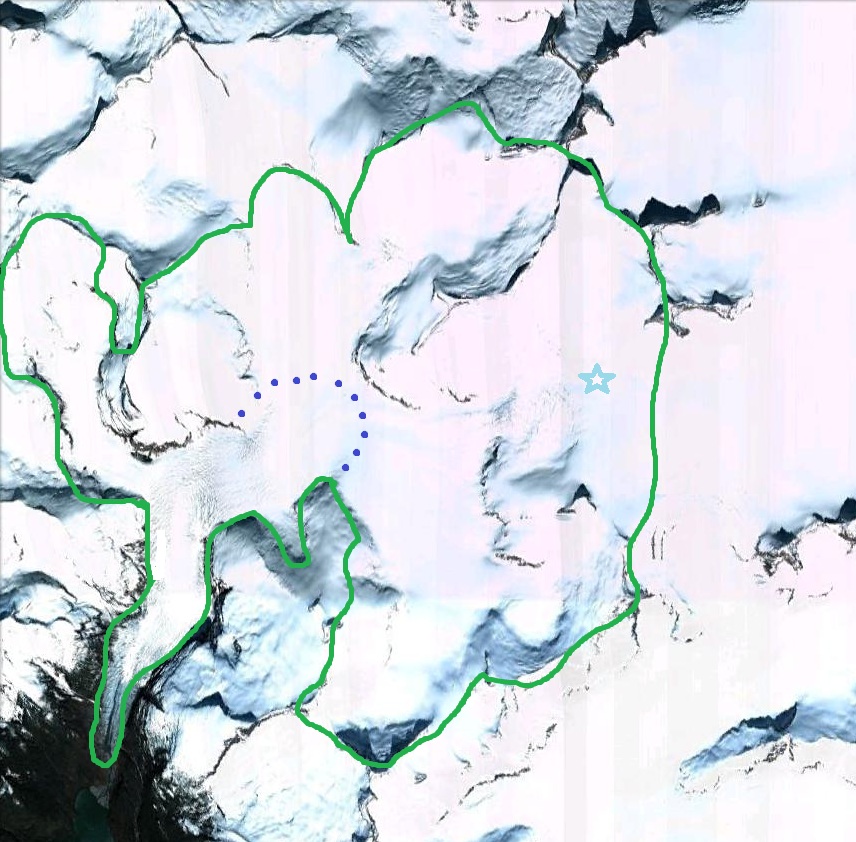
Eagle Glacier has experienced a significant and sustained retreat since 1948. The first map image below is of the glacier in 1948, at this time the glacier ended at the south end of a yet to be formed glacier lake. By 1982 when I first saw the glacier and when it was mapped again by the USGS (second image) the glacier had retreated to the north end of this 1 kilometer long lake. In the sequence of images the red line is the 1948 terminus, the magenta line the 1982 terminus, the green line 2005 terminus and the orange line the 2011 terminus. 
 From 1982 to the 2005 image used in Google Earth the glacier retreated 500 meters, 21 meters/year (next image). The bottom image is from a 2011 Landsat image in May and indicates the terminus position once again with an additional retreat in six years of 400 meters, 65 meters/year. Going back to the 1948 map the terminus in 2011 is located where the ice was 500-600 feet thick in 1948
 The more rapid retreat follows the pattern of more negative balances experienced by the glaciers of the Juneau Icefield (Pelto et al, 2008). The Equilibrium line altitude which marks the boundary between the accumulation and the ablation zone each year is a good marker of this. On Eagle Glacier to have an equilibrium the glacier needs to have an ELA of 1050 meters. At this elevation more than 60% of the glacier is in the accumulation zone. Satellite imagery allows identification of the ELA each year, seen below is the elevation in 1984, 1998, 1999 and each year since 2003.
  The number of years where the ELA is well above 1050 meters dominate leading to mass loss, thinning and glacier retreat. This follows the pattern of Lemon Creek Glacier that is monitored directly for mass balance, which has lost 26 meters of thickness on average since 1953.
Brady Glacier Retreat Leads to Rapid Lake Expansion 2004-2010
This post details changes in Brady Glacier between the 2004 Google Earth imagery and a 2010 Landsat image and that are examined in more detail by (Pelto et al, 2013). A detailed look at retreat up to 2004 is detailed in a previous post on Brady Glacier.. Brady Glacier is a large glacier at the south end of the Glacier Bay region, Alaska. When first seen by George Vancouver it was a calving tidewater glacier in 1794 filling Taylor Bay with ice. Brady Glacier ceased calving and advanced approximately 8 km during the 19th century (Klotz, 1899). As Bengston (1962) notes, the advance is likely another example of an advance following a change from tidal to non-tidal status rather than that of a more positive mass balance. Bengston (1962) further notes that the massive outwash plain at the terminus is primarily responsible for Brady glacier maintaining itself well other glaciers in the Glacier Bay region retreat. The ELA on this glacier is 800 m, the line above which snow persists even at the end of the average summer, this is one of the lowest in Alaska. The main terminus was still advancing in the 1960’s and 1970’s and has managed a 250-300 meter advance since the USGS map of the 1950’s. The main terminus is not advancing any longer and has begun to retreat, the retreat to date is less than 300 meters. The glacier has been thinning and this has caused many of the subsidiary termini to retreat significantly.

There have been significant changes cause by continued retreat since 2004. For North Tripp Lake, labelled A in images. The glacier lake has separated into two parts since 2004, at the red arrow in the images below, as the glacier margin has pulled back an additional 250 meters. The lake level has dropped resulting in this separation. The drop in elevation is due to drainage south from the lake adjacent to the glacier underneath and beside the glacier, instead of solely to the west. This new drainage path was evident in the 2004 image and noted in the previous post. The color of the two lakes is markedly different, the deeper blue of the lake more distant from the glacier indicates less glacier eroded material in suspension. 
 . Deception Lake, labelled B, has expanded by 500 meters as the glacier has retreated this same amount. At this rate this lake may soon follow the pattern of North Tripp Lake. Across the glacier, an unnamed arm, labeled C has begun to disintegrate. The white arrows in the 2010 image indicate the new open lake area. The area of this lake is now 1.5 square kilometers. North of Lake C is Abyss Lake, labelled D, this lake has expanded due to the 240 meters of retreat of the glacier in the 2004-2010 period.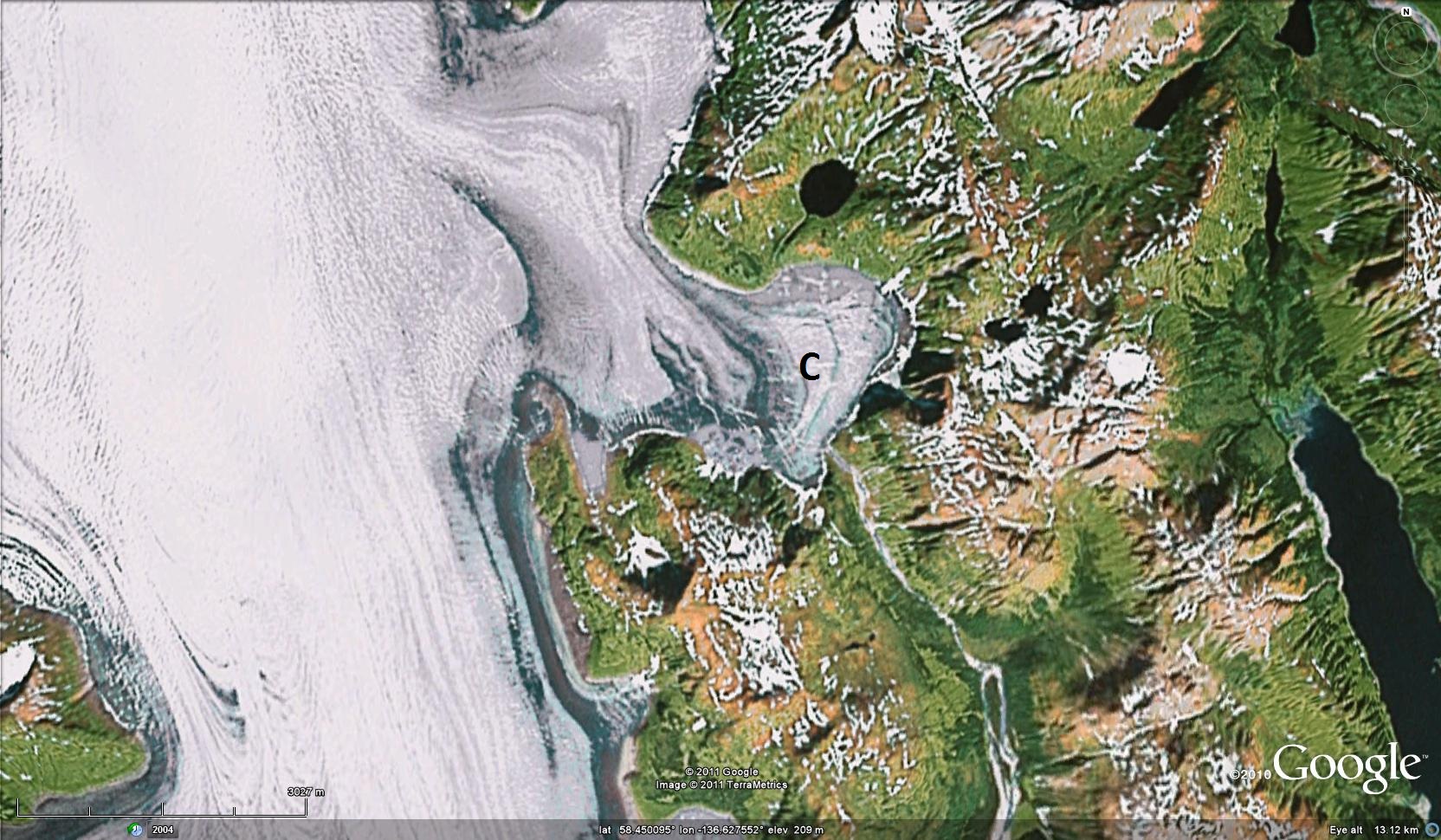
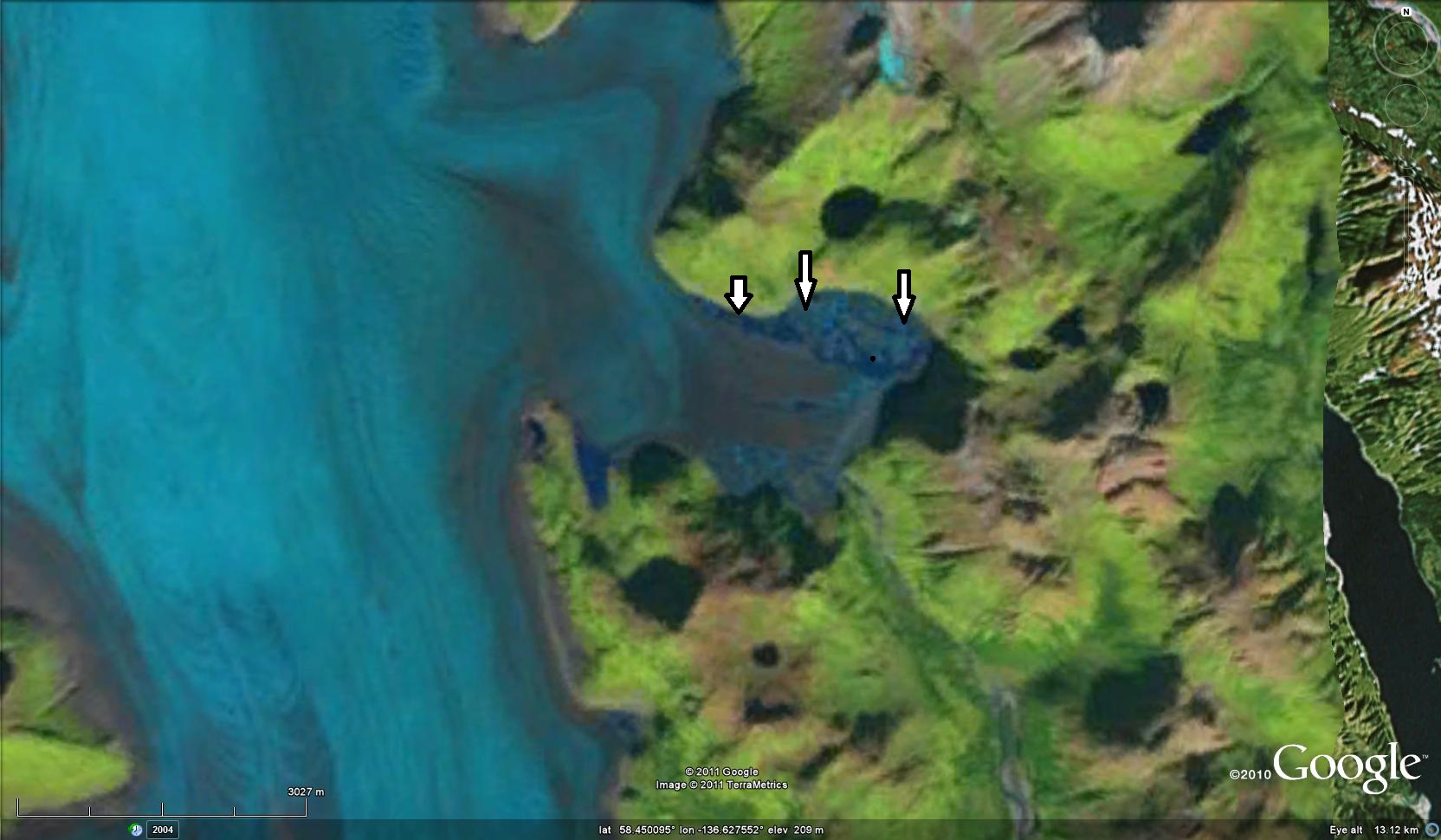 . To the west of Brady Glacier an unnamed glacier arm that used to join a branch of the Brady Glacier has now retreated fully from lake created by its retreat. Note point A in the time sequence below. The retreat from 1950 to 2004 was 3600 meters northeast up the lake basin, top image map from 1950, middle image Google Earth 2004. From 2004 to 2010 the glacier has retreated an additional 600 meters the retreat turning the elbow and now progressing northwest, bottom image 2010 Landsat image.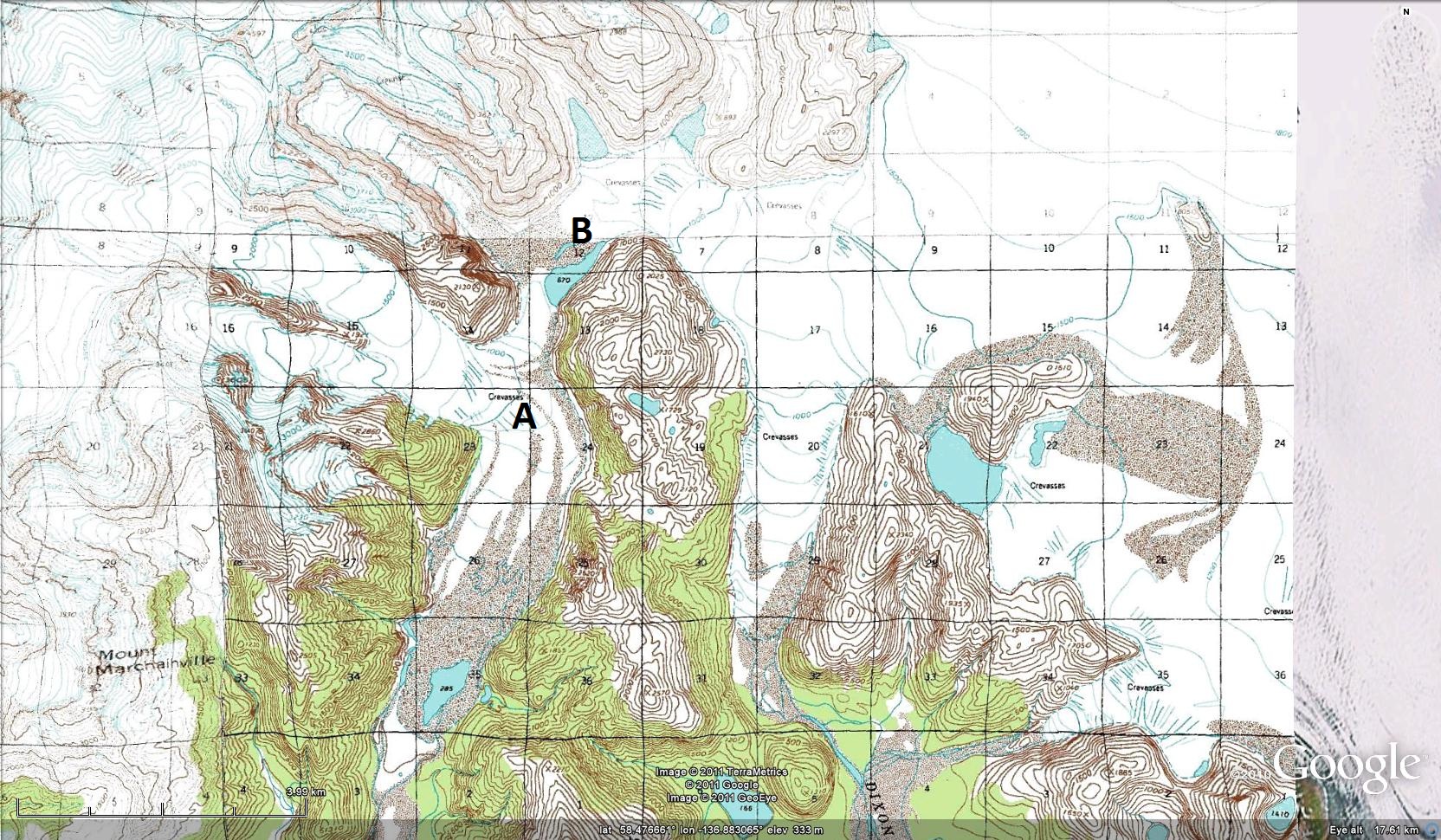
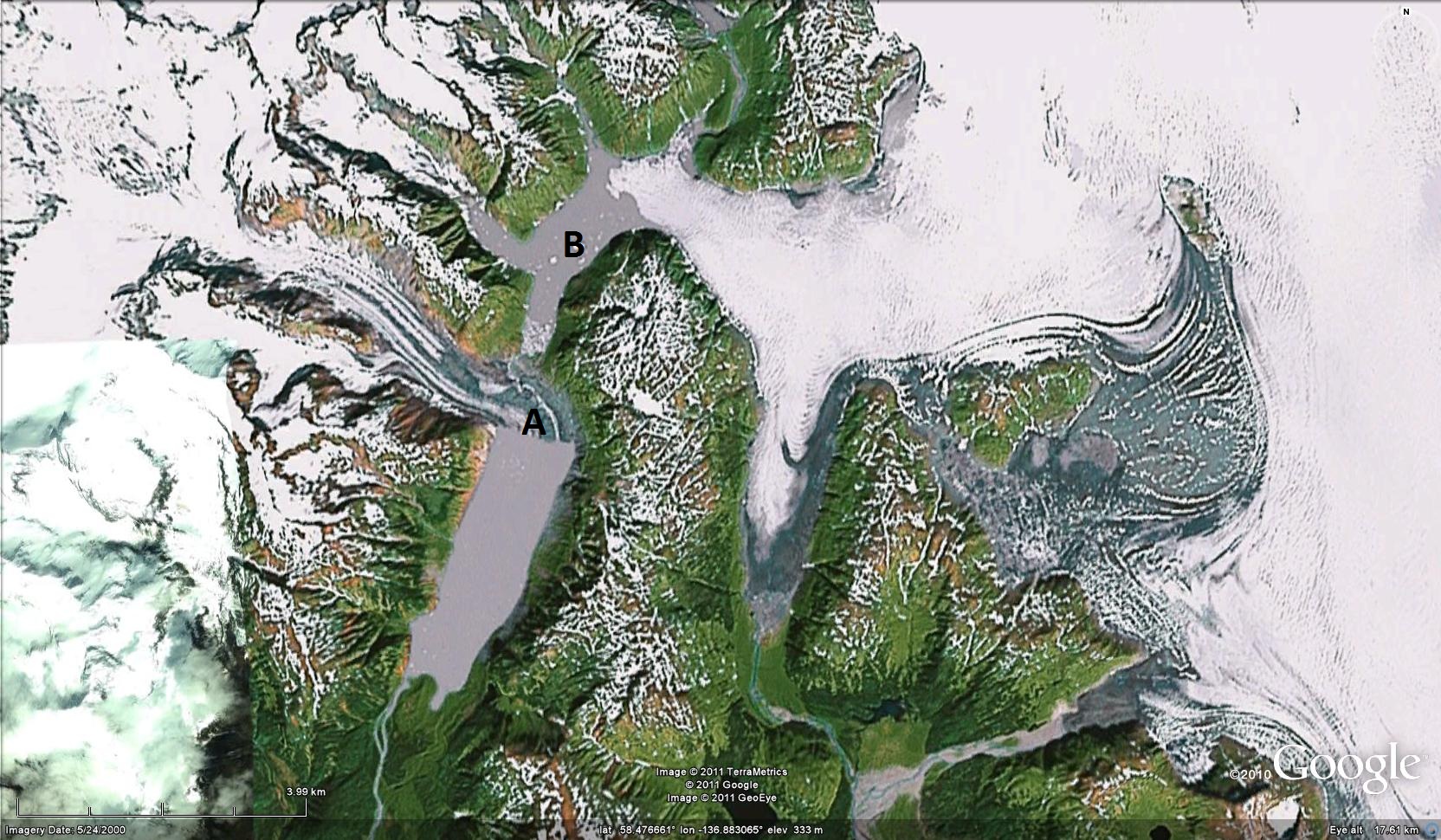
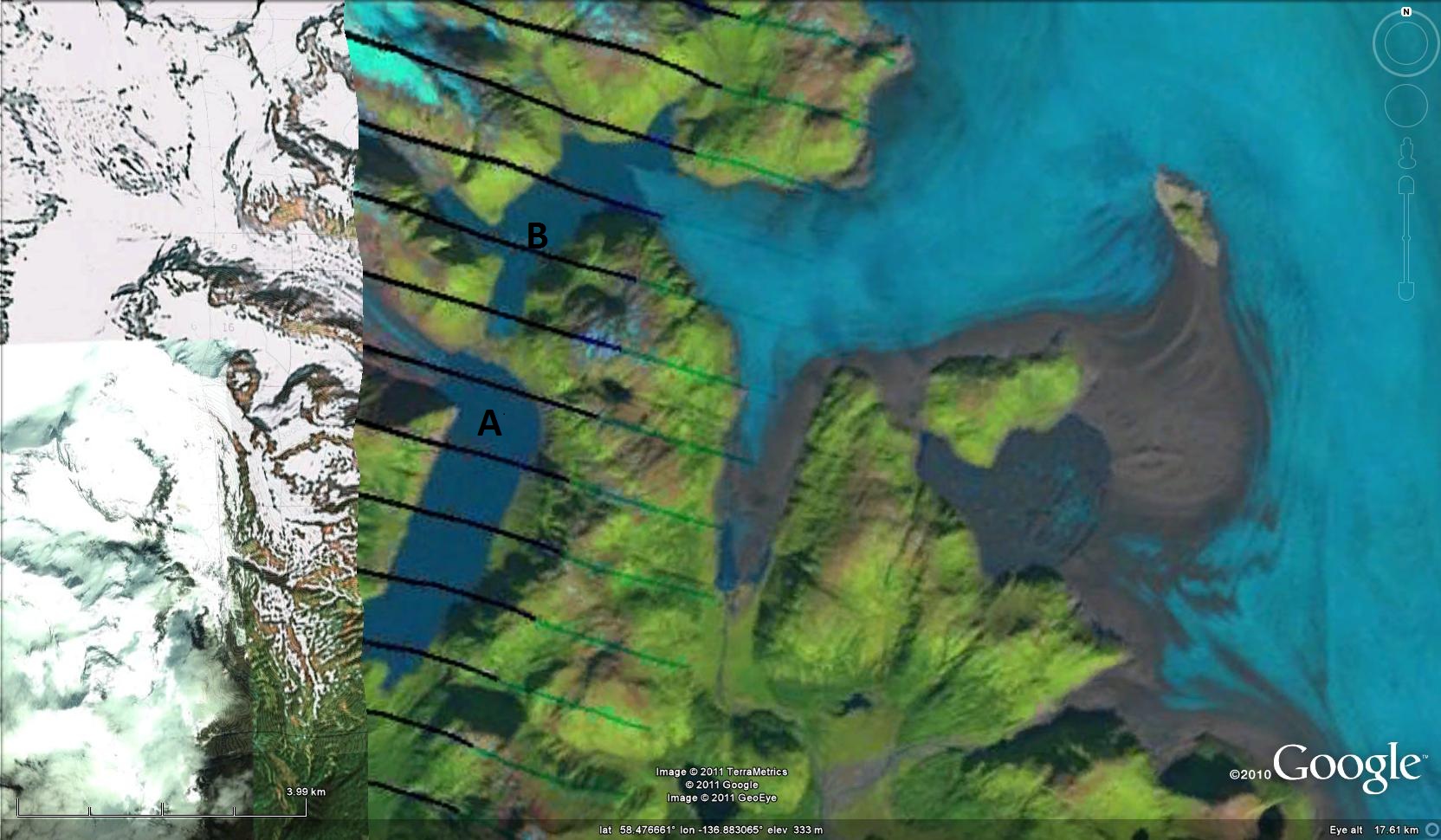 Clearly the Brady Glacier thinning as indicated by tributaries on both its east and west side, continue do demonstrate that a rapid retreat of the main terminus will begin.
Chickamin Glacier, Alaska Extensive Retreat
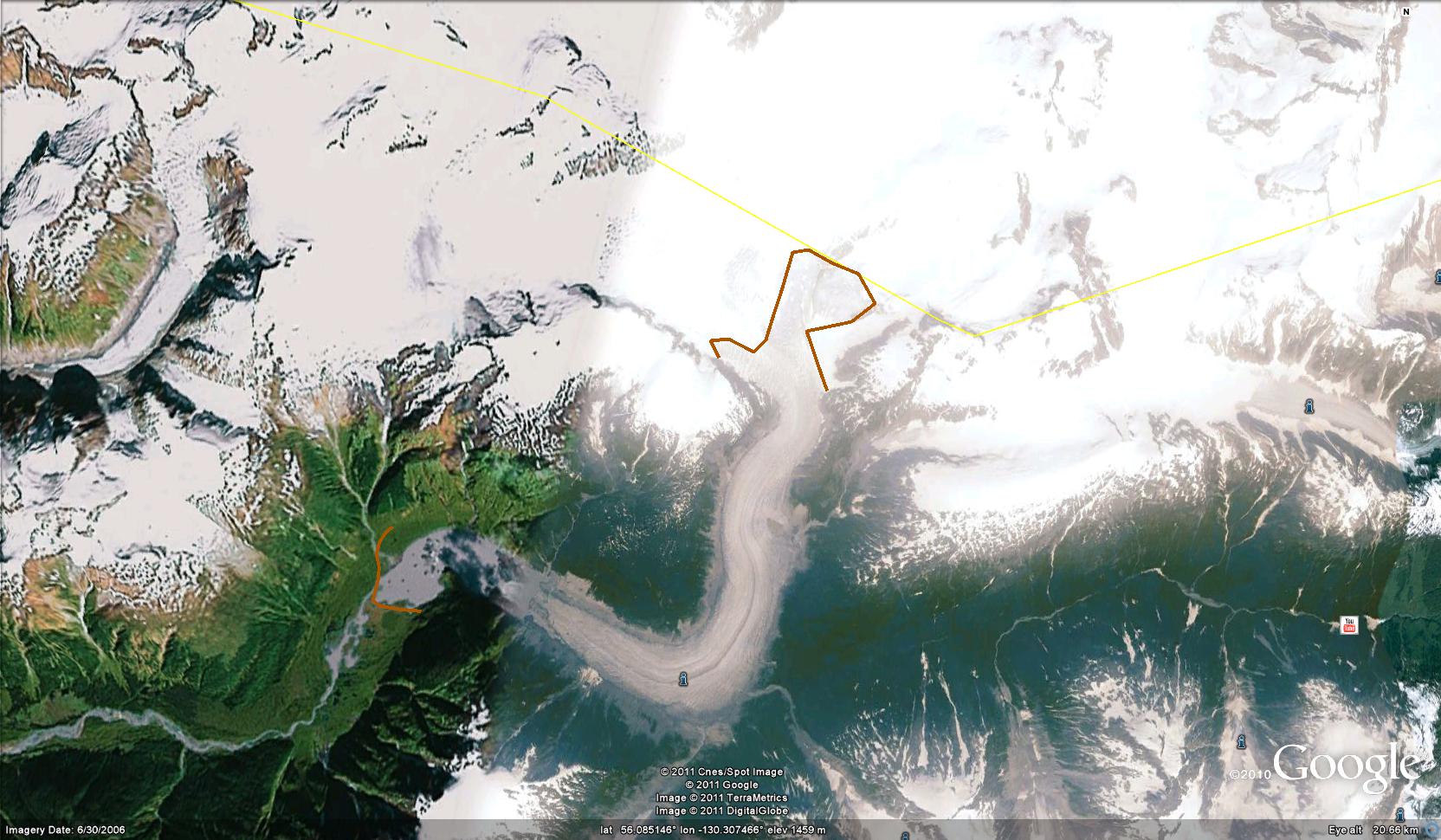
Chickamin Glacier in southeast Alaska has undergone a 3 kilometer retreat since 1955. The glacier drains south from an icefield near Portland Canal and straddling the border with British Columbia. The glacier ended on an outwash plain in 1955 at 250 meters. The Through Glacier at this time is a large tributary feeder joining Chickamin at the elbow where it turns west, (bottom image)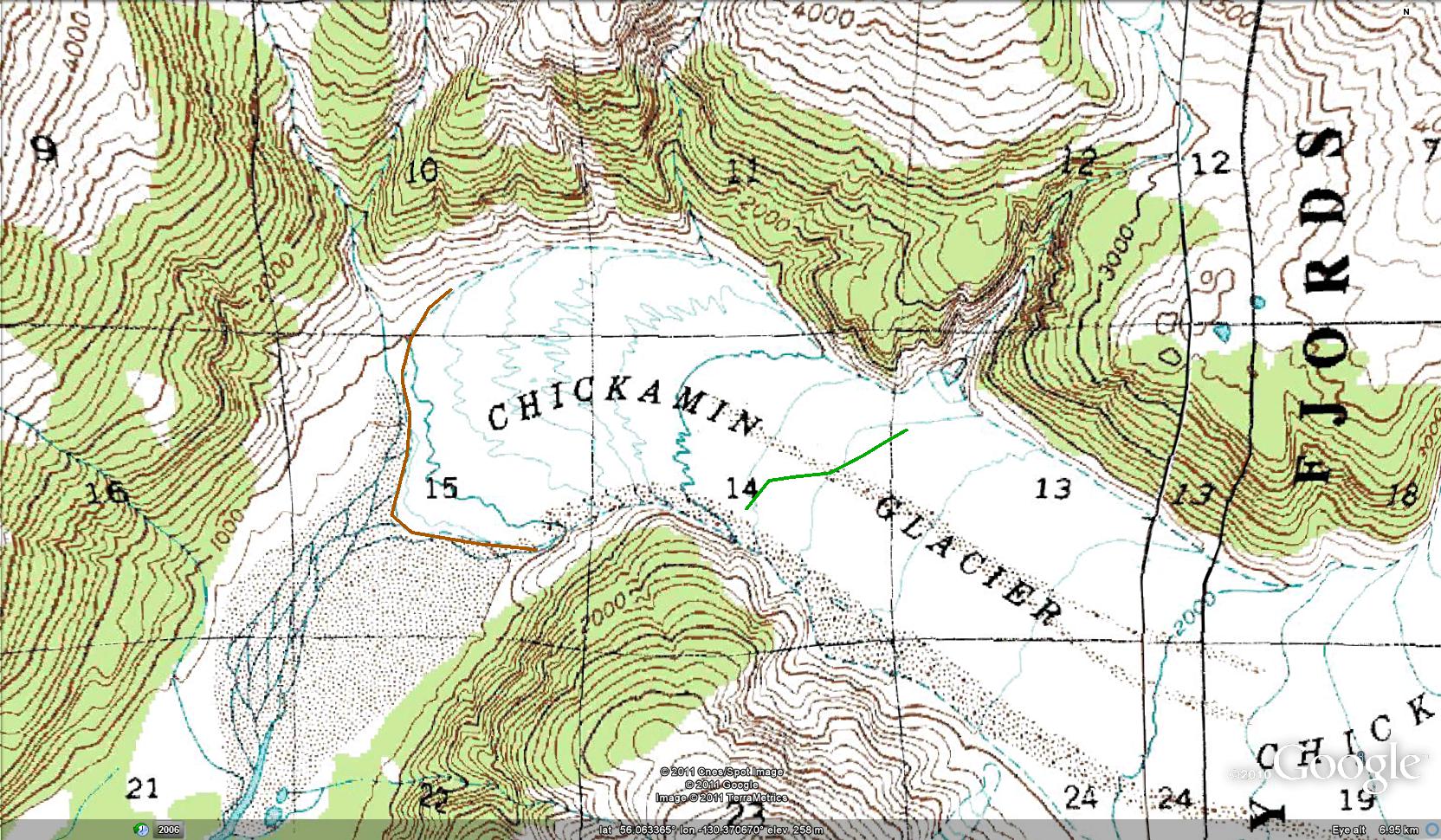
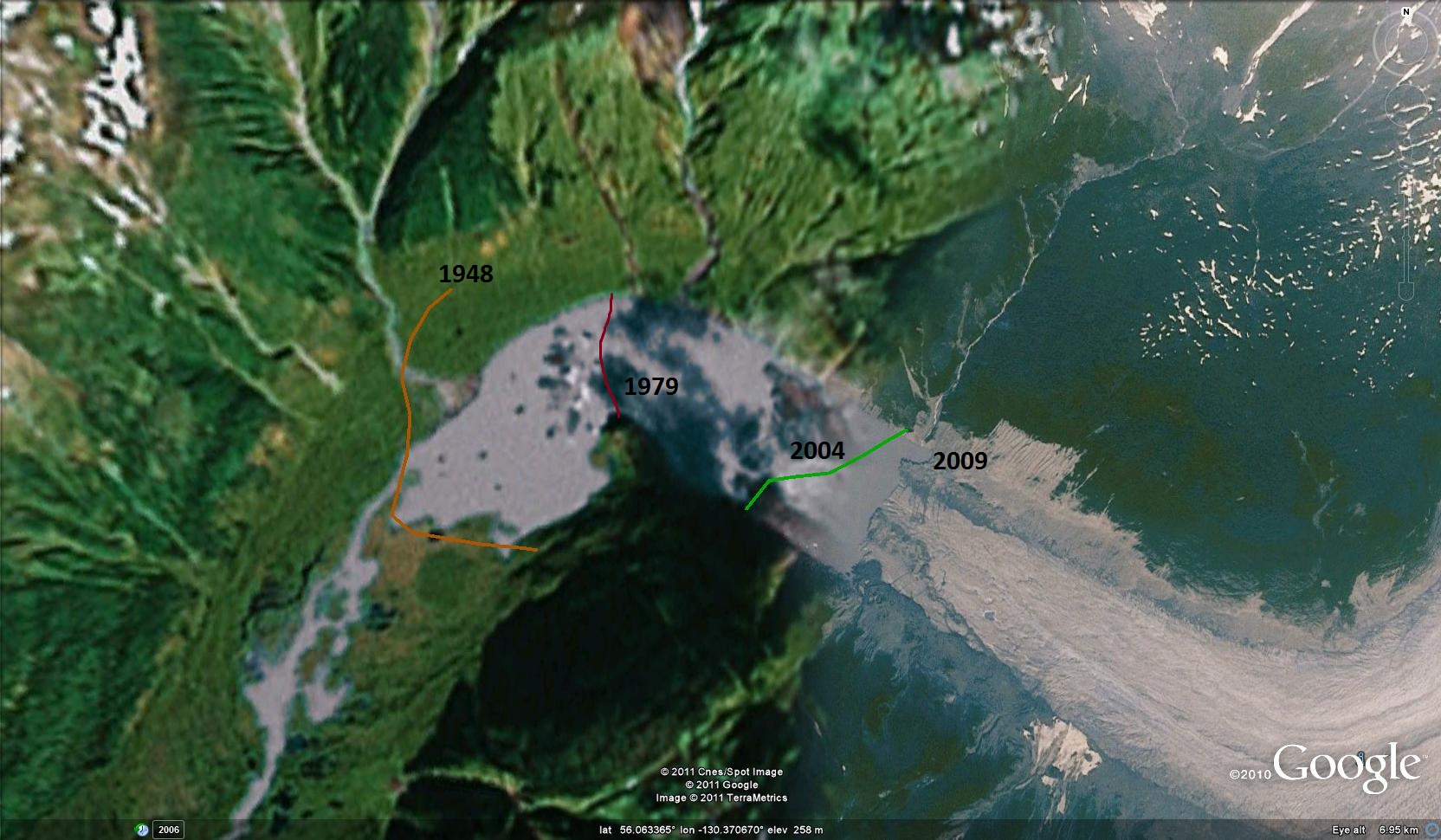
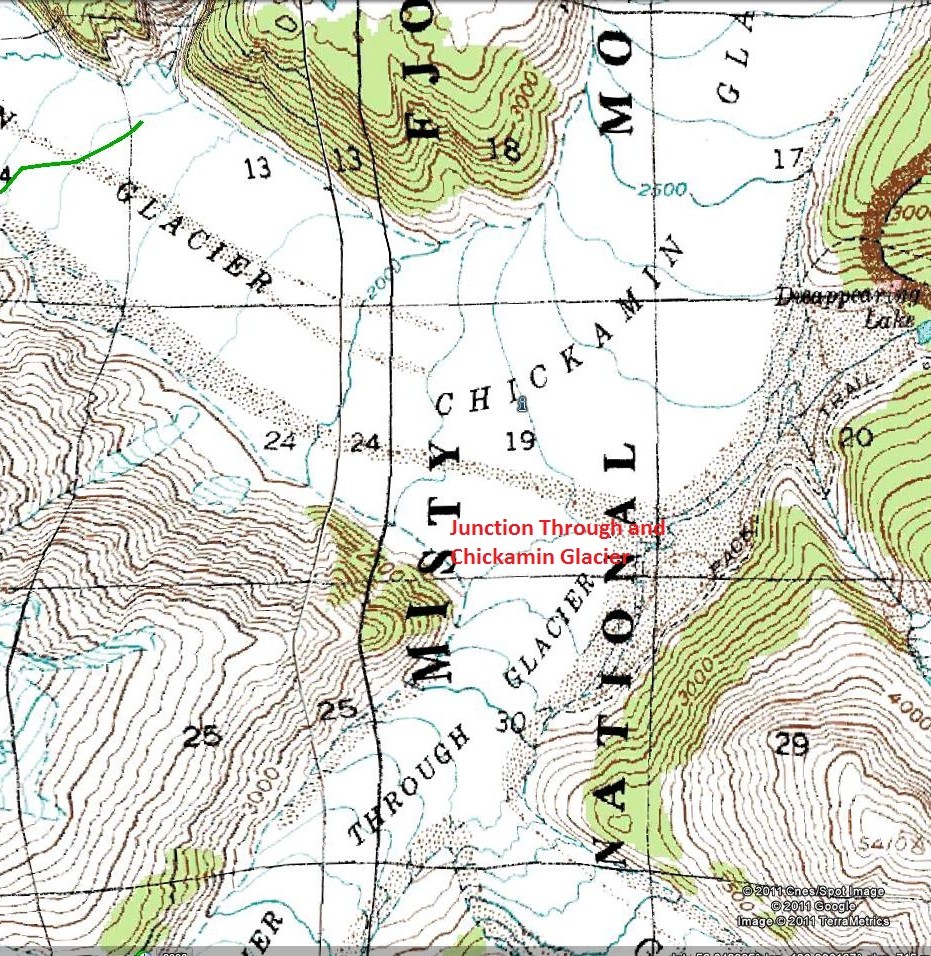 Shortly thereafter a lake began to form, and by 1979 a Landsat image indicates a lake that is 1300 meters long. A this point the Through Glacier is just barely in contact with Chickamin Glacier.
 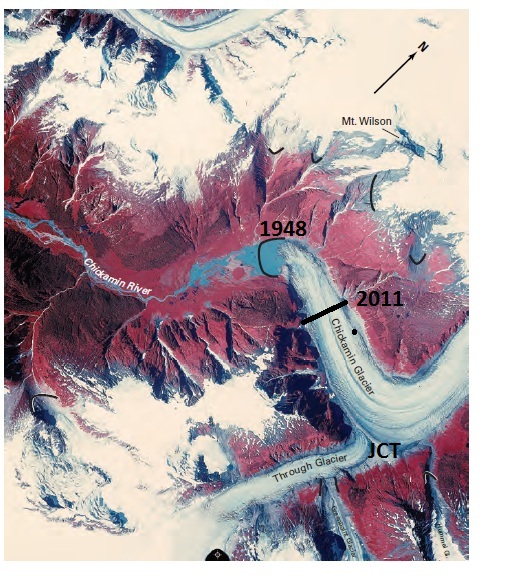 . By 2004 in an Ikonos image the glacier has retreated 1400 meters from the 1979 position, top image. This image is from the USGS and has been further annotated. In a 2009 Geoeye image the glacier has receded an additional 300 meters, 3000 meters since 1955.
 Just as impressive is the retreat of Through Glacier that now terminates 1500 meters from its former Junction with Chickamin Glacier. This separation and retreat has occurred during a period of higher snowlines in the region. The snowline of the glacier has averaged 1200 meters in recent years, 100 meters higher than before, and the summit of the glacier is at 2000 meters. The retreat and thinning of this glacier follow that of Sawyer Glacier, Gilkey Glacier and Lemon Creek Glacier
 . The current terminus region indicates considerable rifting in the lower 500 meters indicating this will be rapidly lost, note the red arrow. The blue arrow indicates a zone below which the glacier appears stagnant with no active crevasse features. The green arrow indicates the transition to a zone of active flow and crevassing. At meters kilometers above the terminus a basin has developed, orange arrow, this is filled periodically becoming a lake, which then drains beneath this glacier. This lake and basin will continue to expand.

Grand Plateau Glacier Retreat, Alaska
Grand Plateau Glacier drains southwest from Mount Fairweather in southeast Alaska. The glacier advanced during the Little Ice age to the Alaskan coastline. Early maps from 1908 show no lake at the terminus of the glacier. The 1948 map shows three small distinct lakes at the terminus of the main glacier and a just developing lake at the terminus of the southern distributary terminus (D). By 1966 the glacier had retreated enough for the formation of one lake. The distance from the Nunatak N to the terminus was 12 km in 1948. The lake at D is 400 m wide.

USGS map displayed in Google Earth-1948 base images.
Landsat images from 1984, a Google Earth Mosaic of the 2003-2009 period and a Landsat image from 2013 indicate the substantial changes that have occurred. Here both the main terminus and a distributary (D) terminus draining south are examined. The main reference points in each image are the Nunatak, N, and and Island, I. The retreat from 1984-2013 is evident with the yellow arrows indicating the 1984 terminus and pink arrows showing the 2013 terminus location. The distance from the Nunatak to the terminus is 9.6 km in 1984, 6.8 km in the Google Earth image and 3.5 km in 2013. A six kilometer retreat at the glacier center in 30 years. On the north shore of the lake the retreat between arrows is 2.7 km from 1984-2013. From the island the glacier retreated 3.3 km from 1984-2013. The distributary tongue (D) retreated 2.2 km from 1984-2013. The offset of the terminus is 300-350 m indicating a five year retreat rate of 75-90 meters per year. The retreat has been driven by higher snowlines in recent years, the snowline had been reported at 3400 feet in the 1950’s. Satellite imagery of the last decade indicates snowlines averaging 1500 m, red arrows. The glacier snowline is evident in Landsat imagery in 2009 and 2013 red arrows. The combination of higher snowlines and increased calving into the terminus lake will continue to lead to retreat of this still mighty river of ice. This retreat parallels that of nearby Yakutat Glacier, Norris Glacier and Melbern Glacier

1984 Landsat image

2013 Landsat image

Google Earth images
 From a Glaciers Perspective