Scott Glacier, Alberta Retreat 1987-2019

Scott Glacier, Alberta in 1987 and 2019 Landsat images. Yellow arrow indicates the 2019 terminus location and Point A and B are areas of bedrock expansion amidst the glacier.

Scott Glacier is the largest outlet glacier of the Hooker Icefield the drains into the Whirpool River and then the Athabasca River.  The icefield straddles the BC/Alberta border. Jiskoot et al (2009) examined the behavior of the Clemenceau-Chaba Icefield, 25 km south finding that from the mid 1980’s to 2001 the Clemenceau Icefield glaciers lost 42 square kilometers, or 14% of their area. On Columbia Icefield 60 km to the southeast Tennant and Menounos (2013) found that from 1919-2009 glaciers had a mean retreat of 1150 m and mean thinning of 49 m for glaciers, with the fastest rate of loss from  2000-2009.

The Scott Glacier in 1987 had terminated at 1500 m, within 300 m of an alpine lake.  At Point A there is a convex aspect to the glacier as it passes over a subglacial knob.  The snowline is near this knob at 2200 m.  In 1998 there is limited retreat of the main terminus and Point A is still beneath the ice. The snowline is just above Point A at 2250 m. In 2014 the glacier has retreated to the base of a step at ~1800 m.  The snowline is well above Point A at 2450 m.  In 2019 the terminus has retreated 750 m since 1987.  Point A has emerged as a bedrock knob at the glacier surface.  At Point B a rock rib has widened since 1987 and extends further into the heart of the glacier. The snowline in 2019 is at 2400 m at the end of July.

Scott Glacier’s retreat is less extensive than other nearby glaciers such as Chaba Glacier ,  Cummins Glacier and  Columbia Glacier.

Scott Glacier, Alberta in 1998 and 2014 Landsat images. Yellow arrow indicates the 2019 terminus location and Point A and B are areas of bedrock expansion amidst the glacier.

Scott Glacier map indicating the glacier margins in the 1990’s.
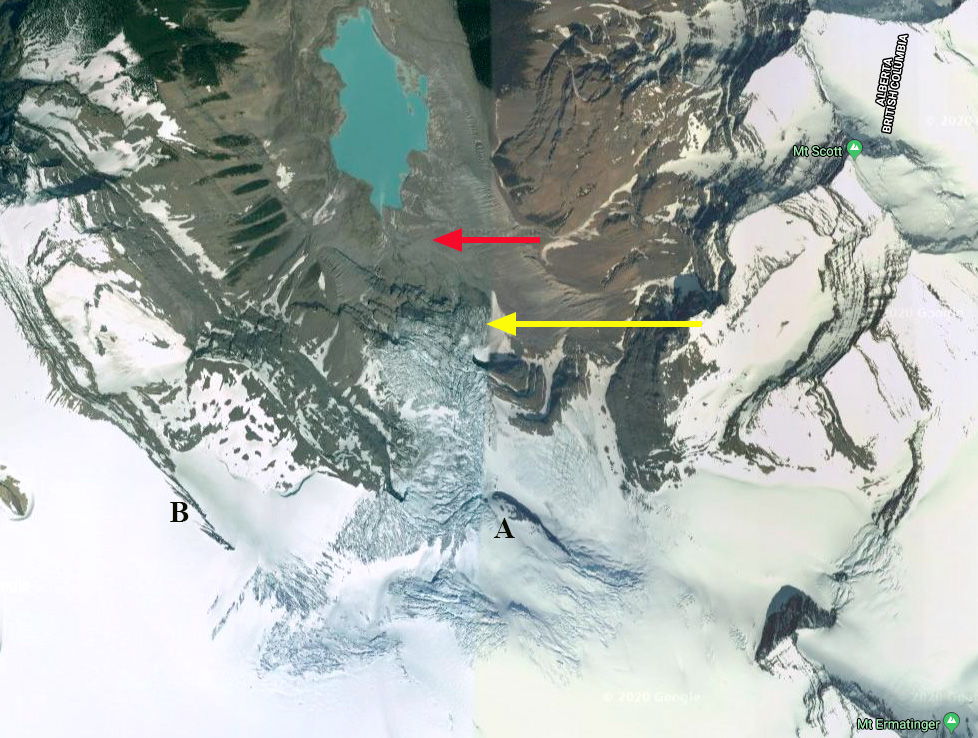
 

Scott Glacier Digital Globe image indicating 1987 terminus location (red arrow) and 2019 terminus location yellow arrow. Point A is where bedrock is emerging and Point B is where the bedrock ridge is extending across glacier. Both Point A and B indicate bedrock steps that the glacier steepens as it flows over. The glacier remains crevassed to the front indicating no stagnant zone.


Conway Glacier Separation and Retreat, Alberta

Conway Glacier drains east from the border with British Columbia into the Howse River. The Howse River joins the Saskatchewan River upstream of the Bighorn Hydropower project, which impounds Lake Abraham and produces 120 MW of power. The map of this area was updated based on 1990 images which indicate Conway Glacier is comprised of two lobes that join near the terminus.   An inventory of glaciers in the Canadian Rockies indicate area loss of 15% from 1985 to 2005 (Bolch et al, 2010).  The more famous Columbia Icefield, 50 km north, has lost 23 % of its area from 1919-2009 with ice loss at a minimum during the 1970′s (Tennant and Menounos, 2013)Here we examine Landsat imagery from 1986 to 2014 to see the impact of recent climate change.

conway glacier map

Map of Conway Glacier area from 1990 image.

In 1986 the two glaciers are still joined, with a surface lateral moraine at their junction, orange dots indicate this narrow surface rock band eroded from the ridge between the two lobes. The yellow arrow in each image indicates the 1986 terminus location of the northern lobe, the red arrow indicates a bedrock step near the southern lobe terminus, green arrow indicates an ice filled basin, and the purple arrow a small tributary joining the main glacier.  In 1986 the southern lobe extends 300 meters beyond the bedrock step.  By 1994 a small lake is developing at the basin indicated by the green arrow and the northern lobe is reduced in width.  Overall less than 40% of the glacier is snowcovered.  By 1998 the southern lobe has retreated to the bedrock step and the northern lobe has retreated from the end of the lateral moraine.  The glacier again is less than 40% snowcovered.  The 2013 image has better resolution thanks to the better Landsat 8 imagery, and has been sharpened using a higher resolution panchromatic image layer by Ben Pelto (Technique will be explained in a future post).  The glaciers are no longer joined.  The northern lobe has retreated 500-550 m since 1986 and a small lake has formed at the 1986 terminus location, another yellow arrow indicates 2013 terminus.  The northern lobe has retreated above the bedrock step, a total retreat of 500-600 m since 1986.  Two additional red arrows have been added to indicate 1986 and 2013 terminus location.  The small lake at the green arrow has expanded.  The tributary connection at the purple arrow is nearly severed.   Retained snowpack on the glacier is also limited in area with most of the glacier in 2013 being bare glacier ice. This indicates that snow was not retained in recent previous years either.  For a glacier to be in equilibrium it needs more than 50% of its area to be covered by snow at the end of the melt season, not  35% with a few weeks left in the melt season. as in 2013. This glaciers retreat and volume loss mirrors that of the region including Saskatchewan Glacier and Fraser Glacier.   Peyto Glacier is the nearest glacier, just 20 km southeast, with a long term mass balance record, which indicates a cumulative loss or over 28 m w.e or 30 m of glacier thickness.

conway glacier 1986a

1986 Landsat image

conway glacier 1994

1994 Landsat image

conway glacier 1998

1998 Landsat Image

Red Channel|Green Channel|Blue Channel 2013 Landsat image-Pan sharpened by Ben Pelto (Univ. Northern British Columbia)