
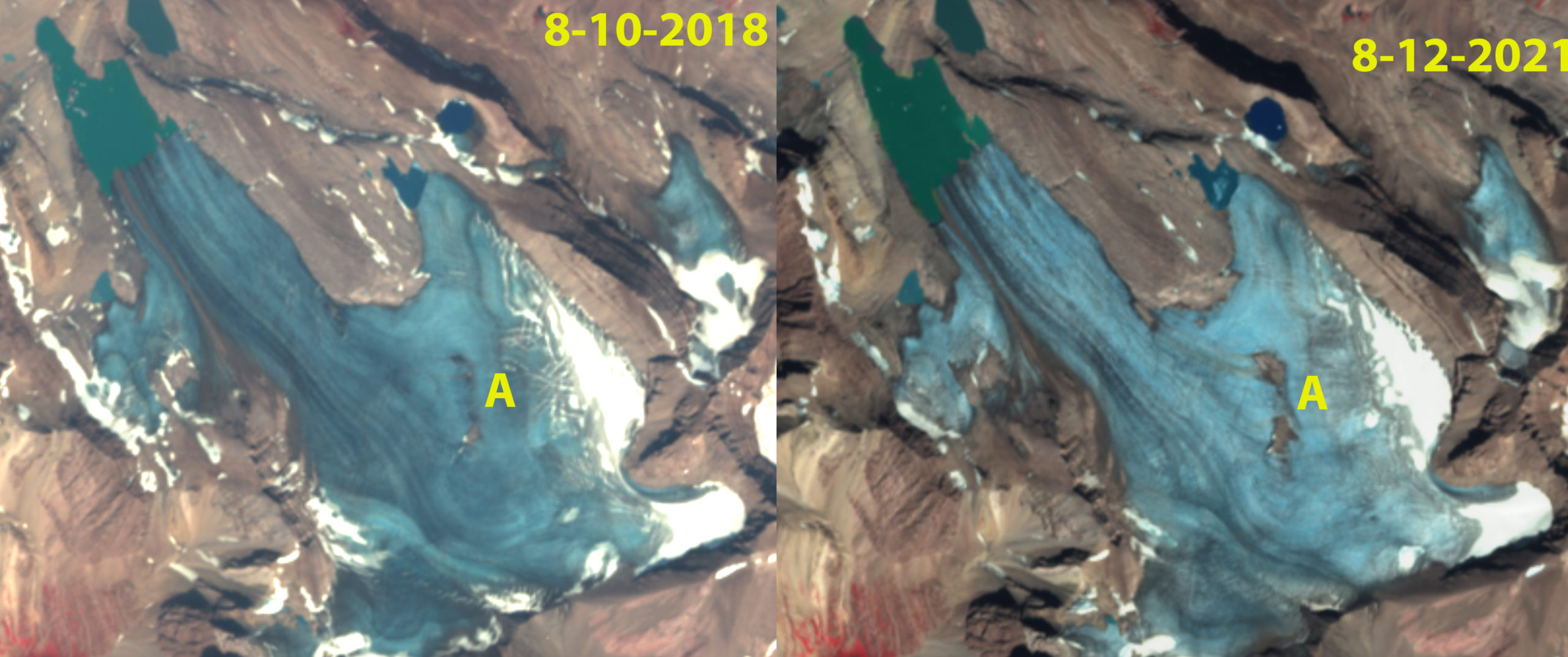
Bonnet Glacier in Sentinel 2 images indicating the emergence of bedrock due to thinning in the former accumulation zone, Point A. Note the lack of retained snowcover in both years with at least a month left in the melt season.
Bonnet Glacier, Alberta drains north from Bonnet Peak in the Sawback Range 30 km east of the Rocky Mountain Crest. It is at the headwaters of Douglas Creek that feeds into the Red Deer River. In 2017 we reported on the formation of new alpine lakes and the 900 m retreat of the glacier, 20% of its length, from 1987-2016 (Pelto, 2017). Here we examine changes from 1987-2021, including developments in the accumulation zone that provide a future forecast. An inventory 0f glaciers in the Canadian Rockies indicated area loss of 15% from 1985 to 2005 (Bolch et al, 2010), with Alberta glaciers losing area at a higher rate. Tennant et al (2012) noted that from 1919-2006 the glaciers in the central and southern Canadian Rocky Mountains lost 40% of their area. Of the 523 glaciers they observed 17 disappeared and 124 separated. Columbia Icefield, 125km northwest, lost 23 % of its area from 1919-2009 (Tennant and Menounos, 2013).
In 1987 and 1990 the accumulation zone is limited to upper periphery of Bonnet Glacier. In 2015 and 2016 the accumulation zone is restricted to the northeastern periphery. This is indicative of a glacier without a significant persistent accumulation zone. The consistent mass loss is driving the retreat and glacier thinning. In 2018 in the midst of what had been the accumulation zone a small area of bedrock has emerged at Point A. By 2021 this area has expanded substantially with the two bedrock areas poised to merge soon. This thinning in the midst of the former accumulation zone is indicative of a glacier that cannot survive (Pelto, 2010). In 2015, 2018 and 2021 the accumulation area ratio was between 10-15%, a value that typically results in glacier annual mass balance of more than -2 m. The area of main proglacial expanded 50% from 2016 to 2021 to 0.33 square kilometers.
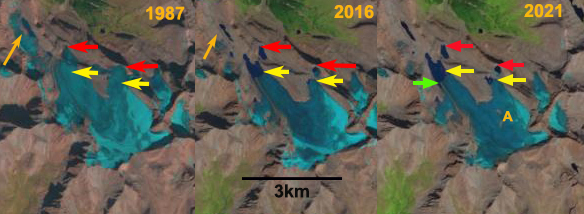
Bonnet Glacier in Landsat images from 1987, 2016 and 2021 indicating retreat. Red arrows indicate 1987 margin, yellow arrows 2016 and the green arrow 2021. Point A indicates the emerging bedrock.

Bonnet Glacier in Landsat images from 1990, 2015 and 2021 indicating retreat. Purple arrows indicate lakes that have formed due to retreat. Point A indicates the emerging bedrock.


 From a Glaciers Perspective