Safuna & Arhuey Glacier, Peru Retreat from Lakes

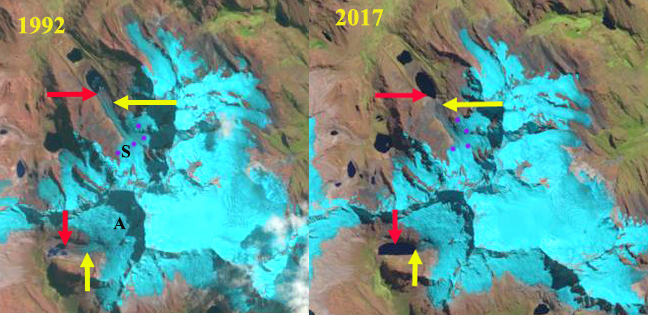
Safuna Glacier (S) and Arhuey Glacier (A) in 1992 and 2017 Landsat images indicating glacier retreat from the 1992 terminus red arrow to the 2017 terminus position yellow arrow.  Snowline indicated by purple dots.

Safuna Glacier (S) is at the northern end of the Cordillera Blanca Range, Peru flowing north from Nevados Pucajirca.  Arhuey Glacier (A) is adjacent to Safuna and flows west formerly terminating in Arhuey Lagunacocha impounded by a moraine. Safuna Glacier in 1992 terminated in Laguna Safuna Alta, which is impounded by a moraine dam and has a history of water level fluctuations.   Reynolds Geosciences (2003) provides a detailed look at the lake, moraine and associated engineering.  The moraine appeared unstable in the 1960’s prompting excavation of  a tunnel through the moraine in 1970, which ended up below the lake water level after the lake surface elevation dropped 25 m in late 1970.  In 1978 a second tunnel was constructed, that to date remains above the lake waterline and has not been used.  The Peruvian Government was early in their proactive engineering to address glacier lake outburst flood hazards (Carey, 2008). In 2002, a rockslide created a wave of at least 80 meters in height (Reynolds Geosciences , 2003), overtopping the moraine and damaging both tunnels but not damaging the moraine.  This landslide also filled in the lake reducing depth significantly. Here we examine changes  from 1992 to 2017 using Landsat imagery from July of Safuna Glacier (S) and Arhuey Glacier (A). Though glacier outburst floods have capture more attention it is the overall reduction in glacier water runoff that has more impact on local communities (GlacierHub-Angle, 2017).

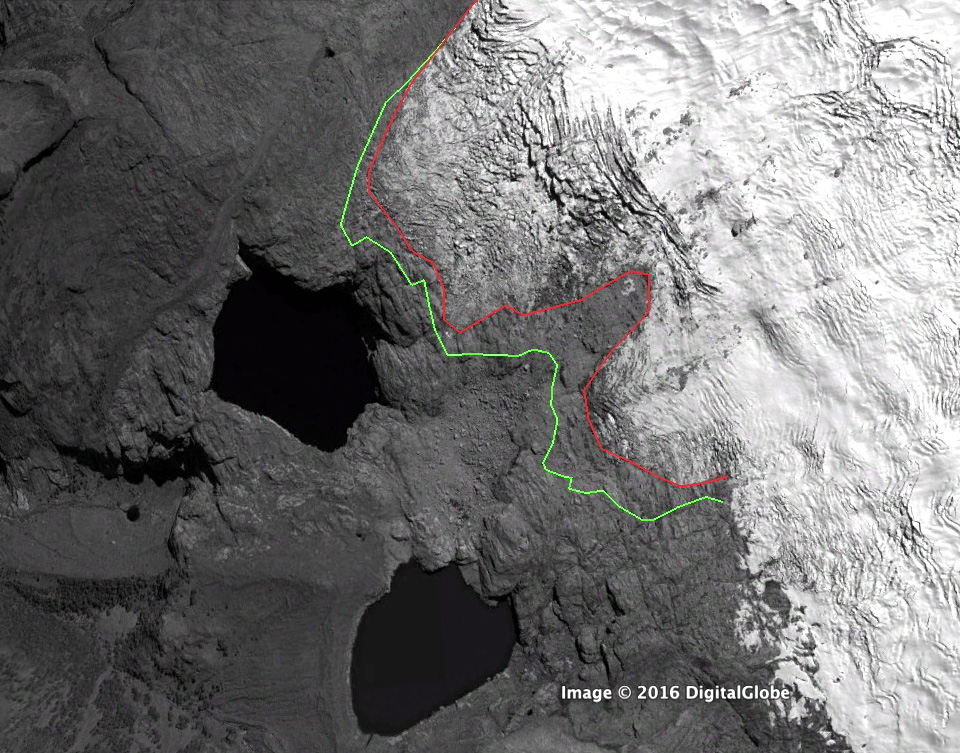
In 1992 the glacier terminated in the 800 m long Laguna Safuan Alta, red arrow .  The lower glacier featured a long narrow valley tongue extending into the lake.  By 1995 retreat had led to further lake expansion, with the glacier still reaching the lake across a narrower front.  In 1996 as was the case in 1992 and 1995 the snowline on the glacier is above the main icefall area where the valley tongue descends from the accumulation zone, purple dots at an elevation of 4950 m. By 2015 the glacier had receded from the shore of the lake and the terminus is covered in debris from the 2002 landslide.  In 2015 and 2016 the snowline is higher than in the 1990  at 5100 m.  In 2017 the glacier terminates 200 m from the lake shore and 500 m from the 1992 terminus location.  The lake is now 1100 m long. The glacier no longer can easily release ice avalanches into the lake

The retreat of this glacier mirrors that of Arhuey Glacier (A), which terminated in the newly forming Arhuey Lagunacocha. By 1995 and 1996 the terminus tongue is more distinct and the lake is 400-500 m long.  By 2015 and 2016 the glacier has retreated to the far end of the lake basin, though still in contact with the lake  By 2017 the lake is 1150 m long, indicating a 700 m retreat since 1992.  The upper portion of the glacier remains incredibly crevassed indicate vigorous accumulation and motion.  The glacier has a relatively small ablation zone with the loss of the flatter terminus reach, and should have a reduced rate of retreat.  The glacier now has a reduced but still significant ability to release ice avalanches into the lake.  The glacier fits into the  Cordillera Blanca regional pattern which has experienced a 22% glacier loss from 1970-2003 (Racoviteanu et al, 2008).

Emmer et al (2016) note that the number of GLOF’s were greater from moraine dammed lakes in the region early in the retreat phase in the 1940’s and 1050’s.  This suggest the moraines are becoming more stable with time since formation and glacier retreat.  The broader impact of climate change is examined by the GlacierHub (Marconi, 2016). 
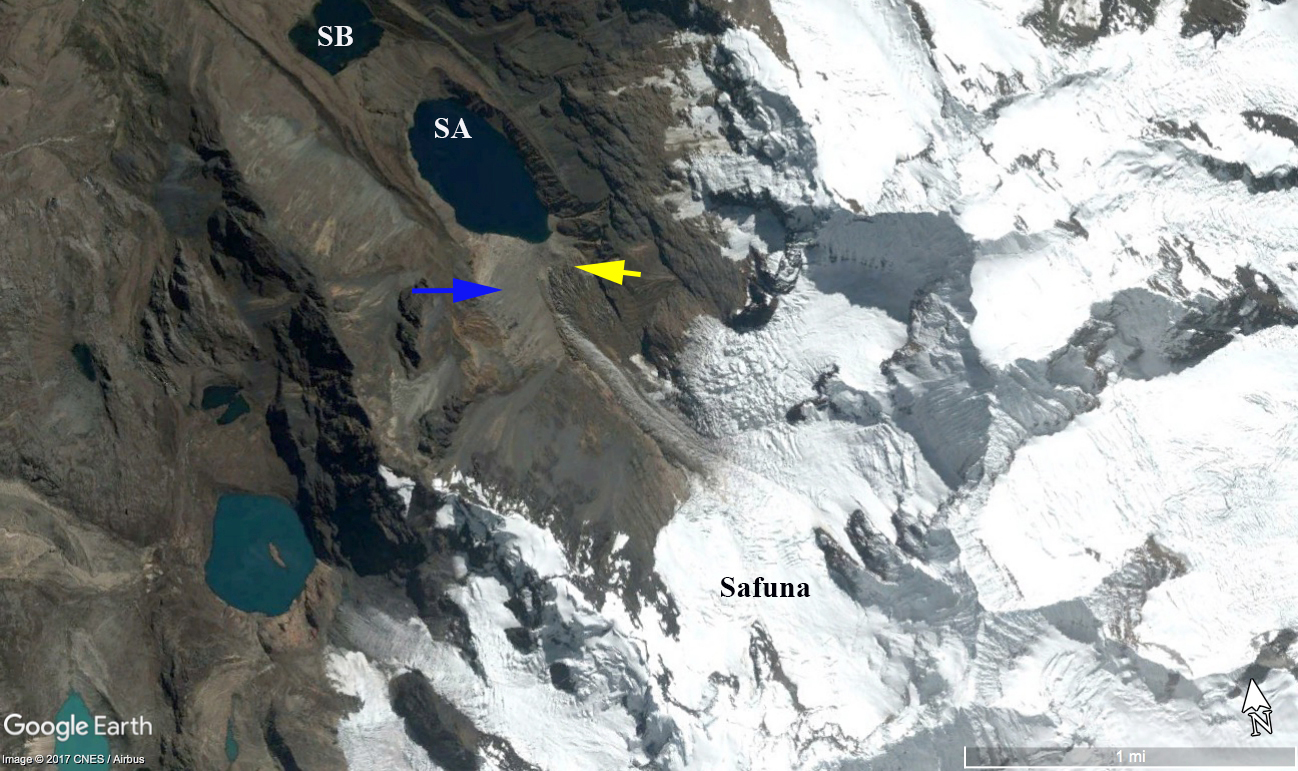

Safuna Glacier, Laguna Safuna Alta and Laguna Safuna Baja (SB), blue arrow recent 2002 landslide scar and yellow arrow 2017 terminus.
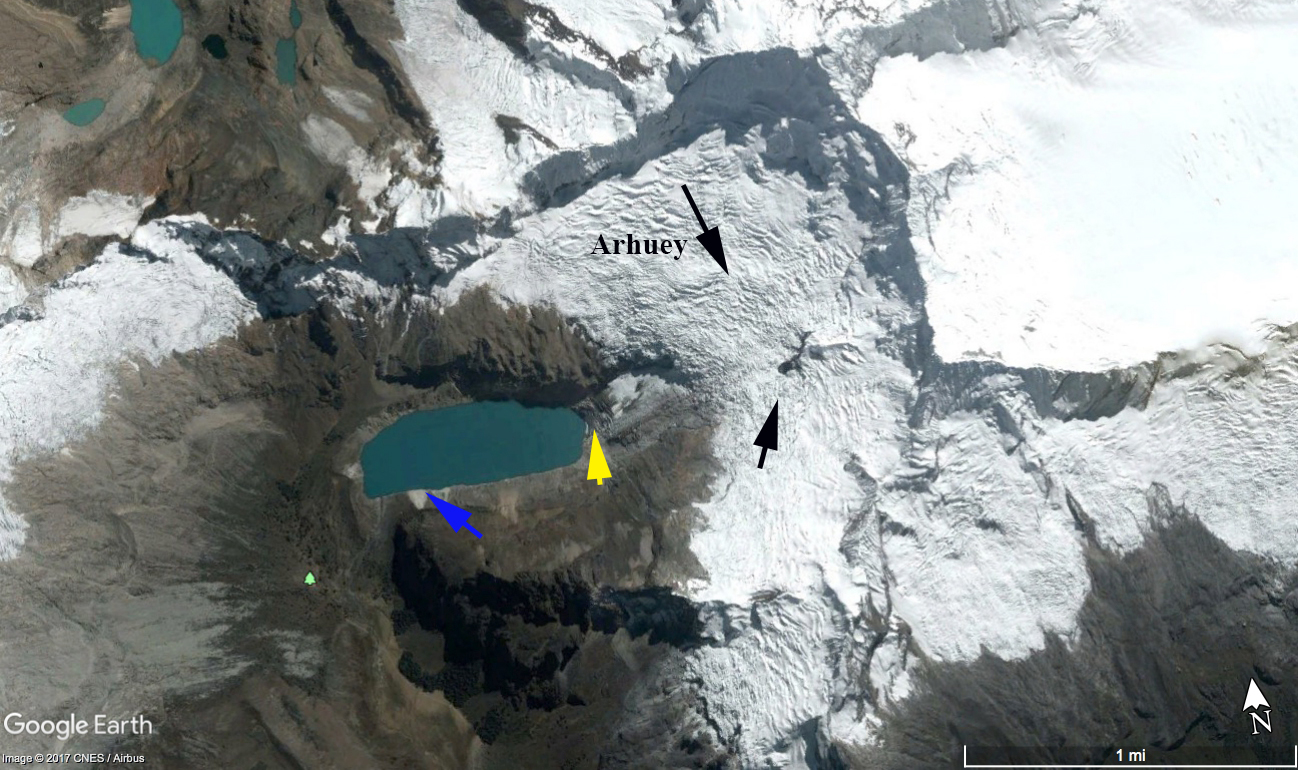

Arhuey Glacier and Arhuey Lagunacocha. Black arrows indicate heavy crevassing, blue arrow recent landslide scars and yellow arrow 2017 terminus.

Safuna Glacier (S) and Arhuey Glacier in 1995 and 2015 Landsat images indicating glacier retreat from the 1992 terminus red arrow to the 2017 terminus position yellow arrow.  Snowline indicated by purple dots.
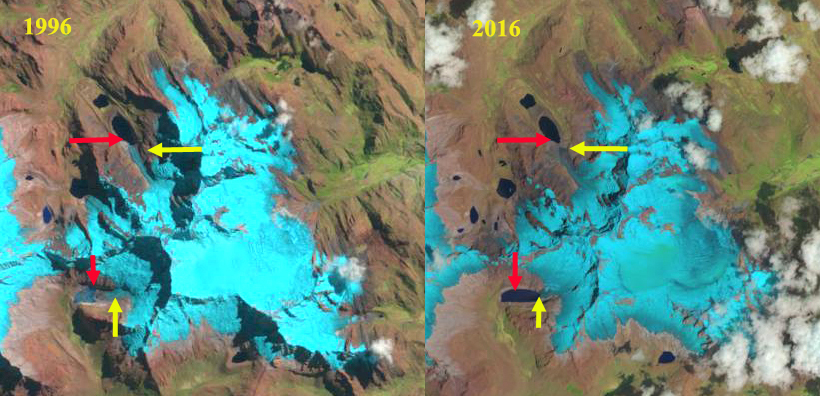
Safuna Glacier (S) and Arhuey Glacier in 1996 and 2016 Landsat images indicating glacier retreat from the 1992 terminus red arrow to the 2017 terminus position yellow arrow.  Snowline indicated by purple dots.  

Vallunaraju Glacier Retreat, Peru 1992-2016

Vallunaraju Glacier comparison in Landsat images from 1992, 1995 and 2016.  Red dots represent the 1992 margin and yellow dots the 2016 margin

The Cordillera Blanca, Peru has 27 peaks over 6,000m, over 600 glaciers and is the highest tropical mountain range in the world. Glaciers are a key water resource from May-September in the region (Carey, 2010).  Mark Carey describes the importance of glacier runoff to the Andean society in this region in his book”In the Shadow of Melting Glaciers: Climate Change and Andean Society“.  The loss of snow and consequent impacts is also beautifull illustrated by Ben Orlove and others in the book “Darkening Peaks : Glacier Retreat Sciecne and Society”. The glaciers in this range have been retreating extensively from 1970-2003, GLIMS identified a 22% reduction in glacier volume in the Cordillera Blanca. Vuille (2008) noted that the mean retreat rate has increased from 7-9 meters per year in the 1970’s to 20 meters per year since 1990. One of the glaciers that is receding  is Vallunaraju Glacier descending the west slopes of Vallunaraju. This glacier drains into the Rio Santa in Huarez, Peru. Baraer et al  (2012) notes the importance of glaciers to the Cordillera Blanca watersheds in the Huarez region, which receive at least 30% of their runoff from glaciers.  Rio Santa is undergoing a decline in dry-season flow that likely began in the 1970s and given the weak correlation between discharge and precipitation suggests the trend is driven by the glacier retreat. Bury et al (2013) examined glacier recession in the Cordillera Blanca, declining Santa River discharge, and alpine wetland contraction noting that water shortages already exist in the basin. Fraser (2012) reporting on recent NSF research project examining water from interdisciplinary perspectives throughout Peru’s Santa River watershed—from Cordillera Blanca glaciers to the Pacific Ocean.  That included Mark Carey, University of Oregon, Bryan Mark at Ohio State University, Jeffrey Bury at UC Santa Cruz,  Kenneth Young at the University Texas, Austin, and  Jeff McKenzie at McGill University.

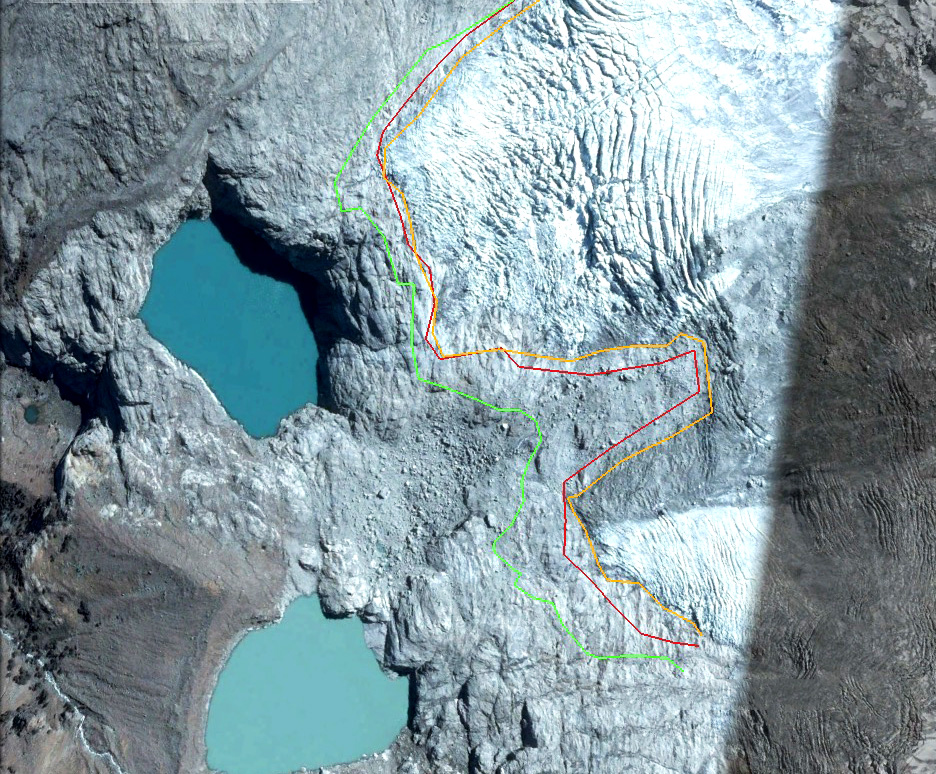
In 1992 Vallunaraju Glacier extended to the cliffs immediately above the northern of two alpine lake adjacent to the glacier and within 400 m of the southern alpine lake, red dots in Landsat above.  By 2003 the glacier seen in Google Earth imagery had retreated from cliff top above the northern lake.  By 2011 the glacier had retreated 100-200 meters across the entire glacier front since 2003.  An area of bedrock between two terminus lobes had also begun to expand rapidly. This expansion continued up to 2016.  The retreat of the glacier from 2003-2016 averaged 180 m across the glacier front.  Retreat from 1992-2016 ranged from 200-300 m.  The glacier remains heavily crevassed indicating significant glacier flow resulting from substantial annual accumulation.  In every Landsat image analyzed there is a significant snowcovered area. The glacier though receding maintains a significant accumulation zone and can survive current climate.  The glacier is adjacent to the retreating Llaca Glacier.

2003 Google Earth image of Vallunaraju Glacier. Green line is the 2003 margin and red line the 2013 margin.
2011 Google Earth image of Vallunaraju Glacier. Green line is the 2003 margin and red line the 2013 margin.
2013 Google Earth image of Vallunaraju Glacier. Green line is the 2003 margin and red line the 2013 margin.
2016 Google Earth image of Vallunaraju Glacier. Green line is the 2003 margin and red line the 2013 margin. and orange line is the 2016 margin

Zongo Glacier retreat

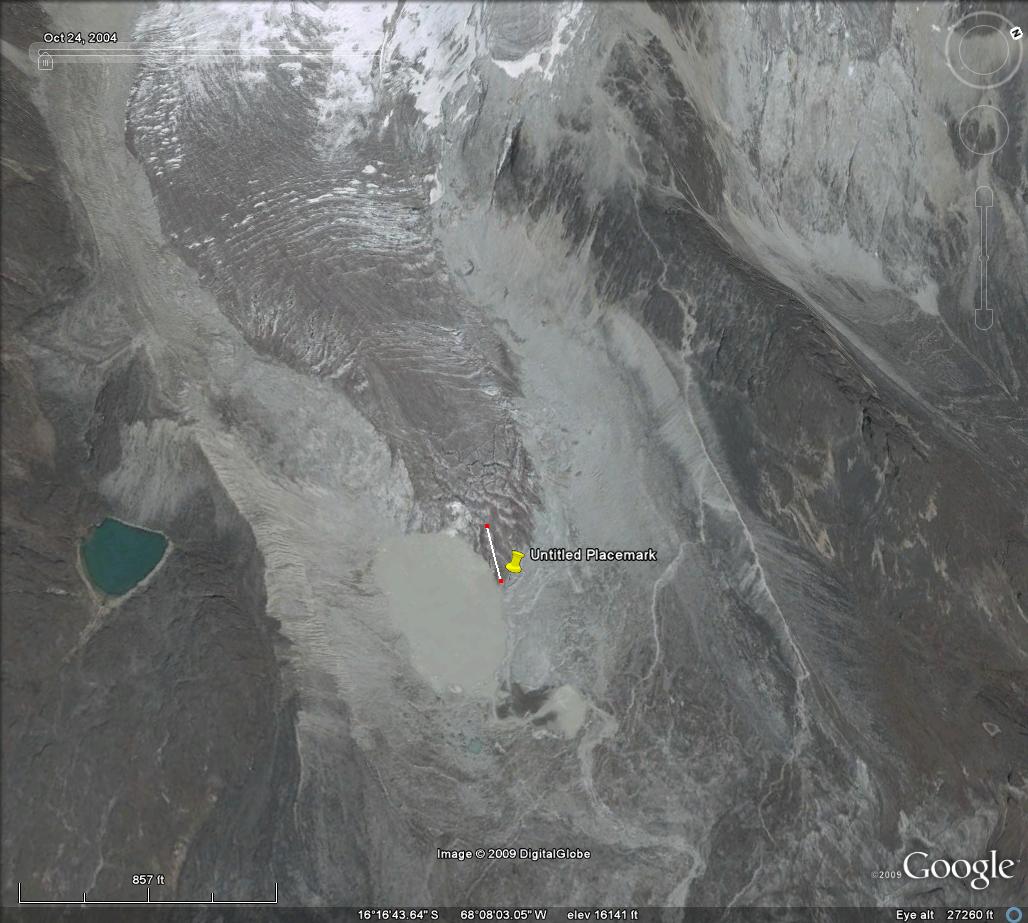
Zongo Glacier, Bolivia extends 2.9 km down the south side of Huayna Potosi from 6000 m to 4900 m. Zongo Glacier is a small valley glacier located north-east of La Paz, and its runoff is directed to an important hydraulic power station which supplies La Paz. Note Laguna Zongo in foreground of the first image. The dam is visible as is the power station to the right and below the lake. The glacier has considerable snowcover on its upper section and crevassing. This indicates a persistent accumulation zone. In 1991 a glaciological research program (page 46) was established on Zongo Glacier to monitor mass balance, understand its hydrology and energy balance. The long term director of this research Bernard Francou has been called the glacier guardian. The typical Alpine glaciers undergoes a long accumulation period in winter and a short ablation season in summer. The glaciers of the tropical Andes experience snow accumulation during the wet season, austral summer on their upper regions and maximum ablation during the same season low on the glacier. In the dry season winter there is a period of low ablation over the whole glacier. Mean annual air temperature at the long term snowline at 5250 m is -1.5 °C. Mean precipitation is about 0.9 m/year.

Since 1991 the glacier has lost more than 5 m of thickness and has retreated significantly. The mass balance loss has been most pronounced during El Nino periods, thus 2009 should not be a good year for Zongo Glacier. La Nina’s are associated with positive or only slightly negative mass balance. The ongoing mass balance loss has led to retreat of 184 meters of this glacier from 1996-2005. A comparison of satellite images from 2004-2008 indicate a retreat of 70-75 meters, this is consistent with the reported retreat rate of 18 meters per year. The glacier has withdrawn from the new glacier lake formed from the ongoing glacier retreat in the 1990’s. The images below are focussed on the terminus in 2004 and in 2008, note the retreat from the lake shore.

Zongo Glacier continues to have an accumulation zone, a necessary essential for glacier survival, and unlike the nearby Chacaltaya Glacier which has disappeared in 2009, it will exist for sometime. The Chacaltaya Glacier is a small glacier, like 80% of the glaciers in this region of the Cordillera Real, and its disappearance puts more pressure on the water resources provided by the larger remaining glaciers such as Zongo Glacier.