Coley Glacier and Sjögren Glacier, Antarctic Peninsula Exhibit Rapid Melt Feb. 2020

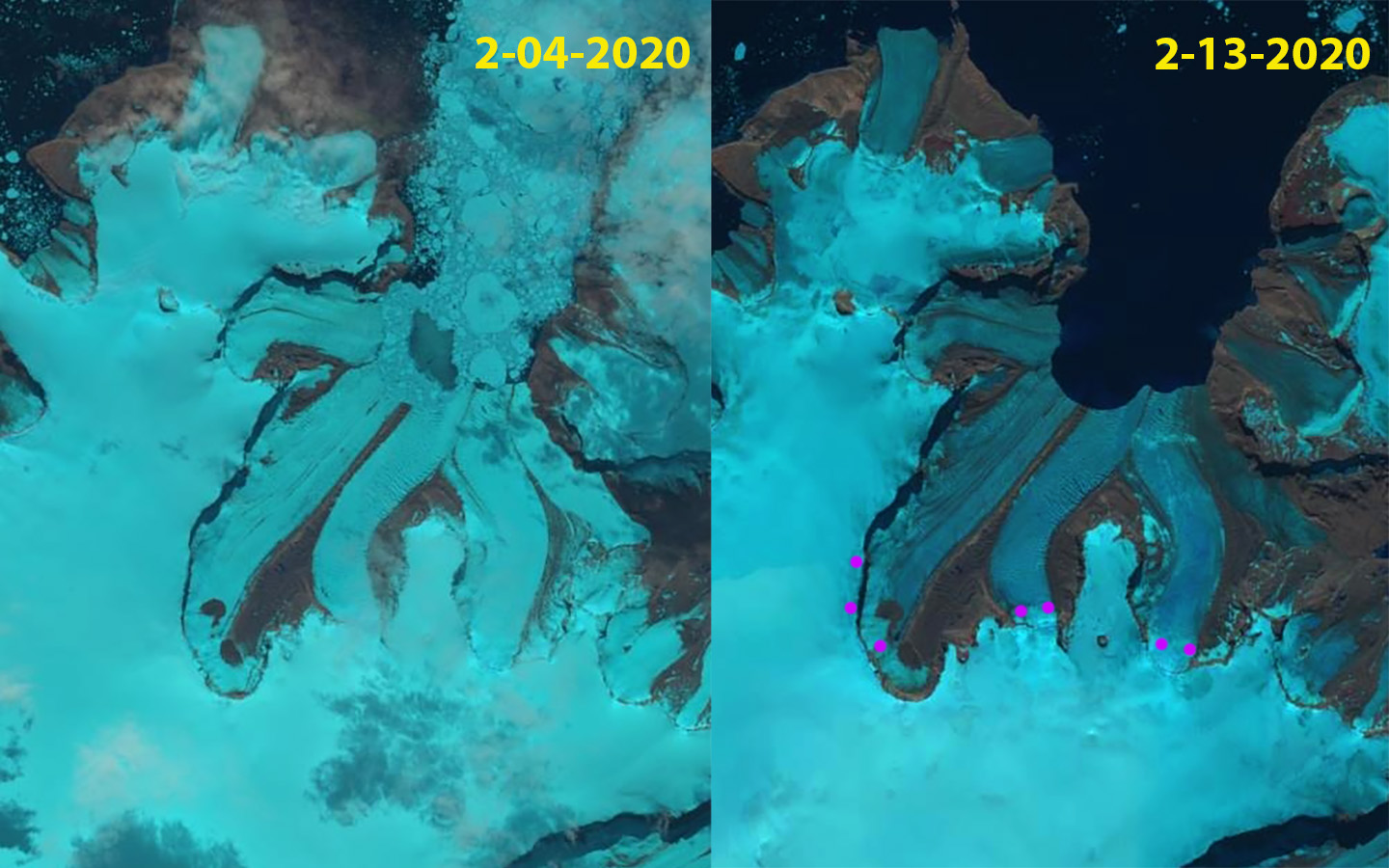
Coley Glacier in Landsat images from Feb. 4, 2020 and Feb. 13, 2020. Magenta dots indicate the snowline

The impact of a period of record warm weather over the Antarctic Peninsula during February 2020 was rapid development of melt features and expansion of melt area on many glaciers near the tip of the Peninsula, where the temperature records were set at Esperenza and Marambio Base. Here we examine Landsat imagery at Coley Glacier on James Ross Island and Sjögren Glacier to identify surface melt extent and surface melt feature development (see map below). Coley Glacier is 30 km west and Sjögren Glacier 120 km west of Marambio Base respectively. Xavier Fettweis, University of Liege Belgium, used the MAR climate model output forced by the Global Forecast System (GFS) to generate daily melt maps for Antarctica, for Esperanza the melt map indicates that daily melt increased to above 30 mm/day on Feb. 6, with a maximum temperature on the warmest day of 18.3 C (65 F). The impact was noted at Eagle Island Ice Cap and  Boydell Glacier where melt ponds and melt saturated snowpack quickly developed. On Eagle Island Ice Cap melt averaged 22 mm/day ffrom Feb 6-Feb 11(Xavier Fettweis, 2020).

Coley Glacier retreated ~1.5 km from 2001-2015.  On Feb. 4 snowcover extends to the terminus of the glacier, this is a thin snowpack resulting from a recent summer snow event.  The bay is also largely filled with sea ice.  Nine days late on Feb. 13 the bay is free of sea ice and the snowline has rise to 400 m, at the base or just on top of the escarpment.  The loss of snow and sea ice in just nine days is a remarkable melt rate for Antarctica. On March 7 2020 the snowline is also at 400 m and melt plumes are evident at the glacier front indicating ongoing melt conditions.

Coley Glacier in March 7, 2020 viewed in the Antarctic REMA Explorer

Sjögren Glacier retreated 10-11 km from 2001-2016. On Sjögren Glacier on Feb. 11 the snowline is at 500 m, compared to ~200 m on January 12, having shifted 8 km upglacier. The false color Landsat image, deep blue coloration below the snowline indicates the presence of meltwater at the surface. Melt plumes are evident at the glacier front, yellow arrows.  The snowline is still at 500 m on March 7, with meltwater plumes indicating that significant meltwater is still exiting the glacier. The lower 15 km of the glacier was in the ablation zone for an extended period during the Antarctic summer of 2020.

The above examples added to those at Eagle Island Ice Cap and  Boydell Glacier illustrate the extent of the melt event.
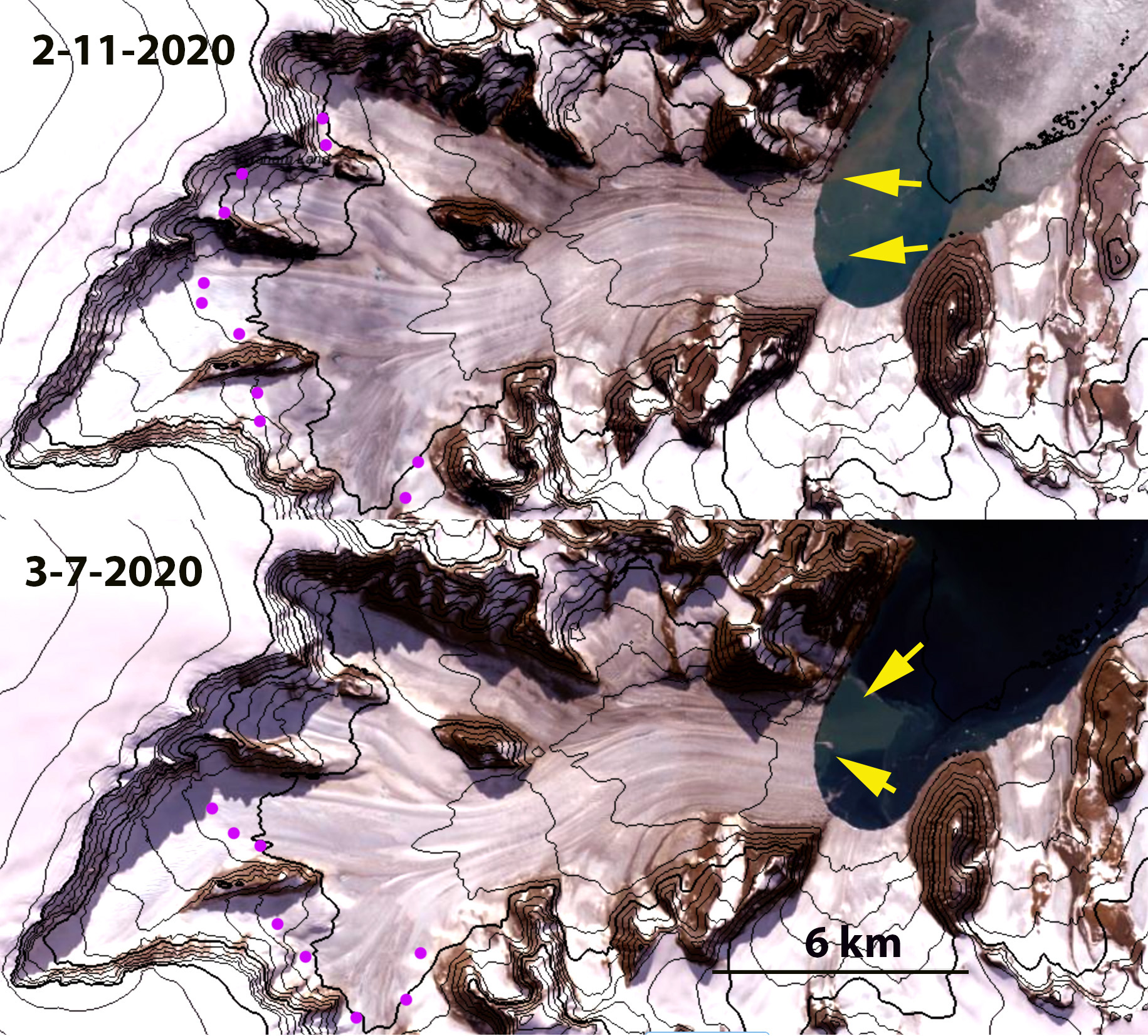
Sjögren Glacier in Landsat images above from Feb. 11, 2020 and below from March 7, 2020 viewed in the Antarctic REMA Explorer.  Yellow arrows indicated meltwater plumes and magenta dots the snowline. Contours are at 100 m intervals.
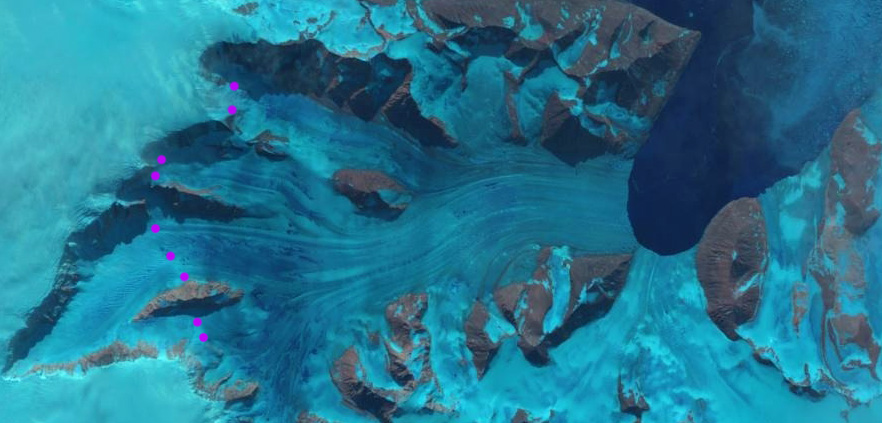
Sjögren Glacier in Feb. 11, 2020 Landsat image indicating snowline with magenta dots.  The areas with significant surface meltwater have a deep blue color.
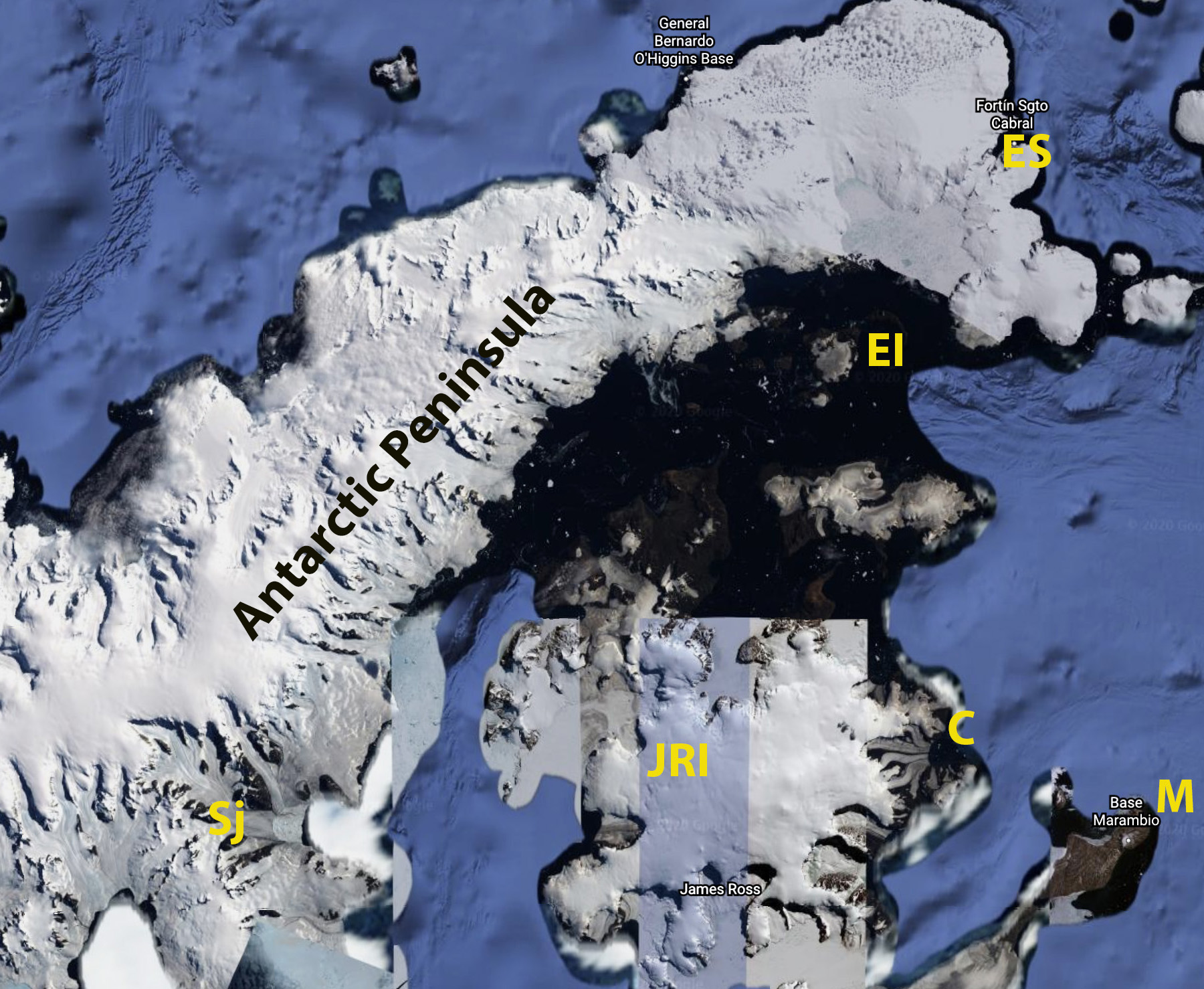
Base map for region indicating Esperanza Base=ES, Marambio=M, James Ross Island=JRI, Coley Glacier=C, Sjogren=Sj and Eagle Island=EI

Boydell Glacier, Antarctica Rapid Retreat 2001-2017

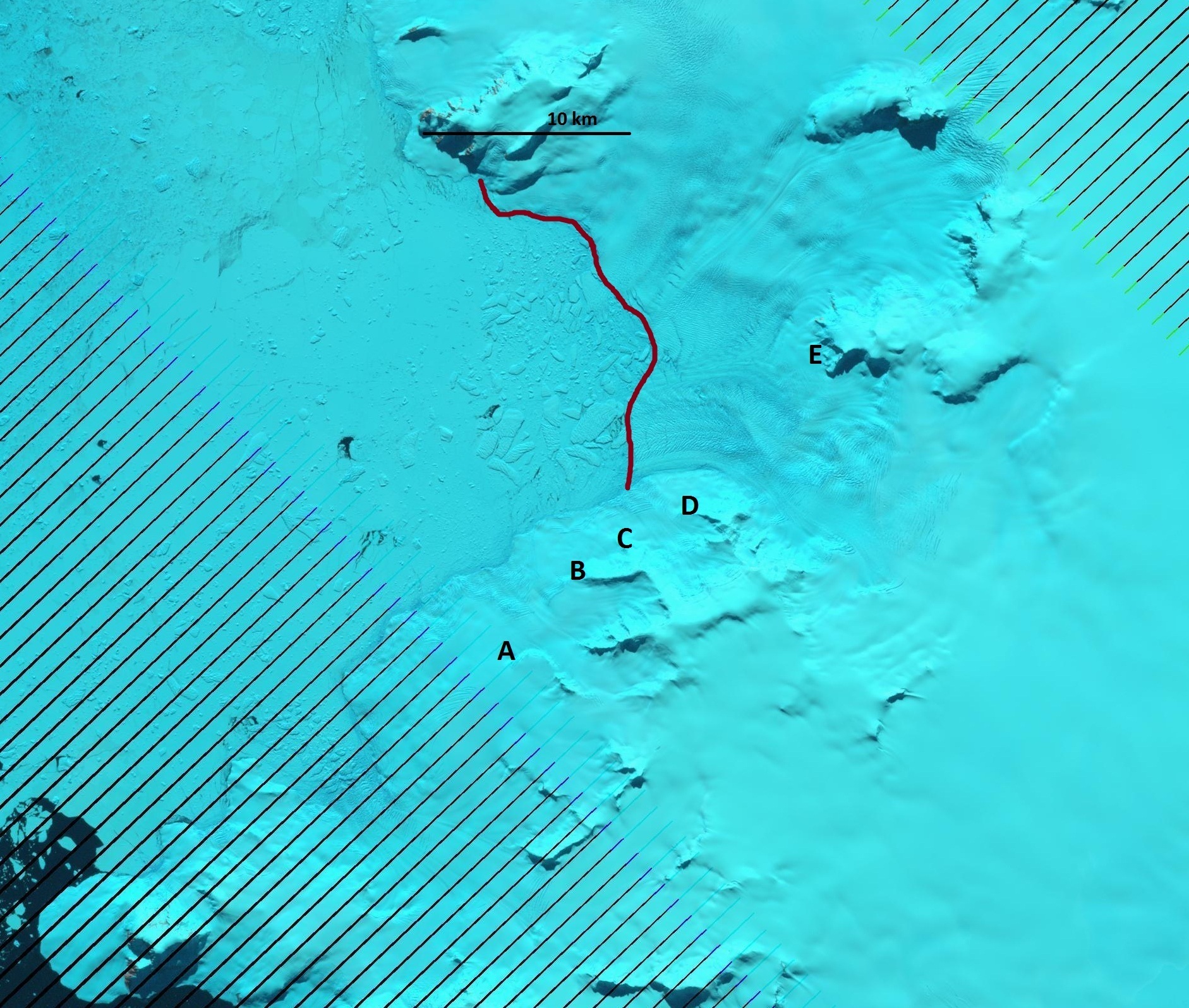
Boydell Glacier, Antarctica retreat in Landsat images from 2001 and 2017,  terminus in 2001 at red dots in 2017 at yellow dots.  A-E are reference points. 

Boydell Glacier flows east from the northern Antarctic Peninsula and prior to the 1980’s was joined with the Sjogren Glacier as a principal feeder glacier to Prince Gustav Ice Shelf.  This 1600 square kilometer ice shelf connecting the Peninsula to James Ross Island disintegrated in the mid-1990’s and was gone by 1995 (Cook and Vaughan, 2010).  Scambos et al (2014) noted a widespread thinning and retreat of Northern Antarctic Peninsula glaciers with the greatest changes where ice shelf collapse had occurred, Boydell/Sjogren Glacier being one of the locations.  A new paper by Seehaus et al (2016)  focuses on long term velocity change at Sjögren Glacier as it retreated.  This study illustrates the acceleration after 1996 from 0.7 m/day to 2.0 m/day in  2003 and then after separation Boydell Glacier, which is slower, has declined from  a velocity of 1.6 m/day in 2007 to  a velocity of 1.0 km day in 2015. Here we examine Landsat images from 1990, 2001, 2005 and 2017 to illustrate changes in terminus position of Boydell Glacier.

In the 1990 Landsat image Boydell/Sjögren Glacier feed directly into the Prince Gustav ice Shelf which then By 1993 Seehaus et al (2016) note that Boydell/Sjögren Glacier had retreated to the mouth of Sjögren Inlet in 1993, this is marked Point A on Landsat Images. By 2001 the glacier had retreated to Point B,  a distance of 7 km.  Between 2001 and 2005  a 2.5 km ot 3 km retreat led to a separation of Boydell Glacier and Sjogren Glacier and a retreat to Point C.  In 2017, Boydell Glacier has retreated 6.5 km since 2001.  This is less then the  Sjögren Glacier retreat of 10-11 km from the 2001 location.   Seehaus et al (2016) Figure 1  indicates that the area of high velocity over 1.0 m/day on Boydell Glacier in the last decade extends the entire 12 km length of the valley reach, which is fed by an icefall from a higher plateau region. The high velocity and limited change in fjord width in the lower 6 km indicates there is not a new pinning point to slow retreat appreciably in this stretch. Figure 1 also illustrates the retreat from 1993-2014. The pattern of ice shelf loss and glacier retreat after loss has also played out at Jones Ice Shelf and Rohss Bay.

sjogren glacier 1990

1990 Landsat Image of Boydell/Sjogren Glacier and Prince Gustav Ice Shelf, terminus marked by red dots.

2005 Landsat Image of Boydell/Sjogren Glacier terminus marked by red dots.

Antarctic REMA Explorer view of Boydell (B)  and Sjogren (S) in 2002.

Retreat of Prospect Glacier, Antarctic Peninsula

Prospect Glacier flows into the Sea on the E=West Coast of Antarctica. The glacier used to drain into the Wordie Ice Shelf which was formerly located at 69o on the west coast of the Antarctic Peninsula. In a joint study released by the USGS and British Antarctic Survey (BAS) the history of the Wordie Ice Shelf is reviewed. Below is the view in a Landsat 1979 image of the ice shelf. . The ice shelf advanced from 1947 to 1966. The ice shelf advanced on the northern end and retreated on the southern end from 1966 to 1974. The retreat at the southern end where Prospect Glacier fed the ice sheet was 1-2 km. By 1989 an additional 2 km of retreat had occurred. From 1989 to 1997 a general advance of the ice shelf occurred. From 1999 to 2001 retreat of 3-10 km occurred which marked the end of the ice shelf. The retreat is summarized in a figure from the USGS(2011). . The demise of the Wordie Ice Shelf was first documented by D.Vaughan and C.Doake (1991) of the BAS. The USGS long term project of mapping the changes with Landsat has been led by R. Williams, C.Swithinbank and J.Ferrrigno Examination of recent Landsat imagery indicate continued retreat of Prospect Glacier like its neighbor Fleming Glacier since ice shelf loss. A comparison of the ice front in the Prospect Glacier area is indicated in Landsat imagery from 1989 (top), 2002 (middle) and 2009 (bottom). Mount Balfour is at the northern edge of the Prospect Glacier, and may well become an island. The retreat is more pronounced on the southern side of the glacier note the locations A-E are the same prominent mountain features in the 2002 and 2009 images. The terminus is retreating eastward along Mount Balfour, from 1989-2002 but not significantly from 2002-2009. . A closeup view of the 2009 terminus indicates considerable rifting near the ice front, that represent icebergs that will soon calve off leading to further retreat. Surface melt in this area is quite limited, and the loss of the ice shelf through thinning and then rifting and breakup must have been triggered in part by increased basal melt. With the loss of the ice shelf, there is less back force slowing glacier motion at the ice front. The acceleration is leading to further thinning and continued extensive rifting. Rifts are indicated by red arrows and are likely due to basal crevasses expanding towards the surface.