Talking about Iceberg Melt Rates and Glacier Frontal Ablation: Seller and Heim Glacier, Antarctica

Figure 1: Study sites considered in this article: Seller Glacier and Heim Glacier (Landsat-8 image courtesy of the U.S. Geological Survey)

Post by Mariama Dryak

Iceberg melt is caused by the temperature of the water in which an iceberg floats and the velocity of the water flowing around the iceberg. As a result, iceberg melt is an excellent indicator for the ocean conditions in which an iceberg resides. Given the remote location of Antarctica, and the difficulty in taking direct oceanographic measurements immediately in front of glacier termini in Antarctica, icebergs near glacier fronts can act as a useful proxy for what the ocean conditions are in these areas, especially under changing climate.

Dryak and Enderlin (2020) compared remotely-sensed iceberg melt rates (2013 – 2019) from eight study sites along the Antarctic Peninsula (AP) to glacier frontal ablation rates (2014 – 2018) where they overlapped in time and found a significant positively correlated relationship between the two. In general, iceberg melt rates were found to be much lower on the eastern AP where ocean waters are characterized as very cool relative to the heterogeneous, but generally warmer, waters on the western AP–where iceberg melt rates were higher. When we take a closer look at the data and consider what this means in the context of a stratified water column, the iceberg melt rate magnitudes also make sense relative to one another and what is known of regional ocean conditions.

Here we take a look at the results from two of those study sites: Seller Glacier and Heim Glacier.

Seller Glacier is the southernmost study site considered in our study on the Antarctic Peninsula, and produces very large, sometimes tabular icebergs with relatively high mean melt rates. Figure 2 indicates the changes in the same iceberg at two points in time. These icebergs are larger than and different in style to all of the other study sites, with the Seller Glacier terminus also being the widest of all the glaciers considered in the study. Due to the large area of the icebergs produced, we know that the keel depths of these icebergs also extend deep into the water column (See Table 1, Dryak and Enderlin, 2020), contacting warm subsurface waters (and some contacting Circumpolar Deep Water (CDW)) as characterized by Moffat and Meredith (2018) in Figure 3 below. In the upper layers these icebergs also sit in the very cold Winter Water (WW) layer and expanded section of Antarctic Surface Water (AASW) prevalent in the Seller region.

Figure 2: An iceberg from Seller Glacier in 2014 and later in 2016. Mean submarine melt rates for the Seller Glacier icebergs from this time period were 6.54 cm/day (Imagery © [2019] DigitalGlobe, Inc.)

Figure 3: Figure 3 from Moffat and Meredith (2018).

Frontal ablation rates at Seller Glacier are higher than expected given iceberg melt rates at the other sites on the western Antarctic Peninsula (Figure 4). Dryak and Enderlin (2020) suggest this to be because of a long-term dynamic adjustment of the Seller Glacier in response to the collapse of the Wordie Ice Shelf, which occurred between 1966 and 1989 (Vaughan, 1991)-a similar case to the sustained elevated velocities witnessed at Crane Glacier on the eastern Antarctic Peninsula following the collapse of the Larsen B Ice Shelf in 2002.


Figure 4:     Scatterplot of iceberg melt rates and frontal ablation  for nearby glaciers over near-coindicdent time periods. Symbols indicate median frontal ablation rates. Figure 8 from Dryak and Enderlin (2020)

In contrast, the study site at Heim Glacier, north of Seller Glacier, contains smaller, shallow icebergs with low iceberg melt rates on par with iceberg melt rates found on the eastern Antarctic Peninsula. The glacier that produced the sampled icebergs, though not the smallest of the sites sampled, produces icebergs small in area that often do not last from one season to the next. The keel depths of the sampled icebergs at Heim Glacier likely do not reach below the cold WW layer (Table 1, Dryak and Enderlin, 2020), terminating in the very cold water layer or above in the compressed and comparatively cool AASW. However, the Heim study site is also located near the Marguerite Trough, an area of deep bathymetry known for the presence of warm waters, so the low melt rates here may be surprising to some without taking a closer look at the specific locale. Our study suggests that the bathymetry of the area in which the icebergs reside might be sheltered due to the presence of Blaiklock and Pourquoi Pas Islands, which may deflect warmer waters from reaching the Heim Glacier.

Frontal ablation rates at Heim Glacier are low, and of a similar magnitude to eastern Antarctic Peninsula sites, corresponding in magnitude to the low iceberg melt rates for the site as well (Dryak and Enderlin, 2020; Figure 8).

Overall, this paper re-emphasizes the importance of considering the ocean’s role in forcing changes on glaciers that terminate in the ocean around Antarctica, especially under changing climate. With the ocean acting as a large sink for excess heat in the atmosphere, evaluating the consequences of the storage of this heat in the ocean is essential when attempting to understand the feedback mechanisms associated with such change. The moral of the story is that we must keep one eye on the ocean going forward and how it could lead to changes in glacier dynamics, which could lead to changes in the contributions of glaciers to sea level and the marine ecosystems that exist within the ocean.

For full results and discussion of all of the study sites considered along the western and eastern sides of the Antarctic Peninsula, read the full Dryak and Enderlin (2020) article in the Journal of Glaciology.

*Note the Seller Glacier like many others in the region have experience rapid retreat in the last 30 years, Fleming Glacier, Sjogren Glacier and Boydell Glacier.

Coley Glacier Retreat, James Ross Island, Antarctica

coley-compare

Coley Glacier terminus comparsion in Landsat images from 2000 (red arrows) and 2016 (yellow arrow)  indicating a retreat of 2 km along the western side and 1 km along the eastern side.  Purple dots indicate the transient snowline and the purple arrow an area of debris exposed with glacier thinning. 

Coley Glacier is a tidewater glacier on the northeast side of James Ross Island near the tip of the Antarctic Peninsula. Davies et al (2012) observed that 90% of the glaciers of the Northern Antarctic Peninsula including James Ross Island retreated from 1988-2001 and 79% from 2001-2009. They further observed that the rapid shrinkage of tidewater glaciers on James Ross Island would continue due to their low elevation and relatively flat profiles. Rohss Bay Glacier is one example of this having retreated 15 km from 1999-2009 (Glasser et al, 2011).  Barrand et al (2013) note a strong positive and significant trend in melt conditions in the region, driving the retreat.

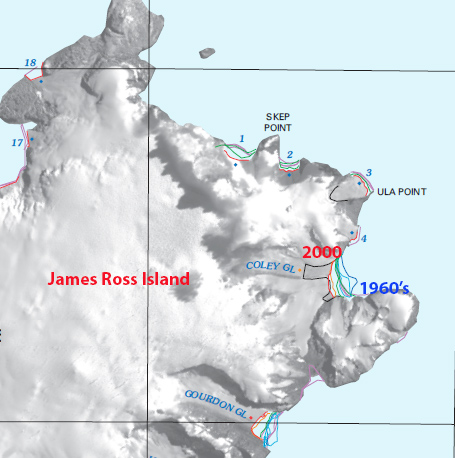
Coley Glacier in 2000 had a relatively straight calving front running across the embayment. The front represents the joining of four tributary glaciers.  The snowline was generally below the top of the escarpment just west of Point C, the elevation of this lower glacier reach is below 200 m.  This fits the low elevation low slope criteria noted by Davies et al (2012).  By 2016 the glacier has developed a concave glacier front with the northern tributary almost separating the retreat ranges from 2 km on the west side to 1 km on the east side.  The snowline is above the escarpment at 400 m. A comparison below of 2001 and 2015 indicates that the snowline in 2015 was also near 400 m and above the escarpment. A map of the region from the USGS (Ferigno et al.,2006) illustrates the retreat from the 1960’s to 2000.  Nývlt et al (2010)  reported on the retreat and changes on two glaciers on the north side of James Ross Island.coley-tsl-compare

Coley Glacier terminus comparison in Landsat images from 2001 and 2015.  Red arrows is the 2000 terminus and yellow arrows the 2016 terminus.  Purple dots indicate the transient snowline and the purple arrow an area of debris exposed with glacier thinning. 

coley-glacier-map
COASTAL-CHANGE AND GLACIOLOGICAL MAP OF THE TRINITY PENINSULA AREA AND SOUTH SHETLAND ISLANDS, ANTARCTICA: 1843–2001
USGS (Ferigno et al.,2006)


Nansen Ice Shelf, Antarctica Calving Event Occurs April 2016

nansen compare calving

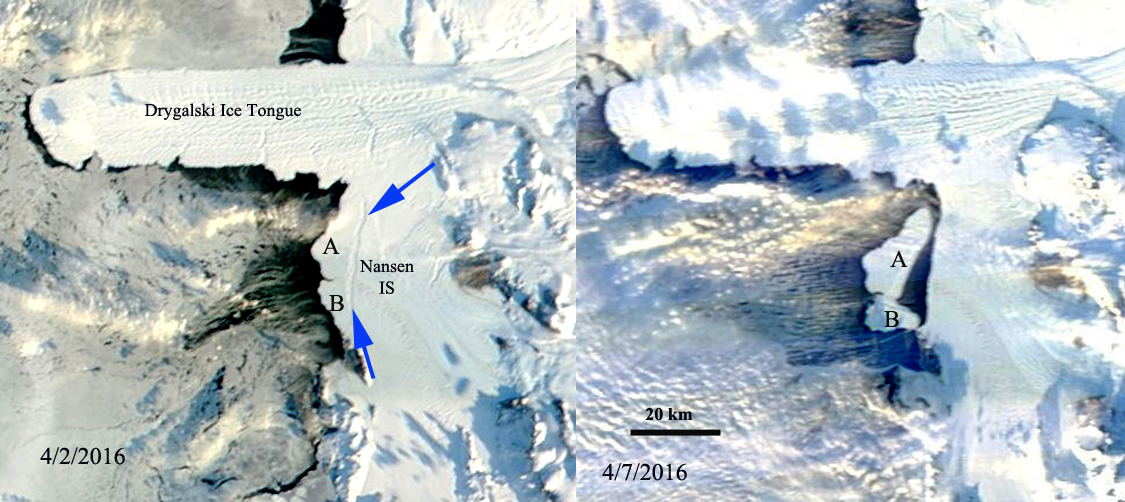
Nansen Ice Shelf just north of Dryglaski Ice Tongue on April 2 with evident rift,blue arrows, and after calving two icebergs on April 7, A and B. Images from NASA MODIS

The NIWA reported a calving event from the Nansen Ice Shelf on April 11, 2016.  They are concerned about a mooring in Terra Nova Bay in front of the ice shelves. The area of the Nansen Ice Shelf is 1500 square kilometers, these icebergs have a combined estimate of approximately 250 square kilometers.  This is a substantial calving event for such a small system. Below is an image of the Nansen Ice Shelf on January 1, 2014 and January 1, 2016.  This illustrates the Terra Nova Bay polyna that develops every summer, and affects sea ice dynamics, and certainly the ice shelf. The former lacks a notable rift, the latter exhibits the rift that would lead to calving, the rift had formed in late 2013, but is still not evident in imagery of the resolution of MODIS.  NIWA had been watching this expanding rift for signs of calving.  NASA had warned in March that calving was imminent and had been monitoring the ice shelf to determine the affect of tides on the ice shelf dynamics.  The rift is beautifully shown by NASA in its growth from 2013 to 2015. Such rifting and calving can be part of stable dynamics as on Stange Ice Shelf or an indicator of instability as in the case of Verdi Ice shelf.

nansen comapre

Nansen Ice Shelf in January 2014 and January 2016.

terra nova 1999

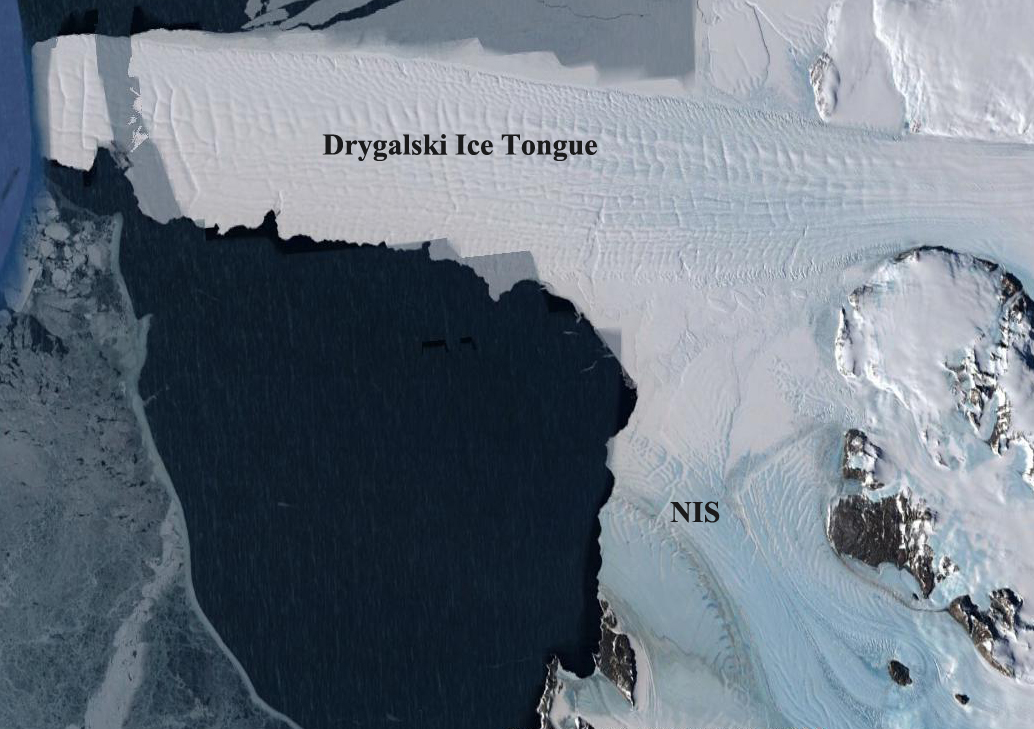
Google Earth image of the region in 1999 indicating several significant rifts.

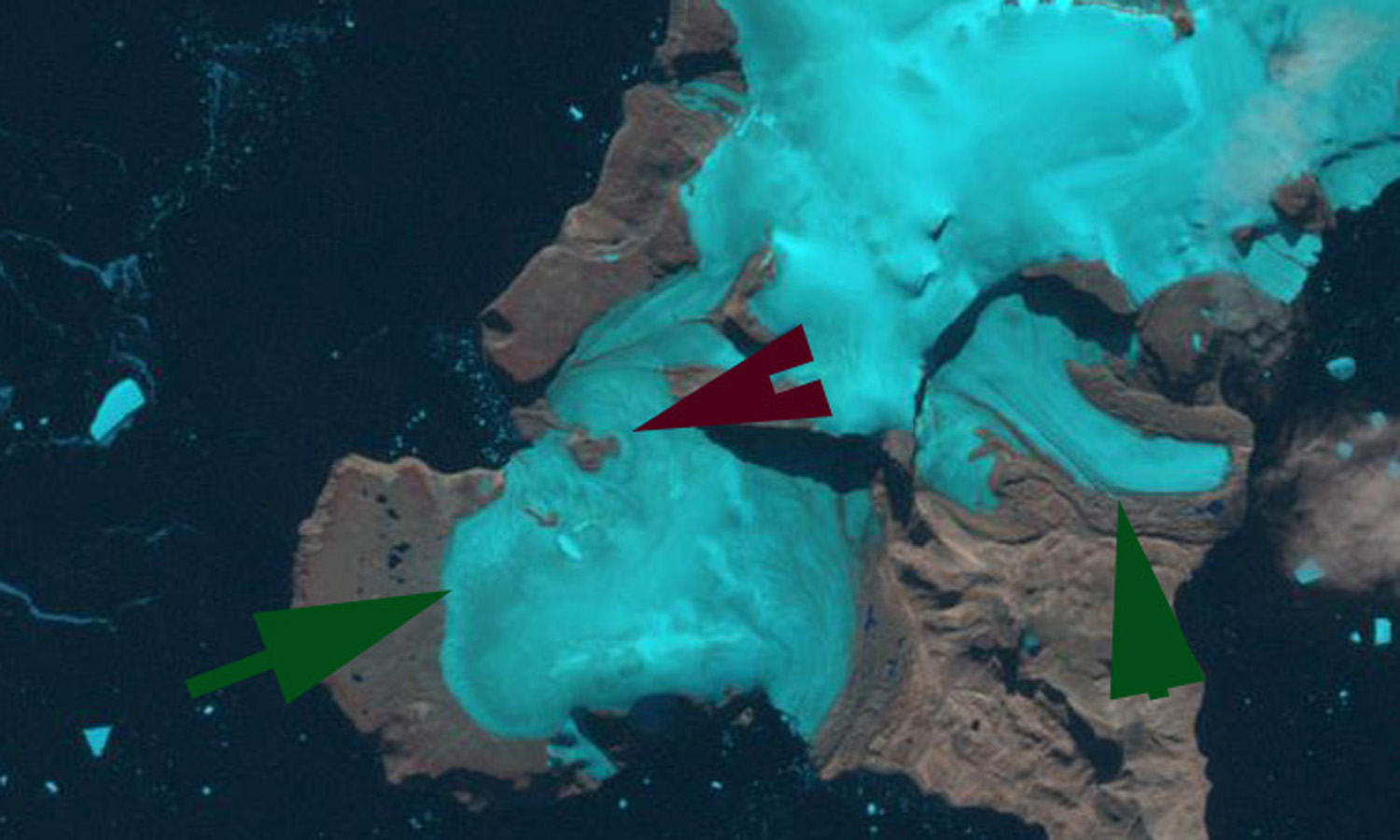
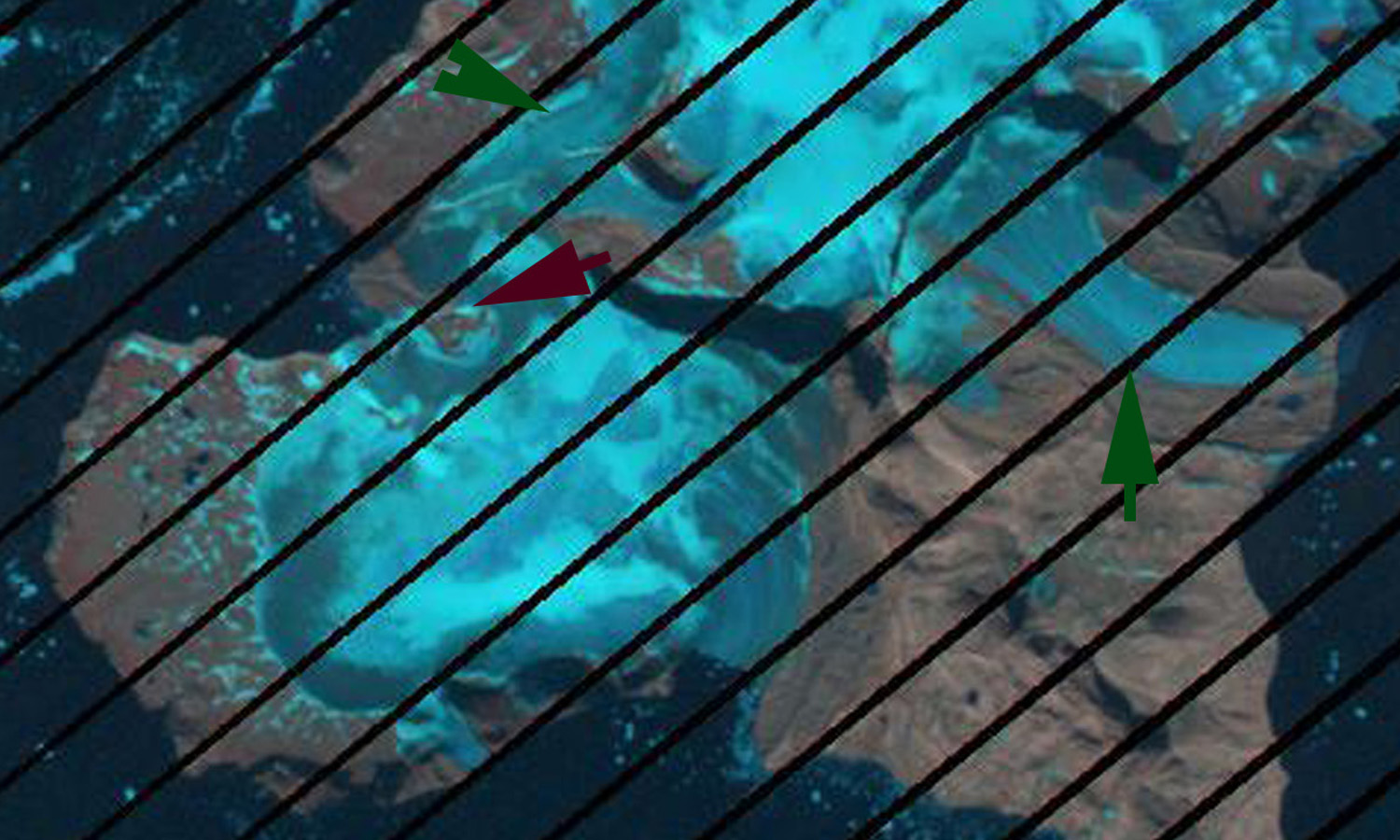
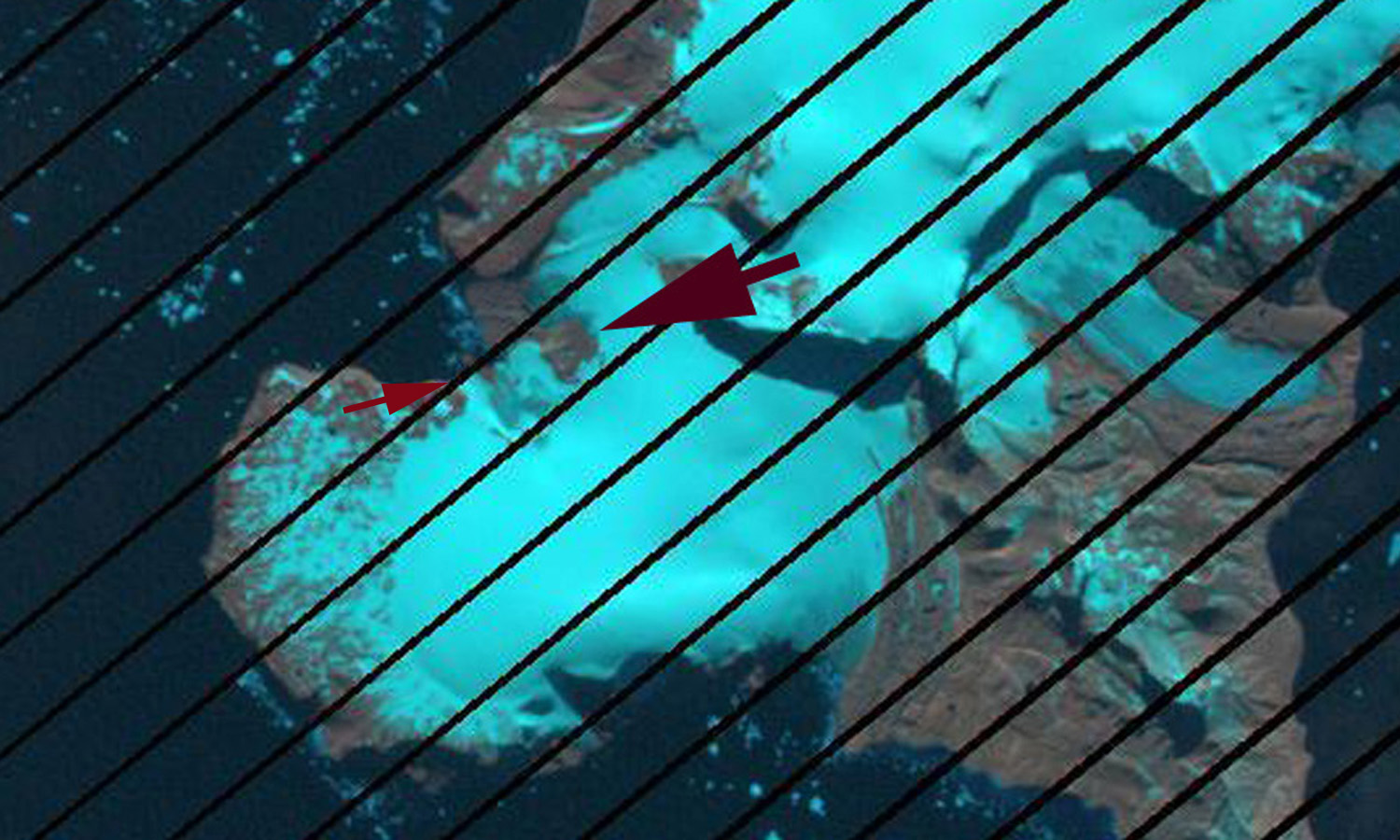
Northwest Vega Island, Antarctica Glacier Retreat

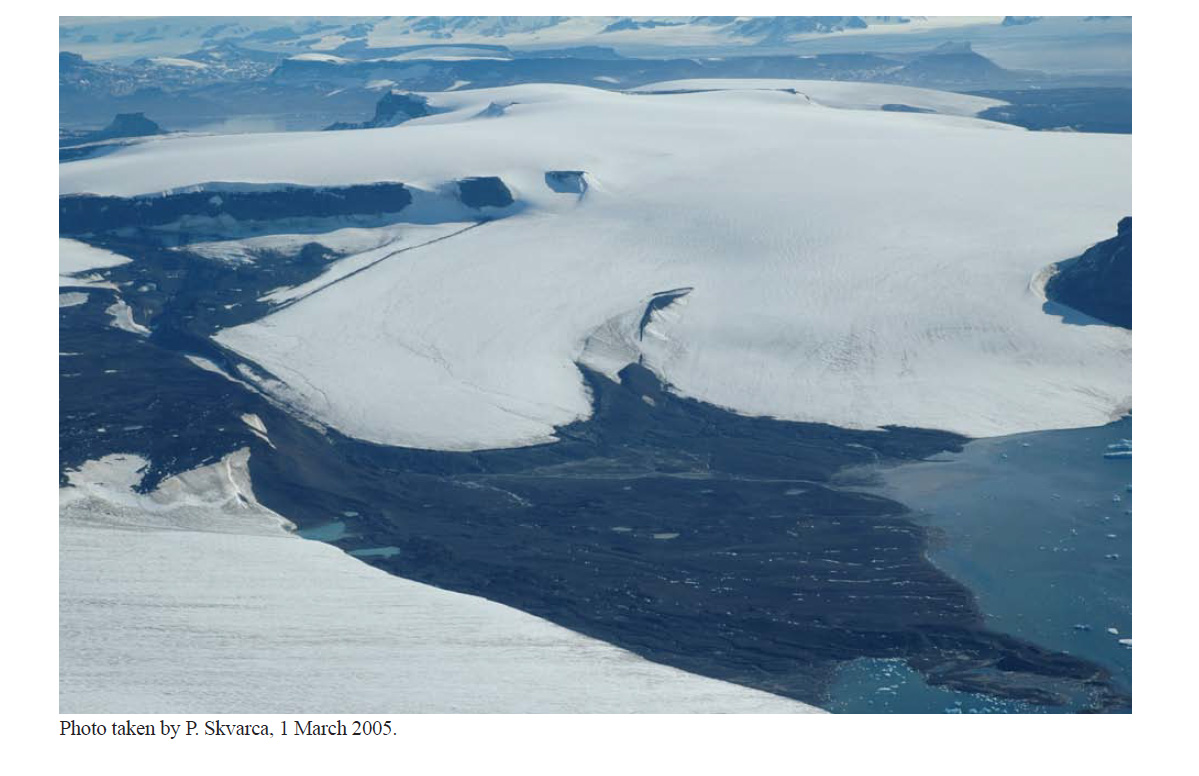
Vega Island is a heavily glaciated island just east of the northernmost section of the Antarctic Peninsula (map from Davies et al, 2010 Aberystwyth University). The mass balance of Bahia Del Diablo Glacier (BDD green arrow) located on this island has been monitored by an Argentina research group since 1999/2000 (Skvarca et al 2004 and WGMS, 2010). Nine of these ten years have seen negative mass balances, four substantial losses. The glacier begins at 600 meters and ends at 100 m, with an ELA of 425 meters on average, an image from Pedro Skvarca of Bahia Del Diablo indicates the ice cap nature of the glaciers on Vega Island. Eight kilometers west of Bahia Del Diablo is are three adjacent glaciers at the northwest corner of the island (NW: burgundy Arrow on Vega Map) that is the focus here. In the initial glacier inventory these were listed as glacier 02-04 on Vega Island (Rabassa et al, 1982) This glacier barely reaches to the ocean, but the amount of bare land exposed at the coast along the glacier front is increasing. Further during several recent years this glacier has lost all of its snowcover. This glacier has only a tiny bit of its total area above 400 meters, below the observed ELA of the last decade on Bahia del Diablo. This is an issue for a couple of adjacent glaciers as well. Note the 1999 Google Earth imagery and the Landsat imagery from 2000 that indicate the lack of snowcover, green arrows. In 1999 and 2000 the glacier reached the coast along a distance of 900 meters, red arrows in second image. Note the change in the size of the bedrock exposed near the terminus, burgundy arrow from 1999 to 2011. The glacier frontage by 2011 had been reduced to 250 meters, the bare brown red areas have nearly merged along the coast, soon this glacier will not be reaching the shoreline. The bare rock area between two lobes of the glacier has also expanded, from 1999-2011, burgundy arrows. In 2007 and 2008 there was very little if any snowpack left on this glacier by the end of the melt season. The issue for a glacier without a consistent accumulation zone, is that it will not survive (Pelto, 2010). These glaciers are more like ice caps are not thin and are not melting away quickly. The glacier volume loss is consistent with that observed all around the Antarctic Peninsula, Nordenskjold Coast

Northwest Vega Island, Antarctica Glacier Retreat

Vega Island is a heavily glaciated island just east of the northernmost section of the Antarctic Peninsula (map from Davies et al, 2010 Aberystwyth University). The mass balance of Bahia Del Diablo Glacier (BDD green arrow) located on this island has been monitored by an Argentina research group since 1999/2000 (Skvarca et al 2004 and WGMS, 2010). Nine of these ten years have seen negative mass balances, four substantial losses. The glacier begins at 600 meters and ends at 100 m, with an ELA of 425 meters on average, an image from Pedro Skvarca of Bahia Del Diablo indicates the ice cap nature of the glaciers on Vega Island. Eight kilometers west of Bahia Del Diablo is are three adjacent glaciers at the northwest corner of the island (NW: burgundy Arrow on Vega Map) that is the focus here. In the initial glacier inventory these were listed as glacier 02-04 on Vega Island (Rabassa et al, 1982) This glacier barely reaches to the ocean, but the amount of bare land exposed at the coast along the glacier front is increasing. Further during several recent years this glacier has lost all of its snowcover. This glacier has only a tiny bit of its total area above 400 meters, below the observed ELA of the last decade on Bahia del Diablo. This is an issue for a couple of adjacent glaciers as well. Note the 1999 Google Earth imagery and the Landsat imagery from 2000 that indicate the lack of snowcover, green arrows. In 1999 and 2000 the glacier reached the coast along a distance of 900 meters, red arrows in second image. Note the change in the size of the bedrock exposed near the terminus, burgundy arrow from 1999 to 2011. The glacier frontage by 2011 had been reduced to 250 meters, the bare brown red areas have nearly merged along the coast, soon this glacier will not be reaching the shoreline. The bare rock area between two lobes of the glacier has also expanded, from 1999-2011, burgundy arrows. In 2007 and 2008 there was very little if any snowpack left on this glacier by the end of the melt season. The issue for a glacier without a consistent accumulation zone, is that it will not survive (Pelto, 2010). These glaciers are more like ice caps are not thin and are not melting away quickly. The glacier volume loss is consistent with that observed all around the Antarctic Peninsula, Nordenskjold Coast