Coley Glacier Retreat, James Ross Island, Antarctica

coley-compare

Coley Glacier terminus comparsion in Landsat images from 2000 (red arrows) and 2016 (yellow arrow)  indicating a retreat of 2 km along the western side and 1 km along the eastern side.  Purple dots indicate the transient snowline and the purple arrow an area of debris exposed with glacier thinning. 

Coley Glacier is a tidewater glacier on the northeast side of James Ross Island near the tip of the Antarctic Peninsula. Davies et al (2012) observed that 90% of the glaciers of the Northern Antarctic Peninsula including James Ross Island retreated from 1988-2001 and 79% from 2001-2009. They further observed that the rapid shrinkage of tidewater glaciers on James Ross Island would continue due to their low elevation and relatively flat profiles. Rohss Bay Glacier is one example of this having retreated 15 km from 1999-2009 (Glasser et al, 2011).  Barrand et al (2013) note a strong positive and significant trend in melt conditions in the region, driving the retreat.

Coley Glacier in 2000 had a relatively straight calving front running across the embayment. The front represents the joining of four tributary glaciers.  The snowline was generally below the top of the escarpment just west of Point C, the elevation of this lower glacier reach is below 200 m.  This fits the low elevation low slope criteria noted by Davies et al (2012).  By 2016 the glacier has developed a concave glacier front with the northern tributary almost separating the retreat ranges from 2 km on the west side to 1 km on the east side.  The snowline is above the escarpment at 400 m. A comparison below of 2001 and 2015 indicates that the snowline in 2015 was also near 400 m and above the escarpment. A map of the region from the USGS (Ferigno et al.,2006) illustrates the retreat from the 1960’s to 2000.  Nývlt et al (2010)  reported on the retreat and changes on two glaciers on the north side of James Ross Island.coley-tsl-compare

Coley Glacier terminus comparison in Landsat images from 2001 and 2015.  Red arrows is the 2000 terminus and yellow arrows the 2016 terminus.  Purple dots indicate the transient snowline and the purple arrow an area of debris exposed with glacier thinning. 
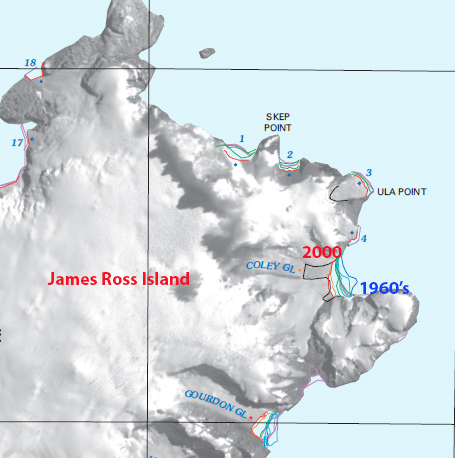
coley-glacier-map
COASTAL-CHANGE AND GLACIOLOGICAL MAP OF THE TRINITY PENINSULA AREA AND SOUTH SHETLAND ISLANDS, ANTARCTICA: 1843–2001
USGS (Ferigno et al.,2006)


Nordenskjöld Coast Glacier Retreat, Antarctic Peninsula

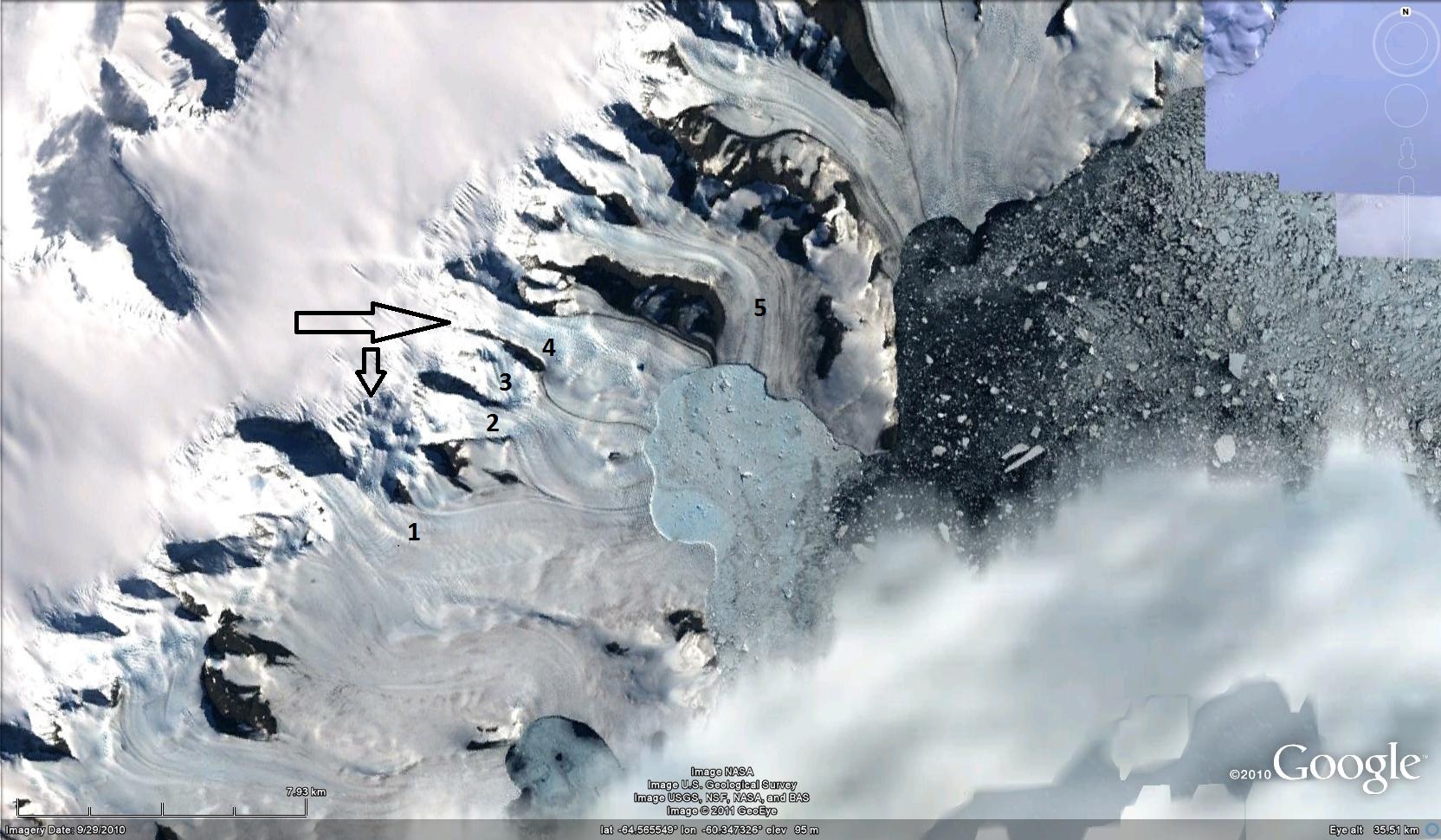
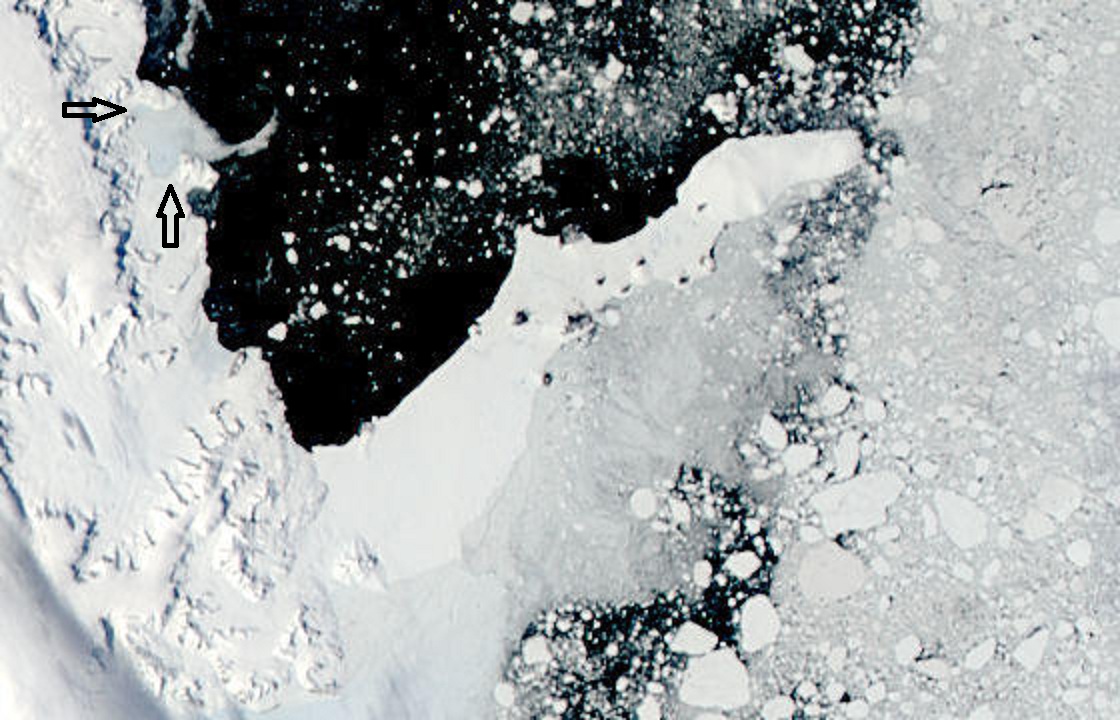
A recent paper by Shuman et al (2011) in the Journal of Glaciology examined the thinning and retreat of glaciers feeding the area that used to contain Larsen Ice Shelf B and the southern end of Larsen Ice Shelf A. They found that the thinning of over 80 meters occurred over large areas of Hektoria, Jorum, Evans, Crane and Green Glaciers. Terminus retreat of five kilometers of the primary glaciers from late 2002-2009 occurred for Larsen B. The rapid loss of thickness and retreat has accompanied the expected and observed acceleration of the glaciers after ice shelf loss. The removal of an ice shelf is a substantial reduction in the backforce on a feeder glacier, or like taking off the brakes. Pine Island Glacier is another example where this is of concern. The Shuman et al (2011) paper particularly the figures are compelling and prompted me to take a look at one embayment in the Larsen A region that is experiencing ongoing glacier retreat. The area has been mapped by USGS and is referred to as the Nordenskjöld Coast. We will look at the unnamed embayment marked B, between Drygalski and Dinsmoor Glacier. This embayment which has formed in the last decade is 25 square kilometers in area.The above map indicates the extensive retreat due to the Larsen A ice Shelf loss that took place in the mid-1990’s and the development of the embayment by 2009. The five glaciers that feed it flow from the center of the Antarctic Peninsula, upper left in the image below. . The embayment itself has numerous icebergs suggesting the rapid ice discharge from the glaciers feeding this bay. This bay has been ice covered for a long time, transitioning from a grounded ice sheet to an ice shelf environment 10,700 years ago, and which has persisted since (Brachfield et al, 2003). The embayment did not expanded notably from the Landsat imagery from 2001 to 2009, as seen in the 2001 Landsat. In 2011 the retreat was significant as seen in MODIS imagery from Jan.27 the embayment has developed two lobes (note black arrows in image below.. The southern lobe has expanded by 1.5 km. The northern lobe by a smaller amount, but the area between glacier 4 and 5 is now a headland, indicating at least 500 meters of retreat.. The glaciers in this bay do not appear to have large floating sections generating tabular icebergs at this point, such as are evident on Fleming Glacier.