Freemanbreen, Svalbard Retreat Leads to Island Formation

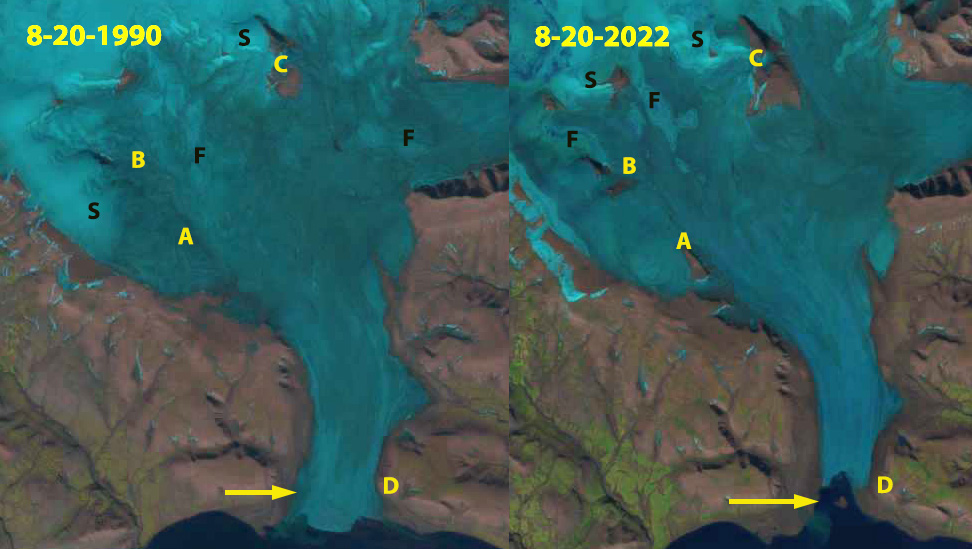
Freemanbreen in 1990 and 2022 Landsat images.  Both are years with limited retained snowcover (S) and some area of retained firn (F). The glacier has retreated from a new island that had formed at Point D. At Point A-C glacier melt and resultant thinning has exposed and expanded bedrock areas.

Freemanbreen is the primary southern outlet glacier of the icecap that dominates Barentsøya, Svlabard. Here we examine Landsat imagery from 1990-2022 to illustrate the the impact of climate change on this glacier. Dowdeswell and Bamber (1995) report that Freemanbreen last surged in 1956 and has retreated since, and that most of its bed is above sea level. Morris et al (2020) note a thinning rate of -0.6 m/year for the area from 2011-2017 that is driven by atmospheric temperature and sea surface temperature warming.

In 1990 Freemanbreen experienced a year of extensive melt with limited retained snowpack (S), there is some retained firn which does retain some percolating meltwater from the snowpack. The glacier extended beyond its fjord ending in a convex tidewater front in Freeman Sound. By 2010 the glacier had retreated into the fjord and was pinned on an island in the center of the fjord. By 2013 the glacier had pulled back from the island and the terminus has since developed a concave terminus front. In 2022 the glacier has retreated 800 m from the island  (Arrow-Point D) and 1.8 km from its 1990 position. The tidewater front has been reduced from 2.8 km to 1.3 km. The reduction in calving has not offset the increase in glacier melt resulting in continued retreat. The surface melt has led to surface thinning and the expansion or exposure of bedrock areas amidst Freemanbreen at Point A-C. In 2022 the glacier experienced another summer of extensive melt, likely the most extensive melt in the region in at least the last 50 years (Climato-Liege University).  This left the glacier largely bare of snowpack, with less than 5% snowcover in the area above 500 m near Point C and limited retained firnpack from previous years note NW of Point B. The ice cap summit is in the 600 m range. This loss is similar but not as complete as obseved on the ice caps of Edgeøya.

Left image aerial photograph from TopoSvalbard, at right Sentinel 2 image from 2022. Island indicated by arrow.

Freemanbreen surface conditions in Sentinel image from 8-19-2022, snow cover (S), Firn Cover (F.)
Besselsbreen Retreat Glacier Wide Thinning , Svalbard

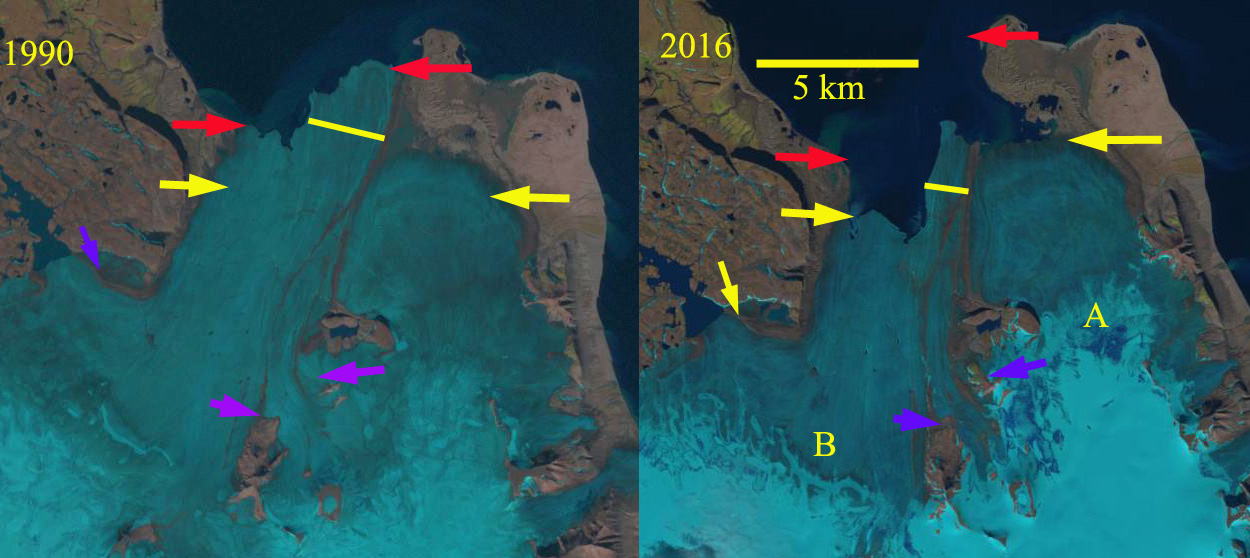
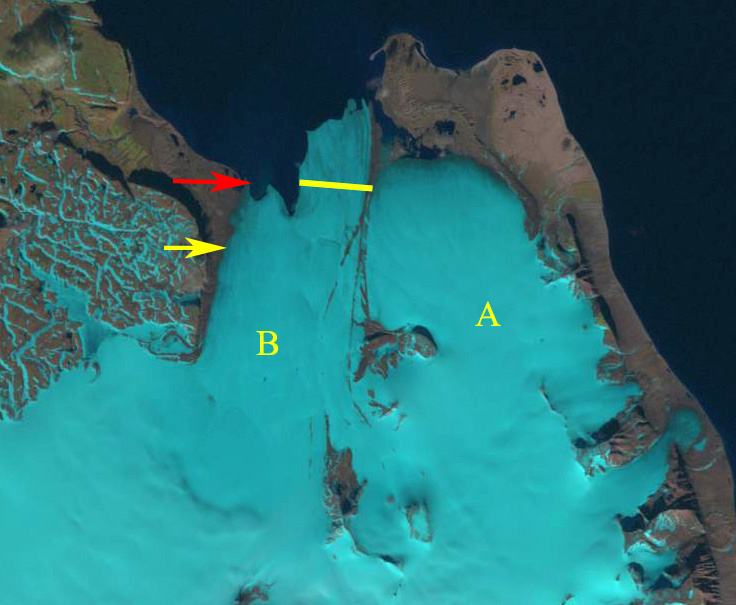
Besselsbreen (B) and Augnebreen (A) comparison in a 1990 and 2016 Landsat image. Red arrows indicate terminus position in 1990, yellow arrow indicates terminus in 2016, purple arrows indicate locations of upglacier thinning from 1990 to 2016 and the yellow line indicates the width of the tongue on the eastern side of Besselsbreen to the medial moraine with Augnebreen

Besselsbreen Glacier flows north to  tidewater from the Barents Icecap on Barentsoya Island in Svalbard.  The glacier has a low slope with the surface elevation reaching 250 m 10 km from the glacier front. The result is limited velocity and crevassing.  The lack of crevasses and flow enables formation of interesting surface stream networks as well. Here we examine Landsat imagery from 1990 to 2016 and Google Earth imagery from 2013 to identify key glacier changes. Dowdeswell and Bamber (1995) indicate the glacier has not surged since its Little Ice Age maximum and that the lowest 4 km of the glacier has a bed that is below sea level.  Gruell et al (2017) mapped the albedo of the glacier using MODIS and found it quite low all the way to the crest in the summer of 2003.  This suggests limited retained snowpack. The recent ocean and atmospheric warming (Isaksen et al , 2016) driving increased summer melt.

In 1990 Besselsbreen extended to within 1.2 km of Kap Bessels on the east side of the glacier and to the embayment widening on the west. The east side of the terminus had a 2.4 km wide tongue that extends beyond the rest of the terminus. There is no lake or tidewater at the terminus of Augnebreen.  The snowline is at 500 m near the top of the glacier. In 2000 the eastern tongue of the glacier is 2.0 km wide, the glacier has retreated a minor amount.  By 2016 the terminus on the west side of the inlet has retreated 1.9 km and 2.6 km on the east side of Besselsbreen.  The eastern tongue of the glacier is now 1.2 km wide.  The snowline in mid-August is at 400 m. Significant thinning has exposed substantial new bedrock areas at the purple arrows which are between 250 m and 350 m in elevation.   This is indicative of higher annual snowlines leading to significant surface melt driven thinning.  The glacier terminus has crevassing only near the embayment where the eastern tongue extends north from the rest of the terminus.  This suggest limited calving, no icebergs are noted in any images used. Warming sea temperatures and reduced sea ice are likely playing a role in enhanced near terminus melt rates. The lack of crevasses and extensive melting has led to substantial stream networks and surface ponds on the lower glacier as seen in Google Earth images below.  The low albedo of the relatively dark surface of the glacier even near the top underscores the failure to retain snow/firn through the summer allowing dust to accumulate on the surface. The medial moraine between Augnebreen and Besselsbreen will be a continuing location of separation.  Augnebreen is retreating less rapidly, 1.2 km from 1990-2016, but now has a significant tidewater embayment at the glacier front that should enhance retreat. 

The retreat here is less than the more calving dominated tidewater glaciers such as Hinlopenbreen, Kronebreen or Svitjodbreen.  In the case of Kronebreen that glacier has also been separating from Kongsvegen. 

Besselsbreen (B) and Augnebreen (A) comparison in a 2000 Landsat image. Red arrows indicate terminus position in 1990, yellow arrow indicates terminus in 2016 and the yellow line indicates the width of the tongue on the eastern side of Besselsbreen to the medial moraine with Augnebreen

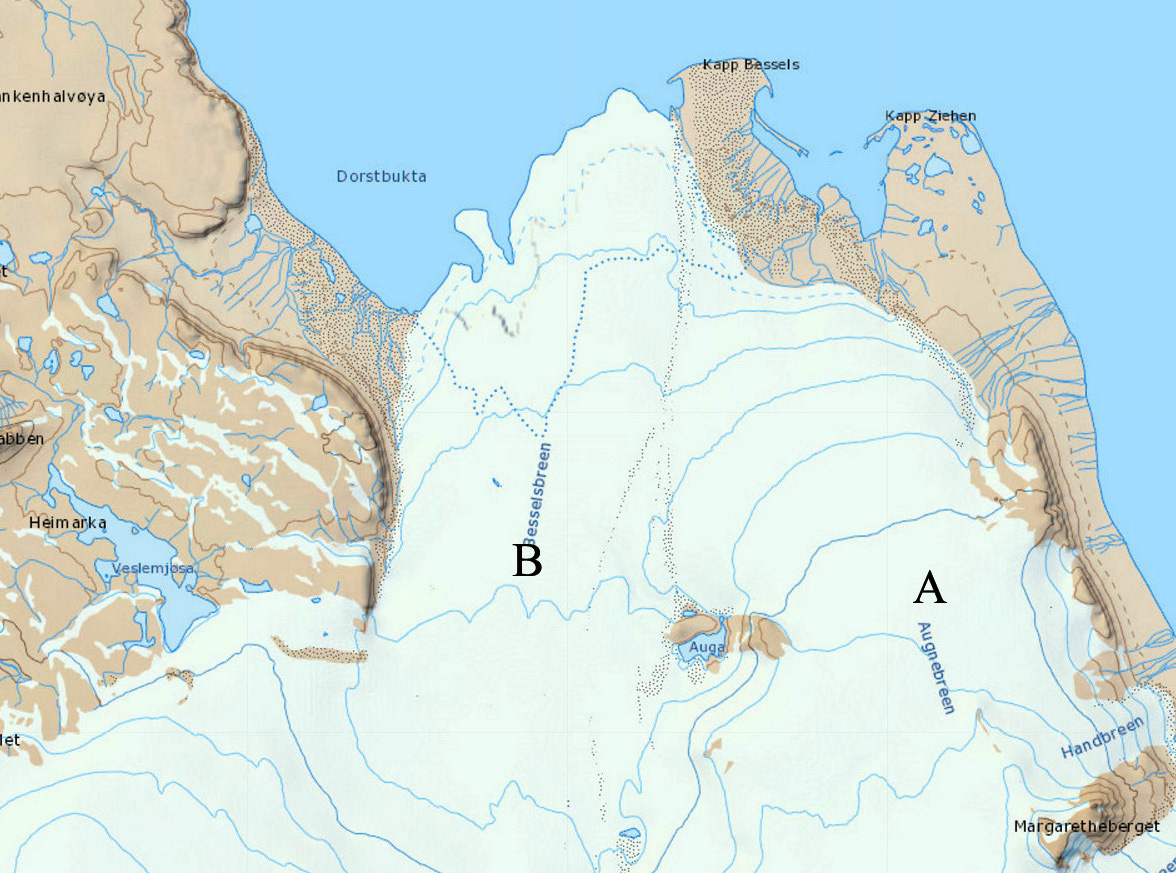
Besselsbreen (B) and Augnebreen (A) comparison from TopoSvalbard map

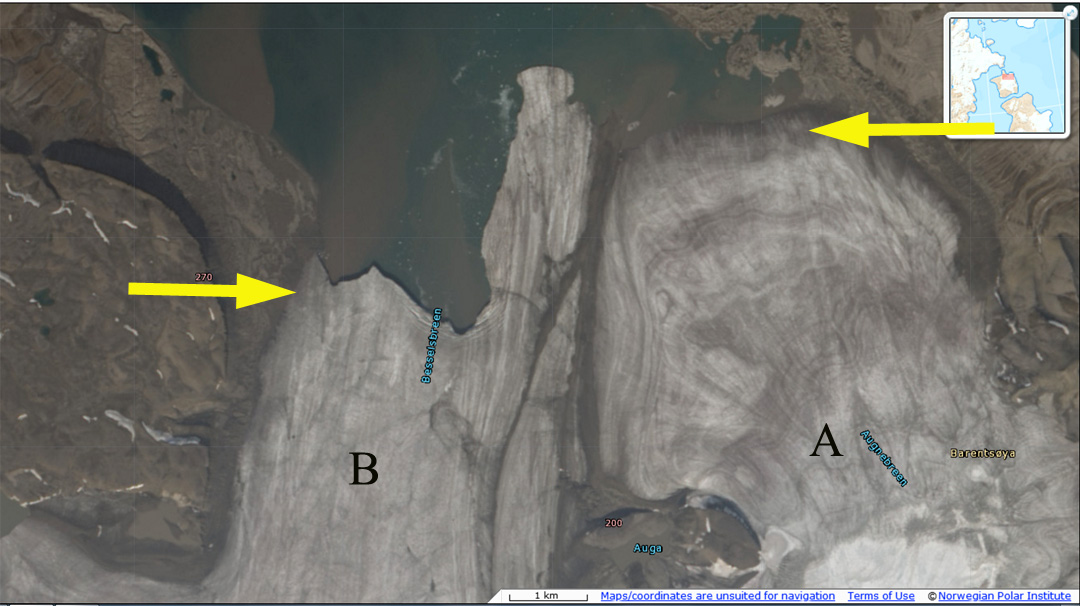
Besselsbreen (B) and Augnebreen (A) comparison from TopoSvalbard image of 2013, yellow arrows indicate 2016 terminus. Note dark color of ice surface.

Besselsbreen in a Google Earth image indicating melt ponds and supraglacial streams.  Yellow dots indicate the ice front.