Southeast Glacier #3, Devon Ice Cap, Canada Recent Retreat

Southeast #3 Glacier, Devon Ice Cap in July 9, 2016 and August 29, 2021 Sentinel 2 images of the lower 10 km  showing three supraglacial streams S1, S2 and S3 and the outlet plumes of each stream at Point 1-3. The yellow line is the 2016 margin.

The southeast sector of the Devon Ice Cap, Devon Island, Nunavut has three tidewater outlet glaciers Southeast Glacier #1, #2 and #3.  Van Wychen et al (2017) indicate the dynamic discharge of the three at .06-.07 Gt per year, all three glaciers have been retreating during this period.  Southeast #3 is between 0.01 and 0.02 Gt per year.  Sharp et al (2011) note that increasing summer temperatures has led to increased mass loss on Devon Ice Cap. Here we examine retreat and the supraglacial stream networks using Landsat and Sentinel 2 imagery.

In 2002 the calving front of Southeast #3  Glacier extended north from with five distinct peninsulas of ice. The retreat by 2016 was more pronounced on the north south oriented southern portion of the front than the northwestern part.  From 2016 to 2021 it is evident that the glacier front has receded, particularly at the prominent ice peninsulas evident in 2016. The retreat averages 600 m across the 5 km wide tidewater front seen above from 2016-2021. This is an addition to the  1200 m retreat from 2002-2016, while the northwestern section retreated ~500 m during the 2002-2021 period. S1, S2 and S3 indicates supraglacial stream drainages that exit the glaciers at Point 1-3 respectively.  The plumes of sediment from these streams is evident in the July 24, 2020 image below from each of these surface outlet streams. The plumes are evident in the July 2016 image, but no the late August image of 2021.  The lack of plumes on 8-29-2021 indicate the lower melt rates that are typical of late August. The stream network has become more prominent as melt rates have led to greater flow and more incising into the ice.

This retreat has occurred during the same period that was noted as generating three new islands in 2018 on the northeast margin of the Devon Ice Cap. Noel  et al (2018) observe that this is part of a trend seen across Canadian Arctic ice caps have been losing mass for decades and that mass loss accelerated in 1996.
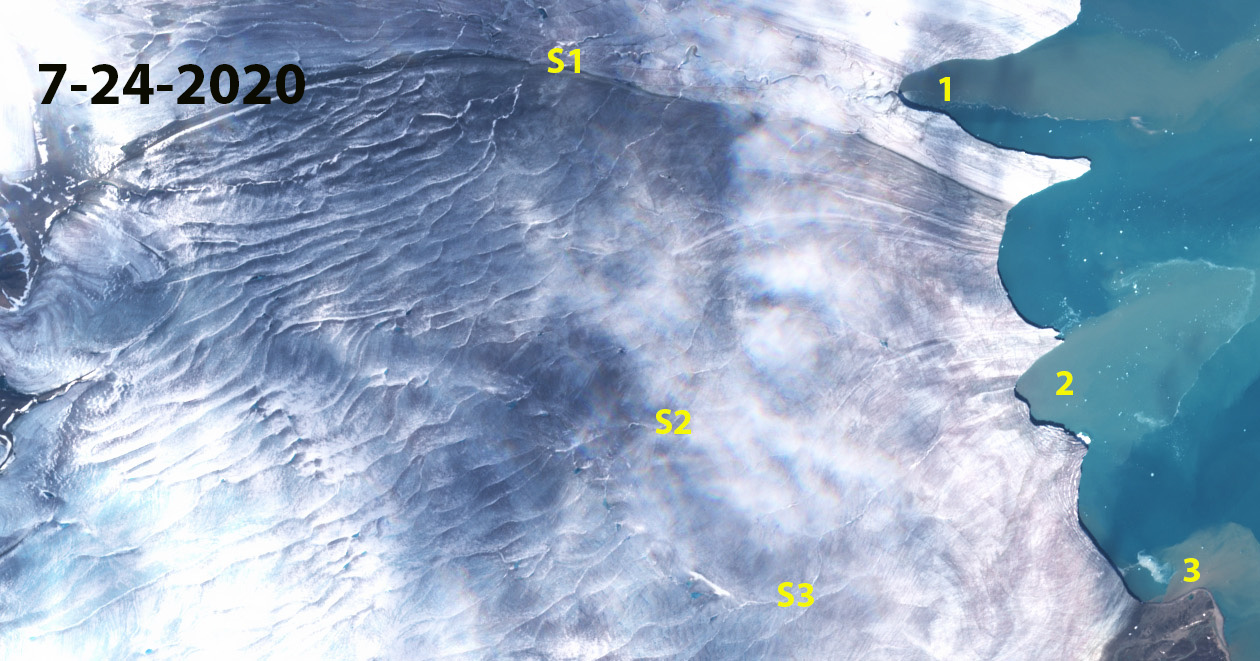
 

July 24, 2020 Sentinel 2 image of the lower 10 km of Southeast #3 Glacier showing three supraglacial streams S1,S2 and S3 and the outlet plumes of each at Point 1-3.

Southeast #3 Glacier in 2002 and 2021 Landsat images. Yellow dots indicate the 2002 margin of the glacier.
 

Croker Bay Glacier, Nunavut Canada Poised for Further Retreat

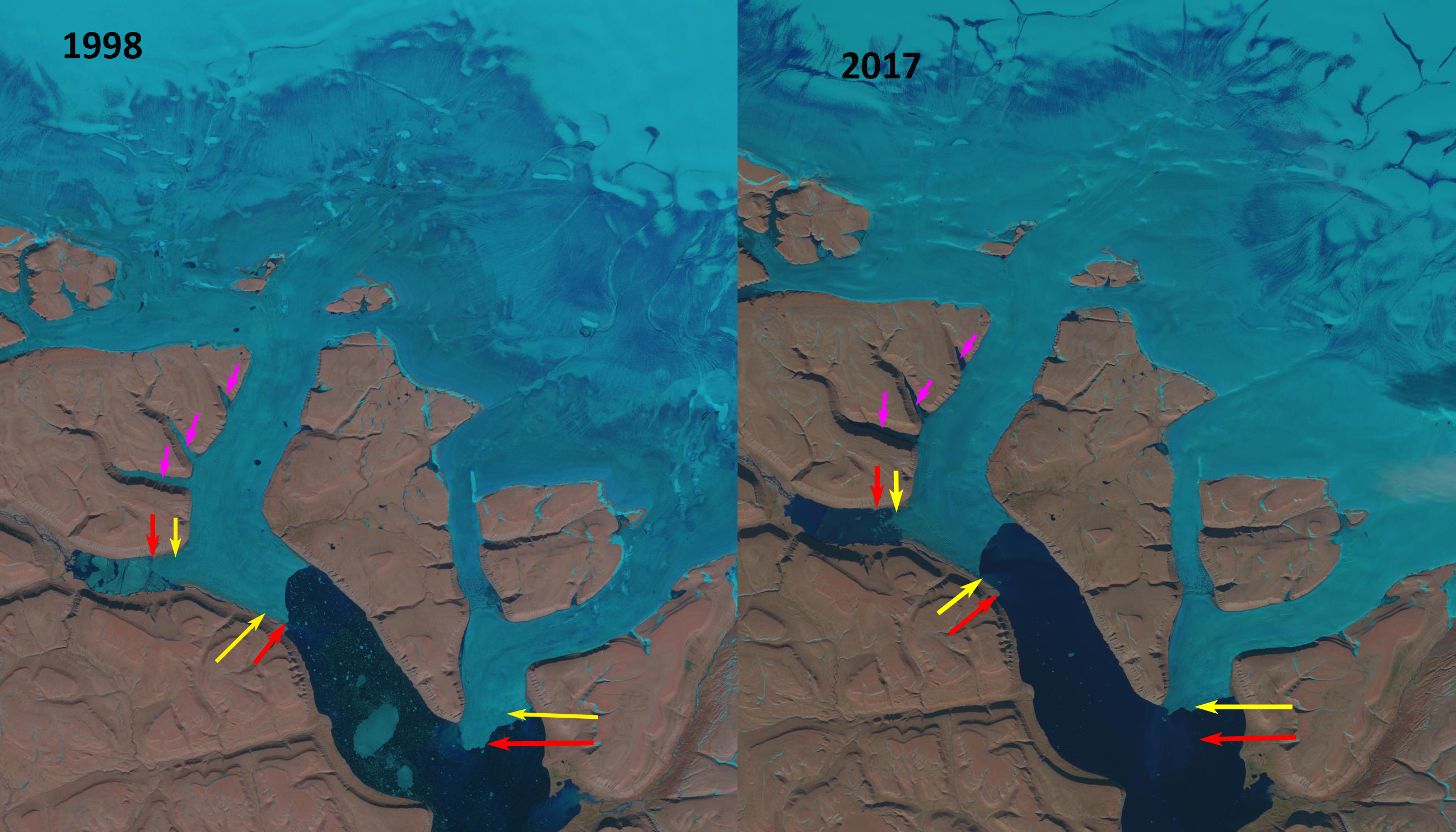
Croker Bay Glacier, Devon Ice Cap, Nunavut in Landsat images from 1998 and 2017.  The red arrows indicate the 1998 terminus location, yellow arrows the 2017 terminus location.  The pink arrows indicate three inlet on the north glacier. 

Croker Bay Glacier drains the southwest quadrant of the Devon Ice Cap, Nunavut.  A study by Van Wychen et al (2012) focused on velocity changes of the Devon ice Cap. They identify that Croker Bay Glacier has two main termini, the south and north terminus and that the region of higher velocity +100 m/year for these glaciers penetrates further into the ice cap than other outlets.  This is on the opposite side of the ice cap from where three new islands have emerged due to retreat.

In 1998 the south terminus of Croker Glacier extends 1.2 km beyond the tip of the peninsula on its west margin. In 1998 the northern terminus has both an east and a west terminus. The west terminus extends up a side valley.  The pink arrows indicate three side channels into which the glacier flows into the southern two.  The transient snowline in 1998 is ~1100 m, with the crest of the ice cap at 1800 m.  In 2001 there is limited change and a recent snowfall has covered most of the glacier. By 2017 the southern terminus has retreated to approximately parallel with the western margin peninsula, a distance of 1700 m.  The northern terminus has retreated 1400 m on the eastern side and 1100 m on the western side. The result is a much thinner ice connection reaching the southern side of the Croker Bay fjord. The transient snowline is high at ~1100 m again.  The 2018 image is from 2018. The snowline has already begun to decline due to a late summer snow event. There are a number of small icebergs in Croker Bay, particularly trapped in front of the western most terminus indicating continued calving retreat.  The observations here are a local example resulting from the ongoing mass losses  found on Canadian Arctic ice caps that have been losing mass for decades and that mass loss accelerated in 1996,  Noel  et al (2018).  This has led to widespread area losses.  White and Copland (2018) quantify the change in the areal extent of 1773 glaciers on Northern Ellesmere Island from 1999 to 2015. They found regional glacier area decreased by ∼6%, with not a single glacier increasing in areal extent.

Croker Bay Glacier, Devon Ice Cap, Nunavut in a Landsat image from 2001 and a Sentinel image from 2018.  The red arrows indicate the 1998 terminus location, yellow arrows the 2017 terminus location.  The pink arrows indicate three inlet on the north glacier. 

Velocity Map of Devon Ice Cap, which is Figure 1 from Van Wychen et al (2012)