Digerfonna, Svalbard Snow Cover Free with Expanding Bedrock Emerging in 2024

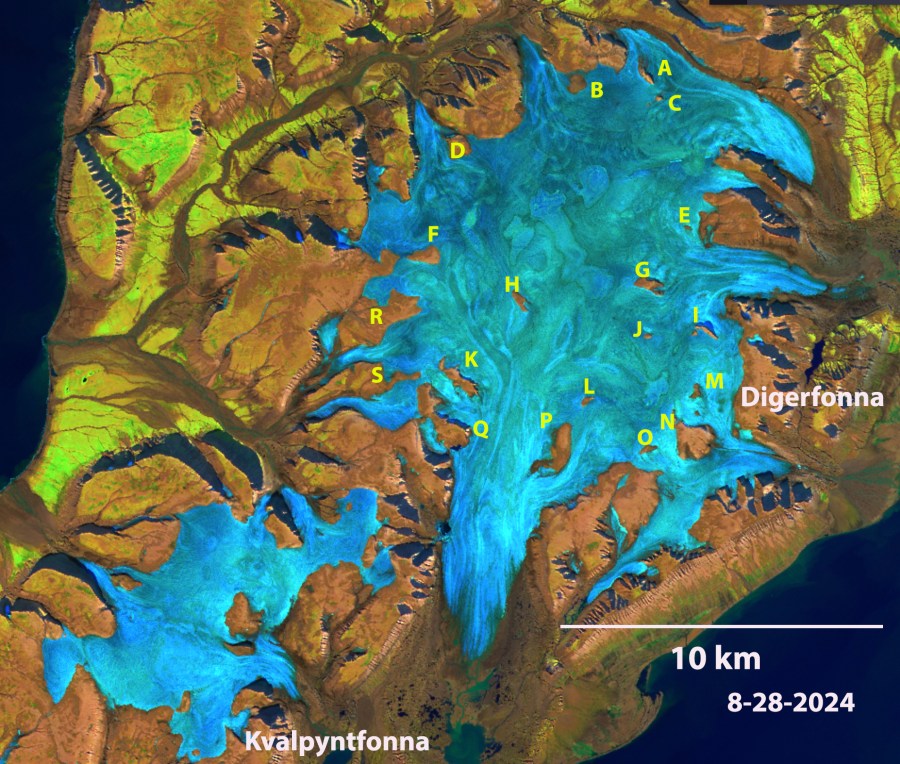
Digerfonna in Aug. 28, 2024 Sentinel image illustrating the number of bedrock areas emerging/expanding Point A-S. There is no snowcover retained, which leads to overall firn loss and greater bare glacier ice exposed.

Digerfonna is the second largest ice cap on Svalbard’s Edgeøya Island at ~200 km2. Svalbard ice caps such as Digerfonna have low maximum elevations 450-550 m in this case. Noel et al (2020) explain that for Svalbard glaciers summer melt consistently exceeds winter snowfall and their survival depends on refreezing a considerable fraction of surface melt in the firn layer covering their accumulation zones. Recent high melt summers have reduced the area of firn cover significantly reducing the ability to refreeze and enhancing melt from darker bare ice surfaces.

Longyearben had its warmest August on record in 2024, indicative of Svalbard as a whole. This led to all snowcover being lost from Digerfonna by early August. This allows continued firn loss that also was observed in 2022 and 2023. On Aug. 28, 2024 the extent of firn is ~10 km2.

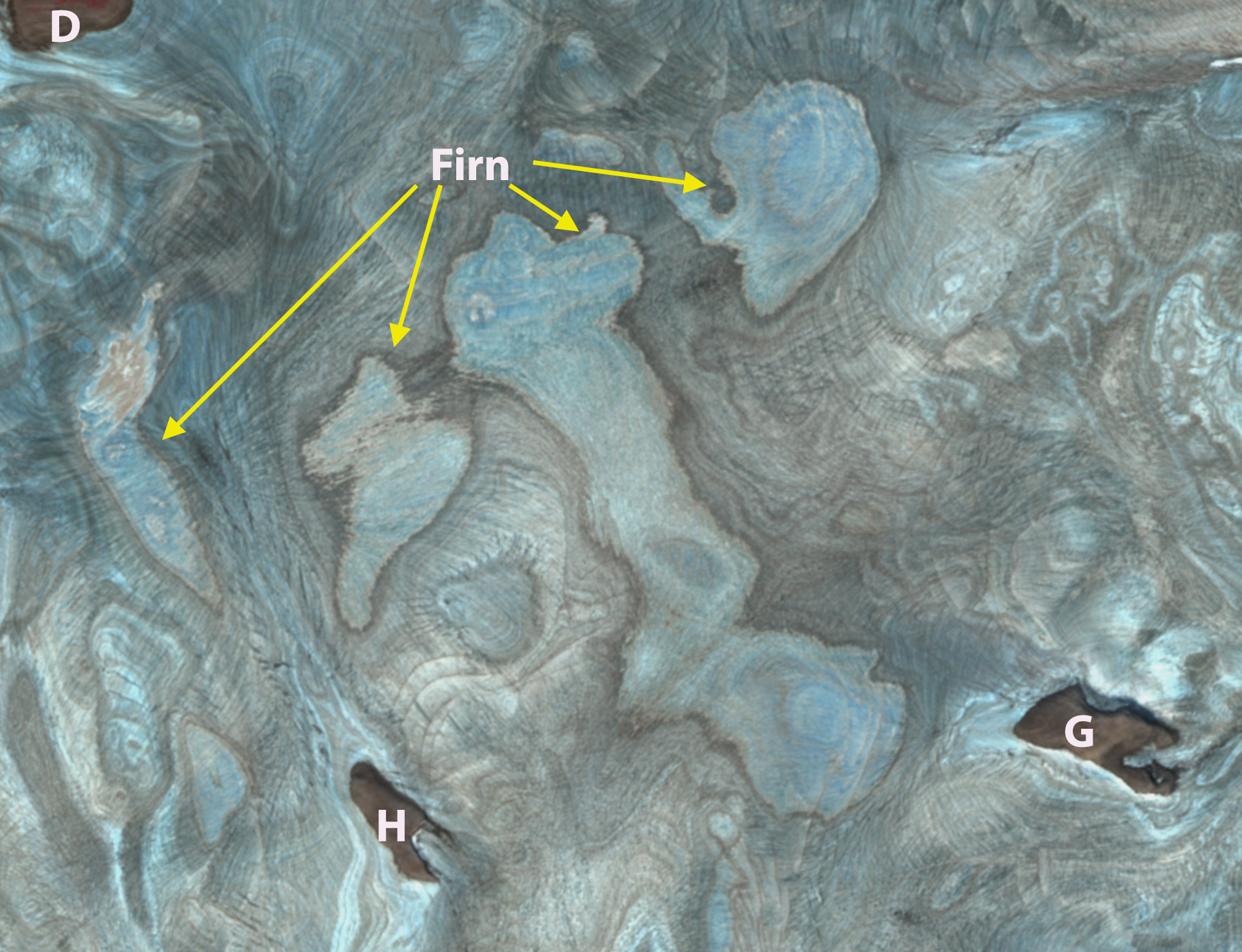
Areas of porous firn near crest of Digerfonna in false color Sentinel image from 8-28-2024.

The firn loss and thinning even at the highest elevations is evident by expansion of bedrock areas near the crest of the ice cap. Note comparsion to six year ago.

Digerfonna in Aug. 14, 20218 Sentinel image illustrating bedrock areas emerging. There is 55% of the ice cap with firn or snow cover retained, which leads to overall firn loss and greater bare glacier ice exposed.

Edgeøya, Svalbard Ice Caps Snow Free in 2022; Fragmentation Ongoing

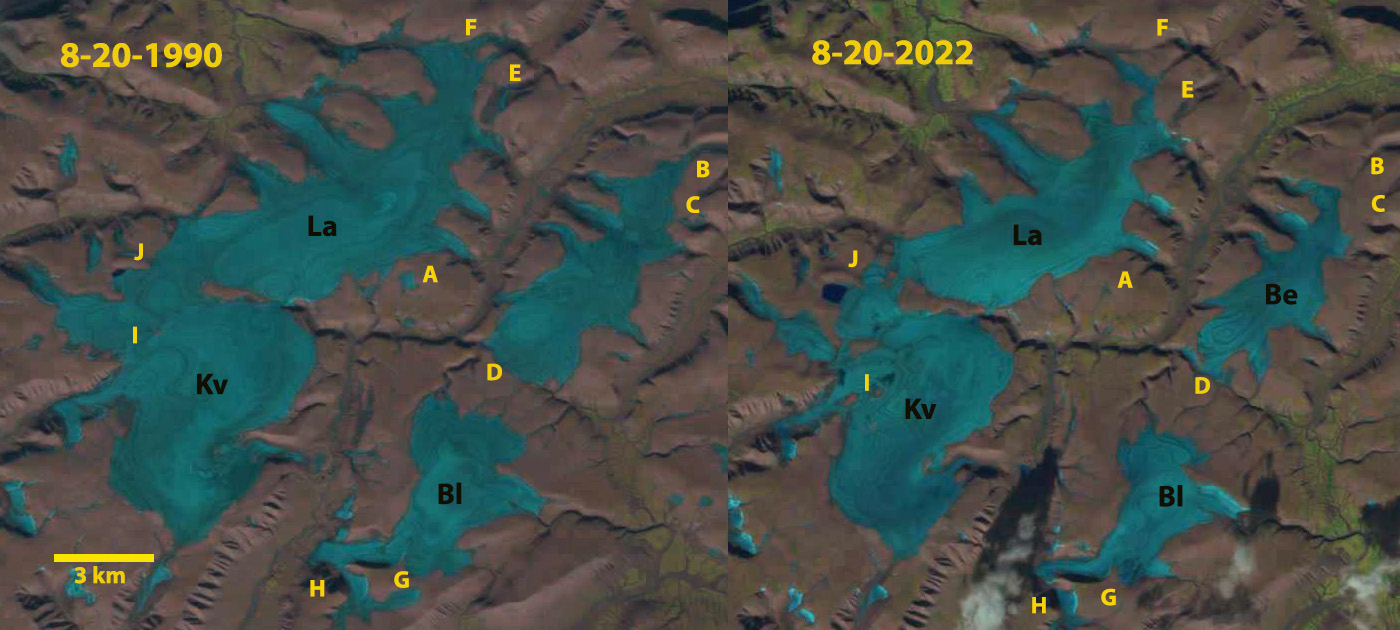
Langjokulen (La), Kvitisen (Kv), Bergfonna (Be) and Blaisen (Bl) ice caps on Edgeøya in Landsat images from 1990 and 2022. Two years of excepational melt where the ice caps lost all of their snow cover. Here the changes in the ice caps are reviwed at Points A-J.

Edgeøya, Svalbard is ~40% ice covered had a number of ice caps some reaching tidewater and others in the interior (Dowdeswell and Bamber 1995). Here we focus on four inland ice caps that have there summits between 440 and 570 m. Thinning is prevalent across the Edgeøya ice caps with significant thinning even at the highest elevations, though less than at lower elevations (Morris et al, 2020). Here we examine the changes of four inland ice caps Bergfonna, Blaisen, Kvitisen and Langjokulen with Landsat imagery from 1990, 2020 and 2022. The lack of retained snow cover is evident.  The annual layering is even more apparent in Sentinel imagery.

Point A- In 1990 a small glacier 0.15 km2 exists that dissapears by 2022.

Point B and C are valleys occupied by ice from Bergfonna outlet tongues that are gone by 2022.

Point D is the valley that Bergfonna terminated in along its southern margin that is now lost most of its ice infill.

Point E and F are valleys occupied by ice from Langjokulen that have lost that ice by 2022.

Point G and H are locations where Blaisen Ice Cap is fragmenting from 1990 to 2022.

Point I is where new bedrock is emerging as Kvitisen thins.

Point J is the location of an expanding proglacial lake now with an area of 0.3 km2 on the northwest side of Kvitisen.

Langjokulen (La), Kvitisen (Kv), Bergfonna (Be) and Blaisen (Bl) ice caps on Edgeøya in Sentinel image from 8-20-2022 illustrating the lack of snowcover, limited firn areas and numerous annual layers. This pattern of annual layers due to glaciers being stripped of snow cover is becoming increasingly frequent. Note Andes last winter and Pacific Northwest summer 2021.

Because of the low top elevation and relatively flat slopes their ability to survive is dependent on much of meltwater generated on the higher plateau areas being refreezing within the firn instead of escaping the glacier (Noel et al 2020). In 2020 the snowcover was lost and the firn thickness diminished. In August 2022 the snowcover again has been lost and there is little evident firn that could lead to refreezing of meltwater. This will drive substantial volume loss of these ice caps in 2022. The MAR Arctic ice caps surface mass balance model illustrates the excess melt from Svalbard as over 1 m in 2022.

TopoSvalbard map and August 2020 Landsat image of the ice caps. This is after a recent small snow event and some drifted snow is evident, though 95% of the ice caps are snow free. 

Gandbreen Retreat and Lake Expansion, Svalbard

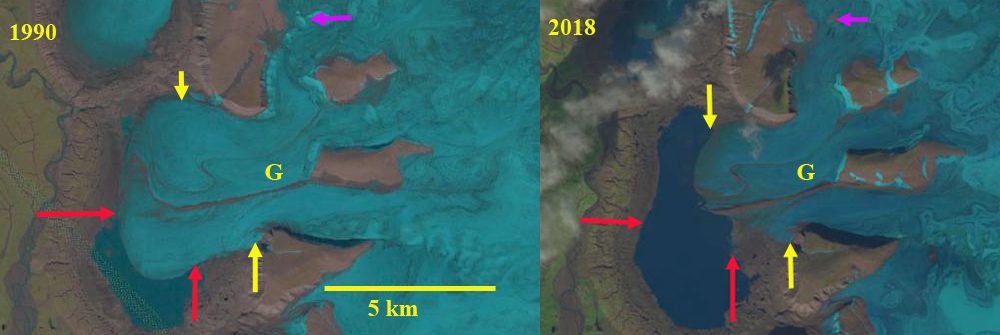
Gandbreen in 1990 and 2018 Landsat images.  The red arrow indicates 1990 terminus location, yellow arrows the 2018 terminus location, and purple arrow a location where bedrock emerges. 

Gandbreen is a western outlet of the Edgeøya Ice Cap, Svalbard.  This is a surging glacier, that has not had an observed surge.  Deltabreen a larger adjacent glacier to the south has no observed either.  Strozzi et al (2017) noted that the western outlet of Edgeøya Ice Cap, Stonebreen had slowly retreating glacier front from 1971 until 2011, followed by a large increase in  velocity since 2012.  This is less of a true surge and potentially a change in frontal dynamics.  Glaciers in Svalbard have experienced significant retreat and volume loss, including surging glaciers. Edgeøya Ice Cap has lost 18% of its area from 1936-2006 (Nuth et al 2013).  ( Möller and Kohler (2018) identified this region as having had an increasing and significant mass loss from 1900-2010 driven largely by ablation increases. Here we examine the glacier changes from 1990-2018 using Landsat images.

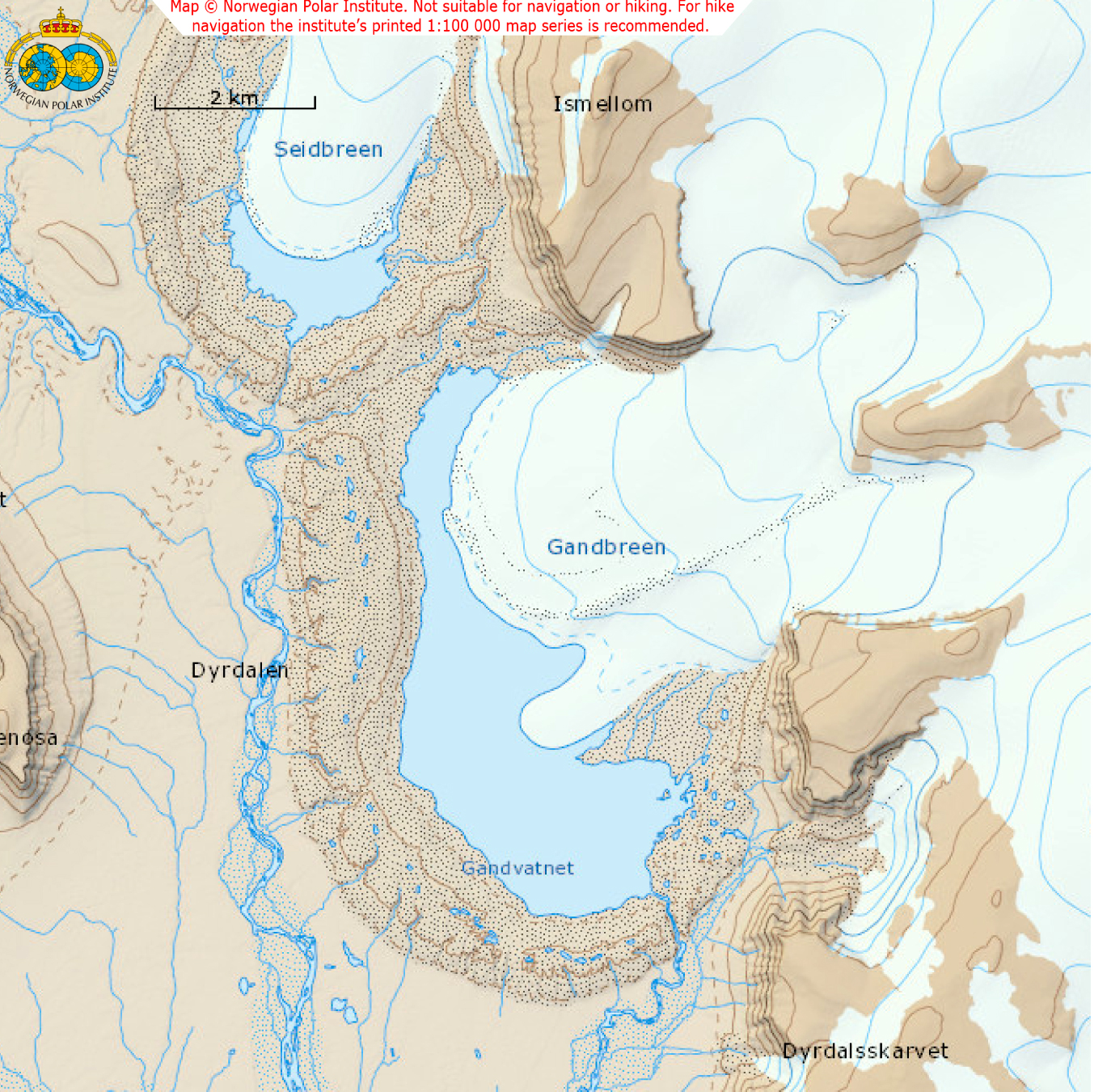
In 1990 Gandbreen’s southern margin terminated in the Gandvatnet proglacial lake, while the northern margin was grounded.  The area of the lake was 3.7 square kilometer and the length of the glacier front in contact with the glacier was 3.4 km. There is not a substantial area of retained snowpack on the ice cap in 1990.  By 2002 the entire margin of the glacier had retreated into the lake and the glacier front in the lake was now 7 km long.  The northern half of the lake was narrow at 100-400 m wide.  By 2016 further retreat and reduced the glacier front in the lake to ~5 km.  A new area of bedrock had appeared, pink arrow, had appeared at an elevation of  300 m, the ice cap divide is at 400-450 m. By 2018 the southern margin of the glacier is grounded on the eastern shore of the lake.  Gandvatnet has expanded to an area of 10.7 square kilometers and the margin of the glacier in the lake is 4.5 km. The terminus has retreated 1800 m on the southern margin, 1250 m in the center, and 2400 m on the north margin.  There is not a substantial area of retained snowpack on the ice cap in 1990, indicating that expanded ablation has driven the retreat.  The retreat of Gandbreen is less significant than at Besselbreen.  Fridtjovbreen has potentially surged for the last time, has Gandbreen?

Gandbreen in 2002 Landsat image.  The red arrow indicates 1990 terminus location and yellow arrows the 2018 terminus location. 

Toposvalbard map of Gandbreen

Gandbreen in 2016 Landsat image.  The red arrow indicates 1990 terminus location, yellow arrows the 2018 terminus location, and purple arrow a location where bedrock emerges.