Potential Preconditioning for Landslide High 2020 Glacier Snow Lines in Rishi Ganga Basin, India 2020

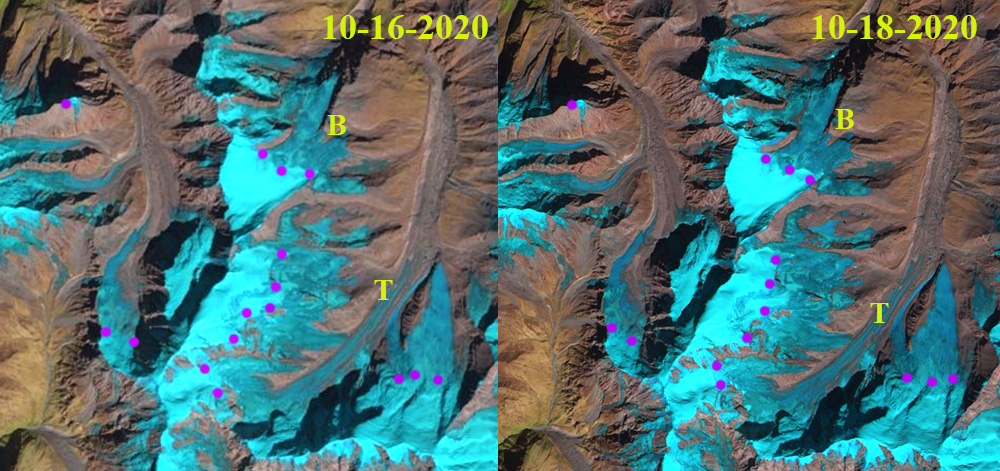
Snowline elevation on Trisul (T) and Bethartoli Glacier (B) in a 10-26-2020 Landsat and 10-18-2020 Sentinel image.  The snowline ranges from 5800-6000 m, purple dots.

The catastrophic landslide and resulting flood in the Rishi Ganga basin Uttarakhand, India on Feb. 7 was triggered on a formerly glaciated slope at 5600 m detailed in a blog post by Petley (2021). This event occurred after a post-monsoon season featuring high snowlines on adjacent glaciers and the warmest January in the last six decades  in Uttarakhand, India. Glacier snowlines are a proxy for the elevation where melting predominates. Were these preconditioning factors? Here we examine the elevation of the glacier snowlines in 2020.

The headwaters of the Rishi Ganga Basin, India feature a number of large glaciers draining the slope of  Nanda Devi, Trisul and other high Himalayan peaks. The response of glaciers of the Rishi Ganga basin to climate change was examined by Kumar et al, (2020). They found a 10% reduction in glacier area from 1980-2017.  They further observed the ELA to fluctuate from 5200-5700 m.
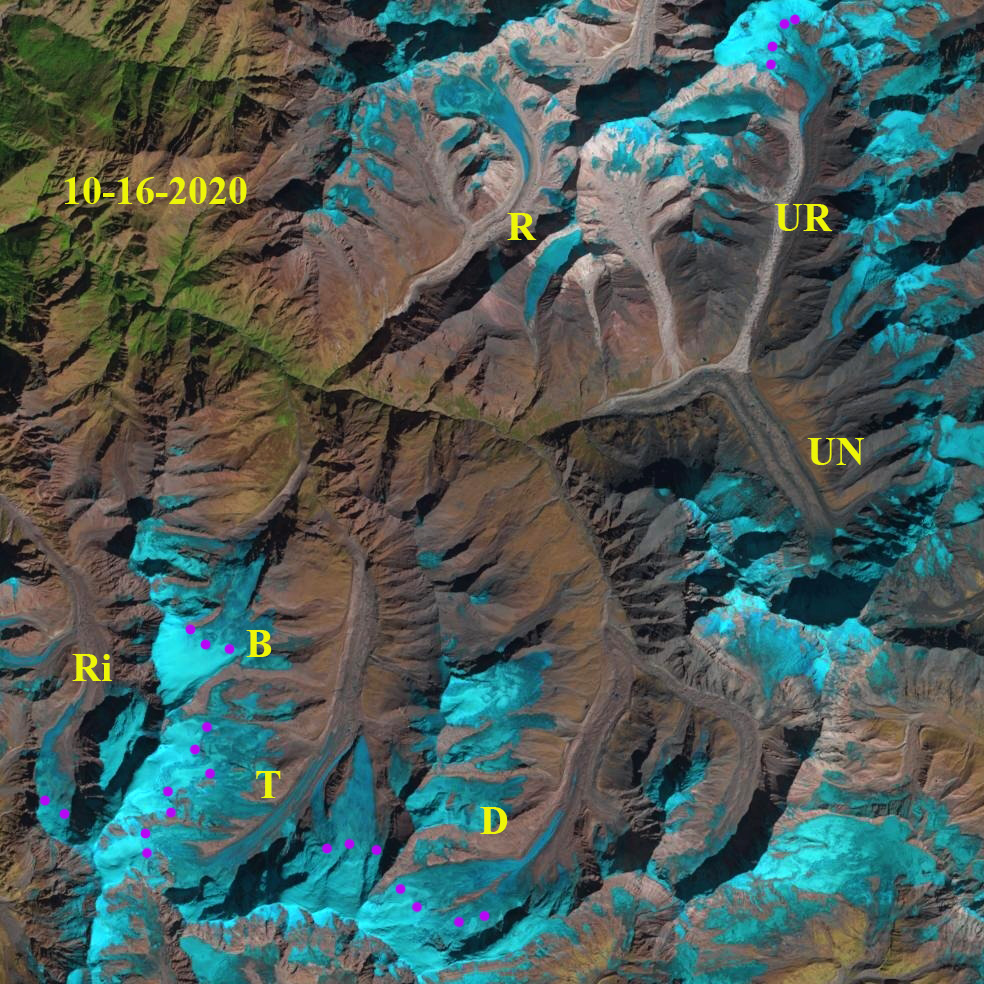
Nanda Devi region glaciers in 10-16-2020 image indicating the snowline at between 5800 and 6000 m on all the glaciers in the upper Rishi Ganga: Bethartoli (B), Dakshini (D), Ramani (R), Rinti (Ri), Trisul (T), Uttar Nanda Devi (UN), Uttar Rishi (UR).

In 2020 at the end of the summer monsoon the snowline on glaciers in the Rishi Ganga Basin were high at 5600-5700 m on Sept.13 as noted in particular on Trisul (T), Rinti (Ri), Ramani (R), Uttar Rishi (UR), Uttar Nanda Devi (UN), Dakshini (D) and Bethartoli Glacier (B) and an Rinti Glacier to the west that the landslide debris ended falling below. By mid October the snowline on the glaciers had risen to ~5800-6000 m on these seven glaciers in Landsat and Sentinel imagery.  On Ramani Glacier there is no retained snowpack with the top elevation of the glacier at 5800 m. The amount of dark blue bare ice is striking. The snowline indicates an elevation that the freezing level during that year frequently rose above. This indicates the freezing line rose above the trigger elevation site ~5600 m frequently enough in 2020 that melting exceeded snowfall. This is higher than Kumar et al (2020) had observed during the recent period of increased glacier snow lines. By January 11, 2021 the area was blanketed by snow down to 4400 m, the subsequent warm period led to widespread melting and snow cover loss up to at least 5000 m on Trisul Glacier and Uttar Rishi Glacier.  The freezing line and glacier snowline elevations in the post monsoon period are similar to near Mount Everest, where the January warmth led to even greater high elevation melt (NASA, 2021).

Whether the unusually high elevation melting and freezing levels observed on glaciers in the region in 2020 were pre-conditioning cannot be answered with analysis such as this, but it does demonstrate the the elevation range of landslide initiation was below the observed glacier snow lines in 2020 and in an elevation zone that experienced unusual melt conditions in 2020. The increased freezing levels in the region over the last several decades were documented for the Mount Everest area by Perry et al (2020),indicative of a long term trend.
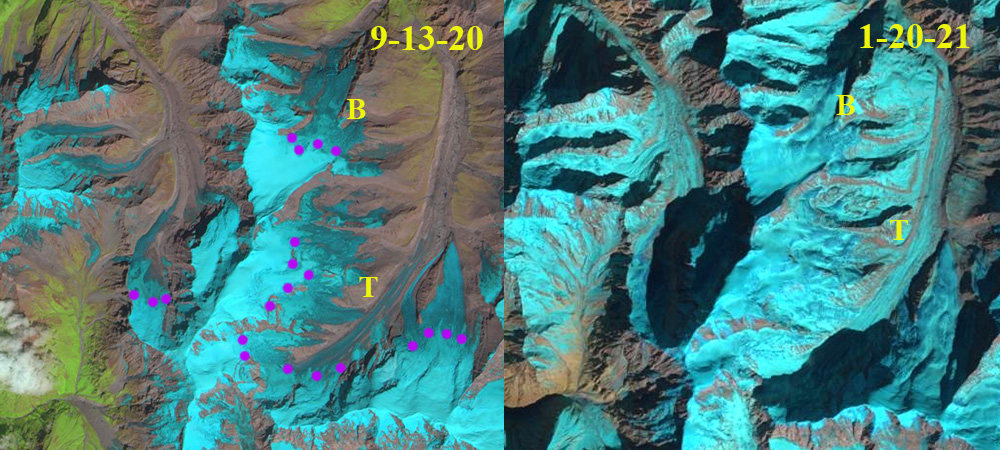
Snowline elevation on Trisul (T) and Bethartoli Glacier (B) in a 9-13-2020 Landsat and 1-20-2021 Sentinel image.  The snowline ranges from 5600-5700 m in September.
Heard Island Retreat of Glaciers Enables Lagoon Development

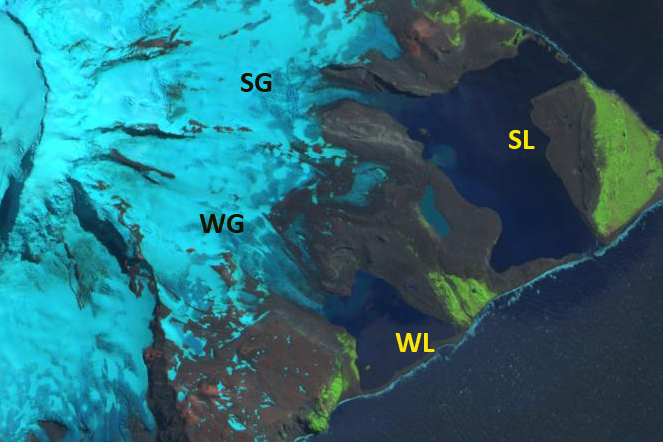
Stephenson Glacier (SG), Sephenson Lagoon (SL), Winston Glacier (WG) and Winston Lagoon (WL) in 2019 Sentinel Image.

The Australian Antarctic Division (AAD) manages Heard Island and has undertaken a project documenting changes in the environment on the island. One aspect noted has been the change in glaciers. The Winston, Brown and Stephenson Glacier have all retreated substantially since 1947 when the first good maps of their terminus are available. Fourteen Men by Arthur Scholes (1952) documents a year spent by 14 men of the Australian National Antarctic Research Expedition that documented the particularly stormy, inclement weather of the region. Their journey to the east end of the island noted that they could not skirt past the glaciers along the coast. After crossing Stephenson Glacier they visited an old seal camp and counted 16,000 seals in the area. It is a rich area for wildlife, that will benefit from the lagoon formation overall. Three species of seal commonly breed on Heard Island, southern elephant seals, Antarctic fur seal and sub-antarctic fur seals (AAD, 2019).

Here we examine the retreat of Stephenson Glacier and Winston Glacier from 2001-2019 and the consequent lagoon expansion. As Kiernan and McConnell observed retreat of Stephenson Glacier had begun by 1971 the glacier had retreated 1 km from the south coast and several hundred meters from the northern side of the spit. This retreat by 1980 caused the formation of Stephenson Lagoon.

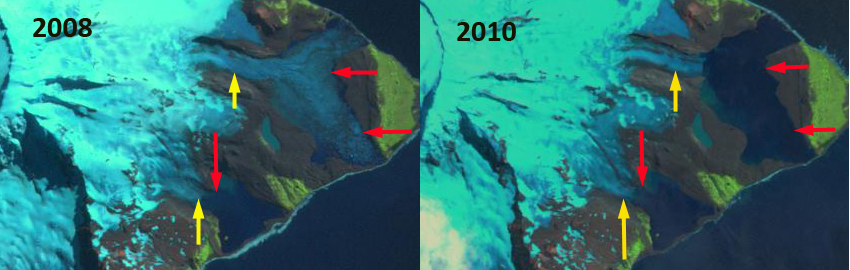
Retreat of Stephenson Glacier and Winston Glacier from 2001 (red arrows) to 2018 (yellow arrows) in Landsat images.

In 2001 Stephenson Glacier has two separate termini, red arrows terminating in two separate lagoons, Doppler to the south and Stephenson to the east. There are numerous icebergs in Doppler lagoon but none in Stephenson Lagoon, indicating the retreat is underway. Winston Glacier terminates where the lagoon widens. In 2008 the two lagoons in front of Stephenson Glacier are joined with a narrow eastern channel, the lagoons are filled with icebergs as a terminus collapse is underway. Winston Glacier has retreated into a narrower inlet from the wider Winston Lagoon.  By 2010 Stephenson Glacier had retreated from the main now singular Stephenson Lagoon, and like Winston Glacier in 2001 terminates at narrow point where the glacier enters the main lagoon.  By 2018 Stephenson glacier has retreated from the main lagoon, the northern arm of the glacier experienced a 1.8 km retreat from 2001 to 2018 and the southern arm as 3.5 km retreat.  The lagoon is free of ice for the first time in several centuries if not several millennia. The period of rapid retreat due to calving of icebergs into the lagoon is over and the retreat rate will now be slower.  Winston Glacier has retreated 600 m from 2001-2018.  The overall lagoon expansion has been limited as the glacier has retreated up an inlet that is 500 m wide.

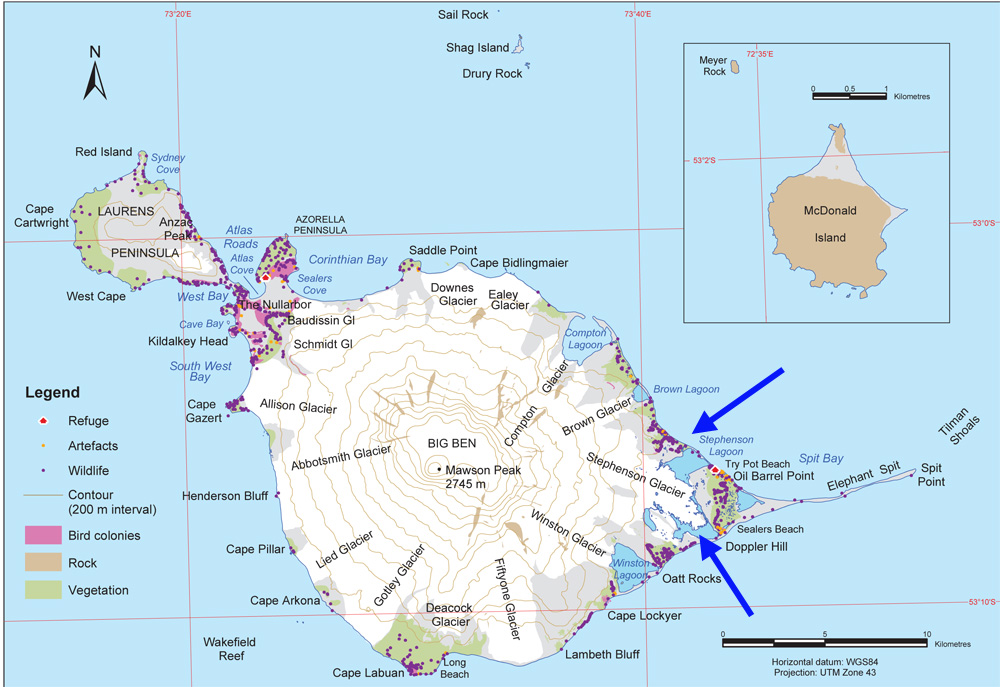
The AAD has a number of images in their gallery of Heard Island glaciers including Stephenson Glacier. The climate station at Atlas Cove indicates a 1 C temperature rise in the last 60 years.  The AAD will also certainly be looking at how this new lagoon impacts the local seal and penguin communities. The population of king penguins increased sharply from the 1940’s into the 21st century, while rockhopper, gentoo and macaroni  penguins numbers declined over the same period (AAD, 2019).The map below indicates the importance of Stephenson Lagoon and Winston Lagoon for wildlife, king penguins and cormorants are noted by AAD.  The retreat of this glacier follows the pattern of glacier retreat at other glaciers on islands in the circum-Antarctic region Cook Ice Cap, Kerguelen Island Hindle Glacier and Neumayer Galcier, South Georgia.

HIMI_general.pdf

Map of  Heard Island from AAD

Stephenson Glacier and Winston Glacier in Landsat images from 2008 and 2010.  Terminus location of 2001 red arrows and terminus location in 2018  at yellow arrows.