Vallelunga and Barbadorso Glacier Retreat, South Tyrol Italy

vallelunga compare

Vallelunga (above) and Barbadorso di Dentro Glacier (below) retreat from 2003 (orange line) to 2015 yellow dots.  Blue arrows indicate flow path and pink arrow the junction of main two tributaries of Vallelunga Glacier.

Vallelunga Glacier and Barbadorso di Dentro Glacier are at the headwaters of the Vallelunga watershed which feeds the Reschensee.  Reschensee is a reservoir famous for the church tower that emerges above its surface.  This artificial lake was completed after World War II and is the reservoir for the 105 MW Glurns Hydroproject owned by Seledison.  These two glaciers are examined as part of the annual campaign of the Italian Glacier Committee.  The annual reports for 2011-2013 indicate a retreat of 78 m for Vallelunga and 60 m for Barbadorso.  Here we examine Google Earth images from 2003 and 2015 to indicate the change in a twelve year period.

In 2003 Vallelunga Glacier terminus was at an altitude of 2500 m.  The glacier is comprised of two tributaries that join at the pink arrow. The orange line is the 2003 terminus location. By 2015 the smaller western tributary has nearly separated from the main glacier.  the terminus has retreated 460 m in the 12 year period. Barbadorso Glacier terminated at 2690 m in 2003.  By 2015 the terminus has retreated 250 m and terminates 100 m higher in elevation at nearly 2700 m. On July 31, 2015 the snowline on the two glaciers is at 3100-3200 m with 6-8 weeks left in the melt season.  This indicates another year of negative mass balance that will continue to drive retreat.

These glaciers are just across the border from Gespatcherferner one of the fastest retreating Austrian Glacier’s in recent years. Carturan et al (2016) examining long term Italian glacier mass balance series note the 2004-2013 period as particularly negative.  They further observe that this is mainly due to increased ablation and that annual balance is becoming more closely correlated with accumulation season (October-May) temperature suggesting warmer winters extending melt season and leading to an increased ratio of winter rain events. The continued reduction in glacier area reduces late summer water flow to the reservoir, which will either cause reduced power output or the need for more storage early in summer (Pelto, 2014).
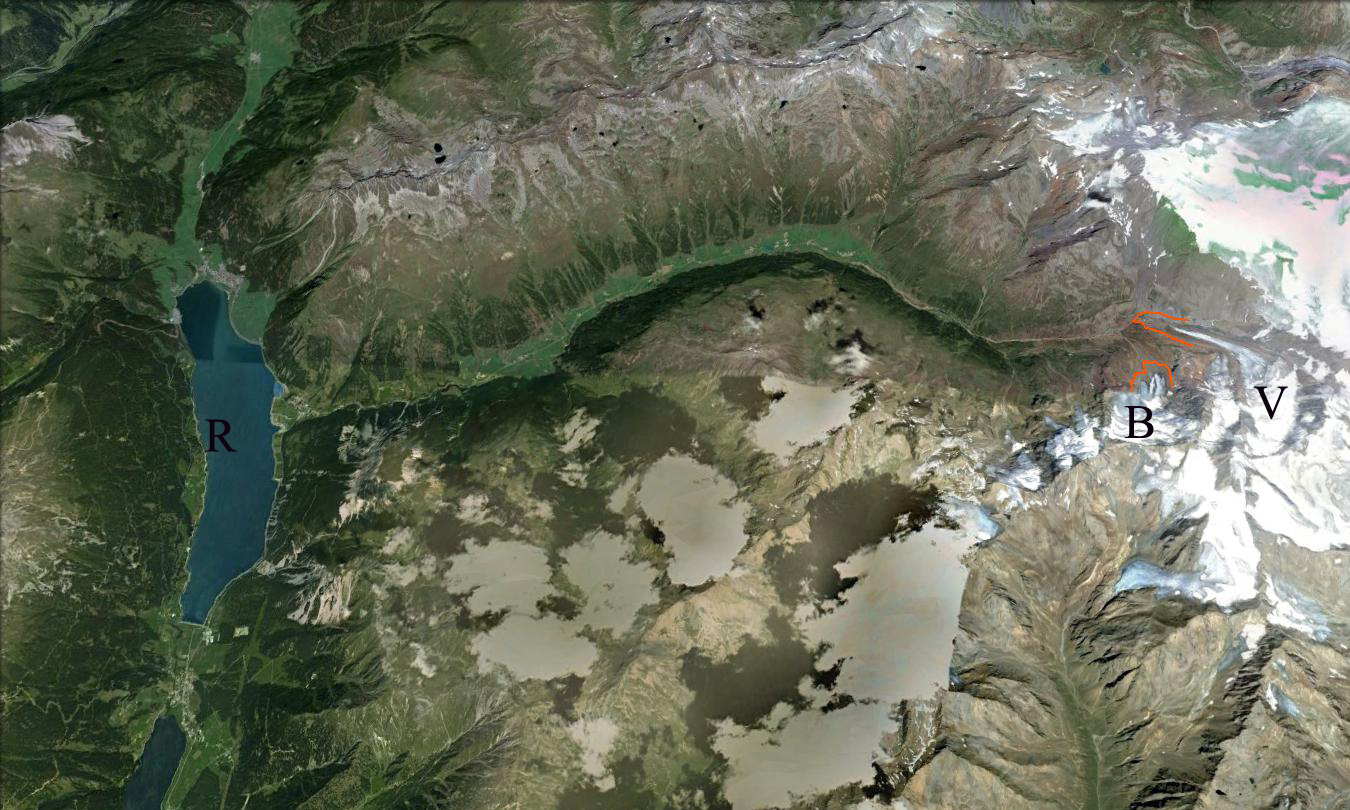
reschensee ge

Vallelunga watershed feeding Reschensee (R).  Vallelunga Glacier (V) and Barbadorso Glacier (B).

vallelunga 2015 tsl

July 31, 2015 Landsat indicating a high snowline, purple dots, with nearly half the summer to go. 


Sabbione Glacier Retreat, Italy

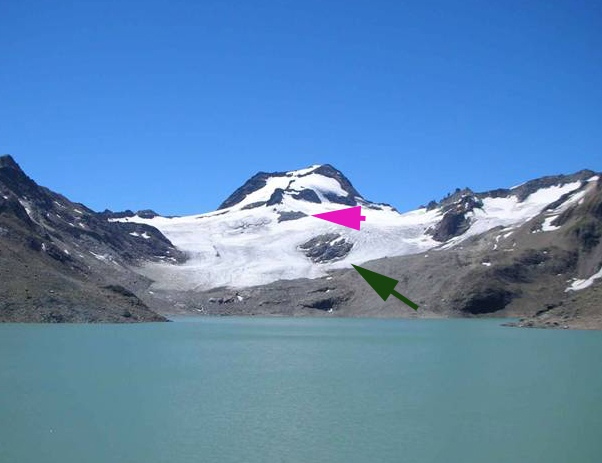
Italy’s mountains have been experiencing a warm summer, rivaling their warmest summer in the last couple of centuries, 2003. The impact on the glaciers will be considerable melting. Here we look at the retreat of the Sabbione Glacier. The glacier drains into Lago Sabbione an artificial lake that in turn drains into Lago Morasco, which is a 29MW hydropower facility. The lake also has good fishing. This glacier in 1988 reached the shore of Lago Sabbione.
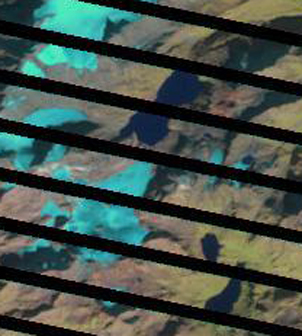
In a series of Landsat images from 1988, 2006 and 2010 and a picture from Lago Sabbione in 2007, the retreat from the lake is evident. Tthe 1988 terminus is indicated by a red arrow, the 2010 terminus by a yellow arrow, the new outcrop in the midst of the glacier by a magenta arrow and the outcrop that has reached the margin of the glacier in 2010 a green arrow. The retreat during this period has been 450 meters. of greater concern for the future of the glacier is the emergence of rock outcrops in the midst of the middle portion of the glacier, and smaller ones on the upper glacier. This indicates a glacier that is not in equilibrium lacks a persistent accumulation zone, indicating it will not survive current climate.

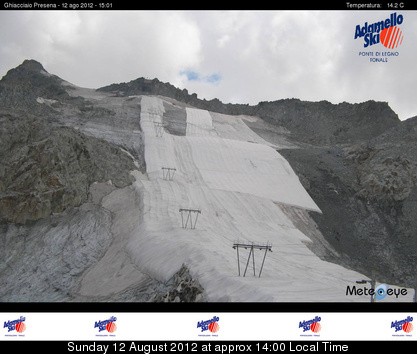
The retreat is similar to the losses experienced across Italy from the smaller Dosde Glacier, the larger Forni Glacier and the Presena Glacier, ski area. On the latter on Aug. 12, 2012 from the ski area webcam you can see the attempts to use blankets, grooming and snowmaking to supplement the glacier, which off the ski run is bare ice.

Dosde Glacier, Italy retreat and separation

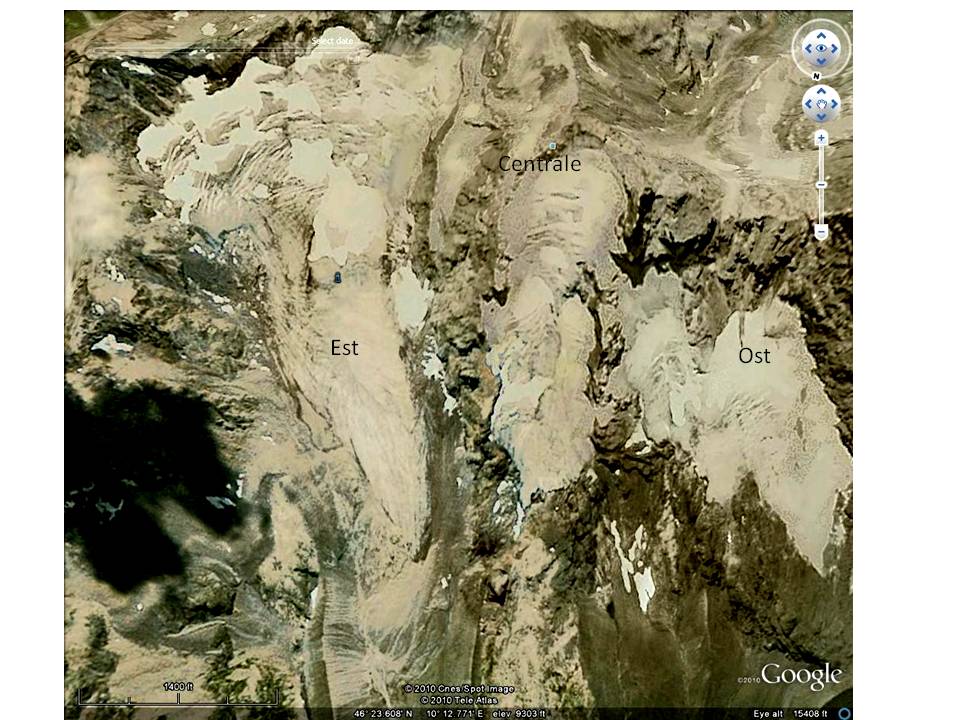
Dosdè Glacier in the Dosdè-Piazzi Group of the Italian Alps has been the focus of research by the University of Milan Department of Geography in the last decade to both chronicle its retreat, examine the causes, and evaluate the impacts and potential mitigation steps. In 1954 there was a Dosdè Est, Dosdè Centrale and Dosdè Ovest glaciers with respective areas of 1.2 and 0.8 and 0.9 square kilometers. By 2003 the areas had been reduced to 0.8, 0.5 and 0.3 square kilometers. This is evident in the picture from 1932 and 2007 of the Dosdè Glacier group from Guglielmina Diolaiuti, University of Milan. I have added arrows annotating key changes Est is on the left, Centale in the middle and Ovest (labelled Ost) on the right. The purple arrow indicates the separation of two glaciers. The blue arrow indicates the change in glacier size near the top of the peak. The orange arrow notes the thinning of the glacier near the current glacier tongue. The green arrow indicates the retreat at the head of the glacier indicating thinning even in the accumulation zone. This glacier lost all of its snowcover in several recent summers including 2010, in this Google Earth view the summer of 2010 is ongoing and their are a few white patches of snowpack from the previous winter, that were then lost. This inconsistency of the accumulation zone is a sign of a glacier that cannot survive In this region at least 6 glaciers have been observed to disappear in the last 50 years. The continued decline in area and lack of accumulation zone persistence does not suggest that glaciers in this mountain massif will survive. Dosdè Est has retreated over 400 meters in the last 50 year, but of more importance to its survival is the degree of thinning apprarent from the terminus to its head. Dosdè Est has been the focus of study utilizing a covering blanket to examine its efficacy in reducing ablation as was done on Stubai Glacier in Austria. The University of Milan group reported a 43% decline in snow ablation and a 100% decline in ice ablation. The retreat of this glacier follows the trend of increasingly rapid and widespread retreat seen throughout the Italian Alps, as chronicled by the Italian Glacier Commission, which reported more than 95% of the over 100 glaciers examined retreating from 2000-2005. The smaller size and elevation range of the Dosdè Glacier group makes them more vulnerable to complete loss than Forni Glacier.