Hallo Glacier Retreat, Katmai Alaska

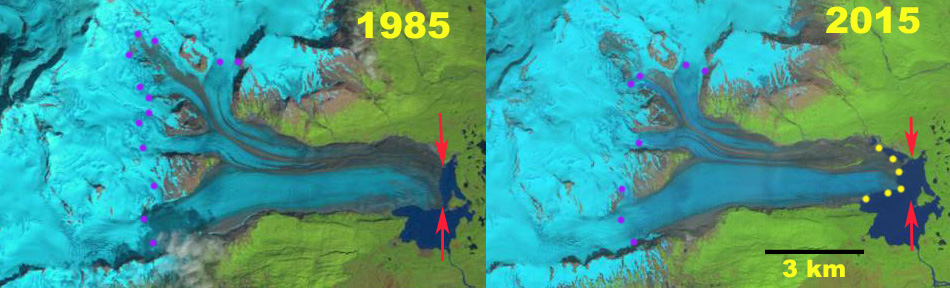
Landsat images of Hallo Glacier in 1985 and 2015 indicating the 1985 terminus position red arrows and yellow dots indicate 2015/2016 terminus location.  Purple dots show the snowline

Hallo Glacier is one of the larger glaciers in Katmai National Park draining east from Mount Steller and ending in an expanding proglacial lake east of Hallo Bay.  Hallo Bay is well known as a good location for brown bear watching (NPS).  Arendt and Larsen (2012) assess the glacier changes in Alaska National Parks they provide a map of the change in glacier extent from 1956-2009, Figure 7.  This indicates a significant retreat but it is not quantified. They further note a 15% decrease in areal extent of Katmai Region glaciers from 1956-2009.  Giffen et al (2015) indicate the glacier retreated 900 m from 1951-1987 and then advanced 150 by 2000. Here we utilize Landsat imagery to examine retreat from 1985 to July 2016 to examine the glaciers response.

In 1985 the glacier terminated just off the western shore of a small island in the lake.  The terminus front in the lake measured 3000 m in length.  The snowline averaged 1050 m across the glacier. By 1995 little retreat had occurred, the snowline was averaged 1050 m. In 2000 the glacier terminus had changed little from 1985.  The average snowline was at 1100 m. In 2015 the terminus had retreated 600 m from the island and 800 m along the northern shore of the lake.  The snowline is at 2000 m.  In 2016 the snowline is averages 1150 m , the highest observed. The terminus front in the lake remains 3000 m long.  The rate of retreat increased after 2000, and the glacier is poised for additional retreat. A 2013 Google Earth image illustrates that the lower 3.5 km of the glacier has a low slope and limited crevassing, except for minor crevassing along southern calving front.  This indicates the lake is likely to expand at least to this point.  Further that the glacier is poised for continued significant retreat and lake expansion.  The retreat is less than, but similar to that of nearby  FourPeaked  and  Spotted Glacier.
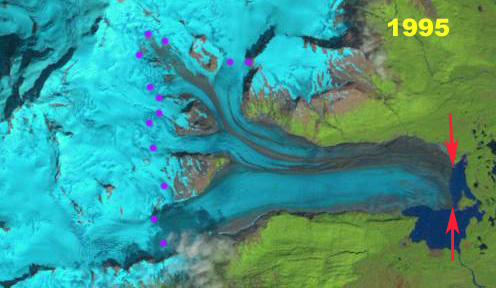
 

1995 Landsat image of Hallo Glacier indicating the 1985 terminus position red arrows.  Purple dots show the snowline

2000 Landsat image of Hallo Glacier indicating the 1985 terminus position red arrows and yellow dots indicate 2015/2016 terminus location.  Purple dots show the snowline

2016 Landsat image of Hallo Glacier indicating the 1985 terminus position red arrows.  Purple dots show the snowline.
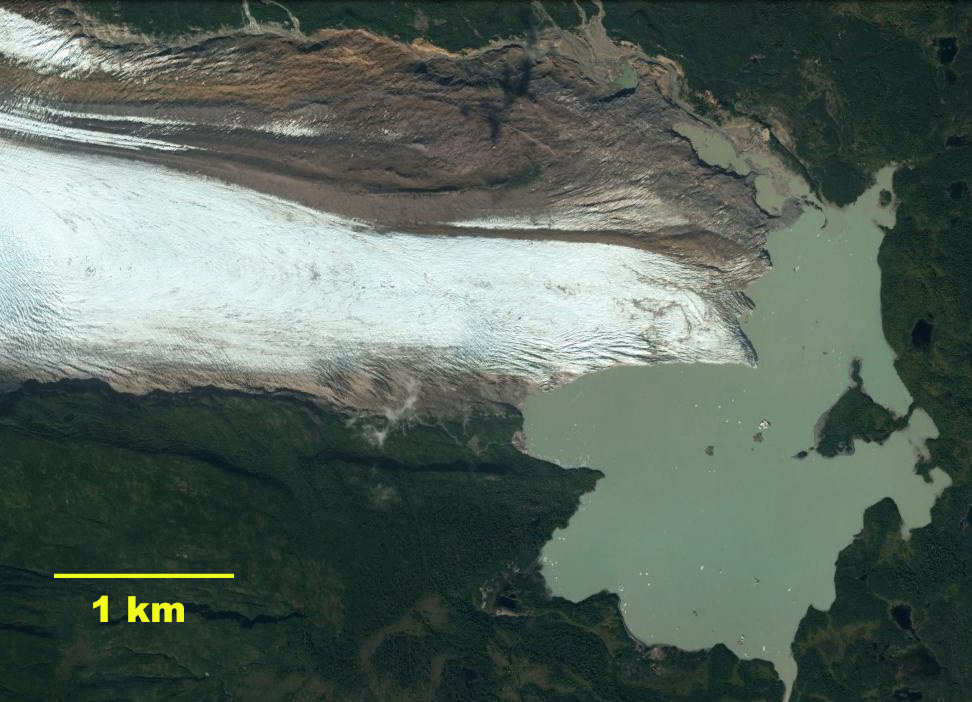
2013 Google Earth image of Hallo Glacier, note low uncrevassed terminus tongue in lower 3.5 km.


Spotted Glacier Retreat, Katmai Region, Alaska

Spotted Glacier flows north from Mount Douglas and terminates in a developing proglacial lake. In the USGS map from 1951 the lake is not evident. Giffen et al (2008) noted that the glacier retreated ~1200 m from 1951-1986, a rate of 33 m/year.
spotted glacier map
Here we examine 1985 to 2013 Landsat imagery to identify the terminus change of this glacier since 1985. In each image the red arrow indicates the 2013 east side of the terminus, the pink arrow a rock knob adjacent to the 1985 terminus, and the yellow arrow a peninsula that should become an island as the further retreat occurs. In 1985 there is no evidence of the peninsula, the lake is relatively round, and has a north-south length of 1250 m. By 2000 the glacier has retreated sufficiently to expose the peninsula at the yellow arrow. The lake is now 1450 m from north to south. Neither of the images indicates many icebergs suggesting this is currently not a main mechanism of ice loss. By 2013 the peninsula is 450 m long, the north-south length of the lake is 1700 m. The retreat of 450 m in the 28 year period is nearly 30 m/year, a similar rate to the 1951-2000 period. The 2012 Google Earth image indicates a few small icebergs in the lake, again suggesting that despite some calving this is not a main glacier volume loss. The glacier front remains active and crevassed, suggesting that retreat will remain slower than for nearby Fourpeaked, Excelsior or Bear Glacier.
spotted glacier 1985
1985 Landsat image

spotted glacier 2000
2000 Landsat image

spotted glacier 2013
2013 Landsat image

spotted glacier ge 2012
2012 Google Earth image

Fourpeaked Glacier Retreat, Katmai area, Alaska

Fourpeaked Glacier drains east from the volcano of the same name in the Katmai region of southern Alaksa. The Park Service in a report (Giffen et al 2008) noted that the glacier retreated 3.4 km across a broad proglacial lake that the glacier terminates in from 1951-2986, a rate of 95 m/year. From 1986-2000 they noted a retreat of 163 m, or 13 m/year. In a more recent report with the Park Service Arendt and Larsen (2012) provide a map of the change in glacier extent from 1956-2009, Figure 4, but note the poor data overall on historic changes of Fourpeaked. Here we utilize Landsat imagery to examine retreat from 1981 to July 2014.
fourpeaked ge
Google Earth image
A Landsat 2 image from 1981 with relatively low resolution indicates much of the proglacial lake still occupied by ice, but much of this is floating icebergs detached from glacier, which is hard to distinguish in this image. In each image the red arrow is the 1985 terminus and the yellow arrow is 2013-2014 terminus. In 1985 the terminus is at the red arrow, with considerable floating ice still evident that is not part of the glacier. The snowline, purple dots, is at 750-800 m though this is not near the end of the summer. By 2000 the floating ice is gone, and the terminus has retreated into a narrower inlet. The snowline is at 850 m. By 2013 the glacier has receded further up this inlet and the width of the lower glacier is less. This is a July image and the snowline is still relatively low. In the July 2014 image the snowline is quite high at 700 m, given that this is mid-summer. It is not apparent in the Landsat image, but the large local forest fires in the spring could reduce albedo and enhance melt this summer. The terminus has retreated 1.9 km from 1986 to 2014 a rate of 68 m/year. The retreat from 1981-2000 was fed by calving in a broad proglacial lake. From 2000-2014 the retreat has continued despite the narrowing of the calving front. That the glacier has narrowed even more and thinned in the lower reach is indicative of a retreat that will continue. This glacier is behaving like other Katmai area glaciers, Giffen et al (2008) noted that 19 of 20 are retreating. The glacier retreat has led to formation and expansion of a large lake much like other glaciers in the region; Bear Glacier, Excelsior Glacier and Pedersen Glacier. The last image is an animated gif created by Espen Olsen illustrating the change in the glacier. Katmai 1981
1981 Landsat image

katmai 1985
1985 Landsat image

katmai 2000
2000 Landsat image

katmai 2013
2013 Landsat image

katmai 2014
2014 Landsat image

mauri
Espen Olsen animated gif of Landsat images