Weddel Glacier Retreats from Tidewater, South Georgia Island

Weddel Glacier in 1989 and 2020 Landsat images.Red arrow marks the 1989 NW terminus, orange dots the terminus location, purple arrows locations of ice spilling over a ridge, pink arrow a tributary glacier and yellow arrow the base of an icefall.

Weddel Glacier is on the southeast coast of South Georgia Island terminating in Beaufoy Cove  just north of Gold Harbor. The change in glacier terminus position was documented by Alison Cook at British Antarctic Survey in a BAS retreat map.  In 1958 it reached within 400 m of the outlet of Beaufoy Cove.  For Weddel Glacier the retreat was rapid from 1960 to 1974 and was slow from 1992-2003.  Here we examine Landsat imagery from 1989 to 2020 to visualize and update this change.

In 1989 the glacier terminates near the tip of a peninsula, red arrow in each image. The calving front extends southeast, orange dots. At the yellow arrow the glacier fills a small side valley adjacent to the main glacier. At the purple arrows are two locations where ice spillovers a bedrock ridge.  The pink arrow indicates a low elevation tributary glacier joining the main glacier, its highest elevation is 500 m.  In 2002 there is only minor retreat between the red and yellow arrow, but thinning has led to the small extension of the main icefall being almost cutoff by bedrock. By 2015 the glacier has retreated 200-300 meters from the 1989 position and the main terminus is narrower and calving has essentially ceased. At the purple arrow this is just bedrock now, there is no glacier extension flowing down the bedrock step. At the pink arrow the tributary glacier connection has narrowed, but is still connected. The glacier connection to Beaufoy Cove is almost gone in 2015.  By 2020 the glacier has receded from the tidewater of Beaufoy Cove.  The greening of the area around the cove is also evident. The tributary on the east side at pink arrow is no longer connected to the main glacier. The ridge at the upper purple arrow is just bedrock, while the lower purple arrow marking a pass to Bertrab Glacier has narrowed and bedrock has emerged at this 500 m glacier divide.

Weddel Glacier retreat is a 400 m since 1989, which is quite limited compared to Neumayer Glacier which retreated 8.8 km from 1999-2020 or Hindle Glacier which retreated 4.4 km from 1989-2017. This retreat of glaciers on South Georgia is portrayed in NASA Earth Observatory feature.

Weddel Glacier in 2002 and 2015 Landsat images. Red arrow marks the 1989 NW terminus, orange dots the terminus location, purple arrow indicates ice spilling over a ridge, pink arrow a tributary glacier and yellow arrow the base of an icefall.
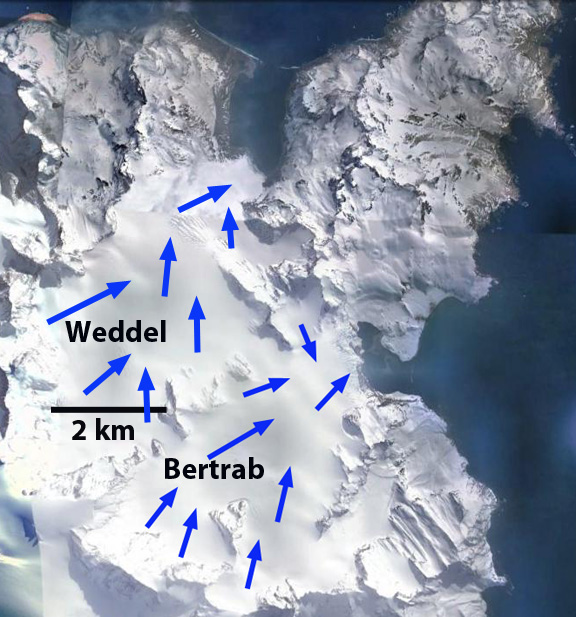
Weddel Glacier flow.


Nordenskjold Glacier, South Georgia Retreat Accelerates

Nordenskjold Glacier in 1993 and 2019 Landsat images.  Red arrow is the 1989 terminus location, yellow arrows the 2019 terminus location. Purple arrow is a tributary that has separated. Point #1 and #3 is expanding bedrock ribs.  Point #2 is an impounded glacial lake.

Nordenskjold Glacier is a tidewater glacier flowing into Cumberland East Bay on the east coast of South Georgia, Island.  Cook et al (2010) and Gordon et al (2008) noted a pattern island wide with many calving glaciers having the fastest retreat.  Gordon et al., (2008) observed that larger tidewater glaciers remained in relatively advanced positions from the 1950’s until the 1980’s, followed by significant recession,  this retreat was delayed on Nordenskjold Glacier until 2000. The map below from the British Antarctic Survey indicates the slow retreat from 1957-1998 and a more rapid retreat since. Here we use Landsat imagery from 1989-2019 to identify changes.

In 1989 the glacier terminated at approximately the same location as in 1957. Vegetation extended quite close to the terminus with a minimal trimline or recently deglacated zone evident. At Point #1 and #3 are bedrock ridges that generate medial moraines. At Point #2 is a glacial lake impounded by a secondary terminus. At the purple arrow is a tributary glacier joining the main glacier. By 1993 there has been a limited retreat exposing some newly deglaciated unvegetated terrain adjacent to the shoreline and glacier terminus. There was limited additional retreat up to 2000. This is unusual as the neighboring glaciers had all retreated substantially by 2000. By 2016 the glacier had retreated substantially, ~900 m. The tributary at the purple arrow no longer reaches the main glacier. At Point #2 the impounded lake has expanded slightly and is open water. The snowline is also at 500 m above Point #1 and #3.  In 2019 the snowline is again above 500 m. The area of bedrock at Point #1 and #3 has expanded significantly indicating glacier thinning, and greater ablation at this elevation. The terminus has retreated an average of 1250 m from 1989-2019. There is a significant trimline and recently deglacited terrain on the western shore of the bay.

The retreat is much less than on Neumayer, Twitcher or Hindle Glacier. The upglacier thinning suggests this process will continue, with a 3.2 km wide calving front in water of unknown depth calving will continue to be a key driver of retreat.

Nordenskjold Glacier in 1989 and 2016 Landsat images.  Red arrow is the 1989 terminus location, yellow arrows the 2019 terminus location. Purple arrow is a tributary that has separated. Point #1 and #3 is expanding bedrock ribs.  Point #2 is an impounded glacial lake.

Map of terminus change from the British Antarctic Survey map platform