Vilkitskogo Glacier, Novaya Zemlya Retreat Releases Islands 1990-2020


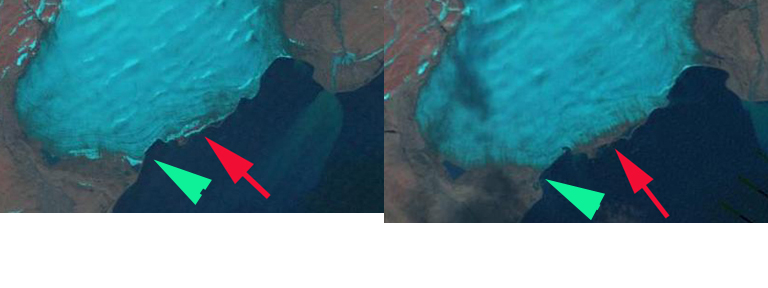
Vilkitskogo Glacier North (VN) and South (VS) terminus in 1990 and 2020 Landsat images. Terminus in 1990 ends on an island forming. Red arrow is 1990 terminus, yellow arrow is the 2020 terminus.  The 2020 image is from early June and shows low snowpack for so early in summer.

Vilkitskogo Glacier has two termini that had just separated in Vilkitsky Bay in 1990.  The glacier flows from the Northern Novaya Zemlya Ice Cap to the west coast and the Barents Sea. The glacier has been retreating rapidly like all tidewater glaciers in northern Novaya Zemlya (LEGOS, 2006;)(Pelto, 2016), Carr et al (2014) identified an average retreat rate of 52 meters/year for tidewater glaciers on Novaya Zemlya from 1992 to 2010 and 5 meters/year for land terminating glaciers. For Vilkitskogo they indicate retreat into a widening fjord, and that the south arm has a potential bathymetric pinning point. The increased retreat rate has occured synchronously with sea ice cover depletion in the Barents Sea and sea surface temperature increases. Both factors would lead to increased calving due to more frontal ablation.

The north and south glaciers both terminated at the mouth of their respective fjords in 1990, with the southern arm ending on a small island/peninsula extension. In 1994 there is limited evident retreat.  By 2001 embayments had developed particularly along the peninsula separating them and the south terminus still ended on a developing island.  By 2015 Vilkitskogo North has retreated 5000 m along the northern side of the fjord and 4000 m along the south side since 1990.  This fjord has no evident pinning points, and the rapid calving retreat should continue.  Vilkitskogo South has retreated 1000 m on the west side and 1800 m on the east side.  The retreat had exposed a new island in the center of the glacier.  The glacier in 2015 terminates on another island.  Retreat from this pinning point will allow more rapid retreat to ensue.

In 2020 the northern arm has retreated 5500 m since 1990 a rate of  ~180 m/year. The southern arm has retreated from the island with an overall retreat of 2300 m, a rate of ~75 m/year.

The front of the terminus in each case remains heavily crevassed indicating  high frontal velocity and ablation.  This indicates the calving retreat will be ongoing. The retreat has the same unfolding story as KrivosheinaNizkiy and Glasova Glacier and Krayniy Glacier.

Vilkitskogo Glacier  terminus in  2020 Landsat image showing two new islands. Terminus in 1990 ends on an island forming. Red arrow is 1990 terminus, yellow arrow is the 2020 terminus. 
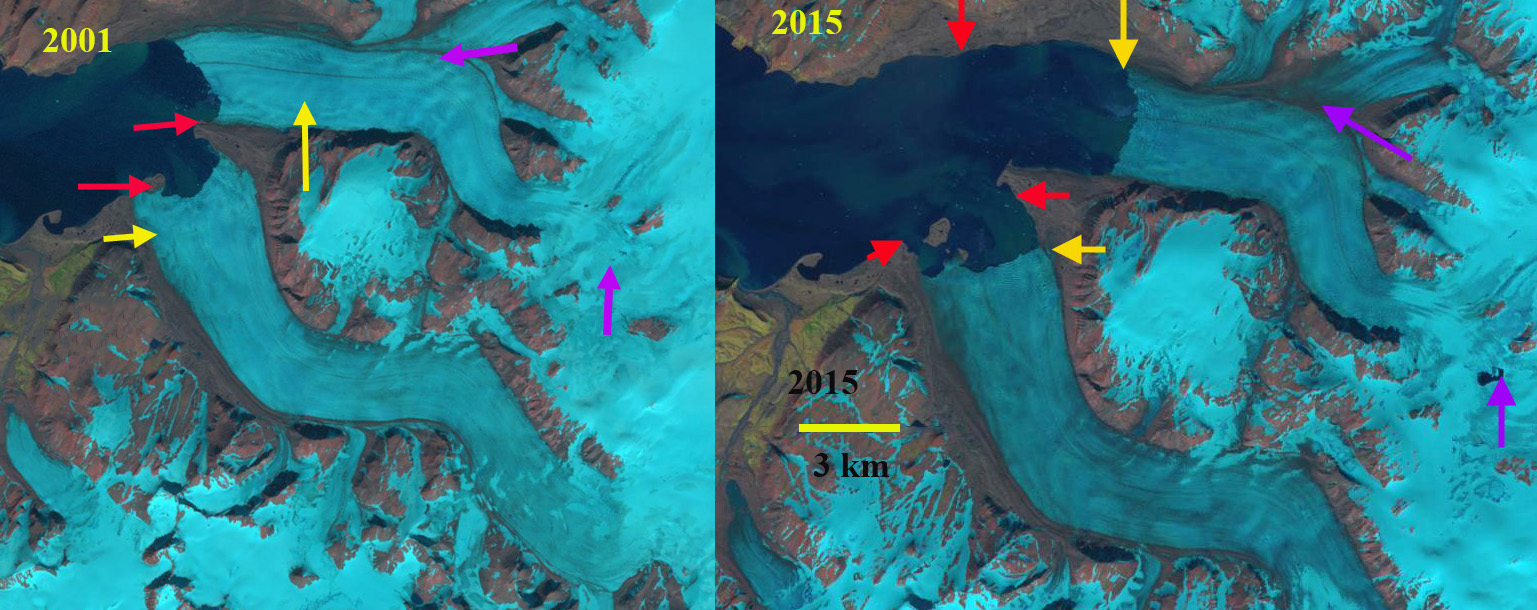
Vilkitskogo Glacier terminus in 2001 and 2015 Landsat images. Terminus in 2001 ends on an island to be. Terminus in 2015 ends on a second island forming. Red arrow is 1990 terminus, yellow arrow is the 2015 terminus. Purple arrows show areas of expanding bedrock.

Taisija Glacier Retreat, Novaya Zemlya

Taisija is an outlet glacier that drains the northern side of the Novaya Zemlya Ice Cap into the Barents Sea. This outlet glacier is just southwest of Chernysheva Glacier, and like that glacier has retreated from an island since 1988. The glacier has been retreating like all tidewater glaciers in northern Novaya Zemlya (LEGOS, 2006) taisij ge Google Earth Image

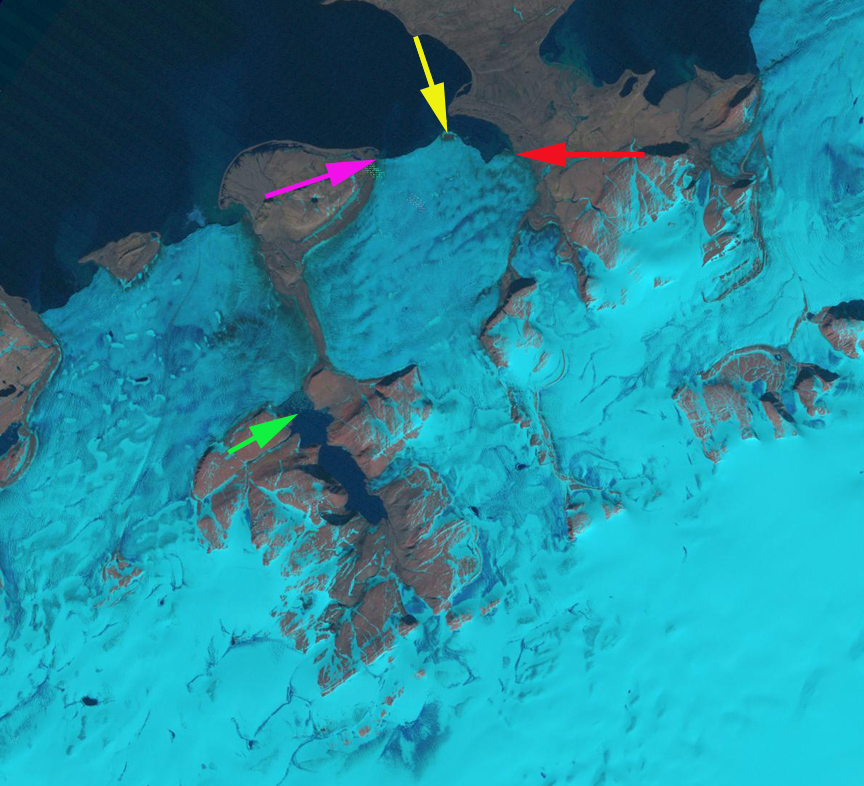
Here we examine the glacier using Landsat imagery from 1988-2013. In 1988 the glacier terminus was grounded on an island near the center of the glacier, yellow arrow. The western margin purple arrow is near the tip of a peninsula. On the east side an embayment exists in 1988 and the terminus is on a small island, red arrow. The green arrow indicates a glacier dammed lake that is full in 1988 on the neigboring glacier Kraynij Glacier. By 2006 the glacier center is still grounded on the island. An embayment has formed on the west side of the glacier and it has retreated from the peninsula. On the east side the glacier has retereated from the island, though this embayment has some sea ice in it that makes the retreat less evident. The glacier dammed lake is partially filled. By 2011 the glacier in the center has retreated from the island. The embayments on the east and the west have both expanded. The glacier dammed lake is empty. In June 2013 a Landsat 8 image provides a clearer perspective, the eastern embayment still has sea ice, but has pulled well back from the thin island at the red arrow. The retreat of this glacier is 1 kilometer on the west, 1.2 km in the center and 1.5 km on the west since 1988. This retreat is similar to that of Chernysheva, Krivosheina, Roze and Sredniy
taisij 19881988 Landsat image

taisij 20062006 Landsat image

taisij 2011
2011 Landsat image
taisij 2013
2013 Landsat 8 image

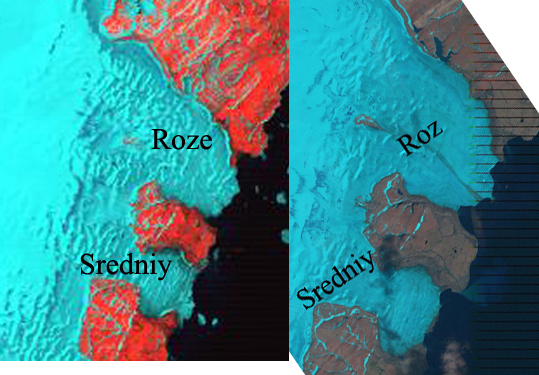
Retreat of Roze and Sredniy Glacier and New Island Formation Novaya Zemyla

The glaciers of northern Novaya Zemyla, Russia receive little attention. There remoteness and lack of importance as a water resource being the key reasons. A recent map produced by LEGOS (Laboratoire D’Eetudes en Geophysicque et Oceanographie Spatiales) in France highlights the changes of these glaciers from 1990-2000. The Roze Glacier and Sredniy glacier are the two northern most glaciers that reach tidewater on the east coast. Roze glaciers is noted by LEGOS (Alexei Kouarev, Frédérique Rémy and Benoit Legresy) as having lost 6.5 square kilometers of area from 1990-2000. Sredniy Glacier lost 1.35 square kilometers. In this post we examine the changes from 1989 to 2011 and zoom in the retreat from 2006 to 2011 using Landsat images. The first image is from 2006 and illustrates the snowline at 900 feet and the tidewater termini. he second image is a comparison of 1989 to 2011. In 1989 the Sredniy has quite a broad tidewater terminus compared to 2011. The Roze Glacier protruded beyond the coastline in 1989, by 2011 it is retreating into and expanding bay. on the northeast side a new peninsulas has been exposed. This is not the only new island as Krivosheina Glacier on the northwest coast has retreated exposing a new island as well. . A closeup pairing of a 2006 (left) and 2011(right) image indicate that Sredniy Glacier retreat is exposing a new island (red arrow) and a new cape is also evident green arrow). On Roze Glacier the combined 2006-2011 image illustrates the retreat on the northeast side of the terminus (red arrow), and the increasing distance from the terminus to a small island (green arrow).