
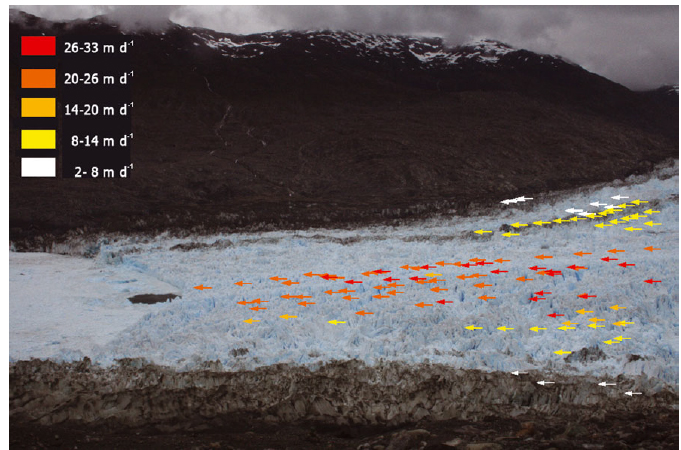
The Jorge Montt Glacier is one of the main tidewater glaciers of the Southern Patagonia Icefield. The glacier has been the focus of ongoing annual observations by the Laboratorio de Glaciologia at the Center for Scientific Studies, University of Chile. Two recent papers highlight the dramatic changes this glacier is undergoing. The glacier has retreated 19.5 km from 1898-2011 (Rivera et al, 2012a). A recent photograph of the terminus from Andrés Rivera indicates the extensive crevassing and calving of icebergs indicating the high very high velocities. . The velocities were determined from tracking of salient features for an 11 month period using time lapse photography and indicated a mean velocity of 13 meters/day, with maximum velocities of up to 33 meters/day, in the center of the glacier (Rivera et al, 2012b). These velocities rival the high velocities on the faster Greenland outlet glaciers and San Rafael Glacier, Chile. They did not observed seasonal velocity changes. This paper provides a nice visual of the velocity, top image. The velocity and retreat tend to increase when water depth increases. The mean water depth at the calving front has declined from over 260 m 1997-2003 to closer to 220 m 2003-2011, bottom image indicates the water depths from Rivera et al (2012a).
  .
. 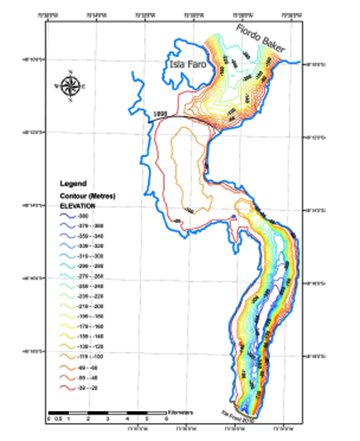 . A map of the long term retreat of the glacier is provided in both papers, here we examine a closeup view of the lower glacier from Landsat imagery in 1997, 2003 and 2011. The glacier retreat peaked during the 1990-2000 period with 8.5 km of retreat. The lake widened and deepened at the calving front for that period. The yellow arrow indicates the 1997 terminus, burgundy arrow 2003 and orange arrow 2011. The green arrows point the expansion of exposed bedrock areas on the east margin of the glacier from 1997-2011. Retreat from 1997-2003 was 2250 m, 375 m/year. Retreat from 2003-2011 was 2000 meters, 250 m/year. In 2011 an additional nunatak has emerged as the glacier has thinned. The 2011 terminus is near a point where the lake appears it will widen again, the potential depth is hard to assess. The map from Rivera et al (2012a) indicates at least a short term deepening at the ice front, this is at the same point as a modest lake width reduction.
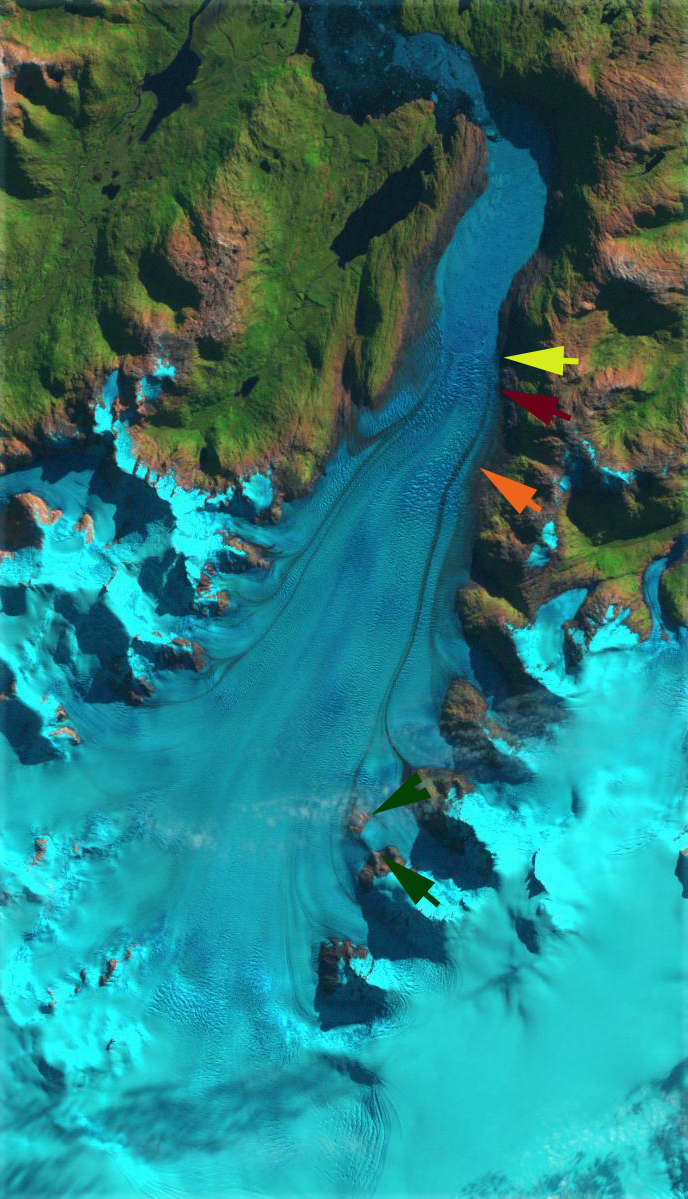
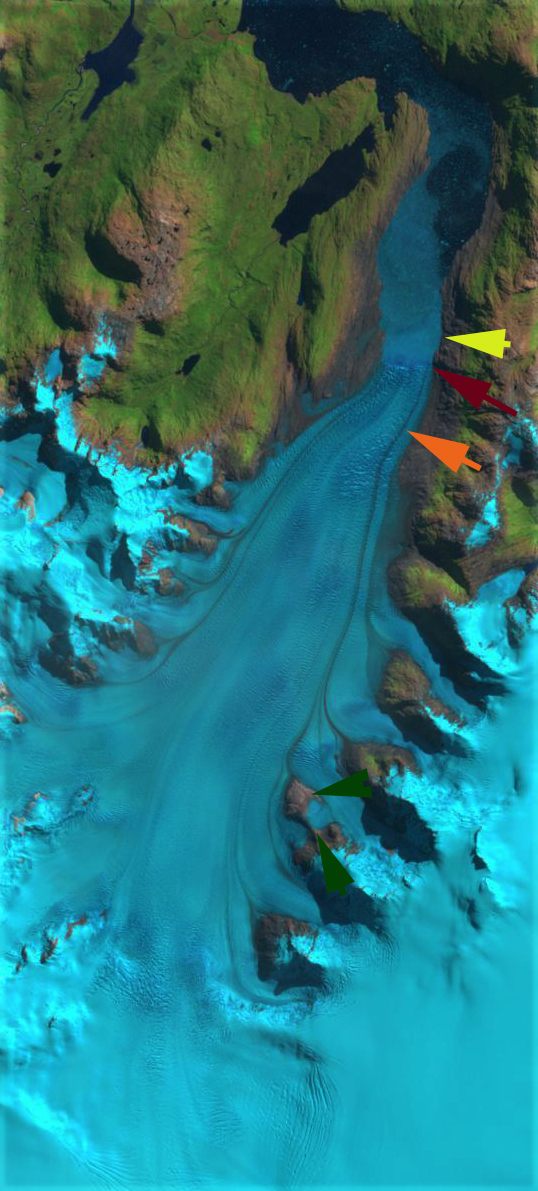
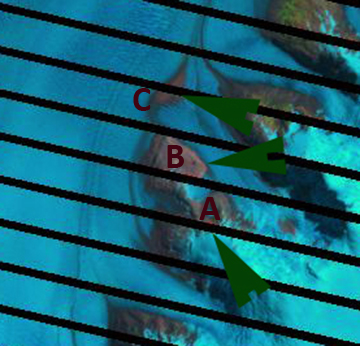
 . Below is a closeup of the changes 12-14 km upglacier of the terminus indicating the rapid thinning from 2003 to 2011 expanding the bedrock exposed at point B and exposing the new nunatak at Point C. The retreat of this glacier follows the regional pattern observed by the Laboratorio de Glaciologia on other glaciers such as Gualas Glacier, Nef Glacier, Alemania Glacier, Tyndall Glacier and Colonia Glacier.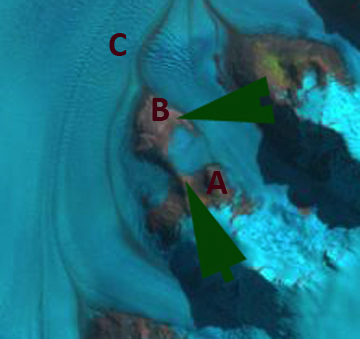
Tag: patagonia glacier retreat
Onelli Glacier retreat separation, Argentina
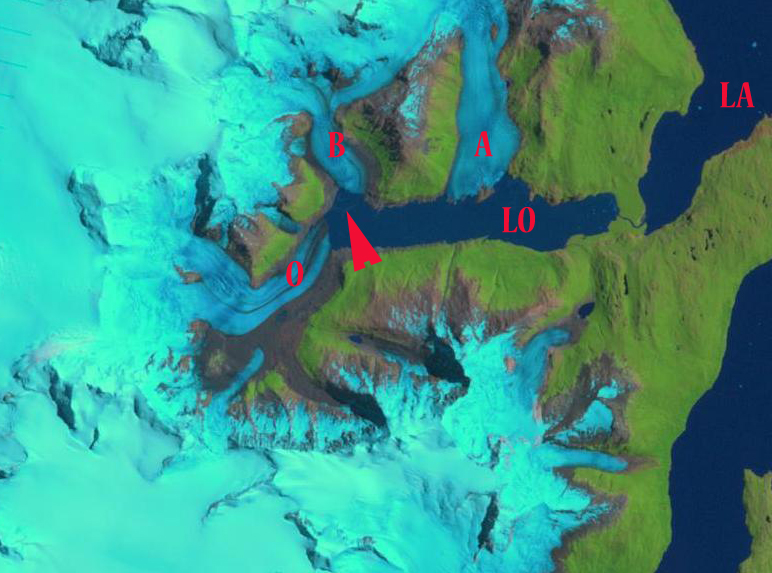
The Onelli Glacier drains eastward from the South Patagonia Icefield into Lago Onelli (LO), which then connects to Lago Argentino (LA). Lago Onelli has three main glaciers termininating in the lake Aggassiz (A), Onelli(O)and Bolados Glacier (B). The glacier is noted as 13 km long with an area of 84 square kilometers by the Labratorio de Glaciologia in Chile . Warren and Sugden (1993) note an 1800 meter retreat from 1945-1992 for Onelli Glacier and 850 meters for Agassiz Glacier. Eric Shipton was the first to visit this glacier and did so in the company of Ohio State glaciologist John Mercer in 1958. They found Lago Onelli so filled with icebergs that little water could be seen (Shipton, Land of Tempest, 1963). Agassiz and Onelli Glacier were observed to have a shared terminus much like Onelli Glacier and Belados Glacier in 2003, ion contact but one flowing into the fjord from the north with a steep calving face, and one from the northwest (Onelli) with a gentler slope. The focus for Mercer was the age of the moraines beyond the glacier terminus, for Shipton hiking up onto the icefield to explore potential avenues to the crest of the icefield. The glacier is located on the icefield base map image from the Glaciares of Argenina website.  . A comparsion of Landsat satellite images indicate the separation and retreat of Bolados (B) and Onelli Glacier(O) from 2000-2010. In 2000 the joint terminus cuts directly across Lago Onelli as one reasonably straight 1.6 km long. By 2003 the glaciers are barely touching and the combined termini are now long 1.8 km long. BY 2008 the glaciers are separated by 1300 meters. The retreat from the 2000 terminus of Onelli Glacier has been 1500-1800 meters depending where on the ice front the retreat is assessed. Theretreat of the last decade of 160 meter/year is a considerable acceleration over the period from 1945-1990. Belados Glacier has retreated 800 meters. The ELA in the satellite images from recent years has been 1300 meters.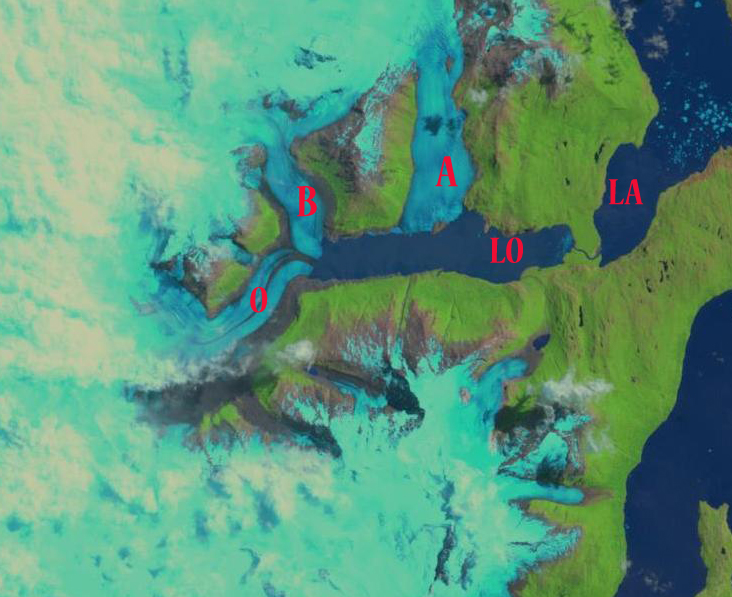

Tyndall Glacier, Chile Retreat Continues
Tyndall Glacier is a large outlet glacier of the Southern Patagonia Icefield (SPI). This glacier has an area of over 300 square kilometers. The main glacier terminus ends in Lago Geikie, which began to form around 1940, and the east terminus previously terminated in Lago Tyndall . Raymond et al (2005) report that the glacier had receded 5 km from 1945 to 2001. The retreat is illustrated in a figure from Rivera & Casassa (2004)
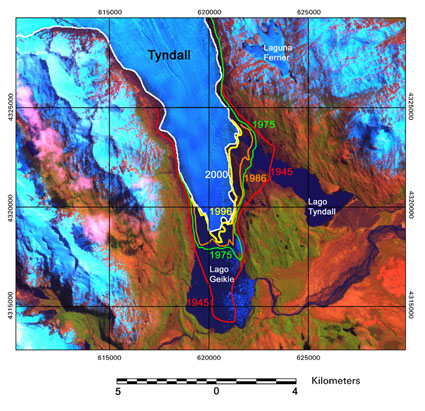 . This web page on the Tyndall Glacier is one of many provided by Andrés Rivera at the Laboratorio de Glaciología at Universidad de Chile. Assessing the ice surface elevation changes on three profiles 8-15 km above the terminus, the amount of thinning was determined by Raymond et al (2005). From 1945-2002 the average thinning rate of the glacier at meters was 2.3 meters per year. The rate has accelerated averaging over 3.3 meters per year since 1985. This has driven the retreat. Lago Geikie is a deep lake with maximum depths reaching 400 meters and was 300 meters at the calving front in 2001 Raymond et al (2005) . This allows for considerable calving of the thick Tyndall Glacier, which is grounded on the bottom of the lake at its terminus. The glacier velocity near the calving front is 700 meters per year. A comparison of the terminus position from the aforementioned papers, Google Earth from 2003 (top Image) and a Geoeye image from 2010 (bottom image) indicates the changes of Tyndall Glacier are ongoing. Lago Tyndall (LT) for example is continuing to contract as the terminus (TE) that feeds it has thinned and pulled back from the valley that feeds it. Increasingly this is becoming a watershed that will not be fed by Tyndall Glacier. Lago Geikie (LG) continues to expand now 7 km long. The retreat in the last 7 seven years has been 600-900 m on the main calving front. This has exposed a new peninsula (P).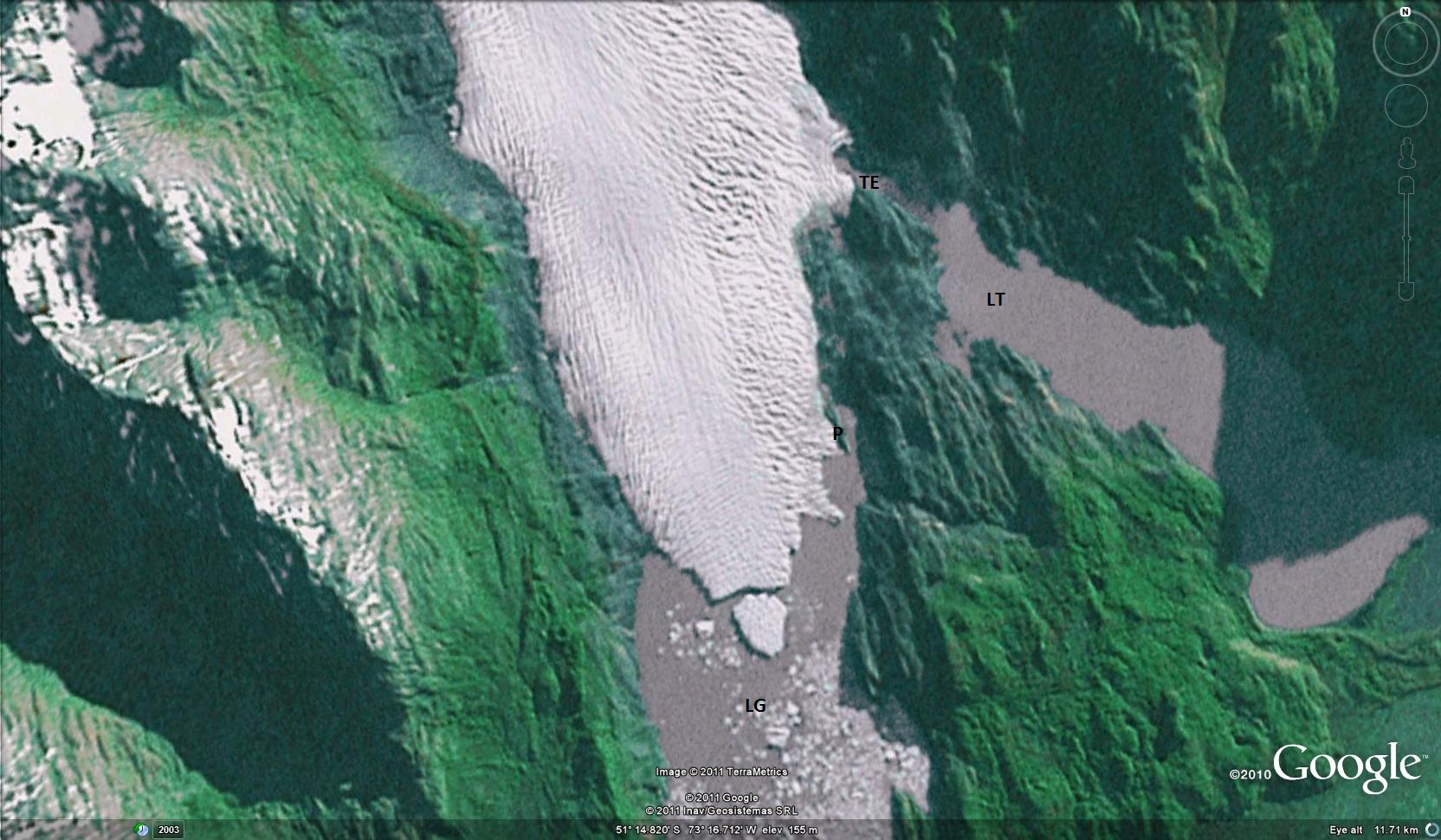
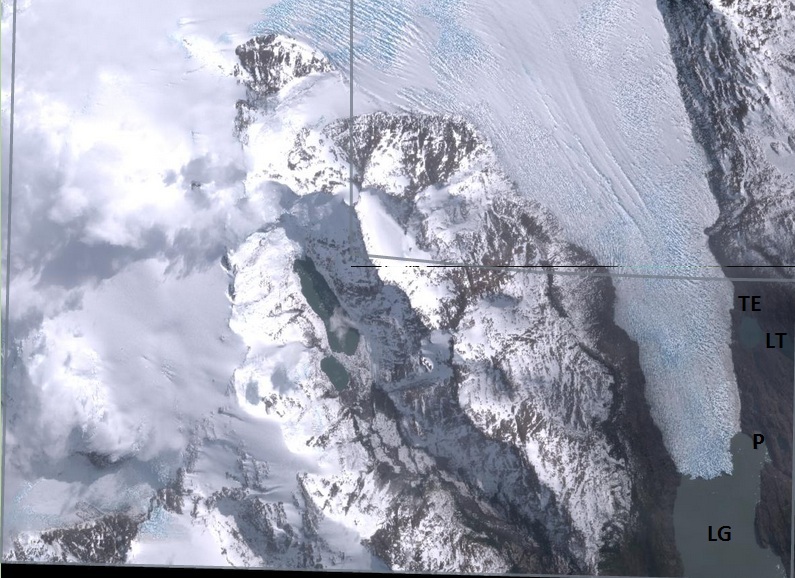 The glacier terminus is much narrower than in 1975 in an aerial image from Raymond et al (2005). The snowline on the glacier is at 900 meters and there is considerable glacier area above 1200 meters, indicating this glacier can survive additional warming, note the above image. As Raymond et al (2005) emphasized the glacier bottom remains below the Lago Geikie lake level for 14 km. Over much of this distance calving would play a role, helping continue the recent retreat. This retreat due to calving into a glacier lake resulting from ongoing glacier thinning resulting from increased surface ablation is widespread from Bear Glacier, Gilkey Glacier and Yakutat Glacier in Alaska, to Tasman Glacier in NZ to Nef Glacier and Colonia Glacier in
Colonia Glacier Retreat and Glacier Lake Outburst Floods
Colonia Glacier drains east from the Northern Patagonia Icefield feeding the Baker River, Chile. The recent substantial retreat of Colonia Glacier like Glacier Nef just to its north is posing new hazards. The glacier is unusual in the number of lakes that are adjacent to or feed into the adjacent glacier damed or proglacial lakes. In the image below Lake A=Arco Lake, Lake B=East Terminal Lake, Lake C=Cachet 1 , Lake D= West terminal Lake, Lake E=Colonia Lake and Lake F=Cachet 2.  The glaciers recent retreat and glacier lake outburst floods have been closely monitored by the Laboratorio de Glaciología in Valdivia, Chile.Aniya and others (1999)observed that Colonia Glacier began a rapid retreat after 1985
Superimposition of a RADARSAT image from 1997 and a Landsat 1987 image indicated a retreat of
400 m, from 1997-2005 the retreat has further accelerated, with a general frontal retreat of 2.5 km.  Rivera and others (2007) observed that the Colonia Glacier had lost 9.1 square kilometers of area from 1979-2001, which is 3% of the total glacier area. The Laboratorio de Glaciologia’s
In the spring of 2008 Baker River suddenly tripled in size, in less than 48 hours, roads, bridges, and farms were severely damaged. Lake Cachet 2 had vanished the 5 square kilometer glacial lake had emptied 200 million cubic meters of water in just a matter of hours. This lake drained beneath the glacier after sufficient water had filled the lake to buoy part of the glacier and subglacial conduits had begun to develop. Since Cachet 2 emptied in April 2008, the lake has emptied five more times October,
December 2008, March and September 2009 and March 2010, with peak flows released of  3000 cubic meters per second. Below are images of Cachet 2 half- full in Google Earth Imagery from Sept 2008 (note trimline above lake), and full after the flood on 5/28/2008 and empty on 4/8/2008, and lastly the image of the Colonia River’s wide fresh braided stream channel flowing into the Baker River. The newly deposited material from the flood is what makes the wide braided valley such a fresh sediment brown color.

 The two lakes at the terminus of the glacier did not exist in 1979, the western most terminus lake (B) drained into the easternmost terminus lake (D) via a sub-glacial tunnel after formation in the late 1980’s until 2005 when a channel was cut right through the glacier terminus. This is evident in the image below, there is still glacier ice on both sides of this drainage channel.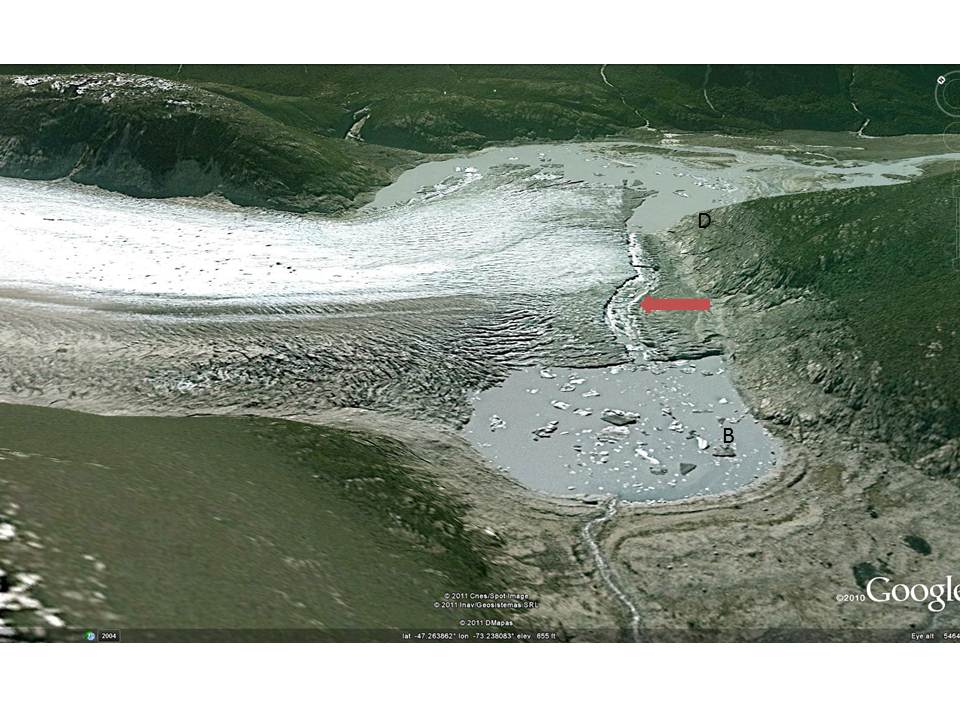
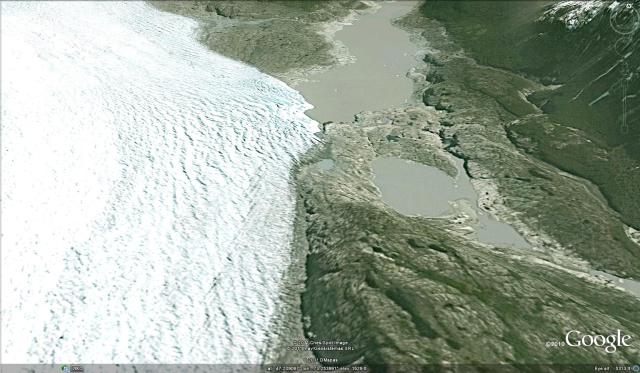 The development and demise of glacier dammed lakes and the resultant problem of glacier lake outburst floods is not rare today, Imja Glacier, and Tulsequah Glacier are other examples. In the case of Baker River the outburst floods are a threat to the planned hydropower developments as documented by Dusaillant and others (2009). The Colonia Glacier retreat mirrors that of Glacier Nef the next major glacier to the north. Hidroaysen Project is proposing 5 dams on the Baker and Pascua River generating 2750 MW of power. Glacier Nef retreated 3400 m from 1945-2000, 2400 m retreat of the retreat occurred in the 1994 collapse of the terminus tongue into the proglacial lake, which is now 3.5 km long. This retreat includes that of , Gualas GlacierReichert Glacier, Steffen Glacier, and Nef Glacier.
 From a Glaciers Perspective