Penny Ice Cap NW Thinning and Retreat Evident

The Northwest (NW) and Northnorthwest (NNW) outlet of the Penny Ice Cap in 1991 and 2019 Landsat images. Red arrow indicates the 1991 terminus location. Point 1 is a large proglacial, Point 2-4 are areas of emerging and expanding bedrock amidst the ice cap.

The two largest outlet glaciers of the NW quadrant of the Penny Ice Cap feed the Isurtuq River.  In 1991 both outlet glaciers terminated at 600 m. Schaffer et al. (2017) noted a substantial reduction in velocity of the six largest outlet glaciers of the Penny Ice Cap from 1985-2011, 12% per decade. This is driven by mass balance losses, which drive thinning and retreat as well. Here we examine the changes from 1991-2019 of the Northwest (NW) and Northnorthwest (NNW) outlet of the Penny Ice Cap. The summer of 2019 is shaping up to feature substantial mass balance losses.

In the 1991 Landsat image the NW outlet reaches the Isurtuq River. The large 7 km2 proglacial lake #1 is impounded by the glacier, it is mostly covered by lake ice in this image.  At Point #3 there is no bedrock that has emerged.  The NNW outlet terminates 1 km south of the Isurtuq River, upglacier Point #2 is a single bedrock outcrop and Point #4 is barely evident.  In 2000 the NW outlet has receded from the river, the proglacial lake is still 7 km2 and Point #3 has no evident bedrock. The NNW outlet has receded 100-200 m and bedrock at Point #2 and 4 are more evident.  In 2016 the proglacial lake has diminished and now is several small lakes.  At Point 3 bedrock is evident.  At Point #2 there are two areas of bedrock covering 0.25 km2. The snowline in 2016 is above this portion of the icecap. In 2019 the NW outlet has retreated 500 m, proglacial lake #1 has three separate parts that total less than 2 km2. Bedrock at Point #2-4 has expanded significantly indicating ice cap thinning.  On June 30 2019 the snowline is already above this section of the ice cap, +1100 m with two months of melting to come.  Point #2 has an exposed bedrock area of 0.8 km2. Look for a merging of the bedrock at Point 2 and further expansion at 3 and 4. The high snowline at +1100 m, for this early in the summer was also observed at Fork Beard Glacier just east of Penny Ice Cap and is due to very warm temperatures in June in the region.

Way (2015) noted that the Grinnell Ice Cap also on Baffin Island, has lost 18% of its area from 1974 to 2013 and that the rate of loss has greatly accelerated due so summer warming. Grinnell Ice Cap also has seen a loss of snowpack even at its crest.

The Northwest and Northnorthwest outlet of the Penny Ice Cap in 2000 and 2016 Landsat images. Red arrow indicates the 1991 terminus location. Point 1 is a large proglacial, Point 2-4 are areas of emerging and expanding bedrock amidst the ice cap.

Map of the region
Coronation Glacier, Baffin Island Retreat Leads to Building a New Island

corontation-compare-copy

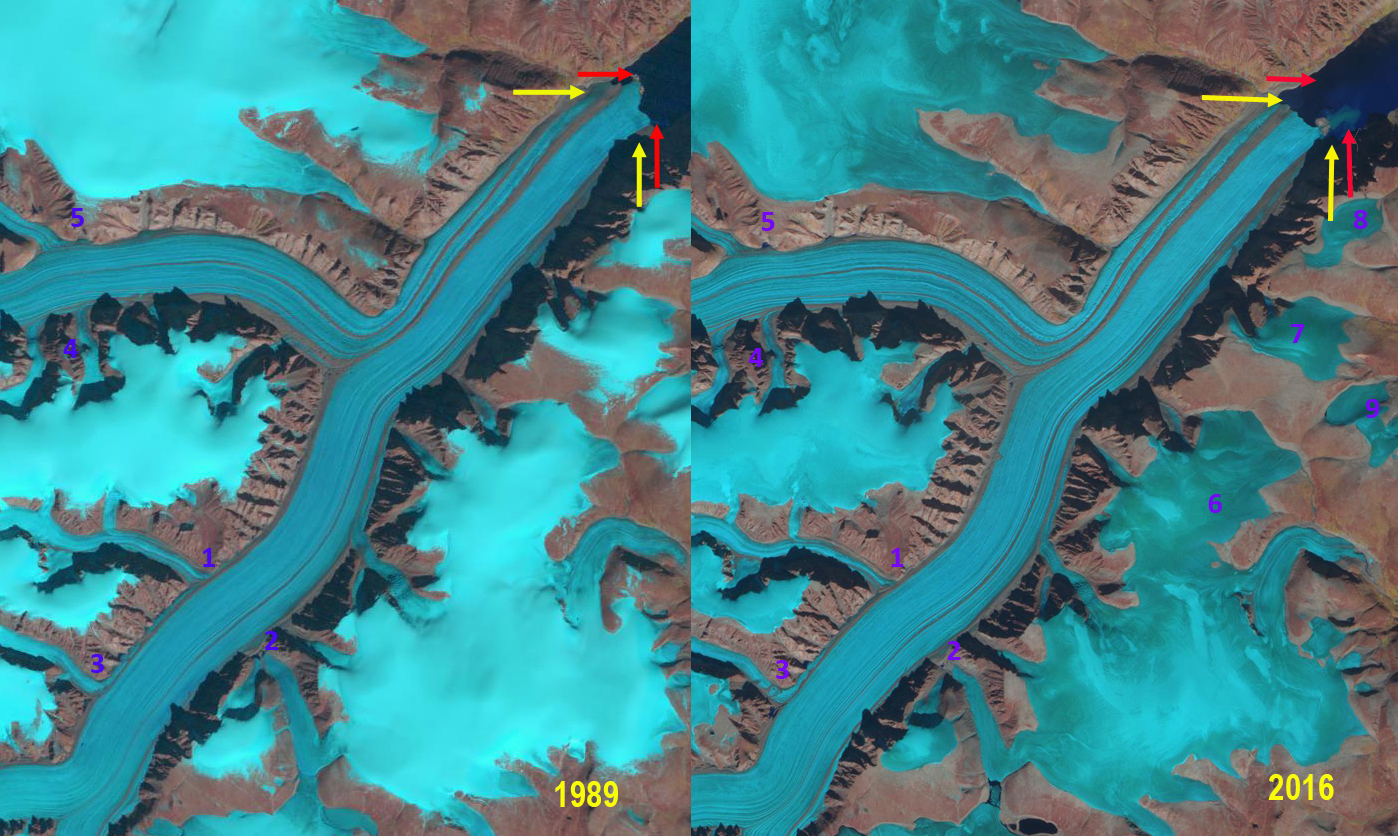
A Landsat image from 1989 and a Sentinel 2 image from2016 illustrate the retreat of Coronation Glacier.  Red arrows indicate the 1989 terminus and yellow arrows the 2016 terminus location.  Purple numbers 1-5 indicate locations of tributary retreat or thinning. Purple numbers 6-9 are icecaps that did not retain snowcover in 2016. 

Coronation Glacier is the largest outlet glacier of the Penny Ice Cap on Baffin Island. The glacier has an area of ~660 square kilometers and extends 35 km from the edge of the ice cap terminating in Coronation Fjord. On January 10, 2017 an Art Exhibit “Into the Arctic” by Cory Trepanier opens at the Canadian Embassy in Washington DC, the first stop in a two year North American tour.  The exhibit features some amazing paintings of Coronation Glacier (see below). Here we examine the response driven by climate change of this glacier from 1989 to 2016 using Landsat and Sentinel Imagery. Van Wychen et al (2015) observe that it is the largest glacier from any of the Baffin Island Ice Caps with discharge greater than 10 Mt/year. They observed peak velocities of 100-120 m/year in the descent from the main ice cap into the main glacier valley. The velocity in the terminus section is ~30 meters/year. Syvitski (1992) noted that Coronation glacier retreated at an average rate of 12 meters per year from 1890-1988. Zdanowizc et al (2012) noted that in recent years the ice cap has experienced heightened melt, a longer melt season and that little retained snowpack survives the summer, that most of the retained accumulation is refrozen meltwater (superimposed ice). This has helped lead to firn temperatures at 10m depth near the summit of Penny Ice Cap to warm by 10 °C between the mid-1990s and 2011, (Zdanowizc et al (2012). Geodetic methods indicate surface lowering of up to 1 m/year on all ice masses on Baffin Island and Bylot Island between 1963 and 2006 (Gardner et al.2012).trepaniergreatglacier_study-1024x372

Cory Trepanier Great Glacier painting, which is of Coronation Glacier. 

In 1989 Coronation Glacier terminates at the red arrow, where the main outlet stream has created a pair of small deltaic islands on the northern side of the fjord. By 1998 the terminus has retreated from both islands, with the northern one already having disappeared. There is a plume of glacier sediments in the fjord from the main river outlet emanating from below the glacier is near the center of the glacier. There has not been significant retreat on the south side of the glacier terminus. In 2002 both islands are gone, most of the retreat is still on the northern side of fjord. The plume of glacier sediments in the fjord from the main river outlet remains near the center of the glacier. In 2016 a new deltaic island has formed near the southern edge of the margin, indicating a shift in the position of the main river outlet emanating from below the glacier, this is also marked by a large plume. The island formed is larger than those observed in 1989 or 1998. The nature of the loosely consolidated glacier sediments deposited in a fjord is to subside/erode after the sediment source is eliminated. The retreat of the glacier insures that this will occur soon to the island here. The size of the island gives it potential to survive, based on satellite imagery. A visit to the island would be needed to shed light on its potential for enduring. Cory Trepanier is hoping to return for more paintings, which will illustrate better the change to us than a satellite image can.   Retreat from 1989 to 2016 has been 1100 m on the northern side of the fjord and 500 m on the south side of the fjord. The average retreat of 800 m in 27 years is over 30 m/year, much faster than the 1880-1988 period. Locations 1-5 are tributaries that have each narrowed or retreated from the main stem of the glacier.

coronation-2016-terminus

Closeup of the Coronation Glacier terminus and the new island in 2016, Sentinel 2 image.

The other noteworthy change is the lack of snowpack retained at locations 6-9 in the 2016 Sentinel image on small ice caps adjacent to Coronation Glacier in 2016. This continues a trend observed in 2004, 2009, 2010 and 2012 and that Zdanowizc et al (2012) also noted, 2009 image below.  The high snowline is also evident on Grinnell Ice Cap The driving force has been an increase in temperature and this has caused mass losses on ice caps throughout the Canadian Arctic (Gardner, et al. 2011) and (Sharp et al, 2011).

coronsation-landsat

Sequence of Landsat images indicating terminus positions.  Red arrow is the 1989 terminus position and yellow arrow the 2016 terminus position. 

coronation-2009a-copy

2009 Landsat image of Coronation Glacier indicating lack of retained snowcover on surrounding ice caps.


Penny Ice Cap southwestern margin retreat

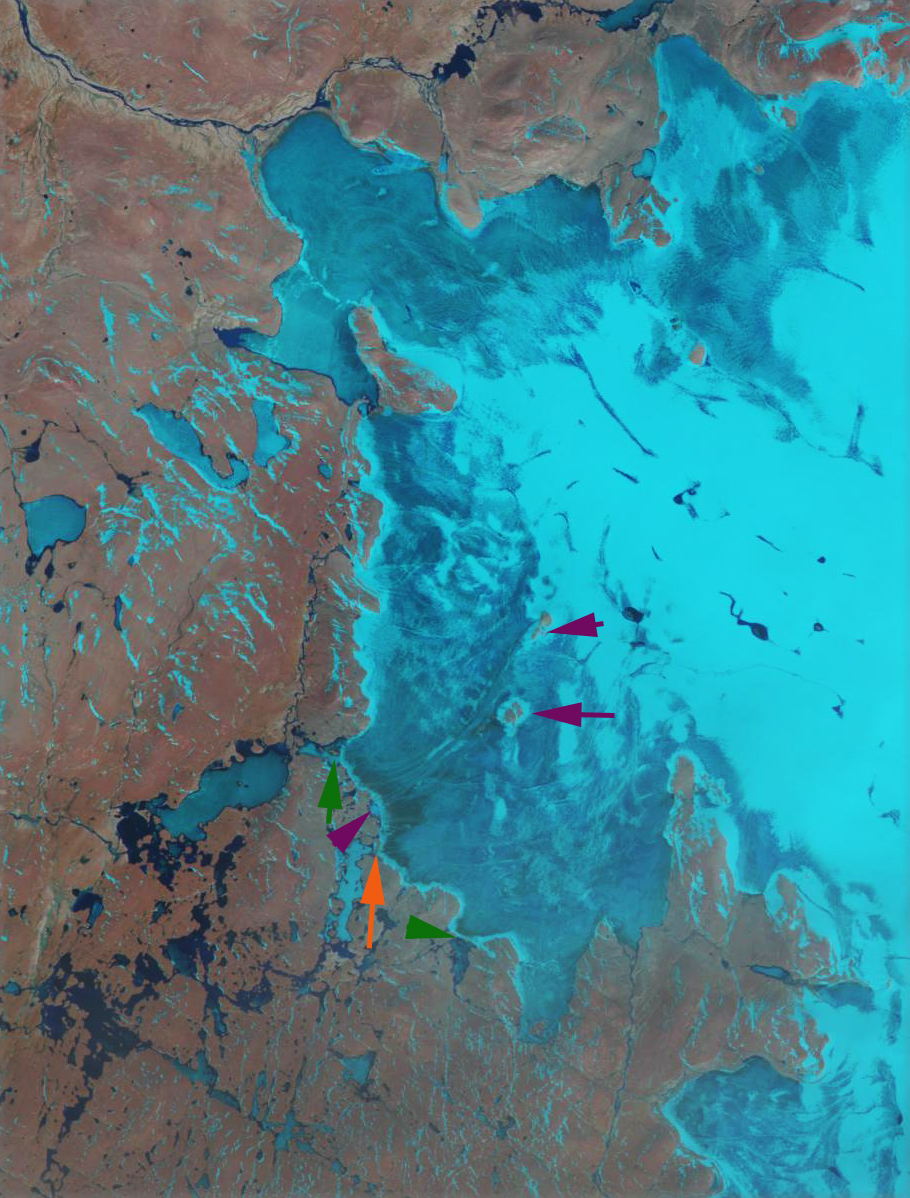
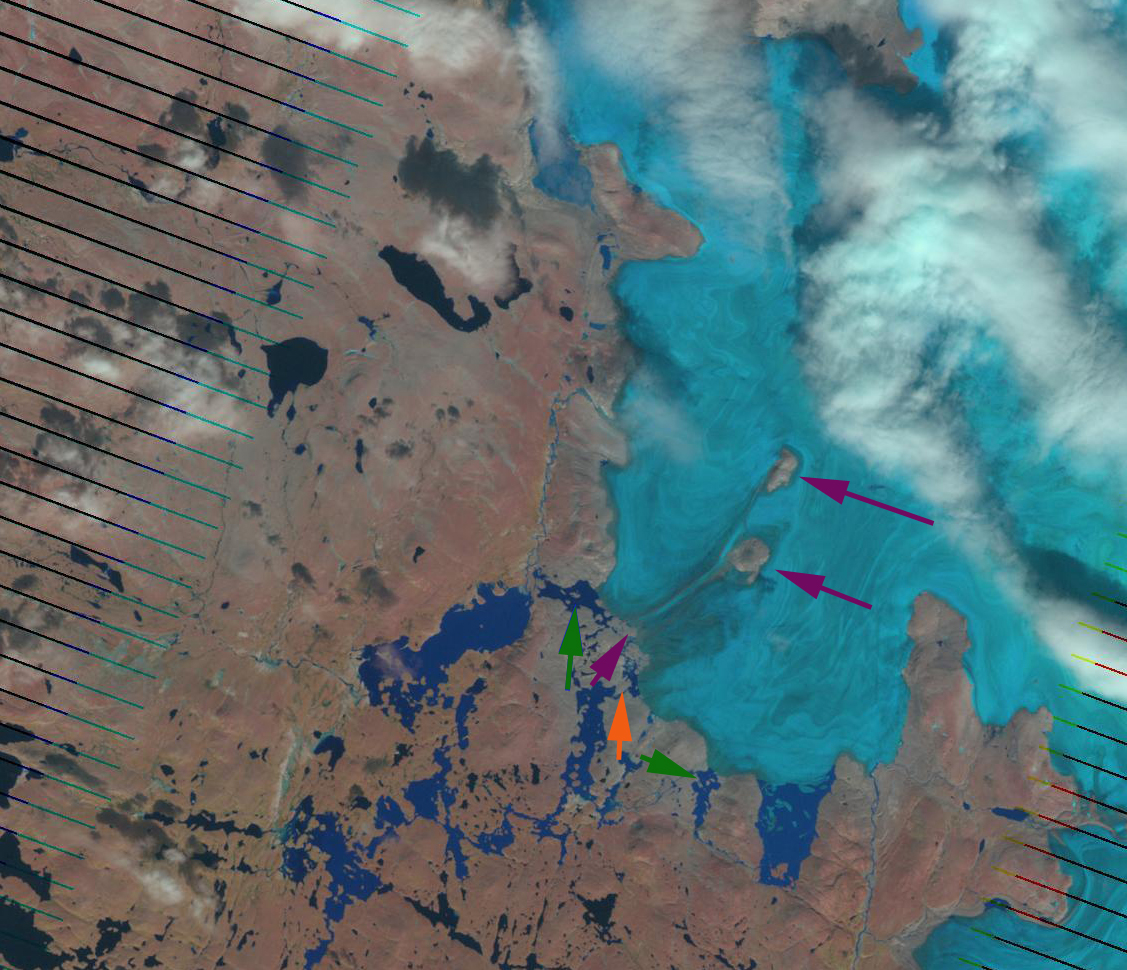
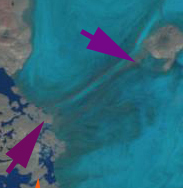
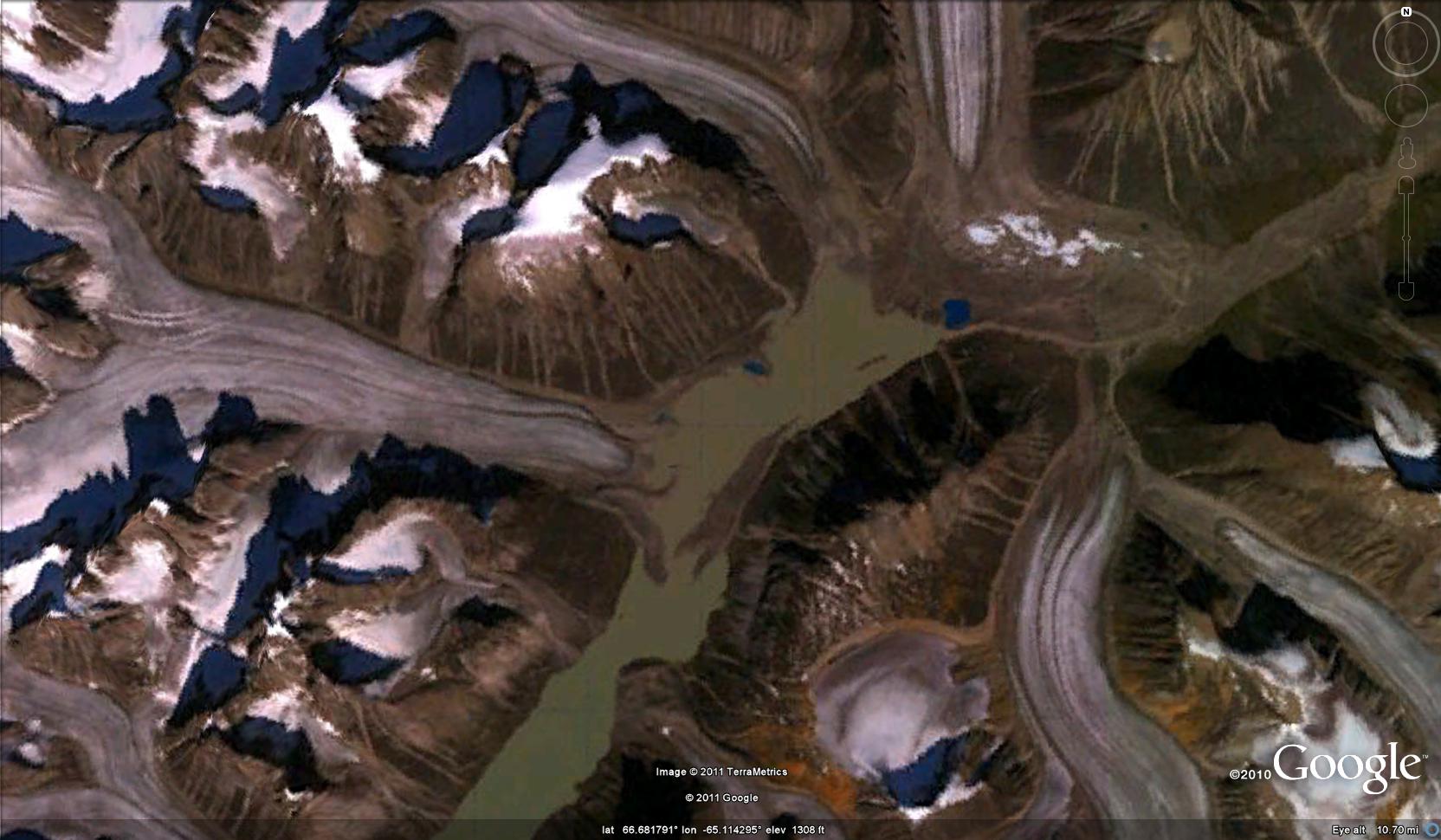
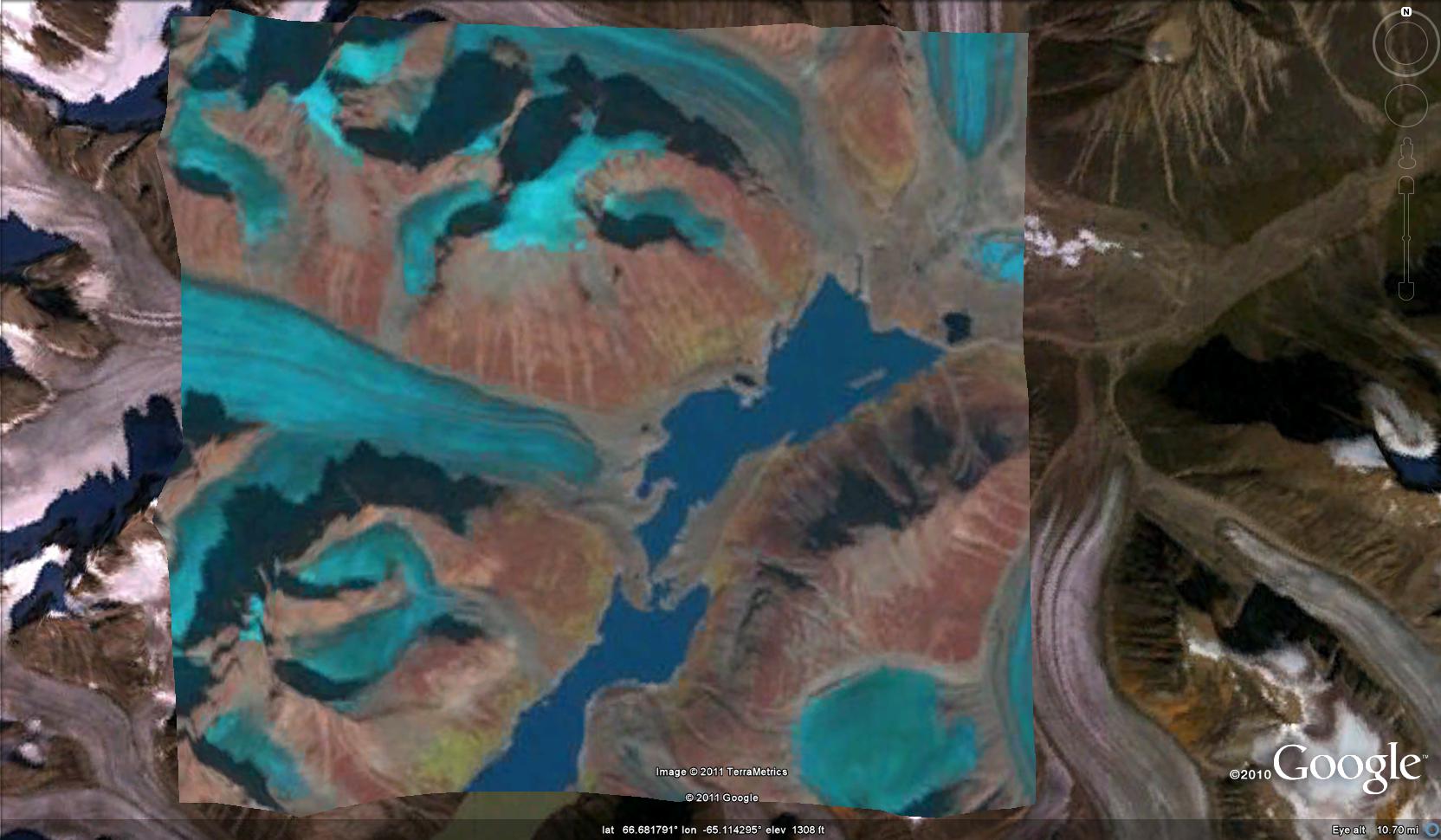
Examination of 1991 and 2009 Landsat imagery highlights the retreat of the Penny Ice Cap at its southwestern margin. The glaciers and lakes in this region are unnamed. The Penny Ice Cap is one of two large ice caps on Baffin Island and is the southernmost of the two, with an area of more than 5600 square kilometers. On the east side the glacier exit the ice cap through spectacular mountains. The westside spreads across rolling upland terrain. In this post we examine the margin at the southwest corner, where the ice cap ends in a series of upland lakes. Changes in the margin are identifed from Landsat images from 1991-top, 2003-middle and 2009-bottom. The snowline in this region is near 900 meters in the 1991 and 2003 images. In the 2009 image the snowline is at least 1100 meters leaving the southwest corner of the Penny Ice Cap with a minimal accumulation zone. Zdanowizc et al (2012) note that in recent years the ice cap has experienced heightened melt and that little retained snowpack survives the summer, that most of the retained accumulation is refrozen meltwater (superimposed ice). In each image key locations are indicated: the nunataks are marked with violet arrows as is the margin downstream of the nunataks, key islands and peninsulas are noted with green arrows that are at the 1991 margin, the orange arrow indicates a region just east of a key marker lake. Landsat imagery from 2003 and 2009 indicates the same locations. It is evident that new islands, lakes and peninsulas are developing. The retreat and formation of new lakes at the orange and violet marginal arrow are apparent the appearance of new islands in the lakes at the green arrows is also evident. One of the largest marginal changes is downstream of the nunataks. In 1991 the margin here had no notable indent from the rest of the margin and the glacier surface was not notably debris covered. In 2009 the margin has developed a new lake as an indent has formed and the glacier surface has more evident debris. This debris is too thin to insulate the ice underneath and instead will reduce the albedo and enhance melting. The nunatak is also expanding particularly toward the margin. Overlaying the 1991 and 2009 images in Google earth provides comparison of the margin of 1991 to the Google Earth imagery and 2009 imagery. The retreat along this section of the ice cap is 300-400 meters during this 18 year period. The driving force has been an increase in temperature and this has caused mass losses on ice caps throughout the Canadian Arctic (Gardner, et al. 2011) and (Sharp et al, 2011). The mass losses of the Penny Ice Cap are also affecting the eastern margin around Coronation Glacier.

Penny Ice Cap Retreat, Baffin Island

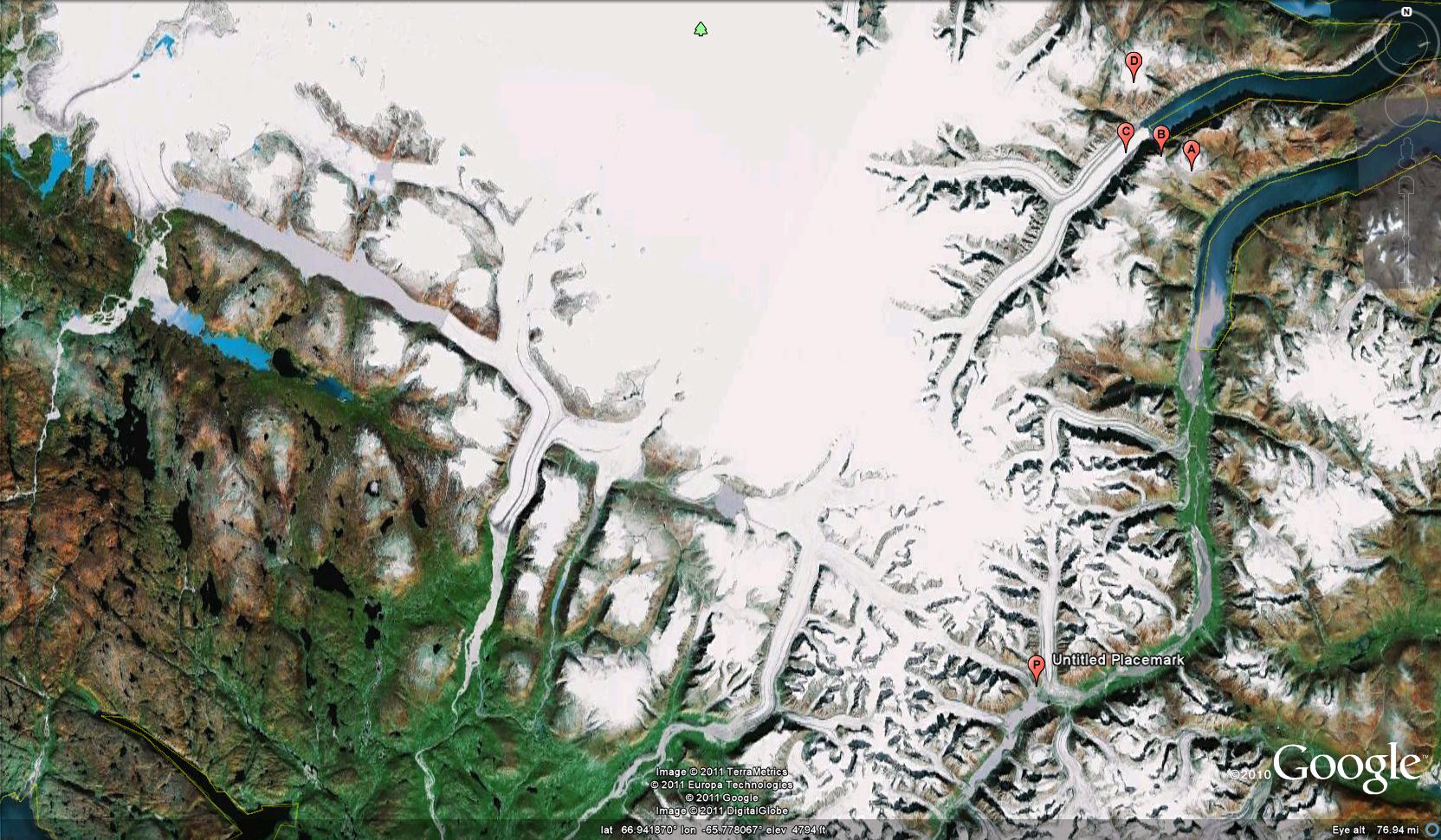
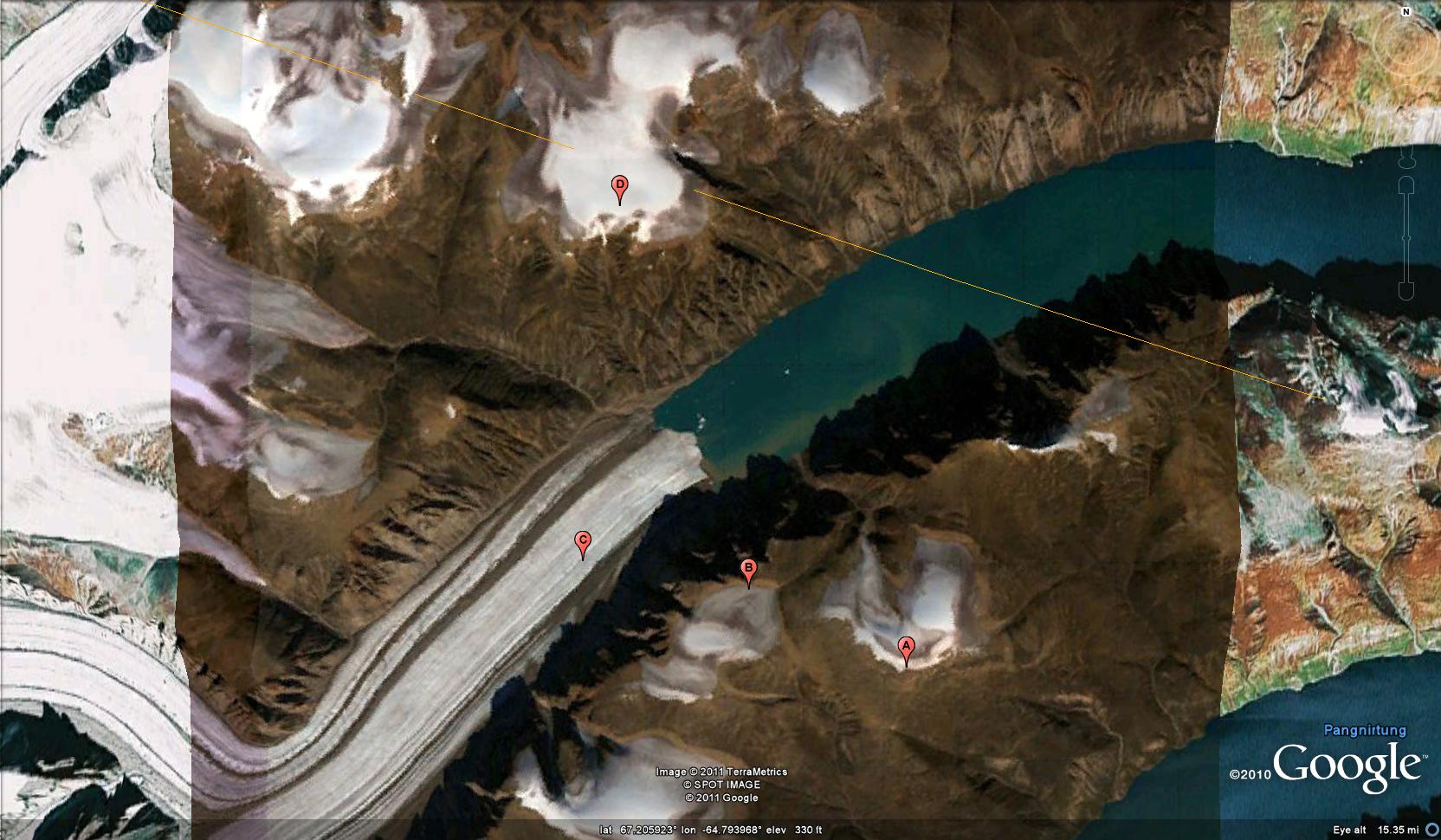
The Penny Ice Cap is extends north from the Pangnirtung Pass regiion of Baffin Island.. To capture the majesty of the region, you have to turn to the artwork of Cory Trepanier, seen below is his Great Glacier study, not to the science data. The ice cap has been shrinking as evidenced by the retreat of a number of outlet glaciers. This post focuses on two of these glaciers. The first is Turner Glacier which flows 11 km downvalley from the ice cap ending in the Pangnirtung Valley. In 1961Turner Glacier reached to the summit lake in Pangnirtung Pass. In 1953 the glacier front was also much wider as seen in an Arctic Institute of North America Photograph. In the images below Turner Glacier enters from the left center of the image. By 2004 (top image) the glacier had receded 280 meters from the lake shore and 600 meters from the moraine it was in contact with in 1953. By 2009 the retreat was 570 meters from the lake shore and 900 meters from the moraine, bottom image. The 2009 image is an August 2009 Landsat Image. . In particular retreat after 2000 has been more rapid. Coronation Glacier is the largest outlet glacier of the Penny Ice Cap, it extends 35 km from the edge of the ice cap terminating in Coronation Fjord. Syvitski (1992) noted that Coronation glacier has been retreated at an average rate of 12 meters per year from 1890-1988Coronation Glacier. The focus at Coronation Glacier (C) is the imagery from 2004 and 2009 both indicating a lack of snow cover on some of the small glaciers adjacent to this glacier. Glaciers A and B are nearly snow free in both summers, and this is still in August. The small glacier labelled D is snow free in 2009. . In this five year interval The Coronation Glacier has retreated 200 m. Note the change in the glacier terminus position with respect to the stream entering the north side of the fjord at the terminus. The limited snow cover on Baffin Island mirrors that of most of the Canadian Arctic in recent years with high melt rates leading to mass balance losses and sea level rise as published this week by Gardner and others (2011).