Herz Glacier, South Georgia Loses 25% of its Length 1989-2021

Landsat images from 1989-2021 of Herz Glacier.  Red arrow is 1989 terminus location, yellow arrows the 2021 terminus location. I=Iris Bay.

Herz Glacier is on the southeast coast of South Georgia Island, and is adjacent to the Twitcher Glacier. The terminus change of this tidewater glacier ending in Iris Bay was completed by the British Antarctic Survey for the 1960-2011 period, see map below (Gordon et al, 2008). This map indicates the slow retreat from 1960-1988 and a more rapid retreat since. Here we utilize Landsat imagery from 1989-2021 to examine terminus change.

In 1989 the glacier is 10 km long with the terminus located in the east trending arm of Iris Bay at a point where it widens substantially. Point A is the midway point of the glacier.  By 2002 the terminus has retreated ~1.1 km to Point B in a narrower portion of the fjord.  The calving front is 0.9 km wide in 2002.  By 2009 the glacier had retreated 1.8 km on the north side of the fjord and  2.2 km on the south side. The overall 2 km retreat is a rate of 100 meters/year and is 20 % of the total glacier length (Pelto, 2017). By 2015 the terminus has retreated into an even narrower portion of the fjord, which would reduce calving.  The snowline in both 2002 and 2015 is ~1000 m. In 2021 the terminus has continued to recede and could be nearing the head of the fjord. The snowline in 2021 is somewhat above 1000 m in the early March landst image.

The retreat has been 2.5 km in the 32 year period from 1989-2021, a rate of  78 m/year.  The glacier is nearing the inland end of the ridge separating Herz from Twitcher.  As both Twitcher Bay and Iris Bay have expanded there are certainly new locations for both elephant seal and penguin colonies (BAS, 2018). The retreat of this glacier is comparable to that of other South Georgia glaciers noted by NASA Earth Observatory; Neumayer Glacier, Twitcher Glacier and Hindle Glacier.
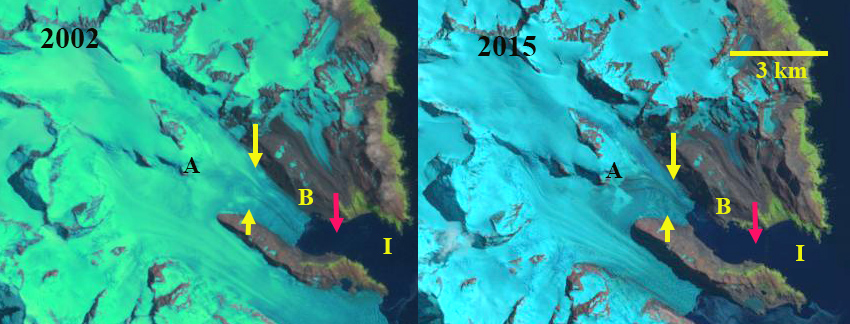
Landsat images from 2002 and 2015 of Herz Glacier.  Red arrow is 1989 terminus location, yellow arrows the 2021 terminus location. I=Iris Bay.
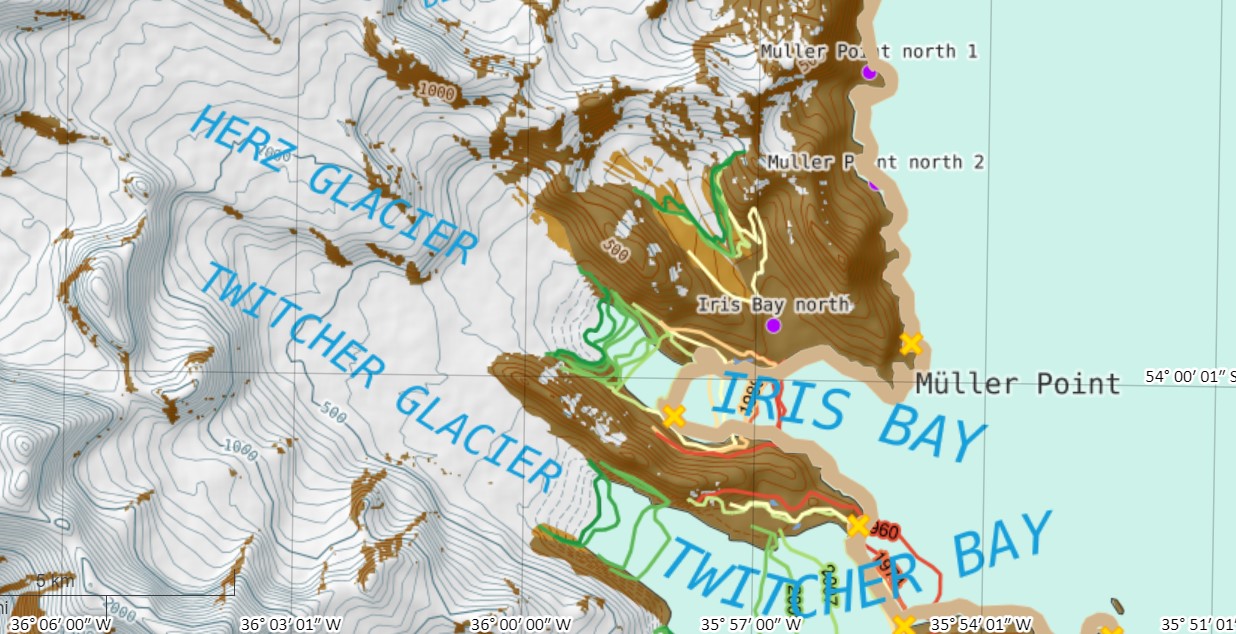
Map of Herz Glacier area from the British Antarctic Survey, illustraing glacier front changes 1988-2011. Yellow crosses mark elephant seal beaches and purple dots penguin colonies, which can expand to new locations in this opening fjord.

Twitcher Glacier, South Georgia, 40% of Length Lost 1989-2019

Twitcher Glacier in Landsat images from 1989 and 2019.  The red arrow is the 1989 terminus and yellow arrow is the 2019 terminus.  1, 2 and 3 are tributaries.

Twitcher Glacier is the next glacier south of Herz Glacier on the east coast of South Georgia. Until 1989 the glacier ended at the tip of a peninsula, the ensuing retreat has led to the opening of a new fjord.  Twitcher Glacier was 12 km long and had a 2.3 km wide calving front in 1989. The terminus change of this tidewater glacier was completed by the British Antarctic Survey for the 1960-2007 period. The glacier retreated 1.5 km between 1960 and 2007, with half of the retreat occurring after 1992 (Gordon et al, 2008). The map below indicates the slow retreat from 1960-1988 and a more rapid retreat since.

In 1989 this glacier terminated approximately at the end of a peninsula separating the two glaciers. Here we examine Landsat imagery from 1989, 2002, 2015 and 2019 to identify the rate retreat. The 1989 terminus position is indicated with the down pointing red arrow and the 2019 terminus position with a yellow arrow. The retreat is less than 0.5 km  from 1989-2002. Three tributaries from the south side are feeding the main glacier in 1989 and in 2002.  By  2015 the glacier has retreated  a further 1.7 km retreat and tributary #1 now flows directly into the expanding Twitcher Bay. By 2019 tributary #2 has detached from the glacier as well.  The glacier retreat from 1989-2019 has been 5.2 km, which is 40% of its 12 km length in 1989.  last image is a closeup in Google Earth from 2010 note the significant crevassing which is indicative of rapid flow. The terminus is currently quickly retreating to the next peninsula where the terminus will separate into two parts.  The retreat of this glacier rivals that of both Neumayer Glacier and Hindle Glacier that have also separated and opened up large new fjord reaches NASA Earth focused on this assessment. Hindle and Twitcher have both had the fastest retreat since 2015. The glacier currently has a 1 km wide calving front, but this should widen some as tributary #3 is reached.  This will lead to greater retreat in terms of area if not length.

Twitcher Glacier in Landsat images from 2002 and 2015.  The red arrow is the 1989 terminus and yellow arrow is the 2019 terminus.  1, 2 and 3 are tributaries.

Retreat of Twitcher Glacier in the BAS map from 1988-orange lines to 2017 green line at glacier front.