Bridge Glacier, Southeast Alaska Retreat & Lake Formation

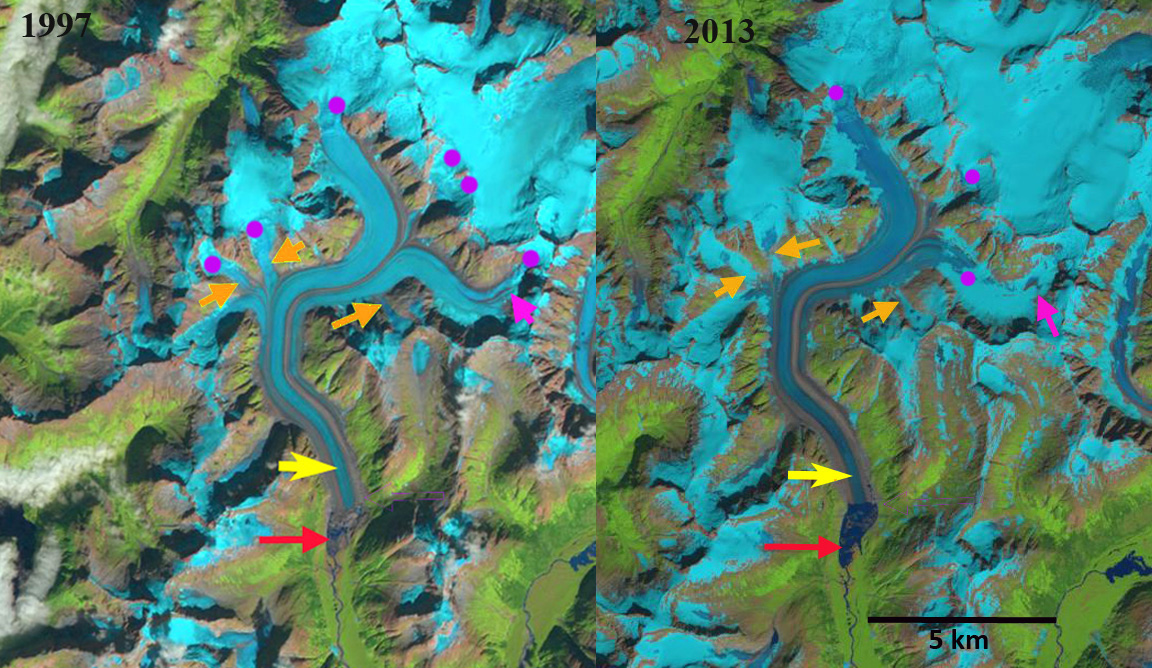
Bridge Glacier in Landsat image from 1984 and Sentinel image from 2017. The red arrow indicates the 1984 terminus where no lake exists, yellow arrow is 2017 terminus, orange arrows are selected tributaries and purple dots the snowline. 
Bridge Glacier drains the same icefield as the Wright and Speel Glacier 45 km southeast of Juneau, Alaska. Here we examine the changes in this glacier from 1984-2017 using Landsat and Sentinel imagery.

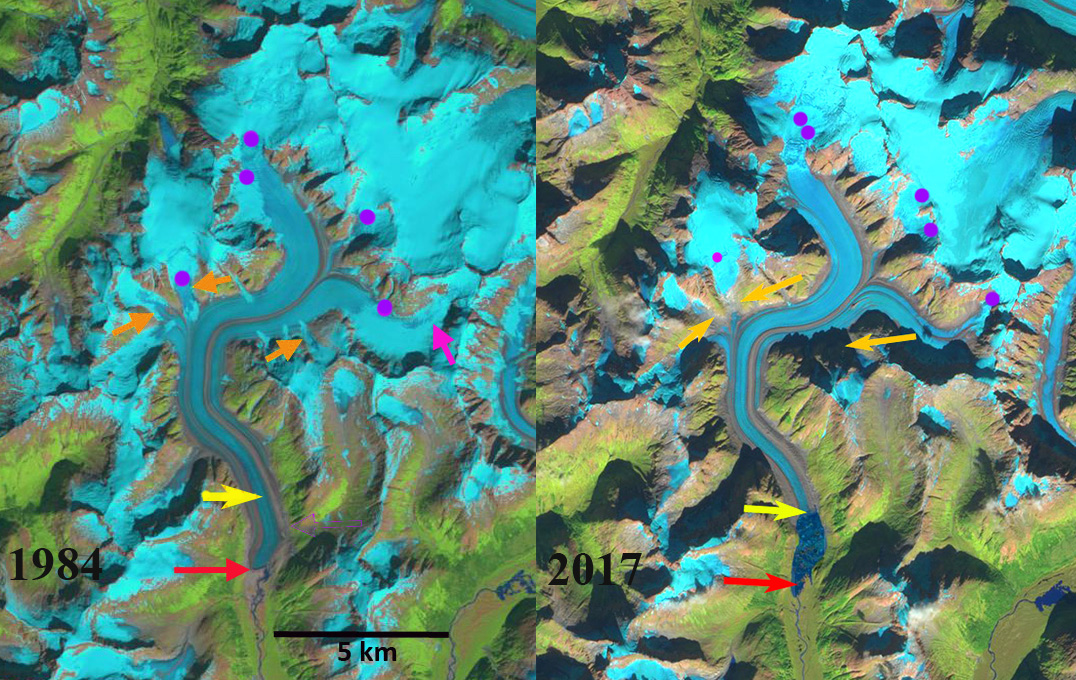
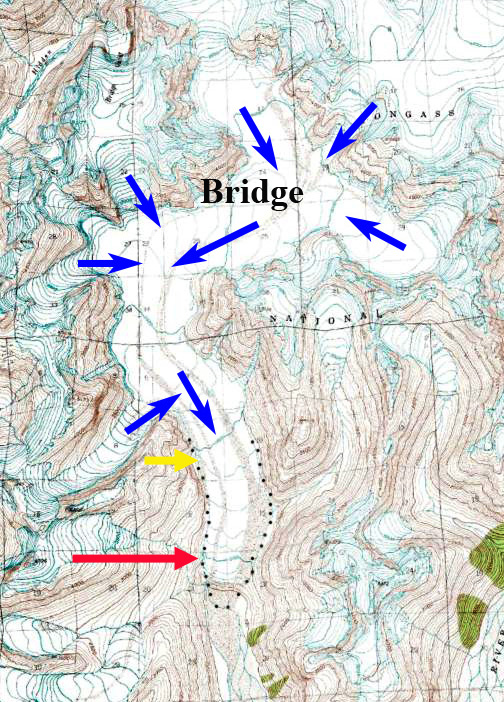
In 1984 the glacier ended on an outwash plain at the head of a branch of Speel River. The red arrow indicates the 1984 terminus for each image, the yellow arrow the 2017 terminus and the orange arrows three tributaries feeding the glacier.  The purple dots indicate the snowline at 1200 m. In 1984 all three tributary glaciers fed Bridge Glacier and the glacier has no proglacial lake at the terminus. In 1997 a lake basin is beginning to develop, though it is still largely filled by ice. The eastern tributary pink arrow, has lost all of its snowpack. The three tributaries at the orange arrows are connected to Bridge Glacier still and the snowline is at 1250 m. In 1999 the proglacial lake has formed and has length of 1 km, the lake has expanded south and north of the 1984 terminus position, and does not entirely represent glacier retreat.  In 2013 the glacier has retreated 1200 m from the 1984 position and the lake is still expanding. The orange arrows indicate that none of the three tributaries are still connected to the main glacier. The glacier in a sense is losing its income flow from these subsidiaries. The eastern tributary has retained some snowcover with six weeks left in the melt season in 2013, but this is mostly gone a month later, the snowline is at 1100 m. nbsp; Total retreat from 1984 to 2017 is 1900 m. In 2017 the snowline is at 1300 m, and the separation of the tributaries is by more than 500 m in each case. The snowline has been high by the end of each summer from 2014-2017 indicating retreat will continue. The retreat of this glacier is the same story as seen at nearby PattersonGilkey and Norris Glacier.

.

Bridge Glacier in Landsat images from 1997 and 2013. The red arrow indicates the 1984 terminus , yellow arrow is 2017 terminus, orange arrows are selected tributaries and purple dots the snowline. 

Bridge Glacier in USGS map when it ended on the outwash plain in 1948.


Long Peak Glacier, Southeast Alaska

“Long Peak” Glacier is an unnamed glacier southeast of Juneau, Alaska. The glacier occupies a narrow northeast oriented avalanche fed valley, light blue arrows indicate the avalanche feeding regions around the glacier. In 1948, as indicated in the USGS map,the glacier extended from 1600 m to 500 m, a small lake is shown at the terminus, with an overall length of 3.8 km. The glacier is a short distance southwest of the retreating Speel Glacier, and it does drain into the Speel River. Here we examine Landsat imagery of changes in this glacier from 1984 to 2013. This is a small, remote glacier that receives that has not attracted attention. It is close to the Long Lake Snotel snowpack measurement station operated by the USDA. I observed the glacier in 1998 from a helicopter and thought it did not look poised to survive our warming climate for long. long peak glacier
Here we examine Landsat imagery from 1984-2013 to observe glacier retreat and lake expansion. By 1984 the lake had expanded to 750 m in length, with a glacier retreat of 500 m from the mapped terminus. The snowline is marked with purple dots, the 2013 terminus with a red arrow, and the orange arrow indicates a debris covered region of the glacier. Only 20% of the glacier is snowcovered and the melt season is not yet over in the 1984 image. This same pattern of snowcover remaining is seen in 1993, 1995, 1996, 1997 and 1998 for example. By 1999 the glacier has retreated an additional 300-350 m, the snowcovered area is greater but this is an August image. In 2013 a late June and a Late July image depict the loss of snowcover during a month. The overall length of the glacier is now 2.6 km, indicating a retreat of 1200 m since and a retreat of 700 m from 1984-2013. The glacier is still terminating in the lake that has expanded by the same amount. This glacier has not only retreated but also thinned and the slopes above the glacier have greened a bit particularly on the north side. This glacier cannot survive with the level of retained snowcover it has (Pelto, 2010). Ongoing mass balance work on the Lemon Creek Glacier of the Juneau Icefield, where the Juneau Icefield Research Program is beginning measurements next week, has thinned by 29 m during the 1955-2013 period (Pelto et al, 2013). In 2014 the Long Lake Snotel site at an elevation of 850 feet, lost its snowpack on June 11, a bit earlier than normal, indicating this glacier will lose most of its snowpack in 2014.

long peak 1984
1984 Landsat image

long peak 1997
1997 Landsat image

long peak 1999
1999 Landsat image

long peak june 2013June 2013 Landsat image

long peak 2013
July 2013 Landsat image