Taku Glacier, Alaska in 2018 Highest Snowline in 70+ years

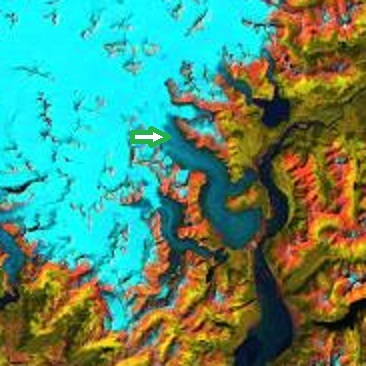
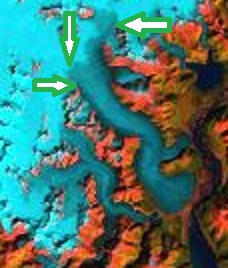
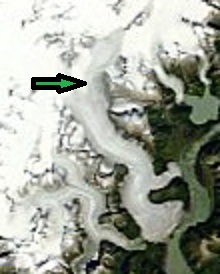
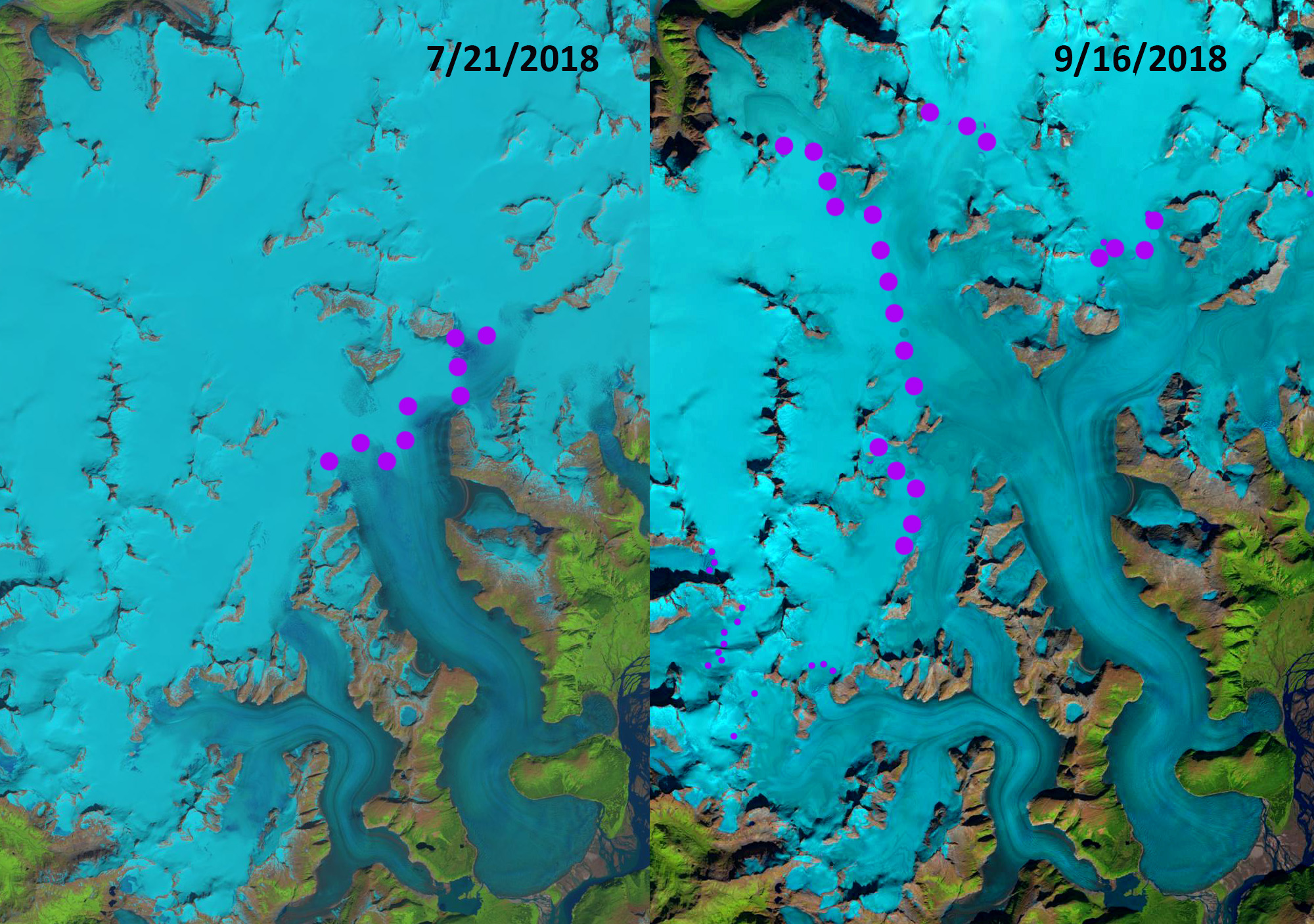
Taku Glacier transient snowline (purple dots) in Landsat images from 7/21 and 9/16/2018.

The Juneau Icefield Research Program (JIRP) has been examining the glaciers of the Juneau Icefield since 1946. Until the NASA Landsat program began, field measurements and aerial observations were the only means to observe the glaciers of the icefield. For more than 40 years it was Maynard Miller, U of Idaho, who led this expedition that has trained so many of today’s glaciologists, today it is led by Seth Campbell, U of Maine who followed Jeff Kavanaugh, U of Alberta.   Landsat images have become a key resource in the examination of the mass balance of these glaciers (Pelto, 2011). The overall mass balance record of the glaciers was published this by Pelto et al (2013). On Taku Glacier, the mean annual equilibrium line altitude (ELA) has risen 85 m from the 1946–1985 period to the 1986–2018 period.  Mean annual mass balance from 1946-1985 and 1986-2018, with 2018 values being preliminary, were +0.40 m/yr and −0.18 m/yr respectively, indicative of the snow line rise resulting in cessation of the long-term thickening of the glacier.

The height of the transient snowline (purple dots) at the end of the summer represents the ELA for the glacier, where ablation equals accumulation.  This also is a good estimator of mass balance. The end of the summer melt season typically occurs in September. In the last three decades the average ELA has been 1000 m.  In 2018 the transient snowline on July 21 was at 975 m, and by July 30 the TSL was above 1075 m.  On Sept. 16, 2018 the snowline was at 1400 m on average, the highest observed since records began in 1946. This is a rise of 425 m in ~57 days.  Given the balance gradient observed on the glacier of  ~3.3 mm/m this represents ablation of 1.4 m w.e. snow, or 2.0 m of snow depth  (Pelto et al 2013 and Roth et al 2018)  The snowline on Brady Glacier, Glacier Bay was also the highest that had been observed in 2018. In the images below the TSL in 2013 is at 1000 m, in 2014 at 1100 m, 2015 at 1140 m, and in 2017 at 1150 m. Pelto (2017) identifies the response of the entire icefield to climate changes from 1984-2013. The 2014-2018 period has been the most negative balance 5 year period for the icefield, which will lead to continued thinning and volume loss.


Annual equilibrium line altitude on Taku Glacier 1946-2018, 2018 is the highest and 1985 the lowest.

Taku Glacier transient snowline (purple dots) in Landsat image from 9/15/2013.
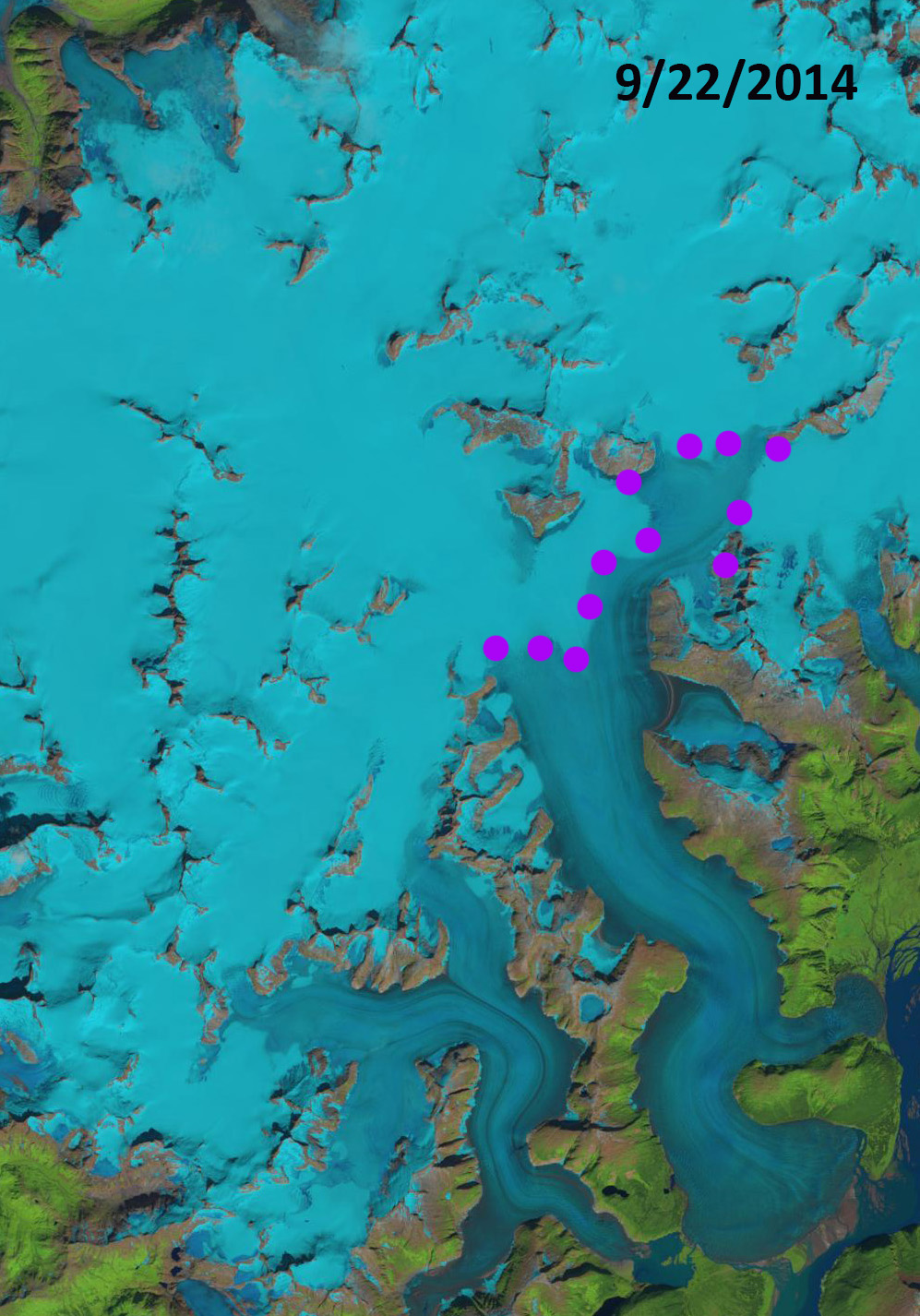
Taku Glacier transient snowline (purple dots) in Landsat images from 9/22/2014.

Taku Glacier transient snowline (purple dots) in Landsat images from 9/8/2015.

Taku Glacier transient snowline (purple dots) in Landsat images from 9/20/2017.
Taku Glacier Transient Snow Line Paper Published

This post examines in simpler terms and more images the paper published this week in The Cryosphere on “Utility of late summer transient snowline migration rate on Taku Glacier, Alaska”. The transient snowline (TSL) is the point of transition from snow to older glacier firn and ice. The TSL rises during the course of the summer melt season and at the end of the melt season is the equilibrium line altitude (ELA). This paper represents a concept that occurred to me while skiing and probing snow pack on the Taku Glacier in 1998 with the Juneau Icefield Research Program (JIRP), something I have spent six months doing over the years. There simply was not enough consistent satellite imagery to apply the model until recently, we also needed field data-ground truth-to quantify and verify the TSL model. This meant probing snowpack along a 5 km transect near the TSL during several summers, following my 1998 probing, Matt Beedle completed the probing in 2004 and 2005 with JIRP and Chris McNeil did so in 2010, 2011 and 2014. Below is the transient snowline in August 2014 on the Juneau Icefield. juneau Icefield tsl 8212014
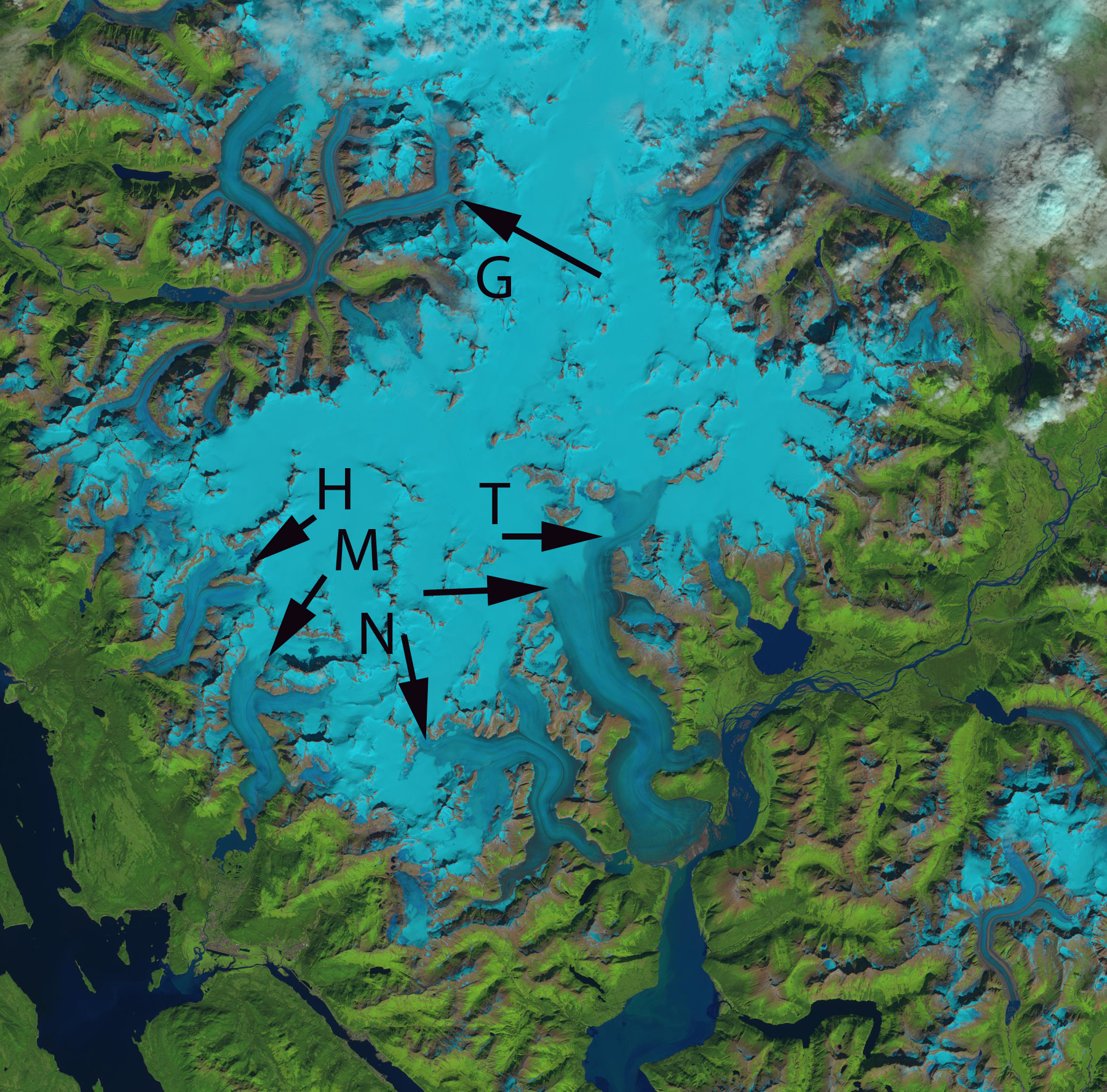
Landsat Image: T=Taku, G=Gilkey, H=Herbert, M=Mendenhall and N=Norris. Black arrows indicate the snowline which was quite high at over 1000 m with a month left in the melt season.
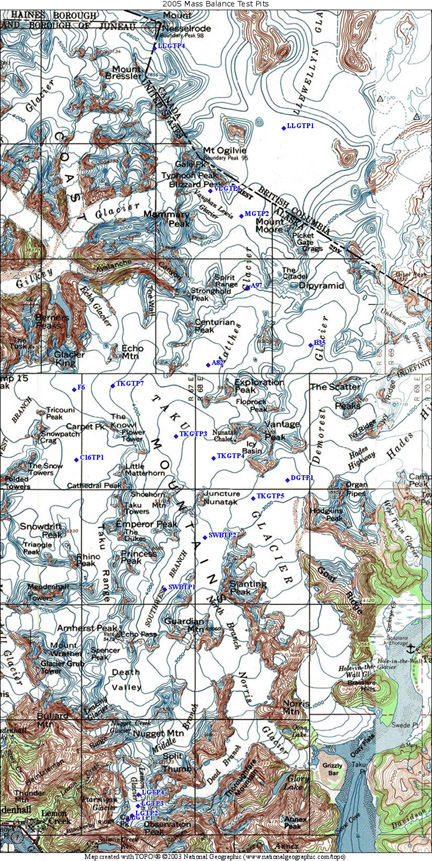
The ELA is the point at which accumulation equals melting on temperate alpine glaciers this is where snow transitions to bare glacier ice. Mass balance for non-calving glaciers is the difference between snow accumulation on a glacier and snow and ice loss from the glacier. The easiest to observe and most useful estimate of mass balance without detailed measurement is the equilibrium line altitude (ELA). Today the TSL can be observed frequently in satellite imagery. There are two ways the TSL is useful in assessing mass balance. First the rise of TSL during the melt season provides an assessment of the rate of melting. Second the TSL rate of rise can be used near the end of the melt season to determine the ELA, when imagery at that point is not available due to cloud cover. This allows widespread assessment of melt rate on glaciers. On Taku Glacier which is fairly typical we found a very consistent gradient of snowpack change with elevation from year to year. This allows determination of melt rate simply from rate of TSL rise. We use Landsat Imagery of which there are typically only two-four useful images during the melt season, barely enough and more recently MODIS imagery from GINA, which is obtained daily for the entire globe and provides the most frequent point of observation. However, the resolution of MODIS makes it inaccurate on glaciers less than 1 km wide or 1 km long. Taku Glacier is 55 km long and 5 km wide at the ELA. As the melt season begins the snow cover extent is large on Taku Glacier. The key is how rapidly the TSL rises during the melt season. On the ground the JIRP measures the snow depths and snow melt during July and August on Taku Glacier. This program was led by Maynard Miller, U Idaho for more than 50 years and is currently under the direction of Jeff Kavanaugh U Alberta. The Taku Glacier mass balance measurements allows validation of the melt rate, note snowpit locations on map below. For example in 2004 the TSL was at 850 meters on July 15, first image below. At this time the snowpack was 1.6 meters at 1000 meters. On September 1 the snowline was at 1030 m, second image below. The TSL had risen at an average rate of 3.9 meters per day, all 1.6 m of snow had melted. Below are images from May 26, 2006, then July 29, 2006 and then Sept. 15 2006. Indicating the rise of the snowline.
The below images from May 26, July 29 and Sept. 15 2006 indicate the rise of the ELA during the course of the melt season, from 370 m to 800 m to 975 m. Snow depths at the the Sept. 15 ELA, where snowpack=0, was 2 m on July 22. Thus, we had 2 meters of snow melt at 975 m between July 22 and Sept. 15. In 2004 the melt rate was 0.036 meters per day and in 2006 0.038 meters per day. All of the TSL images above are from Landsat> For Sept. 14, 2009 (top), Sept. 20, 2010 (middle) and Sept. 11, 2011 (bottom) MODIS images are used, resolution not as good as with the Landsat images. Note the similarity in the end of the year snowline on Taku Glacier for those three years. . The next task is to apply the TSL to other glaciers and to carefully compare results from MODIS and Landsat. Through 2010 there were only four days with good coverage from both. Below is the Landsat imagery from Sept. 11, 2011, same as the MODIS date above. Noted is the TSL, in this case the ELA for Lemon Creek and Taku Glacier.