Eyrie Bay, Antarctic Peninsula Retreat 2000-2020

From REMA Landsat images from Feb. 2016 and Oct. 2019 indicating the front of the Cugnot Ice Piedmont (CP)  and Broad Valley (BV) ice fronts in Eyrie Bay.  Point A, B, and C indicate specific bedrock knobs near the ice front.  Point D is just south of a side glacier entering the bay.

Eyrie Bay is near the tip of the Antarctic Peninsula and is rimmed by tidewater glaciers including the Cugnot Ice Piedmont.  The changes of the ice front fed by the Cugnot and from Broad Valley were mapped by Ferrigno et al (2008)   They noted a retreat from 1956-1977 averaging 36 m/year from 1977-1988 a retreat of 12 m/year, and 6 m/year from 1988-2000. Here we examine Landsat imagery from 2000-2020 to identify changes of the two glacier fronts. The continued significant warming air temperatures on the Antarctic Peninsula have increased surface ablation in the region (Barrand et al 2013), with 87% of glaciers around the Antarctic Peninsula now receding Davies et al (2012) . The most dramatic response has been the collapse of several ice shelves, Jones, Prince Gustav, Wordie, Larsen A and Larsen B. The  nearby Prince Gustav Ice Shelf connecting James Ross Island to the Trinity Peninsula collapsed after 1995 (Glasser et al 2011).

In 2000  the Broad Valley terminus (BV) extended 500 m beyond bedrock knob at Point A and 1400 m eastward beyond the bedrock knobPoint B. The Cugnot Ice Piedmont terminus (CP) extended from the northern tip of the bedrock knob at Point C. In 2016 the BV terminus in Eyrie Bay was 600 m east of the Point A bedrock knob and 1200 m east of the Point B bedrock knob.  By October 2019 the BV ice front had retreated to the bedrock knob at Point B and terminated near the western end of the bedrock knob at Point A, with just a narrow band of fringing ice around Point A. At Point C a small embayment has developed along the west margin of the CP terminus and the embayment near Point D has become wider and move concave.

The surface slope upglacier of the BV terminus rises quickly indicating a rising bedrock topography too, which should slow retreat in the near future.  The CP terminus has a gradual even slope suggesting there will be continued retreat. The retreat of glaciers in this region has been attributed to both atmospheric warming in the region driving surface melt increases , and in some cases increasing ocean temperatures and ice shelf bottom melting (Barrand et al 2013; Davies et al 2014).

Landsat images from 2000 and 2020 indicating the front of the Cugnot Piedmont (CP)  and Broad Valley (BV) ice fronts in Eyrie Bay.  Point A, B, and C indicate specific bedrock knobs near the ice front.  Point D is just south of a side glacier entering the bay.

From REMA Antarctica contour of Broad Valley (BV) and  Cugnot Ice Piedmont (CP), contour interval is 25 m.
Depot & Mondor Glacier Retreat, Antarctic Peninsula

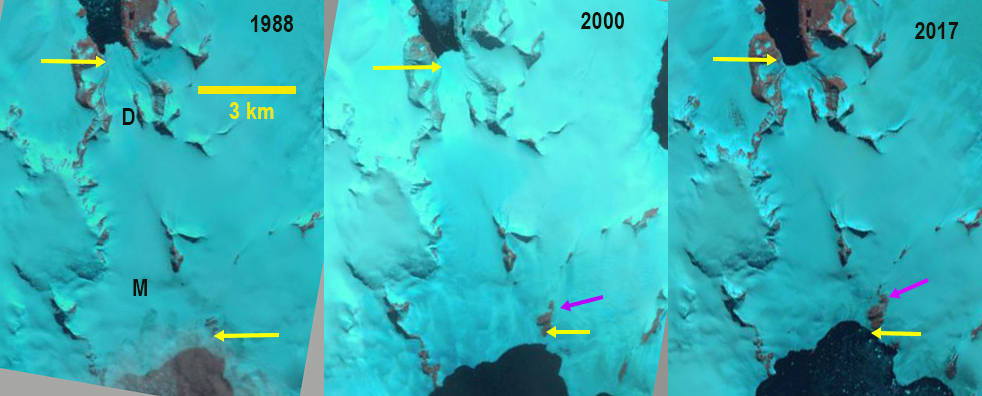
Mondor and  (M) and Depot Glacier (D) at the tip of the Antarctic Peninsula in Landsat imagers from 1988, 2000 and 2017.  Yellow arrows indicates the 2017 terminus location of each.  The purple arrow indicates a bedrock ridge that has been expanding.

On the Trinity Peninsula,which is the region at the tip of the Antarctic Peninsula, are Depot and Mondor that flow north and south from the same accumulation zone emptying into Hope Bay and Duse Bay respectively. The Argentine Research Station, Esparanza is on Hope Bay. This region experienced some of the greatest warming on Earth from 1950-1990’s, but no additional warming since the 1990’s (Turner et al, 2016). This climate change has led to a rapid glaciological response, with 87% of glaciers around the Antarctic Peninsula now receding Davies et al (2012) . The most dramatic response has been the collapse of several ice shelves, Jones, Prince Gustav, Wordie, Larsen A and Larsen B. The Prince Gustav Ice Shelf connecting James Ross Island to the Trinity Peninsula collapsed after 1995 (Glasser et al 2011). There is limited surface melting on Antarctic glaciers, as a result almost all of the mass loss is from bottom melting under ice shelves and calving. These processes have led to and continue to drive dramatic retreat, thinning and acceleration of glaciers that feed ice shelves and the ice shelves, such as Rohss Bay and Coley Glacier Here we examine a glacier that is grounded, which limits the impact of enhanced melting from warmer ocean temperatures. Esparanza Base has a long term climate record with only December and January having a mean temperature above 0 C, at 0.4 and 0.5 C respectively. The record high temperature in Antarctica was recorded at Esparanza Base on March 24, 2015 at 17.5 C (Skansi et al, 2017). Specific anomalously warm days are when most mass balance losses occur. Barrand et al (2013) note a strong positive and significant trend in melt conditions in the region, driving the retreat.

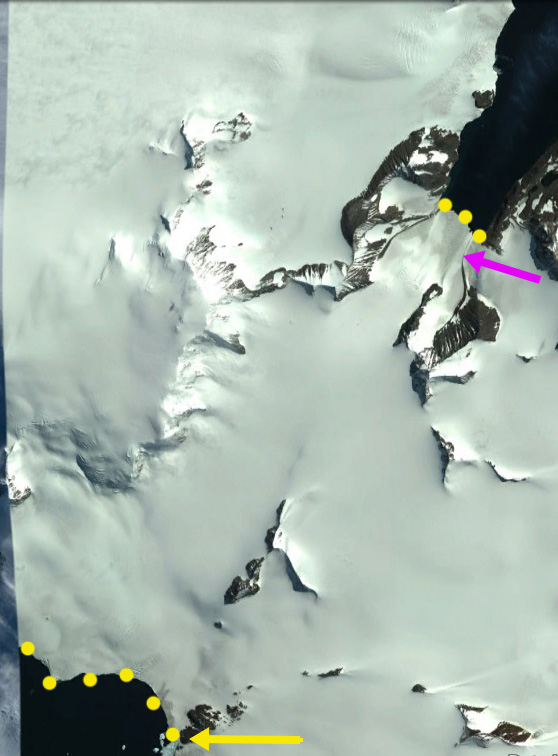
In 1988 Depot Glacier terminus was north of a tributary entering on the west side of Depot Glacier. By 2000 the glacier terminus has receded and is adjacent to the northern side of this tributary.  By 2017 the terminus has retreated further and is nearly at the southern edge of the tributary glacier, a retreat of 500 m. Mondor Glacier in 1988 terminates south of bedrock ridge on the east margin of the glacier, yellow arrow. In 2000 the bedrock ridge has expanded and is closer to the terminus. By 2017 the bedrock rib has further extended north, purple arrow, indicating glacier thinning. The overall retreat of the terminus is 400 m from 1988 to 2017. The retreat rate increased after 2000, which is what Davies et al (2012) reported for the region. The rate of retreat is limited as the grounded glaciers have limited calving, and there is limited surface melt. The melt zone is not significant in any of the images on Mondor Glacier. On Depot Glacier there is a melt zone  below 200 m evident in both Goggle Earth images, purple arrows and the 2017 Landsat image. The limited changes of this glacier underscores that it is ocean warming that has been the key to date in glacier retreat in the region.  There has been a significant temperature rise, but it remains too cold for substantial surface melt.

Google Earth image from 2013 of Mondor Glacier terminus, black dots bottom and Depot Glacier black dots top.  Purple arrow indicates area of melting where snowpack has been lost. Yellow arrow a bedrock ridge on east side of Mondor Glacier.

Google Earth image from 2015 of Mondor Glacier terminus, black dots bottom and Depot Glacier black dots top.  Purple arrow indicates area of melting where snowpack has been lost. Yellow arrow a bedrock ridge on east side of Mondor Glacier.