
Petain Glacier’s meltwater feeds Petain Creek and then Upper Elk Lake in . The glacier like the vast majority in Alberta has been losing area and volume during its retreat.
Bolch et al (2010) noted that the glaciers in western Canada had on average lost 11% of their area from 1985 to 2005, 16% on the east slope of the continental divide in the Rocky Mountains of Alberta. 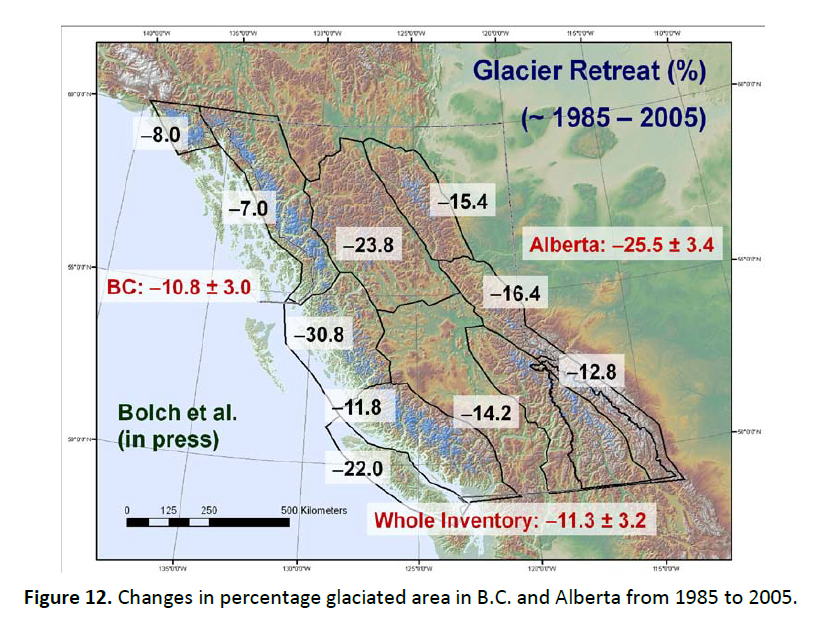 As the glaciers retreat their meltwater that is primarily yielded in late summer when other sources are at a minimum is declining. It is anticipated that during this century glacier contributions to streamflow in Alberta will decline from 1.1 km3 a−1 in the early 2000s to 0.1 km3 a−1 by the end of this century Marshall et al (2011). Petain Glacier has a well defined moraine established during the Little Ice Age, green line. Retreat is examined by comparison of Google earth Imagery in 2005 and 2010 and Landsat imagery from 1994 and 2009. By 1994 the glacier had retreated 850 meters from the Little Ice Age moraine, and 900 meters by 2005 (orange line) and 930 meters by 2009.


 .
.
The retreat rate has been 4 meters/year recently. The retreat will continue as the blue arrows indicate locations where the glacier is thinning and exposing new areas of rock upglacier of the terminus. The red arrows indicate small lakes beyond the glacier terminus. The 2005 and 2010 images from Google Earth are tilted and indicate a 30 m retreat in the 5 years. In the image of the terminus below the blue arrow indicates the terminus the yellow arrows collapse features near the terminus indicating stagnation, the light green arrow indicates the thin debris covered area with surface stream channels again indicating stagnant conditions and retreat that will continue.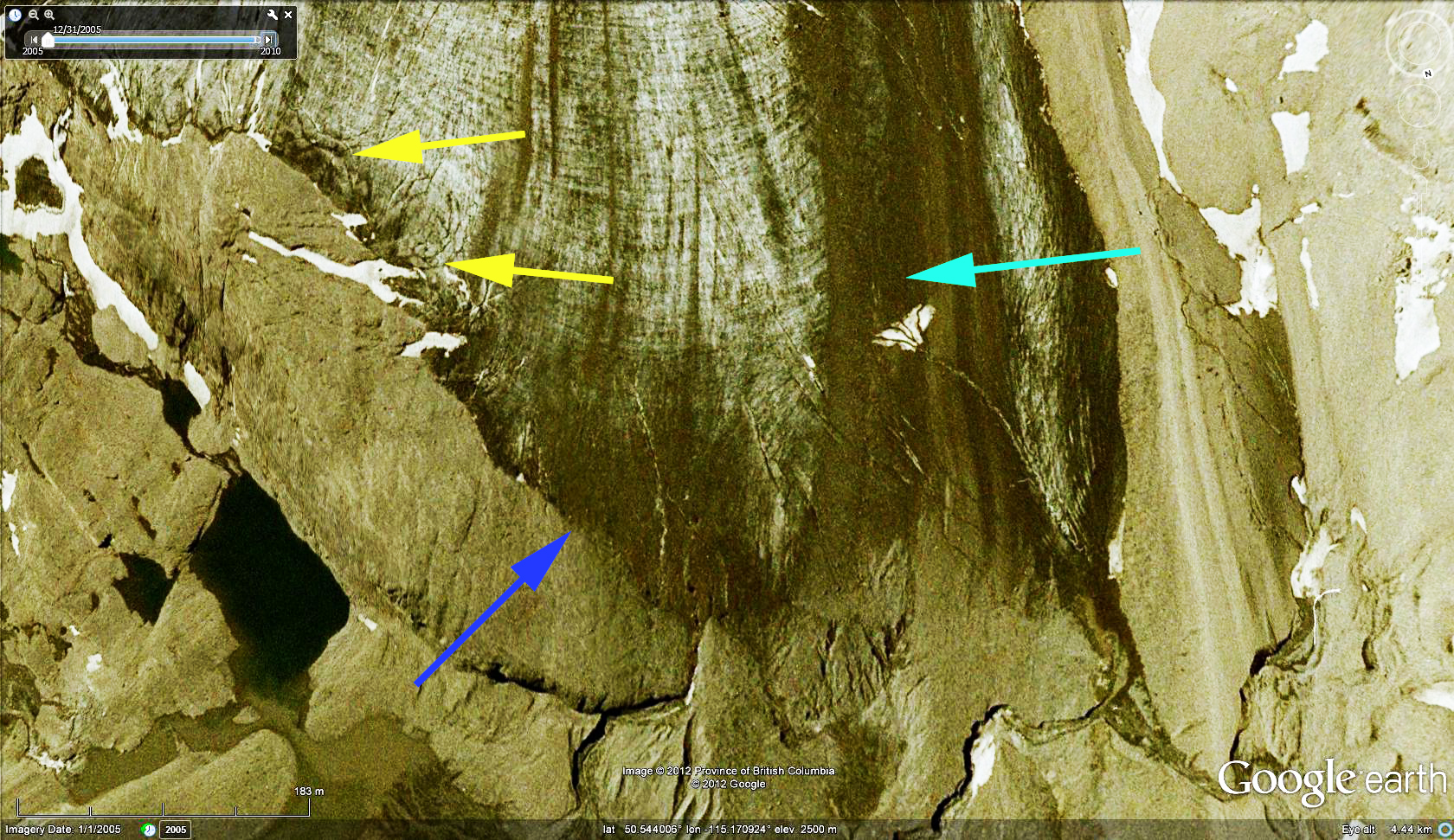
Month: March 2012
Epiq Sermia retreat, Greenland
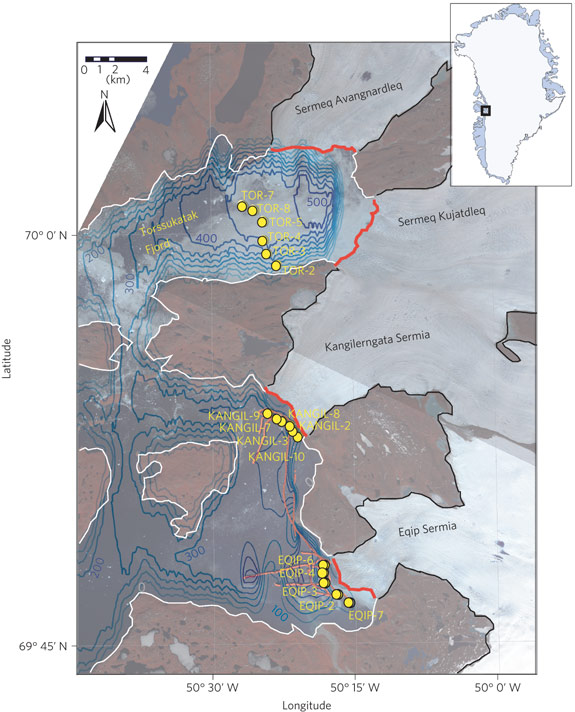
Epiq Sermia is an outlet glacier of northwest Greenland, 70 km north of Jakobshavn Glacier. Epiq Sermia discharges 2-3% of the ice volume that Jakobshavn discharges.  The glacier was observed to have had a small retreat in the first half of the 20th century and a minor advance in the 1960’s. Currently it is undergoing a more rapid retreat. This outlet glacier behaves as other Greenland marine terminating outlet glaciers, thinning at the terminus induced by greater basal and surface melting, triggers thinning which reduces basal friction and allows for acceleration and retreat. The glacier and its neighbor Kangilergnata Sermia have attracted recent research Rignot et al (2010) examined melting beneath the terminus tongue of both glaciers. They found rates of submarine melting 100 times larger than surface melt rates, but comparable to rates of iceberg discharge. Rignot et al (2010-PR) identified melt along the submerged bottom of Kangilergnata and Epiq Sermia where it comes into contact with warm ocean waters, which melts the glacier bottom, thinning the ice, shifting its grounding line, increasing its flotation, which leads to retreat. Figure 1 from Rignot et al (2010) indicates that water depths at the calving front are between 200-300 m deep, not that deep for the ice thickness observed.
 .
.
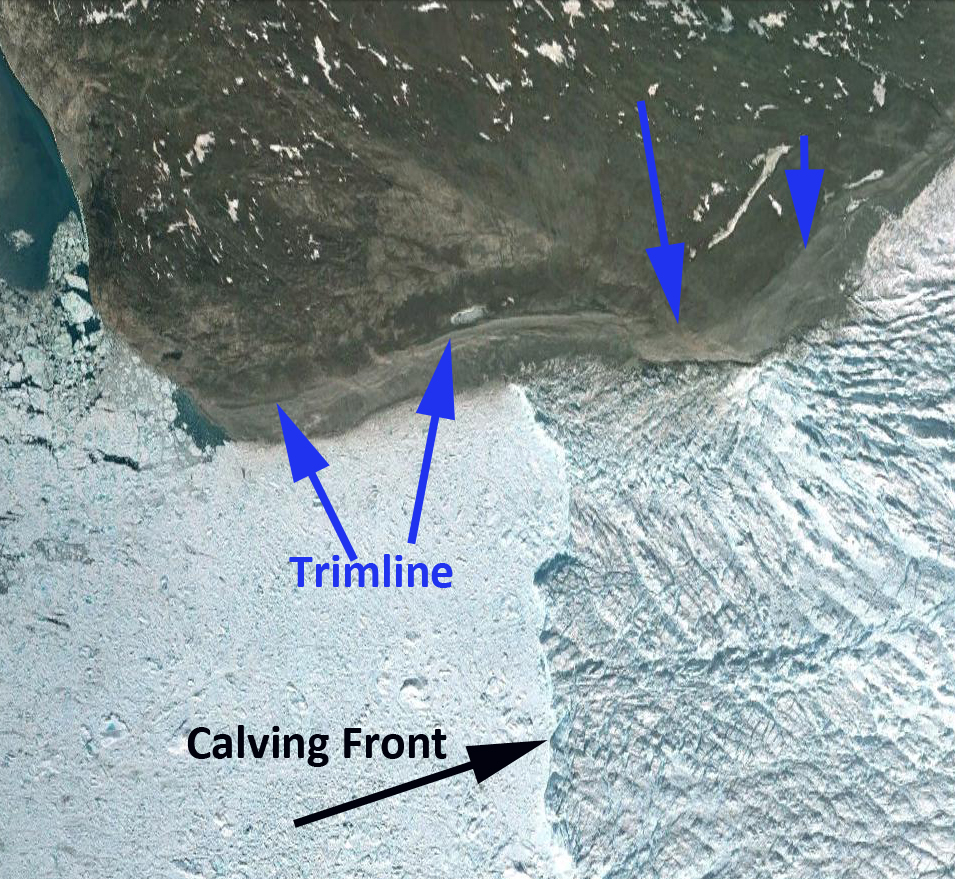
A comparison of a 2001 and 2011 Landsat image overlain on Google Earth imagery identifies recent changes. The image comparison indicate average retreat of 1.1 kilometers over the 10 years for Epiq Sermia and 2.5 km for Kangilergnata Sermia, the yellow line is the 2001 margin and red line the 2011 margin. Thinning of Epiq Sermia is also apparent in the retreat upglacier from the terminus with the trimline being exposed and retreat at the secondary terminus into the lake. 

 Retreat of the Epiq Sermia and Kangilergnata Sermia mirror that of other outlet glaciers, Howat and Eddy (2011) found that from 1964-2010 64% were retreating and from 2000-2010 98% of the outlet glaciers in NW Greenland were retreating. The also noted the average retreat rate rose from 20 m/year to 125 m/year, Howat and Eddy (2011). Specific examples of Umiamako Glacier, Upernavik Glacier and Kong Oscar Glacier.
Arhuey Glacier Retreat, Peru
The Cordillera Blanca, Peru has the greatest concentration of glaciers of any region in the tropics. Glacier mass balance losses and glacier area losses in this range have been large since 1990 (Rivera,INRENA) Laguna Arhueycocha is proglacial lake dammed by a glacier end moraine emplaced by the Arhuey Glacier (AG) during the Little Ice Age. The glacier currently terminates in this lake. Moraine dammed lakes can be a hazard as they expand since the moraine material that comprises the dam is relatively unstable. The glacier still filled the lake basin in 1963 photographs. By 1991 the lake was 500 meters long (Reynolds Geoscience, 2003) . In a 1999 Landsat image the lake is 750 meters long, by 2002 IKONOS imagery the lake and 2003 Google Earth imagery indicates a lake that is 1050 meters long, and finally in 2011 Landsat imagery the lake is 1200 meters long. The 2003 Google Earth image has the terminus position in red for 1991, purple 2002 and green 2011 indicated. The red arrow points to the artificial outlet channel. The 700 meter retreat since 1999 leaves only a tiny bit of the glacier in contact with the lake, and it appears the lake will not extend much further.


To relieve the threat of an expanding glacier lake breaking its dam, a (Reynolds Geoscience, 2003) 122 meter long channelthat is 12 meter deep was completed through the moraine to limit the surface elevation rise of the lake. The terminus in the 360 degree shot in Google Earth a snapshot of which is seen below, indicates the width of the glacier at the terminus is small and the terminus is quite steep, which given the thin nature of the ice, indicates a steep slope under the glacier, not a continuation of the lake basin. . The retreat of this glacier parallels the retreat of other nearby glaciers Llaca Glacier and Artesonraju Glacier
Himalaya Glacier Index
Himalaya-Pamir-Hindu Kush-Tien Shan-Quilian-Karakoram Range Glacier Change
Below is a list of individual glaciers in the Himalaya and high mountains of Central Asia that illustrate what is happening glacier by glacier. In addition to the individual sample glaciers we tie the individual glaciers to the large scale changes of approximately 10,000 glaciers that have been examined in repeat satellite image inventories. In the high mountains of Central Asia detailed glacier mapping inventories, from GLIMS: (Global Land Ice Measurements from Space), ICIMOD (International Centre for Integrated Mountain Development), ISRO ( Indian Space Research Organisation) and Chinese National Committee for International Association of Cryospheric Science (IACS) of thousands of glaciers have indicated increased strong thinning and area loss since 1990 throughout the region except the Karokoram. The inventories rely on repeat imagery from ASTER, Corona, Landsat, IKONOS and SPOT imagery. It is simply not possible to make observations
on this number of glaciers in the field.
Reqiang Glacier, Tibet———-Ngozumpa Glacier, Nepal
Samudra Tupa, India———-Zemu Glacier, Sikkim
Theri Kang Glacier, Bhutan———-Zemestan Glacier, Afghanistan
Khumbu Glacier, Nepal———-Imja Glacier, Nepal
Gangotri Glacier, India———–Milam Glacier, India
Satopanth Glacier, India———-Kali Gandaki Headwaters, Nepal
Menlung Glacier, Tibet———-Boshula Glaciers, Tibet
Urumquihe Glacier, Tibet———-Sara Umaga Glacier, India
Dzhungharia Alatau, Kazakhstan———-Petrov Glacier,Kyrgyzstan
West Barun Glacier, Nepal—–Malana Glacier, India
Warwan Basin, India—–North Lhonak Glacier, Sikkim
Changsang Glacier, Sikkim——Emend River Headwaters, Afghanistan
Yajun Peak Glacier, Afghanistan—–Godur Glaicer, Pakistan
Tirich Mir, Pakistan—–Longbasba Glacier, Tibet
Lumding Glacier, Tibet—-Rongbuk Glacier, Tibet
Matsang Tsanpo Glacier, Tibet——-Sepu Kangri, China
Jiongla Glacier, Tibet—-Bode Zanbo Headwaters, Tibet
Zayul Chu Headwaters, Tibet—Hkakabo Razi, Myanmar.
Jaonli Glacier, India
In the Russian Altai mapping of 126 glaciers indicate a 19.7 % reduction in glacier area 1952-2004, with a sharp increase after 1997 (Shahgedanova et al., 2010). In Garhwal Himalaya, India, of 58 glaciers examined from 1990-2006 area loss was 6% (Bhambri et al, 2011). They also noted the number of glaciers increased from 69 (1968) to 75 (2006) due to the disintegration of ice bodies. Examination of 466 glaciers in the Chenab, Parbati and Baspa Basin, India found a 21% decline in glacier area from 1962 to 2004 (Kulkarni, 2007). Glacier fragmentation was also observed in this study, which for some fragments represents a loss of the accumulation area, which means the glacier will not survive (Pelto, 2010). The India glacier inventory (ISRO, 2010) identified glacier area losses and frontal change on 2190 glaciers and found an area loss rate of 3.3% per decade and 76% of glaciers retreating. In the Nepal Himalaya area loss of 3808 glaciers from 1963-2009 is nearly 20% (Bajracharya et al., 2011). The Langtang sub-basin is a small northeast-southwest elongated basin, tributary of Trishuli River north of Kathmandu and bordered with China to the north. The basin contained 192 km2 of glacier area in 1977, 171 km2 in 1988, 152 km2 in 2000 and 142 km2 in 2009. In 32 years from 1977 to 2009 the glacier area declined by 26% (Bajracharya et al., 2011). In the Khumbu region, Nepal volume losses increased from an average of 320 mm/yr 1962-2002 to 790 mm/yr from 2002-2007, including area losses at the highest elevation on the glaciers (Bolch et al., 2011). The high elevation loss is also noted in Tibet on Naimona’nyi Glacier which has not retained accumulation even at 6000 meters. This indicates a lack of high altitude snow-ice gain (Kehrwald et al, 2008). The Dudh Koshi basin is the largest glacierized basin in Nepal. It has 278 glaciers of which 40, amounting to 70% of the area, are valley-type. Almost all the glaciers are retreating at rates of 10–59 m/year and the rate has accelerated after 2001 (Bajracharya and Mool, 2009). In the Tien Shan Range over 1700 glaciers were examined from 1970-2000 glacier area decreased by 13%, from 2000-2007 glacier area shrank by 4% a faster rate than from 1970-2000 (Narama et al, 2010).
An inventory of 308 glaciers in the Nam Co Basin, Tibet, noted an increased loss of area for the 2001-2009 period, 6% area loss (Bolch et al., 2010). Zhou et al (2009) looking at the Nianchu River basin southern Tibet found a 5% area loss. 1990-2005. Cao et al, (2010) completed an inventory of 244 glaciers in Lenglongling Range of Eastern Qilian Mountains from 1972 to 2007 and found a 23.5% loss in glacier area. The highest rate of 1% per year of area loss was identified from 2000 to 2007. In the Pumqu Basin, Tibet an inventory of 999 glacier from the 1974 & 1983 to 2001 indicated the loss of 9% of the glacier area and 10% of the glaciers disappeared (Jin et al, 2005).
Pan et al (2011) looking at the Gongga Mountains, China found a 11.3% area loss from 1966-2009. In the Wakhan Corridor, Pamir Range, Afghanistan 30 glaciers were examined over a 27 year period, 1976-2003, indicating that 28 of the glacier retreated with an average retreat of 294 m, just over 10 meters/yr (Haritashya, et al., 2009). The Karokoram is the one range where a mix of expansion and retreat is seen. The anomalous expansions are confined to the highest relief glaciers and appeared suddenly and sporadically (Hewitt, 2005). After decades of decline, glaciers in the highest parts of the central Karakoram expanded, advanced, and thickened in the late 1990s. Many of the largest glaciers in the Karakoram are still retreating including the Baltoro, Panmah and Biafo Glacier, albeit slowly (Hewitt, 2011).
A new means of assessing glacier volume is GRACE, which cannot look at specific changes of individual glaciers or watersheds. In the high mountains of Central Asia GRACE imagery found mass losses of -264 mm/a for the 2003-2009 period (Matsuo and Heki, 2010). This result is in relative agreement with the other satellite image assessments, but is at odds with the recent global assessment from GRACE, that estimated Himalayan glacier losses at 10% of that found in the aforementioned examples for volume loss for the 2003-2010 period (Jacobs et al, 2012). At this point the detailed glacier by glacier inventories inventories of thousands of glaciers are better validated and illustrate the widespread significant loss in glacier area and volume, though not all glaciers are retreating.
This page will continue to be updated as new inventory data is published and new individual glaciers are examined herein. Yao et al (2012) in an examination of Tibetan glaciers observed substantial losses of 7090 glaciers.
Reqiang Glacier Retreat, Tibet
Requiang Glacier, Tibet is just east of Shishapangma Mountain one of planets 14 8000 meter peaks and terminates in the rapidly expanding Kong Tso (lake) at 5200 meters. The glacier is fed by avalanching from the high slope of Molamenqing the eastern satellite peak of Shishapangma, the black outline is the boundary of the glacier’s watershed. The glacier has been undergoing a rapid retreat since 1977.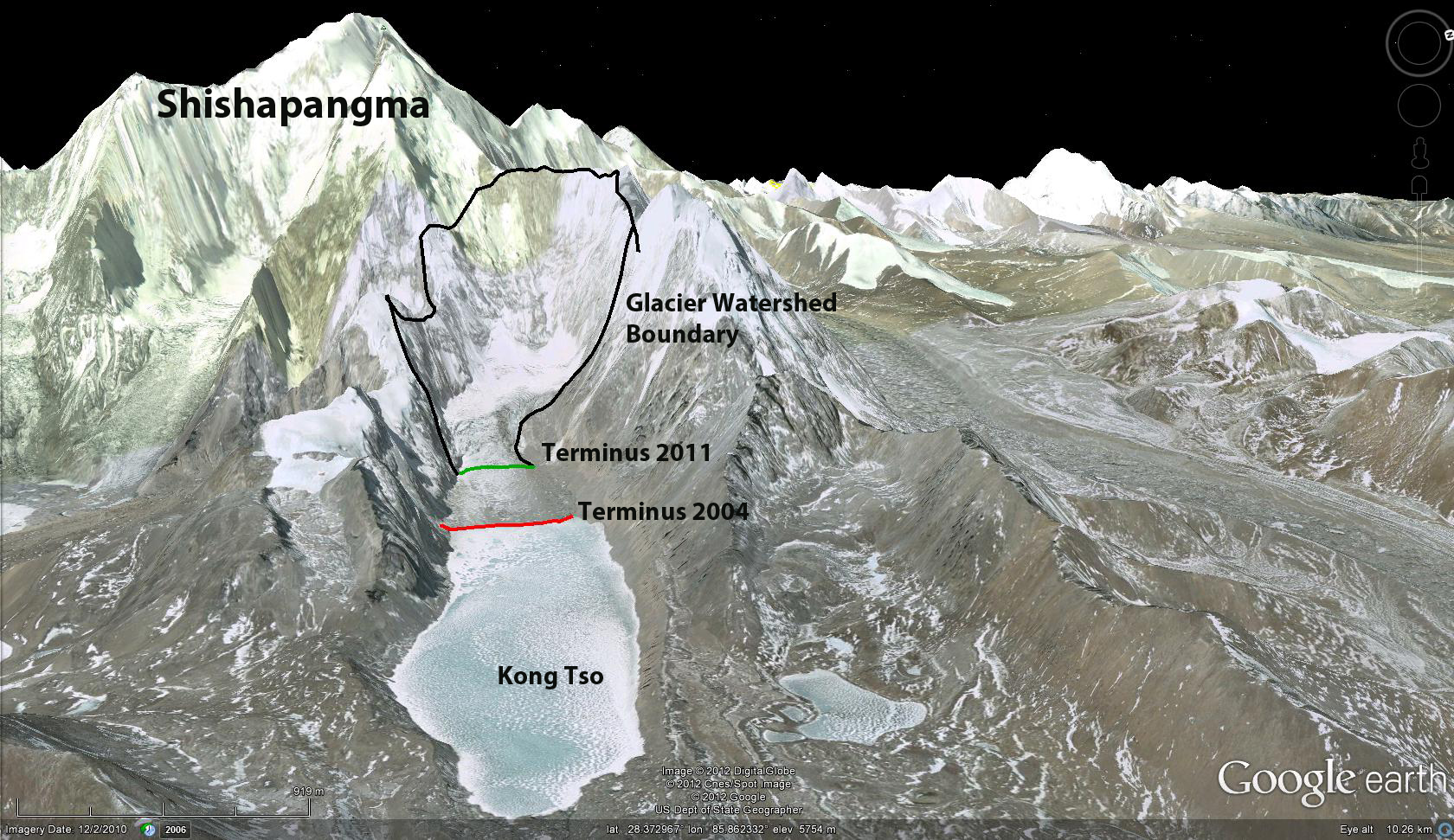 The area of Reqiang Glacier decreased by 22.90 % and retreated 71 m/year from 1977-2003 (Che et al., 2005). A comparison of Landsat imagery from 2000, Google Earth Imagery from 2004 and Landsat imagery from 2009 and 2011 indicates a more rapid retreat has ensued of 300 meters from 2000-2004, 75 m/ year, similar to the 1977-2003 period. From 2004 to 2011 the glacier retreated 1300 meters, 185 m/year. The net retreat of 3100 meters since 1977 is close to 50% of the glacier length lost since 1977. The red arrows are just west of two ridges and point to the 2004 terminus. The 2000 terminus is right near the ridges, red line, the 2011 terminus at the green arrow and green line
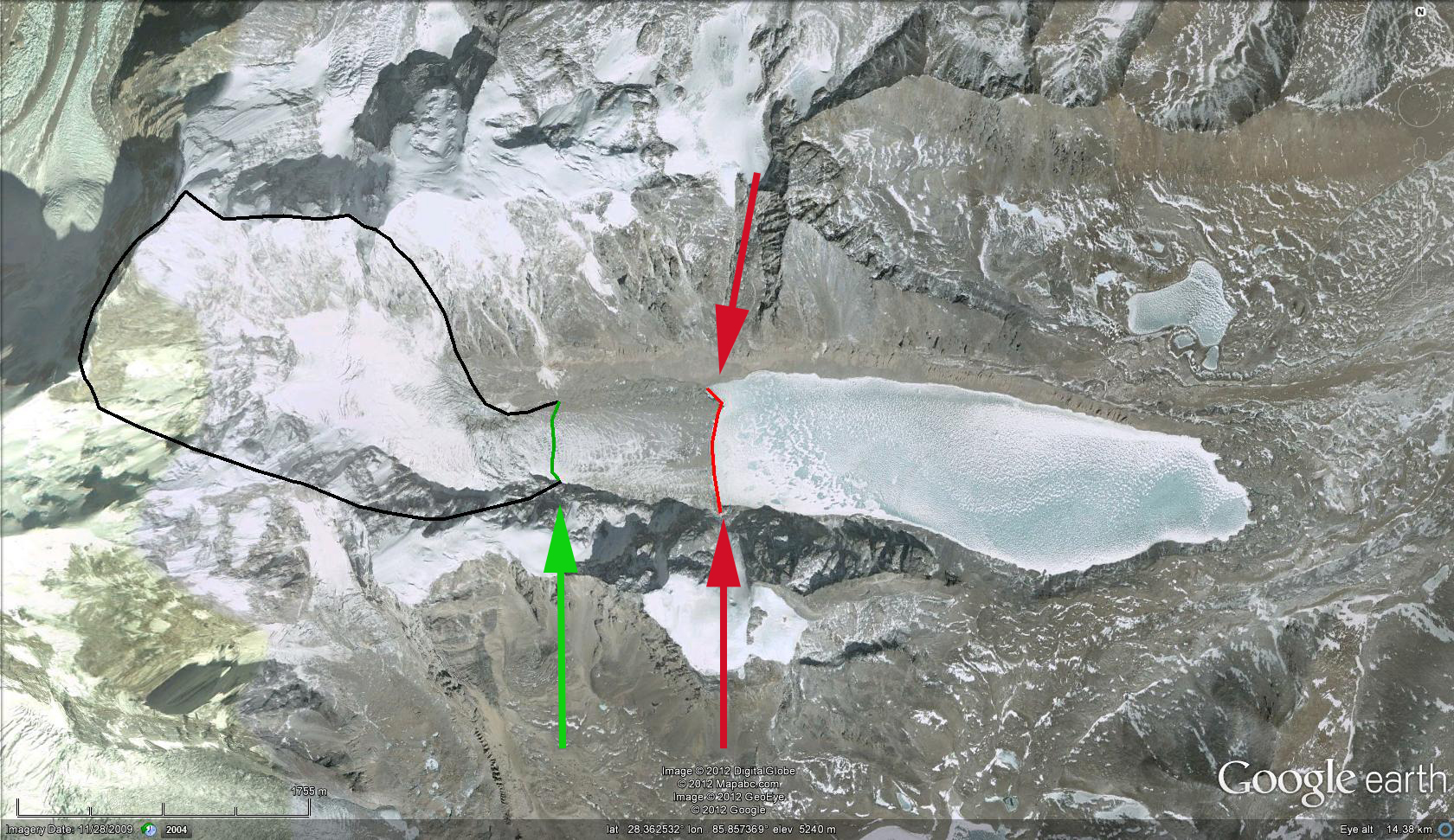
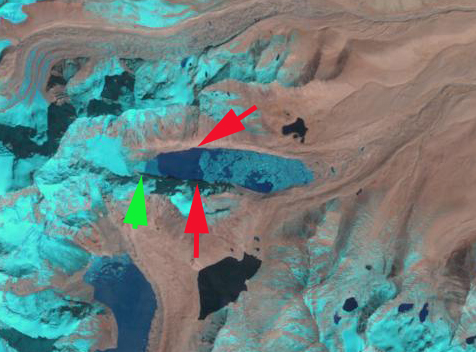
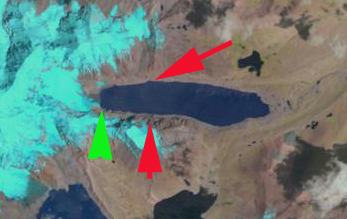 This story fits with the behavior of other glaciers in the area. For example Menlung Glacier, Tibet and Their Kang, Bhutan. In Li et al (2011) it is noted that increasing temperature, especially at altitude, the fronts of 32 glaciers have retreated, mass losses of 10 glaciers have been considerable, glacial lakes in six regions have expanded and melt water discharge of four basins has also increased. An inventory of 308 glaciers in the Nam Co Basin, Tibet, noted an increased loss of area for the 2001-2009 period, 6% area loss (Bolch et al., 2010). A look at the Reqiang Glacier with the 2011 Landsat Image superimposed and georeferenced in Google Earth, indicates how small the glacier is versus Kong Tso and its previous size. Given the access to high elevation avalanching, this glacier seems unlikely to disappear; however, its retreat is indicative of warming even at higher elevations.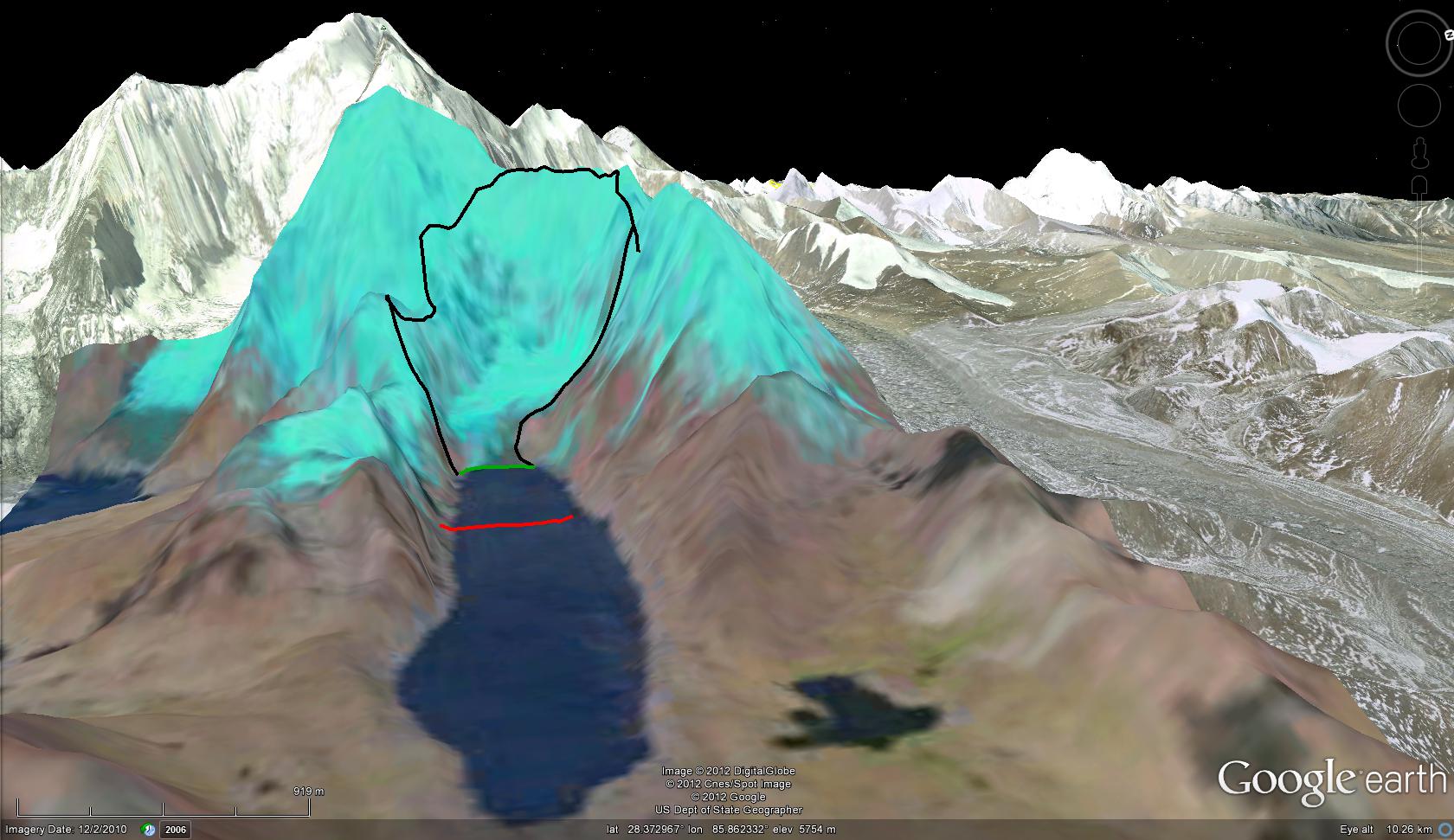
Tyndall Glacier Retreat, Kenya
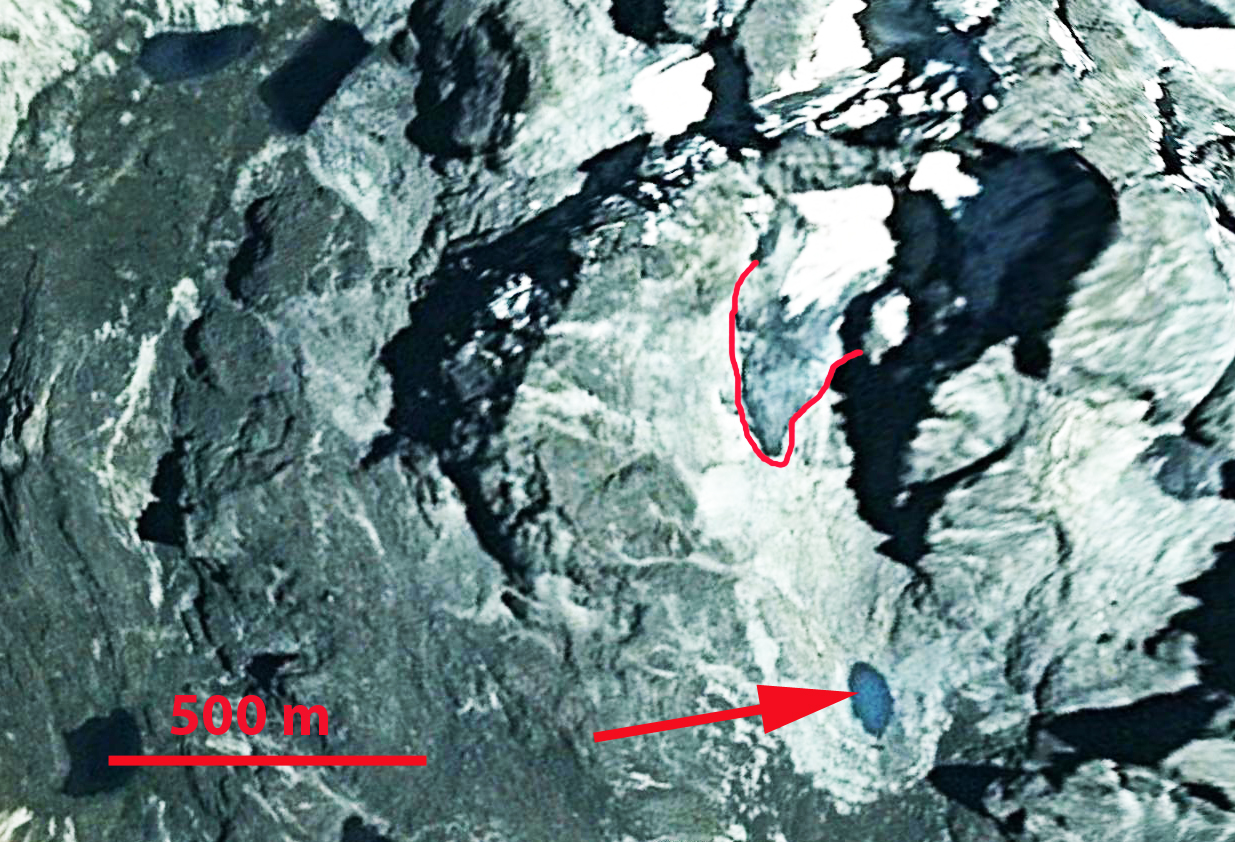
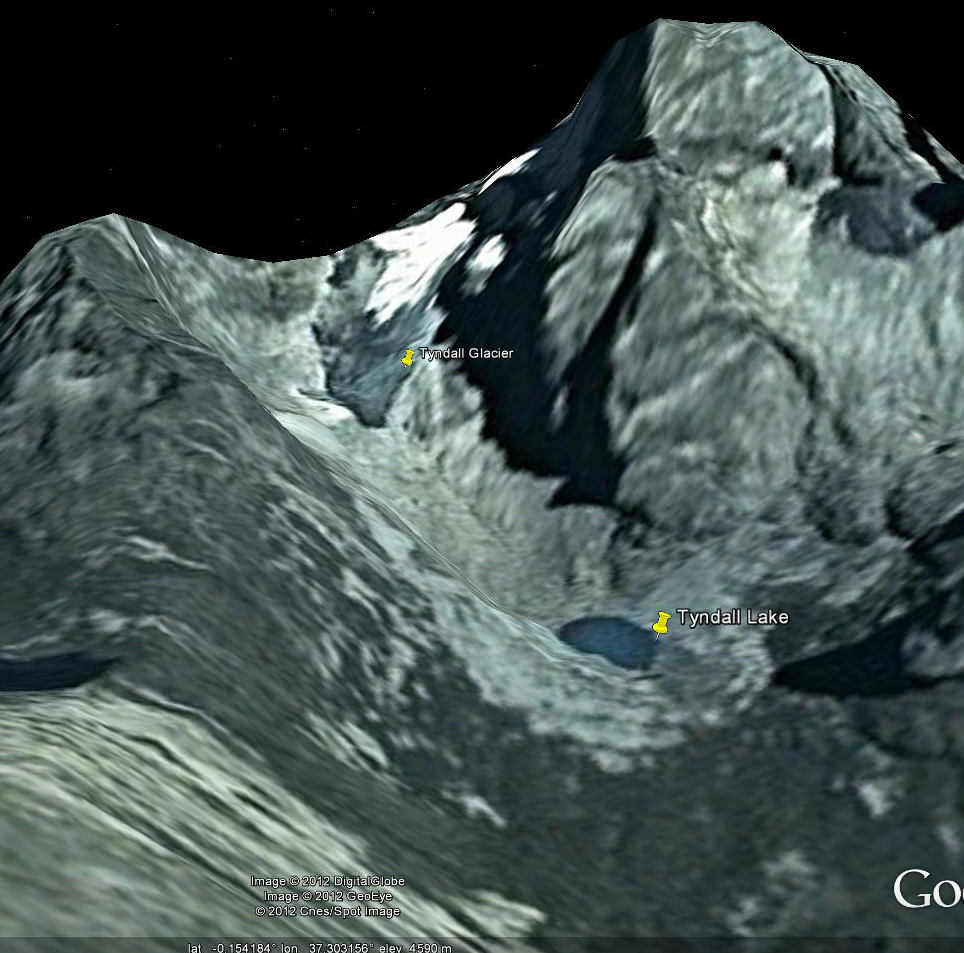
The snows of Mount Kilimanjaro are more famous, but Mount Kenya is even closer to the equator and host to a number of glaciers that are rapidly diminishing. The Tyndall Glacier is the second largest glacier on the mountain. Stephen Hastenrath, University of Wisconsin in particular has documented the changes of Mount Kenya glaciers. In a color version of the map from the WGMS FOG 9that Hastenrath produced on page 9 of the link above the changes in the glacier from 1893 to 2004 are shown. The glacier retreated from Tyndall Lake in the late 1920’s. 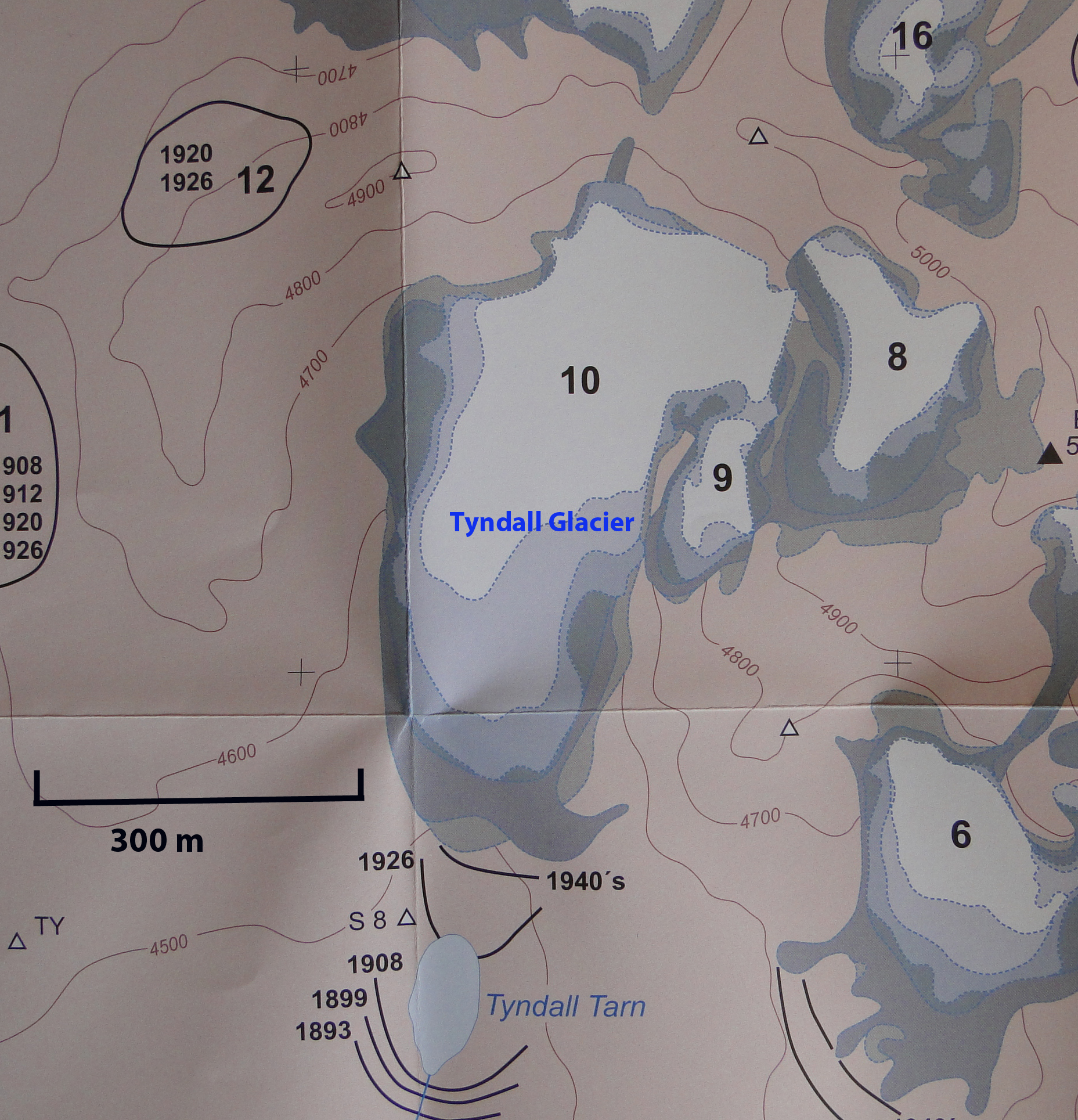 By 2004 the glacier was 275 meters from the lake. In the more recent Google Earth imagery the retreat is 360 meters Mizuno (2005) observed retreat rates of 3 meters per year from 1958 to 1997 and 10 meters per year from 1997-2002. The Google Earth imagery of 2011 indicates that the terminus is still retreating at 9-10 meters per year. The photographic sequence below from Mizuno (2005) indicates considerable thinning of the glacier even its upper reaches. This suggests the glacier not only has strong negative mass balance but also lacks a persistent accumulation zone, without which it cannot survive (Pelto, 2010). The last image below is the current Google Earth view tilted to provide a comparable view to the time sequence.
 Mizuno (2005) also focussed on the vegetation of the newly deglaciated terrain observing that pioneer species such as groundsel , alpine rockcress, mosses, and lichen recolonized the area at a rate similar to the glacier retreat rate. The first colonizers developed within five years of glacier retreat. Hastnerath (2006) observes that increased net shortwave radiation led to the initial recession in the late nineteenth century and that recently the increased retreat on Mount Kenya is due to the greenhouse effects. The retreat of Mount Kenya glacier is similar to the scale seen in the Rwenzori Range. The largest glacier on Mount Kenya is Lewis Glacier which averages just 18 meters in thickness and has lost 90% of its volume since 1934. This suggest Tyndall Glacier is also quite thin (Prinz et al, 2011).
Glacier Index of Posts
Glacier Index List
Below is a list of the individual glacier posts examining our warming climates impact on each glacier. This represents the first 2.7 years of posts, 180 total posts, 166 different glaciers. I have worked directly on 40. The others are prompted by fine research that I had come across, cited in each post or inquiries from readers and other scientists. I then look at additional often more recent imagery to expand on that research. The imagery comes either from MODIS, Landsat, Geoeye or Google Earth.
United States
Columbia Glacier, Washington
Lyman Glacier, Washington
Boulder Glacier, Washington
Ptarmigan Ridge Glacier, Washington
Anderson Glacier, Washington
Milk Lake Glacier, Washington
Paradise Glacier, Washington
Easton Glacier, Washington
Redoubt Glacier, Washington
Honeycomb Glacier, Washington
Vista Glacier, Washington
Rainbow Glacier, Washington
Daniels Glacier, Washington
Colonial Glacier, Washington
Quien Sabe Glacier, Washington
Mazama Glacier
Fairchild Glacier, Washington
White Glacier, Washington
Banded Glacier, Washington
Borealis Glacier, Washington
Hinman Glacier, Washington
Lower Curtis Glacier, Washington
McAllister Glacier, Washington
Lewis Glacier, Washington
Kennedy Glacier, Washington
Fremont Glacier, Wyoming
Minor Glacier, Wyoming
Grasshopper Glacier, Wyoming
Grasshopper Glacier, Montana
Harrison Glacier, Montana
McDonald Glacier, Montana
Sperry Glacier, Montana
Hopper Glacier, Montana
Old Sun Glacier, Montana
Yakutat Glacier, Alaska
Grand Plateau Glacier, Alaska
Eagle Glacier, Alaska
Gilkey Glacier , Alaska
Gilkey Glacier ogives, Alaska
Lemon Creek Glacier, Alaska
Taku Glacier, Alaska
Bear Lake Glacier, Alaska
Chickamin Glacier, Alaska
Okpilak Glacier, Alaska
Sawyer Glacier, Alaska
Antler Glacier, Alaska
Field Glacier
East Taklanika Glacier, Alaska
Brady Glacier, Alaska
Brady Glacier Retreat lake expansion 2004-2010
Thiel Glacier, Alaska
Speel Glacier, Alaska
Canada
Icemantle Glacier, BC
Bridge Glacier, British Columbia
Washmawapta Glacier, British Columbia
Bubagoo Glacier, British Columbia
Hector Glacier, Alberta
Helm Glacier, British Columbia
Melbern Glacier
Warren Glacier, British Columbia
Castle Creek Glacier, British Columbia
Hoboe Glacier, British Columbia
Tulsequah Glacier, British Columbia
Decker and Spearhead Glacier, British Columbia
Columbia Glacier, British Columbia
Freshfield Glacier, British Columbia
Apex Glacier, British Columbia
Devon Ice Cap, Nunavut
Penny ice Cap, Nunavut
Penny Ice Cap SW, Nunavut
Snowshoe Peak, Yukon
New Zealand
Tasman Glacier
Murchison Glacier
Donne Glacier
Mueller Glacier, NZ
Gunn Glacier, NZ
Africa
Rwenzori Glaciers
Himalaya
Ngozumpa Glacier, Nepal
Samudra Tupa, India
Zemu Glacier, Sikkim
Theri Kang Glacier, Bhutan
Zemestan Glacier, Afghanistan
Khumbu Glacier, Nepal
Imja Glacier, Nepal
Gangotri Glacier, India
Milam Glacier, India
Satopanth Glacier, India
Kali Gandaki Headwaters, Nepal
Menlung Glacier, Tibet
Boshula Glaciers, Tibet
Urumquihe Glacier, Tibet
Sara Umaga Glacier, India
Dzhungharia Alatau, Kazakhstan
Petrov Glacier,Kyrgyzstan
Hailuogou Glacier, China
Europe
Taconnaz GLacier, France
Mer de Glace, France
Dargentiere Glacier, France
Grand Motte and Pramort Glacier Tignes Ski area, France
Saint Sorlin, France
Sommelier Glacier
Obeeraar Glacier, Austria
Ochsentaler Glacier, Austria
Pitzal Glacier, Austria
Dosde Glacier, Italy
Maladeta Glacier, Spain
Presena Glacier, Italy
Triftgletscher, Switzerland
Rotmoosferner, Austria
Stubai Glacier, Austria
Hallstatter Glacier, Austria
Ried Glacier, Switzerland
Cavagnoli Glacier, Switzerland
Chuebodengletscher and Ghiacciaio-del-Pizzo-Rotondo
Forni Glacier, Italy
Peridido Glacier, Spain
Engabreen, Norway
Midtdalsbreen, Norway
Tunsbergdalsbreen, Norway
TungnaarJokull, Iceland
Gigjokull, Iceland
Skeidararjokull, Iceland
Kotlujokull, Iceland
Lednik Fytnargin, Russia
Rembesdalsskaka, Norway
Irik Glacier, Mount Elbrus, Russia
Greenland and European Arctic
Mittivakkat Glacier
Ryder Glacier
Humboldt Glacier
Petermann Glacier
Kuussuup Sermia
Jakobshavn Isbrae
Umiamako Glacier
Kong Oscar, Glacier
Upernavik Glacier
Sortebrae Glacier, Greenland
Severnaya Zemlya, Russian Arctic
Hansbreen, Svalbard
Nannbreen, Svalbard
Hornbreen and Hambergbreen, Svalbard
Roze and Sredniy Glacier, Novaya Zemyla
South America
Colonia Glacier, Chile
Artesonraju Glacier, Peru
Nef Glacier, Chile
Tyndall Glacier, Chile
Zongo Glacier, Bolivia
Llaca Glacier, Peru
Seco Glacier, Argentina
Onelli Glacier, Argentina
Quelccaya Ice Cap, Peru
Glacier Gualas, Chile
Antarctica and Circum Antarctic Islands
Pine Island Glacier
Fleming Glacier
Hariot Glacier
Amsler Island
Stephenson Glacier, Heard Island
Neumayer, South Georgia
Ampere, Kerguelen
Nordenskjold Coast, Antarctic Peninsula
Prospect Glacier, Antarctic Peninsula
Ross Hindle Glacier, South Georgia
Vega Island Ice Cap
Rohss Bay, James Ross Island, Antarctica
North Cascade Glacier Climate Project Reports
Forecasting Glacier Survival
North Cascade Glacier Mass Balance 2010
Columbia Glacier Annual Time Lapse
North Cascade Glacier Climate Project 2009 field season
28th Field Season Schedule of the North Cascade Glacier Climate Project
North Cascade Glacier Climate Project 2011 Field Season
BAMS 2010
2011 Glacier mass balance North Cascades and Juneau Icefield
Taku Glacier TSL Paper
Taconnaz Glacier Retreat, Mont Blanc, France
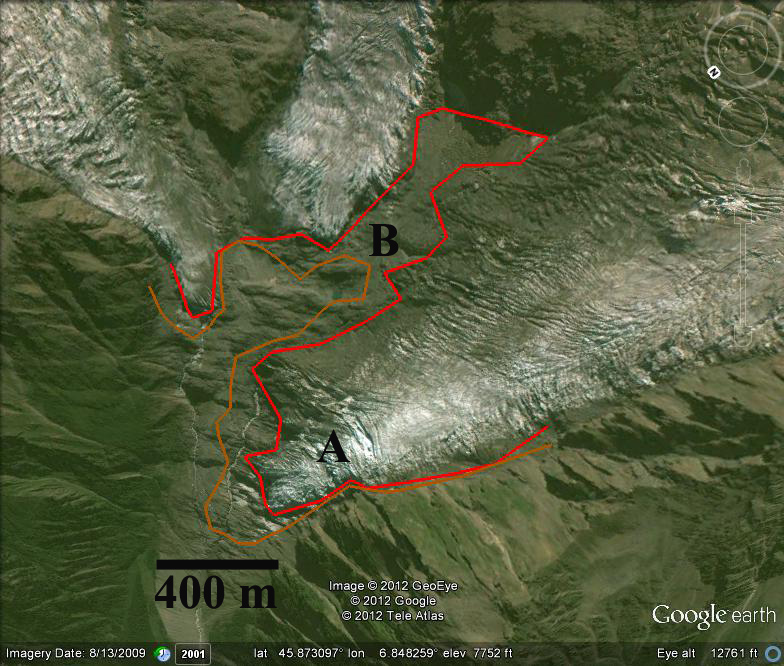
The Taconnaz Glacier flows from 4300 m to 2000 m down the west side of Mont Blanc, from the Dôme du Goûter toward the Chamonix Valley. This glacier is best known for the large avalanches that are generated by the break off of large serac ice blocks from a wide ice cliff at 3300 m during the winter, blue arrows (Le Meur and Vincent, 2006). 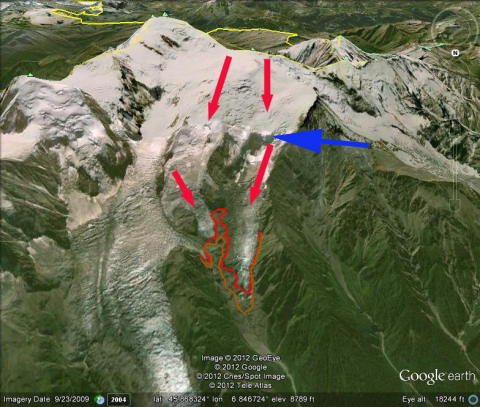 The ice blocks have been devastating to inhabited areas of the Chamonix valley as recently as 1999. A comparison of 2004 and 2009 imagery in Google Earth indicates that the main terminus (A) has retreated 200 meters in five years. The orange line is the 2004 margin and 2009 is the red line. Taconnaz is two glaciers south of Mer de Glace, which retreated 500 m from 1994-2008, and several glaciers south of Glacier d’Argentiere, which retreated 400m from 2000-2010. There has also been a large retreat in the vicinity of Point B which is where a secondary terminus used to be connected to the main valley glacier. This retreat indicates that above the terminus there is a reduction in the volume of ice heading down valley. This suggest retreat will continue.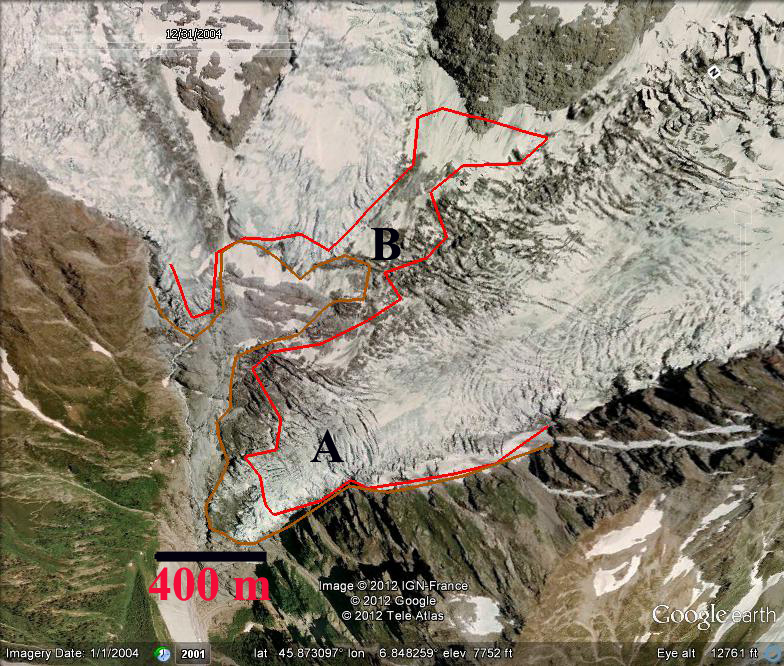
The avalanche hazard has prompted construction of avalanche defenses that are well documented in photographs, such as the one below. This site on Mont Blanc glaciers also has nice images of the terminus glacier from 2010 indicating a much more robust terminus than Mer de Glace, based on the crevassing and glacier thickness. The avalanche protection worked in 2006 slowing an April avalanche. 

McDonald Glacier, Montana Retreat
McDonald Glacier is in the Mission Range of the Montana southeast of Flathead Lake. It is the largest and one of only two significant glaciers in this range. The glacier is tucked under the north side of McDonald Peak. 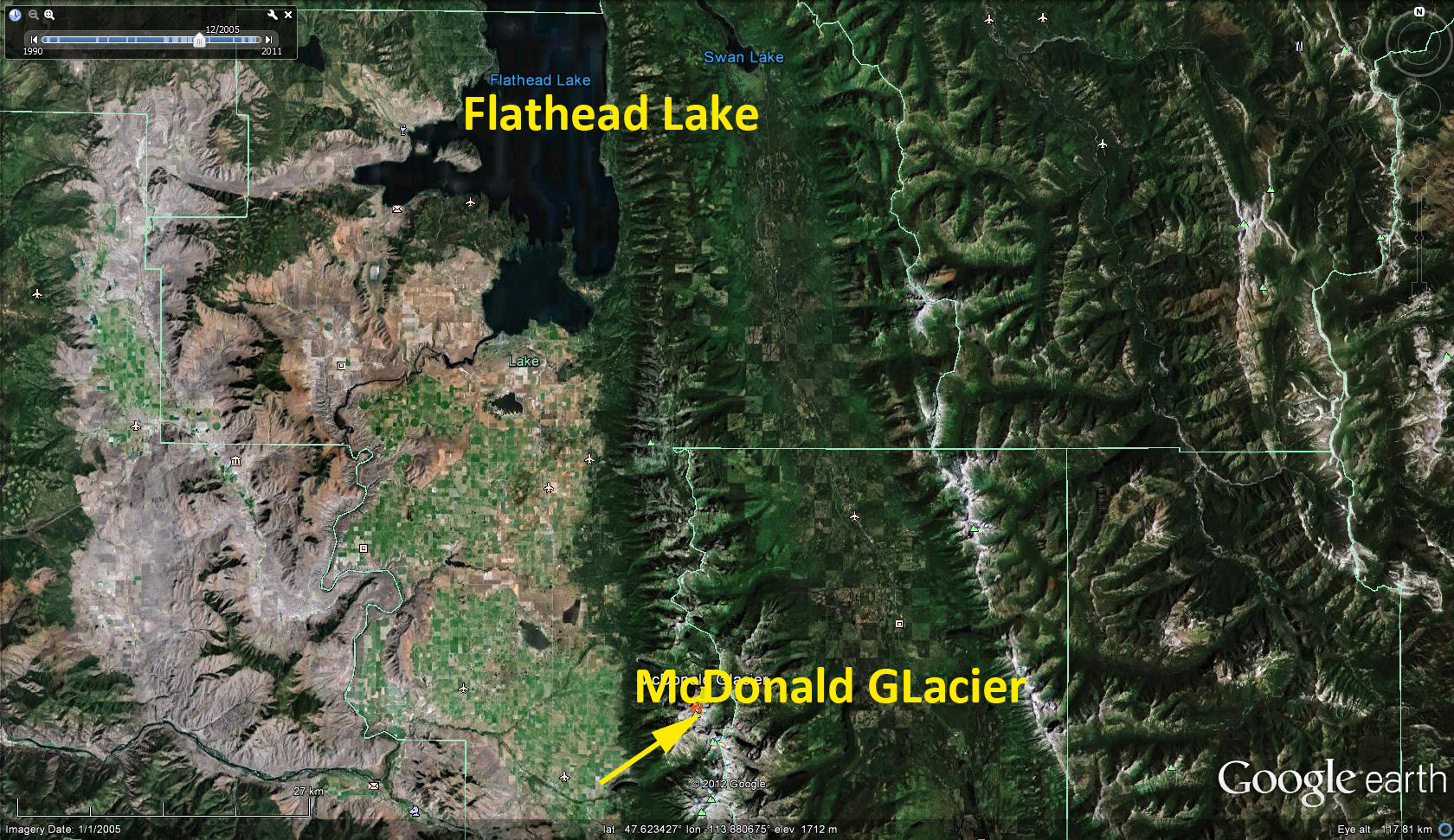 The glacier was over 1 kilometer long in the 1966 USGS map of the region. By 2005 the glacier has lost 45% of its area, retreating 200 meters on average and losing one of its accumulation areas. A comparison of the map image, 2003 and 2005 image illustrate this retreat, orange line is the map terminus, black lines the terminus in 2003 and 2005.
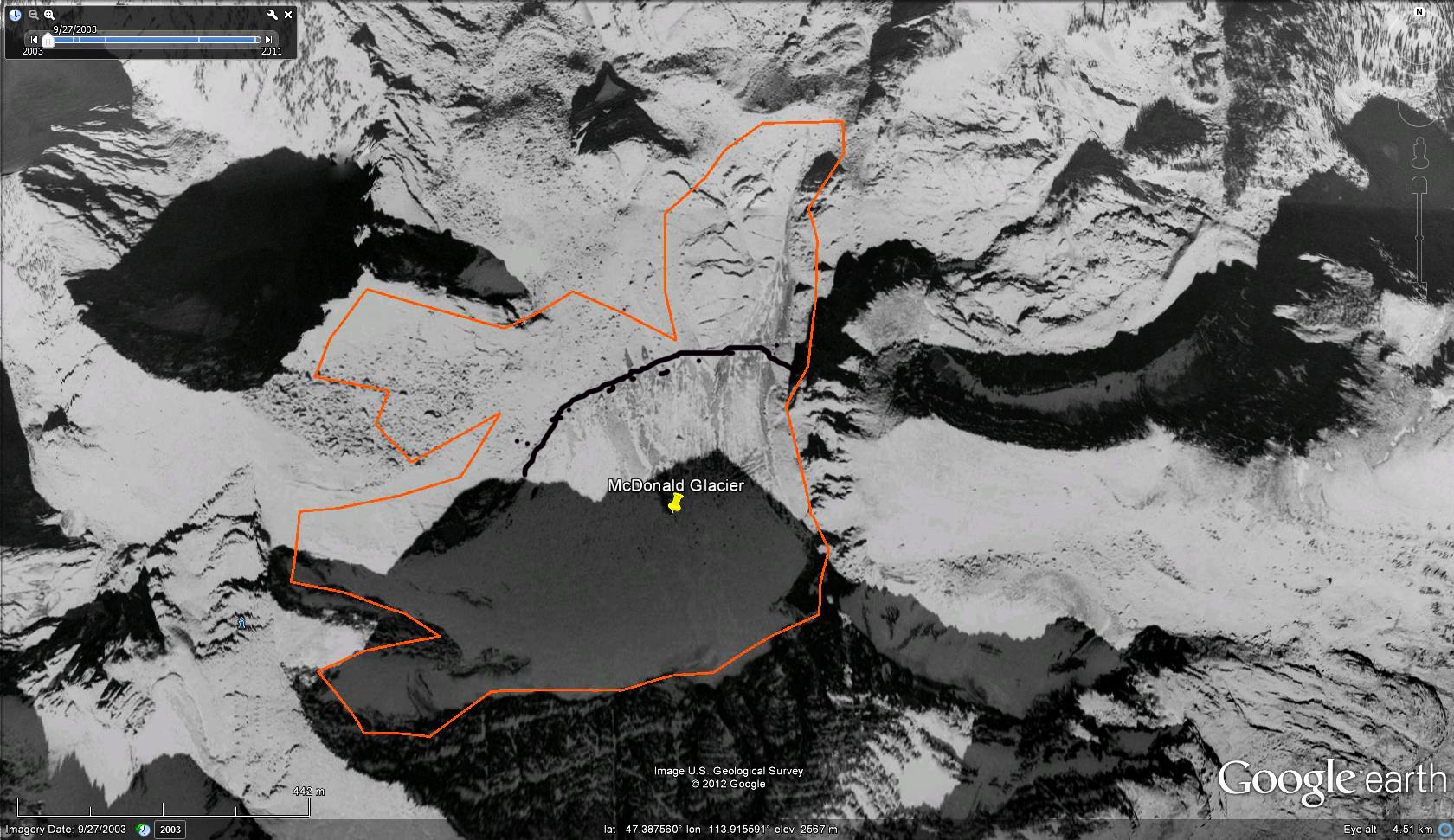
 Two closeup views indicate a key exposure of rock in the midst of the glacier, black arrow. Three former areas of accumulation A,B and C are also noted. At this point area C is no longer part of the glacier. A and B both still indicate some minor crevassing indicating the glacier is not stagnant, and that these areas have been an accumulation area in the years prior to 2005. Accumulation area B in the first closeup looks to have a minimal connection to the main glacier, and is such a small area, that it is on the path of accumulation area C to disappearance.
 In Montana there are many glaciers that are rapidly disappearing (Hopper Glacier, and a few that are only shrinking slowly (Harrison Glacier). McDonald Glacier is in between these two paths retreating steadily, but not on the verge of disappearing, Sperry Glacier is another example of this response type.
Rohss Bay Glacier Retreat, James Ross Island, Antarctica
In January 1995 the Prince Gustav Ice Shelf connecting James Ross Island to the Antarctic Peninsula collapsed (Glasser et al 2011). One of the principal glaciers feeding the iceshelf was the outlet glacier from Rohss Bay on James Ross Island. By 1999 this outlet glacier terminus was at the outlet of Rohss Bay. From 1999 to 2009 Rohss Bay opened up as the Rohss Bay glacier retreated 15 km. This retreat represents part of the extensive ice loss, 490 square kilometers for the island from 1988-2009 Davies et al (2011). From 1988-2001, 91 of 100 glaciers on the island examined by Davies et al (2011) retreated. Imagery from the field work by the LARISSA project in the region provides excellent context for the region. A combination of Landsat and Google Earth Imagery from 1999, 2000, 2008 and 2010 illustrates this change in a sequence below. The margin is indicated in each case as is an unnamed island by an arrow at the southwest end of Rohss Bay. Most of the ice loss was the breakup of a floating ice shelf in the bay. 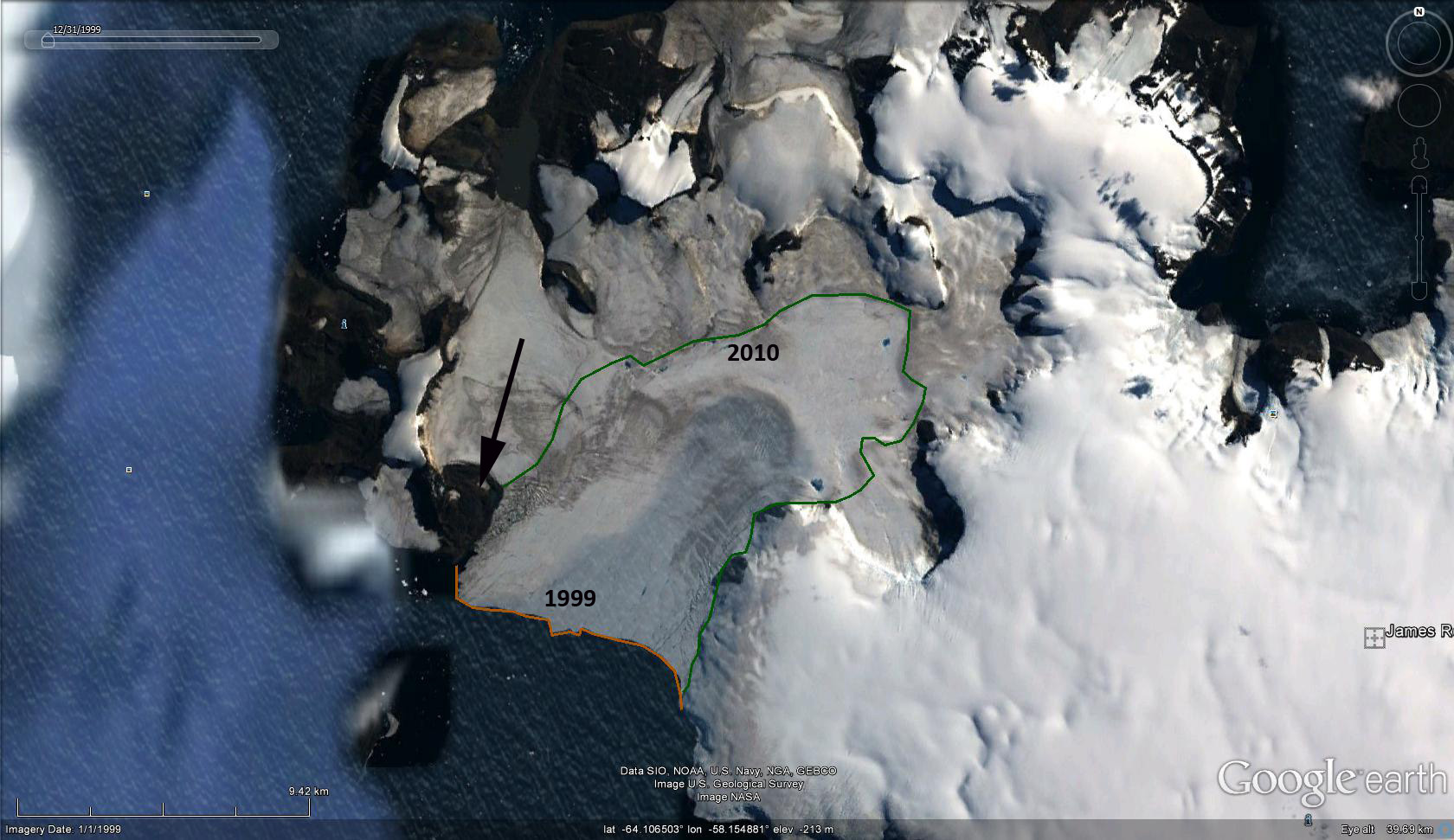
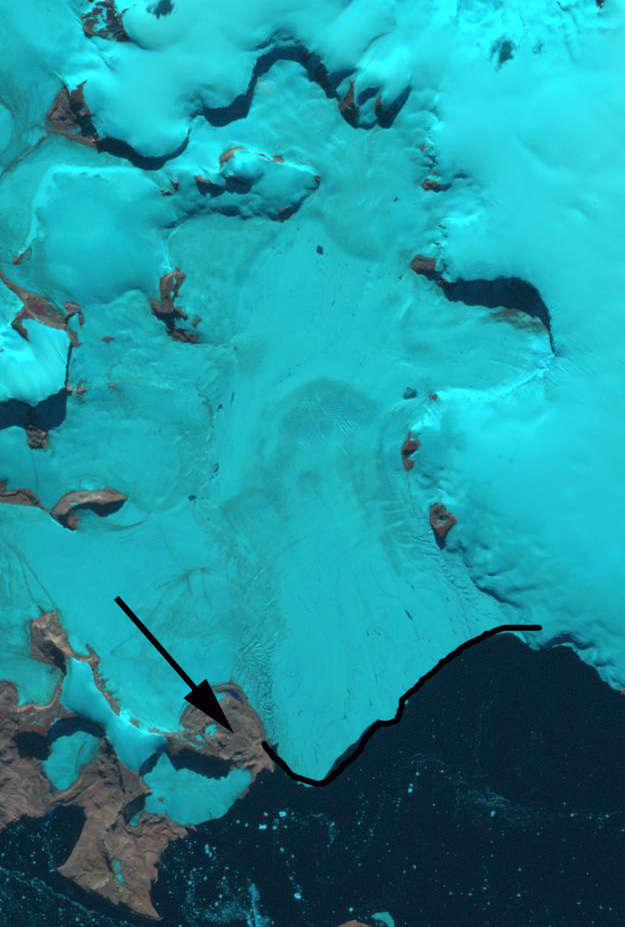
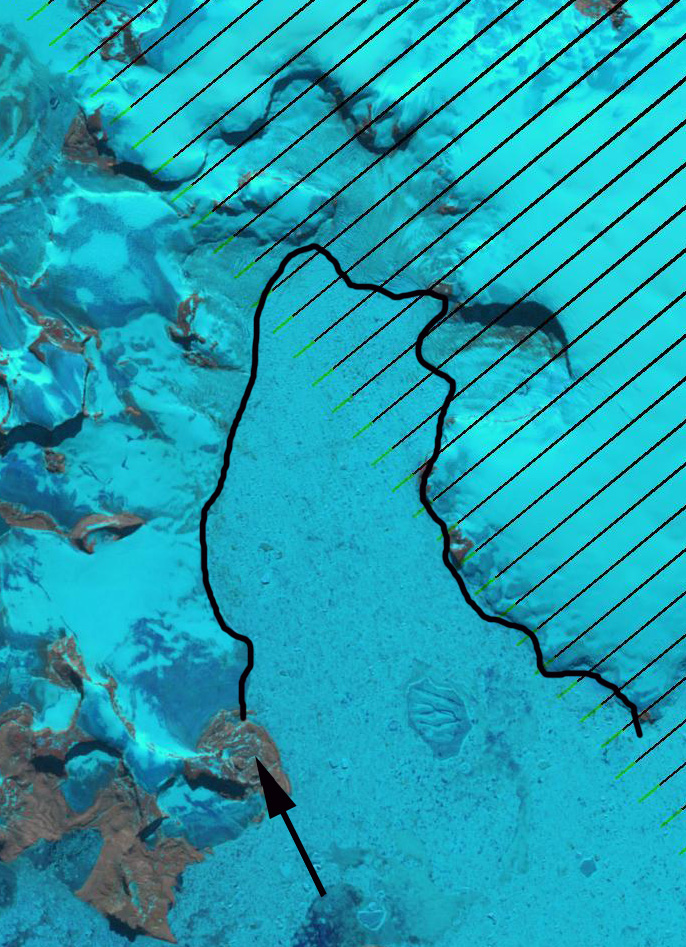
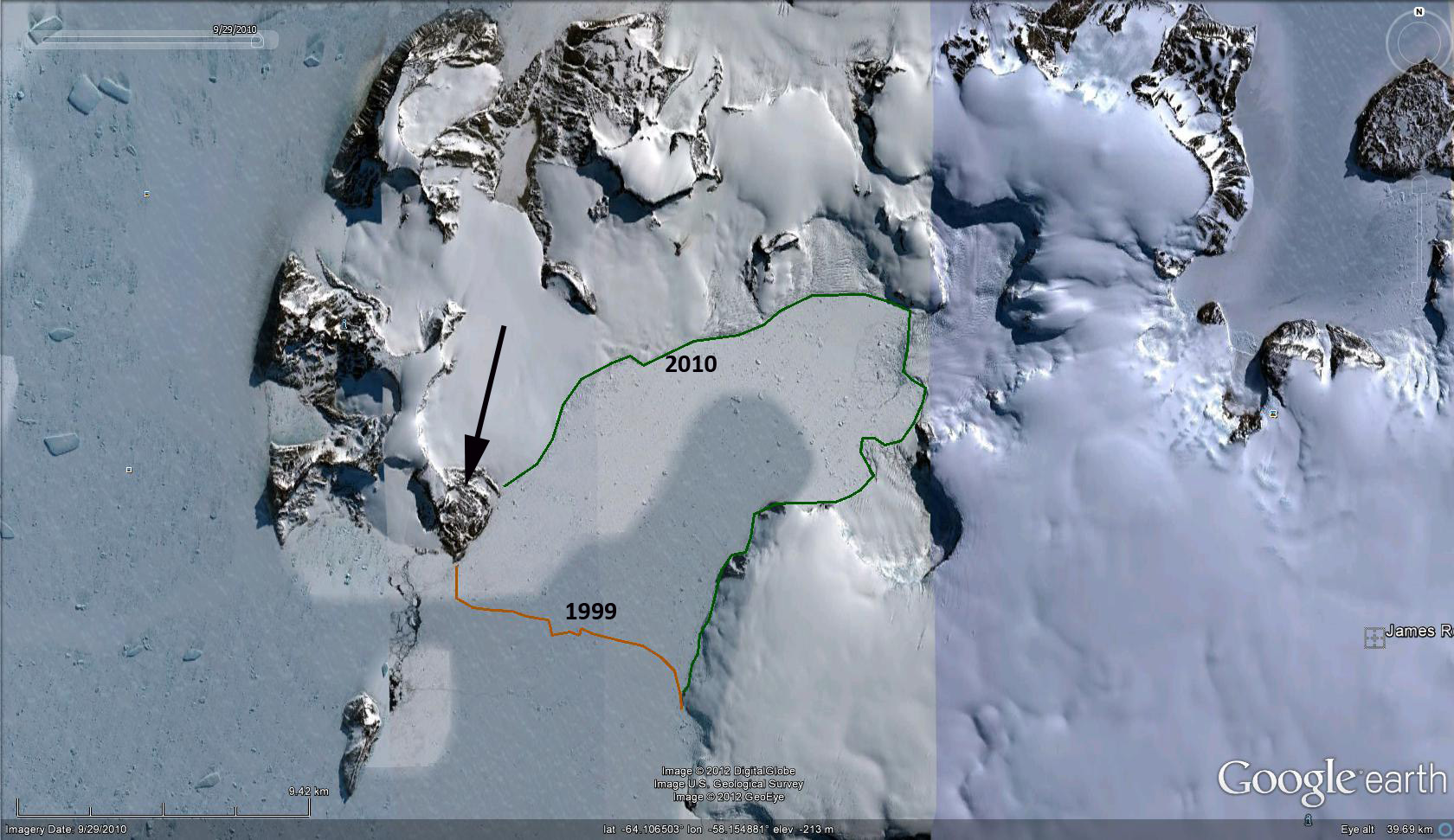 Glasser et al (2011) provide a sequence from 2002-2006 that illustrates most of the retreat occurring in this five year period. Currently most of the floating ice of the bay has been lost and retreat should slow down considerably. The ice was lost not through surface melting, but via calving. The typical sequence for ice shelf collapse is thinning from basal and surface melt increases, that leads to weakening and destabilization of the iceshelf, expansion of rifting and then breakup. The retreat on James Ross Island is also observed on the island to the north Vega Island.
Snowshoe Peak Glacier Retreat, Yukon
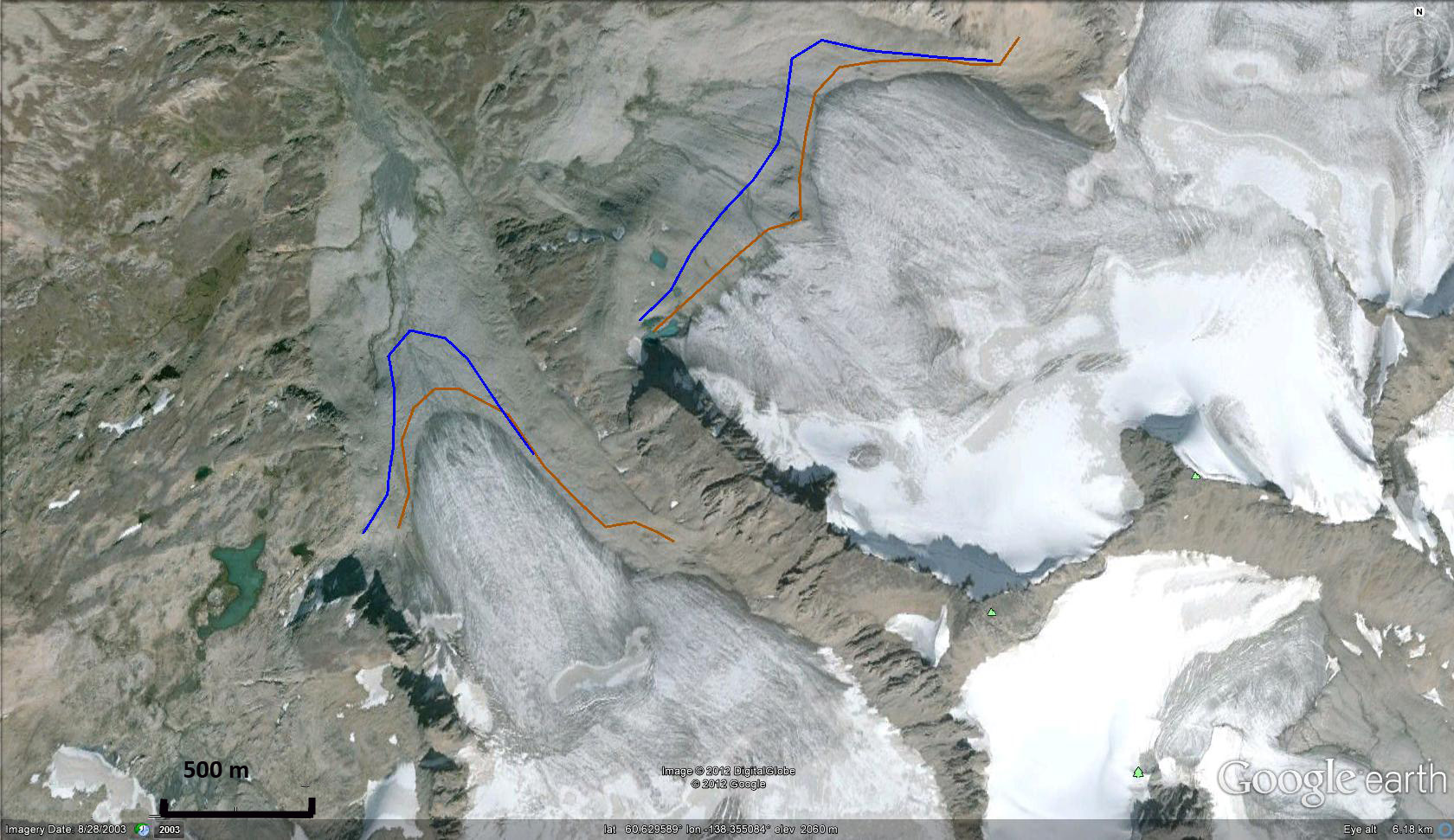
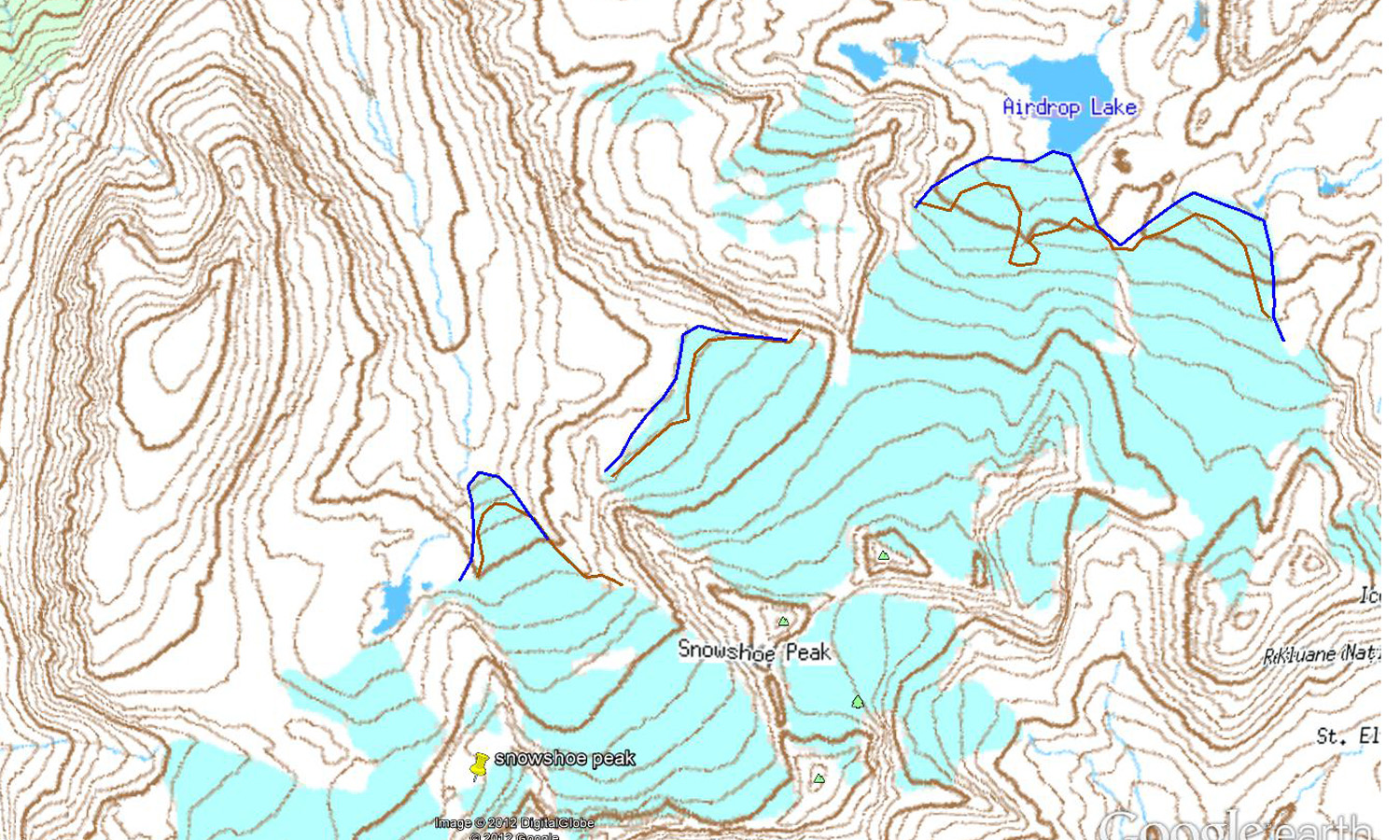
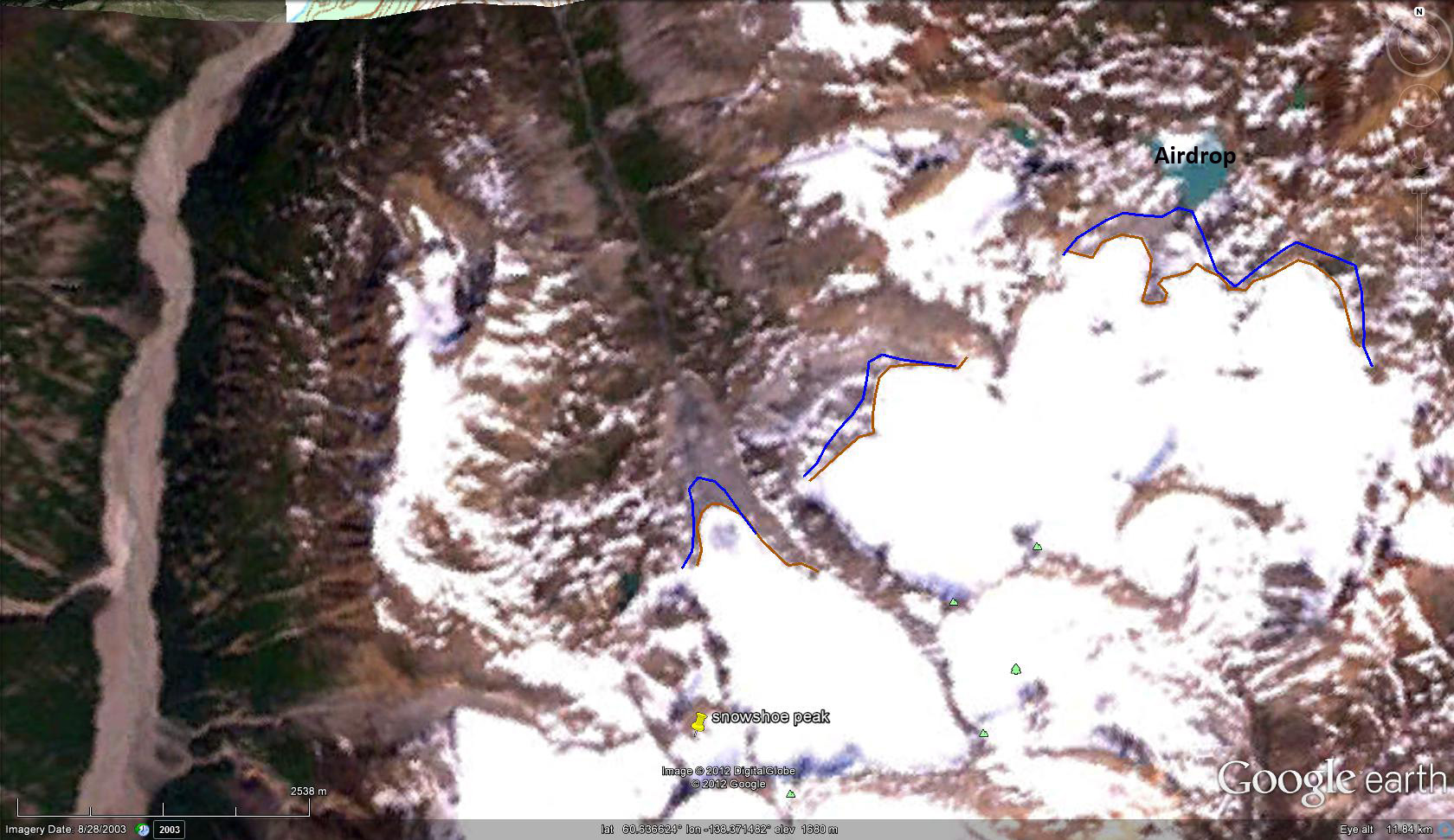
There was the Yukon Gold Rush and then there are a number of surging glaciers in the Yukon. These two have drawn our attention. In Kluane National Park, besides the large surging outlet glaciers draining the St. Elias Mountains (Donjek, Lowell, Kaskawulsh etc.) there are numerous smaller alpine glaciers in ranges just east of the St. Elias. In a recent ice core study in the Eclipse Icefield it was found that the Gold Rush led to higher fire activity (Yalcin et al., 2004). This post examines several of these glaciers that have not been the focus of any detailed study, in the are of Airdrop Lake and Snowshoe Peak. Each of the glaciers is 1.5 to 2.0 kilometers long, beginning near 2100 meters the summit area of Snow Peak and terminating between 1800 and 1900 m.  This is relatively small elevation change for alpine glaciers. In the 2003 Google Earth Imagery the lack of snowcover is evident. The blue line is the terminus position from the map of 1970’s and the brown line a 1998 satellite image. There are a few outrops of rock in the midst of the glacier that formerly terminated at Airdrop Lake. Comparison of a 1987 (top), 2003 (middle) and a 2010 (bottom) Landsat image indicate that the two key outcrops that were in the midst of the glacier in 1990 are at the terminus in 2010. Two others have expanded and with terminus retreat are markedly closer to the margin of the glacier in just seven years from 2003-2010.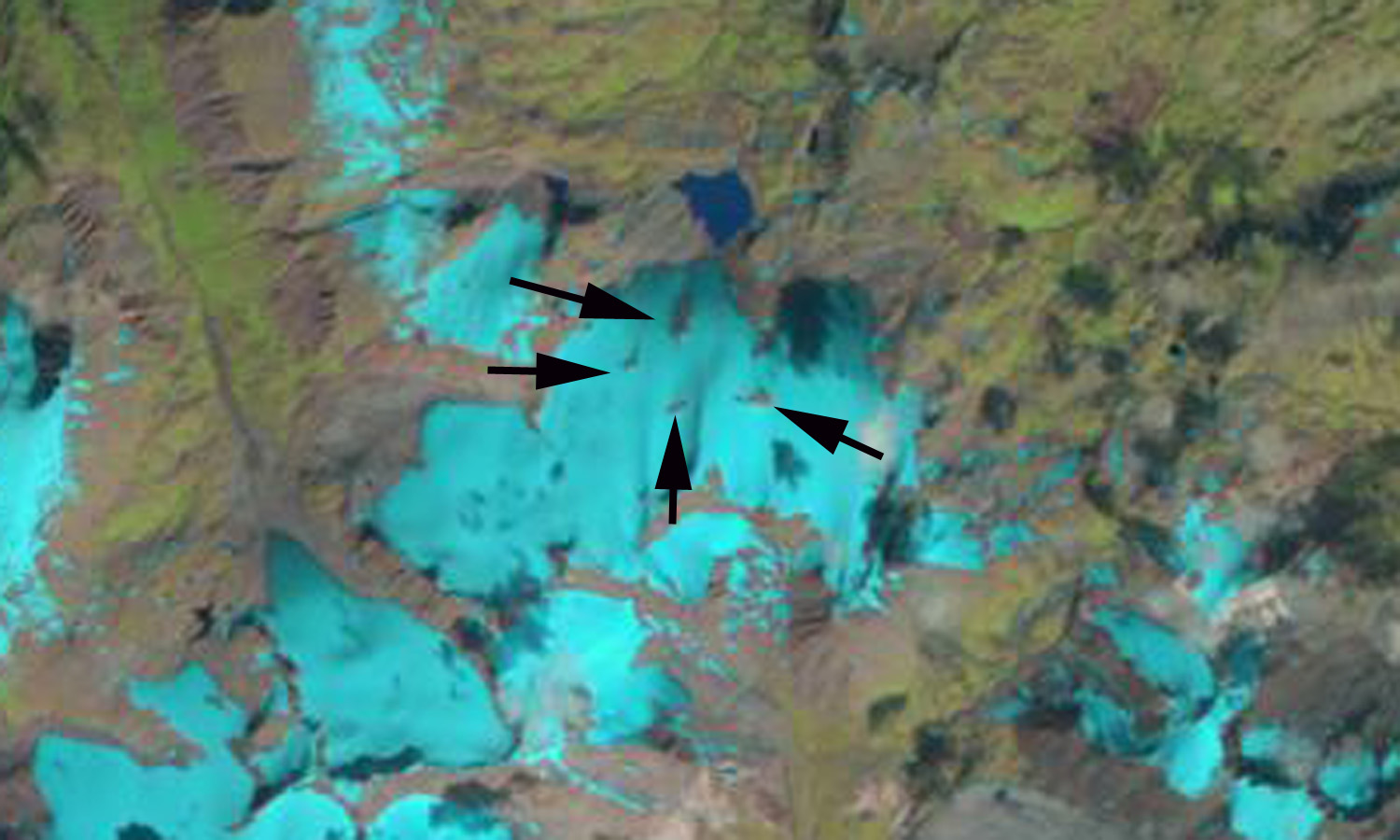
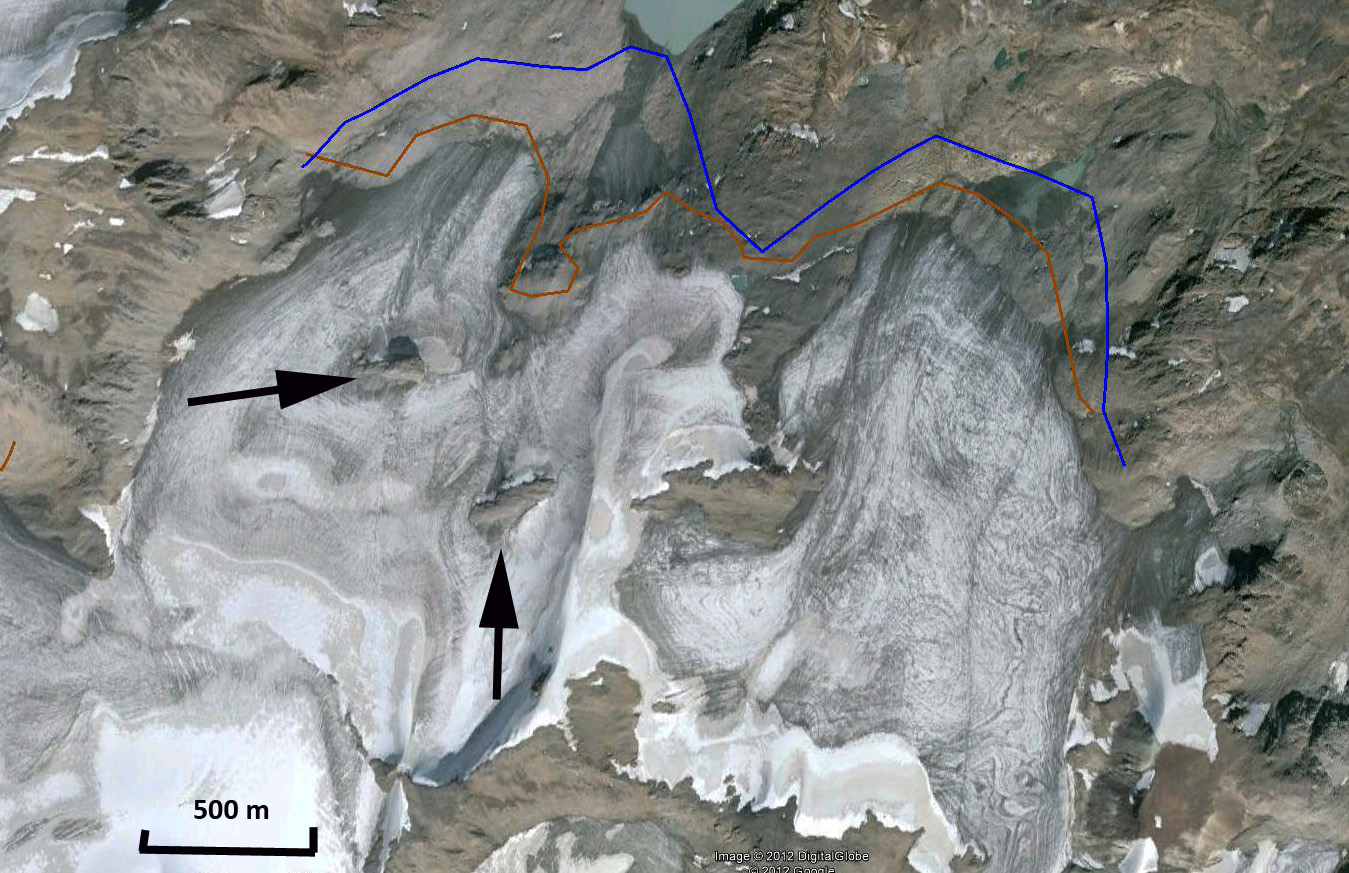
 The lower section of each glacier is quite thin and uncrevassed. The lack of snowcover during many recent years indicate a mass balance loss and glacier thinning that is driving the retreat. It does not appear the glacier that flows toward Airdrop Lake can survive, with thinning high on the glacier and limited retained snowcover. There are some patches of stagnant ice near the terminus of the Airdrop Lake Glacier, this glacier has retreated 250-450 meters from the map to 2003, 20-30% of the glacier length and is still retreating quickly as the 2010 imagery indicates. The Snowshoe Peak glaciers have retreated 150 m to 300 meters which is 10-20% of the glacier length. The retreat of the small glaciers here parallels that of the larger glaciers nearby such as Melbern Glacier.
 From a Glaciers Perspective