North Cascade Glacier Climate Project 2014 Field Season (31st Annual) Preliminary Results

The 2014 Glacier Field season was our 31st consecutive year working on North Cascade glaciers. After a late winter surge of snowfall, the North Cascades had a slightly above average snowpack as the melt season began in early May. The warm, dry summer to date, could end up being the warmest for the region, currently 2013 was the warmest melt season. The result is glacier melt has been high overall. In the field we measured the mass balance, terminus position, surface elevation and runoff from North Cascade glaciers. This includes assessment of annual retained snow layer thickness in crevasses and overall crevasse depth.

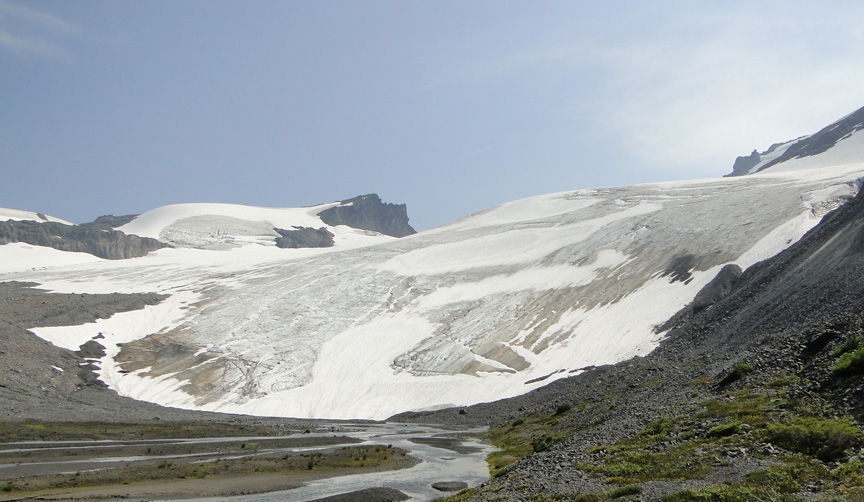
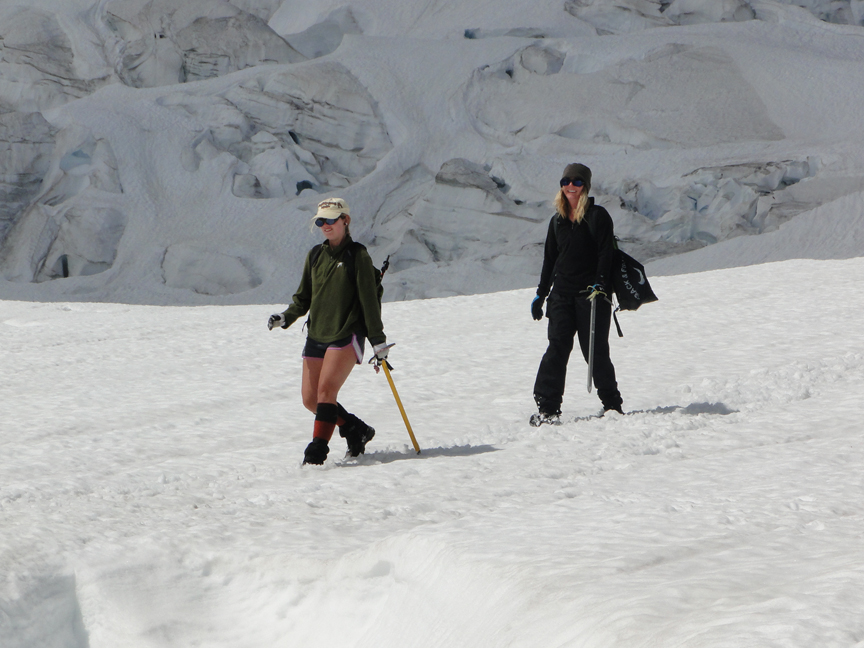
We first examined the Easton Glacier on the south side of Mount Baker, which has now retreated 370 m since 1990. The glacier has retreated 55 m in the last two years. The most interesting change is that the western toe of the glacier has receded beyond its normal drainage channel, and there is no outlet stream from the west side of the glacier. Snowpack below 2100 m was much below normal including on the bench at 1900 m below the main icefall. Above this main icefall snowpack was closer to normal. Snowpack average 4.5 m at 2500 m, assessed in numerous crevasses. The ongoing warm conditions will continue to reduce the snowpack more than the average summer. With typical late summer conditions mass balance will be -1.1 m on Easton Glacier. The Deming Glacier debris cover has now spread across the entire terminus, retreat from 1985 to 2014 is 480 m. The snowline was at 2075 m in early August in the main icefall, which is 100 m higher than normal.
breakfast
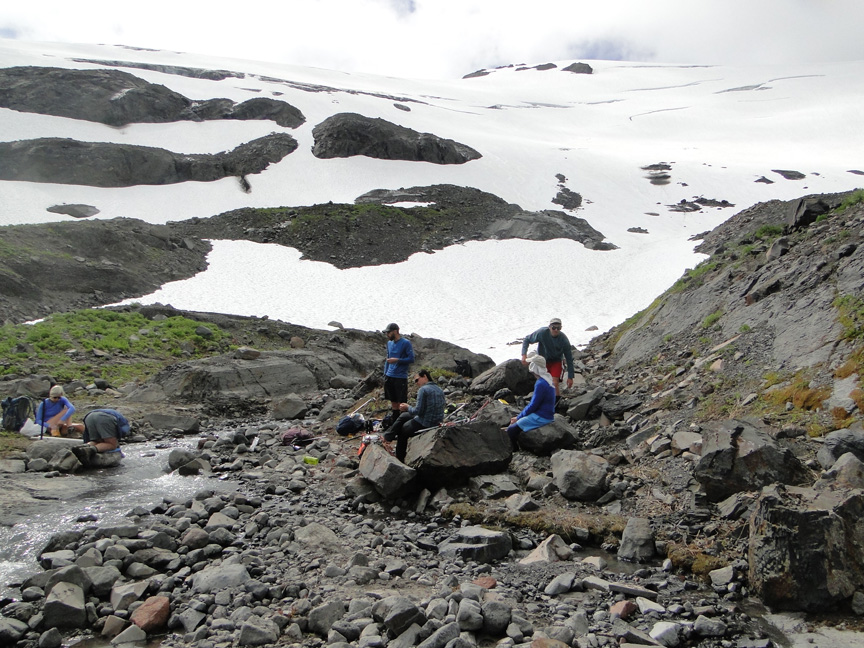
Breakfast at camp below Easton Glacier

crevase depth
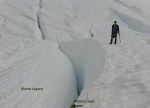
Jill Pelto assessing the depth of crevasses on Easton Glacier, her sixth year working on glaciers.

crevasse examination
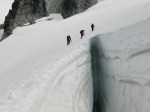
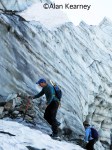
Determination of annual retained snowpack depth using crevasse stratigraphy.
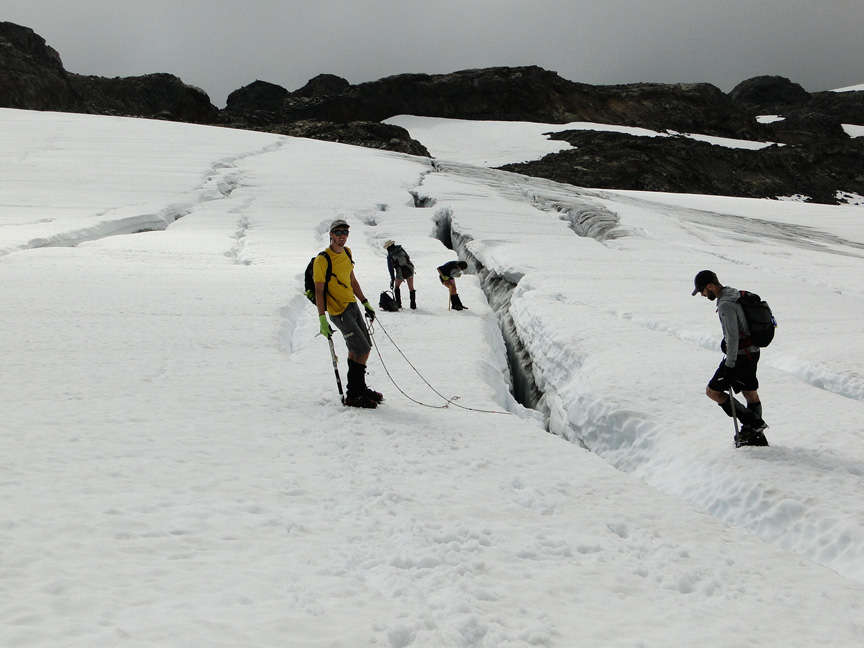
crevasse measure
More snowpack assessment by Ben Pelto and Justin Wright.

ashley
Ashley Edwards descending Easton Glacier lower icefall

melviewMelanie Gajewski visually examining the Easton Glacier profile.
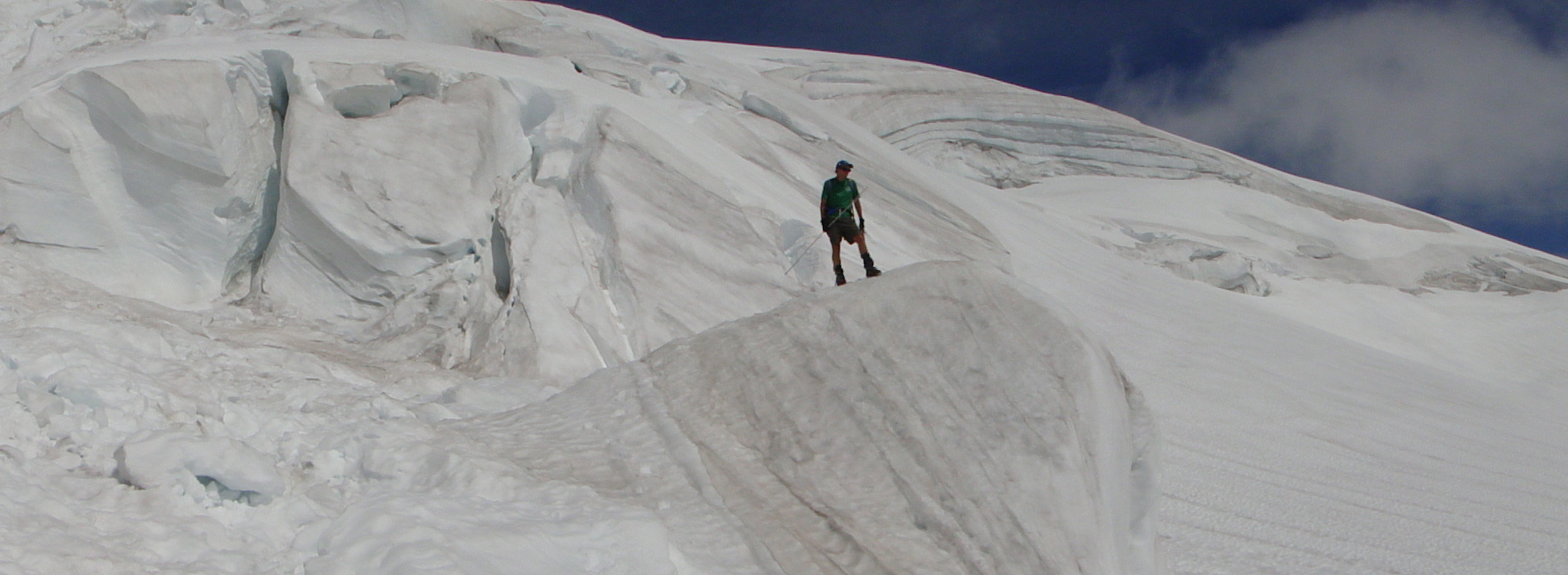
icefall panorama
Mauri Pelto on a serac in Easton Glacier icefall, 31st year working on these glaciers.

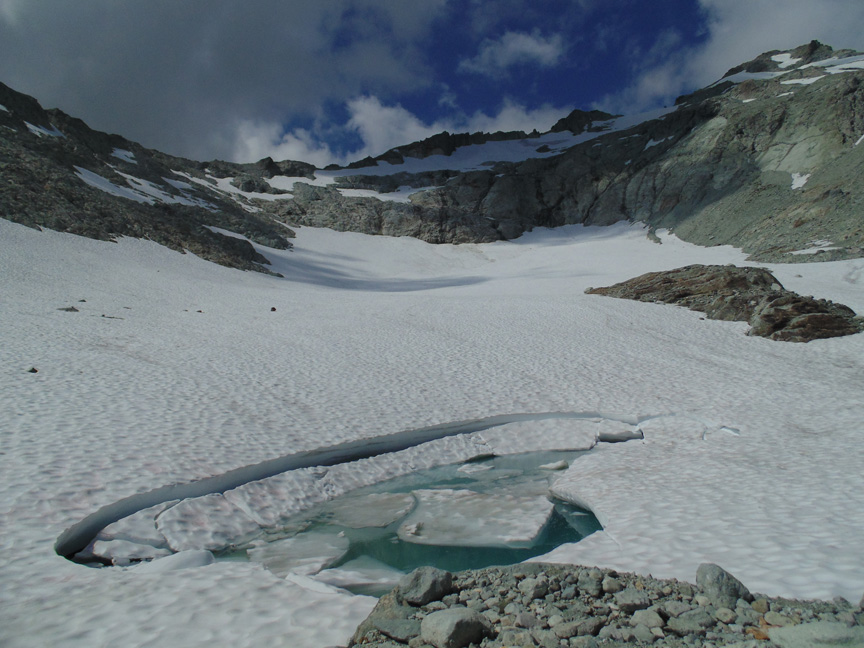
The next stop was Helitrope Glacier on the north side of Mount Baker, where we installed of a stream gage below the Heliotrope Glacier. Oliver Grah and Jezra Beaulieu of the Nooksack Indian Tribe installed the gage while we calibrated runoff and assessed the amount of snowcover on the Heliotrope Glacier, the western extension of the Coleman Glacier, and installed ablation stakes. The rise in the snowline over the rest of the summer will identify the ablation of snowcover. The maximum snowpack on Heliotrope Glacier was less than 3.5 m, which means almost the entire glacier will lose snowpack by the end of September up to the ridge above it. The daily runoff from the Roosevelt-Coleman-Heliotrope system during our observations was an impressive 14 million cubic feet per day.The snowline was quite high on Roosevelt Glacier and Coleman Glacier at 2000 m in mid-August. The retreat of Roosevelt in particular is impressive since my first visit in 1985, a retreat has been 450 m over this interval.
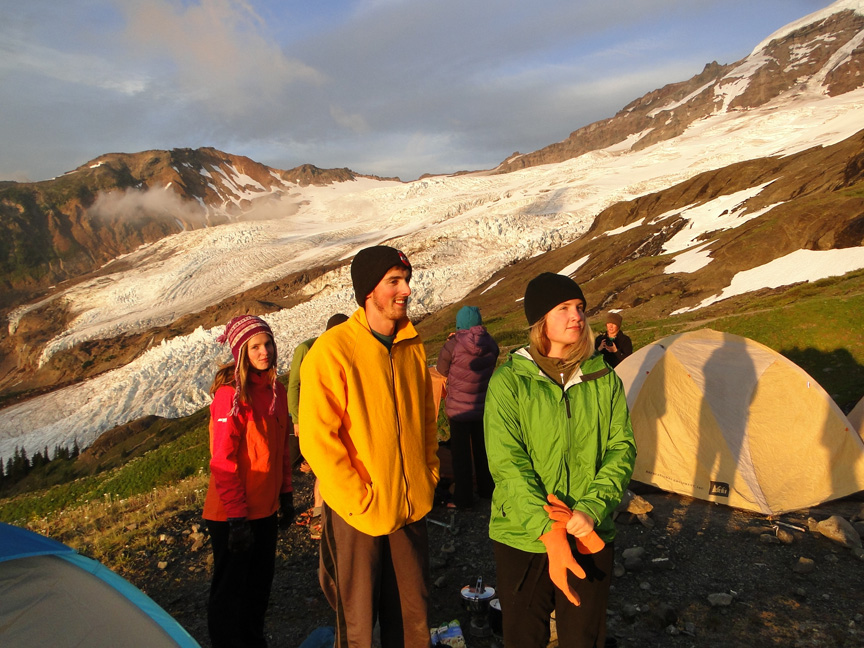
heliotrope camp2
Camp at Heliotrope Glacier.

coleman Justin Wright on the Coleman Glacier

helitrope gage
Oliver Grah installing stream gage below Heliotrope Glacier.jill probing Jill Pelto probing snowpack.
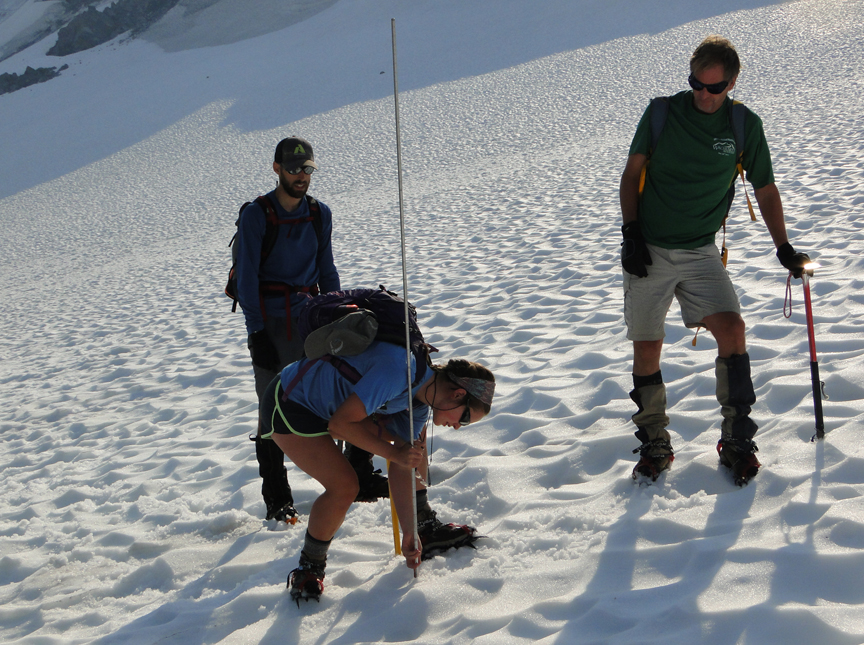
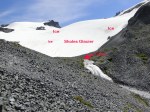
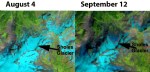
Continued warm dry weather led to records numbers of hikers at Artists Point as we headed out Ptarmigan Ridge on the northeast side of Mount Baker to work on Rainbow Glacier and Sholes Glacier. During our first day the east wind pushed forest fire smoke into the area eliminating views. We surveyed the mountain goat herds as usual seeing three herds and a total of more than 60 different goats. With the high temperatures and forest fire haze the number of iceworms emerging at sunset during our population count was also an all time low. Rainbow Glacier had snowpack that was 1.25 m below normal. With typical late summer conditions mass balance will be -1.5 m on Rainbow Glacier. Sholes Glacier already had 15% blue ice exposed, on August 7th. This had expanded to 25% by August 12th. This rapidly expanded to 50% by August 23rd, note Landsat comparison below. It will be 60% by the end of August and then likely close to 80% loss by the end of the summer. With typical late summer conditions mass balance will be -1.6 m on Sholes Glacier. Remember glaciers in this area need 60% snowcover at the end of the melt season to balance their frozen checkbook. On Sholes Glacier we completed 118 measurements of 2014 snowpack depth via probing in this relatively crevasse free glacier.
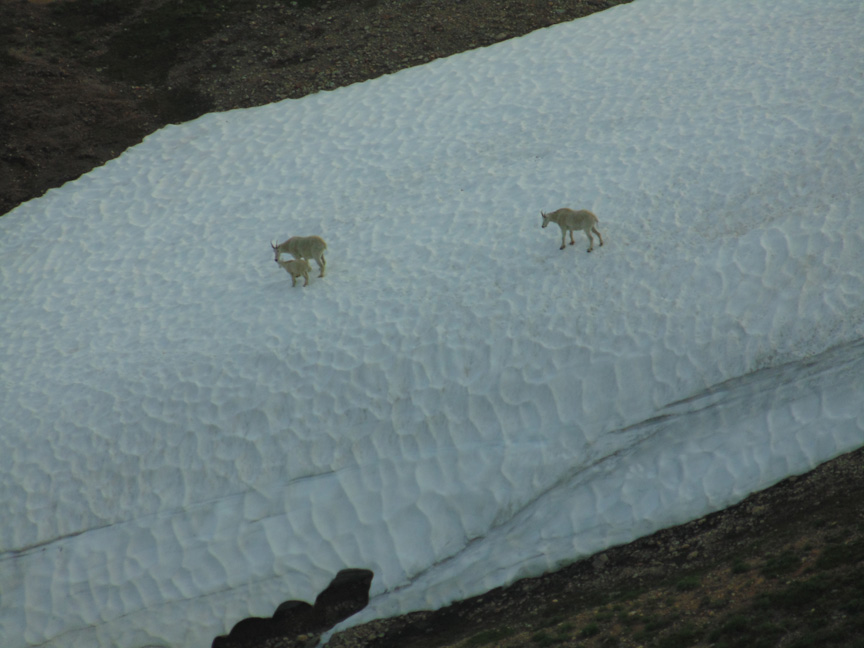
mountain goatsA herd of 48 mountain goats.

sholes probing snowpack
Snowpack probing on Sholes Glacier.

sholes overvieew 2014 Looking at Sholes Glacier from outlet where stream gage is installed.
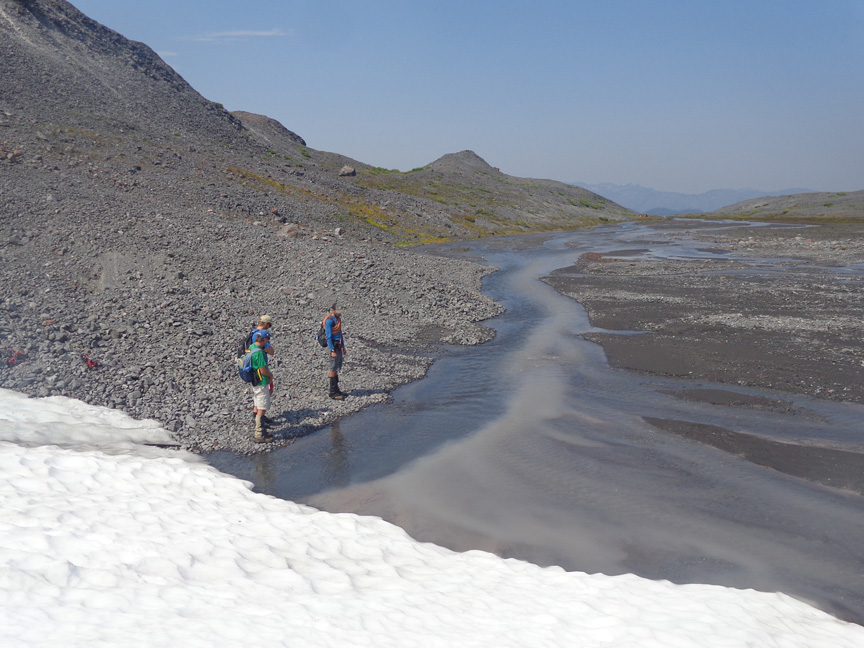
sholes outlet
Sholes Glacier outlet with the clearer surface melt runoff versus the turbid basal meltwater stream.
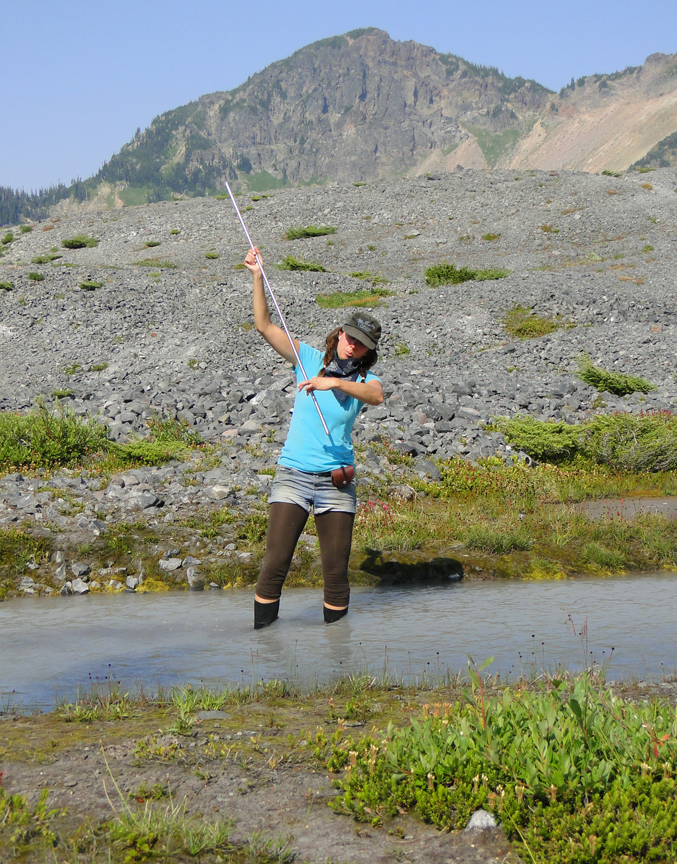
ashley streamflowAshley Edwards measuring streamflow.

sholes landsat 2014
Landsat 8 iamges from 8/7/2014 and 8/23/2014-red line is boundary of bare blue glacier ice where the 2014 snowpack has been lost.
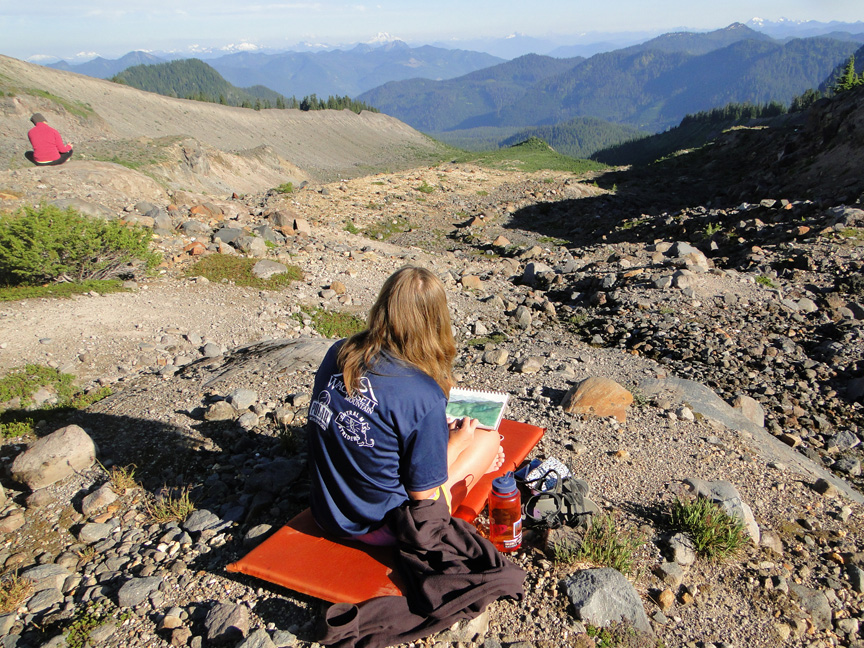
jill sketch Jill Pelto sketching in camp.

megan sketchMegan Pelto sketching in camp.

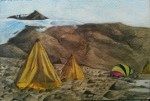
penstemon Jill’s field sketch of glacier runoff with Penstemon in foreground.

coffeepotMegan’s field sketch of glacier input to rising sea level.

We then headed to Lower Curtis Glacier, on Shuksan where the rain gods had their turn. That night we had one of the top three heaviest rainstorms I have experienced during my 31 years and 600+ nights camping in the North Cascades. Totals by morning exceeded 4 inches. Rain continued lightly during the day, making for a foggy day on the glacier. The avalanche danger was too high due to the warm temperatures even with the rain to survey the terminus. The main basin of the glacier had limited areas with snowpack over 2.8 m, which is how much is needed in mid-August to survive to the end of the melt season. With typical late summer conditions mass balance will be -1.1 m on Lower Curtis Glacier
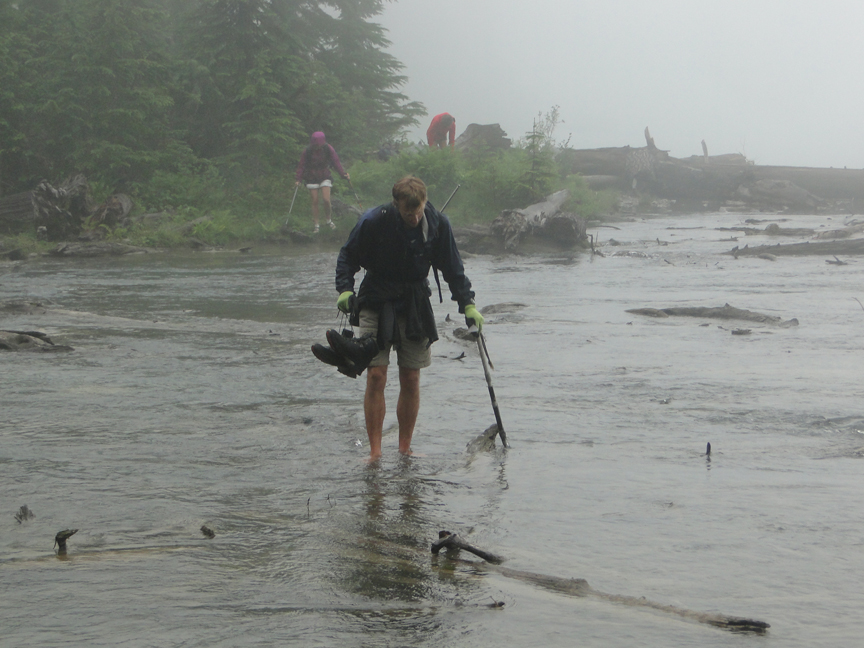
The forecast of a one day rain event was now extended to two more days. We hiked up to Blanca Lake in the rain, woke up in the rain, hiked to the glacier in the drizzle and completed our measurements. The rain returned during the hike around the lake to camp. Snowpack was low around the lake, on the trail in and seemingly everywhere but on the glacier. Strong avalanching made this the first glacier even close to average in its snowpack. Snowpack was low in the highest basin of the glacier that is not as heavily avalanche fed. With typical late summer conditions mass balance will be -0.6 m on Columbia Glacier. The warm weather was evident in the temperature of the water being much warmer than usual in the stream ford that is required to reach the glacier.
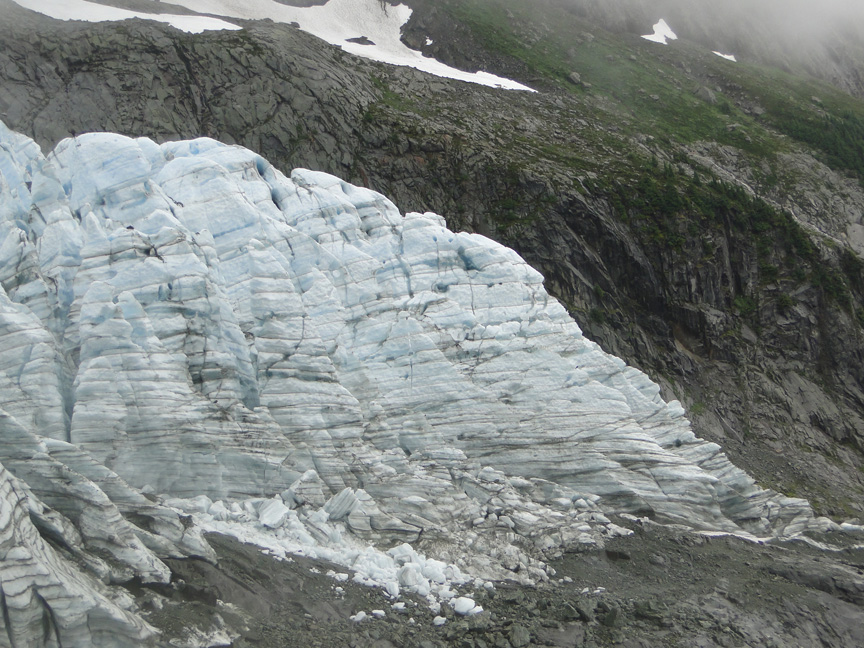
lower curtis 2014 profile Annual layers of the Lower Curtis Glacier terminus.

ben stream Surface stream assessment, Ben Pelto

wet funBen Pelto in his tenth year working on the glaciers, fording stream in wet weather to access Columbia Glacier.
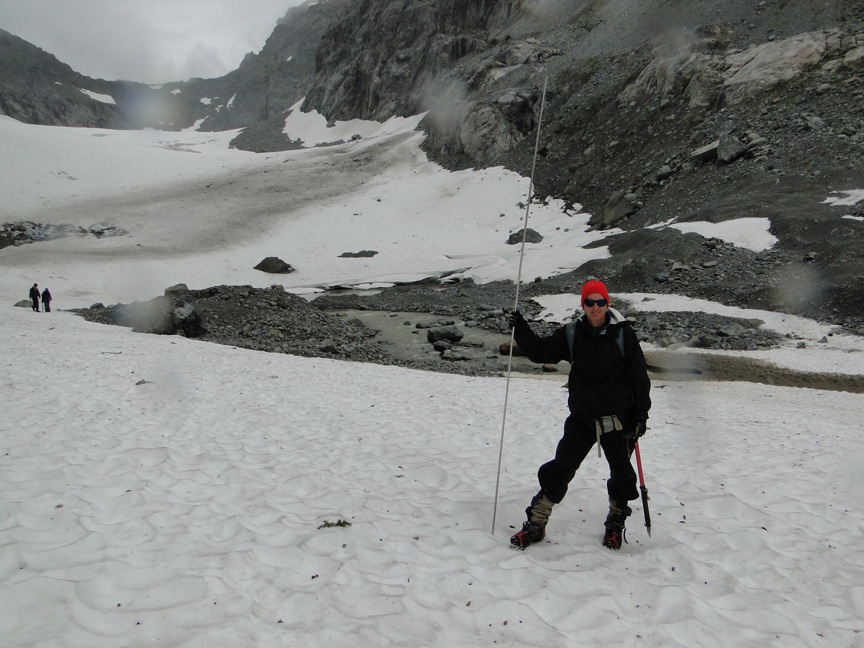
columbia 2014 snowpackSnowpack on Columbia Glacier limited blue ice.

columbia glacier july 20 2014 Blanca Lake and Columbia Glacier.

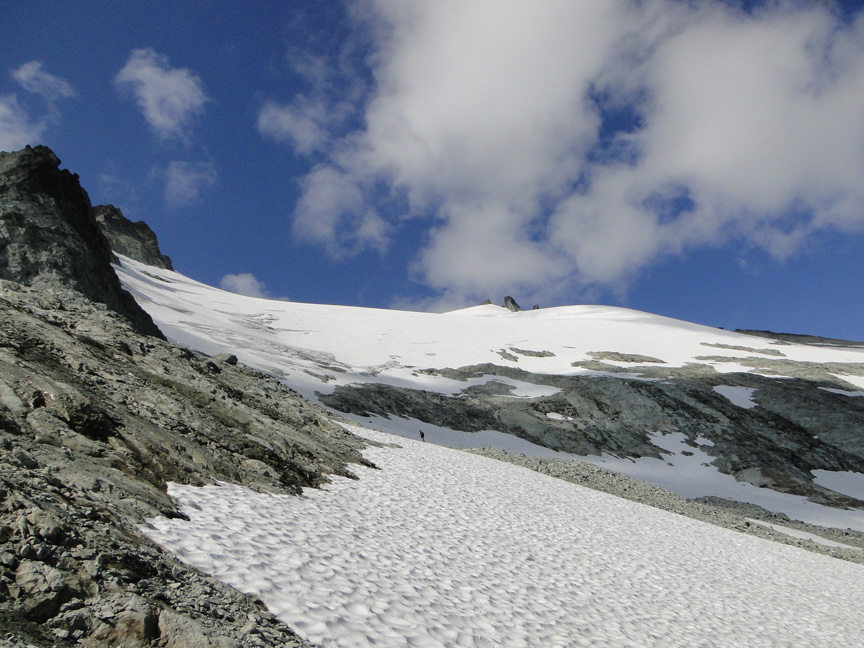
On Mount Daniel the first surprise was that Deep Lake had changed from the normal blue to a jade green. This was due to the heavy rain, even east of the crest, the previous three days, which also caused the Cle Elum River to be quite high, though the water was also warm. Having hiked passed this lake each of the last 30 years this is the first time it was not a deep blue color. It will be interesting to see how long it is until the color reverts to normal. We hiked up the Daniels Glacier to the main summit of Mount Daniel, then descended the Lynch Glacier before reascending the Lynch Glacier. Both glaciers had below normal snowpack and considerable blue ice exposure. With typical late summer conditions mass balance will be -1.2 m on Lynch Glacier and -1.1 m on Daniels Glacier. Neither glacier receives much avalanche snow. The following day on Ice Worm Glacier snowpack was above normal on the lower half of this small glacier, clearly because of unusually large amounts of avalanche accumulation. The top half of the glacier had 1-2 m of snowpack that will be lost by mid-September. With typical late summer conditions mass balance will be -0.5 m on Ice Worm Glacier lynch glacier downview
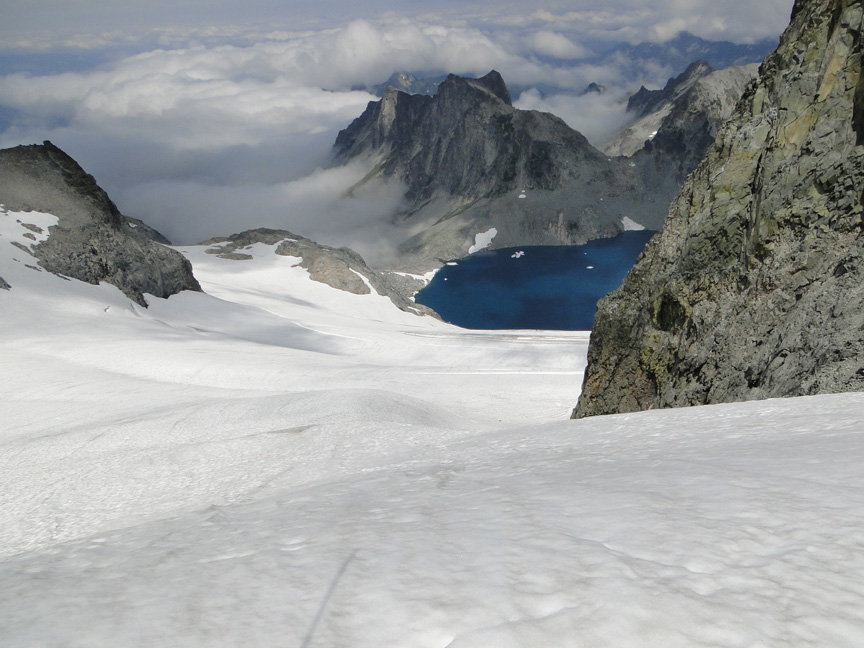
View down the Lynch Glacier.

daniels overview
Daniels Glacier vieww

ice worm glacier Ice Worm Glacier viewed across terminus melt pond

marmot ptarmigan
Marmot near camp.

Overall North Cascade glaciers will lose considerable volume. The volume lost is less on glaciers in the southern portion of the range and those with high percentages of avalanche accumulation.

easton profile
Easton Glacier profile.

easton icefall2
Easton Glacier icefall

icefall exit
Melanie Gajewski and Megan Pelto below icefall.

Hollentalferner Retreat, Bavarian Alps Germany

Hollentalferner (Glacier) is on the east flank of Zugspitze the highest mountain in the Bavarian Alps of Germany. The upper portion of the glacier is avalanche fed which flows through a minor icefall to the main terminus tongue that displays prominent annual layers.Hagg et al (2012) in a detailed examination of Bavarian Alp glaciers report on changes in the area of this glacier from 1950 to 2010. They note that from 1959 to 1981 the glacier expanded from 26 to 30 hectares. From 1989 to 2010 the glacier contracted from 30 hectares to 22 hectares. A comparison of 2000 and 2009 Google earth images indicates a retreat of the main terminus tongue of 40 m. The glacier tongue also contracted a similar amount in width. The level of crevassing on the upper glacier declined somewhat. In a closeup of the annual layers, last image, the main tongue displays 45 annual layers, red arrows. The secondary terminus, pink arrow, displays much narrower and more numerous layers. The supraglacial streams, orange arrows have incised more deeply into the glacier from 2000 to 2009. The combination of retraction of the terminus tongue, reduced crevassing and greater surface stream development on the glacier indicate a thinning glacier that will continue to slowly retreat. The crevasses in the icefall reach, green arrows, have significant depth ~10 m, and are widened by ablation processes. They indicate active flow from the upper glacier in the recent past, but the sharply concave profile below the icefall suggests limited flow into the terminus tongue area at present. The glacier retreat is less than on Blaueis Gletscher and though the glacier cannot achieve equilibrium with current climate and will disappear, this process will take longer than on the other Bavarian glaciers, this glacier will almost certainly still be around after 2030. hoellentalkar_hq
Image from Karlsruhe Institute of Technology

holleantal area
Table of areal extent change from Hagg et al (2012)

hollental 2000
Google Earth 2000

hollental 2009
Google Earth 2009

hollental annual layers
Google Earth 2009

Blaueis Gletscher Retreat, Bavaria Germany

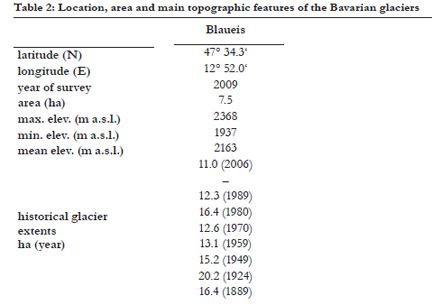
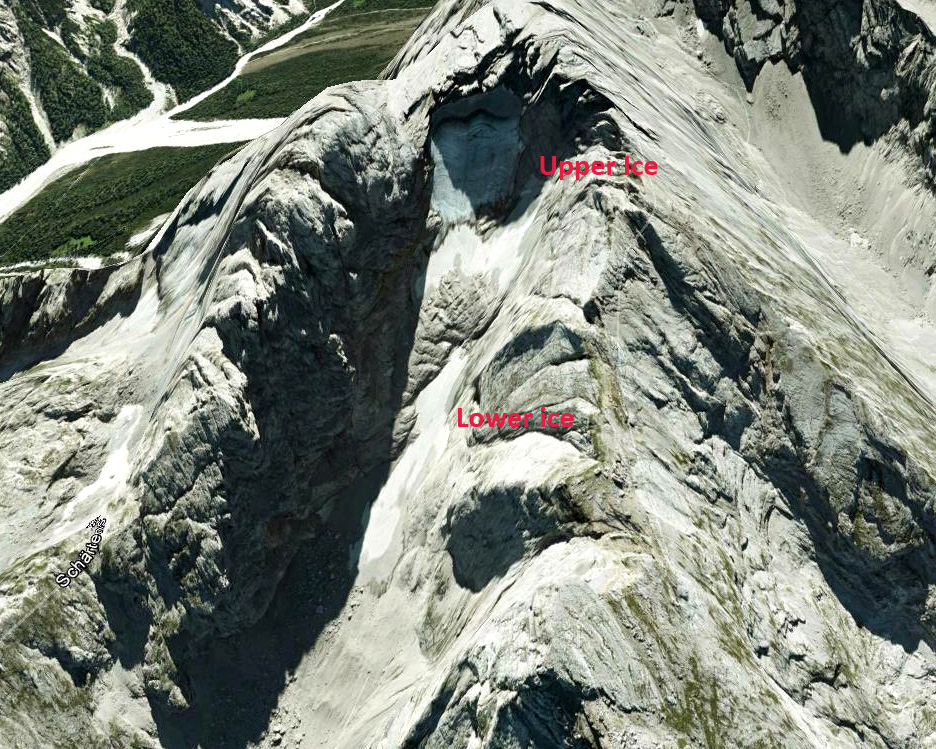
The Blaueis Gletscher is the furthest north glacier in the Alps.  It occupies a narrow deep valley oriented north, between the summits of Blaueisspitze and Hochkalter. Hagg et al (2012) in an examination of Bavarian glaciers over the last 120 years note the changes in area of Blaueis Gletscher.  The glacier increased in area from 16 to 20 hectares during the 1889 to 1924.  Retreat from 1924 to 1970 led to a decrease in area to 12.6 hectares.  Advance in the 1970’s increased the area back to 16 hectares by 1980.  Since 1980 rapid area loss to 7.5 hectares by 2009.  This rapid loss has led to many media reports of the imminent loss of the glacier. Here we examine imagery of the glacier from 1982-2014 to identify its current status.  In 1982 the glacier consisted of the main upper reach and a thin lower ice in a photograph from R. Drescher from the Bayerische Gletscher website.  By 2005 the thin lower ice has declined in area and thickness and is not  connected to the upper glacier allowing ice transfer. There is some fringing thinner ice in 2005 on the lower margin of the upper ice.  By 2009 the thin marginal ice at the downhill end of the upper glacier, has declined and become largely detached from the main glacier.  A closeup in 2009 indicates the glacier has 45-48 annual layers of accumulation exposed at the glacier surface.  This image indicates that no recent accumulation has been retained as all of the layers are blue ice and no snow or recent firn exists on the  upper glacier.  A glacier without consistent accumulation cannot survive (Pelto, 2010).  This survival forecast method does not detail how long it will take to disappear. The number of annual layers exposed indicates the glacier thickness is still significant, further the location precludes rapid melt.  Thickness maps from 2007, from the Bayerische Gletscher group, indicate the main upper ice is 5-10 m thick, with some areas over 10 m thick, based on radio echo sounding. Based on the number of annual layers and lack of crevassing reaching the glacier base, it seems to me the average thickness is somewhat greater. Glacier’s that I have worked on develop significant crevasses that reach the glacier base as the thickness drops below 10 m. Using typical volume-area scaling coefficients suggest the average thickness to be 12-15 m. There is a webcam at the Blaueis Hut that indicates the glacier today 8/22/2014 still has substantial snowcover. With the current climate this glacier in the least exposed niche on the mountain should be able to endure more than a decade.
blaueis area
Data from Hagg et al (2012)

blaueis 1982_Drescher
R. Drescher, Photograph

blaueis gl 2005
2005 Google Earth image

balueis gl 2009
2009 Google Earth image

blaueis close 2009
2009 Google Earth image

blaueis 2014a
8/22/2014 Webcam image
 

2014 North Cascade Glacier Field Season, 31st consecutive year.

This is the 31st consecutive field season for the North Cascade Glacier Climate Project. This project begun in 1984 monitors the response of North Cascade glaciers to climate change and monitors the mass balance of more glaciers than any other program in North America. This entails measuring mass balance, terminus position, surface elevation changes and glacier runoff. This is done with a combination of field measurements and satellite imagery. The unique aspect is we use no helicopter or outside support, everything is backpacked in by us. This summer our main focus will be continued work with the Nooksack Indian Tribe particularly Oliver Grah and Jezra Beaulieu, who have worked with us in 2012 and 2013. We are quantifying the role of glacier runoff on conditions for salmon in the Nooksack River. The critical aspect of this is underscored by our findings on the impact on stream discharge and temperature. Our utilization of satellite imagery and ground truth measurements caught the attention of NASA last summer. We will continue our annual mass balance survey of 10 glaciers, terminus survey of which ever glaciers have exposed termini, mountain goat survey on Ptarmigan Ridge and ice worm survey on Sholes Glacier. What we do is march around each glacier and measure the snow accumulation, ablation, survey the terminus and elevations across the glacier, then head back to our tents for the night.  We will look to again combine our field data with Landsat 8 imagery.

Selected Posts on the glaciers we will be observing.  There will be no new posts for three weeks during the field season.

Columbia Glacier, Washington**********************Deming Glacier, Washington
Lower Curtis Glacier Annual Survey, Washington*****Easton Glacier Assessment, Washington
Mount Baker Mass balance, Washington**********Ptarmigan Ridge Glacier, Washington
Rainbow Glacier, Washington********************Daniels Glacier, Washington
Nooksack Basin********************************Mount Baker Glacier Mass Balance


The snowpack on June 1 was quite normal at glacier elevations in the North Cascades. The peak mean snow depth is typically on May 10th, but this year it was May 3rd. An El Nino is forecast to begin during the fall, though the forecast is not robust. This typically leads to warm conditions in the North Cascades. June and July have been warm and dry leading to forest fires east of the Cascade Crest, snow levels have dropped below normal by July 1, and a warm July had led to more exposed ice on the glaciers than usual. The field crew for 2014 consists of scientists and visual artists. The value of the scientific data from this program, the most extensive in monitoring glaciers in the United States continues to increase as the time series extends. It is equally evident that the data does not speak for itself to most people. This year we will have an additional focus on production of video and illustrative art that tells the story of glacier change in a different fashion. The goal will be to weave the four threads of science, nature, video and illustrations into the most compelling narrative we have produced.

Mauri Pelto:
The director of the project for 31 years and also the US representative for the World Glacier Monitoring Service. This includes more than 600 nights in a tent in the North Cascades measuring glaciers.

Ben Pelto
Ben has finished his MS at UMASS-Amherst in geosciences and will be heading to University of Northern British Columbia in the fall for a doctoral program. This will be his tenth year working in the North Cascades. He has also worked on glaciers at the summit of Mount Kilimanjaro and has taken part in scientific drilling voyage on the USCGC Healey in the Arctic Ocean.

Jillian Pelto:
Jill is a senior double major in Earth Sciences and Art at UMaine. She will be spending her sixth year in the field on North Cascade glaciers. This year she also worked in the Dry Valleys of Antarctica with a research team from the University of Maine and UC-Davis.

Ashley Edwards:
Is a senior in geology at Central Washington University, and has worked as an Aquatic Ecologist in Alaska. Most importantly is an avid skier.

Justin Wright Is a senior at Oregon State University. He has worked as a web developer before getting smart and going into the earth sciences. He has worked and climbed on Mount Saint Helens and Mount Adams.

Tom Hammond
Has spent portions of 11 field season with us. And visits one of our glaciers at the end of each melt season. He is Vice President of the North Cascades Conservation Council. He is also Project Manager at the University of Washington in the Information Technology and Services area.
Tom was in the Cascades for a spring avalanche assessment and has a report on it at NCCC


Visual Crew consists of

Melanie Gajewski, Videographer
Melanie has just graduated with a degree in business at Nichols College and is enrolled in the MBA program. At Nichols College she directed most of the TV commercials used by the college in the last two years. Her aim is to be a videographer specializing in Environmental Awareness issues. She is an avid hiker, this is a first trip to glaciers.

Welcome to Visual – Melanie Gajewski from Visual Communications on Vimeo.


Megan Pelto, Illustrator:

Megan is a senior in the Illustration program at Savannah College of Art and Design. She has an extensive camping background, but this will be a first visiting the glaciers.

Jillian Pelto, Painting and Printing: I a senior Art major at University of Maine.

Hike into Easton Glacier
Survey Easton Glacier terminus and Lower Bench
Survey Upper Easton Glacier
Hike out Easton Glacier-Hike in Heliotrope
Heliotrope Glacier survey
Hike Out Heliotrope- Hike in Rainbow Glacier
Sholes Glacier Survey
Rainbow Glacier Survey
Hike out Rainbow Glacier-Hike in Lower Curtis Glacier
Lower Curtis Glacier Survey
Hike out Lower Curtis Glacier; Hike in Columbia Glacier
Columbia Glacier survey
Hike out Columbia Glacier
Hike in Mount Daniels
Ice Worm Glacier Survey
Mount Daniels Survey
Lynch Glacier Survey
Hike out Mount Daniels

Spotted Glacier Retreat, Katmai Region, Alaska

Spotted Glacier flows north from Mount Douglas and terminates in a developing proglacial lake. In the USGS map from 1951 the lake is not evident. Giffen et al (2008) noted that the glacier retreated ~1200 m from 1951-1986, a rate of 33 m/year.
spotted glacier map
Here we examine 1985 to 2013 Landsat imagery to identify the terminus change of this glacier since 1985. In each image the red arrow indicates the 2013 east side of the terminus, the pink arrow a rock knob adjacent to the 1985 terminus, and the yellow arrow a peninsula that should become an island as the further retreat occurs. In 1985 there is no evidence of the peninsula, the lake is relatively round, and has a north-south length of 1250 m. By 2000 the glacier has retreated sufficiently to expose the peninsula at the yellow arrow. The lake is now 1450 m from north to south. Neither of the images indicates many icebergs suggesting this is currently not a main mechanism of ice loss. By 2013 the peninsula is 450 m long, the north-south length of the lake is 1700 m. The retreat of 450 m in the 28 year period is nearly 30 m/year, a similar rate to the 1951-2000 period. The 2012 Google Earth image indicates a few small icebergs in the lake, again suggesting that despite some calving this is not a main glacier volume loss. The glacier front remains active and crevassed, suggesting that retreat will remain slower than for nearby Fourpeaked, Excelsior or Bear Glacier.
spotted glacier 1985
1985 Landsat image

spotted glacier 2000
2000 Landsat image

spotted glacier 2013
2013 Landsat image

spotted glacier ge 2012
2012 Google Earth image

Fourpeaked Glacier Retreat, Katmai area, Alaska

Fourpeaked Glacier drains east from the volcano of the same name in the Katmai region of southern Alaksa. The Park Service in a report (Giffen et al 2008) noted that the glacier retreated 3.4 km across a broad proglacial lake that the glacier terminates in from 1951-2986, a rate of 95 m/year. From 1986-2000 they noted a retreat of 163 m, or 13 m/year. In a more recent report with the Park Service Arendt and Larsen (2012) provide a map of the change in glacier extent from 1956-2009, Figure 4, but note the poor data overall on historic changes of Fourpeaked. Here we utilize Landsat imagery to examine retreat from 1981 to July 2014.
fourpeaked ge
Google Earth image
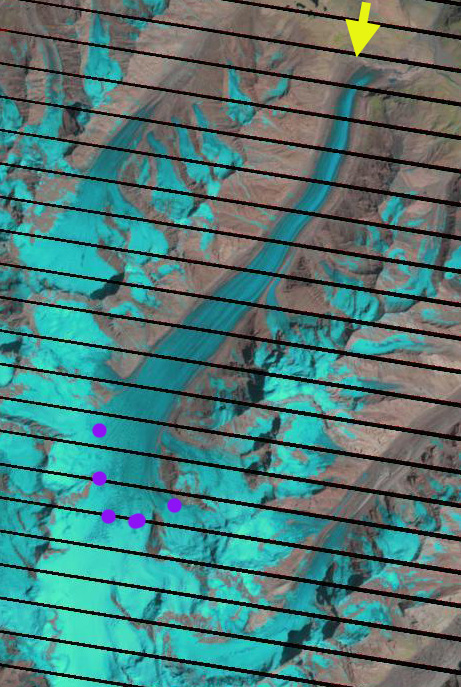
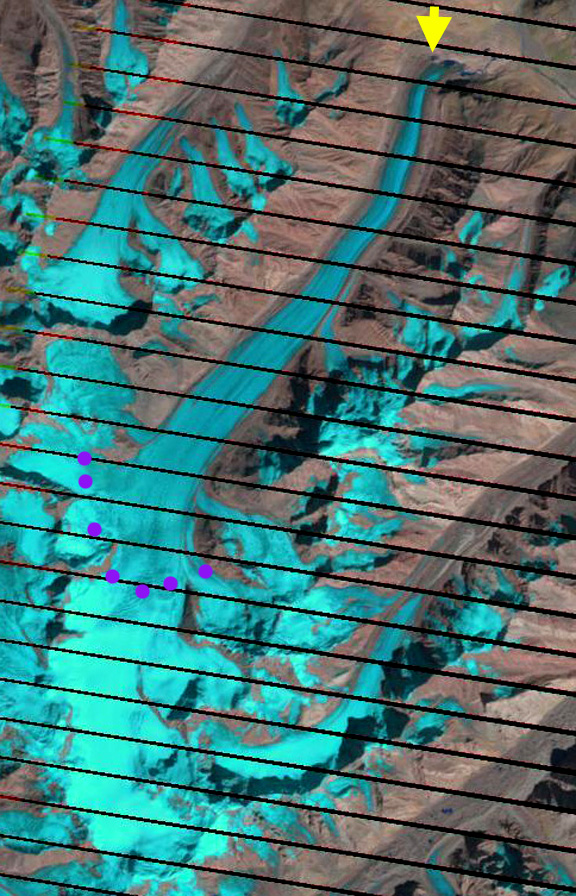
A Landsat 2 image from 1981 with relatively low resolution indicates much of the proglacial lake still occupied by ice, but much of this is floating icebergs detached from glacier, which is hard to distinguish in this image. In each image the red arrow is the 1985 terminus and the yellow arrow is 2013-2014 terminus. In 1985 the terminus is at the red arrow, with considerable floating ice still evident that is not part of the glacier. The snowline, purple dots, is at 750-800 m though this is not near the end of the summer. By 2000 the floating ice is gone, and the terminus has retreated into a narrower inlet. The snowline is at 850 m. By 2013 the glacier has receded further up this inlet and the width of the lower glacier is less. This is a July image and the snowline is still relatively low. In the July 2014 image the snowline is quite high at 700 m, given that this is mid-summer. It is not apparent in the Landsat image, but the large local forest fires in the spring could reduce albedo and enhance melt this summer. The terminus has retreated 1.9 km from 1986 to 2014 a rate of 68 m/year. The retreat from 1981-2000 was fed by calving in a broad proglacial lake. From 2000-2014 the retreat has continued despite the narrowing of the calving front. That the glacier has narrowed even more and thinned in the lower reach is indicative of a retreat that will continue. This glacier is behaving like other Katmai area glaciers, Giffen et al (2008) noted that 19 of 20 are retreating. The glacier retreat has led to formation and expansion of a large lake much like other glaciers in the region; Bear Glacier, Excelsior Glacier and Pedersen Glacier. The last image is an animated gif created by Espen Olsen illustrating the change in the glacier. Katmai 1981
1981 Landsat image

katmai 1985
1985 Landsat image

katmai 2000
2000 Landsat image

katmai 2013
2013 Landsat image

katmai 2014
2014 Landsat image

mauri
Espen Olsen animated gif of Landsat images

Chilung Glacier Retreat, India

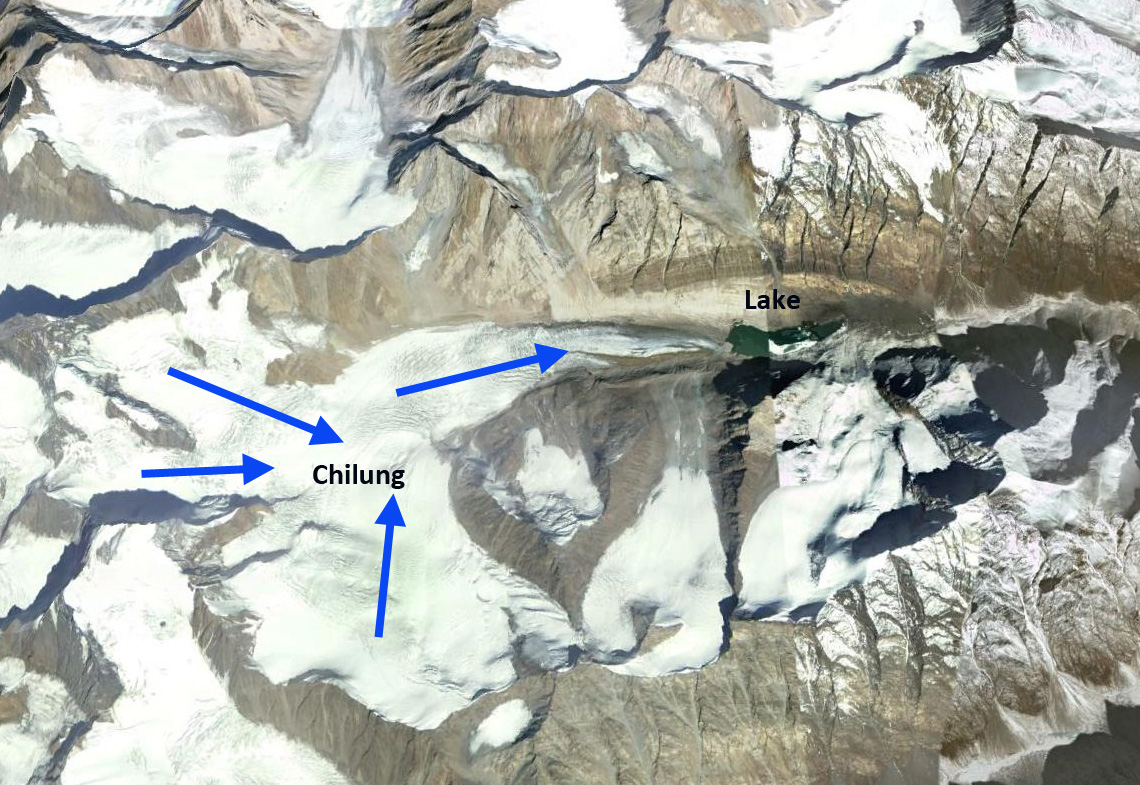
East of the Chilung La and 20 km northwest of Durung Drung Glacier draining into the Sankpo (Suru) River is an unnamed glacier, here referred to as Chilung Glacier. The Suru River flows northwest from Pensi La, while the Zanskar River flows southeast from the Pensi La. The Suru River has a 44 MW hydropower project at Chutak. The glacier is 6 km long starting at 5400 m and terminating at 4400 m.
drung drung map
Topographic map of region

chilung Glacier
Google Earth image

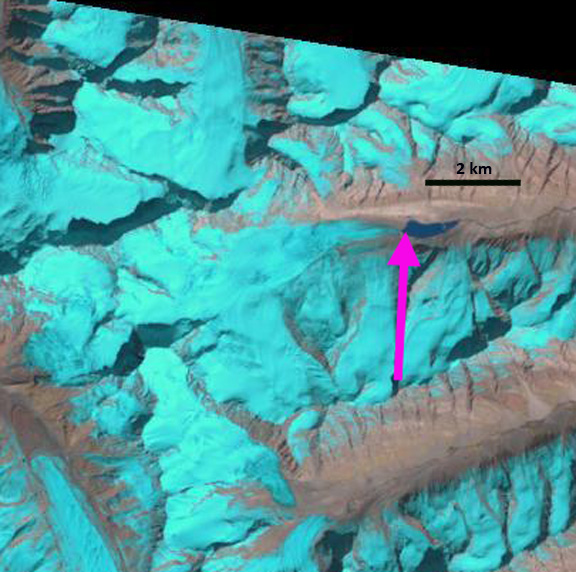
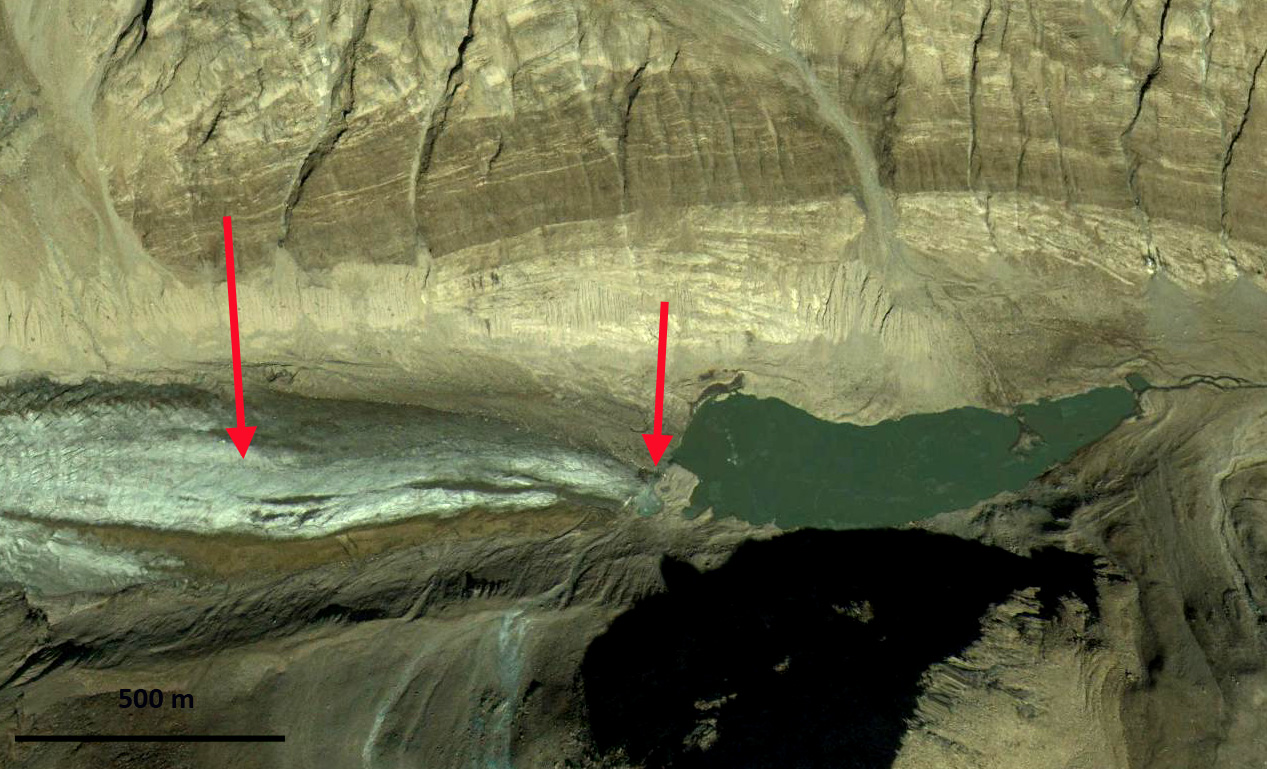
An examination of Landsat imagery from 1998-2013 indicate the expansion of a proglacial lake at the terminus and glacier retreat. The 1998 terminus is marked by a pink arrow in each image. The yellow and green arrow indicate adjacent small glaciers. In 1998 the proglacial lake is 1100 m long and in 2000 it is 1200 m long. By 2005 the glacier has retreated 200 m and the lake is 1400 m long. In 2013 the lake is 1650 m long, and the glacier has retreated 400-450 m since 1998. The retreat rate of 30 m/year is slightly faster than on Durung Drung. A comparison of the adjacent small glaciers on the slopes above Chilung Glacier, yellow and green arrows, from 2000 to 2013 indicate a loss in area of these glaciers as well. Google Earth imagery in 2000 indicates that lower 900 m of the glacier is uncrevassed and relatively stagnant, by 2013 half of this area has been lost. The lake is shallow and may not expand much further as the glacier retreats. The consistent nature of the retreat in this area was noted by Kulkarni (2014)indicating retreat of 12 of the 13 observed glaciers in the region during recent decades. Glacier thinning has exceeded the rate of retreat on many glaciers in this area, indicating that retreat is likely to increase. chilung glacier 1998
1998 Landsat image

chilung 2000
2000 Landsat image

chilung 2005
2005 Landsat image

chilung 2013
2013 landsat image
chilung glacier terminus
2000 Google Earth image

Alpine Glaciers-BAMS State of the Climate 2013

The post below is the chapter from the BAMS State of the climate 2013, that I author each year.

Full report which is the most comprehensive assessment of climate in 2013.

Alpine Glaciers – Mauri S. Pelto

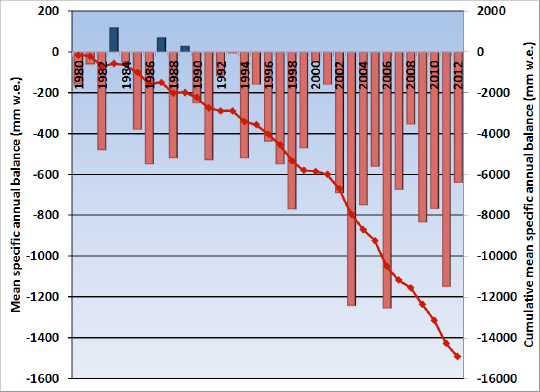
The World Glacier Monitoring Service (WGMS) record of mass balance and terminus behavior (WGMS, 2013) provides a global index for alpine glacier behavior. Mass balance was -638 mm in 2012, negative for the 22nd consecutive year. Preliminary data for 2013 from Austria, Canada, Nepal, New Zealand, Norway, and United States indicate it is highly likely that 2013 will be the 23rd consecutive year of negative annual balances. The loss of glacier area is leading to declining glacier runoff, since globally 370 million people live in river basins where glaciers contribute at least 10% of river discharge on a seasonal basis (Schaner et al, 2012).
Bamsf2
Figure 1: The mean annual balance reported for the 30 reference glaciers to the WGMS. And the cumulative annual balance for the reference glaciers 1980-2012.

Alpine glaciers have been studied as sensitive indicators of climate for more than a century, most commonly focusing on changes in terminus position and mass balance. The worldwide retreat of mountain glaciers is one of the clearest signals of ongoing climate change (Haeberli et al, 2000). The retreat is a reflection of strongly negative mass balances over the last 30 years (WGMS, 2013). Glacier mass balance is the difference between accumulation and ablation.

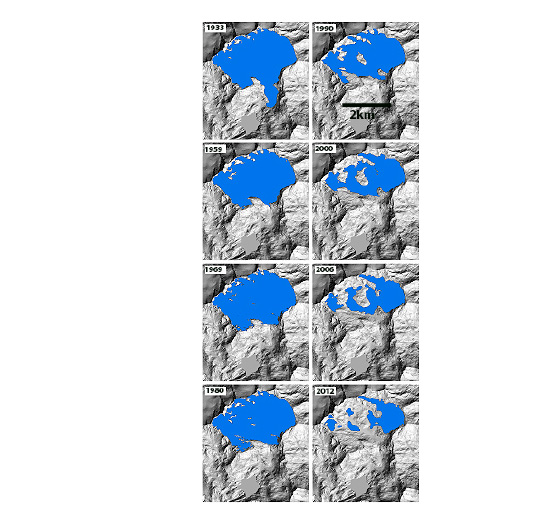
The cumulative mass balance loss since 1980 is 14.9 m w.e. the equivalent of cutting a 16.5 m thick slice off the top of the average glacier (Figure 1). The trend is remarkably consistent from region to region (WGMS, 2011). WGMS mass balance results based on 30 reference glaciers with 30 years of record is not appreciably different, -15.1 m w.e. The decadal mean annual mass balance was -198 mm in the 1980’s, -382 mm in the 1990’s, and 740 mm for 2000’s. The declining mass balance trend during a period of retreat indicates alpine glaciers are not approaching equilibrium and retreat will continue to be the dominant terminus response. The recent rapid retreat and prolonged negative balances has led to some glaciers disappearing and others fragmenting (Figure 2)(Pelto, 2010; Carturan et al; 2013).
bamsf1
Figure 2. Disintegration of Careser Glacier, Italy 1933-2012, glacier in blue. (Carturan et al, 2013)

In 2013 The Austrian Glacier inventory in examined 96 glaciers, 93 were in retreat, 1 was advancing and 2 were stationary, average terminus change was -17 m. Mass balance in 2013 was slightly negative on three glaciers with completed data. A 170 m increase in annual equilibrium line altitude on 43 glaciers in the Alps from 1984-2010, is driving the ongoing retreat (Rabatel et al, 2013).

In Norway terminus fluctuation data from 33 glaciers for 2013 with ongoing assessment indicate, 26 retreating, 4 stable and 3 advancing. The average terminus change was -12.5 m (Elverhoi, 2013). Mass balance surveys with completed results are available for six glaciers, all have negative mass balances with an average loss exceeding 1 m w.e. (Andreassen, 2013).

In the North Cascades, Washington the 2013 winter accumulation season featured 93% of mean snowpack (1984-2013). The melt season was exceptional with the mean June-September temperature tied with the highest for the 1989-2013 period and had the highest average minimum daily temperatures. The result was significant negative balances on all ten glaciers observed, with an average of -1 m w.e. (Pelto, 2013). In British Columbia end of summer snowlines were quite high and annual mass balance significantly negative. In Alaska all four glaciers with mass balance assessed had significant negative mass balances (Pelto, 2013).DSC02892
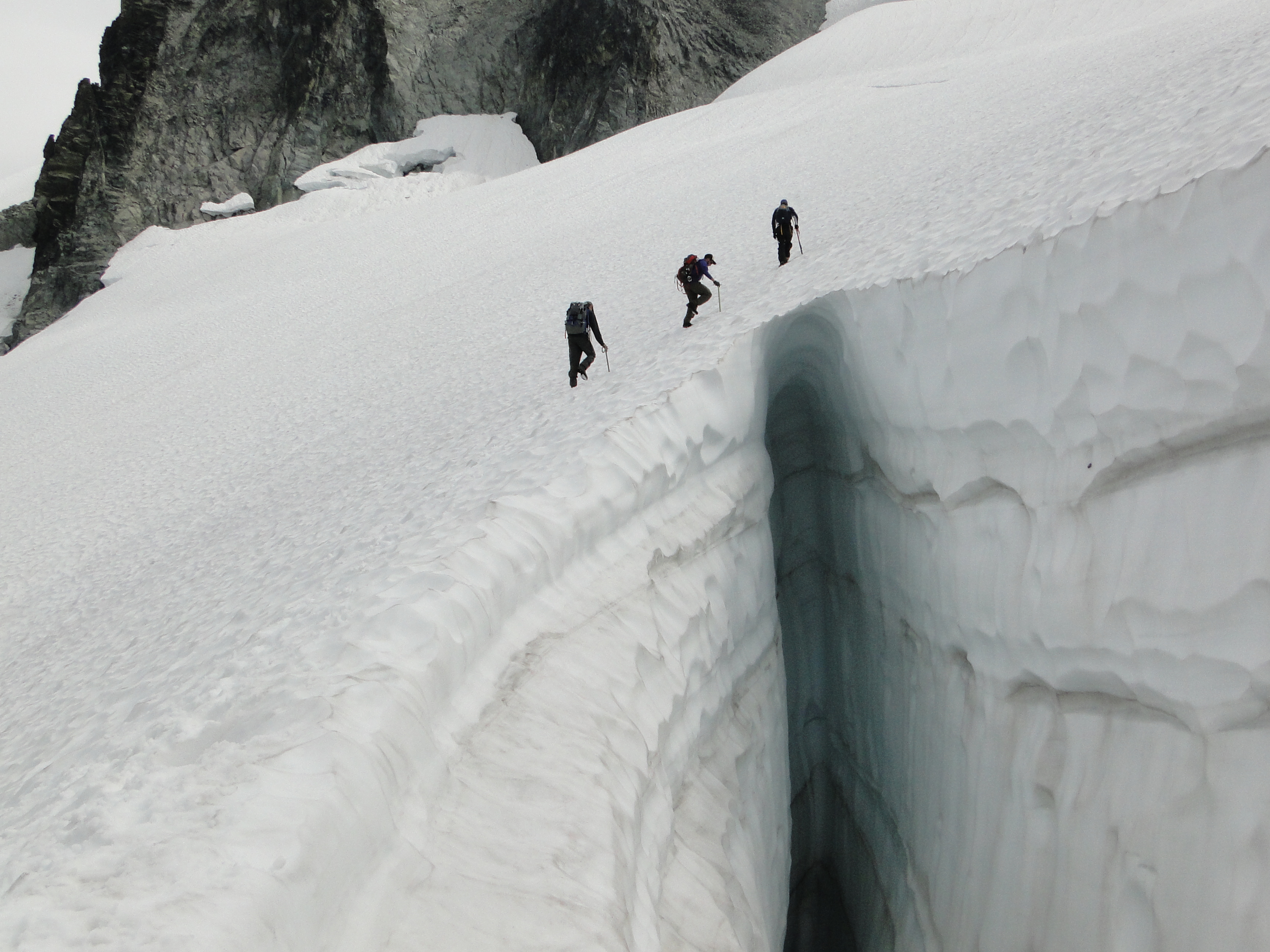
Figure 3 Assessing snow depth in crevasse Lynch Glacier, North Cascades.

In New Zealand the annual end of summer snowline survey on 50 glaciers found snowlines that were slightly above the elevation for glacier equilibrium. Heavy snow accumulation during October was offset by a warm and dry summer with high ablation (NIWA, 2013).

In Nepal the mass balance of Yala, Mera and Pokalde Glacier were near equilibrium. Accumulation was the highest of the last seven years, with particularly heavy snow from extratropical storm Phailin (ICIMOD, 2013).

References:

Andreassen, L., 2013: Cyroclim/NVE. http://glacier.nve.no/viewer/CI/en/cc/

Carturan, L., Baroni, C., Becker, M., Bellin, A., Cainelli, O., Carton, A., Casarotto, C., Dalla Fontana, G., Godio, A., Martinelli, T., Salvatore, M. C., and Seppi, R. 2013: Decay of a long-term monitored glacier: Careser Glacier (Ortles-Cevedale, European Alps). The Cryosphere, 7, 1819-1838, doi:10.5194/tc-7-1819-2013.

Elverhoi, H., 2013: Norwegian water resources and energy directorate 2013 glacier length change Table.http://www.nve.no/Global/Vann%20og%20vassdrag/Hydrologi/Bre/Nedlastinger/Length_Change_Table_2000-2013.pdf?epslanguage=en.

Fischer, A. 2013: Gletscherbericht 2011/2012. http://www.alpenverein.at/portal_wAssets/docs/service/presse/2013/PA_Alpenverein_Gletscherbericht_Bergauf-2-2013.pdf

Haeberli, W., J. Cihlar and R. Barry 2000: Glacier monitoring within the Global Climate Observing System. Ann. Glaciol, 31, 241-246.

ICIMOD, 2013: Students learn glacier mass balance measurement. http://www.icimod.org/?q=12401

NIWA, 2013: State of the Climate 2013. NIWA. http://www.niwa.co.nz/climate/state-of-the-climate/state-of-the-climate-2013

Pelto, M. 2010: Forecasting temperate alpine glacier survival from accumulation zone observations. The Cryosphere,4, 67–75.

Pelto, M. 2013: Pacific Northwest 2013 Glacier Assessment. https://glacierchange.wordpress.com/2014/02/20/pacific-northwest-glacier-mass-balance-2013/

Rabatel, A., Letréguilly, A., Dedieu, J.-P., and Eckert, N.: Changes in glacier equilibrium-line altitude in the western Alps from 1984 to 2010: evaluation by remote sensing and modeling of the morpho-topographic and climate controls, The Cryosphere, 7, 1455-1471, doi:10.5194/tc-7-1455-2013, 2013.

Schaner, N., Voisin, N., Nijssen, B. and Lettenmaier, D. 2012: The Contribution of Glacier Melt to Streamflow. Environmental Research Letters 7  (doi:10.1088/1748-9326/7/3/034029.

WGMS, 2013: Glacier Mass Balance Bulletin No. 12 (2010–2011). Zemp, M., Nussbaumer, S. U., GärtnerRoer, I., Hoelzle, M., Paul, F., and Haeberli, W. (eds.), ICSU(WDS)/IUGG(IACS)/UNEP/UNESCO-WMO, World Glacier Monitoring Service, Zurich, Switzerland.

Himalayan Glacier Change Index

Himalaya Range Glacier Change Below is a list of individual glaciers in the Himalaya that illustrate what is happening glacier by glacier. In addition to the individual sample glaciers we tie the individual glaciers to the large scale changes of approximately 10,000 glaciers that have been examined in repeat satellite image inventories. In the Himalayan Range, stretching from the Karokaram Range in NW India east south east to the border region of Bhutan and China,  detailed glacier mapping inventories, from GLIMS: (Global Land Ice Measurements from Space), ICIMOD (International Centre for Integrated Mountain Development), ISRO ( Indian Space Research Organisation) and Chinese National Committee for International Association of Cryospheric Science (IACS) of thousands of glaciers have indicated increased strong thinning and area loss since 1990 throughout the the Himalayan Range. The inventories rely on repeat imagery from ASTER, Corona, Landsat, IKONOS and SPOT imagery. It is simply not possible to make observations on this number of glaciers in the field.  This is an update to the assessment by Pelto (2012) in the BAMS State of the Climate, which was the source of a Skeptical Science article as well

Kali Gandaki Headwaters, Nepal——–Ngozumpa Glacier, Nepal

Khumbu Glacier, Nepal ————         West Barun Glacier, Nepal 

Imja Glacier, Nepal ——–                       Nobuk Glacier, Nepal

Lumding Glacier, Nepal———-

Milam Glacier, India————                Samudra Tupa, India

Ratangrian Glacier, India———–       Khatling Glacier, India

Satopanth Glacier, India———-         Durung Drung Glacier, India

Gangotri Glacier, India————         Warwan Basin, India

Sara Umaga Glacier, India—–          Malana Glacier, India 

Jaonli Glacier, India——–                  Kalabaland Glacier, India  

Jaundhar Barak, India———–         Burphu Glacier, India

Changsang Glacier, Sikkim—–     Zemu Glacier, Sikkim 

South Lhonak Glacier, Sikkim——North Lhonak Glacier, Sikkim

Theri Kang Glacier, Bhutan———-Luggi Glacier, Bhutan

Mangde Chu Glacier, Bhutan——–Thorthormi Glacier, Bhutan

Menlung Glacier, Tibet———-       Yejyumaro Glacier, Tibet

Lumding Glacier, Tibet—-             Rongbuk Glacier, Tibet

Sepu Kangri, China———–          Longbasba Glacier, Tibet

Jiongla Glacier, Tibet———-        Bode Zanbo Headwaters, Tibet

Zayul Chu Headwaters, TibetBoshula Glaciers, Tibet

Matsang Tsanpo Gl, Tibet—–    Reqiang Glacier, Tibet 

Himalaya-Small

In Garhwal Himalaya, India, of 58 glaciers examined from 1990-2006 area loss was 6% (Bhambri et al, 2011). They also noted the number of glaciers increased from 69 (1968) to 75 (2006) due to the disintegration of ice bodies. Examination of 466 glaciers in the Chenab, Parbati and Baspa Basin, India found a 21% decline in glacier area from 1962 to 2004 (Kulkarni, 2007). Glacier fragmentation was also observed in this study, which for some fragments represents a loss of the accumulation area, which means the glacier will not survive (Pelto, 2010). The India glacier inventory (ISRO, 2010) identified glacier area losses and frontal change on 2190 glaciers and found an area loss rate of 3.3% per decade and 76% of glaciers retreating. (Kulkarni, 2014) reports on Indian Himalyan glaciers  that 79 of 80 with terminus change records have been receding.

In the Nepal Himalaya area loss of 3808 glaciers from 1963-2009 is nearly 20% (Bajracharya et al., 2011). The Langtang sub-basin is a small northeast-southwest elongated basin, tributary of Trishuli River north of Kathmandu and bordered with China to the north. The basin contained 192 km2 of glacier area in 1977, 171 km2 in 1988, 152 km2 in 2000 and 142 km2 in 2009. In 32 years from 1977 to 2009 the glacier area declined by 26% (Bajracharya et al., 2011). In the Khumbu region, Nepal volume losses increased from an average of 320 mm/yr 1962-2002 to 790 mm/yr from 2002-2007, including area losses at the highest elevation on the glaciers (Bolch et al., 2011).  The Dudh Koshi basin is the largest glacierized basin in Nepal. It has 278 glaciers of which 40, amounting to 70% of the area, are valley-type. Almost all the glaciers are retreating at rates of 10–59 m/year and the rate has accelerated after 2001 (Bajracharya and Mool, 2009).  ICIMOD (2013) completed an inventory of Nepal glaciers and found a 21% decline in area from the 1970’s to 2007/08.  ICIMOD has developed an  map viewer application for examining the changes through time.

An inventory of 308 glaciers in the Nam Co Basin, Tibet, noted an increased loss of area for the 2001-2009 period, 6% area loss (Bolch et al., 2010). Zhou et al (2009) looking at the Nianchu River basin southern Tibet found a 5% area loss. 1990-2005. In the Pumqu Basin, Tibet an inventory of 999 glacier from the 1974 & 1983 to 2001 indicated the loss of 9% of the glacier area and 10% of the glaciers disappeared (Jin et al, 2005). The high elevation loss is also noted in Tibet on Naimona’nyi Glacier which has not retained accumulation even at 6000 meters. This indicates a lack of high altitude snow-ice gain (Kehrwald et al, 2008).

A new means of assessing glacier volume is GRACE, which cannot look at specific changes of individual glaciers or watersheds. In the high mountains of Central Asia GRACE imagery found mass losses of -264 mm/a for the 2003-2009 period (Matsuo and Heki, 2010). This result is in relative agreement with the other satellite image assessments, but is at odds with the recent global assessment from GRACE, that estimated Himalayan glacier losses at 10% of that found in the aforementioned examples for volume loss for the 2003-2010 period (Jacobs et al, 2012). At this point the detailed glacier by glacier inventories inventories of thousands of glaciers are better validated and illustrate the widespread significant loss in glacier area and volume, though not all glaciers are retreating. This page will continue to be updated as new inventory data is published and new individual glaciers are examined herein. Yao et al (2012) in an examination of Tibetan glaciers observed substantial losses of 7090 glaciers.  Bolch et al (2012) in a report on the “State and Fate of Himalayan Glaciers” noted that most Himalayan glacier are losing mass and retreating at rates similar to the rest of the globe.  ICIMOD has also developed an application illustrating changes of glaciers in Bhutan.

Sittakanay Glacier Retreat, British Columbia

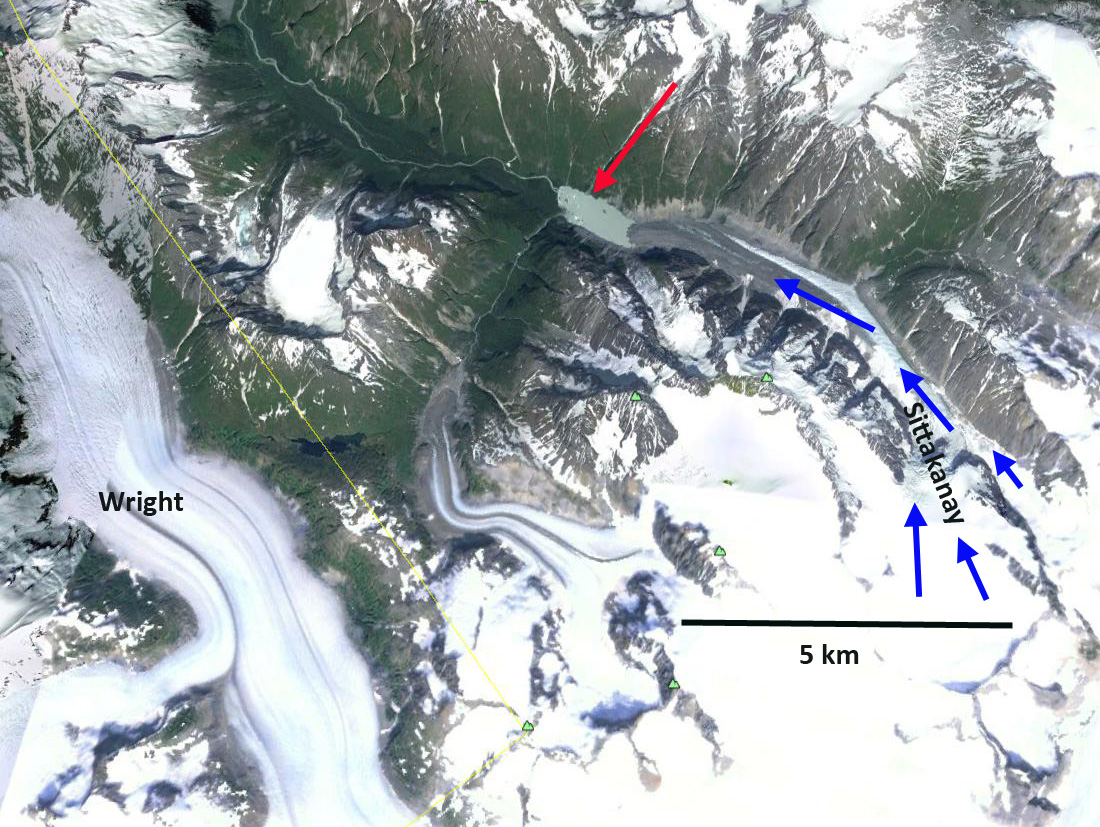
Sittankanay Glacier drains the north side of the small icefield that feeds the retreating Wright, Speel and West Speel Glacier. The 10 km long glacier is the headwaters of the Sittkanay River, a tributary to the Taku River. Here we utilize Landsat images from 1984-2013 to identify the recent changes in the glacier. The glacier begins at 2000 m and ends in a lake at 250 m, the terminus has heavy debris cover, which is unusual for this area. The Canadian Topographic map indicates a lake that is 400 m long.
sittikanay map
Canada Topographic map

sittakany westge
Google Earth Image

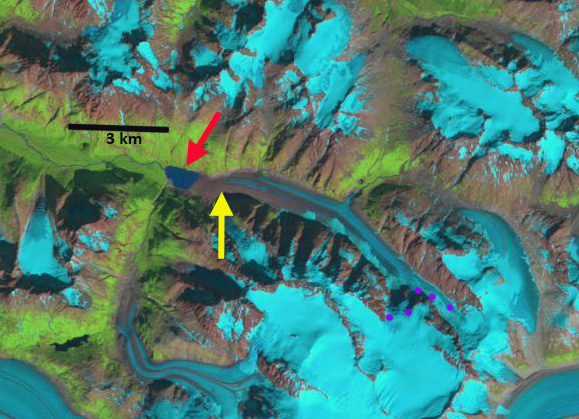
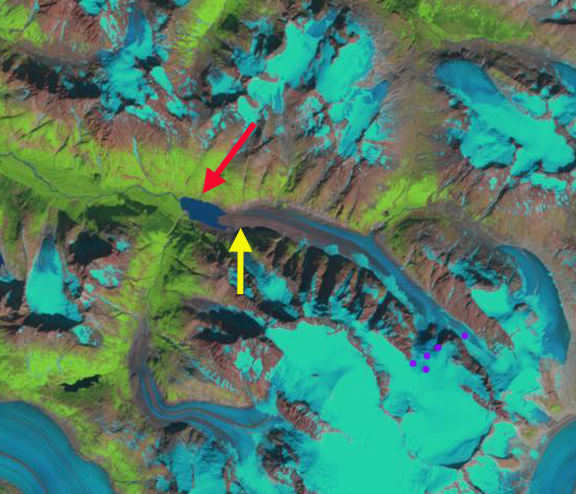
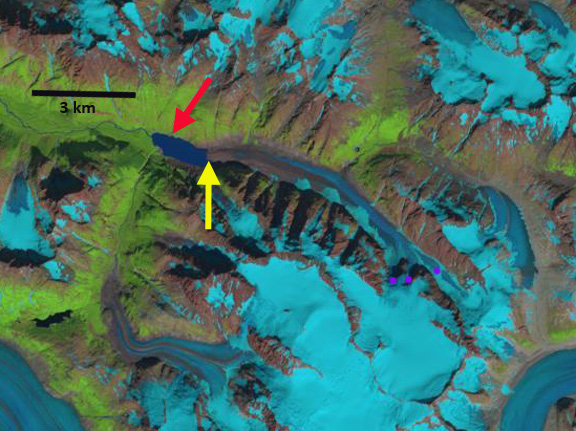
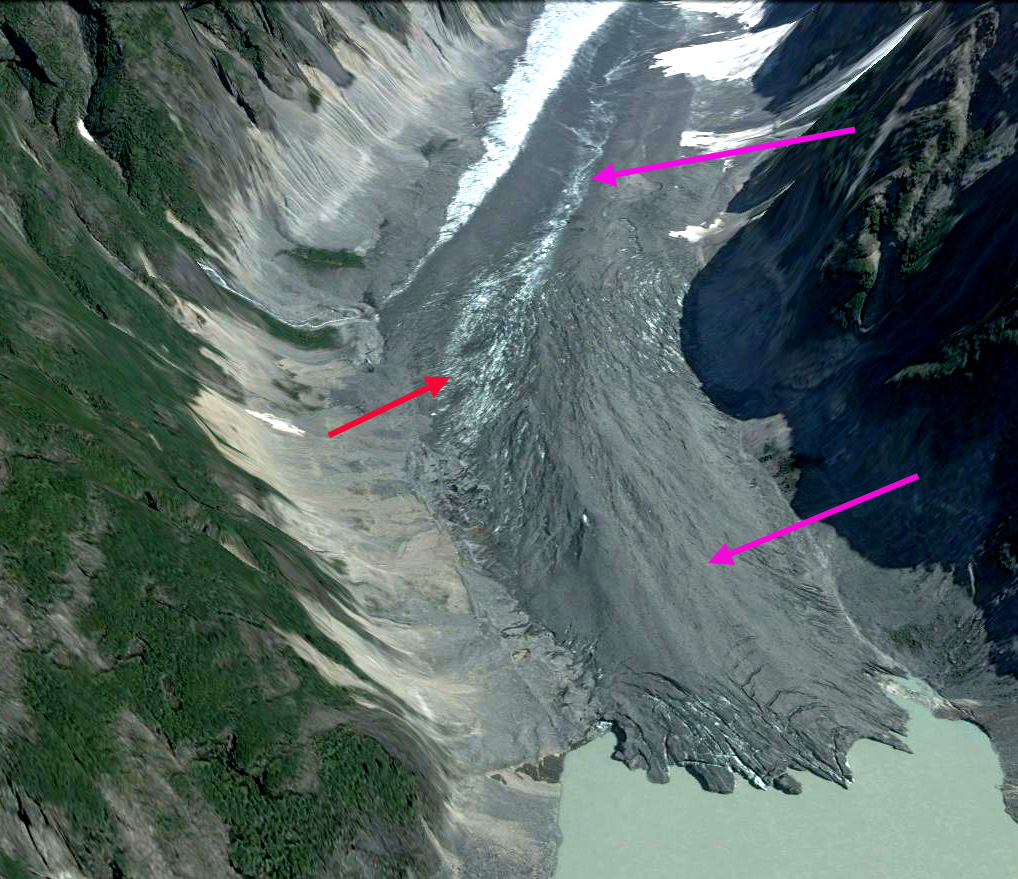
In 1984 the terminus of the glacier, red arrow is at the base of a steep gulch, yellow arrow marks the 2013 terminus. The lake has expanded to 600 m in length. The purple dots indicate the snowline is at 1500 m, which leaves limited snowpack for sustaining the glacier. In 1996 and 1999 the snowline was also at 1500 m, indicating negative mass balances that underlie the retreat. By 2013 the glacier the lake had expanded to 1700 m in length. The glacier has retreated 1100 m since 1984. The snowline is at 1400 m in the mid-August image, and will rise above 1500 m by the end of the melt season. A close up view of the terminus indicates the heavy debris cover has large uncrevassed sections that appear nearly stagnant, pink arrows. There is one feature in the 2006 Google Earth image that is 1.0 km from the terminus, a circular depression-red arrow, with concentric crevasses that indicates a subglacial lake that partially buoys the glacier. This also indicates that rapid retreat will continue. The retreat is enhanced by calving, but it is the insufficient size of the accumulation zone that is driving the retreat of this glacier and its neighbors.

sittakanay 1984
1984 Landsat image

sittakanay 1996
1996 Landsat image

sittakanay 1999
1999 Landsat image

sittakanay 2013
2013 Landsat image

sittakanay terminus
Google Earth image

Durung Drung Glacier Retreat, Zanskar, India

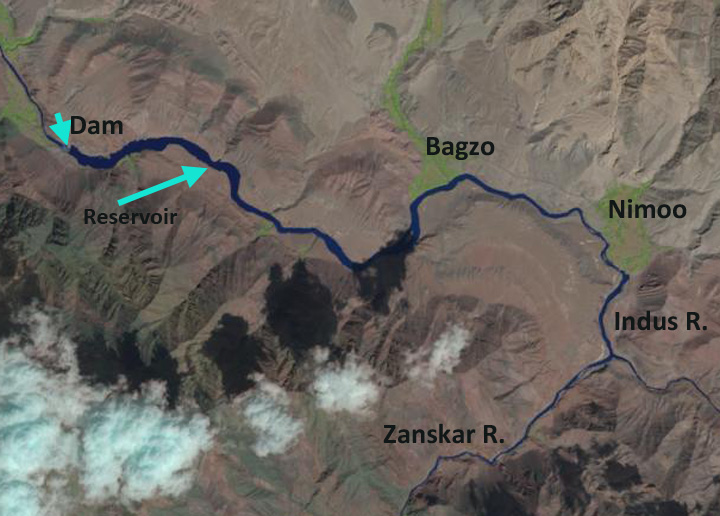
The Durung Drung Glacier (Drang Drung) is a frequently seen glacier from the unpaved Kargil-Leh road in the Zanskar, Lakdakh region of India that flows north from the slopes of Doda Peak. This road climbs up the Suru River valley from Kargil, crosses Pensi La Pass crosses the front of the Durung Drung Glacier and descends the Zanskar River valley to Nimoo. The Zanskar River joins the Indus River just above the village of Nimoo. The Nimoo Bazgo Hydroelectric Project opened in 2012 and provides 45 MW of power to the Ladakh Region. Chris Rubey has a nice image of this power plant. This is a run of river project, that does not alter the downstream flow, but it does have a reservoir that stores 120,000,000 gallons of water, as seen in a 2013 Landsat image.

durung drung 1998a
1998 Landsat Image show flowlines fro Durung Drung Glacier

nimoo Bagzo 2013
2013 Landsat image of the dam and reservoir for the Nimoo Bagzo Hydropower Project

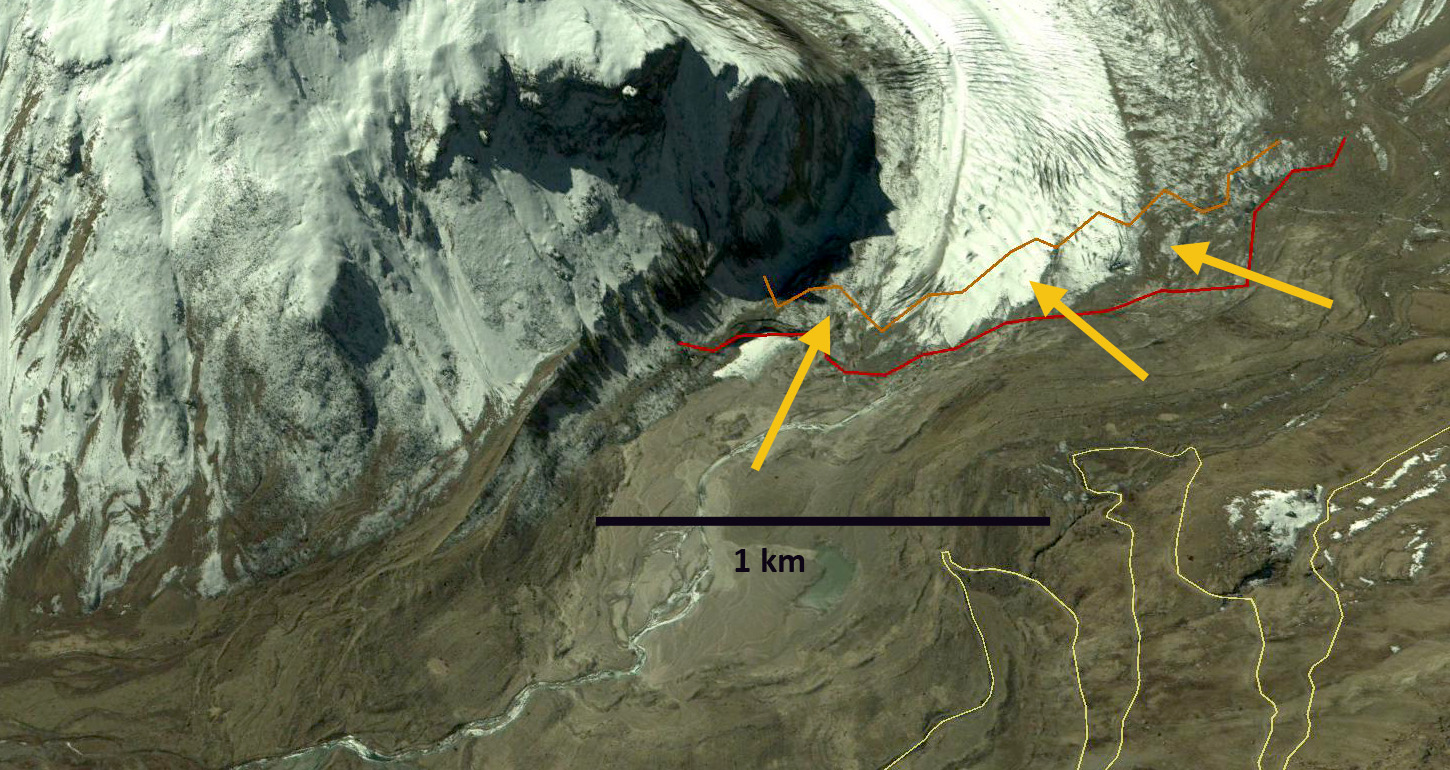
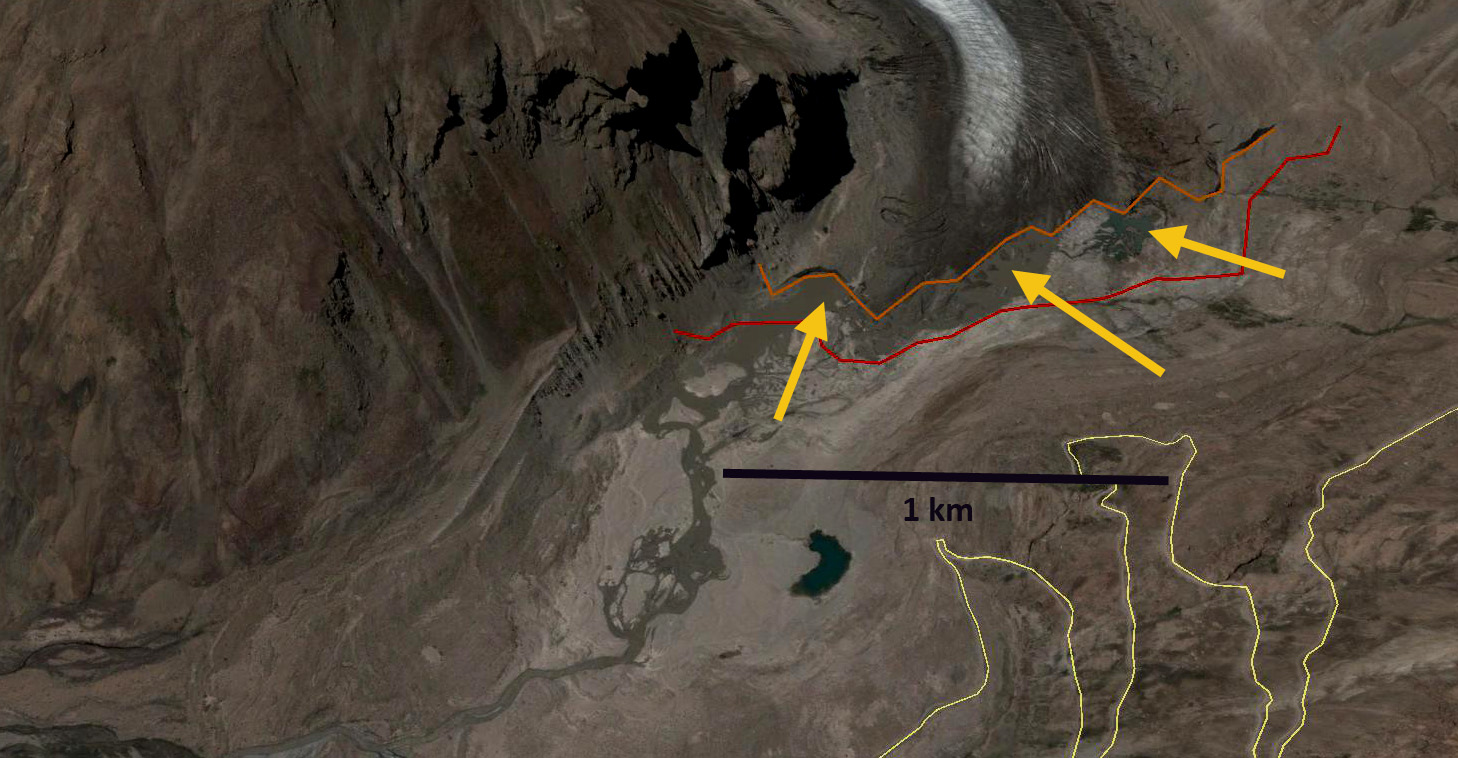
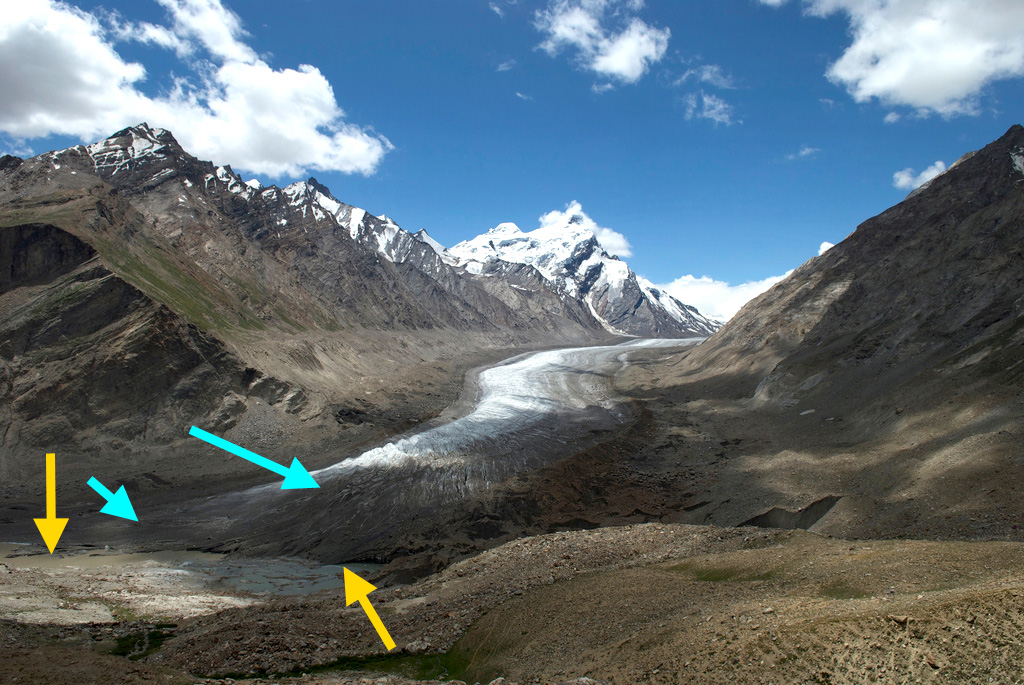
There have a few inaccurate reports of late that this glacier is not currently retreating. Here we examine Landsat and Google Earth imagery from 1998 to 2013 to identify the magnitude of the recent retreat. In Landsat images in 1998 there were no evident proglacial lake at the terminus of the glacier, red arrow. By 2013 a series of proglacial lakes are evident in Landsat images at the terminus red arrow. Looking at the higher resolution Google Earth imagery from 2004 and 2013. The retreat and development of the lakes is apparent. In each image the red line is the 2004 terminus and the brown line the 2013 image, orange arrows indicate three lakes that have formed by 2013. The retreat is 200-250 m not large for a glacier of this size but significant for such a short period of time. More importantly the smooth low slope terminus with pieces breaking off into the proglacial lake in 2013 is indicative of a glacier that is thinning and retreating, note video. The lowest 1.2 km of the glacier is uncrevassed and has a low slope suggesting this area will continue to melt away. An image from a Zanskar River expedition indicates the lakes and icebergs in the lakes as well with the blue arrows indicating the low-sloped uncrevassed region. durung drung 1998
1998 Landsat of Durung Drung Glacier terminus

durung Drung close 2013
2013 Landsat of Durung Drung Glacier terminus

durung drung glacier terminus 2004
2004 Google Earth image of Durung Drung Terminus

durung drung terminus 2013
2013 Google Earth image of Durung Drung Terminus

durung drung glacier exped
Whitewater Asia image

Landsat images from 2005 and 2013 indicate the snowline on the glacier as well as the change at the terminus. In 2005 and 2013 the snowline is at 5100 m, purple dots. Given that the glacier extends from 6000 m to 4100 m this is near the median elevation, but this is also likely not the date of highest snowline position. The retreat of Durung Drung Glacier is similar to the more debris covered Gangotri Glacier and Satopanth Glacier but slower than the similarly debris limited Malana Glacier and Samudra Tupa Glacier

durung drung 2005
2005 Landsat image

durung Drung 2013
2013 Landsat image

Wright Glacier Retreat, Southeast Alaska

Wright Glacier is the main glacier draining a small icefield just south of the Taku River and the larger Juneau Icefield. Wright Glacier is 60 km east of Juneau and has ended in a lake since 1948. A picture of the glacier in 1948 from the NSIDC collection indicates the terminus mainly filling the lake, but breaking up. The glacier drains the same icefield as the retreating West Speel and Speel Glacier. The dark blue arrows indicate the flow vectors of Wright Glacier, light blue arrows flow vectors for adjacent glaciers. Despite being 30 km long this glacier has been given very little attention, maybe because it does not reach tidewater.
wright glacier1948080301
NSIDC Glacier Photograph Collection Photographer unknown.

wright glacier ge
Google Earth view

In 1984 the glacier ended at a peninsula in the lake where the lake turns east. This was my view of this glacier during the summers of 1981-1984 from the Juneau Icefield with the Juneau Icefield Research Program. Our bad weather came from that direction so keeping an eye on that region during intervals between whiteout weather events, the norm, was prudent. Here we examine Landsat imagery from 1984-2013 to document the retreat of Wright Glacier and the elevation of the snowline on the glacier. The red arrow indicates the 2013 terminus, the red arrow the terminus at the time of the image and the red dots the snowline on the date of the imagery. In 1984 the lake had a length of 3.1 km extending northwest from the glacier terminus. The snowline in mid-August with a month left in the melt season was at 1150 m. By 1993 the glacier had retreated little on the north side of the lake and 200 m on the south side. The snowline in mid-September close to the end of the melt season was at 1150 m. In 1997 the fourth in a five year run of extensive mass balance losses and high equilibrium lines in the region, noted on the Juneau Icefield (Pelto et al, 2013), the snowline had risen to 1450 m. The terminus had retreated 200 m on the north side since 1984 and 600 m on the south side. In 2003 the snowline was at 1250 m with a month left in the melt season. The terminus retreat on the north side and south side since 1984 had now evened out with 900 m of retreat. In 2013 the snowline was at 1150 m in mid-August and 1350 m by the end of the melt season. The terminus had retreated 1300 m since 1984 and the lake is now 4.5 km long. The lower 2 km of the glacier has many stagnation features on it, suggesting continue retreat. It is unclear how far the basin that will be filled by the lake upon retreat extends, but it is not more than 2 km from the current terminus, as a small icefall reflecting a bedrock step occurs there. This glaciers retreat has accelerated since 1984. To be in equilibrium the glacier needs a minimum of 60% of its area to above the snowline at the end of the melt season. This is to offset the 10-12 m of melt that occurs at the terminus. This requires a snowline no higher than 1150 m. The snowline has been above this level in 1994-1998, 2003-2006 2009-2011 and in 2013, which suggest the glacier cannot maintain its current size and will continue to retreat. The glacier has a larger high elevation than the West Speel and Speel Glacier that originate from the same mountains. The glacier is following the pattern of retreat of all but one of the glaciers of the Juneau Icefield.

wright glacier 1984
1984 Landsat image

wright glacier 1993
1993 Landsat image

wright glacier 1997
1997 Landsat image

wright glacier 2003
2003 Landsat image

wright glacier 2013
2013 Landsat image