
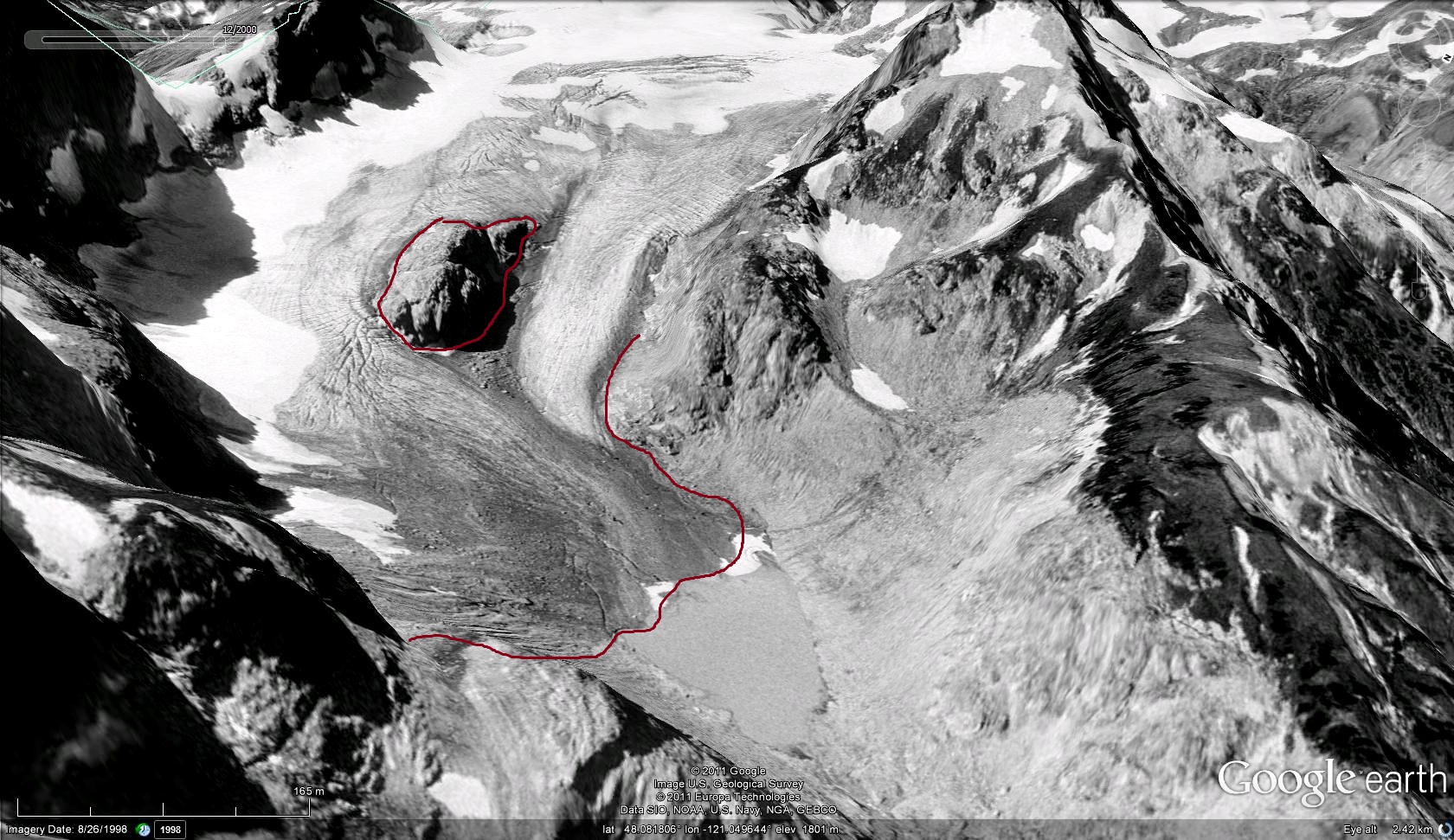
This video examines the 2009 North Cascade Glacier Climate Project Field Season. It is a look more at where we work, than what we find. Mass balances were substantial averaging -1.93 m. The winter season was wetter than average, with close to average snowpack in the North Cascades. Summer melt conditions were exceptionally warm, leading to enhanced melting and considerable losses in glacier volume. The mass loss of approximately 2 meters represents about 4% of total glacier volume, gone in one year. In July ablation averaged 8.5 cm per day. For glaciers that average 50-60 m in thickness that is the loss of 2.5 m in one month. Most of the melt was snowpack from the previous winter. However, by mid-August blue ice was exposed on the majority of the glacier surfaces across the North Cascades and any ablation was a loss in long term glacier volume. In the case of Columbia Glacier at the end of August a view of its surface indicates only a few white patches of snow remaining.  Glacier retreat was slowed on Rainbow and Ice Worm glaciers where the terminus was buried under avalanche snow. Retreat of Easton Glacier was 20 m, Lower Curtis Glacier 11m, Daniels Glacier 12 m, Lynch Glacier 8 m. All 42 glacier observed retreated in 2009. Easton Glacier developed a new rock outcrop in the midst of the glacier
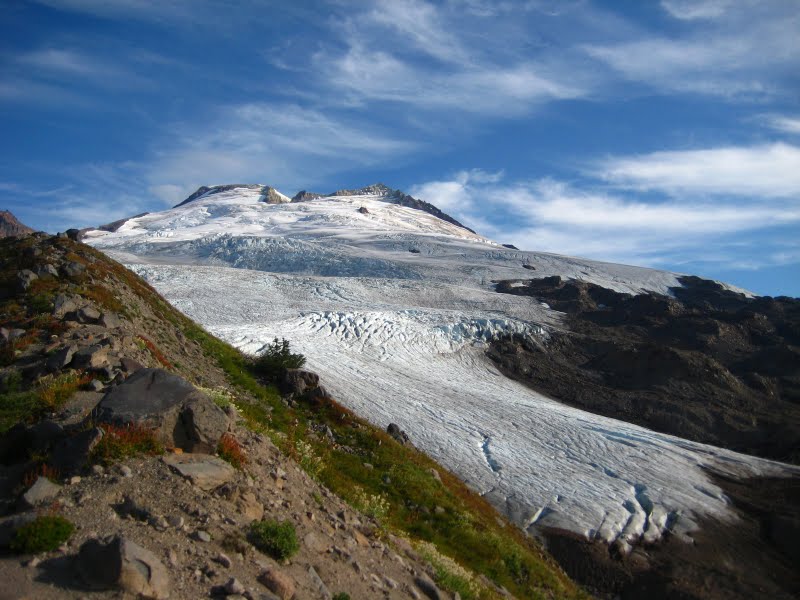 . More details on this project North Cascade Glacier Climate Project
[url=http://www.youtube.com/watch?v=DJGQXlvWXy8]
Author: mspelto
Professor of Environmental Science at Nichols College in Massachusetts since 1989. Glaciologist directing the North Cascade Glacier Climate Project since 1984. This project monitors the mass balance and behavior of more glaciers than any other in North America
Bugaboo Glacier, British Columbia Retreat
Bugaboo Glacier is the most visible glacier of the Bugaboo Range in southern British Columbia. The Conrad Kain Hut who was the first mountaineer to explore the range is adjacent to the glacier and is the main starting point for climbers lured to the region by the fantastic quartz monszonite spires. Since Conrad Kain’s visit in 1910 with the famous mountain explorer Tom Longstaff the Bugaboo Glacier has retreated 2150 meters. The glacier continues to flow around both sides of Snowpatch Spire, the aptly named peak surrounding by the glacier on the left side of the glacier. Also notice the glacier width declines as it descends past a prominent ridge trending toward the glacier from the right, before expanding in the valley below. 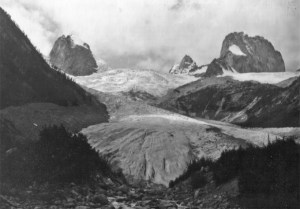 The glacier used to flow all the way to the valley bottom. The active front was both steep and crevassed By the early 1970’s the glacier had retreated from the valley bottom and had begun to retreat up the mountain slope adjacent to the Kain Hut. Snowpatch Spire is still surrounded by ice, but ice that is not as crevassed, indicating reduced thickness and velocity. The glacier than ended somewhat below where the ridge approached from the right of the glacier.
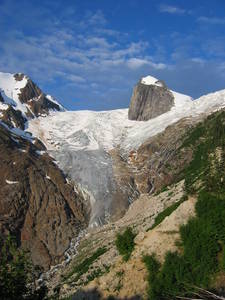
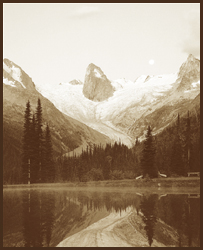 In the ensuing 34 years the glacier has continued to retreat up the slope and is notably thinner coming down the final steep slope. The glacier ends at the termination of the ridge on the right of the glacier. The glacier has retreated 420 m since 1972.
  . The first view is nearly identical to the 1972 view and the second more similar to the 1910 view
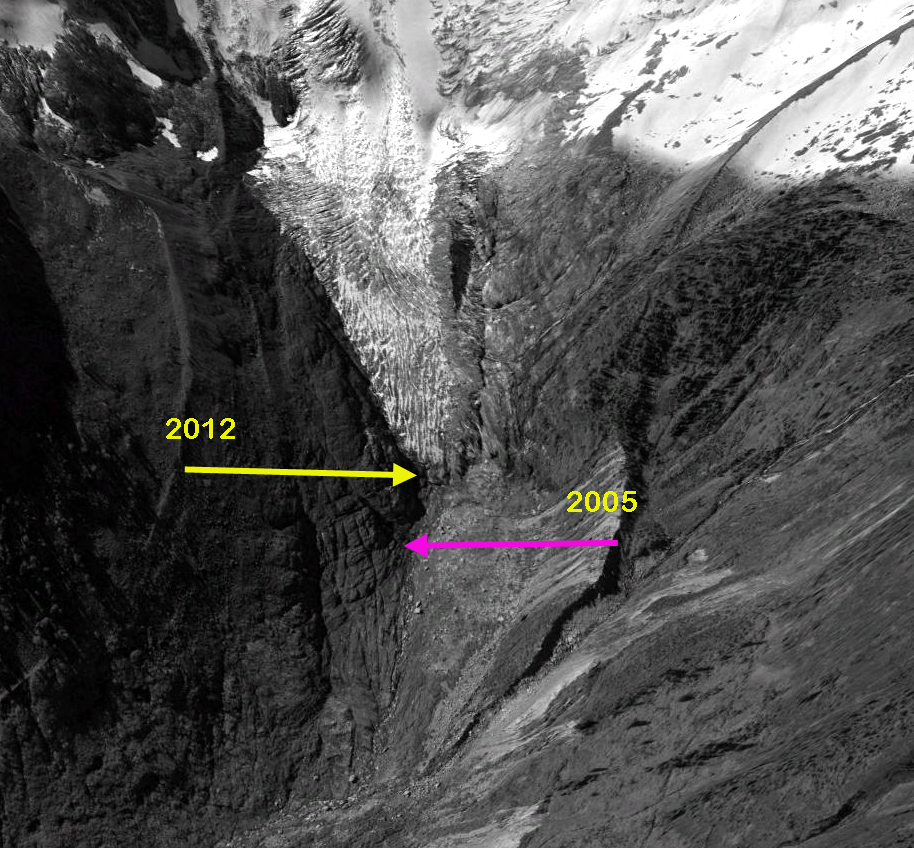
 A Google Earth image from 2005 of the terminus region indicates that the lower 700 meters of the current glacier is thin and lacks any crevasses indicating it nearly stagnant. By 2012 the terminus had retreated 80-90 m from 2005, yellow arrow indicates 2012 terminus, pink arrow 2005. This is in contrast to an active front, which indicates a healthy glacier, that would be thick and crevassed. A healthy glacier can still be retreating, the front was active at the time of my first visit to the glacier in 1984. The glacier is still 3.5 kilometers long and even after the retreat the glacier will still have a substantial length and area.
Minor Glacier-Wind River Range
Minor Glacier on Gannett Peak in the Wind River Range of Wyoming is truly minor compared to when its name was given. The glacier has retreated about 500 m since 1966, which was 35% of its total length. The east side of the glacier is nearly gone. The area has been reduced from 0.87 to 0.26 km2 in the last 50 years. 
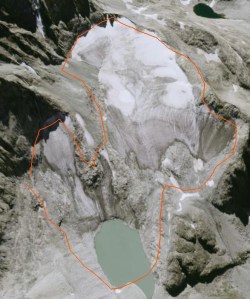 That is after a slow 12% loss in area from its Little Ice Age Maximum to 1952. A comparison of the 1966 map of the glacier and a 2006 SPOT satellite image illustrates the change. The glacier map outline is in orange on the satellite image. The glacier is quite thin and despite the steep slope has few crevasses evident in the image below. There is a substantial new lake that has formed at the terminus of the glacier since the 1966 map, which indicates no lake existed.
 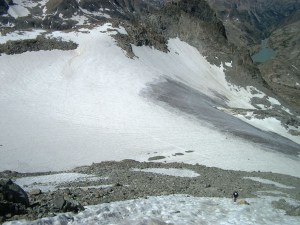 bottom image From Peter Bakwin.
Milk Lake Glacier Loss, North Cascades, Washington
In the USGS map for Glacier Peak in the North Cascades, Washington based on 1979 aerial photographs, Milk Lake Glacier fills most of the Milk Lake Basin, with just a fringe of water seen. The glacier had an area of 0.24 square kilometers at this time. 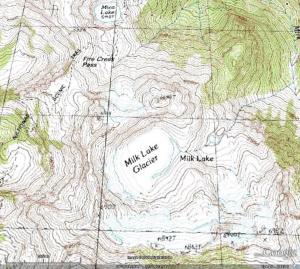 The flat topography over the lake indicates a very thin unstable glacier area. In 1967 the lake has begun to form, Austin Post, USGS image and a few bergs are evident. By 1988, Milk Lake had formed, a notably circular new alpine lake, the former glacier ice still filled part of the lake as ice bergs. In visiting the glacier in 1988 I was surprised at the expansion of this formally small lake. The glacier had retreated to the margins of the lake fringing the west side of the lake. The fringing ice was clearly thin, we found several crevasses that reached bedrock 5-10 m down. In 1994 on a return visit in miserable weather, there was no longer any icebergs in the lake and the lake was more of a jade to turquoise color. The fringing ice had lost about half of its area since 1988. This glacier remnant was not going to last long.
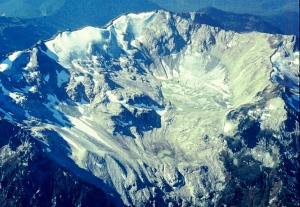 By 2006 the glacier was gone entirely even the fringing elements. One less glacier, one more alpine lake.
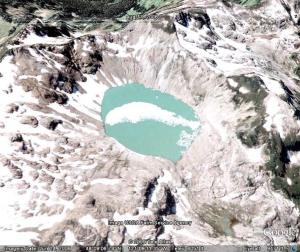 And in 2009 it is clear that Milk Lake would not be the correct name any longer, not a scrap of ice in sight this past summer.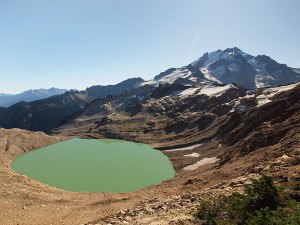
Honeycomb Glacier Retreat, New Lake Formation
Honeycomb Glacier is one of the longest and largest glaciers in the North Cascades. It is currently 3.7 km long and has an area of 3.1 km2. It has retreated 2.05 kilometers since its Little Ice Age Maximum. The glacier was an imposing site to C.E. Rusk who recounted his early 20th century exploration (1924). Like all 47 glaciers observed by the North Cascade Glacier Climate Project it has retreated significantly since 1979.
A 1960 photograph taken by Austin Post shows the glacier ending with no lake at its terminus. The terminus is gentle and has no crevasses, indicating it is relatively stagnant and poised to melt away. The glacier has retreated 1.3 km from its Little Ice Age moraines at this point. In 1967 another Austin Post image indicates a new small lake forming at the terminus.
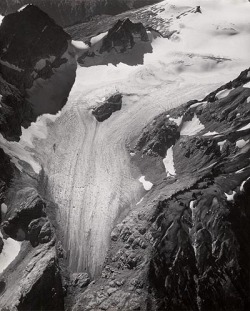 In 1995 we visited the margin of this lake, where the glacier ended in 1967 and took a photograph back to the glacier. As seen below retreat to this point was 400 m.
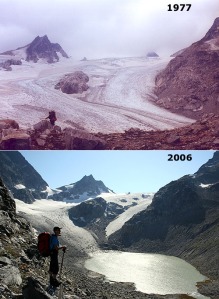
 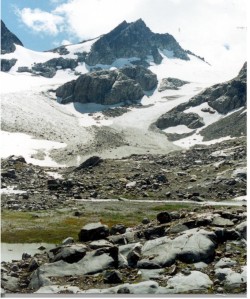 A pair of images from Bill Arundell in 1973 and Lowell Skoog in 2006 indicate the scale of the retreat, these images do not show the actual terminus but do show the main nunatak-rock island and how much it has become exposed in the 33 years. This nunatak was hardly evident in 1960, and in a 1940 image of the glacier literally did not yet exist.
 The terminus had retreated 400 m from the 1967 position to 1995. In 1987 a new lake began to form at the terminus of the glacier at 1680 m. The glacier is shown ending in this lake in 2002 from both the far end of the lake and the nunatak above the lake, the glacier had retreated 210 m since 1995. In 2006 the glacier retreated from the end of this lake. This is a shallow lake that may eventually be filled in by glacier sediments. The terminus is flat and stagnant ending at 1680 m in the lake. Thus, the rapid retreat will continue, the glacier is still not close to acheiving a post LIA equilibrium. Glacier retreat from 1940-1967 averaged 9 m/year. Retreat was minor between 1967 and 1979. The retreat rate since 1979 has been greater than 38 m/year, with a total retreat of 700 m. The nunatak in the middle of the glacier, which was beneath the ice in 1940 is now 90 m above the ice. The section of the glacier below the nunatak in 2002 is stagnant with no crevasses.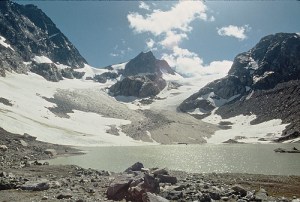
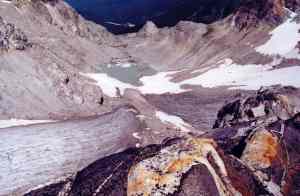 Indicating this glacier will retreat at least to the base of this rock knob, which will then no longer be a nunatak. A comparison of Google Earth Imagery from 1998 and 2009 illustrate the appearance of numerous new bedrock knobs in the area where there was an icefall in 1995.
 survive The upper portion of the glacier has retained its snowcover in recent years indicating the glacier can survive current climate at a much smaller size.
Zemu Glacier, Sikkim Thinning and Retreat
Zemu Glacier is a 26 km long glacier draining the east side of Kanchenjunga the world’s third highest mountain. The importance of the glacier is that it is a key water source for the Teetsa River. The glacier acts as a natural reservoir releasing water due to melting. The Teetsa River is the focus of a hydropower development project being undertaken by the Government of Sikkim. To date 510 mw of the proposed 3500 mw potential are operating. This is a run of the river project, with the water extracted from the river without a dam, run along the valley wall and dropped back to the river through a series of turbines. Run of river is much less expensive than a dam in this remote, earthquake prone, mountainous valley. Zemu Glacier has received little attention, and hence we will have to rely on Digital Globe imagery to observe its changes. The glacier has been observed to retreat at 27 m per year from 1967-1984. Given the length of the glacier the retreat was fairly slow. The glacier has a heavy debris cover on most of its length, insulating it from ablation, and leading to know detectable retreat of the main terminus from 2000 to 2013 Basnett et al (2013). A view of the lower glacier indicates this heavy debris cover, with some scattered small glacial lakes on its surface.

The newly devegetated zone beyond retreating glaciers is small, indicating the slow retreat. Thinning has been significant. The lateral moraine ridges on either side of the main glacier average 150 feet above the main glacier surface. These were built during the Little Ice Age advance. Lateral moraines do not reach above the glacier surface that built them. Thus, the lower glacier has thinned by approximately 150 feet in the last century or so.
A view of a portion of the upper glacier indicates one issue for the glacier. 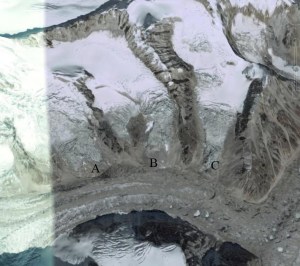
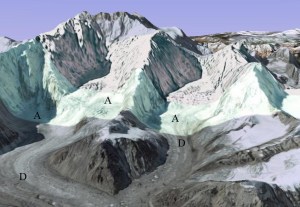 Several of the tributaries no longer join the Zemu, depriving it of a portion of a portion of its former accumulation sources. Near the head of the glacier the walls of Kanchenjunga delivers the debris and large amounts of snow in the form of avalanches to the glacier basin at 5900 to 5200 m. The lower 18 km of the glacier is in the ablation zone where melt dominates. A comparison of 2000 and 2013 Landsat images indicates the lack of change in location of main terminus, red arrows, but recession of surrounding glaciers in the Zemu Basin, yellow arrows.

Landsat 2000
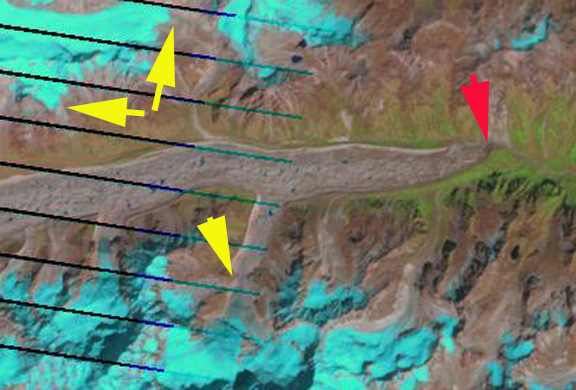
Landsat 2013
This area from 5200 m to the 4200 m terminus would quickly melt away without the natural debris cover. The glacier receives considerable snow input from up to 8000 m via avalanches, which are deposited in this region between 5200 m and 5900 m. This glacier will continue to be a large water source for the Teetsa River for the foreseeable future. The glacier has not been retreating as fast or developing a proglacial lake as has happened to Southh Lhonak Glacier, Middle Lhonak Glacier and Changsang Glacier to the north, this should be anticipated in the near future.
Dramatic Retreat of Antler Glacier, Alaska

Above is a pair of Landsat images from 1984 and 2013 indicating the 2600 m retreat of Antler Glacier in that period. Below is a detailed analysis of the glacier.
The Antler Glacier is an outlet glacier of the Juneau Icefield. It is actually a distributary glacier of the Bucher Glacier. It splits from the Bucher Glacier 8.5 km above where the Bucher Glacier joins the Gilkey Glacer as a tributary. In 1948 it spilled over the lip of the Antler River valley from the Bucher Glacier and flowed 6 kilometers downvalley to end in a proglacial lake. The glacier was 6200 m long in 1948. Note the comparison of the USGS map based on 1948 photographs and the 2005 satellite image below. 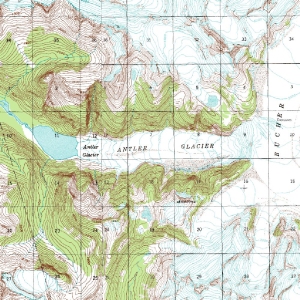
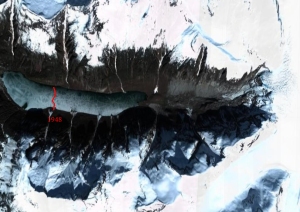 My only chance to see this glacier in person was in August, 1981 scouting the geology along the Bucher Glacier. Antler Glacier disappeared downvalley into the fog and light snow flurries. The terminus not in site, and icefall to daunting to wish to descend. By 2005 the glacier has retreated almost to the lip of the valley, a 5400 m retreat which is 85-90% of it total length. The Lake -Antler Lake- has expanded from a length of 1.6 km to 4.2 km. The lake is a gorgeous sight, and the valley once filled by the glacier is now nearly devoid of glacier input.
 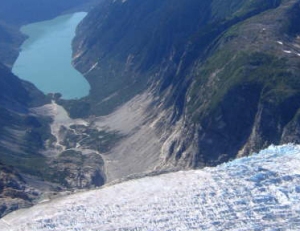 The retreat is largely a result of reduced flow from the thinning Bucher Glacier which no longer spills over the valley lip significantly. As the Bucher Glacier continues to thin, the Antler Glacier will cease to exist. This thinning is due to increased melting (ablation) of the glacier. The neighboring glaciers Field and Gilkey Glacier have also thinned and retreated considerably.
Recession of Jakobshavn Isbrae continues
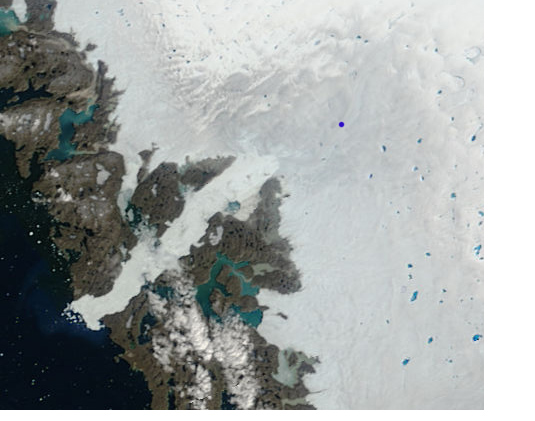
The Jakobshavn Isbrae (glacier) has captured our attention over the last 30 years because it has the highest long term average velocity of any glacier in the world. At the ice front the velocity has remained above 16 meters per day for all measurements completed over the last 50 years. The ability of this glacier which is 10 km wide at its front and 800 m thick at the calving front to drain 6.5 % of the Greenland Ice Sheet is its importance. The annual volume of discharge is 40 cubic kilometers. This prompted the University of Maine’s Terry Hughes to take a close look at the glacier in 1985. I participated in that project and one key conclusion we reached was that the Jakobshavn Isbrae was in approximate equilibrium (Pelto and others, 1989). The terminus had not shifted significantly in the past 30 years and no thinning was evident either. The image below of terminus change The top image above is from Jason Box, Byrd Polar Research Center, Ohio State University, and is a mosaic of Landsat and ASTER images indicates a substantial retreat from 1850-1964 of about 30 km. The first image is from the fall of 2009 and the second a Modis image from June 2010. The third from July 2010,from NASA. The last two in the sequence are Landat 8 imagery from May 9 and June 1, 2014 indicate an early summer retreat that was first noticed by the ongoing sharp observations of Espen Olsen. The retreat follows the typical winter advance, and is not back to the 2013 furthest retreat also identified by Espen Olsen. Notes on these latest images below the sequence.
From 1964 to 2001 the glacier terminus did not recede significantly and observations of terminus velocity remained relatively constant at 16 to 20 m year at the glacier front. Then in 1997 an acceleration began. The velocity reached 34 m per day by 2003, twice its normal speed, the glacier thinned by up to 15 m year and retreated 10 km, from 2001 to 2003. From 2004-2007 an additional retreat of 5 km occurred.

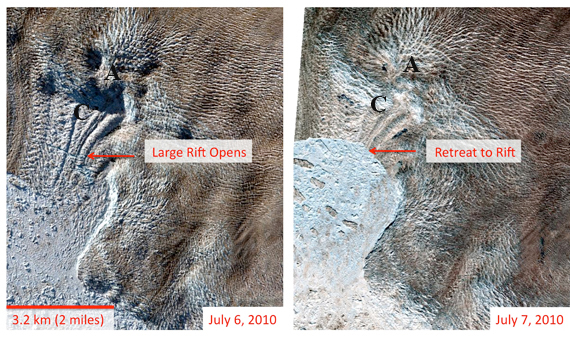
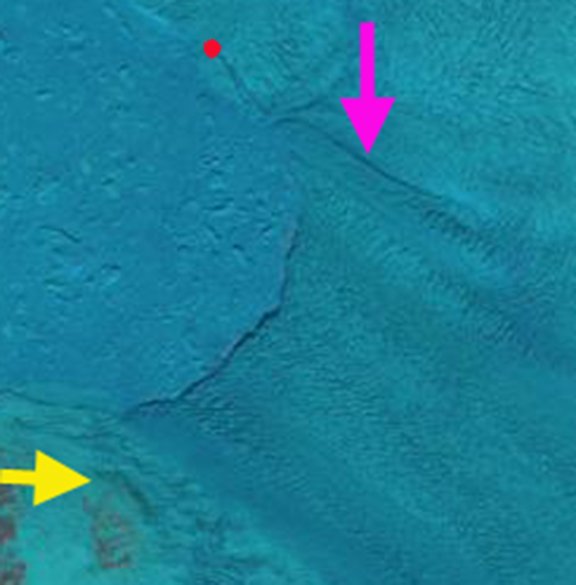
[caption id="attachment_7425" align="aligncenter" width="480"] Pink arrow indicates a prominent lateral rift. Yellow arrow reference location. Red dot an existing transverse rift.
The pink arrow notes a prominent lateral rift, the yellow arrow a reference point. Red dot is a transverse rift near the ice front. No large rifts are apparent in the area of the main calving on May 9.[/caption] A bedrock high beneath the glacier is reflected by the sudden increase in slope below point A. What is fascinating is the speed at which the glacier surface below A at Point C was transformed from an ordinary set of transverse crevasses to the chaotic scene typically indicative of an area of rapid acceleration and failure of seracs, those walls betweens crevasses. The glacier has had a profound response to the rifting-calving retreat of the previous day. The area of crevasse transformation is an indication of the connection of this area of the glacier to action at the terminus, the crevassed areas response was so swift that it was effectively involved in the calving retreat incident. The area around C is a zone of weakness to watch for further appearance of rifting. The area in front of the bedrock high is clearly not a place for the terminus to stabilize. The bedrock high itself could well be a point of greater stability for the terminus. Upglacier 2010 is not a good year for the glacier either the snowline is high for June exposing larger areas of bare glacier ice with higher albedo for melting, see image at bottom.
On Jakobshavn the acceleration began at the calving front and spread up-glacier 20 km in 1997 and up to 55 km inland by 2003 (Joughin et al., 2004). Luckman et. al., (2006) observed…“The most plausible sequence of events is that the thinning eventually reached a threshold, ungrounded the glacier tongues and subsequently allowed acceleration, retreat and further thinning. It is reasonable to believe that the 1998 Jakobshavn speed-up, also following a long period of stability, was triggered by the same processes of thinning but occurred earlier and after a shorter period of thinning because the tongue was already afloat.”
On Jakobshavn the acceleration was not restricted to the summer, persisting through the winter when surface meltwater is absent. This indicates that it is the change in conditions at the calving front where the backforce on the glacier was reduced that allowed acceleration and retreat. This is typical for Greenland marine terminating outlet glaciers, they have accelerated most at the calving front and the acceleration is not seasonal. The acceleration is not significantly due to meltwater enhanced lubrication. Below is the acceleration of the last decade compared to before, illustrating that the greatest acceleration is at the calving front (Thomas et al., 2009). 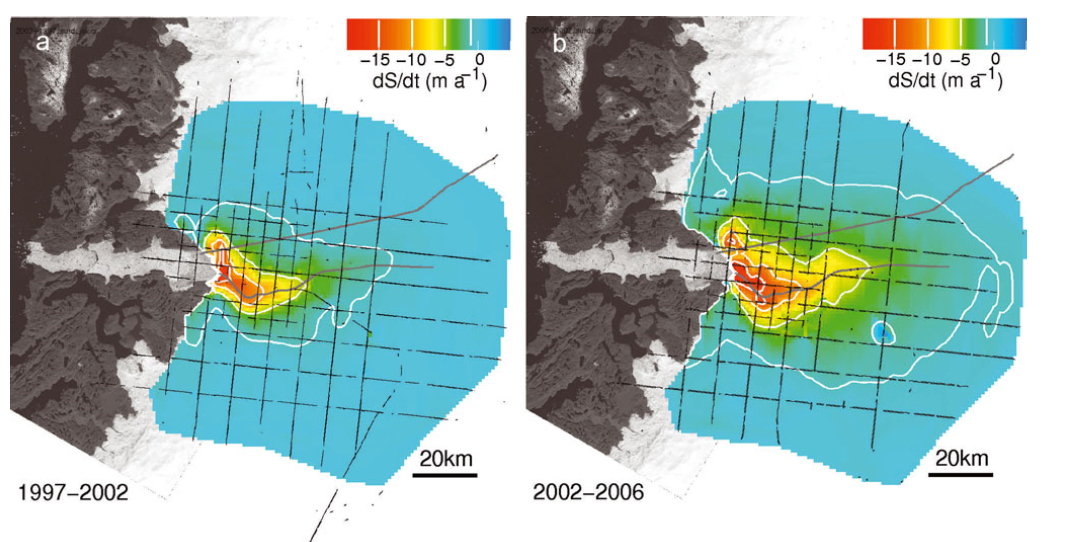
The Jakobshavn is of particular importance as it has a bed below sea level for at least 80 km inland from the terminus. In this reach there are no significant pinning points, or abrupt changes in slope or width (Clarke and Echelmeyer, 1996) that would help stabilize the glacier during retreat. In particular the bed becomes deeper from 24-40 km behind the calving front, which should reinforce calving acceleration (Thomas et al., 2009). 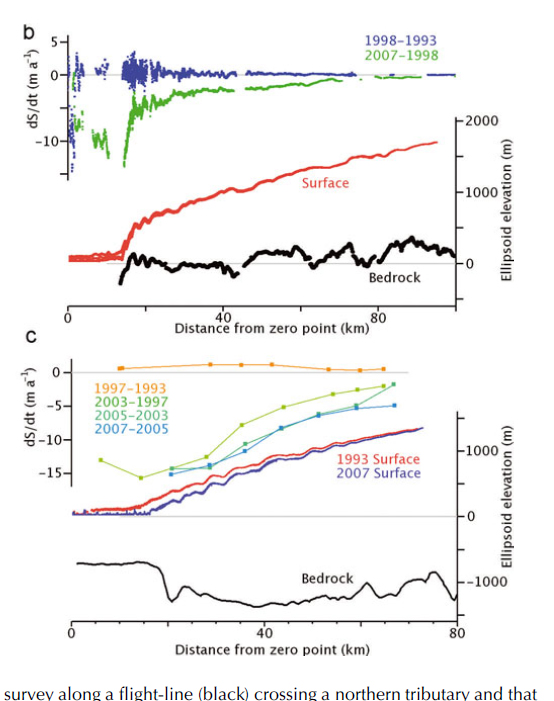 Images of Jakobshavn Isbrae in 2001 indicate substantial rifts on the north side of the glacier near the 2005 terminus position, suggesting the glacier had been preconditioned for retreat. In the image below from June 17, 2010 the snowline is evident on the north side of Jakobshavn as the transition to the much lighter blue tone, in this Landsat image. The red line is the June 2009 snowline and the green line the 2008 June snowline.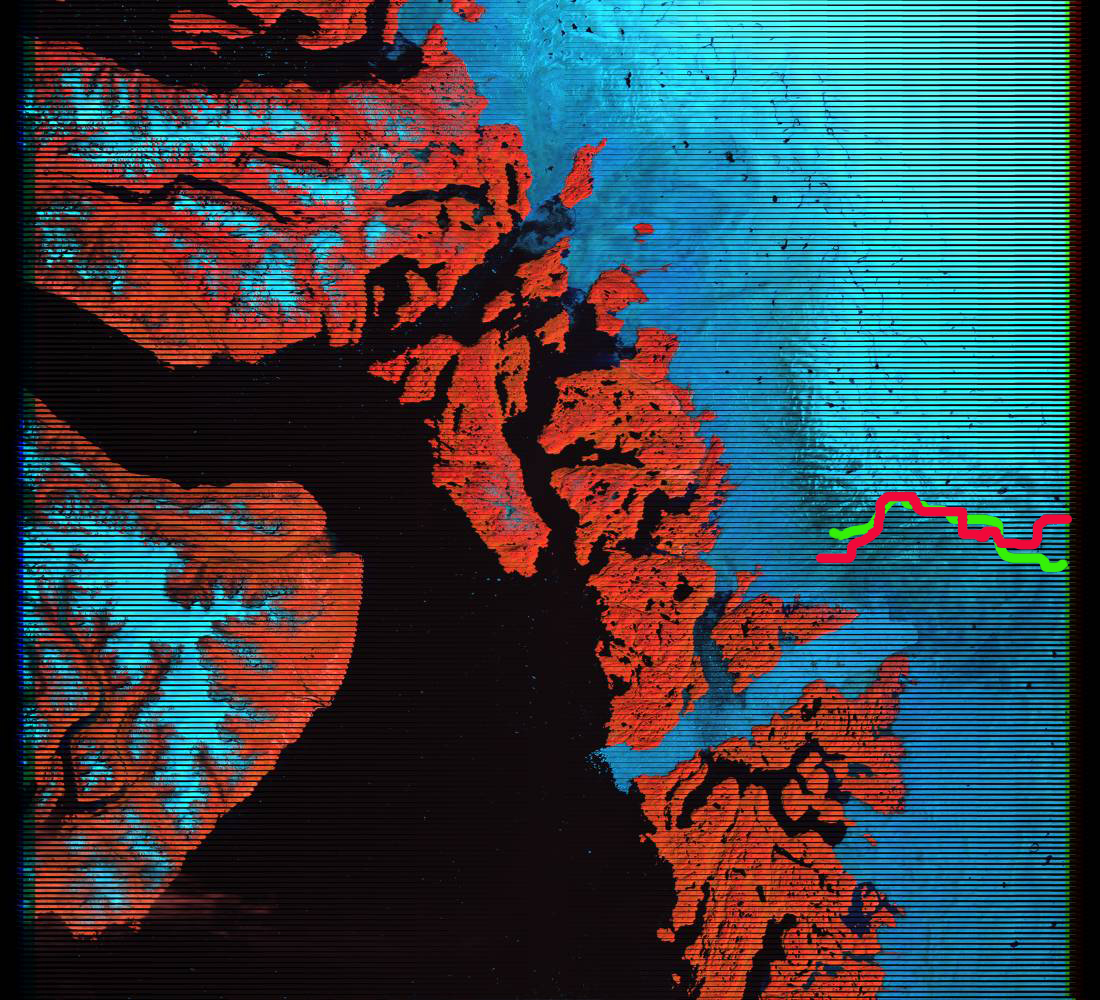
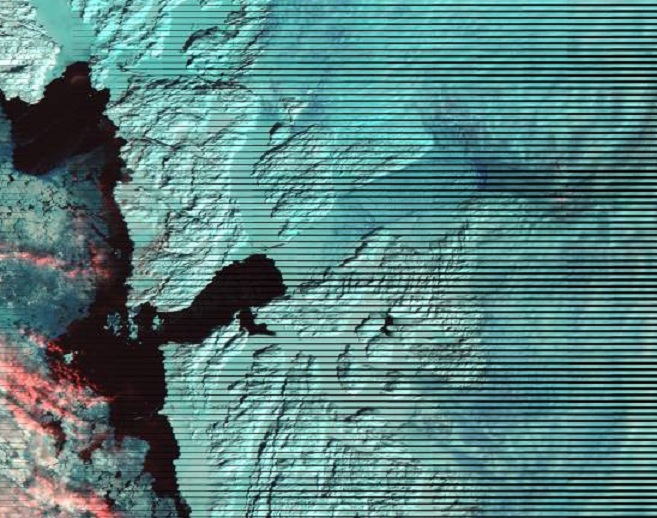
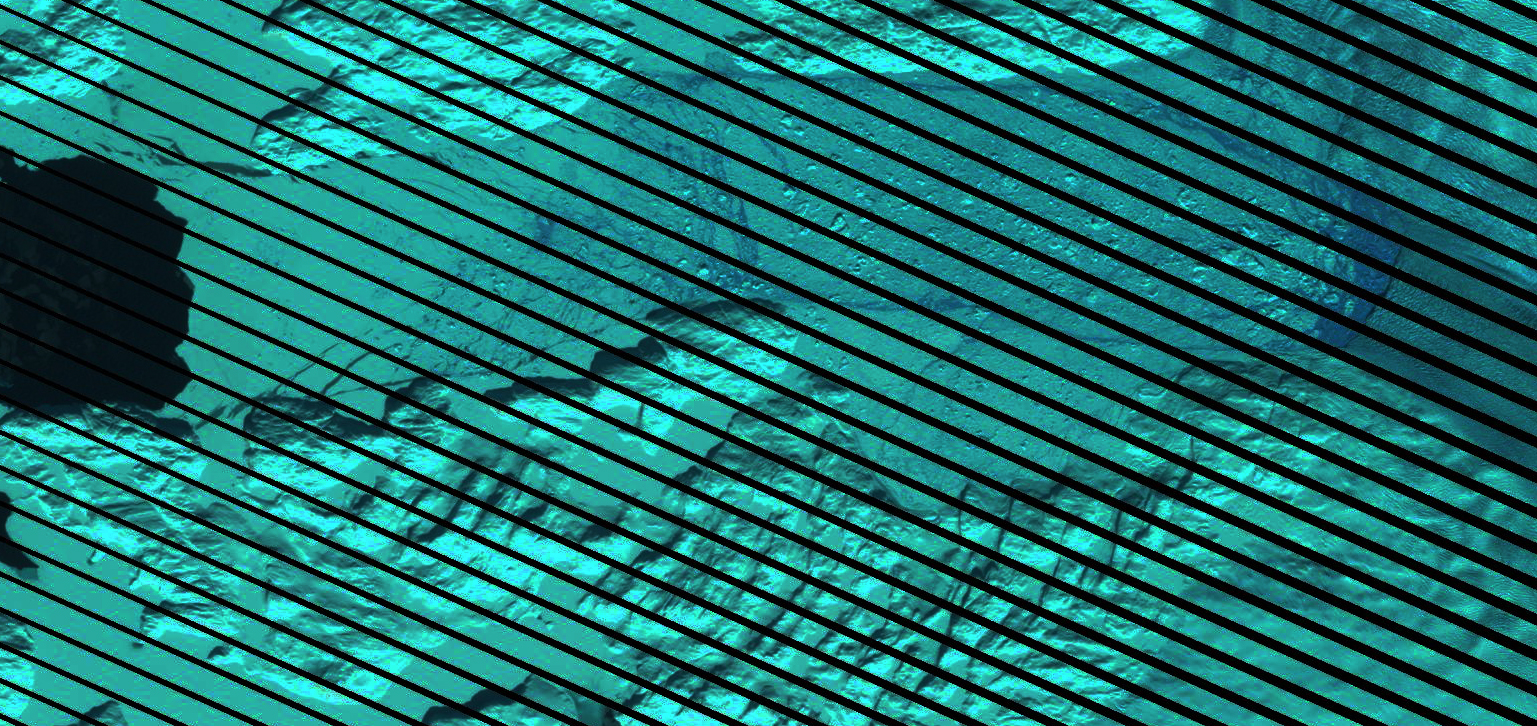
A comparison of April 2010 (top image below) and April 2011 Landsat image (middle image) indicates a somewhat lower snowline on the Jakboshavn in 2011. The zoomed in version indicates the amount o the ice that is actually icebergs. 
Peridido Glacier Retreat
The Peridido Glacier, Pyrenees Mountains, Spain has lost 92% of its area since 1894. The glacier lost 50% of its area declining from 90 hectares to 44 hectares from 1991 to 2001. Pyrenees Glacier report, written by a group of scientists including Enrique Serrano from the Universidad de Valladolid and Eduardo Martínez de Pisón from the Autónoma de Madrid has noted the loss of 50-60% of the entire area of Pyrenees Glaciers since 1990. The images of Peridido Glacier from 1898 and 1910 were provided by Eduardo Blanchard. In 1910 as seen in the picture below right, the glacier has three sections each connected. The upper section connected with the mid section by a narrow crevassed icefall, the crevasses indicate active movement. The middle section is connected to the lower avalanche fed section by a wide crevassed icefall. The lower section is not heavily crevassed and has thinned and pulled back from the terminus moraine of the Little Ice Age. This moraine is the sediment ridge in the foreground. By 1998 there is no connection between the three sections, the lower section is nearly gone, with just a bit or relict ice. There are very few crevasses indicating a lack of active movement. The glacier is melting more or less in place. The Pyrenees have experienced a 0.9 C degree warming since 1910.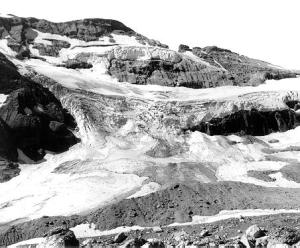

Peridido Glacier is rapidly disappearing, at the current rate of area loss it cannot survive to 2050, and more likely not until 2030. It is not alone in the Pyrenees, at least three glaciers have disappeared in the last 15 years, Balaitus, La Munia and Perdigurero.
Lyman Glacier a Century of Change-Years Numbered
This blog will focus glacier by glacier on the changes that are resulting from climate changes. Each has a unique story, yet there will be a recognizable refrain. Lyman Glacier, North Cascades, Washington retreated 1300 m from 1907 to 2008. Below is the glacier viewed from near Cloudy Pass in 1921 on a Mountaineers expedition and in 2005.
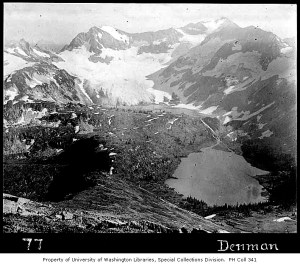
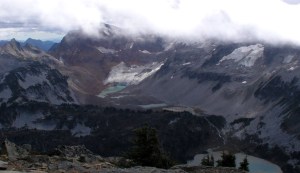
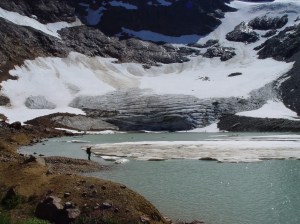
This 76% loss in length has been accompanied by a 88% loss in area and a 91% loss in glacier volume. I first visited the glacier in 1985, and have since been to the glacier on 15 occasions, twice with Bill Long, who first visited the glacier in 1940, measuring its terminus position then. The glacier currently ends in a beautiful expanding glacier lake, with an impressive ice cliff that is 40 meters high, 26 meters above the water. This aids in the retreat as the glacier does calve icebergs occassionally. The rate of retreat is 11 meters per year, for a glacier that is 440 m long, this gives the glacier 40 years at the current retreat rate. The glacier is losing area at a rate of 4% per year, giving it 25 years to survive. Volume loss is between 4 and 5% per year, giving the glacier 20-25 years to survive. By any measure with current climate Lyman Glacier will not survive to 2050. For this glacier the warmer summers since 1977 and the reduced snowpack due to more winter rain events has hastened its decline. The glacier is near a snow measurement station of the US Dept. of Agriculture, which indicates an 18% decline in mean April 1 snowpack since 1945, despite a small rise in precipitation. The glacier is no longer large, but still has considerable thickness, up to 50 m. This particular glacier has not approached equilibrium since the end of the Little Ice Age. Its loss has been hurried along by the recent warming. Even small glaciers take a long time to fully melt away.[url=http://www.youtube.com/watch?v=SiJzgiKReZI]
 From a Glaciers Perspective