Meade Glacier, Alaska 4 km Retreat 1986-2018

Meade Glacier in Landsat images from 1986 and 2018.  The red arrow indicates the 1986 terminus, pink arrow the 2014 terminus, yellow arrow the 2018 terminus, orange arrows tow tributaries to Meade Glacier and the purple dots the snowline.

Meade Glacier drains the northwest portion of the Juneau Icefield, with meltwater entering the Katzehin River and then Chilkoot Inlet. The glacier begins in British Columbia and ends in Alaska. Here we use Landsat imagery to examine changes in the glacier from 1986 to 2018. The glacier experienced a slow continuous retreat from 1948 to 1986 of 400 m, with the glacier ending on an outwash plain.

In 1986 the terminus is indicated by a red arrow, the snowline is at 1250 m in 1986, there is no evident lake at the terminus of glacier just an expanding outwash plain. Both tributaries from the south, orange arrows, are 750 m+ wide where they join Meade Glacier. By 2004 a 400 m long proglacial lake has formed at the terminus. The two tributaries from the south, at the orange arrows, no longer are connected to the glacier. The snowline is at 1450-1500 m. In 2014 the proglacial lake is 3.5 km long, the entire lower 2.5 km of the glacier has collapsed since 2004. There is still considerable relict ice floating in the lake. There is a substantial lake along the southern margin of the glacier where a tributary streams enters the main valley. This indicates the glacier will quickly retreat to this point by further collapse into the lake.  The snowline in 2014 is at 1450 m on Aug. 2, the date of the imagery, the high snowline ensures continued mass loss and glacier retreat.  By 2018 Mead Glacier has retreated 4.1 km since 1986.  The snowline is at 1450 m on October 2, when fall snow should have already begun.  A third tributary entering the glacier from the east at 1200 m no longer reaches the main stem.  Based on surface slope changes the glacier appears to be within 1 km of the inland limit of the proglacial lake.  The inland limit should be near the prominent bedrock knob on the south side of the glacier a short distance inland of the current terminus. When this is reached the glacier retreat will be reduced.  The retreat parallels that of most Juneau Icefield glaciers including the next glaciers to the south Field Glacier and Gilkey Glacier.  The glacier shares a divide with Warm Creek Glacier that terminates in British Columbia that is also retreating rapidly in an expanding lake.

Meade Glacier in Landsat image from 2004.  The red arrow indicates the 1986 terminus, pink arrow the 2014 terminus, yellow arrow the 2018 terminus, orange arrows tow tributaries to Meade Glacier and the purple dots the snowline.

Meade Glacier in Landsat image from 2014.  The red arrow indicates the 1986 terminus, pink arrow the 2014 terminus, yellow arrow the 2018 terminus, orange arrows tow tributaries to Meade Glacier and the purple dots the snowline.
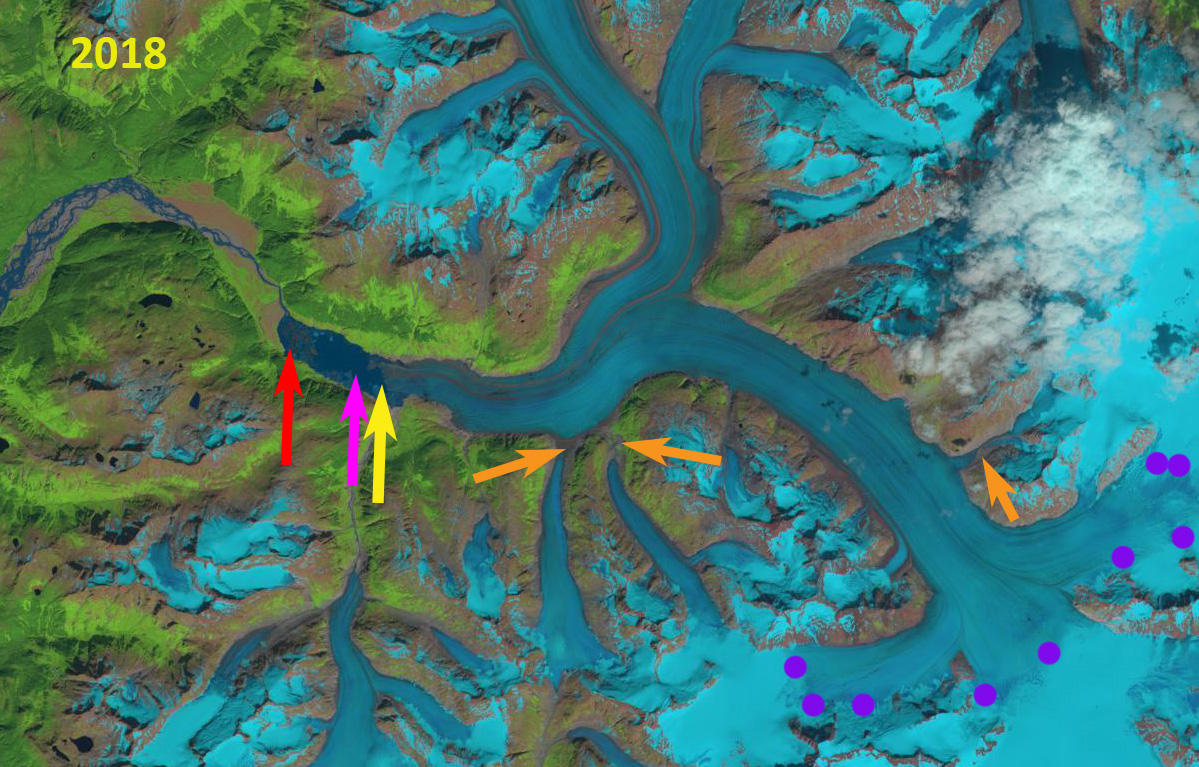
Meade Glacier in Landsat image from 2018.  The red arrow indicates the 1986 terminus, pink arrow the 2014 terminus, yellow arrow the 2018 terminus, orange arrows tow tributaries to Meade Glacier and the purple dots the snowline.
Taku Glacier, Alaska in 2018 Highest Snowline in 70+ years

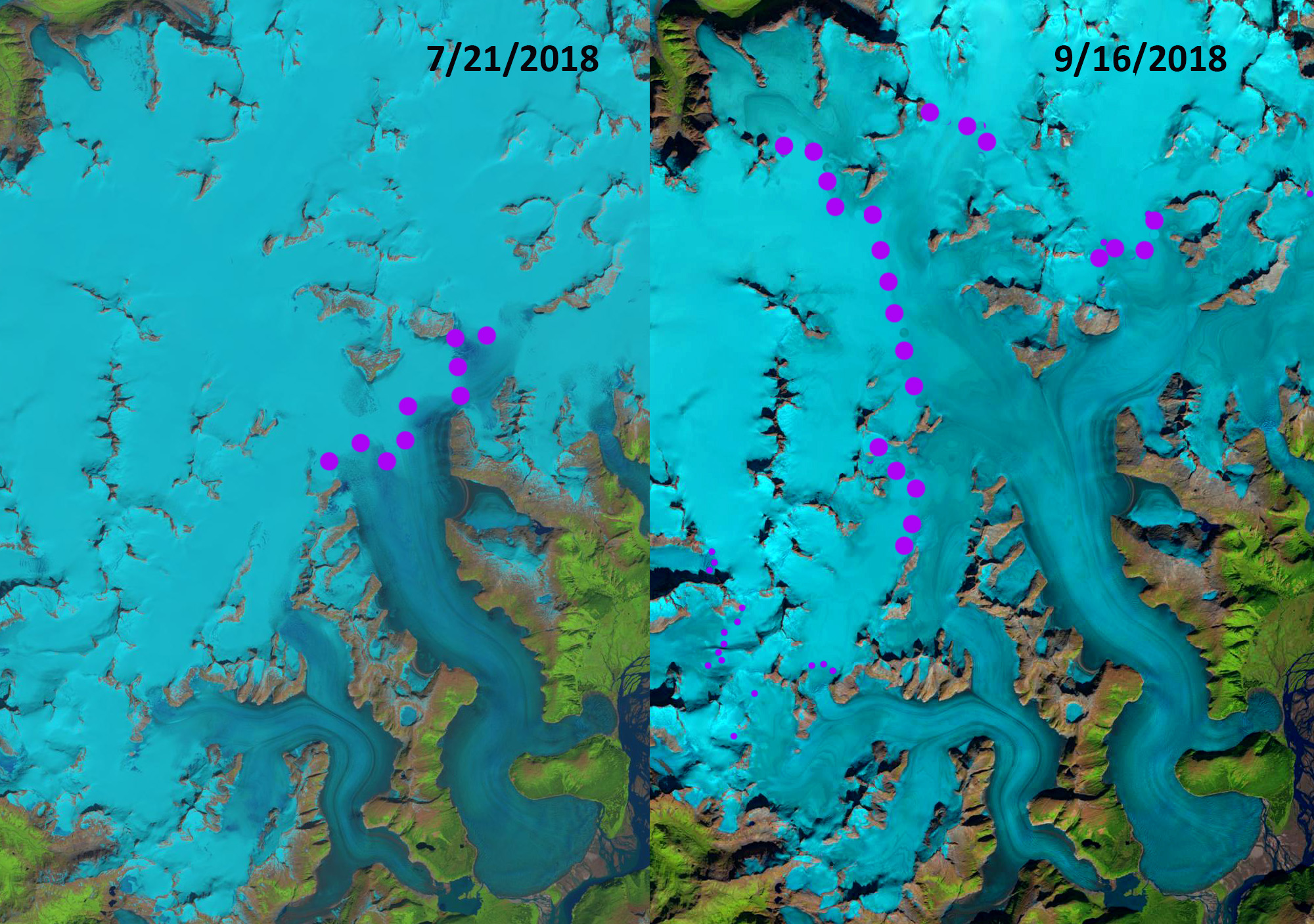
Taku Glacier transient snowline (purple dots) in Landsat images from 7/21 and 9/16/2018.

The Juneau Icefield Research Program (JIRP) has been examining the glaciers of the Juneau Icefield since 1946. Until the NASA Landsat program began, field measurements and aerial observations were the only means to observe the glaciers of the icefield. For more than 40 years it was Maynard Miller, U of Idaho, who led this expedition that has trained so many of today’s glaciologists, today it is led by Seth Campbell, U of Maine who followed Jeff Kavanaugh, U of Alberta.   Landsat images have become a key resource in the examination of the mass balance of these glaciers (Pelto, 2011). The overall mass balance record of the glaciers was published this by Pelto et al (2013). On Taku Glacier, the mean annual equilibrium line altitude (ELA) has risen 85 m from the 1946–1985 period to the 1986–2018 period.  Mean annual mass balance from 1946-1985 and 1986-2018, with 2018 values being preliminary, were +0.40 m/yr and −0.18 m/yr respectively, indicative of the snow line rise resulting in cessation of the long-term thickening of the glacier.

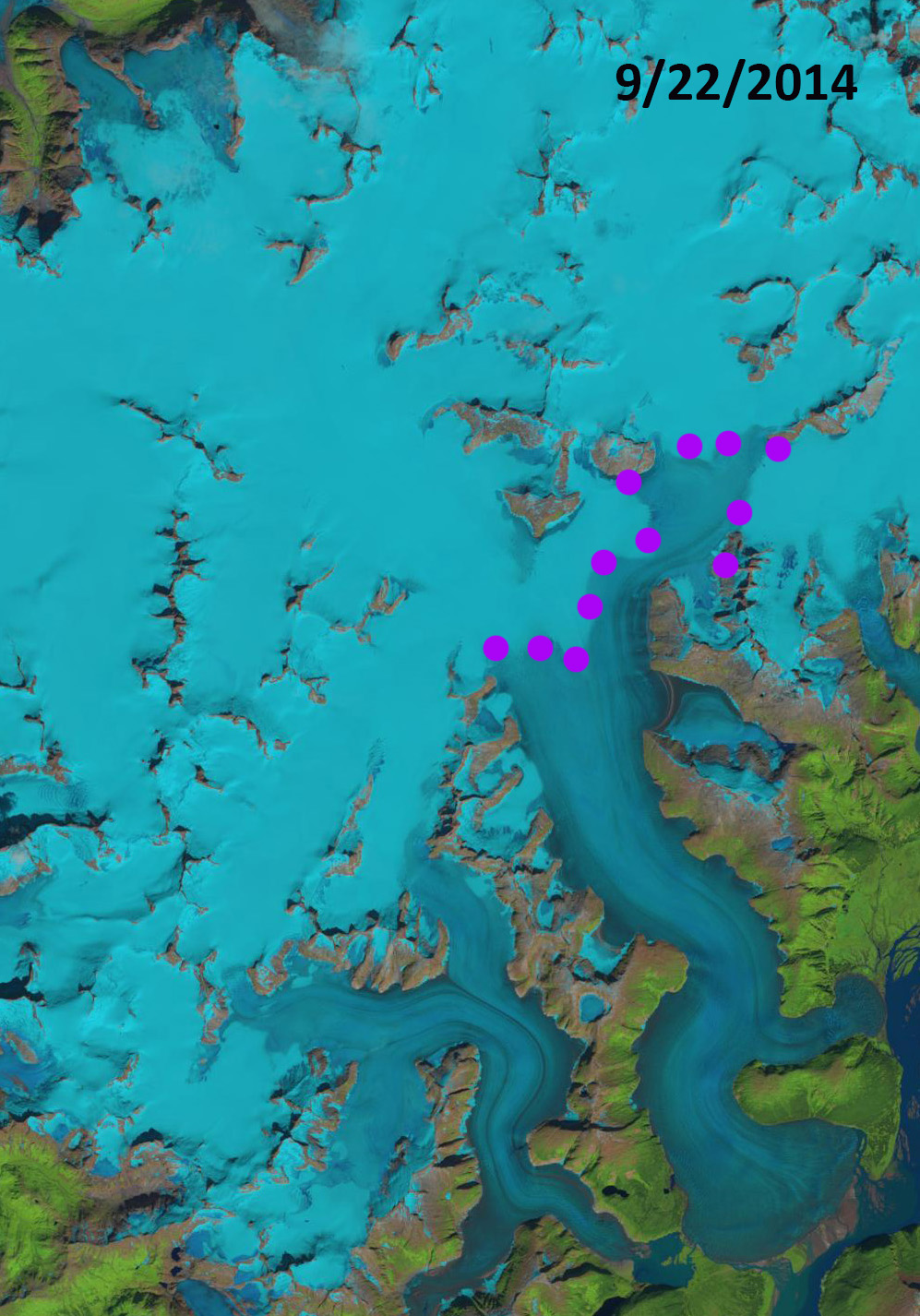
The height of the transient snowline (purple dots) at the end of the summer represents the ELA for the glacier, where ablation equals accumulation.  This also is a good estimator of mass balance. The end of the summer melt season typically occurs in September. In the last three decades the average ELA has been 1000 m.  In 2018 the transient snowline on July 21 was at 975 m, and by July 30 the TSL was above 1075 m.  On Sept. 16, 2018 the snowline was at 1400 m on average, the highest observed since records began in 1946. This is a rise of 425 m in ~57 days.  Given the balance gradient observed on the glacier of  ~3.3 mm/m this represents ablation of 1.4 m w.e. snow, or 2.0 m of snow depth  (Pelto et al 2013 and Roth et al 2018)  The snowline on Brady Glacier, Glacier Bay was also the highest that had been observed in 2018. In the images below the TSL in 2013 is at 1000 m, in 2014 at 1100 m, 2015 at 1140 m, and in 2017 at 1150 m. Pelto (2017) identifies the response of the entire icefield to climate changes from 1984-2013. The 2014-2018 period has been the most negative balance 5 year period for the icefield, which will lead to continued thinning and volume loss.


Annual equilibrium line altitude on Taku Glacier 1946-2018, 2018 is the highest and 1985 the lowest.

Taku Glacier transient snowline (purple dots) in Landsat image from 9/15/2013.

Taku Glacier transient snowline (purple dots) in Landsat images from 9/22/2014.

Taku Glacier transient snowline (purple dots) in Landsat images from 9/8/2015.

Taku Glacier transient snowline (purple dots) in Landsat images from 9/20/2017.

Brady Glacier, Alaska Nunatak Expansion and High Snowline 2018

Emergence of Nunataks at Point A, B and C at 850 m on Brady Glacier from 1986 and 2018 Landsat Images.  Transient snowline on 9/21/2018 indicated by purple dots.

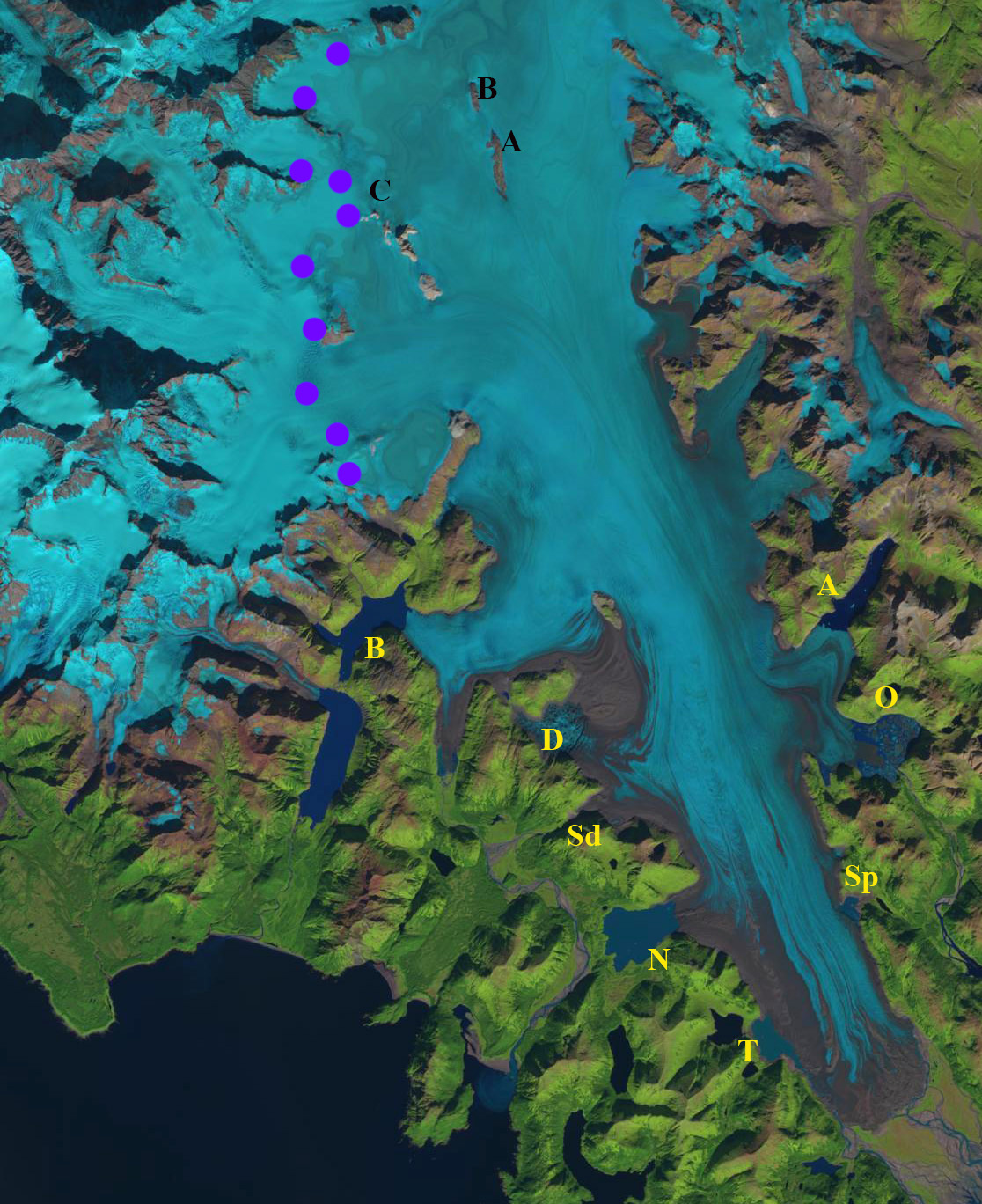
Brady Glacier,  is a large Alaskan tidewater glacier, in the Glacier Bay region that is beginning a period of substantial retreat Pelto et al (2013). Pelto et al (2013) noted that the end of season observed transient snowline averaged 725 m from 2003-2011, well above the 600 m that represents the equilibrium snowline elevation, for the glacier to sustain its current size. In 2015, 2016 and 2018 the snowline has been at 900-1000 m.  This is leading to thinning across of what was much of the accumulation zone.  Here we examine Landsat images from 1986 to 2018 to identify signs of this thinning.

In 1986 Point A and B have insignificant rock exposure, while C has a limited single rock nunatak.  By 2000, below there is bedrock exposed west of Point A and B, with two small nunataks near C.  By 2015 there is a 2 km long bedrock ridge at Point A and a ~1 km long bedrock ridge at Point B.  The snowline in 2015 is just above Point B and C at 900 m.  In 2016 on Oct. 1 2016 after the end of the typical melt season the snowline is at 900 m. In 2018 the snowline on Sept. 21 is at 1000 m.  At Point A the bedrock Ridge is now 2300 m long and up to 300 m wide.  At Point A the ridge is 1100 m long.  At Point C a third nunatak has emerged and the series of nunataks will soon merge into a single ridge.

The persistent high snowlines indicate the consistent accumulation zone is now above 900 m, below this point thinning will continue.  The mean elevation of the glacier is at 720 m and thinning is significant below 1000 m from 1995-2011(Johnson et al 2013).  That far less than 50% of the glacier is retaining snowpack and widespread thinning will drive further retreat of the distributary glacier termini in expanding lakes noted by Pelto et al (2013) and a the 2016 blog post.   Brady Glacier abuts the adjacent Lampugh Glacier that has and will be impacted by a large landslide.

Trick Lakes: In 1986 North and South Trick Lake are proglacial lakes in contact with the glacier. By 2016 the two lakes are no longer in contact with the glacier, water levels have fallen and a third lake East Trick Lake has formed. The more recently developed East Trick Lake is the current proglacial Trick Lake, a large glacier river exits this lake and parallels the glacier to the main Brady Glacier terminus, going beneath the glacier for only several hundred meters.

North Deception Lake had a limited area in 1986 with no location more than 500 m long. By 2016 retreat has expanded the lake to a length over 2 km. The width of the glacier margin at North Deception Lake will not change in the short term, but the valley widens 2 km back from the current calving front, thus the lake may grow considerably in the future.

South Dixon Lake This new lake does not have an official name. It did not exist in 1986, 2004, 2007 or 2010. It is nearly circular today and 400 m in diameter.

Dixon Lake: It is likely that retreat toward the main valley of the Brady Glacier will lead to increased water depths at Dixon Lake, observations of depth of this lake do not exist. Retreat from 1986 to 2016 has been 600 m.

Bearhole LakeBearhole Lake is expanding up valley with glacier retreat, and there are no significant changes in the width of the valley that would suggest a significant increase in calving width could occur in the near future. Currently the lake is 75 m deep at the calving front and there has been a 1400 m retreat since 1986 Capps et. al. (2013).

Spur Lake:It is likely that retreat toward the main valley of the Brady Glacier will lead to increased water depths at Spur Lake. the depth has fallen as the surface level fell from 1986-2016 as the margin retreated 600 m, leaving a trimline evident in the 2016 imagery.

Oscar Lake has experienced rapid growth with the collapse of the terminus tongue. Depth measurements indicate much of the calving front which has increased by an order of magnitude since 1986 is over 100 m. The tongue as seen in 2014 Google Earth image will continue to collapse and water depth should increase as well. The central narrow tongue has retreated less than 200 m since 1986, but the majority of the glacier front has retreated more than 1 km since 1986.

Abyss Lake: Continued retreat will lead to calving width expansion> The retreat from 1986 to 2016 has been 400 m. The water depth has been above 150 m at the calving front for sometime and should remain high.

Emergence of Nunataks at Point A, B and C at 850 m on Brady Glacier from 2000 and 2015 Landsat Images.  Transient snowline on 9/21/2018 indicated by purple dots.

Landsat image of Brady Glacier on 9/21/2018 indicating the snowline (purple dots)  and the emerging nunataks at Point A-C. Lakes noted are: A=Abyss, B=Bearhole, D=Dixon, N=North Deception, O=Oscar, Sd=South Dixon, Sp=Spur, T=Trick.

Landsat image of Brady Glacier on 10/1/2016 indicating the snowline (purple dots)  and the emerging nunataks at Point A-C.

Yakutat Glacier Terminus Collapse Nears Completion, 45 km2 lost 2010-2018

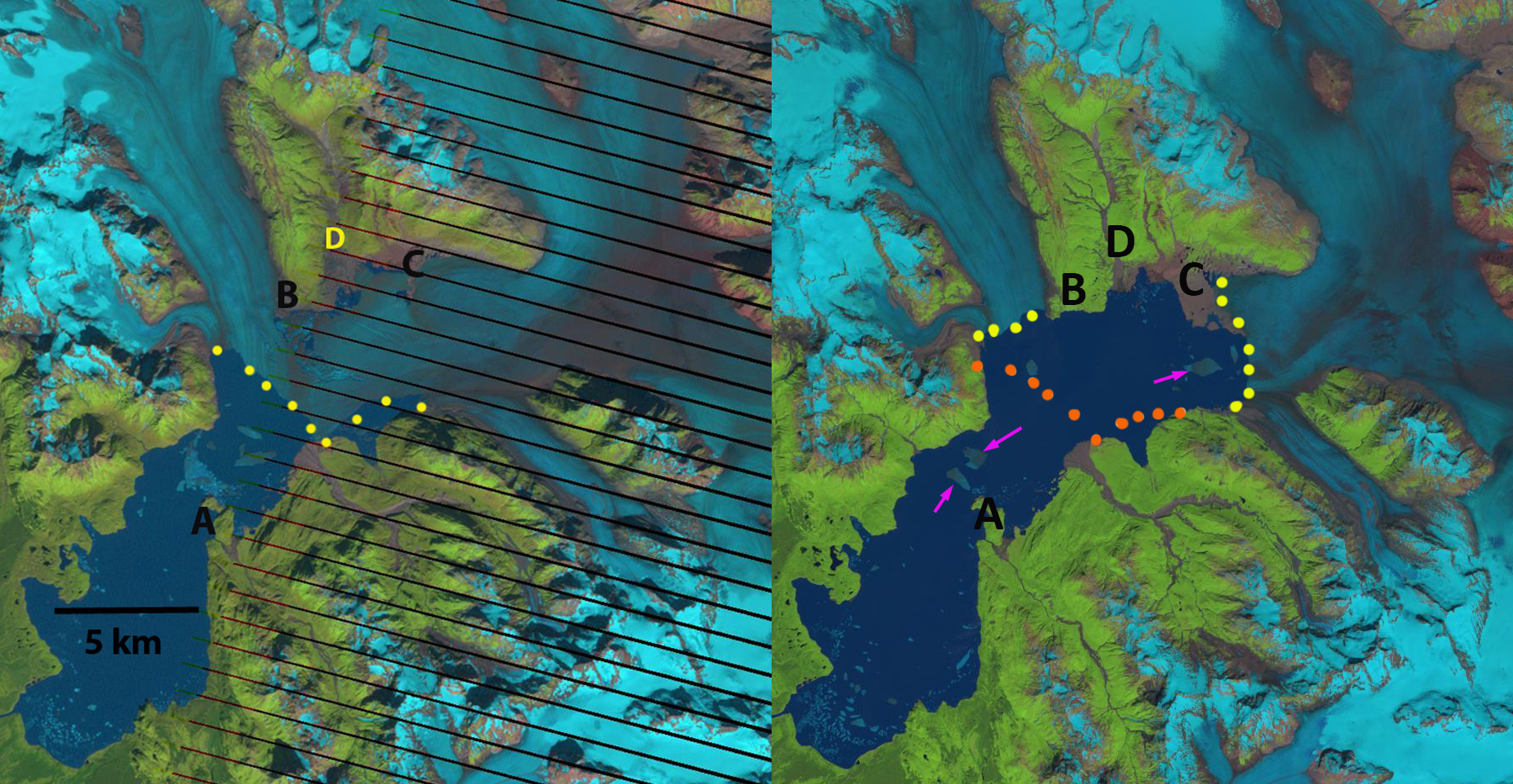
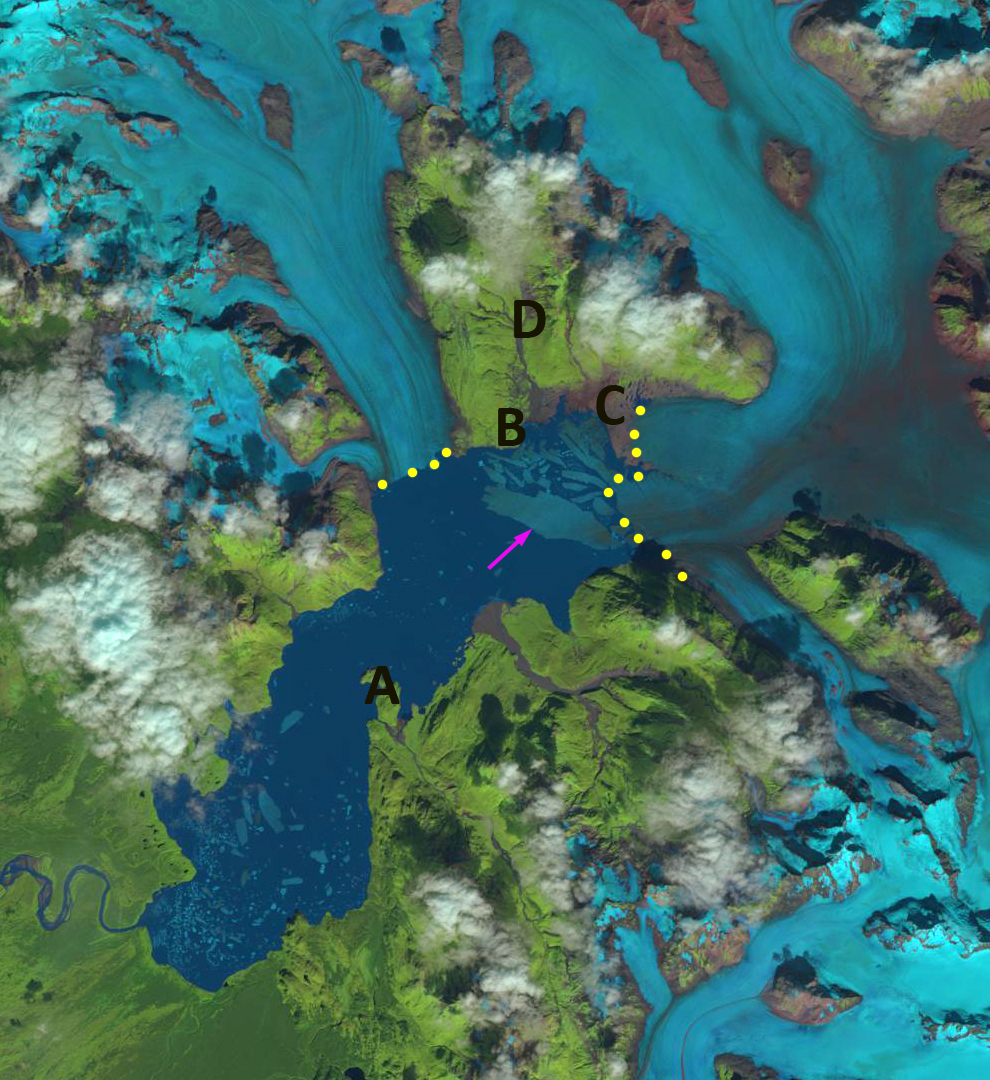
Landsat images from 2010 and 2018 with terminus indicated by yellow dots in both, the orange dots indicate 2010 margin on 2018 image. Point A indicates the 1987 terminus location, pink arrows indicate icebergs. Main terminus now extends south near Point C. Northern terminus extends west from Point B.

Yakutat Glacier, Alaska has experienced a spectacular retreat in the last decade losing 45 km² from 2010-2018.  The Yakutat Glacier during the 1894-1895 Alaskan Boundary Survey ended near a terminal moraine on a flat coastal outwash plain. By 1906 the glacier had retreated from the moraine and a new lake was forming, Harlequin Lake.  From 1906-1948 the glacier retreated an additional 5 km. From 1948-1958 the glacier retreated 3.6 km. Here we examine Landsat imagery to quantify the retreat from 2010-2018. This is an update to a Yakutat Glacier 2016 post

In 2010 the glacier has just retreated from the peninsula at Point A, the valley at D was deglaciated, a small strip of bedrock-sediment was exposed at C from that had been beneath the glacier, and B was still well inland of the terminus. An aerial image of the glacier indicates significant rifting, blue arrows,  in 2010 that leads to the substantial 2013 breakup.  Rifts are not just crevasses, as they typically extend to the base of the glacier along part of the glacier.  They typically form in areas of a glacier that are near flotation.  In this case an area that has thinned until approximate flotation (Benn, Warren ann Mottram, 2007). In 2013 there is a large area of icebergs and melange in front of the terminus, yellow dots. By 2013 the northern arm of the glacier had retreated 6.4 km from the peninsula at A toward the peninsula at B. The central arm of the glacier toward C had retreated 7.5 km and the retreat on the southern edge of the glacier was 6.5 km.  In 2015 the snowline is quite high at 2200 m, leaving very little of the glacier in the accumulation zone. In 2015 a large iceberg detached pink arrow, that is 5 km by ~1 km. In 2016 the snowline is again around 2200 m. From 2013 to 2016 the glacier retreated from Point B to Point C on the northern side and to Point E on the southern side this is a distance of 10.2 km in thirty years since 1987 or 340 m/year. In 2016 the Peninsula extending across the lake from Point C is 2.5 km long. The terminus is resting on this and adjacent shoals across 50% of its width.  The iceberg has diminished to 2.5 km long and 700 m wide, pink arrow.  The northern terminus extending west from Point B has changed little from 2013-2016. The 2018 image compares the 2010 position (yellow dots) with 2018 (orange dots), indicating an area of 45 km² lost.  The main terminus retreated 7 km. There are some small icebergs in 2018.  The ability to produce icebergs as large as in 2015 has been lost as the calving front has been restricted by the Peninsula which is now 3 km long, leaving less than a 3 km wide calving front.   The narrower calving front and reduced water depth should in the short term reduce retreat. The northern terminus near Point B has experienced limited retreat since 2013.

The glacier has thinned by more 200 m on average according to the preliminary thickness change maps from a U. Alaska-Fairbanks project (Truessel et al 2013) and updated by Truessel et al (2015). The Yakutat Glacier does not have a high accumulation zone and the recent increase in the snowline elevation and thinning of the glacier have led to a substantial shrinking of the accumulation zone and thinning of the glacier in the accumulation (Truessel et al 2013). This glacier does not have a persistent significant accumulation zone in 2015, 2016 and 2018 and cannot survive (Pelto, 2010).  Truessel et al (2015) modelling indicates a reduced rate of retreat from 2020-2030, which supports the expected reduced calving.  Their model also indicates the glacier will disappear between 2070 and 2110 depending on the warming scenario.  For a calving glacier to be in equilibrium it needs to have more than 60 % of its area snowcovered at the end of the summer, this was not achieved in 2015, 2016 or 2018.. The glacier is in the midst of a large ongoing retreat. The retreat rate and calving mechanism is similar to that of Grand Plateau GlacierAlsek Glacier and Gilkey Glacier. However, unlike these Yakutat Glacier lacks an accumulation zone, a better analog is East Novatak Glacier, which also has a lower elevation accumulation zone.

2010 image of the Yakutat Glacier terminus reach with blue arrows indicating rifts.

Landsat images from 2013 with terminus indicated by yellow dots. Point A indicates the 1987 terminus location. Note large area of melange and icebergs.

Landsat images from 2015 with terminus indicated by yellow dots. Point A indicates the 1987 terminus location.  Main terminus now extends south near Point C. Northern terminus extends west from Point B. Note large iceberg that calved in 2015, pink arrow.

Landsat images from 2016 with terminus indicated by yellow dots. Point A indicates the 1987 terminus location. Main terminus now extends south near Point C. Northern terminus extends west from Point B.Note large iceberg that calved in 2015, pink arrow.

Cordova Glacier, Alaska Loses a Lake & a Tributary

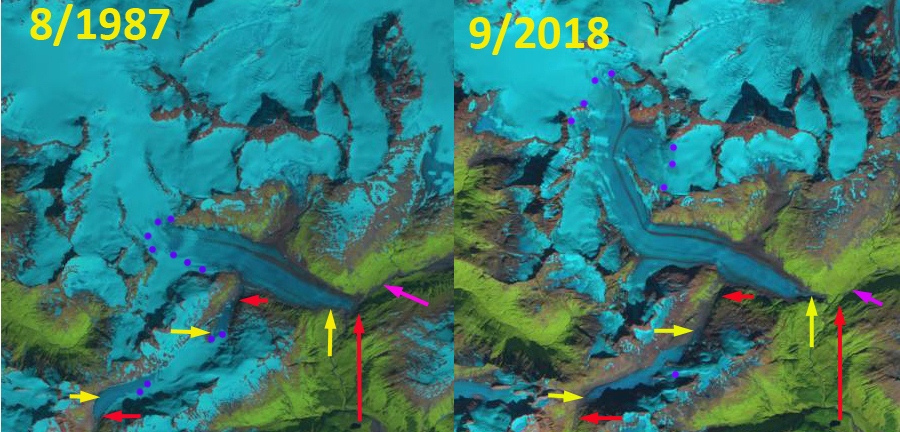
Cordova Glacier retreat and glacier separation revealed by Landsat images from 1987 and 2018, red arrow is the 1987 terminus position of main glacier and tributaries, yellow arrow is the 2018 terminus location.  Purple dots indicate the snowline and the pink arrow the former location of Rude Lake. 

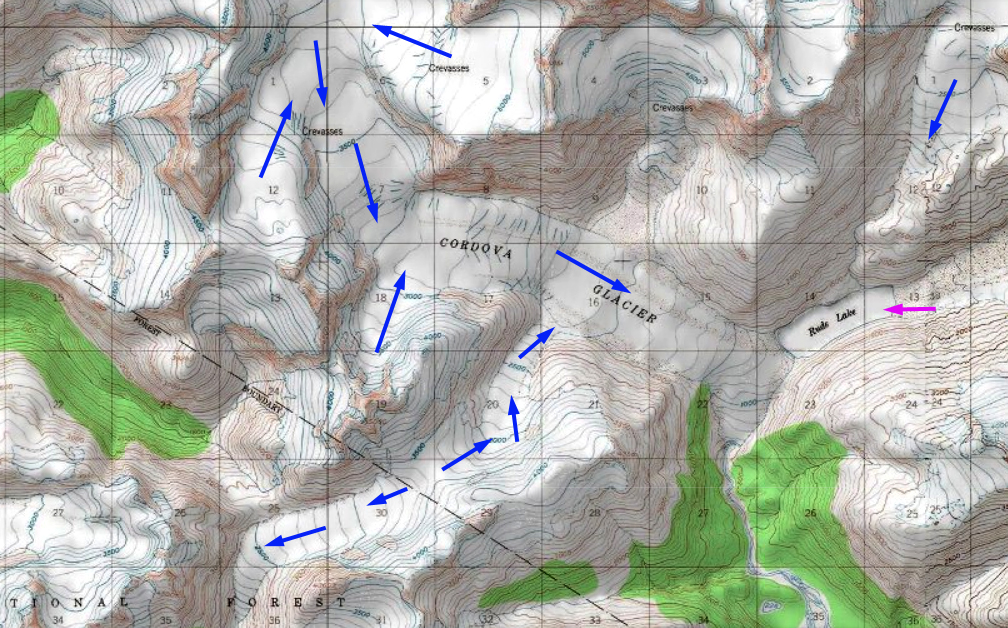
Cordova Glacier is located at the head of the western fork of the Rude River in the Chugach Mountains, Alaska. In USGS maps the glacier dams Rude Lake which is ~1.5 km long and 0.5 wide (see below).  Molnia (2008) noted the lake was gone in 2008 and the former bed was covered by vegetation indicating the lake had not recently drained for the last time. Here we examine changes in the glacier from 1987-2018 using Landsat imagery.

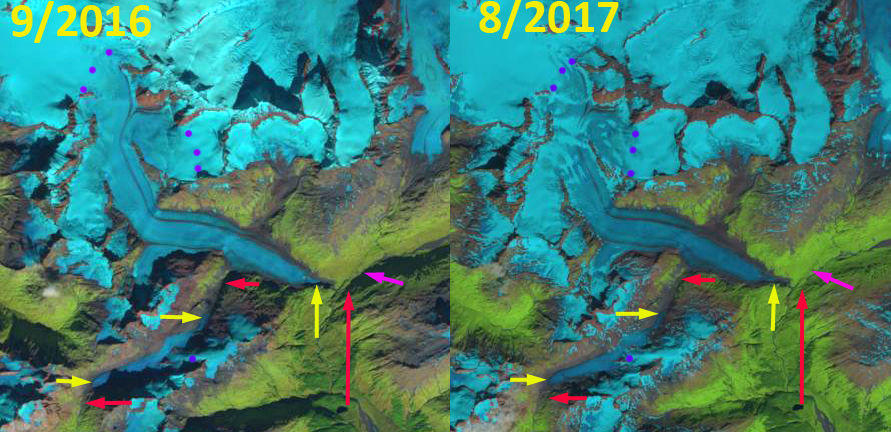
In the USGS map of the region from the 1950’s, Rude Lake is dammed by the terminus of Cordova Glacier, pink arrow.  There is a significant tributary entering from the southwest a short distance above the terminus. By 1987  Rude Lake has drained and much of the lake bottom has been occupied by vegetation.  The terminus does still extend to the bottom of the West Branch Rude River Valley. The tributary entering from the southwest has detached from Cordova Glacier.  The snowline is at 950 m in August 1987. In 9/2016 and 8/2017 the transient snowline is at 1400 m and 1350 m respectively. The former southwest tributary like the main glacier has limited retained snowcover that cannot maintain the glacier at it current size. In early September 2018 the snowline on Cordova Glacier is again at 1400 m.  The main terminus has retreated 800 m since 1987.  The southwest tributary has both a western and eastern terminus that have retreated 1100 m and 500 m respectively.  The total length of the southwest tributary declined from 6.1 km to 4.1 km in length the entire valley reach of the glacier has lost snowpack in 2016-2018.  That heralds that this section of the glacier will melt away.

The retreat of this glacier is less significant than many glaciers in the region including Alsek Glacier and Shoup Glacier.  The high snowline in 2018 indicative of high ablation, which was also noted on Lowell Glacier.

Alaska Topographic Map of Cordova Glacier indicating Rude Lake, pink arrow. 

Cordova Glacier terminus position and snowline revealed by Landsat images from 2016 and 2017, red arrow is the 1987 terminus position of main glacier and tributaries, yellow arrow is the 2018 terminus location.  Purple dots indicate the snowline and the pink arrow the former location of Rude Lake. 


Glaciers Abandon Farragut River Valley, Alaska

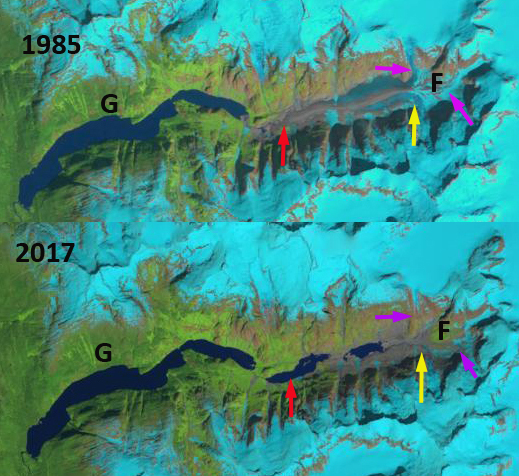
The Farragut Glacier  (F) in Landsat images in 1985 and 2017.  The red arrow indicates the 1985 terminus location, the yellow arrow the 2017 terminus location and the purple arrow, two tributaries in 1985 that now no longer connect to the former valley glacier. The glacier now terminates well short of Glory Lake (G) and two new lakes have formed. 

The Farragut River drains into Frederick Sound in Southeast Alaska.  The headwaters of this river in 1985 was a valley glacier, Farragut Glacier, fed by seven glaciers descending from peaks on the south wall of the valley or flowing down from the Stikine Icefield. The river is known for significant Pink and chinook salmon runs as well.  This valley is just to the north of Baird Glacier that has begun to retreat.

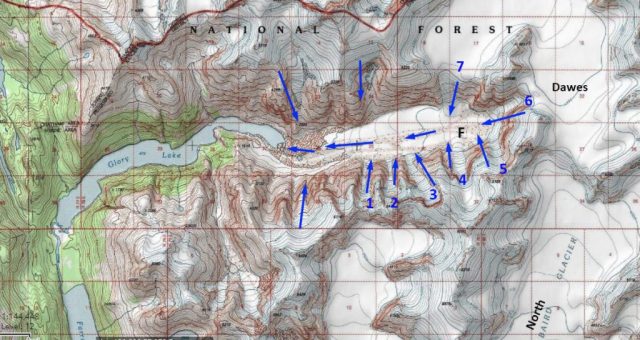
In the USGS map from 1975 there are seven glaciers that drain into the valley bottom contributing to the Farragut Glacier, see map below. The glacier at this time terminated in Glory Lake.  By 1985 the glacier had retreated 1.2 km from Glory Lake and was 7.2 km long. There was a medial moraine that had expanded in width and height indicating the glacier tongue was thinning rapidly. The overflow tributaries from Dawes and North Baird Glacier, purple arrows, still connected to the valley glacier.  By 1993 thinning and retreat had led to formation of a new lake.  The overflow tributaries from Dawes and North Baird Glacier no longer reach Farragut Glacier.  By 2016 vegetation there are two new lakes where the Farragut Glacier used to be.  New vegetation has developed where the tributary from Dawes and North Baird Glacier formerly joined the Farragut Glacier.  By 2017 there is only a single tributary that contributes to the Farragut Glacier, which occupies only a small segment of the valley floor.  The distance from this tributary to the terminus is 3.1 km.  The glacier has lost most of its length, six of its former glacier connections and two lakes have developed in 32 years of retreat and thinning.  The Farragut River valley has largely been abandoned by glaciers in the last three decades. The thinning and retreat is larger here than at Baird Glacier and Patterson Glacier

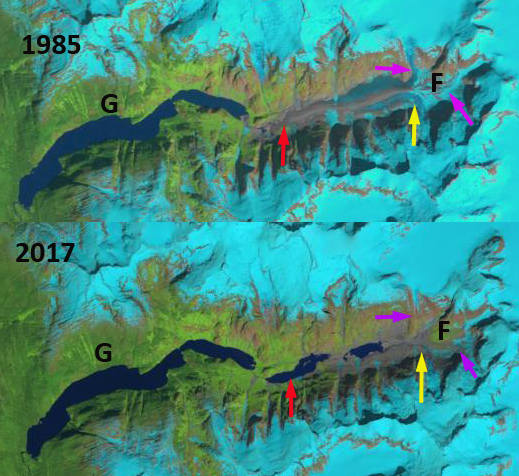
The Farragut Glacier  (F) in Landsat images in 1993 and 2016.  The red arrow indicates the 1985 terminus location, the yellow arrow the 2017 terminus location and the purple arrow, two tributaries in 1985 that now no longer connect to the former valley glacier.

USGS map indicating the seven glaciers that connect to make the Farragut Glacier in 1948.

Google Earth Image indicating the two lakes and the one tributary that reaches the Farragut River valley floor. 

Sherman Glacier, Alaska Diminishing Protective Blanket=Mass Loss

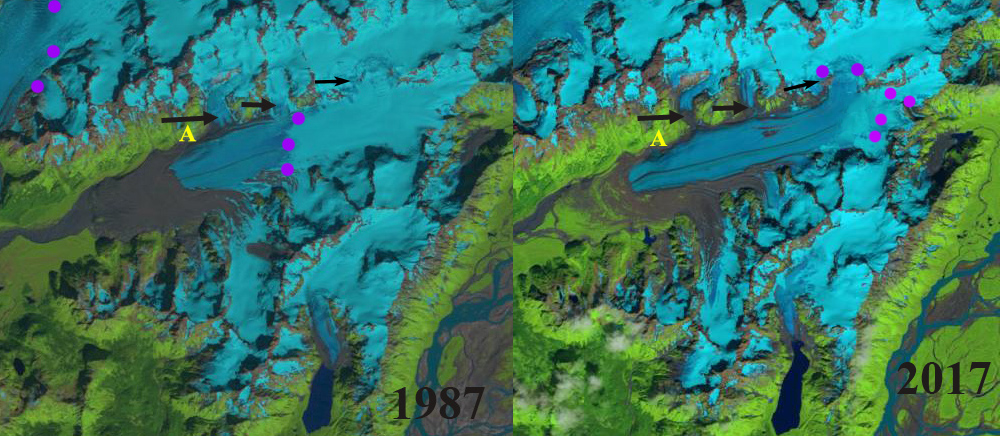
Sherman Glacier, Alaska in Landsat images from 1987 and 2017.  Black arrows indicate tributaries on north side. Purple dots indicate the snowline. Point A indicates a depression formed from lateral recession. Also notice how the debris cover has with glacier flow been shifted downglacier. 

Sherman Glacier is in the Chugach Mountains of southern Alaska and is famous for the large landslide triggered by the magnitude 9.0 Good Friday earthquake in 1964 that spread across a substantial portion of the glacier below 450 m. This debris insulated the ablation zone of the glacier from melting leading to a glacier advance.  The landslide average 1.6 m in thickness and covered 8.25 km2 (McSaveney, 1978).  Marangunic (1972) notes the glacier was retreating 25 m/year and thinning by 2 m/year prior to the landslide. By 1966 he notes the glacier had begun to advance.  This advance continued up to 2009 (Reznichenko et al (2010).    Here we utilize Landsat imagery to indicate the changes from 1987 to 2017 on Sherman Glacier.

The terminus of Sherman Glacier remains buried by a portion of the landslide debris and its position change at present is hard to discern, upglacier the changes are striking.  In 1987 their are three tributaries entering the glacier from the north.  The snowline is at 450 m.  The glacier at Point A extends the the valley wall.  In 1999 the three north side tributaries are still connected and the glacier extends to the valley wall at Point A.  The snowline is at 600 m.  In 2015 the snowline is at 850 m with only 30% of the glacier in the accumulation zone.  At Point A a circular depression has formed as the glacier has receded from the valley wall.  In 2016 the snolwine is again at 850 m.  The lowest tributary on the north side has detached from the main glacier.  The middle tributary has lost most of its connection.  The highest tributary is now connected across just half of its former width with a bedrock rib extending across the other half.  In 2017 the snowline is at 725 m with a month left in the melt season.  This sequence of years of high snowlines is indicative of what is causing the detachment of tributaries.  The glacier is thinning significantly up to at least 800 m in elevation.  This represents a mass loss across most of the glacier, which is leading to retreat of tributaries and marginal retreat in much of the ablation zone.  The lateral recesssion at Point A since 1987 is 250 m.  This volume loss belies the minor recent terminus retreat of the debris buried terminus. This glacier due to the landslide has not retreated as much as its neighboring glaciers such as Valdez Glacier.

Sherman Glacier, Alaska in Landsat images from 1999, 2015 and 2016.  Black arrows indicate tributaries on north side. Purple dots indicate the snowline. Point A indicates a depression formed from lateral recession.

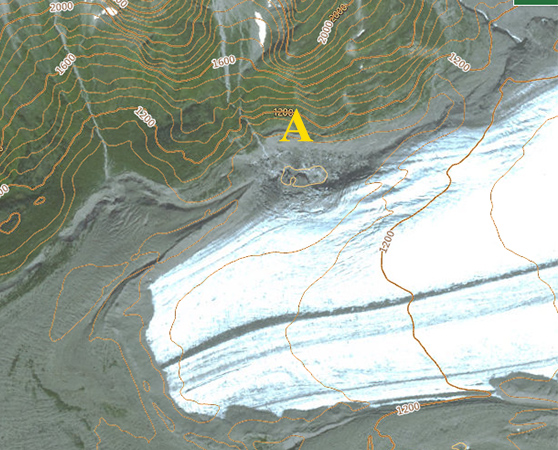
Sherman Glacier in the National Map viewer, indicating depression below Point A and lateral recession.


Sherman Glacier tributary detachment, 275 m of retreat from main glacier in the National Map Viewer image from several years ago. 

Figure 12 from (Reznichenko et al (2010)  The rock avalanche caused by the 1964 Great Alaska Earthquake covered part of the ablation zone of Sherman Glacier. (a) The rock-avalanche cover after its emplacement in 1967. (b) The rock avalanche reached the terminus of the glacier in 2008 (pictures from Mauri McSaveney).

Popof Glacier Retreat, Alaska Features Tributary Separation

Popof Glacier comparison in 1986 and 2016 Landsat images. Red arrow is the 1986 terminus location, yellow arrows the 2016 terminus location, pink arrows indicate two key tributaries and purple dots indicate the snowline.

Popof Glacier is at the southern end of the Stiking Icefield in southeast Alaska.  In 1948 the glacier had two terminus sections  that separated around Mount Basargin and then rejoined.  By 1979 the glacier termini were separated (Molnia, 2008).  Here we examine Landsat imagery from 1986-2016 to identify changes in the glacier.

In 1986 both glacier termini were located at the far end of a basin, with no proglacial lakes in existence.  The  termini were separated from each other by 400 m after nearly wrapping all the way around Mount Barsargin. The first tributary to join main glacier from both the west and east were connected to the main glacier, pink arrows.  The snowline in 1986 was at 800 m.  By 1999 the northern terminus tongue had disintegrated extending only a few hundred meters from the main glacier and forming a new lake.  A fringing proglacial lake had developed at the main or southern terminus. The snowline was at 750-800 m.  The first  tributaries entering from east and west still reach the main glacier.  In 2015 the snowline is nearly at the summit of the glacier at 925 m. The main terminus has retreated from the proglacial lake that formed in the 1990’s. The first  tributaries entering from east and west no longer reach the main glacier.  In 2016 the snowline is  at 950 m, even higher than in 2015, with less than 5% of the glacier retaining snowcover.  The main terminus has retreated 700 m from 1986 to 2016 and the northern terminus 1.7 km from 1986-2016.  The retreat is less spectacular than the nearby Shakes Glacier and Great Glacier, though both of those glaciers have retained a substantial accumulation zone.  The Popof Glacier cannot survive with snowlines as high as those seen in 2015 and 2016.

Popof Glacier comparison in 1999 and 2015 Landsat images. Red arrow is the 1986 terminus location, yellow arrows the 2016 terminus location, pink arrows indicate two key tributaries and purple dots indicate the snowline.

Popof Glacier in 1979 USGS map of the region, indicating flow directions. 

Double Glacier, Alaska Retreat at the Double & A Volcanic Ash Blanket

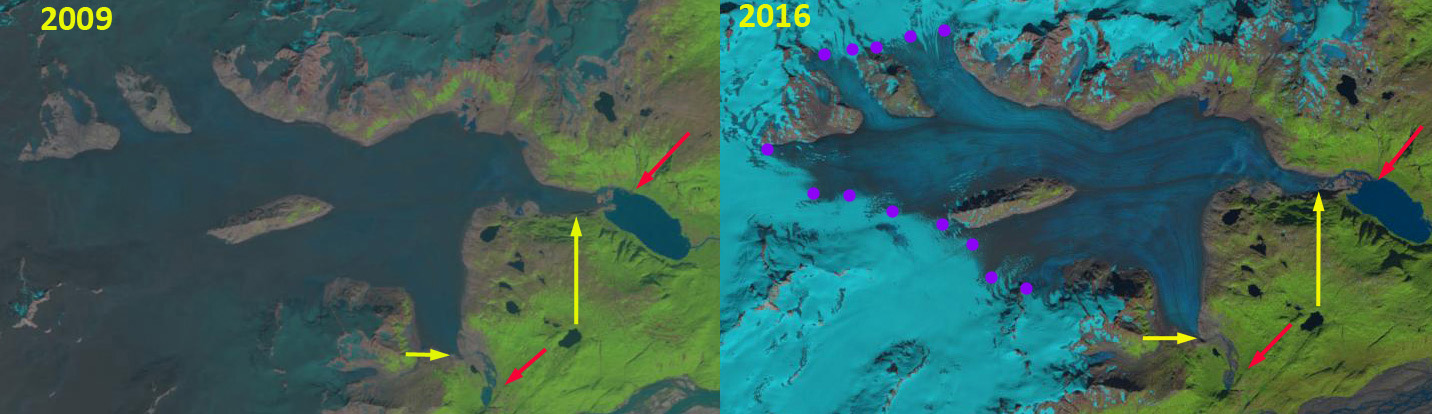
Double Glacier, Alaska in 1986 and 2017 Landsat images.  The 1986 terminus location of the northern Big River Lobe and Southern Drift River Lobe are shown with red arrows. Yellow arrows indicate the 2017 terminus locations.  Purple dots indicate the snowline.  Point A indicates a prominent and expanding nunatak that is below the snowline.

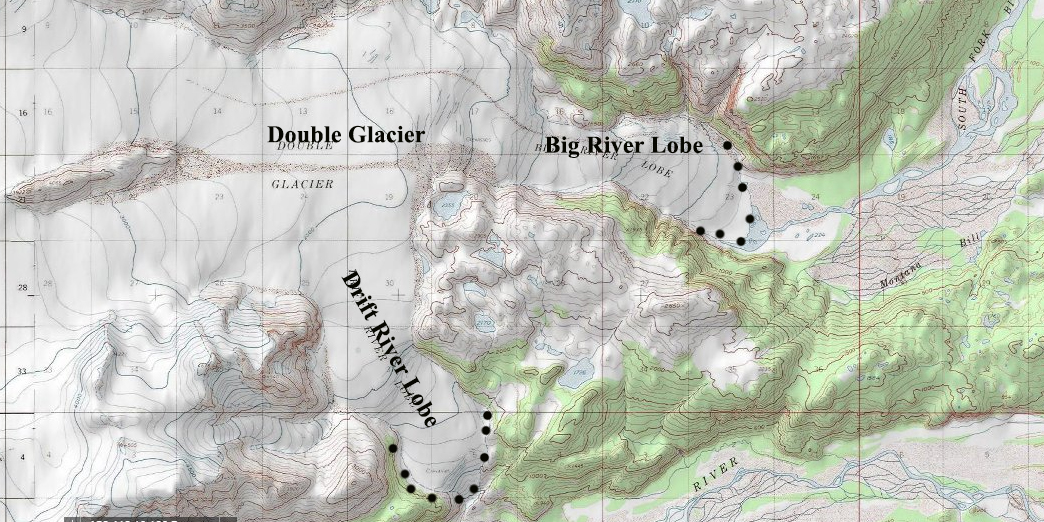
Double Glacier is the largest glacier contained within the Lake Clark National Park (LCNP) with an area of 137 km2 (Arendt et al, 2012). The glacier has a double eastern terminus with the northern or Big River Lobe terminus feeding the South Branch Big River and the southern terminus or Drift River Lobe feeding the Drift River.  From 2001-2008 Arendt et al (2012) found that Double Glacier had large elevation losses of ~2 m/year below 1400 m. From 1956-2007 Double Glacier lost 7% of its area, which was below average in the region (NPS, 2012). Here we examine Landsat imagery from1986-2017 to identify changes of the glacier including the surface impact of Mt. Redoubt volcano 2009 eruption.

In the 1956 Kenai Topographic map the Drift River Lobe extends to  an elevation of 150 m almost to the Drift River Valley bottom.  The Big River Lobe terminates near the eastern end of the proglacial lake that is just a small fringing water body. In 1986 the Big River Lobe reached the western margin of a 2.5 km long proglacial lake (Big River Lobe Lake), red arrow.  The Drift River Lobe terminated at a ridge at 300 m, red arrow.  A prominent nunatak, Point A extends 4 km up the middle of the glacier from 850 m to 1050 m in elevation.  The snowline is at 1050 m. In 2009 the most striking visual is volcanic ash covers the entire glacier.  This is from Redoubt volcano which the  Alaskan Volcano Observatory reports on the 2009 eruption of this stratovolcano on the west side of Cook Inlet beginning in March 2009. Nineteen major ash-producing explosions generated ash clouds that reached heights between 5200 m and 18900 m. During ash fall in Anchorage, the Ted Stevens International Airport was shut down on for part of March 28  and March 29. The explosive phase ended on April 4 with a dome collapse and an ash cloud that reached 15,200 m and travelled southeast, depositing up to 2 mm of ash fall in Homer, Anchor Point, and Seldovia. The final lava dome ceased growth by July 1, 2009. In 2009 the Big River Lobe has retreated 500 m from the 1986 position.  The Drift River Lobe has had a 1600 m retreat since 1986.  This retreat was not driven by the ash that fell just months before the Landsat image was acquired. In 2016 the snowline is at 1050 m.  The ash remains evident in the ablation zone. In 2017 the snowline is again at 1050 m in late July, with six-eight weeks left in the melt season.  The Drift River Lobe terminus retreat from 1986-2017 has been 1700 m.  The Big River Lobe terminus retreat from 1986-2017 has been 1400 m.  The decreased albedo from the ash between 1986 and 2017 is evident and will lead to enhanced ablation zone melting and retreat. The Nunatak, Point A is located below the snowline each year.  Glacier thinning has led to the expansion in width and vertical relief from the glacier of this nunatak. The lowest 1 km of the glacier today is narrow and fed by a thin ice tongue. The retreat of this glacier is similar to that of Blockade GlacierHallo and Spotted Glacier in the same region, each have had substantial retreats with lake expansion.

Double Glacier, Alaska in 2009 and 2016 Landsat images.  The 2009 image indicates ash fall from Redoubt Volcano covering the glacier. The 1986 terminus location of the northern Big River Lobe and Southern Drift River Lobe are shown with red arrows. Yellow arrows indicate the 2017 terminus locations.  Purple dots indicate the snowline.  Point A indicates a prominent and expanding nunatak that is below the snowline.

Kenai Topographic map indicating glacier margins in 1956. 


Blockade Glacier, Alaska Retreat Generates Expanding Lake

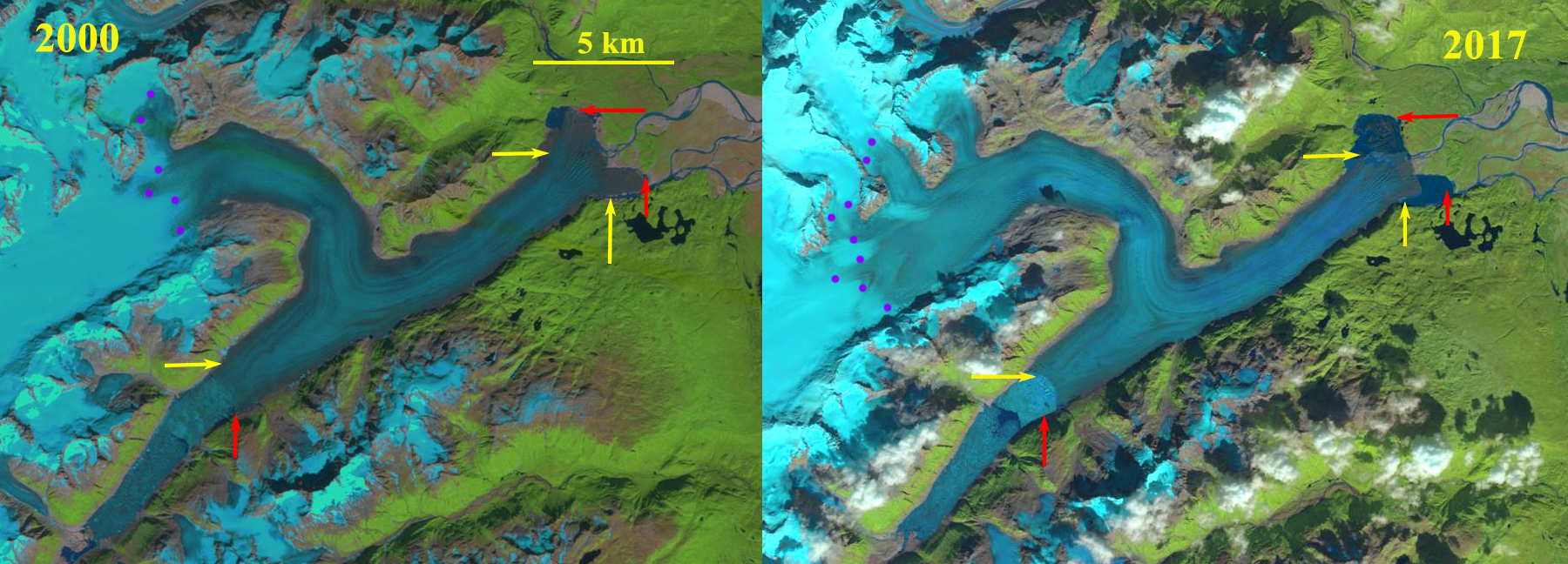
Blockade Glacier in 2000 and 2017 Landsat images.  Red arrow indicates 2000 terminus locations, yellow arrows 2017 terminus locations and purple dots the snowline. 
Blockade Glacier drains east from the Neacola Mountains in southern Alaska.  The glacier has two prominent terminus locations, the western terminus is in Blockade Lake, blocked by the glacier and the eastern terminus is in a new expanding lake at the headwaters of the MacArthur River. Arendt and Larsen (2012) assessed the glacier changes in Alaska National Parks and found in Lake Clark NP that glacier area declined by 11% from 1956 to 2008.  Hallo and Spotted Glacier in the same region have had substantial retreats with lake expansion.

In 2000 the eastern terminus of Blockade Glacier terminates on an outwash plain with a narrow discontinuous fringe of open water. In 2000 and 2003 the western terminus in Blockade Lake is actively calving across the 1.5 km front, making the front difficult to distinguish.   The snowline is at 1000 m.  The eastern terminus has not changed since 2000 and the snowline is at 900 m.  By 2016 the western terminus has retreated 600 m and with retreat the width of the calving front has increased to 1.8 km.  The wider calving front along with what should be increasing lake depth should lead to a greater calving flux and retreat of the western terminus. The eastern terminus has two embayments filled with a glacier lobe.  The southern lobe has collapsed opening up a a 1 square kilometer lake area.  The snowline in 2016 is at 1000 m. By 2017 the eastern terminus has retreated 1200 m on the south side and 1700 m on the north side.  The northern lobe has now largely collapsed like the southern lobe leading to a lake expansion of 1.5 square kilometers.  The lake depth should be increasing and when the center pulls back from the outwash plain it is still grounded on, glacier retreat will increase.  The snowline is at 1200 m in 2017.

Blockade Glacier USGS map, indicating the lack of a lake at the eastern terminus. 

Blockade Glacier in 2003 Landsat image.  Red arrow indicates 2000 terminus locations, yellow arrows 2017 terminus locations and purple dots the snowline.

Blockade Glacier in 2016 Landsat image.  Red arrow indicates 2000 terminus locations, yellow arrows 2017 terminus locations and purple dots the snowline.
Alsek Glacier, Alaska Retreat & Glacier Separation

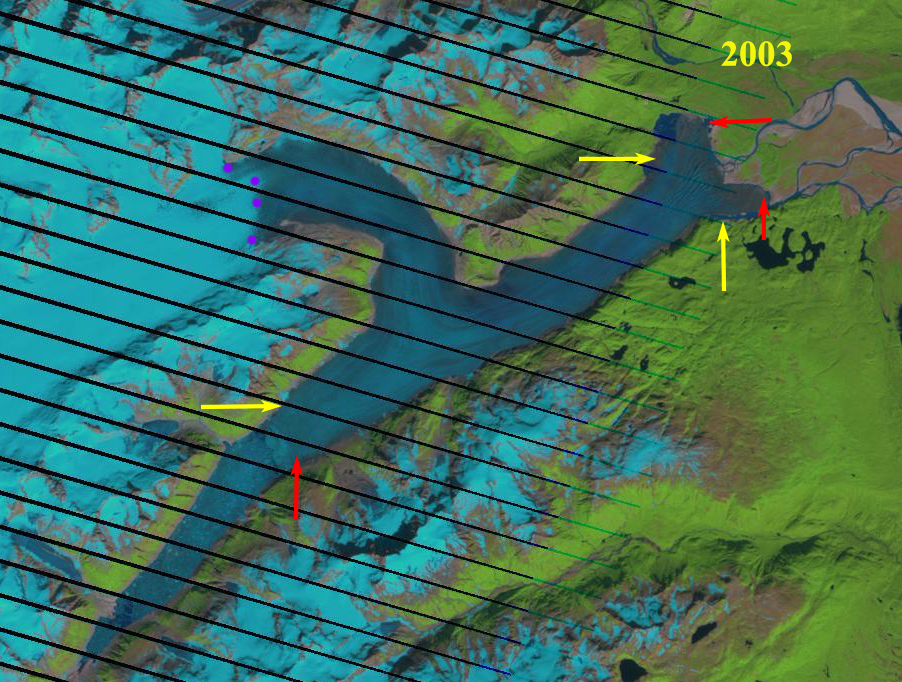
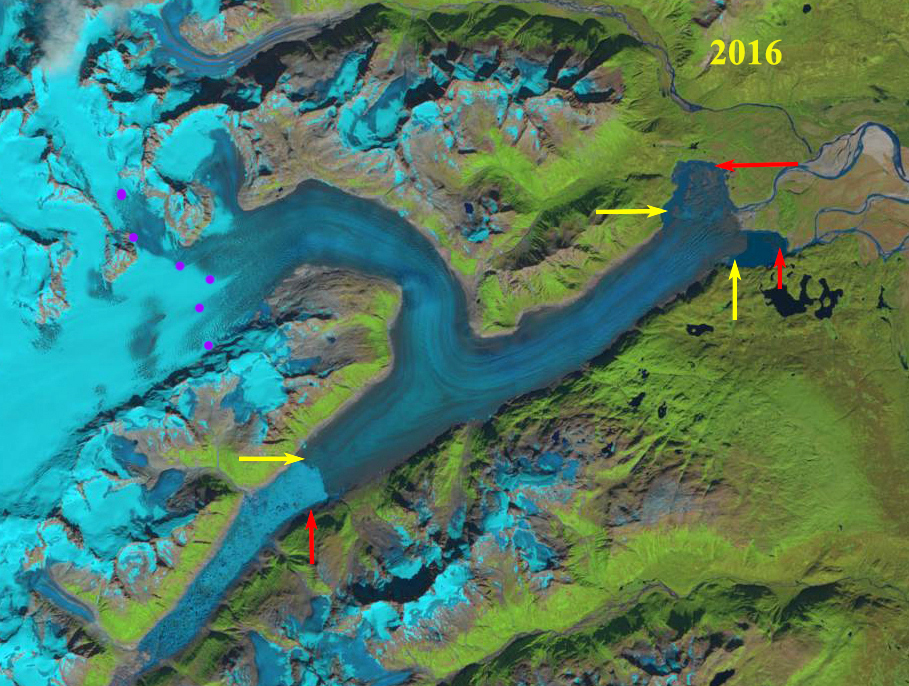
Alsek Glacier in a 1984 Landsat image and 2017 Sentinel image.  Red arrows indicate 1984 terminus, yellow arrows 2017 terminus location, pink arrows tributaries that joined the glacier in 1984 and purple dots the snowline.  AR=Alsek River, G=Gateway Knob and P=Prow Knob.
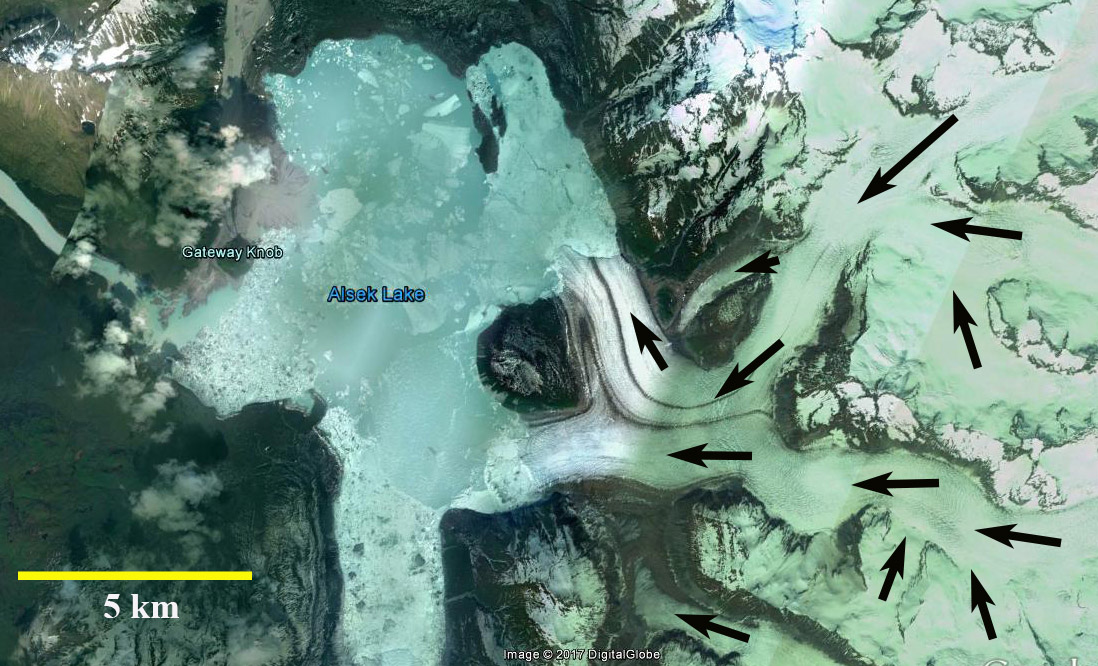
Alsek Glacier descends from the Fairweather Range terminating in Alsek Lake on the coastal plain. The glacier terminated at Gateway Knob (G) near the outlet of Alsek River from Alsek Lake in the early part of the 20th century (Molnia, 2005). At that time it had a joint terminus with Grand Plateau Glacier. The glacier retreated 5-6 km by 1984 along the central margin from Gateway Knob. The glacier remained connected with the Grand Plateau Glacier in 1984. In 1960 the glacier had a single terminus joining downstream of an unnamed island in Alsek Lake, that Austin Post told me reminded him of a boats prow. This “Prow Knob” (P) much like Gateway Knob a century ago stabilizes the terminus. Retreat from this knob will lead to an increase in retreat of Alsek Glacier. Here we examine the change from 1984-2017 with Landsat and Sentinel imagery.

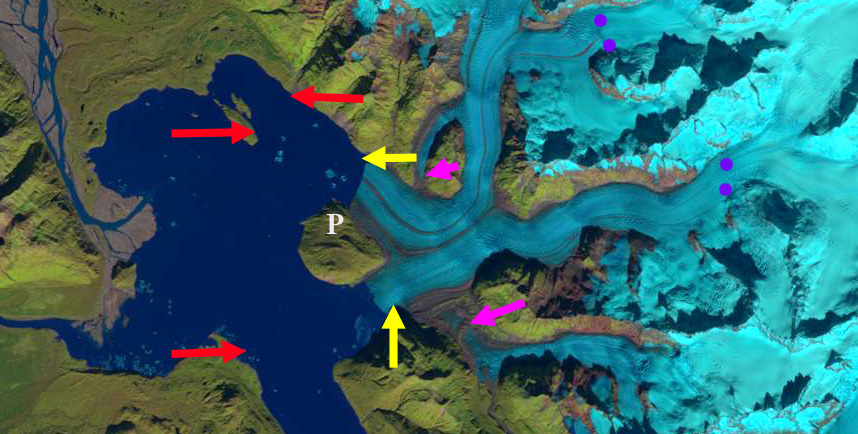
In 1984 the terminus location is denoted with red arrows it has separated into two termini on either side of “Prow Knob”. The northern terminus tongue is located on a narrow island on the north side of Alsek Lake. The southern tongue merges with the northern arm of Grand Plateau Glacier. Two tributaries at the pink arrows merge with the main glacier. In 1984 the snowline is at 900 m. By 1999 the northern tongue has retreated from the narrow island, which exposes the terminus to enhanced calving. The southern terminus has separated from the Grand Plateau Glacier. In 1999 the snowline is at 900 m. By 2013 the northern terminus has retreated almost to the northern end of “Prow Knob” and the southern terminus is directly south of “Prow Knob” in a 1.8 km wide channel. By 2016 two tributaries of Alsek Glacier are fully detached from the glacier, pink arrows. In 2017 the northern terminus tongue has retreated 3.7 km since 1984 into the 2.0 km wide channel on the northeast side of “Prow Knob”. The center of the southern terminus has retreated 3.0 km since 1984 and remains in the channel on the south side of “Prow Knob”. The length of the calving front has declined from an 8 km long calving front in 1984 to a 4 km calving front in 2017. In both 2016 and 2017 the snowline is at 1200 m, at this elevation the mass balance of the glacier will be significantly negative driving further retreat. Larsen et al (2007) indicate thinning in the lower Alsek Glacier of 3+m/year in the last half of the 20th century, indicating the glacier is a in a long term adjustment to climate change.  The retreat of this glacier is similar to that of Walker Glacier and North Alsek Glacier, and less than that of the northern arm Grand Plateau Glacier to which it was connected in 1984 or Yakutat Glacier a short distance north.   

Alsek Glacier in a 1999 Landsat image .  Red arrows indicate 1984 terminus, yellow arrows 2017 terminus location, pink arrows tributaries that joined the glacier in 1984 and purple dots the snowline.   P=Prow Knob.
Alsek Glacier in 2014 Google Earth Image,indicating flow directions. 

Alsek Glacier in a 2016 Landsat image .  Red arrows indicate 1984 terminus, yellow arrows 2017 terminus location, pink arrows tributaries that joined the glacier in 1984 and purple dots the snowline.   P=Prow Knob.
 

Bridge Glacier, Southeast Alaska Retreat & Lake Formation

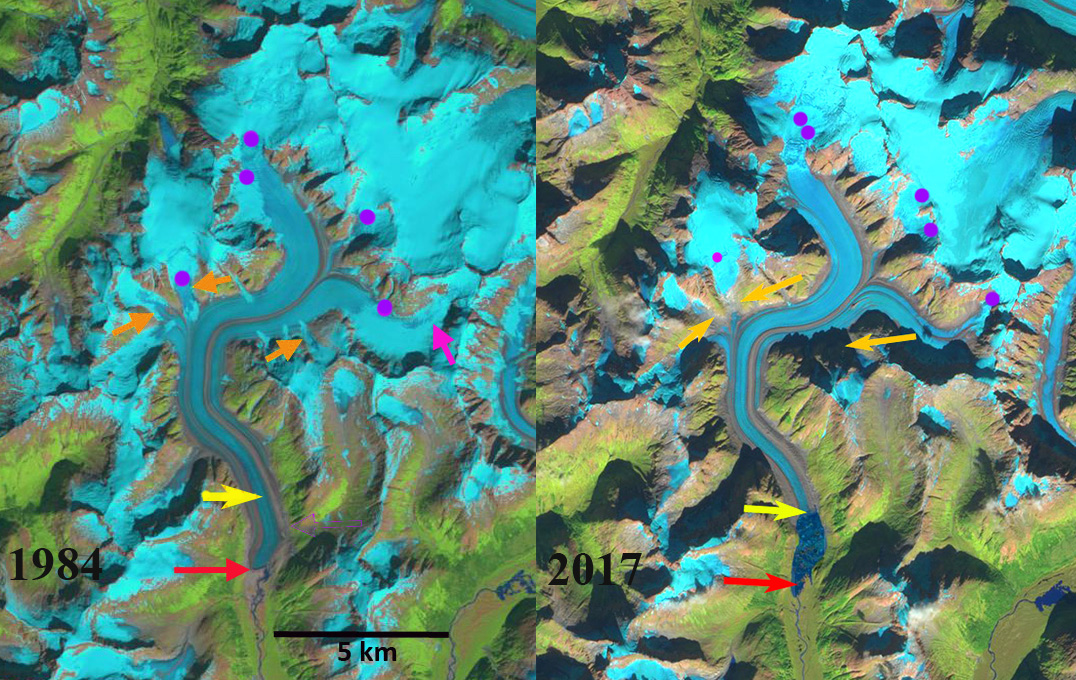
Bridge Glacier in Landsat image from 1984 and Sentinel image from 2017. The red arrow indicates the 1984 terminus where no lake exists, yellow arrow is 2017 terminus, orange arrows are selected tributaries and purple dots the snowline. 
Bridge Glacier drains the same icefield as the Wright and Speel Glacier 45 km southeast of Juneau, Alaska. Here we examine the changes in this glacier from 1984-2017 using Landsat and Sentinel imagery.

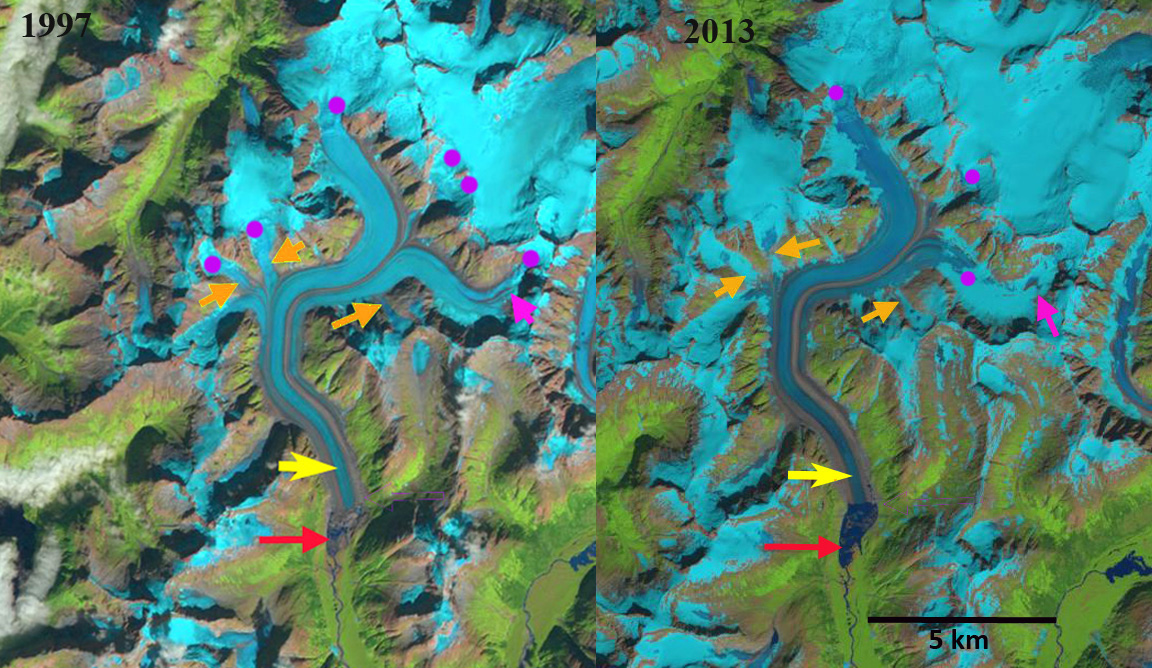
In 1984 the glacier ended on an outwash plain at the head of a branch of Speel River. The red arrow indicates the 1984 terminus for each image, the yellow arrow the 2017 terminus and the orange arrows three tributaries feeding the glacier.  The purple dots indicate the snowline at 1200 m. In 1984 all three tributary glaciers fed Bridge Glacier and the glacier has no proglacial lake at the terminus. In 1997 a lake basin is beginning to develop, though it is still largely filled by ice. The eastern tributary pink arrow, has lost all of its snowpack. The three tributaries at the orange arrows are connected to Bridge Glacier still and the snowline is at 1250 m. In 1999 the proglacial lake has formed and has length of 1 km, the lake has expanded south and north of the 1984 terminus position, and does not entirely represent glacier retreat.  In 2013 the glacier has retreated 1200 m from the 1984 position and the lake is still expanding. The orange arrows indicate that none of the three tributaries are still connected to the main glacier. The glacier in a sense is losing its income flow from these subsidiaries. The eastern tributary has retained some snowcover with six weeks left in the melt season in 2013, but this is mostly gone a month later, the snowline is at 1100 m. nbsp; Total retreat from 1984 to 2017 is 1900 m. In 2017 the snowline is at 1300 m, and the separation of the tributaries is by more than 500 m in each case. The snowline has been high by the end of each summer from 2014-2017 indicating retreat will continue. The retreat of this glacier is the same story as seen at nearby PattersonGilkey and Norris Glacier.

.

Bridge Glacier in Landsat images from 1997 and 2013. The red arrow indicates the 1984 terminus , yellow arrow is 2017 terminus, orange arrows are selected tributaries and purple dots the snowline. 
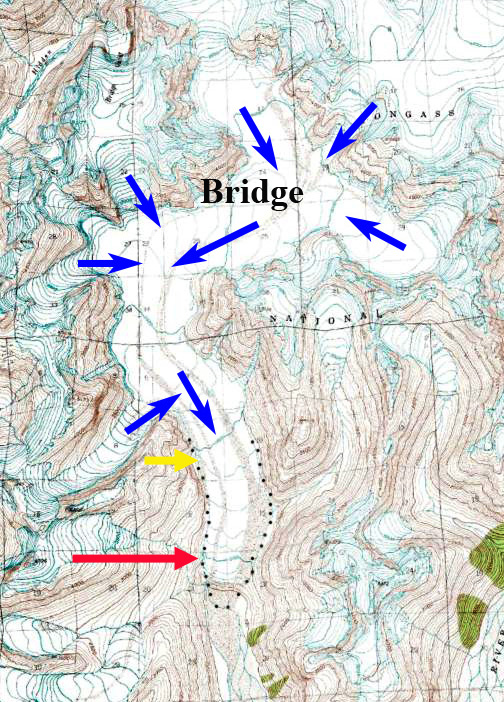
Bridge Glacier in USGS map when it ended on the outwash plain in 1948.