Muller Ice Shelf, Antarctica 2018 Calving Event

Comparison of the ice front-yellow dots, icebergs-pink arrow and rifting-blue arrow in March 2018 and November 2018 Landsat images. A=Antevs Glacier, B=Bruckner Glacier, H=Humphreys Island and M=Muller Ice Shelf. New iceberg is at the lowest pink arrow adjacent to western calving front.

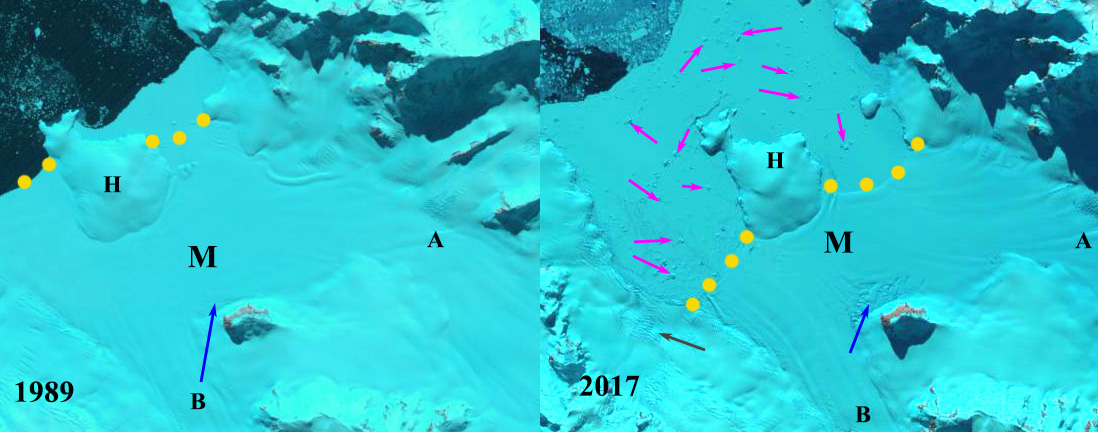
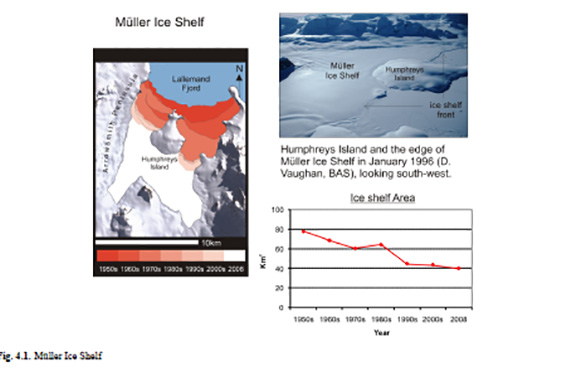
Muller Ice Shelf is on the west side of the Antarctic Peninsula and  is one of the smallest remaining ice shelves covering 40 km2 in 2007. It is the northernmost ice shelf on the western side of the Peninsula and is fed by Bruckner Glacier (B) and Antevs Glacier (A), and is pinned on Humphreys Island (H). The glacier advanced from 1947 to 1956 with subsequent retreat until  another advance period from 1974-1986 when the ice front advance led to a 4 square kilometer expansion (Cook and Vaughan, 2010).  Retreat has since ensued Domack et al. (1995) suggested that warm CDW that is currently within the fjord may be contributing to the rapid bottom melting and retreat of the ice-shelf  in recent years.    From 1989 to  2017 the western margin has retreated 2.5 km and the eastern margin 1.5 km (Pelto, 2017). Here we use Landsat imagery to identify changes from 2016 to 2018, focussing in particular on a large 2018 calving event. I noticed the iceberg first in the Antarctica REMA Explorer.  This is a wonderful viewer for exploring the region. REMA is a Reference Elevation Model of Antarctica that is time stamped and has an 8 m spatial resolution.

In 2016 the both the eastern and western margin are near the southern end of Humphreys Island, which acts as a pinning point, but this connection is becoming tenuous.  Of equal importance is the development of an area of substantial rifting north of the bluff on the southern margin of the ice shelf between Antevs and Bruckner Glacier at the blue arrow.  In 2017 the rifting has further expanded, the ice melange now covering an area of ~1 square kilometer.   The retreat due to calving is ongoing as indicated by the number of new icebergs in the Feb. 2017 image, pink arrows.  In March of 2018 there is one substantial new iceberg several kilometers beyond the western terminus. There is not a significant rift across the western calving front. By Nov. 9, 2018 an iceberg that spans 80% of the western calving front of Muller Ice Shelf has been released.  The sea ice is still keeping the iceberg in place adjacent to the calving front.  The iceberg is  1.6 km long and 0.4 km wide. This is small by Antarctic standards, but large for the Muller Ice Shelf. The decreased connection to Humphreys Island and the expanding rift area indicates that the Muller Ice Shelf is poised for disintegration like what occurred on nearby Jones Ice Shelf and what is poised to occur on Verdi Ice Shelf.

Antarctica DEM explorer view of the new Iceberg from the 11/9/2018 Landsat imagery.
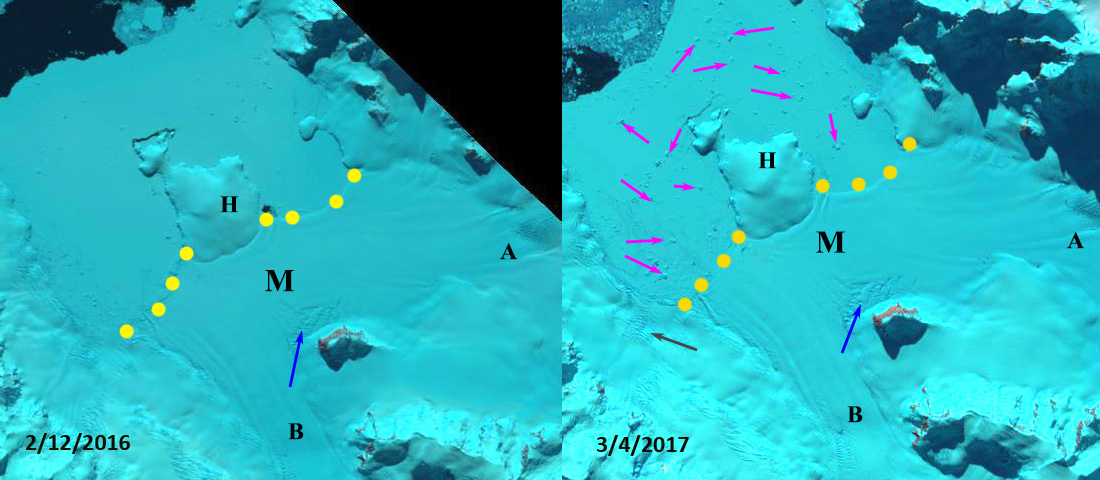
Comparison of the ice front-yellow dots, icebergs-pink arrow and rifting-blue arrow in 2016 and 2017 Landsat images. A=Antevs Glacier, B=Bruckner Glacier, H=Humphreys Island and M=Muller Ice Shelf.
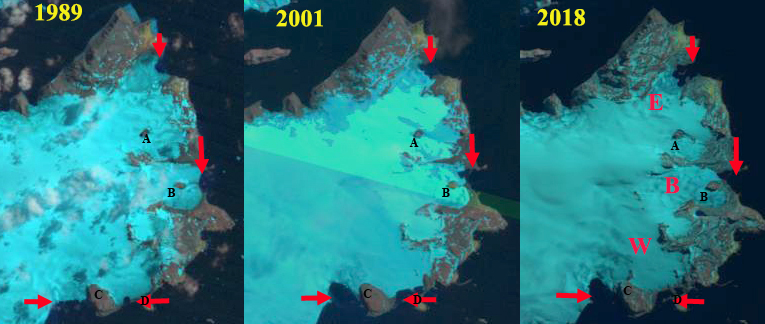
Warsaw Icefield, King George Is., Antarctica Retreating from Shoreline

Warsaw Icefield, King George Island, Antarctica glacier retreat and nunatak expansion in 1989, 2001 and 2018 Landsat images. E=Ecology Glacier, B=Baranowski Glacier, W=Windy Glacier, 1989 terminus locations indicated by red arrows.  Point A & B are nunataks. 

The Arctowski Polish Research Station is located on a relatively large ice-free oasis northeast of the Warsaw Icefield on King George Island, Antarctica. The station is on Admiralty Bay where  Ecological monitoring has been conducted since the late 1970’s in order to determine the size and condition of populations of seabirds and pinnipeds. The ocean bottom has had over 800 distinct benthic species identified. A long term study of a chinstrap penguin colony on King George Islands during the last 30 years indicates the size of the breeding populations has decreased by 84% probably due to limitations of the marine food web (Korczak-Abshire et al 2012). The outlet glaciers of Warsaw Icefield experienced significant retreat and mass loss (Petlicki et al, 2017). Here we examine Landsat images from 1989 to 2017 to illustrate the changes.  The Warsaw Icefield extends from 400 m to sea level.

In 1989 Baranowski and Windy Glacier terminate on the coastline lacking any significant embayment.  Ecology Glacier has a wide front in a shallow embayment.  Nunataks A and B are amidst the icefield. In 1990 the snowline is at 200 m with nunatak A and B in the ablation zone.  In 2001 nunatak A and B are still surrounded by ice.  Windy Glacier and Baranowski Glacier have retreated with embayments forming.  The embayments are separated from ocean by a coastal strip of land.  An embayment has also opened to the west of Windy Glacier and Point C due to glacier retreat. In 2005 the snowline is at 250 m.  Baranowski glacier retreat has led to Nunatak B reaching the margin of the glacier, the embayment expanding on the north side of the margin. In 2014 Ecology Glacier has retreated opening the embayment.  In 2018 Ecology Glacier has retreated 600 m since 1989 exposing several small new islands in this protected embayment.  the Tidewater front is quite limited in 2018. Nunatak A is within 400 m of the edge of the icefield, whereas in 1989 the nunatak was 1.2 km from the margin. The 1989-2018 500 m retreat of Baranowski Glacier has led to the development of a dominantly land based terminus. Windy Glacier has retreated 400 m since 1989 and is now land terminating. The glacier to the west of Windy Glacier and Point C has opened a 0.5 square kilometers embayment. The retreat of Warsaw Icefield is similar to that of Endurance Glacier, Elephant Island.  Petlicki et al,( 2017) indicate mass balance has not been as negative from 2012-2016 which should slow retreat.  The new embayments offer potential new locations for penguins that Arctowski scientists will monitor.

Warsaw Icefield, King George Island, Antarctica glacier retreat and nunatak expansion in 1990, 2005 and 2014 Landsat images. E=Ecology Glacier, B=Baranowski Glacier, W=Windy Glacier.  Point A & B are nunataks in 1989. 

Map from the Arctowski Research Station in 2007 indicating glacier changes from 1978 mapped margins to 2007 dark line margin.  This dark line has been annotated to be visible for this post. 

Muller Ice Shelf, Antarctica Retreat and Rift Zone Expansion

Muller Ice Shelf (M) in 1989 and 2017 Landsat images fed by the Antevs (A) and Bruckner Glacier (B). The ice front is shown with yellow dots with separate calving margins on either side of Humphrey Island (H).  The blue arrow indicates a developing rifted zone of melange ice.  The pink arrows point out icebergs among sea ice. 

Muller Ice Shelf is on the west side of the Antarctic Peninsula and  is one of the smallest remaining ice shelves covering 40 km2 in 2007.
It is the northernmost ice shelf on the western side of the Peninsula and is fed by Bruckner Glacier (b) and Antevs Glacier (A), and is pinned on Humphreys Island (H). The glacier advanced from 1947 to 1956 with subsequent retreat until  another advance period from 1974-1986 when the ice front advance led to a 4 square kilometer expansion Cook and Vaughan (2010).  Retreat has since ensued Domack et al. (1995) suggesting that warm CDW that is currently within the fjord may be contributing to the rapid bottom melting and retreat of the ice-shelf  in recent years.    Here we use Landsat imagery to identify changes from 1989 to 2017.  

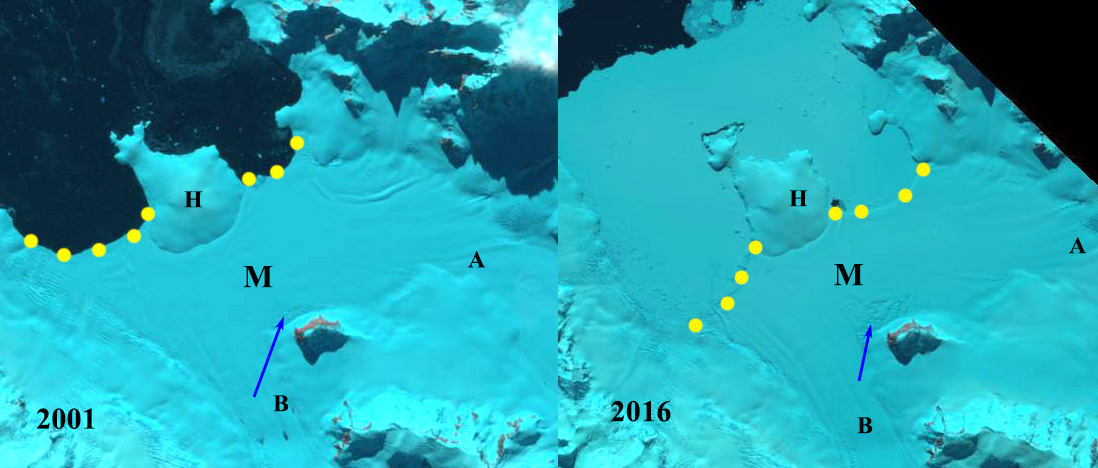
In 1989 the western side of the ice shelf edge is near the north end of Humphrey Island and the east margin near a cape half along the eastern edge of Humphrey Island.  By 2001 the western margin has retreated 1.5 km and the eastern margin 1.2 km.  In 2016 the both the eastern and western margin have retreated to the southern end of Humphrey Island.  The island still acts as a pinning point, but this connection is becoming tenuous.  Of equal importance is the development of an area of substantial rifting north of the bluff on the southern margin of the ice shelf between Antevs and Bruckner Glacier at the blue arrow. In 2017 the rifting has further expanded, the ice melange now covering an area of ~1 square kilometer.  From 1989 to  2017 the western margin has retreated 2.5 km and the eastern margin 1.5 km.  The retreat due to calving is ongoing as indicated by the number of new icebergs in the Feb. 2017 image, pink arrows. Between this area of rifting and the decrease in connection to Humphrey Island the Muller Ice Shelf is poised for rapid disintegration like nearby Jones Ice ShelfBethan Davies provides a detailed look at the weaknesses of other Antarctic Peninsula ice shelves.

Muller Ice Shelf (M) in 2001and 2016 Landsat images fed by the Antevs (A) and Bruckner Glacier (B). The ice front is shown with yellow dots with separate calving margins on either side of Humphrey Island (H).  The blue arrow indicates a developing rifted zone of ice weakness. 

Google Earth image from 1998 and 2016 indicating rift development at blue arrow. 

Figure 4.1 from Cook and Vaughan (2010)   illustrating changes in ice shelf area.

Depot & Mondor Glacier Retreat, Antarctic Peninsula

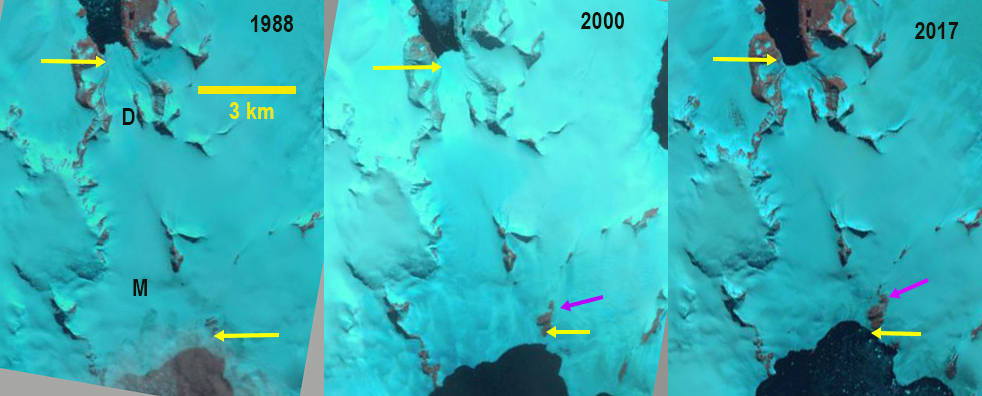
Mondor and  (M) and Depot Glacier (D) at the tip of the Antarctic Peninsula in Landsat imagers from 1988, 2000 and 2017.  Yellow arrows indicates the 2017 terminus location of each.  The purple arrow indicates a bedrock ridge that has been expanding.

On the Trinity Peninsula,which is the region at the tip of the Antarctic Peninsula, are Depot and Mondor that flow north and south from the same accumulation zone emptying into Hope Bay and Duse Bay respectively. The Argentine Research Station, Esparanza is on Hope Bay. This region experienced some of the greatest warming on Earth from 1950-1990’s, but no additional warming since the 1990’s (Turner et al, 2016). This climate change has led to a rapid glaciological response, with 87% of glaciers around the Antarctic Peninsula now receding Davies et al (2012) . The most dramatic response has been the collapse of several ice shelves, Jones, Prince Gustav, Wordie, Larsen A and Larsen B. The Prince Gustav Ice Shelf connecting James Ross Island to the Trinity Peninsula collapsed after 1995 (Glasser et al 2011). There is limited surface melting on Antarctic glaciers, as a result almost all of the mass loss is from bottom melting under ice shelves and calving. These processes have led to and continue to drive dramatic retreat, thinning and acceleration of glaciers that feed ice shelves and the ice shelves, such as Rohss Bay and Coley Glacier Here we examine a glacier that is grounded, which limits the impact of enhanced melting from warmer ocean temperatures. Esparanza Base has a long term climate record with only December and January having a mean temperature above 0 C, at 0.4 and 0.5 C respectively. The record high temperature in Antarctica was recorded at Esparanza Base on March 24, 2015 at 17.5 C (Skansi et al, 2017). Specific anomalously warm days are when most mass balance losses occur. Barrand et al (2013) note a strong positive and significant trend in melt conditions in the region, driving the retreat.

In 1988 Depot Glacier terminus was north of a tributary entering on the west side of Depot Glacier. By 2000 the glacier terminus has receded and is adjacent to the northern side of this tributary.  By 2017 the terminus has retreated further and is nearly at the southern edge of the tributary glacier, a retreat of 500 m. Mondor Glacier in 1988 terminates south of bedrock ridge on the east margin of the glacier, yellow arrow. In 2000 the bedrock ridge has expanded and is closer to the terminus. By 2017 the bedrock rib has further extended north, purple arrow, indicating glacier thinning. The overall retreat of the terminus is 400 m from 1988 to 2017. The retreat rate increased after 2000, which is what Davies et al (2012) reported for the region. The rate of retreat is limited as the grounded glaciers have limited calving, and there is limited surface melt. The melt zone is not significant in any of the images on Mondor Glacier. On Depot Glacier there is a melt zone  below 200 m evident in both Goggle Earth images, purple arrows and the 2017 Landsat image. The limited changes of this glacier underscores that it is ocean warming that has been the key to date in glacier retreat in the region.  There has been a significant temperature rise, but it remains too cold for substantial surface melt.

Google Earth image from 2013 of Mondor Glacier terminus, black dots bottom and Depot Glacier black dots top.  Purple arrow indicates area of melting where snowpack has been lost. Yellow arrow a bedrock ridge on east side of Mondor Glacier.

Google Earth image from 2015 of Mondor Glacier terminus, black dots bottom and Depot Glacier black dots top.  Purple arrow indicates area of melting where snowpack has been lost. Yellow arrow a bedrock ridge on east side of Mondor Glacier.


Coley Glacier Retreat, James Ross Island, Antarctica

coley-compare

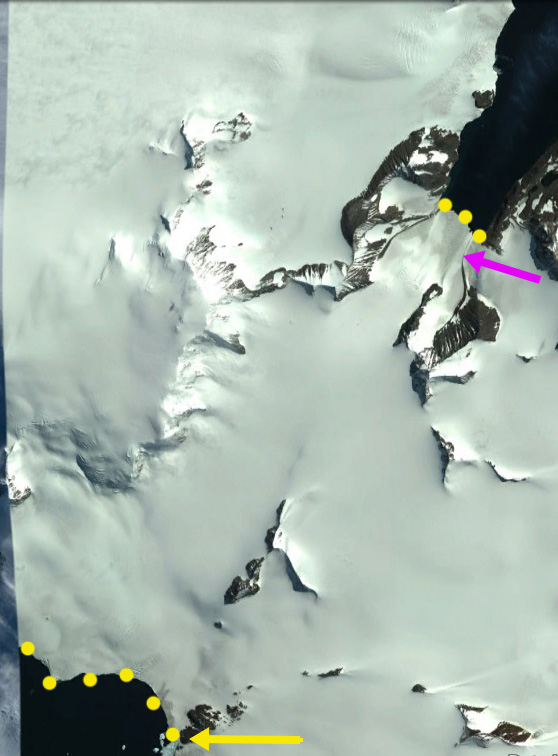
Coley Glacier terminus comparsion in Landsat images from 2000 (red arrows) and 2016 (yellow arrow)  indicating a retreat of 2 km along the western side and 1 km along the eastern side.  Purple dots indicate the transient snowline and the purple arrow an area of debris exposed with glacier thinning. 

Coley Glacier is a tidewater glacier on the northeast side of James Ross Island near the tip of the Antarctic Peninsula. Davies et al (2012) observed that 90% of the glaciers of the Northern Antarctic Peninsula including James Ross Island retreated from 1988-2001 and 79% from 2001-2009. They further observed that the rapid shrinkage of tidewater glaciers on James Ross Island would continue due to their low elevation and relatively flat profiles. Rohss Bay Glacier is one example of this having retreated 15 km from 1999-2009 (Glasser et al, 2011).  Barrand et al (2013) note a strong positive and significant trend in melt conditions in the region, driving the retreat.

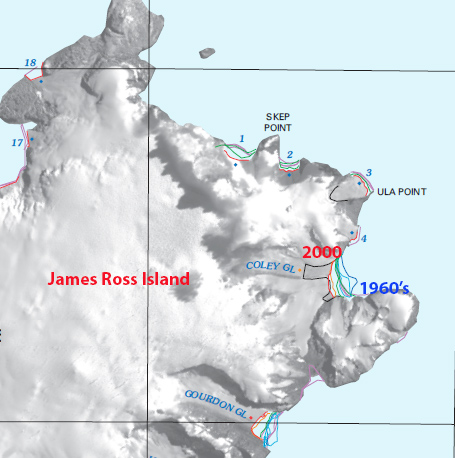
Coley Glacier in 2000 had a relatively straight calving front running across the embayment. The front represents the joining of four tributary glaciers.  The snowline was generally below the top of the escarpment just west of Point C, the elevation of this lower glacier reach is below 200 m.  This fits the low elevation low slope criteria noted by Davies et al (2012).  By 2016 the glacier has developed a concave glacier front with the northern tributary almost separating the retreat ranges from 2 km on the west side to 1 km on the east side.  The snowline is above the escarpment at 400 m. A comparison below of 2001 and 2015 indicates that the snowline in 2015 was also near 400 m and above the escarpment. A map of the region from the USGS (Ferigno et al.,2006) illustrates the retreat from the 1960’s to 2000.  Nývlt et al (2010)  reported on the retreat and changes on two glaciers on the north side of James Ross Island.coley-tsl-compare

Coley Glacier terminus comparison in Landsat images from 2001 and 2015.  Red arrows is the 2000 terminus and yellow arrows the 2016 terminus.  Purple dots indicate the transient snowline and the purple arrow an area of debris exposed with glacier thinning. 

coley-glacier-map
COASTAL-CHANGE AND GLACIOLOGICAL MAP OF THE TRINITY PENINSULA AREA AND SOUTH SHETLAND ISLANDS, ANTARCTICA: 1843–2001
USGS (Ferigno et al.,2006)


Sjögren Glacier Fast Flow, Fast Retreat, Antarctica

sjogren compare

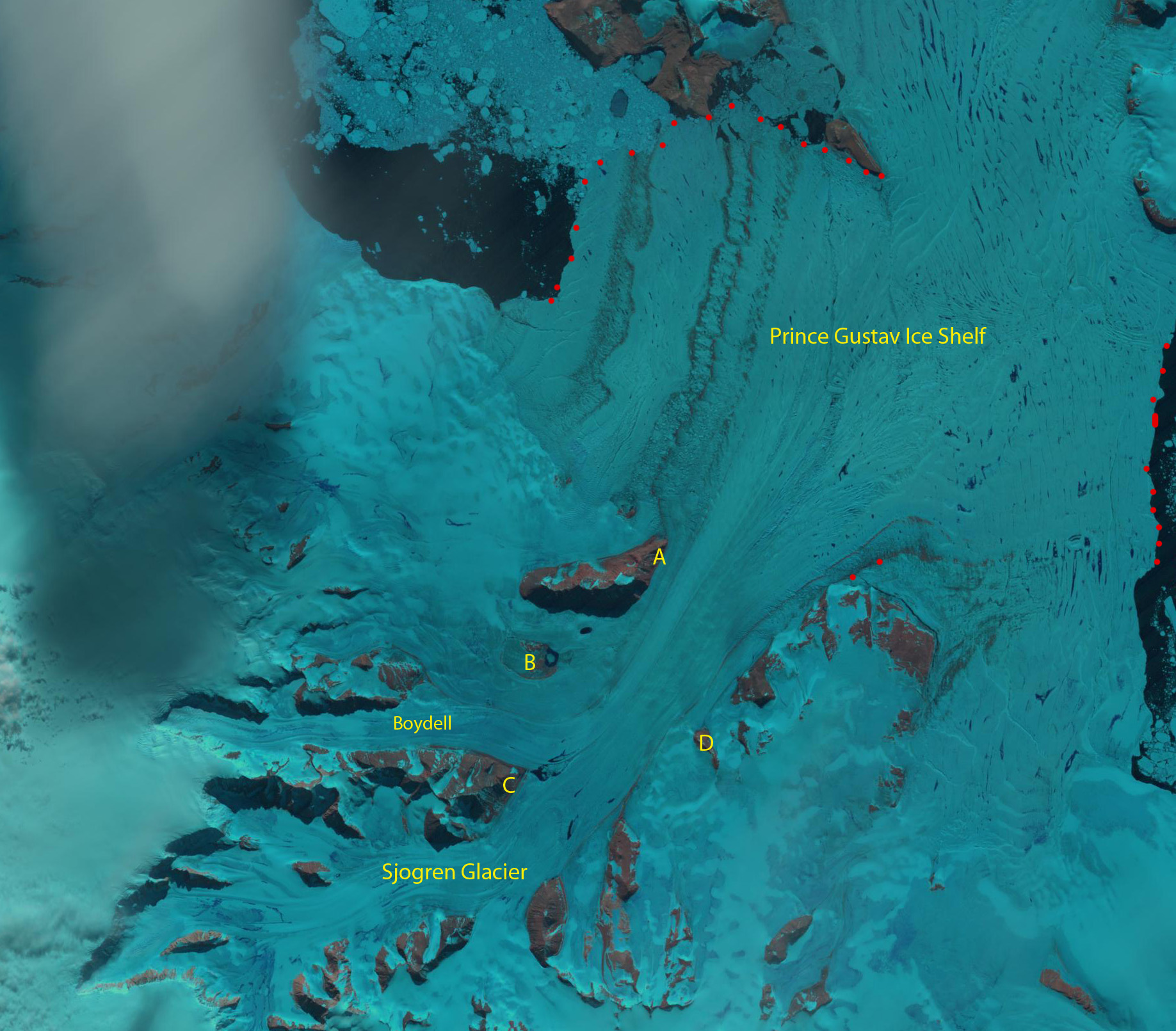
Sjögren Glacier comparison in Landsat images from 2001 and 2016, red dots indicate terminus position, Point A, B, C and D are in fixed locations. 

Sjögren Glacier flows east from the northern Antarctic Peninsula and prior to the 1980’s was a principal feeder glacier to Prince Gustav Ice Shelf.  This 1600 square kilometer ice shelf disintegrated in the mid-1990’s and was gone in 1995 (Cook and Vaughan, 2010). Scambos et al (2014) noted a widespread thinning and retreat of Northern Antarctic Peninsula Glaciers with the greatest changes where ice shelf collapse had occurred, Sjögren Glacier being one of the locations. Scambos et al (2004) first documented the acceleration of glaciers that fed an ice shelf after ice shelf loss in the Larsen B region. A new paper by Seehaus et al (2016)  focuses on long term velocity change at Sjögren Glacier as it continues to retreat.  This study illustrates the acceleration is long lived with a peak velocity of 2.8 m/day in 2007 declining to 1.4 m/day in 2014, compared to a 1996 velocity of  0.7 m/day, which was likely already higher than the velocity in years prior to ice shelf breakup. Here we examine Landsat images from 1990, 2001, 2005 and 2016 to illustrate changes in terminus position of Sjögren Glacier

In the 1990 Landsat image Sjögren Glacier feed directly into the Prince Gustav ice Shelf which then By 1993 Seehaus et al (2016) note that Sjögren Glacier had retreated to the mouth of Sjögren Inlet in 1993, this is marked Point A on Landsat Images. By 2001 the glacier had retreated to Point B,  a distance of 7 km.  Between 2001 and 2005 Sjögren Glacier retreat led to a separation from Boydell Glacier at Point C.  In 2016 Sjögren Glacier had retreated 10-11 km from the 2001 location, and 4.5 km from Point C up the expanding fjord. The production of icebergs remains heavy and the inlet does not narrow for another 6 km from the front.  Seehaus et al (2016) Figure 1  indicates that the area of high velocity over 1 m/day extends 1 km upglacier, with somewhat of a slowdown at 6 km behind the front. The high velocity and limited change in fjord width in the lower 6 km indicates there is not a new pinning point to slow retreat appreciably in this stretch. Figure 1 also illustrates the retreat from 1993-2014. The pattern of ice shelf loss and glacier retreat after loss has also played out at Jones Ice Shelf and Rohss Bay.

sjogren glacier 1990

1990 Landsat Image of Sjogren Glacier and Prince Gustav Ice Shelf, terminus marked by red dots

sjogren 2005

2005 Landsat Image of Sjogren Glacier, terminus marked by red dots


Nansen Ice Shelf, Antarctica Calving Event Occurs April 2016

nansen compare calving

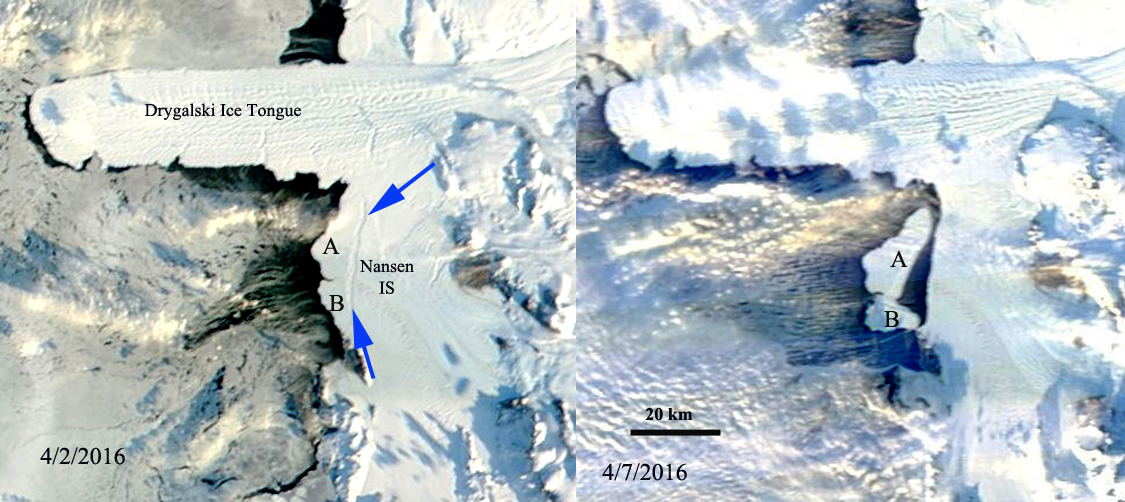
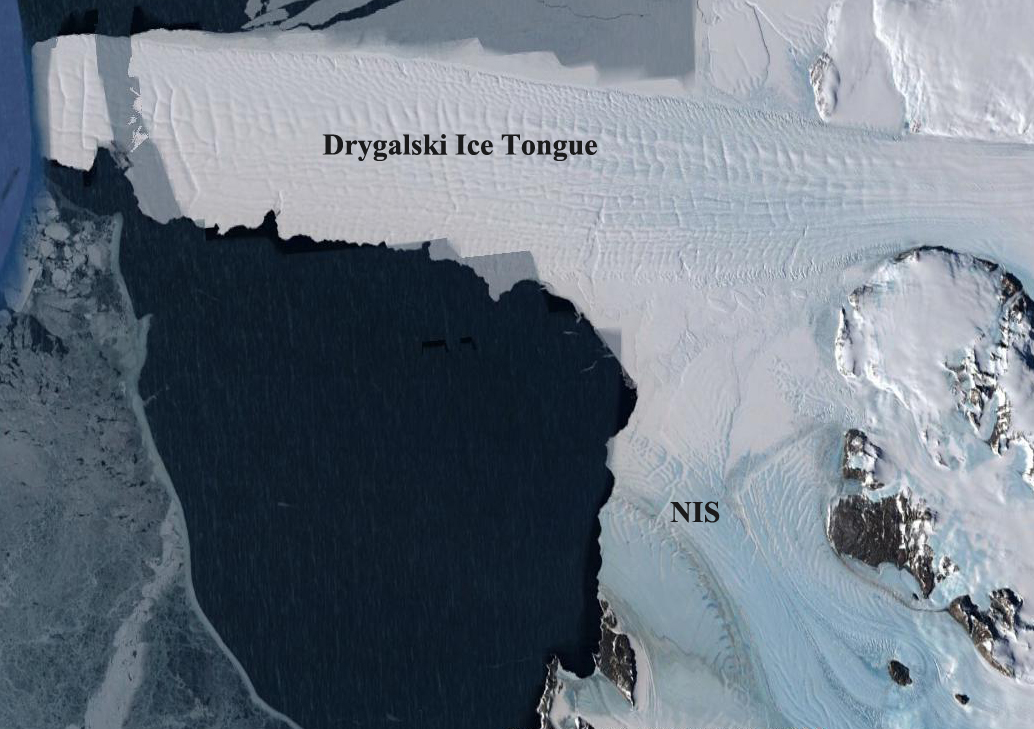
Nansen Ice Shelf just north of Dryglaski Ice Tongue on April 2 with evident rift,blue arrows, and after calving two icebergs on April 7, A and B. Images from NASA MODIS

The NIWA reported a calving event from the Nansen Ice Shelf on April 11, 2016.  They are concerned about a mooring in Terra Nova Bay in front of the ice shelves. The area of the Nansen Ice Shelf is 1500 square kilometers, these icebergs have a combined estimate of approximately 250 square kilometers.  This is a substantial calving event for such a small system. Below is an image of the Nansen Ice Shelf on January 1, 2014 and January 1, 2016.  This illustrates the Terra Nova Bay polyna that develops every summer, and affects sea ice dynamics, and certainly the ice shelf. The former lacks a notable rift, the latter exhibits the rift that would lead to calving, the rift had formed in late 2013, but is still not evident in imagery of the resolution of MODIS.  NIWA had been watching this expanding rift for signs of calving.  NASA had warned in March that calving was imminent and had been monitoring the ice shelf to determine the affect of tides on the ice shelf dynamics.  The rift is beautifully shown by NASA in its growth from 2013 to 2015. Such rifting and calving can be part of stable dynamics as on Stange Ice Shelf or an indicator of instability as in the case of Verdi Ice shelf.

nansen comapre

Nansen Ice Shelf in January 2014 and January 2016.

terra nova 1999

Google Earth image of the region in 1999 indicating several significant rifts.

Stange Ice Shelf, Antarctica, Maintains Stability 1989-2016


stange-2016b

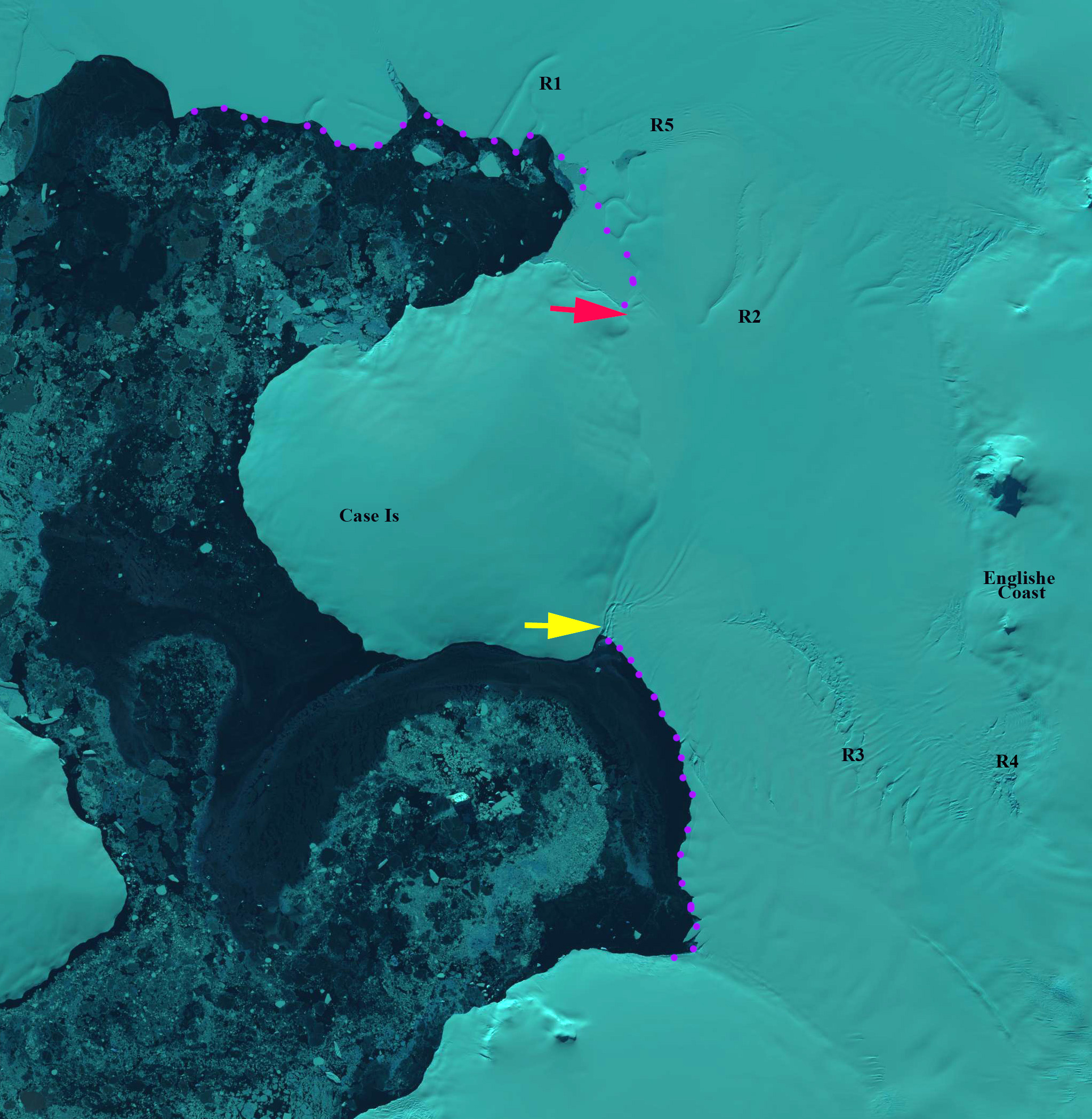
Stange Ice Shelf, Antarctica in 2016 Landsat image.  Five rift zones are mentioned two  by the southern ice front R3 and R4.  Two by the central ice front R1 and R2. Purple dots mark ice front and yellow and red arrow the 1989 frontal positions on the north and south side of Case Island

Holt et al (2014) provide an exemplary examination of the dynamics from 1973 to 2011 of Stange Ice Shelf  This ~8000 square kilometer ice shelf is at the base of the Antarctic Peninsula on its west side. With several ice shelf collapsing and indicating structural weakness, all should be examined, each will have a different story. They examined the ice shelf for the four key precursor symptoms of an ice sheet collapse.  1) Significant thinning due to surface or basal melt, which can structurally weaken the ice sheet.  2) Structural weakening along suture zones.  3) Sustained retreat and development of a concave front that has less connection to pinning points.  4) Increase in velocity.  Examples where weakness is evident are en Verdi Ice Shelf, Wordie Ice Shelf and Jones Ice Shelf to the north. Here we use Landsat imagery from 1989, 2003 and 2016 to examine the south and central ice front, which illustrates what Holt et al (2014) concluded that the ice shelf is currently stable.

stange map

From Holt et al (2014)

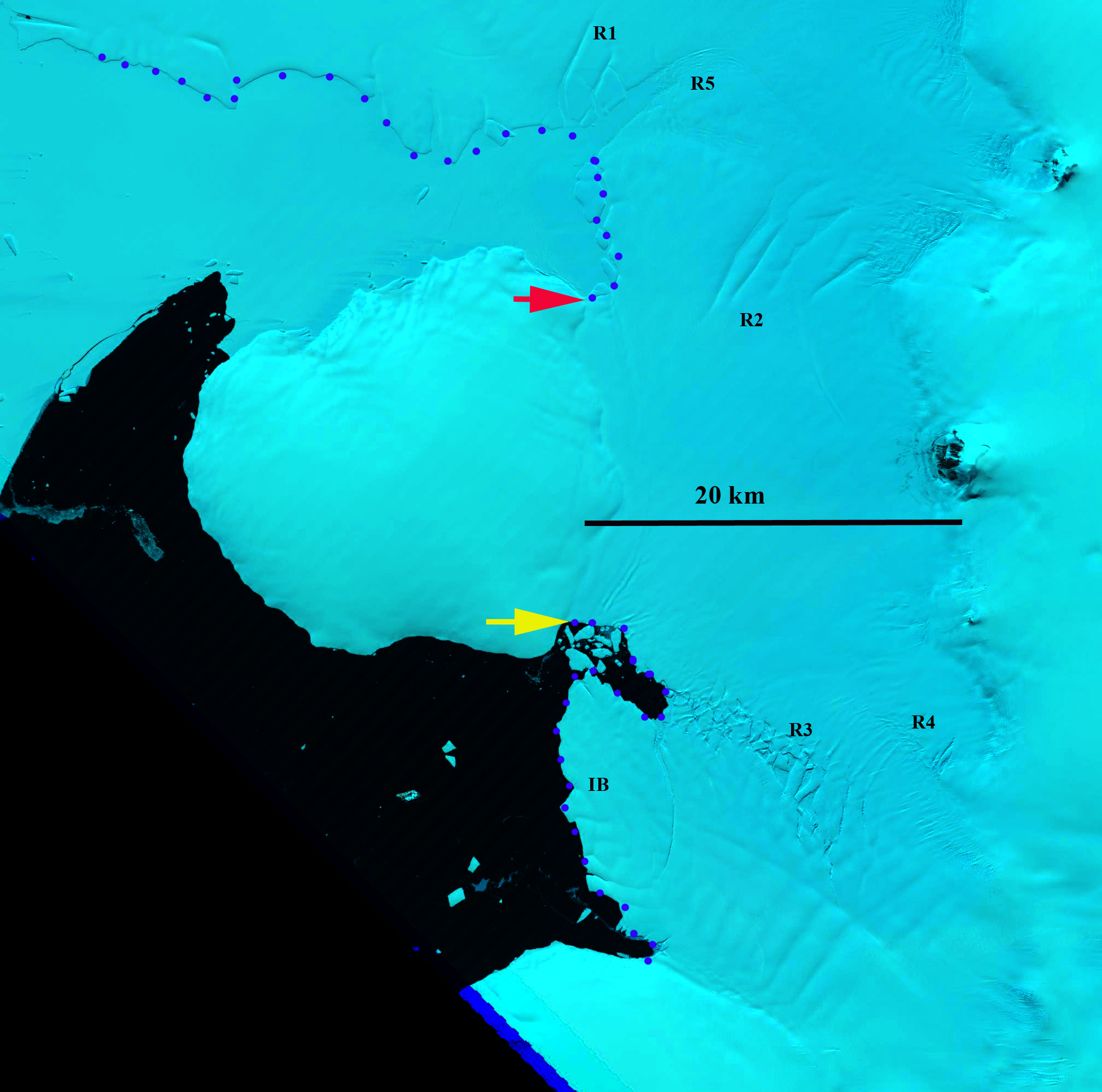
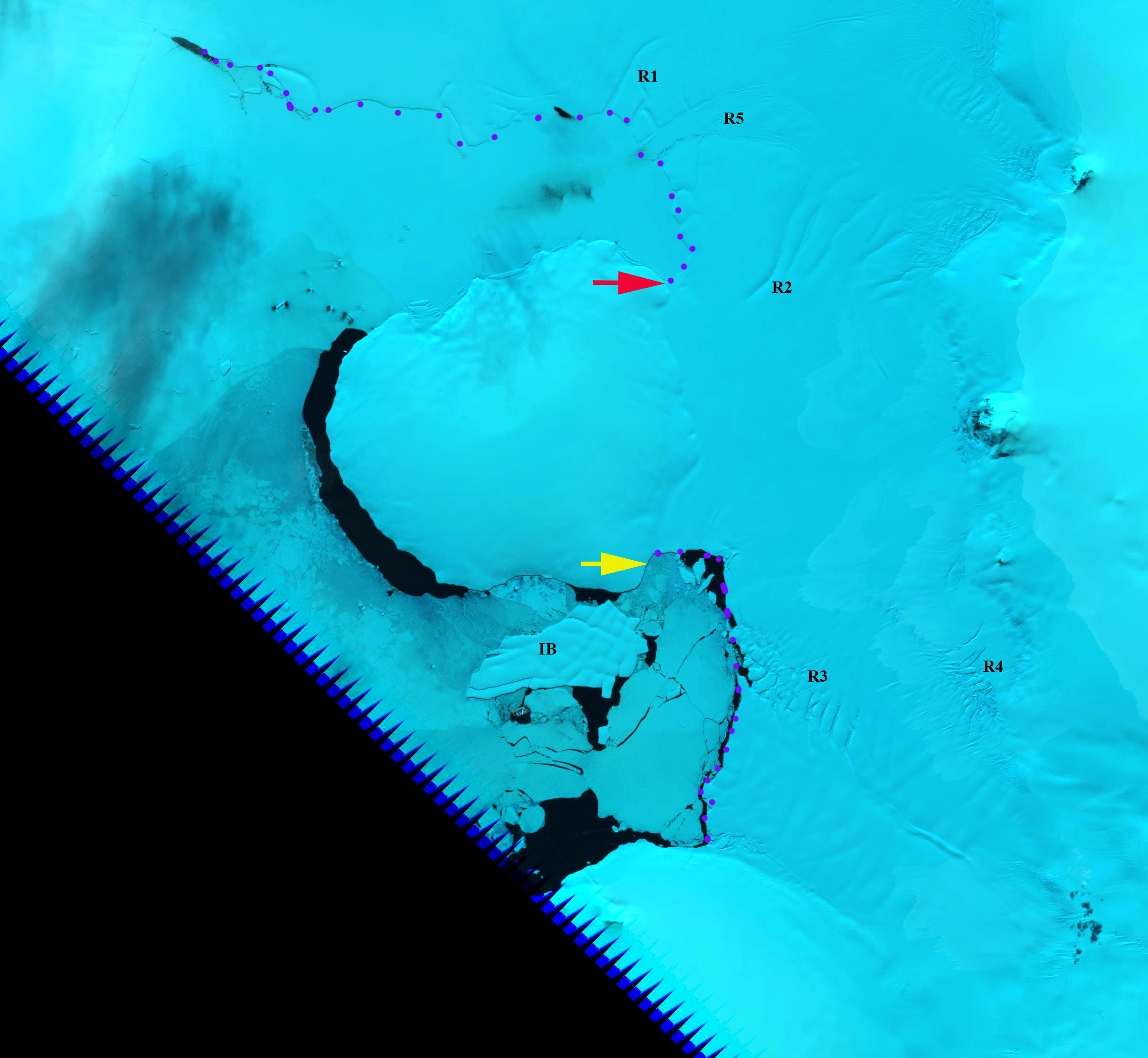
The northern portion of the Ice shelf did lose 384 square kilometers between 1973 and 2011, while the southern and central ice front region each gained, a combined 48 square kilometers (Holt et al., 2014: Figure 2).  Comparisons from 1989 to 2016 indicated very limited net ice front change from 1989 to 2016. The net change is 4% ice shelf area loss.  In the case of the southern and central ice front there is not a sustained retreat. For velocity the net change in Holt et al (2014: Fig. 4) indicates only one area of significant acceleration, just southeast of Case Island and running just north and west of Rift zone R3. Just south of this zone and R3 was a zone of declining velocity. Surface elevation change was not consistent temporally or spatially.  There was a net overall thinning of 0.17 m/year, a relatively minor amount (Holt et al, 2014: Fig. 5).  This is a region dominated by basal melt ablation, which has been the key loss for most ice shelves (Pritchard et al 2012).  A structural examination of rifting and suture zones indicated that most rifting had been persistent throughout the period.  The exception was on the boundary of the accelerating and decelerating ice near R3, that occurred after 2001 when the iceberg noted calved. In 1989 this yet to be created iceberg has rifts that indicate it will soon calve, and in 2003 it has calved and moved from the calving front. For most rift areas there is little change from 1989 to 2003 to 2016,  except for 3 where the degree of rifting has decreased. The overall assessment is that Stange Ice Shelf is currently stable, with none of the four precursor symptoms being widespread and significant spatially and temporally.

stange 1989

Stange Ice Shelf, Antarctica in 1989 Landsat image.  Five rift zones are mentioned two  by the southern ice front R3 and R4.  Two by the central ice front R1 and R2. Purple dots mark ice front and yellow and red arrow the 1989 frontal positions on the north and south side of Case Island. IB= Ice berg that calves in 2001

stange 2003

Stange Ice Shelf, Antarctica in 2003 landsat image.  Five rift zones are mentioned two  by the southern ice front R3 and R4.  Two by the central ice front R1 and R2. Purple dots mark ice front and yellow and red arrow the 1989 frontal positions on the north and south side of Case Island. IB= Ice berg that calves in 2001

Coronation Island Glacier Retreat, South Orkney Islands

sunshine compare

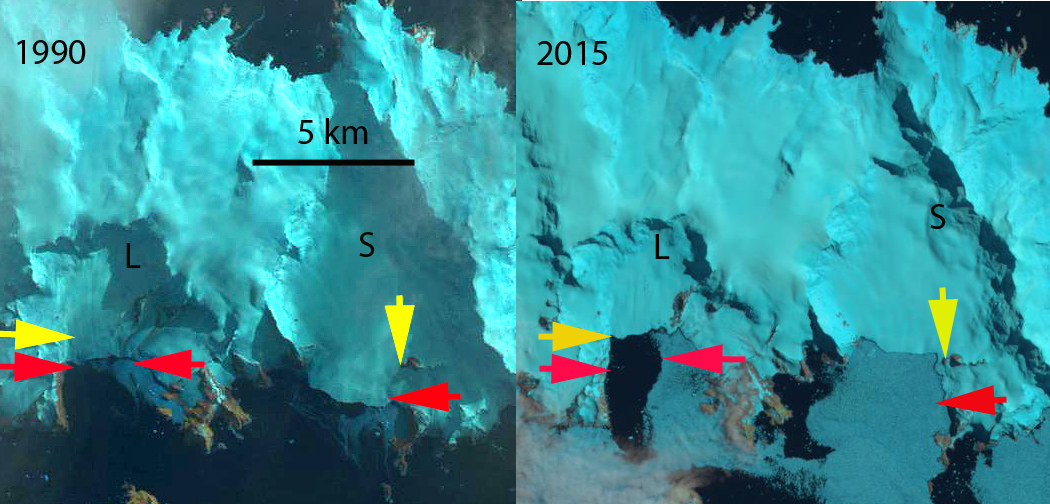
Lewis Glacier (S) and Sunshine Glacier (S) on Coronation Island in 1990 and 2015.  Red arrow is 1990 terminus location and yellow arrow the 2015 terminus location.  

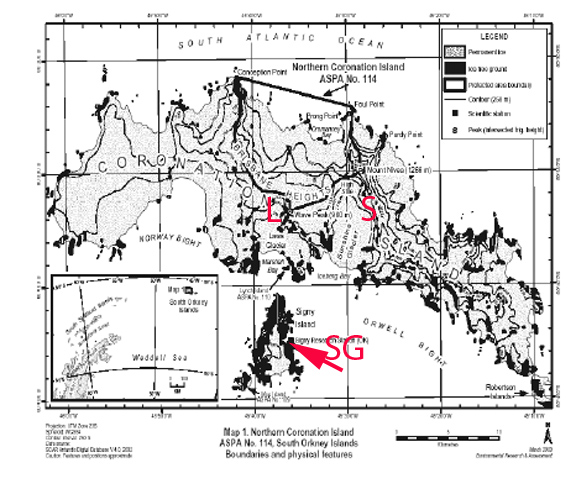
Sunshine and Lewis Glacier are tidewater glaciers on the south side of Coronation Island in the South Orkney Islands.  This is an area of excessive cloud cover leading to few available satellite images illustrating glacier change.  A map of the glaciers from the British Antarctic Survey indicates they had nearly filled the embayments.  The BAS maintains a research base on Signy Island (SG) that faces directly across the Orwell Bight to Sunshine Glacier.  Coronation Island is extremely windy with the prevailing westerly wind averaging about 14 knots, at Signy Station with gales recorded on about 60 days each year. The Signy Station research focuses mainly on marine mammals and birds, with elephant seals, chinstrap, Adelie and gentoo penguins being most common.Cornonation map

Map of Coronation Island indicating Lewis Glacier (L), Sunshine Glacier (S) and the BAS Signy research station (SG)

SIGNY_sunshine

View across Orwell Bight from Signy Island to Sunshine Glacier with the BAS Research vessel James Clark Ross in view during November 2015. (From BAS)

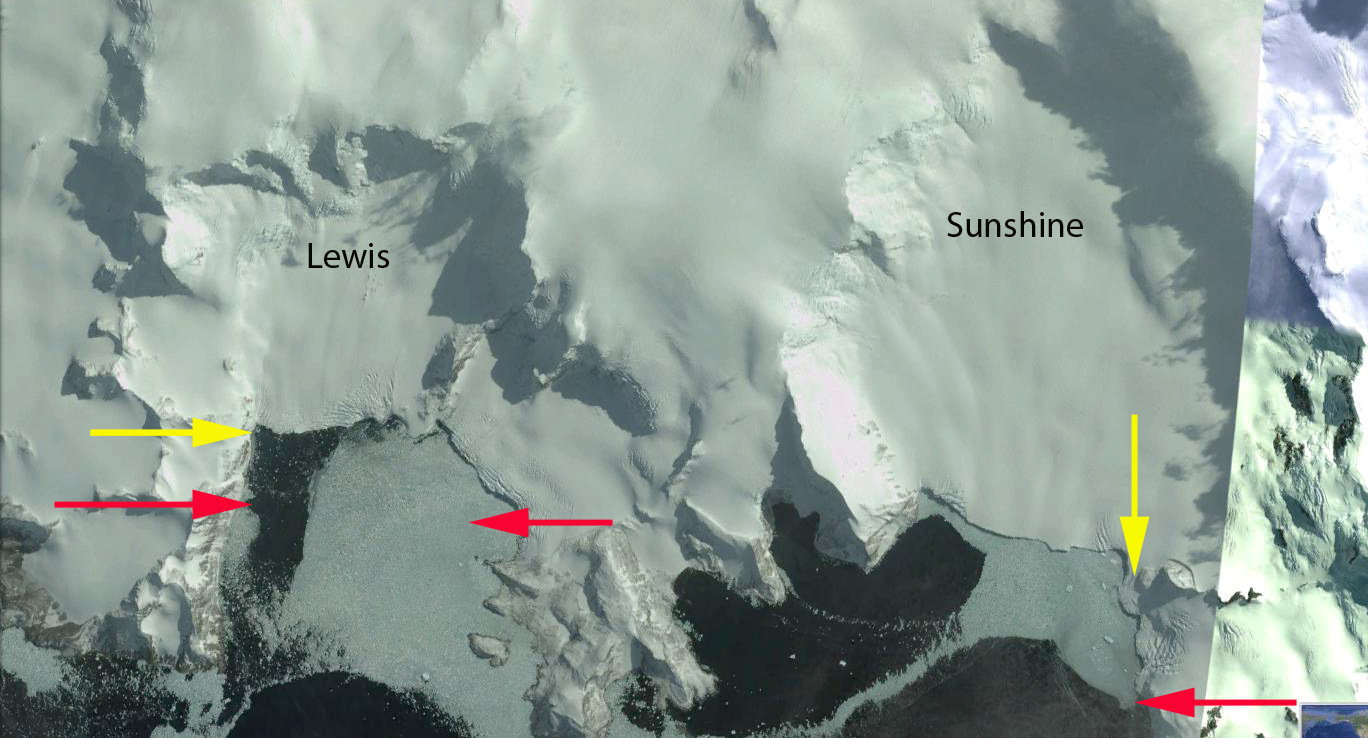
In 1990 Lewis Glacier had an east-west calving front extending from the last prominent east-west oriented ridge on the west side of the glacier.  Sunshine Glacier extended well beyond the end of  prominent ridge on the west edge of the glacier.  By 2005 in the Google Earth image below Lewis Glacier had retreated in the center of the glacier more than on the west end.  By 2013 Lewis Glacier had retreated to a second prominent east west trending ridge.  Sunshine Glacier had retreated beyond the prominent ridge on the west by 2005.  From 2005 to 2013 additional retreat occurred along the east side of Sunshine Glacier.  The terminus on the east side of Sunshine Glacier is now adjacent to a series of  nunataks comprising a ridge extending east from the glacier. Retreat of Lewis Glacier from 1980 to 2015 averaged 900 m across the 3 km wide calving front.  Sunshine Glacier retreated 1100 m from 1990 to 2015 across the 3.5 km wide calving front.  Both glaciers have relatively flat regions within one kilometer of the calving front which are prone to continued calving retreat. The glaciers are encased in sea ice much of the year protecting the calving front, but the summer climate is maritime with temperatures typically above freezing and the area relatively ice free.  Today the region is also accessed by Oceanwide Expeditions.  The retreat is similar to that of nearby on Endurance Glacier on Elephant Island and many retreating glaciers on South Georgia Island. .

sunshine 2005 ge

Google Earth images from 2005 and 2013 indicating the 1990 (red arrows) and 2015 terminus locations (yellow arrows). 

sunshine 2013 ge

Click to access aca2_spa114.pdf

Endurance Glacier, Elephant Island Retreat

endurance glacier compare

Landsat comparison from 1990 and 2015 of Endurance Glacier, Elephant Island-Embayment development east and west side of calving terminus. 

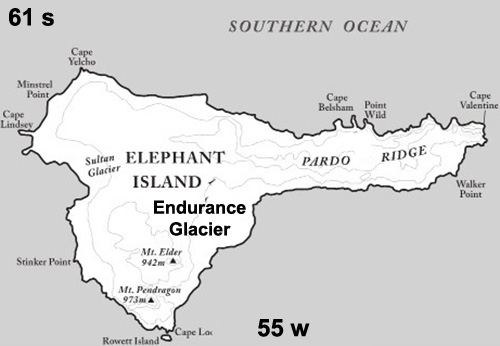
Endurance Glacier is the main outlet glacier of this heavily glaciated island of the South Shetland Islands. The name of the island comes from the numerous elephant seals. The name of the glacier comes from the Ernest Shackleton and his crew from the Endurance reaching the island in 1916 after a journey in open boats, following the loss of their ship Endurance in Weddell Sea ice.  Amazingly 28 men somehow survived the trip to Elephant Island. The name is also appropriate as it takes real endurance to visit and observe the glacier as is evident in the lack of observations on this glacier. I have been waiting since the launch of Landsat 8 in 2013 for a reasonably clear image of this obviously cloudy area. The December 16th, 2015 image is that image. here we examine the changes in this glacier from 1990 to 2015 using Landsat images. Endurance Glacier has 6 km wide calving front facing the open ocean. The glacier is heavily crevassed in the center near the calving face. This glacier must be exposed to as much wave action as any glacier in the world, since it lacks sea ice protection from November-May.

elephant island

 Elephant Island, South Shetland Islands

In 1990 the calving front has a slight convexity with the terminus extending parallel to the coast from the red arrows. A specific nunatak is Point 1, and is 1.4 km from the calving front. By 2001 embayments have begun to develop on the east and west end of the calving front. By 2015 the calving front has a pronounced convex center with two substantial embayments on the east and the west. Point 1 is now 700 m from the calving front. The embayment adjacent to this indicates a retreat of 500-1000 m across a 2 km ice front. The western embayment is larger 2.25 km wide with the front having retreated 1000 to 1500 m. The increasing exposure of the central terminus tongues to wave action and ocean water, should lead to its loss in the near future. This is evident in the Google Earth image below. This glaciers retreat is less than glaciers on South Georgia such as Neumayer and Hindle Glacier.

elephant island 2000
2001 Landsat image

elephant island ge

Google Earth image from 2014 note convex center tongue, embayments east and west and heavy crevassing.


Pine Island Releases New Iceberg after Austral Winter 2015

Pine_Island_Glacier.2015267.terra

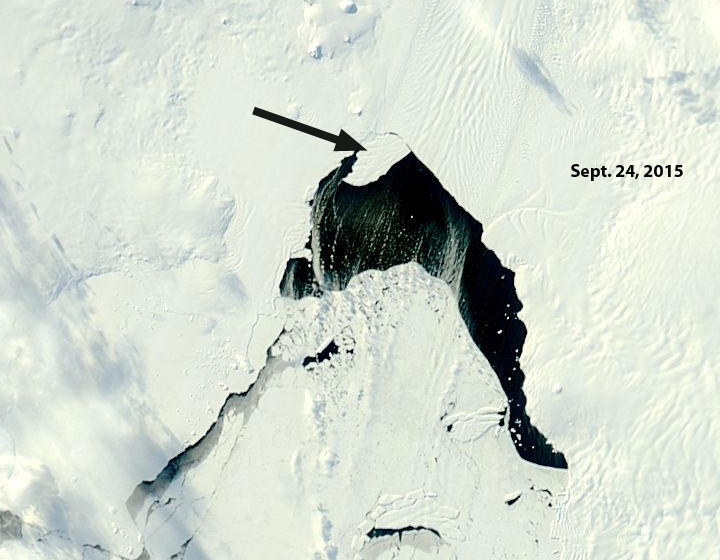
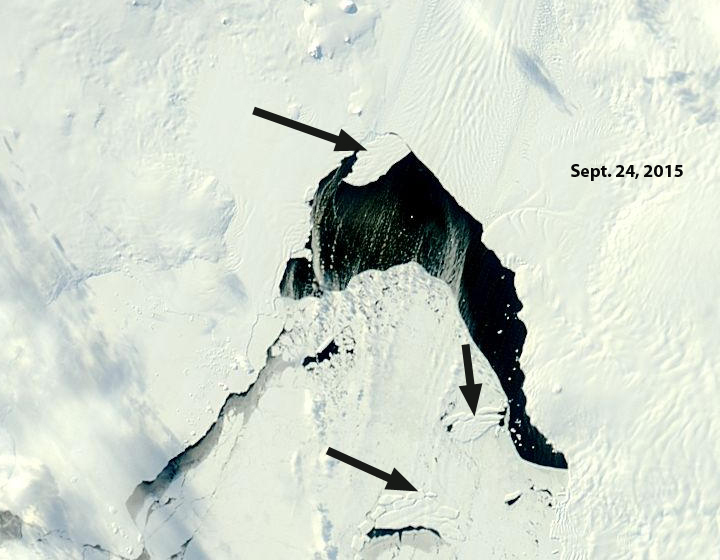
NASA MODIS Image from Sept. 24, 2015 showing new iceberg at calving front of Pine Island Glacier, Antarctica
In the MODIS images from the NASA Rapid Response image sets below you can see the lack of rifting in February, 2015 and April, 2015 that will lead at the calving front where the iceberg will break off that is evident on Sept. 24, 2015.  A new iceberg was reported having calved by the US National Ice Center in August, labelled B-35, it was reported to be 12.66 miles (20.4 km) long by 8 miles (12.8 km) wide. The iceberg indicated in the Sept. 24 image is not B-35.  It is much smaller than B-31 that broke off in 2013, but is approximately 14 km long and 8 km wide.  There are two other icebergs indicated that also broke off over the winter from Pine Island Glacier, into the polyna.

As Operation IceBridge begins its 2015 southern campaign I am sure we will learn much more about this iceberg. Details on the 2013 Calving illustrate a slower process from rift formation to calving. Pine Island Glacier is remains a key glacier that is undergoing rapid change.

Pine_Island_Glacier.2015091.terra

Pine_Island_Glacier.2015053.terra

Pine_Island_Glacier 9242015

Pine_Island_Glacier.2013320.aqua


Developing Instability of Verdi Ice Shelf, Antarctica: Extensive Rift Formation

The Verdi Ice Shelf is a small ice shelf on the Beethoven Peninsula of Alexander Island on the Antarctic Peninsula. Its small size limits its global importance, but it does provide an excellent example of the rapid development of rifting that indicates potential instability. An ice shelf is a floating portion of a glacier, it buttresses glaciers that drain into it and is in turn buttressed by pinning points along the margin and within the ice shelf provided by islands and ice rises. Ice Shelf processes are well described by Davies (2014).

Cook and Vaughan (2010)  observed that in recent decades, seven out of twelve larger ice shelves around the Antarctic Peninsula have retreated significantly or been almost entirely lost. This is a pattern of behavior that indicates the ability of ice shelves to collapse entirely or significantly in a short period of time. A recent paper by Holland et al (2015) noted that the much larger Larsen C Ice Shelf is thinning from above and below. The thinning of an ice shelf is the essential pre-conditioning for collapse (Pelto, 2008). NASA last week also predicted the demise within five years of the remaining portion of Larsen B.

Holt et al (2013) outlined several key glaciological characteristics as typically preceding recent ice shelf collapses:

(1) Sustained ice-front retreat, resulting in a frontal geometry that bows inwards towards its centre from both lateral pinning points (Doake et al., 1998);

(2) Continued thinning from atmospheric or oceanic warming (Shepherd et al., 2004);

(3) An increase in flow speed:

(4) Structural weakening,  such as rifting along suture zones (Glasser and Scambos, 2008), and also rifting transverse-to-flow due to changing stress regimes within the ice shelf (Braun et al., 2009). Braun et al (2009) note that for Wilkins Ice Shelf just to the north of Verdi Ice Shelf surface melt and drainage of melt ponds into crevasses were not relevant for break-up. Increased buoyancy forces from thinning caused rift formation before the break-up in February 2008 was the key. Glasser et al (2011) examined the Röhss Glacier following the 1995 collapse of the Prince Gustav Ice Shelf, Antarctic Peninsula identifying the development of numerous structural discontinuities: rifts, crevasses and melt ponds on the ice shelf before the collapse.

Here we examine Landsat imagery of Verdi Ice Shelf from 2000-2014. To identify both frontal changes and structural changes.

LayoutForPDF
Map of the Verdi Ice Shelf region taken from the USGS Palmer Land Map.

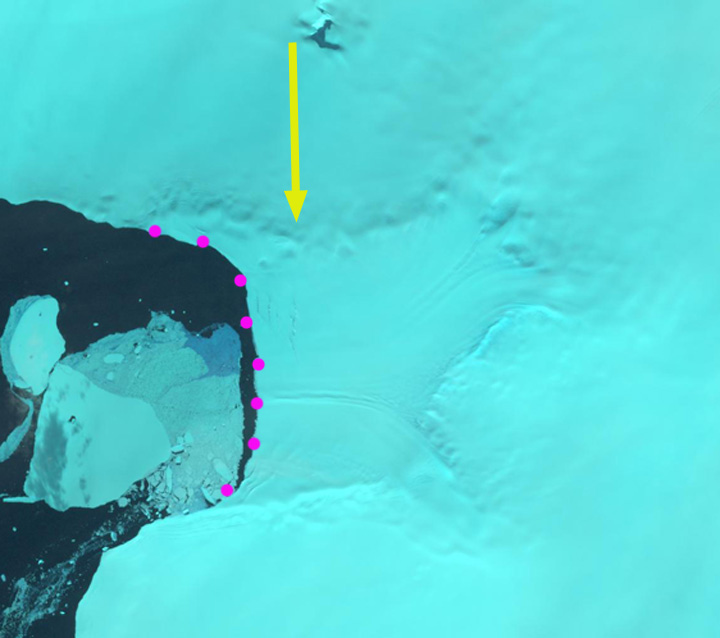
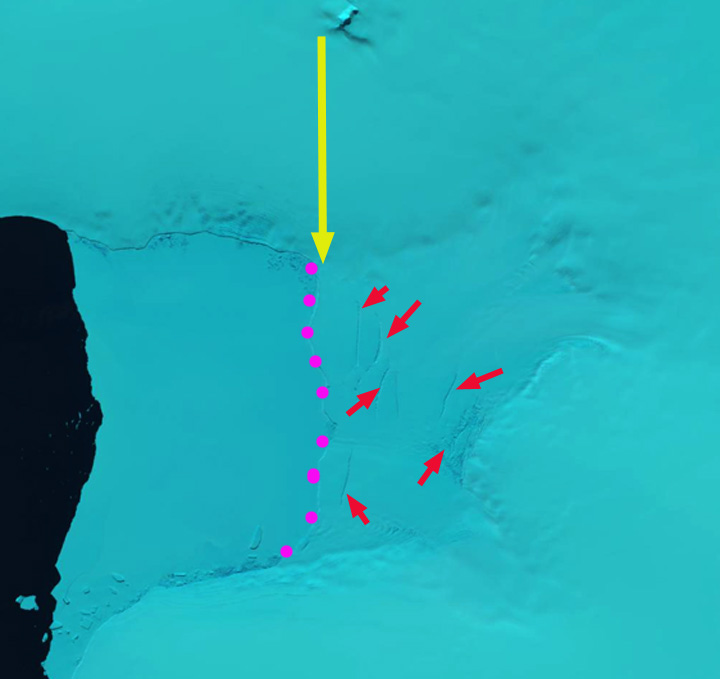
The above map indicates retreat of 1.5-2 km of the ice front from 1973-2001 and that the front is bowed inward at the center meeting the first criteria noted above. In each image the yellow arrow indicates the 2001 ice front of Verdi Ice Shelf on the northeast side. The pink dots in each image is the complete ice front. The red arrow indicate large rifts visible in the Landsat images, which have a 30 m resolution. In 1999 there are no major visible rifts. There are a few minor rifts close to the ice front. The maximum length of the ice shelf is 14.5 km. In 2001 the frontal position has not changed significantly and no significant rifts are visible. In 2003 the ice front has retreated 0.5-1 km, there are two minor visible near the ice front, to the left (west) of the yellow arrow. In 2013 and 2014 the maximum length of the ice shelf has declined to 12.5 km, a 2 km retreat in 15 years. More importantly there are now six significant rifts in the ice shelf, including two well back of the ice front. The rifts range from 2-4 km in length, a significant portion of the entire ice shelf width. The most inland rifted area noted occurs at the inland edge of the ice shelf and instead of a single rift is an area of numerous smaller rifts. The rapid development of the rifts suggests the ice shelf has thinned to a point of instability. This does not mean it will disintegrate entirely or immediately, but does suggest that most of the ice shelf is poised to collapse in the next decade.

Similar recent ice shelf changes reviewed are: Jones Ice Shelf and Wordie Ice Shelf. The understanding of the processes has taken detailed field work by many field teams. Examples being the LARsen Ice Shelf System, Antarctica (LARISSA) team and the British Antarctic Survey supported research at James Ross Island and Wilkins/Larsen Ice Shelf.
verdi is 1999
1999 Google Earth image

verdi is 2001
2001 Landsat image

verdi is 2003
2003 Landsat image

verdi is 2013
2013 Landsat image

verdi is 2014
2014 Landsat image