San Lorenzo Sur Glacier, Argentina Retreat 1986-2020

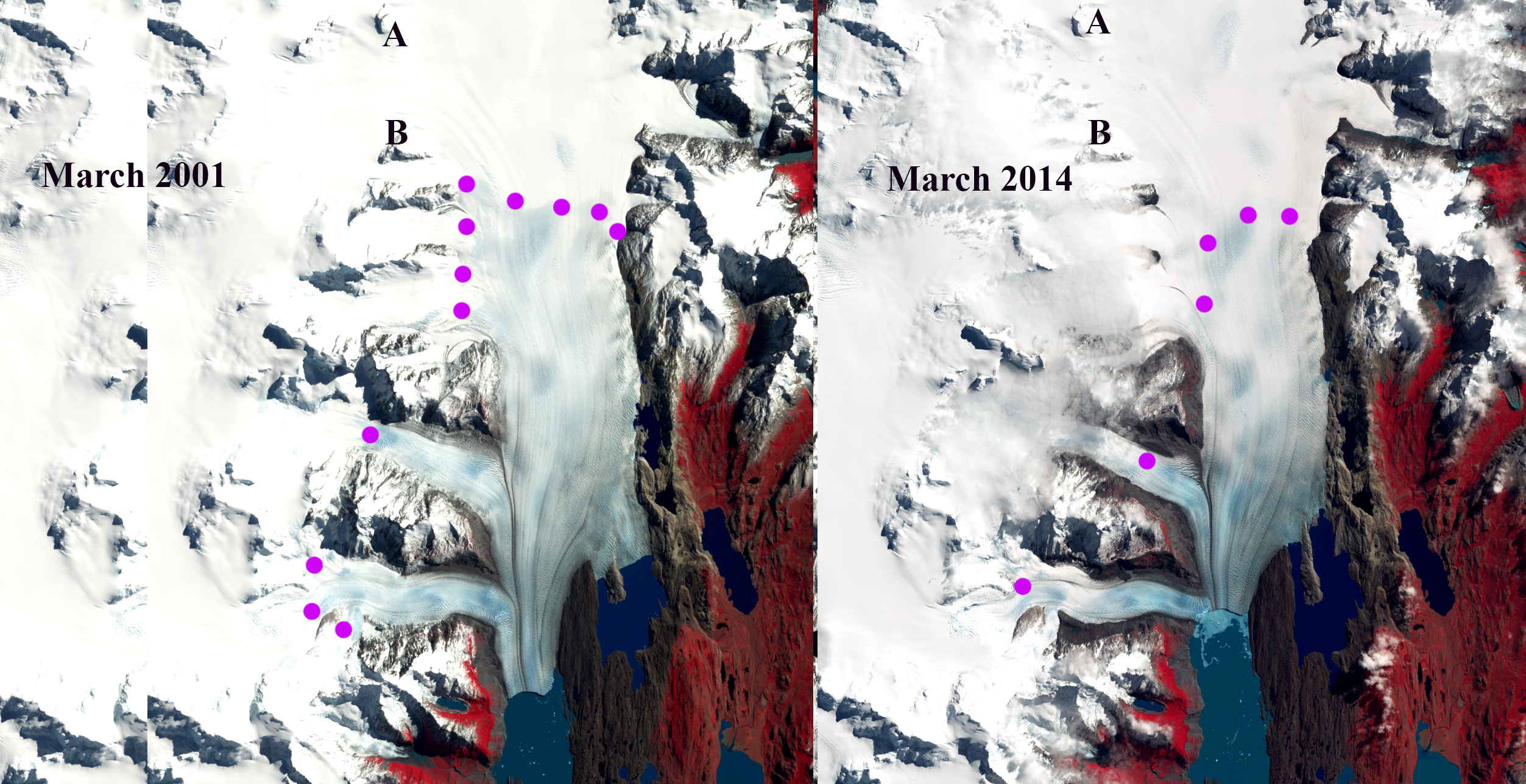
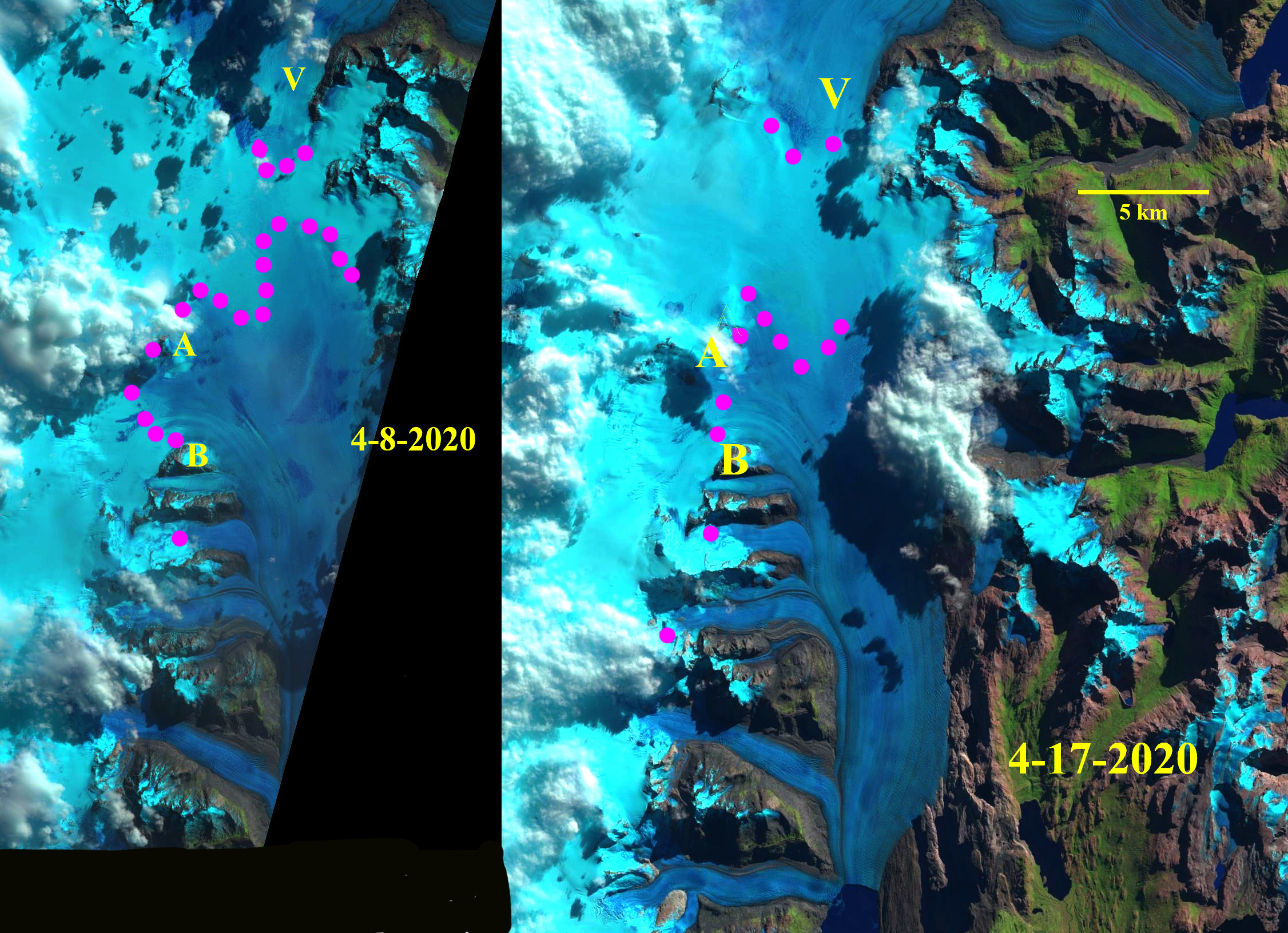
San Lorenzo Sur Glacier in Landsat images from 1986 and 2020.  Yellow arrow is the 2020 terminus location, red arrow the 1986 terminus location, purple dots indicate the snowline. Point A indicates a location at 1400 m where debris cover has expanded.

San Lorenzo Sur Glacier is the main eastern outlet glacier of the Monte San Lorenzo range on the Chile-Argentina border. This Argentina glacier flows east from the border separating into an eastern (sometimes referred to as Rio Lacteo Glacier) and southern terminus tongue, that in 1986 terminated in two small developing proglacial lakes. From 1985 to 2005/2008 Monte San Lorenzo glaciers lost 18.6% of their area (Falaschi et al 2013). In this region glaciers thinned by ~0.5 m/year from 2000-2012 with most of the thinning on  San Lorenzo Sur Glacier occurring on the lower sloped valley section below 1400 m (Falaschi et al 2017). The glacial history of the region has been documented with detailed visual depictions including dated Holocene moraines and trimlines encircling the developing proglacial lakes by Davies et al (2020), see below example. Here we examine the changes in San Lorenzo Sur Glacier from 1986-2020 using Landsat images.

In 1986 the southern terminus ended in a 0.5 km2 proglacial lake, while the eastern terminus ended in a developing proglacial lake of 0.2 km2.  The snowline is at 1350 m and widespread debris cover begins below 1300 m, with Point A being above this elevation.  By 1999 retreat has led to lake expansion at the southern terminus to 0.8 km2 and 1.1 km2 at the eastern terminus.  The snowline is at 1600 m.  In 2016 debris cover has expanded to Point A and the snowline is at 1800-1900 m.  There are numerous small icebergs in the proglacial lake in front of the eastern terminus.  By 2020 the southern terminus has retreated 2.5 km since 1986, and the proglacial lake now has an area of 3.3 km2.  The eastern terminus has retreated 2.9 km since 1986 and the lake now has an area of 3.2 km2.  Debris cover is now widespread at Point A indicating the ablation zone expansion. The lower 2 km of the southern terminus is a heavily debris covered relatively stagnant zone, poised for retreat. The eastern terminus has a stagnant zone that is 0.5 km wide indicating more limited near term potential for retreat and lake expansion.  The snowline is again at 1800-1900 m.  The elevation of snowline is not sufficient to maintain the larger valley tongues of the glacier. The expansion in area and elevation of debris cover has been observed on Northern Patagonia Icefeld glaciers as well (Glassser et al, 2016), for example on Exploradores Glacier.

Retreat here follows that of adjacent Caluqueo Glacier and the Sierra de Sangra region, Argentina and glaciers of the Northern Patagonia Icefield, such as Fiero Glacier and Acodado Glacier.

San Lorenzo Sur Glacier in Landsat images from 1999 and 2016.  Yellow arrow is the 2020 terminus location, red arrow the 1986 terminus location, purple dots indicate the snowline. Point A indicates a location at 1400 m where debris cover has expanded.

In the map above from Davies et al (2020) GIS app.  The Black arrows indicate dated locations on moraines from ~2000-5000 years ago, while the green arrows indicate deglaciation dates from the Little Ice Age period. Yellow arrows on right hand image indicate Holocene moraines.

Turbio Glacier Retreat, Argentina Generates New Lake

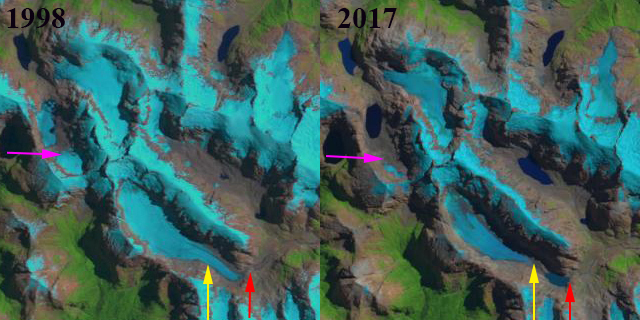
Turbio Glacier retreat from 1986 to 2018 in Landsat images.  Red arrow is 1986 terminus location, yellow arrow 2018 terminus location and pink arrow glacier across the border in Chile.

Turbio Glacier is at the headwaters of the Turbio River, Argentina and flows into Lago Puelo.  The glacier descends east from  Chile/Argentina border at 1500 m descending into a low slope valley at 1300-1000 m.  From 1986-2018 this glacier like many others nearby has retreated substantially leading to development of a new lake.  Wilson et al (2018) noted a substantial growth in the number of lakes in the central and Patagonian Andes due to the ongoing rapid retreat.  Masiokas et al (2008) reported that significant warming and decreasing precipitation over the 1912–2002 interval in the region. Harrison et al (2018) observed the number of glacier lake outburst floods have declined despite the increase in lakes.

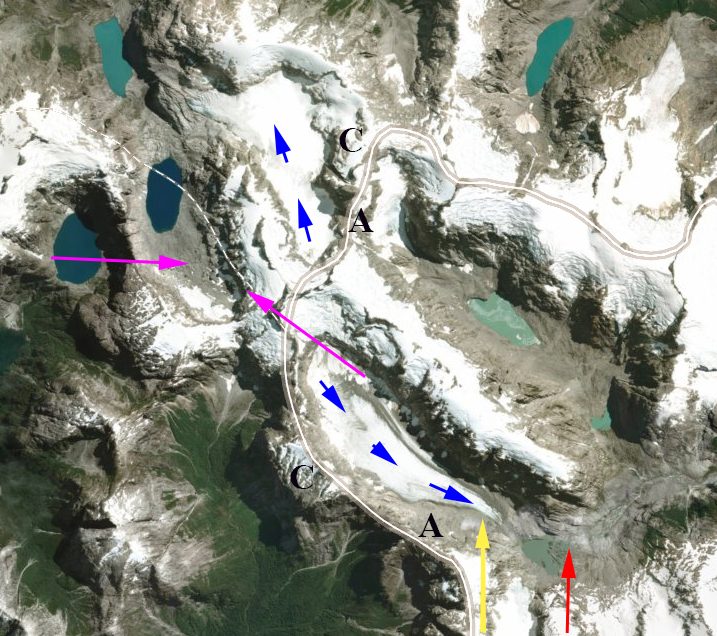
In 1986 the glacier terminated at the southeast end of a buttress at the junction with another valley, red arrow. The glacier was 4.3 km long and was connected to a headwall segment that extends to 1500 m. There is no evidence of a lake at the terminus of Turbio Glacier.  Across the divide in Chile the glacier with a pink arrow has a length of 3 km.  In 1998 the retreat from 1986 has been modest and no lake has formed at Turbio.  Across the border in Chile the glacier has divided into two sections.  By 2017 Turbio Glacier has retreated exposing a new lake.  The glacier is essentially devoid of retained snowpack illustrating the lack of  a significant accumulation zone that can sustain it.  Across the border in Chile the glacier has nearly disappeared with the lower section revealing a new lake and little retained snowpack indicating it cannot survive.  By 2018 Turbio Glacier has retreated 1.3 km, which is over 30% of its total length in 32 years. The glacier is separated from the headwall glacier, which can still shed avalanches onto the lower glacier. It is possible that with additional retreat another lake will be revealed in this valley.  The substantial retreat here is comparable with that of nearby Argentina glaciers such as Pico Alto Glacier and Lago Cholila .  The retreat is greater than on Tic Toc Glacier to the southwest in Chile.

Turbio Glacier retreat from 1998 to 2017 in Landsat images.  Red arrow is 1986 terminus location, yellow arrow 2018 terminus location and pink arrow glacier across the border in Chile.

Turbio Glacier in a Digital Globe image from 2013.  Red arrow is 1986 terminus location, yellow arrow 2018 terminus location, blue arrows show glacier flow and pink arrow glacier across the border in Chile.  The border is also indicated.

Cerro Tronador Glacier, Argentina Retreat and Lake Formation

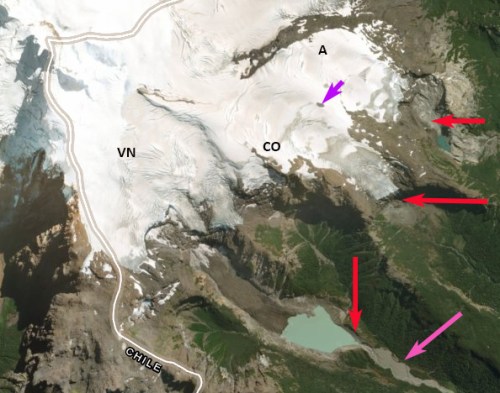
Cerro Tronador glaciers in Landsat images from 1985, 1998 and 2018.  A=Alerce, CO=Castana Overo, VN=Ventisquero Negro.  Red arrows mark the 1985 glacier terminus locations, yellow arrows the 2018 terminus location of VN, pink arrow the location of the 2009 dam breach outwash plain deposit, and purple arrow location of a bedrock outcrop. 

Cerro Tronador with a summit elevation of 3428 m straddles the Chile/Argentina border east of Lago Todos los Santos.  The peak is heavily glaciated including three glaciers that flow into the Alerce River basin of Argentina, Ventisquero Negro (VN), Castana Overo (OV) and Alerce (A).  Paul et al (2014) observed a 25% decrease in glacier area and the formation of over 100 new proglacial lakes in Northern Patagonia. Worni et al (2014) report on a moraine dam breach below Ventisquero Negro in 2009 and model this event. Here we examine Landsat imagery from 1985 -2018 to identify changes.

In 1985 there is no lake at the terminus of Ventisquero Negro with the debris covered terminus extending across the entirre basin.  The pink arrow indicates the vegetated valley below the moraine.  Alerce Glacier extends over a topographic step at 1600 m and extends to a proglacial lake at 1350 m. Castana Overo Glacier terminus broadly extends over the topographic step at 1600 m.  By 1998 Ventisquero Negro has developed a small fringing proglacial lake.  Alerce Glacier has lost its lowest valley tongue that extended to the proglacial lake.  The width of the Castana Overo Glacier terminus has been reduced.

By 2012 below the moraine dam breach has occurred depositing a significant outwash plain that is evident at the pink arrow just downstream of Ventisquero Negro.  A substantial proglacial lake has also formed that is 1.2 km long, Lago Manso.  Alerce Glacier has retreated to the top of the 1600 m step. A new bedrock outcrop, purple arrow has appeared on the ridge between Alerce and Castana Overo Glacier at 2100 m.  In 2016 the snowline extends to the new bedrock outcrop. By 2018 Ventisquero Negro has retreated 1450 m since 1985, with the proglacial lake still growing.  Alerce Glacier has retreated 800 m since 1985 and Castana Overo Glacier has retreated 400 m.  All three glaciers have significant crevassing indicating substantial retained accumulation being transported down slope. The debris covered tongue of Ventisquero Negro will continue to disintegrate and the Lago Manso will continue to expand.

Cerro Tronador glaciers in 2012 Google Earth image.  A=Alerce, CO=Castana Overo, VN=Ventisquero Negro.  Red arrows mark the 1985 glacier terminus locations, , pink arrow the location of the 2009 dam breach outwash plain deposit, and purple arrow location of a bedrock outcrop. 

Cerro Tronador glaciers in 2016 Digital Globe image.  A=Alerce, CO=Castana Overo, VN=Ventisquero Negro.  Red arrows mark the 1985 glacier terminus locations, , pink arrow the location of the 2009 dam breach outwash plain deposit, and purple arrow location of a bedrock outcrop. 


Lago Cholila, Argentina Headwaters Glacier Retreat Lake Formation

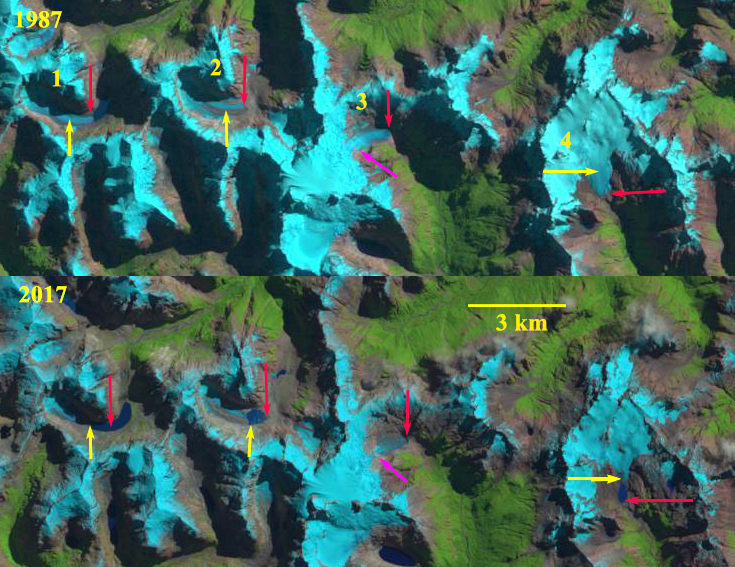
Changes in four glacier at the headwaters of Rio Tigre, Argentina in 1987 and 2017 Landsat images.  The red arrow indicate the 1987 terminus position and the yellow arrow the 2017 terminus position. 

Glaciers form the headwaters for Lago Cholila which drains into  Futaleufu River in west central Argentina .  Davies and Glasser (2012) mapped the glaciers in the Hornopiren region just to the northwest and Parque Nacionale
Corcovado just to the southwest  finding a 13-15 % area loss from 1986 to 2011. Here we examine the changes of four of the glaciers in Landsat images from 1987-2017.

In 1987 only one of the four glaciers terminates in a lake #1, #2, and #3 end at the far end of a cirque basin and #4 terminates at the downvalley end of a basin.  Glacier #3 also has a 400 m wide connection from the upper to the lower glacier, pink arrow.  By 2000 a small terminus lake has appeared at #2 and #4, while #1 has retreated around a bend in the lake.  In 2016 the upper and lower portion of #3 have nearly separated, pink arrow.  No lake has yet formed. By 2017 #1 has retreated 700 m since 1987, with the remaining glacier only 1400 m long.  Glacier #2 has retreated 500 m with a new lake of the same width having developed.  Glacier #3 thinning instead of retreat has dominated.  The glacier will continue to lose its terminus tongue, with the lower glacier effectively cutoff from the upper glacier. Glacier #4 has retreated 600 m, with a new lake having formed, and the terminus now having retreated upglacier of the lake.  The headwaters of the Lago Cholila has and is losing significant glacier volume, which is leading to new and expanding lakes. Below a Google Earth image indicate the new lake and the limited accumulation zone on Glacier #4.  The retreat is similar to that we reported for the Sierra de Sangra to the south and Pico Alto just to the north in Chile.

Changes in four glacier at the headwaters of Rio Tigre, Argentina in 2000 and 2016 Landsat images.  The red arrow indicate the 1987 terminus position and the yellow arrow the 2017 terminus position. 

Google Earth image indicating new lake formed by retreat of Glacier #4.

Lago Onelli, Argentina trio of Glaciers Retreat and Separate

glacier onelli compare

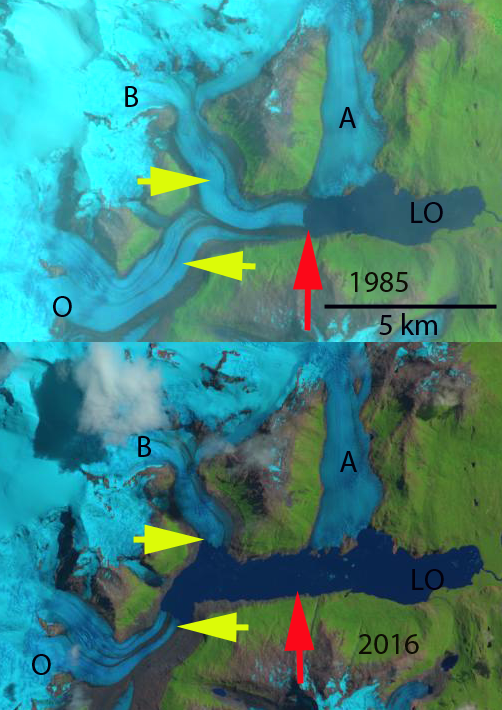
Onelli Glacier (O), Belados Glacier (B) and Agassiz Glacier (A) compared in Landsat images from 1985 to 2016.  The red arrow indicates the 1985 terminus location and yellow arrow is the 2016 terminus location. 

The Onelli Glacier drains eastward from the South Patagonia Icefield (SPI) into Lago Onelli (LO), which then connects to Lago Argentino. Lago Onelli has three main glaciers terminating in the lake Agassiz (A), Onelli(O) and Bolados Glacier (B). Onelli glacier is noted as 13 km long with an area of 84 square kilometers by the Labratorio de Glaciologia in Chile . Davies et al (2012) noted that the most rapid period of retreat since 1890 for Bolado and Onelli Glacier was from 1986-2001.  Warren and Sugden (1993) note an 1800 meter retreat from 1945-1992 for Onelli Glacier and 850 meters for Agassiz Glacier. Eric Shipton was the first to visit this glacier and did so in the company of Ohio State glaciologist John Mercer in 1958. They found Lago Onelli so filled with icebergs that little water could be seen (Shipton, Land of Tempest, 1963). Agassiz and Onelli Glacier were observed to have a shared terminus in 1958 much like Onelli Glacier and Belados Glacier in 1985.

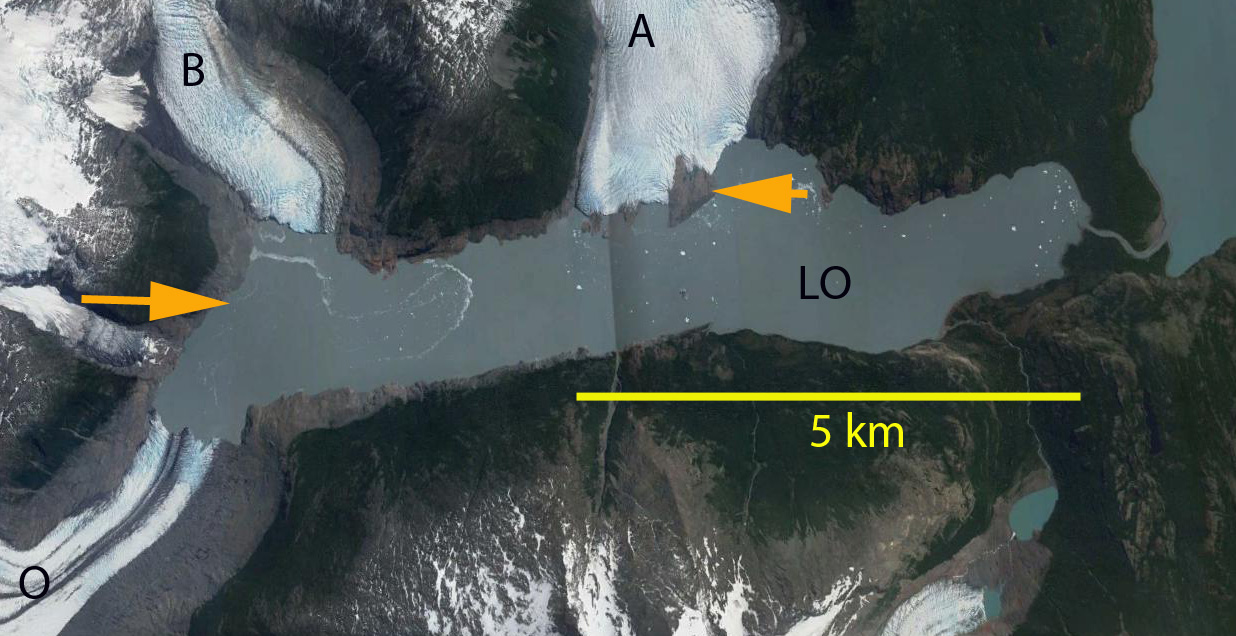
A comparison of Landsat satellite images indicate the separation and retreat of Bolados (B) and Onelli Glacier (O) from 1985-2016. In 1985 the joint terminus cuts directly across Lago Onelli as one reasonably straight 1.6 km wide calving front just short of connecting with Agassiz Glacier. By 2004 the glacier had retreated 3000 m and Belados and Onelli were  barely touching.The combined termini width was 1.8 km. By 2010 the glaciers were separated by 1300 meters. By 2016 Belados Glacier has retreated 3500 m from 1985-2016 and Onelli Glacier has retreated 3800 m. The glaciers in 2016 are separated from each other by 1800 m. The ELA in the satellite images from recent years has been 1300 meters. Agassiz Glacier has retreated 400 m during the 1985-2016 period.  The glacier is grounded on three islands that acts as pinning points, reducing calving losses and the retreat rate.

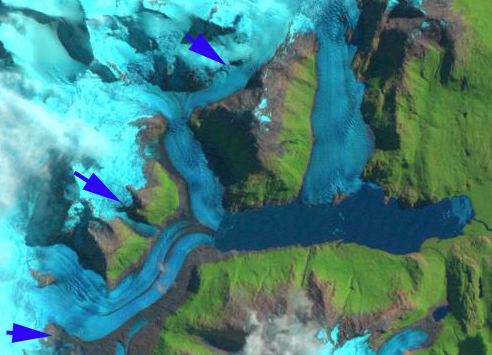
Willis et al (2012) examined the mass change of the 12,100 km2  SPI  from 2000-2012: in the accumulation zone the average thickness change of −1.1 ± 0.1 m/year, for the ablation zone the average thickness change is −3.5 ± 0.02 m/year.  This widespread loss even in the accumulation zone indicates that retreat will continue.  A comparison of Landsat images from 1998 to 2013 indicates upglacier thinning at the purple arrows. Schaefer et al (2015) noted that the mass loss of SPI has been largely from increased calving losses.  Mouginot and Rignot (2015) observed that Onelli Glacier does not have a high velocity reach extending beyond the immediate terminus zone, unlike major outlet glaciers of the SPI.

glacier onellis 2004 ge

Google Earth image of Onelli Glacier and Belados Glacier in 2004 above and 2015 below.  Orange arrow indicates the 2004 terminus location. 

glacier onelli 2015 ge

glacier onelli1998

Landsat images from 1998 and 2013 indicating specific areas of upglacier thinning at the purple arrows. 

glacier onelli 2013

Sierra de Sangra Glacier Retreat, Argentina

mayer compare

Comparison of four outlet glaciers of Sierra de Sangra in Argentina in a 1985 and 2015 Landsat image.  Read arrow is the 1986 terminus location when all terminated in a lake.  By 2015 only one terminates in a lake, yellow arrows. 

The Sierra de Sangra Range is located along the Chile-Argentina boundary with the east draining glaciers flowing into the Rio Mayer and then into Lake O’Higgins at Villa O’Higgins. Here we examine four glaciers that in 1986 all ended in lakes and by 2015 only one still terminates in the lake. Davies and Glasser (2012) noted the fastest retreat rate of this icefield during the 1870-2011 period has been from 2001-2011. NASA’s Earth Observatory posted an article on this blog post with better resolution images.

mayer ge

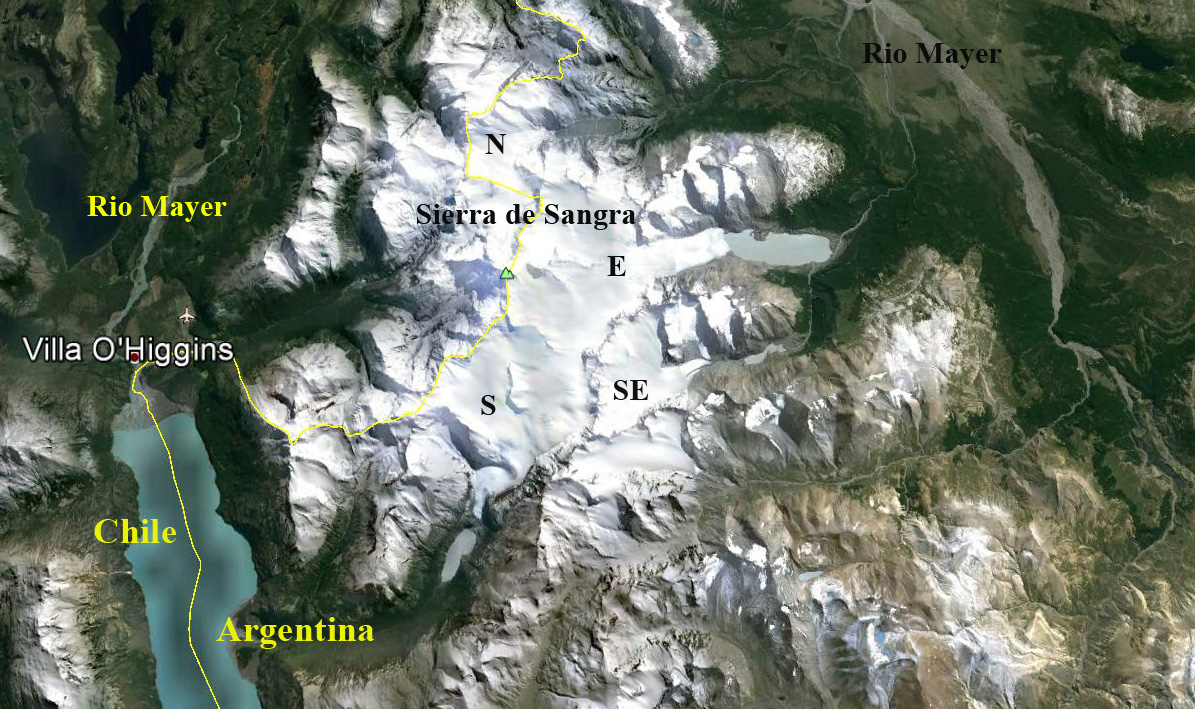
Sierra de Sangra is just east of Villa O’Higgins with the crest of the range on the Chile Argentina border. The four glaciers examined here are indicated by S, SE, E and N. 

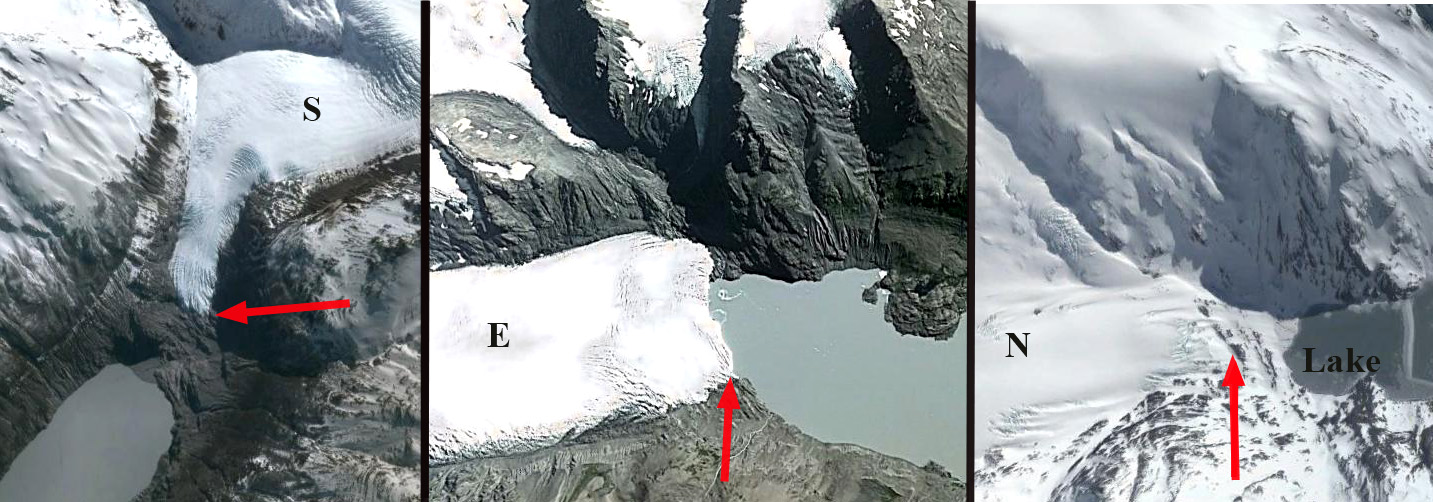
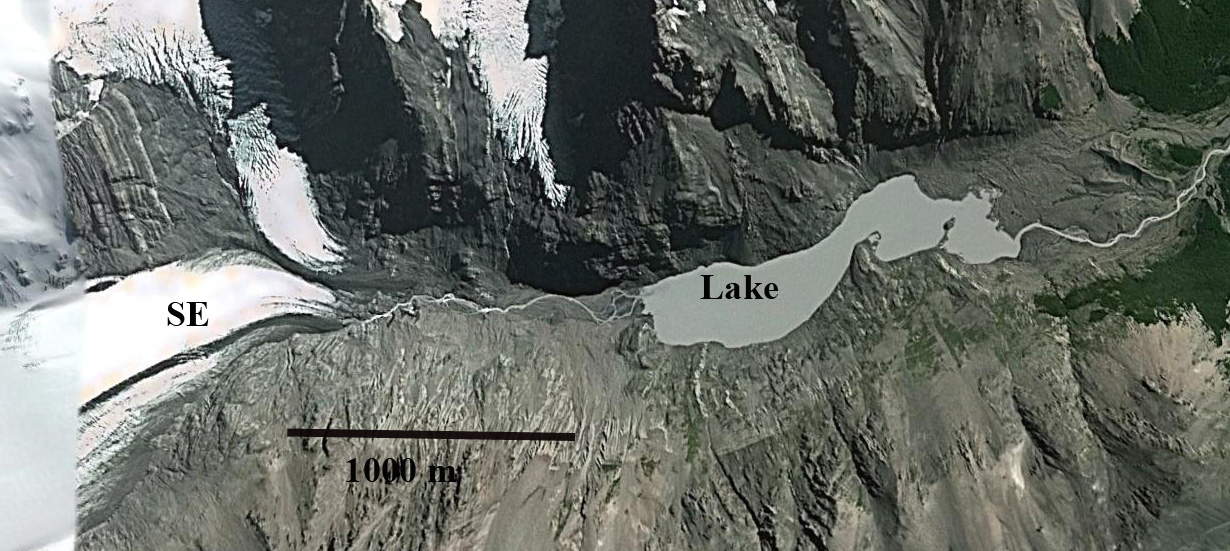
The South Outlet Galcier (S) has retreated 700 m from 1986 to 2015 and terminated in a lake in 1986.  By 2015 it terminates on a steep slope well above the lake.  The Southeast Outlet Glacier (SE) terminates in a lake in 1986.  By 2015 it has retreated 1200 m to a junction with a tributary from the north.  The East Outlet Glacier is the largest glacier and has retreated just 300 m from 1986 to 2015. There is a sharp elevation rise 200 m behind the terminus, which likely marks the end of the lake basin.  This is marked by a crevasse zone.  The North Outlet Glacier (N) ended in a lake in 1986.  By 2015 it has retreated 700 m and ends on a bedrock slope well above the former lake level. All of the glaciers have an accumulation zone in each satellite image examined.  This indicates they can survive present climate. The glacier retreat is not as large as Cortaderal Glacier and Glaciar Del Humo.

mayer terminus

Google Earth images from 2013 of the terminus of three outlet glaciers above and one below.  The red arrow indicates terminus location. Three of the four no longer terminate in a lake. 

mayer southeast