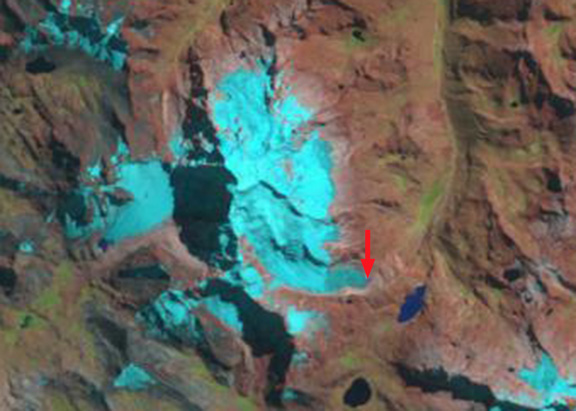
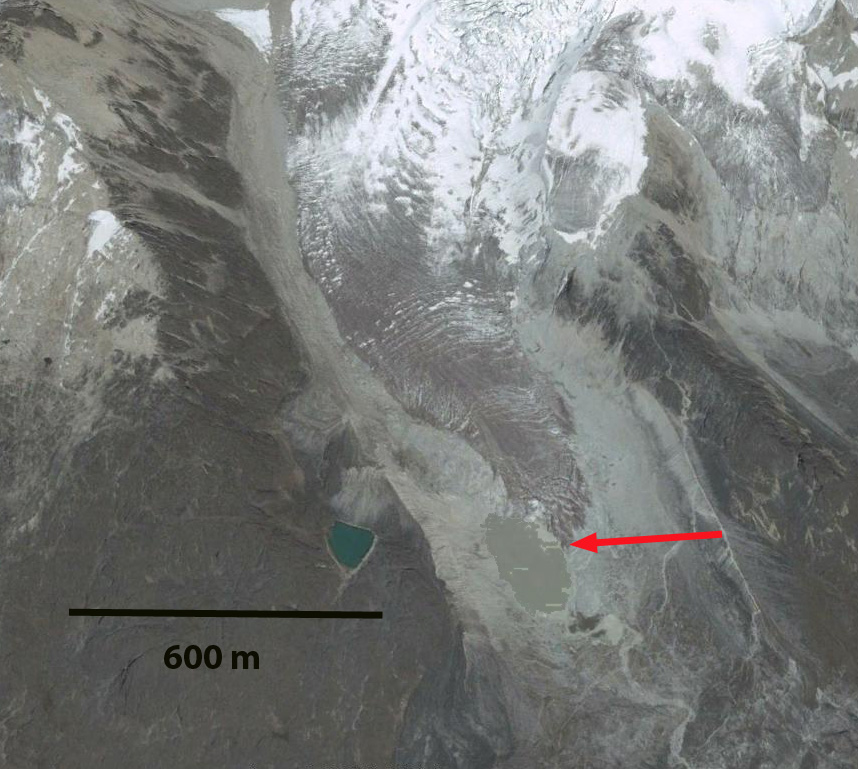
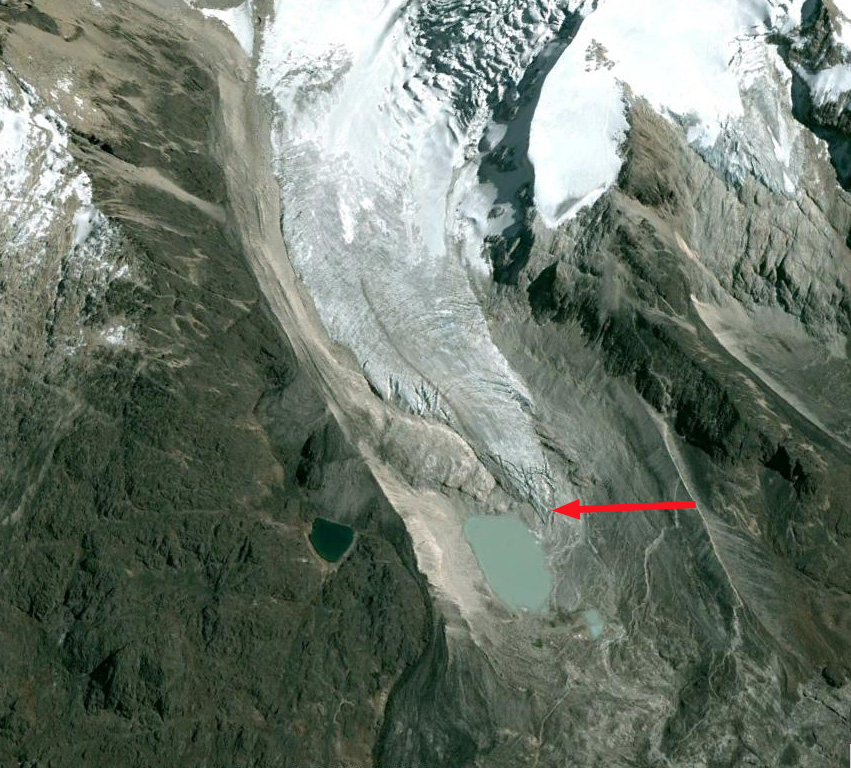
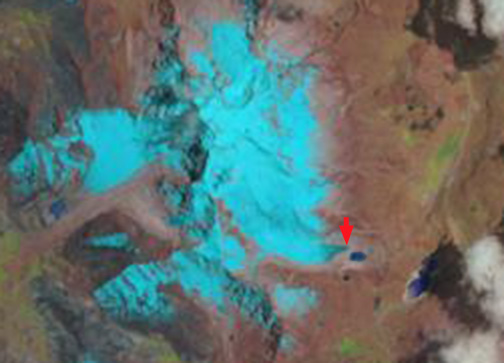
Carbon Lake Glacier Retreat, Alaska

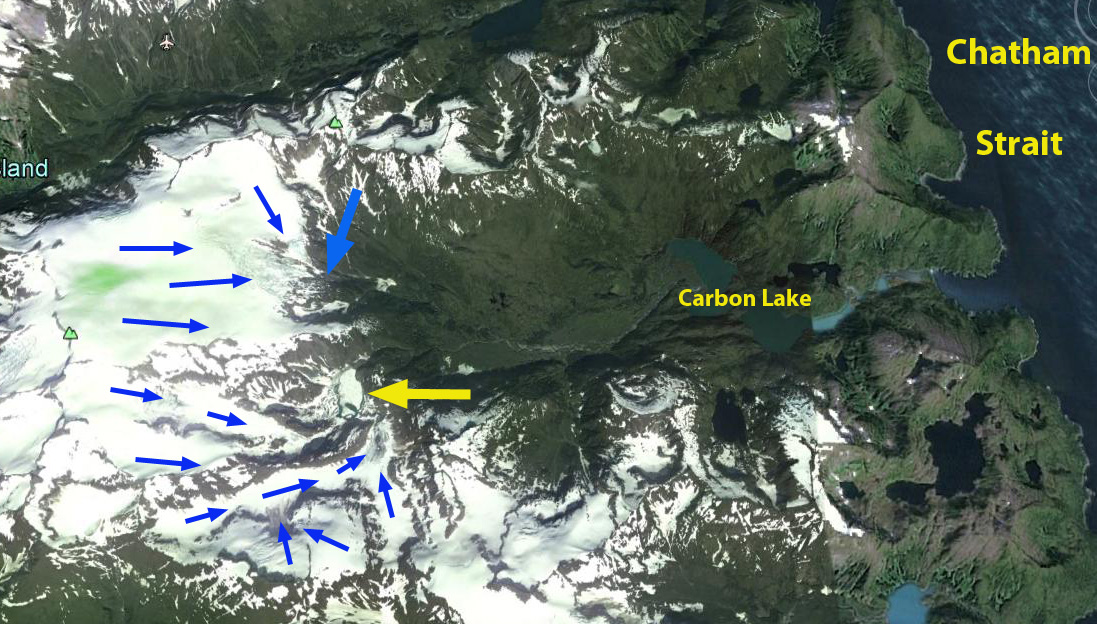
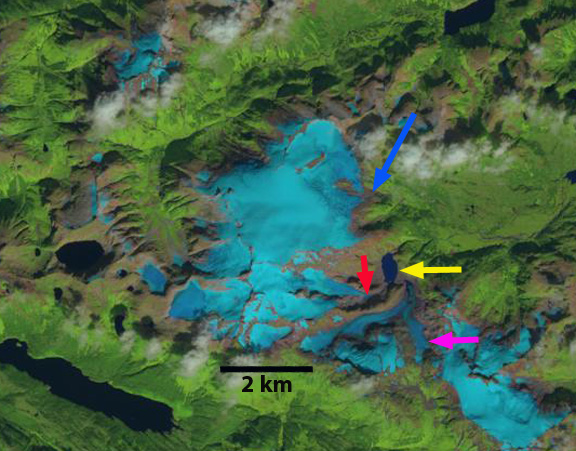
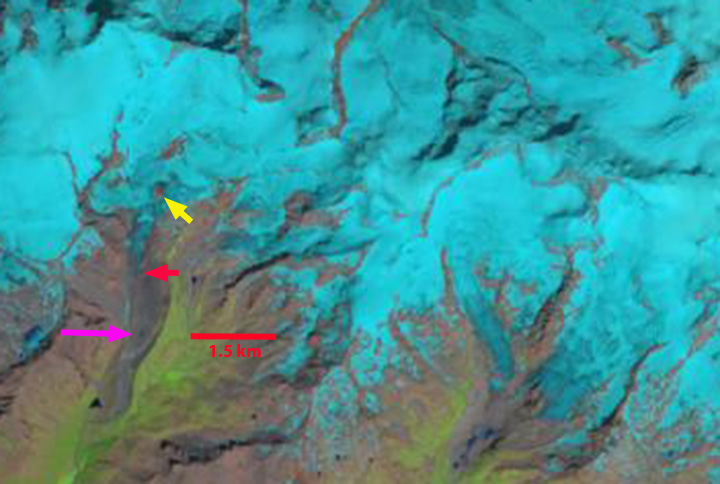
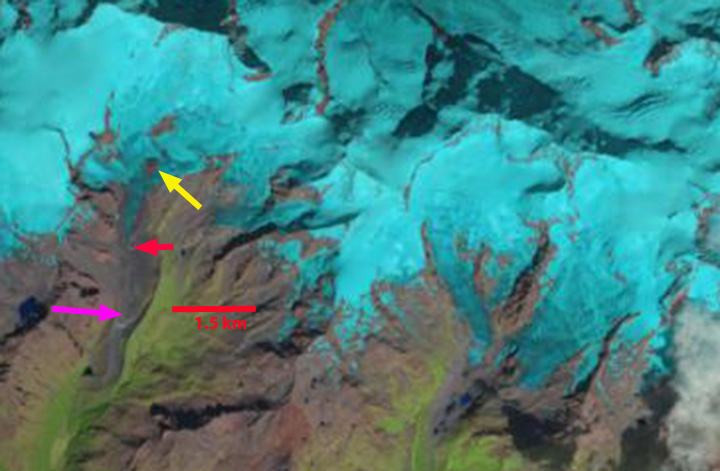
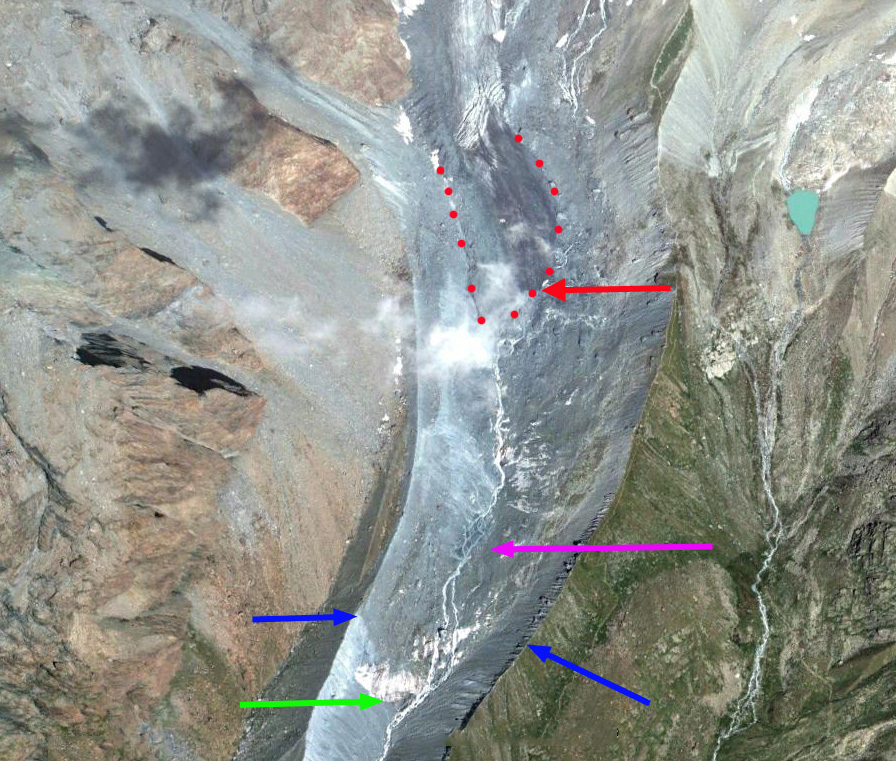
On Baranof Island in southeast Alaska there are a pair of unnamed glaciers at the headwaters of the Carbon Lake watershed, that then drains into Chatham Strait.  Here we examine changes in these glacier from 1986 to 2014 using Landsat imagery.  The blue arrow indicates the northern glacier terminus and the yellow arrow the southern glacier terminus region.

carbon lake ge

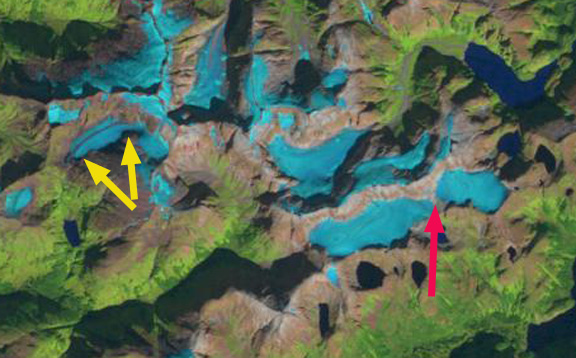
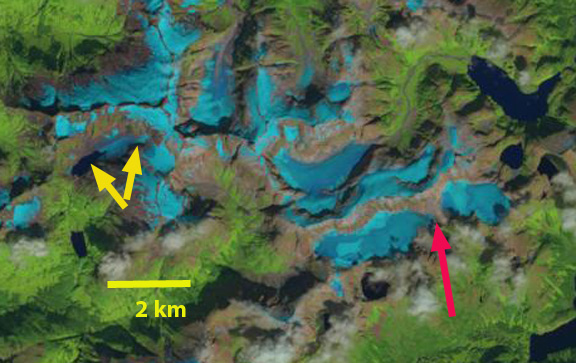
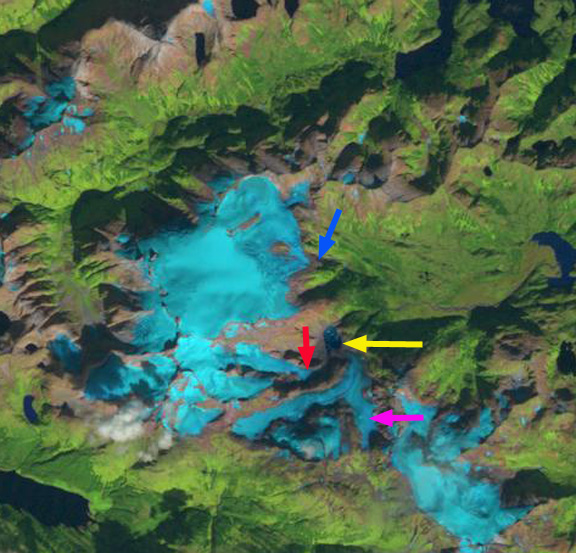
In 1986 the southern glacier terminus, yellow arrow consisted of three main tributaries combining to form a low sloped terminus region.  The northern glacier had a single terminus.  By 1997 a lake has formed at the southern glacier, which now has two separate termini, the red arrow indicates a new terminus area and the pink arrow the eastern portion of this glacier.  The northern glacier, blue arrow, is retreating but still joined.  By 2014 the southern glacier has separated into three parts.  There is a terminus at the red arrow, this represents a 900 m retreat since 1986.  This portion of the glacier has further separated since 1997 into two parts.  The eastern glacier, pink arrow has retreated 700 m since 1986.  The new alpine lake is 600 m long.  The northern glacier, blue arrow, has separated into two main termini and the glacier has retreated 200 m.   The retreat of these glaciers paralells the observed losses of other smaller glacier in the region most notably Lemon Creek Glacier, which is a World Glacier Monitoring Service reference glacier, 30 km west on the edge of the Juneau Icefield.  Another nearby example is Sinclair Glacier.  Lemon Creek Glacier has lost more than 25 m of glacier thickness during the 1953-2014 period when its mass balance has been observed by the Juneau Icefield Research Program, and has retreated more than 1 km.

carbon lake 1986
1986 Landsat image Carbon Lake Glaciers
carbon lake 1997
1997 Landsat image Carbon Lake Glaciers
carbon lake 2014
2014 Landsat image of Carbon Glacier


Chickamin Glacier Retreat, North Cascade Range, Washington

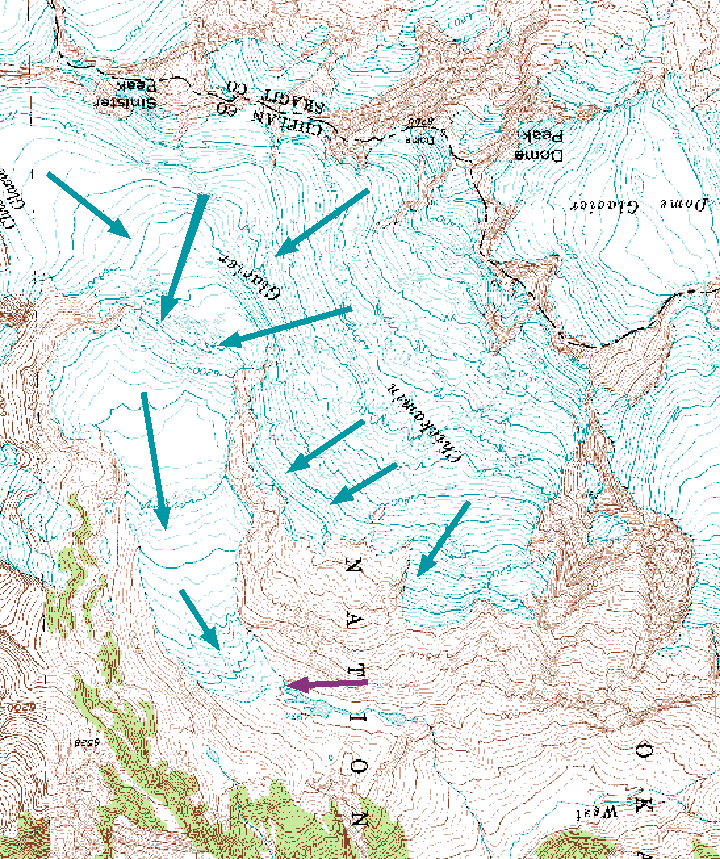
Chickamin Glacier covers the north slope of Sinister Peak in the North Cascade Range of Washington.  The glacier has a valley tongue that descends to an outwash plain.  Here we examine retreat of the glacier from 1979 to 2012. The glacier had advanced from 1955-1975, before commencing retreat.

CHICKAMIN_GLACIER05
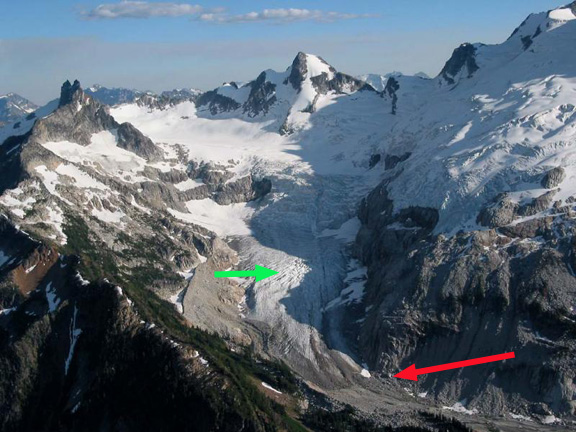
Chickamin Glacier (Tom Hammond)

chickamin map

USGS Map of Chickamin Glacier

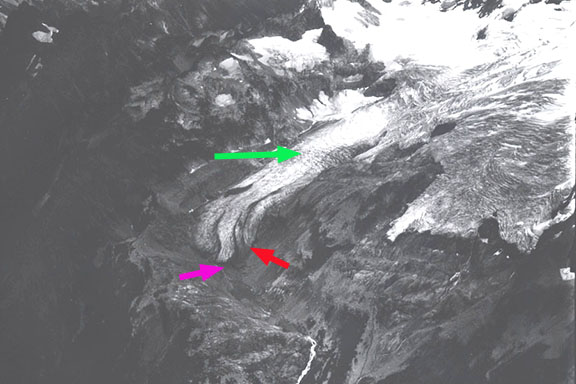
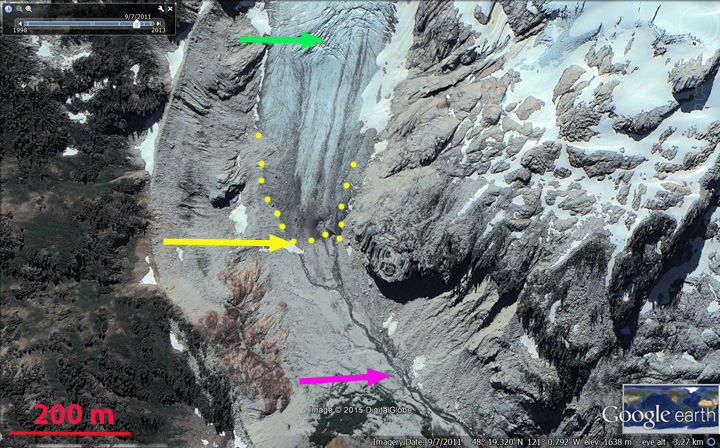
In 1979 the glacier terminus was at the pink arrow, several hundred meters beyond a prominent buttress, red arrow, where the glacier turns west.  The lowest icefall is indicated by a green arrow. In 1991 the glacier has retreated from the pink arrow, but still is turning the corner beyond the buttress.  The lower icefall is still extensively crevassed.  By 1998 in a Google Earth image the terminus is outlined with yellow dots and has retreated 230 m from the 1979 position.  The lower icefall is still crevassed.  By 2005 in a photograph from Tom Hammond (North Cascades Conservation Council), the glacier has retreated to the buttress. in a 2006 Google Earth image the terminus position is indicated by yellow dots, with a retreat of 50 m since 1998.  The lower portion of the glacier has limited crevassing.  In the 2012 image the glacier terminus no longer reaches the buttress and has retreated 360 m since 1979. We observed exceptional ablation conditions in the North Cascades in 2013 and 2014, which combined with exceptionally low snowpack in 2015 will lead to a continued significant retreat of this glacier.  The crevassing in the lowest icefall has declined and is now superficial. All 47 glaciers observed by the North Cascade Glacier Climate Project have been retreating and four have disappeared (Pelto, 2011). This glacier is similar in size and retreat to Boston Glacier and Honeycomb Glacier.

chickamin79

Chickamin Glacier 1979 (Austin Post)chickamin glacier1991

1991 Chickamin Glacierchickamin 1998 geterminus

1998 Google Earth image

CHICKAMIN_GLACIER05

2005 Chickamin Glacier (Tom Hammond)chickamin 2006 geterminus

2006 Google Earth imagechickamin 2012 geterminus

2012 Google Earth Image

Eiriksjökull Reeat, Iceland

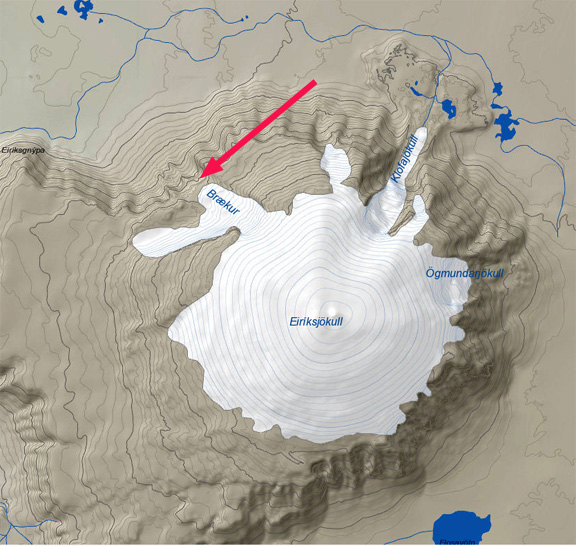
Eiriksjökull  is an ice cap just west of Langjökull In central Iceland.  Here we examine its main western outlet the Braekur using Landsat imagery from 1989 to 2014.  The Icelandic Glaciological Society website on terminus variations is the source of the map for the glacier. The IGS program monitors 50 glaciers, all of them are currently retreating.  Eiriksjökull ,  is not one that is in this monitoring program. eiriksjokull map

In 1989 the Braekur outlet flowed over the edge of a lava cliff at the red arrow.  The glacier terminated on the bench between the upper and lower cliff.  In 1994 the glacier still extended  to the edge of the cliff.  By 2010 the Google Earth images indicates a retreat from the edge of the cliff.  In 2014 the glacier has receded 200 m from the edge of the cliff and 300 m from is 1989 position and terminates at the yellow arrow. The high snowlines in recent years will lead to continued retreat. The retreat and area loss of Eiriksjökull is less than on nearby Norðurjökull a primary outlet of Langjökull or on Porisjokull a small ice cap just south of Langjökull.

eiriksjokull 1989

1989 Landsat image

eiriksjokull 1994

1994 Landsat image

eiriksjokull 2010

2010 Google Earth image

eiriksjokull 2014

2014 Landsat image
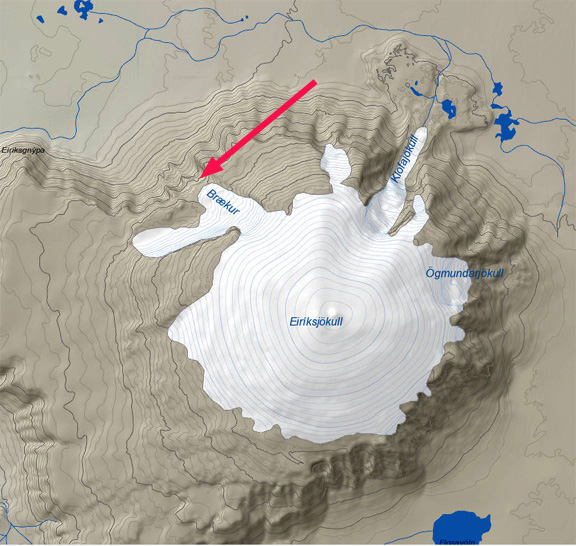
Eiriksjökull Retreat, Iceland

Eiriksjökull  is an ice cap just west of Langjökull In central Iceland.  Here we examine its main western outlet the Braekur using Landsat imagery from 1989 to 2014.  The Icelandic Glaciological Society website on terminus variations is the source of the map for the glacier. The IGS program monitors 50 glaciers, all of them are currently retreating.  Eiriksjökull ,  is not one that is in this monitoring program. eiriksjokull map

In 1989 the Braekur outlet flowed over the edge of a lava cliff at the red arrow.  The glacier terminated on the bench between the upper and lower cliff.  In 1994 the glacier still extended  to the edge of the cliff.  By 2010 the Google Earth images indicates a retreat from the edge of the cliff.  In 2014 the glacier has receded 200 m from the edge of the cliff and 300 m from is 1989 position and terminates at the yellow arrow. The high snowlines in recent years will lead to continued retreat. The retreat and area loss of Eiriksjökull is less than on nearby Norðurjökull a primary outlet of Langjökull or on Porisjokull a small ice cap just south of Langjökull.

eiriksjokull 1989

1989 Landsat image

eiriksjokull 1994

1994 Landsat image

eiriksjokull 2010

2010 Google Earth image

eiriksjokull 2014

2014 Landsat image

Weddel Glacier Thinning-Retreat, South Georgia Island

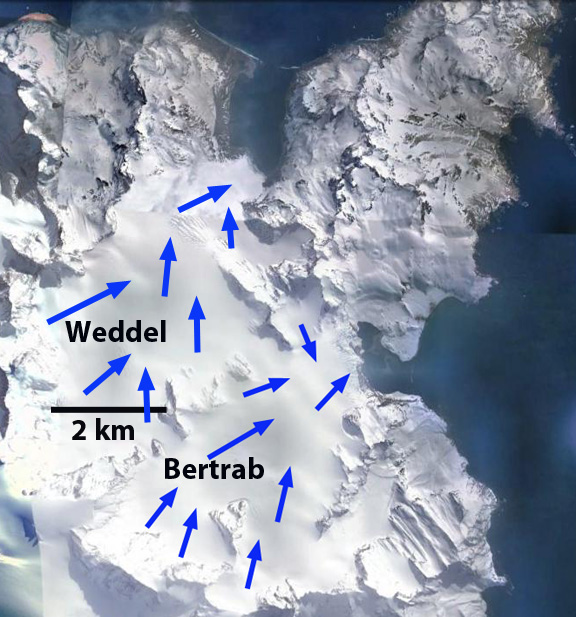
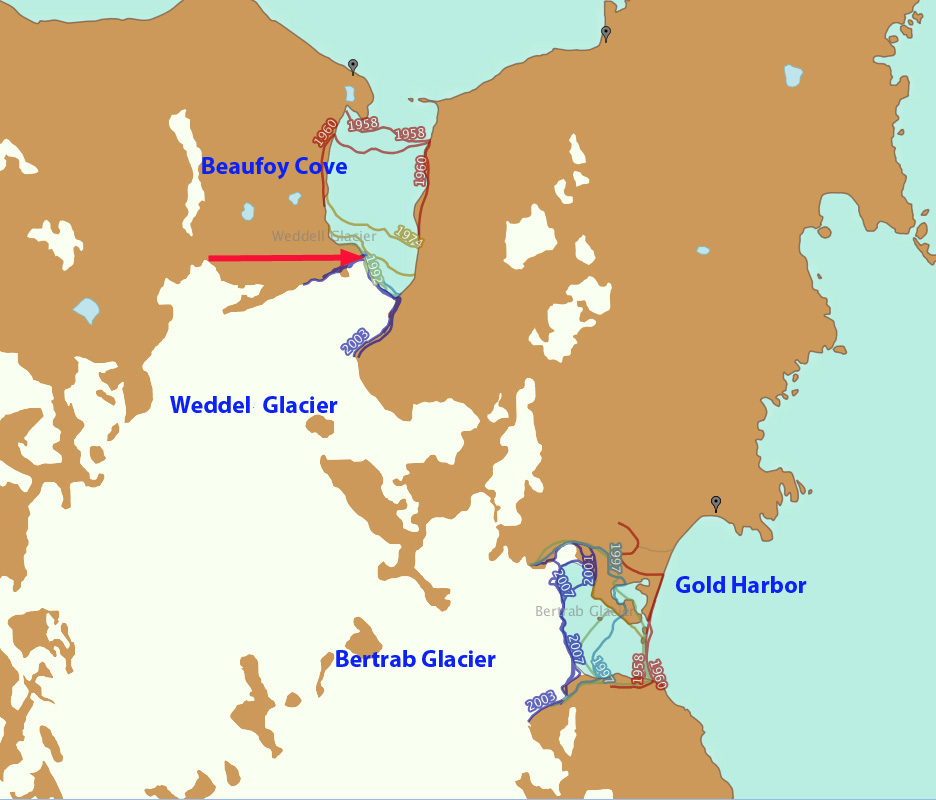
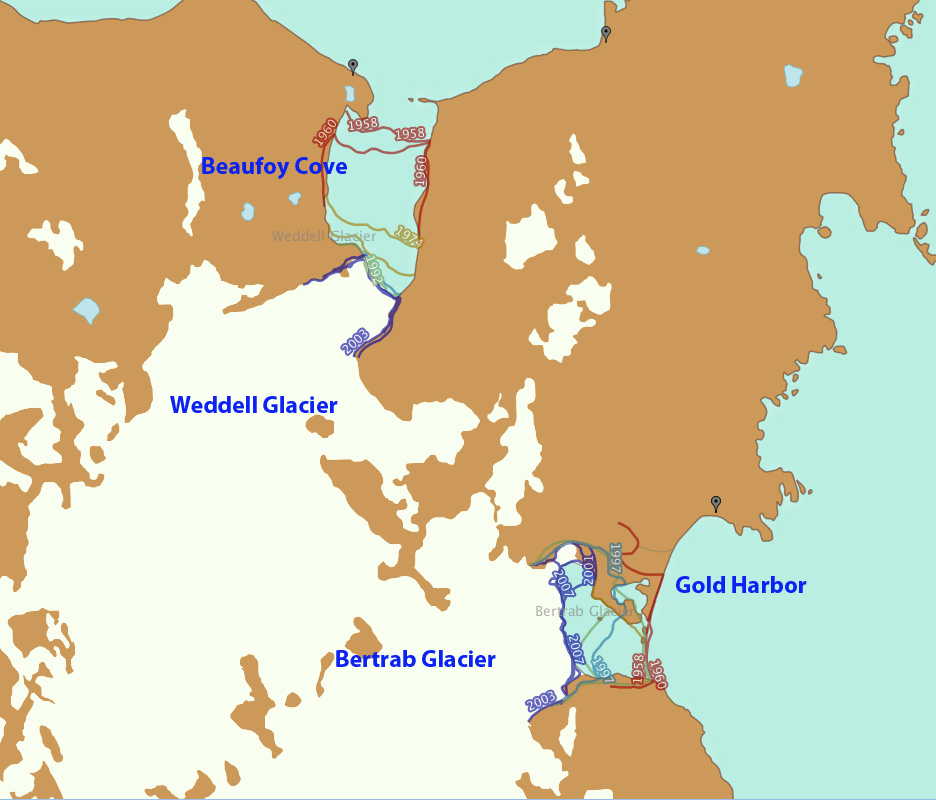
Weddel Glacier is on the southeast coast of South Georgia Island.  It terminates in Beaufoy Cove just north of Gold Harbor.The change in glacier terminus position has been documented by Alison Cook at British Antarctic Survey in a BAS retreat map.  In 1958 it reached within 400 m of the coast at the outlet of Beaufoy Cove. Gordon et al., (2008) observed that larger tidewater and sea-calving valley and outlet glaciers generally remained in relatively advanced positions until the 1980s. For Weddel Glacier the retreat was rapid from 1960 to 1974 and was slow from 1992-2003.  Here we examine Landsat imagery from 1989 to 2015 to visualize and update this change.
bertrab ge
Google Earth Image

weddell-bertrab map
BAS map of glacier terminus position

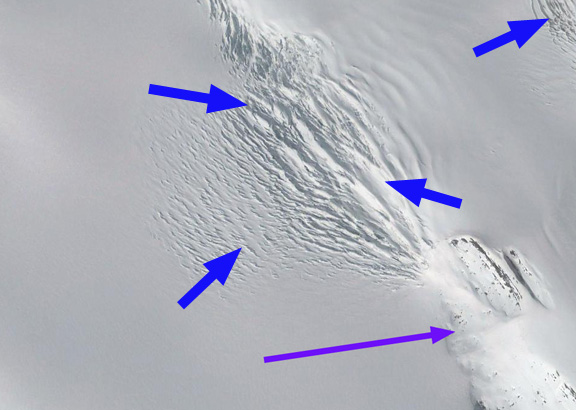
In 1989 the glacier terminates near the tip of a peninsula, red arrow in each image. The calving front extends southeast, orange dots. At the yellow arrow the glacier fills a small side valley adjacent to the main glacier. At the purple arrow is a small extension of the main icefall flowing down the bedrock step.
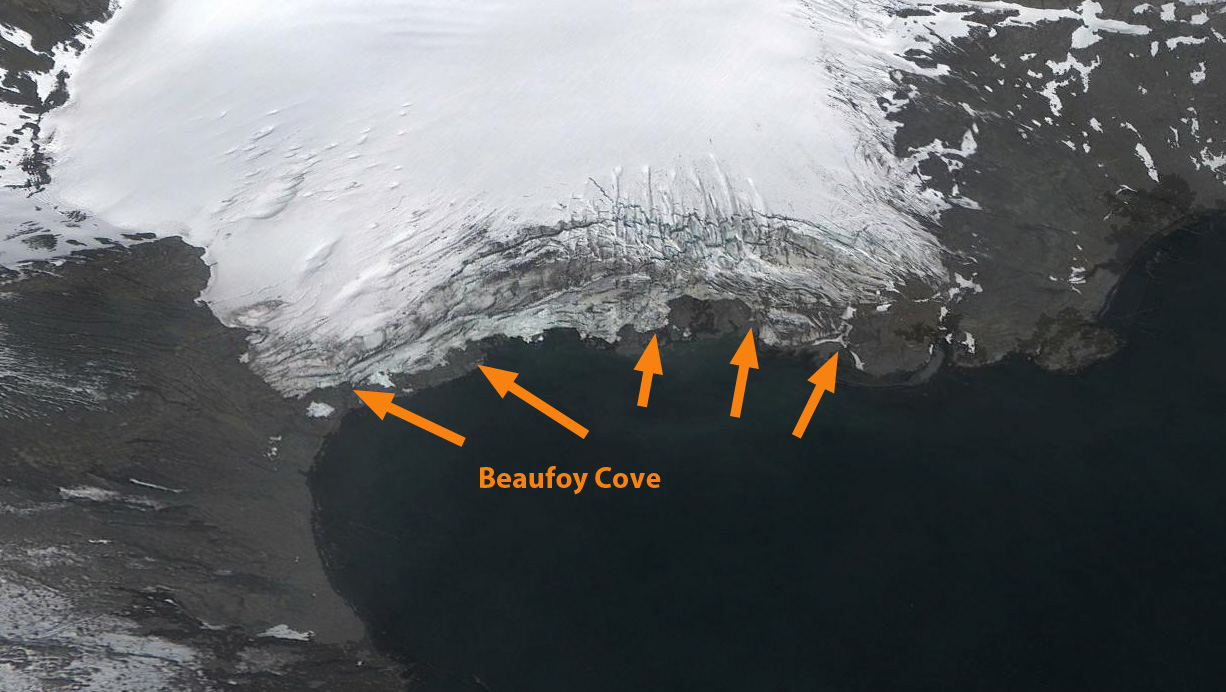
In 2002 there is only minor retreat at the red and yellow arrow, but thinning has led to the small extension of the main icefall being almost cutoff by bedrock. By 2015 the glacier has retreated 200-300 meters from the 1989 position and the main terminus is narrower. At the yellow arrow the side valley no longer has ice. At the purple arrow this is just bedrock now, there is no glacier extension flowing down the bedrock step. A close up the icefall in a 2009 Google Earth image indicates both the extensive crevassing but also the lack of glacier ice at the purple arrow, where an extension of the icefall formerly flowed. A Google Earth closeup of the terminus indicates that only a small section is still in contact with Beaufoy Cove in 2009, with land exposed at the orange arrows. This glacier is almost not tidewater and has terminated in shallow water since 1989, which helps explain a slower rate of retreat. The glacier has thinned more rapidly than it has retreated in the last 25 years. The retreat rate is less than nearby Bertrab Glacier, Konig Glacier and Neumayer Glacier on the same coast of South Georgia.

weddel glacier 1989

Landsat Image 1989

weddell glacier 2002

Landsat image 2002

weddel glacier 2015
Landsat image 2015

weddel icefall
Google Earth icefall image
weddel terminus
Google Earth 2009 image

Bertrab Glacier Retreat, South Georgia Island

Bertrab Glacier is on the east coast of South Georgia Island.  The change in glacier terminus position has been documented by Alison Cook at British Antarctic Survey in a BAS retreat map.  In 1958 it reached the coast in Gold Harbor. Gordon et al., (2008) observed that larger tidewater and sea-calving valley and outlet glaciers generally remained in relatively advanced positions until the 1980s. For Bertrab Glacier the retreat was minimal from 1958 to 1989. Since 1989 a whole new embayment has opened.  Here we examine Landsat imagery from 1989 to 2015 to visualize and update this change.

weddell-bertrab map

BAS Glacier Front map 1958-2007.

bertrab ge

Google Earth image

In 1989 the southern arm of the glacier extends to the shoreline of the barrier beach system in Gold harbor, Red arrow. The northern arm extends around to the edge of a very green region, suggesting well developed vegetation, hence no real retreat for sometime.  By 2002 a lake has formed at the northern arm terminus and it has retreated 400 m.  The southern arm has retreated across a new embayment ending near the yellow arrow, though the exact position is obscured by cloud.  In 2011 the southern terminus has retreated up a slope from the edge of the embayment, yellow arrow.  In 2015 there are no longer two arms to the glacier.  The glacier terminates near the edge of the new embayment. The retreat is 700 m on the northern arm and 1000 m for the southern end since 1989.  The glacier no longer reaches the water limiting calving.  The glacier also ends on moderate slope.  This should lead to a reduced retreat in the near future.  The 2015 picture is from Jan.15, so there is still two months left in the melt season. The retreat is similar to that of Ross Hindle Glacier , Konig Glacier and Neumayer Glacier on the same coast of South Georgia, and faster than for neighboring Weddel Glacier.  Like on Stephenson Glacier, Heard Island the new embayment does offer new potential habitat for penguins and seals.

bertrab glacier 1989

1989 Landsat image
bertrab glacier 2002

2002 Landsat image

bertrab glacier 2011

2011 Landsat image

bertrab glacier 2015

2015 landsat image

Southwest Brazeau Icefield Retreat, Alberta

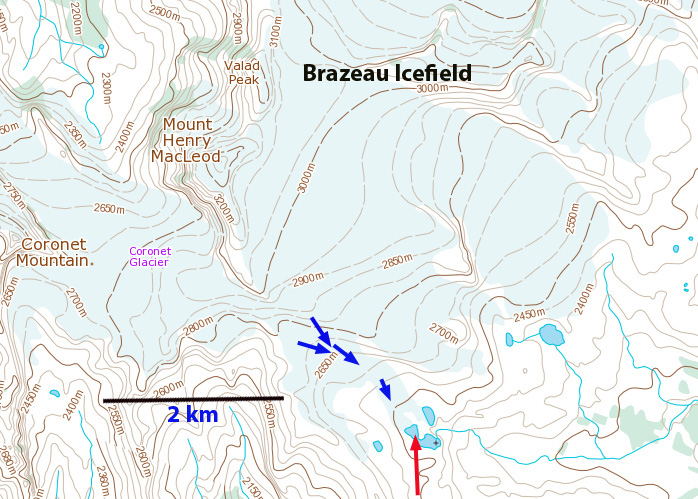
The Brazeau Icefield straddles high peaks southeast of Jasper, Alberta.  The northern outlet glaciers drain into Maligne Lake and the southern outlet glaciers drain in to Brazeau Lake and the Brazeau River.  The Brazeau River flows into Brazeau Reservoir a 355 MW hydropower facility, before joining the Saskatchewan River. An inventory of glaciers in the Canadian Rockies indicate area loss of 15% from 1985 to 2005 (Bolch et al, 2010).  The more famous Columbia Icefield to the west has lost 23 % of its area from 1919-2009 with ice loss at a minimum during the 1970’s (Tennant and Menounos, 2013). Here we examine an unnamed outlet glacier at the southwest corner of the Brazeau Icefield from 1995 to 2014 using Landsat imagery.

brazeau Icefield map

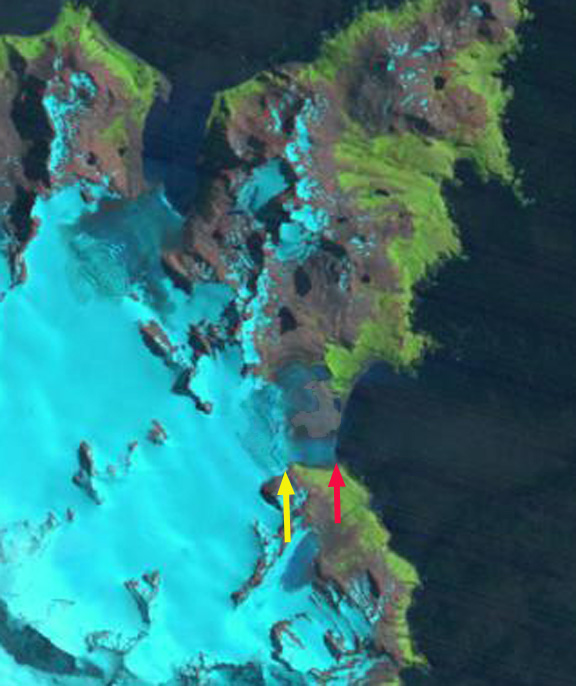
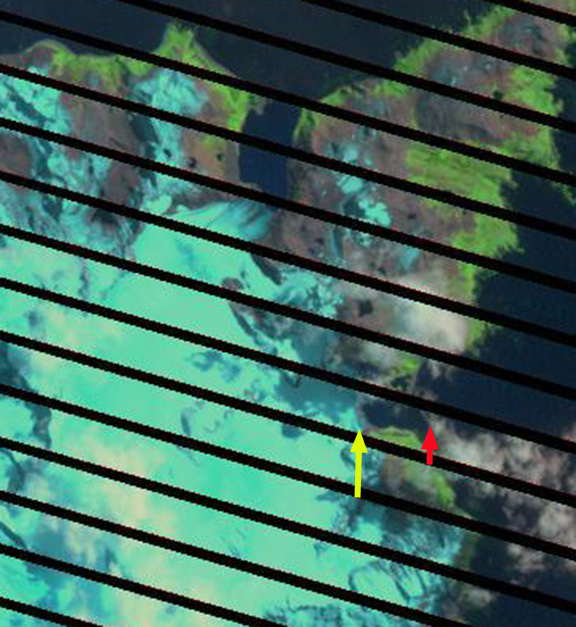
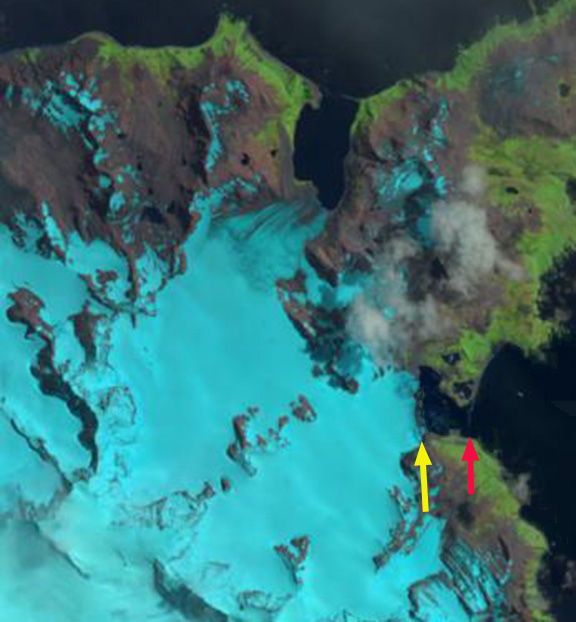
In 1995 the glacier terminated at the red arrow and was 1900 m long, orange dots mark the upper boundary.  The glacier had limited retained snowpack in 1995.  The poor clarity is do to forest fire smoke in the region.  In 1998 the proglacial lake where the glacier terminates is much clearer, snowpack is again limited, but more extensive than in 1995.  In 2002 retreat is evident as the lake is expanding as the glacier retreats.  The glacier still ends in the lake and still has limited snowcover.  In 2013 the glacier has retreated completely from the lake and snowcover is again limited.  The lack of snowcover is persistent in the satellite images which are typically not from the end of the melt season, hence even more snowcover will be lost.  Lack of a significant persistent snowcover area indicates a glacier that will not survive (Pelto, 2010). In 2014 the area experienced considerable forest fires, which leads to poor image clarity.  The glacier terminus is now significantly separated from the lake and terminates at the yellow arrow.  The distance from the yellow to the red arrow represents a 350-400 m retreat in 20 years.  The glacier has lost 20% of its length in this period.  This retreat is similar to that of Fraser Glacier and more significant given the small size of the glacier than for Saskcatchewan Glacier

brazeau icefield 1995

1995 Landsat image

brazeau icefield 1998

1998 Landsat image

brazeau sw 2002

2002 Landsat image

braeau sw 2013

2013 Landsat image

brazeau sw 2014

2014 Landsat image
Crevasse Reduction and Retreat of Salisbury Snowfield-Almer Glacier, New Zealand

Almer Glacier is fed by the Salisbury Snowfield which also has its own terminus, and both are former tributaries to the Franz Josef Glacier.  In 2007 the Almer Glacier almost reconnected with Franz Josef Glacier.  The glaciers of the southern Alps have some of the highest recorded accumulation rates in their upper sections and highest ablation in the lower reaches. Anderson et al (2006), note accumulation rates exceeding 6 m on Franz Josef Glacier.  This combined with the steep slopes lead to higher velocity and extensive crevassing on even smaller alpine glaciers.  Purdie et al (2014)  examined modern and historic length change for Franz Josef and noted a ~ 3 km loss in length since the 1800s, with the greatest retreat from 1934 and 1983, despite two periods of advance in that 50 year period.  The retreat particularly since 1983 has been punctuated by advances 1983–1999 (1420 m) and 2004–2008 (280 m), with the current retreat up to 2014 being the fastest rate of retreat during the period of record. (Purdie et al , 2014). The annual end of summer snowline surveys by NIWA monitors the Salisbury Snowfield, the snowline was 140 m or more above the equilibrium altitude in 4 of the last six years and 20-30 m below the equilibrium line altitude in the other two.  The net result is significant mass loss in the last six years driven by exceptional melt, driving the retreat.

Salisbury snowfield

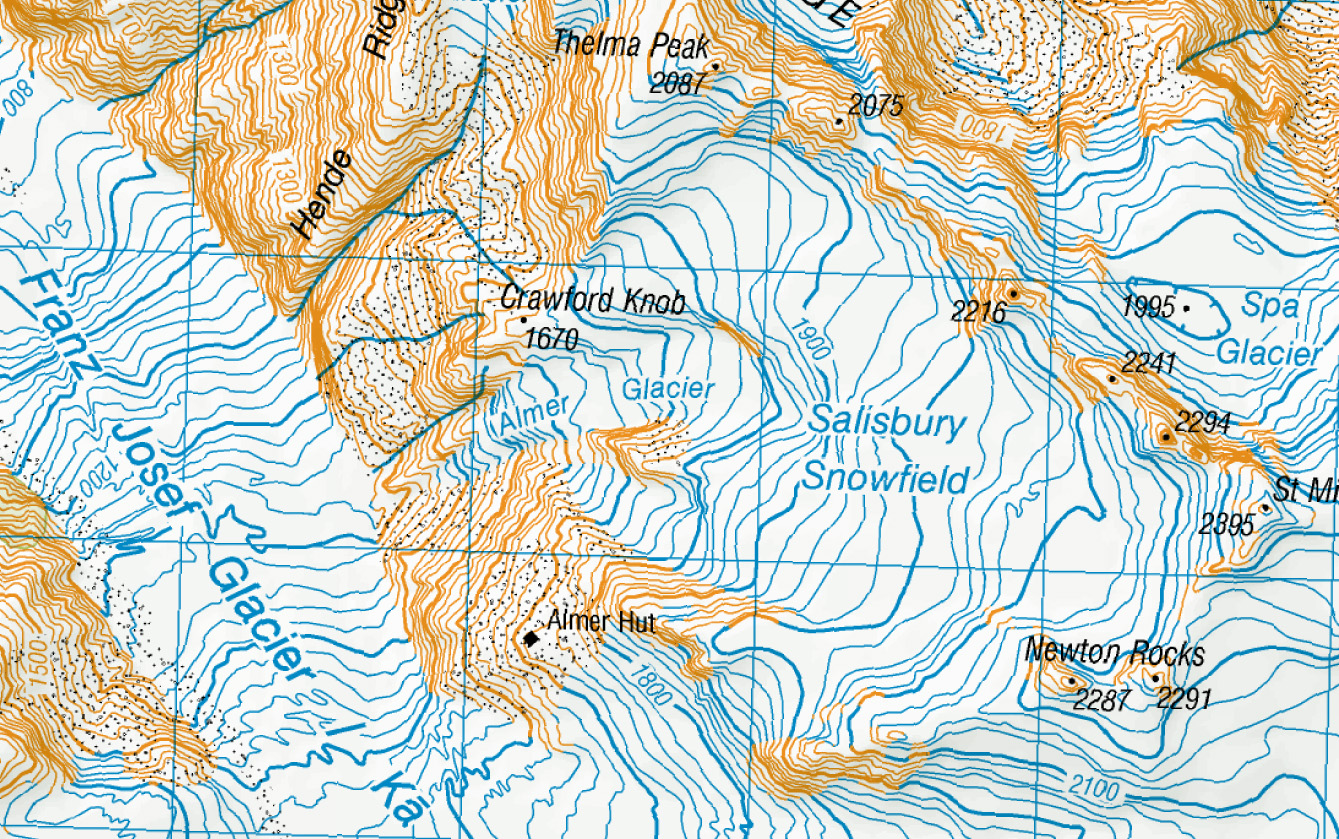
Topographic Map of Salisbury Snowfield-Almer Glacier area

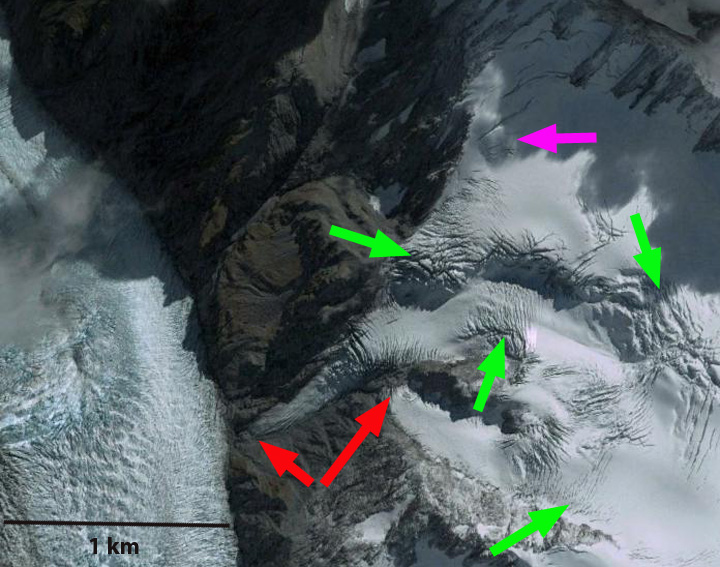
Here we examine changes particularly in crevassing as well as retreat of Salisbury Snowfield and Almer Glacier from 2000-2015. In the Google Earth images from 2007 and 2013 the green arrows indicate crevassed areas and the red arrows the terminus of the Almer Glacier above and Salisbury Snowfield below.  The decrease in the amount of crevassing is evident at each location.  This indicates not just a reduction in velocity, but in glacier thickness that is driving flow.  The thinning is evident with the emergence of a bedrock knob at the pink arrow in 2013 that had been covered by crevassed ice in 2007.  The red arrow indicates the terminus where the main Almer Glacier is within 75 m of the Franz Josef Glacier.  By  2013 the terminus is much dirtier and is 200 m from Franz Josef Glacier. The icefall comparison image from 2007 and 2013 indicates the reduction in width and number of open crevasses, probably in depth too. This is something Jill Pelto (UMaine) has been measuring crevasses in the field on Easton Glacier in the North Cascades over the last few years to see how crevasses are changing as a glacier thins and slows (image below).

In 2014 New Zealand had a warm year and snowlines are high for early summer in January 2015 which will continue the retreat.  The Landsat image from January, 2015 suggests further retreat has occurred since 2013, but given the dirty terminus, it is to hard to determine a specific amount.  The retreat here follows the pattern of glaciers across the Southern Alps of New Zealand- Lyell Glacier and Tasman Glacier

salisbury 2007

2007 Google Earth image

salisbury 2013

2013 Google Earth Image.

salisbury icefall comparison

2007-2013 icefall closeup 

crevase depth
2015 Crevasse Assessment, Jill Pelto, North Cascades

salisbury 2000


2000 Landsat image

salisbury 2015


2015 Landsat image


Lys Glacier Rapid Retreat, Italy

Lys Glacier drains south from Lyskamm in the Monta Rosa Group of Italy.  This glacier has a long history of observations that have indicated two short term advances in the 20th century 1912-21 and 1973-85 amidst a broader retreat.  The net change for the 1915-2004 interval was a 600 meter retreat (Smiraglia et al, 2006). They also noted a 10% area extent loss from 1975-2003, and since the glacier was advancing up to 1985 this change occurred more rapidly.  The Italian Glacier Commission report on terminus change of this glacier annually in the two latest reports Lys Glacier retreated 10 m in 2012 and 20 m in 2011. The total reported retreat from 2005-2012 was 186 m, more than 20 m per year. Here we examine Landsat images from 1990 to 2014.

lys ge

Google Earth Image

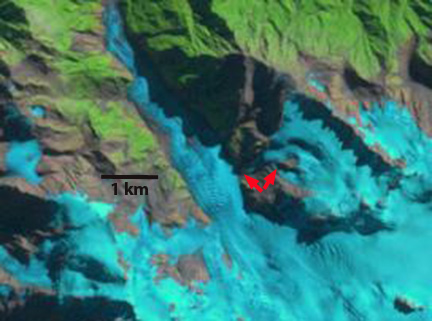
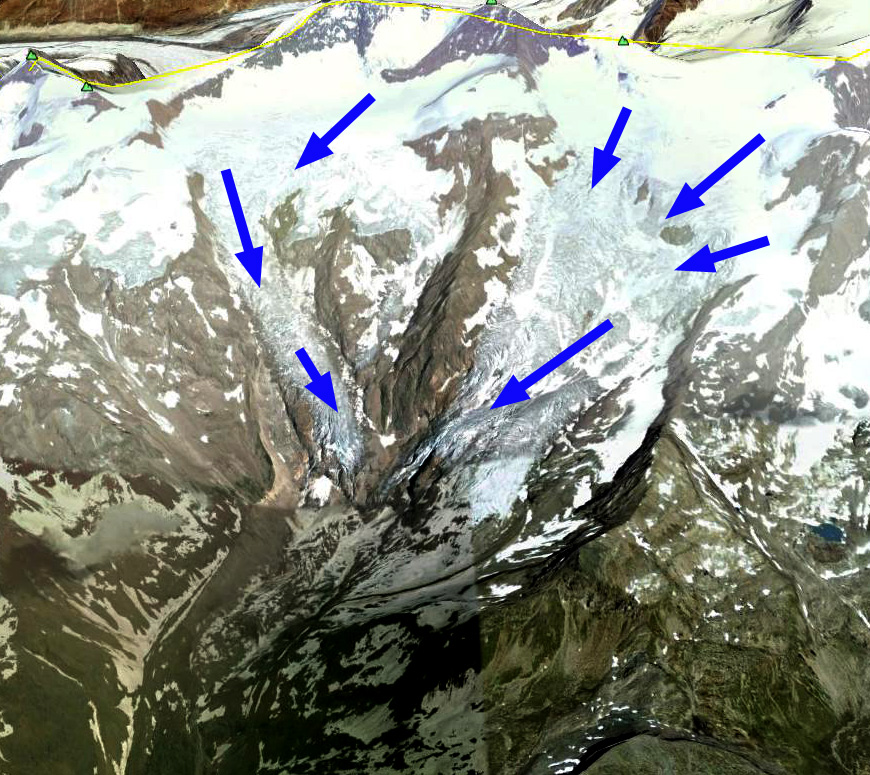
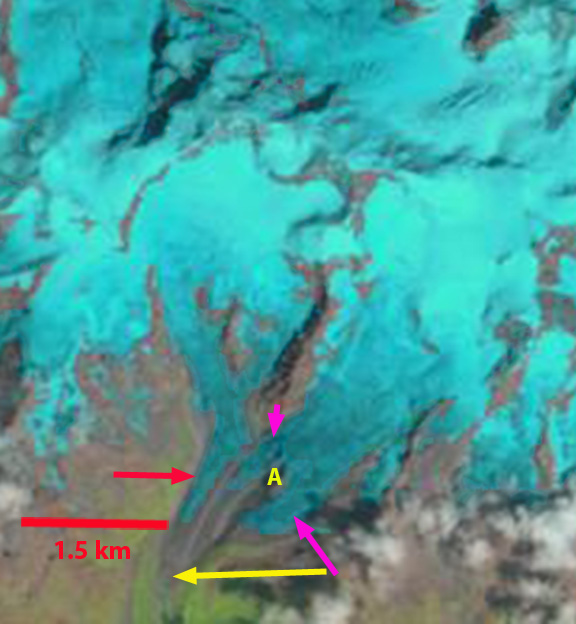
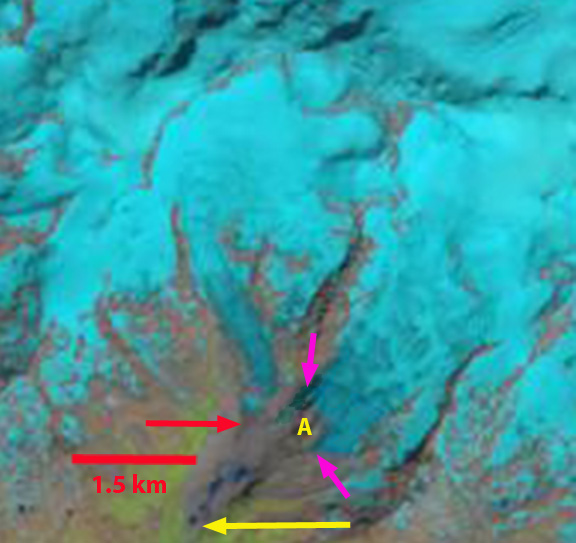
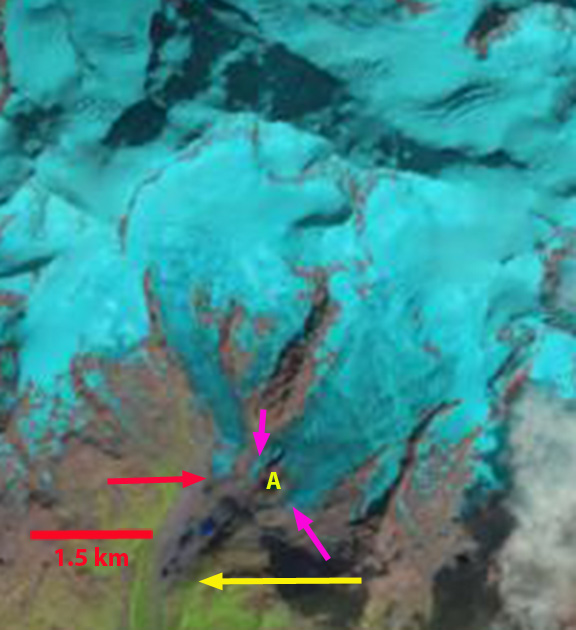
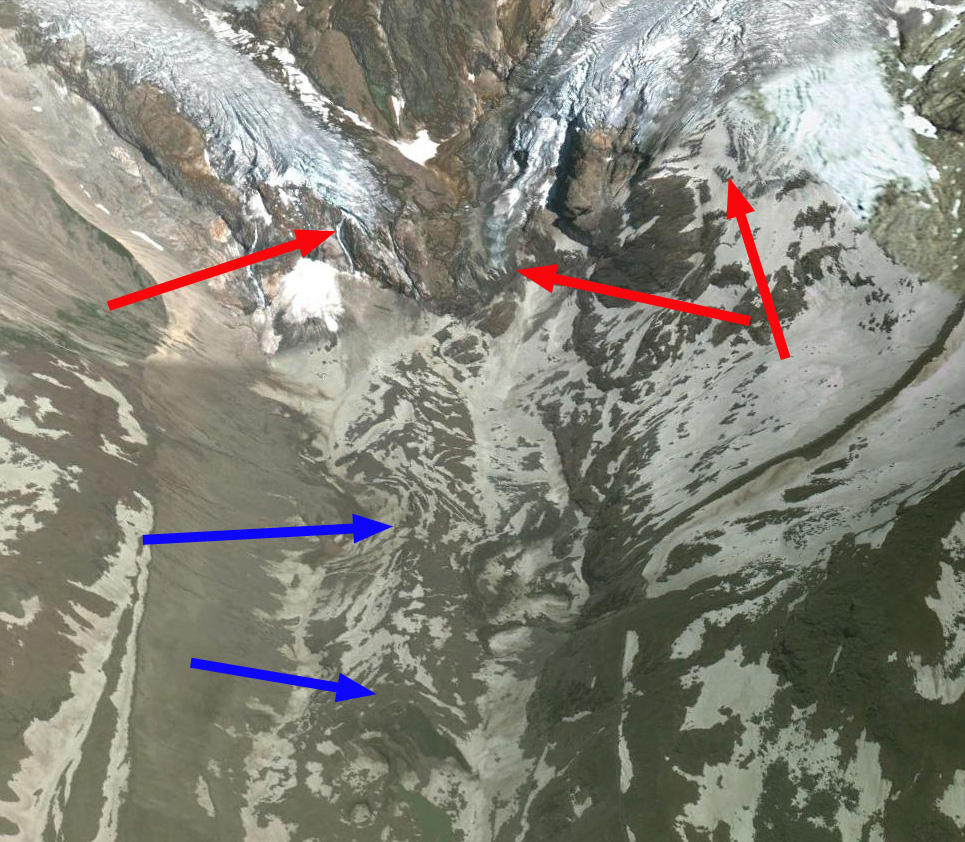
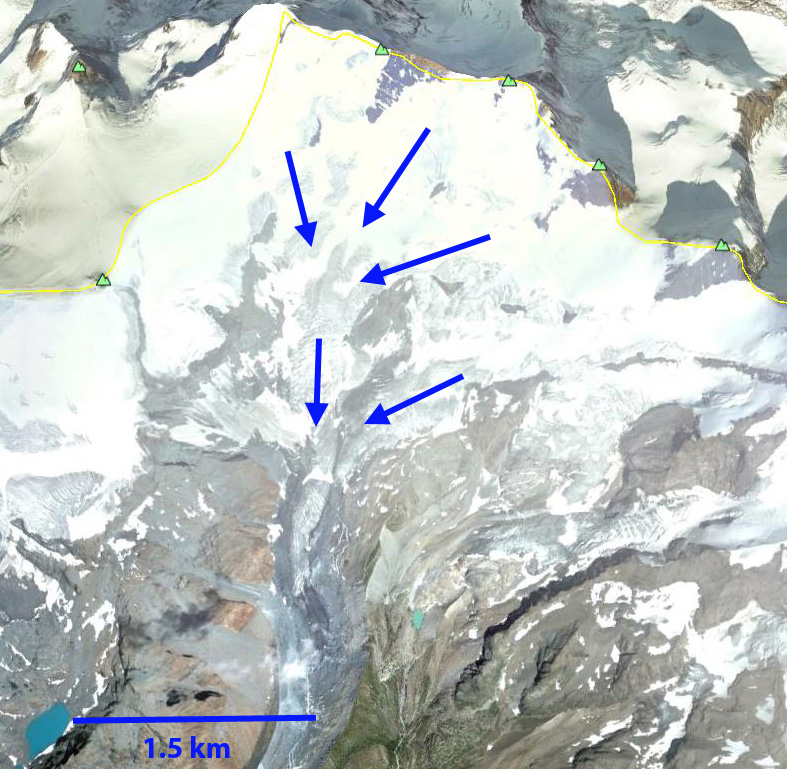
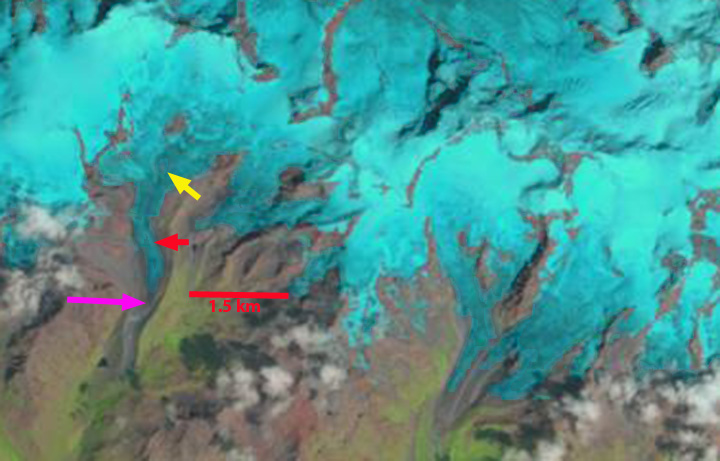
In 1990 two branches of the glacier merged in the valley bottom and extended to the red arrow marking the terminus of the glacier at that time.  The yellow arrow indicates the 2014 terminus position, and the yellow A indicates a prominent bedrock knob that a branch of the glacier encircles, pink arrows.  By 2013 the glacier in the main valley have separated, there are a few small lakes forming amidst the decaying stagnant ice tongue between the yellow and red arrow.  The bedrock knob at Point A has greatly expanded. In 2014 none of the termini reach the floor of the main valley.  As the stagnant ice melts, the lake area is expanding indicating that a new alpine lake will likely form.  The retreat from 1990-2014 is 1300 meters.  A closeup in 2009 from Google Earth indicates the two tongues with bedrock below separating them from the main valley floor, red arrows. There is still some relict ice below on the valley floor detached from the active glacier, blue arrows, that has small lake developing amid the stagnant ice. There is substantial crevassing above both actual termini, but not immediately. The retreat should slow now that the glacier has retreated onto steeper slopes, having lost the low elevation low slope valley tongue.
The retreat of this glacier is similar to that of nearby Verra Grande Glacier. lys glacier 1990
1990 landsat image
lys glacier 2013
2013 Landsat image
lys glacier 2014
2014 Landsat Image
lys glacier terminus
Google Earth Image

Verra Grande Glacier Retreat, Italy

Verra Grande flows south from Breithorn, in the Monta Rosa group of Italy. The glacier is 3.5 km long extending from 4000-2700 m. Carnielli (2005) noted that this glacier retreated 816 meters from 1914 to 2001.  There were two period of advance 1914-1921 and 1971-1985. Retreat was most rapid from 1934-1956 and 1991-2002 (Carnielli, 2005). Here we examine the change in this glacier from 1990 to 2014 using Landsat imagery.
lago italy 2009 ge
Google Earth Image
In 1990 the glacier terminated at the pink arrow, which is at the same location in each image. At the yellow arrow which is in an icefall in the upper ablation zone, there is complete glacier cover. The red arrow is at the 2014 terminus location in each image. By 2013 at the yellow arrow an area of bedrock has been exposed as the glacier has thinned during a period of retreat. In 2014 the glacier has retreated to the red arrow a distance of 850-900 meters from the 1990 terminus location, pink arrow. The snowline is high at 3500 m above the new bedrock area at the yellow arrow. A close up of the terminus from Google Earth in 2009 indicates the Little Ice Age moraines, blue arrows and the debris covered nature of the terminus, red dots. The retreat is similar to Sabbione Glacier and Lobbia Glacier. The Italian Glacier Commission conducts an annual terminus survey, with the most recent completed survey results posted from 2012. In 2012 there were 124 glaciers retreating, 3 advancing and 5 changed by less than two meters.  This ubiquitous retreat is leading to the separation of some glaciers, development of new lakes and loss of others in the Italian Alps.
verra grande 1990
1990 Landsat image

verra grande 2013
2013 Landsat image

verra grande 2014
2014 Landsat image

lago italy terminus
Google earth terminus view 2009

Spørteggbreen Separation and Retreat, Norway

Spørteggbreen is a small ice cap just east of Jostdalsbreen, Norway’s largest ice cap.  The Norway Glacier atlas chronicles the area of the 10 glaciers that comprise the ice cap at 23.8 square kilometers in 2006 (Andreassen and Winsvold, 2012). The Norwegian Water Resources and Energy Directorate (NVE) has an excellent glacier monitoring program that monitors 10 glaciers that drain Jostedalsbreen from 2008-2013 the net change was retreat on all 10. This is exemplified by Tunsbergdalsbreen. In 2014, 33 of 38 glaciers observed in Norway retreated and 5 did not change. Laumann and Nesje (2014) examined Spørteggbreen during the Holocene.  They noted the glacier disappeared from 7300 years before present and reformed approximately 5400 years before present.  Their model simulates minor changes from 2011 to 2050. Here we focus on changes to the southwest side of this ice cap using Landsat imagery from 1988-2014 and implications for the near future.

sporteggbreen 2010Norway Glacier atlas image looking southwest toward Jostdalsbreen.  The foreground is the main Sporteggbreen, the new lake is in midground and then the separated southwest extension.  There is no retained snowcover evident on the southwest extension and it is thin.

In 1988 at the southwest side of Spørteggbreen the main ice cap joins the southwest extension of the ice cap in a small lake at the red arrow. At the purple and yellow arrow are small peripheral proglacial lakes. The green arrow indicates a narrow section in the southwest extension. In August 1998 there is substantially more snow and lake ice, which makes identification of change difficult. In 2010 the southwest extension is well separated by a lake from the main ice cap, red arrow. This lake is m across, with the glaciers reaching the shore at both ends. The lakes at the purple and yellow arrow have also expanded. The width of the narrow section of the southwest extension has narrowed from 600 m to 300 m. In 2014 the main Spørteggbreen Ice Cap no longer reaches the eastern shore of the lake, red arrow. The lake is 750 m across. The lake at the purple arrow is now equivalent to the glacier that ends in the lake and is m long. The width of the glacier at the narrow section is down to 200 m. The most noteworthy item is that in this mid-September image the ice cap has 25% of its area still covered in snowpack, note the areas marked with pink letter A. The other areas are either firn from previous years or bare glacier ice.  By the end of the melt season at the end of the month this will likely be closer to 20% . Remember a glacier typically needs 55-65 % snowcover to be have an equilibrium balance.  This will lead to a large negative balance and thinning right to the top of the ice cap. This was the case in 2013 as well. Hence, the Spørteggbreen Ice Cap is currently experiencing significant volume and area losses. The retreat is not as large in terms of distance as on nearby Tunsbergdalsbreen.

sporteggbreen 1988a


1988 Landsat image.

sporteggbreen 1998

1998 Landsat image

sporteggbreen 2010a

2010 Landsat image

sporteggbreen 2014a
2014 Landsat image
Anderson Glacier, Olympic Mountains, Washington Disappears

Anderson Glacier was the headwaters of the Quinault River in the Olympic Mountains of Washington. A century ago the glacier was 2 km long, and a half kilometer wide. Retreat of this glacier in the first half of the 20th century exposed a new alpine lake as the glacier retreated 1 kilometer. From 1950-1980 the glacier diminished slowly. From 1959 to 1990 the glacier thinned and retreated from the shore of the lake trapped behind the Little Ice Age moraine. The 1959 picture below was donated to me by Austin Post. Since 1990 the glacier has begun to shrink rapidly. The Google Earth image from 1990, indicates Anderson Glacier has retreated 200 m from the 1959 terminus position near the lake shore, green arrow to the 1990 position, pink arrow. The red arrow indicates a future location of a bedrock outcrop.
1959 Austin Post image
anderson Glacier 1990
1990 Google Earth image
Investigating this glacier in 1992 we measured its area at 0.38 square kilometers, down from 1.15 square kilometers a century before. Ten years later the glacier had diminished to 0.28 square kilometers, but had thinned even more, leaving it poised for a spectacular change, over the next five years. Large outcrops of rock appeared beginning in 2003 and further exposed in 2005 and 2007 in the middle of the glacier. Note the outcrops in the 2007 image from Kathy Chrestensen. The 2009 Google Earth image indicates the 1990 terminus position, pink arrow, and the fact that there is no longer a ribbon of snow that is even 50 m wide. The snow patches have insufficient size or thickness to be classified as a glacier.  The largest outcrop at the red arrow had been beneath the ice in 1990, giving a scale to the thinning.  The glacier at this point no longer exists. In 2014 an Eric Hovden image indicates some seasonal snow in the basin, but the thin ribbon of snow has numerous holes in it as well, indicating the thin nature of the remaining snow patches, with a month left in the 2014 melt season.
Kathy Chrestensen Image
anderson glacier 2009
2009 Google Earth Image
anderson glacier 2014
2014 Eric Hovden image.

This glacier had become a series of small disconnected relict glacier ice patches in 2005 and by 2009 had disappeared. It is not the only glacier that is disappearing, which has led to a visual model for forecasting glacier survival (Pelto, 2010). The key is observed retreat of the margin of the upper portion of the glacier and emerging rock outcrops in the upper part of the glacier where snow should accumulate and be retained through the melt season. If a glacier does not have a significant persistent accumulation zone it cannot survive. Anderson Glacier was not the only glacier feeding the Quinault River, all the others are retreating as well. The result of this glacier retreat is reduced late summer and early fall streamflow, impacting salmon runs at that time of the year. This is primarily the fall Coho, Chum and Chinook salmon and Steelhead summer run. During the spring and early summer runoff increases as snowmelt still occurs, but is not retained in the glacier system.To get a sense of the special nature of this area Out of the Mist is an excellent start