Shakes Glacier drains the southern portion of the Stikine Icefield and terminates in Shakes Lake. It is between the more famous LeConte Glacier to the west and Great Glacier to the east. Larsen et al (2007) indicate recent thinning of 2-4 meters per year on the glaciers along the southern margin of the Stikine Icefield. Here we utilize 1985-2013 Landsat imagery to examine changes in this glacier.
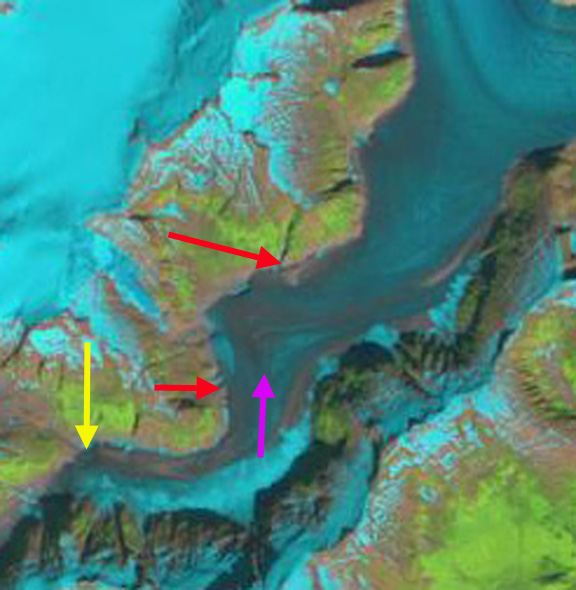
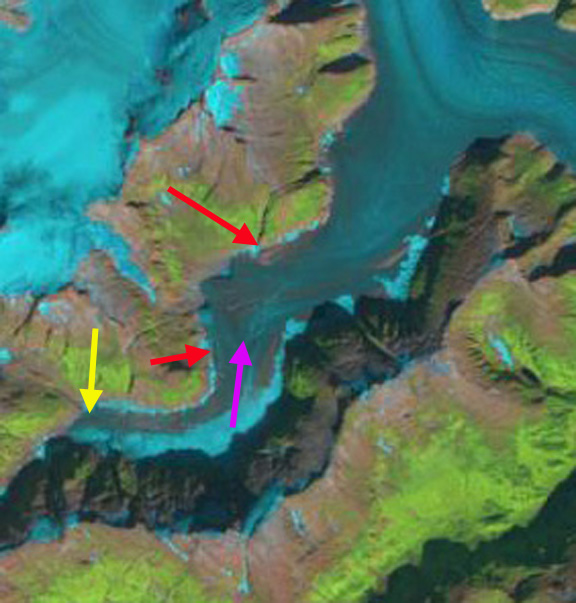
The USGS map of Shakes Glacier indicates the glacier turning the corner south along Shakes Lake. In each image the red arrow marks the 1986 terminus, the yellow arrow the 2013 terminus, the pink arrow a tributary from the east and the purple arrow a tributary from the west. In 1985 and 1986 the glacier has retreated onto the southeast trending arm of the lake ending at a deep gully on the west side of the lake, red arrow. The tributaries are still well connected to the glacier. By 1993 the glacier has retreated 300 m, the east tributary is still well connected, the west tributary at the purple arrow has considerably diminished. By 2003 the terminus has retreated 1.2 km from the 1985 position, the west tributary is just separating from the main glacier. The snowline is nearly at the top of the west tributary with a month left in the melt season. By 2011 a Google Earth image indicates the loss of connection with the west tributary and the disconnection on the east side which ends in a steep icefall slope. There is also a lake, green arrow just behind the terminus indicating impending rapid retreat will continue. The 2013 Landsat image the terminus has retreated 2.2 km from 1985, that is 78 meters/year. The lake is still evident behind the terminus. The continued significant retreat of Shakes Glacier matches that of other glaciers in the area Great Glacier, Baird Glacier, Patterson Glacier and Sawyer Glacier.
1985 Landsat image
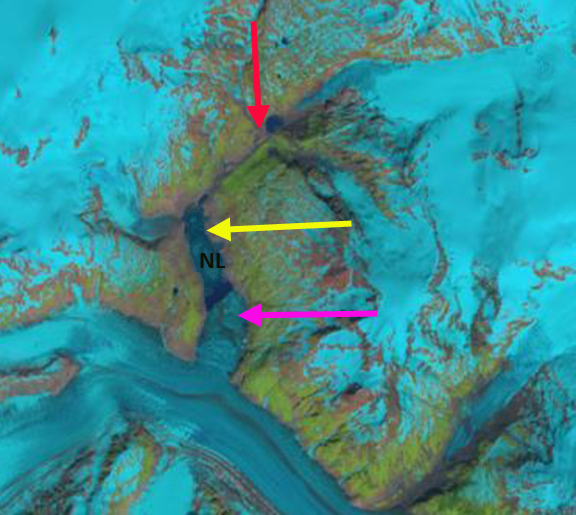
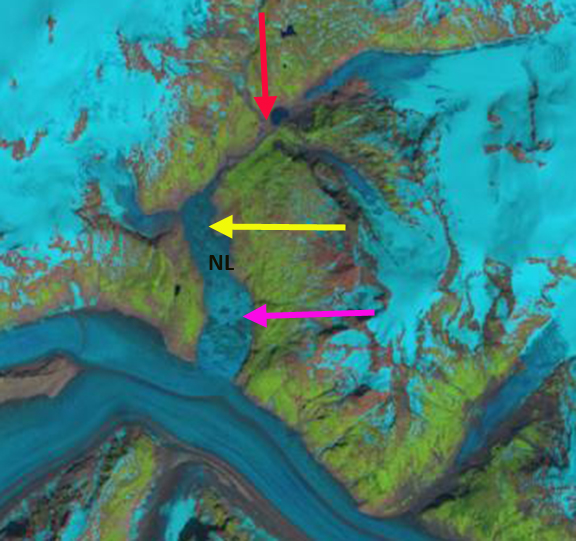
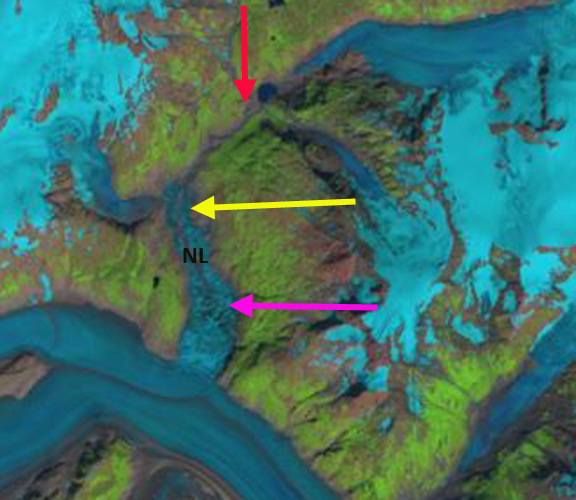
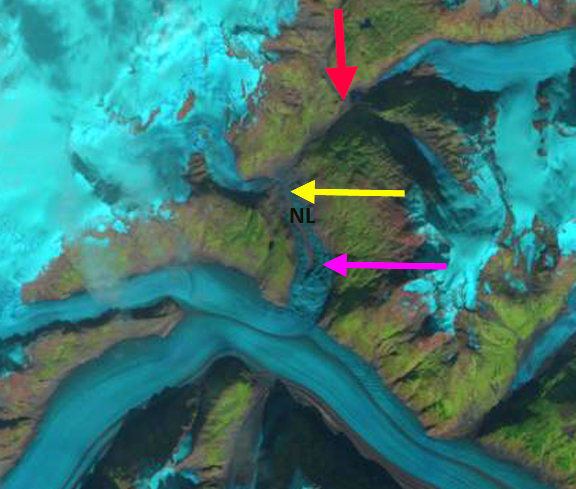
Lake No Lake is a glacier dammed lake that periodically drains under the retreating Tulsequah Glacier. Canadian topographic maps indicate that three glaciers coalesced to fill this valley: Tulsequah, No Lake East and No Lake West. By 1984 when I had a chance to see this lake had formed while working on Tulsequah Glacier. Here we examine the retreat of the three glaciers that has led first to lake formation and now to a reduction in lake size from 1984-2013. In 1984 the lake extended to the terminus of No Lake East Glacier at the red arrow, after that glacier separated from the other two. Most of the valley below this point is filled with the Tulsequah and No Lake West Glacier that are still connected. The retreat of No Lake East is 1.75 km and now filled by a lake. A series of five Landsat 8 images from 2013 indicates the progression of this lake during a summer. On June 14, 2013 the No Lake East Glacier and Tulsequah Glacier are now separated with a valley 2.5 km long in between. This segment of the valley is filled by the lake, but the lake does not extend upvalley from West to East No Lake Glacier. By June 21 the lake has extended another 400 m upvalley to the northeast as the lake fills. By June 30th the lake has expanded to a length of 3 km and an average width of 600 m. By August 1st the lake has largely drained, though there are many icebergs still on the lake bottom and there is certainly some water remaining. By September 28th the lake is completely drained. The retreat of No Lake East Glacier from the 1984 terminus location at the red arrow is 450 m. The retreat of No Lake West Glacier from the yellow arrow is 400m. The 30 year retreat of the arm of the Tulsequah Glacier from the yellow to the pink arrow is 1800 m. As the damming arm of Tulsequah Glacier continues to thin this glacier will continue to decline in both depth and area. A 2010 Google Earth image is used to indicate the lake margin as indicated by stranded icebergs after drainage. Geertsema and Clague (2012) observed that this lake grew rapidly and began having glacier outburst floods during the 1970’s, but is now declining in size.
1984 Landat image
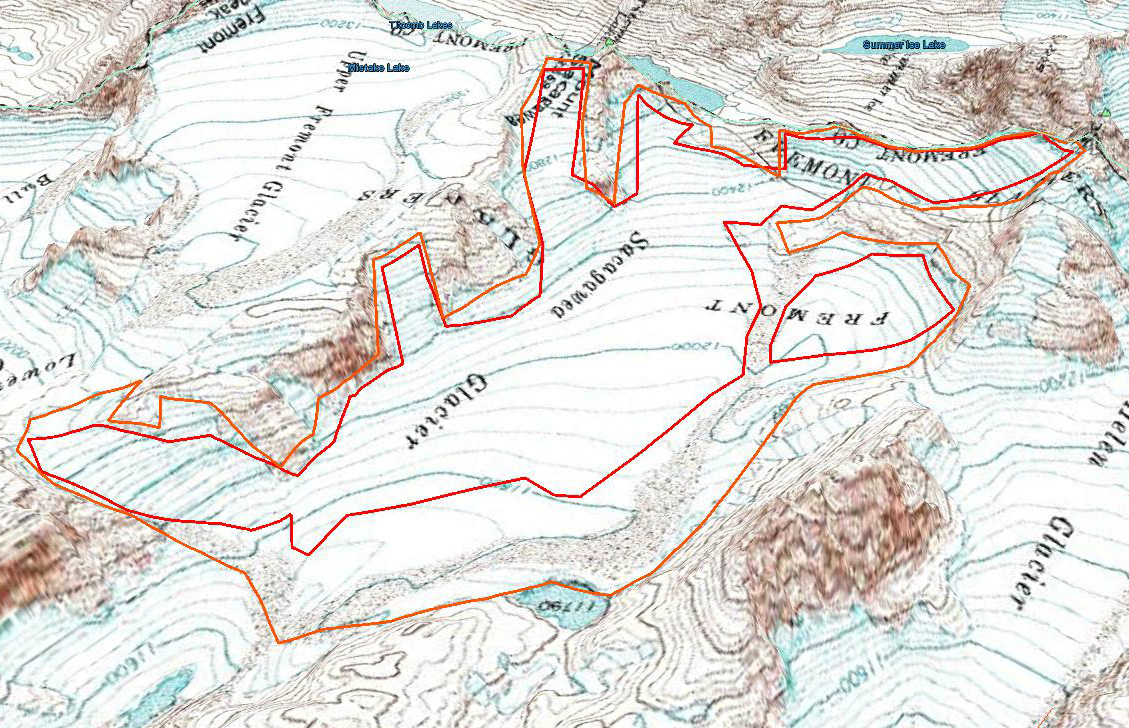
Sacagawea Glacier in the Wind River Range of Wyoming lost 35% of its area between 1966 and 2006. This glacier on the west slope of Sacagawea Peak and Helen Peak and just north of Upper Fremont Glacier. Here we compare Google Earth imagery of the glacier that indicates the change during this forty year period. In 1966 the glacier had an area of square kilometers. The first image is the USGS map of the glacier from 1966 imagery. The orange outline is the glacier margin at this time and the red outline the 2006 glacier boundary. By 1994 Google Earth images indicate a retreat of 270 m along its main terminus. A small lake has also begun to form along the southern section of the terminus. The northern section of the glacier below Helen Peak had by 1994 become practically disconnected from the main section of the glacier. In 1994 the exposed blue ice area is extensive, indicating that most of the glacier was consistently losing its snowcover. With retained snowcover limited to the steeper slopes above 3700 m. By 2006 the lake was 400 m long and 150 wide along the southern section of the terminus. The terminus retreat along the main terminus averaged 350 m since 1966. The northern section of the glacier is fully detached from the rest of the glacier. The fraction of snowcovered area is 10% in 2006, which was typical for the 2003-2006 period. This is insufficient to maintain a glacier, the snowcovered area for temperate alpine glaciers such as the Sacagawea that lacks extensive avalanching is 55-65 % snowcover at the end of the melt season. The locations marked with Point A in red are locations where rock formerly beneath the glacier has been exposed as the glacier melted from that location. By 2013 a Landsat image of the glacier indicates that the glacier is beginning to recede from the terminus lake, further that there is almost no retained snowcover in 2013 and that the glacier is separated into three segments note the yellow arrows. The upper margin of the glacier is receding which indicates thinning in the accumulation zone, an indicator that this glacier does not have a significant accumulation zone and cannot survive current climate (Pelto, 2010). In a Planet Action Project Pelto (2010)reported that 2/3 of the 15 Wind River glaciers examined were not going to survive current climate. This includes Minor Glacier, Sourdough Glacier, Grasshopper Glacier and Lower Fremont Glacier.
1966 USGS map
1994 Google Earth
2006 Google Earth
2013 Landsat Image
Analysis of Sacagawea Glacier and Upper Fremont Glacier, Wind River Range, Wyoming
Haworth Glacier in the northern Selkirk Mountains of British Columbia drains into Palmer Creek, which flows into Kinbasket Lake, and then the Columbia River. This glacier is often visited by climbers as the Canadian Alpine Club has a summer base camp near the terminus of the glacier. The glacier has a low slope and limited crevassing that makes it a good training ground for climbing. Menounos et al (2008) noted an advance of this glacier overrunning a stump that has since been exposed by retreat in the period from 3800 years before present, similar in timing to many glaciers in the region. The stump remained buried until recent exposure.
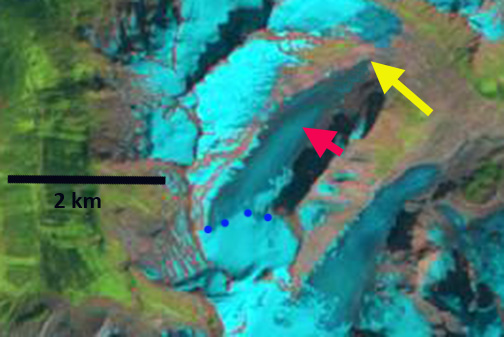
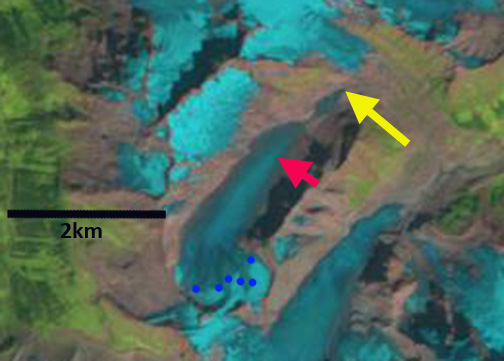
Here we examine a series of Landsat images from 1986-2013 to identify the retreat and forecast whether the glacier can survive even current climate conditions. In each image the blue dots mark the snowline, yellow arrow is the 1986 terminus and the red arrow the 2013 terminus. In 1986 the glacier ended near the far end of the basin where a lake has since developed, yellow arrow. Snowcovers 30% of the glacier in the late summer of 1986, 55-65% is necessary for glacier equilibrium. By 1994 the glacier had retreated exposing the new lake basin, the glacier was 25% snowcovered. By 1998 the glacier had retreated 550 m since 1986, the glacier was 15% snowcovered. In 2009 the glacier was 20% snowcovered. In 2013 the glacier terminates at the red arrow indicating a retreat of 1000 m since 1986, 37 m per year. The glacier is 10% snowcovered. The percent snowcover in each year is much less than the 55% minimum needed for a minimum balance, the images are also not precisely at the end of the melt season. If a glacier does not have a consistent and persistent snowcover at the end of the melt season it has no “income” and cannot survive (Pelto, 2010). This glacier has managed to retain a very small area of snowcover, but given the ongoing thinning and the lack of avalanche accumulation on this glacier, it is unlikely to be enough to save this glacier. Bolch et al (2010) noted a 10% area loss for British Columbia glaciers from 1985 to 2005, Haworth Glacier is above this average. Tennant and Menounos (2013) noted that the fastest rate of loss on Columbia Icefield glaciers from 1919-2009 was during the 2000-2009 period. The glacier is not retreating as fast as some of the glaciers that also calve into lakes such as Columbia Glacier, British Columbia. Nearby Apex Glacier has retreated at a similar rate. Jiskoot et al (2009) observed the terminus change of 176 glaciers in the Clemenceau Icefield and adjacent Chaba Icefield, and noted an average retreat of 21 meters per year from the 1980’s to 2001.
1986 Landsat image
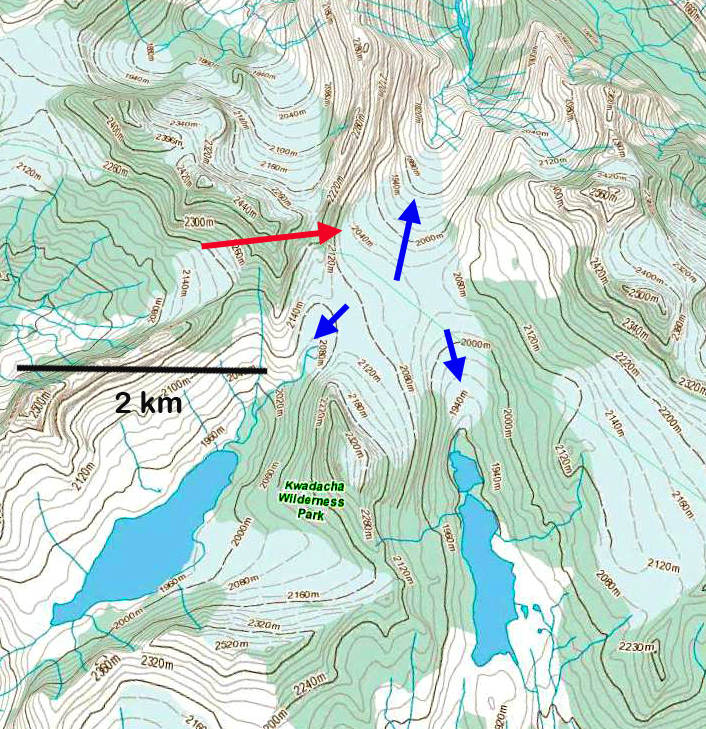
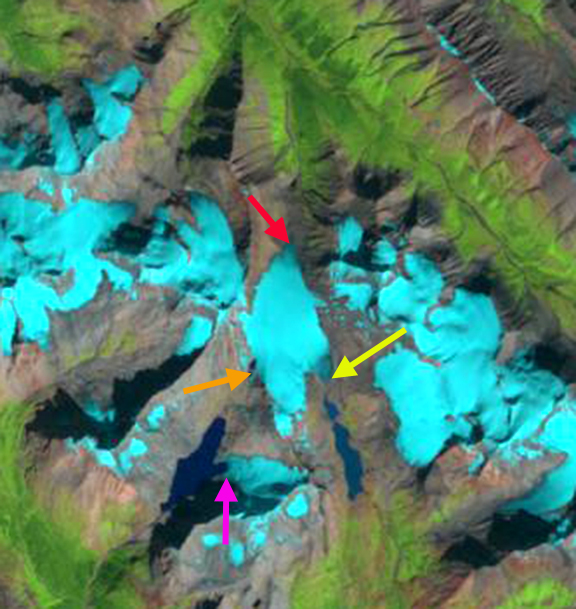
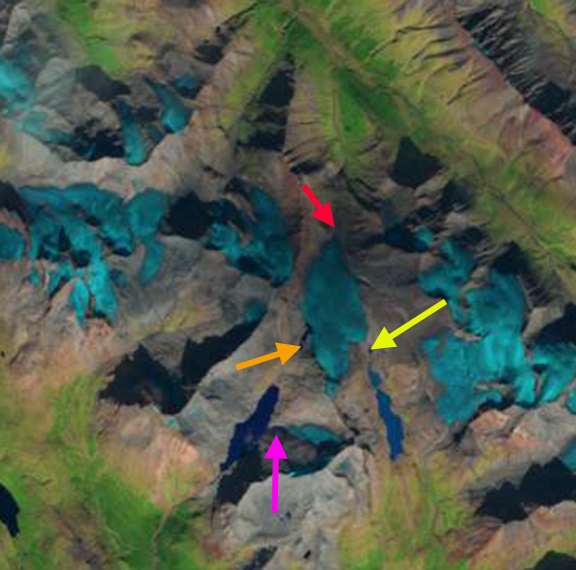
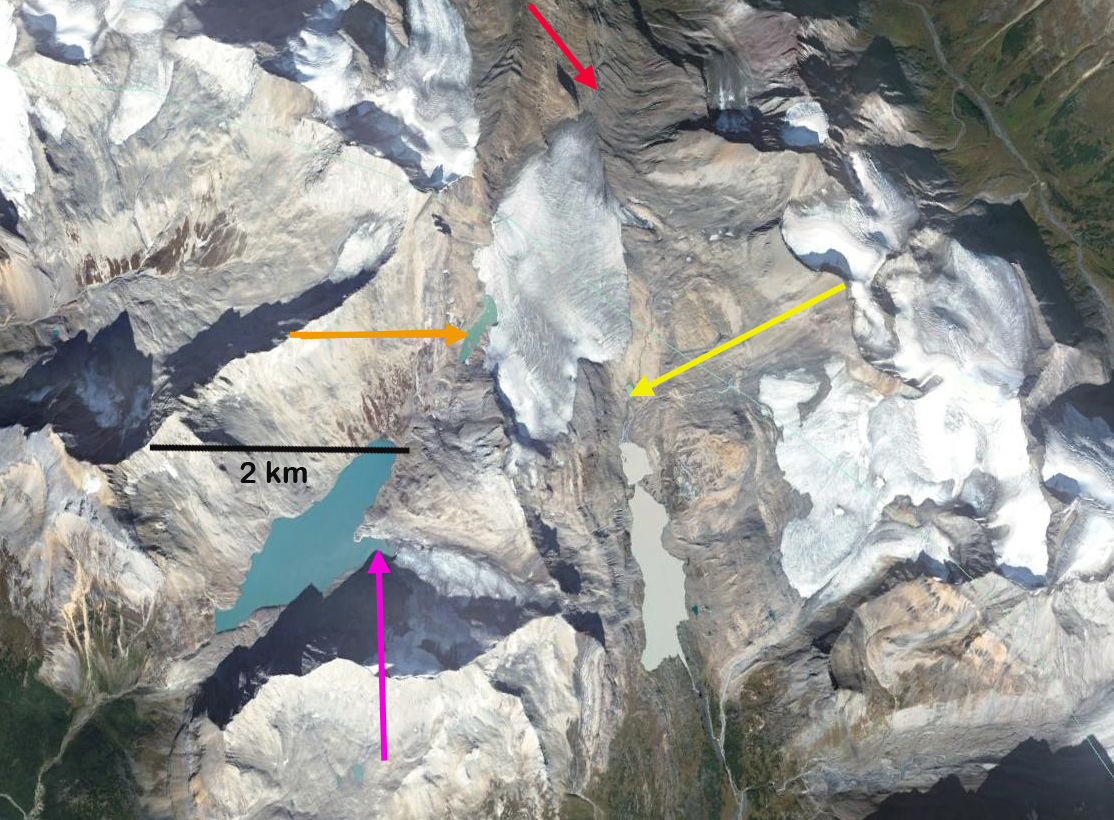
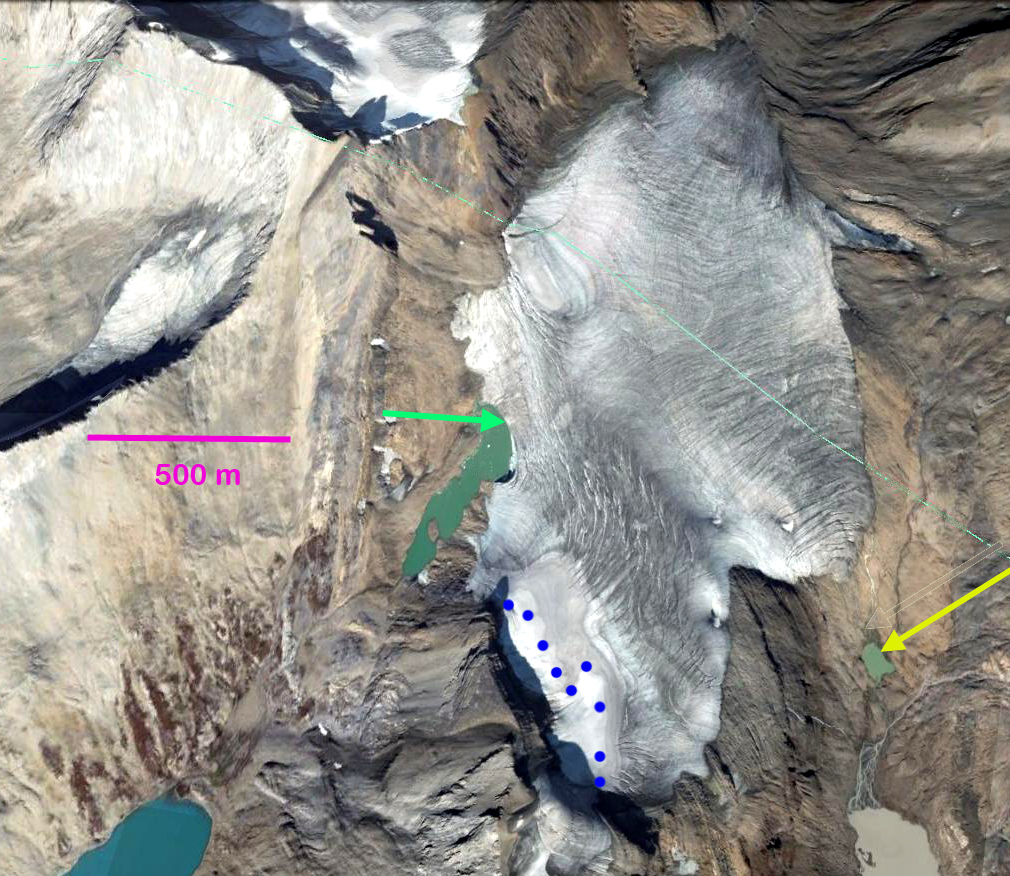
Kwadacha Wilderness Provincial Park in Northern British Columbia is host to numerous glaciers. Here we focus on an unnamed glacier that drains north into the Kechika River, which joins the Laird River. This glacier straddles both a watershed divide. The map of the glacier indicates the three separate termini of this glacier. Bolch et al (2010) noted that this area of BC lost 15% of its glacier area from 1985 to 2005. A comparison of Landsat imagery and Google Earth imagery during the 1994-2013 period indicate the changes to this Kwadacha Park glacier. In 1994 the glaciers three termini are at the red-northern terminus, yellow-southeaster terminus and orange-southwestern terminus arrows. A separate glacier ends at the margin of an alpine lake at the violet arrow. In 1995 there is no snowcover retained on the glacier. In 2001 the terminus at the orange arrow has retreated leading to lake expansion and at the red arrow. By 2013 the glacier’s northern terminus has retreated 250-300 m since 1994 and now terminates at the end of a rock rib. The southeastern terminus has retreated 250 m losing most of this glacier tongue. The southwestern terminus has retreated 300 m, and some calving is occurring. The glacier also has no retained snowpack in 2013. A glacier that consistently loses all of its snowpack cannot survive (Pelto, 2010). This glacier falls into that category. The retreat is evident in the Google earth image with the arrows marking the 1994 terminus locations. A closeup of this image indicates the lack of retained snowcover, blue dots mark snowline. The southwestern terminus calving margin is noted at the green arrow. The near stagnant nature of the northern terminus is also evident with the lack of crevassing. This glaciers will continue to thin and retreat and with current climate will not survive. The retreat is similar to that of other glaciers in the region including Snowshoe Glacier, Yukon, Great Glacier and Freshfield Glacier.
1994 Landsat image
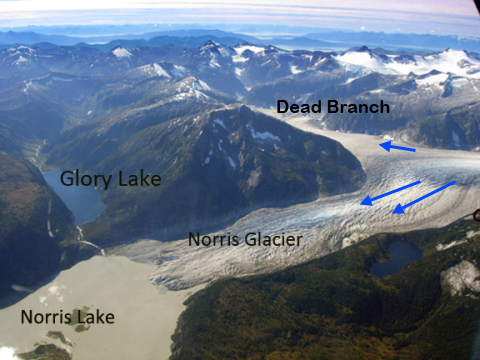
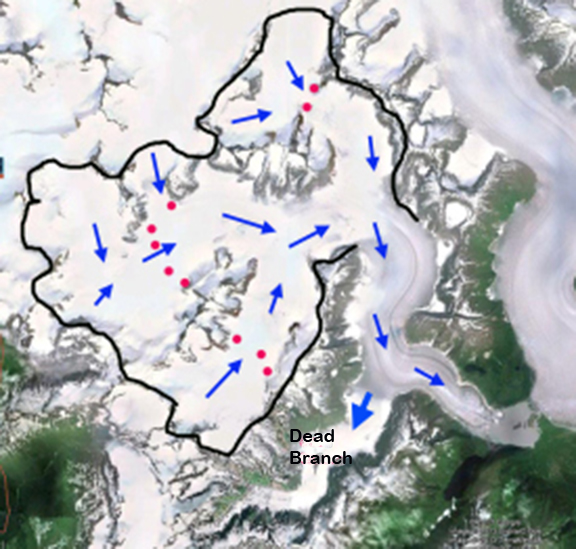
The Dead Branch of the Norris Glacier is a side valley of the Norris Glacier fed by the main glacier. Instead of tributary it is a distributary tongue. As the Norris Glacier has thinned and retreated 100 m from 1984-2013 recently the inflow had declined. The Dead Branch has retreated and a subglacial lake forms each spring that lifts the glacier causing concentric crevasses to form. The lake then drains later in the summer and the glacier subsides. The crevassing has gotten much worse since I first saw this glacier in 1984. Here we look at Landsat and Google Earth imagery from 1984-2013.
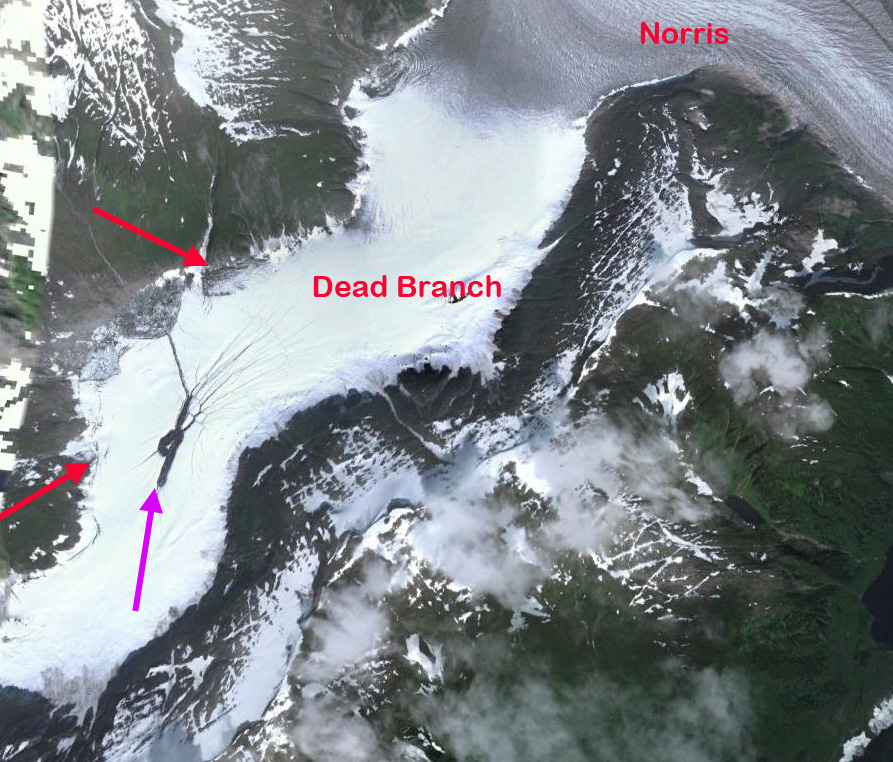
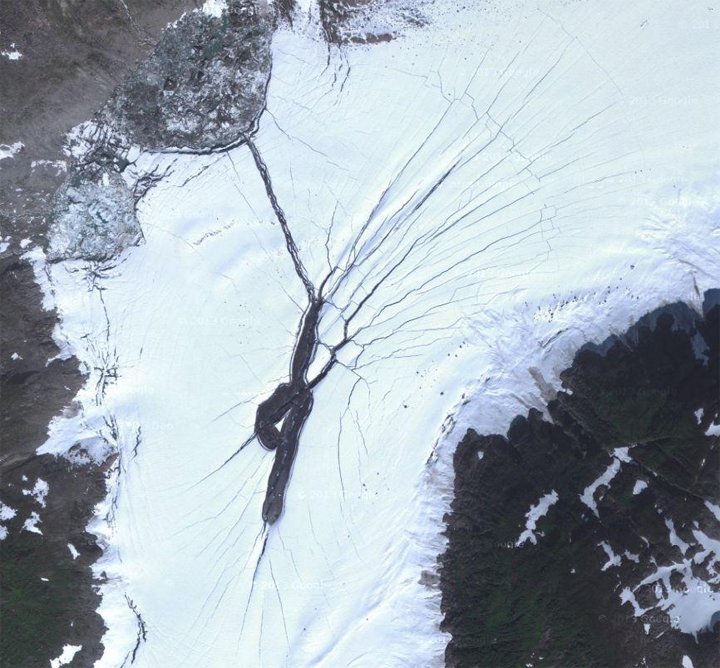
Below is a sequence of three images from 2010 indicating the key feature in the center of the glacier. This dark feature, purple arrow amidst the snow covered glacier in July is caused by large crevasses due to glacier uplift by the sub-glacial lake. The water table rises to near the glacier surface bringing with it sediment that then stains the surrounding snow it infiltrates. There is one large north trending crevasse that connects to a lake that is partly on and partly adjacent to the Dead Branch. The next two images are closeups. The concentric crevasses and radial crevasses, that look like spokes, are indicative of lake uplift in this otherwise flat stagnant reach of the glacier. The expansion of this network suggests that the thinning glacier is easier to lift over a larger area.
Google Earth 2010 image
2010 Closeup annotated- rred arrow concentric crevasses, blue arrow main connection crevasses, purple arrows radial crevasses.
2010 Digital Globe
The set of images below are from Landsat images from 19884-2013 the yellow arrow indicates the western terminus of the glacier tongue. This has retreated 400-500 m during this period. The red arrows indicate two prominent features on the side of the glacier which indicate that there is some thinning and lateral retreat, though not nearly as much as on the feeder Norris Glacier. The large crevasses do not show up well in the late summer 2013 Landsat as the lake has drained and the glacier subsided closing many, and due to the reduced resolution of the image. This branch is similar to that of the Witches Cauldron of Baird Glacier. Both appear poised to expand into large lakes in isolated valleys. In early summer 2014 we will closely watch the lake formation and glacier response .
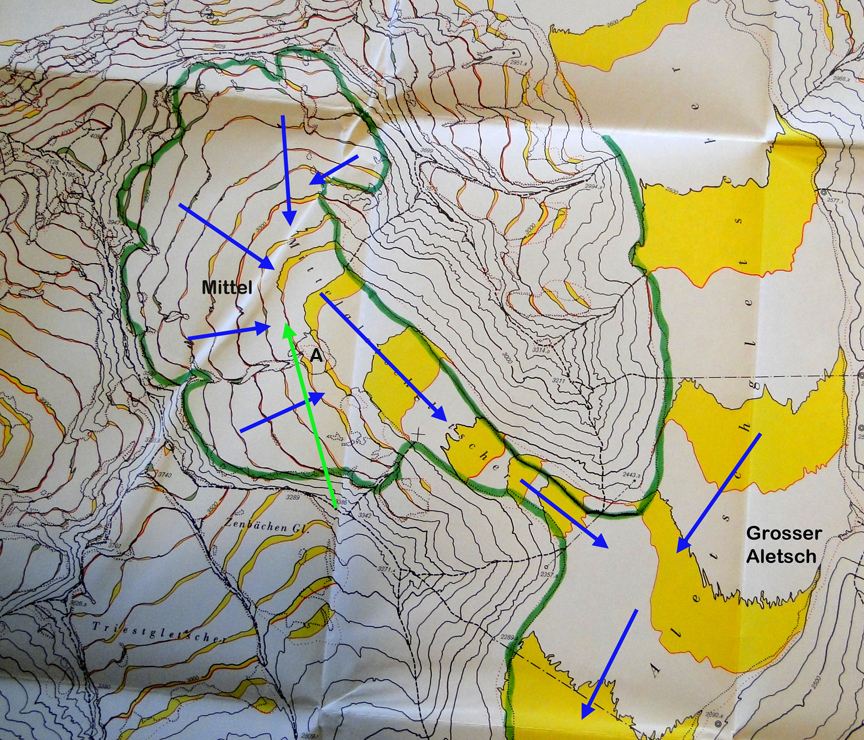
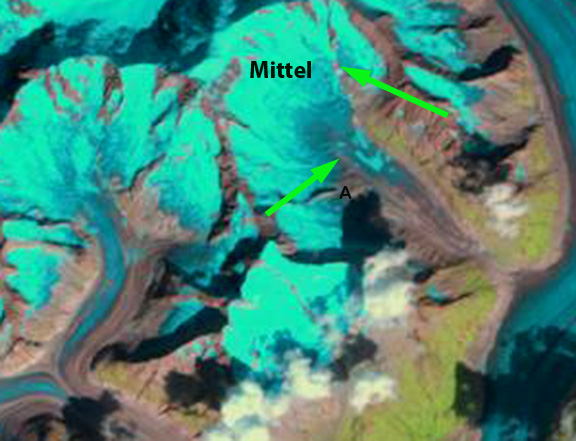
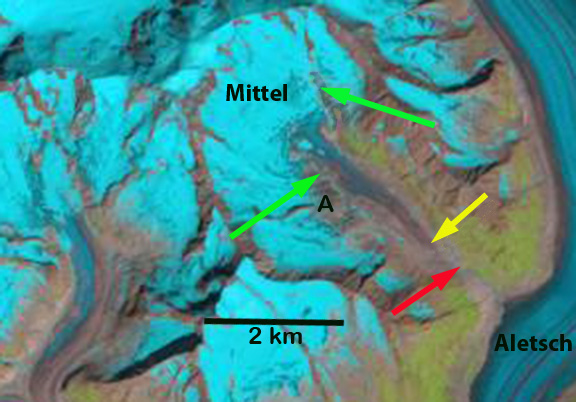
Mittelaletsch Glacier was a tributary to the Alps largest glacier Grosser Aletsch, until separation in 1990. The map of the glacier represents changes in the glacier from 1926 to 1957, indicating the connection of the two glaciers at that time. By 1970 Mittel had separated from Grosser, and experienced 420 m of retreat from 1970 to 2000 as noted by the Swiss Glacier Monitoring Network.
Map showing 1957 glacier extent with elevation changes from 1926 in yellow.
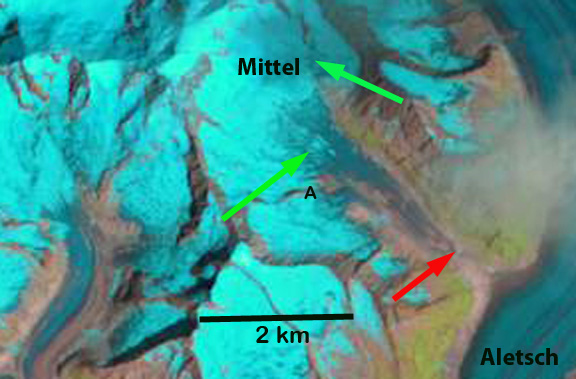
Here we examine changes in the glacier using Landsat imagery from 1990 to 2013. In each image an upper and lower green arrow point to the same location where expanding bedrock areas are separating the upper and lower portion of the glacier. Point A is at the lower end of a prominent rock rib. In 1990 the glacier ends at the red arrow separated from Grosser Aletsch by 600 m. At the lower green arrow the glacier is flowing across this slope contributing snow and ice to the lower glacier. In 1999 the area of exposed bedrock between the upper and lower glacier has expanded by at least 500 m at both green arrows. By 2007 Google Earth imagery indicates a continued expansion at the lower green arrow. The glacier terminates at the yellow arrow 1050 m from a connection to the Grosser Aletsch Glacier. The lower 1 kilometer of the glacier is stagnant as seen in the closeup view of the terminus, pink arrow indicates start of stagnant section. In 2013 the glacier has retreated 1400 m from the Grosser Aletsch Glacier, terminating at yellow arrow versus 1990 terminus red arrow. The margin of the Grosser Aletsch has contracted 150-200 m, hence the actual retreat since separation is 1200-1250 m. By 2013 at the lower green arrow the bedrock strip separating this section of the upper and lower glacier has expanded to a length of 1 km. This is equivalent to a company losing income from an important division, or a family losing one income stream. The lower glacier is recieving less snow and ice contribution and will continue to retreat, quickly loseing the stagnant area the comprises the lowest 700-100 m of the glacier. Jouvet et al (2011) reconstruct the behavior of the Aletsch Glacier system to various climate scenarios and find that any scenario leads to 2 km of retreat by 2040 for Grosser Aletsch and somewhat less for Mittelalestch. This glaciers behavior is similar to that of nearby Gauli and Oberaar.
1990 Landsat image
Gauligletscher drains into the Aare River in the Bernese Oberland of Switzlerand. The glacier is in the next valley north or the Oberaar Glacier, that is also retreating and important to hydropower. The Aare River is both has a complex scheme for generating hydropower and a simple system of run of river power stations Alpiq Hydro Aare AG manages the Flumenthal, Ruppoldingen and Gösgen which use the power of the River Aare to generate 90 MW of electricity, without using significant reservoirs or altering flow. Kraftwerke Oberhasli (KWO) from the 1930’s through 1979 built a constellation of power plants, seven hydro dams, a natural lake and around 130 km of water carrying pipes. The total output of the KWO system is 1100 MW, equivalent of a large nuclear plant. This network supplies 7% of the hydropower for Switzerland. The glacier has been in rapid retreat since 2000, with the Swiss Glacier Monitoring Network identifying a retreat of 246 m from 1958-1990, 132 m from 1990-2000 and 864 m from 2000-2013.
KWO hydropower scheme for Aare River.
Google Earth 2007 image showing new lake that the glacier is calving icebergs in.
Here we use Landsat satellite imagery to examine the retreat, the formation of a new lake and the retreat from that lake during the 1990-2013 period. The Glaciers Online site has excellent images of the retreat of this glacier during the lake formation phase from Jürg Alean and Michael Hambrey. In each Landsat image Point A-D are fixed to provide a comparison of terminus change. In 1990 there is no lake at the terminus of the glacier, the terminus has a low slope ending at 2170 m. By 1999 a tiny lake can be seen forming at the northern side of the terminus as the glacier has retreated into a basin. By 2002 there are two small lakes at the north and south corner of the terminus. In 2007 the lake has coalesced into one lake that is 500 m wide and has a length of 600 m on the northern and southern margins and 250 m long in the middle, where ice is still calving into the lake as seen in the Google Earth image above. By 2013 the glacier has retreated out of the 800 m long lake, and terminates 100-150 m from the lake shore. The terminus in 2013 is approaching the base of a steeper slope with more crevassing. This region has thinned both in width, depth and has lost crevassing. The retreat will slow as the glacier retreats up the slope, but is not near an end.
If glaciers did not change in response to climate, we would not have to think about their role in water resources in the watersheds that they reside. During the last two years in an ongoing study with the Nooksack Indian Tribe we have been working on quantifying the role glaciers play in that watershed. Glaciers comprise the headwaters of the Nooksack River and are a critical source of summer discharge and greatly influence summer stream temperatures. There are nine species of salmon in the watershed that the Nooksack Indian Tribe depends on for cultural, subsistence, and economic uses. Climate change is an additional new threat to salmon that has caused and will continue to cause an increase in winter flow, decreased summer baseflow, and increased summer water temperatures.
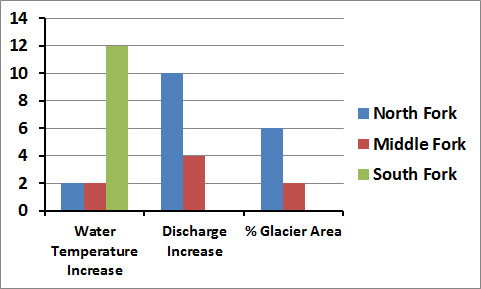
This post will focus on the changing impact of glaciers on streamflow and the evolving water temperature threat. The Nooksack River watershed has three significant watersheds, South Fork, Middle Fork and North Fork. The South Fork has no glaciers, the Middle Fork has four significant glaciers and 2% of the watershed area above the USGS gage is glaciated. The North Fork has 12 significant glaciers that cover 6% of the watershed area above the USGS gage. Here we examine stream discharge and water temperature at USGS gages on each stream to illustrate the different response to 12 warm weather events during the summers of 2009, 2010, 2012 and 2013. During each of these periods we have along with Oliver Grah and Jezra Beaulieu, working for the Nooksack Tribe, have been observing the ablation and runoff directly from the glaciers. The largest area of glaciers are those on Mount Baker, a strato volcano that is the highest mountain in the North Cascades. Pelto and Brown (2012) note that terminus observations on the nine principal Mount Baker glaciers, 1984–2009, indicate retreat ranging from 240 to 520 m, with a mean of 370 m or 14 m/year. Pelto and Brown (2012) observed that this is the result of a sustained mass balance loss averaging -0.5 m/year during the 1990-2010 period. This equates to an 11-m loss in glacier thickness, 12–20% of the entire 1990 volume of glaciers on Mount Baker. This summer we will for the 31st consecutive year be measuring glacier mass balance on Mount Baker.
Mazama Glacier headwaters North Fork
Deming Glacier headwaters Middle Fork
Crevasse examination
Probing snow depth
Outlet of Sholes Glacier, North Fork
Measuring snow depth in crevasse
During each of these events ablation was measured on glaciers in the basin. For stream discharge, a 10% increase is set as the key threshold for significant response to each warm weather event. For the North Fork 10 of 12 warm weather events exceeded the limit, in the Middle Fork 4 of 12 events had a significant response and for the South Fork none of the 12 events led to a 10% flow increase. It is apparent that warm weather events increase glacier melt, thus enhancing flow in the North Fork. In a basin without glacier runoff the hydrologic system consistently experiences reduced discharge.
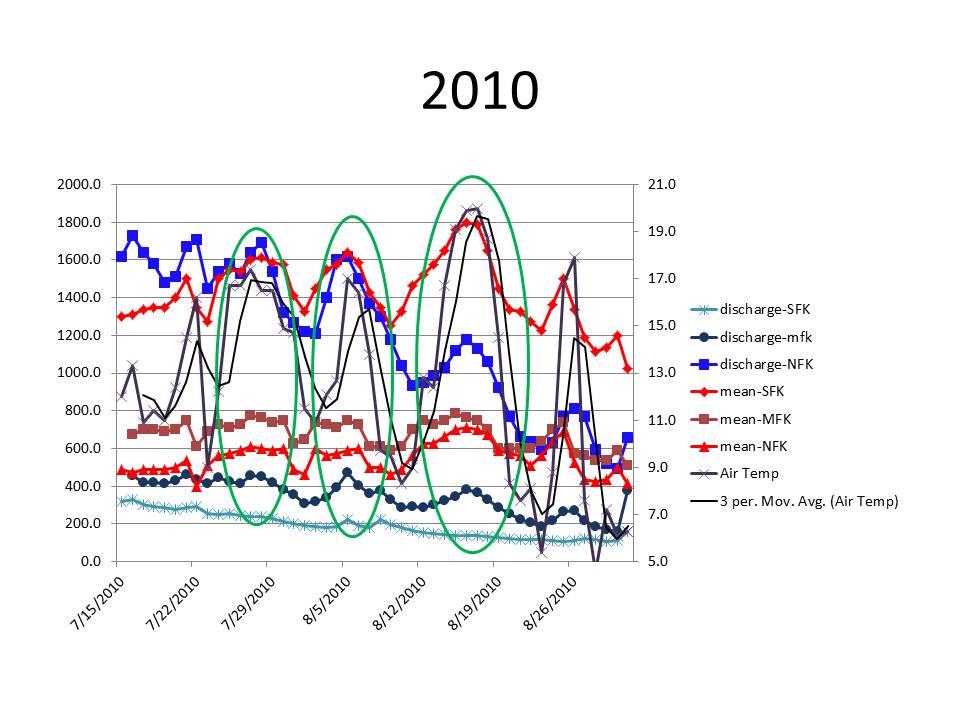
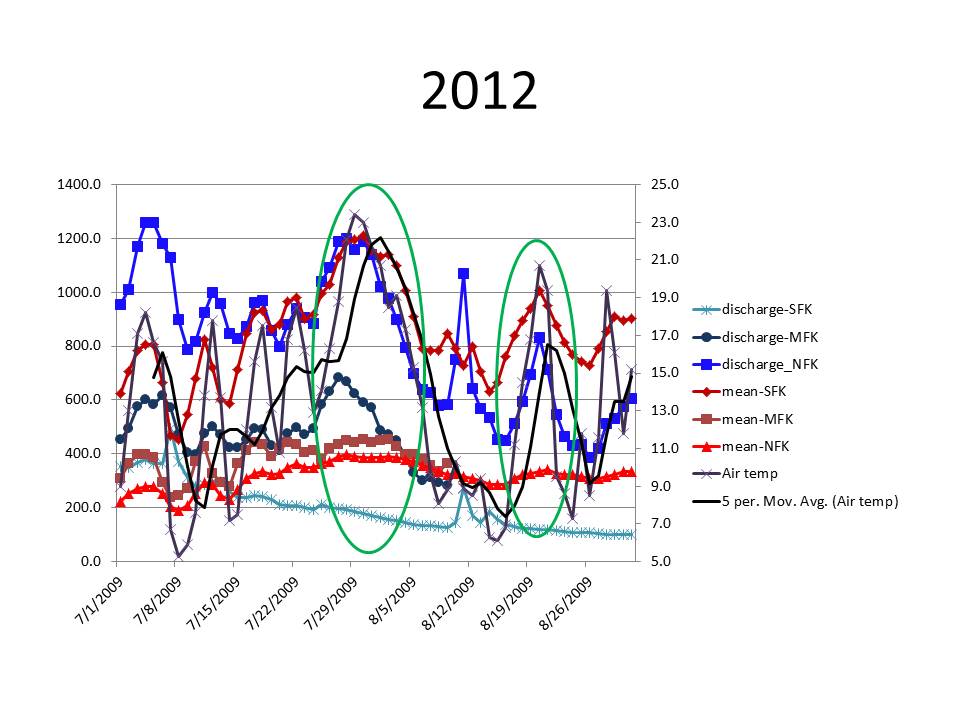
For water temperature, an increase of 2° C is the threshold of significance used for response to warm weather events. In each the North Fork and Middle Fork, 2 of 12 events exceeded this threshold, and for the South Fork 12 of 12 events exceeded this threshold, each event is a green ellipse on the charts below. Warm weather events consistently generate a significant increase in stream water temperature only in the non-glaciated South Fork Basin. During 6 of these 12 warm events, runoff measurements below Sholes Glacier and ablation measurements on Sholes and Easton Glacier indicate daily ablation ranging from 0.05-0.06 meters per day, which for the North Fork currently yields 9.5-11 m3/second. This is 40-50% of the August mean discharge of 24 m3/second, despite glaciers only covering 6% of the watershed. Increased glacier discharge largely offset the impact of increased air temperature on stream water temperature during the warm weather events. In the charts below note the red line with diamond markers that is the South Fork stream temperature and the top brightest blue line that is North Fork discharge and what happens during the warm events, green ellipses. Also note the South Fork discharge bottom blue line does not respond nor does the North Fork stream temperature red line with triangles.
As the glaciers continue to retreat the North Fork will trend first toward the more limited impact of the Middle Fork and then the highly sensitive South Fork where warm weather leads to declining streamflow and warming temperatures. This will lead to a situation similar to the Skykomish River where the number of low flow days has sharply increased. The retreating glaciers include the Sholes, Roosevelt,Deming and Mazama.
Number of the 12 warm weather events with increased discharge, increased water temperature and the percent of glaciation in each basin
Streamflow and water temperature in the Nooksack in Summer 2009
Streamflow and water temperature in the Nooksack in Summer 2010
Streamflow and water temperature in the Nooksack in Summer 2012
Streamflow and water temperature in the Nooksack in Summer 2013
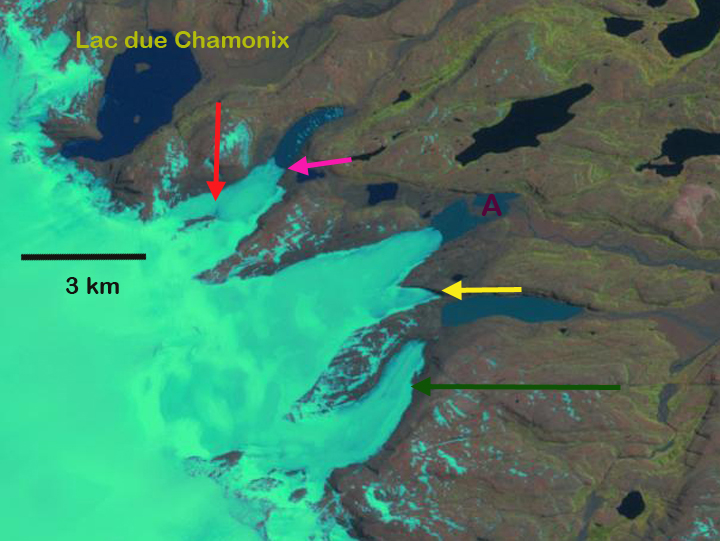
On the east side of the Cook Ice Cap on Kerguelen Island a series of outlet glaciers have retreated expanding and forming a new group of lakes, red arrow. This area is just south of Lac du Chamonix which has existed. Here we examine the changes from 2001-2014 along using Landsat imagery. This is a retreat examined by Berthier et al (2009), and exemplified by the retreat of Ampere Glacier and Aggasiz Glacier from the same ice cap.
In 2001 at the red arrow is the north tributary of a glacier ending in the northernmost lake at the pink arrow. In the second lake is an island, marked with point A, this glacier has a secondary terminus ending at the yellow arrow. The southernmost glacier examined at the green arrow has retreated from one lake and does not end in a lake. By 2011 the northern tributary is starting to separate losing its connection with the Cook Ice cap, red arrow and retreating from the pink arrow. The distance from the island for the middle glacier has increased. A lake is forming at the yellow arrow. For the third glacier a lake has formed at the green arrow. The 2013 Landsat image still has snowcover obscuring the glacier boundaries. In January 2014, it is evident that at the red arrow the northern tributary has lost all connection with the Cook Ice Cap. The main terminus has retreated 700 m, expanding the lake it terminates in. With the loss of the northern tributary the retreat will continue. The distance from the island at Point A to the terminus of the middle glacier has increased 900 m indicating the retreat since 2001. The glacier is nearly at the western end of the lake it terminates in. At the yellow arrow the new lake is now 900 m long indicating a retreat of slightly less than this. The green arrow marks the 2013 terminus in each image of the southern of the three glaciers. This glacier has retreated 800-900 m leading to the continued expansion of a new lake. In just a decade we see the formation of two new lakes and the expansion of two others at the terminus of the three eastern outlet glaciers of Cook Ice Cap.
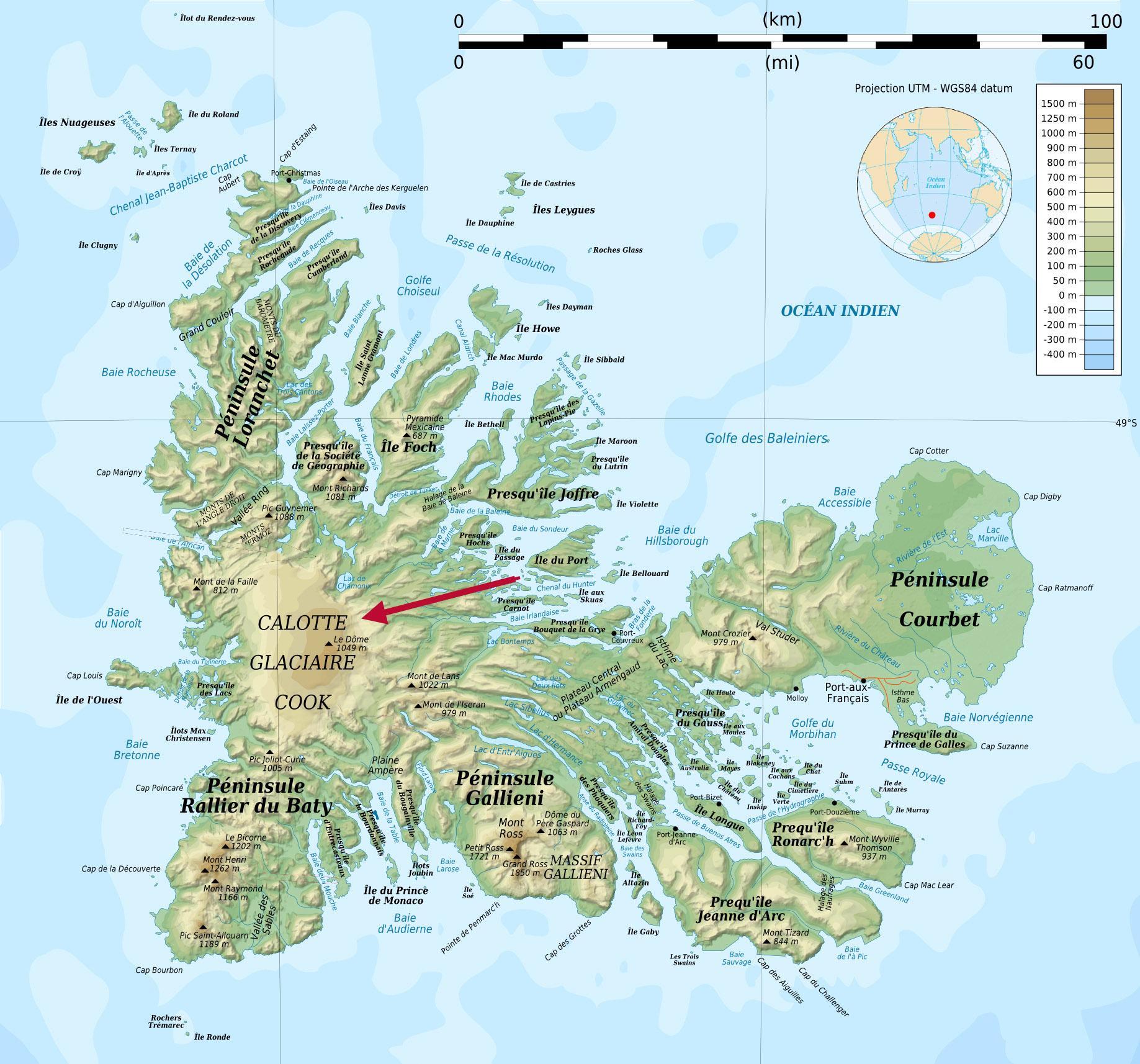
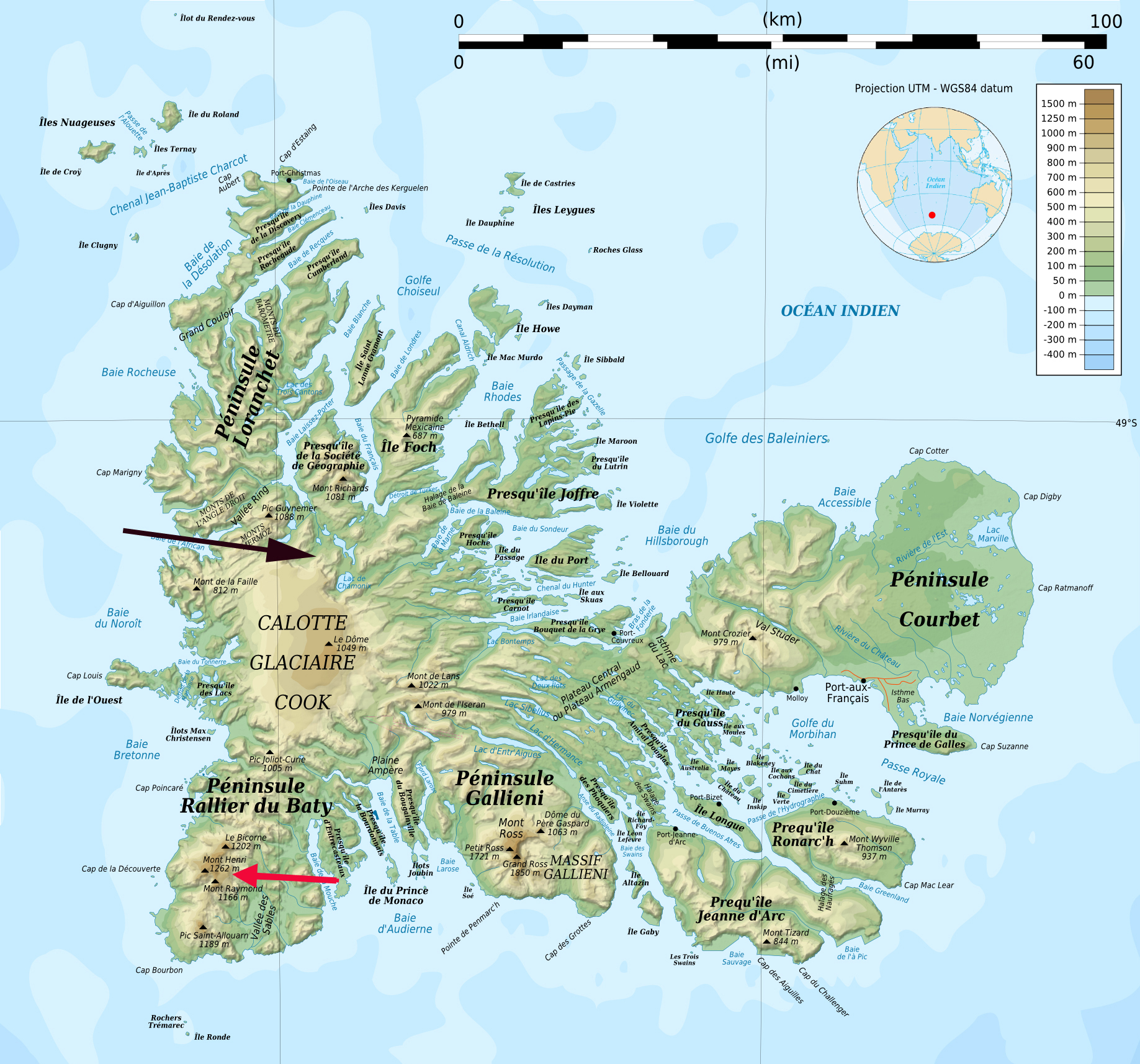
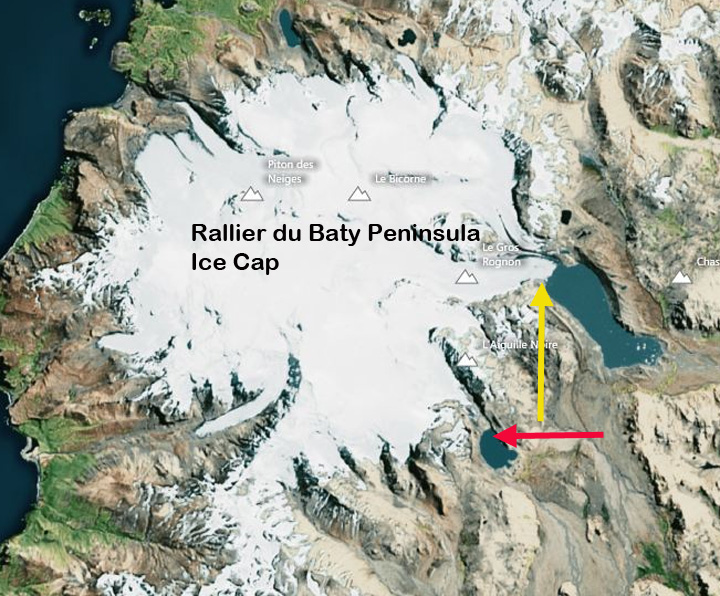
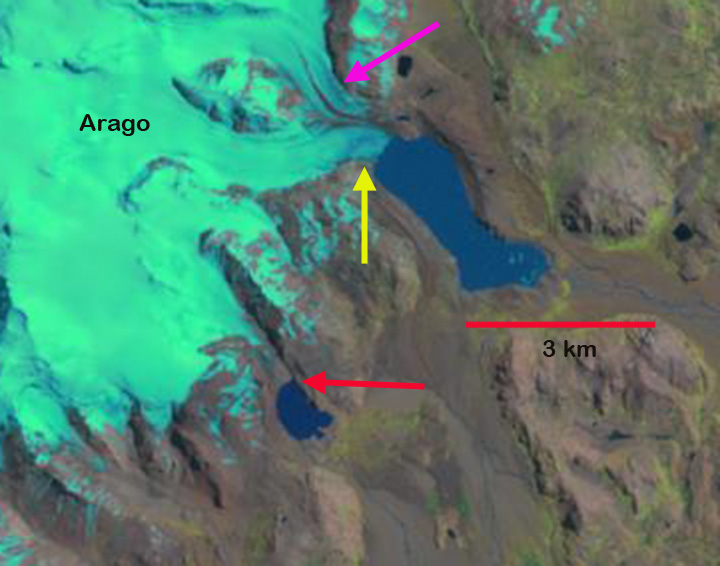
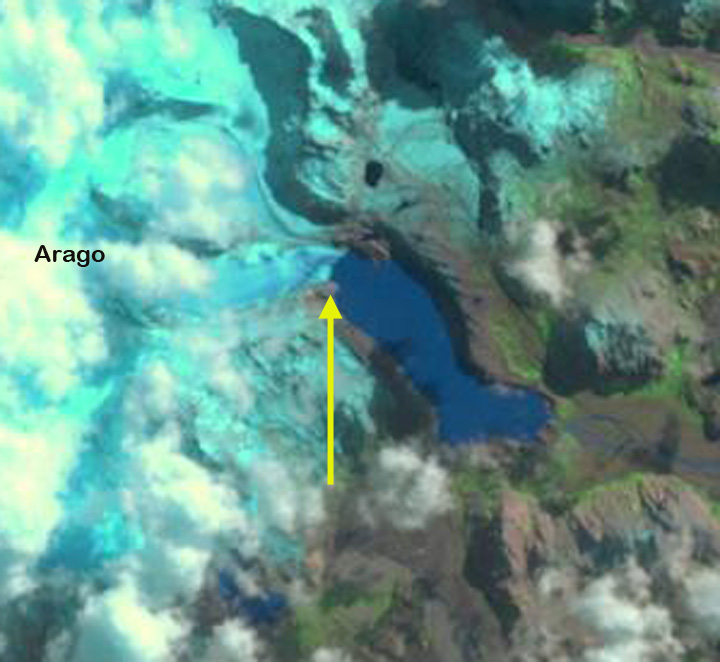
Kerguelen Island sits alone isolated at the edge of the furious fifties in the southern Indian Ocean. The island features numerous glaciers, the largest being the Cook Ice Cap at 400 square kilometers. Here we focus on the Arago Glacier and an adjacent glacier to the south on an icecap on the Raillier du Bay Peninsula Ice Cap using satellite imagery from 2001-2011. Arago Glacier descends east from the ice cap currently ending in a proglacial lake.
Kerguelen Island Map
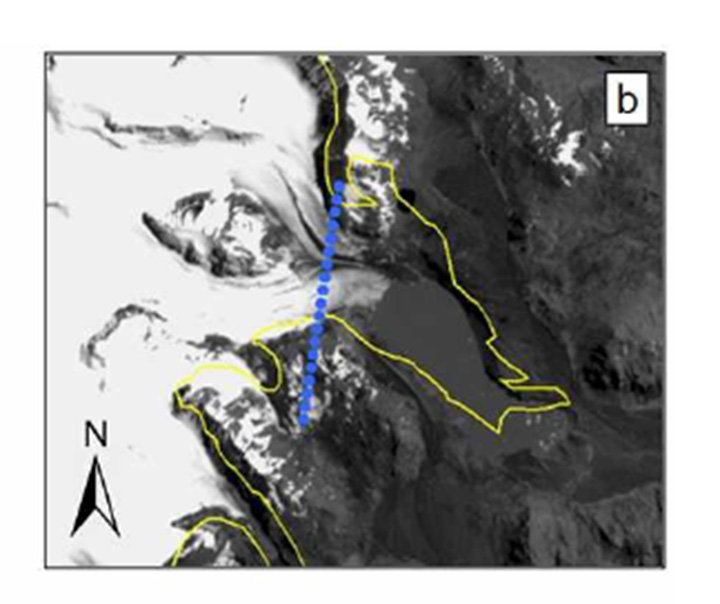
Rallier du Baty Peninsula Google Earth image Berthier et al (2009)note that this glacier had retreated 3 km from 1964-2001. In 1964 the glacier filled the lake basin, yellow line in first figure below. They had a single profile across the glacier shortly above the terminus that indicated 80 km of thinning from 1964-2000 and 30 m from 2000-2005. The profile is the blue dotted line from their paper in the first figure below. In 2001 Arago Glacier terminated at the tip of a peninsula, yellow arrow. The Arago Glacier is joined just above the terminus by a tributary from the north, which has a substantial width in 2001 at the pink arrow. The glacier to its south ended at the northern end of a lake, red arrow. By 2006 Arago Glacier has retreated from the peninsula. Cloud cover obscures the glacier to the south. By 2011 Arago Glacier has retreated from the peninsula, 300-400 m since 2001, expanding the proglacial lake. The glacier tributary at the pink arrow width has declined substantially. This is indicative of a thinning glacier as well. The contribution of this tributary to the main terminus is quite limited by 2011. The glacier to the south at the red arrow has also retreated 300-400 m, leading to lake expansion there. This island is notoriously cloud covered, and I have not located an image with a clear view of the region since 2011, when I do the post will be updated. The retreat of Arago Glacier follows the pattern of retreat of the glaciers of other glaciers on the island including Ampere Glacier and the northern outlet of the Cook Island Ice Cap
Figure 8 from Berthier et al (2009)
Landsat image in 2001
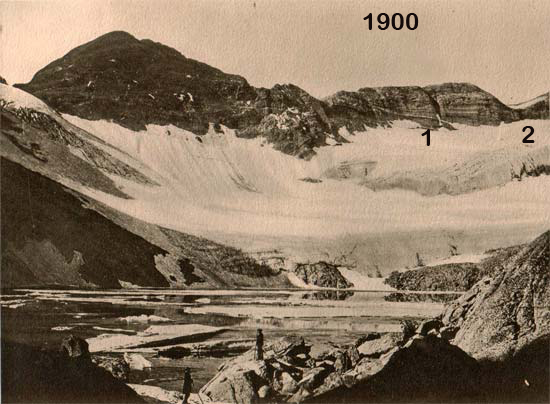
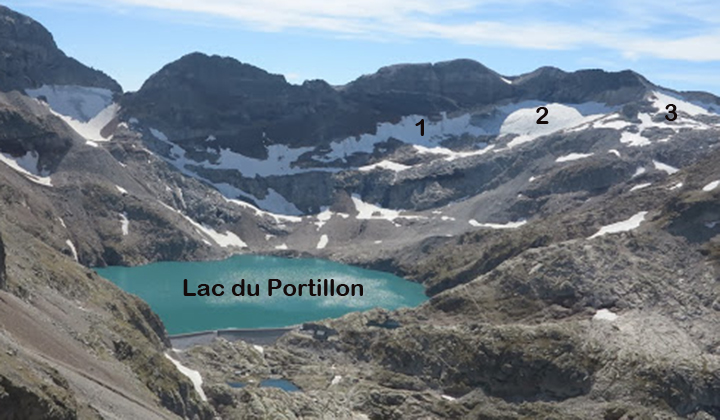
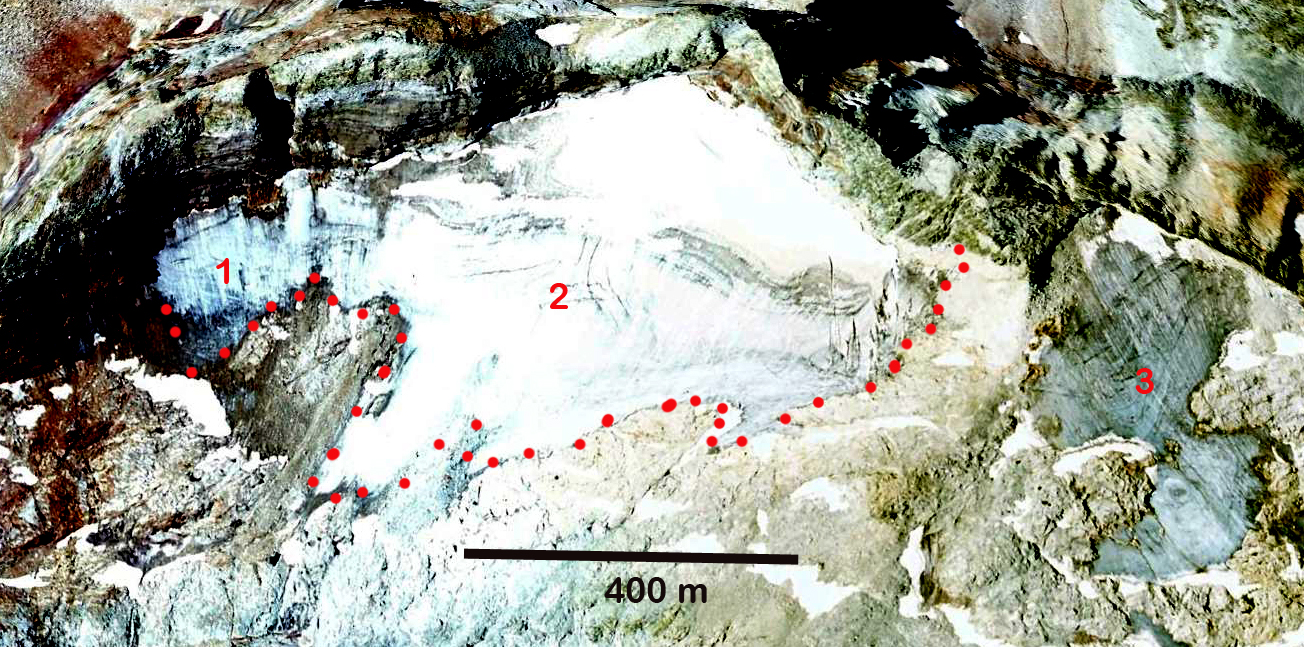
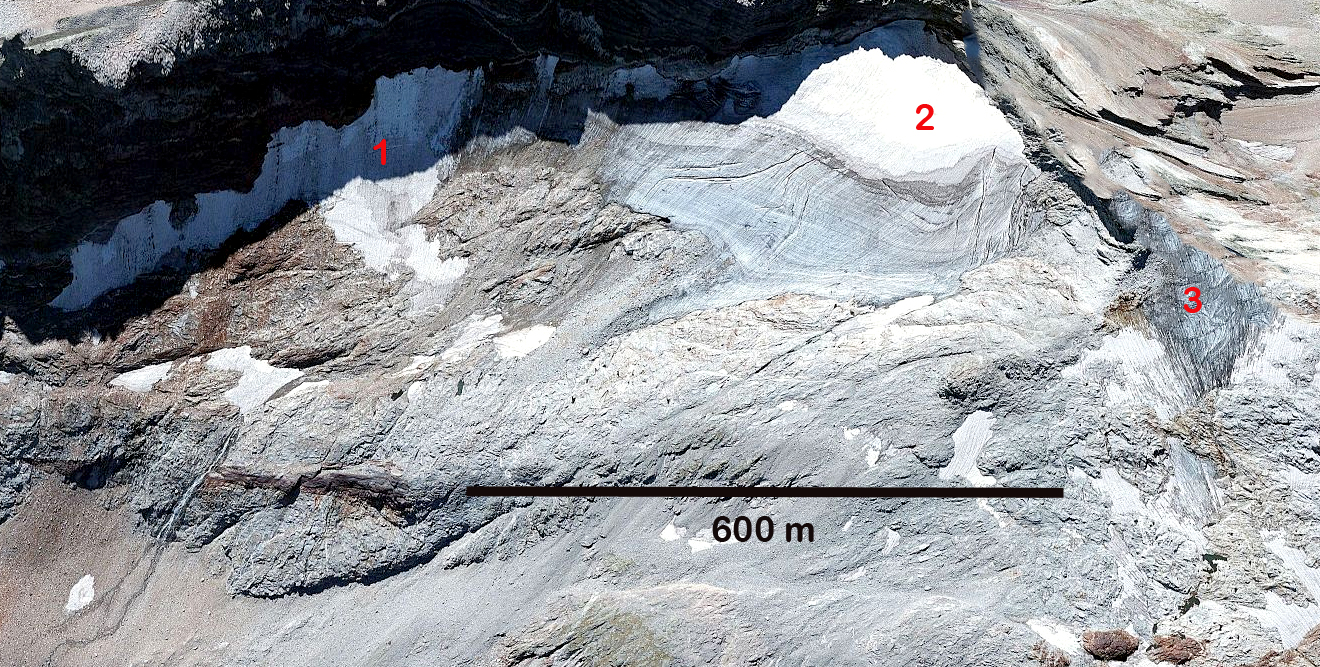
Portillon Glacier is in the Luchon-Bagneres region of the French Pyrenees, just north of the border with Spain. This currently small, and becoming smaller glacier drains into Lac du Portillon, which has a dam impounding it for hydroelectric generation. Like the nearby Aneto Glacier, Portillon Glacier has been thinning, retreating and separating. First a comparison of photographs from 1900 and 2013. In 1900 the glacier fills most of the cirque and nearly reaches the shore of the lake. The lake level is lower at this time also. By 2013 the glacier occupies a few small niches near the head of the cirque.
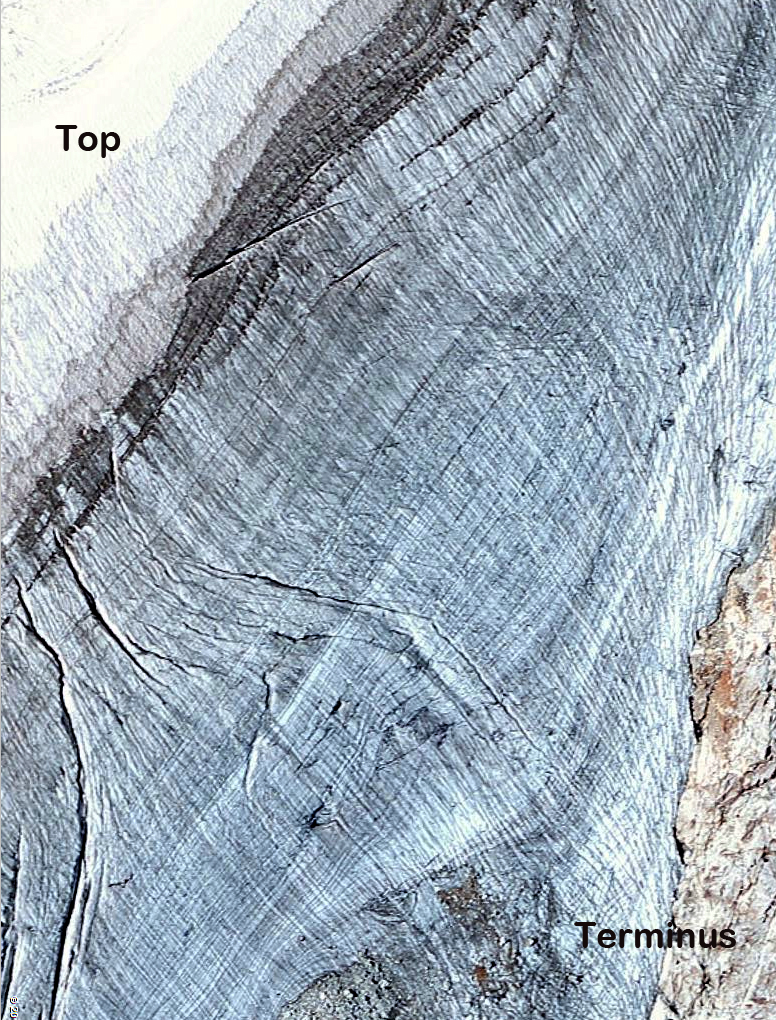
By 2006 Google Earth imagery indicates a glacier with an area of 0.12 square kilometers, red dots indicate the terminus of the glacier. Section 3 of the glacier has separated from the main section, 2. Section 1 is a narrow avalanche fed fringe beneath the cliffs. This section is too steep to retain good snow. In the 2008 image The glacier also is notably thin with few crevasses, and several bedrock outcrops amidst the thinning ice. Both the 2006 and 2008 image indicate the lack of snowcover on the glacier. This has exposed up to 75 annual layers in a closeup transect from head to terminus of the glacier. There are only a few crevasses on this relatively steep glacier, indicating the lack of movement, which can only come from thin ice on a steep slope.
The lack of persistent snowcover at the end of the melt season indicates a glacier,, like the Aneto and Maladeta Glacier, that will not survive current climate (Pelto, 2010). Its area is much less than Aneto Glacier, and it will disappear sooner. As SOER (2010) indicates more than 80% of the area of glaciers in the Pyrenees has been lost since the start of the 20th century. The color of Lac du Portillon and the loss of glacier in the basin reminds me of the Milk Lake Glacier, Washington that I watched disappear recently.
Google Earth image


 In 1985 and 1986 the glacier has retreated onto the southeast trending arm of the lake ending at a deep gully on the west side of the lake, red arrow. The tributaries are still well connected to the glacier. By 1993 the glacier has retreated 300 m, the east tributary is still well connected, the west tributary at the purple arrow has considerably diminished. By 2003 the terminus has retreated 1.2 km from the 1985 position, the west tributary is just separating from the main glacier. The snowline is nearly at the top of the west tributary with a month left in the melt season. By 2011 a Google Earth image indicates the loss of connection with the west tributary and the disconnection on the east side which ends in a steep icefall slope. There is also a lake, green arrow just behind the terminus indicating impending rapid retreat will continue. The 2013 Landsat image the terminus has retreated 2.2 km from 1985, that is 78 meters/year. The lake is still evident behind the terminus. The continued significant retreat of Shakes Glacier matches that of other glaciers in the area Great Glacier, Baird Glacier, Patterson Glacier and Sawyer Glacier.
























 From a Glaciers Perspective