Pine Island Glacier 2013 Iceberg Rift update

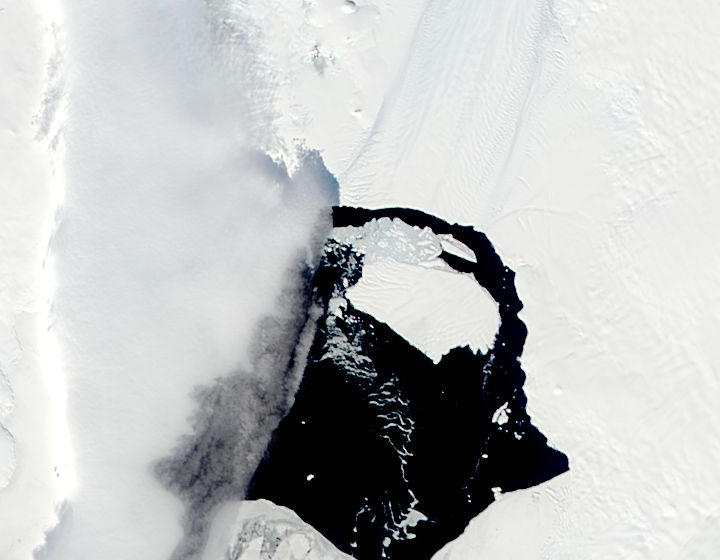
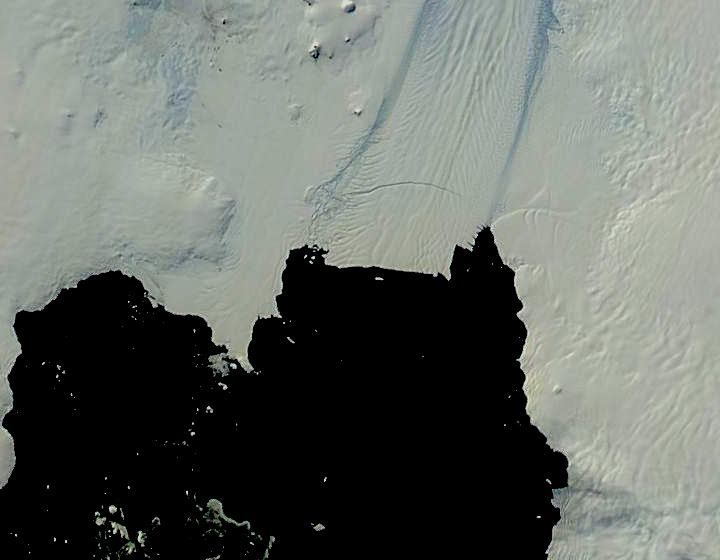
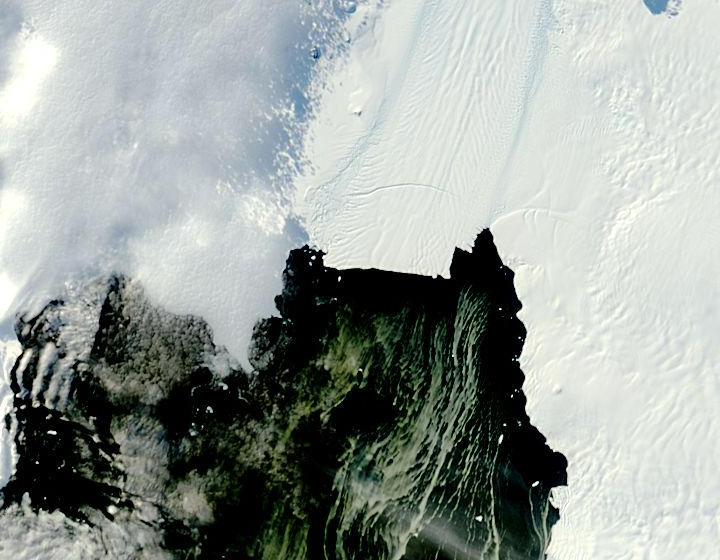
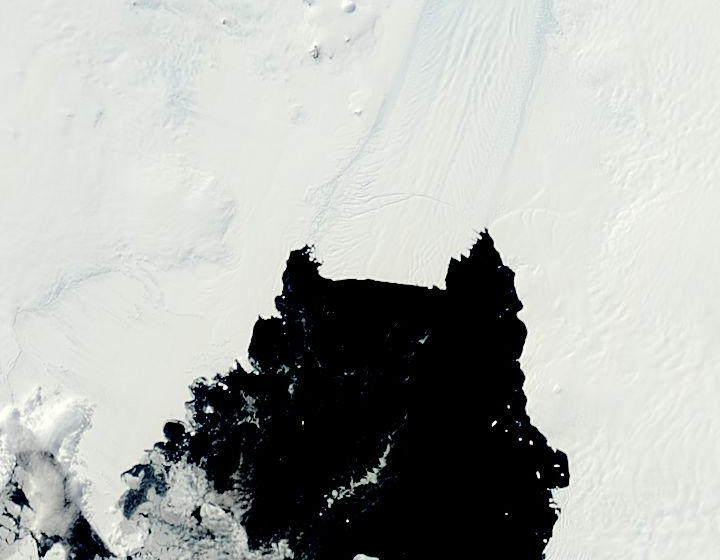
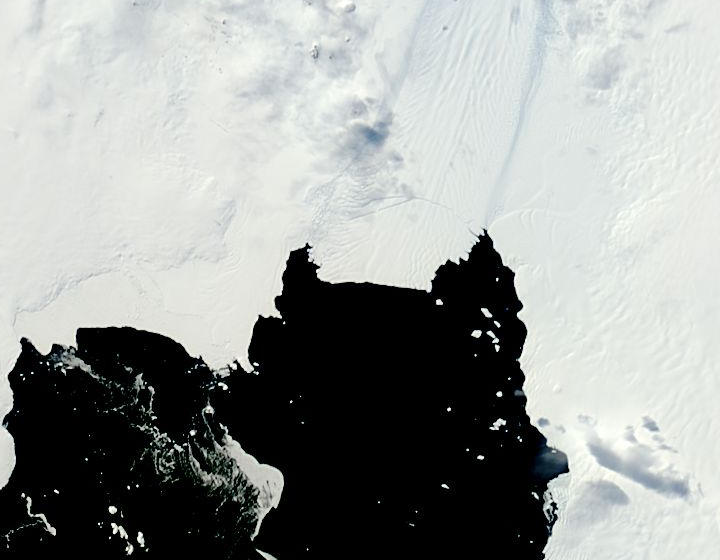
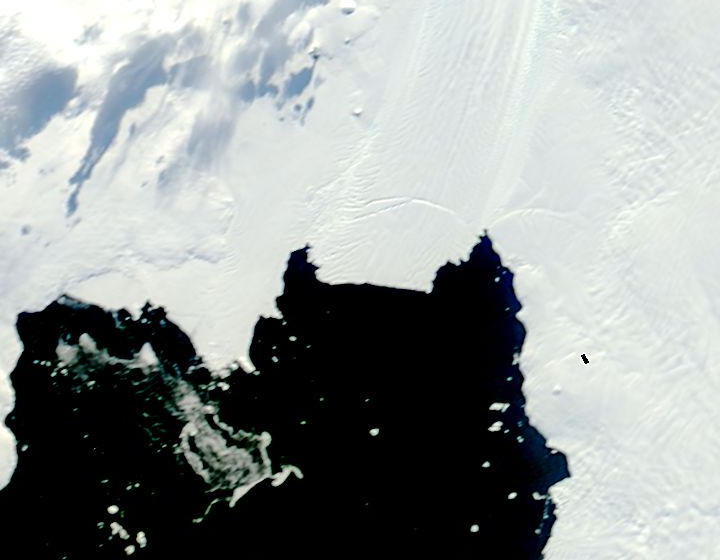
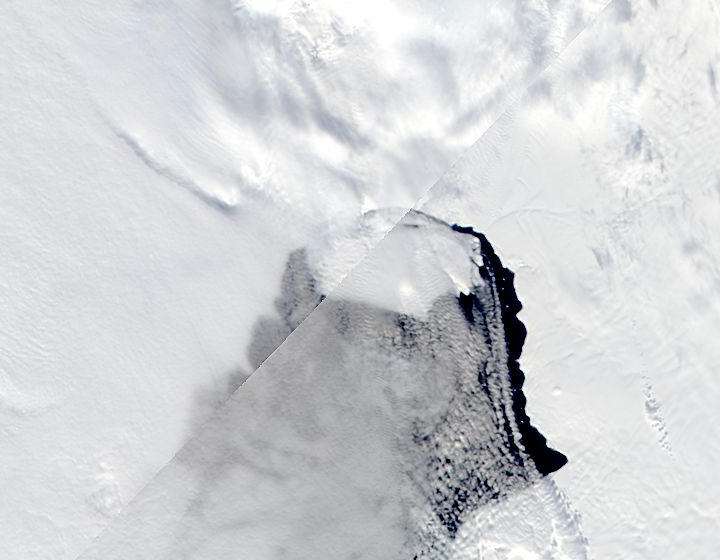
Operation Icebridge kept an eye this past fall on the extensive rift transecting the PIG that will lead to calving of a large iceberg in the near future. This rift was identified by NASA’s Operation Icebridge in 2011. This rift expanded laterally through 2012 and in width in early 2013, but had not shown open water in the daily MODIS imagery until 11/11/2013. The iceberg had not detached fully from the glacier until now. The iceberg being calved is approximately 780 square kilometers in size. With the Antarctic Operation Ice Bridge just beginning a new campaign great imagery will soon come via Pine Island Glacier I am sure.

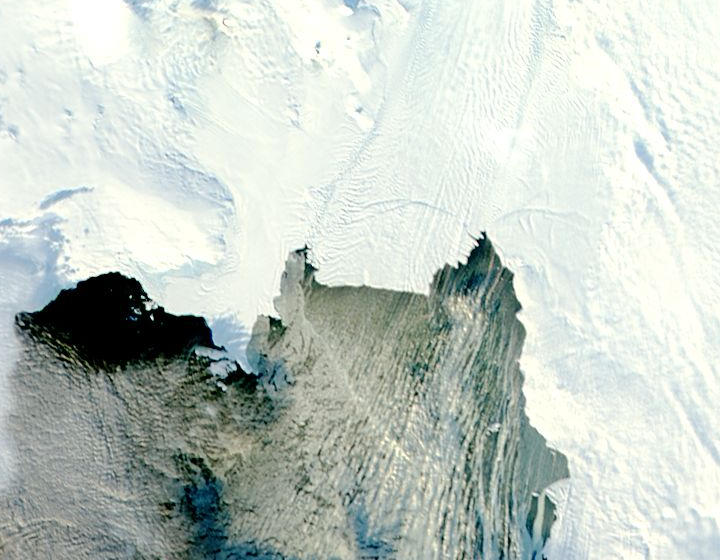
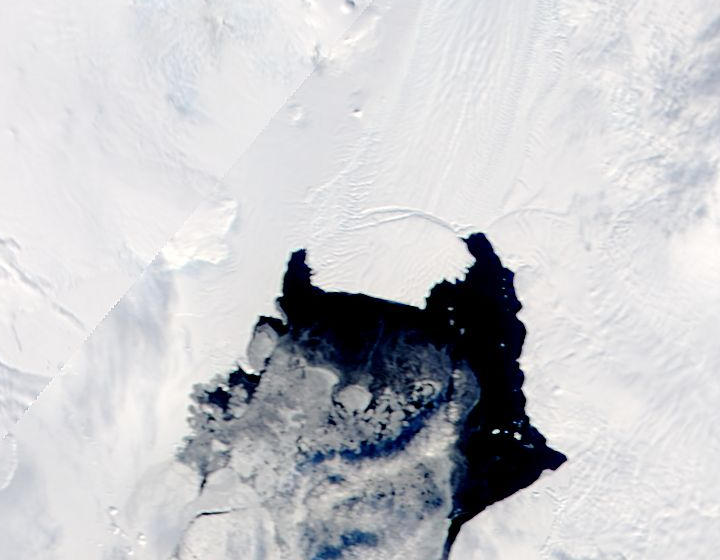
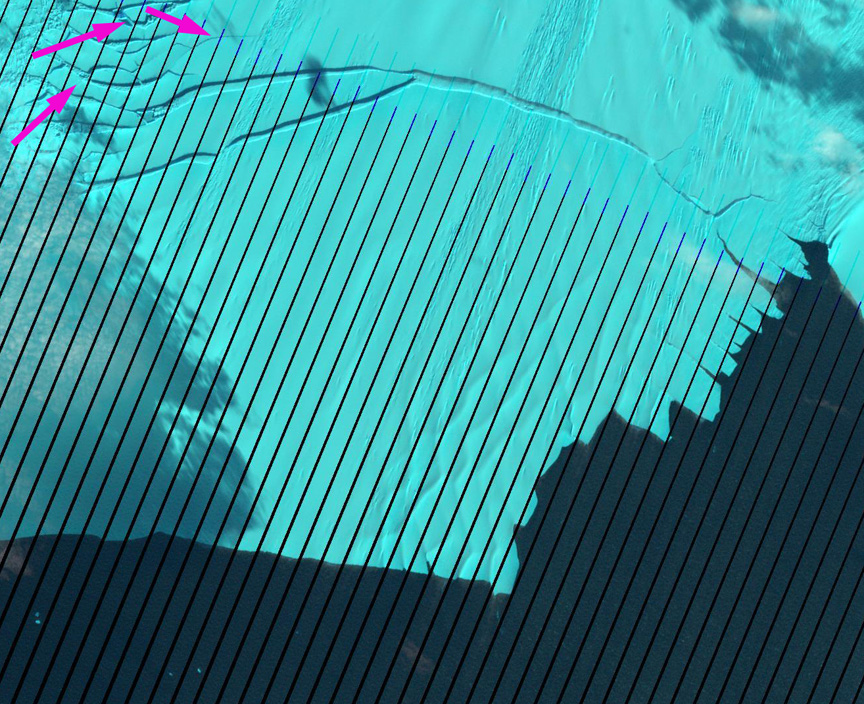
Below is the image from Nov. 11 & 16 2013 annotated followed by a sequence of MODIS images of the rift in 2012 and 2013 from the MODIS Rapid Ice Sheet Change Repository for Antarctica updated daily.
Pine_Island_Glacier nov112013
Nov. 11, 2013 MODIS
Pine_Island_Glacier.2013320.aqua.250m (1)
Nov. 16 2013 MODIS
Pine_Island_Glacier feb42012
Feb. 4, 2012 MODIS

Pine_Island_Glacier march 9
March 9, 2012 MODIS

Pine_Island_Glacier.2012323.terra.250m
Nov. 19 2012 MODIS

Pine_Island_Glacier.2012359.aqua.250m
Dec. 25 2012 MODIS

Pine_Island_Glacier.2013033.terra.250m
Feb. 2 2013 MODIS

Pine_Island_Glacier.2013040.terra.250m
Feb. 9, 2013 MODIS

Pine_Island_Glacier.2013049.terra.250m
Feb 18, 2013 MODIS

Pine_Island_Glacier.2013093.aqua.250m
April 3, 2013 MODIS

Pine_Island_Glacier.2013296.terra.250m
Oct. 23, 2013 MODIS

Pine_Island_Glacier.2013309.aqua.250m
Nov. 5, 2013 MODIS

Pine_Island_Glacier.2013315.aqua.250m
Nov. 11, 2013 MODIS

PIGmarch32013Landsat Image from March 2013, indicating the rift, before separation including additional rifts forming on east margin.

This iceberg can be compared to the development of an iceberg in 2001 (NASA 2001).
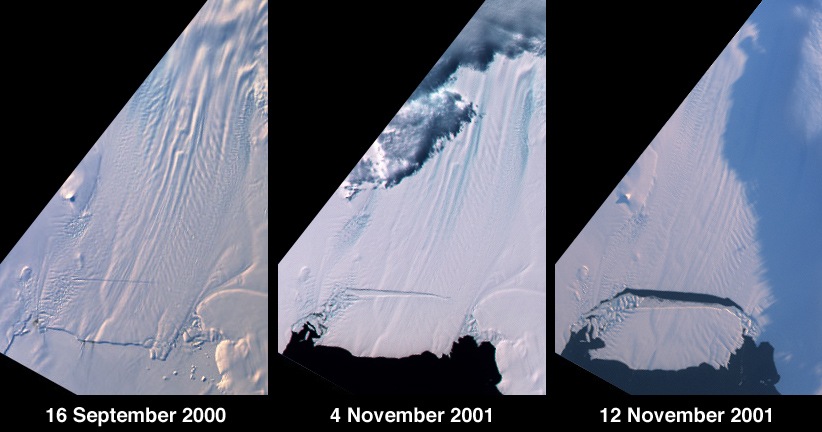
PIA03431_lrg

On December 17, 2012 researchers with the PIG project announced that they had successfully drilled through the remote Pine Island Glacier ice shelf.
The successful drilling will help to reach the project’s ultimate objective: to study the physical processes that are causing a rapid melting of the 60-kilometer-long (37 miles) ice shelf that extends into Pine Island Bay. One cause is suspected to be the circulation of relatively warmer ocean waters under the floating ice shelf that are undercutting the shelf (NSF, 2012). The logistics of this operation is captured in fascinating detail by the PIG Ocearnography Program. Meanwhile the Glaciology Program under Bob Bindshacler of NASA will be sizing up the glacier. PIG has thinned and accelerated since 1984, the most notable cause is melting of the base of ice sheet by warm water that was directly measured using and autosub (Jenkins et al, 2011). This research led to observations of channelized melt beneath the glacier (Stanton et al 2013).
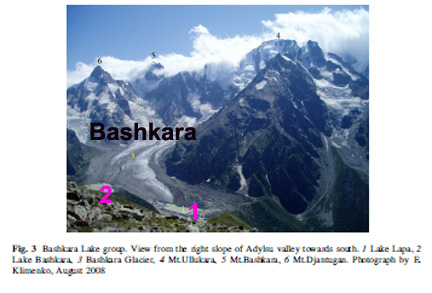
Gora Bashkara Region Glacier Retreat, Western Caucasus, Russia and Georgia

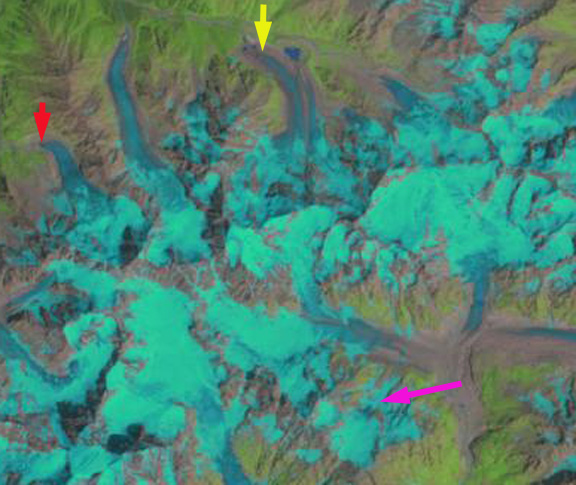
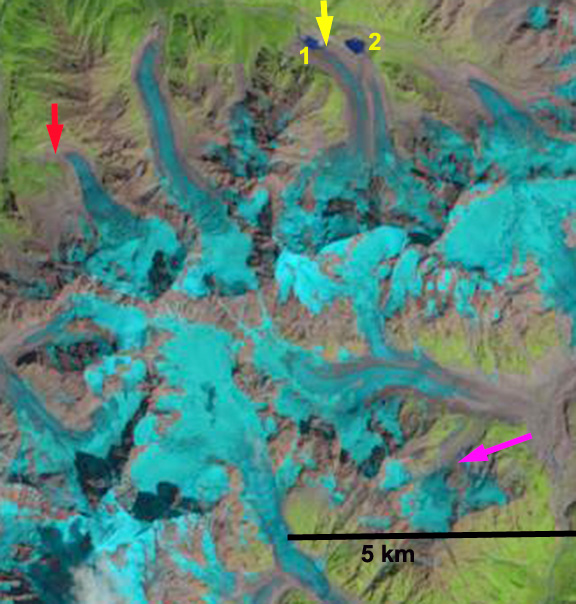
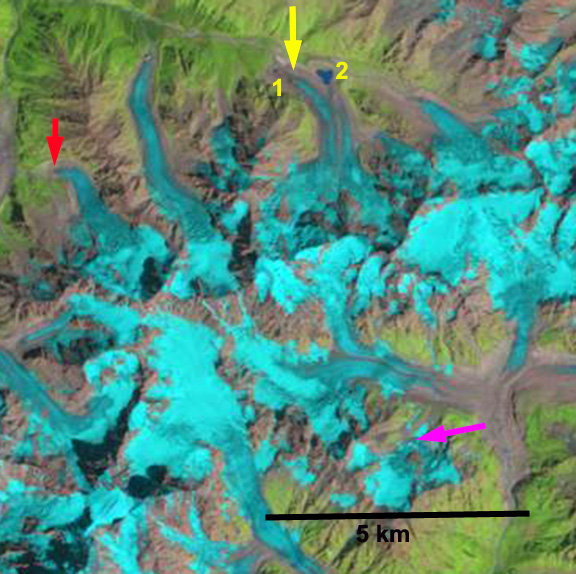
In the vicinity of Bashkara Glacier in the Western Caucasus we examine using Landsat imagery the response of several glacier over the 1998 to 2013 period. This region has been experiencing widespread significant retreat (Shahgedanova et al 2009), with average retreat of 8 m per year due in large part to increased summer temperatures. This region has been an area of increased proglacial lake formation as well Stokes et al (2007). Petrakov et al (2011) examined changes in the lakes at the margin of Bashkara Glacier. They examined three lakes near the margin of the glacier and identified large expansion of two of them due to glacier retreat. They found the terminus reach to be stagnant and thinned 13 meters from 1999 to 2007. Lake Lapa has expanded eastward 250 m since 1999 due to terminus retreat Petrakov et al (2011). bashkara lakes
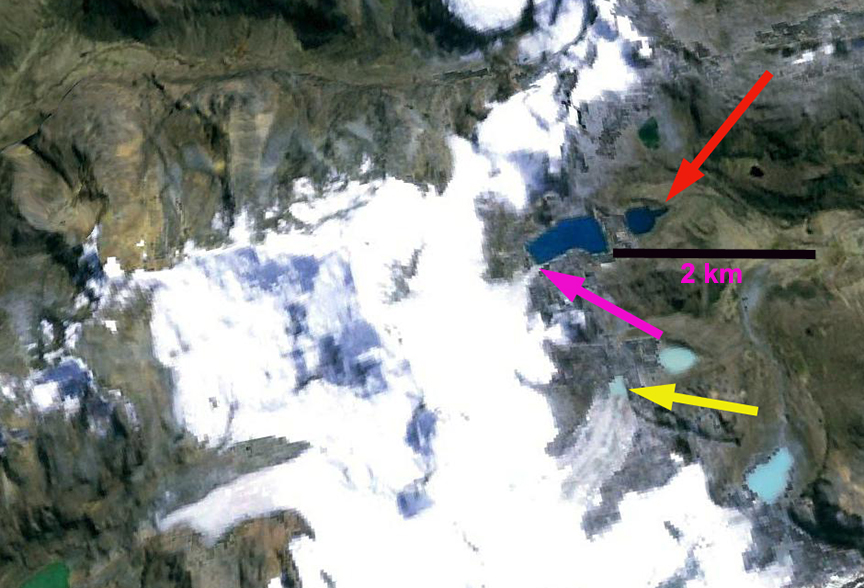
Image from Petrakov et al (2011). Lake Lapo=1 and Lake Bashkara=2.

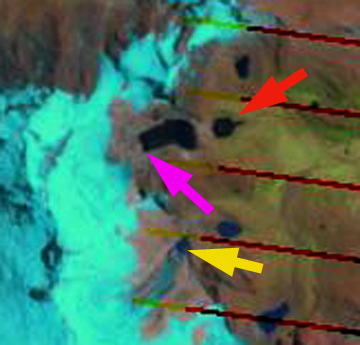
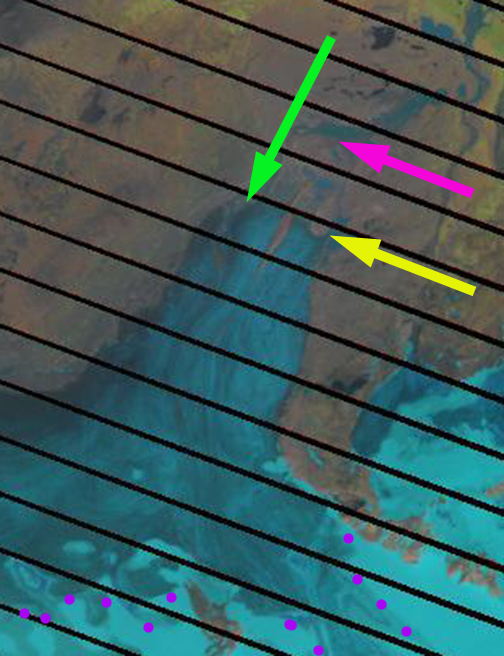
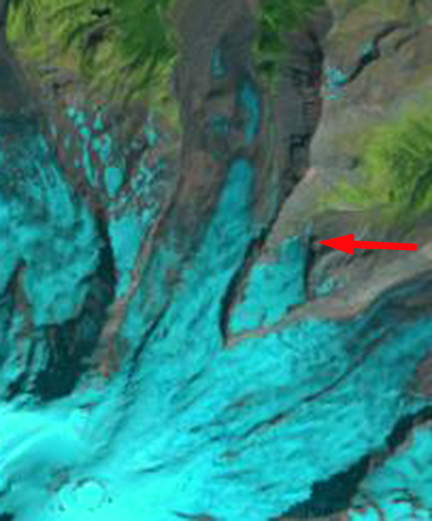
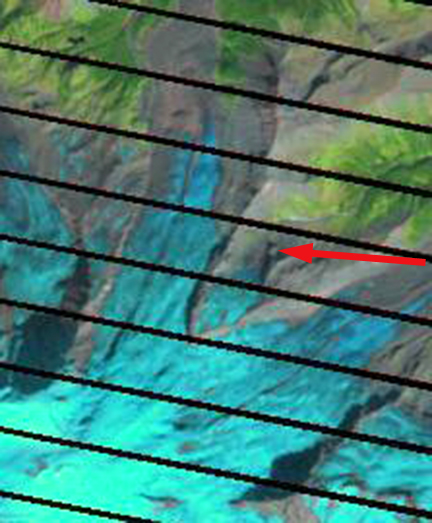
In 1998 only Bashkara Lake is substantial in sie, yellow arrow. Two valleys to the west an unnamed glacier ends at the red arrow after taking a sharp right turn. At the pink arrow an unnamed mountain glacier descends from the upper basin at m to the lower valley where it terminates. In 2001 little has changed at the three locations. By 2013 Lake Lapo the western most lake at the yellow arrow has expanded as the glacier has retreated that Petrakov et al (2011) noted. The unnamed glacier at the red arrow has retreated 500 m and now barely rounds the turn to the west. At the pink arrow the glacier now no longer descends from the upper basin to the lower valley. The terminus region in the valley bottom has melted away, a retreat of 400-500 m. The retreat of these glacier follows that of other glacier in the region Great Azau Glacier, Kirtisho Glacier and Lednik Karaugom Glacier. baykara 1998
1998 Landsat image

baykara 2001
2001 Landsat image

baykara 2013
2013 Landsat image

Marconi Glacier Retreat, Patagonia, Argentina

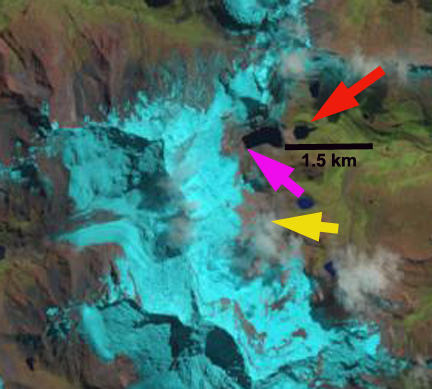
Marconi Glacier, Argentina is one of the more common routes onto the Southern Patagonia Ice Cap (SPI) via Marconi Pass. The glacier is not fed by the ice cap itself, unlike the Glaciar Chico just to the north. The glacier drains into Electrico Lake and Rio Electrico. The good news is despite the name Rio Electrico will not be developed, since it is in Parque Nacional Los Glaciares, Argentina. marconi ge Here we examine changes in the glacier observed in Landsat imagery from 1986 to 2012. In 1986 the glacier ends in the valley bottom, without a proglacial lake km from Electrico Lake, yellow arrow. Two neighboring glaciers one ending in a lake, red arrow and one on the valley wall pink arrow are noted. By 2002 Marconi Glacier has retreated 450-500 m exposing a new lake that it terminates in. The snowline blue arrows is at 1100 m. The glacier on the valley wall has retreated leading to a new lake forming, pink arrow. By 2011 Marconi Glacier’s retreat is 800 m since 1986 and it is still ending in the new expanding proglacial lake. The snowline is again close to 1100 m, though this is not the end of the summer. The glacier terminating at the red arrow has now retreated from the lake it ended in. In 2012 Marconi Glacier appears to be close to exiting from the proglacial lake. There is an excellent image of the terminus of the glacier in 2012 from useless conquests, a blog I find useful, that indicates the tenuous connection to the lake. Overall retreat from 1986 to 2012 is 800-850 m.

The pattern of retreat is consistent between these glaciers and the region as noted by Davies and Glasser (2012), who note a 0.15-0.20% area loss per year for the Marconi Glacier and its neighbors that are not part of the main SPI. Davies and Glasser (2012) further note that overall annual rates of shrinkage were far faster from 2001-2011 than from 1870-1986 or 1986-2001. The Argentine Institute of Snow Research, Glaciology and Environmental Sciences has developed maps of the retreat of many of the glaciers from Little Ice Age moraines of SPI that are in Argentina. Each of these indicates a pattern of retreat like Marconi Glacier. Onelli Glacier and Seco Glaciers are other glaciers in the area that retreating.
marconi 1986

1986 Landsat image

marconi 2002
2002 Landsat image

marconi 2011a
2011 Landsat image

marconi 2012
2012 Landsat image

marconi terminus 2010
2010 Google Earth image

Glaciar Chico Retreat, Patagonia, Chile

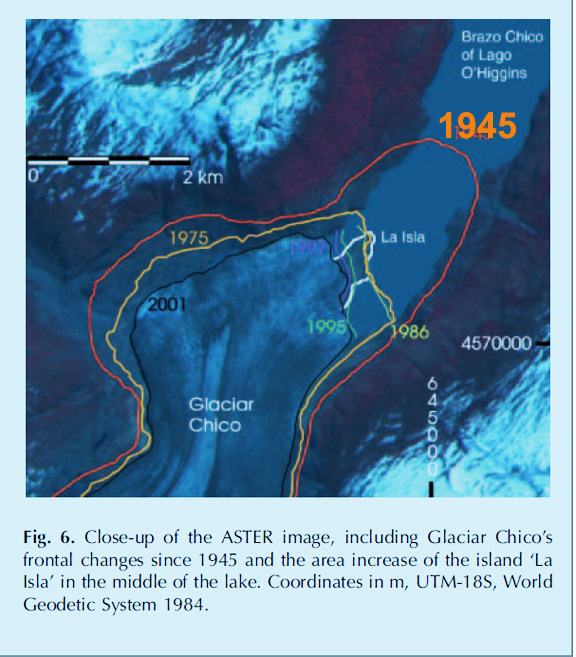
Glaciar Chico drains the east side of the Southern Patagonia Icecap (SPI). Rivera et al (2005) noted that Glaciar Chico had retreated significantly from 1945 to 1976, calving into Brazo Chico, but then retreated slower than most SPI glacier from 1975 to 2001, second image from Rivera et al (2005).

glaciar chico  ge
glaciar chico retreat
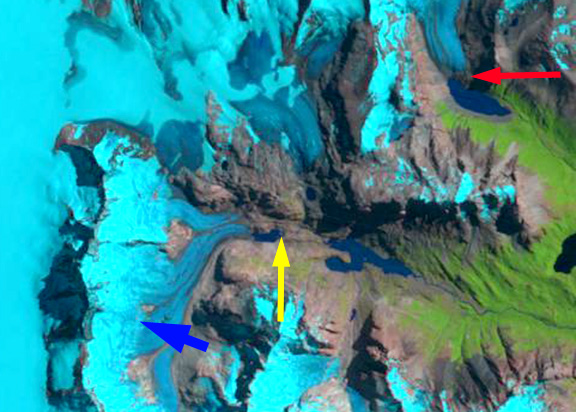
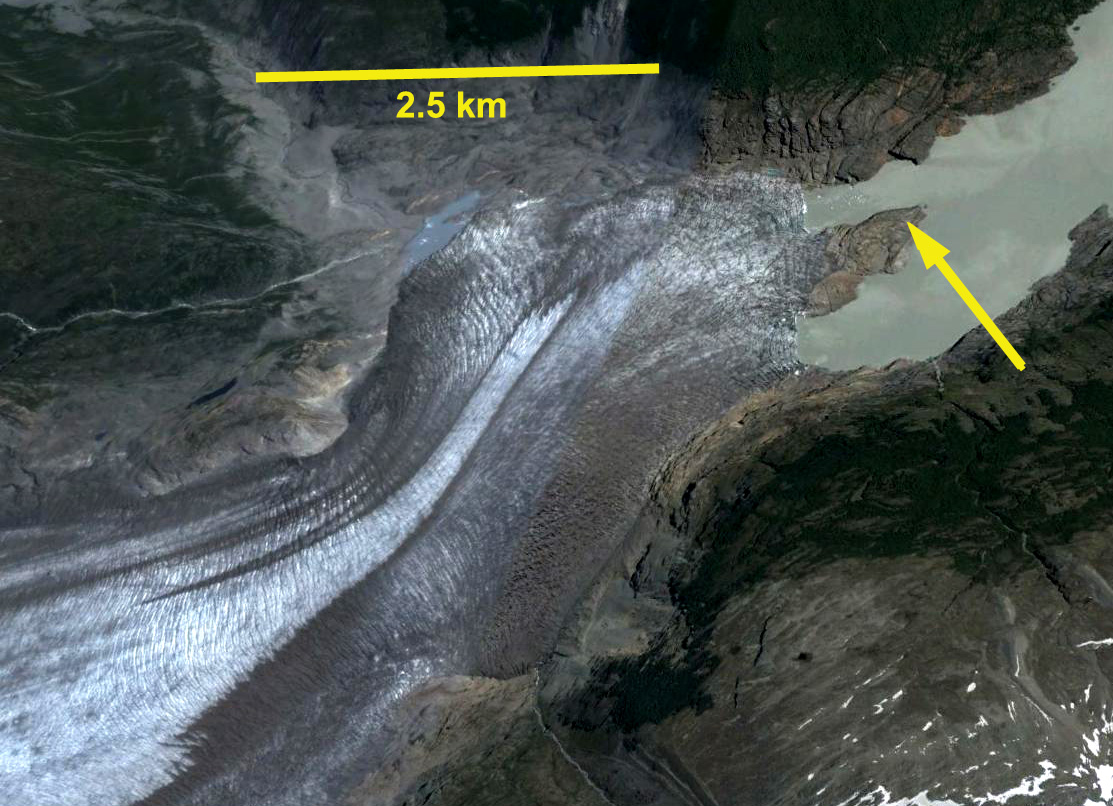
Davies and Glasser (2012). noted that Glaciar Chico’s thinning rates are comparable to other glaciers of the SPI, and the rate of area SPI now shrinking at 20.5 km2 per year. Here we examine Landsat imagery of the glacier from 1986, 1999, 2011 and 2013. In 1986 the glacier terminates near the northern end of a small island in Brazos(Lago) Chico, yellow arrow. A portion of the terminus extends due north to Glacier O’Higgins forming two proglacial lakes, red arrow. The red dot and pink dot indicate the 2013 terminus positions. By 1999 the island is half exposed, a retreat of 600 m. By 2011 the glacier has exposed nearly the full island a retreat of 900 m. The northern margin at the red arrow has also retreated 300 m and the proglacial lakes have now drained. By 2013 at the beginning of the melt season, Glaciar Chico has retreated from the island, and is ending in the lake, though the lake is not likely very deep. The glacier has retreated 1100-1200 meters from its 1986 position. The northern margin has retreated 400-500 meters from its 1986 position. This indicates widespread thinning has continued as Rivera et al (2005) and Davies and Glasser (2012) have indicated would be the case. At the orange arrow 5 km above the terminus the glacier width has decreased by 15-20% from 1986-2013, indicating a continued reduction of flow of ice into the terminus region. The closeup of the terminus from Google Earth indicates a glacier with active crevassing and flow into the terminus region, suggesting that rapid retreat will not ensue. The retreat of this glacier is typical of the other Patagonian glaciers as Davies and Glasser (2012) have so well documented. Examples of the retreat include Onelli Glacier, Jorge Montt Glacier, and Glaciar Steffenchico 1986
1986 Landsat image

glaciar chico 1999
1999 Landsat image

glaciar chico 2011
2011 Landsat image

glaciar chico 2013
2013 Landsat image

glaciar chico terminus
Google Earth terminus closeup

Chocolate Glacier Retreat, Glacier Peak, Washington

From 1994-1997 we ran a four year project to survey the terminus response of all the glaciers on Glacier Peak, Washington to climate change. This was a century after a climb in the region by C.E. Rusk. Chocolate Glacier is the largest of the east side valley glaciers. The average retreat of Glacier Peak glaciers from the LIA to the 1958 positions was 1640 m. Richard Hubley noted that North Cascade glaciers began to advance in the early 1950s, after 30 years of rapid retreat. The advance was in response to a sharp rise in winter precipitation and a decline in summer temperature beginning in 1944 (Hubley, 1956; Pelto and Hedlund, 2001). All ten glaciers on Glacier Peak advanced. Advances of Glacier Peak glaciers ranged from 15 to 480 m and culminated in 1978 (Pelto and Hedlund, 2001). All Glacier Peak glaciers that advanced during the 1950-1979 period emplaced identifiable maximum advance terminal moraines, that were fresh and easy to recognize in the 1990’s. By 1984, all the Glacier Peak glaciers were again retreating, the North Cascade Glacier Climate Project has monitored this retreat since 1984.chocolate 2005
2005 Glacier Peak east side

glacier tunnel-esker
Cliff Hedlund beneath Vista Glacier during 1994 expedition.

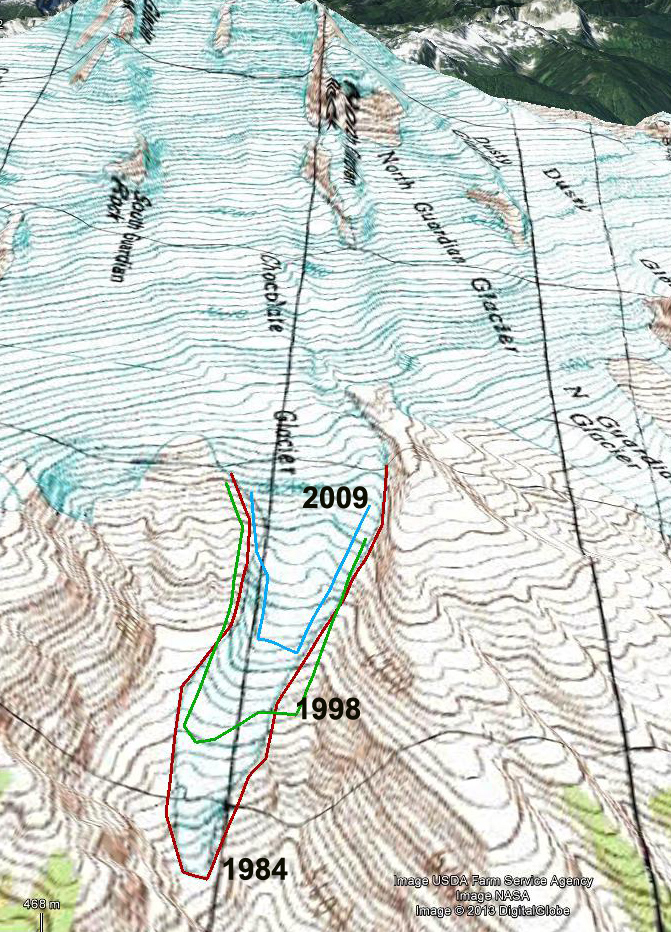
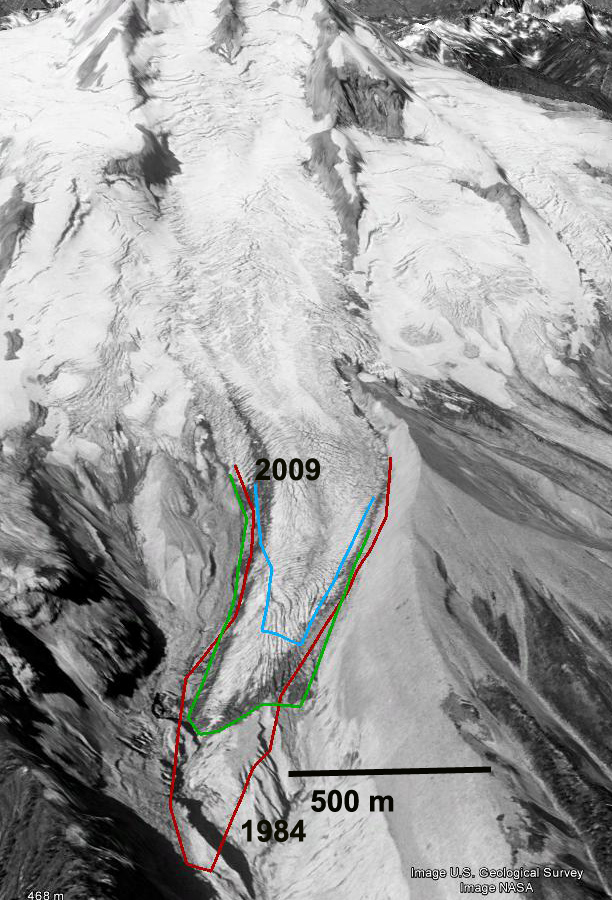
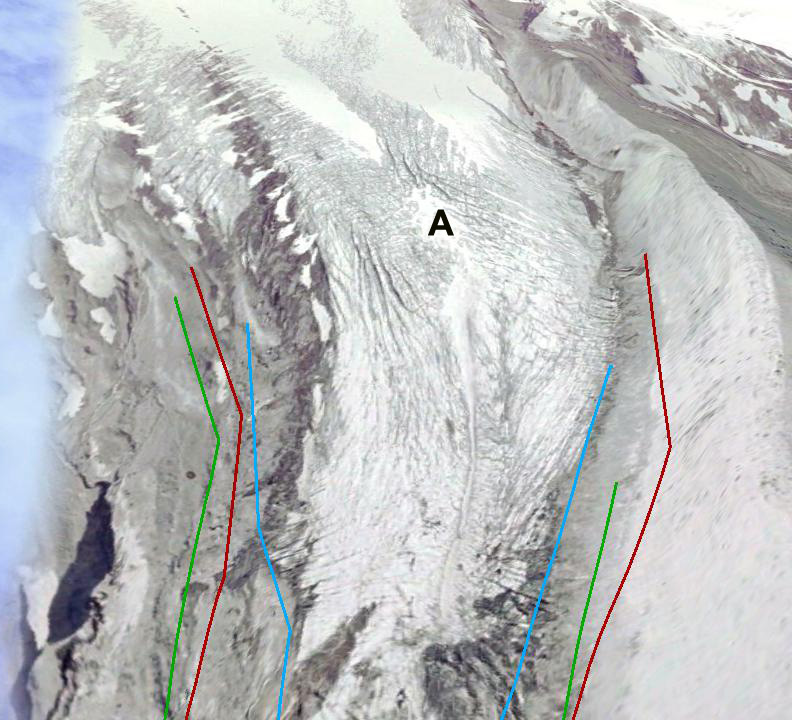
Beginning at 3050 m Chocolate Glacier descends to 1800 m today. When Rusk (1924) first saw this glacier he noted that it presented a dramatic sediment covered front. Immediately above the terminus it was heavily crevassed and quite active, indicating a slow retreat. This glacier which he named Cool Glacier had retreated little from the alpine meadows fringing the south side of the glacier. The terminus had already retreated 400 m up the narrow valley by 1906 from its LIA. A retreat of 1380 m occurred between 1906 and 1946. The retreat was noted to be particularly rapid during the 1920-1940 period by Austin Post. Glacier advance had begun by 1950. An advance from 1946-1955 of more than 200 m occurred (Hubley, 1956). The advance continued up until 1975 totaling 450 m. This was the largest advance of the Glacier Peak glaciers, probably due to the nature of the steep, narrow valley down which the glacier flows from 1960 m to the terminus. The glacier was approximately at this maximum position when mapped in 1984. In the next sequence of images the red line is the mapped 1984 terminus, green is 1998 and blue is 2009. During our visit in 1994 the glacier had retreated 210 m from the moraine it had generated. By 1998 the glacier had retreated 275 m, and was at the based of a steeper slope. By 2009 the glacier had retreated 500 m since 1984, ending at 1925 m, this is still the lowest of the east side glaciers. chocolate 1984
1984 map view

chocolate 1998
1998 Google earth view

Chocolate 2009
2009 Google Earth

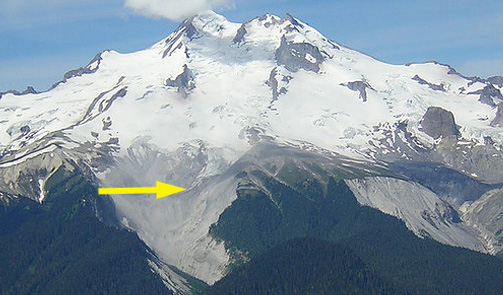
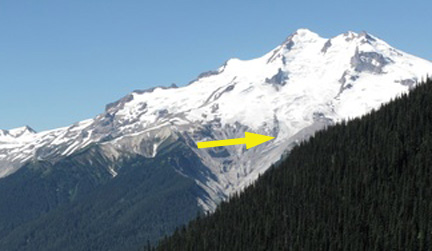
Chocolate Glacier remains crevassed and active, but the degree of crevassing has decline from 1998 to 2009 as evidenced by this closeup of the 2000-2200 m region. It is hard to get a good view of this glacier from up close the best vantage is from across the Suiattle River valley, as seen below. chocolate crevasses 1998
1998 Google Earth view

chocolate crevasses 2009
2009 Google earth view

chocolate Glacier 2006
2006 Glacier Peak from the east

chocolate 2007
2007 Glacier Peak from the east

chocolate 2010

Yanashallasa Glacier Retreat, Peru

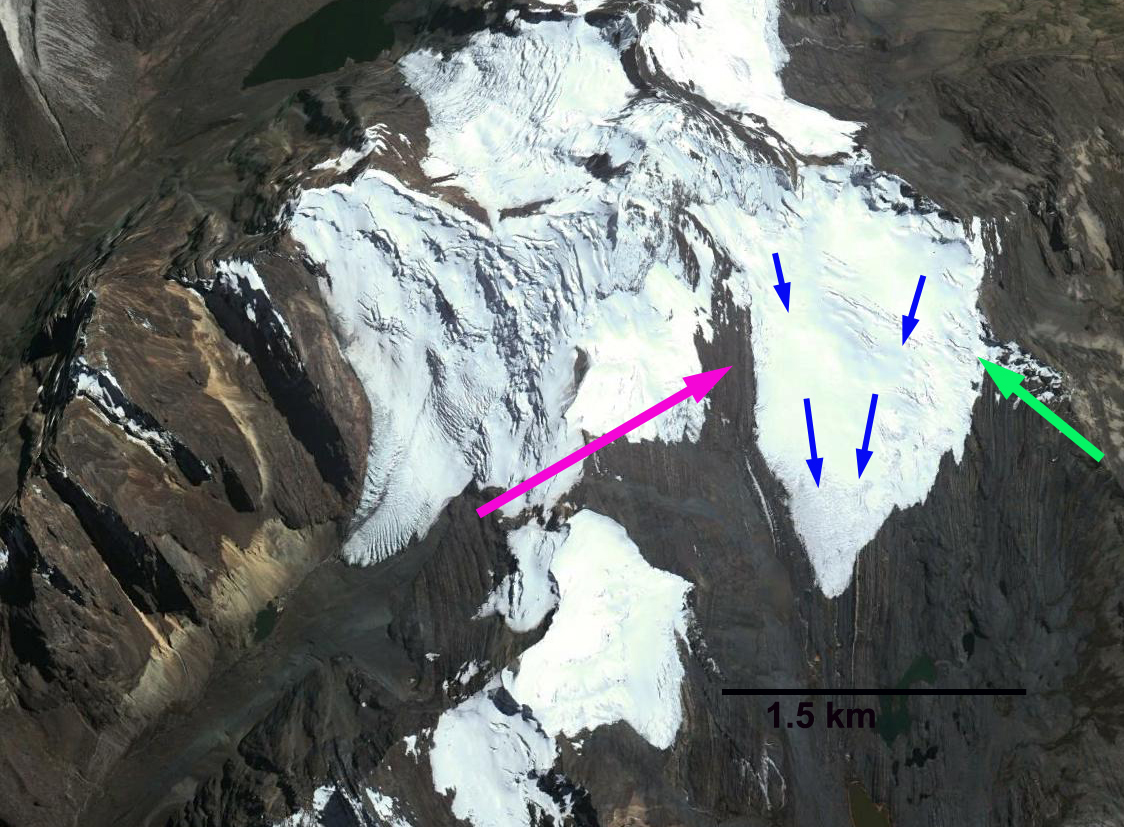
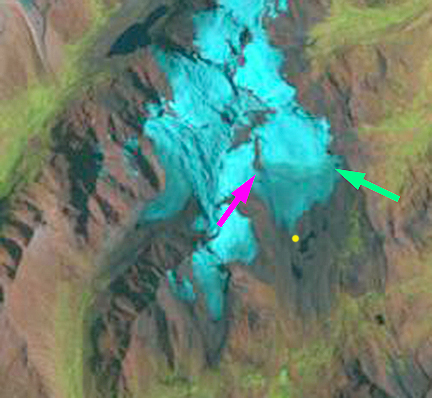
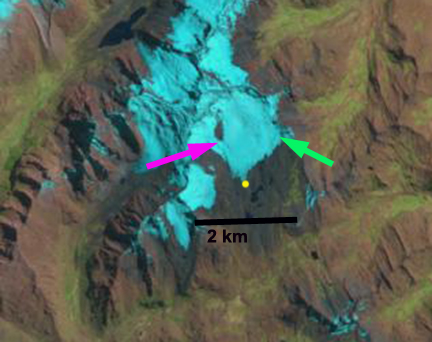
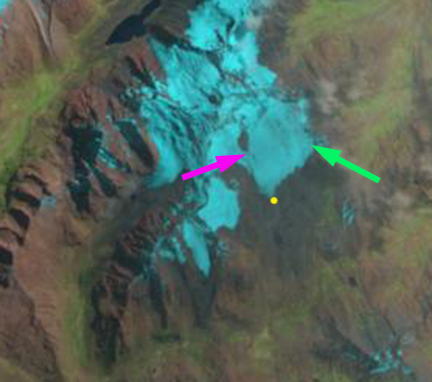
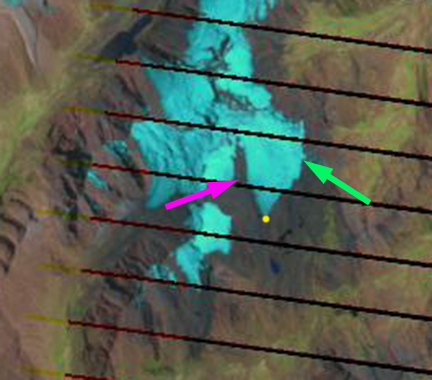
Yanashallasa Glacier is near the southern end of the Cordillera Blanca in Peru. The glacier feeds the Rio Santa river, which provides irrigation for substantial agricultural acreage. Marks and Seltzer (2003) identify that at least 30% of the runoff comes from glaciers, rising considerably during the dry season. The glacier retreat in the region with a 22% area loss from 1970-2003 (Racoviteanu et al , 2008), will lead to continued decline in glacier runoff. Here we examine satellite imagery from 1992-2013 of changes in the Yanashallasa Glacier. yanas In each image the yellow dot marks the terminus, the pink arrow the same location on the west side of the glacier and the green arrow the same location on the east side of the glacier. In 1992 the terminus almost reaches a small lake beyond the glacier margin. The west margin indicates a wide connection of the glacier to slopes on the west side of the glacier. In 1999 and 2000 the glacier has retreated 150-200 m, the glacier still has a connection on the west side of the glacier. In the east side the glacier extends to the ridge east of the glacier even at the terminus. By 2013 the glacier has become disconnected from the slopes to the west of the glacier, pink arrow, the separation is a key sign of glaciers in disequilibrium. On the east side of the glacier the glacier has retreated from the east ridge at the terminus, green arrow. The losses in area along the lateral margins exceeds the retreat of the main margin, yellow dot. The main terminus retreated 250 m from 1992 to 2013. The impact of these glacier changes was assessed by USAID (2011). Other glaciers in the region are retreating in a losing mass Shallop Glacier Gurgiser et al (2013) and retreating: Quebrada Carhuascancha Glacier, Corihuasi Glacier and Chuecon Glacier in Cordillera Centrale adn Artesonraju Glacier similar fashion yanas 1992
1992 Landsat imagery

yanas 1999
1999 Landsat imargery

yanas 2000
2000 Landsat imagery

yanas 2013a
2013 Landsat imagery

yanas 2013
2013 Landsat imagery

Quebrada Carhuascancha Glacier Retreat, Peru

Quebrada Carhuascancha Glacier is in the Cordillera Blanca of Peru, draining the northeastern slopes of Huantsan. A glacier lake outburst flood was reported in the valley in 1965 from a landslide into one of the lakes. The region has experienced ongoing glacier loss with Racoviteanu et al (2008) noting a 22% loss in area from 1970-2003 in the Cordillera Blanca. They further observed an average rise of terminus elevation by 113m and an average rise in the median glacier elevation of glaciers of 66 m, with the greatest changes on the eastern side of the Cordillera. Vuille et al (2008) observed that the glacier in the Cordillera Blanca are not in balance with regional climate, and that tropical glaciers shrink in response to increased air temperature, which was the observed case in the Cordillera Blanca region. On three glaciers on nearby Nevado Queshque Marks and Seltzer (2005) observed volume loss and retreat due to warming. Examining temperature records from 29 stations in the Cordillera Blanca they found an average rising temperature trend ofof 0.26 1C per decade over the 1962-1999 period.

In this post the pink arrow notes the western margin of the lake that Carhuascancha reached in 1999 and 2000. The yellow arrow notes the terminus of the next glacier to the south of Carhuascancha, and the orange arrow a terminal-lateral moraine from the Little Ice Age. In 1999 and 2000 the glacier reaches just to the margin of the Laguna, and the southern glacier ends against a bedrock ridge. In both 2013 images Carhuascancha no longer reaches the lake terminating 250 m short of the lake and 200 m above the lake in elevation. The southern glacier terminates in a small lake that has formed. This small lake is also evident in the Google Earth imagery, which is an unknown date. Corihuasi Glacier and Chuecon Glacier in Cordillera Centrale, Yanashallasa Glacier and Artespnraju Glacier have all had a similar recent retreat. quebrada 1999
1999 Landsat image

quebrada 2000
2000 Landsat image

quebrada 2013a
2013 Landsat image

quebrada 2013
2013 Landsat image

quebrada ge
Google Earth image

Glacier du Mont Miné Retreat, Swizterland

Glacier du Mont Miné is an 8 km long alpine glacier that drains into the Rhone River. The runoff from this glacier is heavily tapped for hydropower, for example Compagnie Nationale du Rhône has 19 hydropower plants on the river. The Swiss Glacier Monitoring Network measures the terminus position of this glacier each year, graph below. The glacier experienced a period of minor advance from 1971-1989, followed by a retreat of 600 m from 1989-2011. montmine graph
Annual terminus change Glcier du Mont Mine, from Swiss Glacier Monitoring Network

mont mine 2010
Glacier du Mont Miné, Google Earth image 2009

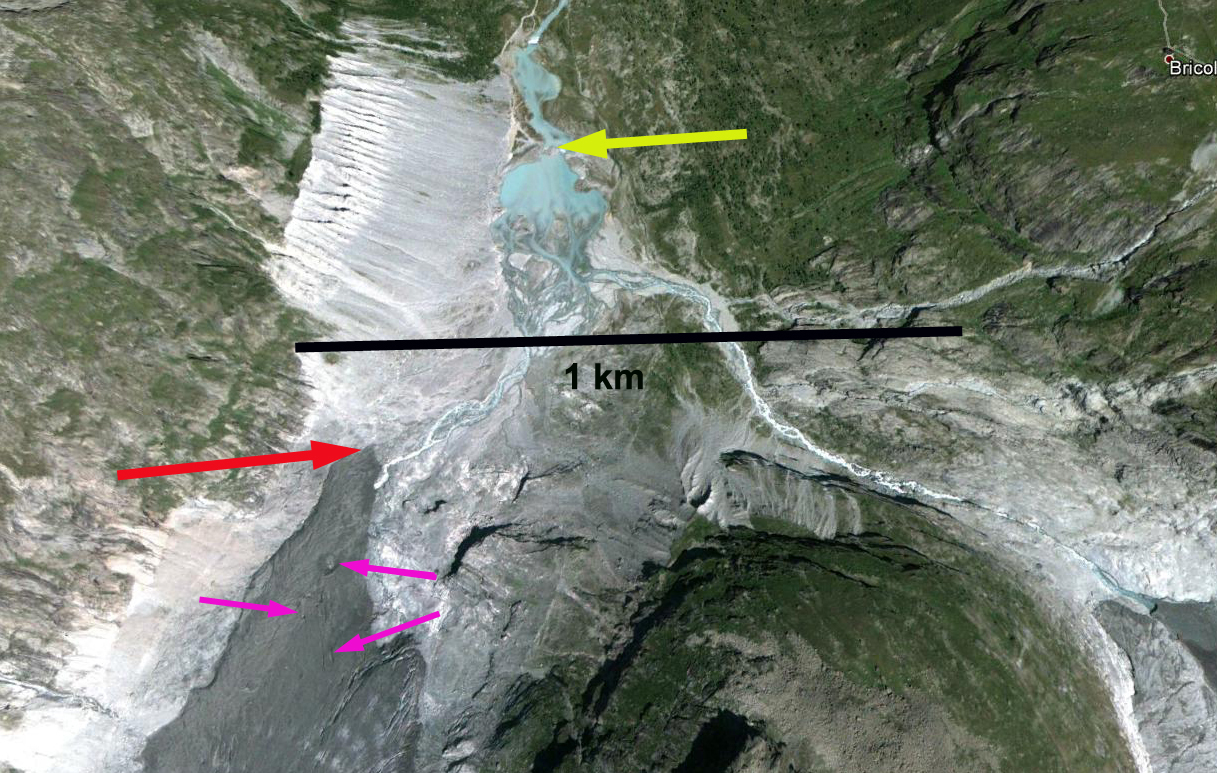
The advance moraine emplaced by the 1971-1989 advance is indicated by a yellow arrow in each image, a pink dot indicates the actual terminus at the time of the image. In the 1988 Landsat image Glacier du Mont Miné is in an advance position in contact with the moraine at the end of a small lake that is quickly being infilled with sediment. By 1999, Landsat image, the glacier has retreated out of the low lying basin below 2000 m. In 2011 and 2012 the glacier has pulled into its own valley having retreated 600 meters from 1988. The terminus is quite thin in the 2009 Google Earth image, yellow arrow indicates 1989 advance moraine, red arrow current debris covered terminus. The lower 300 m of the glacier is thin and stagnant, note depressions indicated by pink arrows. There is an icefall 2 km above the terminus, green arrow that is now detached from the glacier below. It still contributes mass via avalanching, but the lower terminus tongue will not survive long term without direct icefall connection. The retreat is similar to that of Gietro Glacier, Ried Glacier and Triftgletscher. mont mine glacier 1988
1988 Landsat image

mont mine glacier 1999
1999 Landsat image

mont mine glacier 2011
2011 Landsat image

mont mine glacier 2012
2012 Landsat image

glacier du mont mine terminus
2009 Google Earth image

mont mine icefall
2009 Google Earth image

Theodulgletscher Retreat, Zermatt Ski area Swizerland

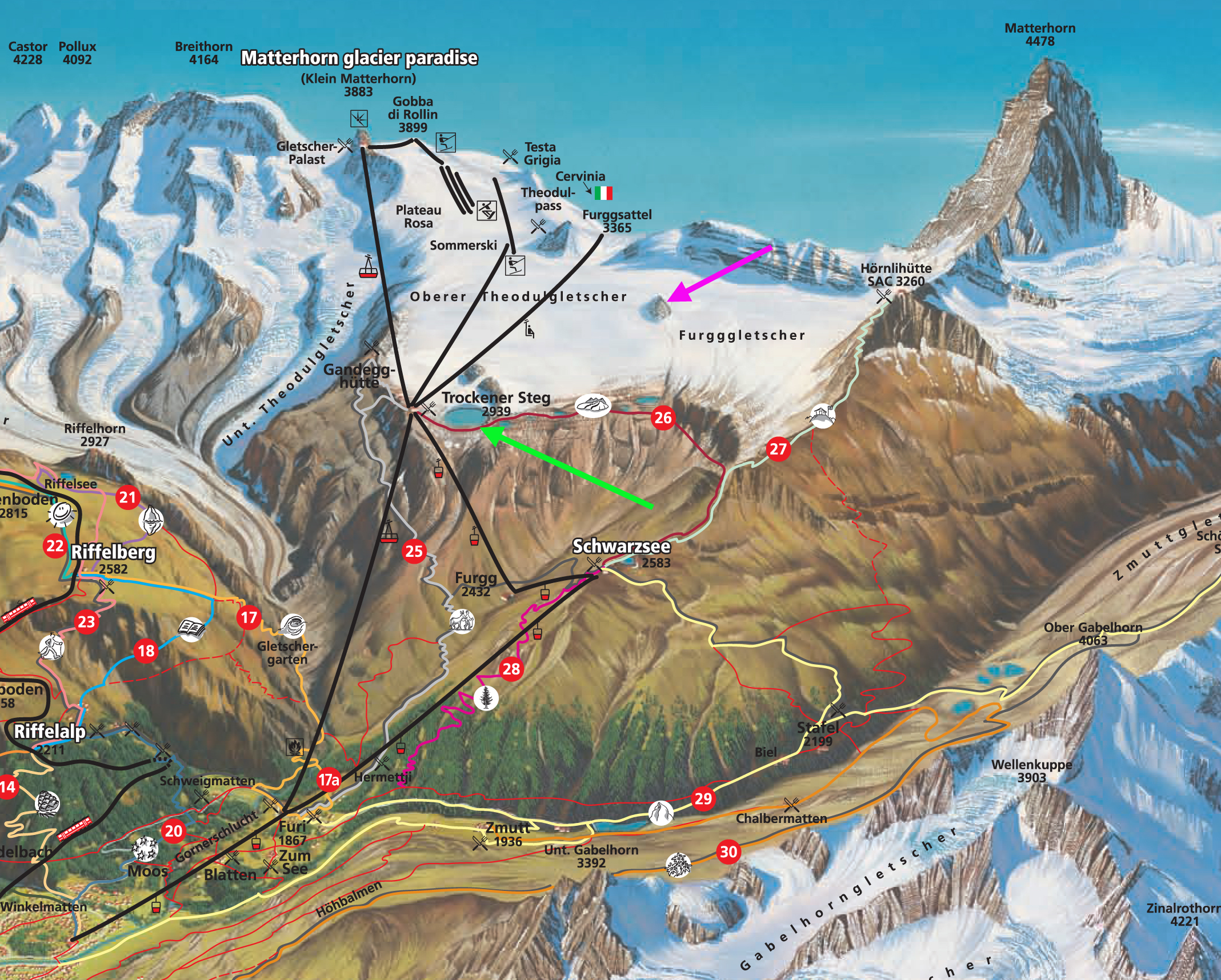
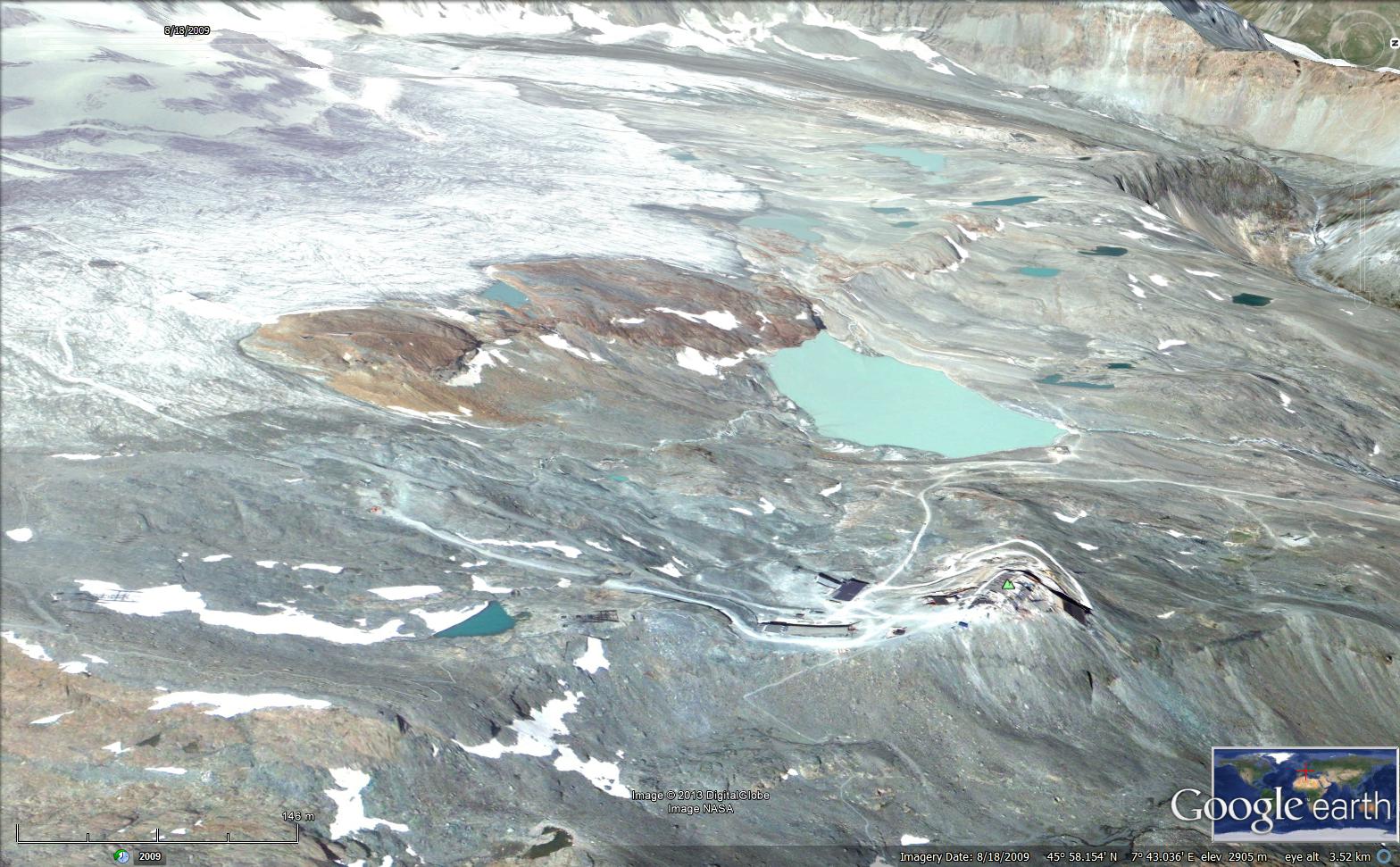
Theodulgletscher is one of the most visited glaciers in the world. It is part of the Zermatt ski resort in Switzerland. With three lifts crossing the glaciers western half. theodul trail map.
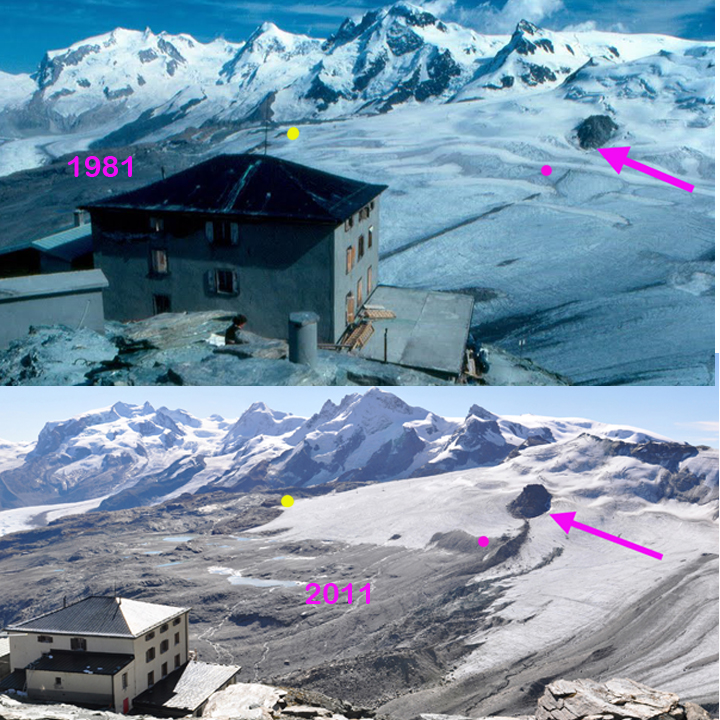
As ski season approaches I am reminded of ski area taking extraordinary steps to maintain the glaciers Stubai, Les 2 Alpes, Tignes and now Zermatt. Since 2003 summer skiing has been enhanced with Europe’s longest glacier chairlift, the 2.5 km long lift can transport 2,400 people every hour, ascending from Trockener Steg, at 2940 m, to Furggsattel station at 3365 m, above the Theodulgletscher in 8 1/2 minutes. Engineering wise the interesting part is that 12 of its 18 supporting masts stand on glacier ice, and have been engineered so that masts can shift and revolve to accommodate the glacier’s movement. This post examines changes in this glacier from 1999-2013. What makes Theodulgletscher a good ski run is its modest slope and limited movement that leads to few crevasses. The skiis runs themselves are well-groomed and marked to keeps skiers from venturing into areas where there are crevasses. With glacier retreat the distance from the glacier runs to the lift base at Trockener Steg has increased. Today an IDE snowmaker is being used to connect the Theodulgletscher to Trockener Steg with a 700 m long strip of snow. The IDE snowmaker is the world’s first snow machine that operates independently of ambient temperature. This is not enough to slow the retreat of this large glacier as seen from 1981-2011 below. The 1981 image is from Dave Brown Photrography.
theodulgletscher change

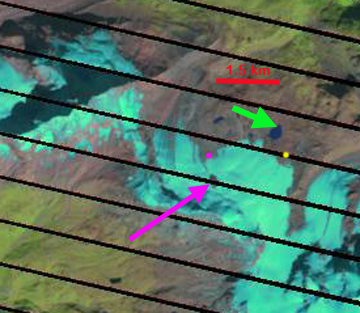
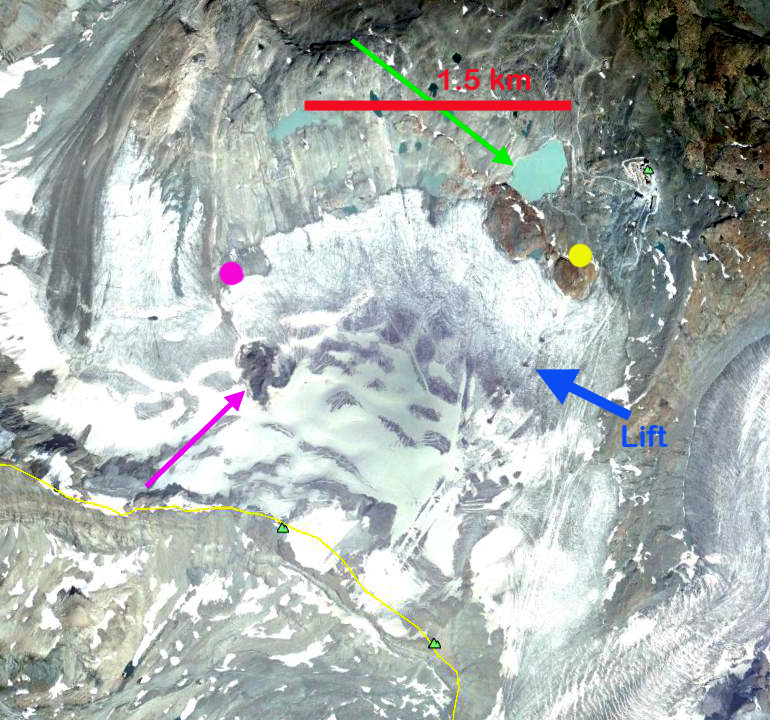
In each of the images in the sequence below and the images above the pink arrow indicates a prominent rock knob in the midst of the glacier, the pink dot below this knob is the glacier terminus, the green arrow indicates a small reservoir, and the yellow dot a location adjacent to the 1999 terminus below a rock knob. It is quite evident that the distance from the rock knob to the terminus, pink dot has changed dramatically in the 13 years 1999-2012, from 850 m to 450 m. A 400 m retreat of the west side of the Theodulgletscher in 13 years. The eastern side near Trockener Steg has experienced less retreat, with 140 m of retreat near the yellow dot. This is partly due to the grooming of the ski runs, where the compacted snow does not melt off as fast, last image. The glacier is quite thin across the entire front indicating retreat will continue.The daily web cam pictures from the top of the Matterhorn Glacier Paradise show the Theodulgletscher, though not that clearly. This identifies the day when the lower glacier loses its snowcover. This was July 19th in 2012 and August 2nd in 2013.
theodul 1999
1999 Landsat Image

theodul 2012
2012 Landsat Image

steg 2009
2009 Google Earth image

steg 2010

theodul 2011
2009 Google Earth image after a snowfall.

theodul terminus
2009 Google earth side view.

theodul surface
2012 surface of Theodulgletscher, note the last snowcovered areas are groomed regions.

J Glacier Retreat-Impending Loss, Wyoming

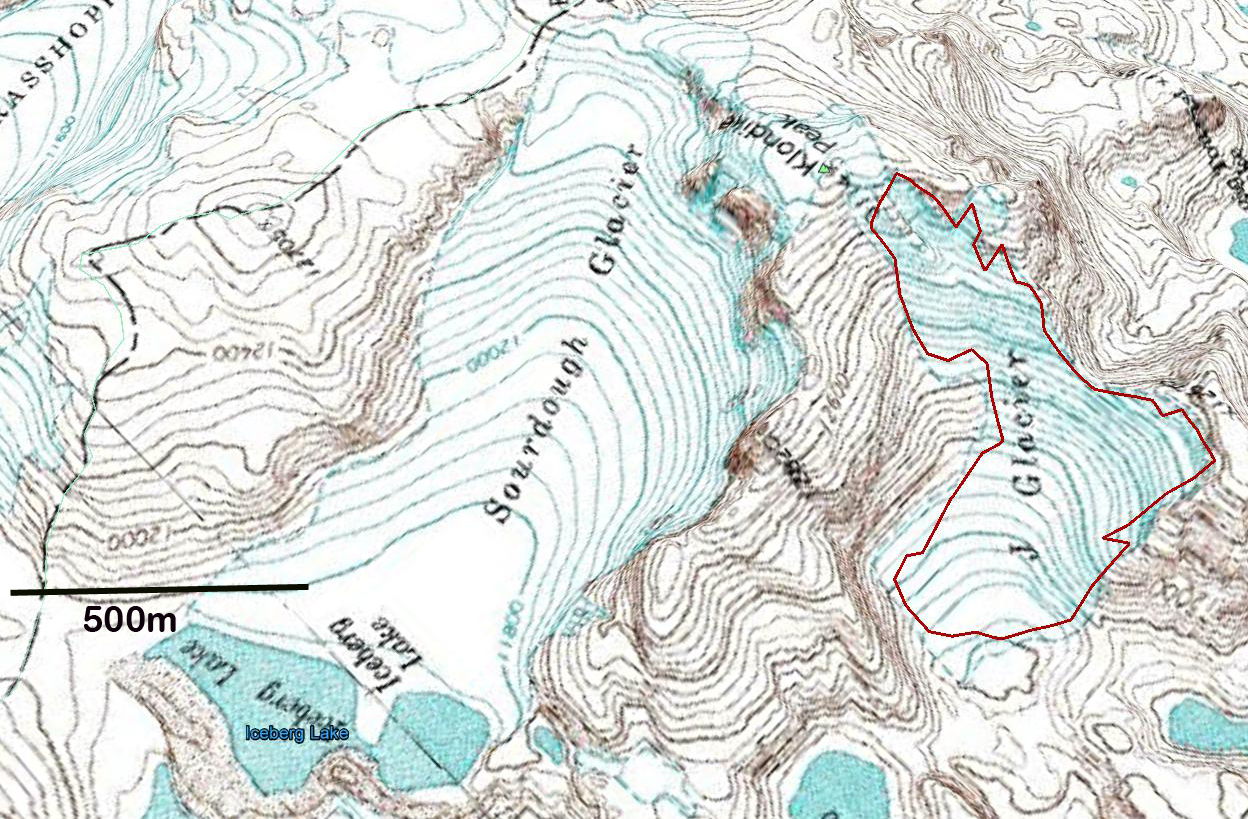
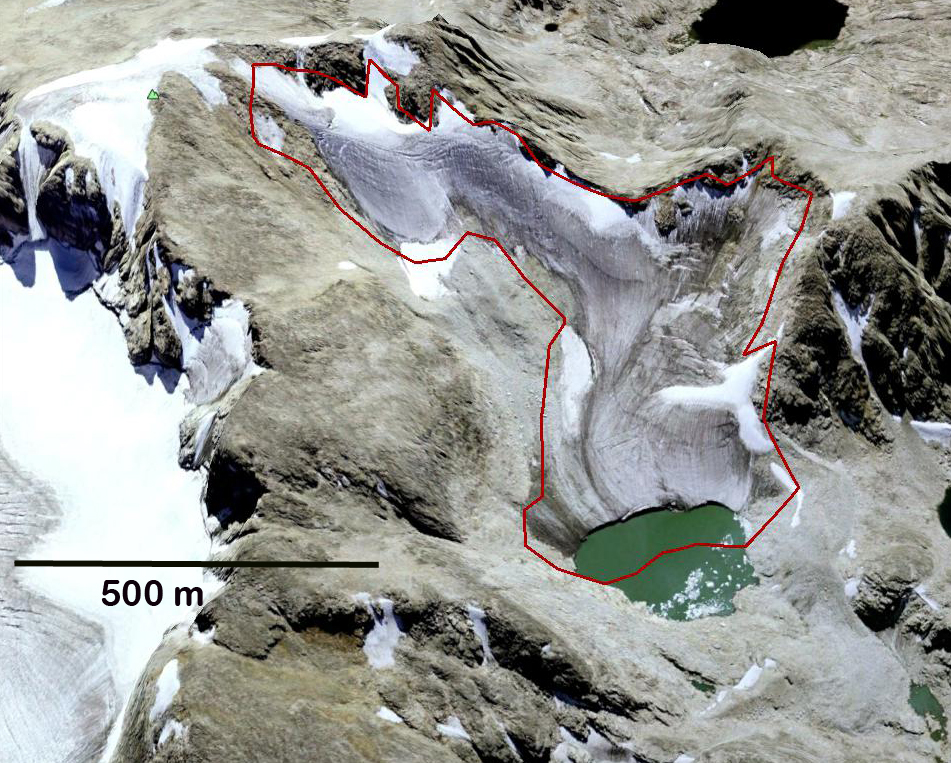
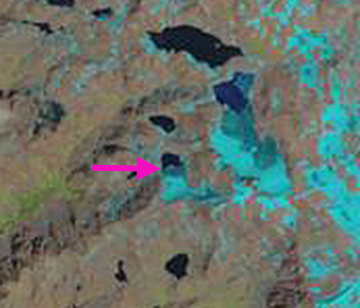
J Glacier is a small Glacier on the northwest side of Klondike Peak in the Wind River Range of Wyoming. In this post we examine changes in this glacier from 1994-2013 using Landsat Imagery and from 2013 and Google Earth imagery from 1994, 2006 and 2009. In 1966 the glacier ended on the far side of the lake basin and no lake was present. The retreat from 1966-1995 was 60 m a rate of 2 m per year. By 1994 a lake had formed at the terminus, the 1994 margin of the glacier is indicated with a burgundy line on each Google Earth image. The main terminus of the glacier retreated 100 m from 1994 to 2009, a rate of 6.6 m/year. More importantly the image from 2006 indicates a significant retreat and rock exposure on the upper portion of the glacier on the west side, pink arrow. In 2009 the glacier terminus is beginning to recede out of the lake as seen by emerging shoreline rock near the glacier center. In 2013 a July and August Landsat images indicate the extent of snowpack loss that occurred in just one month, leaving the glacier without any snowcover by late August. The terminus is indicated with a pink arrow, any change since 2009 cannot be discerned on this image. The complete snowpack loss has led to glacier ice melt and separation of the upper eastern corner of the glacier from the rest of the glacier, yellow arrow. The loss of area and exposure of rock on both the upper west and upper east side of the glacier indicate the lack of an accumulation zone. This indicates a glacier that cannot survive as noted by Pelto (2010). This is the same forecast as for nearby Minor Glacier and Grasshopper Glacier, whereas the neighboring Sourdough Glacier has fared a bit better. j glacier map
USGS Map of J glacier and Sourdough Glacier, from 1966 aerial photography.

J glacier 1994
1994 Google Earth image

j glacier 2006
2006 Google Earth Image

J glacier 2009
2009 Google Earth image

j glacier 7-2013
July 2013 Landsat Image

j glacier 8-2013
August 2013 Landsat image

Eyjabakkajökull Retreat, Iceland

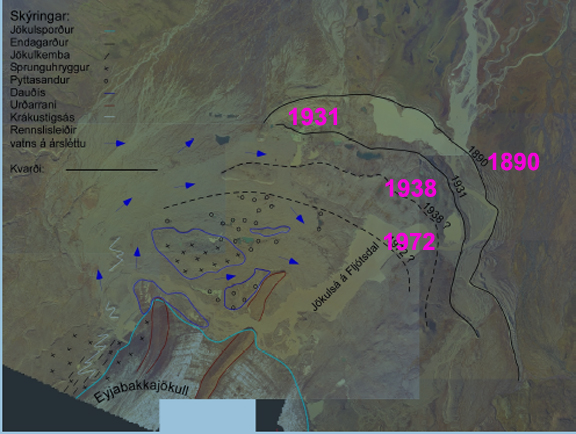
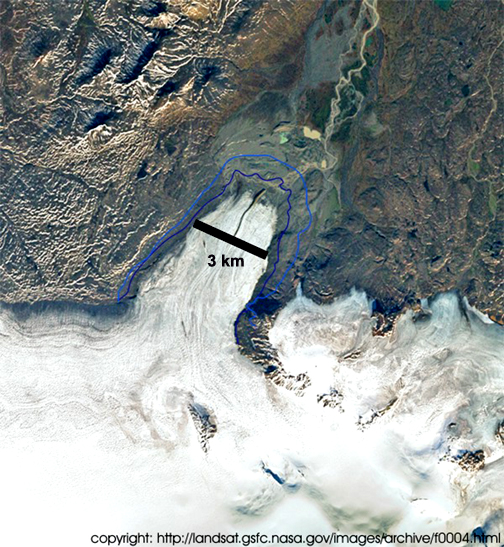
Eyjabakkajökull is a surging glacier that emanates from the north side of Vatnajokkull Ice Cap. The glacier surged in 1890, 1931, 1938 and 1972. During the latter advance the glacier advanced approxmately 2 km (Ívar Örn Benediktsson, 2009). A recent project focused on this glacial geology in front of this glacier led by Ólafur Ingólfsson and Ívar Örn Benediktsson (University of Iceland) and Dr. Frank Lisker (University of Bremen). The information was put together by Antje Herbrich. The first image is a map from this project indicating the glacier moraines emplaced by the four most recent surges. It is apparent that each surge has not extended as far as the previous surge. In the second image also from the Eyjabakkajökull project, the blue line is the 1973 terminus and the purple line the 1991 terminus position drawn on a 2000 Landsat image. eyej map

Eyjabakkajökull 2000

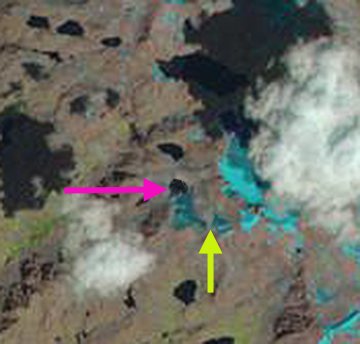
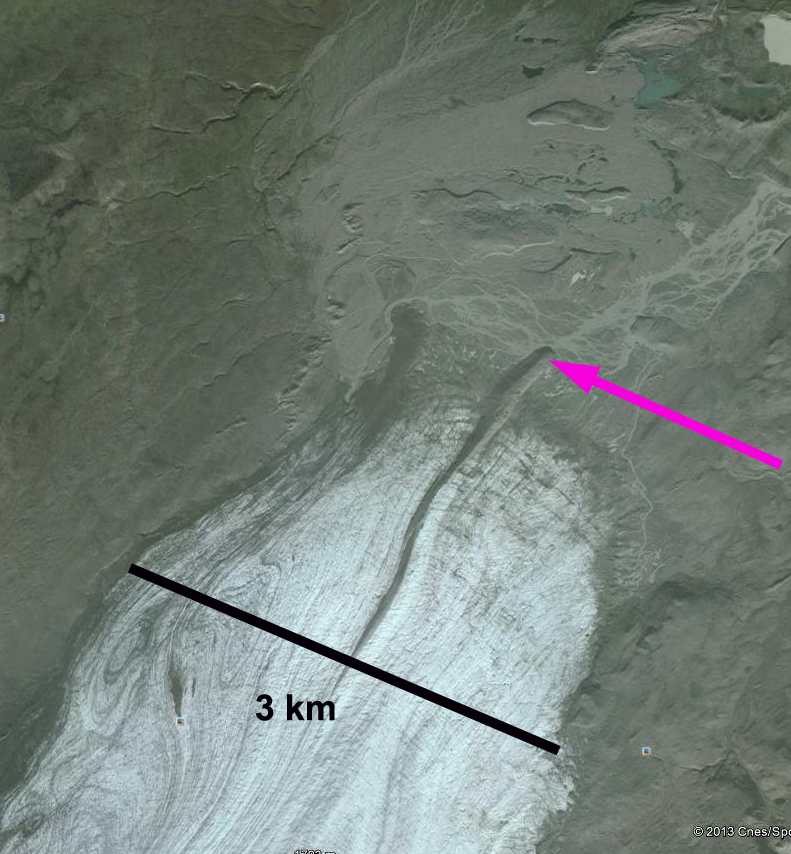
Here we examine Landsat Imagery from 1999, 2012 and 2013 and Google Earth imagery in 2000. The glacier tongue has a prominent medial moraine ridge that in 1999 ended just short of the outlet river in a stretch where it ran west to east, pink arrow. This is a ridge because it is an ice cored moraine, as the ice core melts the ridge disappears. By 2012 the glacier had retreated 2 km from the 1999 terminus, and ending at the yellow arrow. This distance is emphasized by the length of the green line to the terminus. The green line starts from a specific lake and terminates at the glacier. In 2013 the 2 km retreat since 1999, and the 1.1 km retreat from 1972-1999 places the terminus about a kilometer behind the terminus location prior to the 1972 advance. The 1972 terminus is marked with a red arrow. The current terminus has a very low slope and limited crevassing indicating that a rapid retreat will continue. Hence, when the next surge comes, it will begin from quite a recessed position and will fell well short of the 1972 advance moraines. The snowline in 2012 and 2013 is above 1100 m, purple dots, which is high enough to indicate significant negative mass balance.
Eyjabakkajökull 1999
1999 Landsat image

Eyjabakkajökull ge
2000 Google Earth

Eyjabakkajökull 2012
2012 Landsat image

Eyjabakkajökull 2013
2013 Landsat image

This retreat is similar to that of draining the Tungnaarjökull west side of Vatnajokulland Skeiðarárjökull Glacier on the south side and Brúarjökull . The low slope is seen in the image below looking across the glacier from Ívar Örn Benediktssoneyej 2007

Inter Glacier Retreat-Demise, Mount Rainier Washington

Inter Glacier is one of the smaller glaciers on Mount Rainier, Washington, lying between the larger Emmons and Winthrop Glacier. The glacier now extends from 2800 to 2200 m, with recent retreat shortening the glacier to 1 km in length. This post examines the retreat from 1992 to 2013 using Landsat imagery, Google Earth imagery and pictures from 2013 from Tyler Christensen.
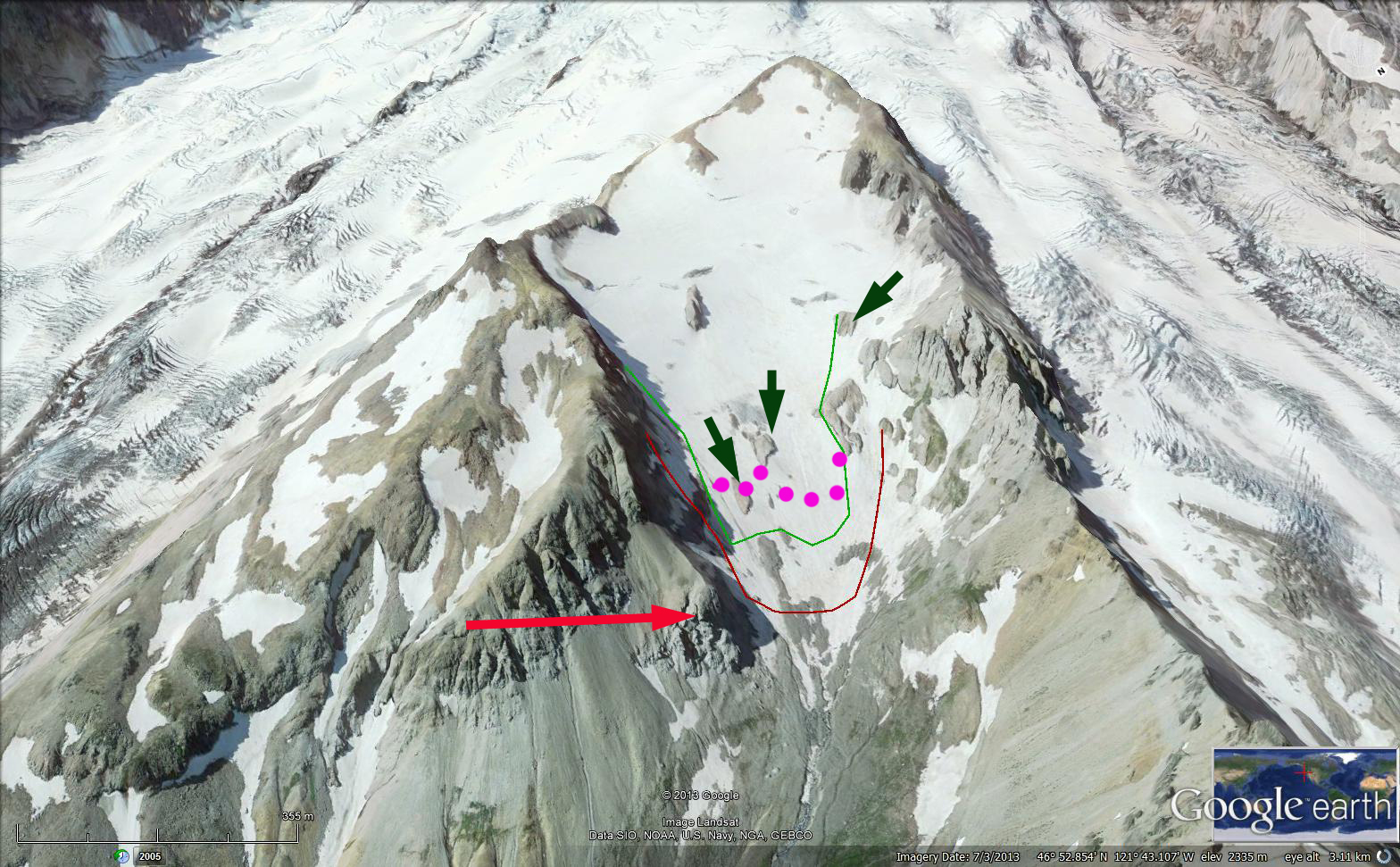
In 1992-1994 the glacier extends below a prominent knob on the east side of the glacier, red arrow. There are also only two bedrock knobs protruding through the glacier surface. The 1994 margin in the Google Earth image is a red line. inter glacier 1992
Landsat Image 1992

inter glacier 1993
Landsat image 1993

inter glacier 1994
Google earth image 1994

By 2009 the glacier has thinned considerably and retreated 200 m, terminus indicated by green line. There are five outcrops of rock that now protrude through the thinning glacier, see dark green arrows. The thin stagnant nature of the lower glacier indicates the retreat will continue. The 2013 Landsat image indicates the glacier has retreated beyond the bedrock knob east of the glacier, red arrow and to the bedrock knobs that had been amidst the glacier on its east side. The glacier 2013 terminus is indicated with pink dots on the 2012 and 2013 image below. The last two images are from Tyler Christensen who was climbing on Mount Rainier in August, 2013. The first picture is from below the terminus, indicating the stagnant nature of the lower glacier and emerging bedrock. The second image is a view east across the glacier at 2400 m, indicating the lack of crevassing, the number of emerging bedrock higher on the glacier, and the lack of snowcover with six weeks left in the melt season. All three of these observations indicate a glacier that cannot survive (Pelto, 2010).

inter glacier 2009
Google Earth image 2009

inter glacier 2012
Google Earth Image 2012

inter glacier 2013
Landsat Image 2013

IMG_20130811_124527
Tyler Christensen image

IMG_20130811_115737
Tylear Christensen image

This glacier is responding like all Mount Rainier glaciers, retreating. Inter Glacier is a smaller glacier like Paradise Glacier, and like Paradise Glacier it will not survive current climate. There is limited detailed study of Mount Rainier glaciers compared to Mount Baker (Pelto and Brown, 2012). With limited mass balance work on two glaciers Nisqually and Emmons. A detailed report on change in the termini is only up to 1994.