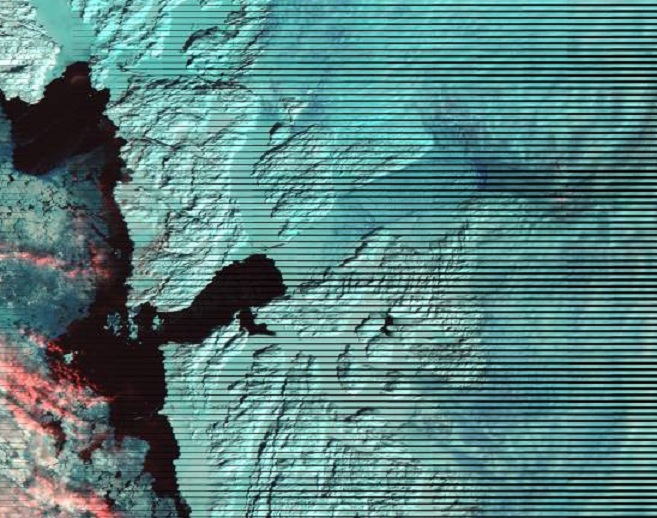
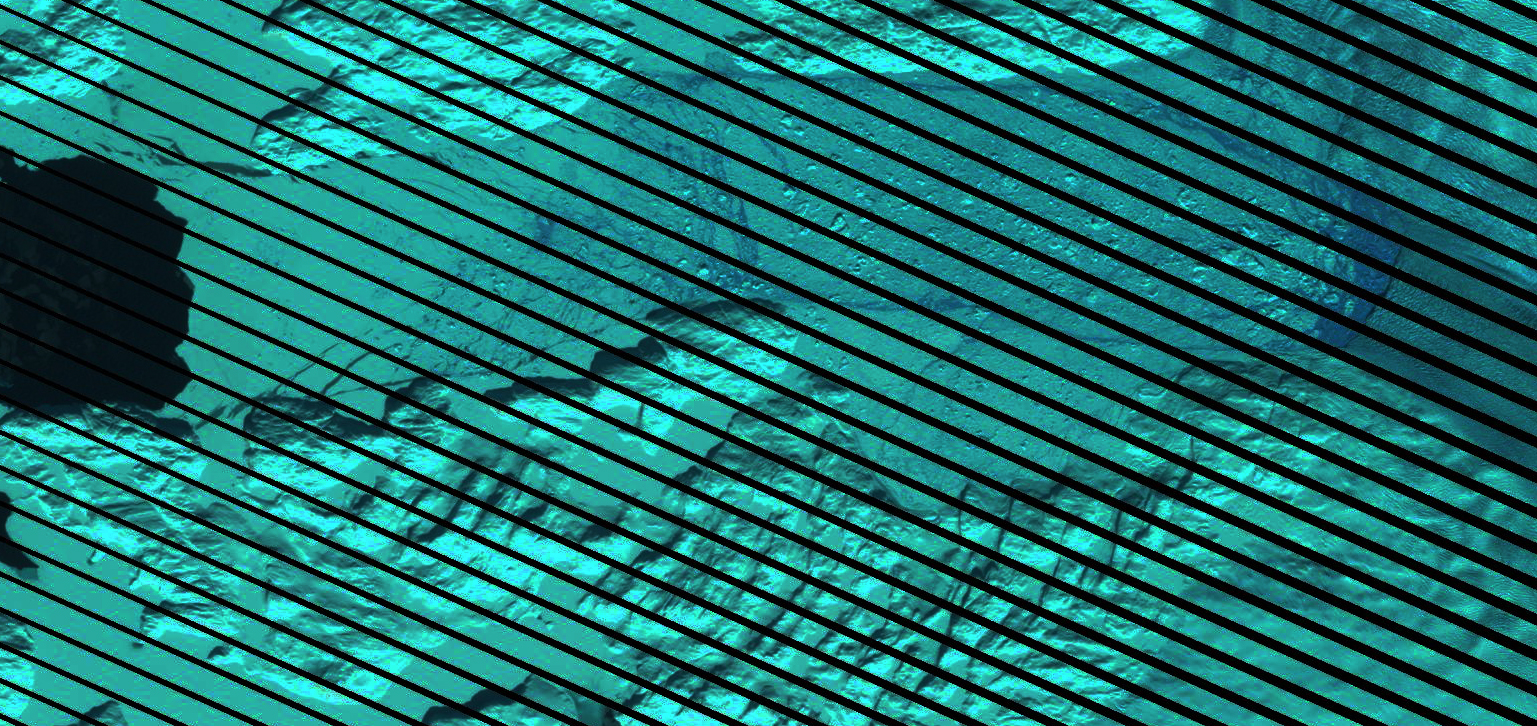
Update for 2/22/2011-the Tasman Glacier’s thin and weak terminus area, see in the GE image below, in Tasman Lake shed some large icebergs due to the earthquake generating some substantial waves in the lake. The post earthquake image with numerous fresh icebergs is the second below and is from the EPA. 
 No word on the Hooker Glacier in the next valley west, which also calves into an expanding lake or Murchison Glacier in the next valley east. There is a Tasman Glacier update in 2013.
 . The New Zealand National Institute of Water and Atmospheric Research has been examining the changes in volume and snowline on New Zealand Glaciers since 1977. This survey has concluded for 2009 they same observation as for 2007 and 2008, the glaciers are shrinking. An examination of the recent volume changes on the glacier indicate that the volume has been particularly negative since 1998.
 . This followed a period of relatively positive mass balance from 1990-1997, which made the New Zealand glaciers the least rapidly retreating glaciers in the world. For Tasman Glacier the retreat has been ongoing, the NWIA has noted a retreat of 180 m per year on average since the 1990’s. The proglacial lake at the terminus continues to expand as the glacier retreats upvalley. The lake is deep with most of the lake exceeding 100 metes in depth, and the valley has little gradient, thus the retreat will continue. It has been noted by researchers at Massey University that it is just to warm for the terminus area at 730 m to endure. Imagery of Tasman Glacier indicates the future it faces. There was no lake in 1973 and now it is more than 7 km long. The glacier appears quite rotten along the ice margin and poised for further retreat. The glacier drains a valley just east of the highest mountains in the range Mount Cook and Mount Tasman.
  . The image above has a blue line up the center of the glacier from the former terminus at the end of the lake too the head of the glacier. The upper image is from 2007 and the lower image from 2009. In the latter image the lake has expanded considerably. The disconnected lakes and debris covered ice on the left side-west side of the glacier has been replaced by all lake. Icebergs are afloat in this lake, they do not survive very long. The debris cover itself insulates the glacier ice from melting, slowing the process. However, the process due to the warmth and increased melting of the last decade has been increasing.


In the image below is a closeup of the section of ice that has now disintegrated, before it did. You can see the crevasses in some of the icebergs too. This is a rapidly changing environment due to the ongoing climate warming.
Category: Glacier Observations
Post detailing changes in a glacier
Pine Island Glacier Grounding Line Updated 2012
The Pine Island Glacier is a principal outlet glacier of the West Antarctic Ice Sheet draining into the Amundsen Sea. The ice stream is 40 km wide as it reaches the sea. Recent retreat, thinning and acceleration have focussed attention on this glacier. This is a brief note in support of a RealClimate article. The grounding line is of principal concern here. This is where the glacier goes afloat. The grounding line is where the bottom of the glacier comes in contact with the ground, in this case the sea bottom. The grounding line is an anchoring point for the outlet glaciers. The length of the glacier that is grounded is being both slowed and stabilized by the basal friction. Beyond the grounding line toward the margin the floating ice shelf is susceptible to a rapid calving retreat and as the grounding line retreats, so would the calving front. Note in the image below that the current grounding line is on relatively high terrain, but is close to a deep basin. The annotated image below is from a British Antarctic Survey image, taken from their autosub program exploring beneath the ice shelf of the Pine Island Glacier combined with data from radar altimeter data flown by NASA. The second image below is a profile of depth under Pine Island Glacier from (Shepard et al, 2001)that indicates that beyond the grounding line the depth remains more than 1000 meters below sea level for approximately 200 km. 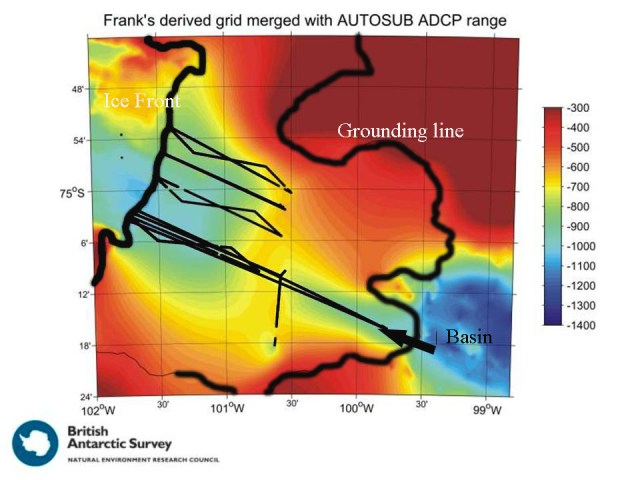
 Grounding line retreat could lead to the glacier retreating into this basin, not a stable situation. Basal melting is of particular concern, has been calculated to exceed 15 m/year. In addition the formation of basal crevasses which are much wider than surface crevasses may be critical in the rifting process. The British Antarctic Survey, NASA and several universities in particular have been focusing on this glacier. The second image shows the grounding line in the surface. This is an annotated satellite image from NASA. Just above the grounding line you can note that the surface of the glacier has some large scale roughness which indicates the impact of the sub-glacier topography.
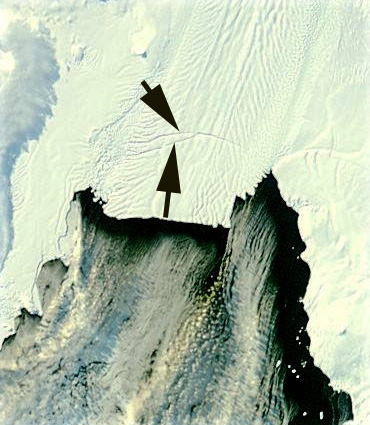
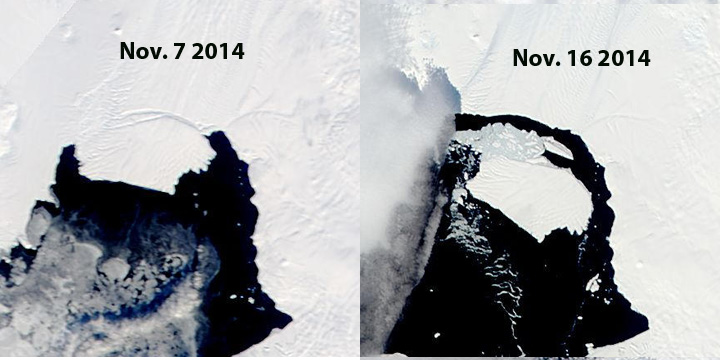
 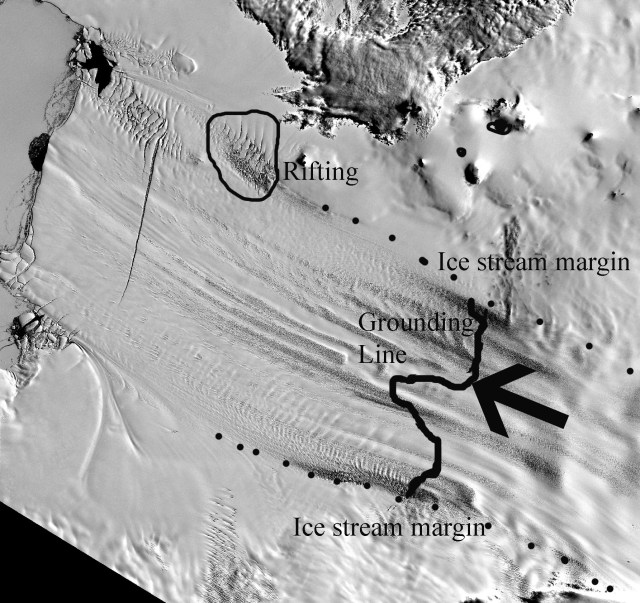 This topography acts to slow and buttress the glacier. This area is above the topographic rise from the deep basin to the higher terrain of the current grounding line. The ongoing focus on the Pine Island Glacier will be fascinating to watch. In particular the emphasis on the oceanographic aspects beneath the ice shelf. The melt rates beneath the ice shelf are significant, on the order of 15 m/year. This is an aspect that has received less attention and will certainly yield interesting results, considerable technologic frustrations and innovations. The nearby Smith Glacier has experienced a similar inland spread of rifting and retreat. In 2011 an additional rift has formed that is 20-25 km inland of the calving front, first noted by NASA’a Operation Icebridge. November 3, 2011 MODIS imagery is seen below. The rifts in both 2001 and 2011 have begun on the east edge of the ice stream an propogated westward. The propagation is more likely as an exploitation of basal crevasses then surface crevasses. The rift from 2011 led to iceberg formation in the fall of 2013 as seen in MODIS images.
 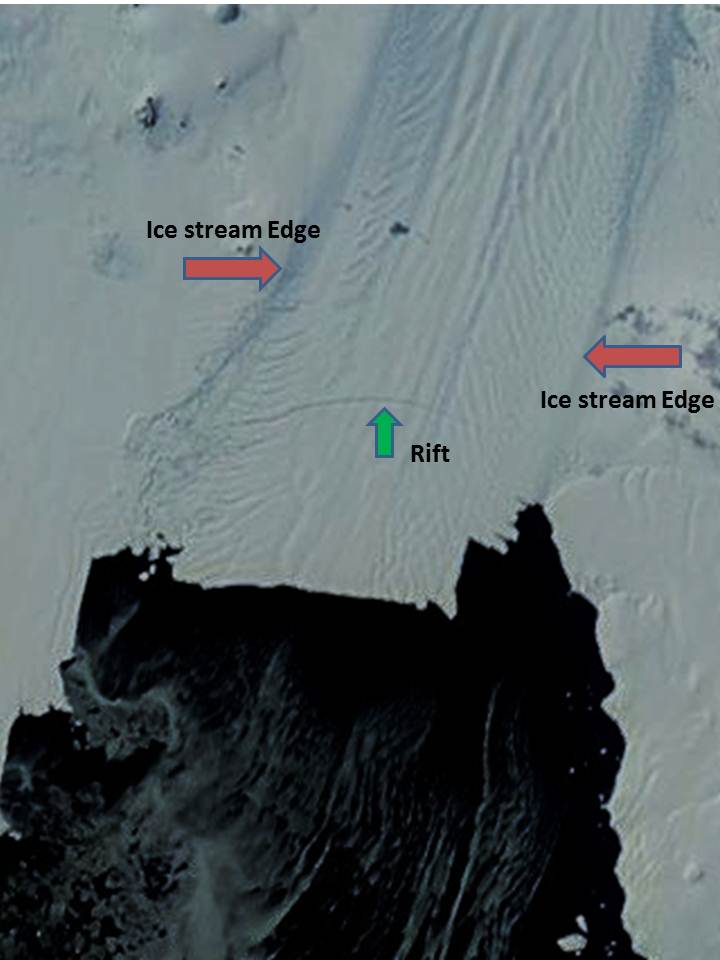 On October 5, 2011 MODIS imagery indicates no rift. By Sept. 17, 2012 a second rift parallel to the first had developed.
Gilkey Glacier Retreat, Juneau Icefield
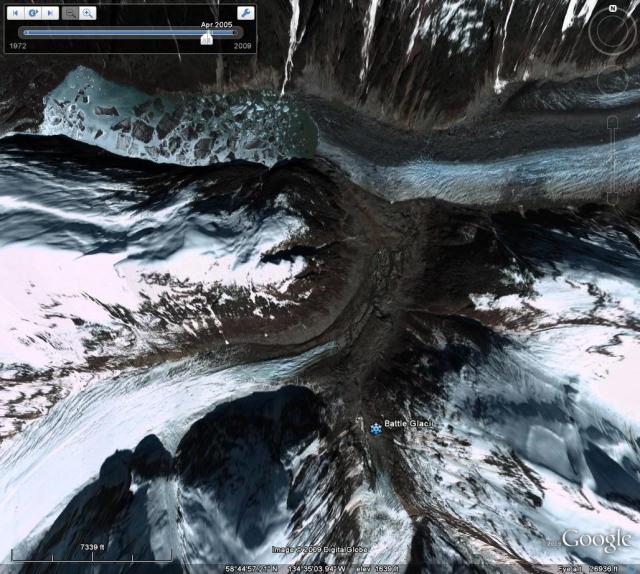
 Above is a paired Landsat image from 1984 left and 2013 right indicaing the 3200 m retreat during this period of Gilkey Glacier.The Juneau Icefield Research Program has long monitored the mass balance of the Lemon Creek and Taku Glacier on the Juneau Icefield. This program begun by Maynard Miller in 1946 and continuing through today has also monitored the terminus behavior of the icefields outlet glaciers. Of the 17 significant outlet glaciers 5 have retreated more than 500 m since 1948, 11 more than 1000 m, and one glacier the Taku has advanced. I have a chance to visit the glaciers during a number of summers over the last 25 years as part of this ongoing annual program. The Gilkey Glacier is a 32 km long 245 km2 outlet glacier flowing west from the Juneau Icefield. In 1948 it terminate at the head of a braided outwash plain. At that time it was joined 5 km above the terminus by the Battle and Thiel Glaciers from the south.
 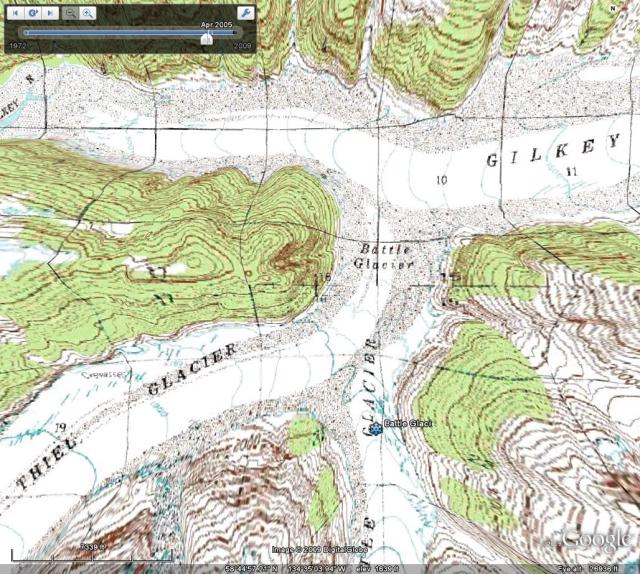 All three of these glaciers drain from the Juneau Iceifeld accumulation zone between 1500 and 2000 m, which maintain consistent snow cover. From 1948 to 1967 the Gilkey Glacier retreated 600 m and in 1961 a proglacial lake began to form. By 2005 Gilkey Glacier had retreated another 3200 m , generating a proglacial lake that is now 3.9 kilometers long, which is approximately the amount of retreat in the last 60 years as well.
  The lake is partly filled with large icebergs from disintegration of the, note below in an image from Scott McGee of JIRP,Gilkey terminus. The lake is currently terminating in this still growing lake. Approximately half of this retreat occurred after a 1991 satellite image indicated the lake was close to half its current size. The retreat has been resulted from calving icebergs into the new lake as well as thinning from melting in the lower reach of the glacier. The extensive debris cover and lack of crevassing in the lower 1500 meters of the glacier indicates that this section is stagnant and will break up soon.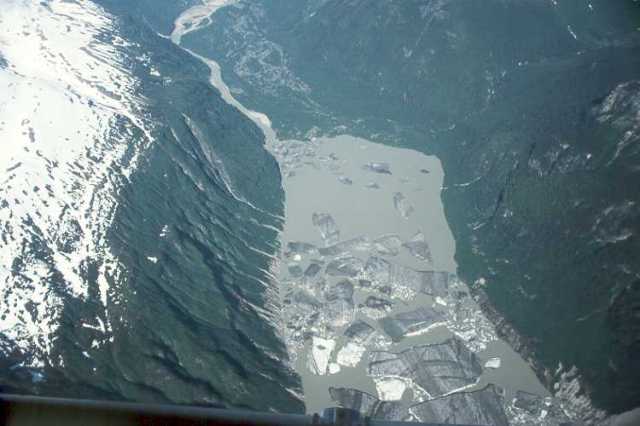
Gilkey Glacier was in 1955 joined by the tributary glaciers Battle and Thiel Glacier. A visit to the Battle Glacier in 1982 indicated that it had separated from the Gilkey Glacier and the Thiel Glacier, but the Thiel Glacier was still connected. By 1991 the Thiel Glacier had separated. Today these glaciers terminate 3200 m and 1700 m up their respective valleys from Gilkey Glacier. Thiel has retreated 1700 m from the Gilkey Glacier. A retreat of 3200 m has created a glacier 70 % its former length. The vast bare valley beyond the terminus is in stark contrast to the map above. Thiel Glacier has extensive lateral moraines extending above the glacier terminus indicating the ongoing retreat. The lower 3 kilometers of this glacier are flat and are downwasting, indicating a substantial retreat is still underway. A view up the valley from the Gilkey toward the terminus of Battle Glacier indicates that most of the area deglaciated was a flat low elevation valley. Now that the glacier is retreating up a steeper slope, the retreat rate of Battle Glacier should slow.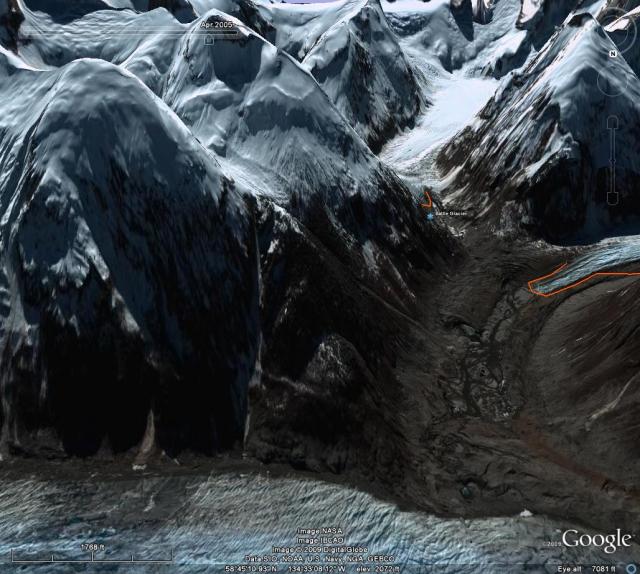
Mass Balance of the Easton Glacier 2009
Immediately below is Easton Glacier on Mt. Baker in the North Cascades in late May 2009. The glacier is still completely snow covered. The bench where the small gray cloud shadows are at 6000 feet averages 20 feet of snow remaining.
 Easton Glacier extends from the terminus at 5600 feet to the slopes near Sherman Crater at 9000 feet. Each summer since 1990 NCGCP has measured the mass balance of this glacier. View Youtube for a pictorial review of the full 2009 field season . The glacier has retreated 300 m since 1990. During this same period the glacier has lost a cumulative mean of 13 m of thickness. Given a thickness in 1990 between 60 and 75 m, this is about 20 % of the total glacier volume. The image below shows the terminus in 2009(green=2009, 2006=brown, red=2003, purple=1993 and yellow=1984).
  Measuring mass balance requires assessing snowpack depth and areal extent at the end of the summer melt season and the amount of melting in areas where blue ice or firn (snow more than a year old) is exposed. Below is measuring crevasse stratigraphy and below that emplacing a stake to measure ablation with weather instruments on it.

Mass Balance = residual snow accumulation – ice-firn melting.
The melt season began a bit late just when the May picture was taken Winter snowpack was between 75and 90% of normal in the area as of April 1. The melt season had been late to begin and snowpack by late May was near normal. Record heat was experienced at the end of May and the start of June, quickly causing snowpack to fall below normal.Each year we measure the snow depth via probing and crevasse stratigraphy at more than 200 locations. These depth measurements allow the completion of a map of snow distribution. This map is completed in early August and updated, based on a smaller number of observation in late September. The amount of melting is assessed from stakes emplaced in the glacier and the recession of the snowline in areas where snow pack depth has been assessed. below are images from early and then mid-August indicating the rise of the snowline. 

A warm June and July caused exceptional snow pack melt and by early August when we began assessing snow pack depth retained, the snowcover had receded to the 6400 foot level, 300-400 feet higher than normal. Snowpack remained below normal all the way to the 8600 foot level. the snowpack since early July had been rising nearly 100 feet per week. By mid-August at right the snow line on the glacier averaged 6800 feet. By mid and Late September the snowline had risen to 7400 feet a rate of rise of 150 feet per week since mid-August. Below is an image from mid-September 2009.  The amount of melting on the glacier in July was the highest we have measured totaling, 2.1 m. This led to the exposure of a couple of new bedrock knobs evident in the picture at right near the 2100 meters, black arrows. Overall the mass balance of the glacier in 2009 was a negative 2.06 m. This glacier averages 55-70 m in thickness and this mass balance loss represents a 3% volume loss in a single year for the glacier.
Sperry Glacier Recession
In 1900 Sperry Glacier had an area of 3.39 km2. By 1938 it had diminished to 1.58 km2 and by 1946 it was only 1.34 km2 in area. The estimated loss in volume between 1938 and 1946 was a 23 meter reduction in the level of the surface of the lower half of the glacier during that period. Recession proceeded at an annual rate of 15.3 m. be¬tween 1938 and 1945; 11.9 m. from 1945 to 1947; 10.5 m. from 1947 to 1948; and 12.9 m. from 1948 to 1949 (Dyson, 1950).
Recession of Sperry Glacier continued from about 1950-1970 and has been accompanied by loss of volume of the lower part of the glacier. Sperry Glacier has been examined in reconnaissance (Johnson, 1958, 1960, 1964). Comparison of longitudinal and transverse profiles shows that since 1947 the upper part of the glacier has increased in vol¬ume during some years and remained constant during others, whereas the lower part has decreased in volume. Throughout this time span slow terminal recession has been continuous. Surface ice velocities on Sperry Glacier average about 3 m./year.
Sperry Glacier retreated at a slower rate of 5 m/a, from 1950-1979 (Cararra and McGrimsey, 1981). The retreat has ranged from 3-5 m/a from the 1979-1993 period (Key, Fagre and Menicke, 2002).
In 1993 0.87 square kilometers remained. This glacier still has crevasses and is not merely stagnant and melting away. A comparison of imagery from 1991 top (orange line for terminus), 2003 middle (green line) and 2005 bottom (blue line) indicate the marginal changes during this 14 year interval. These images are all from Google Earth using the historic imagery function. 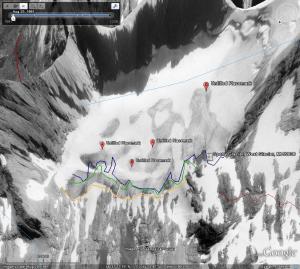
 Marginal recession averages 95 meters in this period ranging from 20-200 meters. The glacier was 1200 meters long in 1990 so this is close to a 10% loss in length. The current rate of retreat is slightly higher than the 3-5 m/a average fro the 1979-1993 period. The image in 1991 is from Aug. 25th, the glacier still has 70% of its area covered with snow from the previous winter. This is called the accumulation area ratio and in general must be above 60 at the end of the summer for the glacier to not lose mass. In 2003 the accumulation area ratio is about 30 and this is on Sept. 25th at the end of the melt season. In 2005 the accumulation area ratio is 30 at the most. Both years this limited a snowcover would lead to a significant negative mass balance, volume loss. The thinning in the upper portion of the glacier appears limited. There is not an evident change in the upper margin of the glacier. The crevassing which is indicative of movement has also not decreased much suggesting limited changes in the dynamics of the upper glacier. The comparatively slow changes in the accumulation zone, suggests a glacier that still has a consistent accumulation zone and is not likely to melt away rapidly, within the next 30 years, given the current climate. The glacier is showing no signs that it is approaching equilibrium, and that it can survive the current climate. This is in contrast to nearby Harrison Glacier which is receding quite slowly. There are new outcrops appearing at points A and B in the 2005 image indicating thinning and retreat is continuing. Annual layers are evident at point c in the 2005 image. Crevassing in the same area at point D is evident in each image.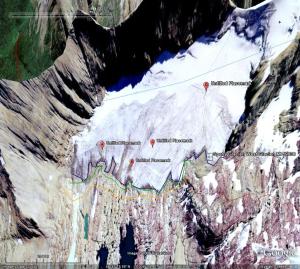
The USGS and the NPS have made Sperry Glacier a focus of field study beginning in 2005. The long term record of glacier area and glacier retreat makes it a good candidate. To date no mass balance data has been completed or reported. This data is essential to understand future terminus and volume responses. This project has been particular good at acquiring historic images to compare to current images 1913 and 2008. Bob Sihler captured the lack of snow remaining on Sperry Glacier in 2009., with a month still left in the melt season.
Devon Ice Cap
Two recent papers have examined the changes in flow, mass balance and volume of the Devon Ice Cap(Shepherd et al., 2007) (Dowdeswell, 2004). The Devon Ice Cap on Devon Island in the Canadian Arctic ice cap’s area has an area of 14,000 km2, with a volume of 3980 km3 . The ice cap area decreased by 332 km2 (2.4%) between 1960 and 2000.
The mass balance of the glacier has been assessed since 1960, the total mass loss due to surface melting and runoff between has been about 59 km3. Between 1960 and 1999 about 21 km3 of ice was lost from the ice cap by calving of icebergs, contributing 0.21 ± 0.02 mm to global sea level over this time. The long term mean net surface mass balance was 0.13 m from 1960-2000. From 1998-2007 the mean annual balance has been -0.23 m year, a substantial increase. 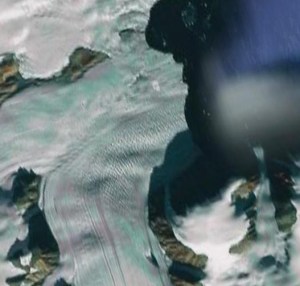 The Belcher Glacier above is the principal outlet glacier calving up to 30% of the total iceberg volume from the ice cap.
Devon Ice Cap’s negative balance has been due to warming and greater ablation, as the upper part of the glacier has seen some increase in accumulation, which has been more than offset by increased melting. 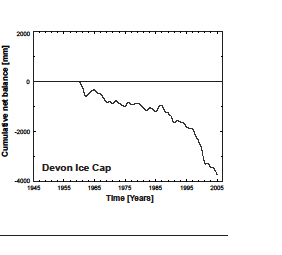 In this case the mass balance record indicates a dramatic worsening after 1995. It will be interesting to see the ablation results from the summer of 2008, when record melting was noted both in northern Greenland and northern Ellesmere Island. The glacier is not alone in its behavior, the Prince of Wales Icefield has had a negative mass balance over the last forty years of -80 km3, equivalent to a mean-specific mass balance across the ice field of -0.1 m w.e. a-1, contributes 0.20 mm to global eustatic sea level rise (Mair et at., 2008).
Photographs of the fieldwork coordinated by the University of Alberta
26th Annual North Cascade Glacier Climate Project 2009 Field Season
This video examines the 2009 North Cascade Glacier Climate Project Field Season. It is a look more at where we work, than what we find. Mass balances were substantial averaging -1.93 m. The winter season was wetter than average, with close to average snowpack in the North Cascades. Summer melt conditions were exceptionally warm, leading to enhanced melting and considerable losses in glacier volume. The mass loss of approximately 2 meters represents about 4% of total glacier volume, gone in one year. In July ablation averaged 8.5 cm per day. For glaciers that average 50-60 m in thickness that is the loss of 2.5 m in one month. Most of the melt was snowpack from the previous winter. However, by mid-August blue ice was exposed on the majority of the glacier surfaces across the North Cascades and any ablation was a loss in long term glacier volume. In the case of Columbia Glacier at the end of August a view of its surface indicates only a few white patches of snow remaining.  Glacier retreat was slowed on Rainbow and Ice Worm glaciers where the terminus was buried under avalanche snow. Retreat of Easton Glacier was 20 m, Lower Curtis Glacier 11m, Daniels Glacier 12 m, Lynch Glacier 8 m. All 42 glacier observed retreated in 2009. Easton Glacier developed a new rock outcrop in the midst of the glacier
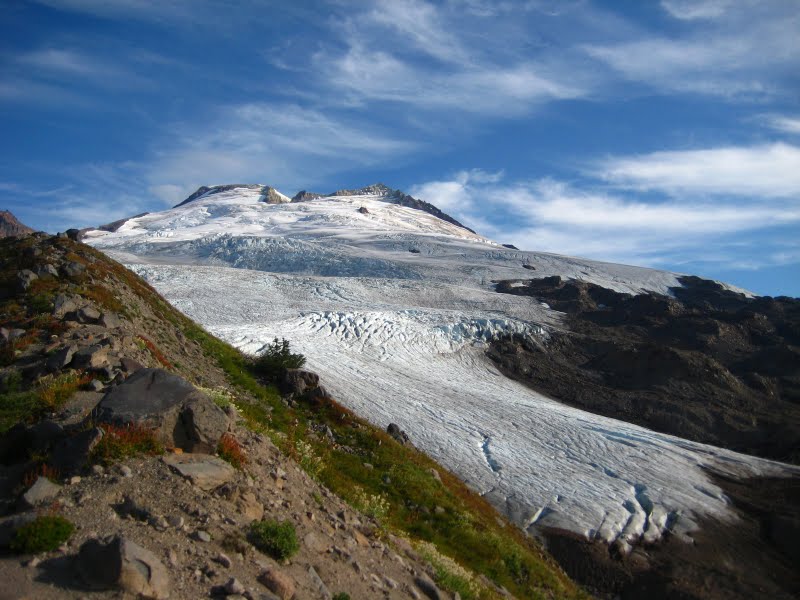 . More details on this project North Cascade Glacier Climate Project
[url=http://www.youtube.com/watch?v=DJGQXlvWXy8]
Honeycomb Glacier Retreat, New Lake Formation
Honeycomb Glacier is one of the longest and largest glaciers in the North Cascades. It is currently 3.7 km long and has an area of 3.1 km2. It has retreated 2.05 kilometers since its Little Ice Age Maximum. The glacier was an imposing site to C.E. Rusk who recounted his early 20th century exploration (1924). Like all 47 glaciers observed by the North Cascade Glacier Climate Project it has retreated significantly since 1979.
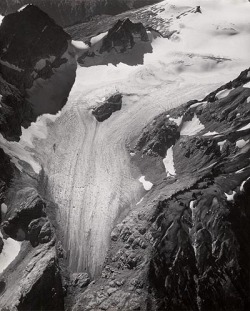
A 1960 photograph taken by Austin Post shows the glacier ending with no lake at its terminus. The terminus is gentle and has no crevasses, indicating it is relatively stagnant and poised to melt away. The glacier has retreated 1.3 km from its Little Ice Age moraines at this point. In 1967 another Austin Post image indicates a new small lake forming at the terminus.
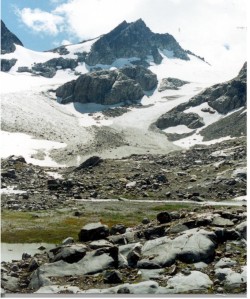
 In 1995 we visited the margin of this lake, where the glacier ended in 1967 and took a photograph back to the glacier. As seen below retreat to this point was 400 m.
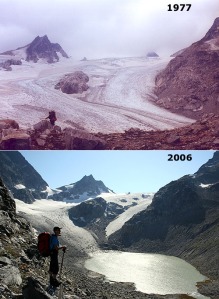
  A pair of images from Bill Arundell in 1973 and Lowell Skoog in 2006 indicate the scale of the retreat, these images do not show the actual terminus but do show the main nunatak-rock island and how much it has become exposed in the 33 years. This nunatak was hardly evident in 1960, and in a 1940 image of the glacier literally did not yet exist.
 The terminus had retreated 400 m from the 1967 position to 1995. In 1987 a new lake began to form at the terminus of the glacier at 1680 m. The glacier is shown ending in this lake in 2002 from both the far end of the lake and the nunatak above the lake, the glacier had retreated 210 m since 1995. In 2006 the glacier retreated from the end of this lake. This is a shallow lake that may eventually be filled in by glacier sediments. The terminus is flat and stagnant ending at 1680 m in the lake. Thus, the rapid retreat will continue, the glacier is still not close to acheiving a post LIA equilibrium. Glacier retreat from 1940-1967 averaged 9 m/year. Retreat was minor between 1967 and 1979. The retreat rate since 1979 has been greater than 38 m/year, with a total retreat of 700 m. The nunatak in the middle of the glacier, which was beneath the ice in 1940 is now 90 m above the ice. The section of the glacier below the nunatak in 2002 is stagnant with no crevasses.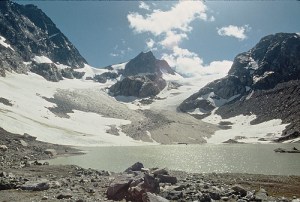
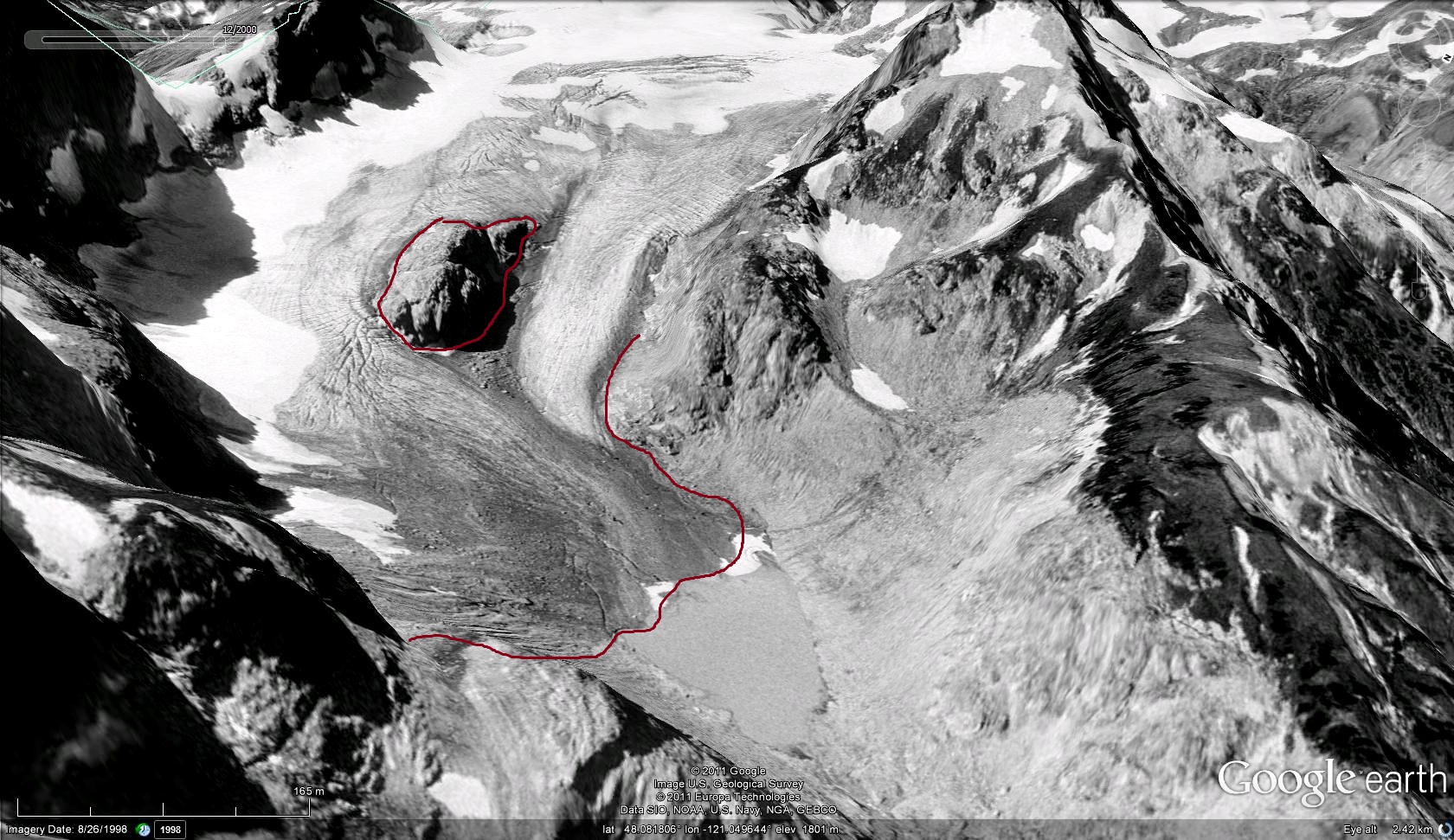
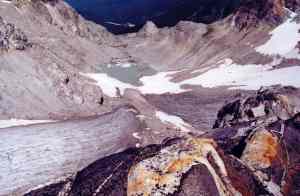 Indicating this glacier will retreat at least to the base of this rock knob, which will then no longer be a nunatak. A comparison of Google Earth Imagery from 1998 and 2009 illustrate the appearance of numerous new bedrock knobs in the area where there was an icefall in 1995.
 survive The upper portion of the glacier has retained its snowcover in recent years indicating the glacier can survive current climate at a much smaller size.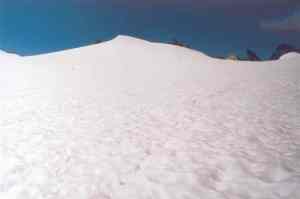
Recession of Jakobshavn Isbrae continues
The Jakobshavn Isbrae (glacier) has captured our attention over the last 30 years because it has the highest long term average velocity of any glacier in the world. At the ice front the velocity has remained above 16 meters per day for all measurements completed over the last 50 years. The ability of this glacier which is 10 km wide at its front and 800 m thick at the calving front to drain 6.5 % of the Greenland Ice Sheet is its importance. The annual volume of discharge is 40 cubic kilometers. This prompted the University of Maine’s Terry Hughes to take a close look at the glacier in 1985. I participated in that project and one key conclusion we reached was that the Jakobshavn Isbrae was in approximate equilibrium (Pelto and others, 1989). The terminus had not shifted significantly in the past 30 years and no thinning was evident either. The image below of terminus change The top image above is from Jason Box, Byrd Polar Research Center, Ohio State University, and is a mosaic of Landsat and ASTER images indicates a substantial retreat from 1850-1964 of about 30 km. The first image is from the fall of 2009 and the second a Modis image from June 2010. The third from July 2010,from NASA. The last two in the sequence are Landat 8 imagery from May 9 and June 1, 2014 indicate an early summer retreat that was first noticed by the ongoing sharp observations of Espen Olsen. The retreat follows the typical winter advance, and is not back to the 2013 furthest retreat also identified by Espen Olsen. Notes on these latest images below the sequence.
From 1964 to 2001 the glacier terminus did not recede significantly and observations of terminus velocity remained relatively constant at 16 to 20 m year at the glacier front. Then in 1997 an acceleration began. The velocity reached 34 m per day by 2003, twice its normal speed, the glacier thinned by up to 15 m year and retreated 10 km, from 2001 to 2003. From 2004-2007 an additional retreat of 5 km occurred.

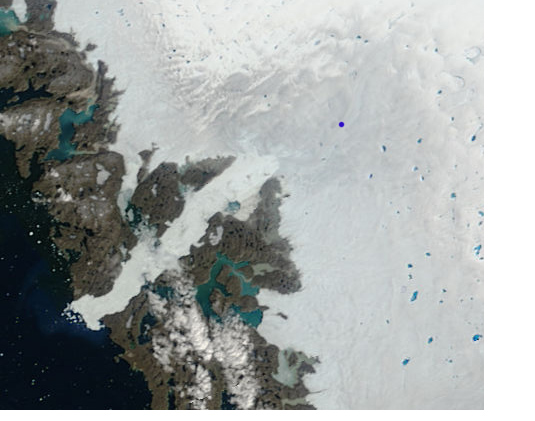
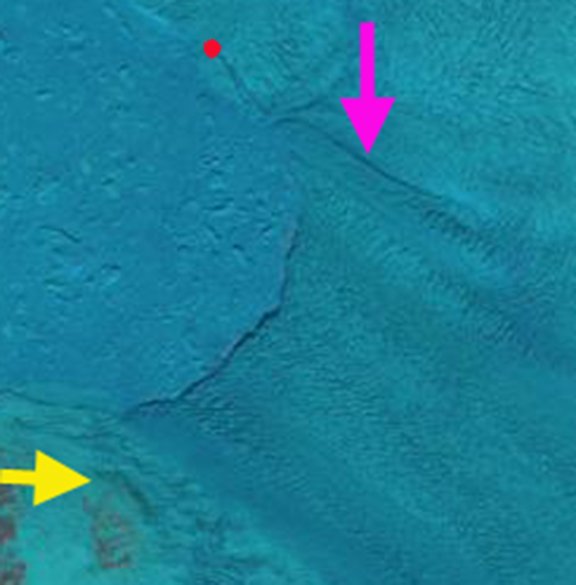
[caption id="attachment_7425" align="aligncenter" width="480"] Pink arrow indicates a prominent lateral rift. Yellow arrow reference location. Red dot an existing transverse rift.
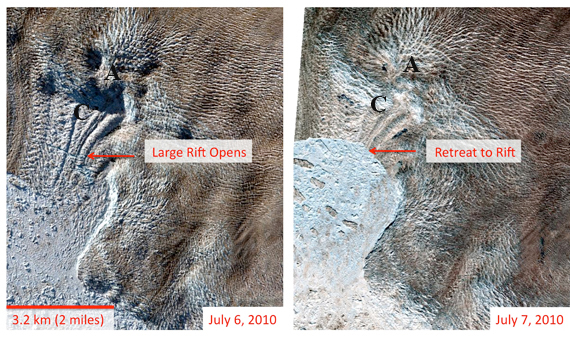
The pink arrow notes a prominent lateral rift, the yellow arrow a reference point. Red dot is a transverse rift near the ice front. No large rifts are apparent in the area of the main calving on May 9.[/caption] A bedrock high beneath the glacier is reflected by the sudden increase in slope below point A. What is fascinating is the speed at which the glacier surface below A at Point C was transformed from an ordinary set of transverse crevasses to the chaotic scene typically indicative of an area of rapid acceleration and failure of seracs, those walls betweens crevasses. The glacier has had a profound response to the rifting-calving retreat of the previous day. The area of crevasse transformation is an indication of the connection of this area of the glacier to action at the terminus, the crevassed areas response was so swift that it was effectively involved in the calving retreat incident. The area around C is a zone of weakness to watch for further appearance of rifting. The area in front of the bedrock high is clearly not a place for the terminus to stabilize. The bedrock high itself could well be a point of greater stability for the terminus. Upglacier 2010 is not a good year for the glacier either the snowline is high for June exposing larger areas of bare glacier ice with higher albedo for melting, see image at bottom.
On Jakobshavn the acceleration began at the calving front and spread up-glacier 20 km in 1997 and up to 55 km inland by 2003 (Joughin et al., 2004). Luckman et. al., (2006) observed…“The most plausible sequence of events is that the thinning eventually reached a threshold, ungrounded the glacier tongues and subsequently allowed acceleration, retreat and further thinning. It is reasonable to believe that the 1998 Jakobshavn speed-up, also following a long period of stability, was triggered by the same processes of thinning but occurred earlier and after a shorter period of thinning because the tongue was already afloat.”
On Jakobshavn the acceleration was not restricted to the summer, persisting through the winter when surface meltwater is absent. This indicates that it is the change in conditions at the calving front where the backforce on the glacier was reduced that allowed acceleration and retreat. This is typical for Greenland marine terminating outlet glaciers, they have accelerated most at the calving front and the acceleration is not seasonal. The acceleration is not significantly due to meltwater enhanced lubrication. Below is the acceleration of the last decade compared to before, illustrating that the greatest acceleration is at the calving front (Thomas et al., 2009). 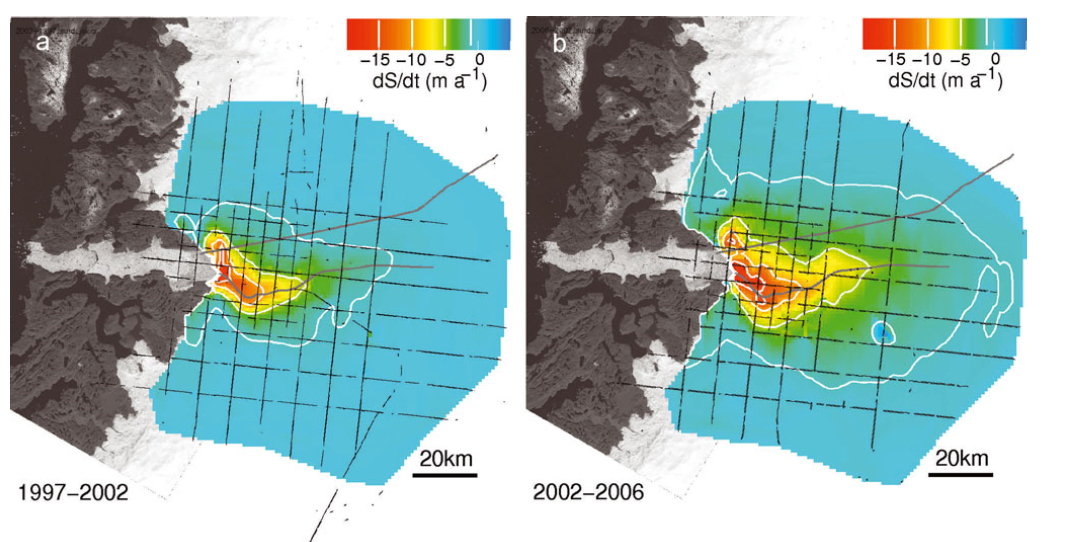
The Jakobshavn is of particular importance as it has a bed below sea level for at least 80 km inland from the terminus. In this reach there are no significant pinning points, or abrupt changes in slope or width (Clarke and Echelmeyer, 1996) that would help stabilize the glacier during retreat. In particular the bed becomes deeper from 24-40 km behind the calving front, which should reinforce calving acceleration (Thomas et al., 2009). 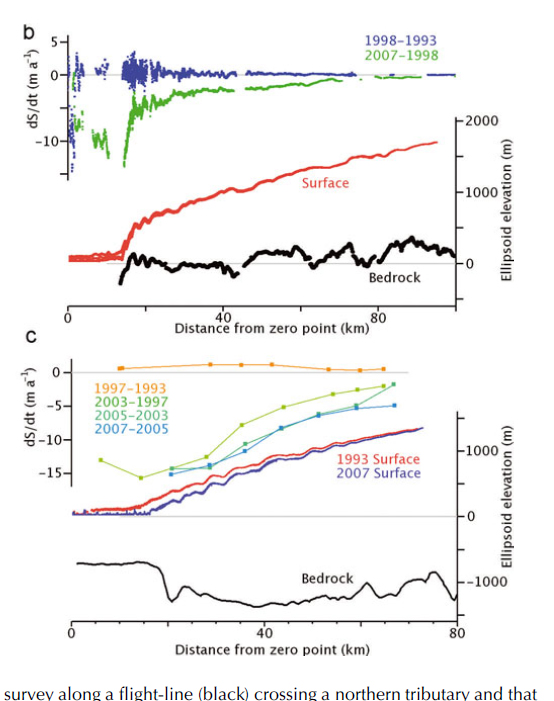 Images of Jakobshavn Isbrae in 2001 indicate substantial rifts on the north side of the glacier near the 2005 terminus position, suggesting the glacier had been preconditioned for retreat. In the image below from June 17, 2010 the snowline is evident on the north side of Jakobshavn as the transition to the much lighter blue tone, in this Landsat image. The red line is the June 2009 snowline and the green line the 2008 June snowline.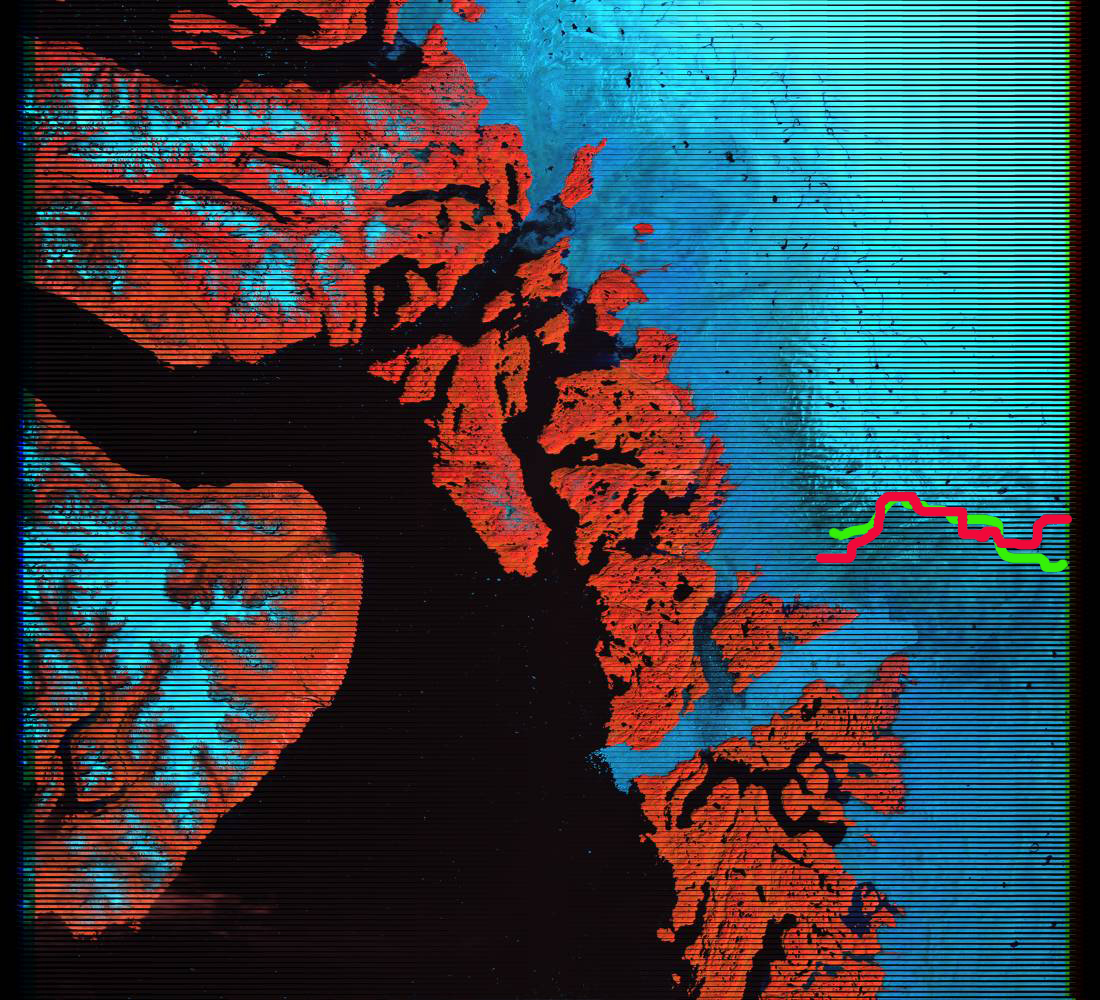
A comparison of April 2010 (top image below) and April 2011 Landsat image (middle image) indicates a somewhat lower snowline on the Jakboshavn in 2011. The zoomed in version indicates the amount o the ice that is actually icebergs.