
Brady Glacier is a large glacier at the south end of the Glacier Bay region, Alaska. When first seen by George Vancouver it was a calving tidewater glacier in 1794 filling Taylor Bay with ice. Brady Glacier ceased calving and advanced approximately 8 km during the 19th century (Klotz, 1899). As Bengston (1962) notes, the advance is likely another example of an advance following a change from tidal to non-tidal status rather than that of a more positive mass balance. Bengston (1962) further notes that the massive outwash plain at the terminus is primarily responsible for Brady glacier maintaining itself well other glaciers in the Glacier Bay region retreat. The ELA on this glacier is 800 m, the line above which snow persists even at the end of the average summer, this is one of the lowest in Alaska. The main terminus was still advancing in the 1960’s and 1970’s and has managed a 250-300 meter advance since the USGS map of the 1950’s. The main terminus is not advancing any longer and has begun to retreat, the retreat to date is less than 200 meters. The image below is the 1950’s map of the glacier.  Brady Glacier is a complex glacier with many subsidiary termini. Echelmeyer, Arendt, Larsen and Harrison from the University of Alaska noted a thinning rate in the mid 1900’s of about 1 meter per year on the Brady Glacier complex. A comparison of 1950’s USGS maps and 2004-2006 satellite imagery indicate all six main subsidiary termini are retreating. The retreat ranges from 200 m in Abyss Lake, 200 m in Trick Lake to 1200 meters in North Deception Lake. The image below is the 2006 satellite image. Compare to the map, Deception has increased in size several fold. North Trick and South Trick Lake are now joined, Trick Lake.
 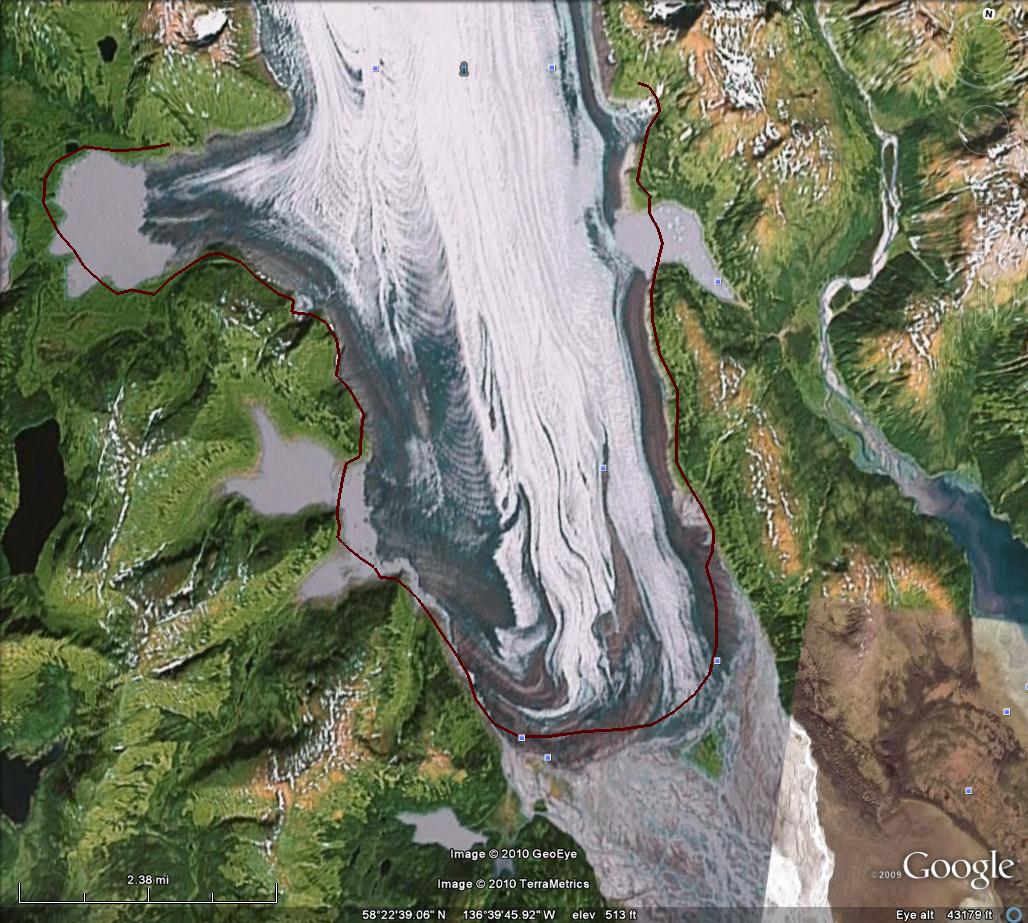 Of further interest is the stream draining Trick Lake that sneaks down the west margin of the glacier. This has enabled the water level in the glacier dammed Trick Lake to decline. Note the brown grey “Bath Ring” so to speak above the lake level. The outlet has also been marked in the image below. Pelto (1987) noted that the percentage of the glacier in the accumulation zone was right at the threshold for equilibrium. Subsequent warming of the climate in southeast Alaska and reduced glacier mass balance in the region has initiated this retreat.
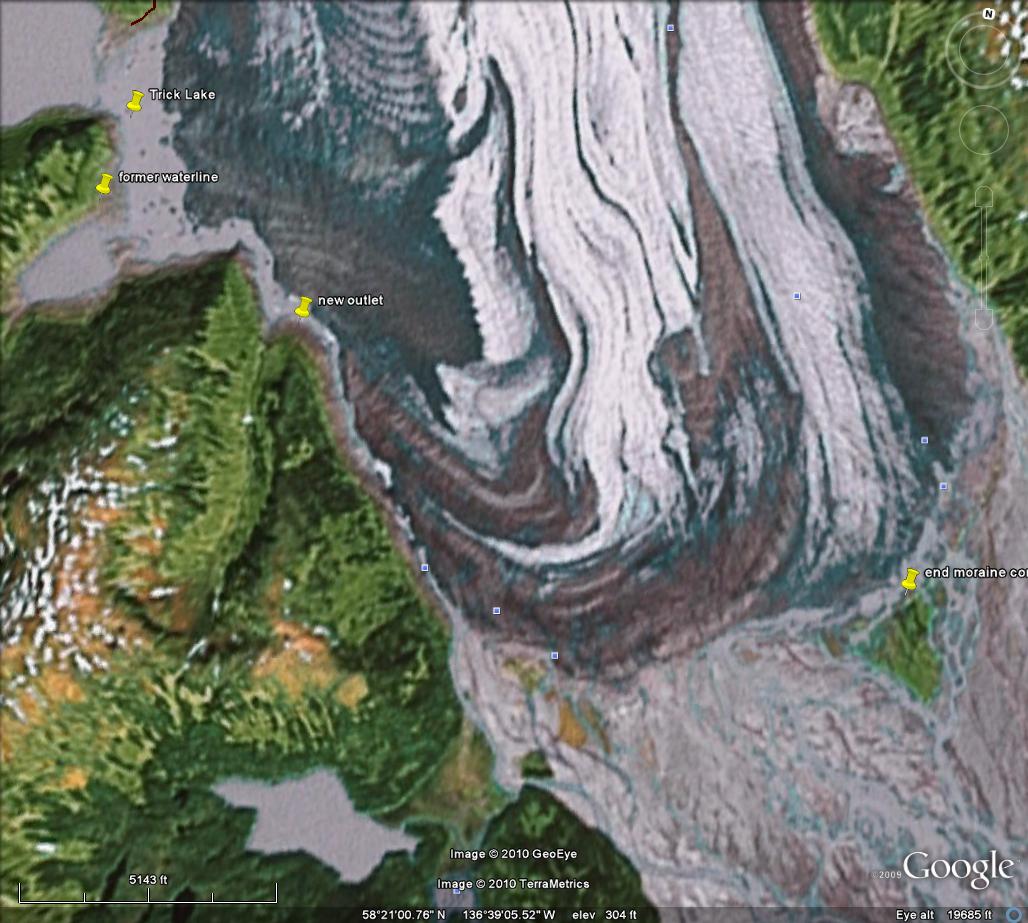 These termini are all closer to the equilibrium and would respond first to changes in mass balance due to recent warming and consequent measured thinning. This entire line of reasoning must be explored. The glacier is thinning substantially and would appear to be poised for a substantial retreat of the main termini, not just the subsidiary termini.
References not linked:
Bengston, K. recent behavior of Brady Glacier, Glacier Bay National Monument, Alaska. IAHS, 58, 59-77.
Klotz O. 1899: Notes on glaciers of southeast Alaska and adjoining territories. Journal of Geography, 14, 523-534.
Pelto, M. 1987. Mass balance of southeast Alaska and northwest British Columbia glaciers from 1976 to 1984: Methods and Results”. Annals of Glaciology 9: 189–193.
Category: Glacier Observations
Post detailing changes in a glacier
Rotmoosferner Retreat and Dynamic Change
There are currently 51 glaciers in the Ötztal Nature Park. Right now, glaciers cover 27% of the total area of the Ötztal Nature Park. All have been retreating, from 1987-2006. Detailed mapping of these glaciers and Rotmoosferner by Abermann and others (2009), University of Innsbruck provide interesting results. Ötztal glaciers lost 8 % of their total area. One of the glaciers that has a long record of observation is Rotmoosferner. This glacier has retreated 2.1 km since the Little Ice Age and 600 meters since 1969, 15 meters per year. A detailed map of Rotmoosferner from Abermann and others (2009) University of Innsbruck indicates that in 1975 it was joined to the Wasserfallferner, but in 2005 it separated. 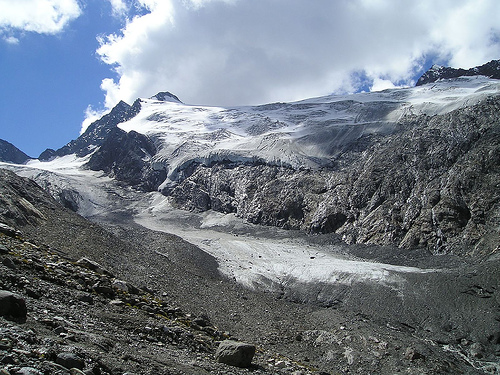 In the image above the Rotmoosferner is to the lower left and the Wasserfallferner above and to the right. Compare this image to one taken four years later at the end of the post. In the last decade new rock outcrops have emerged in the middle of the Rotmoosferner. These outcrops are noted in the google earth image below. The annotated image also indicates the former zone of connection to the Wasserfallferner.
  A map of the outline of the glaciers clearly identifies the new outcrops and the separation of the glaciers. The map is based on satellite imagery and older aerial photographic based maps by Abermann and others (2009) from 1969, 1997 and 2006. The retreat from 1969-1997 occurred across a relatively flat foreland. The current retreat is up a steeper slope, since 2001 retreat has averaged 18 m per year. The appearance of the rock outcrops in the mid-section of the glacier as the map shows, indicates little contribution to the tongue of the glacier, and that retreat of this lower section will continue to be rapid. The glacier still does appear to have an accumulation zone most years and is thus not forecast to disappear with current climate.
The picture below is from September of 2008 from Jakob Abermann, Institute of Meteorology and Geophysics, University of Innsbruck. Note the change versus the first picture from four years earlier. The exposed rock area has expanded amazingly and is nearly cutting off the lower tongue.

Colonial Glacier Retreat and Hydropower
Colonial Glacier is on the southwest side of Colonial Peak in the Skagit River Watershed, North Cascades of Washington. The North Cascade Glacier Climate Project has made six visits to this glacier over the last 25 years. Meltwater from this glacier enters Diablo Lake above Diablo Dam and then flows through Gorge Lake and Gorge Dam. These two Seattle City Light hydropower projects yield 360 MW of power. As this glacier shrinks the amount of runoff it provides during the summer for hydropower is reduced. In 1979 the glacier was clearly thinning, having a concave shape in the lower cirque, but still filled its cirque, there is no evidence of a lake in this image from Austin Post (USGS). The glacier had retreated 80 meters since 1955. In 1985 my first visit to the glacier there was no lake at the terminus. In 1991 the lake had begun to form, second image, but was less than 30 m across. The upper glacier was a smooth expanse of snow. 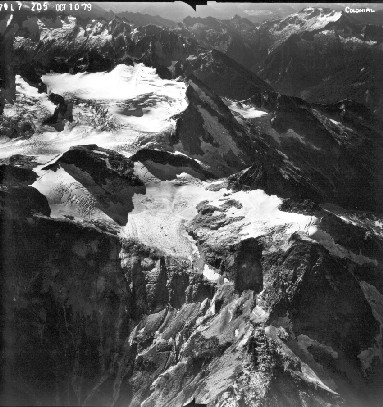
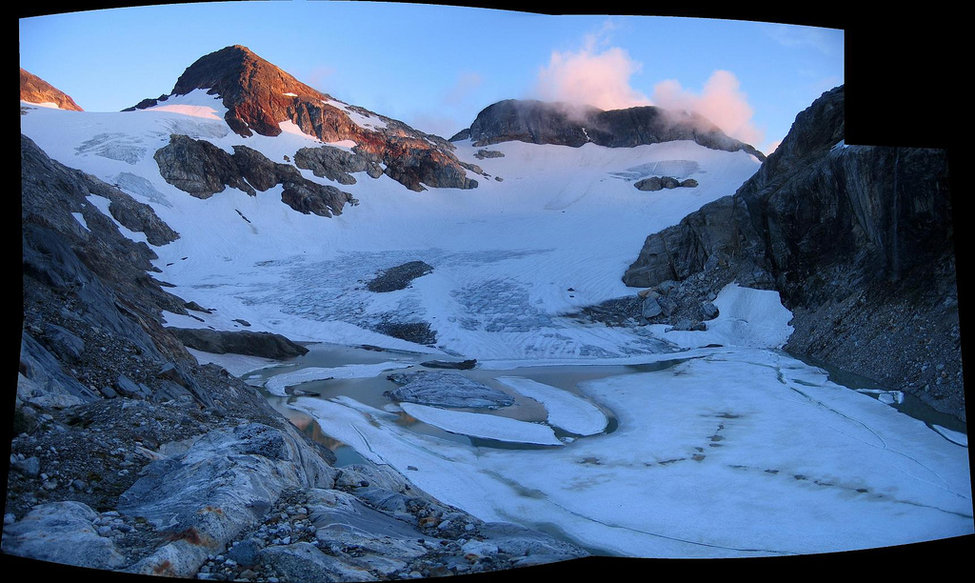
 By 1996 the lake was evident, and was 75 meters long. In 2001 the lake had expanded to a length of 125 meters. By 2006 the lake was 215 m in length, and had some thin icebergs broken off from the glacier front. Runoff to the Skagit River is impacted directly by the climate change and the resultant retreat of the glaciers. Three notable changes in North Cascade streamflow have occurred.
1) Alpine runoff throughout the North Cascades is increasing in the winter (Nov.-Mar.), as more frequent rain on snow events enhance melting and reduce snow storage Streamflow has risen 18% in Newhalem Creek and 19% in Thunder Creek despite only a slight decrease, 1% in winter precipitation at Diablo Dam, within 5 km of both basins. These basins are on either side of Colonial Glacier.
2)Spring runoff (April-June) has increased in both basins by 5-10% due to earlier alpine snowpack melting.
3)Summer runoff has decreased markedly, 27%, in the non-glacier Newhalem basin with the earlier melt of reduced winter snowpack. In Thunder basin runoff has in contrast increased negligibly, 4%. The difference is accounted for in part by enhanced glacier melting. The observed net loss of -0.52 meters per year in glacier mass spread over the melt season is equivalent to 2.45 cubic meters per second in Thunder Basin, 10% of the mean summer streamflow. This trend of enhanced summer streamflow by reduction in glacier volume will not continue as the extent of glaciers continues to decline.
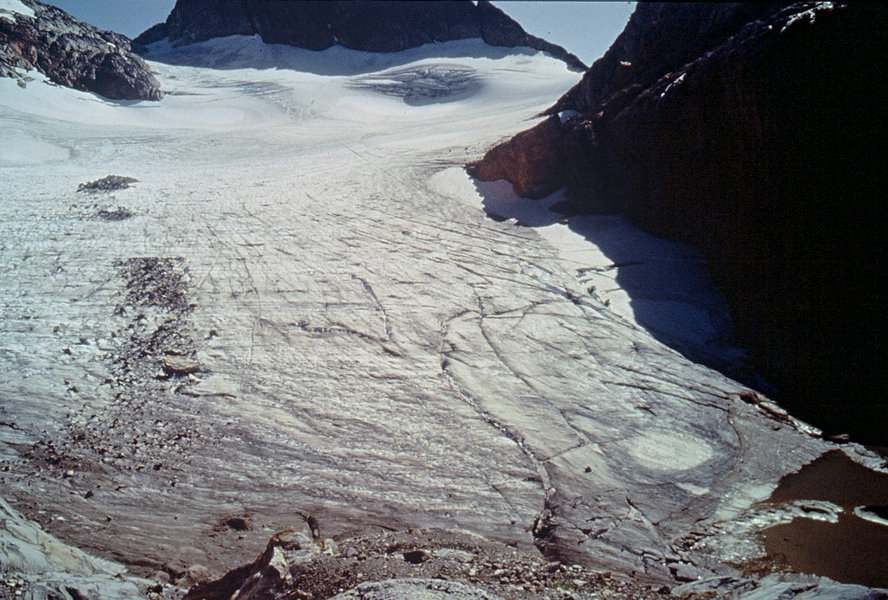 The lower portion of Colonial Glacier is not moving. GPS readings on both rockpiles on the lower glacier indicated no movement from 1996-2006. In the picture above the lake is still small in 1996, lower right corner and the lower rock pile distant from the terminus. The first two images below are from 2006, the lower rock pile is near the terminus and the last image is 2007 the lake has expanded back to the lower rockpile. Additional rock outcrops have appeared in the midst of the upper glacier that were not present in 1991, indicating this glacier does not have a persistent accumulation zone and will not survive current climate.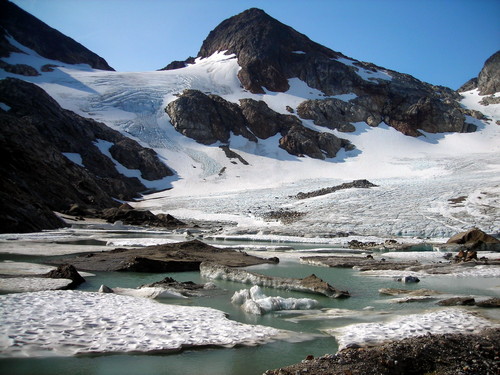

Gangotri Glacier Retreat Continues 2013 and Hydropower
In India the Gangotri Glacier is the largest glacier at the headwaters of the Bhagirathi River. The false-color image below provided by NASA shows the retreat of Gangotri Glacier, situated in the Uttarkashi District of Garhwal Himalaya. It is one of the larger glaciers in the Himalaya, and like all of the nearby Himalayan glaciers is retreating significantly. 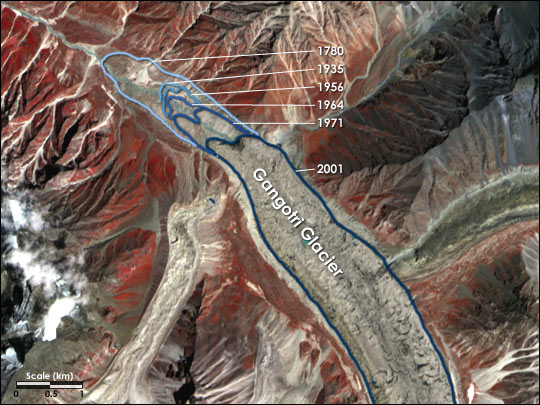 The Bharigrathi River has the Tehri Dam, a 2400 mw hydropower facility. With an area of 286 square kilometers Gangotri Glacier (Singh and others, 2006) provides up to 190 cubic meters per second of runoff for this river. Gangotri Glacier provides hydropower as it passes three hydropower plants generating 1430 MW, including the 1000 MW Tehri Dam and reservoir and maneri Bhali I and II, see map below. The Tehri also provides flood control, such as this past week of June 17, 2013. The Tehri Reservoir level rose 25 m within 48 hours which is a storage of approximately 1.3 billion cubic meters. Below is a view of the Tehri Reservoir, images of the dam and its operations are here.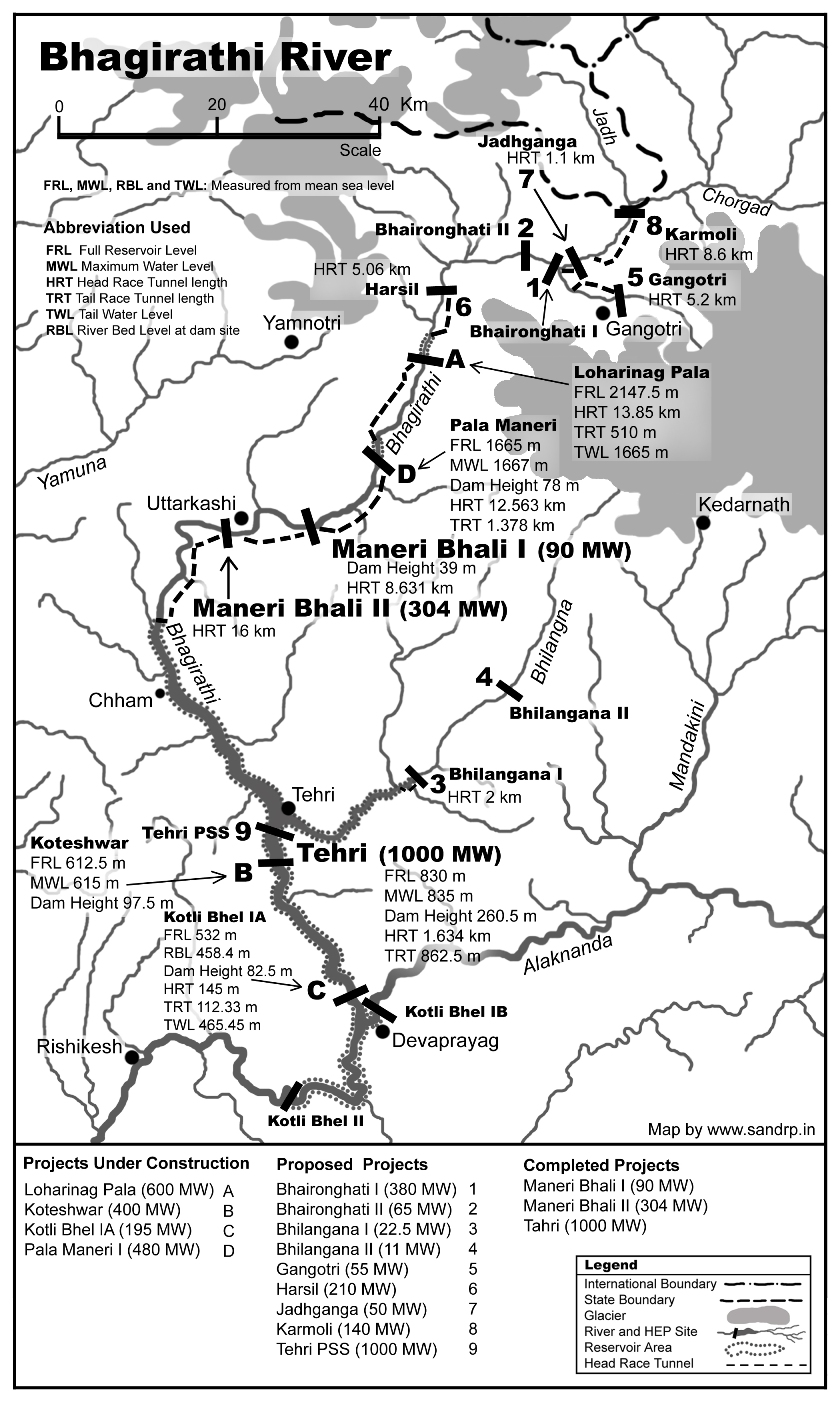
Map from the Southeast Asian Network on Dams, Rivers and People
 Gangotri Glacier retreated 26.5 meters per year form 1935-1971. From 1968-2006 the glacier retreated 800 meters, close to 20 meters per year (Bhambri et al, 2012). Srivastava et al (2013) indicate the retreat rate of 21 m/ year from 2004-2010. The glacier continues to thin and tributary inflow decline, while the thick heavily insulated by debris terminus retreat is slow. Srivastava (2012) published a report with numerous terminus pictures though they do not have a common reference point beginning on page 90. Where the river exits the glacier is referred to as Gomukh.
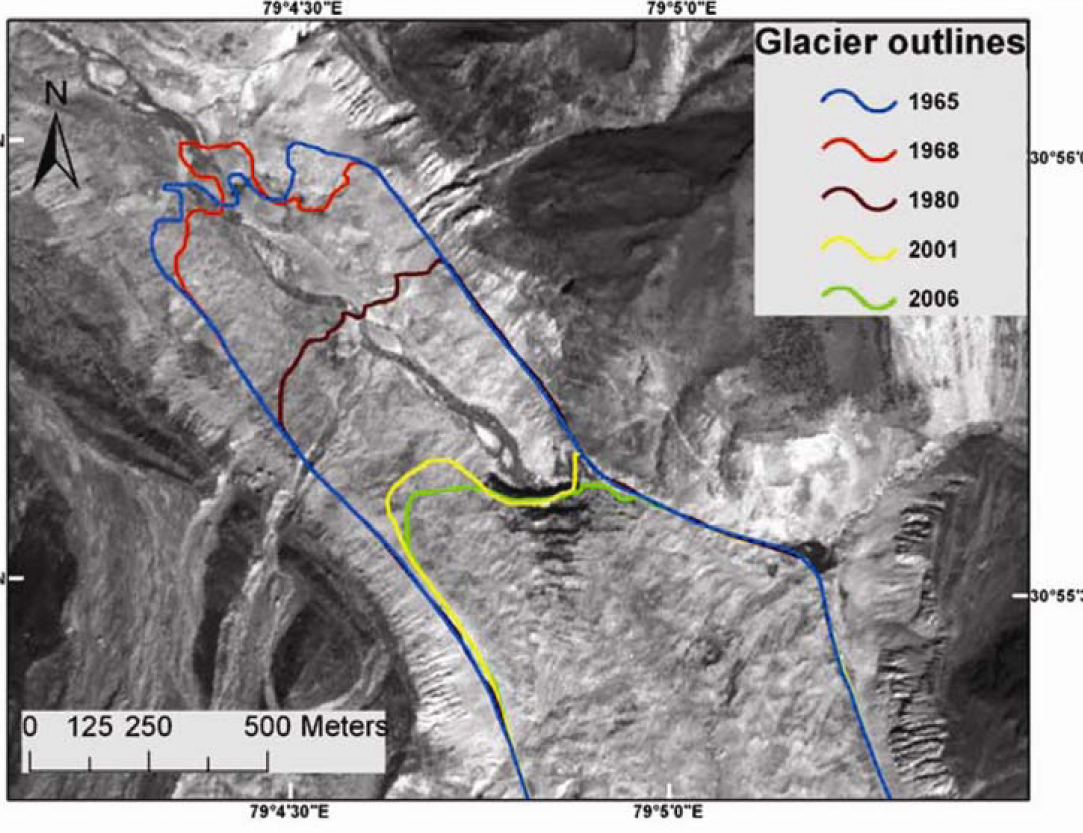
Here we compare both Landsat and Google Earth images during the 2000-2013 period. First the 2000 and 2013 Landsat images. A 2000 and 2013 landsat image pinpoint the terminus change, the yellow and red arrows converge on the 2000 location of Gomukh. The blue arrow indicates the mouth of a side valley from the east that is at the terminus in 2013 and actively cutting the face, which is not the case in 2000. The orange dots indicate the course of this stream. A 2006 Cartosat image from Bhambri et al (2012) can be compared to the 2010 and 2013 Google Earth images. In Google Earth the 2010 image gives a clear view of Gomukh which can be compared to the 2006 Cartosat image from Bhambri et al (2012). In 2000 and even 2006 this was not the case. A 2013 Google earth also indicates this point,with the glacier having retreated to the side valley from the east. The retreat from the location of Gomukh in 2000 to 2013 is 240-270 m, approximately 20 m per year as noted by Srivastava et al (2013) for a shorter interval.

2000 Landsat image
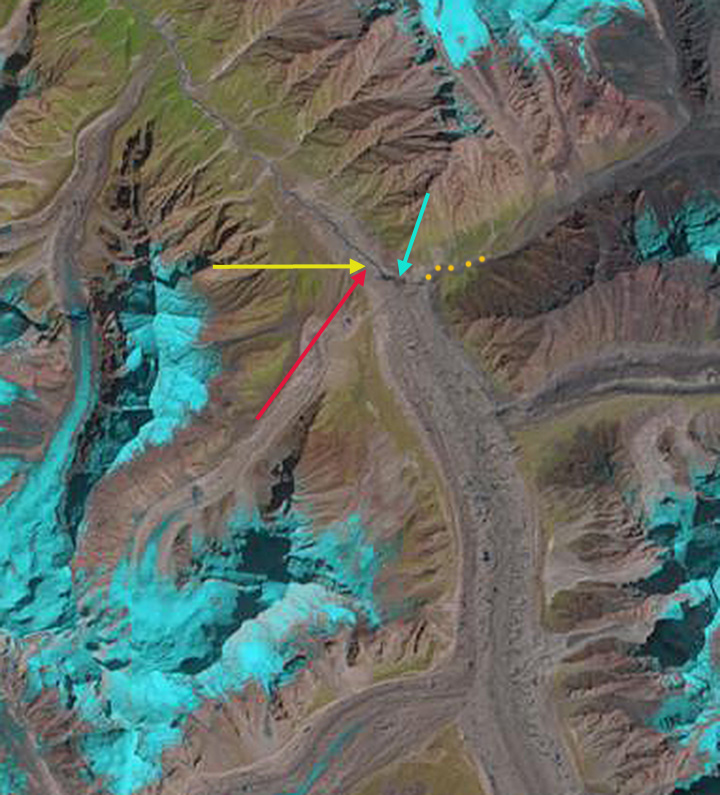
2013 Landsat image
 .
.
2006 Cartosat image
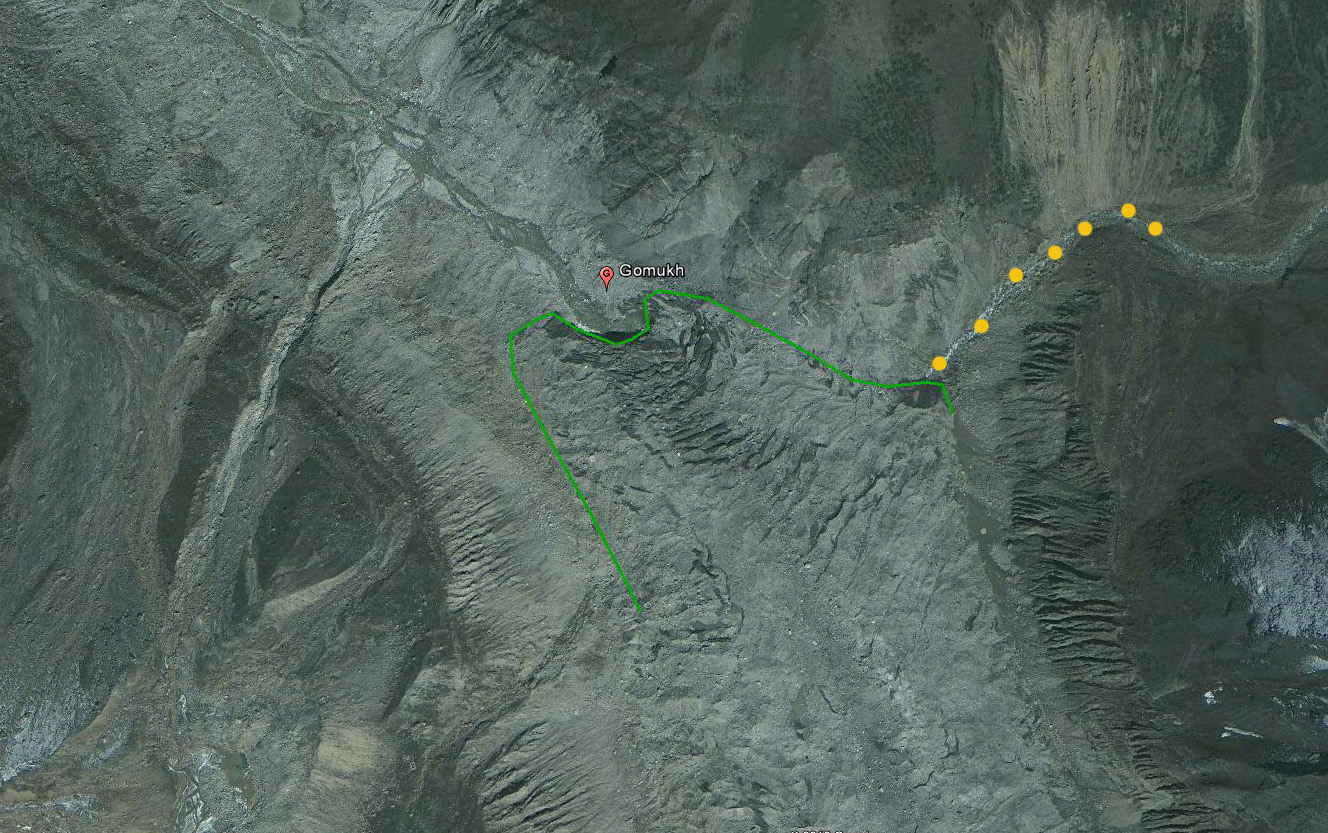
2010 Google Earth image

2013 Google Earth image

2013 Google Earth image
This glaciers remains over 30 km long, and is not in danger of disappearing anytime soon. The lower section of the glacier is heavily debris covered, which slows melting. The debris cover prevents black carbon-soot from enhancing melt over most of the ablation zone. The upper reaches of the glacier extends above 6000 meters and remains snow covered even during the summer melt season June-August, as this is also a main accumulation season due to the summer monsoon. This is different from other alpine regions, where the melt season is also the dry season, here it coincides with the wet season and the accumulation season on the upper glacier. Compare the differences in hydrographs from Thayyen and Gergen (2009) Figure 3 and 4. The new snowcover on the upper glacier also limits the impact of black carbon or soot on ablation. The glacier is fed from avalanches off of the even larger area of mountains above 6000 meters adjacent to it. This is one of many glacier in the Himalaya that is being tapped for hydropower. The retreat is slower than that of nearby Malana Glacier and Samudra Tupa Glacier but similar to Durung Drung Glacier. 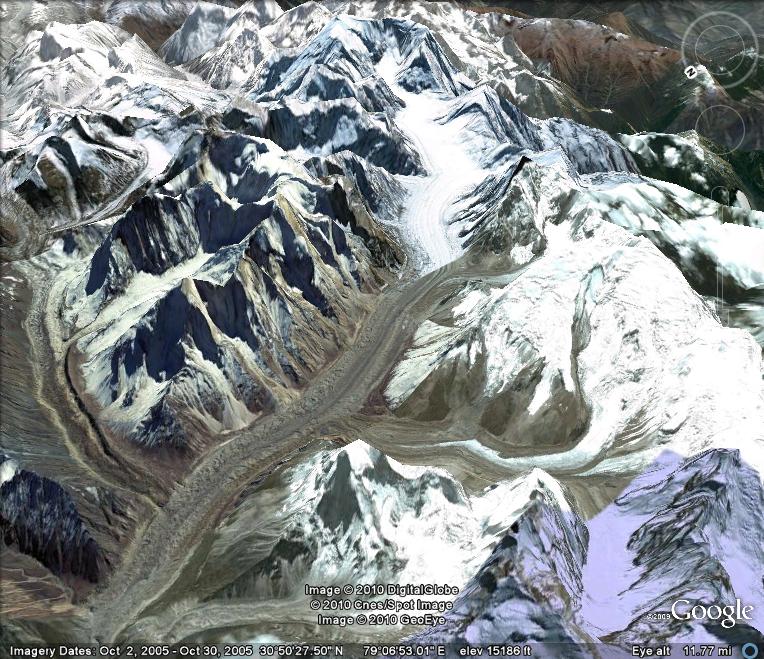
Forni Glacier, Italy Retreat
Forni Glacier is the largest valley glacier in Italy. It is currently 5 km long and has retreated 2.5 kilometers since its Little Ice Age Maximum. It is in the Cevedale Group, Alps and part of the Parco Nazionale dello Stelvio. In this image the Little Ice Age terminal moraine is the prominent sharp debris ridge in the foreground, twenty years ago the glacier descended beyond the bottom of the image. The Italian Glaciologic Commission has observed and reported its annual terminus change over the last 30 years to the World Glacier Monitoring Service. The glacier began a sustained retreat in 1988, after advancing a small distance in the 1970-1987 period. As reported by the IGC to the WGMS from 1990-1995 Forni Glacier retreated 290 m, between 1995 and 2000 130 m, and from 2000-2005 115 m. Using IKONOS (Bellingeri and Zini, 2006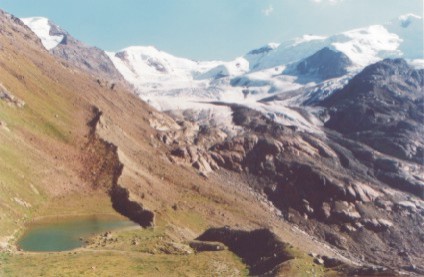 stereoscopic high resolution imagery linear retreat of the glaciers tongue was established as 520 meters for Forni Glacier in the 1981-2003 period. The glacier was found to have lost an average of 15 m in thickness in this period, 60 m near the terminus. The glacier as seen below above the key icefalls has a substantial consistent accumulation zone. It is the terminus tongue below the icefall that is at risk with current climate.
  A close up view of the terminus illustrates the region that has been deglaciated in the last 20 years, there is virtually no green vegetation evident in this region. The lower section of the glacier is rapidly downwasting still.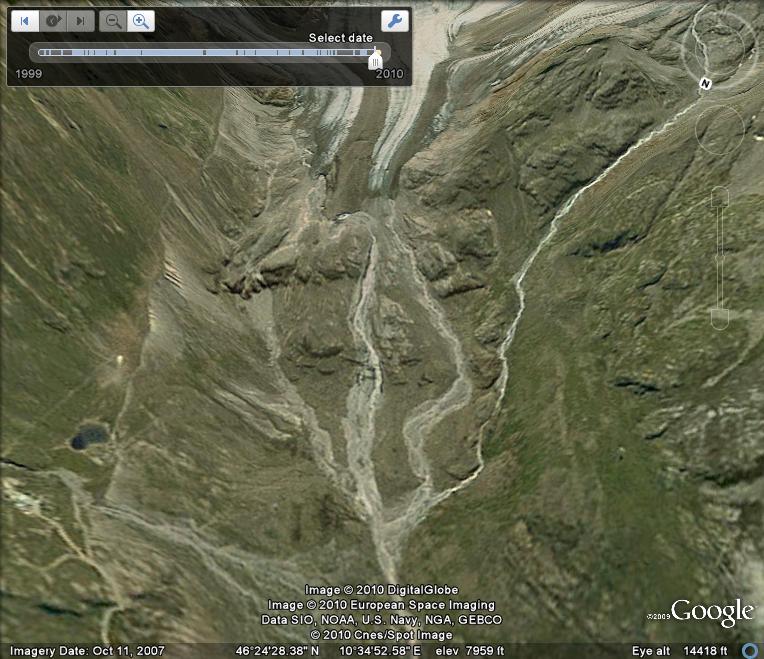
Boulder Glacier Retreat, Mount Baker
Boulder Glacier flows down the west side of Mount Baker a strato volcano in the North Cascades of Washington. This steep glacier responds quickly to climate change and after retreating more than 2 kilometers from its Little Ice Age Maximum, it began to advance in the 1950’s as observed by William Long. The glacier advance had ceased by 1979. From 1988-2008 we (NCGCP) have visited this glacier at least every five years recording its changes. In 1988 the glacier had retreated only 25 meters from its furthest advance of the 1950-1979 period. By 1993 the glacier had retreated 100 m from this position. At this time the lower 500 meters of the glacier was clearly stagnant. By 2003 the glacier had retreated an additional 300 m. In 2008 the glacier had retreated 490 meters from its 1980 advance position, a rate of 16 meters per year. The glacier as seen in 2008 despite the steep slope has few crevasses in the debris covered lower 400 meters of the glacier. This indicates this section of the glacier is stagnant and will continue to melt away. The transition to active ice in at the base of the icefall on the right-north side of the glacier. Below is the glacier in 1993 note the darkened cliff at adjacent to and right of the terminus. The picture below that is from 1998 again note cliff, than in 2003 from the same location as the 1993. Than an image from 2008 of the terminus from further upvalley, as it is not clearly in view from the previous location. And a picture from Asahel Curtis taken in 1908. This glacier after 25 years of retreat is still not approaching equilibrium and will continue to retreat. This is a reflection of continued negative mass balance as measured on the adjacent Easton Glacier. It does respond fast to climate change, and the climate has not been good for this glacier. The glacier does have a consistent accumulation zone and can survive current climate.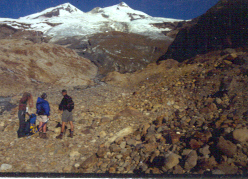 Picture from August, 1993 of the terminus of Boulder Glacier
 Picture from August 1998 of the terminus of Boulder Glacier
 Picture from August 2003 of the terminus of Boulder Glacier.
 Boulder Glacier in August 2008.
 Boulder Glacier in 1908 viewed across the glacier at the present terminus location during a Mountaineers trip taken by Asahel Curtis. A satellite image from 2009 (green=2009, brown=2006, purple=1993 yellow=1984), shows additional retreat now at 515 meters from 1984 to 2009, 20 meters per year. An examination of the same view of the terminus in 1993 and 2009 indicates the extent of the retreat and the reduction in crevassing below the icefall. (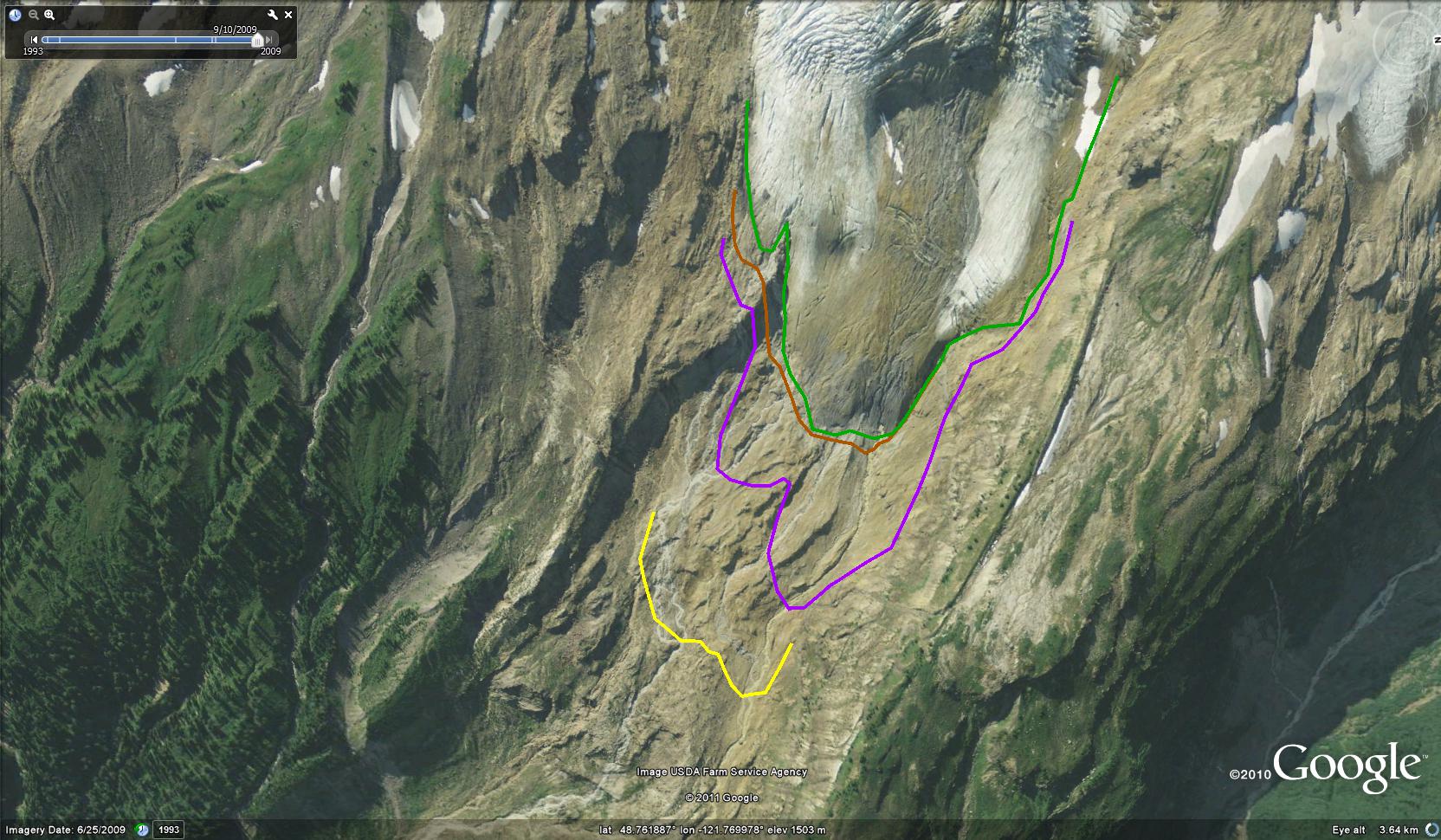
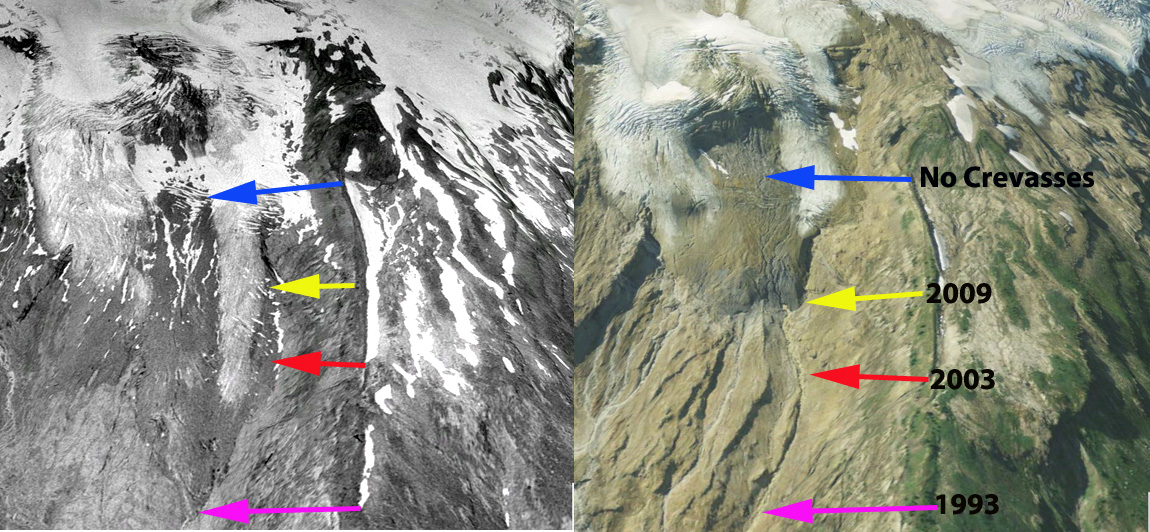
For 30 years the North Cascade Glacier Climate Project has focused on observing the response of glaciers to climate change.
Rembesdalsskaka, Norway Current Retreat
The Hardangerjøkulen Ice Cap is situated in southern Norway,150 km from the western coast. This elliptical shaped ice cap covers 73 square kilometers and ranges in altitude from 1020 to 1865 meters. It rises above the community of Finse offering access to snow year around. Norway has the most comprehensive glacier monitoring program in the world, mainly due to the heavy reliance on hydropower, for which glacier runoff is a key input. The Rembesdalsskaka drains west from the ice cap, the left side feeding the Rembesdalsvatnet Reservoir.  The research is led by the The Norwegian Water Resources and Energy Directorate (NVE). Statkraft runs the Sima power station that is fed from Rembesdalsvatnet Reservoir and the larger Sysenvatn fed by the southern glaciers of Hardanger. This system produces 620 Mw of hydropower. The largest glacier draining the western side of the ice cap is the Rembesdalsskaka with an area of 17 square kilometers. Since the LIA maximum Rembesdalsskaka has retreated almost two kilometres, The ice cap decreased in volume from the Little ice Age until 1917, followed by an increase in ice cap volume and glacial advance until 1928, . After this a period with high negative mass balances cause a rapid retreat of Hardangerjøkulen until 1950. Retreat continued until 1961, but the rate declined. From 1961 to 1995 mass balances increased, with the highest balances in the late 1980’s and early 1990’s. This resulted in an advance of Rembesdalsskaka. Since the early 1990’s mass balance has been negative, with exceptionally negative years in. This has led to the retreat of the Rembesdalsskaka each year from 2000-2009 a total of 307 meters.
  The retreat is measured each year from a benchmark painted on rock beyond the terminus, reported to the NVE and then to the World Glacier Monitoring Service. In 2009 the NVE reported 19 glaciers retreated, 3 were stationary and one advanced.
Anderson Glacier Retreat, Middle section exposed
Anderson Glacier is the headwaters of the Quinault River in the Olympic Mountains of Washington. A century ago the glacier was 2 km long, and a half kilometer wide. Retreat of this glacier in the first half of the 20th century exposed a new alpine lake, as the glacier retreated 1 kilometer. From 1950-1980 the glacier diminished slowly. From 1959 to 1990 the glacier thinned and retreated from the lake trapped behind the Little Ice Age moraine. The picture below was given to me by Austin Post. 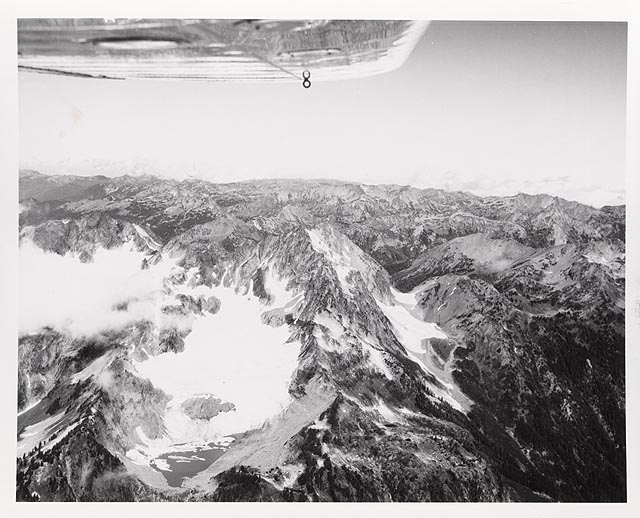 Since 1990 the glacier has begun to shrink rapidly. The USGS aerial photograph of the glacier is from 1990, Anderson Glacier is on the right, West Glacier is to the left.
 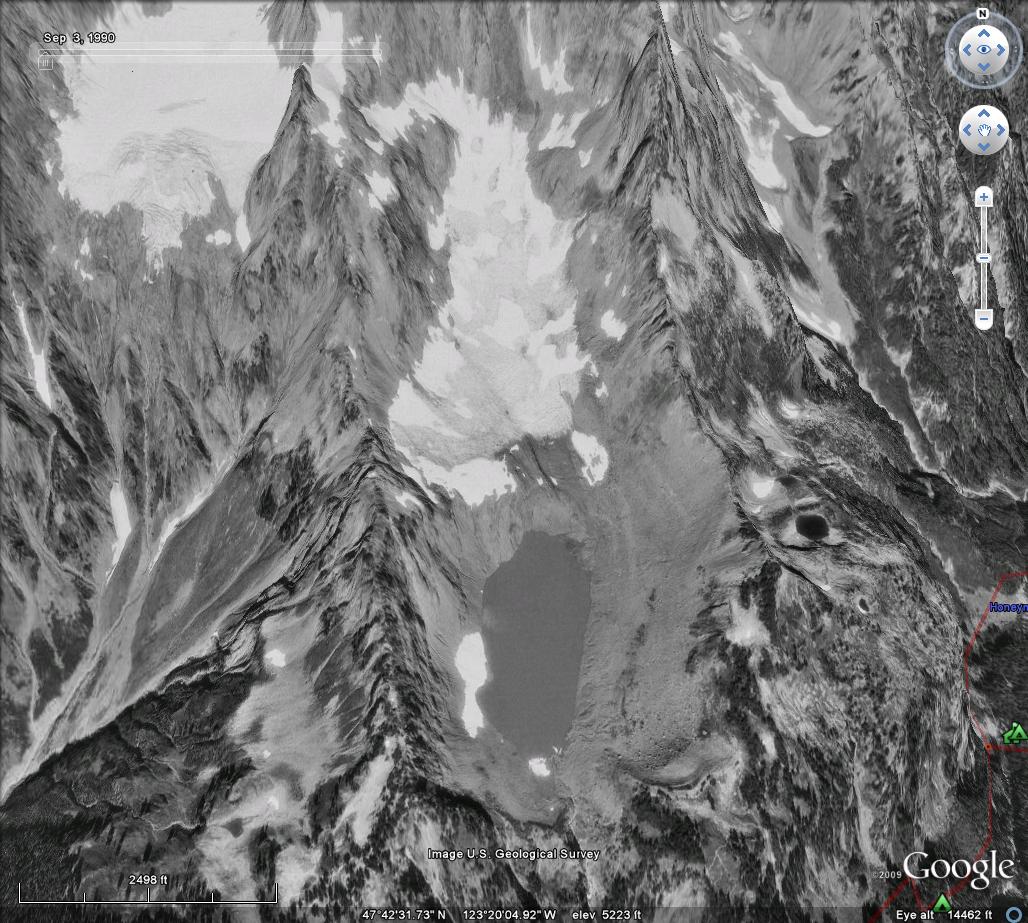 Investigating this glacier in 1992 we measured its area at 0.38 square kilometers, down from 1.15 square kilometers a century before. Ten years later the glacier had diminished to 0.30 square kilometers, but had thinned even more, leaving it poised for a spectacular change, over the next five years. Large outcrops of rock have appeared beginning in 2003 and further exposed in 2005 and 2009 in the middle of the glacier. Note the outcrops in this 2007 image from Kathy Chrestensen
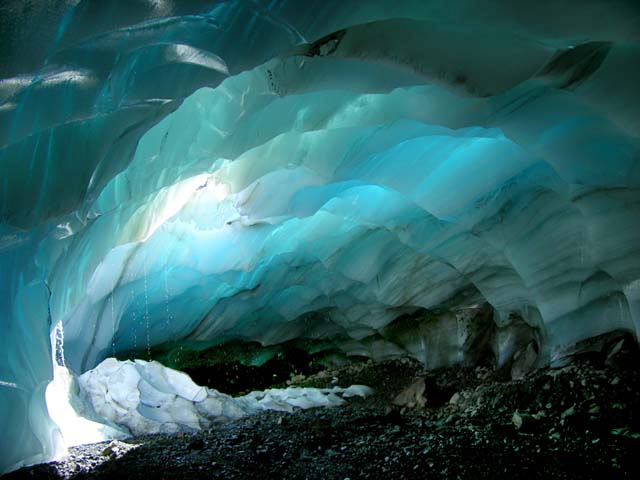
  The end of the glacier is an avalanche runout area and is thinning slower than most of the lower reach of the glacier. This glacier has become a series of small disconnected relict glacier ice patches. There are some large ice caves that have developed under the glacier. This is an indication of limited flow, and stagnant melting ice.
  Anderson Glacier is not the only glacier feeding the Quinault River, all the others are retreating as well. The result of glacier retreat is reduced late summer and early fall streamflow, impacting salmon runs at that time of the year. This is primarily the fall Coho, Chum and Chinook salmon and Steelhead summer run. During the spring and early summer runoff increases as snowmelt still occurs, but is not retained in the glacier system.
Zemestan Glacier, Afghanistan Retreats
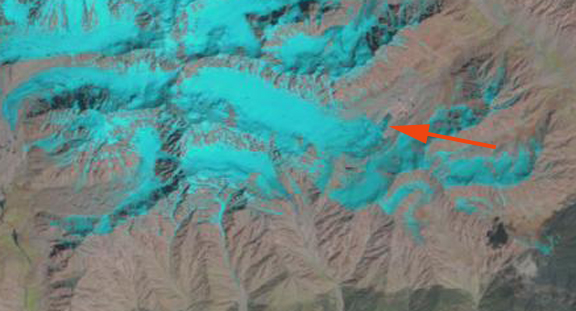
The Wakhan Corridor in Afghanistan is not easy to get to, as a result field study of its glaciers are quite limited. This is where the Global land ice Monitoring System (GLIMS) comes in. GLIMS acquires satellite imagery of glaciated areas, making these images available to researchers and processing them to an extent for inventory purposes. GLIMS is led by Jeff Kargel at the University of Arizona. In the Wakhan Corridor a group of glaciers was examined by Umesh Haritashya and others (2009). This recent GLIMS project examined ASTER and Landsat MSS data 1976–2003, in the Wakhan Corridor of Afghanistan. Of the 30 alpine glaciers of varying type, size and orientation examined 28 glacier-terminus positions have retreated, two have been stationary. 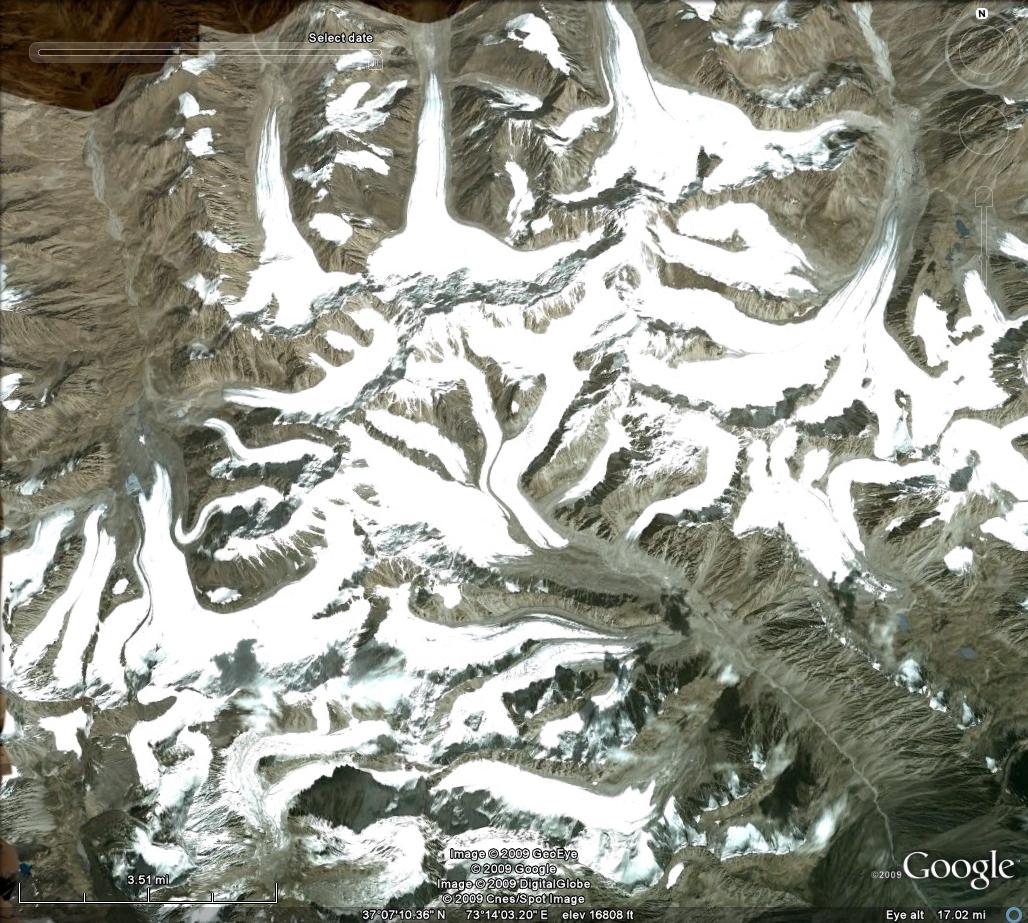 The largest average retreat rate was 36 m per year, and the average retreat was 11 m per year. The retreat is evident in a comparison of 1998 Landsat and 2010 Landsat images, note the orange arrow in both. The width and length of the terminus tongue has changed. One of the glacier examined was the Zemestan Glacier. This glacier is 5.3 kilometers long, has an area of 5.2 square kilometers, begins at 5640 meters and terminates at 4800 meters. It is one of many glacier in the Central area of the Wakhan Corridor. Zemestan Glacier has retreated at a rate of 17 meters per year over the study period, a total retreat of 460 meters, 9% of its total length. A comparison of 1998 and 2010 Landsat imagery indicates the retreat of the terminus tongue in width and length at the orange arrows.
 The glacier has remained snowcovered at its higher elevations at the end of the summer in recent satellite images.
  This indicates that with current climate the glacier does have a significant accumulation zone and can survive current climate. Continued warming will increase the retreat rate and could threaten its survival. The glacier feeds the Pamir River which in turn drains into the Panj River, to the Amu Darya River and then the Aral Sea. The terminus is on a shallow slope lacks a steep slope and is not extensively crevassed. All of these factors indicate retreat will continue. The glacier has little debris cover unlike many glaciers in the Karakoram-Himalaya-Pamir Ranges such as the Khumbu Glacier or the Zemu Glacier
Helm Glacier Melting Away-2014 Video Update
It is clear that the business model for glaciers in our current climate is not working. The Helm Glacier in the Coast Mountains of southwest British Columbia is an example of this. Helm Glacier has been the focus of annual mass balance surveys since 1967. During the 1984-2013 period its mass balance losses have been the greatest of any of the 16 glaciers monitored in North America. The mass balance loss has been about 32 m of water equivalent, about 35 m of ice thickness lost. This is less than losses on other nearby glaciers like Spearhead Glacier but more than others such as Warren Glacier. The regional volume loss has impacted even the large glaciers Bridge Glacier and small glaciers. The loss is more than 30% of the Helm lost in just 25 years, and the trend mirrors that of all glaciers in the Pacific Northwest. Helm Glacier also fits into the pattern of glacier retreat across Canada, Canadian Glacier Retreat index.  The glacier had an area of 4.3 square kilometers in 1928. Today the area has declined by 78% to 0.92 square kilometers. In 1928 the glacier is not too distant from its Little Ice Age moraines. The trimlines of recently deglaciated terrain are clear. The glacier has two termini, one draining north and the other west. Today in the picture from Johannes Koch, there is a vast expanse of newly deglaciated terrain that as yet lacks significant vegetation. The western terminus is gone.
Remainder of post and updates moved to
Helm Glacier
Zongo Glacier retreat
Zongo Glacier, Bolivia extends 2.9 km down the south side of Huayna Potosi from 6000 m to 4900 m. Zongo Glacier is a small valley glacier located north-east of La Paz, and its runoff is directed to an important hydraulic power station which supplies La Paz. Note Laguna Zongo in foreground of the first image. The dam is visible as is the power station to the right and below the lake. The glacier has considerable snowcover on its upper section and crevassing. This indicates a persistent accumulation zone.  In 1991 a glaciological research program (page 46) was established on Zongo Glacier to monitor mass balance, understand its hydrology and energy balance. The long term director of this research Bernard Francou has been called the glacier guardian. The typical Alpine glaciers undergoes a long accumulation period in winter and a short ablation season in summer. The glaciers of the tropical Andes experience snow accumulation during the wet season, austral summer on their upper regions and maximum ablation during the same season low on the glacier. In the dry season winter there is a period of low ablation over the whole glacier. Mean annual air temperature at the long term snowline at 5250 m is -1.5 °C. Mean precipitation is about 0.9 m/year.
Since 1991 the glacier has lost more than 5 m of thickness and has retreated significantly. The mass balance loss has been most pronounced during El Nino periods, thus 2009 should not be a good year for Zongo Glacier. La Nina’s are associated with positive or only slightly negative mass balance. The ongoing mass balance loss has led to retreat of 184 meters of this glacier from 1996-2005. A comparison of satellite images from 2004-2008 indicate a retreat of 70-75 meters, this is consistent with the reported retreat rate of 18 meters per year. The glacier has withdrawn from the new glacier lake formed from the ongoing glacier retreat in the 1990’s. The images below are focussed on the terminus in 2004 and in 2008, note the retreat from the lake shore. 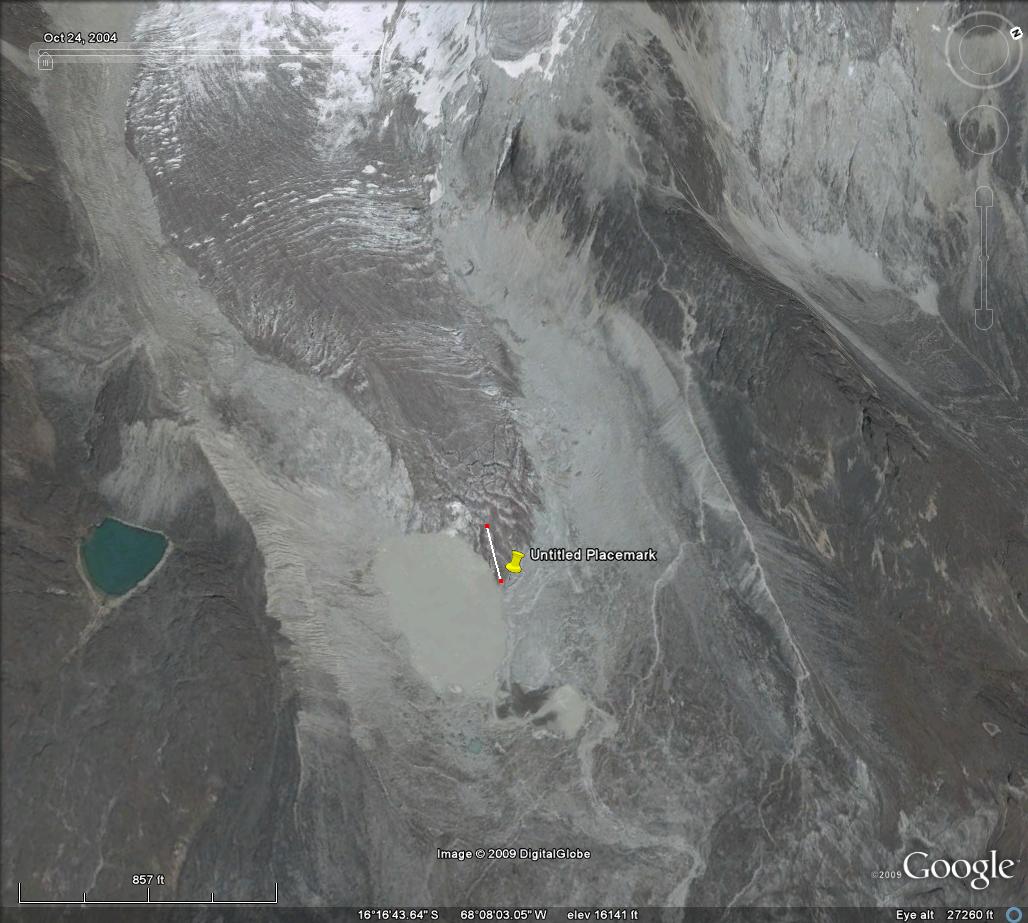

Zongo Glacier continues to have an accumulation zone, a necessary essential for glacier survival, and unlike the nearby Chacaltaya Glacier which has disappeared in 2009, it will exist for sometime. The Chacaltaya Glacier is a small glacier, like 80% of the glaciers in this region of the Cordillera Real, and its disappearance puts more pressure on the water resources provided by the larger remaining glaciers such as Zongo Glacier.
Khumbu Glacier Decay
The Khumbu Glacier is a large debris-covered glacier in the Khumbu region. It is one of the more famous and often visited Himalayan glaciers as it is the key route for climbing Mount Everest. About 12 km long, it drains mainly from the West Cwm between Mt. Everest and Lhotse and ranges in altitude from over 8000 meters to 4900 m. The equilibrium line separating the region where snow typically persists through the year is 5600 m. Melting is very limited above 5800 m. The famed Khumbu Icefall transitions the glacier from the accumulation zone to the ablation zone. The ablation zone is where melting dominates. Base camp for climbing expeditions is on a debris covered portion of the glacier below the Khumbu Icefall, Pumori Lake is about one mile away. The debris cover is brought down by avalanches and exposed at the surface via melting. In the lower picture it is evident that the lower 10 km of the glacier is dominantly debris covered. 
 The Kathmandu-based mountain research institute, ICIMOD, reports that the Khumbu Glacier is retreating at an average of 20m per year. The length of the glacier has shrunk from 12,040m in the 1960s to 11,100m in 2001. This 1 kilometer retreat has been consistently between 15 and 20 m per year during this interval. This retreat is less than nearby Ngozumpa Glacier and Imja Glacier. Everest Base Camp has actually dropped from 5,320m to 5,280m since Hillary and Tenzing first set up camp there more than fifty years ago. This 40 m of thinning at the base camp has occurred over this 55 year period. Base camp is on the right side of the glacier in this view notice the small colored blotches.
Measurements of velocity on the glacier by Nakawao and others (1999) noted that the Khumbu Glacier near the climbing base camp slowed by 10% between 1958 measurements and 1995 measurements. Kadota and others (2000) surveyed the Khumbu glacier in 1995 and compared the results with those of the 1978 survey. They found that the surface of the glacier lowered about 12-15 meters over most of the length but by only 6-8 meters near the terminus. A recent paper by Bolch et al (2008) compared a Corona DTM 1962 image and the ASTER DTM 2002 of Khumbu, Glacier. During this interval the Khumbu Glacier thinned in the ablation zone by an average of 17 m, This is a rate of 0.4 m/year.
Bolch et al. (2008).
Thinning at base camp of 40 meters is greater than at the terminus. The result is a reduced glacier slope. Reduced slope and thickness both lead to deceleration. The reduced thickness loss at the terminus is due to the debris cover thickness increasing towards the terminus. The same story is playing out on the Satopanth Glacier(Image from Jeff Engels)  Takeuchi and others (2000) noted that for Khumbu Glacier debris cover less than 5 cm increases ablation, debris greater than 5 cm in thickness reduces ablation. On Khumbu Glacier their ablation measurements indicate that ablation is reduced 40% from that of clean ice when the debris cover is 10 cm thick. Thicker debris cover reduced ablation even more, but only slightly. This is the primary reason why thinning has been less near the terminus.
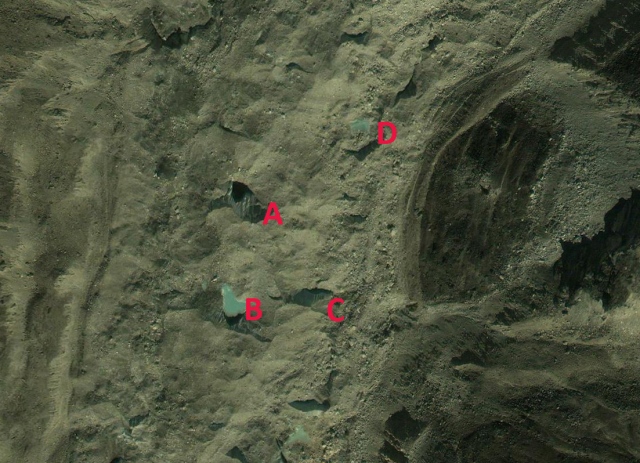
Naito et al. (2000) developed a model coupling mass balance and flow dynamics of debris covered glaciers and applied it to the Khumbu Glacier. The model predicts formation and enlargement of a depression in the lower ablation area about 5 km upstream of the terminus. This depression could transform into a glacier lake in future. Given the more rapid melting upglacier of the terminus and the low surface slope of this glacier, this is a reasonable result. The movement of the glacier can be tracked by examining the movement of supraglacial lakes downglacier. Below is 4 lakes denoted in a 2003 and 2009 image, the mean movement has been 120 m, 20 meters/year. 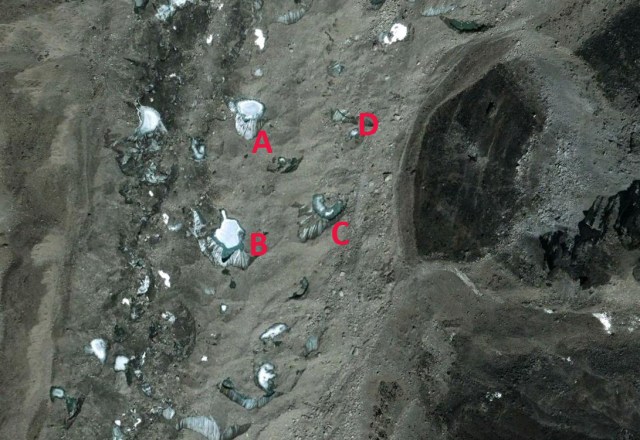
Given the slow rate of retreat and the 3000 m of altitude range above the current snowline the Khumbu Glacier is not in danger of disappearing with current climate. The entire Western Cwm the flat cirque seen beneath Nuptse, Lhotse and Everest here is in the permanent snow zone above 6000 m. The icefall then descends to 5400 m. The terminus is at 4900 m. It is not difficult to imagine this lower section of the glacier below the icefall wasting away. It is likely that a substantial proglacial will develop as is occurring at Ngozumpa Glacier and has occurred at Imja Glacier. 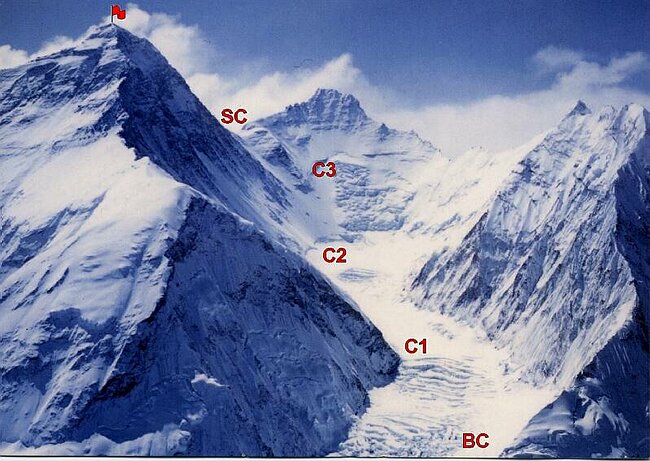

Kadota, T., K. Seko, T. Aoki, S. Iwata, and S. Yamaguchi. 2000.
Shrinkage of the Khumbu Glacier, east Nepal from 1978 to
1995. IAHS Publ. 264 (Symposium at Seattle 2000 – Debris-
Covered Glaciers), 235–243.
Naito, N., M. Nakawo, T. Kadota and C.F. Raymond. 2000.
Numerical simulation of recent shrinkage of Khumbu Glacier,
Nepal Himalayas. IAHS Publ. 264 (Symposium at Seattle 2000 –
Debris-Covered Glaciers), 245–254.
Nakawo, M., H. Yabuki and A. Sakai. 1999. Characteristics of
Khumbu Glacier, Nepal Himalaya: recent changes in the debriscovered
area. Ann. Glaciol., 28, 118–122.

