Midui Glacier, Tibet, China: Retreat and Terminus Collapse 1995-2014

Midui Glacier is 7 km from the G318 National Highway in China and 2 km from Midui village, hence the lake near the terminus is often visited. The glacier is near the headwaters of Yarlung Tsangpo. Glaciers in this region have experienced significant retreat and area loss as noted by the second China Glacier inventory. This compared glacier area from the 1950’s, 2002 and 2010, Liu et al (2013) noted that glacier area has declined 13%. The Midui Glacier was advancing as recently as 1964 when it emplaced an advance moraine (Xu et al, 2012).  This is a region where Li et al (2011) noted that increasing temperature, especially at altitude, the fronts of 32 glaciers have retreated, mass losses of 10 glaciers have been considerable, glacial lakes in six regions have expanded and melt water discharge of four basins has also increased. This is further documented by an inventory of 308 glaciers in the Nam Co Basin, Tibet, where an increased loss of area for the 2001-2009 period, 6% area loss (Bolch et al., 2010) was observed. The nearby Yemayundrung Glacier retreat is similar. Here we examine changes in this glacier using Landsat imagery and Google Earth from 1995-2014.
midui glacier 1995
1995 Landsat image

midui glacier 2014 landsat
2014 Landsat image

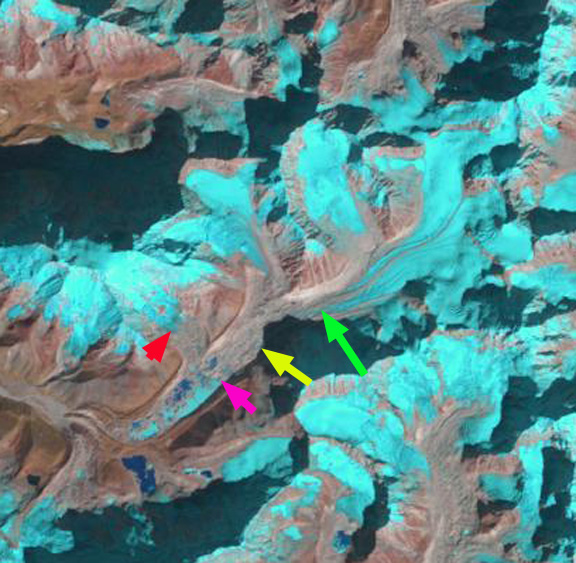
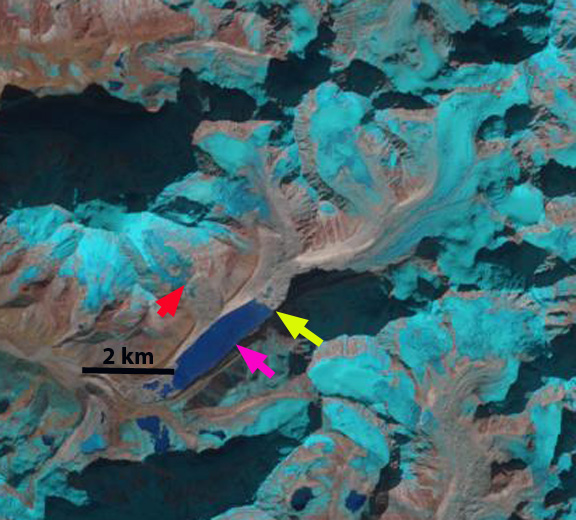
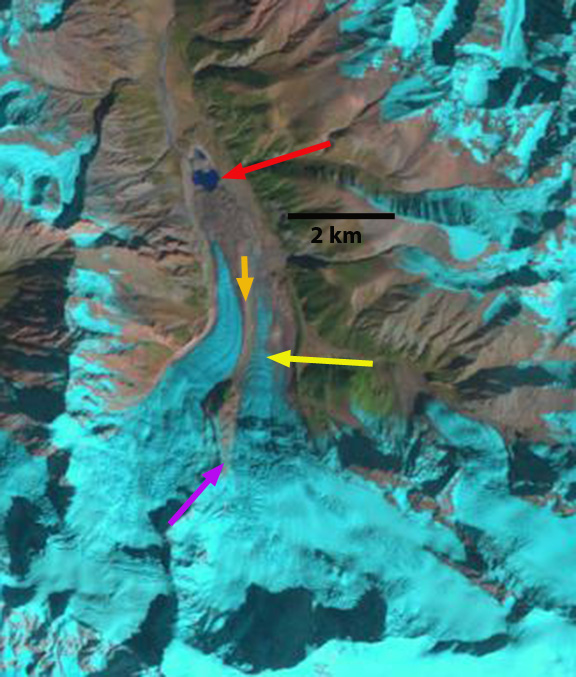
In the Landsat images above in 1995 the glacier terminates in a proglacial lake at the red arrow. A ridge separates two tributaries each with an icefall creating ogives, purple arrow. There are ogives below a pair of icefalls at the yellow arrow. The tributaries are separated by a medial moraine orange arrow. By 2014 retreat has led to expansion of the lake at the terminus. The retreat is 300 meters during this 20 year period. The icefall on the right, east side of the glacier, is no longer producing significant ogives and the bare glacier ice has been replaced with extensive debris cover, yellow arrow. Both the ridge and medial moraine separating the tributaries have expanded in width as the glacier has thinned.

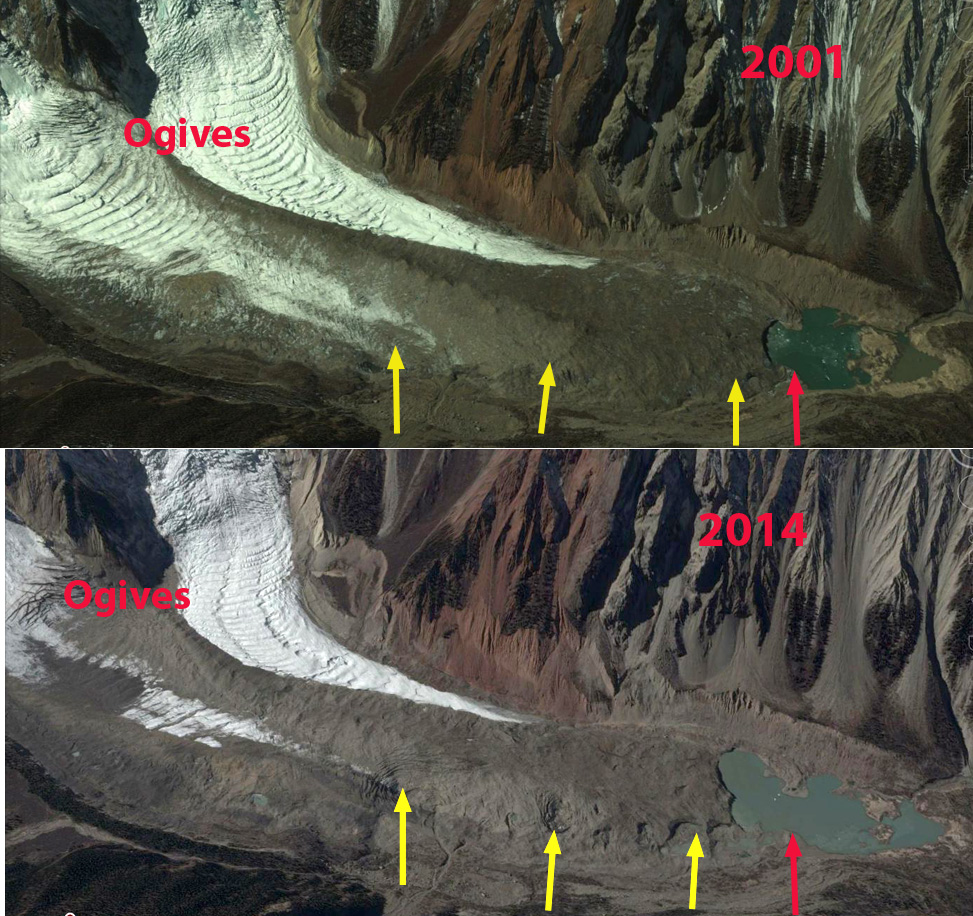
A series of comparison images from Google Earth in 2001 and 2014 further illustrate the changes noted above.

In the first pair the terminus change and lake expansion is evident at the red arrow. Debris cover expansion at the lateral moraine area with thinning of the eastern tributary is notable at the yellow arrow.

The second pair is the terminus reach. A series of depressions are noted with each yellow arrow, indicated by concentric crevassing. This indicates collapse due to a subglacial basin/lake. Further this indicates a stagnant collapsing terminus area in the lower 1.5 km of the glacier.

The last pair is the icefall region indicating reduced crevassing below the lefthand icefall, pink arrow and the expanding medial moraine yellow arrow. It is clear that this glacier is going to continue to retreat in the coming decades, and the rate is going to increase in the near future as the collapsing sections of the terminus melt away. There is still considerable glacier area that remains snowcovered each year, and it can survive current climate and some additional warming. The snowline on the glacier is at 5000-5100 m and the head of the glacier is at 6100 m.
midui glacier comp
Midui Glacier comparison from Google Earth
midui terminus comp
Midui Terminus comparison from Google Earth

midui icefall
Midui Icefall comparison from Google Earth

Menlung Glacier Rapid Retreat & Lake Expansion, Tibet, China 1992-2014

Menlung Glacier is one valley north of the China/Tibet border with Nepal and on the south side of Menlungste Peak. Menlung Glacier has a glacier lake at its terminus that is dammed by the glacier’s moraine. The glacier began to withdraw from the moraine and the lake began to develop after the 1951 expedition to the area. The glacier lake is at 5050 meters, the glacier descends from 7000 meters with the snowline recently around 5500 meters. The lower section of the glacier is heavily debris covered, which when the debris is more than several centimeters thick as in most areas here, reduces the rate of glacier melt. Melt is highest around the supraglacial lakes (shallow lakes on glacier surface), which can lead to the lakes expanding and coalescing. Benn (2001) examined the process on nearby Ngozumpa Glacier, Nepal. This region has experienced significant mass loss of -0.25 m/year from 2000-2010 (Gardelle et al, 2013). The Japanese Aerospace Exploration Agency has a side by side 1996 and 2007 satellite imagery that indicates the Menlung Glacier Lake developing in 1996 that still has remnant glacier ice in it, that is melted by 2007. Here we use Landsat imagery and Google Earth imagery to identify the changes from 1992-2014.

menlung glacier 1992
1992 Landsat image: In each image the pink arrow is the 1992 terminus, the yellow arrow the 2014 terminus, the green arrow the furthest downglacier extend of clean glacier ice and the red arrow the lower margin of a tributary glacier in 2014.

In Landsat imagery from 1992 the lake is still developing from a system of supraglacial lakes interspersed with debris covered stagnant glacier sections. In 1994 there is little change, other than some of the lakes are frozen. In 2001 a contiguous lake has formed that is 500 m long and 600 m wide, though the main glacier front has changed little. The lake rapidly expanded to a length of 1900 meters by 2009. The glacier retreat is 500 meters, the other 300 meters of lake expansion is a continued growth at the moraine end of the lake as ice cored moraine continues to melt. By 2013 the lake has extended to a length of 2250 m, due solely to further glacier retreat. In 2014 has experienced a further 50-100 m of retreat from 2013. The lake is now 2300 m long, and is turning a darker blue color as the amount of glacier flour in it diminishes. A comparison of the terminus and lake using Google Earth images from 2005 and 2014 indicate the rapid lake growth in the last decade. The lower portion of the glacier remains debris covered, and appears stagnant, but has significant supraglacial lakes only with 400 meters of the 2014 terminus, suggesting the period of rapid retreat is nearly over. The region above the terminus in 2014 is dissected by a significant surface glacier stream that extends 2.5 km upglacier to the beginning of the first sections of debris free ice. That the river stays on the surface so long indicates the lack of crevassing and the stagnant nature of the ice. From 1992 to 2014 the area of clean glacier ice has also migrated 1 km upglacier, green arrows. The red arrows indicate a smaller glacier that has retreated further from the lake and has developed some substantial bedrock areas amidst the lower glacier between 1992 and 2014. The retreat and lake expansion parallels that seen at Longbasba, Reqiang, Sepu Kangri and Ngozumpa Glacier.

menlung glacier 1994
1994 Landsat image

menlung glacier 2001
2001 Landsat image

menlung glacier 2009
2009 Landsat image

menlung glacier 2013
2013 Landsat image

menlung glacier 2014
2014 Landsat image

menlung glacier compare
2005 and 2014 Google Earth image comparison
menlung terminus 2014
2014 Google Earth images. Black arrows indicate supraglacial stream.