Heat Wave Leads to Rapid Glacier Snowcover Loss in Alps

Grande Murailles Glacier, Italy (GM) in June Sentinel images. The yellow line is the glacier margin, the expansion of bare glacier ice from 1-3% of the glacier on June 10 to 20% of the glacier by June 18 is evident. The snowline is ~3200 m.

The heat wave during the last week that has impacted western Europe and the Alps has led to a predictable impact on glaciers (WMO, June 17, 2022). A month ago I focussed on the fact that heat waves and glaciers don’t usually go together; however, in the last several years an increasing number of heat waves have affected alpine glacier regions around the world (Pelto, 2022). In particular heat waves leave a greater portion of the glacier snow free, which enhances melting and mass balance losses. This is most pronounced when the heat wave occurs prior to or early in the melt season exposing bare glacier ice for a the bulk of the melt season.  Di Mauro and Fugazza (2022) identified an increasing melt season length and decreasing minimum albedo on glaciers in the Alp from 2000-2019, that does enhance melt. Here we utilize Sentinel 2 images from June 10 and June 18 to look at the rate of snowcover loss on three glaciers in the Alps.

On June 10 ~98% of Grande Murailles Glacier is snowcovered, 96% of Gries Glacier, and 100% of Sabbione Glacier is snowcovered. After eight days of unusual heat, the bare glacier ice regions have expanded notably, ~80% of Grande Murailles Glacier is snowcovered, 80% of Gries Glacier, and 65% of Sabbione Glacier remain snowcovered.  Grande Murailles Glacier drins west from Dent d”Herens just west of the Matterhorn. Sabbione Glacier feeds Lago del Sabbione a hydropower reservoir. Gries Glacier feeds Griessee a Hydropower reservoir. This rapid snowcover loss early in the summer is a particular issue given bare glacier ice melts ~50% faster than snowcover. This same scenario was observed last year in the Pacfic Northwest following a June Heat wave and in the Central Andes this summer 2022 after a January heat wave. In each case substantial mass balance losses occurred by summers end on these glaciers. This will continue to accelerate the fragmentation and loss of Sabbione Glaciers. This year the early season heat waves ability to strip snowcover from glaciers is enhanced by the limited snowpack that was received during the winter season that @VAW_glaciology has been reporting during spring monitoring of Swiss glaciers. This post will be updated on June 23 with additional images.

Gries Glacier, Switzerland (G) draining into the Griessee (Gs) in June 2022 Sentinel image. The terminus tongue, yellow arrow, extends below 2650 m to the terminus.


Sabbione Glacier, Italy (S) draining into Lago del Sabbione  (LS) in June 2022 Sentinel images. The west and south Sabbione Glacier are both entirely snowcovered on June 10. By June 18 most of the west Sabbione Glacier is bare glacier ice and 

Sabbione Glacier, Italy Retreat & Fragmentation

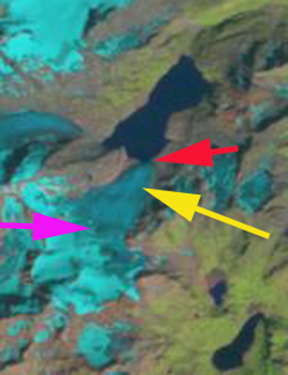
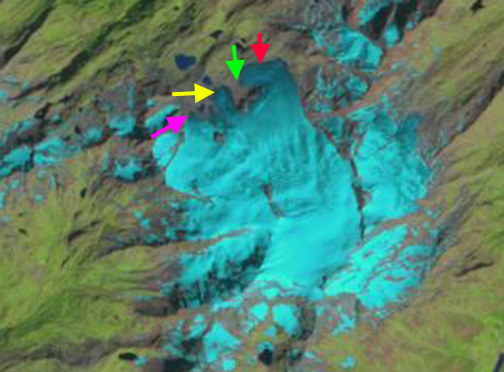
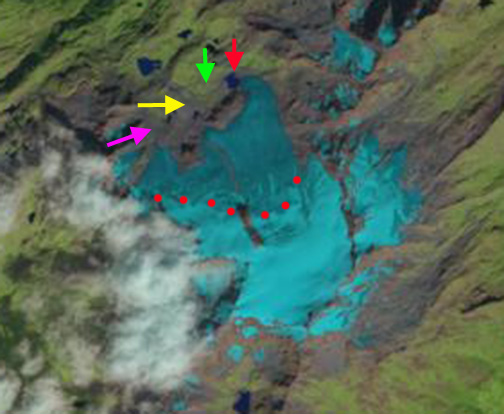
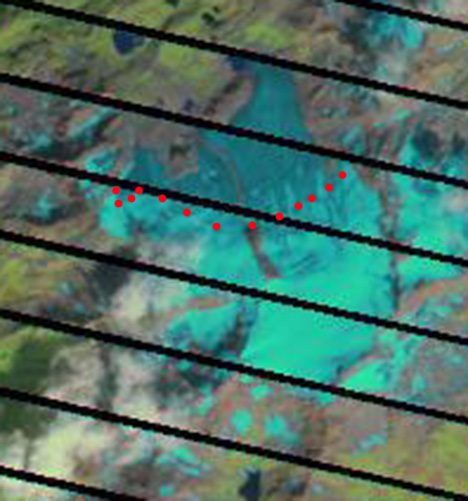
Sabbione Glacier in 1999, 2001 and 2016 Landsat images.  Red arrow is 1999 terminus location, red arrow the 2016 terminus location and the purple area new rock outcrops emerging in the midst of the glacier.

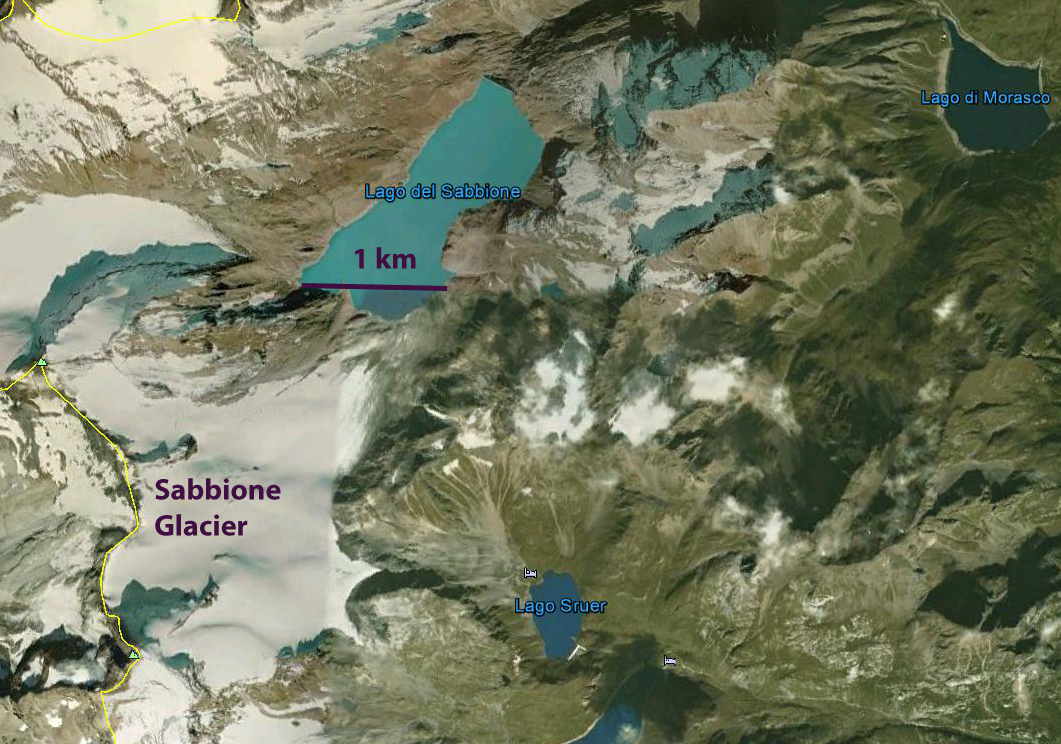
Sabbione Glacier is on the Swiss-Itlaian border.  The glacier drains into Lago Sabbione an artificial lake that in turn drains into Lago Morasco, which is a 29MW hydropower facility. The lake also has good fishing. This glacier in 1988 reached the shore of Lago Sabbione. Today glacier retreat has changed its nature dramatically.  It is not as close to disappearance as nearby Cavagnoli Glacier or Careser Glacier.  Huss and Fischer (2016) indicate that the majority of the small alpine glaciers, less than 0.5 square kilometers will disappear in the next 25 years.
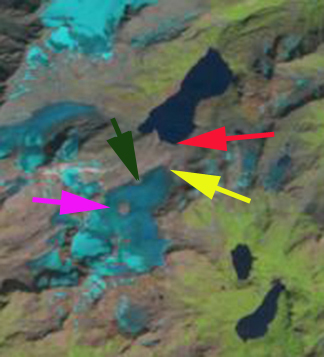
In a series of Landsat images from 1999, 2001 and 2016 and a picture from Lago Sabbione in 2007, the retreat from the lake is evident. The 1988 terminus in an image below is indicated by a red arrow, the 2010 terminus by a yellow arrow, the new outcrop in the midst of the glacier by a magenta arrow. The retreat from 1988 to 1999 is 240 m, there is no rock outcrops emerging in 1999 or 2001. The glacier is 2.5 km long beginning at 3200 m and terminating at 2550 m in 1999. By 2007 image below the rock outcrop has become apparent. By 2016 the glacier has retreated 950 m from the lake and 700 m since 1999 and is now less than 2 km long.  The outcrop in the glacier center is 200 m wide. Of greater concern for the future of the glacier than retreat is the emergence of rock outcrops in the midst of the middle portion of the glacier, and smaller ones on the upper glacier. In 2016 the glacier only has 15% snow cover in this late August image, much less than the 50-60% needed for equilibrium balance. This indicates a glacier that is not in equilibrium lacks a persistent accumulation zone, indicating it will not survive current climate  (Pelto, 2010). In the most recent survey published by the Italian Glacier Commission indicates all glaciers in this region of Italy retreated in 2015.

Google Earth image of Sabbione Glacier and Lago Sabbione.


1988 Landsat image of Sabbione Glacier

Vallelunga and Barbadorso Glacier Retreat, South Tyrol Italy

vallelunga compare

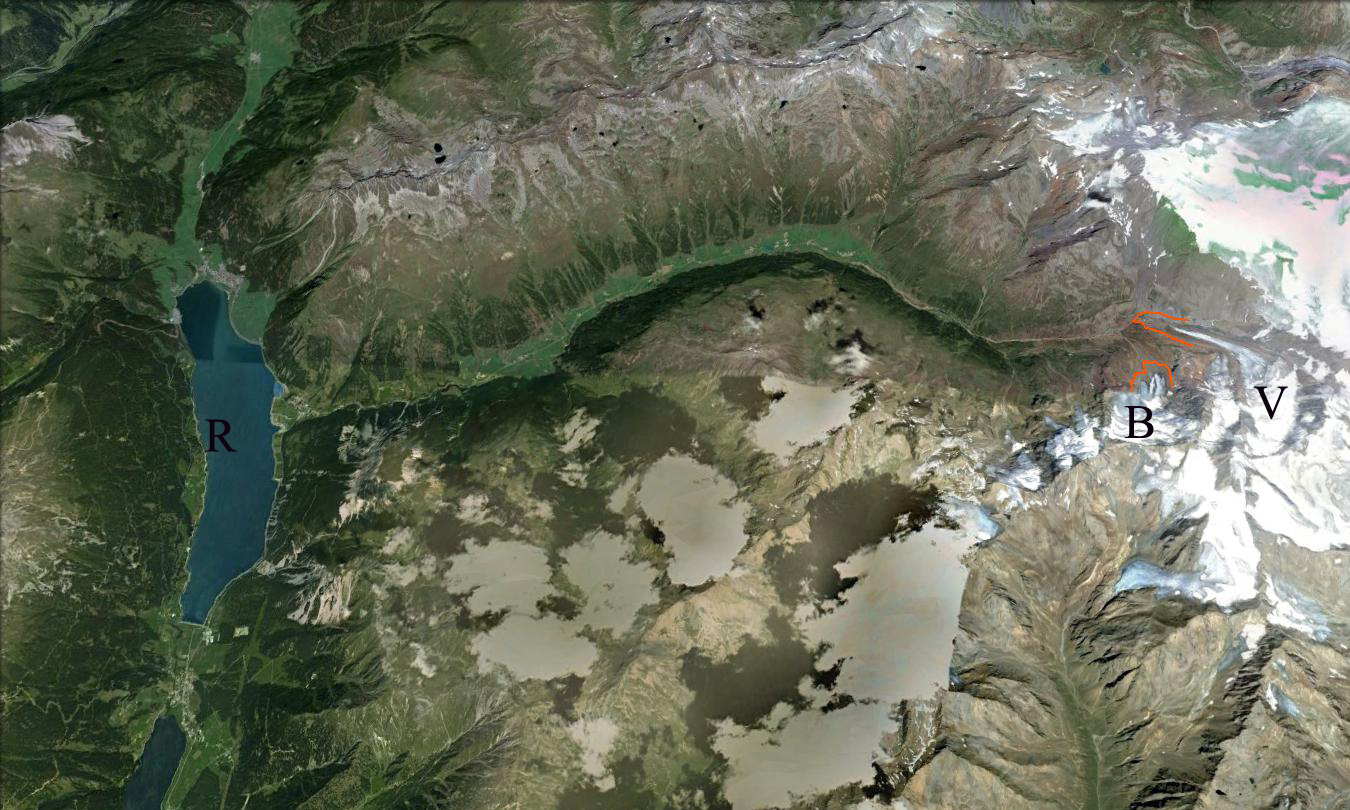
Vallelunga (above) and Barbadorso di Dentro Glacier (below) retreat from 2003 (orange line) to 2015 yellow dots.  Blue arrows indicate flow path and pink arrow the junction of main two tributaries of Vallelunga Glacier.

Vallelunga Glacier and Barbadorso di Dentro Glacier are at the headwaters of the Vallelunga watershed which feeds the Reschensee.  Reschensee is a reservoir famous for the church tower that emerges above its surface.  This artificial lake was completed after World War II and is the reservoir for the 105 MW Glurns Hydroproject owned by Seledison.  These two glaciers are examined as part of the annual campaign of the Italian Glacier Committee.  The annual reports for 2011-2013 indicate a retreat of 78 m for Vallelunga and 60 m for Barbadorso.  Here we examine Google Earth images from 2003 and 2015 to indicate the change in a twelve year period.

In 2003 Vallelunga Glacier terminus was at an altitude of 2500 m.  The glacier is comprised of two tributaries that join at the pink arrow. The orange line is the 2003 terminus location. By 2015 the smaller western tributary has nearly separated from the main glacier.  the terminus has retreated 460 m in the 12 year period. Barbadorso Glacier terminated at 2690 m in 2003.  By 2015 the terminus has retreated 250 m and terminates 100 m higher in elevation at nearly 2700 m. On July 31, 2015 the snowline on the two glaciers is at 3100-3200 m with 6-8 weeks left in the melt season.  This indicates another year of negative mass balance that will continue to drive retreat.

These glaciers are just across the border from Gespatcherferner one of the fastest retreating Austrian Glacier’s in recent years. Carturan et al (2016) examining long term Italian glacier mass balance series note the 2004-2013 period as particularly negative.  They further observe that this is mainly due to increased ablation and that annual balance is becoming more closely correlated with accumulation season (October-May) temperature suggesting warmer winters extending melt season and leading to an increased ratio of winter rain events. The continued reduction in glacier area reduces late summer water flow to the reservoir, which will either cause reduced power output or the need for more storage early in summer (Pelto, 2014).

reschensee ge

Vallelunga watershed feeding Reschensee (R).  Vallelunga Glacier (V) and Barbadorso Glacier (B).

vallelunga 2015 tsl

July 31, 2015 Landsat indicating a high snowline, purple dots, with nearly half the summer to go. 


Pré de Bar Glacier Retreat, Italy

pre de bar compare

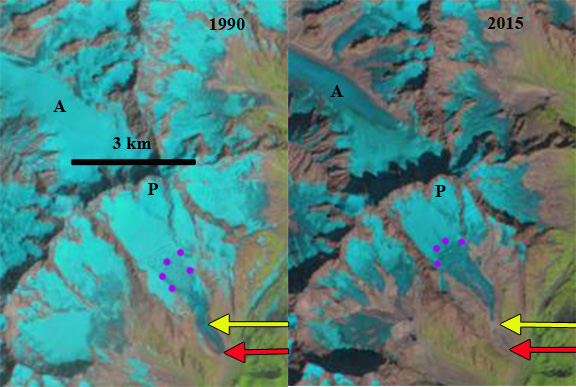
Landsat image comparison from 1990 and 2015 of the Pré de Bar Glacier (P).  The adjacent Argentiere Glacier (A) is shown, the red arrow is the 1990 terminus, the yellow arrow the 2015 terminus and the purple dots the snowline. Retreat from 1990 to 2015 was 

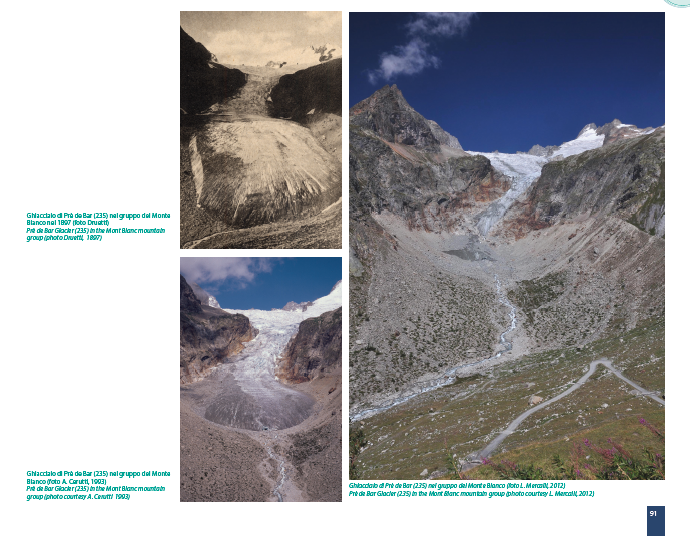
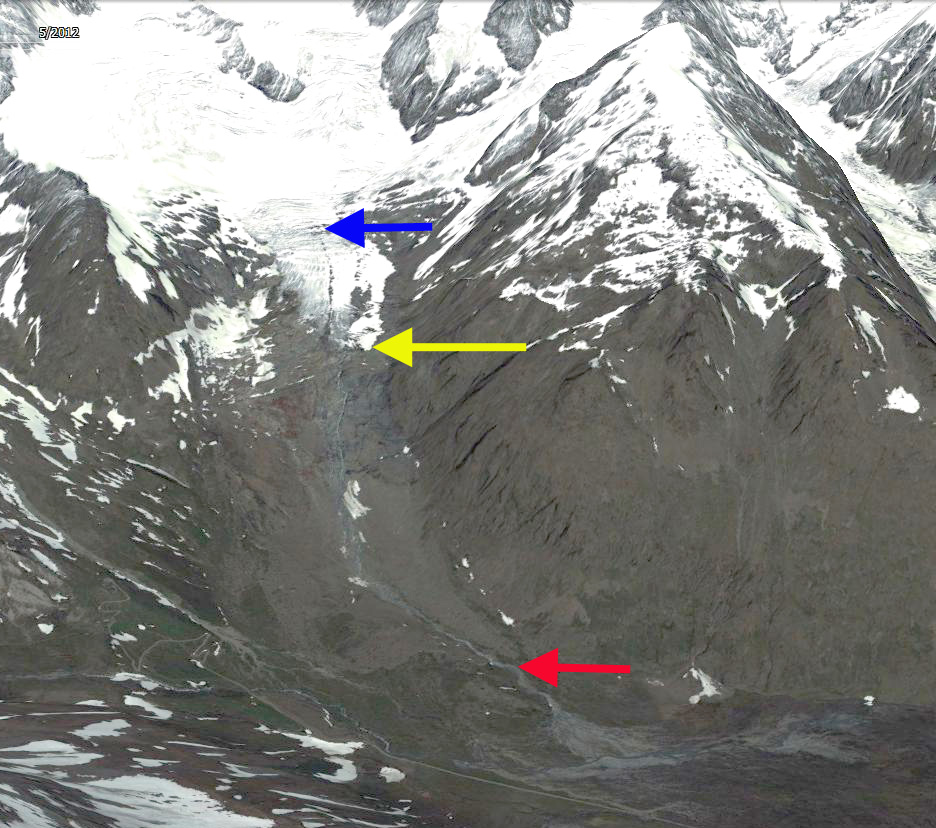
Pré de Bar Glacier is a glacier on the east side of Aiguille de Triolet and south side of Mont Dolent. This is a steep valley glacier that experienced a large retreat during the first half of the 20th century, then advanced from the 1960’s-1980’s, before beginning a retreat again in 1990, that has continued to 2015. In the Landsat images above the 1990 terminus extended approximately 600 m beyond the base of an icefall, forming a substantial low slope terminus lobe.  By 2015 this lobe below the icefall had disappeared and the terminus is now at the base of the icefall, with a net retreat of 550 m since 1990.  With the retreat increasing during each five year increment according to WGMS from 1990-2010 and image analysis here from 2011-2015. The retreat is measured each year by the Italian Glacier Committee  and reported to WGMS.  The New Italian Glacier Inventory that has just been released has reports on each region of glaciers in Italy. For the Glaciers of Aosta Valley it is observed that there are 192 glaciers about 21% of Italy’s total, covering 133.7 square kilometers, 24% less than a half-century ago. This amazing inventory was completed by the Earth Science Department of the University of Milan’s Glaciology staff, led by Claudio Smiraglia and Guglielmina Diolaiuti. On page 91 of the Aosta Chapter is a series of images of Pré de Bar from 1897, 1993 and 2012. The main change from 1993 to 2012 is the loss of the terminus lobe below the narrow icefall.

pre de bar historic

Figure from the New Italian Glacier Inventory of Pré de Bar Glacier in 1897, 1993 and 2012

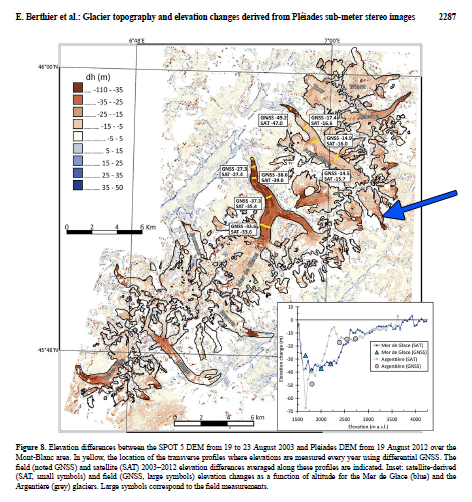
Berthier et al (2014) mapped ice thickness changes in this region from 2003 to 2012 using the Pléiades satellites. They identify a negative Mont Blanc region wide mass balance of glaciers of -1.04 m/year for the 2003-2012 period.  On Pré de Bar Glacier their figure below indicates at least 5 m thinning across nearly the entire glacier, with more than 25 m of thinning in the terminus region below the icefall.  This dramatic thinning largely driven by increasing summer melting. Bonnano et al (2012) identified a long term retreat rate of 3 m per year for the glacier.  However, retreat from 1990 to 2015 is 22 m/year, the WGMS indicates retreat of 404 m from 1990-2010, a rate of 20 m/year.  The rate of retreat incireased from 16 m/year in the 1990’s to 24 m/year in the 2000’s.  The thinning identified by Berthier et al (2014) up to 2012 high on the glacier suggests this will continue.  Note in the image below  from Bonnano et al., (2012) of Pré de Bar Glacier the amount of firn exposed above the ELA particularly on the two easternmost feeders, and the 2015 Landsat image indicates the annual ELA is closer to the end of the black arrows in that image than the red line from 2000.  The pattern of thinning is similar to that of nearby Lex Blanche Glacier, and Glacier d’Argentiere, but Mer de Glace has a much larger relatively low slope ablation zone section with high thinning.

The meltwater runoff from this glacier feeds the Dora Baltea River and eventually the Po River.  The Aosta Valle region hosts extensive hydropower along this drainage including the Avise, Champagne,Nus, Montjovet, Isollaz, Chatillon, Verras, Hone and Ivrea.

mont blanc thinning

Figure from Berthier et al (2014) indicating thinning of Mont Blanc Glacier 2003-2012, Pre de Bar Glacier noted with blue arrow.

Pre-de-Bar
Pre de Bar Glacier in 2000 showing the ablation zone, accumulation zone, ELA, glacier front this is from Bonnano et al (2012)


Lex Blanche Glacier Recession, Mont Blanc Massif, Italy

lex blanche compare

Lex Blanche Glacier (Lb) comparison in a 1990 and 2015 Landsat image.  Red arrow indicates 1990 terminus, yellow arrow the 2015 terminus and the purple arrow a separated tributary. Debris covered Miage Glacier (M) is adjacent. 

Lex Blanche Glacier descends from 3500 m on the southeast flank the Aiguille de Glaciers of the Mont Blanc Massif into the Vale Veny of Italy. The glacier is adjacent to Miage Glacier (M). The glacier advanced over 700 m from 1970 to 1990. In 1990 the glacier extended to the base of a steep slope and turned north to terminate at 1980 m. By 2001 the glacier has retreated up a steep slope to near where the 1970’s advance had begun.  By 2009 and 2011 further retreat has left the terminus just above a particularly steep bedrock slope.  By 2015 the glacier has retreated 1100 m and terminates at 2450 m remaining on a relatively steep slope. The glacier is heavily crevassed a short distance above the terminus suggesting the period of rapid retreat should be ending. A tributary from the north has detached from the main glacier at the purple arrow. In recent warm summers the glacier has retained snowcover above 3150 m.  The mass balance noted in Figure 8  (see below) of a paper by Berthier et al (2014) indicates the thinning is glacier wide but most prominent on glacier tongue.  Berthier et al (2014) used  the Pléiades satellites to identify a negative region wide mass balances of glaciers in the Mont-Blanc area of -1.04 m/year for the 2003-2012 period. The meltwater runoff from this glacier feeds the Dora Baltea River and then the Po River.  Both rivers feature extensive hydropower including the Champagne and Nus hydropower plant on the Dora Baltea  that produce 41 MW.  The retreat of this glacier mirrors that of other glaciers of Mont Blanc including Taconnaz, Bionnassay, Mer de Glace and Tour Glacier.

berthier mass balance lex blanche

Figure 8 from Berthier et al (2014) on glacier wide mass change with thinning in browns, and darker browns greater thinning.

lex blanche 2001

Google Earth image from 2001 indicating the 1990 terminus at red arrow and 2001 terminus at yellow arrow.

lex blanche 2009

Google Earth image from 2009 indicating the 1990 terminus at red arrow and 2009 terminus at yellow arrow.

lex blanche 2011

Google Earth image from 2011 indicating the 1990 terminus at red arrow and 2011 terminus at yellow arrow.  Blue arrow indicates the lowest heavily crevassed region.


Rutor Glacier, Italy Retreat and Rising Snowline

The Rutor (Ruitor) Glacier is one of the 10 largest in Italy and is on the France-Italy border draining into the Aosta River valley.  The glacier has three termini with the main terminus being the eastern one. The position of the glacier snout has been surveyed though not every year by the Italian Glaciological Committee since 1900. The glacier has a long series of terminus and volume observations compiled by Villa et al (2007) at the University of Milano-Bicocca, that indicate a 27% loss in area from the LIA maximum in the mid 19th century to 1975.  The glacier than increased slightly (1%) to 1988, followed by a loss of 5% from 1988 to 2004 (Villa et al, 2007). They further observe that the equilibrium line altitude (height of snowline at end of summer) was 2775 m during the Little Ice Age and 2850 m during the 1975-1992 period. Here we examine landsat imagery from 1988 to 2014 to identify the current trend in both ELA and terminus change.
ruitor ge 2011
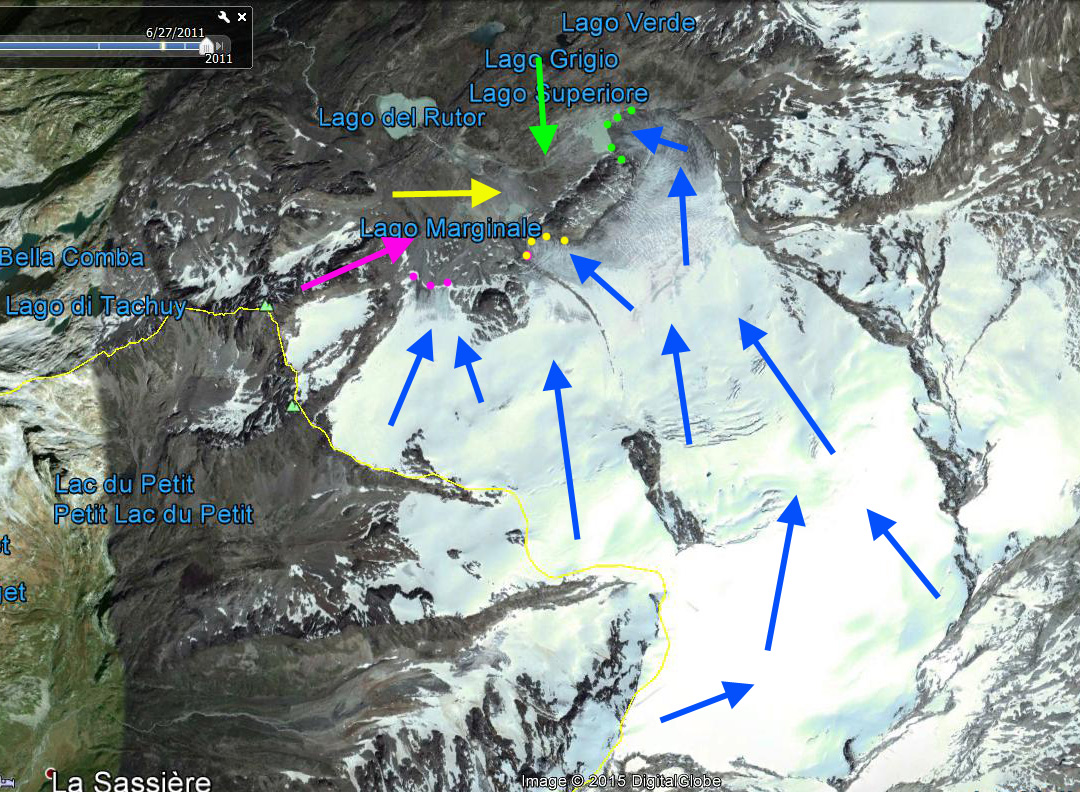
Google Earth image indicating the three terminus of the Rutor glacier, arrows indicate 1988 terminus position, dots the 2011 terminus position of each.

In 1988 the eastern terminus, green arrow, had expanded slightly occupying the same location as it had in 1975, this left a trimline do the lack of retreat from 1975 to 1991, the area down valley had been deglaciated an additional 20 years. All three termini descended below 2600 m in 1988. The eastern and central terminus (yellow arrow) were separated by only 400 m. There was a small nunatak shortly above the terminus between the central and western (pink arrow) terminus. By 2014 a lake, red arrow, has formed due to retreat of the eastern terminus. The retreat is 500 m. Additionally between the eastern and central terminus the glacier margin has pulled back from a series of bedrock knobs. The central terminus, yellow arrow, has receded 400 m, and no longer reaches the lower slope foreland below 2650 m. The nunatak between the central and western terminus is now a substantial bedrock knob beyond the glacier margin. the western terminus has receded the least 300 m, but this is a greater percentage of the full length of the glacier feeding this terminus. Further there is negligible retained snowpack in 2014. The 2011 Google Earth image has stagnant areas evident at the terminus, red arrows, that lack of crevassing or other features of movement.

The snowline in 2014, red dots, extends east and west from a prominent rib, and is at 3000-3050 m. In 2011  the snowline is at 3050 m-3100 m and in 2013 the snowline is at 2950-3000 m.  The average snowline of the last four years is 150 -200 m higher than during the 1975-1991 period and 250 m higher than during the LIA.  This is substantial and will drive further continued rapid retreat.  This is the same climate that is driving retreat throughout the Alps from Verra Grande Glacier to Sabbione Glacier to Presena Glacier, that needed a blanket.

rutor Glacier 1988
1988 Landsat image
rutor Glacier 2014
2014 Landsat image
ruitor terminus
Google Earth image of new lake formed and retreat of eastern terminus
rutor 2011
2011 Landsat image

rutor 2013
2013 Landsat image