40th Field Season of North Cascade Glacier Climate Project Underway

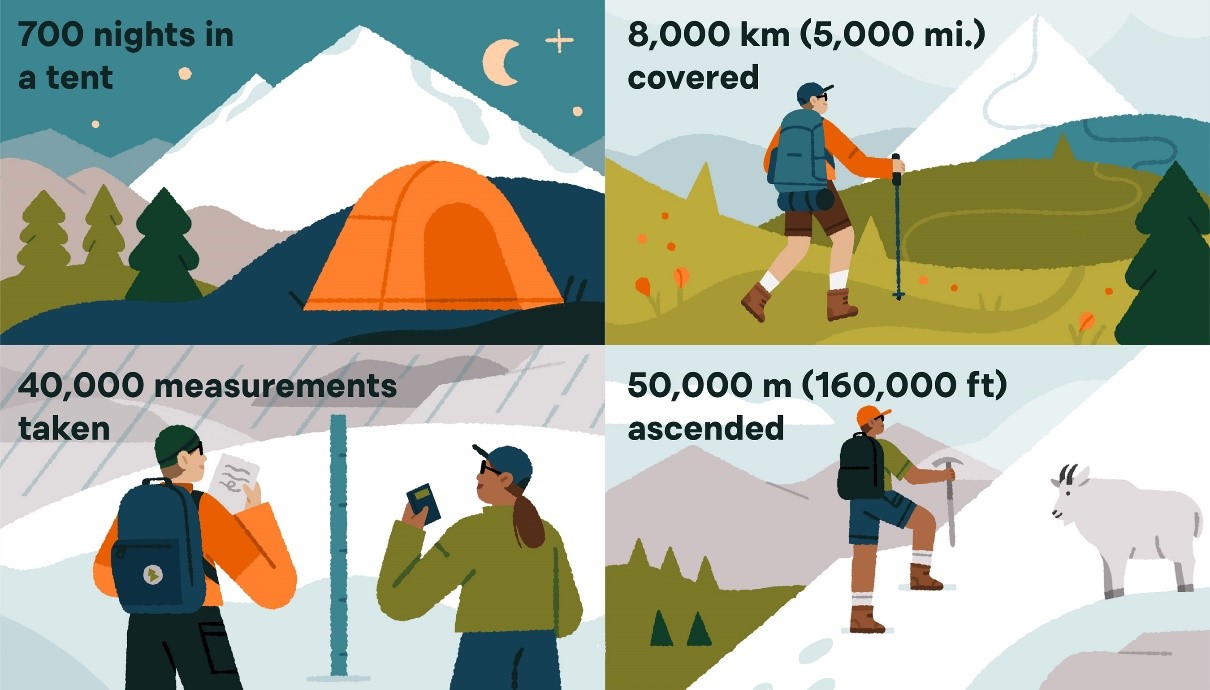
Illustration by Megan Pelto of key numbers behind what it takes to undertake a 40 year field study on glaciers.

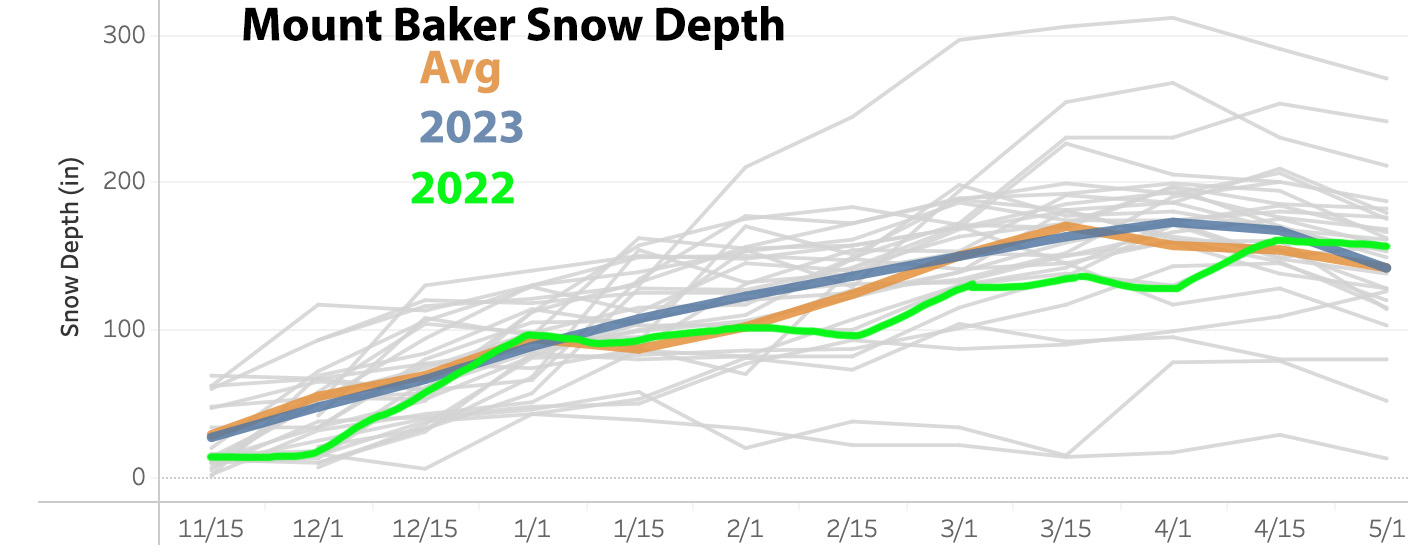
For the 40th consecutive summer the North Cascade Glacier Climate Project is heading into the field to measure and communicate the impact of climate change on North Cascade glaciers. This field season follows the 2021 and 2022 seasons that featured a historic heat wave and periods of extended warm weather. The heat led to a greater exposure of bare ice on glaciers, particularly at higher elevations. For ice surfaces with a higher albedo and greater density the observed melt rates are 7-9 cm per day water equivalent during warm weather events vs 4-6 for snow surfaces. This led to substantial mass losses on North Cascade glacier for the two years of -2.5 m. Winter snowpack in the North Cascades in 2023 was 80-90% of normal on April 1 and May 1.

Science objectives: We will complete detailed measurements on 10 glaciers, three of which are part of the World Glacier Monitoring Service reference glacier network (42 glaciers globally), which have 30+ consecutive years of mass balance observations. This summer we will have an opportunity to assess the long-term ramifications of the 2021 and 2022 summers and measure the response of glaciers to the weather of 2023 with detailed mass balance, crevasse depths and glacier surface elevation profiling.

Art Objectives: We will collaborate with several artists who will join us for a portion of the field season. They will be able to create their own work about the landscape and the science or may join us for fieldwork and make plans for future artwork. Potential artists include painters, a podcast creator, a photographer, and a printmaker. We hope to use this art to share our research with a broader audience and highlight the beauty and importance of these places.

Communication Objectives: We are seeking expedition sponsors this year with brands who have a climate change focus. These organizations can help spread our message; we have two so far. We are looking to support the production of podcasts as well.

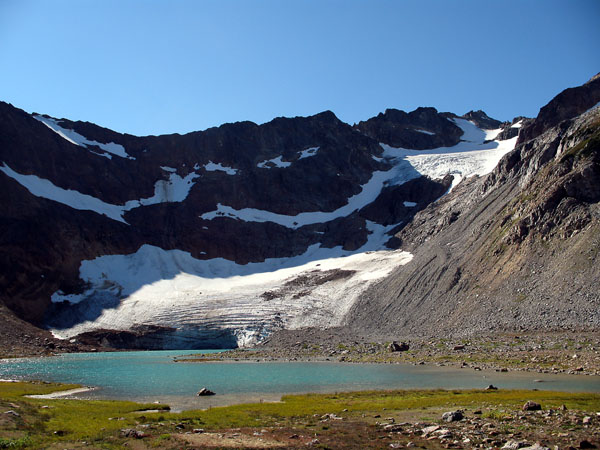
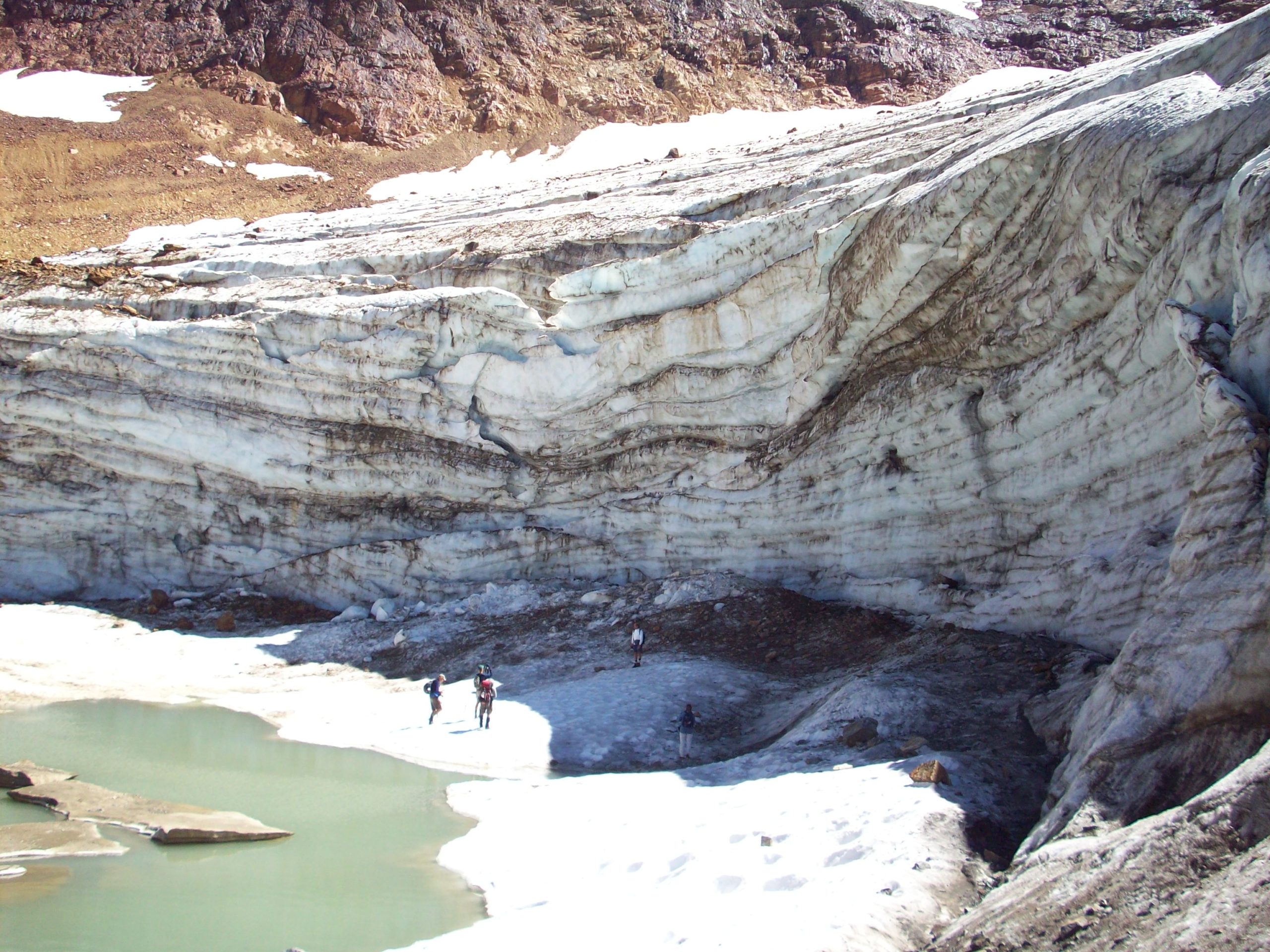
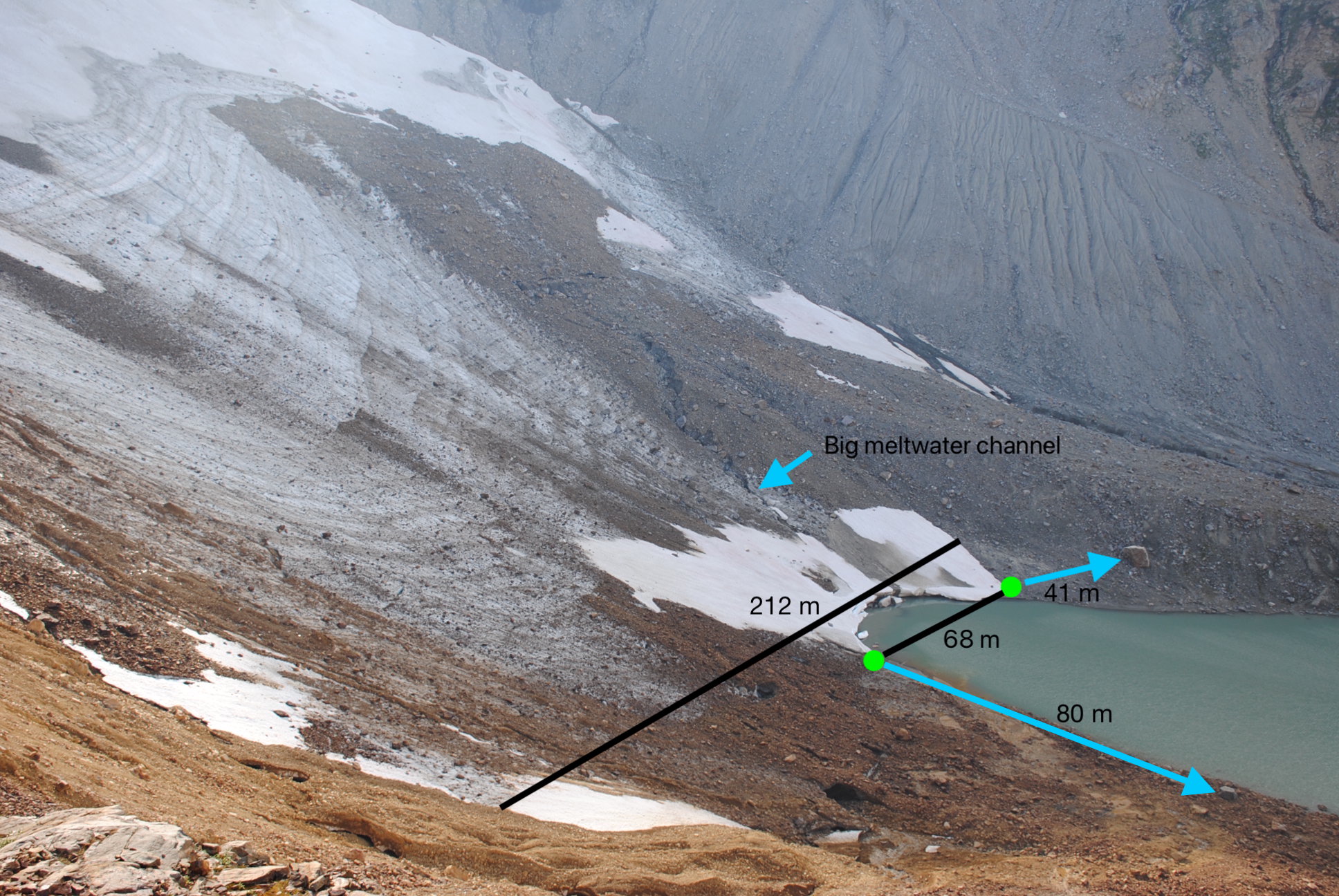
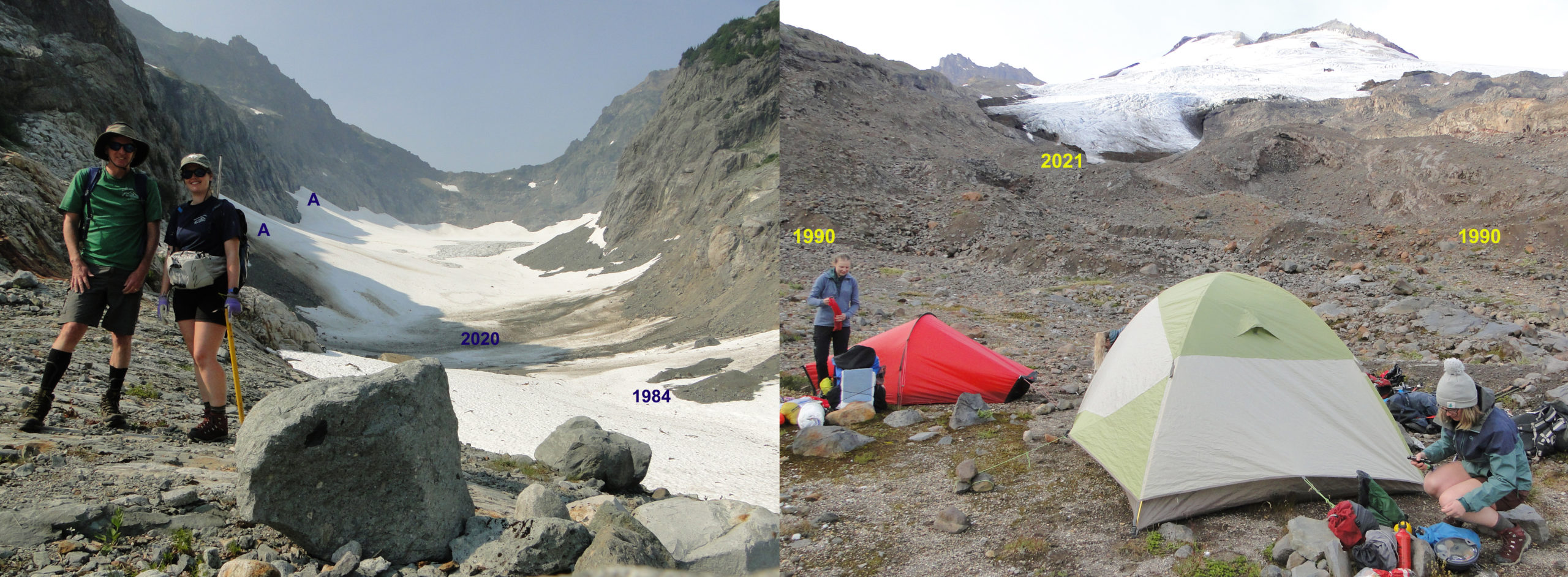
Terminus change at two World Glacier Monitoring Service reference glaciers. Columbia and Eastson Glacier. 

Field Team 2023:

Jill Pelto  (she/her)is an artist and scientist from New England who grew up loving winter sports and trips to the mountains. She incorporates scientific research and data into paintings and prints to communicate environmental changes. Her multi-disciplinary work weaves visual narratives that reveal the reality of human impacts on this planet. She completed both her B.A. degrees in Studio Art and Earth and Climate Science, and her M.S. focused on studying the stability of the Antarctic Ice Sheet at the University of Maine, spending two field seasons at a remote camp in the southern Transantarctic Mountains. Jill will be joining the project for her 15th field season. She is excited about continuing to document the change in North Cascade glaciers that she has witnessed each of the last ten years — through science and art.
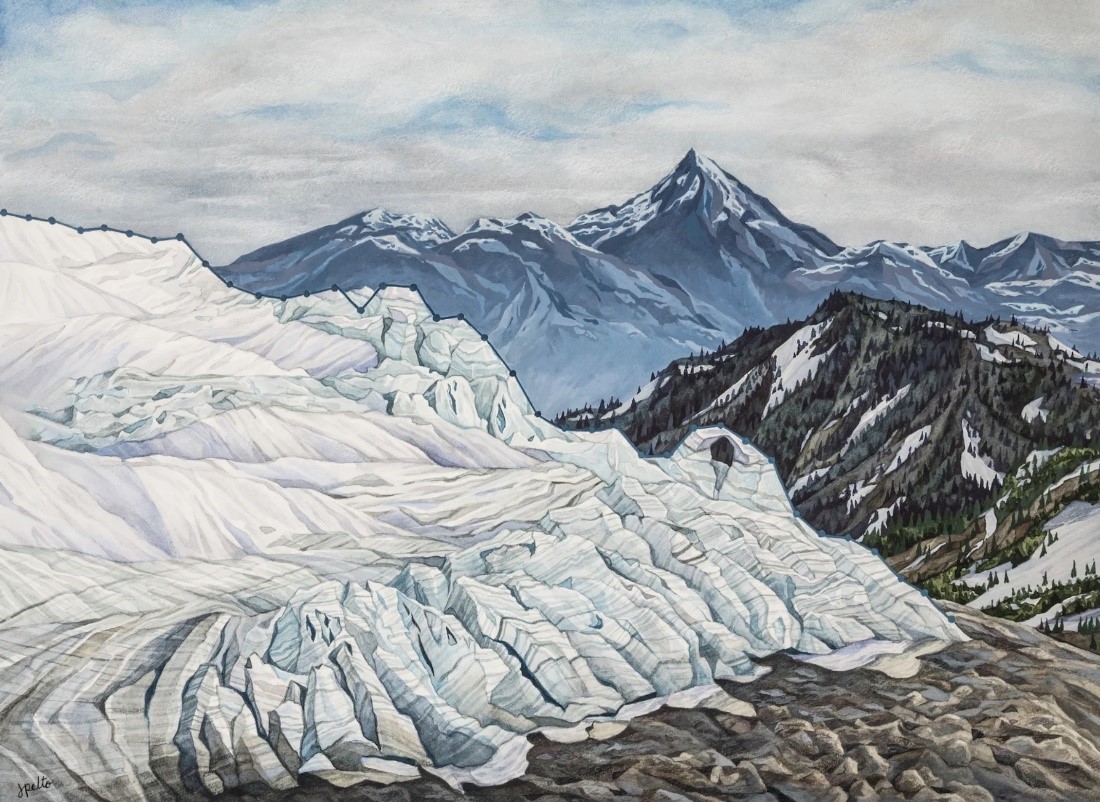
Painting by Jill Pelto that incorporates mass balance data from NCGCP from 1983-2022 along the top of the glacier.

Mauri Pelto (he/him) has directed the project since its founding in 1984, spending more than 800 nights camped out adjacent to these glaciers. He is the United States representative to the World Glacier Monitoring Service. For a decade he has been author of the AGU blog “From a Glacier’s Perspective,” and associate editor for three science journals.  He is on the Science Advisory Board for NASA’s Earth Observatory. His primary position is Associate Provost at Nichols College, where he has been a professor since 1989. He either runs on trails or ski’s on trails alpine and cross country everyday.

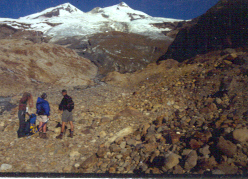
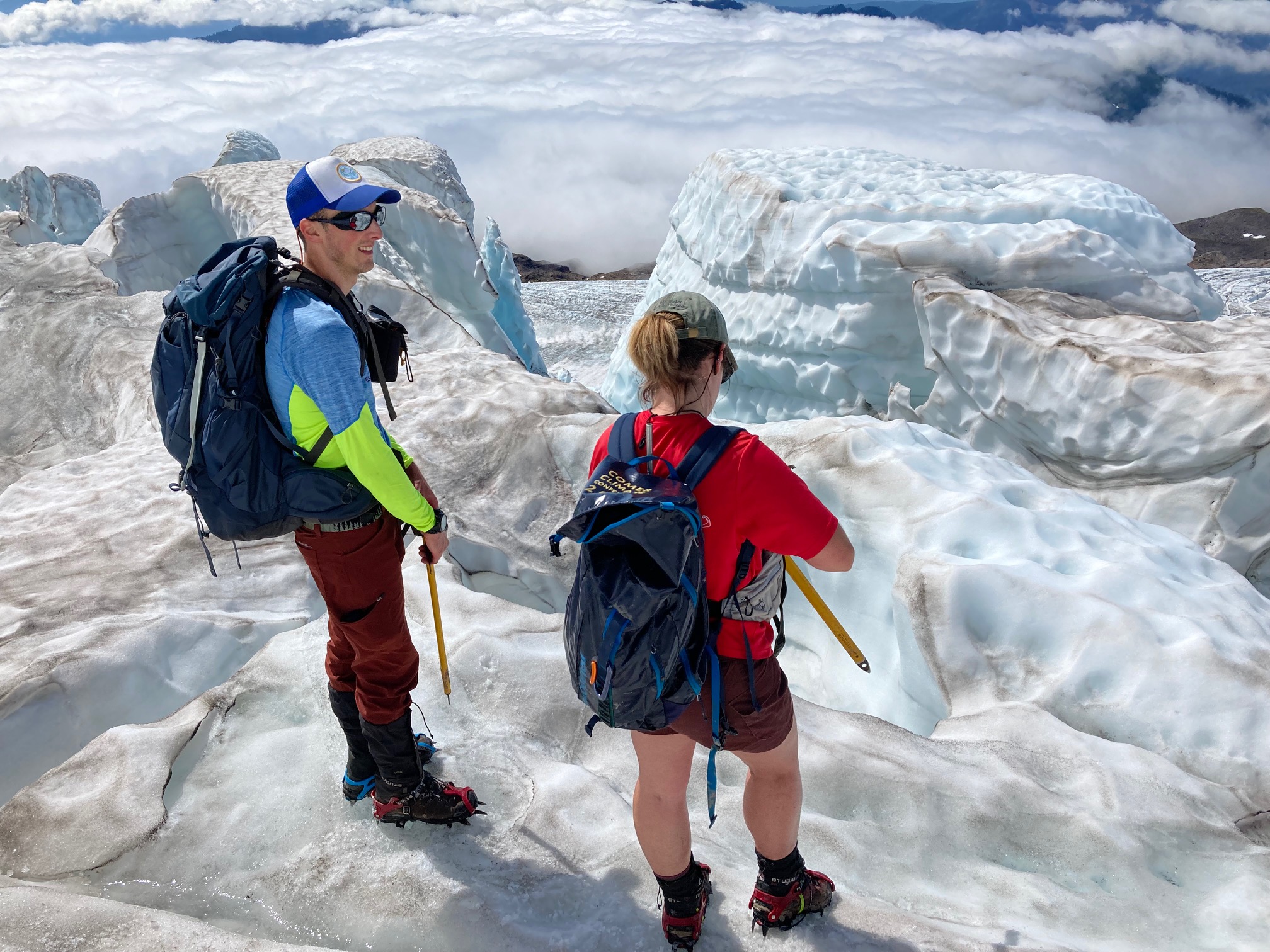
Mauri Pelto looking at deglaciated envioronment below Easton Glacier

Mariama Dryak-Vallies (she/her) is the Director for the Polar Science Early Career Community Office (PSECCO) hosted by CIRES at University of Colorado Boulder. Mariama grew up on a farm in west-central Wisconsin before earning her B.A. in physical geography and archaeology at Durham University (UK)—where her passion for studying, researching, and teaching about glaciers, climate change, and the natural environment was born. She completed her M.S. in Earth and Climate Sciences at the University of Maine, studying Antarctic glaciology and ice-ocean interactions. During graduate school she was actively involved advocating for polar early career scientists as board member and co-chair of the US Association of Polar Early Career Scientists (USAPECS). Mariama is passionate about working towards building accessible Earth and polar sciences spaces for all.
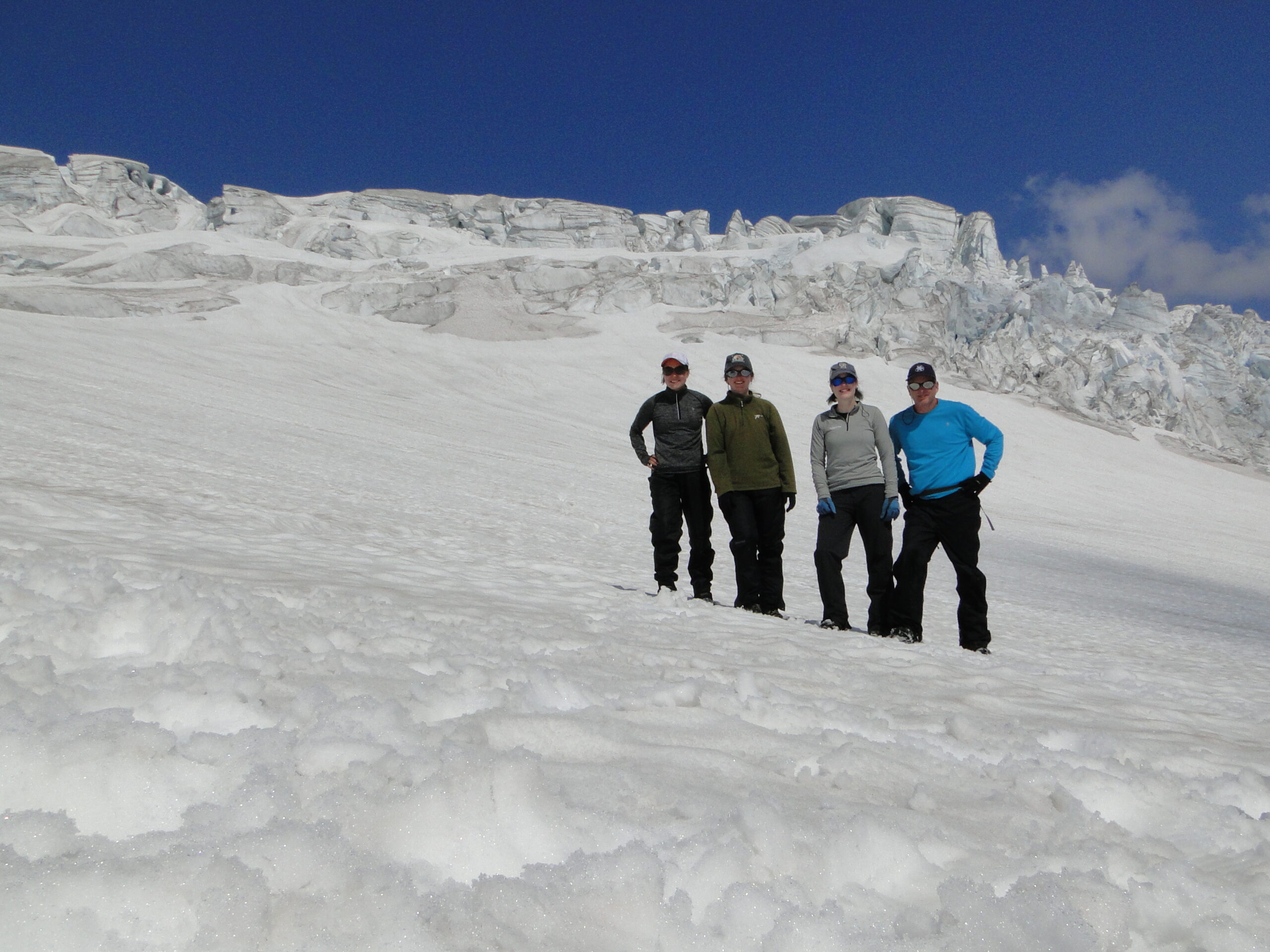
2018 field team including Jill, Mauri, Mariama and Erin

Kaiyuan Wang (he/himis a recent graduate from McGill University with a B.Sc in Honours Physical Geography, a minor in Geology. Originally from China, he developed an aspiration for Geoscience in the Great White North while living on the former bed of the Laurentide Ice Sheet. His passion for the cryosphere has led him to fieldwork on glaciers in the Kluane National Park in Yukon, Jasper National Park in Alberta, and a glaciological conference in Iceland. He will be doing his Ph.D. in Arctic Hydrology at the Northern Change Research Laboratory at Brown University. Kai is thrilled to be part of the 40-year-long effort of documenting glaciers as a living testimony to a warming world.

Shivaprakash Muruganandham (he/him) is currently a PhD candidate in Ocean Science and Engineering at the Georgia Institute of Technology, Atlanta, USA. He is back in school after a few years as a strategy consultant, during which time he specialized in satellites and space applications: earth observation and satellite communications in particular. Prior to this, he graduated with Master’s degrees in Space Technology and Cybernetic Systems/Control. Shiva is fascinated by ice, and his research focus on ice sheet/glacier modeling is motivated by his interests in the downstream impacts of cryosphere-climate interactions on coastal and mountain communities..

Field Partners 2023

Lizz Ultee (she/they) is an Assistant Professor of Earth & Climate Science at Middlebury College, Vermont.  They earned a B.Sc. in mathematical physics at Queen’s University (Canada) and a Ph.D. in climate science at the University of Michigan, specializing in mathematical methods to understand and predict glacier change.  Lizz finds ice endlessly inspiring.  Beyond inspiring, though, glaciers are important for downstream communities — motivating Lizz’s present research focus on glacier contributions to sea-level rise and water resource availability.

Alia Khan’s research team including grad students Sally Vaux, Colby Rand, and Anne Wilce focus on environmental chemistry in the cryosphere, including black carbon and snow algae to document global change of glacier and snow melt in mountainous and polar regions.Western Washington University Cryosphere Studies and Aquatic Biochemistry Lab.

Claire Giordano is an environmental artist, writer, and educator creatively telling the stories of science, climate change, and the modern experience of nature. From creating rain-dappled sketches in an old growth forest to filming a watercolor class beside a glacier, careful observation of nature inspires her goal is to connect people and place through art. In 2021 she founded the Adventure Art Academy – a series of virtual watercolor classes filmed outside – to invite others into the joy of painting outside.

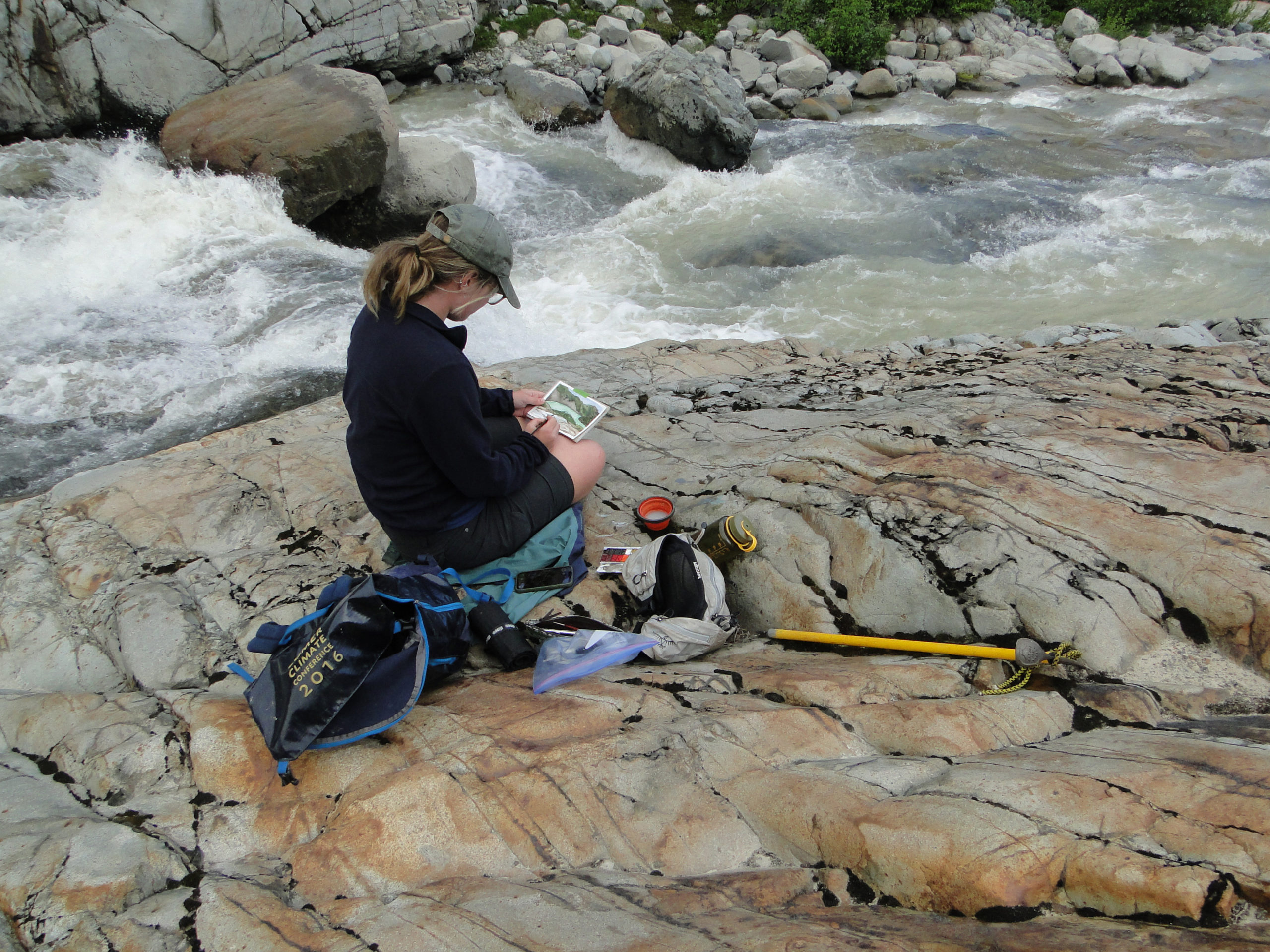
Field study by Claire Giordano, artist in residence with the NCGCP for her 4th year. She creates these incredible pages with notes, paintings, and sketches from her days out exploring the landscape.

Kathleen Shannon is a freelance journalist & radio producer telling science and environmental justice stories across the West. She is based in Missoula and earned a master’s degree in Environmental Science and Natural Resource Journalism from the University of Montana in 2023. Her work has appeared on NPR, in High Country News and elsewhere.

Julia Ditto is a science illustrator from Anchorage, Alaska who specializes in environmental and ecological graphics. Julia spends much of her time recreating in the backcountry, which inspires much of her work. She has always used art as a tool for observing and communicating her experiences, both inand out of the field. She is currently attending CSU Monterey Bay’s Graduate Science Illustration Program.

Who are we? NCGCP was founded in 1983 to identify and communicate the response of North Cascade glaciers to regional climate change. NCGCP is a field project including scientists and artists that has a broad interdisciplinary scope and examines more glaciers than any other program in North America.  We do so cost effectively relying on no permanent camps or helicopter support. The field season includes no days off and each day is spent completing measurements on glaciers.  The focus is on glacier mapping, mass balance measurement, terminus observations, glacier runoff monitoring and capturing the environment with art.  

Why study glaciers in the North Cascades? Glaciers are one of the world’s best climate monitors and are a critical water resource to many populated glaciated regions. This is particularly true in the North Cascades where 700 glaciers yield 200 billion gallons of summer runoff and glaciers have lost 30 % of their area in the last century. This has reduced glacier runoff in late summer in the region as the reduction in glacier area has exceeded the increase in melt rate. During heat waves this role is even more profound with the glacier fed North Fork Nooksack River discharge rising ~24% due to greater melt, while unglaciated South Fork Nooksack River discharge declines by ~20%. The increased discharge limits the rise in river temperature during heat waves to 0.7 C in the North Fork, with the South Fork increasing by 2 C, increasing stress on the salmon in the South Fork (Pelto et al., 2022).
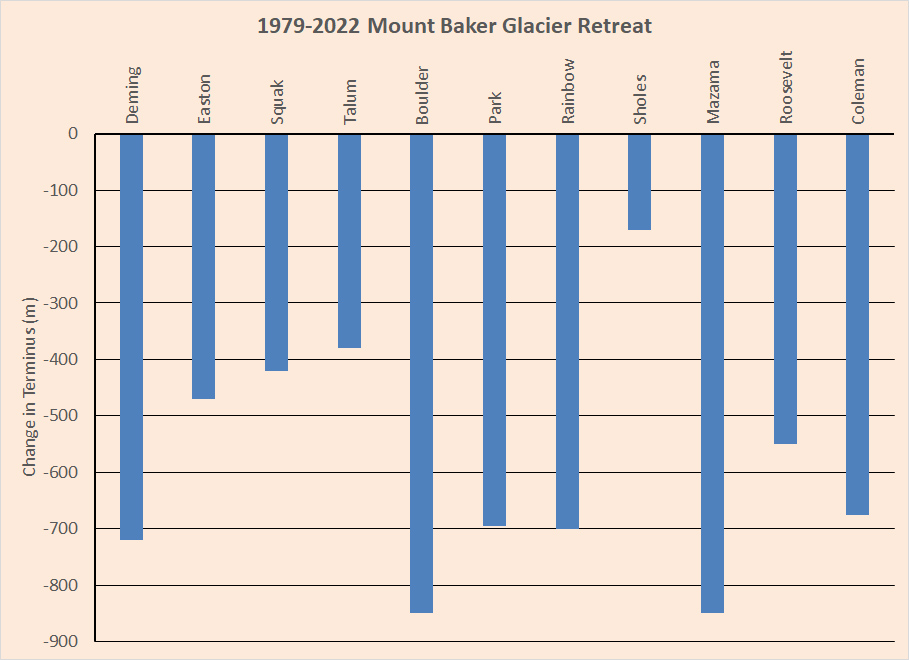
Retreat of Mount Baker glaciers documented by our program

The mass balance record we have compiled since 1984

Summer temperature records from NOAA WA Division 5
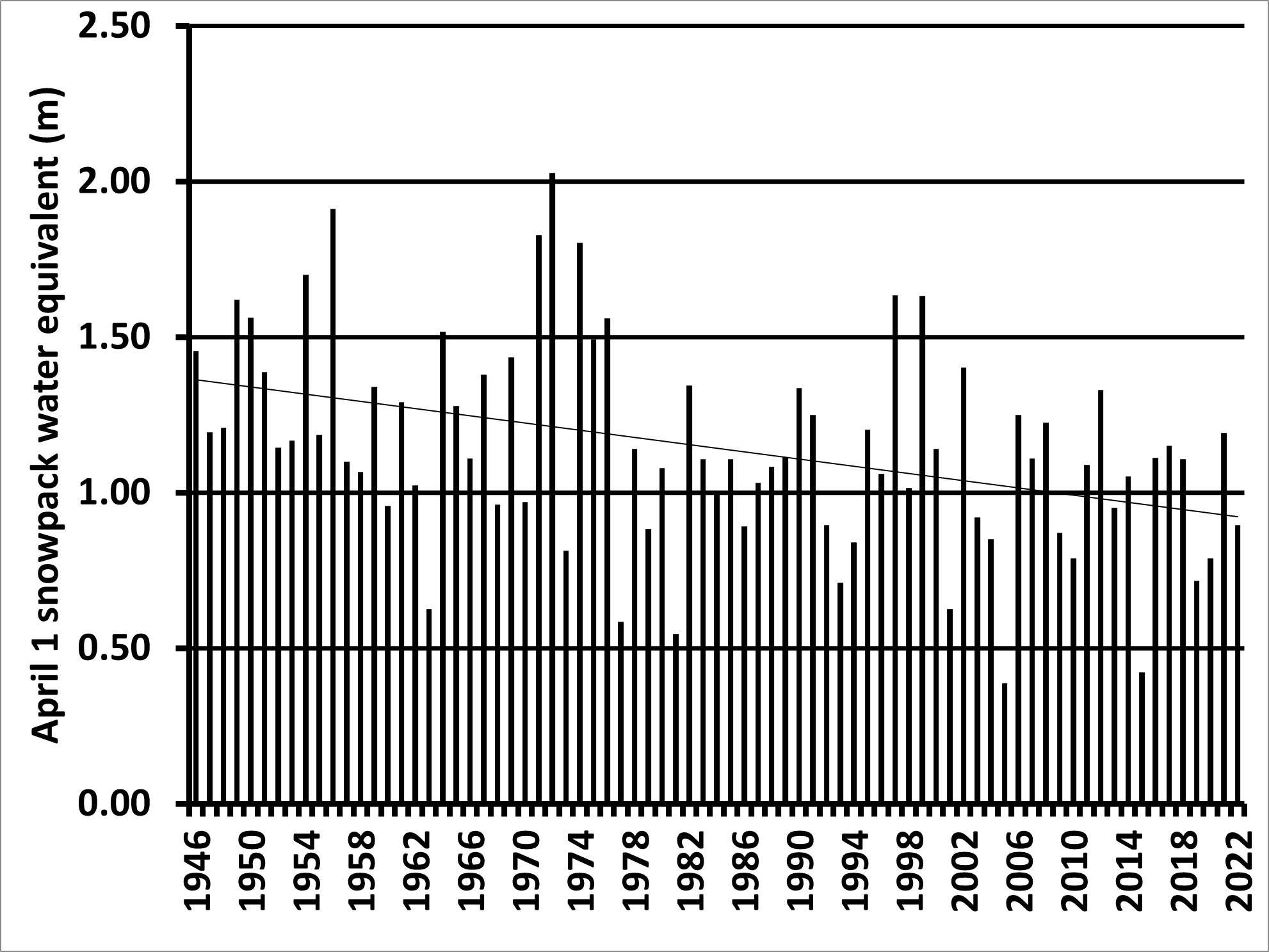
Winter Snowpack from North Cascade long term Snotel stations on April 1
Mount Baker Glacier’s Perspective on Climate Change 1984-2022-Disastrous!

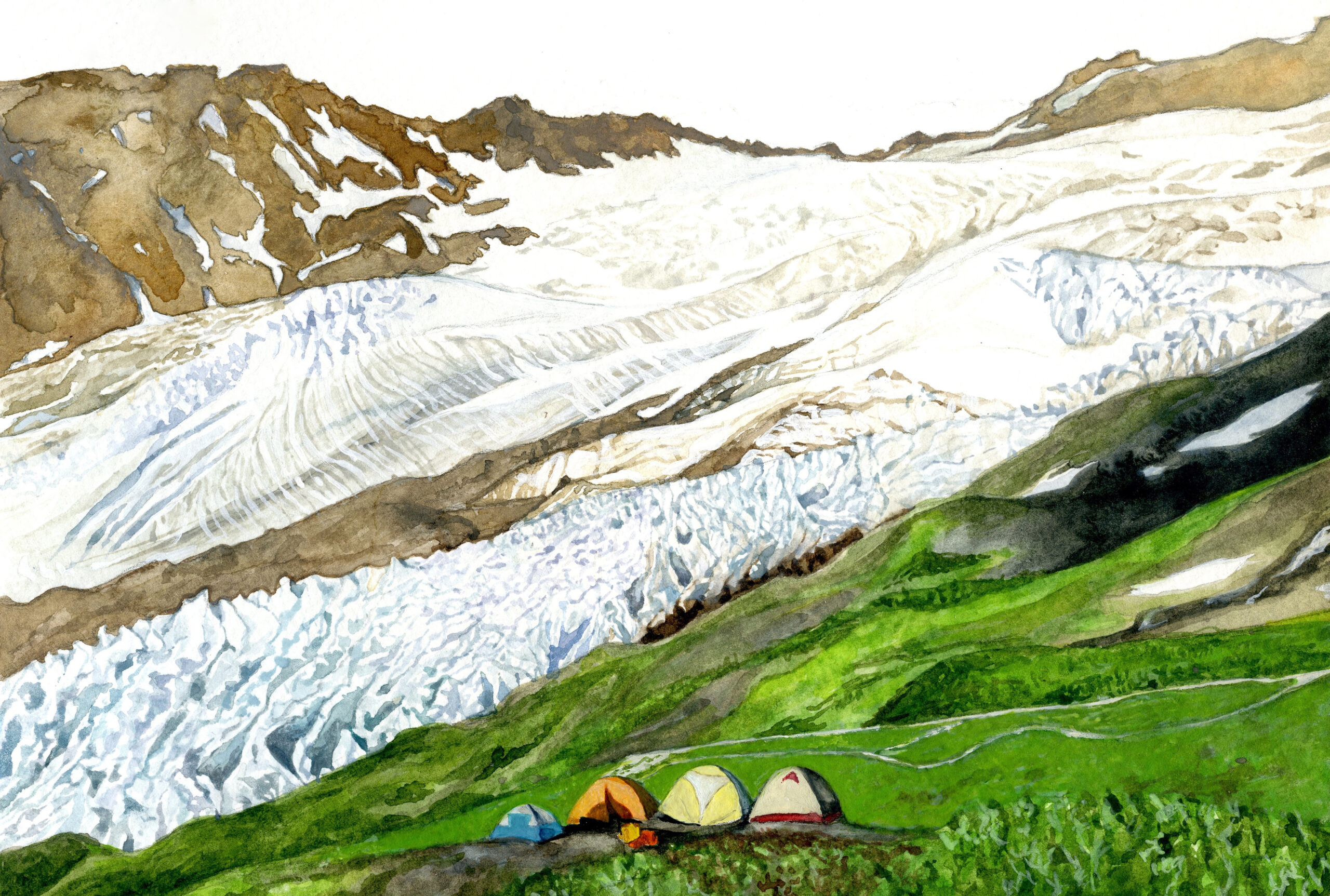
Camp above Coleman Glacier on Heliotrope Ridge, (Jill Pelto painting)

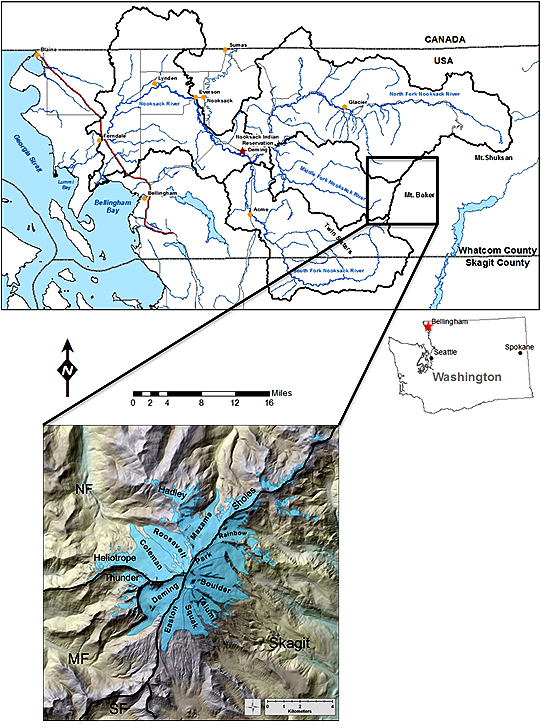
Mount Baker is the most glaciated peak and highest mountain in the North Cascade Range at 3286 m.  The Nooksack Indian Tribe refers to this strato volcano as Komo Kulshan, the great white (smoking) watcher. Mount Baker has 12 significant glaciers that covered 42 km2 in 1984 and ranged in elevation from 1320 m to 3250 m.  Kulshan watches over the Nooksack River Watershed, and its flanks are principal water sources for all three branches of this river and Baker River.  In 1984 we began an annual monitoring program of glacier mass balance, terminus position and glacier area on these glaciers. Over the last 40 years we have visited these glaciers every summer observing their response to climate change.

In 1984/85 we visited 11 of the 12 glaciers mapping their terminus position.  All but one had advanced between 1950 and 1975 emplacing an advance moraine.  In the 1980’s as each glacier retreated from this moraine we used these prominent moraines as a benchmarks, as their ice cores have melted and erosion has occurred they have become less prominent. The distance from the typically well preserved, fresh moraines  to the current glacier front has been measured in each case using a laser ranging device with an accuracy of +1m.   In 2009 Mount Baker glacier had declined to 38.5 km² Pelto and Brown (2012). The Randolph Glacier Inventory reported a glacier area of 37 km² in 2015.  In October 2022 an updated area was determined for Mount Baker glaciers at 33.5 km². This represents a decline of 20% in 38 years. Pelto and Brown (2012)  identified a mean annual mass balance loss of -0.52 m/year from 1990-2010 on Mount Baker glaciers. From 2013-2021 the mass loss had more than doubled to -1.30 m/year. Below we review each glacier circling the mountain counter-clockwise

Measurement of glacier retreat from the advanced moraines ~1979 to 2022. We have measured terminus position of these glacier on 130 occassions from 1984-2022.

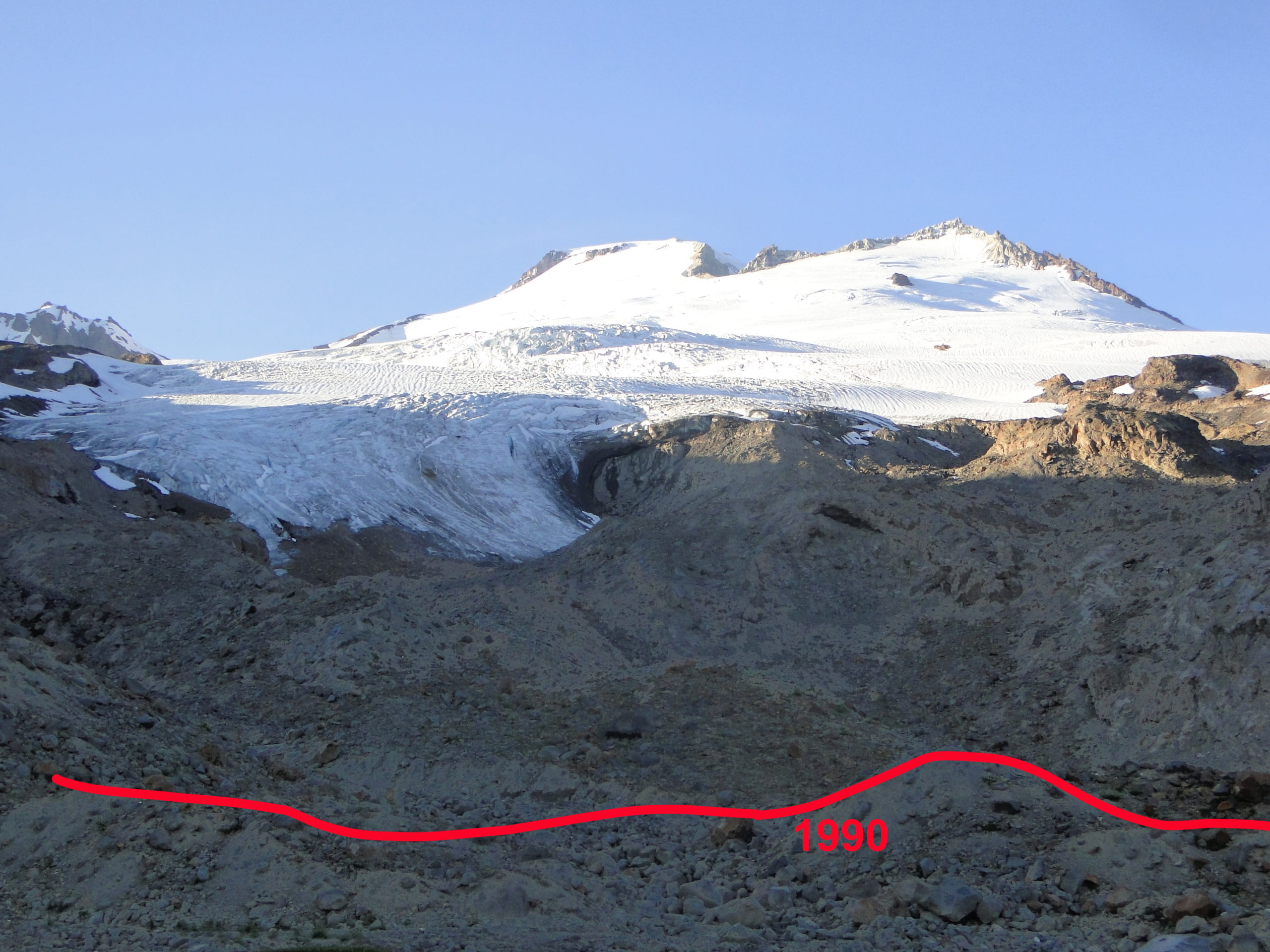
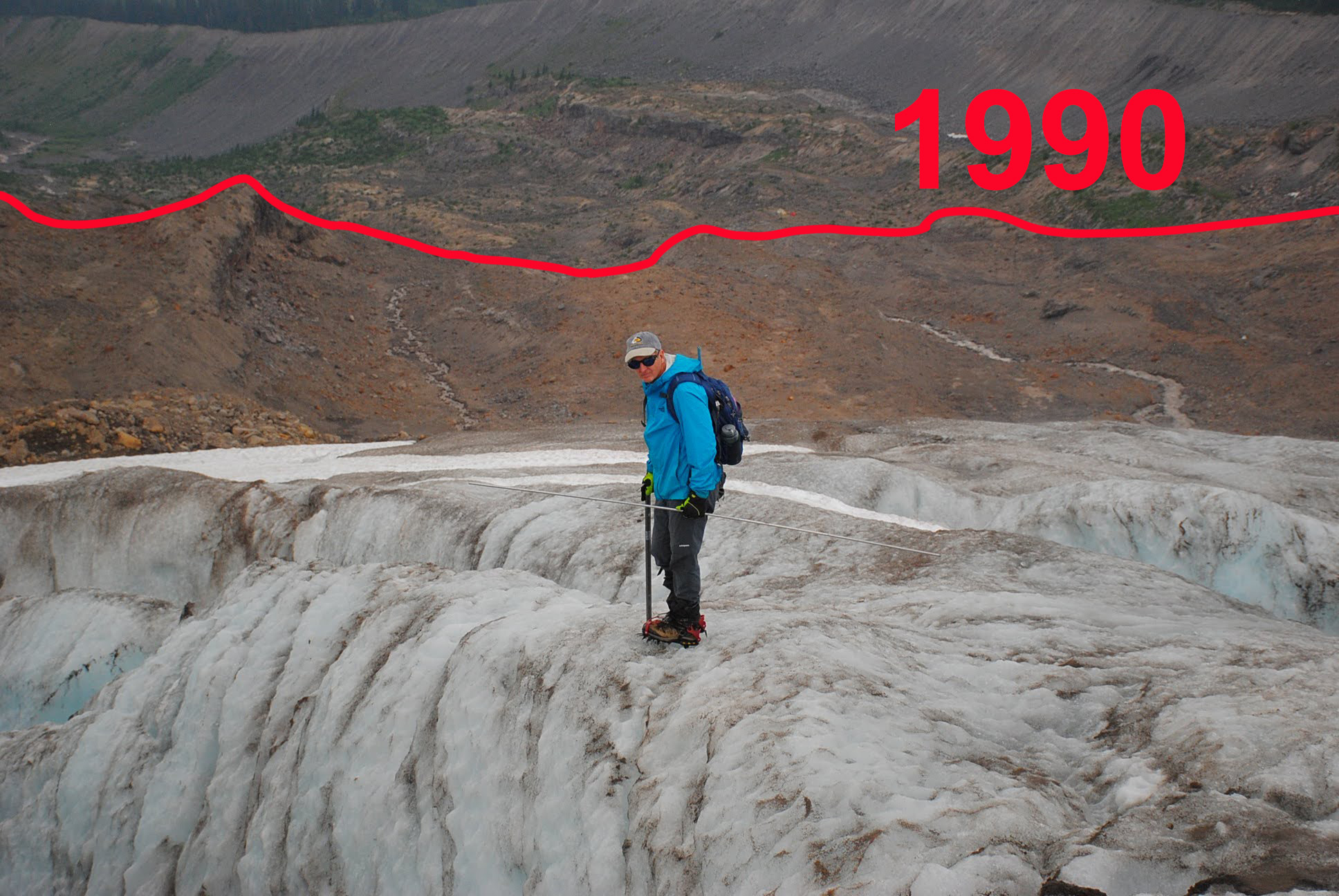
Easton Glacier from our survey camp  in (2022) above and 2003 (below) illustrating 470 m retreat from 1990-2022.

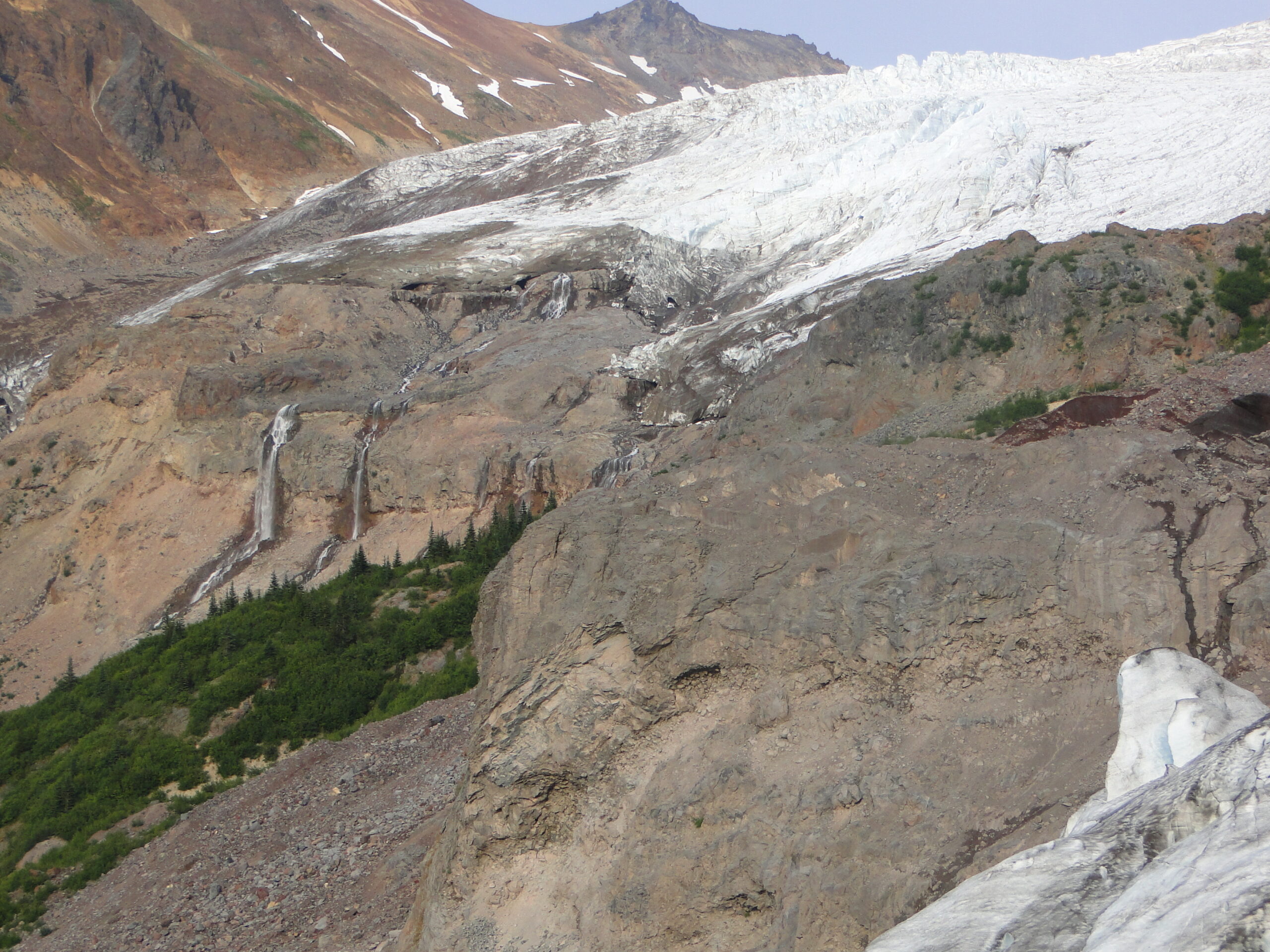
Change at terminus from August 2022 to August 2023. Image from same location though different orientation area the size of a hockey rink lost all of its ice here.

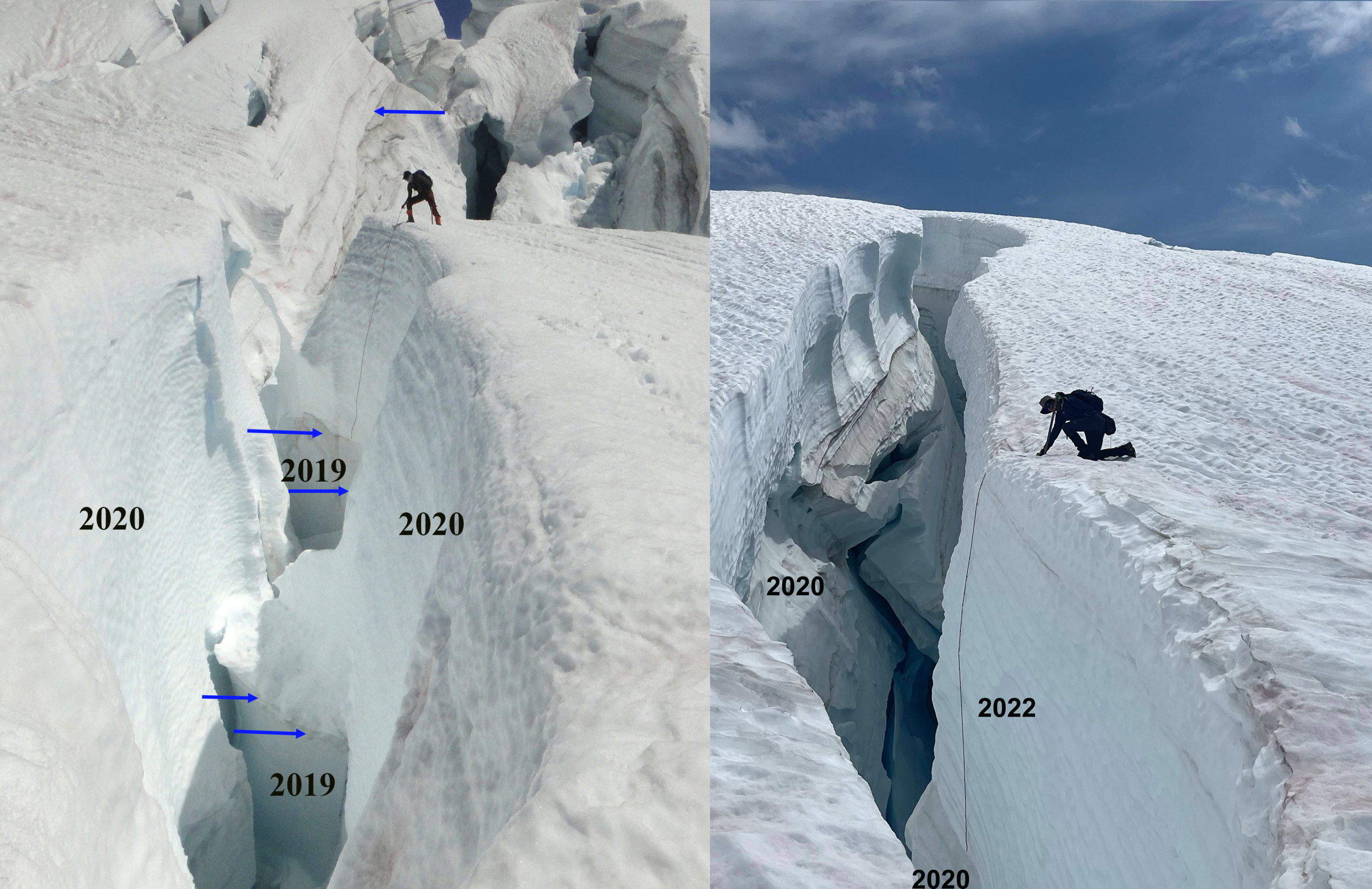
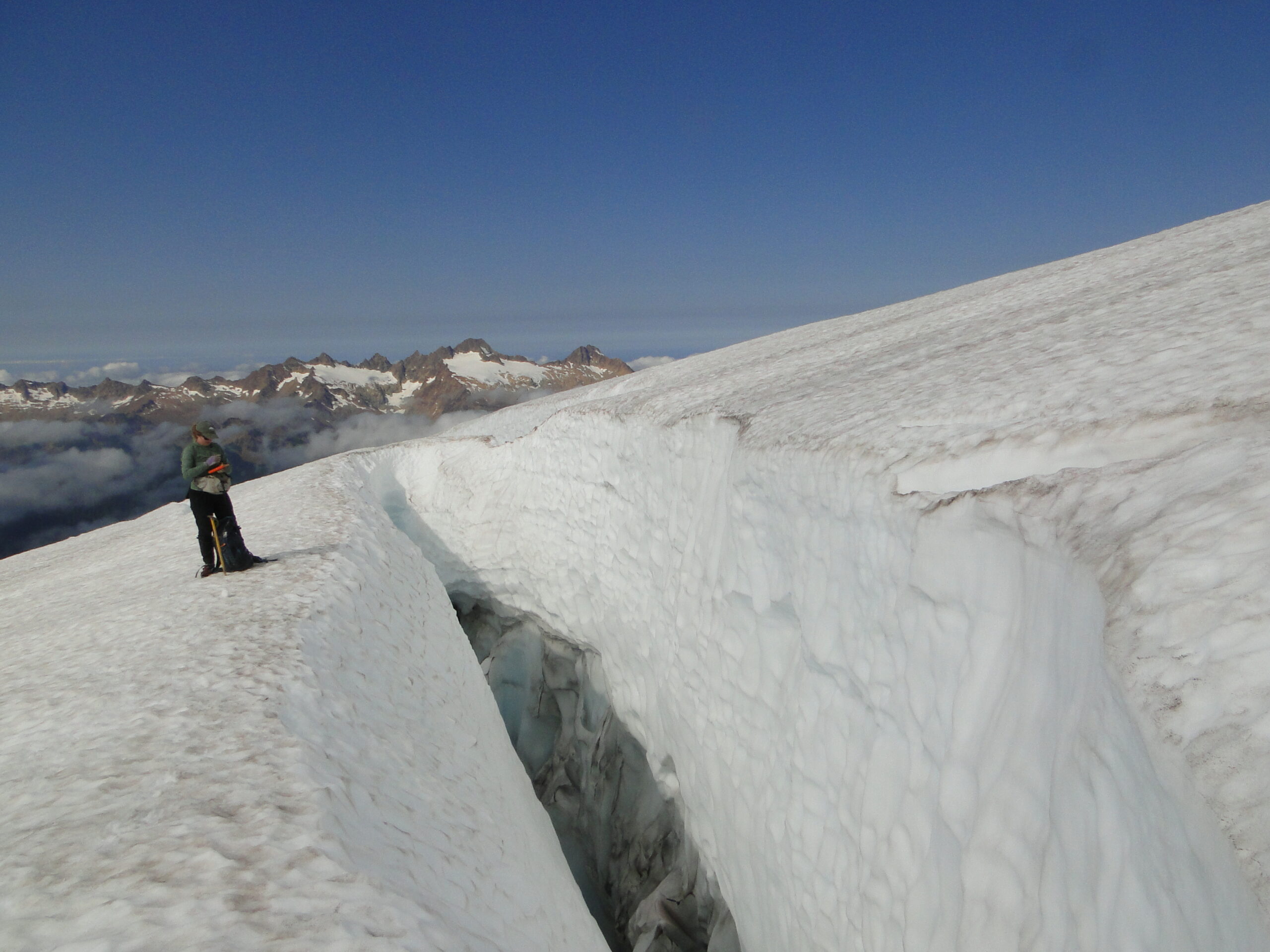
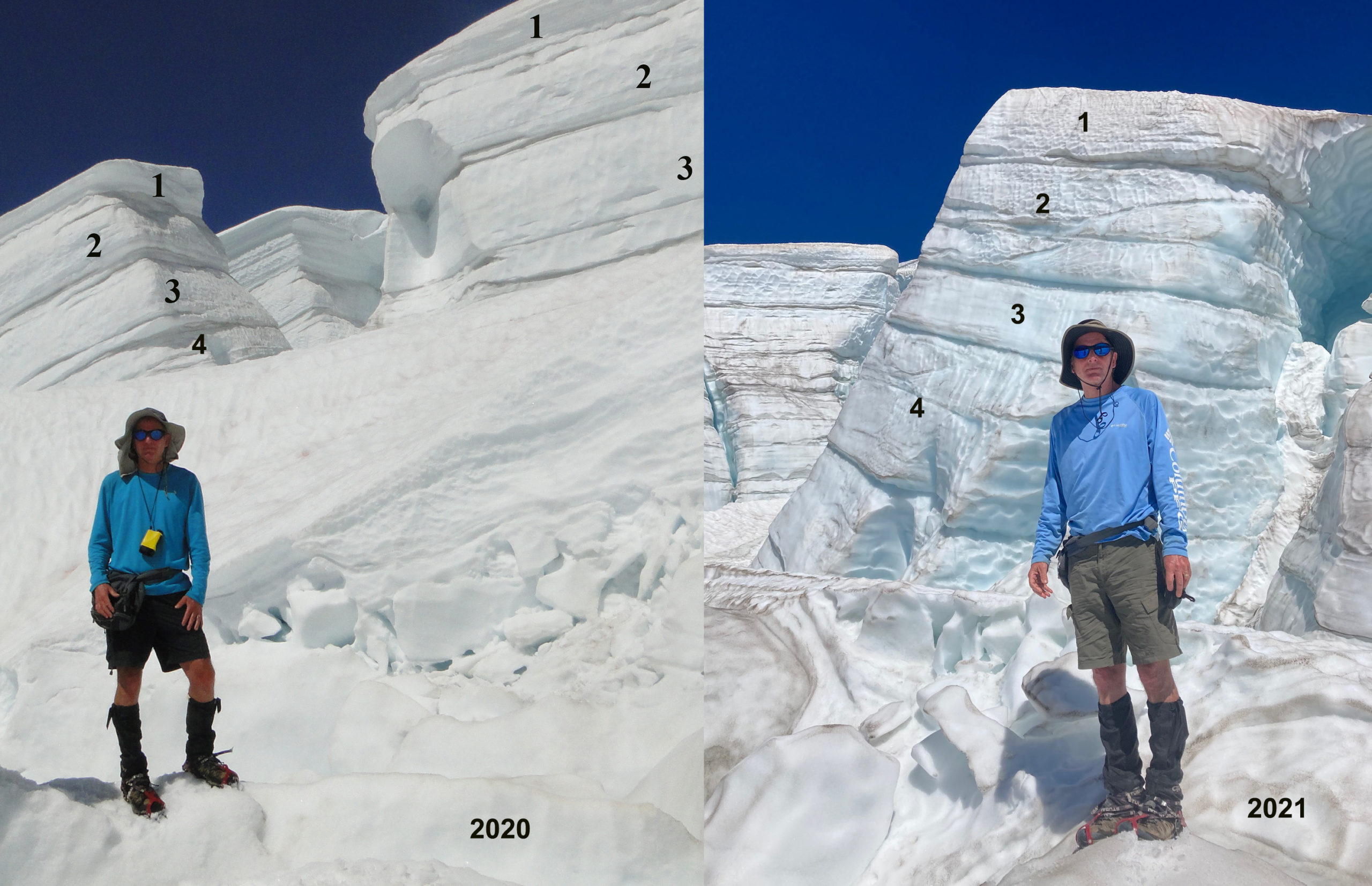
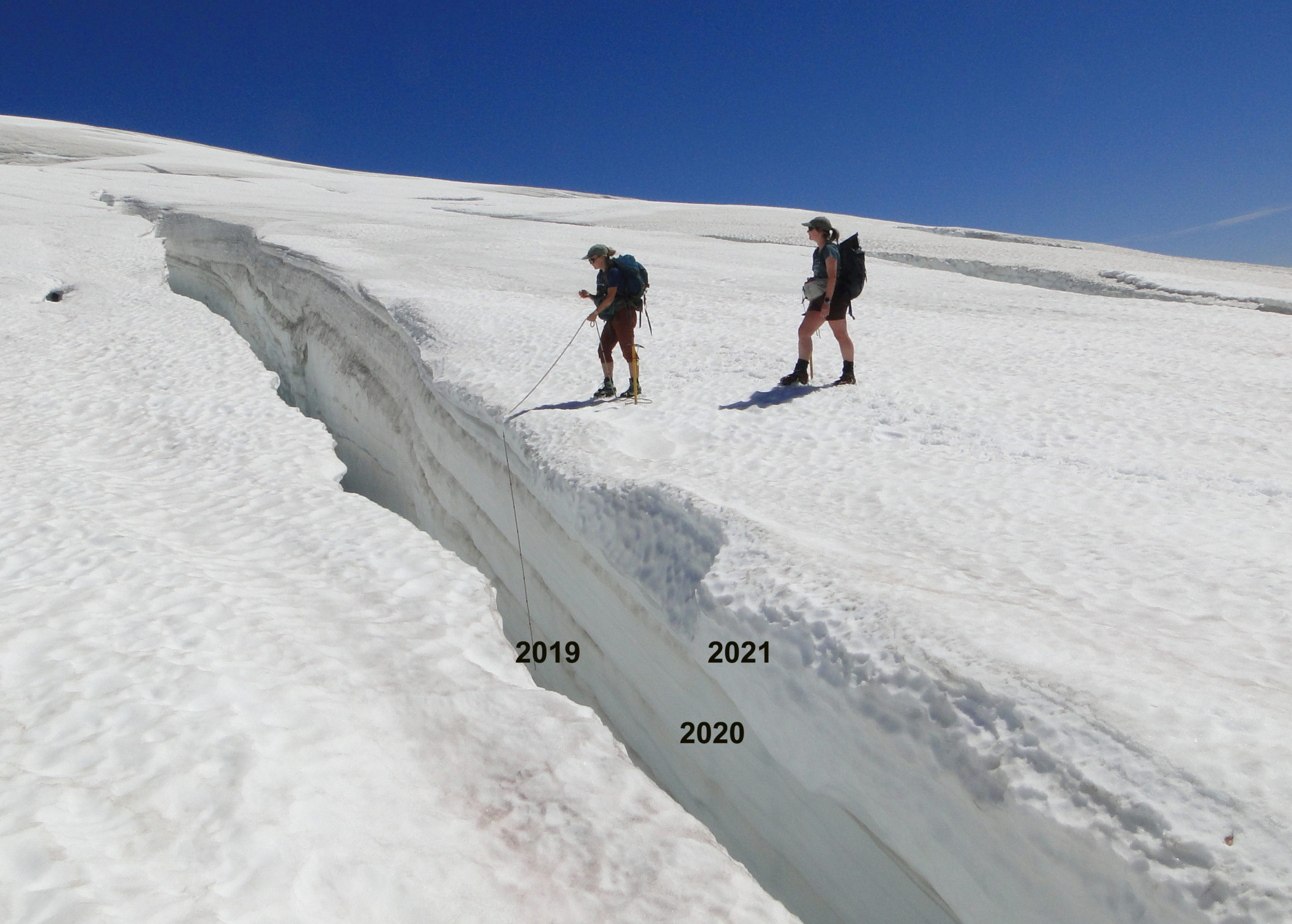
Crevasse measurement of annual snowpack at 2500 m on Easton Glacier comparison of 2019-2022.

Easton Glacier flows down the south side of the mountain and feeds the Baker Lake Hydropower project. We have monitored the mass balance and terminus change of this glacier every year from 1990-2022. This is a World Glacier Monitoring Service reference glacier. In recent years thinning has exposed a few bedrock knobs near 2200 m on the glacier. The glacier has lost 21 m w.e. since 1990 driving a 470 m retreat during this interval. The pace of loss and retreat has been faster since 2013. The typical snowpack retained at the end of the summer has declined from 2.6 to 1.2 m w.e. at 2300 m.

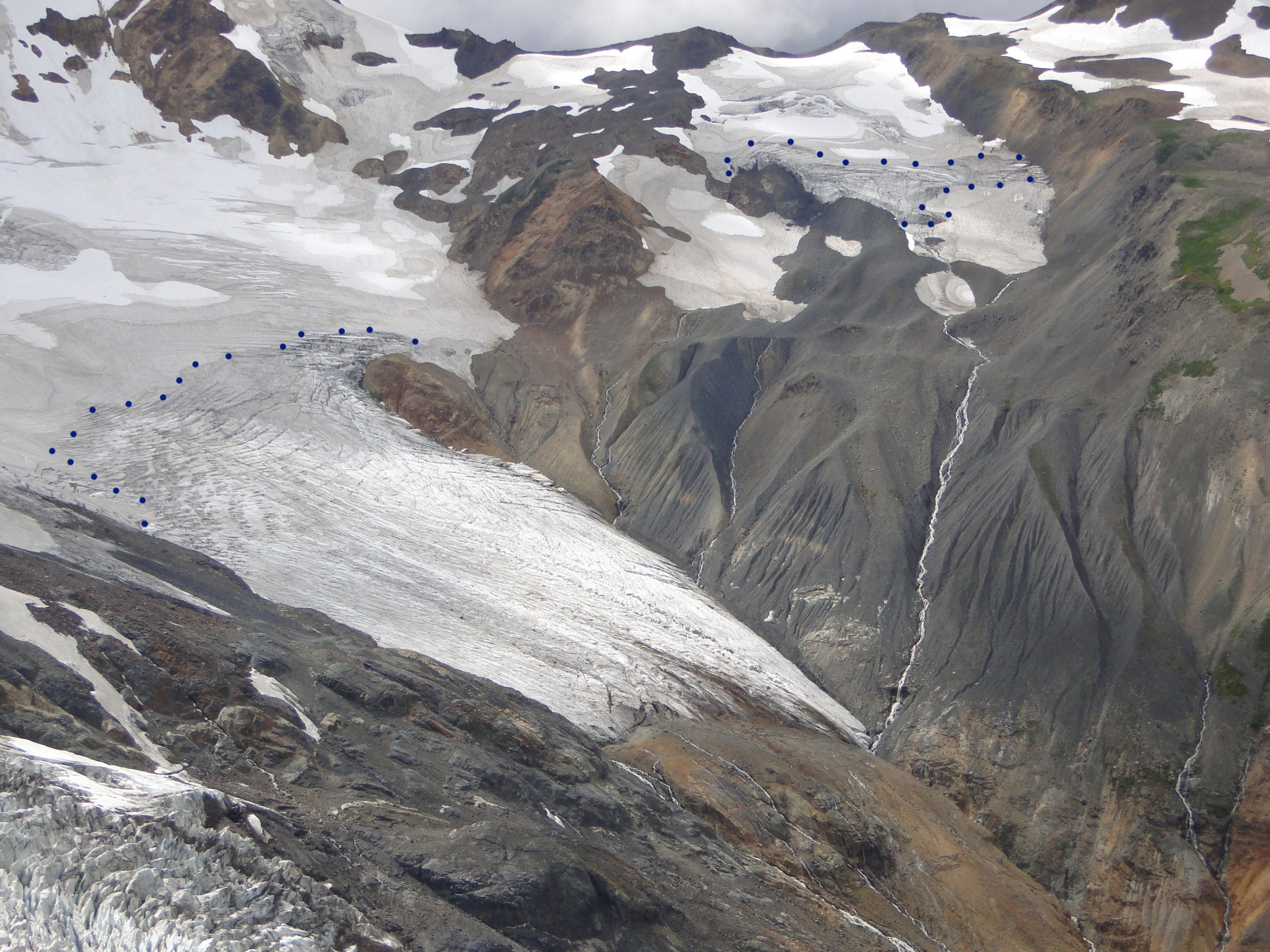
Deming Glacier icefall indicating velocity locations and change in terminus from 1979.

The Deming Glacier drains the southwest side of the summit of Mount Baker a stratovolcano in the North Cascades of Washington, with a massive icefall feeding the lower valley terminus reach of the glacier. The icefall begins at 2200 meters and descends to 1600 meters. The glacier feeds the Middle Fork Nooksack River which provides water supply to Bellingham, WA. Deming Glacier flows from the summit and is the headwaters of the Middle Fork Nooksack River. We observed the terminus of this glacier every year from a survey point and conduct snow depth measurements at 2200 m on the glacier. he NASA Measures ITS_LIVE application uses feature tracking to determine glacier velocity. An examination of velocity change from the top of the icefall to the bottom on Deming Glacier from 2015-2022 indicates deceleration at the three points within or below the icefall, but no change at the top of the icefall.  At the top of the icefall red X velocity has declined ~20%. In the middle of the icefall, green X, velocity has also declined ~20% since 2017. Near the base of the icefall, orange X, velocity has a chaotic signal lacking a clear trend.  Below the icefall at the blue X, velocity has declined by ~20-30%.  The resulting reduction in flux to the terminus will continue the rapid retreat.  Pelto and Brown (2012) measured a 360 m retreat of Deming Glacier from 1979-2009, ~20 m/year. From 1979-2021 the glacier has retreated 725 m, with the rate of retreat from 2009-2021 of ~30 m/year.

Coleman Glacier and Roosevelt Glacier terminus at their maximum size in 1979, photo from Austin Post. Each has receded above the first prominent icefall step indicated by extensive crevassing.

Coleman and Roosevelt Glacier in 2014

In 1984 Coleman Glacier had just completed its advance begun in 1948.  The Roosevelt Glacier on left almost merged with it and Coleman stretched across the Glacier Creek in the valley bottom leaving a prominent moraine that we surveyed retreat from.  The Coleman Glacier has retreated 200 m upslope from Glacier Creek by 1997. Retreat has accelerated with 675 m of retreat from the 1979 moraine to 2022. In 2019 we surveyed the same line across the glacier at 1800 m that we had examined in 1988 and found the glacier had thinned by 38 m in this area.


Coleman Glacier Terminus in 2022.

Roosevelt Glacier retreating to top of bedrock step in 2019.

Roosevelt Glacier is adjacent to Coleman Glaier on the northwest side of Mount Baker. It has followed the same pattern as the Coleman Glacier with less total retreat since 1979 of 550 m.  The glacier in 2022 has retreated above a large bedrock step and has a thin profile that will encourage ongoing rapid retreat.

Mazama Glacier in 2015

Looking up Mazama Glacier from near the saddle with Rainbow Glacier at 2000 m.

Mazama Glacier  flows from the summit down the north side of Mount Baker. The glacier terminates at the head of Wells Creek at 1470 meters. This is a glacier we visit briefly each summer since 1984, but is not a focus of detailed observations. The glacier had a low slope relatively stagnant tongue in 1988 that has led to a rapid retreat of 825 m by 2022. The glacier has a high snow algae region near the Dorr Steamfield.

Sholes Glacier terminus in 2015 with stream gaging location, we calibrated this stream discharge station for the Nooksack Indian Tribe.

Sholes Glacier terminus in 2022 with 1984 terminus location indicated.

Sholes Glacier is on a ridge extending northeast from Mount Baker. We have surveyed mass balance on this glacier each year since 1990. In 2012 in a joint project with the Nooksack Indian Tribe we began summer long monitoring of streamflow below this glacier that has identified the response of glacier melt to heat waves (Pelto et al 2022). The glacier has lost 24.6 m w.e. thickness since 1990 and retreated 170 m, most of that retreat since 2010. Our studies of streamflow indicate how during heat waves glaciers in this basin increase discharge by ~20% and limit water temperature increases (Pelto et al 2022).

Rainbow Glacier terminus in 2014 indicating the 2o14 and 1984 position. Taken by Tom Hammond from Rainbow Ridge.
Rainbow Glacier annual accumulaiton layer thickness in 2013.

Rainbow Glacier is a World Glacier Monitoring Service reference glacier that we have measured the mass balance of each year since 1984.The glacier begins at 2200 m at a saddle with Mazama and Park Glacier and drains the northeast flank of Mount Baker into the headwaters of Rainbow Ceeek and then Baker Lake. The glacier has lost 17.7 m w.e thickness which has driven a retreat of 700 m. The glacier was advancing during our first two years of observations. At the 2000 m saddle with Mazama Glacier the accumulation zone has persisted. The average retained snowpack has declined from 2.7 m to 1.5 m.

Park Glacier Cliffs in 2003

Park Glacier drains the northeast side of Mount Baker’s summit area, meltwater flowing into Baker Lake. Each year we work on the adjacent Rainbow Glacier and during the 1980’s and 1990’s the Park Glacier Cliffs provided a daily sequence of avalanches, the noise echoing across the valleys. By 2010 this occurrence was rare, as the cliffs receded and diminished in height. This accompanied the retreat of the main valley tongue that most of these avalanches had fallen onto.  By 2022 the glacier has receded 690 m from the advance moraine of the 1970’s

Boulder Glacier in 1993 from just below its 1970s advance moraine.

Boulder Glacier from our camp in 2003 illustrating retreat

Debris covered terminus of Boulder Glacier, due to subglacial debris exiting onto glacier surface

Boulder Glacier drains the east side of Mount Baker into Boulder Creek and then Baker Lake. The glacier was advancing rapidly in the 1950s. Our second visit in 1988 revealed a significant retreat underway.  The terminus area of the glacier is debris covered due to subglacial debris flows from the crater exiting onto the glacier surface. This glacier has retreated 850 m retreat from its advance moraine of the 1970’s.

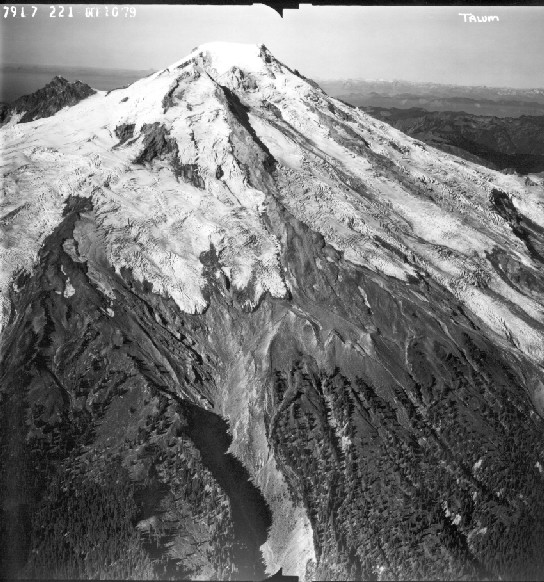
Talum Glacier in 1979 image from Austin Post

Talum Glacier has a wider bottom then top, as it is pinched between the Boulder and Squak Glacier on the east flank of Mount Baker. There are several terminus tongues, which tends to reduce the rate of retreat. Retreat from the advance moraines to 2022 has been 380 m.

Squak Glacier from survey camp in 1990

Squak Glacier from survey camp in 2009

Squak Glacier is adjacent to Easton Glacier on the southeast slope of Mount Baker. This glaciers retreat has been 420 m since 1984 when it was still in contact with its advance moraine. There are several bedrock areas emerging in what was the accumulation zone of the glacier, indicating a substantial expansion of the ablation zone. Thinning of the glacier from 1990-2009 is evident with expansion of ridge between Squak and Talum.

In 2023 we will again be on Mount Baker assessing the ongoing rapid response to climate warming generating glacier thinning and retreat.


Mount Baker Glaciers, Washington Snowpack Recession and Evolution May 2022-May 2023

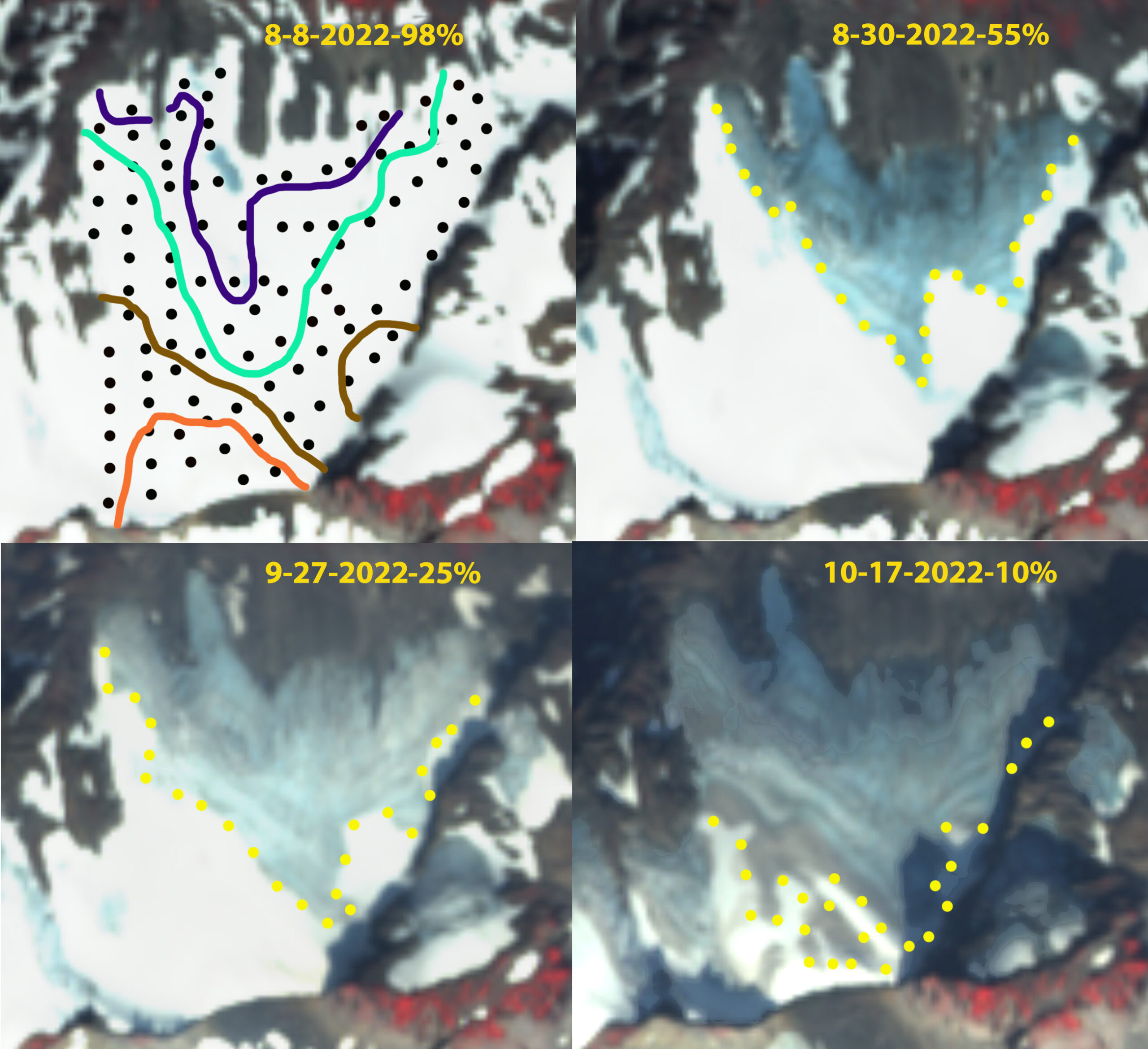
Sholes Glacier snowcover extent change from 8-8-2022 to 10-17-2022. Snowcover declined from 98% of glacier to 10% of glacier during this period. Black dots are measurement sites, yellow dots the transient snowline, purple contour= 1.5 m, green contour= 2 m, brown contour= 2.5 m, and orange contour= 3 m snow depths on 8-8-2022.

The 2022 melt season for Moutn Baker glaciers was one for the record books, with a slow start and a prolonged intense melt lasting into Late October. Peak snowpack was not reached until May 20, 2022 at the Lyman Lake (1515 m) and Middle Fork Nooksack (1825 m) Snotel sites, with limited melt before June 1. These two sites have the highest correlation with our glacier mass balance observations (Pelto, 2018). Peak snowpack at Paradise, Mount Rainier  (1565 m) was reached on May 26. The snowpack on June 1 at LL and MFN was 1.45 m Snow Water Equivalent (SWE) and 1.40 m SWE respectively.  Snowpack at LL melted completely on July 14 and at MFN on July 11, with an average daily loss of 3.2 cm/day SWE. From June 1-Oct. 19 when the melt season ended, observed melt exceeded the previous highest years, we have observed during the 1984-2022 period. In 2023 peak snowpack was reached in mid-April at both LL and MFN, with rapid melt reducing snowpack during the first half of May.

Lyman Lake and Midde Fork Nooksack Snotel site snowpack depth in cm SWE observations beginning April 1 in 2022 and 2023. In 2022 May was a period of snowpack increase in 2022, while the first half of May 2023 has resulted in rapid snowpack depletion.

Heather Meadows  snowpack depth (inches) at 1300 m, with 2022 rising above average during late April, while 2023 dips to average by the start of May.

On Sholes Glacier on August 6th-8th, 2022 we observed snow depths at 110 locations with an average snow depth of 2.25 m, 1.35 m SWE. We also checked two ablation stakes emplaced on June 1 indicating 3.55 m of snow melt, 2.1 m SWE. Sentinel images from Aug.8, Aug. 30, Sept. 9, Sept 27 and Oct. 17 reveal the recession of the snowline through the observation network allowing identification of snow ablation during these intervals. On Aug. 8, 98% of the glacier was snowcovered. On Aug 30, this had declined to 55%, with the snowline intersecting regions of the glacier that had 1.1 m SWE of snow cover on Aug. 8. By Sept. 9, the glacier was 40% snowcovered. On Sept. 27 the glacier was 25% snowcovered, with the snowline interseting sites that had 1.9 m SWE on Aug. 8. This is usually approximately the end of significant melt.  However, in 2022 summer conditions continued through Oct. 19. The glacier was 10% snowcovered on Oct. 17, with the snowline intersecting sites that had 2.7 m SWE on Aug. 8.

The total observed snow melt for the June 1-Oct. 17 period was 4.8 m SWE on Sholes Glacier, eclipsing the previous June-end of melt season highs in 2015 of 4.0 m and in 2021 of 4.4 m.  In both of those years the melt season did not extend into October, though May had significant melt. The Sholes Glacier did not suffer as much mass loss, because the initial snowpack was significantly greater in 2022. To have an equilibrium mass balance a glacier typically requires 55-65% of its area be snowcovered at the end of the melt season. A 10% snowcover indicates substantial mass losses.

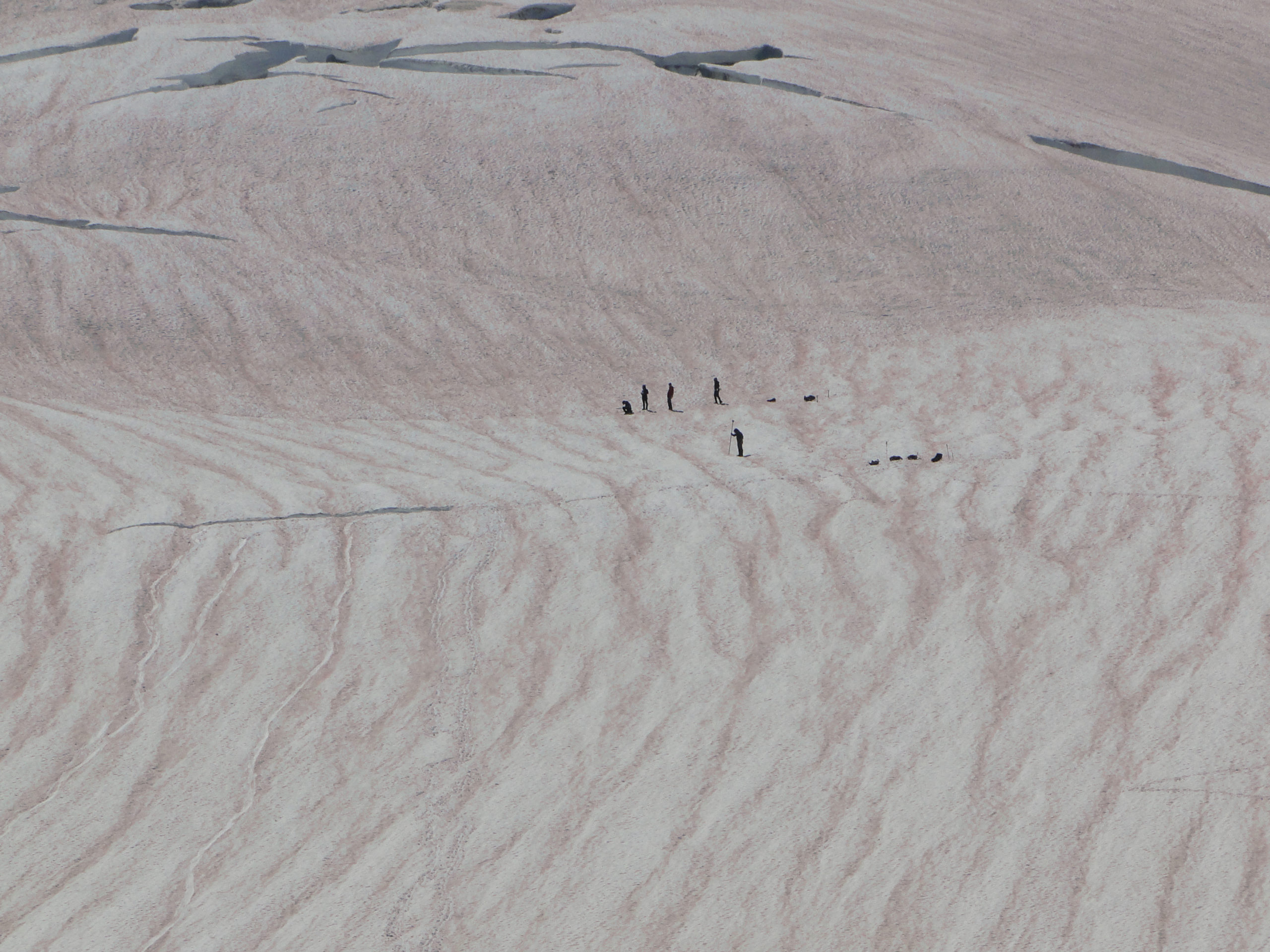
On Rainbow Glacier on Mount Baker observations of snow depth on Aug 5-6, 2022 identified snow depths across the glacier. By Oct. 17th the areas of the glacier with 3.8 m or less of snowpack in early August had lost snowcover, indicating ablation of 2.4 m SWE of snowpack after early August. There was an area of exceptional snow algae at ~2100 m downwind of Dorr Steamfield on Rainbow Glacier, that Alia Khan’s Western Washington University research group examined. We led them through the Rainbow Icefall to this location.

On Easton Glacier, Mount Baker at 2500 m on Aug. 10th there was 5.25 m of snow remaining, compared to 2.75 m on September 27. At 2100 m there was 2.6 m of snowpack on August 10th with this snowpack melting completely between Sept,. 22 and Sept. 27. Indicating 1.6 m SWE of ablation during this period.

What 2022 illustrated is that a good winter season of accumulation, followed by a delayed melt season start, still cannot offset the persistent extended heat the region has experienced the last two summers.  With the melt season off to a faster start in 2023 the outlook for Mount Baker glaciers is for another significant mass loss.

Snow depths on Rainbow Glacier on Aug 5-6, 2022. 

Snow algae on Rainbow Glacier at 2100 m on Aug. 5th. Alia Khan’s WWU collecting samples.

Contrasting snow depth in crevasse in mid-August of 2020 and 2022 at 2500 m on Easton Glacier. Snow depths remaining on August 10, 2022 was ~5.25 m in 2022.

Snow depth at 2100 m on Aug 10th, 2022 on Easton Glacier


Loss of Hinman Glacier, North Cascade Range 1958-2022

Himan Glacier in 1958 USGS map and in 2022 Sentinel 2 False Color image. The three ice masses with an area greater than 0.01 km² are indicated.

Hinman Glacier had descended the northwest flank of Mount Hinman in the North Cascades, Washington and based on 1958 aerial photographs, Hinman Glacier the USGS had listed this as the largest glacier in the North Cascades south of Glacier Peak with an area of 1.3 km² (Post el al 1971). In 2022 the glacier is gone with the largest relict fragment of ice at 0.04 km². This is the story of this glaciers demise that as documented by the North Cascade Glacier Climate Project, that for 40 years has observed in the field the response of glaciers to climate change.

Hinman Glacier in 1988 with 4 distinct ice masses.

In the 1960’s the glacier extended from the ridge top of Mount Hinman at 2250 m to the bottom of the valley at 1675 m. In 1988, Hinman Glacier from the west was  a group of four separated ice masses that we surveyed. The amount of blue exposed that year indicates the glacier lacked a consistent accumumulation zone. This is indicative of a glacier that cannot survive (Pelto, 2010).  In 1992 we mapped the largest of these remaining ice masses at 0.12 km², this was another year with only pockets of blue ice left. In 1998 the glacier has a few areas of blue ice are seen, the glacier was 20% of its mapped size 0.25 km².

In 2005 we observed how thin the ice was including being able to see rock at the bottom of several crevasses  (see below). In 2006, from a Google Earth image,at this point the glacier is no longer detectable under the snowcover that persisted that summer, note the map outline and the gorgeous new “Hinman” Lake  The new lake is 1 km long. A 2009 view from the far end, north end of Lake Hinman up the valley and mountain side that was covered by the Hinman Glacier, now 90% gone. Each of the two larger ice masses from 1998 is now divided into at least two smaller portions. By 2022 the ice fragments have further diminished with the largest just 0.04 km2, less than 4% of its 1958 size. The tendency of this former glacier to be bare of snowcover by late August in many years, is what led to the rapid loss. This same story is playing out on Foss Glacier on the other side of the ridge, though not as quickly.
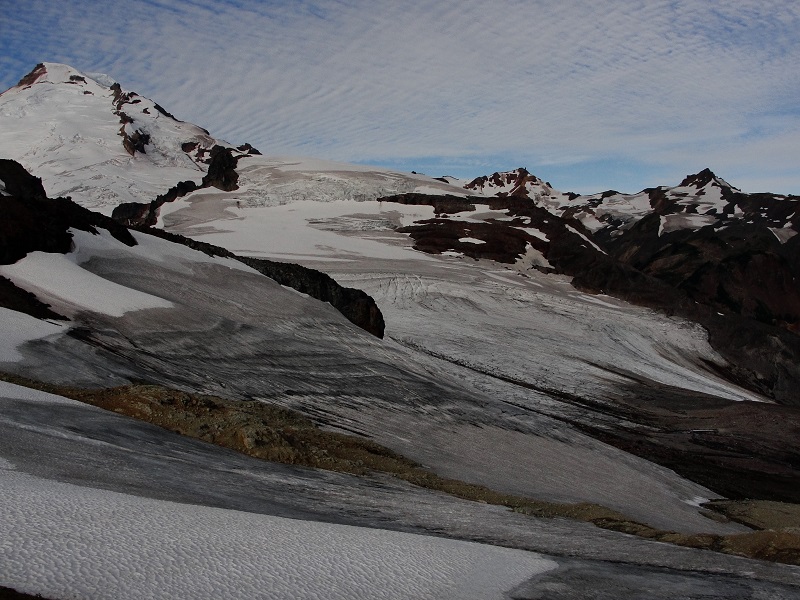
Hinman Glacier thin sections of ice fragmenting in 2005.

The loss of glacier area of this glacier and in the Skykomish River Basin has impacted summer runoff in the Skykomish River watershed. From 1958-2009 glacier area declined from 3.8 km² to 2.1 km²,  (Pelto, 2011), and in 2022 has further diminished to 1.7 km², a 55% reduction. We have monitored all four major glaciers in the basin Columbia, Foss,  Hinman and Lynch Glacier, the primary glaciers in the basin, declined in area by 25%, 70%, 95% and 40% respectively since 1958. Despite 15% higher ablation rates during the 1985-2022 period, the 55% reduction in glacier area led to a 40-50% reduction in glacier runoff between 1958 and 2022. The impact on the Skykomish River is evident.
Glacier runoff on Hinman Glacier heading the Skykomish River. Streams like this used to drain across the glacier all summer long. Now they no longer exist to feed the Skykomish in late summer.

A key threshold of in-stream flow levels considered insufficient to maintain short term survival of fish stocks is below 10% of the mean annual flow (Tennant, 1976).   For the Skykomish River 10% of mean annual flow is 14 m3s-1.  In the Skykomish River from 1958-2021 there have been 363 melt season days with discharge below 14 m3s-1.  Of these only three occurred before 1985, and 67% have occurred since 2003. The loss of 55% of the glacier runoff is a key reason for the onset of critical low flow days. Of more concern for aquatic life is the occurrence of extended periods of low flow (Tennant, 1976). From 1929-2021 in the Skykomish River basin there have been 12 years where streamflow dropped below 14 m3s-1 for 10 consecutive days during the melt season, 1986, 1987, 1992, 1998,  2003, 2005, 2006, 2007, 2015, 2017, 2019, 2021 and 2022.  Precipitation has not declined during this interval, hence earlier snowmelt, reduced glacier runoff and greater evapotranspiration must be causing the increase in late summer low flow periods.

In 2022 a cool start to summer allowed snowpack to persist in the basin into August. Runoff was strong from Columbia Glacier on Aug.1 as we forded the outlet stream, see below. By September glaciers represented the main area of melt. An extended warm period extending into October led to persistent low flow conditions, below 495 cfs (14 m³/sec), from Sept 9.-Oct. 20.

The former Himan Glacier from the new”Hinman” Lake that has formed since 1958 with glacier retreat, 3 small ice patches remain in this 2009 view.

Hinman Glacier basin in 2006 Google Earth view, with “Hinman Lake”.

Himan Basin in Open Elevation map and in 2022 Sentinel 2 False Color image. 

Streamflow and temperature in the Skykomish River at the USGS site at Gold Bar. Period of low flow begins after flow drops below ~500 CFS.

(https://waterdata.usgs.gov/monitoring-location/12134500/)

Fording headwaters of North Fork Skykomish, which is the runoff from Columbia Glacier, on 8-1-2022. 

Suiattle, White River, Whitechuck and Honeycomb Glaciers North Cascade Range Diminishing Rapidly

USGS Map of the four glacier from 1984, with none of the seven lakes existing.

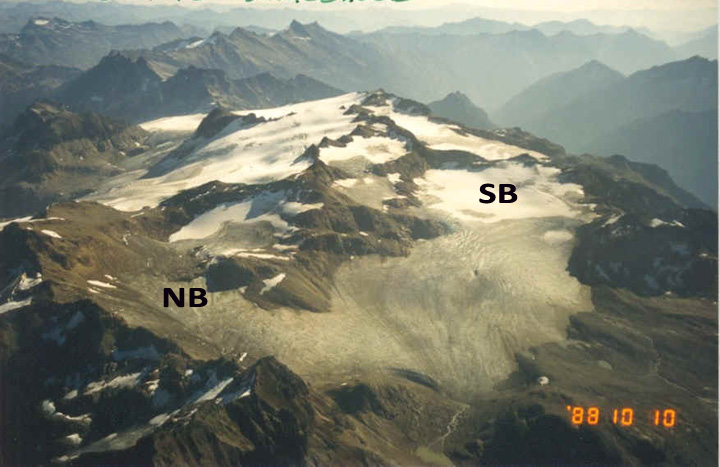
In 1988 we mapped four glaciers arrayed around the Kololo Peaks just south of Glacier Peak; Honeycomb and White River feeding into Wenatchee Lake watershed, while Whitechuck and Suiatlle fed into the Suiattle River watershed. They had a combined area of 9.2 km². The glaciers had not developed a series of proglacial terminus lakes at that time. We visited each glacier and completed observations in 1995 and 2002 illustrated the formation of six proglacial lakes, with one more developing after that, Lake #7. Further details and image for Whitechuck Glacier . In 2022 the glaciers have retreated away from each of these lakes that had not even begun to form in 1988. The combined area of the four glaciers in 2022 is 5.6 km², a 40% decrease in 34 years.

Whitechuck Glacier in 1988, with the North Branch and South Branch joined and terminating at Lake #5.

Whitechuck Glacier in 2002 with a detached glacier segment at Lake #5.

White River Glacier in 1988 with no lake yet formed at #3 or #4.

White River Glacier terminus with Lake #3 having formed, but still largely snowcovered in early August.

Honeycomb Glacier in 1995 with no lake #1 at the terminus yet.

Honeycomb Glacier in 2002 still in contact with Lake #1.

Kololo Peak glaciers in Sept. 9 2022 Sentinel image.  H=Honeycomb, S=Suiattle, WC=Whitechuck, WR=White River, purple dots are the snowline and Point 1-7 proglacial lakes that formed after 1988 and are no longer in constact with glacier.

In 2022 we had the most extensive melting we have observed after September 1, with active significant melt extending to October 19. The result is striking in Sentinel images from Sept. 7 and Oct. 19 indicating the reduction in snowcovered area, the percentage of a glacier covered by snow is its accumulation area ratio (AAR). On September 9 the AAR of these glaciers was 45% diminishing to 10% by October 19. With negligible retained snowpack on Whitechuck and White River Glacier. Since 1988 Honeycomb Glacier has retreated 950 m, White River Glacier 475 m, Whitechuck Glacier 950 m and Suiattle Glacier 450 m.

Kololo Peak glaciers in Oct. 19, 2022 Sentinel image.  H=Honeycomb, S=Suiattle, WC=Whitechuck, WR=White River, purple dots are the snowline and Point 1-7 proglacial lakes that formed after 1988 and are no longer in constact with glacier.

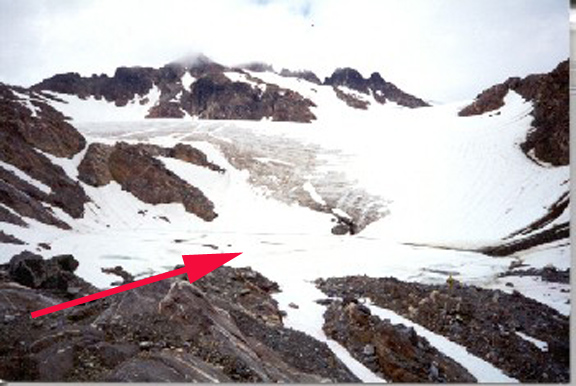
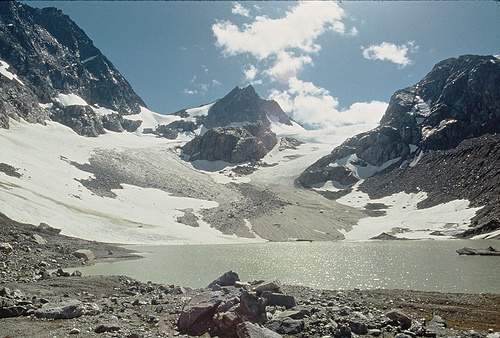
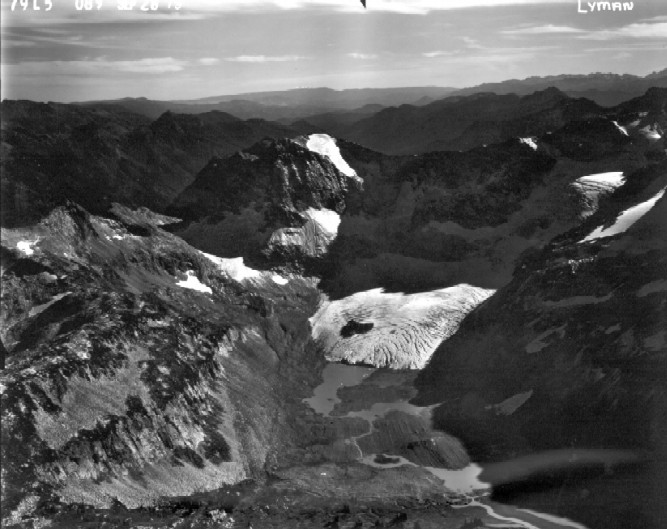
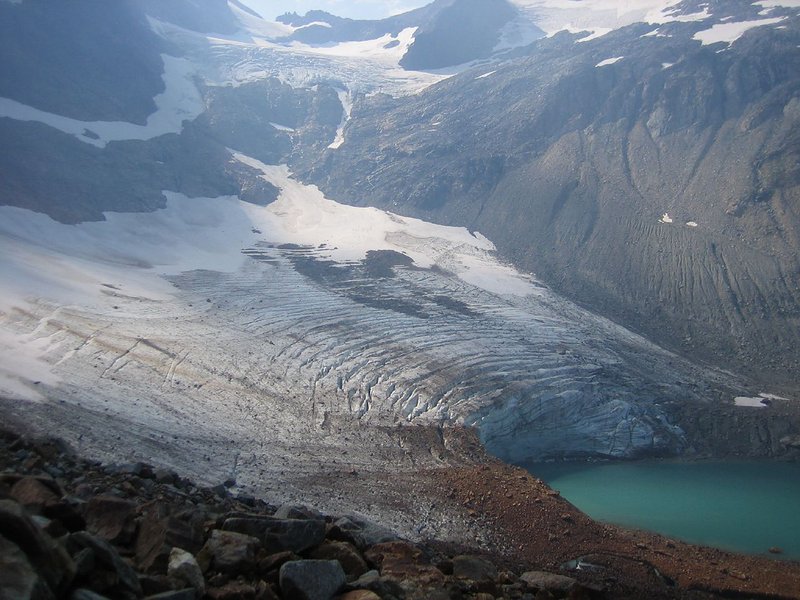
Lyman Glacier Lost Half its area from 1979-2022

Map illustrating changes in Lyman Glacier 1890-2017- losing 87% of its area.

Lyman Glacier which feeds into Lyman Lake and then Railroad Creek in the Lake Chelan drainage of the North Cascade Range, Washington has retreated a total of 1330 m from the 1890 moraine. In 1929 year the terminus position was mapped by the Washington Water Power Company. The Washington Water Power Company emplaced a benchmark from which to measure retreat of the glacier which they monitored from 1929-1940. They found the glacier retreated 195 m from 1929-1940, and 530 m from the Little Ice Age Maximum to the 1940 position. William Long  (Bill) visited the glacier with this party in 1940 and again in 1944 on leave from the 10th Mountain Division. In 1988 and 1990 Bill retured for the first times since 1944, with us, pointing out the benchmark. From 1986-2022 we have surveyd the terminus of this glacier in the field during 15 different summers. Lyman Glacier retreated 11 m/year 1940-1986, 11 m/year from 1986 to 2008, and 5.5 m/year retreat from 2008-2022. Retreat since our first field observations in 1986 has been 298 meters, 800 meters since 1940.

The area of the glacier in 2022 is 0.22 km², which is less than 13% of the 1890 area of 1.72 km².  The glacier has been losing ~1% of its area per year since 1979. The glacier was noted to be in disequilibrium with climate and would melt away with current climate by Pelto (2010). From 1986-2008 the glacier reamined  thick in the middle, over 40 m, as evidenced by a significant ice cliff into the lake. In 1986 this ice cliff maximum height was 15 m. The height increased to more than 20 m by 2003 and reached a maximum of 24 m high in 2008.. By 2011 the ice cliff had diminished to 15 m, and by 2022 to 2.5 m. The current glacier length is 360 m on the eastern portion and 400 m on the western portion. With retreat the slope in the glacier center has increased from 16 to 25 degrees from 1986-2022. The continued retreat at the 50 year retreat rate would eliminate the glacier in 35-50 years, but a simple extrapolation is typically not a good approach to determine when a glacier disappears. In 2008 we noted that the “glacier was still quite thick and should slow its retreat once the bedrock slope begins to increase, and the minor lake calving ceases.” Without a terminus ice cliff crevassing near the front has greatly diminished indicating that the terminus acceleration due to the ice cliff no longer exists. This retreat rate has slowed, while the rate of thinning due to mass balance loss has remained high ~1 m/year. The headwall also is the location of greatest avalanche accumulation, which also will slow retreat.

Additional details and images on Lyman Glacier.

1921 Mountaineers Expedition view of Lyman from the first upper Lyman Lakes shoreline (University of Washington Library), near the 1890 terminus position. Note the glacier is connected to the arm leading to Spider Gap top center. 


Lyman Glacier in 1979 (USGS) no longer connected to spider gap section. A second upper Lyman lake has formed and the glacier terminates in this lake. The glacier is connected to upper Lyman Glacier extending top right.

Lyman Glacier in 1986. Debris pile from 1930’s avalanche just reaching front, calving front at terminus narrow and only 5-8 meters high, Mauri Pelto in foreground.

Lyman Glacier 2006 with very active crevassing behind 15-20 m high calving front. Glacier is disconnected from upper Lyman Glacier, top center.

Lyman Glacier in 2007 from far end of newest upper Lyman Lake near the 1940 terminus position.

2008 Terminus ice cliff that is 18-24 m high above and below.

Lyman Glacier 2011 most extensive snowpack in the 2000’s, ice cliff 10-15 m.

Lyman Glacier in 2022 from east margin reduced slope and size compared to similar viewpoint in 1988, Jill Pelto in foreground (Kevin Duffy-image)

Lyman Glacier 2022 with annotated measurements from the 2008 terminus locations and of terminus condition. Kevin Duffy on the terminus rock. (Jill Pelto-Image)

North Cascade Glacier 2022 Initial Observations-39th Field Season

field team 1

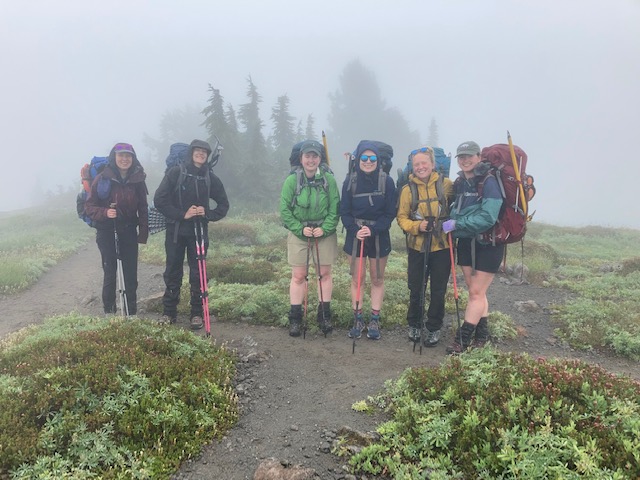
2022 North Cascade Glacier Climate Project Field Team

Science Director: Mauri S. Pelto, mspelto@nichols.edu
Art Director: Jill Pelto, pelto.jill@gmail.com

For the 39th consecutive summer we were in the field to measure and communicate the impact of climate change on North Cascade glaciers. We completed detailed measurements on 10 glaciers, three of which are part of the World Glacier Monitoring Service reference glacier network (42 glaciers globally), which have 30+ consecutive years of mass balance observations. NCGCP was founded in 1983 to identify and communicate the response of North Cascade glaciers to regional climate change. We are a fieldwork-based project with a focus on measuring changes in mass balance, glacier runoff, and terminus behavior. The project has an interdisciplinary scope — collaborating with a range of natural scientists, artists, journalists, and conservationists.

This winter snowpack remained below average until a late season surge from April into May.  Snowpack was 90% of the mean (1977-2021) on April 1% and 110% of the mean on May 10.  The month of May and June had below normal temperatures leading to an above average glacier snow cover as June ended. July and August were exceptionally warm at Heather Meadows  (4200 feet) average July and August maximum temperature is 19.2 C, this year 20 days reached or exceeded 5 C above this temperature in July and August 2022. At Stevens Pass (4000 feet) average July and August maximum temperature is 21.4 C, this year 24 days reached or exceeded 5 C above the temperature in July and August 2022. The average July-August temperature at the Stevens Pass and Lyman Lake sites was the highest since records began in 1990.

The result is that glacier snowcover rapidly melted during the July-August period, which is resulting in significant mass losses for North Cascade glaciers that continue to thin, retreat and lose volume. The climate stress is evident on the glaciers, but also in the alpine vegetation and alpine aquatic ecosystems.

Field team backpacking around Blanca Lake at our first field site.

Columbia Glacier with the 1984 terminus position, note the glacier profile now descends from west side (left) to east side (right) of the glacier. The glacier has retreated 270 m since 1984. Note steep tongue extending across entire cirque valley in 1988 lower image.

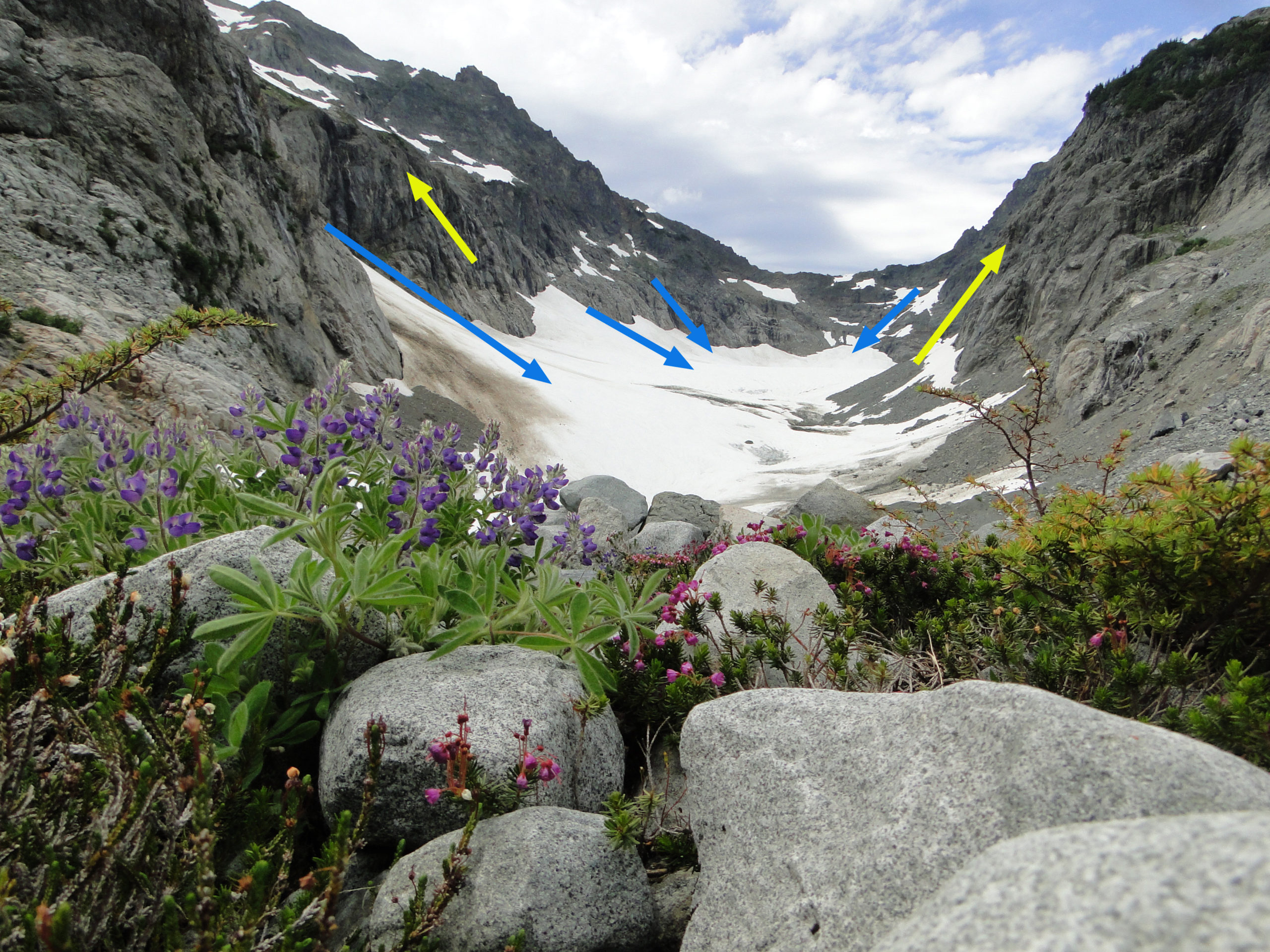
Columbia Glacier indicating the avalanche fans that now provide most of the accumulation to the glacier at the blue arrows. The yellow arrows indicate avalanche slopes that are no longer key feeders resulting in marginal thinning and recession. These locations or reduced avalanching have resulted from the source area slopes having lost their perennial snow and ice, which must be filled each winter before a slide can occur. Snowpack in the avalanche fans exceeds 3 m, while outside of the avalanche fans averaged 1.8 m on Aug. 1-2, 2022.

Jill Sketching Blanca Lake and Troublesome Creek draining from Columbia Glacier.

Braided stream issuing from the the rapidly retreating and thinning Sholes Glacier on the north flank of Mount Baker. Retreat since 2015 has been 90 m, with 225 m since 1984.

Snow depth measurements  in meters on Rainbow Glacier using crevasse stratigraphy, adjacent Park and Mazama Glacier drain the upper part of Mount Baker. Average depth at 2000 m was 5.25 m, 3.15 m water equivalent. The terminus of the glacier continues to retreat rapidly, but was buried by avalanche debris at the time of our survey in 2022.

Alia Khan’s Western Washington University team assessing a red algae zone on Rainbow Glacier, we led them through the icefall to this location, where they sample impurities on the glacier surface and relate that to remote sensing products.

Jill’s sketch of Rainbow Glacier and Mount Baker from trail above Lake Ann.

Lower Curtis Glacier indicating recession since 1985. The glacier has thinned considerably in the lower section since the 2003 image below.

Navigating through the icefall region on Lower Curtis Glacier where we are mapping snow pack depth and crevasse depth. 

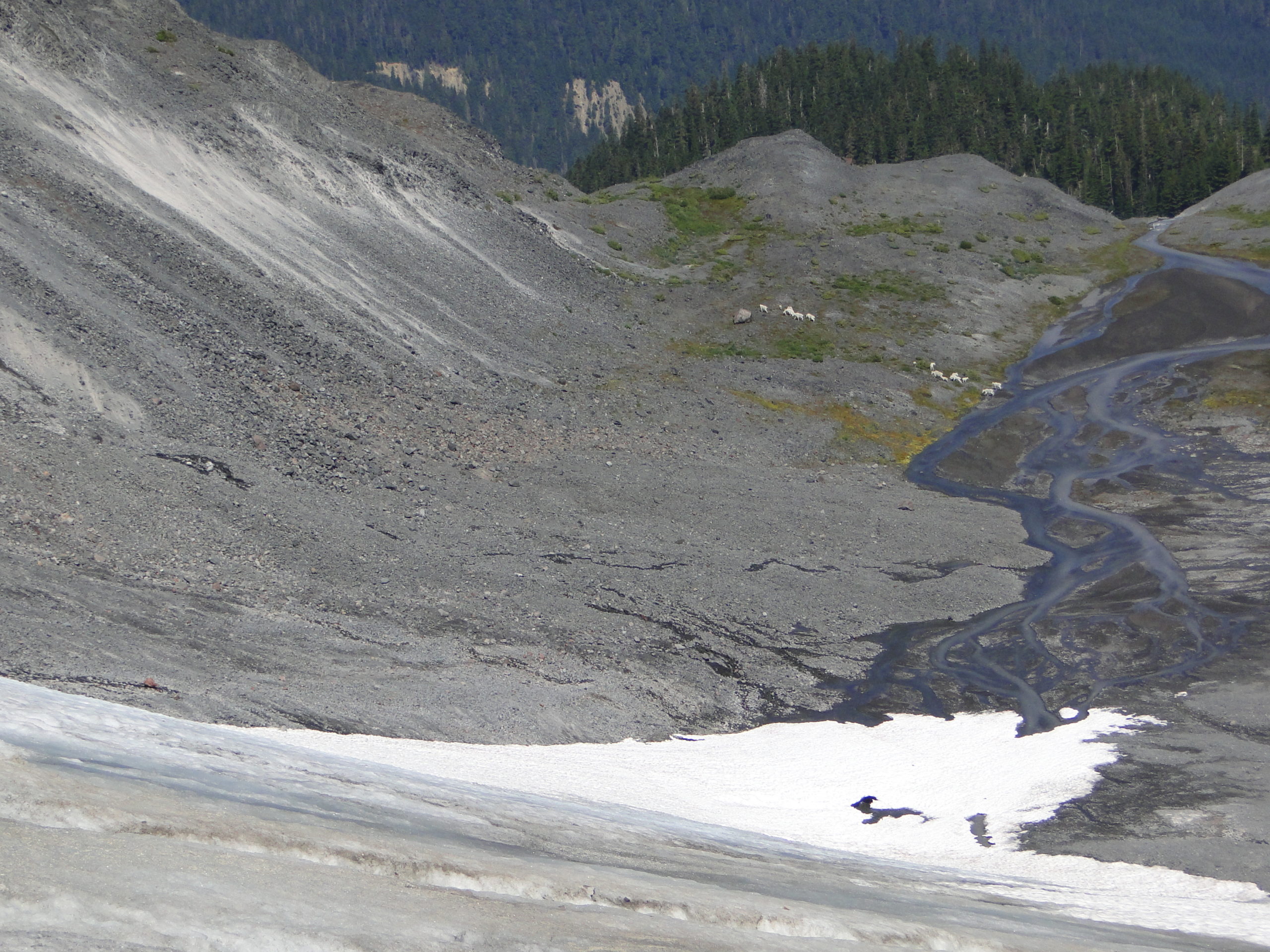
Deglaciated terrain since 1990 below Easton Glacier. We mapped this at 0.18 square kilometers in 2022.

We have observed crevasse depths for a decade and have seen both their number and depth decline in icefalls on Easton and Lower Curtis Glacier due to glacier thinning and reduced velocity. Deepest crevasses are at the top of the convex slope change, 25-30 m deep.

Claire Giordano painting Easton Glacier crevasse ‘blues’ at top of lowest icefall.

Ascending into Easton Icefall with five annual layers exposed on serac.

Snow depth assessment in specific crevasse at 2500 on Easton Glacier. No snow was retained here in 2021. Avergage depth in 2020 in this region 5.5 m, 4.75 m in 2022.

Easton Glacier has retreated 470 m from 1990-2022. Above is 2022 and below is 2003 image.

Ice Worm Glacier on Mount Daniel was fully snowcovered. We completed a grid of 72 snow depth measurements with a mean of 2.1 m in depth. The glacier continues to recede faster on its upper margin than at the terminus.

Descending onto Lynch Glacier, which had an accumulation area ratio of 83% in mid-August. Average snow depth 2.5 m.

Probing snow depth and surveying blue ice margin on Lynch Glacier.

Daniel Glacier was fully snowcovered in mid-August. Consistent snow depths of 1.8-2.5 m.

Jill’s field watercolor and colored pencil. This piece was done below the small Iceworm Glacier, on Mt. Daniel. It looks out towards the prominent Cathedral rock and Alpine Lakes Wilderness. Jill really enjoyed making this piece — to start she sketched the landscape, and then temporarily moved in front of the purple penstemon and the pale elmira flowers to capture them in the foreground. A while after she began painting, the wind dropped, and the mosquitoes arrived in force. Jill had to stop painting for the evening and went back to camp. Because Jill then finished at home, it was fun to add some more detail to this piece.

In the vicinity of Peggy’s Pond near our Mount Daniel base camp are a dozen shallow ponds, 10-20 cm are average that typically endure through the hatch of tadpoles in late August or early September. The primary inhabitants are frogs (Rana Cascadea) and their tadpoles. In 2022 despite a wet spring and early summer that had the ponds brimming with water, right above, tadpoles were observed, where typically there are several hundred, and the frog numbers were ~50% of usual. This followed the dried beds of these ponds in 2021, at left.  Maybe this is in part why mosquitoes were swarming here.

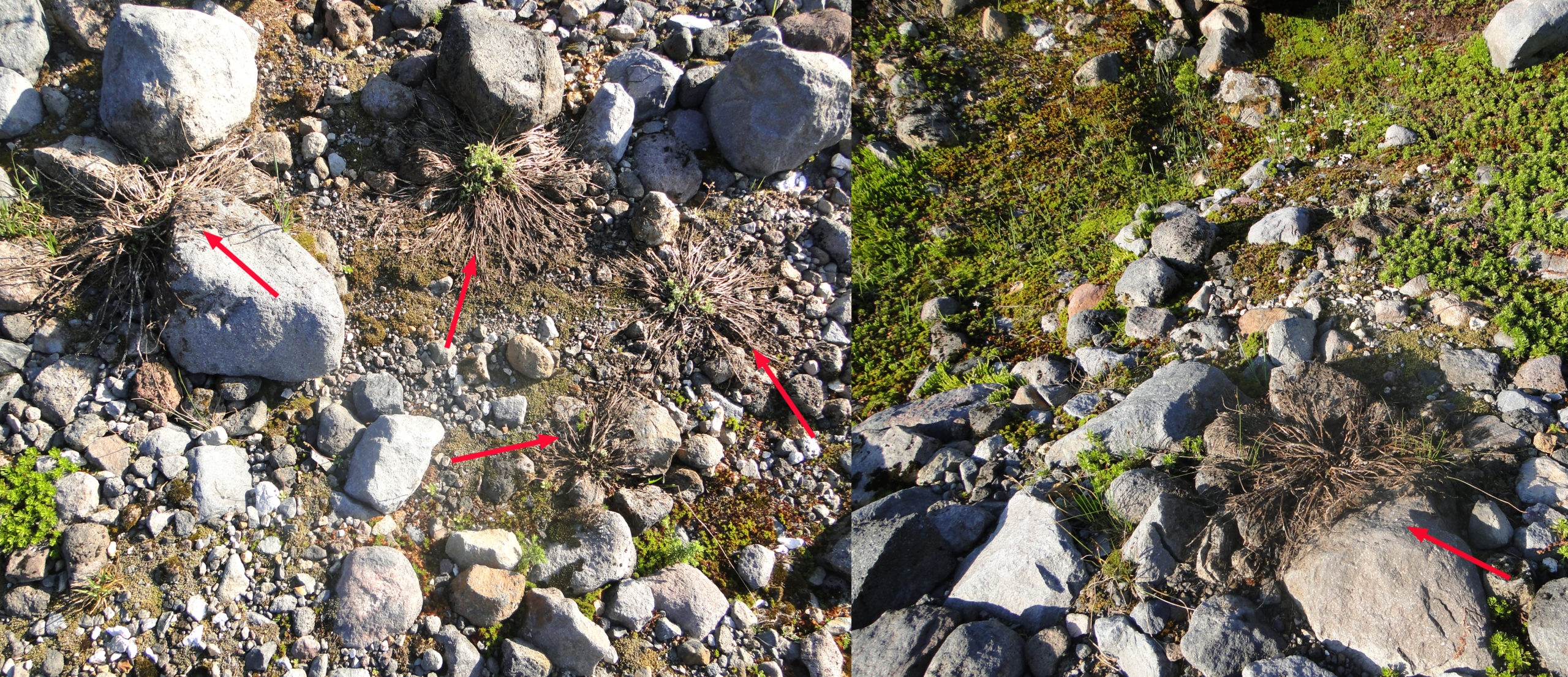
In 2021 below Easton Glacier we noted a number of alpine plants that had emerged just before or during the record June heat wave, had been dessicated/cooked by the heat in this are of relatively barren volcanic rock. Most notably lupine. This year in the same region we noted that ~30% of the lupine had failed to develop by August 2022, despite a cool wet spring. In contrast the evergreen alpine plants in the same area penstemon, saxifrage, pink and white heather, and partridge-foot all were fine.

NORTH CASCADE GLACIER CLIMATE PROJECT 2022-39th Annual Field Program

Mount Baker camp for Rainbow and Sholes Glacier (Illustration by Megan Pelto)

Science Director: Mauri S. Pelto, mspelto@nichols.edu
Art Director: Jill Pelto, pelto.jill@gmail.com

2022 Field Season: For the 39th consecutive summer we are heading into the field to measure and communicate the impact of climate change on North Cascade glaciers. We will complete detailed measurements on 10 glaciers, three of which are part of the World Glacier Monitoring Service reference glacier network (42 glaciers globally), which have 30+ consecutive years of mass balance observations.

Who we are? NCGCP was founded in 1983 to identify and communicate the response of North Cascade glaciers to regional climate change. We are a fieldwork-based project with a focus on measuring changes in mass balance, glacier runoff, and terminus behavior. The project has an interdisciplinary scope — collaborating with a range of natural scientists, artists, journalists, and conservationists. The goal of this is to best document and share our research with a broad audience. We aim to bring stories of these places and their changes to as many people as we can, making our research feel personal to more than just our team. The North Cascades glaciers are important for the ecosystem, as a water resource to Washington, and as a place of recreation for so many. By monitoring them every year, we continue to provide critical data on glacier response to climate change and informed stories of their health that reveal the impacts of our warming world.

2021 Field Team for Rainbow Glacier

Why study glaciers in the North Cascades? Glaciers are one of the world’s best climate monitors and are a critical water resource to many populated glaciated regions. This is particularly true in the North Cascades where 700 glaciers yield 200 billion gallons of summer runoff and glaciers have lost 30 % of their area in the last century.  This has reduced glacier runoff in late summer in the region as the reduction in glacier area has exceeded the increase in melt rate. During heat waves this role is even more profound with the glacier fed North Fork Nooksack River discharge rising ~24% due to greater melt, while adjacent unglaciated South Fork Nooksack River discharge declines by ~20% (Pelto et al., 2022). The increased discharge limits the rise in river temperature during heat waves to 0.7 C in the North Fork, with the South Fork increasing by 2 C. This increases stress on the salmon in the South Fork (Pelto et al., 2022).

Terminus Change at Columbia and Easton Glacier.

This field season follows the 2021 season that featured a historic heat wave at the end of June and a period of extended warm weather that lasted until Mid-August. The heat led to a greater exposure of bare ice on glaciers earlier in the summer, particularly at higher elevations.  For ice surfaces with a higher albedo and greater density the observed melt rates are 7-9 cm per day water equivalent during warm weather events vs 4-6 for snow surfaces. This led to substantial mass losses on North Cascade glaciers, -2 m.

This summer we will have an opportunity to assess the long-term ramifications of the 2021 summer and measure the response of glaciers to the weather of 2022. This winter snowpack remained below average until a late season surge from April into May. The month of May and June had below normal temperatures leading to an above average snowpack. A hot July has melted into this snowpack and we will observe how much remains on the glaciers.

Field Team 2021:

Jill Pelto is an artist and scientist from New England who grew up loving winter sports and trips to the mountains. She incorporates scientific research and data into paintings and prints to communicate environmental changes. Her multi-disciplinary work weaves visual narratives that reveal the reality of human impacts on this planet. She completed both her B.A. degrees in Studio Art and Earth and Climate Science and her M.S. focused on studying the stability of the Antarctic Ice Sheet at the University of Maine, spending two field seasons at a remote camp in the southern Transantarctic Mountains. Jill will be joining the project for her 14th field season. She is excited about continuing to document the change in North Cascade glaciers that she has witnessed each of the last ten years — through science and art.

Mauri Pelto has directed the project since its founding in 1984, spending more than 700 nights camped out adjacent to these glaciers. He is the United States representative to the World Glacier Monitoring Service, author of the AGU blog “From a Glacier’s Perspective”, and associate editor for three science journals.  He is on the Science Advisory Board for NASA’s Earth Observatory. His primary position is Associate Provost at Nichols College, where he has been a professor since 1989.

Echo Allen is a rising Junior at UC Berkeley studying Architecture and Sustainable Design. Her studies deal with urban ecology and environmental justice in relationship to physical design. Echo finds inspiration for her studies in the backcountry as a NOLS backpacking student, avid rock climber, and kayak guide. Echo is currently working with the City of Richmond and SHAC (Sustainable Housing at Cal) to design and construct an affordable and scalable model of a solar-powered off-grid capable tiny house that will be used as affordable housing in Richmond CA. She hopes to help people understand the impact of climate change and implement possible mitigation strategies through her work in outdoor education and architecture.

Ellie Hall (she/her) is a recent graduate from the University of Colorado – Boulder with a BA in Environmental Studies, a minor in Geology, and a certificate in Arctic Studies. She is interested in researching and documenting the nuanced impacts of climate change on cold regions, and especially learning more about the relationship between decreasing snowpacks and increasing wildfires. She has spent the past two summers researching these areas, interning with INSTAAR’s Arctic Rivers Project and NASA’s ABoVE Campaign. She is excited to get into the field this summer to see the theoretical knowledge she’s learned be put into practice to collect valuable data. Ella’s other interests include backcountry skiing, mountain and gravel biking, rock climbing, and water sports.

Jenna Travers (she/they) is about to start her final year as a marine biology major at the University of Oregon. Her research focuses on the impacts of glacier retreat on salmon, how communities are affected by glacier loss and salmon declines, and how climate issues are communicated to the public. They are currently working as a writer with GlacierHub and a salmon identification contractor with the Wild Salmon Center, and they have also worked as a legislative intern for the Oregon State Legislature, a Water Justice intern with a local nonprofit. In her free time, Jenna enjoys hiking, skiing, rock climbing, and playing games with her roommates.

Field Partners 2022

Alia Khan’s research team including grad students Sally Vaux and Shannon Healy focus on environmental chemistry in the cryosphere, including black carbon and snow algae to document global change of glacier and snow melt in mountainous and polar regions. Western Washington University Cryosphere Studies and Aquatic Biochemistry Lab.

Claire Giordano is an environmental artist, writer, and educator creatively telling the stories of science, climate change, and the modern experience of nature. From creating rain-dappled sketches in an old growth forest to filming a watercolor class beside a glacier, careful observation of nature inspires her goal is to connect people and place through art.  In 2021 she founded the Adventure Art Academy – a series of virtual watercolor classes filmed outside – to invite others into the joy of painting outside.

Jaclyn Baer is an artist and photographer in the PNW. She is new to the climate change artist role, but excited to learn and share. She loves painting with gouache in her studio and watercolor out in the field. Besides painting, she spends her free time hiking and backpacking with her husband Ryan.

Nooksack Indian Tribe, for the 11th consecutive year, we will be conducting field work aimed at providing field validation and streamflow calibration data below Sholes Glacier for the ongoing work of the tribe.

Crevasse Stratigraphy on Easton Glacier

 2022 Field Schedule

Jul 31:  Hike in Columbia Glacier
Aug. 1:  Columbia Glacier
Aug. 2:  Columbia Glacier
Aug. 3:  Hike Out Columbia, Hike in Ptarmigan Ridge
Aug. 4:  Sholes Glacier
Aug. 5:  Rainbow Glaciern
Aug. 6:  Rainbow Glacier
Aug.7:   Hike out, Hike in Lower Curtis Glacier
Aug. 8:  Lower Curtis Glacier
Aug. 9:  Hike out, Hike in Easton Glacier
Aug. 10: Easton Glacier
Aug. 11: Easton Glacier
Aug. 12: Hike out Easton/Hike in Daniel
Aug. 13: Ice Worm Glacier Survey
Aug. 14: Daniel and Lynch Glacier Survey
Aug. 15: Ice Worm ablation, Hike out
Aug. 16: Field season concludes


Deming Glacier Icefall Deceleration 2017-2022 Driven by Mass Balance Loss

Deming Glacier velocity from NASA MEaSUREs ITS_Live at four locations from below icefall at blue X to above icefall at red X. There is not a significant change in velocity above the icefall (red X), but significant deceleration in the icefall and below the icefall. 

The Deming Glacier drains the southwest side of the summit of Mount Baker a stratovolcano in the North Cascades of Washington, with a massive icefall feeding the lower valley terminus reach of the glacier. The icefall begins at 2200 meters and descends to 1600 meters. The glacier feeds the Middle Fork Nooksack River which provides water supply to Bellingham, WA. I first observed the Deming Icefall from the terminus area of the glacier in 1987. This visit demonstrated that it is not safe to hike to the terminus of this glacier. In 1990 we began annual observation of Deming Glacier. Each summer we monitor the adjacent Easton Glacier in detail including mass balance, while also taking several specific observations of Deming Glacier including terminus position, and accumulation between 2400-2700 m. This combined with mass balance assessment on Easton Glacier provides an annual assessment of the meltwater provided by the glacier to the Nooksack River system. During heatwaves the tributaries of the Nooksack fed by glaciers have had the impacts mitigated, while those without glaciers have seen significant temperature increase and discharge decrease (Pelto et al 2022).

Pelto and Brown (2012)  identified a mean annual mass balance loss of -0.52 m/year from 1990-2010 on Mount Baker glaciers. From 2013-2021 the mass loss had more than doubled to -1.30 m/year. The declining mass balance is less pronounced above the icefall. The icefall transitions the glacier from the accumulation zone to the ablation (melt) zone at the bottom of the icefall. Above the icefall at 2400-2700 meters the average snow depth left at the end of the summer based on several thousand crevasse stratigraphy measurements from 1990-2013 had been 2.75 meters, from 2014-2021 the average depth has been 2.4 m.

The result of the declining mass balance of the entire glacier and the upper glacier will be glacier deceleration. The NASA Measures ITS_LIVE application uses feature tracking to determine glacier velocity. An examination of velocity change from the top of the icefall to the bottom on Deming Glacier from 2015-2022 indicates deceleration at the three points within or below the icefall, but no change at the top of the icefall.  At the top of the icefall red X velocity has declined ~20%. In the middle of the icefall, green X, velocity has also declined ~20% since 2017. Near the base of the icefall, orange X, velocity has a chaotic signal lacking a clear trend.  Below the icefall at the blue X, velocity has declined by ~20-30%.  The resulting reduction in flux to the terminus will continue the rapid retreat.  Pelto and Brown (2012) measured a 360 m retreat of Deming Glacier from 1979-2009, ~20 m/year. From 1979-2021 the glacier has retreated 725 m, with the rate of retreat from 2009-2021 of ~30 m/year.

View of the Deming Glacier from terminus to top of icefall in 2019. Jill Pelto at left, Abby Hudak and Mauri Pelto at right. X’s mark the velocity locations, Point A ties this to the upper glacier view, red arrow is the 1987 terminus location.

The icefall sweeps around a bedrock with an east and a west arm splitting above and rejoining below the knob.

The Deming Glacier from the top of the icefall to the summit of Mount Baker in 2020.

In mid-August 2022 snowpack was particularly low right to the top of Deming Glacier. Comparison with 2020 which was an average year for the last decade, but still a significant mass balance loss.

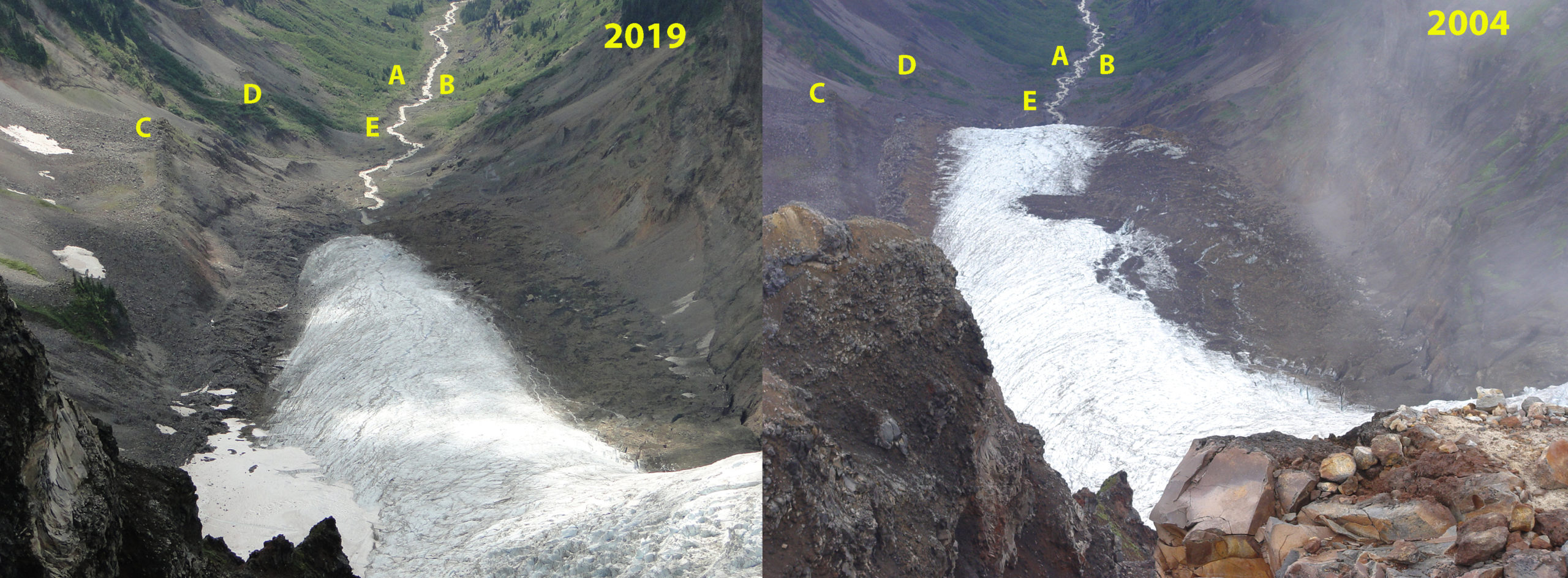
Deming Glacier terminus annotated to show retreat from 2004 to 2019 in photographs from Mauri Pelto

Terminus of Deming Glacier in 2004 and 2019 illustrating the ongoing retreat of the terminus, 725 m from 1979-2021.

Jill Pelto measuring Crevasse depth and snowpack thickness in Crevasse at 2500 m on Deming Glacier.

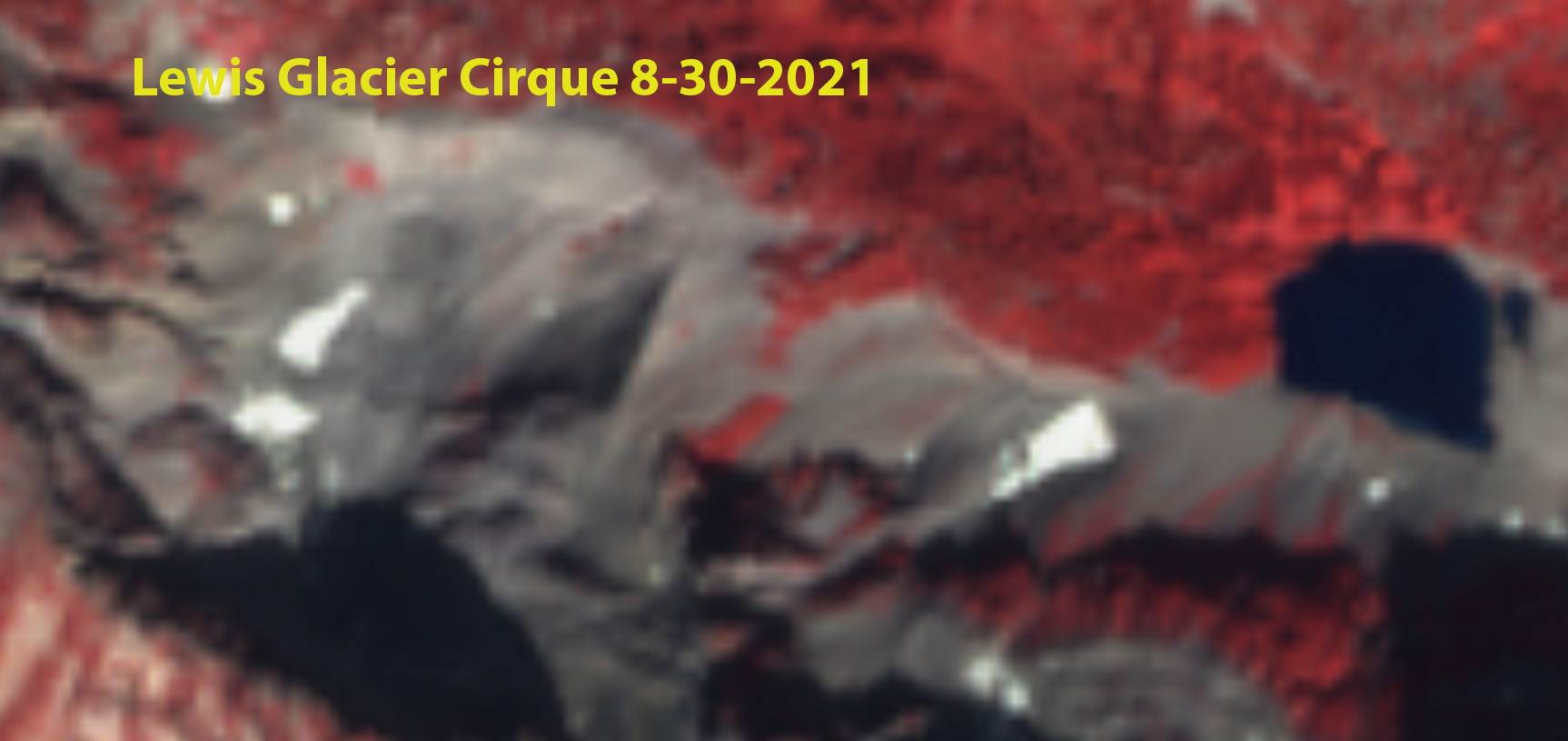
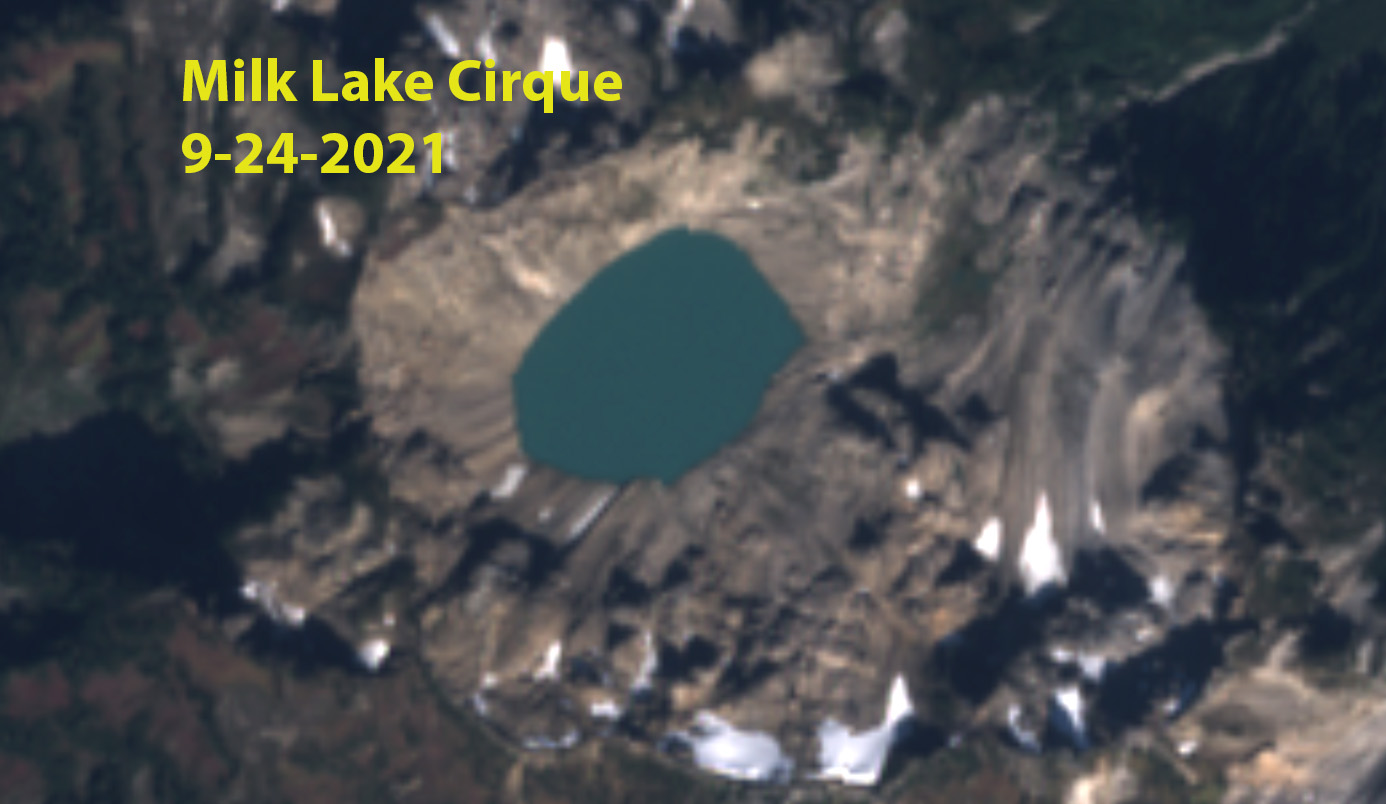
How A Glacier Disappears- Lewis, Milk Lake and Colonial Glacier North Cascade Range?

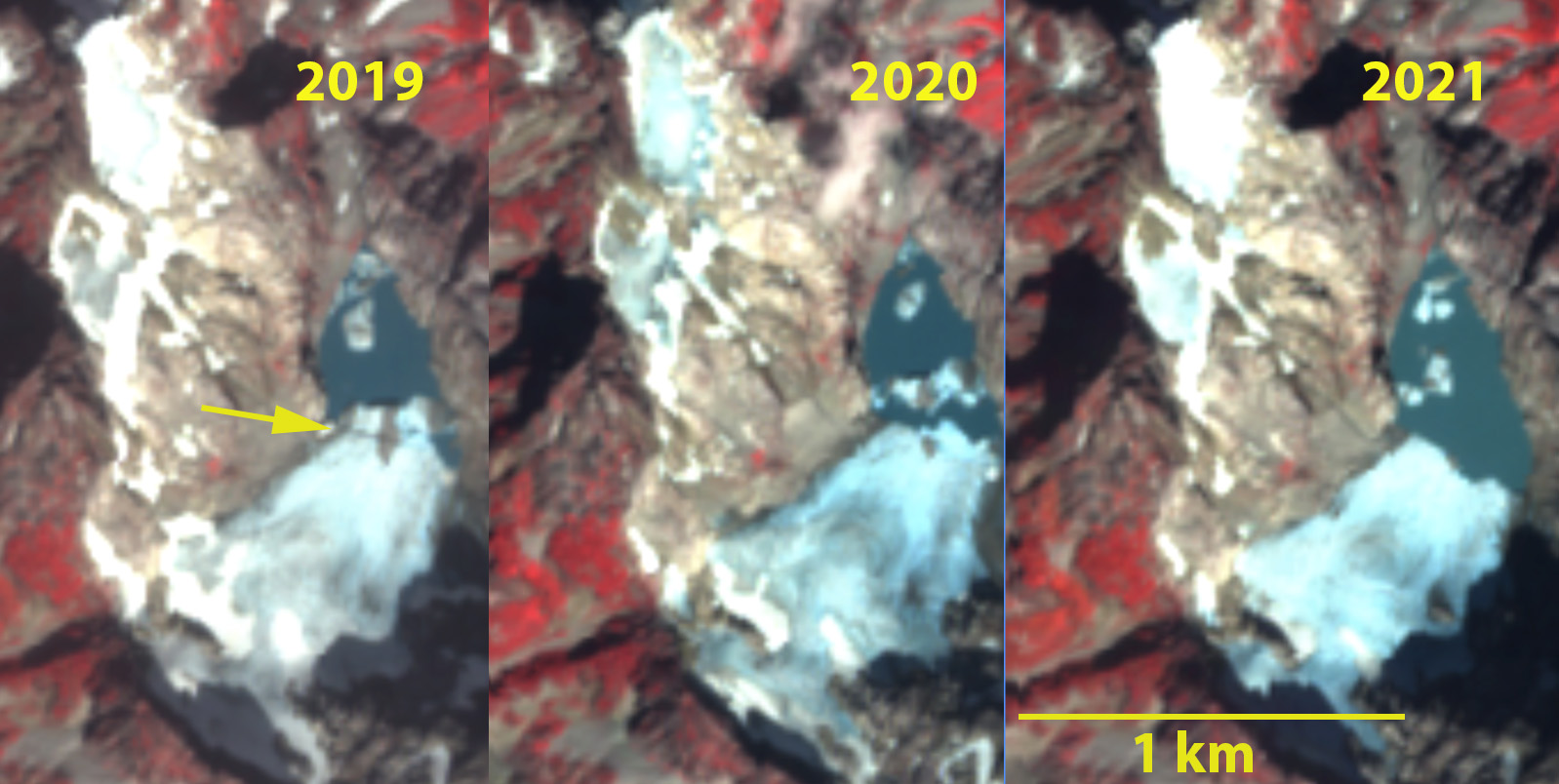
Colonial Glacier in late summer false color Sentinel 2 images from 2019, 2020 and 2021. Yellow arrow indicates step that calves in 2020. Notice the ~10% of snowcover (bright white) remaining on glacier surface with more melt to come.

An alpine glacier disappears when it no longer has a persistent accumulation zone (Pelto, 2010). When this occurs the glacier is typically limited in size, but still can have significant ice thickness that takes time to melt away.  Here we look at three glaciers I have worked on, where two disappeared and the third is disappearing in the North Cascade Range, Washington.

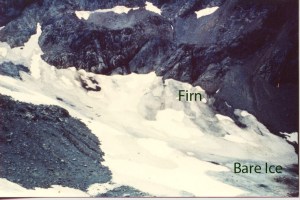
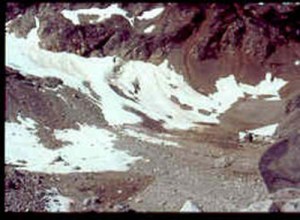
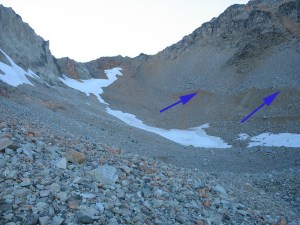
Lewis Glacier was a small cirque glacier in the drier part of the range, near Rainy Pass. In 1985 during my second visit to the Lewis Glacier, was the first time I confronted the idea of a glacier disappearing. We were able to peer down several crevasses and see the bottom of the Lewis Glacier, measurements indicated a maximum depth of 12 meters over an area the size of a football field/soccer pitch. This glacier had been selected for the North Cascade Glacier Climate Projects’s mass balance program assessing mass balance on 10 glaciers across the mountain range.  This size made it attractive to observe in terms of response to climate change. The USGS map indicated a significant glacier with an area of 0.12 km2 in the 1950’s.  By 1985 (top image) the glacier had lost half of its mapped area, there were still some significant blue ice areas, and areas of firn, snow several years old that is not yet glacier ice. Return visits each summer over the next few years chronicled the demise of the glacier. By 1988 (middle image) the glacier had shrunk dramatically even since 1985, the thickest ice measured was 5-6 meters. By 1990 the glacier was gone (bottom image), no blue ice left in the basin, the blue arrows indicate the lateral moraine above the now empty glacier basin. At the time I had not developed the model for forecasting glacier survival (Pelto, 2010). At bottom is 2021 image of the cirque basin with no glacier.

Milk Lake Glacier was a small glacier on the north flank of Glacier Peak in the North Cascades, Washington. The flat topography over the lake indicated a very thin unstable glacier area. In the USGS map for Glacier Peak in the  based on 1979 aerial photographs, Milk Lake Glacier fills most of the Milk Lake Basin, had an area of 0.24 km2 with just a fringe of lake visible.  Thw flat topography indicates the thin unstable nature of this part of the glacier. By 1988, Milk Lake had formed, a notably circular new alpine lake, the former glacier ice still filled part of the lake as ice bergs. The glacier had retreated to the margins of the lake fringing the west side of the lake. The fringing ice was clearly thin, we found several crevasses that reached bedrock 5-10 m down. In 1994 on a return visit in miserable weather (camera got too wet to function), there was no longer any icebergs in the lake and the lake was more of a jade to turquoise color. The fringing ice had lost about half of its area since 1988. This glacier remnant was not going to last long. By the end of 2005 the glacier had disappeared. The lake retains a beautiful jade color that will slowly become more azure as glacier flour settles. In 2021, see image bottom, the basin does not look like a recently glaciated basin.

Colonial Glacier is a cirque glacier in the Skagit River Watershed, North Cascades of Washington. The North Cascade Glacier Climate Project has made six visits to this glacier since 1985. Meltwater from this glacier enters Diablo Lake above Diablo Dam and then flows through Gorge Lake and Gorge Dam. These two Seattle City Light hydropower projects yield 360 MW of power. In 1979 the glacier was clearly thinning, having a concave shape in the lower cirque, but still filled its cirque, there is no evidence of a lake in this image from Austin Post (USGS).  In 1985 my first visit to the glacier there was no lake at the terminus. We measured the glacier area at 0.92 km2. In 1991 the lake had begun to form, second image, but was less than 30 m across. The upper glacier was a smooth expanse of snow. By 1996 the lake was evident, and was 75 meters across. In 2001 the lake had expanded to a length of 125 meters. By 2006 the lake was 215 m in length, and had some thin icebergs broken off from the glacier front. From 2019-2021 a series of late summer Sentinel 2 images indicate the lack of retained snowcover necessary for survival. In 2019 15% of the glacier is snowcovered with three weeks left in the melt season. The terminus is just below a step in the glacier surface. In 2020 there is only 10% snowcover with two weeks left in the melt season.  The portion of the glacier below the step has calved off and is now an iceberg in the lake. In 2021 the exceptional June heat wave took its toll and by the end of August the glacier only has 10% retained snowcover. The glacier area in 2021 is 0.26 km2, a 70% decline in area.  The glacier has retreated 440 m and now is 520 m long. The lake has an area of  0.1 km2. The continued losses of Colonial Glacier are not being replenished by snowfall, this business model can only lead to the glacier disappearing. Colonial Glacier still has substantial area and thickness that will allow it to survive for a couple more decades. The continued loss of glacier area from Colonial and all other glaciers in the region reduce the mitigating affect of enhanced summer streamflow due to higher glacier runoff during warm dry periods.

Lewis Glacier cirque in Sentinel 2 image from 2021, Lewis Lake is lower right.

Milk Lake cirque in 2021, looking like a basin that was not recently glaciated.


Sholes Glacier, WA and a Cascade of Ologies

Watercolor painting of Sholes Glacier. The small figure is at the current terminus of the glacier, and the photo that inspired this painting was taken from where the glacier used to end about 35 years prior. By Jill Pelto

Sholes Glacier is on the northeast flank of Mount Baker, WA.  We have spent the last 32 years completing detailed measurments on this glacier that has revealed a story of glacier mass balance loss, thinning, retreat, declining area, and a cascade of other consequences impacting other “ologies” beyond the glacier.  If you are intrigued by many ologies, the Podcast by Allie Ward will be inspiring as it was to this title.

Sholes Glacier and stream gage station.  We have constructed a rating curve for this station, that the Nooksack Indian Tribe maintains (Grah and Beaulieu, 2013).

The climatology of the region has shifted, with one key change being more frequent and intense heat waves.  Glaciers and heat waves just are not compatible. Using daily maximum temperatures for the 1981-2021 period for Mount Baker from ERA5 temperature reanalysis, completed by Tom Matthews at Loughborough University, indicates that there have been 83 days where the maximum temperature exceeded 12°C, an average of 2 days/year.  In the last five years there have been 22 days exceeding 12°C,  over 4 days/year. There have been 16 days during 1981-2021 period when the maximum temperature exceeded 14°C, 75% (12) of these have been in the last five years.

Probing snow depth on Sholes Glacier in 2014, this is completed annually at a fixed network of over 100 locations.

In terms of glaciology the result of the climate shift is that the glacier has lost 25-30% of its volume from 1990-2021. The terminus has retreated 155 m while the area has decreased by 25%.  The changes have been most rapid in the last 8 years. The two years of largest mass loss were 2015 and 2021. We measure both melting (ablation) on the glacier and runoff from the glacier. This combination allows determination of the amount of glacier runoff. During 24 heat waves in the region from 2009-2021 mean daily ablation during the heat waves has ranged from 4.5-7.2 cm w.e./day (w.e.=water equivalent).  The highest rate of 7.2 cm was during the June 26-July 1, 2021 period.

Sholes Glacier in 2015 exhibiting the darkening of the surface that occurs in high melt years, increasing melt rates. How much black carbon and algae is part of this darkening is the research of Alia Khan (WWU).

For a glacier to be in equilibrium or have a positive mass balance the majority of the glacier must be in the accumulation zone, snow covered at the end of the summer, that is an accumulation are ratio (AAR) greater than 50%.  Pelto and Brown (2012) noted that for Mount Baker an AAR of 60% is required for a break even balance for the year.  From 2013-2021 the average accumulation area ratio has been 35%.  For Sholes Glacier if 50% of the glacier is exposed ice and firn in early August that increases mass loss.  The ice and firn for the same weather conditions have a 30-40% higher melt rate than the snowpack.  An early season heat wave strips the snow off earlier exposing the darker faster melting glacier surfaces for longer further increasing mass loss, note image above.

Sholes Glacier in 2021. The glacier has retreated 170 m from 1990-2021, the terminus in 1990 is approximately whre the goats are crossing the stream.

Hydrology downstream in Wells Creek and the North Fork Nooksack River is changing in part because of the changes in glacier runoff. Glacier runoff is a major source of streamflow during the summer low-flow season and mitigates both low flow and high water temperatures (Pelto, 2015). This is particularly true during summer heat wavesbut this ability has been diminishing in the region (Moore et al 2020)  For the last 37 summers we have been in the field monitoring North Cascade glaciers response to climate change including during heat waves (Pelto, 2018). In the last decade we have made synchronous observations of glacier ablation and stream discharge immediately below Sholes Glacier, Mount Baker (Pelto, 2015). This in conjunction with observed daily discharge and temperature data from the USGS stations on the ~6% glaciated North Fork Nooksack River (NFN) and the unglaciated South Fork Nooksack River (SFN), contrasts and quantifies the ameliorating role of glacier runoff on discharge and water temperature during 24 late summer heat wave events.

Measuring discharge below Sholes Glacier in 2016.

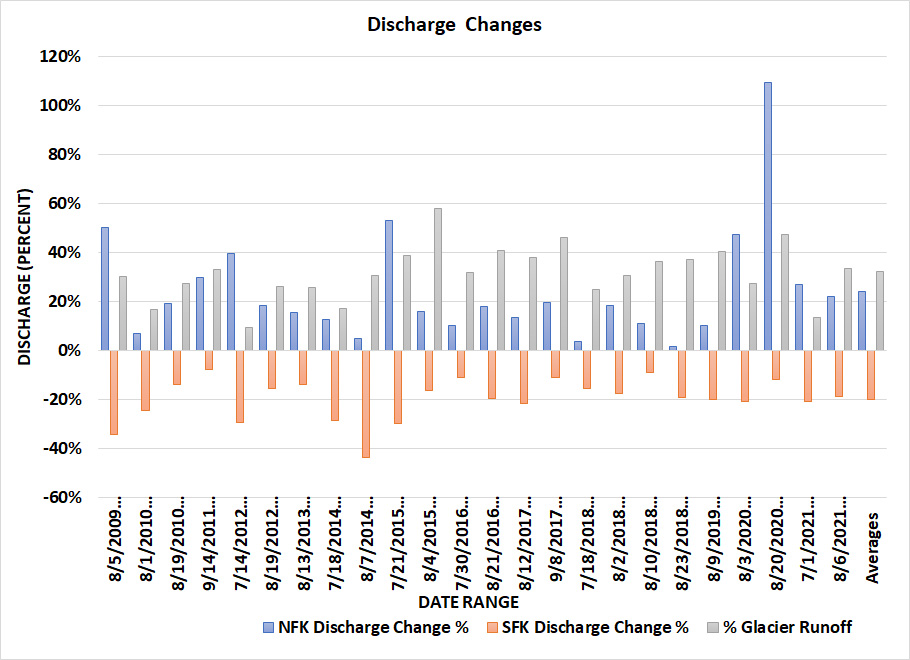
Sholes Glacier and ablation measurements on Sholes Glacier indicate daily ablation ranging from 5-6 cm/day, which for the NFN currently yields 9-11 cubic meters/second. This is 40-50% of the August mean discharge of 24 cubic meters/second, despite glaciers only covering 6% of the watershed. In the unglaciated SFN warm weather events generated a mean stream temperature change of +2°C, only 1 event in the NFN generated this rise and the mean was +0.7°C. Durng the June 2021 heatwave from June 21-29 maxium daily stream temperature in SFN warmed 3°C, vs 0.8°C for NFN.  This illustrates that a greater proportion of snowmelt, which NFN recieves, has limited the temperature rise.  Discharge rose at least 10% in 20 of the 24 events in the NFN with an average increase of 24%.  In the SFN all 24 events led to a decreased discharge with an average decrease of 20%. The primary response to these summer heat waes is increased discharge in the heavily glaciated NFN, and increased stream temperature in the unglaciated SFN.

Discharge change during heat waves in South Fork (decreases) and North Fork Nooksack River  (increases) above.  Below temperature change during heat waves in South Fork (significant rise) and North Fork Nooksack River (small rise).

Glacier runoff is a product of glacier area and melt rate.  Overall glacier runoff declines when area reductions exceed, ablation rate increases.  This has already occurred in the NFN and now glacier runoff is declining (Pelto, 2015). The measured ablation rate is applied to glaciers across the NFN watershed, providing daily glacier runoff discharge to the North Fork Nooksack River.  For the NFN glacier runoff production was equivalent to 34% of the total discharge during the 24 later summer heat wave events. As the glaciers continue to retreat the NFN will have a declining mitigation of heat waves for discharge and temperature and trend towards the the highly sensitive SFN where warm weather leads to declining streamflow and warming temperatures.

Nooksack Falls heavily glacier fed.

Aquatic ecology in glaciated watershed in turn is impacted. Glaciers are important in maintaining sufficient discharge and stream temperature that are critical for salmon in the North Fork Nooksack. Some cold-water trout and salmon species are already constrained by warm water temperatures and additional warming will result in net habitat loss (Isaak et al 2012). In the Fraser River and Thompson River, BC fish community thresholds were obsrved for mean weekly average temperatures of about 12°C and again above 19°C (Parkinson et al 2015). Below 12°C the community were characterized by bull trout and some cold water species, between 12°C and 19°C by salmonids and sculpins and above 19°C by minnows and some cold water salmonids (Parkinson et al 2015). These thresholds indicated small temperature changes can be expected to drive substantial changes in fish communities. During the 24 warm weather events noted in the North Fork only two events exceeded 12°C, while in the South Fork 15 of the events exceeded 19°C.  This suggest that both rivers are near a threshold that could alter the fish community.

In the North Fork Nooksack the number of returning chinook is divided into natural and hatchery spawned salmon. The Chum and Coho salmon data for the Nooksack River during the 1999-2013 interval indicate there are two salmon population peaks for each species. The early peak is in 2002 and the second peak occurs in 2010 (Washington Dept. Fish & Wildlife, 2020). Overall numbers have not sustained an increase and remain endangered.

Ice Worm counts as the sunsets, 110 worms per square meter.

The climatology and glaciology has been difficult for ice wormology  On the glacier itself ice worm population density surveys conducted annually indicate the density of ice worms has decreased since 2000 and that even 10 m beyond the edge of the glacier on snowpack they do not exist.  This combined with the reduction in glacier area indicate population decline of ice worms.

In 2009 we observed the largest goat herd 62 goats (13 kids), some of them seen here below Sholes Glacier.

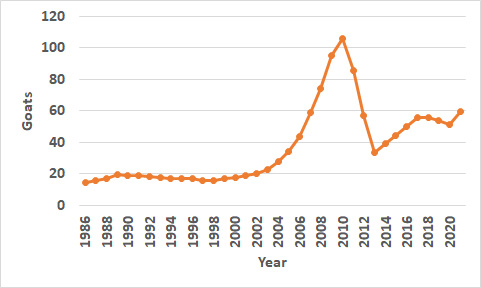
The climatology has been more favorable in terms of Goatology.We have conducted annual mountain goat surveys in the Ptarmigan Ridge-Sholes Glacier region each years since 1984.  Populations stayed steady from 1984-2000, before rising dramatically through 2010. The difficult winters of 2011 and 2012 reduced the population, followed by a recovery up to 2021.

Three year running mean of mountain goat census conducted each summer while we are working on Ptarmigan Ridge, Sholes Glacier and Rainbow Glacier.


A Tale of Two Glaciers Columbia and Easton Glacier 2021

Terminus of Columbia Glacier on left with 1984 terminus location noted.  Observe the avalanche fans (A) and the relatively high snowcover on 8-2-2021.  At right is Easton Glacier on 8-11-2021 with the location of the 1990 terminus indicated, 440 m of retreat to the 2021 terminus position. The glacier has only 38% snowcover at this time, which is better illustrated below.

Columbia and Easton Glacier in the North Cascade Range of Washington are two of the reference glaciers for the World Glacier Monitoring Service.  We have monitored their mass balance in the field for 38 and 32 years consecutively. This year Ashley Parks, Sally Vaux, Jill Pelto  and I worked on all of the glaciers with Abby Hudak, Rose McAdoo and Ben Pelto joining us for either Easton or Columbia Glacier. In 2021 a combination of an above average winter snowfall and a record summer melt has led to a different story of mass balance for the two glaciers. At Mount Baker and Stevens Pass winter snowpack on May 1 was 116% and 115% of normal (NWAC, 2021). From June 1-Aug. 17 the mean average temperature is similar to 1958 and 2015, and well above every other year. With the maximum temperature exceeding 80 F on 17 days during this period at Stevens Pass ( 3950 ft, 1200 m), each of those days represents exceptional melt conditions.  Our observations indicate 11-14 cm of snowpack melt on glacier during exceptionally warm days like this. Just the melt from these 17 days would equate to half of the average summer melt for a North Cascade glacier (Pelto, 2018).  The earlier summer heat wave has led to exposure of greater higher albedo and faster melting glacier ice, which is why such a heat wave is more impactful than in late summer.

Columbia Glacier occupies a deep cirque above Blanca Lake ranging in altitude from 1400 meters to 1700 meters. Kyes, Monte Cristo and Columbia Peak surround the glacier with summits 700 meters above the glacier. The glacier is the beneficiary of heavy orographic lifting over the surrounding peaks, and heavy avalanching off the same peaks.  Standing on the glacier is a bit like being in the bottom of a bath tub, with avalanche slopes extending up both sides, predominantly on the west side. The last half of January 2021 was a dry period in the region, with an extensive crust forming on the snowpack. This was followed by 106 inches of dry snowfall from Feb. 4 to Feb. 20,and then 34 inches of wet snowfall and even rain through Feb. 24 This generated extreme avalanche danger and numerous climax avalanches in the Stevens Pass region.

NWAC’s avalanche forecast on 2/20 for Stevens Pass indicated that, “We haven’t seen rain above 3,500ft or so since mid-January, so one of the main concerns is that slabs 5-10′ feet thick may begin to come crashing down. The avalanche cycle(s) may last through the day Monday. In any case, very large storm slabs and wet loose avalanches are expected to continue to run from steep slopes through Monday as our once beautiful cold, dry snow becomes overloaded by wet, heavy rain and snow.”

The avalanche slopes with many pockets above Columbia Glacier in Aug. 2020, one fan can be seen bottom center. These have to filled each winter season before slides occur, in 2020 avalanching was limited.

As we headed up onto Columbia Glacier on Aug. 1, 2021 we noted a significant number of large avalanches had descended near and onto the glacier. The glacier was 87% snowcovered, including the terminus area.  This is well above the recent early August average. As is the case every year we measure snow pack depth in a grid across the entire glacier.  Snow depth in the three biggest west side avalanche fans averaged 4.9 m, 25% above normal.  The three largest fans comprise an area of 0.14 km2, yielding a volume of 686, 000 m3 swe.  The melt season ends in another month, however, due to this substantial avalanching that will keep this section of the glacier covered in snow, Columbia Glacier will have a small-moderate negative mass balance.

Ashley Parks, Jill Pelto and Sally Vaux measuring snow depth in the Columbia Glacier avalanche fans.

The three primary avalanche fans each had a slope of 23 degrees.  Here we are spaced out at 50 m intervals mapping the size of the fan.

Easton Glacier on the south flank of Mount Baker does not recieve avalanche accumulation, and the regions above 2500 m, typically have significant wind  scouring, that leads to little increase in mass balance with elevation above this elevation on the upper glacier. There are both basins where snow is preferetially deposited by wind and convex regions where snowpack is scoured. In 2021 enroute to the glacier terminus we observed considerable stunted alpine vegetation, that emerged and then did not grow.  This was prevalent on rocky slopes that were exposed during the heat wave.  The example below is of Lupine with the growth from last year now brown and flat indicating the stunted size this year.

Stunted Lupine, each patch is typically 20-30 cm high and equally broad. Here the plants are 3-5 cm high.

On Aug. 11, 2021, the glacier had only 38% snowcover, with more than 50% of the area above 2500 m having lost all winter 2021 snowcover.  By summer’s end the glacier will certainly have the lowest percentage of snowcover of any year since we began monitoring in 1990. The bench at 2000 m typically has 2.75 m of snowpack on Aug. 10, and this year was 50% bare, with an average depth of 0.25 m.  The icefall above also lacked snowcover as well. There are a number of pockets/basins, where wind deposition increased snow depth and this snowpack will be retained.

The observations across the range illustrated that glaciers or areas of glaciers that do not have enhanced deposition from wind drifting or avalanching are either bare already or will be by the end of August.  The full extent of the loss on Columbia and Easton Glacier from this summer will be evident in a month. What is apparent is that the losses from Easton Glacier will be extraordinary. More frequent heat waves continue to plague alpine glaciers, these can even occur in winter such as on Mount Everest in January 2021 (Pelto et al. 2021)

View of the lack of snowcover in the icefall at 2000-2300 m on Easton Glacier.  The lack of snowcover above this point is also evident in the upper image.

Rose McAdoo and Jill Pelto measuring the 2021 snowpack at 2350 m is alareay thinner  than the 2020 or 2019 retained snowpack and will be gone by the end of the month.

In 2021, I am in front of the same serac as in 2020, down slope. The average retained accumulation at this 2600 m location in the laterally extensive layers is 2-2.2 m.  This year there will no retained accumulation.

Ben and Jill Pelto amongst the seracs where snowpack should be extensive, but in 2021 they are standing on 2020 firn.