NORTH CASCADE GLACIER CLIMATE PROJECT 2021 -38th Annual Field Program

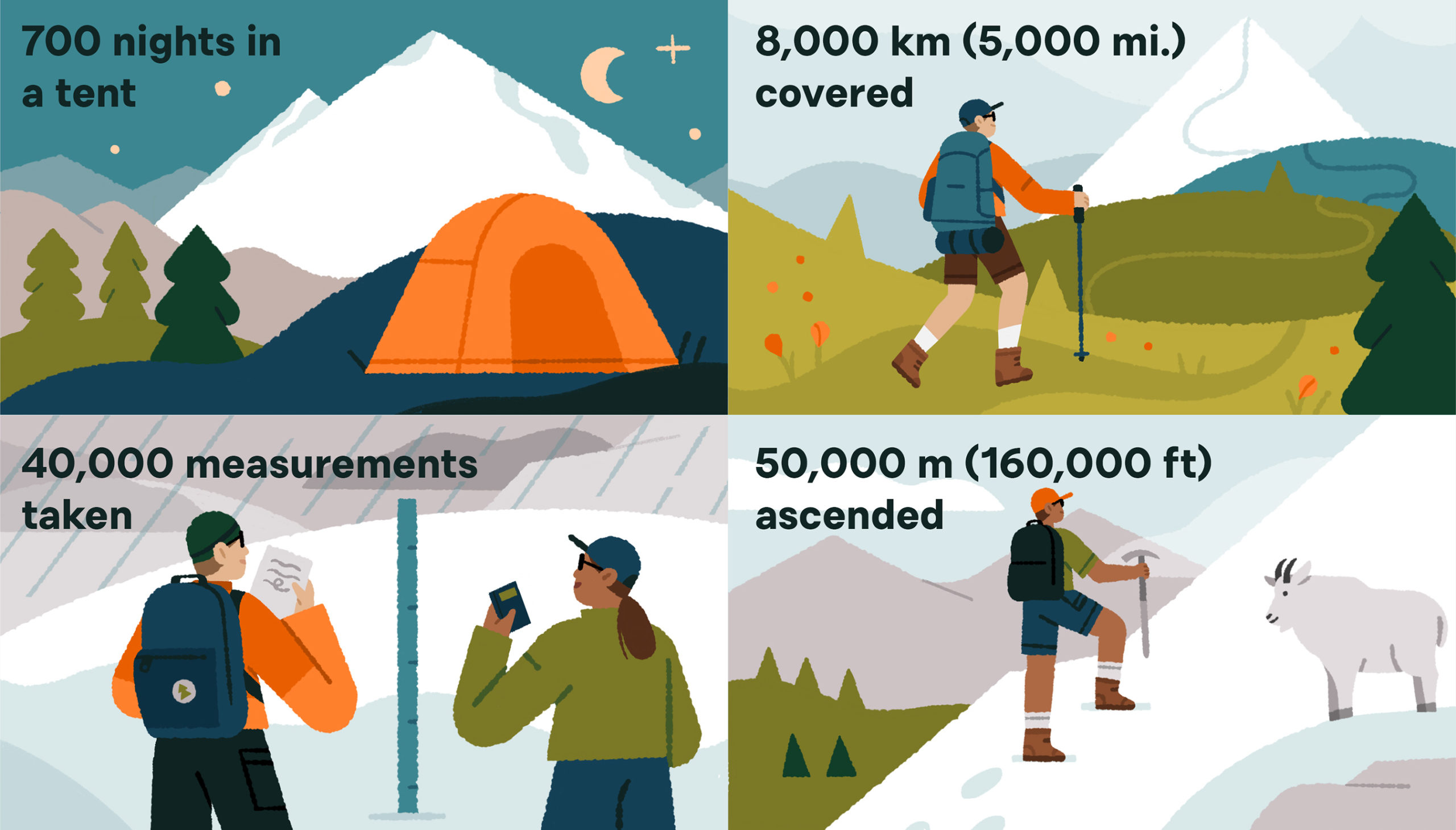
A few measures of what it takes to execute a field monitoring program of glaciers for 37 years, with no helicopter support (Illustration by Megan Pelto).

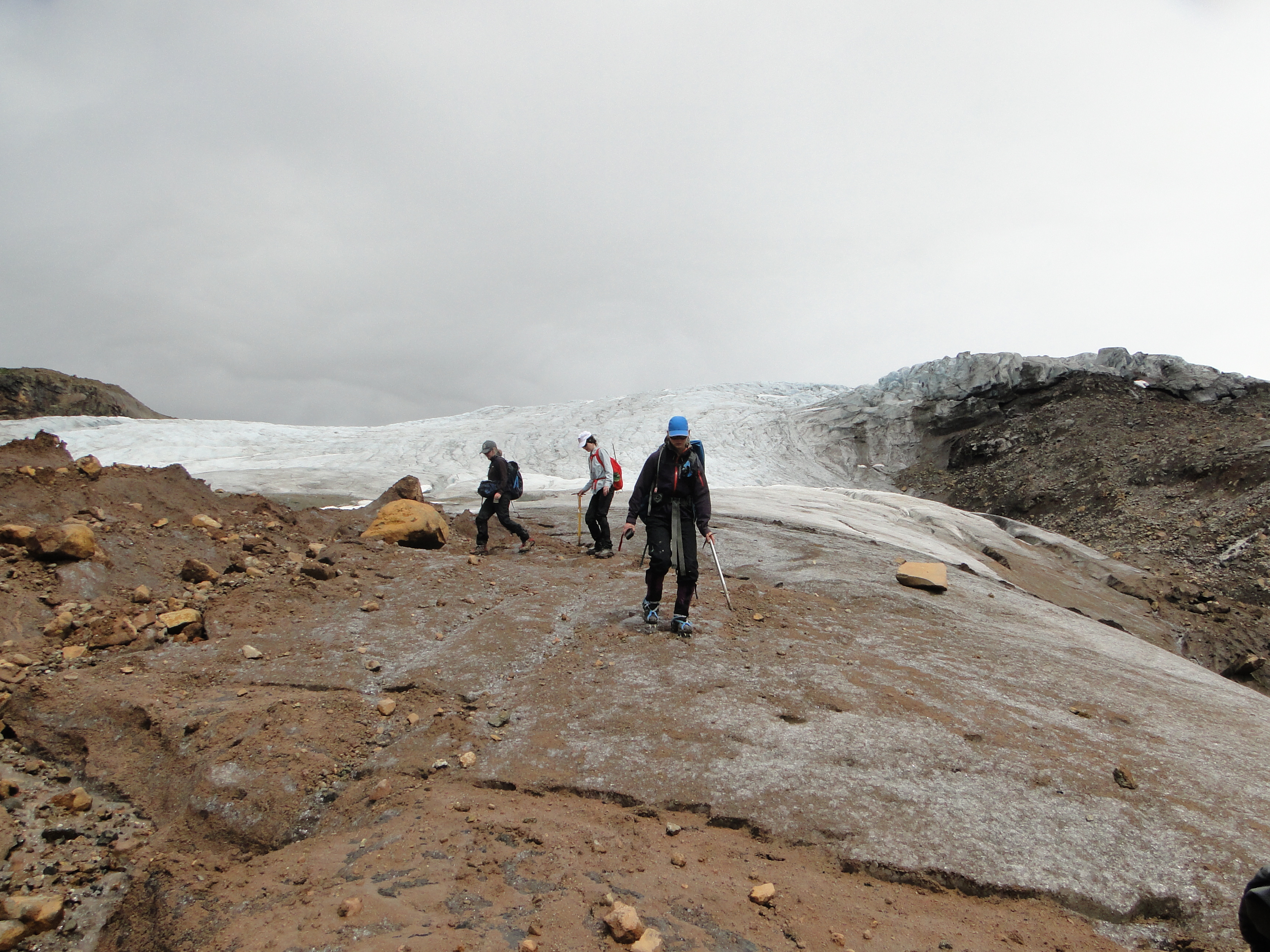
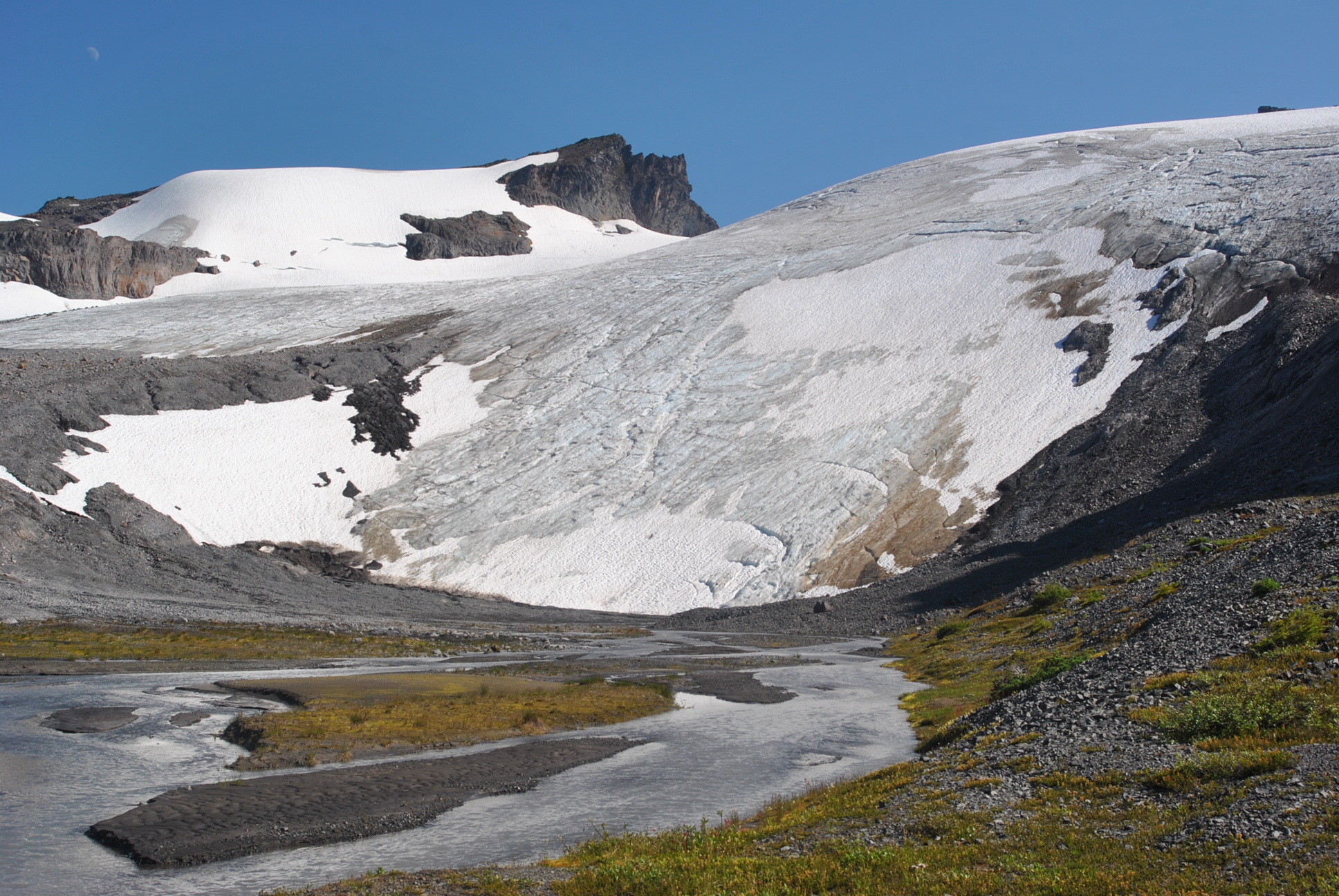
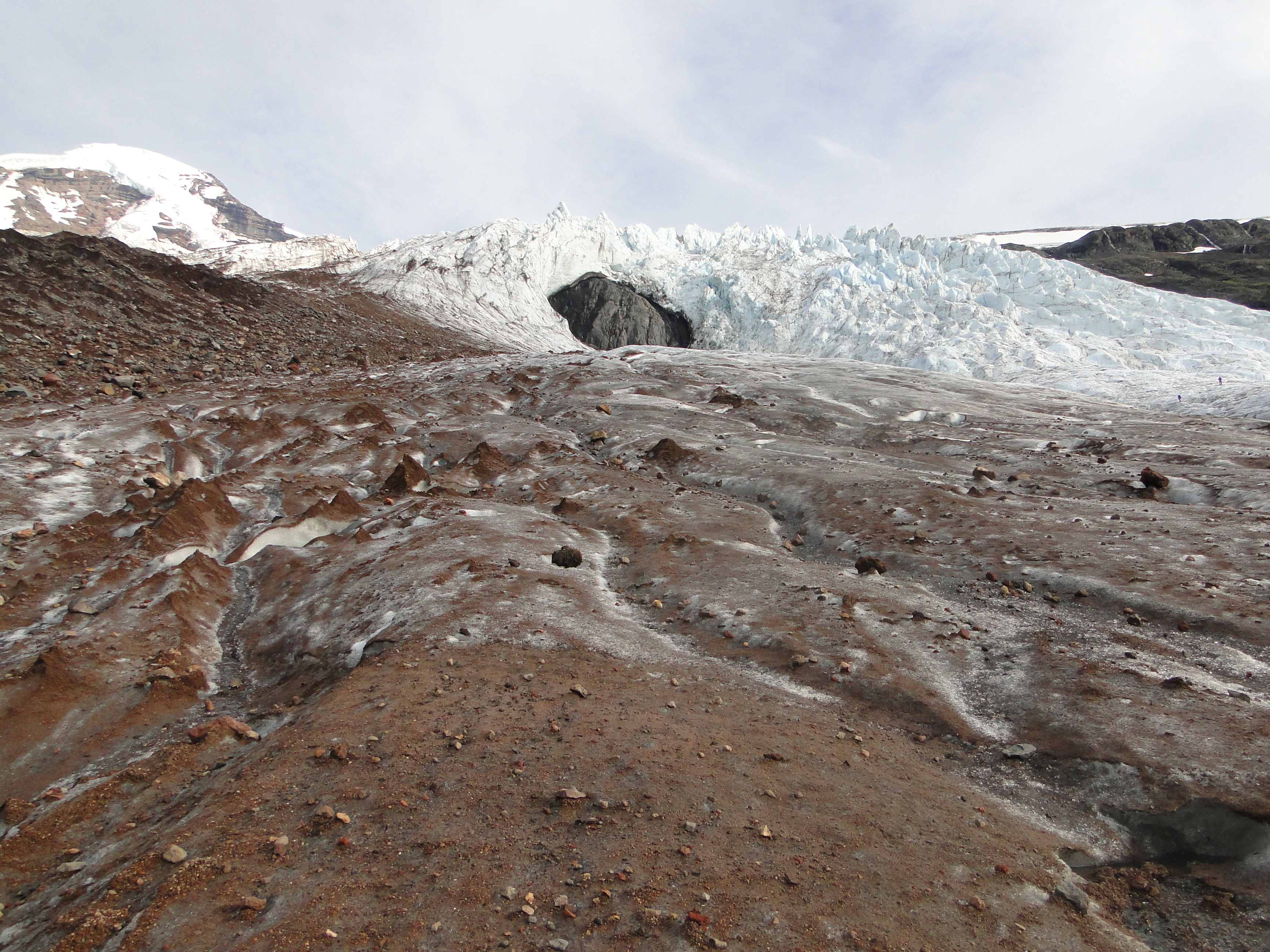
2021 Field Season: For the 38th consecutive summer we are heading into the field later this week to measure the impact of climate change on North Cascade glaciers. We will complete detailed measurements on 10 glaciers, three of which are part of the World Glacier Monitoring Service reference glacier network (42 glaciers globally) that have 30 consecutive years of mass balance observations.  This field season follows both a historic heat wave at the end of June and a month long sustained period of warm weather that has extended from Late June to now. We have observed the rise of the snow line around Mount Baker from a lower than average late June ~1200 m on June 23 to  ~1850 m on July 23, average in late July is 1750 m.  The result is a greater exposure of bare ice on glaciers with summer only half over. For ice surfaces with a higher albedo and greater density the observed melt rates are 7-9 cm/day water equivalent during warm weather events vs 4-6 cm/day for snow surfaces.  We will provide preliminary observations in three weeks when the field season is completed as we did with the 2020 Field Report.

Who we are? NCGCP was founded in 1983 to identify the response of North Cascade glaciers to regional climate change, particularly changes in mass balance, glacier runoff and terminus behavior.   NCGCP is a field project that has a broader interdisciplinary scope and examines more glaciers than any other program in North America.  It does so cost effectively relying on no permanent camps, helicopter support or salaries for the director. The field season includes no days off and each day is spent completing measurements on glaciers.  The focus is on glacier mapping, mass balance measurement, terminus observations and glacier runoff monitoring.

Why study glaciers in the North Cascades? Glaciers are one of the world’s best climate monitors and are a critical water resource to many populated glaciated regions. This is particularly true in the North Cascades where 700 glaciers yield 200 billion gallons of summer runoff and glaciers have lost 30 % of their area in the last century.  This has reduced glacier runoff in late summer in the region as the reduction in glacier area has been exceeded the increase in melt rate (Pelto, 2011) .

Field Team 2021:

Jill Pelto is an artist and scientist from New England who grew up loving winter sports and trips to the mountains. She incorporates scientific research and data into paintings and prints to communicate environmental changes. Her multi-disciplinary work weaves visual narratives that reveal the reality of human impacts on this planet. She completed both her B.A. degrees in Studio Art and Earth and Climate Science and her M.S. focused on studying the stability of the Antarctic Ice Sheet at the University of Maine, spending two field seasons at a remote camp in the southern Transantarctic Mountains. Jill will be joining the project for her 13th field season. She is excited to continue documenting North Cascade Glacier changes that she has witnessed each of the last 12 years—through science and art.

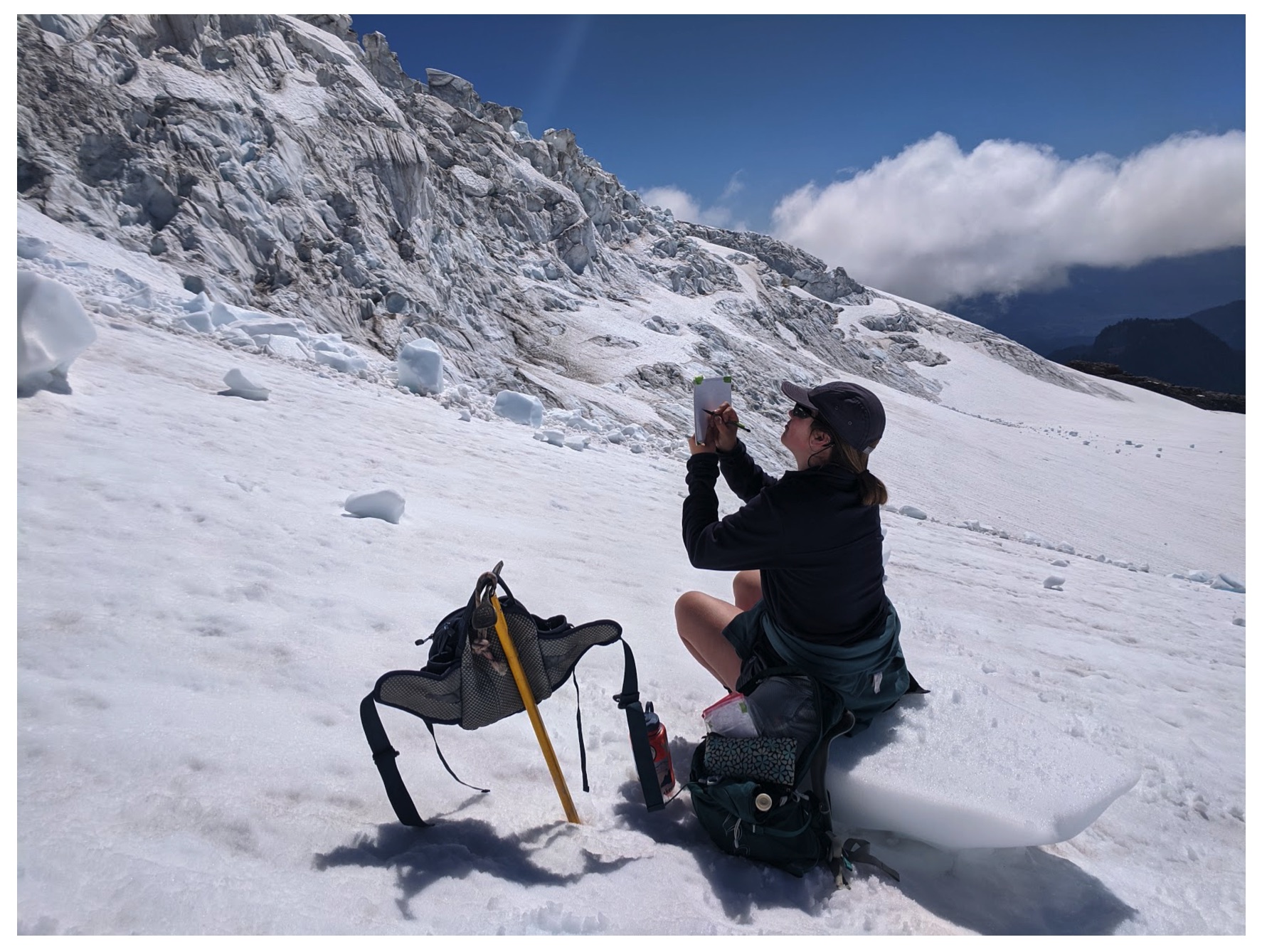
Jill Pelto sketch of Easton Glacier Icefall

Mauri Pelto has directed the project since its founding in 1984, spending more than 700 nights camped out adjacent to these glaciers. He is the United States representative to the World Glacier Monitoring Service, author of the AGU blog “From a Glacier’s Perspective”, and associate editor for three science journals.  His primary job is Dean of Academic Affairs at Nichols College, where he has been a professor since 1989.

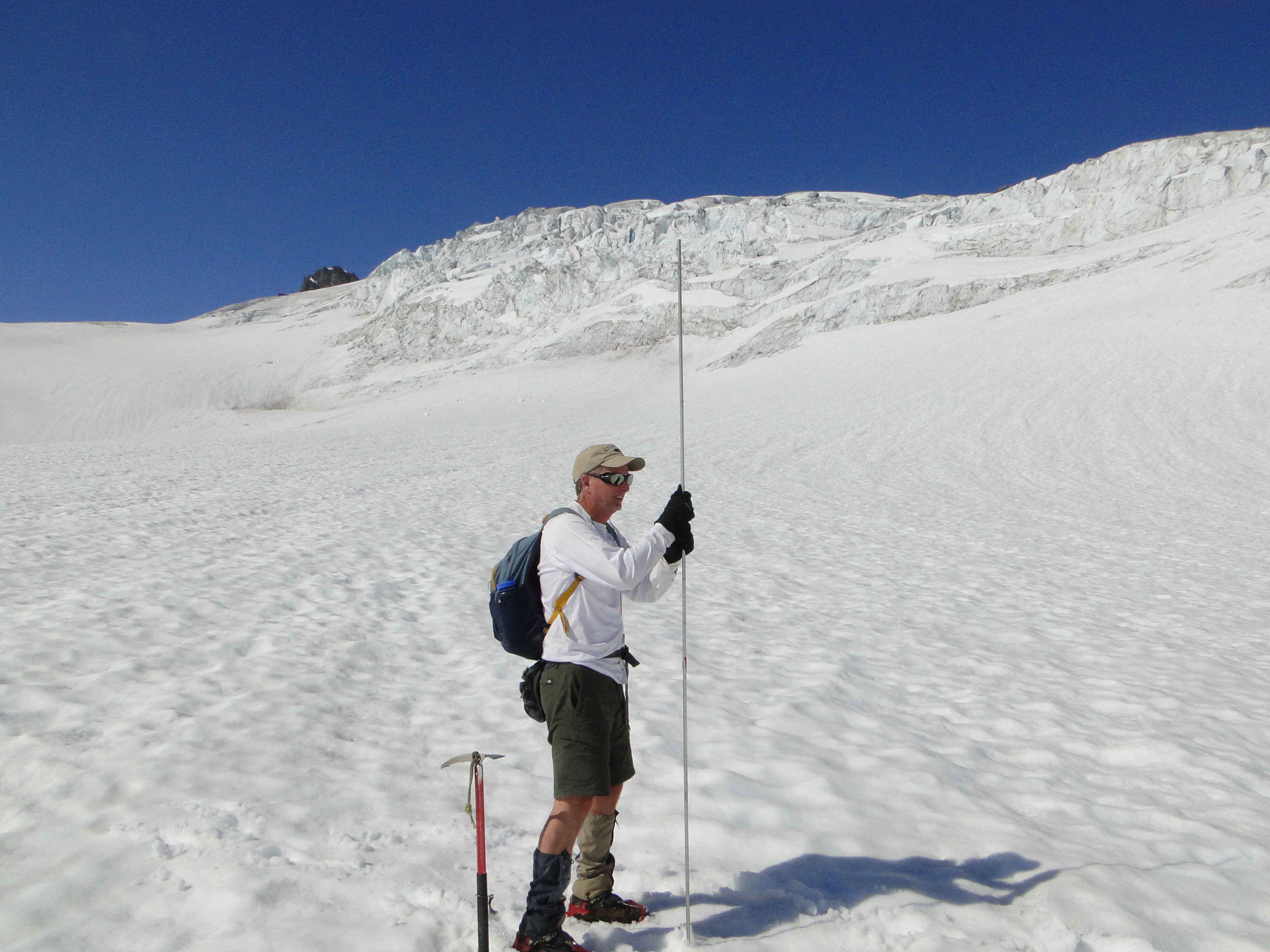
Mauri Pelto probing on Easton Glacier

Sally Vaux (she/her) is an incoming MS student in Environmental Science at Western Washington University. Her research interests include the impacts of aerosol deposition on snow and ice melt and equitable K-12 science education. While obtaining her BS in Environmental Science from WWU, Sally began a water quality monitoring project focused on dissolved organic carbon in the Nooksack River. This summer, she is working on a NASA Space Grant project to understand how climate-driven increases in frequency and intensity of wildfires in the Arctic lead to light-absorbing aerosol deposition on sea ice and how these deposits impact ice albedo. She will also be working to adapt polar and alpine snow science into lessons for elementary and middle school students in Whatcom County, WA. Outside of school and work, Sally likes to run, ski, bike, and read.

Ashley Parks is a recent Huxley graduate from Western Washington University, Environmental Science. Growing up in Bellingham and being an avid fan of winter sports, she has been able to become familiar with the North Cascade Mountain Range, inspiring her to become interested in the glaciology of her region. As glaciers enter a period of trouble due to the climate crisis, she hopes to connect our understanding of climate change effects on local glaciers, and what that means for local communities. Ashley will also be collecting pink snow for The Living Snow project which is run out of Western Washington University in order to characterize the biodiversity of the algae in the snow and its impact on snowmelt dynamics. This summer’s goal is to be able to communicate her findings through an artistic medium that she can share with others, and to be able to gain experience with field data collection.

Field Partners 2021

Alia Khan’s, research team including grad students Sally Vaux and Shannon Healy focus on environmental chemistry in the cryosphere, including black carbon and snow algae to document global change of glacier and snow melt in mountainous and polar regions.

Western Washington University Cryosphere Studies and Aquatic Biochemistry Lab.

Rose McAdoo, is a visual artist using desserts to communicate science and make big ideas digestible. Her work pulls her between New York City, Alaska, and Antarctica — where she works as the sous chef for NASA’s Long Duration Balloon atmospheric research camp and as a member of the winter Search and Rescue team. In 2019, her edible documentation of the U.S. Antarctic Program’s field season won the attention of NPRForbes,  and — most recently — as the featured cover artist for the American Polar Society. She’s currently working as an ice climbing and glacier helicopter guide in Seward, Alaska, and is eager to further visualize the extensive research of the North Cascades Glacier Climate Project.

Cassidy Randall,  is a freelance writer covering stories that push the boundaries on how we think about environment, adventure and people exploring the bounds of human potential https://www.cassidyrandall.com/ . She’s on assignment with NCGCP for National Geographic.

Nooksack Indian Tribe, for the 10th consecutive year we will be conducting field work aimed at providing field validation and streamflow calibration data below Sholes Glacier for the ongoing work of the tribe.

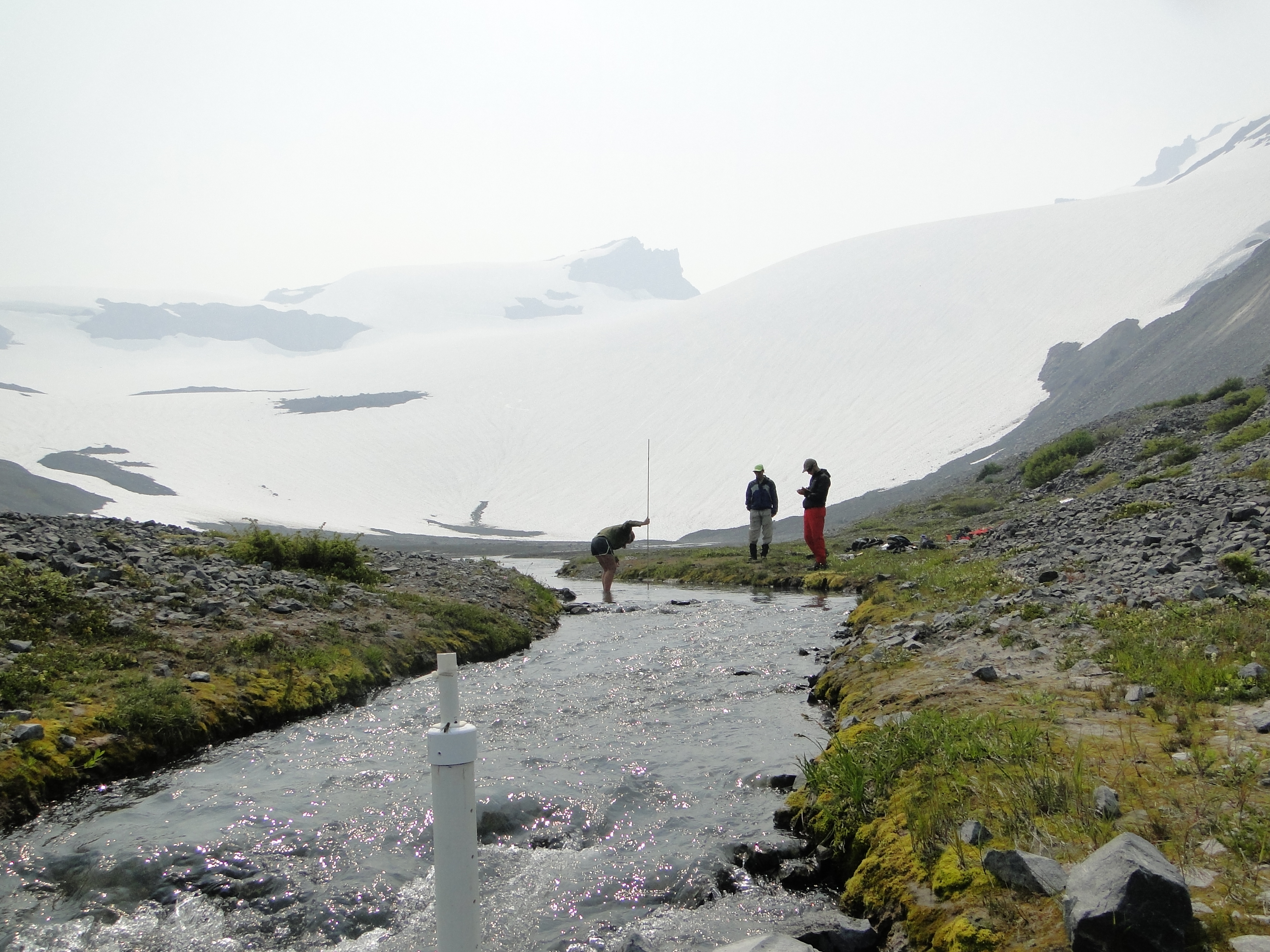
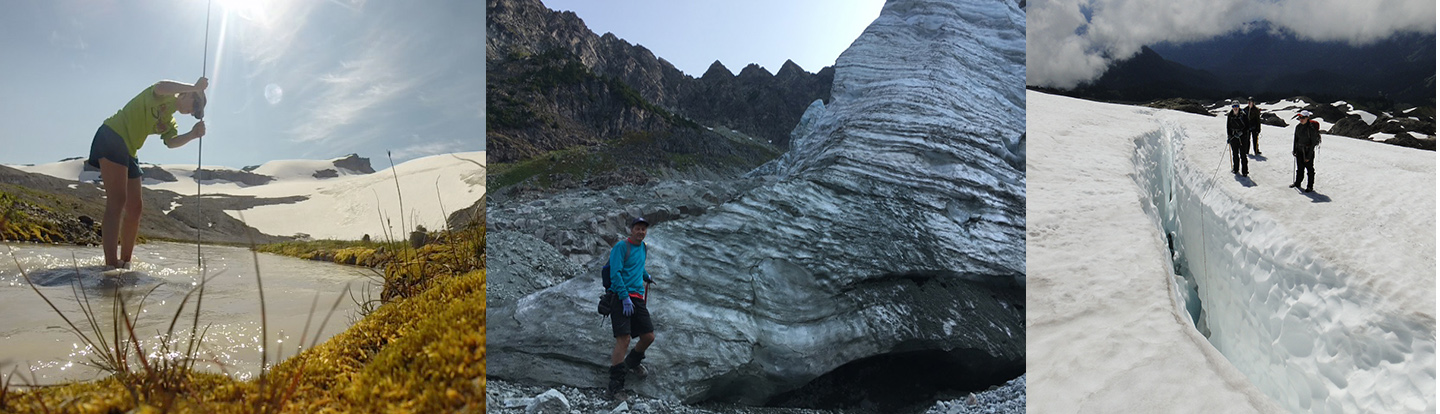
Measuring streamflow below Sholes Glacier. Forest fire haze obscuring sky

2021 Schedule

Jul 31:  Hike in Columbia Glacier
Aug. 1: Columbia Glacier
Aug. 2: Columbia Glacier
Aug. 3: Hike Out Columbia, Hike in Ptarmigan Ridge
Aug. 4:  Sholes Glacier
Aug. 5:  Rainbow Glacier
Aug. 6:  Rainbow Glacier
Aug.7:  Hike out, Hike In Lower Curtis Glacier
Aug. 8:  Lower Curtis Glacier
Aug. 9:   Hike out, Hike in Easton Glacier
Aug. 10:  Easton Glacier
Aug. 11:  Easton Glacier
Aug. 12:  Hike out Easton/Hike in Daniel
Aug. 13: Ice Worm Glacier Survey
Aug. 14: Daniel and Lynch Glacier Survey
Aug. 15: Hike out
Aug. 16:  Arrive home

Pacific Northwest June 2021 Heat Wave Current and Enduring Glacier Impact

Streamflow observation site below Sholes Glacier on August 6, 2015.  We have measured flow at this site for 30 years, the last 10 years in conjunction with the Nooksack Indian Tribe (Grah and Beaulieu, 2013; Pelto, 2015).

The exceptional record breaking Pacific Northwest heat wave of June 2021 had an impact on snow melt both on and off glaciers in the North Cascade Range of Washington and consequently on alpine rivers. Here we examine the specific snow melt, streamflow and stream temperature in the Nooksack Basin, near Mount Baker, from this week.  We compare that to our observations of glacier melt and glacier runoff during summer heat waves, that are typically later in summer over the last 37 years.

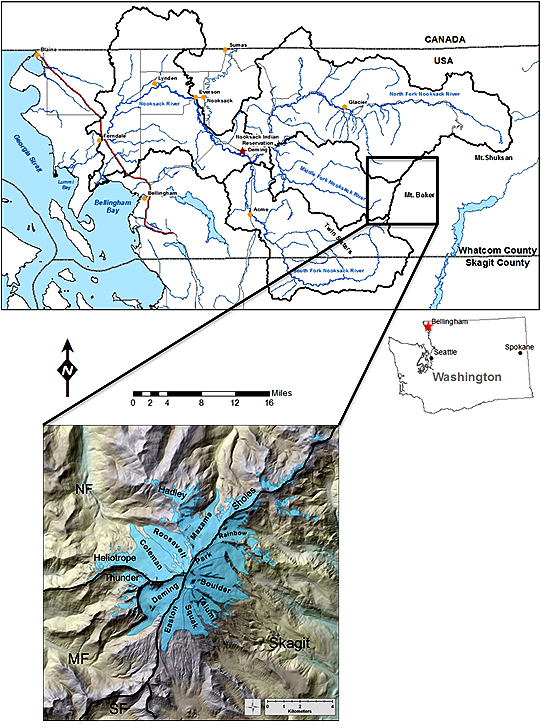
Glacier runoff is a major source of streamflow during the summer low-flow season and mitigates both low flow and high water temperatures (Pelto, 2015). This is particularly true during summer heat waves, but this ability has been diminishing in the region (Moore et al 2020)  For the last 37 summers we have been in the field monitoring North Cascade glaciers response to climate change including during heat waves (Pelto, 2018). In the last decade we have made synchronous observations of glacier ablation and stream discharge immediately below Sholes Glacier, Mount Baker (Pelto, 2015). This in conjunction with observed daily discharge and temperature data from the USGS stations on the ~6% glaciated North Fork Nooksack River (NFN) and the unglaciated South Fork Nooksack River (SFN), contrasts and quantifies the ameliorating role of glacier runoff on discharge and water temperature during 23 late summer heat wave events.  Map of the region below indicates the differences including a mean altitude of  1311 m in NFN being vs 914 m for SFN which leads to higher snowpack and glacies in NFN.

Snowpack loss during the June 21-June 28 period at the Middle Fork Nookack, USDA Snotel site at 1515 m and the Heather Meadows, Northwest Avalanche Center site at 1285 m.

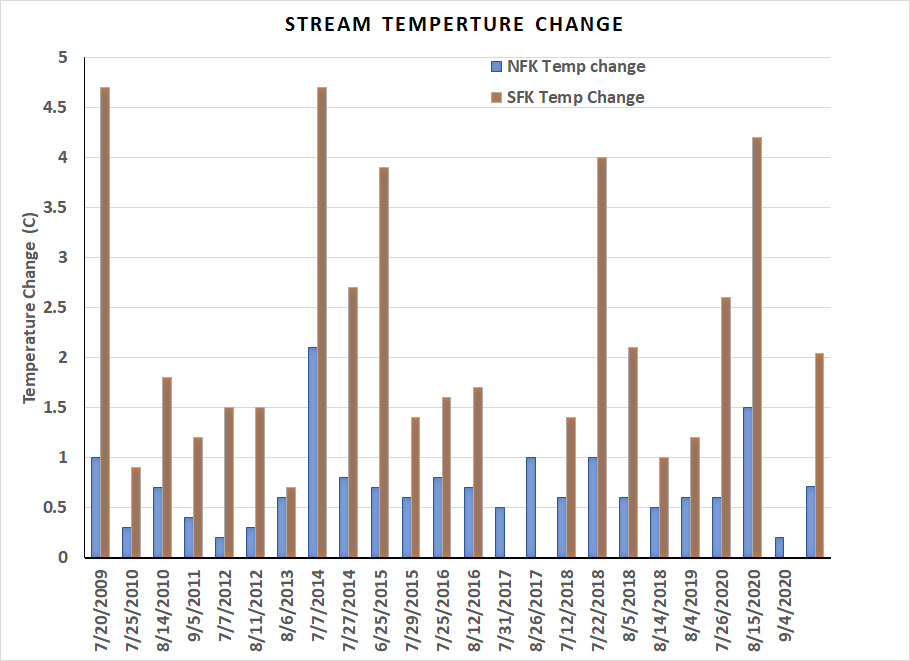
Durng the June 2021 heatwave from June 21-289 maxium daily stream temperature in SFN warmed 3 C, vs 0.8 C for NFN.  This illustrates that a greater proportion of snowmelt, which NFN recieves, has limited the temperature rise.  This is similar to that observed for 23 summer heat waves occurring from Late July on, where the mean water temperature increase was 0.7o C in the NFN and 2o C in the SFN.

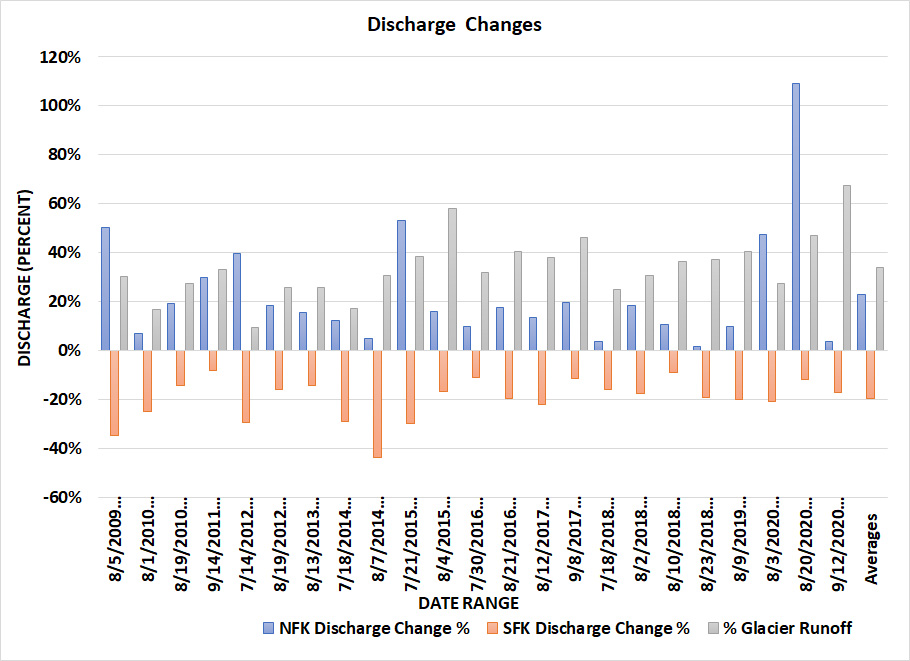
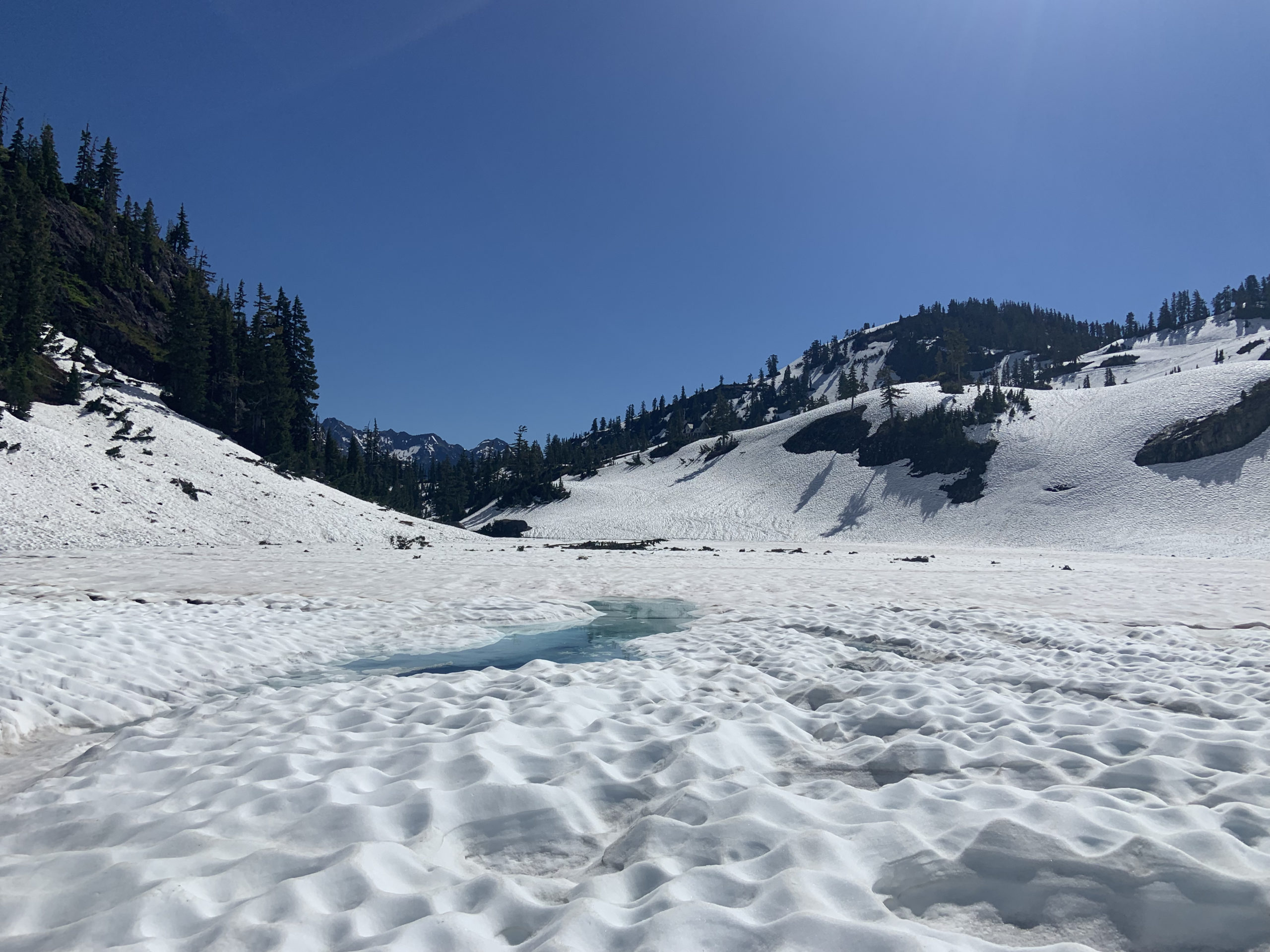
For this period discharge in the SFN first increased 100 cfs from June 23 to June 25 and then by June 28 declined back to the June 23 levels.  The initial increase indicated an increase in snowmelt rate as temperatures rose.  The decrease by June 28 despite high temperatures indicates a decrease in snowmelt volume as the area of snowcover declined more than the increase snowmelt rate. in SFN. For NFN discharge during the week increased from 2500 cfs to 3500 cfs as snowmelt volume increased due to a higher melt rate, and then began to decline on June 29 as snowcover was reduced.  This is a 40% increase in discharge.  During the 23 previous summer warm weather events the discharge increased an average of +23% in the NFN and decreased an average of 20% the SFN.  For the NFN discharge increased by more than 10% during 18 of the 23 periods.  In the SFN discharge decreased by more than 10% during 21 of the 23 periods.  For discharge SFN did not decline from start to end of the heat wave, but did rise and then drop to the pre heat wave level.  For NFN the 40% increase in discharge exceeds the 23% average increase in discharge for summer heat waves later in the summer when glaciers play a larger role and snowpack much less. Snow melt during the June 2021 heat wave in the 1300-1600 m range averaged 15 cm per day in depth and 8 cm water equivalent per day.  Snow cover in the basin on June 21 was nearly complete above 1200 m on June 23, see image below from near 1300 m at Bagley Lakes.  This compares to obseved snow melt rates of 4.5 to 6.5 cm water equivalent per day during heat waves on Mount Baker glaciers in the 1600-2000 m range. For ice surfaces with a higher albedo and greater density the observed melt rates are 7-9 cm per day water equivalent.


USGS streamflow data from 6-21-2021 to 6-29-2021 for the North Fork Nooksack River and South Fork Nooksack.  Discharge in CFS is above and stream temperature is below.

Change in daily stream temperature in the North Fork Nooksack (NFK) and South Fork Nooksack (SFK) during the 23 warm weather events from the beginning of the period to the maximum observed daily temperature.  

Change in discharge in the North Fork Nooksack (NFK) and South Fork Nooksack (SFK) during the 23 warm weather events.  The percent of North Fork Nooksack discharge generated by glacier runoff is also indicated.

The identified ablation rate is applied to glaciers across the North Fork Nooksack (NFN) watershed, providing daily glacier runoff discharge to the North Fork Nooksack River.  For the North Fork glacier runoff production was equivalent to 34% of the total discharge during the 23 later summer heat wave events.  As glacier area declines, this production will decline (Moore et al 2020) .  This summer the ability of the heat wave to expose bare glacier ice earlier, which has a higher melt rate than snow will be key to determining how much mass the glaciers lose.  The primary response to these summer heat waes is increased discharge in the heavily glaciated NFN, and increased stream temperature in the unglaciated SFN.

For the 38th consecutive summer we will be in the field to determine the specific impact and annual balance of North Cascade glaciers. Certinaly this event represents a significant volume loss in the 10-15% range of typical summer ablation, in one week. We have ablation stakes in place to measure ablation on the glaciers,  that will be checked when conditions are safer to work on the glaciers. Ongoing climate change will cause further decreases in summer baseflow and an increase in water temperature potentially exceeding tolerance levels of several Pacific salmonid species (Grah and Beaulieu, 2013).

Snowpack on June 26 at Bagley Lakes Basin, image from Sally Vaux, Western Washington U, who will be working with us in the field this summer.

Map of Nooksack River and Mount Baker glaciers.

Vista Glacier, Glacier Peak WA Retreat and Snow Line Rise

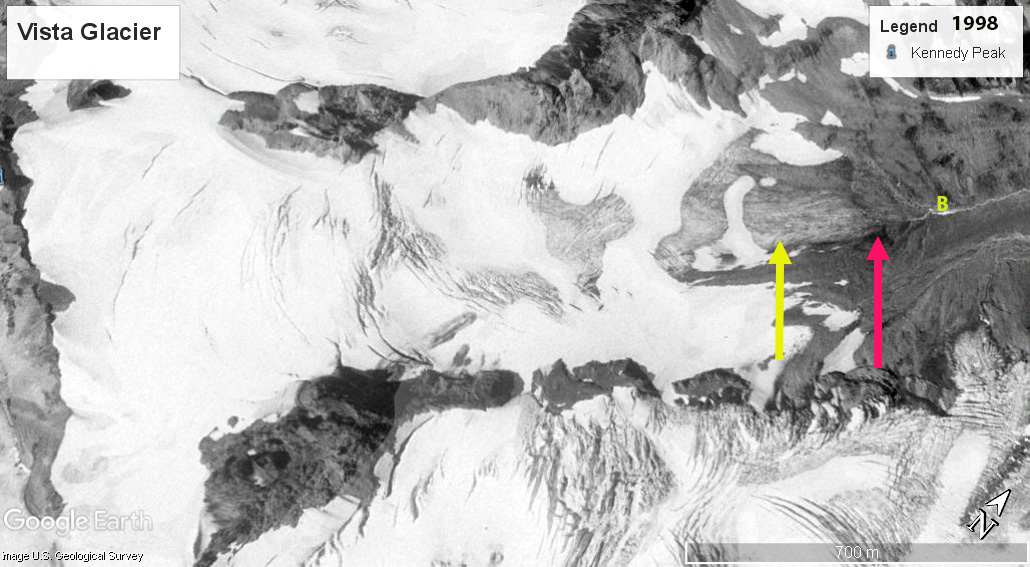
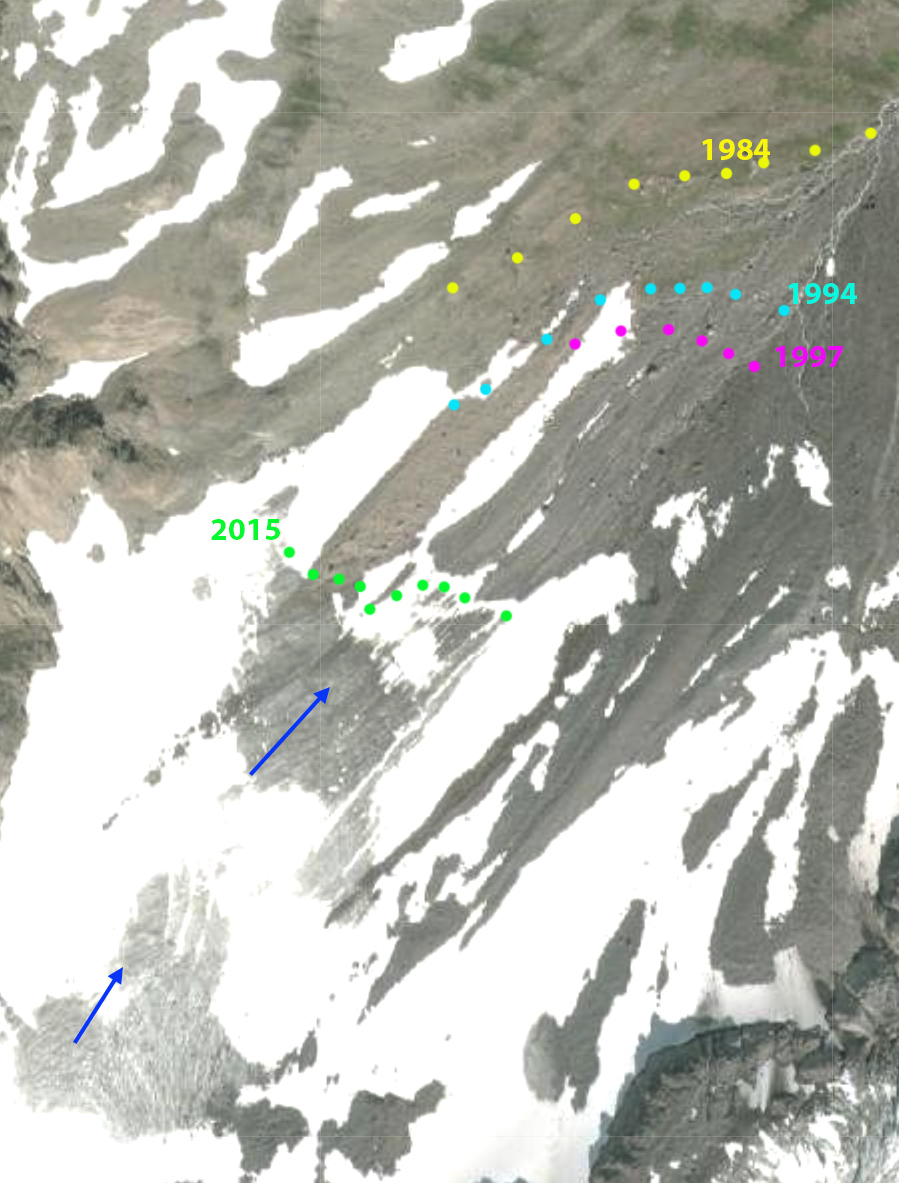
Vista Glacier in 1998 and 2016 Digital Globe images with the the 1984 terminus red arrow and 2015 terminus yellow arrow, Point A is the rock seen below the glacier in 1994 image below and Point B is where the advance moraine reached the valley bottom.

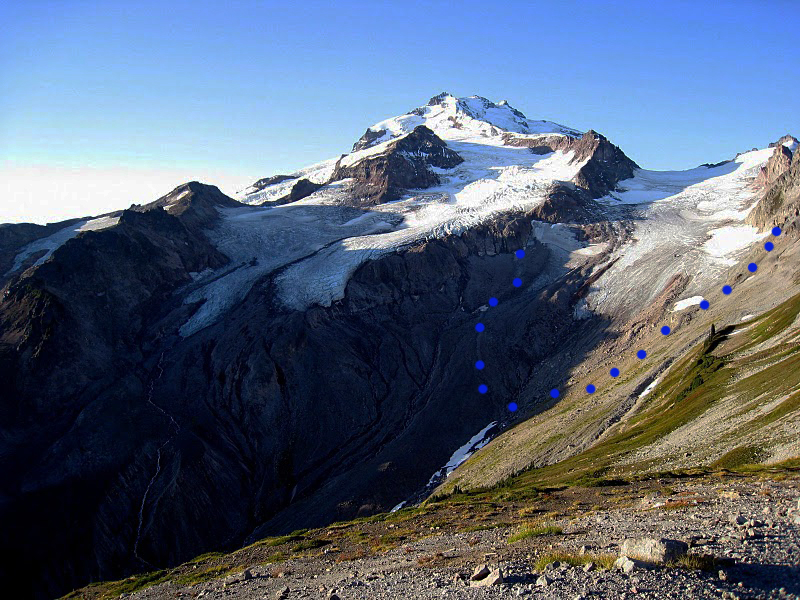
Vista Glacier is a valley glacier flowing down the northeast side of Glacier Peak (Dakobed) that drains into the Suiattle River. The glacier begins at 2475 m beneath Kennedy Peak. We examined all of the glaciers around Glacier Peak in detail from 1993-1997 to document their changes since first closely observed by C.E. Rusk 100 years earlier. The glacier during the LIA joined the Ermine Glacier and extended down to 1345 m. By 1900 when Asahel Curtis photographed this glacier it had retreated 1300 m.  By 1946 the glacier had retreated 1900 m from its LIA moraine, separated from Ermine Glacier and terminated at ~1900 m. In 1955 the glacier began a slow advance, all major Glacier Peak glaciers advanced during this period, that had ended by 1975 with a total advance of 105 m (Pelto and Hedlund, 2001).

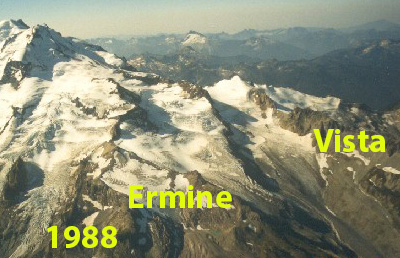
Vista Glacier in 1988 aerial image illustrating the glacier is still adjacent to advance moraine.

In 1985 at our first visit the glacier was again retreating, total retreat was 10-20 meters from the advance moraine. By 1994 the glacier had retreated 90-100 m with the lower part of the glacier thin and crevassed. By 1997 the glacier had retreated beyond the 1946 position. The retreat accelerated after 2003 and had retreated and by 2016 the retreat from the 1984 mapped position was 410 m, a rate of ~13 m/year. The terminus is now at 1900 m.

In 1994 Cliff Hedlund and I were surveying the terminus when we found a beautiful ice cave beneath the glacier, see below. The rock just behind Cliff in the cave is apparent now out in the open in the Digital Globe image from 2016 and the LIDAR image from 2015 (Point A). Cliff was ahead of his time with the homemade neon colored gear that is perfect in an ice cave.

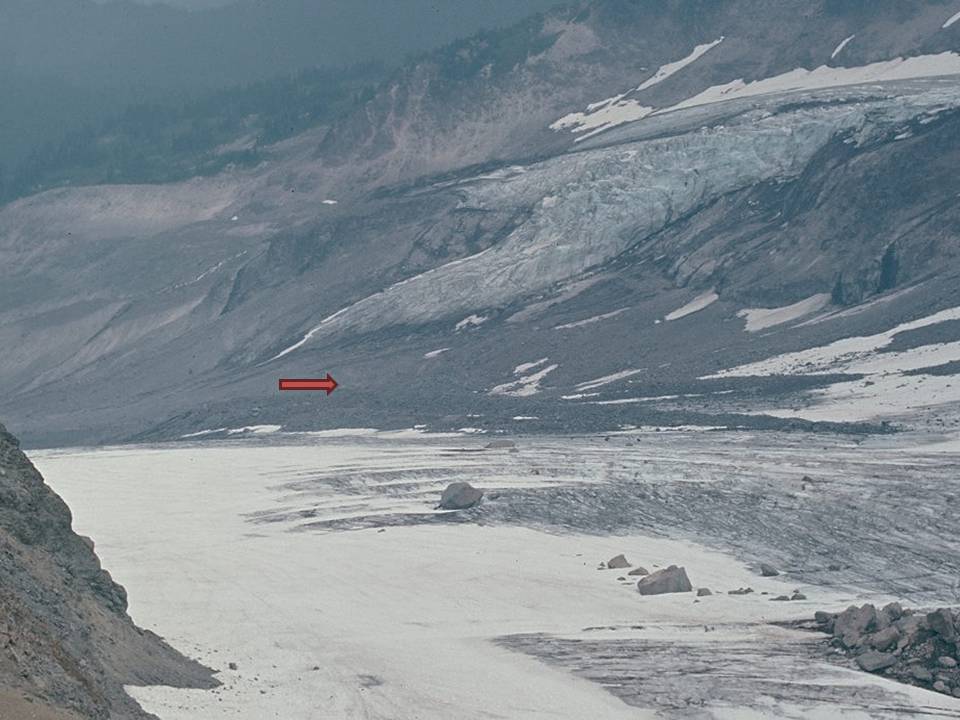
The red arrow in the image below looking down glacier in 1997 indicates the ice surface level in 1985, the glacier has thinned 20 meters in this region. Measuring snow depth up the middle of this glacier in 1994 and 1997 we found limited areas with accumulation of greater than 2 m in early August.  This glacier is prone to losing most of its snow cover in many years such as occurred 2005, 2009, 2015 and 2019.  Overall. This indicates considerable retreat will occur even with present climate. From 2013-2020 the end of summer snowline avearaged 2350 m, leaving just 35% of the glacier in the accumulatioin zone each year.  To have an equilibrium balance North Cascade glaciers need an AAR of  at least 55%, the percentage of glacier in accumulation zone (Pelto and Brown, 2012). We will back in the field this coming summer for the 38th consecutive year measuring the response of North Cascade glaciers to climate change.

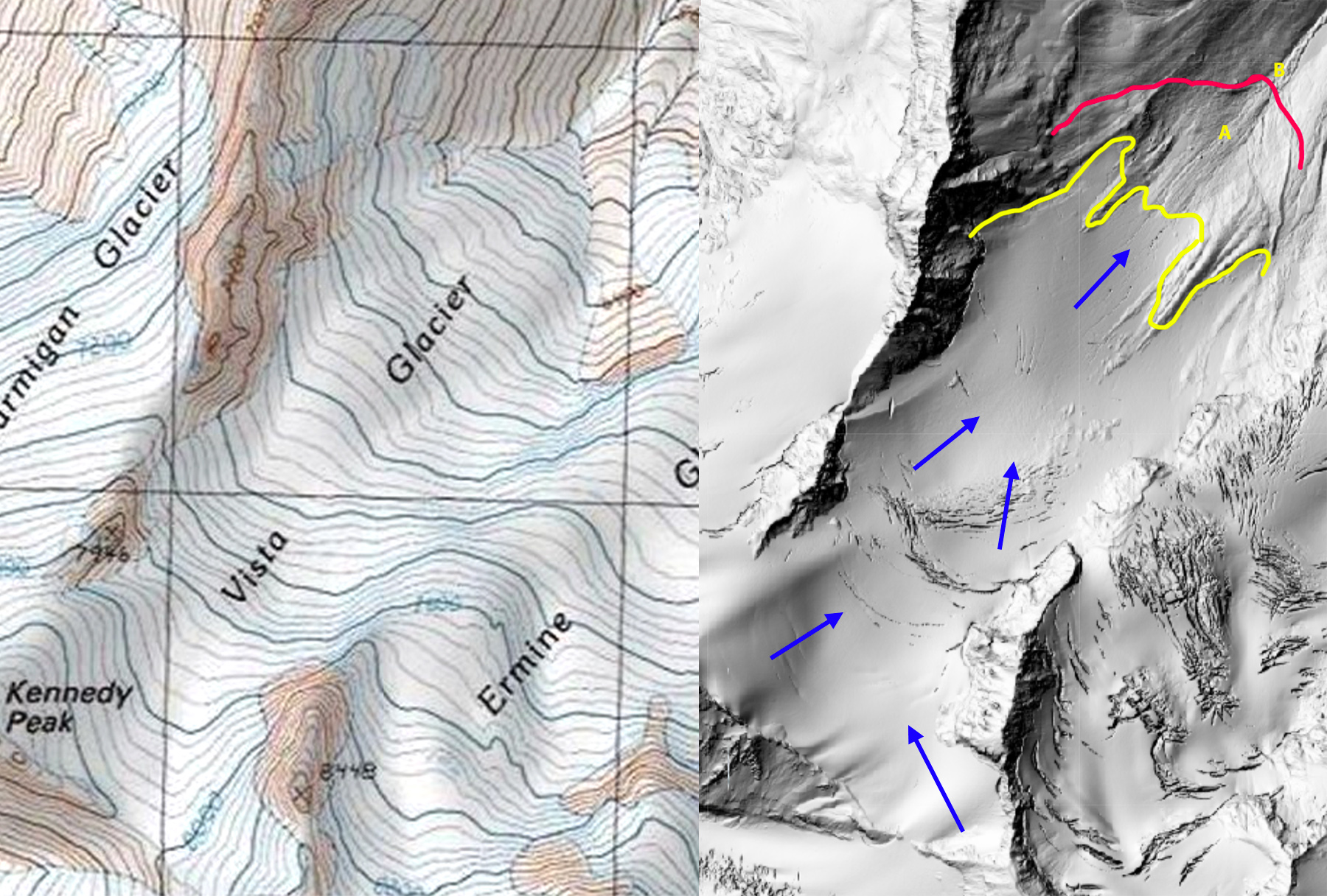
1984 USGS Map  of Vista Glacier and 2015 LIDAR (WA DNR) of Vista Glacier. Red line is the 1984 terminus and yellow line the 2015 terminus location. Note lack of crevasses in lower half of glacier.

Terminus change map of Vista Glacier from 1984-2015.

.

Cliff Hedlund in subglacial tunnel leading to Rock A in 1994.

View across lower half of glacier in 1997 towards Ermine Glacier indicating limited crevassing and flow of this thin section of the glacier

Vista Glacier in 2006 with the blue dots indicating the margin and resulting moraines emplaced by the advance from the 1950’s into the 1970’s.


Art and Science on the Easton Glacier: Reflections from the NCGCP 2020 Field Season

The field team at Camp discussing science communication and gazing at the Easton Glacier. Photo by Jill Pelto

By: Cal Waichler, Jill Pelto, and Mariama Dryak. 

It is the evening of Aug. 9th, 2020 and six of us are camped near the terminus of Easton Glacier. The sun has dropped below the moraine ridge above camp and a chilly breeze has forced us to put on layers. We are enjoying dinner cooked on our camp stoves, discussing what we observed on the ice today.  The toll of climate change on Easton Glacier, on the southern flank of Mount Baker, is impossible to escape. We are here to both measure this change and communicate what it means.

Within our team of six, four of us are trained as scientists, and all of us highly value creative science communication. This passion can manifest as art (painting, printmaking, sketching), writing, podcasting, blogging or video-making. We all appreciate that exercising creativity with others can provide us with a unique context for communicating about glaciers and climate change. 

Cal creates at Columbia Glacier–sketching and taking notes to capture the power of our lunch spot that day. Photo by Mariama Dryak.
Jill paints the icefall. Photo by Mariama Dryak.                                                                                                                                                                                                                  .

The Easton Glacier is large and stretches up to 2950 m elevation. We are here to monitor its health for the 31st consecutive year: its snow coverage, snow depth, terminus retreat, change in surface profile, and its annual mass balance (snow gain vs. snow loss). Easton Glacier is one of the forty-two World Glacier Monitoring Service reference glaciers, meaning it has 30+ consecutive year of mass balance observations, qualifying it for this select group. To learn more about this glacier over time, check out https://glaciers.nichols.edu/easton/  and a previous Easton Glacier update.

While we are at Easton Glacier to measure annual changes, we also see this landscape in the realm of both art and science. From the artistic lens we may note the same things that we do during research: the debris covering the retreating terminus, the crevasses melting down and getting shallower. But we also notice the beauty of these structures, how the crevasse patterns splay out across a knob, and the parallel lines preserved on a serac – recording five years of accumulation like rings on a tree. Observation is a theme in both art and science. We train our eyes to notice things in different ways, to pay attention to certain details. We are able to document these changes in our field notebooks, but also in sketchbooks, journals, photos, and videos.

The records of beauty stored in our sketchbooks serve as a qualitative reminder of what this landscape looks and feels like. In the process of depicting the landscape at the end of a field day, we paint our joy and exhaustion onto the page. In the moment, this act uncovers more details and allows us to reflect. Weeks later when we are off the mountain, we reopen our water-logged, dirt-streaked pages and are taken back to that place where we were. Field sketches, poems and paintings help us capture the emotion of moving through and attempting to understand sublime spaces. They are a vital link between our memories and sharing the meaning of our experience with others. They are also a deliberate recording of time and place — a kind of data in their own right.

The experience of working in this environment is memorable to us — we get to observe a plethora of crevasses, dozens of meltstreams, and strikingly beautiful colors. We can feel a range of excited, inspired, and nervous emotions throughout the day. For us, this experience is giving us the emotional context to our research: being present we can understand that “why”. That reason why the work matters not just for scientific knowledge, or the local ecosystem, but also for humanity. The science results alone can share the data that underlies that, but they might not always connect with other people in a way that elicits that comprehension. Our creative communication through writing and art can elicit that deeper, emotional understanding of why it’s important to preserve and protect these places, and why we need to understand the amount of change that will occur to the climate and ecosystem. Our collection of art shares stories about Easton Glacier in ways that connect with the science, and also go beyond it. 

This summer we all felt especially fortunate to be in the North Cascades. Covid-19 has kept us all so isolated and often indoors. The chance to work on the glaciers and live at their feet for two weeks gave us back some of the breathing room we lacked in 2020 – a lucky opportunity indeed.

Cal’s Art – clairewaichler.com

Mariama’s website – Let’s Do Something Big

Jill’s Art – jillpelto.com


North Cascade Glacier Climate Project Observations 2020, 37th Field Season

The North Cascade Glacier Climate Project 2020 field season was our 37th consecutive year of glacier observations.  The field team consisted of Cal Waichler, Mariama Dryak, Jill Pelto and Mauri Pelto.  Each team member has studied glaciers on more than one continent and is passionate about science communication, using either art, videography or writing.

Mauri Pelto, Jill Pelto, Cal Waichler and Mariama Dryak from left to right on Easton Glacier the 2020 field team (Jill Pelto Photograph).

At Columbia Glacier the field team  was joined by Michelle Tanz a Wlderness Stewardship Fellow for the National Forest Service.  The initial observation was that the 2 km bushwhack around Blanca Lake has gotten much brushier as the alpine meadow becomes more sub-alpine. Columbia Glacier is a low elevation avalanche fed glacier that developed a new lake at its terminus a decade ago that continues to expand.  The east side of the glacier has been thinning much faster than the west side altering the very shape of the glacier.  Observed snowpack in 2020 was below average except for on the slopes of the main west side avalanche fans. The upper basin at 1550-1650 m averaged 2.2 m of snowpack at the 70 probing locations, which is 70% of normal.  This snowpack will not survive the melt season, only snowpack in the main avalanche fans will remain. Terminus retreat has been 217 m since our first observation in 1984.

Lower Curtis Glacier is fed by avalanches from the slopes of Mt. Shuskan.  We were joined in the field by Tom Hammond for the 17th consecutive year and artist Claire Giordano.  There was a similar pattern to Columbia Glacier in that snowpack across most of the glacier was below average, while the primary avalanche fan on the east side had above average snowpack.  The avalanche fans on the central headwall of the glacier fed from the Upper Curtis Glacier continue to thin rapdily, as avalanching has declined.  The terminus slope which had been a daunting 42 degrees in 2015 is now 34 degrees. For the sixteenth consecutive year we had at least one artist in the field, below are field sketches from Cal Waichler and Jill Pelto and a painting from Claire Giordano.  We will be combining the science findings and art in forthcoming articles on Lower Curtis and Easton Glacier.

Claire Giordano working on painting of Lower Curits Glacier and Mt. Shusksan (Mariama Dryak Photograph).

Jill Pelto completes sketch, while sitting on ice chunk, of Easton Glacier icefall (Mariama Dryak Photograph).

Cal Waichler annotated story board style sketches both capture and explain the scene at Columbia Glacier (Mariama Dryak Photograph).

Rainbow Glacier has a terminus that is largely buried by avalanches, but is now is close to detaching from the main valley glacier.  Snowpack at 1700 m averaged 2.4 m which is 75% of average. The saddle with Mazama glacier at 2000-2100 m averaged 3.9 m, which is 85% of normal. Subglacial bedrock knobs continue to become more prominent in expanding crevassing above and slope below the slope change, as the glacier thins.

Sholes Glacier had the highest percentage of surface blue ice of the glaciers observed.  Snowpack had been reduced from at a rate of 8 cm/day during the first week of August, a relatively warm period. A snow cave at the terminus could be entered from a terminus crevasse that was 50 m long, 10 m wide and 2-5 m high.  This is indicative of a relatively stagnant rapidly retreating terminus. From 2014-2020 the glacier has retreated 80 m, which is equivalent to the retreat from 1990-2014. Glacier runoff continues to be monitored just below the glacier by the Nooksack Tribe, while we provide continued rating curve development.  Runoff during early August was averaging 0.25 m3/sec.

On Easton Glacier the terminus slope was the gentlest we had seen in our 31 years of consecutive observations.  The terminus has retreated 430 m in this period. The significant thinning in the last few years had both reduced crevassing in the lowest icefall, but had reduced crevasse depth.  Jill Pelto has been observing the crevasses depth in all the open crevasses in this icefall over the last decade.  The biggest change has been from 2018-2020 with average depth being reduced by 40%. Snowpack on the bench at 2000 m averaged 2.4 m at the 45 observation sites, which is 75% of normal.  The snowpack remained below normal at 2200 m, before a sharp increase to above normal snowpack averageing 5.1 m in 14 crevasse observations at ~2500 m. At this same elevation retained snowpack, now firn from previous years averaged 2.25 m. Based on the storm stratigraphy one significant difference was the result of an atmospheric river precipitation event of 12+ cm of precipitation from 1/31-2/2, that led to a snow depth and snow water equivalent decline at the Middle Fork Nooksack Snotel at 1550 m, while above 2300 m this all fell as snow.  The freezing levels were above 2000 m for much of the event.  The better high elevation snowpack will help Easton Glacier’s mass balance in 2020.

Easton Camp from adjacent to 1990 terminus position (Jill Pelto Photograph).

Crevasse stratigraphy at 2500 m on Easton Glacier indicates an average of 5.1 m of 2020 snowpack in crevasses and 2.25 m for previous annual layers from the 2016-2019 period (Mauri Pelto and Jill Pelto Photographs)


NORTH CASCADE GLACIER CLIMATE PROJECT 2020-37th Annual Field Program

Field season images from 2019 indicating crevasse stratigraphy, annotated by Clara Deck.

Director: Mauri S. Pelto, mspelto@nichols.edu-Nichols College

Field Artist & Scientist: Jill Pelto, pelto.jill@gmail.com

Who we are? NCGCP was founded in 1983 to identify the response of North Cascade glaciers to regional climate change, particularly changes in mass balance, glacier runoff and terminus behavior.   NCGCP is a field project that has a broader interdisciplinary scope and examines more glaciers than any other program in North America.  It does so cost effectively relying on no permanent camps, helicopter support or salaries for the director. The field season includes no days off and each day is spent completing measurements on glaciers.  The focus is on glacier mapping, mass balance measurement, terminus observations and glacier runoff monitoring.  This program monitors two of the World Glacier Monitoring Service’s reference glaciers. There are ~45 such glaciers in the world with 30 years of continuous measurements. We complete mass balance and terminus observations on Columbia, Daniels, Easton, Ice Worm, Lower Curtis, Lynch, Rainbow and Sholes Glacier with runoff measurements below Sholes and Ice Worm.

Why study glaciers in the North Cascades? Glaciers are one of the world’s best climate monitors and are a critical water resource to many populated glaciated regions. This is particularly true in the North Cascades where 700 glaciers yield 200 billion gallons of summer runoff and glaciers have lost 30 % of their area in the last century.

Field Team 2020:

Jill Pelto is an artist and scientist from New England who grew up loving winter sports and trips to the mountains. She incorporates scientific research and data into paintings and prints to communicate environmental changes. Her multi-disciplinary work weaves visual narratives that reveal the reality of human impacts on this planet, as earlier in July was illustrated on the cover of TIME. She completed both her B.A. degrees in Studio Art and Earth and Climate Sciences and her M.S. focused on studying the stability of the Antarctic Ice Sheet at the University of Maine, spending two field seasons at a remote camp in the southern Transantarctic Mountains. Jill will be joining the project for her 12th field season. She is excited about continuing to document the change in North Cascade glaciers that she has witnessed each of the last ten years — through science and art.

Mauri Pelto has directed the project since its founding in 1984, spending more than 700 nights camped out adjacent to these glaciers. He is the United States representative to the World Glacier Monitoring Service, author of the AGU blog “From a Glacier’s Perspective”, and on the Science Advisory Board for NASA’s Earth Observatory.  His primary job is Dean of Academic Affairs at Nichols College, where he has been a professor since 1989.

Cal Waichler is an environmental science major at Colby College in Maine and is from Winthrop, WA. She looks to bridge the gap between science and the public by creating impactful, accurate climate art and storytelling. This summer’s research goal is to generate building blocks to contextualize her work within two fields: glacier science and climate communication.

Mariama Dryak (she/her) is an earth scientist, science communicator/writer and an advocate for action on creating solutions to the global climate crisis. Mariama is the creator and editor of an environmental advocacy blog Let’s Do Something BIG. and the ‘we persist.’ podcast, which shares the stories of underrepresented people in the earth, ocean and environmental sciences. Mariama received her Master’s from the University of Maine in 2019 in Earth and Climate Science, during which she drew connections between inferred ocean conditions and glacier change along the Antarctic Peninsula. Mariama can most often be found chatting science, going on adventures or getting muddy whilst doing something outdoors.

Columbia Glacier terminus with the 2018 field team.

 Field Partners 2020

Victoria Jarvis and Michelle Tanz are Wilderness Stewardship Fellows who will be gathering information about the Henry M Jackson Wilderness including the glacier. They are looking to understand the Columbia Glacier and our research within the scope of the 5 qualities of wilderness character (untrammeled, undeveloped, natural, solitude and primitive rec, other). They will then be able to incorporate our long-term monitoring efforts into their wilderness character narrative– a synthesized agency document providing insight about the wilderness.

Alia Khan, Western Washington University Cryosphere Studies and Aquatic Biochemistry Lab:

The research team including grad students Molly Peek and Shannon Healy focus on environmental chemistry in the cryosphere, including black carbon and snow algae to document global change of glacier and snow melt in mountainous and polar regions.

Tom Hammond, North Cascade Conservation Council,Will be joining us for the 17th year leveraging his experience with our for understanding the ongoing impact of climate change and our stewardship on the region.

Nooksack Indian Tribe, for the 9th consecutive year we will be conducting field work aimed at providing field validation and streamflow calibration data below Sholes Glacier for the ongoing work of the tribe.

Measuring flow below Sholes Glacier

Rainbow Glacier Fieldwork 8-7-2018

The video is of a single day of field work on Rainbow Glacier on 8-7-2018.  This was our 702nd day of fieldwork during the project that began in 1984.  On this day the field team consisted of Mariama Dryak, Erin McConnell, Jill Pelto and Mauri Pelto. Rainbow Glacier is a valley glacier on the northeast flank of Mount Baker, a stratovolcano and the highest mountain in the North Cascade Range, Washington.  The glacier begins at a saddle at 2200 m sharing a divide with Mazama and Park Glacier.  The glacier descends from the saddle through an icefall at 1950 m into the Rainbow Creek valley terminating at 1400 m.  The consistent accumulation area extends from 1800 m to the saddle region above 1950 m. The glacier tongue features a deeply incised supraglacial stream channel.  From 1984-2018 cumulative mass balance loss has exposed several bedrock knobs along the southern margin of the glacier.

Runoff from the glacier drains into Baker Lake, a reservoir for the Baker Dam hydropower facilities that have a generating capacity of 215 MW. Rainbow Glacier advanced during the 1950-1979 period building a terminal moraine.  At the time of the first field season in 1984 the glacier was still in contact with this moraine.  From 1984-2018 the glacier has retreated 620 m. In 2018 the mass balance was -0.53 m.

Terminus of Rainbow Glacier in 2018


Figure 1 is a map of the Rainbow Glacier indicating the mass balance measurement network.


Mass balance map of Rainbow Glacier in 2017 with mass balance isoline in m of water equivalent (Map by Ben Pelto)

North Cascade Glacier Climate Project 2019, 36th Annual Assessment


The summer of 2019 found the North Cascade Glacier Climate Project in the field for the 36th consecutive summer monitoring the response of North Cascade glaciers to climate change.  This long term monitoring program was initiated partly in response to a challenge in 1983 from Stephen Schneider to begin monitoring glacier systems before and as climate change became a dominant variable in their behavior.

The field team was comprised of Clara Deck, Ann Hill, Abby Hudak, Jill Pelto and myself.  All of us have worked on other glaciers. The bottom line for 2019 is the shocking loss of glacier volume. Ann Hill, UMaine grad student observed, that “Despite having experience studying glaciers in southeast Alaska and in Svalbard, I was shocked by the amount of thinning each glacier has endured through the last two and a half decades.”  Glaciers are typically noted as powerful moving inexorably.  Clara Deck, UMaine MS graduate, was struck by “the beauty and fragility of the alpine environment and glaciers.”  Fragile indeed in the face of climate change. Abby Hudak, Washington State grad student, looked at both the glacier and biologic communities as under stress, but glaciers cannot migrate, adapt or alter there DNA.

Over the span of 16 days in the field, every night spent in the backcountry adjacent to a glacier, we examined 10 glaciers in detail. All glaciers are accessed by backpacking.  The measurements completed add to the now 36 year long data base, that indicate a ~30% volume loss of these glaciers during that period (Pelto, 2018). Here we review preliminary results from each glacier. Each glacier will have a mass balance loss of  1.5 -2.25 m, which drives continued retreat.  Columbia and Rainbow Glacier are reference glaciers for the World Glacier Monitoring Service, with Easton Glacier joining the ranks later this year. Below and above is the visual summary. Specific mass balance and retreat data will be published here and with WGMS after October 1.

Easton Glacier, Mount Baker.  Terminus has become thin and uncrevassed as a rapid retreat of 15 m per year continued, 405 m retreat since 1990.

Easton Glacier icefall at 2200 m typically has 1.8 m w.e. at the end of the summer, this year it will be 0 m. The overall mass balance will be ~2 m of loss.

Deming Glacier, Mount Baker has now receded over 700 m since our first visit 35 years ago.

On Lower Curtis Glacier a key accumulation source the NE couloir now shows bedrock. Overall by summers end ~25% of the glacier will retain snowcover, far short of what is needed to maintain its volume.

The Lower Curtis Glacier terminus continues to retreat at 8 m/year, but thinning and slope reduction has been more notable.  

In early August the majority of Sholes Glacier has lost its snowpack.  The thin nature of the terminus indicates the glacier is poised for continued rapid retreat that has exceeded 15 m per year during the last 7 years.

Runoff assessment confirmed ablation stake measurement of 11 cm of ablation/day from 8/6-8/8 on Sholes Glacier.

High on Rainbow Glacier there are still plenty of regions lacking snowcover, instead of a thick mantle of snowpack.

Rainbow Glacier was awash in meltwater streams, see video.  This area should have 1 m of snowpack left. Rainbow Glacier has retreated 650 m since 1984.

Just getting to each glacier does involve overcoming various miseries.

A transect across lower Coleman Glacier, Mount Baker indicates 38 m of thinning since 1988.

Limited snowpack remaining on Columbia Glacier, with six weeks of melt left. Lake in foreground expanded dramatically in last two years.  Retreat ~45 m from 2017-2019 and 210 m from 1984-2019, more than 10% of its length.

Upper basin of Columbia Glacier mainly bare of retained snowpack.

Ice Worm Glacier terminates in expanding lake.

Ice Worm Glacier continues to retreat at the top and bottom of the glacier.  Mass loss is leading to a more concave shape each year.

Daniels Glacier had a maximum snowpack of 1.75 m, instead of 4 m.

Foss Glacier measurements discontinued as it disintegrates, only 20% snowcover in mid-August.

Lynch Glacier less than 50% snowcovered with six weeks of melt left.


The team which completed over 1200 mass balance measurements, 40,000 vertical feet and 110 miles of travel across glacier clad mountains.


36th Annual North Cascade Glacier Climate Project Field Season Begins

Fieldwork includes terminus surveys, glacier runoff measurement and mass balance measurements

Field Season Begins August 1

Who we are? The North Cascade Glacier Climate Project (NCGCP) was founded in 1983 to identify the response of North Cascade glaciers to regional climate change, particularly changes in mass balance, glacier runoff and terminus behavior.   This was prompted by the  National Academy of Sciences listing this as a high priority and a personal appeal from Stephen Schneider. NCGCP is a field project that has a broader interdisciplinary scope and is the most extensive glacier mass balance field program in the United States.  Two of the 41 reference glaciers in the world are in our network, and as of next year that will become three glaciers.  We do this research cost effectively relying on no permanent camps, helicopter support or salary for the director. The field season includes no days off and each day is spent completing measurements on glaciers.  The focus is on glacier mapping, mass balance measurement, terminus observations and glacier runoff monitoring.  Each year we utilize several field assistants to complete the annual glacier surveys, with 2019 being the 36th field season.  Our goal in choosing assistants is not to pick the most experienced, but the individuals who are capable and can benefit the most.  We are a self-contained unit. Recently Hakai Magazine described our process well.

Why study glaciers in the North Cascades? Glaciers are one of the world’s best climate monitors and are a critical water resource to many populated glaciated regions. This is particularly true in the North Cascades where 700 glaciers yield 200 billion gallons of summer runoff and glaciers have lost 30 % of their area since 1980. These glaciers have lost 25-30% of their volume during the course of our study, three of our primary study glaciers have disappeared. We also monitor ice worms and mountain goats since we are in the same locations at the same time each year.

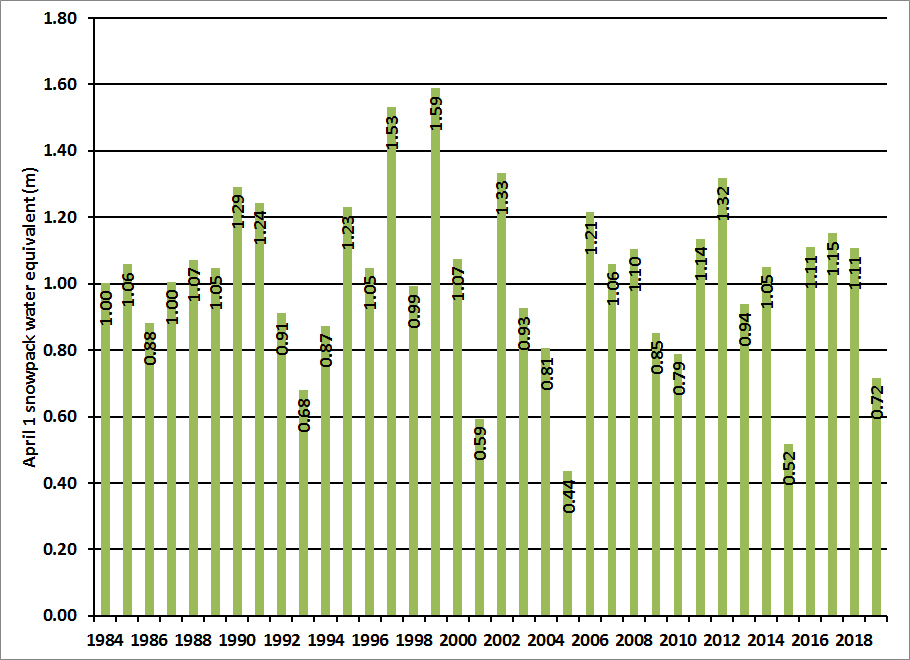
2019 Outlook: For North Cascade glaciers the accumulation season provides that layer of snow, that must then last through the melt season.  A thin layer sets the glaciers up for a mass balance loss, much like a bear with a limited fat layer would lose more mass than ideal during hibernation. The 2019 winter season in the North Cascade Range, Washington has been unusual.  On April 1 the retained snow water equivalent in snowpack across the range at the six long SNOTEL sites is 0.72 m, which is ~70% of average.  This is the fifth lowest since 1984.  The unusual part is that freezing levels were well above normal in January, in the 95% percentile at 1532 m, then were the lowest level, 372 m of any February since the freezing level record began in 1948.  March returned to above normal freezing levels.  As is typical periods of cold weather in the regions are associated with reduced snowfall in the mountains and more snowfall at low elevations.  In the Seattle metropolitan area February was the snowiest month in 50 years, 0.51 m of snow fell, but in the North Cascades snowfall in the month was well below average. From Feb. 1 to April 1, snowpack SWE at Lyman Lake, the SNOTEL site closest to a North Cascade glacier, usually increases from 0.99 m to 1.47 m, this year SWE increased from 0.83 m to 1.01 m during this period. The melt season from May-Mid-July has also been warmer than average.  This combination will lead to significant glacier mass loss in 2019, in one month we will report back on our measurements that will indicate just how negative.

2019 Field Team:

Clara Deck: is an earth scientist from Chicago with a passion for science communication, education, and outreach. She completed a B.A. in geology at the College of Wooster in Wooster, Ohio, where she began a journey in climatological research which led to a love for the cryosphere. In the summer of 2018, Clara contributed to glacial field work in the eastern Alaska Range, and was fascinated by the dynamic day-to-day changes in glacial features she was tasked with measuring. At the University of Maine, she is wrapping up her M.S. focused on numerical modeling of Antarctic ice shelf instabilities, but Clara’s favorite part of her college career has been sharing science with students as a teaching assistant. During her first visit to the North Cascades, she is excited to learn about ongoing glacial change and to explore accessible ways to share the findings with public audiences.

Abby Hudak is a native Floridian that has always had a deep calling to the mountains and frozen landscapes. Her passions revolve around understanding our changing climate and natural world which led her to attain a B.S. in Biological Sciences from the University of Central Florida. After starting her M.S. in Biological Sciences at Washington State University, she immediately indulged in snow sports and mountaineering in the Cascade Range. The beauty and vulnerability of these landscapes have driven her to expand her research interests to understanding aspects of the changing cryosphere. She is eager to intertwine her love for the Cascade Range and her desire to pursue scientific questions pertaining to climate impacts on alpine glaciers by working with the North Cascade Glacier Climate Project this summer.

Ann Hill, ever since she was a young child growing up in Minneapolis, Ann has been fascinated by ice and snow, however it wasn’t until her Sophomore year studying Geosciences at Skidmore College that she realized she could study ice as a career path. Consequently, during her junior year she traveled to Svalbard to gain hands-on experience studying and exploring glaciers. Determined to learn more, Ann spent a summer with the Juneau Icefield Research Program, which exposed her to glaciers that looked and behaved differently. In the fall, Ann will begin her M.S. in Earth and Climate Sciences at the University of Maine. Ann is thrilled to study the North Cascade glaciers to understand how their movement and characteristics compare to those she previously observed in Svalbard and Alaska.

Jill Pelto is an artist and scientist from New England who grew up loving winter sports and trips to the mountains. She incorporates scientific research and data into paintings and prints to communicate environmental changes. Her multi-disciplinary work weaves visual narratives that reveal the reality of human impacts on this planet. She completed both her B.A. degrees in Studio Art and Earth and Climate Sciences and her M.S. focused on studying the stability of the Antarctic Ice Sheet at the University of Maine. She spent two field seasons at a remote camp in the southern Transantarctic Mountains to map glacial deposits and collect samples from them for dating. Jill will be joining the project for her 11th field season. She is excited about continuing to document the change in North Cascade glaciers that she has witnessed each of the last ten years — through science and art.

Mauri Pelto has directed the project since its founding in 1984, spending more than 700 nights camped out adjacent to these glaciers. He is the United States representative to the World Glacier Monitoring Service, author of the AGU blog “From a Glacier’s Perspective”, and associate editor for three science journals.  His primary job is Dean of Academic Affairs at Nichols College, where he has been a professor since 1989.
Schedule

Aug. 1:  Arrive Hike into Easton Glacier

Aug. 2:  Easton Glacier survey

Aug. 3:  Easton Glacier survey

Aug. 4:  Hike out  Hike in Lower Curtis Glacier

Aug. 5:  Lower Curtis Glacier Survey

Aug. 6:  Hike out Lower Curtis Glacier Hike in Ptarmigan Ridge

Aug. 7:  Sholes Glacier

Aug. 8:  Rainbow Glacier

Aug. 9:  Hike out- Coleman Glacier survey

Aug. 10:  Hike in Columbia Glacier

Aug. 11:  Columbia Glacier survey

Aug. 12:  Columbia Glacier survey

Aug. 13:  Hike out Columbia Hike in Mount Daniels

Aug. 14:  Ice Worm Glacier survey

Aug. 15:  Lynch and Daniels Glacier survey

Aug. 16:  Hike out

North Cascade 2019 Winter Accumulation Assessment

April 1 winter accumulation at the longer term North Cascade SNOTEL stations (Fish Lake, Lyman Lake, Park Creek, Rainy Pass, Stampede Pass and Stevens Pass).

For North Cascade glaciers the accumulation season provides that layer of snow, that must then last through the melt season.  A thin layer sets the glaciers up for a mass balance loss, much like a bear with a limited fat layer would lose more mass than ideal during hibernation. The 2019 winter season in the North Cascade Range, Washington has been unusual.  On April 1 the retained snow water equivalent in snowpack across the range at the six long SNOTEL sites is 0.72 m, which is ~70% of average.  This is the fifth lowest since 1984.  The unusual part is that freezing levels were well above normal in January, in the 95% percentile at 1532 m, then were the lowest level, 372 m of any February since the freezing level record began in 1948.  March returned to above normal freezing levels.  As is typical periods of cold weather in the regios are associated with reduced snowfall in the mountains and more snowfall at low elevations.  In the Seattle metropolitan area February was the snowiest month in 50 years, 0.51 m of snow fell, but in the North Cascades snowfall in the month was well below average. From Feb. 1 to April 1, snowpack SWE at Lyman Lake, the SNOTEL site closest to a North Cascade glacier, usually increases from 0.99 m to 1.47 m, this year SWE increased from 0.83 m to 1.01 m during this period.

The Mount Baker ski area snow measurement site has the world record for most snowfall in a season 1140 inches (28.96 m) during the 1998/99 snow season.  The average snowfall is 633 inches (16.07 m) with snowfall this year as of April 15th at 533 inches (13.53 m).  Below is a Landsat image from April 15, 2019 indicating the snowline at ~1000 m in the Nooksack River Valley and 900-1000 m in the Baker Lake valley.

This year for the 36th consecutive year the North Cascade Glacier Climate Project will be in the field measuring North Cascade glaciers, the early signs point towards a seventh consecutive negative balance year.

Freezing levels at Mount Baker, WA from the North American Freezing Level Tracker. February lowest mean freezing level since 1948.


Mount Baker Cloaked in winter snow in 4/15/2019 Landsat image MB=Mount Baker, MS=Mount Shuksan, NR=Nooksack River

Boulder Glacier, Mount Baker Washington Retreat 1980-2018

Boulder Glacier terminus position 1980-2018 as measured in the field. Note Lahar path that descends from Sherman Crater.  Lahars have also occurred subglacially during our field observations.

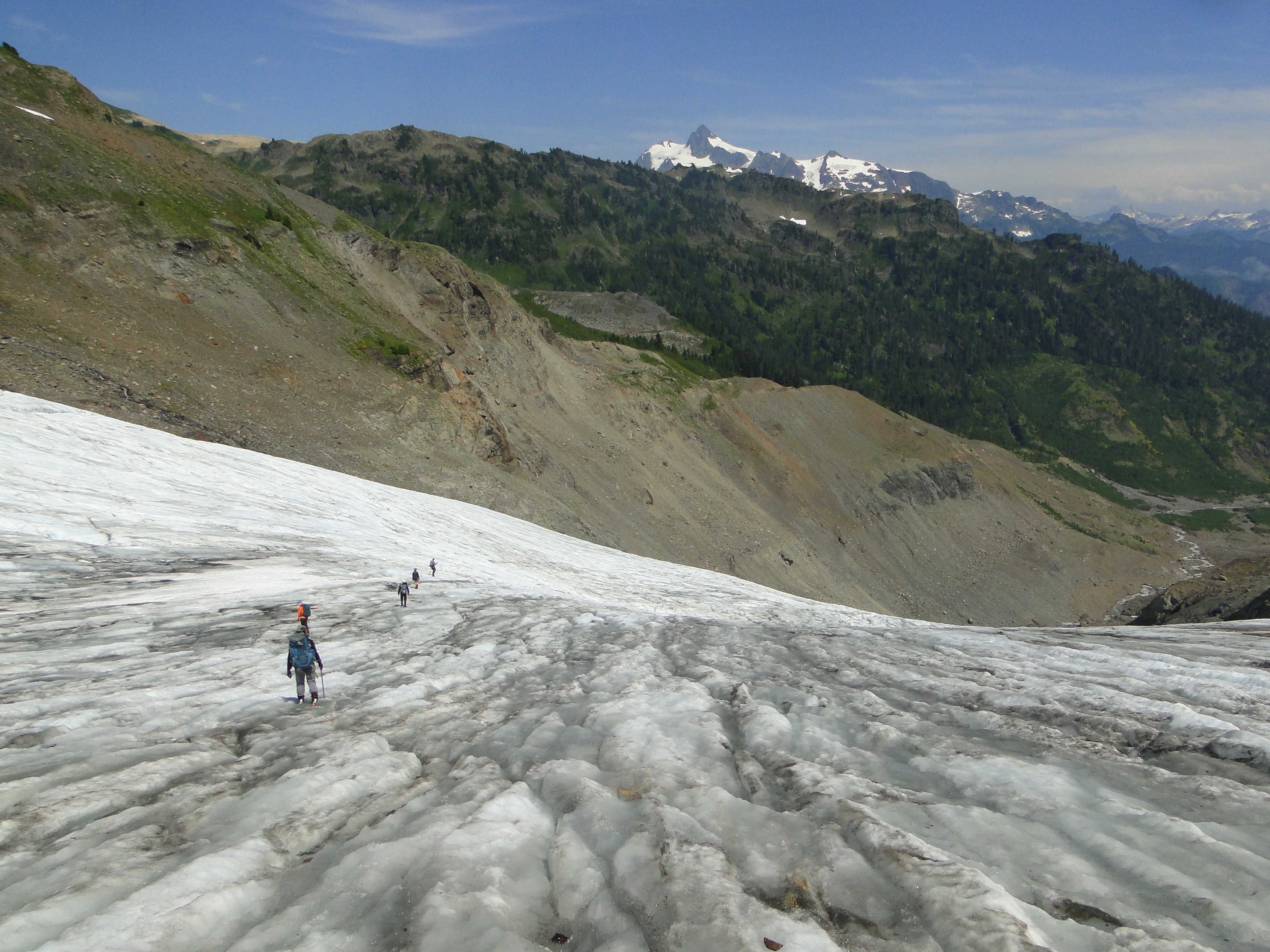
Boulder Glacier flows down the east side of Mount Baker a strato volcano in the North Cascades of Washington. This steep glacier responds quickly to climate change and after retreating more than 2 kilometers from its Little Ice Age Maximum, it began to advance in the 1950’s as observed by William Long (Pelto, 1993). The glacier advance had ceased by 1979. From 1988-2008 we (NCGCP) have visited this glacier at least every five years recording its changes.

In 1988 the glacier had retreated only 25 meters from its furthest advance of the 1950-1979 period.  The advance moraine was a well defined ridge, with a diversity of plant life just beyond the moraine. By 1993 the glacier had retreated 100 m from this position. At this time the lower 500 meters of the glacier was clearly stagnant. By 2003 the glacier had retreated an additional 300 m. In 2008 the glacier had retreated 490 meters from its 1980 advance position, a rate of 16 meters per year. The glacier as seen in 2008 despite the steep slope has few crevasses in the debris covered lower 400 meters of the glacier. This indicates this section of the glacier is stagnant and will continue to melt away. The transition to active ice is at the base of the icefall on the right-north side of the glacier. Below is the glacier in 1993 note the darkened cliff at adjacent to and right of the terminus. The picture below that is from 1998 again note cliff, than in 2003 from the same location as the 1993. Than an image from 2008 of the terminus from further upvalley, as it is not clearly in view from the previous location. The picture from Asahel Curtis taken in 1908 illustrates the width of the active glacier in the zone where it terminates in the 1990’s. The 2017 image illustrates the debris band from the lahar.  Retreat from 1980-2018 has averaged 730 m, with the rate being relatively consistent.  The retreat amounts to 20% of the total glacier length lost and the terminus elevation has increased by ~175 m. This glacier after nearly 40 years of retreat is still not approaching equilibrium and will continue to retreat.   There is active crevassing closer to the current terminus than at any point since our observations began suggesting the retreat could slow in the near future.  Note the 2015 LIDAR image from the Washington DNR, red path is the terminus. During he 2013-2018 period the end of summer snowline has been particularly high averaging ~2100 m.  This is a reflection of continued negative mass balance as measured on the adjacent Easton Glacier. Boulder Glacier does respond fast to climate change, and the climate has not been good for this glacier. The glacier does have a consistent accumulation zone and can survive current climate (Pelto, 2010). For 35 years the North Cascade Glacier Climate Project has focused on observing the response of glaciers to climate change and will continue to do so.
.

Picture from August, 1993 of the terminus of Boulder Glacier

Picture from August 1998 of the terminus of Boulder Glacier

Picture from August 2003 of the terminus of Boulder Glacier

.

Boulder Glacier in August 2008.

Asahel Curtis image of Boulder Glacier in 1908.

Boulder Glacier in 2017 from Rainbow Ridge, taken by Tom Hammond

LIDAR image of Boulder Glacier from 2015 note the crevassing close to the terminus, red line.

35th Annual Field Observations of North Cascade Glaciers

The 2018 field season observations, conditions and summary. Field team Mariama Dryak, Erin McConnell, Jill Pelto and Mauri Pelto.

For the 35th consecutive year I headed to the North Cascade Range, Washington to monitor the response of glaciers to climate change.  Two of the glaciers the North Cascade Glacier Climate Project (NCGCP) monitors are now part of the 42 glaciers comprising the World Glacier Monitoring Service  (WGMS) reference glacier network, where annual mass balance has been assessed for more than 30 years consecutively.

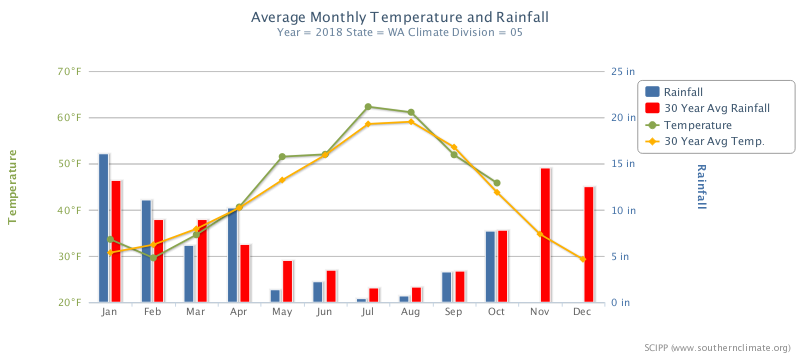
The 2018 winter season featured relatively normal snowpack despite a winter of wide temperature fluctuations, February freezing levels 400 m below the mean and December 500 m above the mean. Summer melt conditions featured temperatures 1.1 C above the 1984-2017 mean. The summer melt season through August was warm and exceptionally dry, which has also helped foster forest fires. The melt rate during the August field season was 35% above normal.

Washington Climate Division Five, western North Cascades

We assessed the mass balance of eight glaciers.  All eight will have significant negative mass balances in 2018, between -0.5 m and -1.0 m.  Retreat was measured on seven of the glaciers where the terminus was exposed, all had retreated since 2017 with the retreat ranging from 7-21 m. This continues the pattern of significant retreat each year that began in 2014. The overall length loss as a percentage of total length falls into a relatively narrow range of 10-22%.  The mass balance losses has also led to additional rock outcrops emerging in what had been the elevation of the accumulation zone.  We continued to measure runoff below Sholes Glacier and to assess crevasse depth.  The average crevasse depth in 2018 was 10 m, with the deepest at 16 m on Lower Curtis Glacier.

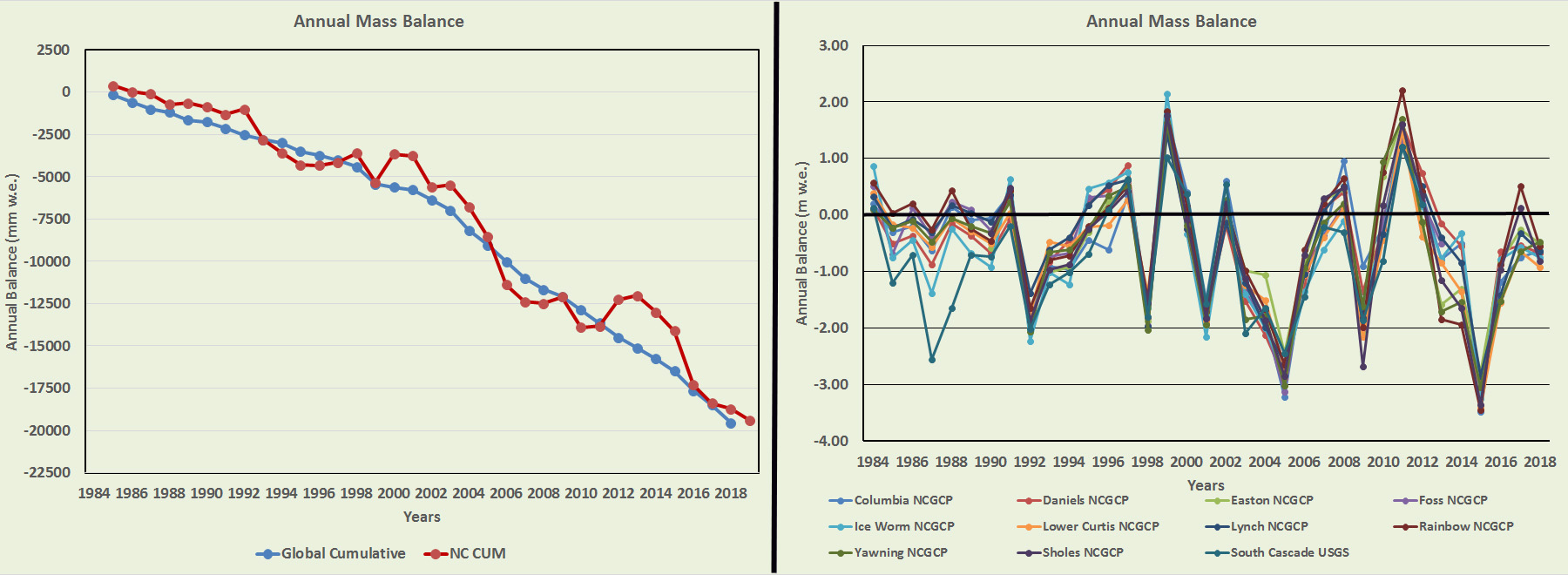
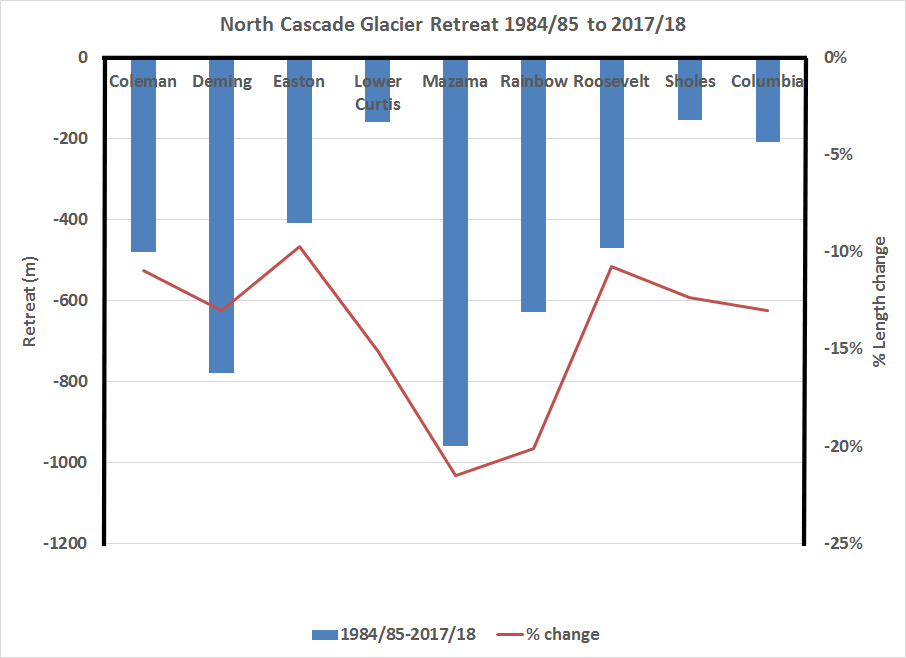
Annual  mass balance of North Cascade glaciers 1984-2018 (right).  Cumulative glacier mass balance from NCGCP compared to WGMS global cumulative mass balance.  Below is the retreat of selected North Cascade glaciers during the last 35 years, in meters and as a percentage of the total length.  Locations for all but Columbia Glacier are in image below. 

Mount Baker and Mount Shuskan glaciers identified in a Landsat image from 8-9-2018. Blue indicates mass balance and terminus change are observed.  Orange indicates only terminus change is observed. C=Coleman, D=Deming, E=Easton, LC=Lower Curtis, M=Mazama, N=Nooksack, P=Price, R=Rainbow, Rv=Roosevelt, SH=Sholes.